S/PV.2537 Security Council
▶ This meeting at a glance
2
Speeches
2
Countries
0
Resolutions
Topics
Cyprus–Turkey dispute
War and military aggression
Global economic relations
Peace processes and negotiations

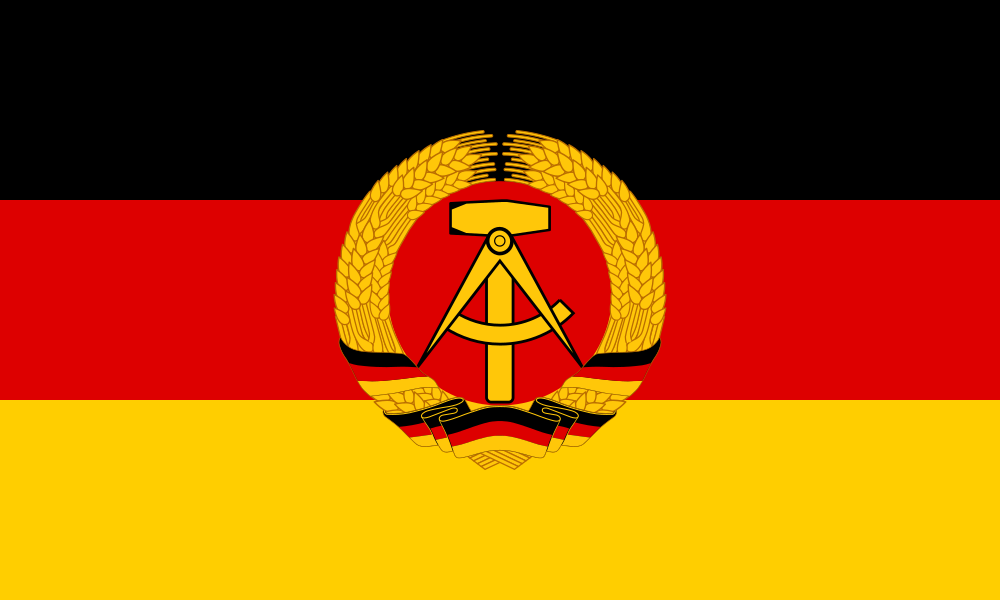
It gives me great pleasure to extend to you, Oleg Aleksandrovich Troyanovsky, m&t cordial congratulations on your assumption of the presidency of the Security Council for the month of May. Your great political and diplomatic skills, your long-standing and persistent activity for the strengthening of peace and international security and your devotion to the principles of the Charter of the United Nations are the guarantee that you, as the representative of the Union of Soviet Socialist Republics, with which my country is linked by fraternal bonds, will successfully guide the responsible work of this body during this month. The delegation of the German Democratic Republic would also like to congratulate the representative of the Ukrainian Soviet Socialist Republic, Vladimir Alexeyevich Kravets, who ,with great diplomatic skill directed the complicated work of this Council during the previous month.
14. The delegation of the German Democratic Republic also thanks the members of the Council for giving us the opportunity to explain here our country’s point of view on the question of Cyprus. We support the convocation of the Council at the request of the Government of the Republic of Cyprus in connection with the serious situation existing on the island as ajustified measure to counter any further aggravation of the tensions. Indeed, the worsening of the crisis in Cyprus constitutes an extremely serious threat to peace and security in the region and to world peace in general.
15. The delegation of the German Democratic Republic appeals urgently to the Security Council to fulfil its responsibility for the maintenance of international peace and security and to initiate measures to prevent a further aggravation of the situation and form a starting point for the resumption of efforts aimed at achieving a negotiated solution of the question of Cyprus.
16. The Government of the German Democratic Republic and its delegation to the United Nations have on various occasions time and again made it clear that
2 ’
17. The General Assembly and Security Council have repeatedly made clear demands and put forth proposals for the achievement of a solution of the question of Cyprus. Last year, in resolution 541 (1983), the Security Council called upon all States to respect the sovereignty, independence, territorial integrity and non-alignment of the Republic of Cyprus and not to recognize any Cypriot State .other than the Republic, and it called upon all States and the two communities in Cyprus to refrain from any action which might exacerbate the situation. How is it then possible that the demands contained in that resolution and other decisions on the question of Cyprus adopted by the United Nations, as well as the efforts of the Secretary-General, can simply be ignored?
18. Even the crocodile tears shed in well-known imperialist quarters over the deplorable developments in Cyprus cannot veil the fact that the answer to this question has to be found within the wider context of the imperialist policy of aggression and domination. Those in imperialist quarters, above all in the United States of America, which declares the whole region of the Mediterranean and the Middle East to be a so-called zone of vital interest, are in no way interested in settling the question of Cyprus through negotiations, respecting the non-alignment of Cyprus and, as demanded by Spyros Kyprianou, the President of Cyprus, demilitarizing the island.
19. The concentration of huge naval forces, the establishment of more and more new military bases, the establishment of so-called rapid deployment forces, the persistent stirring up of tensions and the destabilization of Governments and States, as well as the stationing of new American nuclear missiles in Western Europe -which, by the way, could also become operational against the Mediterranean and the Middle East region-are part and parcel of the imperialist policy of threat and war.
20. Only recently a devastating defeat was inflicted in the Middle East region upon those imperialist factions and the establishment of an imperialist military bridgehead in Lebanon was prevented. The question is rightfully asked whether the old intention of transforming the island of Cyprus into an “unsinkable aircraft carrier” is now to be turned into a reality using all available means. Are the imperialist military bases on Cyprus to be preserved and new ones set up by leaving the question of Cyprus permanently open?
“The narticinants in the meeting stressed the immutability of-the principled courseof their States at eliminating the existing centres of tension and armed conflicts all over the world and at preventing the emergence of new ones, and at settling all the international disputes by peaceful means, through talks. They reiterated their solidarity with the peoples fighting for freedom, independence and social progress, for economic development and against the policy of imperialist aggression, colonialism and racism.” [See S/16504, annex.]
22. Regarding the solution of the question of Cyprus, this means reversing the unilateral division of Cyprus and carrying on constructive negotiations on the basis of relevant United Nations decisions. The German Democratic Republic will in the future also support all decisions and measures to this end. The just struggle of the people of Cyprus against imperialist oppression and interference from outside will continue to have the support of the German Democratic Republic.
23. The PRESIDENT [interpretationfrom Russian]: The Minister for Foreign Affairs of Cyprus, Mr. George Iacovou, has asked to speak. I welcome him and invite him to make his statement.


As this is the first time that I have spoken in this debate, Sir, I should like to extend to you my warmest congratulations on your assumption of the high office of President of the Security Council for the month of May. It is a source -of pleasure for us that the presidency of this body is occupied by the representative of the USSR, a friendly country with which we enjoy very close and friendly relations. Your vast diplomatic experience, your talent and your charm already augur well’for the successful deliberations of the Council. I would also like to express my appreciation to your predecessor, Mr. Kravets of the Ukrainian Soviet Socialist Republic, for the excellent manner in which he guided the work of the Council in the month of April.
25. Even while the Council is considering the grave situation in Cyprus resulting from the continuous violations of its mandatory resolution 541 (1983) and studying ways to reverse them, the Turkish side is warning this body that it will continue with further illegalities in order to consolidate the secessionist act of 15 November 1983. On 3 May 1984, the day the Council was convened [253Zst meeting], we read statements by
26. A few days earlier it was publicly declared that the illegal regime in the occupied area was planning to open part of the new town of Famagusta to settlement by persons other than its inhabitants, thus, in the context of recent developments, adding insult to injury. Even now, today, while the Council is meeting, threats of the settlement of Varosha continue unabated. There are reports in today’s Turkish Cypriot newspapers that with the incitement of the Turkish leadership, the occupation of houses in the new city of Varosha has already begun.
27. Equally serious, indeed potentially dangerous, is Turkey’s and the Turkish Cypriot leadership’s intention to change the status, function or deployment of the United Nations Peace-keeping Force in Cyprus (UNFICYP). This was quite evident from their refusal to concur in the renewal of the mandate of UNFICYP last December,
28. Determined to have a free military hand, Turkey and the Turkish Cypriot leadership, in mid-December 1983, refused to concur with resolution 544 (1983), which extended UNFICYP’s mandate. Even after the Council adopted that resolution, Mr. DenktaS declared his rejection of that mandatory resolution and made it known that at a later stage he would interfere with UNFICYP’s modus operandi and deployment in Cyprus. On 17 March 1984 Mr. Denktas again threatened to prevent the extension of UNFICYP’s mandate if the Council or the General Assembly passed another resolution in favour, as he said, of the Greek Cypriots. As recently as 20 April Mr. Denktag was making menacing noises about the extension of UNFICYP’s mandate if my Government were to approach the Security Council again.
29. The presence and unhindered functioning of UNFICYP are essential to the maintenance of peace and security. Threats against UNFICYP are threats against the quest for a peaceful solution of the Cyprus problem. The withdrawal of UNFICYP is likely to lead to incidents along the cease-fire line, possibly ending in a major conflagration. The threats against UNFICYP thus constitute a potential threat to international peace and security in the area.
30. Today, almost 10 years after the Turkish invasion and the occupation of 37 per cent of the territory of the Republic of Cyprus by Turkish troops, the situation is more critical than ever. The Turkish occupation forces are still on our soil, in violation of the Charter and the resolutions of the United Nations. Not one of the 200,000 Greek Cypriot refugees has been allowed to return to his home and lands. The fate of missing persons remains unascertained. Over this period Turkey and its organs in the occupied area have systematically pursued their plans to consolidate the division and the
3 1. Turkey is solely responsible for what is happening in the occupied part of Cyprus, in fact and in law. Turkey continues to exercise actual and exclusive authority over this area. The occupied area is saturated with Turkish troops; there is one soldier for every four members of the population, including women and children. If one takes into account also the settlers from Turkey, then the proportion is one Turk from Turkey to every two members of the Turkish Cypriot community. It is thus impossible for any independent action to be taken by the Turkish Cypriots. The Turkish Cypriot leadership in fact expresses the will and policy of Turkey. That leadership is no more than a political fig-leaf covering the body of aggression. A persuasive statement made by Mr. Denktag himself speaks for itself: “Whether I believe it or not, whether I consider it right or not, I do whatever Turkey says.” That is taken from the 5 October 1982 edition of Yeniduzen.
32. The European Commission of Human Rights, an international body of distinguished European jurists, after considering the case of Cyprus v. Turkey on violations of the human rights of Cypriots by Turkey, held that sole control over the Turkish occupying forces is vested in the Government of Turkey and that its presence in the occupied area engages Turkey’s intemational responsibility in respect of all persons or property over which they exercise control. That appears in the report of the Commission in the case of Cyprus v. Turkey, 10 July 1976, page 32; in the decision of 10 July 1978 on the admissibility of Application No. 8007177; and in the report on Application No. 80071 77, paragraphs 21 and 22. That same report found Turkey guilty of crimes and of flagrantly violating the human rights and fundamental freedoms of the people of Cyprus.
33. Turkey and the Turkish Cypriot leadership are now in blatant breach of Council resolution 541 (1983). They have ignored paragraph 2, calling for the withdrawal of the declaration of the purported secession; they have ignored paragraph 3, calling for urgent and effective implementation of the Council’s earlier resolutions 365 (1974) and 367 (1975); they have acted contrary to paragraphs 4 and 5 by frustrating the Secretary- General’s mission of good offices and effectively declining to co-operate; and they have breached paragraph 6 by violating the sovereignty and territorial integrity of the Republic of Cyprus. Turkey has ignored paragraph 7 by formally recognizing, by its “ambassadorial exchange”, the so-called Turkish Republic of Northern Cyprus. Both Turkey and the Turkish Cypriot leadership have trampled on paragraph 8 by repeatedly taking new and yet further actions leading to
38. Mr. Emin Dirvana, the first ambassador of Turkey to Cyprus-a legal ambassador to the Republic of Cyprus-in an interview given to the Turkish newspaper Milliyet on 15 December 1964 revealed Turkish tactics when he spoke clearly about
39. Let Mr. Dirvana now speak about the first bloody incidents in Cyprus-before independence. The following statement by him was also published in Milliyet:
35. Turkey is in breach of Article 2, paragraph 4, of the Charter of the United Nations by virtue of its use of force against the territorial integrity of the Republic of Cyprus and in a manner inconsistent with the purposes of the United Nations, and in particular by its lack of respect for and nonobservance of human rights and fundamental freedoms for all without distinction as to race, language or religion, as required by Article 55 of the Charter.
40. Mr. Fazil Ktictik, the Turkish Cypriot Vice- President of Cyprus, wrote the following in his newspaper Hulkin Sesi, on 29 February 1964, describing the events of 1963:
36. Ankara’s plans against Cyprus are becoming more and more manifest every day. Its deeds speak louder than its words. In order, allegedly, to provide security to the Turkish Cypriots, Turkey invaded Cyprus, violated its independence, sovereignty and territorial integrity, occupied almost 37 per cent of its territory and in the process eliminated a high percentage of its population, at the same time uprooting from their homes and lands in the occupied area almost twice as many Greek Cypriots as the total Turkish Cypriot population of the whole of Cyprus. Of course, the Greek Cypriots, who represent 80 per cent of the total population of Cyprus, have, according to this reasoning, no rights whatsoever to be respected by Turkey and its military forces.
41. The recent revelation in the memoirs of Mr. Tahsin, the Chairman of the Turkish Cypriot Teachers’ Union, was really shocking. In the Turkish Cypriot paper Soz, on 21-22 December 1982, he accuses the Turkish Cypriot leadership of being responsible for placing bombs in Turkish mosques and shrines in 1962. Mr. Tahsin said: “There is no one who does not know by now that the bombs placed in the mosques in 1962 were not placed by Greek Cypriots.” He further stated that the .purpose.of the act was to incite the Turkish Cypriots against the Greek Cypriots. Mr. Tahsin accused the TMT, an illegal Turkish organization, of these acts. Mr. DenktaS, in an interview in The Times on 20 January 1978, admitted that he himself had formed the TMT.
37. On the same reasoning, the few intercommunal clashes of the 196Os, which were instigated by.Turkey, are intentionally magnified and exploited in order to justify the imposed artificial separation of our people. Echoes of the provocative invective that was used in the past to arouse in Turkish Cypriots feelings of hatred and enmity towards their Greek Cypriot compatriots have been heard in this Chamber, and unfounded allegations about the usurpation of the rights of Turkish Cypriots have been repeated. Closer investigation is more likely to prove that the Turkish Cypriot population has been the victim of its leadership. However, it is
42. Attempts have been made from time to time to present the Cyprus problem merely as a conflict between the two communities in Cyprus. The Turkish side always very carefully steers away from touching
“the irresponsibility of the extremist terrorist Turkish Cypriot leadership in Cyprus, which disregards the true interests of the Turkish community and concentrates on promoting division and friction between the two communities”.
“I was informed that on 7 June a bomb had been planted in the Turkish Press Office in Nicosia by persons who, as was established later, had nothing to do with the Greek Cypriots. The Turks of Nicosia were then incited ‘to be overwhelmed by holy indignation’ and perpetrated acts similar to those committed on 6 and 7 September in Istanbul.”
“The Greeks are in a state of distress in the full sense of the word. Starting from Nicosia, in all clashes the Greeks suffered great losses, but they did not give the casualty figures. The Turkish fighters have pledged to tight on until the realization of partition. The attitude of the Turkish minority has been admittedly one of provoking division and instigating armed conflict with the aim of partition.”
43. In a recent long interview in the Turkish paper Tercuman of 30 June 1983, Mr. Esenbel, former Secretary-General of the Turkish Foreign Ministry, former Foreign Minister and former Turkish Ambassador to Washington, who also played a role in the Zurich- London Agreements of 1959, revealed Turkey’s real intention towards Cyprus, admitting that behind its partitionist designs on Cyprus were its own strategic considerations. Mr. Esenbel explained how Turkey became a party to the Cyprus problem through enormous and patient work. He further stated that Turkey accepted only the proposals that were leaving the door open to partition and rejected all proposals, including a proposal by the then Governor of Cyprus, Sir Hugh Foot, when they realized that “the road leading to partition was a bit closed”. They accepted Macmillan’s plan only when they were given assurances that the right of separate self-determination could be used, and thus the road to partition could also be used. Mr. Esenbe1 went even further and revealed that the then Turkish Prime Minister Menderes gave them instructions in Zurich to find a formula for Cyprus which would ensure the possibility of Turkey’s security, because “‘it is becoming obvious that at this stage we will not be able to achieve partition”. Referring tothe present day, Mr. Esenbel stated that “according to the de facto situation it is clear on the territory itself, and not on paper, as to how the Cyprus problem will be solved”.
44. Any sufferings of the Turkish Cypriot community can be attributed mainly to Turkey’s old and still valid policy aimed at the partition of Cyprus. This has been borne out on many occasions by the periodic reports of the Secretary-General. In his report of 11 March 1965 he said, “the Turkish Cypriot policy of self-isolation has led the community in the opposite direction from normality” [see S/6228, para. 171, and “the community leadership discourages the Turkish Cypriot population from engaging in personal, commercial or other contacts with their Greek Cypriot compatriots, from applying to government offices in administrative matters, or from resettling in their home villages if they are refugees” [ibid., para. 551.
45. In his report of 8 December 1966 [S/76221 the Secretary-General stated that for some considerable time the Government had been urging the refugees to return to their homes and that it had repaired or rebuilt an abundant number of Turkish Cypriot houses. However, it was known; the report continued, that the Turkish Cypriot leadership would not allow them to return to their former homes located in Government-controlled areas at the time. To justify this position the Turkish Cypriot leadership stressed considerations of security, although there could be little doubt that there was no
“Whereas Turkish Cypriots may move freely throughout the island except in a few militarily restricted areas, access to Turkish Cypriot enclaves, a number of Turkish Cypriot villages and certain roads continues to be denied to Greek Cypriots. . . . the Turkish Cypriots have enjoyed full freedom of movement over the whole island for some time, whilst the Greek Cypriots are still prevented from using some of the Republic’s main roads.” [See S/9233, para. 55.1
47. The Turkish Cypriot population, which is also suffering now under the Turkish military occupation, has many times voiced its concern at the separatist and partitionist attitude of the Turkish side. Indicative of that concern is a statement by Mr. Orhan Kahya, the leader of the Turkish Cypriots who were forced to cross to the occupied area of Cyprus in 1975, published in the Turkish Cypriot magazine Olay in 1982. He said:
“Presently, even the Turkish Cypriot women are exerting efforts to go to their properties in the south and the women are being prevented from doing so. The reason why the people insist on going to the south is that they have properties there.. Now they live in misery in the north.”
48. The leader of the Turkish Cypriot trade union DEV-IS, Mr. Hasan Sarica, denied the allegation that Turks were suffering before 1974, when he stated:
“In pre-1974 years the Turkish Cypriots and the Greek Cypriots worked together in a brotherly manner and the economic position of Turkish workers was excellent. . . . After 1974 the economic position of the Turkish Cypriot workers substantially deteriorated. In pre-1974 Cyprus, the Turkish Cypriots -and Greek Cypriots worked together and shared the same economic profits. The conditions of life of the Turkish Cypriots changed after 1974.”
This statement was published in the newspaper Birlik on 30 August 1980.
49. The Turkish Cypriot Ministers refused in 1964 to participate in the Council of Ministers of the Republic in order to show, as the then Vice-President, Mr. Kiictik put it, “that the Republic was dead” and to promote partition. The agenda of the Council of Ministers continued to be sent to the Turkish Cypriot Ministers for at least one year after they chose not to participate, but they persisted in their refusal. The Turkish Cypriot judges remained in their positions until 1966, but, when they were forced to withdraw on threat of imprisonment by the Turkish leadership, they acted accordingly .
55. Even after the invasion, foreign aid to Cyprus, through the Offtce of the United Nations High Commissioner for Refugees (UNHCR), the European Economic Community, the World Food Programme and the World Health Organization Fellowship Programme was always distributed to the Turkish Cypriot community in accordance with its population ratio. An example of this is the assistance provided through UNHCR. Take, for instance, the United States assistance to Cyprus through UNHCR from 1974 to 1981. According to a report by the United States Accounting Office of 30 November 1981, $90.3,million was distributed to the Greek Cypriots and $20.8 million to the Turkish Cypriots. Taking into consideration the fact-stated in the same report-that $58.1 million of the amount given to Greek Cypriots was allocated to the housing needs of the Greek Cypriot refugees, the proportion of useful assistance to the Turkish Cypriots is much higher than their population ratio. The distribution of aid to the Turkish Cypriot community continues today, even after the recent provocations. Similar evidence can be produced for all aid to Cyprus.
51. Many Turkish Cypriots who served in the diplomatic missions of Cyprus abroad chose to remain in their positions until the Turkish invasion of 1974. In the High Commission of the Republic in London, Turkish Cypriots continue to serve, some even after they retired from the public service, having applied for and been granted an extension of their service.
52. Despite strong objections by the Turkish leadership, for many years before the invasion there was cooperation among the people themselves, and many Turkish Cypriots were working and co-operating with Greek Cypriots. No intercommunal incidents of any significance took place for seven years before the invasion. During the disgraceful coup &&at against President Archbishop Makarios Greek Cypriots were the only victims; not a single Turkish Cypriot was hurt.
53. Attempts to distort the facts as regards the assistance provided to the Turkish Cypriots are easily neutralized by reports of the Secretary-General himself. For example, in his report of 20 May 1971 he stated:
56. Since 1964 Turkish Cypriots have been supplied with 20 million dollars’ worth of electricity a year. No charges have been collected for that service, which is thus being supplied at the expense of Greek Cypriot consumers. The Government of the Republic has also been supplying the Turkish Cypriots with gas at subsidized rates, the cost of the subsidy being borne by the Greek Cypriot consumer. Medical care is available to any Turkish Cypriot who asks for it and who is allowed by his leadership to come to the Governmentcontrolled area for treatment, and thousands of serious cases have, in fact, taken advantage of this.
“To meet the acute demand for skilled workers in certain trades, various courses open to Greek and TurkishCypriots alike have been conducted by the Cyprus Productivity Centre*‘-an institution funded jointly by the International Labour Organisation (ILO) and the Cyprus Government-“For example; 35 Turkish Cypriots participated in an accelerated training programme . . . under the supervision of a Turkish Cypriot instructor especially engaged for the purpose . . . Similarly, Turkish Cypriot students have been attending courses at the Higher Technical Institute and the Hotel and Catering Institute, sponsored by the Government and the United Nations Development Programme with the United Nations Educational, Scientific and Cultural Organizai tion and the International Labour Organisation as executing agencies, respectively.” [See S/10199, para. 39.1
57. As regards telecommunications, the Republic has always been prepared to provide the Turkish Cypriots with the full benefits of the telecommunications service, and some do take advantage of the service. There are telephones installed in the occupied area. Two telephone lines are provided to Mr. De&as himself. Mr. Denktas’s bills for 1983 exceeded $30,000 and were paid by the Cyprus Government. All telegrams and letters arriving in Cyprus for the Turkish Cypriots are promptly delivered through the United Nations authorities.
54. In his report of 22 May 1974, just a few weeks before the invasion, the Secretary-General stated:
“co-operation has been evident in connexion with the Morphou/Tylliria water feasibility study . . . The UNDP/FAO livestock production improvement project, the veterinary services project and the Cyprus Productivity Centre . . . have maintained services to Turkish Cypriots. . .
58. The first action of many Turkish Cypriots who manage to get out of the occupied area is to visit a Republic of Cyprus embassy or consulate to obtain or renew passports of the Republic of Cyprus in spite of the fact that the regime in the occupied area punishes those who do so. The embassies of Cyprus abroad have issued thousands of passports to Turkish Cypriots since the invasion.
“Turkish Cypriots have also shared in the assistance provided by the industrial development services project of UNDP and the United Nations Industrial Development Organization and by the World Food Programme projects. Turkish Cypriot participation
60. Even the Turkish Cypriots themselves see that the stalematk at the intercommunal talks was created by the Turkish side. A recent article in the newspaper Mifliyet on 14 April 1983, stated, “The intercommunal talks are enabling the Turkish side to gain time and for this reason the continuation of the talks is regarded as beneticial by some.” The Turkish Cypriot paper Yeniduzen on 30 August 1983 warned: “No matter what DenktaS says, the world sees the Turkish side as being responsible for the termination of the talks and for the failure of the resumption of the talks, because he puts forward conditions which change daily.”
61. From time to time they throw out a challenge concerning a high-level meeting. Members will all remember that this happened also last October. Of course, it was accompanied by threats and the.setting of time-limits. After consultations with the Secretary- General we accepted the challenge. An announcement was made to that effect by the Secretary-General. In a responsible and quiet way we started working with the acting Special Representative of the Secretary-General in Cyprus on the preparation of the agenda for a meeting that was planned for January of this year. We were already in the second phase of consultations about the agenda when the Special Representative of the Secretary-General, Mr. Hugo Gobbi, returned to Cyprus to pursue the matter further. The day after his return, and without waiting to listen to him, the Turkish side went ahead with the illegal declaration, once more kicking the United Nations and us in the teeth.
62. The memory of the international community is not so poor as to allow it to forget that the “exchange of ambassadors’* and the preparations for a “constitution”, a “referendum”, “elections” and so on took place a little before the formal rejection of the latest ideas of the Secretary-General, which included a new meeting between President Kyprianou and Mr. Denktag. Again, these acts took place at a time when Mr. Gobbi was in Nicosia, in a last effort to rescue the initiative of the Secretary-General.
63. Who is responsible for the recent deadlock is eloquently revealed, admittedly in diplomatic language, by the most recent report of the Secretary-General, distributed as document S/16519 of 1 May 1984.
64. A Turkish Cypriot leader, Mr. Ozgur, in an interview published in the Turkish Cypriot newspaper
65. The developments outlined above speak for themselves. Turkish “faith” and “goodwill” were put to the test and proved to be non-existent. A recent commentator in the 31 March 1984 issue of the Turkish newspaper Hurriyet had the courage to say that “various civilian Governments have come and gone, but Turkey has stuck to a policy of no concession [on the Cyprus problem], as was also confirmed by Evren’s recent statement”.
66. Countries with military might probably do not need the protection of the United Nations. Small countries, when faced by aggressive neighbours, can preserve their territorial integrity and security only by reposing their faith in the United Nations, and the Security Council in particular. Small, defenceless countries have no other way. Cyprus is a small, defenceless country that has placed its faith in the United Nations and in the Council.
67. It is with grave concern that my Government finds it necessary to return to the Security Council. Turkey is flouting the authority of the United Nations and continuing to violate the sovereignty and territorial integrity of the Republic of Cyprus. In doing so it is challenging the credibility of the United Nations, jeopardizing its effectiveness, usefulness and influence in world affairs.
68. On 18 November 1983 the Security Council, mindful of its responsibilities, adopted resolution 541 (1983) in response to the illegal secessionist act of 15 November. Since then the Turkish side has provocatively proceeded to ignore the provisions of that resolution. We express the certainty not only that the Council will reaffirm its resolution 541 (1983), but that it will examine methods to ensure compliance with it. The Council should, further, specifically condemn any new actions contravening resolution 541(1983) and the threats of colonization of Famagusta and against UNFICYP.
69. It is my Government’s contention that Turkey’s conduct towards the Republic of Cyprus in recent months has given rise to a situation likely to endanger the maintenance of international peace and security. My Government, therefore, appeals to the Security Council to discharge with urgency its responsibilities under the Charter by beginning to consider the adoption of such effective measures as are warranted by the situation.
70. The Secretary-General’s mandate of good offices should be revitalized and strengthened in order to p!omote an overall solution of the Cyprus problem. The
71. The Council is being asked to save Cyprus. But in asking the Council to save Cyprus we are asking the Council to do justice to many other countries. For, if the Security Council does not protect. Cyprus, if it does not reverse the trends, and if the policy of partition succeeds, what will be the future of multicommunal and multiconfessional societies around the world? How many countries will survive in their present form if the standards being imposed by Turkey on Cyprus are applied? In asking the Council to do justice to us we are asking it to do justice to the world and to the principles of the United Nations.
74. We have a proverb that says, “The lie lasts no longer than the candle, from morning to night, from night to morning”-as Figaro said.
75. I do not think that that statement merits any response. I am determined not to follow his assiduous efforts, which have no other purpose than to torpedo any chance of a resumption of negotiations and of the search for a final solution-at this time, I repeat, when great opportunities exist.
72. The PRESIDENT [interpretation from Russian]: The representative of Turkey has asked to speak, and I now call on him.
The meeting rose at 1.15 p.m.
! ,-.,,
:.
I ,,I1
HOW TO OBTAIN UNITED NATIONS PUBLICATIONS
United Nations publications may be obtained from bookstores and distributors throughout the world. Consult your bookstore or write to: United Nations, Sales Section. New York or Geneva.
COMMENT SE PROCURER LES PUBLICATIONS DES NATIONS UNIES
Les publications des Nations Unies sont en vente dans les libmiries et les agences dipositaires du monde entier. Informez-vous aupres de votre libraire ou adressez-vous ti : Nations Unies. Section des ventes. New York ou Geneve.
EAK IIOJIYYMTh N3AAHZIR OPX-AHIISAI[HU OKI>E~HHEHHhIX HAUHR
COMO CONSEGUIR PUBLICACIONES DE LAS NACIONES UNIDAS
Las publicaciones de las Naciones Unidas esdn en vcnta en librerias y casas distribuidoras en todas panes de1 mundo. Consulte a su librero o dirijase a: Naciones Unidas. Secci6n de Ventas, Nueva York o Ginebra.
Litho in United Nations, New York 00300 90-61313-Janualy 1993-2,llSO
▶ Cite this page
UN Project. “S/PV.2537.” UN Project, https://un-project.org/meeting/S-PV-2537/. Accessed .