S/PV.8480 Security Council
Provisional
The meeting was called to order at 10.10 a.m.
Adoption of the agenda
The agenda was adopted.
Reports of the Secretary-General on the Sudan and South Sudan Report of the Secretary-General on South Sudan (covering the period from 1 December 2018 to 26 February 2019) (S/2019/191)

In accordance with rule 37 of the Council’s provisional rules of procedure, I invite the representative of South Sudan to participate in this meeting.
In accordance with rule 39 of the Council’s provisional rules of procedure, I invite the following briefers to participate in this meeting: Mr. David Shearer, Special Representative of the Secretary-General for South Sudan and Head of the United Nations Mission in South Sudan, and Ms. Angelina Nyajima Simon Jial, founder of Hope Restoration South Sudan.
The Security Council will now begin its consideration of the item on its agenda.
I wish to draw the attention of Council members to document S/2019/191, which contains the report of the Secretary-General on South Sudan, covering the period from 1 December 2018 to 26 February 2019.
I now give the floor to Mr. Shearer.
Mr. Shearer: It is my pleasure to be present at the Security Council today. There have been considerable developments in South Sudan in the past months. I would like to touch on those and to make a number of observations about the opportunities and challenges moving forward.
The peace agreement signed on 12 September was brokered by the Intergovernmental Authority on Development (IGAD), and in particular through the commendable efforts of South Sudan, and it continues to hold. It is also a testament to the efforts of the parties that have built sufficient trust and confidence among themselves and have committed to working together towards durable peace.
Four positive changes are notable. First, the opposition politicians from the different parties are moving freely around Juba without hindrance and are
taking part in the various meetings as part of the peace process. I would like to recognize the Government for creating the space and the security conditions for that to happen and to thank the opposition leaders for having the courage to return and participate in the peace process.
Secondly, there have been more than 71 meetings and rapprochements held across the country where Government and Sudan People’s Liberation Army in Opposition forces and politicians have met. Many have been facilitated by the United Nations Mission in South Sudan (UNMISS). The enthusiasm for peace among the people is palpable.
Thirdly, overall levels of political violence have diminished significantly. In blunt terms, many people are alive today who might not have been without the agreement having been signed. The exception is in Central Equatoria, where the fighting close to Yei between the forces of Thomas Cirillo and the South Sudan People’s Defence Forces has led to clashes. Once again, the civilians in that area have borne the brunt, with reports of killings, looting and sexual assaults. Cirillo shows no sign of wanting to join the existing peace process.
Fourth, for the first time in three years, people are expressing a willingness to return home. An estimated 135,000 refugees have returned, in addition to many internally displaced who have signalled that they want to go home. So far, the actual numbers are relatively small compared to the approximately 2.3 million people who live as refugees and 1.9 million displaced inside South Sudan — a figure that comprises nearly one third of the population. But it reflects a trend of people seeking to travel in the dry season, which is now, to be home in time to plant crops in July.
That is the positive side. The significant challenge now is to maintain the momentum of the peace process. The timetable set out in the agreement is well behind where it should be and many of the bodies set up under it are still dealing with procedural rather than substantive issues.
There are fundamental issues still to be resolved, many of which were deferred to enable the peace agreement to be signed. These include the resolution of the boundaries and states issue and the formation of a unified armed force to be deployed in Juba and all major towns. The constitution-making process has also faced challenges in this period.
The current phase of the peace process, the pre-transitional government period, ends on 12 May. From that point, the revitalized transitional government is scheduled to take over and the Vice-Presidents, including the First Vice-President, Riek Machar, should have taken up their roles.
What does this mean? A peace process that falters will generate frustration, anger and a possible return to violence that could equal what occurred in 2013 and 2016. We cannot allow that to happen. There are some who believe that a return to violence is inevitable. We do not concur. The agreement has a broader buy-in from parties than the 2015 agreement. It is widely embraced by the population.
We, too, have our concerns about the peace process but there is yet to be a perfect process. For our part, the United Nations has focused attention and resources on making it work and will continue to do so.
I want to stress that there is no alternative plan. There is only this agreement and this path forward. For it to have a chance to work, it needs to be supported.
A year ago, most of us, including myself, did not believe that we would be at this point today. It has confounded the critics. But we have arrived at this point through the leadership and drive largely of IGAD.
A fully engaged IGAD, supported by the efforts of the African Union, is absolutely critical. But the months ahead will be as challenging as those before it have been. I would welcome the urgent appointment by IGAD of the new Chair of the Joint Monitoring and Evaluation Commission to help steer the process forward and overcome some of those challenges.
The United Nations has been working in partnership with IGAD and the people of South Sudan throughout. Through my good offices we have provided, and will continue to provide, specific expertise, ideas and opportunities to the process in order to maintain confidence and trust and substantively move the peace implementation forward. It is an area where we would welcome a more explicit reference in our mandate to our ability to play that role.
However, we must also acknowledge that the suffering goes on. Five months of a more stable environment cannot redress the levels of food insecurity or the absence of health or education services overnight. Humanitarian assistance is still needed to bridge the
gap to self-reliance and to support those who want to move home.
But we should remember that tens of thousands of South Sudanese citizens, young and old, are alive today because of the generosity of donor nations and the heroic work of humanitarian agencies. The fact that their country is supported by taxpayers around the world is a reality that South Sudan’s leaders often forget or take for granted.
Last year, donor nations gave lifesaving support of more than $1 billion — more than twice South Sudan’s State budget. That enabled humanitarian agencies to deliver assistance to 5 million people, or approximately 83 per cent of those whom they had targeted. This year’s target is $1.5 billion to reach 5.7 million people.
Humanitarian agencies have largely been able to move freely across South Sudan. However, in specific areas, in places such as Yei, particularly where there is conflict and where, as a result, civilians have been most vulnerable, denials have occurred.
Governmental delays, including the processing of shipments and the imposition of taxes, have also wasted time and incurred costs in the past three months.
Peace saves lives. It also saves money. South Sudan is a country of abundance where nobody should be hungry.
I would argue that the humanitarian bill is ultimately unsustainable. We have felt strongly the need to switch approaches in the country, and so in the past few months United Nations agencies and UNMISS, backed by donors, have begun to focus more on resilience, which fosters greater self-reliance within communities in more stable areas where we can work. There is a potential in those areas to move away from purely humanitarian support.
Secondly, a trust fund has been established to intervene in areas of ongoing conflict. It aims not only to reconcile differences between warring communities but also to bolster agreements with economic support and services. In the Wau protection of civilians site, for example, the Fertit community has wanted to move back to their land, which they were forced to abandon. A greater chance of success is likely for them if the differences between them and Dinka cattle keepers in the area can be reconciled and if the agreement reached is anchored with support to housing, health services and benefits for all communities.
With the peace deal, some displaced families are choosing to return home and rebuild their lives. The number of people living in protection of civilians sites has dropped from about 205,000 to 193,000 in just three months. In Wau, it has gone down to about 13,000. UNMISS supports the returns process. We have undertaken frequent look-and-see trips where we helicopter people to locations to assess for themselves whether it is safe to go home. As a result, many decided to leave. Hundreds have now left the Bor protection of civilians site. While some were transported by helicopter, most have been transported by barge.
Humanitarian agencies are currently programming agricultural, education and health support in areas expected to be of high return. UNMISS peacekeepers are refocusing priorities from more static operations around protection of civilians site sites to patrolling areas of anticipated return to increase confidence.
UNMISS is very mindful of its protection mandate. Let me be absolutely clear — we will not push people out of protection of civilians site sites against their will. However, we will support those who want to leave because not doing so means condemning them to a life in a camp. Our actions will continue to be consistent with international principles and humanitarian non-governmental organization guidelines that returns must be voluntary and dignified. The next three months will be critical. After that time, the rainy season will make land transport impossible in South Sudan, and the window for planting crops will be lost, resulting in another year’s delay.
People tell us that a key reason why they are reluctant to return home is, of course, security. Sexual violence continues to cause immense harm to women and girls across the country, most recently in northern Unity, where the concentration of forces from all sides of the conflict has led to horrific incidents. The violence must end and the perpetrators must be held to account. Ending impunity is a core function of the Government and a vital part of the reconciliation and peace process. It is the mandated role of UNMISS to actively deter and prevent as many of these horrific crimes as possible, as well as to monitor and report publicly on violations of human rights, particularly where sexual violence is concerned, as we did two and a half weeks ago in Bentiu.
It is worth stating that we are also working with the Governments to build the capacity of the justice system to deal with these crimes. That includes operating a
mobile court system whereby prosecutors and judges are being flown to hotspots like Bentiu and Malakal to hear the cases. It has led to several dozen perpetrators being tried and jailed. At one session in Bentiu, for example, our legal team reported back to me that 49 women queued up in the sun to give evidence in a pre-trial meeting against offenders who were about to be tried. Their desire for justice and to end impunity is inspiring.
In another case, four young men accused of gang raping a 15-year-old swaggered into the court, where they encountered their victim and witnesses. Their faces fell as they realized that the survivor of their brutality had the courage to testify against them and had the faith that justice would prevail. They were all convicted, and they were all sentenced to between three and twelve years. Those are small steps, but they are important ones. This month, a United Nations-supported special court will open in Juba with jurisdiction over crimes of sexual and gender-based violence.
In conclusion, there are just over two months left of the pre-transitional period, and progress has been slow. There is still much to be done. All of us — the parties and stakeholders, but most of all the regional partners — must drive the implementation forward and ensure that it is adequately resourced. The Government needs to play its part and contribute financially.
The peace agreement is far from perfect, but it is the one that we have in front of us today and we are not going to get another chance at it. The cost of failure is unthinkable, so while responsibility lies primarily with the parties to the conflict, it is also beholden on us all to ensure that we make the necessary moves forward together to make the agreement a reality for the sake of the people of South Sudan.
I thank Mr. Shearer for his briefing.
I now give the floor to Ms. Jial.
Ms. Jial: It is a particular honour to be invited to brief the Security Council on International Women’s Day. I want to dedicate my remarks today to the women all around the world who continue to fight for the rights of women and girls and who work daily to restore peace in their communities.
I speak to the Council today as the founder and Executive Director of Hope Restoration South Sudan, an organization that works for the protection of people
with special needs and provides much-needed services for women and girls who have suffered gender-based violence. I also represent a broader community of humanitarians in South Sudan and am a member of the South Sudan Women’s Coalition, which was a representative at the peace talks in 2015 and 2018.
I want to focus my remarks today on civil society in South Sudan, particularly women-led organizations, which I believe play a crucial role in building peace and security in our country. The mass rape in Bentiu last November was a symptom of a much deeper problem affecting women and girls in South Sudan, which suffers from some of the highest rates of gender- based violence in the world. It is in that context that civil society and women-led organizations across South Sudan work tirelessly to deliver some of the most critical life-saving services. They respond to gender- based violence, protect people with special needs and create women-friendly spaces that offer services like psychosocial support and income-generating activities. Because we employ local staff, we can operate in the parts of the country that are hardest to reach. We work throughout the rainy season. We stay and deliver to our communities even when the fighting is going on around us, and we will still be there when the United Nations Mission in South Sudan (UNMISS) has left.
However, we struggle to operate when we lack the necessary resources to carry out our work and to continue to provide these life-saving services to our communities, which have suffered from decades of conflict. In South Sudan today, there is intense competition between international and national non-governmental organizations (NGOs) for humanitarian resources. The bulk of the funding goes to United Nations agencies and international NGOs, and the smallest portion to national NGOs. Within national civil society, by far the smallest portion of funding goes to women-led organizations. We cannot build a strong and vibrant civil society in South Sudan with those constraints, and without us our community’s hopes for a lasting peace will fade.
In September 2018, my own organization, Hope Restoration, received a grant from the South Sudan Humanitarian Fund to open a woman- and girl-friendly space in Leer, where we provided programmes for survivors of gender-based violence. Within months of opening, we were surprised by the number of women who began visiting that space. As they started building relationships of trust with our case workers
and counsellors, many of them began to open up about their own stories. We were even more surprised when we found that nearly half of these women were survivors of gender-based violence; some had suffered multiple rapes.
We started providing medical and psychosocial support services, which most of those women had never had access to. For me, that was our goal — helping our community heal. But then, in early 2019 we lost our funding. One can imagine what it was like for our staff to have to tell those women in Leer that the space would close on 1 March, just six months after opening. How does one tell someone who has been subjected to horrific acts of violence that one can no longer help them? It is very disheartening, but we cannot afford to give up hope. We cannot because we know those women depend on us to keep fighting for them.
I take heart that this year’s humanitarian response plan has prioritized gender-based violence programming. That should give local women-led organizations, such as mine, more resources to provide essential services. It is also encouraging that Mark Lowcock, the Head of the Office for the Coordination of Humanitarian Affairs, recently announced that he will review the United Nations pooled funds to make sure that more money is allocated to women-led local organizations. That shows that more leaders across the United Nations system value the work that we do — that is, filling some of the biggest gaps in humanitarian response and doing so with cost-effective programmes that are making a real difference in our communities. We are the best value operators in town.
So, what does that mean for the Security Council as members consider next steps in South Sudan and the renewal of the UNM1SS mandate?
First, it means including South Sudanese local NGOs, especially women-led organizations, in the UNMISS mandate. We are not there, and that needs to change. There ought to be urgent recognition that we cannot meet humanitarian needs, rebuild institutions or craft a new Government without addressing the deep-rooted gender inequality in South Sudanese society. Women must be involved in discussions about our country’s future. We have talented, determined, visionary women in South Sudan. We are ready to fill the 35 per cent quota in the Revitalized Agreement on the Resolution of the Conflict in the Republic of South
Sudan, but in order to do so we need the backing of the international community and the Council.
The women and peace and security agenda is much more than just getting women to the table. It is about women being central players in all aspects of peace and security, including at the onset of an emergency, throughout the crisis and when rebuilding their communities after conflict has ended. To truly make a difference and address the scale and severity of the needs across South Sudan, local NGOs, particularly those led by women, need greater financial support to operate on a more sustainable basis and to scale up their work.
There are no short-cut fixes if one is serious about ending violence against women and girls. We need long-term funding, and we must be able to provide services where they are most needed. As Council members know, most people are not in protection of civilians sites. We know that one-stop centres work in South Sudan. We need to be able to offer more of them to our communities. By that, I mean a place where a woman can come for medical and legal services and to develop skills so she can earn an income. Being able to do all that in one place works.
In the UNMISS mandate renewal next week, I urge the Security Council to make a direct request to international donors and humanitarian actors to work with South Sudanese local NGOs. We need the Mission and international NGOs to support us in taking on a much greater share of the humanitarian work. It is critical that we scale up the work local NGOs do to help resolve disputes in and between our own communities in ways that do not involve violence, raiding each other’s cattle or abducting women and girls. Those grassroots efforts are critical if we are to build safer communities and sustain peace across the country. To me, that kind of partnership between local NGOs, donors, UNMISS and the international humanitarian community has been one of the critical missing pieces in South Sudan. I think that partnership will work better if we have a clearer understanding of the challenges women and girls face and what their needs are.
That brings me to my final recommendation and another key element missing in South Sudan — effective engagement with South Sudanese communities. We need not just to be consulted, but to be heard. When we raise concerns about tensions mounting or the need for services, we speak from an informed position of local
knowledge. Those are our communities. We understand the complexities of what troubles our communities, whether they are historical tribal grievances or more recent disputes over land or cattle, because we live there.
In conclusion, I want to leave one very clear message with the Council. Within communities and local NGOs in South Sudan, there is a wealth of untapped potential. The key to unlocking that potential is finding better ways to work together. As local NGOs, we stand ready to work with the soon-to-be established transitional Government of national unity, with UNMISS, with the international humanitarian community and with donors. I look forward to building those partnerships and working with men and women across the country to build a peaceful South Sudan.
I thank Ms. Jial for her briefing.
I shall now give the floor to those members of the Council who wish to make statements.


I thank Special Representative Shearer and Ms. Jial for their briefings about the latest developments on the ground in South Sudan.
Today, International Women’s Day, reminds us of a key reason that our conversation on the United Nations Mission in South Sudan (UNMISS) is so important. We must do everything possible to promote a better future for the millions of women in South Sudan who face staggering and unrelenting levels of sexual violence.
Five months into the Revitalized Agreement on the Resolution of the Conflict in the Republic of South Sudan, the United States remains watchful of the parties’ implementation and their commitment to finally putting an end to the horrific violence and instability that have plagued South Sudan for far too long.
On the one hand, we are encouraged by reports that the ceasefire appears to be holding in most parts of South Sudan. At the local level, formerly warring military commanders have engaged with one another in peace celebrations. We are similarly encouraged to see a rapprochement between the Government and opposition parties in communities throughout South Sudan, including a variety of confidence-building measures that have sparked increased economic activity.
On the other hand, the United States is deeply concerned by the apparent lack of political commitment
from all parties at the national level to fully implement all tenants of the agreement. The assault, detention and abuse of members of a Ceasefire and Transitional Security Arrangements Monitoring and Verification Mechanism team by Government officials in December is one glaring example that calls into question the Government’s commitment to the peace process. Such actions against individuals and institutions working to assist in the implementation of the agreement are appalling.
We are also alarmed by continuing violence by all sides in the vicinity of Yei, which has led to mass displacement, the killings of civilians and an urgent need for humanitarian assistance. The violence represents a flagrant breach of the cessation of hostilities agreement and the Revitalized Agreement. Those military actions must stop now. The United States is disturbed by reports that the Government of South Sudan continues to unlawfully recruit young people from military service. That too must stop. Having seen previous peace agreements in South Sudan fail to hold and the country fall back into conflict and instability, the United States, the rest of the Council and the South Sudanese people all expect South Sudan’s leaders to demonstrate a clear commitment to the implementation of the agreement in words and in action.
One fundamental, yet powerful, step the Government should take is to use its own resources to support peace rather than war and corruption. The Government should make use of its increased oil revenues in a transparent manner to support the agreement’s implementation and provide services to South Sudan’s people, many of whom are on the brink of famine yet again. Absent such transparency, South Sudan’s leaders cannot expect the international community to provide substantial financial support to implement the peace agreement.
The commitment to the agreement is not solely a matter of money. There are clear and immediate steps that the Government and opposition parties can take to underscore their commitment to the South Sudanese people and the agreement. Those steps include full adherence to the ceasefire, taking action against gender- based violence, ceasing the obstruction of ceasefire monitors, permitting unhindered humanitarian access and ending the inappropriate taxes and fees imposed on aid workers, releasing all political prisoners, establishing the Africa Union hybrid court and opening up political space for peaceful dissent.
As South Sudan saw during the 2016 outbreak of violence, a peaceful and secure Juba is paramount for any peace agreement to hold. To that end, the Government must allow UNMISS to fulfil its mandate to provide a secure environment in and around Juba and other parts of South Sudan. The Government’s frequent violations of the status-of-forces agreement through unreasonable clearance processes and impromptu road barricades cannot continue. The United States calls on the Government to allow UNMISS to undertake its roles and responsibilities in support of stability in Juba.
There is no bigger supporter of the people of South Sudan than the United States. We want to see this peace process lead to long-term stability and security in the country. In 2018, the United States provided $845 million for South Sudan, the vast majority of it in support of the most vulnerable South Sudanese, who have borne the terrible brunt of this conflict. We have contributed more than $3.7 billion to South Sudan since it gained independence in 2011, but as we announced last year, our assistance is not infinite. Our expected return on current and any future assistance is that the Government and opposition parties will take primary responsibility for the implementation of the peace Agreement in South Sudan and for the welfare of its people. This will help restore the confidence of the South Sudanese people and the international community in the future of South Sudan.


I would first like to congratulate you personally, Madam President, and all the women staff members of the United Nations Secretariat and Permanent Missions accredited to the United Nations, on International Women’s Day. It is in honour of this wonderful holiday that my colleagues have brought you flowers, in keeping with Russian tradition.
It is highly symbolic that this holiday is said to have been born here in New York when women came out to protest and demand equality with men on 8 March 1857. For the holiday itself, we probably have to thank our German colleagues and my friend Christoph Heusgen personally, whose compatriot Clara Zetkin proposed in 1910 to observe this holiday. From way back we have always devoted a great deal of attention and care to women, and we first celebrated this holiday in 1913, while after the October Revolution of 1917 our country became a true leader of the women’s movement. We declared 8 March a holiday at the national level in 1965, after which the countries of the Soviet Union continued
their efforts to improve the situation of women, and in 1975, as we know, International Women’s Day began to be observed at the United Nations.
Since then much has been done both in Russia and all over the world to achieve gender equality and expand women’s rights and opportunities. Of course, a great deal remains to be done. Russia will continue its efforts to improve the situation of women and ensure that women’s rights and opportunities are equal to men’s. At the same time, however, we value women for their femininity and tenderness, and we do not try to compete with them in those areas. Russian society is traditionally built on the harmony of the sexes and their mutual complementarity.
But I should return to the subject of today’s meeting. We would like to thank David Shearer, the Special Representative of the Secretary-General, and Ms. Angelina Jial, whom I also wish to congratulate on International Women’s Day, for their briefings on the situation in South Sudan and the progress of the peace process there.
Looking back on the past year, we believe that its most important event was the signing of the Revitalized Agreement on the Resolution of the Conflict in the Republic of South Sudan. It is important that the South Sudanese parties have shown a willingness to compromise and a desire to settle their disputes. We welcome the significant progress that we are seeing in the implementation of the agreements that have been reached, and in this connection we note the formation and launch of the structures and mechanisms provided for in the Agreement. We are pleased that since the signing of the Revitalized Agreement there has been a significant drop in the level of violence as well as in the number of cases of human rights violations in South Sudan. A growing number of refugees and internally displaced persons have expressed the wish to return to their permanent homes. We believe that all of this is related to the implementation of confidence-building measures and interactions among the opposing parties on the ground. It is significant that thanks to the security conditions established by the authorities, opposition politicians are already returning to the capital and moving around freely. We also note opposition leader Riek Machar’s expressed intention to return to Juba in the near future.
We join in the appeal to the South Sudanese parties to finally formalize the arrangements on security issues
and complete the process of amending the Constitution. We believe that only full and universal compliance by the parties with the commitments they have undertaken will make it possible to enhance mutual trust and prevent any repetition of the mistakes made in the past during the South Sudan settlement.
We would like to once again pay tribute to the countries of the Intergovernmental Authority on Development for their coordination of the mediation efforts, in which they initiated and assured the productive negotiation process held in Khartoum between June and August, as well as the signing of documents vital to the peace process. We greatly value the personal contribution of President Omer Al-Bashir of the Sudan to the achievement of the peace Agreement. We note that the regional stakeholders have continued to maintain their united approach to the settlement in South Sudan, which is extremely important for the future of the peace process.
We do not share the view of a number of our colleagues, who assert that the visible progress in the settlement has been partly enabled by the increase in sanctions pressure on the Republic of South Sudan and the imposition of an arms embargo. The Council should not take credit for the success of the regional mediators, who, by the way, were against the imposition of additional sanctions on the parties in South Sudan. We urge everyone to face up to the truth, which is that it is actually the arms embargo that has prevented regional organizations from providing a flexible response with the help of their own initiatives in the area of security.
We welcome the desire of the Agreement’s guarantors to help to achieve the peace accords through the representation of national contingents from the Sudan, Uganda, Djibouti and Somalia in the Regional Protection Force. We see this as a practical realization of the principle of African solutions to African problems, and an example of the possibility of effective cooperation between the United Nations, its Security Council and regional organizations. We are ready to consider substantive proposals concerning the Regional Protection Force after the South Sudanese parties have reached concrete agreements on security issues. The Russian delegation supports extending the mandate of the United Nations Mission in South Sudan, and we are ready to work constructively on the text of the relevant draft resolution.


Like my colleagues, I too will start by taking note of International Women’s Day. I am grateful to my Russian colleague for mentioning Clara Zetkin, who originated the movement.
I think it is very timely that we are discussing the United Nations Mission in South Sudan (UNMISS) and the situation in South Sudan today, because the situation of women there remains a nightmare. Our view on the role of women is not limited merely to femininity and tenderness, but also includes a focus on leadership, equal rights and protection. The Chancellor of Germany is a woman, as are our Defence and Justice Ministers. Perhaps one day Clara Zetkin will be successful in Russia, and it will have a woman President too.
To come back to the very serious issue of the shocking level of sexual and gender-based violence in South Sudan. In just one instance, in Bentiu, there were a reported 134 cases of rape. What we heard today, of course, is very positive, with 49 women standing their ground and deciding to testify. I think it is a very good sign that there was accountability and that results were achieved. Of course, that is only a part of it. We must continue our efforts and much more must be done. Germany and Peru, with the participation of the United Kingdom, co-chaired last week the first meeting of the Informal Expert Group on Women and Peace and Security held on the situation in South Sudan. It was an important sign from the Security Council because it is an Informal Expert Group of the Council.
Let me repeat what I think are important elements. With regard to accountability, the mobile court initiative is very good but more has to be done. The peace agreement calls for the establishment of the hybrid court for South Sudan. With regard to the issue of participation, I totally agree with the remarks made by Ms. Angelina Jial, who spoke earlier on behalf of civil society. The participation of women is important — not only participation in which they merely sit at the table but one that ensures they are listened to and that their advice is heard. It is not enough that they have a chance to participate. They should be part of the process. The peace agreement sets the quota for women’s representation at 35 per cent and that has not been achieved. I think that we should do everything possible to ensure stronger women’s participation. I wonder why the percentage is only 35. Women make up 50 per cent of the population in South Sudan and therefore 50 per cent of those in Government and other groups should be women.
With regard the UNMISS mandate, I think that the protection of civilians needs to be at the centre. A total of 1.8 million people or more have had to flee. It is the third largest group of refugees after those from Syria and Afghanistan. They need to be protected. UNMISS should also focus on protecting women from sexual and gender-based violence.
I would like to pay tribute to Special Representative Shearer and his work, engagement and dedication and to all peacekeepers. We believe that they need to stay. The mandate should follow the recommendations of the Secretary-General. The mandate is being respected thus far. The freedom of movement of UNMISS is guaranteed. With respect to Mr. Shearer’s remarks about support and the increased participation of UNMISS in the peace process, Germany has contributed $5 million to the trust fund that has been set up and we ask delegations around the table to contribute to it.
I said that the protection of civilians is important. I find it very encouraging that there is now a drive to motivate civilians to leave the protection of civilians sites. Mr. Shearer is absolutely right. The future is not in protection of civilians sites. Refugees must return in a safe, voluntary, well-informed and dignified manner. The support UNMISS provides in order to give them a chance to see where they must go is exemplary. Such support should also be provided in Myanmar. It should be continued as a main task performed by UNMISS.
With respect to the implementation of the peace agreement, I can only echo what our American colleague, Mr. Cohen, just said pertaining to the fact that the commitment to the peace agreement has to be very strong. It must be Government-owned. The Government must also allocate funds in its budget to implement the agreement. It must also uphold the ceasefire and establish the hybrid court. With regard to the remarks made by our Russian colleague, I think it is important that the opposition is now in Juba, although Riek Machar is still not there. I believe that the strongest leader of the opposition and counterpart to the President must be present in Juba.
Last but not least, I would also like to echo what my American colleague said with regard to children in conflict situations. Some have been rescued from the militias, but we hear now that some of them have again been recruited. That must be stopped. We must prevent children from being involved in armed conflict.


I thank Mr. Shearer, Special Representative of the Secretary-General for South Sudan and Head of the United Nations Mission in South Sudan, and Ms. Jial for their briefings.
Today, on International Women’s Day, I would like to focus on the devastating impact that the conflict in South Sudan has had on women and girls. In five years of fighting, the conflict has claimed nearly 400,000 lives and driven 4.3 million people from their homes and 1.4 million to the edge of famine. As we have heard from Ms. Jial, it is often women and girls who have borne the brunt of the violence. Women, including those in their sixties, and girls as young as eight have been subjected to brutal acts of rape and sexual assault. Yet, despite the depth of the horror, time and again perpetrators are not held to account. That impunity drives the cycle of violence.
Despite the signing in September of the Revitalized Agreement on the Resolution of the Conflict in the Republic of South Sudan and the welcome reduction in political violence, there has been a concerning uptick in intercommunal violence and sexual violence. We are particularly concerned about the recent United Nations reports warning of the normalization and persistence of conflict-related sexual violence perpetrated by fighters on all sides, including armed militia groups that have been mobilized and used by the parties in recent offensives and frequently, directly or indirectly, encouraged by commanders.
Despite calls for the Government of South Sudan to take action to identify those responsible and hold them to account, that has not happened. Instead, in some instances, the organizations that provide support to the victims have come under attack by the Government. We cannot accept such brutal acts committed against mothers, sisters and daughters. We cannot allow impunity to persist.
On this day above all, and on each and every day, in order to support lasting peace, we call for an end to the pernicious use of sexual violence and to the culture of impunity in South Sudan. We call on the Government to uphold its responsibility to protect civilians and to thoroughly investigate all instances of sexual violence and bring those responsible for those crimes to justice. We must all support organizations to help survivors, as Ms. Jial has suggested, and continue to exert pressure for accountability whether through national courts, the hybrid court for South Sudan or international sanctions.
But I do not want to focus just on the disproportionate impact of the conflict on women and girls. It is also important to focus on the crucial role women have to play in delivering sustainable peace. The United Kingdom has consistently pressed for the greater inclusion of women in political and peace processes, and we welcome the contributions of brave civil society actors, including those present today. We welcome the commitments made in the September peace agreement to at least 35 per cent executive representation, but that has not yet translated into action and we call on the parties to deliver on their promises, not for some abstract concept of quotas, but because we know that when women meaningfully participate in peace processes, the resulting agreement is more likely to last.
We are grateful that Ms. Jial has been able to join us today. Civil society has played a vital role in the peace process by representing the views and voices of the people of South Sudan, and we support her call for greater engagement with South Sudanese communities. We are therefore concerned that the space for civil society continues to shrink and we encourage all parties to engage in open dialogue with civil society organizations, particularly those representing women.
Finally, it is important to register that the Secretary- General’s report (S/2019/191) is the last 90-day report before the May transition date envisage in the September peace agreement. We welcome the progress made to date and reductions in overall violence, as set out by Special Representative Shearer. The United Kingdom remains committed to supporting those working for peace, but like the Special Representative we are concerned about the lack of progress on some of the most difficult issues, alongside increases in intercommunal and sexual violence.
Conflict is the main driver of South Sudan’s man- made humanitarian and protection crisis. Peace is the only solution. It is vital that the Security Council, the region and the parties to the conflict do not allow this loss of momentum to persist and to destroy the hope of progress that September’s agreement brought. We urge all parties to bring renewed momentum to ensuring that the deal is implemented in full. We must work together or risk failing to deliver a future free of violence for the people, including the women and girls of South Sudan.


At the outset, I extend my congratulations on the commemoration of International
Women’s Day, a day on which we celebrate the progress made and raise awareness on the work that lies ahead in order to achieve gender equality.
Returning to the theme at hand, we wish to thank Ms. Angelina Nyajima Simon Jial and Mr. David Shearer for their important briefings on the situation in South Sudan.
Since the signing of the Revitalized Agreement on the Resolution of the Conflict in the Republic of South Sudan last year, some progress has been made in the situation in South Sudan. For example, the number of victims of political violence has decreased, opposition political leaders can move freely in Juba and can participate in the peace process and some displaced persons have returned to their places of origin.
Nevertheless, that modest progress is fragile and easily reversible. In this precarious environment, threats against civilians and the humanitarian crisis persist. Sexual violence continues to rise, intercommunal conflicts linger and humanitarian personnel are still being blocked access. Humanitarian personnel must be able to move freely without restriction in those territories. The Government of South Sudan must also live up to its responsibility to protect, including through the full implementation of the Revitalized Agreement. More substantive progress is critical. The signatory parties must resolve their differences and put in place measures to reach a timely political solution to the crisis. Regional and international stakeholders must focus on and fully support the process to resolve the conflict and enable the United Nations Mission in South Sudan (UNMISS) to play a supporting role.
In addition to the political crisis, we are concerned about civilian vulnerability and the grim reports of human rights violations and sexual violence. It is unthinkable that in a period of 10 days, more than 100 women and girls were sexually assaulted in Bentiu, and that the prevalence of such acts in 2018 was significantly higher than in 2017. Such violations, kidnappings and other sexual crimes are a constant occurrence in this conflict. It is alarming that those instances of abuse are not investigated, persecuted or sanctioned, and that the Government’s efforts to eradicate such actions are insufficient.
That leads us to wonder whether there is truly the necessary will to put an end to this cruel reality. Impunity should be the rare exception, not the norm. We call on the Government of South Sudan and the parties
to hold the perpetrators accountable, regardless of rank or seniority, and submit them to justice in accordance with the 2014 joint communiqué, and to honour their commitment to the action plan of the Office of the Special Representative of the Secretary-General on Sexual Violence in Conflict.
In that regard, we welcome the initiative of the South Sudan People’s Defence Forces to develop and endorse their own action plan, to be launched next week. We also commend the Government of South Sudan for ratifying the Optional Protocol to the Convention on the Rights of the Child on the Involvement of Children in Armed Conflict, and we hope that the Government’s action plan on this issue will be revised to address the six serious violations committed against children.
We also welcome the setting up of mobile courts and the upcoming launch of a special court in Juba to hear cases on sexual and gender-based violence. Nevertheless, it is vital to establish without delay the independent hybrid court for South Sudan and the other transitional justice mechanisms. It is also essential to provide comprehensive services to survivors of sexual violence and to ensure that conflict-related sexual violence is addressed as a central element of the 2018 Revitalized Agreement.
It is the responsibility of UNMISS to support those processes and to promote the political will to implement them. It is crucial to invest in mediation and peacebuilding efforts that are led by women and youth. Even though the Revitalized Agreement includes important provisions on women and peace and security, including the requirement of a minimum composition of 35 per cent women in important decision-making bodies, only one of the mechanisms and committees have done so, while the Joint Transitional Security Committee and the Joint Defence Board do not have a single female member. The quota provisions are not optional. We therefore call upon the parties to the agreement to follow through on that commitment.
This crisis has destroyed the living conditions of the people and forced more than 4.2 million people to leave their homes. The number of people in need of humanitarian assistance in 2019 is 7 million, half of whom are suffering from severe food insecurity. Given those circumstances and as we prepare to renew the UNMISS mandate, we need the political will and leadership to face these challenges. It is time to redouble our efforts in South Sudan. The failure of the
peace agreement is unthinkable. Even though it is not a perfect tool, it is what we have available to ensure sustainable peace. As Mr. Shearer said, this is plan A. There is no plan B.


We thank you, Madam President, for convening this meeting and David Shearer and Angelina Jial for their important briefings.
A few months from the end of the transition period, we are gratified to know that the Revitalized Agreement on the Resolution of the Conflict in the Republic of South Sudan remains in force and that political violence in that country has decreased.
We recognize the expressions of mutual trust between the Government and the different opposition parties. The various meetings held in the territory of South Sudan are undoubtedly an important step in the peace process. We regret, however, that there has only been modest progress in its implementation. Concrete progress on substantive issues is needed to achieve sustainable peace in South Sudan.
A few months ago, the Secretary-General called on the leaders of South Sudan to achieve two objectives — the establishment of transitional security arrangements and the formation of a revitalized Transitional Government of National Unity — as priorities in the period leading up to the transition. We express our deep concern that neither of those basic objectives have been met.
We urge the parties to implement those commitments in a timely manner. There are still some key outstanding issues, such as the establishment of the Independent Boundary Commission, the adoption of a draft law on constitutional reform that would incorporate the Agreement into the Transitional Constitution and the adoption of the governance system for the transitional Government.
Meanwhile, tensions continue in various parts of the country. We regret that intercommunal violence and clashes between Government forces and factions that did not sign the Agreement continue to affect the civilian population. We reiterate that true peace in South Sudan will be possible only through political will and dialogue among all parties.
We express our deep concern over the grave humanitarian situation. The 1.87 million internally displaced persons and 2.27 million displaced persons
in neighbouring countries are proof of the magnitude of the situation. Added to that are the obstacles impeding the work of humanitarian workers and the violence perpetrated against them and their property, which prevents aid from reaching the most vulnerable. We hope that the parties will be able to guarantee a safer environment.
We must also strongly condemn the continuing violations of human rights, in particular the rampant sexual violence in South Sudan and especially against women and girls. We call on the Government and all parties to fulfil their commitments to punish those responsible for crimes of atrocity. The incidents documented in Bentiu a few months ago are a warning of the urgency of implementing transitional security arrangements as soon as possible.
In that regard, we welcome the training provided by the United Nations Mission in South Sudan to senior commanders of the South Sudanese forces to raise awareness of conflict-related sexual violence, which we hope will be repeated on a regular basis. We believe that more effective and preventive support could be provided by the Mission through a close relationship with women-led non-governmental organizations working on the ground with communities.
Today, on International Women’s Day, we reiterate our desire that women, rather becoming victims, become strong leaders in the process of implementing the peace Agreement. The United Nations, together with the African Union, the Intergovernmental Authority on Development (IGAD) and the guarantors of the Agreement, must ensure the fulfilment of all the commitments of the Agreement, including the 35 per cent quota allocated to the representation of women at all levels and in all Government institutions in which political decisions are made.
Moreover, we welcome the positive impact that the peace Agreement has had on the return of displaced persons. We stress, however, the importance of ensuring that such return and resettlement takes place gradually, in a voluntary, dignified and safe manner and on the basis of informed decisions, while also taking into account the dynamics of each civilian protection centre and complying with international human rights norms and standards.
I will conclude by highlighting the work and efforts of IGAD and the African Union. We reiterate the importance of maintaining the unity of the Council
in the political support and follow-up required to make further progress in the South Sudan peace process, as well as the importance of working in close coordination with the African Union and IGAD.


At the outset, I would like to thank the Special Representative of the Secretary-General, Mr. Shearer, for his briefing and exceptional work under difficult conditions. I would also like to warmly thank Ms. Jial for her touching remarks.
Today, I would like to address three aspects of the situation in the South Sudan — the Revitalized Agreement on the Resolution of the Conflict in the Republic of South Sudan and its implementation; the security and humanitarian situation; and the mandate of the United Nations Mission in South Sudan (UNMISS).
Since the last renewal of the mandate in March 2018, the political landscape and conflict in South Sudan have changed dramatically. In particular, Belgium congratulates the parties and the Intergovernmental Authority on Development (IGAD) on their role in the signing of the agreement in September 2018. Progress has been made on the ground since then, including the reduction of large-scale political violence.
However, problems remain in the implementation of the agreement, including delays in the approval of security provisions. It is essential that the parties agree on a joint vision of the future of the security sector in order to avoid further large-scale violence. The success of that process will depend on the meaningful participation of women in all areas of the peace process, especially in the committees established in accordance with the peace agreement. Belgium would like to emphasize to all parties to the conflict, signatories and non-signatories alike, that the agreement represents a window of opportunity to achieve lasting peace in the country.
We have been alerted by the Secretary-General’s report (S/2019/191) that armed groups continue to target civilians and that a disproportionate humanitarian crisis is affecting the entire country, with 1 in 3 South Sudanese becoming displaced. Although political violence has been reduced, intercommunal violence has intensified in recent months and more than 500 people have lost their lives in that type of violence since the beginning of the year. A better understanding of the root causes of intercommunal violence is essential in order to find a way to address them more effectively.
Women and girls in South Sudan are not yet reaping the dividends of peace, as Ms. Jial mentioned. On the contrary, sexual violence against women has even increased since last year. No lasting solution to the conflict in South Sudan can be found without urgently and effectively addressing such violence, which targets mainly women and girls but men and boys as well.
The terrible mass rapes committed in Bentiu at the end of 2018 are a sad example of such violence. They revealed gaps in the detection, prevention and response to incidents of sexual violence. In a horrific way, an additional nine women and girls were subjected to gang rape in a separate incident near Bentiu a few weeks ago. The need for justice for those women is real and we encourage UNMISS as well as the international community to support the fight against impunity for those acts by all possible means.
In a few days’ time, we will gather around this table to adopt a draft resolution on the renewal of the mandate of UNMISS. The protection of civilians must remain the priority task of UNMISS and must be a priority in all decisions relating to the use of resources by the Mission. The reconfiguration of the civilian protection sites, which others have alluded to, will be possible only under the following conditions.
First, the conditions must be truly favourable in the areas of return. Secondly, a long-term strategy must be put in place that defines sustainable solutions for all displaced persons, including refugees. Thirdly, displaced persons should not be allowed to return to their village or town of origin unless their relocation is voluntary, well-informed, safe and dignified. Fourthly, efforts towards returns must be supported by gender-sensitive planning in cooperation with humanitarian actors.
UNMISS must continue to provide protection and security at the civilian protection sites until those four conditions are met. We would also like to see UNMISS increase its off-site patrols. In addition to providing physical protection, we encourage UNMISS to make use as well of the full range of unarmed civilian protection mechanisms, including community engagement, local mediation, community policing, human rights monitoring and information analysis.


I would like to thank our briefers today, Special Representative of the Secretary- General David Shearer and Ms. Angelina Nyajima
Simon Jial, for the information they shared with us in their briefings.
The signing of the Revitalized Agreement on the Resolution of the Conflict in the Republic of South Sudan represented a significant milestone towards achieving peace in South Sudan. Although we welcome the steps taken towards the implementation of the agreement in recent months, we remain concerned that several fundamental provisions of its, such as establishing transitional security arrangements and concluding the work of the Independent Boundaries Commission, have yet to be implemented, while the timelines set by the agreement are not being adhered to. At the same time, we take it as a good sign that the permanent ceasefire has been largely respected throughout South Sudan and that the parties to the agreement have continued confidence-building measures. We strongly call on all non-signatory actors to join the peace process.
While we welcome the overall improvement in the security situation, we remain deeply concerned about the increased levels of intercommunal violence and the persisting tensions. The primary issue of grave concern is sexual violence against women and girls in South Sudan. We are appalled by the heinous attacks in and around Bentiu and condemn in the strongest terms the use of sexual violence as a weapon of war by the parties to the conflict in South Sudan. We are also deeply troubled by the latest report of the Commission on Human Rights in South Sudan (A/HRC/40/69) and its findings that continuing violence and human rights violations in the country, including rape and sexual violence, may amount to war crimes.
Allow me to repeat emphatically — violence against women and girls in South Sudan must end. There must be accountability for gross violations of human rights and serious violations of international humanitarian law. We join the Secretary-General in his call on the Government to spare no effort in bringing the perpetrators to justice and fulfilling its obligations with regard to the protection of civilians.
We are convinced that there will be no durable peace without inclusiveness. We call on South Sudanese political actors to put into practice the provisions of the peace agreement regarding women’s representation in the pre-transitional, transitional and other decision-making bodies and institutions. We believe that the participation of women in the political process in South Sudan is indispensable. We also see
a need for the genuine inclusion of young people and South Sudanese civil society in the peace process. It is our strong belief that it is only by ensuring inclusive implementation that the peace agreement will stand a chance of being sustainable.
Regional engagement is another important factor that is crucial to the sustainability of peace in South Sudan. We have commended the involvement of Intergovernmental Authority on Development and its member States in brokering the peace agreement, and we continue to believe that the region’s role in ensuring the implementation of the agreement cannot be overestimated. However, there is still a long road ahead for South Sudan. In order to maintain the positive momentum it is vital to ensure sustained regional engagement in the monitoring progress and to hold the parties to the agreement accountable.
The dire humanitarian situation in South Sudan requires our full attention. The scale of the famine in South Sudan is enormous as a result of the destruction of plants and seeds in previous years. If humanitarian aid is not delivered, many children and other vulnerable people will face the threat of starvation. That matter should be treated with the utmost importance, not only by the international community but also by all parties to the agreement — above all by the Government of South Sudan.
On the eve of the renewal of the mandate of United Nations Mission in South Sudan (UNMISS), allow me to briefly agree with the Secretary-General that the current mandate of the Mission remains valid and that it should be amended to allow UNMISS to support the peace process in a flexible manner.
I would like to conclude by thanking UNMISS for its tireless efforts in ensuring the protection of civilians and a conducive environment for humanitarian actors to deliver assistance, as well as by thanking the Special Representative once again.


South Sudan today is better than South Sudan at the end of 2018.
We would like to express our appreciation to you, Madam President, for convening and presiding over today’s meeting. We would like to thank your great country for allowing you to be our boss on International Women’s Day. It is a great tribute to France.
We would also like to thank Special Representative of the Secretary-General David Shearer for his
comprehensive briefing and for all the efforts of United Nations Mission in South Sudan (UNMISS) on the ground. We ask Mr. Shearer to convey our greetings and appreciation to all the women serving in UNMISS for the service that they are providing to the South Sudanese people in ensuring peace in the Sudan. We value the service of the women of UNMISS and all those serving in the United Nations in all the regions of the world in different circumstances.
We thank Ms. Angelina Nyajima Simon Jial, Founder and Executive Director of Hope Restoration South Sudan, for her enlightened contribution. We also ask her to convey our thanks to the thousands of ordinary women in grass-roots organizations for their tireless efforts and contributions to make South Sudan safer for everyone.
I would also like to welcome my colleague and friend the Permanent Representative of South Sudan to the Council. I look forward to his statement later on, in amity.
South Africa pays tribute to the sustained role of the Intergovernmental Authority on Development (IGAD) in the Sudanese peace process. The leaders of that region have done everything possible to bring about the current improved environment in South Sudan. As Mr. Shearer said earlier, political parties are moving freely throughout South Sudan, visiting communities, talking to their supporters and familiarizing themselves with the aspirations of the South Sudanese people. As he also said earlier, the South Sudanese people are gathering peacefully across communities in the country to dialogue about the peace in the Sudan that they want. We are beginning to see the steady return of internally displaced persons and refugees. The journey to go home has begun. The role of the Council is to work to ensure that that journey continues and the Sudanese return to their land to live a normal life. The Council needs to harness those positive developments and encourage the IGAD leaders to continue their efforts to ensure that the peace process in South Sudan is irreversible. The Council should continue to support David Shearer and his team in continuing their good work and to tackle the outstanding issues that he talked about. There is a base. I think that they can now move to deal with those issues.
The Council should address the issues highlighted by our sister Ms. Angelina Jial, who said that we need to take into account the local and grass-roots concerns,
participation and resources in the peace process in South Sudan. She also said that grass-roots efforts had the capacity to anchor the peace process solidly around and across communities and clans in South Sudan. For our part, South Africa thinks that the Council should take to heart what the grass roots can do. That is a very compelling argument by Ms. Jial on behalf of the grass- roots communities in South Sudan.
South Africa welcomes the signing of the final Revitalized Agreement on the Resolution of the Conflict in the Republic of South Sudan by the Sudan People’s Liberation Movement/Army-In Government, the Sudan People’s Liberation Movement/Army-In Opposition, the Former Detainees and the South Sudan Opposition Alliance in September last year. We recognize the importance of the Revitalized Agreement as a positive step towards creating a conducive environment for engaging in the constructive dialogue and democratic processes necessary for working towards sustainable peace and development in South Sudan.
My delegation welcomes the shuttle diplomacy and efforts undertaken by the President of Eritrea, Isaias Afwerki, and the Prime Minister of Ethiopia, Abiy Ahmed, recently in trying to provide support and lifeblood in order to maintain the momentum of the implementation of the peace agreement in South Sudan. It seems that the discussions with President Salva Kiir were very positive.
The visit by the two leaders was very important, as it highlighted the leadership undertaken by African Leaders in making peace in a very volatile region through African solutions and engagement. It is our hope that the rapprochement between Ethiopia and Eritrea will permeate through the region and move the peace processes towards resolution.
In that regard, we encourage the Government of South Sudan, my brother, and other parties to do everything in their power to complete the establishment of the mechanisms and committees provided for in the Agreement, particularly during the pre-transitional period. The return of Vice-President Riek Machar to South Sudan before May is crucial to ensuring the implementation of the Agreement.
For our part, South Africa will continue to play a key role in supporting the peace process in South Sudan through the mediation efforts of President Ramaphosa as Chair of the African Union (AU) High-level Ad Hoc Committee for South Sudan and
Deputy President Mabuza as our President’s special envoy to South Sudan. Such efforts have always been geared towards complementing the African Union and Intergovernmental Authority on Development processes, not to replace them. South Africa notes with concern that the peace landscape in South Sudan still remains a little fragile in some areas given the lack of resources in other areas.
On the humanitarian front, South Africa urges international stakeholders to make meaningful contributions to post-conflict reconstruction and development, in particular as people are returning to their communities. We further appeal for funds for the repatriation and resettlement of internally displaced people and other returnees.
South Africa further wishes to call on all international partners to mobilize and make available resources and relevant expertise in support of the implementation of the Agreement. We support the renewal of the UNMISS mandate in line with the recommendation of the Secretary-General. We maintain that the continued presence of the Mission is critical to ensuring the impartial implementation of the Revitalized Agreement and to provide support for the protection of innocent civilians from the scourge of armed conflict, as colleagues have said.
Lastly, on sexual violence, which impacts women and girls, as many, including Ms, Angelina Jial, said, we are encouraged by the work being done by the Government and UNMISS through the special courts and in building the capacity of the justice system to combat sexual violence in all conflict areas. That issue is particularly important today as we celebrate International Women’s Day. It should also remind us of the importance of ensuring the inclusivity of women in peacemaking.
With the United Nations, working closely with the AU, subregional organizations such as IGAD, partners and local communities, change for the better in South Sudan is possible. As I said at the beginning, South Sudan today is better than South Sudan at the end of 2018. I would like to wish all women, all over the world, a happy International Women’s Day.


Today is International Women’s Day. To all women colleagues present and to all women peacekeepers serving in missions around the world, I would like to offer my holiday greeting and pay my high tribute.
China thanks Mr. Shearer, Special Representative of the Secretary-General for South Sudan, for his briefing. China also acknowledges the briefing by Ms. Jial.
The Government of South Sudan and major opposition groups signed the Revitalized Agreement on the Resolution of the Conflict in the Republic of South Sudan in September 2018, bringing the light of peace to the South Sudanese people. China is pleased to note that, over the past few months, the situation in South Sudan has continued to improve. Signatories to the peace agreement have been making efforts to implement it. The ceasefire has been maintained in large parts of South Sudan. The Government of South Sudan has engaged in in-depth and extensive consultations with the opposition on political and security arrangements for their transitional period and has adopted a multitude of measures to increase mutual trust. The South Sudanese parties held a national dialogue in Wau from 25 February to 2 March. Displaced persons and refugees in some parts of the country have begun to return home.
At the same time, the implementation of the peace agreement still faces many difficulties. There have been delays in some of the work stipulated in it. The international community, in particular the Security Council, should provide more assistance and continue to help maintain the momentum of the peace process in South Sudan and push all parties to work for the further implementation of the agreement. China would like to stress the following three points.
First, the South Sudanese parties bear the primary responsibility for implementing the peace agreement. The international community should, in the light of the needs of the South Sudanese parties, actively provide the necessary funding and technical support and respect the leadership role of South Sudan. At the same time, in monitoring the implementation of the agreement, efforts should be made to bring into active play the role of ceasefire and transitional security arrangements, the monitoring and verification mechanisms and the Joint Monitoring and Evaluation Commission.
Secondly, efforts should be made to actively support regional and subregional organizations, such as the African Union and the Intergovernmental Authority on Development, as well as the countries of the region, and to continue to strengthen their good offices. The priority should be on pushing the South Sudanese
parties to reach consensus quickly on such key issues as implementing the political and security arrangements, as provided for in the peace agreement, and urging all the relevant parties to sign the agreement at an early date and take part in the political process.
Thirdly, efforts should be made to continue to provide humanitarian assistance and economic support to South Sudan and assist it in addressing its food security, while placing priority on strengthening imports, agriculture, energy facilities, infrastructure, education and medical care, with a view to helping the South Sudanese people to rebuild their homes and resume their capacity for development.
China highly commends the United Nations Mission in South Sudan (UNMISS) for its important contribution to maintaining peace and stability in South Sudan. China supports the mandate renewal of UNMISS as well as its focus on the priority work to assist the South Sudanese parties in implementing the peace agreement.
China has always supported peace and development in South Sudan and has contributed more than 1,000 Chinese peacekeepers, including 25 women peacekeepers, to UNMISS. Last month, China provided South Sudan with 1,000 tons of rice in food assistance and a batch of anti-malaria drugs. China will, as always, support actively and participate constructively in the peace process in South Sudan and will make our contribution to South Sudan’s realization of a durable peace and sustainable development.


First of all, my delegation would like to add its voice to those of the speakers who preceded it in paying tribute to all women on this day that is dedicated to them. The fight for the full recognition of their rights is appropriate and valid.
Regarding the topic that brings us together, my delegation would like to commend the briefers on the quality of their briefings, namely, Mr. David Shearer, Special Representative of the Secretary-General for South Sudan and Head of the United Nations Mission in South Sudan (UNMISS), and Ms. Angelina Nyajima Simon Jial, Founder and Executive Director of Hope Restoration South Sudan. Their briefings call for comments on the peace process, the security situation, the humanitarian issue and, finally, the implementation of the UNMISS mandate.
With regard to the peace process, my country once again welcomes the signing, on 12 September 2018, of the Revitalized Agreement on the Resolution of the Conflict in the Republic of South Sudan and commends the signatory parties for the measures taken to establish and strengthen trust. Côte d’Ivoire urges them to make a firm commitment to the success of the political process.
This is an appropriate time to welcome the holding, during the current pre-transition phase, of the various meetings of the peace agreement’s implementation organs, which were attended by several opposition leaders. However, three months into the transitional period, my country notes with concern the delays in achieving several important goals planned for the pre-transition phase.
My country therefore calls on stakeholders to proceed expeditiously with the substantive issues related to the implementation of the relevant provisions of the agreement — the inclusion of the provisions of the agreement in the Transitional Constitution, the establishment of the Independent Boundaries Commission, the formation of a transitional Government and the establishment of transitional security arrangements, as well as defence and security sector reform.
In addition, Côte d’Ivoire would like to acknowledge the efforts of Mr. Ismail Wais, Special Envoy of the Intergovernmental Authority on Development for South Sudan, to reach out to the non-signatory parties to the peace agreement with respect to their participation in the process. In that regard, my delegation welcomes the aspiration of the South Sudan United Front/Army to participate in the peace process and encourages the signatory parties and the Government of South Sudan to respond favourably to that request and to all other similar requests.
With regard to the security situation, Côte d’Ivoire welcomes the decline in the level of violence and the overall respect for the cessation of hostilities agreement. However, my country notes with regret the resurgence of crime, community clashes and conflict-related sexual violence. My delegation strongly condemns those acts, which are encouraged by the presence of militias, widespread impunity and the absence of transitional security arrangements. Côte d’Ivoire therefore calls for the urgent disarmament of ex-combatants, followed by their social integration and reinsertion.
Security sector reform is also an important measure to bring about the unification of the belligerent forces with a view to creating a disciplined army that conducts itself in accordance with international standards. In addition, since transitional justice bodies must also be set up to fight impunity in the country, Côte d’Ivoire reiterates its call for the diligent establishment of the Hybrid Court of South Sudan and its operationalization.
On the humanitarian front, Côte d’Ivoire welcomes the improvement of the general security conditions, which has allowed the voluntary return of a large number of internally displaced persons to their areas of origin. Yet despite that encouraging development, the estimated numbers of internally displaced persons and refugees remain high, at 1.8 million and 2.2 million persons, respectively. My country therefore urges the South Sudanese authorities, with the help of United Nations agencies and regional and international partners, to create the necessary conditions for the voluntary, sustainable, safe and dignified return of those persons.
My delegation also remains concerned about the real risk of famine and the health situation in South Sudan. Since the beginning of the year, about 5 million people have been considered food insecure. In addition, a measles epidemic was recently confirmed in Mayom, in former Unity state. In response, the Ministry of Health, with the support of the World Health Organization, the International Organization for Migration and the United Nations Children’s Fund, launched a campaign to vaccinate approximately 40,000 children. My country also urges the authorities and armed groups to ensure free and unhindered access for humanitarian workers to vulnerable populations so that they can provide them with the assistance they need.
With regard to the implementation of the UNMISS mandate, Côte d’Ivoire reiterates its support for this United Nations force, which is essential in overcoming the crisis and resolving the conflict in South Sudan. My country would like to echo the Secretary-General’s call for the renewal of the UNMISS mandate, but also for it to be strengthened and made more flexible.
In conclusion, Côte d’Ivoire, based on its recent experience, calls on all parties to the conflict to give priority to dialogue for the settlement of their disputes. It also calls on the Government to foster strong national ownership of the post-crisis process in order to ensure its success. Furthermore, we urge the
international community, including the United Nations, the African Union and the Intergovernmental Authority on Development, to maintain its support for the Government of South Sudan with a view to restoring sustainable peace and stability in that country.


In Spanish there is a saying that, no matter how brave one is, one must still be courteous. I would therefore like to add my voice to those of the previous speakers by congratulating, at the outset, all the women in world on this very special occasion, with a special thought for the women of my country. I would like to recall how important this day is, as it makes us remember how important the women in our lives are. Indeed, in my country, Equatorial Guinea, this is a national holiday that is celebrated in acknowledgement of the work that our sisters, wives, daughters and so forth do.
Before I focus on the topic under discussion, I would like to thank Mr. David Shearer, Special Representative of the Secretary-General, and Ms. Angelina Nyajima Simon Jial, Founder of Hope Restoration South Sudan, for their fruitful briefings. I would also like to welcome the presence of my brother Mr. Akuei Bona Malwal, Ambassador and Permanent Representative of South Sudan to the United Nations.
The Government of Equatorial Guinea believes that the signing of the Revitalized Agreement on the Resolution of the Conflict in the Republic of South Sudan, on 12 September 2018, was a significant step forward on the path towards South Sudan’s return to peace and stability. For that reason, on behalf of my country, I congratulate the signatories on the spirit of that agreement. Furthermore, we believe that the formation of the Transitional Government of National Unity has been an achievement for the peace process. We therefore encourage the parties to redouble their efforts to reach a general security agreement for the cantonment and integration of security forces.
We understand that the overall situation in South Sudan has improved, as has been acknowledged by the Ambassador of South Africa. However, we would like to remind the parties to the conflict that the time has come to assume their responsibilities and demonstrate the necessary political will for the full and timely implementation of the peace agreement in its letter and spirit, as it has been demonstrated that the only viable way to resolve the situation in South Sudan is through a
negotiated political solution among the parties. In that regard, my country hopes that the confidence-building measures that have begun to be put in place will help silence the guns. I think that the phrase “silencing the guns” should be familiar because of resolution 2457 (2019), which we recently adopted.
We regret the persistence of sporadic fighting between the Government and opposition forces in Central Equatoria, as well as among opposition groups. We also condemn in the strongest terms all sexual assaults against civilians. We urge the parties, above all the Government, to spare no effort to bring to justice all those responsible for those atrocities.
We welcome the improvement in the humanitarian situation and encourage donors to continue to support humanitarian agencies. Attacks against humanitarian workers and the personnel of United Nations Mission in South Sudan (UNMISS) are unacceptable. I therefore urge all parties, in particular the Government, to ensure a safer environment for humanitarian personnel, who work tirelessly to provide assistance to the most vulnerable civilians in South Sudan. At the same time, we welcome the fact that some displaced people are already beginning to return to their homes.
Equatorial Guinea congratulates the Government of South Sudan and all the stakeholders for having put their country’s overriding interests above personal ambition. As the Special Representative of the Secretary-General said, there is no plan B to the agreements in South Sudan, so there can be no going back in the process that has begun. Equatorial Guinea will always stand with South Sudan in those efforts.
We support the renewal of the mandate of UNMISS because we continue to believe that it is essential for the country’s stability.
In conclusion, my Government thanks the Intergovernmental Authority on Development for its the mediation and commitment, as well as the Heads of State and Government of Ethiopia, Kenya, the Sudan and Uganda for their collective efforts to achieve the signing of the Revitalized Agreement, without forgetting the important contribution of the United Nations and the African Union.


We welcome you, Madam President, as you preside over this meeting which clearly has particular significance. I believe the message is clear to all States of the
world. I also would like to join others who preceded me in congratulating women all over the world on International Women’s Day. I would like as well to thank the special representative of the Secretary- General and Ms. Angelina Nyajima Simon Jial, founder of Hope Restoration South Sudan, for their briefings. I would like to address three basic issues.
First, with regard to the political developments, we are pleased at the progress made by the parties to the Revitalized Agreement for the Resolution of the Conflict in South Sudan. We hope that the parties to the agreement will complete the pre-transitional process by next May, as agreed and with the participation of all peacemakers, including women, for whom we are today celebrating the International Women’s Day. We hope to ensure the continuous active participation of women, but we should not be concerned only with the participation of women on this occasion, but all stakeholders.
We welcome the return to Juba of various political leaders who are parties to the agreement, as well as the reunification efforts made by factions of the Sudan People’s Liberation Movement. We look forward to welcoming at our next meeting the joining of other non-signatory parties to the Revitalized Agreement.
Secondly, the mandate of the United Nations Mission in South Sudan (UNMISS), our meeting today comes at a critical and sensitive time for UNMISS. As the security situation continues to improve in Juba and most parts of South Sudan, UNMISS has to continue protecting civilians and supporting the political process. Kuwait supports that trend and appreciates the flexibility and cooperation of the United States delegation during the ongoing negotiations on the draft resolution to renew the Mission’s mandate.
We cannot but to thank once again South Sudan’s neighbouring States, especially countries of the Intergovernmental Authority on Development that have sought to achieve and support peace and want to continue participating in the Regional Protection Force. We welcome that participation as long as it is within the standards that apply to any of the Mission’s troop- and police-contributing countries and under its unified command.
Thirdly, with regard to the humanitarian situation, we welcome Mr. Shearer’s reference to returns from protection-of-civilians sites. That is a positive and encouraging indicator that gives hope for the continued return of displaced persons and refugees in a safe,
dignified and voluntary manner, with the support of the Mission and its partners and with the efforts of Ms. Jial’s organization.
We condemn once again child recruitment and sexual violence in conflict by any party, while stressing again the need to achieve justice and support survivors of such crimes. We are concerned at the continued fighting in Central Equatoria. We hope that guarantees will be forthcoming that will ensure the free movement of the Mission, in keeping with the status-of-forces agreement, thereby allowing it to fulfil its mandate.
Peace remains our only option. The current Agreement represents an opportunity for South Sudanese politicians to revive hopes in that young country and to break the cycle of conflict and death.


Madam President, I, too, should like to once again wish a happy International Women’s Day to you and to our women Ambassadors and Secretariat staff, as well as to all women around the world.
I wish also to apologize on behalf of Vassily, because I think that the Russian delegation forgot to bring a bouquet to our dear Angelina; everyone but her received flowers from that delegation. But she has our flowers, and I think that Dmitry is also going to send her flowers. I think that she deserves a bouquet of tulips, not only because of International Women’s Day but for the excellent work that she has done in this regard, particularly through her organization’s work to help the people of South Sudan. I also thank her for her briefing.
I wish also to thank Special Representative of the Secretary-General David Shearer for his important briefing and to commend him for his tireless efforts in ensuring the effective contribution of the United Nations to peace and stability in South Sudan. I also welcome my dear brother the Permanent Representative of South Sudan.
My delegation is pleased to note that the South Sudanese parties continue to make progress in implementing the Revitalized Agreement on the Resolution of the Conflict in the Republic of South Sudan. Most of the pre-transitional institutions are in place and have commenced their work. The return of senior opposition leaders to Juba to participate in various meetings of those institutions is encouraging.
Indonesia also draws reassurance from the improvement in the security situation, as set out in the report of the Secretary-General (S/2019/191). The permanent ceasefire has largely taken hold, and the political violence is decreasing. This has been made possible by a rapprochement between the parties, facilitated by the United Nations Mission in South Sudan (UNMISS).
I am happy to hear that returns of internally displaced persons (IDPs) have also been reported across the country, although many remain where they are, as reported by the Special Representative. Nevertheless, there are positive developments and trends, which clearly reflects confidence in the Government of South Sudan. We hope that many other IDPs will return, and I think that this is an important fact that we also must take into account.
My delegation is also cognizant of the many challenges faced by our South Sudanese brothers and sisters. In this regard, I wish to underline following three points.
First, Indonesia agrees that the Revitalized Agreement is the best and only option to ensure lasting peace in South Sudan. We must make this work. I also concur with what David mentioned, that there should be no Plan B, only Plan A. The Council must therefore work very hard to ensure that the momentum generated by the signing of the Agreement does not dissipate, especially as South Sudan is now more than over halfway into the pre-transitional period.
There is still a great deal of work to be done, including on transitional security arrangements, the incorporation of the Agreement into the Transitional Constitution, and the resolution of the issue of boundaries and states. I was also glad to hear from David that the Agreement is widely embraced by the population. I think that this is an important factor that we should work on.
My delegation takes note also of the reconstituted Joint Monitoring and Evaluation Commission’s latest quarterly report, which found that funding and technical expert support are major challenges in the implementation of the Revitalized Agreement. The need for international support, including humanitarian and development assistance, remains critical. We thank all donors that have contributed. Hopefully, the expected target of $1.5 billion will be reached, which will make it
possible to help the more than 5 million people in need, as noted in David’s briefing.
We encourage the continued and proactive engagement of the countries members of the Intergovernmental Authority on Development (IGAD) and the countries of the region, the African Union and the United Nations in supporting the South Sudanese peace process. And, of course, like others, we wish to commend IGAD for its work.
Secondly, as the peace process moves forward, there must be commensurate positive developments on the ground, where the dividends of peace are felt by ordinary citizens. The presence and destabilizing activities of non-signatory armed groups remain a source of insecurity. My delegation is concerned at the continued clashes involving such groups, including the National Salvation Front, in Equatoria, and supports continued outreach by the IGAD Special Envoy, whom we support, to non-signatories to the Agreement.
As we celebrate International Women’s Day, Indonesia is also deeply concerned at the widespread sexual violence, particularly against women and girls. It must be brought to an end. We call for further efforts to strengthen the rule of law and accountability for human rights violations. We call for the provision of capacity-building and assistance, including in the justice system. I think that the idea of having a mobile court is quite innovative.
My delegation also devotes particular attention to the needs of people who require humanitarian assistance in South Sudan and stresses the need to ensure its unhindered delivery.
Thirdly, Indonesia supports the renewal of the mandate of UNMISS to include support for the implementation of the Revitalized Agreement, working in close cooperation with the South Sudanese Government. We see a potential role for UNMISS in the provision of good offices and technical expertise to all parties, including the pre-transitional mechanisms.
My delegation wishes to see UNMISS further explore the possibility of using community engagement to accomplish its mandate, including enhancing its ability to protect civilians. We have several Indonesian military and police officers working on the ground as part of the Mission, and we have women police and peacekeepers on the ground. I would ask David
to convey to them our best wishes on International Women’s Day.
Here I wish to highlight the importance of women peacekeepers in community engagement. In our case, we also have training on community-building and community engagement. I think that this is an important point that could also help with the development aspect so as to benefit our South Sudanese brothers and sisters.
We also noted in the report of the Secretary-General that UNMISS has been mitigating the violence against civilians, which is commendable, and I believe that this should continue.
I should like to close by commending the South Sudanese Government for its perseverance and statesmanship during this difficult time. I affirm once again Indonesia’s long-standing support for peace and stability in South Sudan, including through its contribution to UNMISS.
I shall now make a statement in my capacity as the representative of France.
I would like to start by thanking Special Representative of the Secretary-General David Shearer for his briefing, which is both encouraging and very farsighted. I am also very pleased that we were able to hear Ms. Angelina Jial, whose testimony from the field and exceptional personal commitment are extremely valuable. Her briefing in particular was very relevant today, on International Women’s Day.
I also took note with interest of the historical explanations provided by the Permanent Representative of Russia on the subject of 8 March and his encouraging comments on the efforts made by Russia in the area of the empowerment of women and the promotion of their rights. This is also an important national cause in France.
The statements made by my colleagues were most enlightening. My own will be limited and focused on four priorities.
First, we should not lose the historic opportunity offered by the Revitalized Agreement on the Resolution of the Conflict in the Republic of South Sudan. As the Special Representative of the Secretary-General made clear, South Sudan has experienced significant developments since the signing of the Agreement. The fighting has decreased, the ceasefire is generally being
respected, mutual trust among the parties is increasing and their commitment is stronger than in 2015, and the opposition is starting to return to Juba.
The Revitalized Agreement now represents the only option for ending the conflict. France has welcomed it since its signing and we continue to fully support it. However, as the Special Representative of the Secretary-General eloquently said, much remains to be done and the implementation of the Agreement’s pre-transitional phase is lagging behind. But this historic opportunity must not be missed. The more the parties delay in addressing difficult issues, the more likely it is that the process will run out of steam, especially as the combatants on the ground become impatient.
There are three elements essential to speeding up these efforts. First, the parties must focus on core issues in the negotiations, particularly security arrangements and the drawing of internal borders. Secondly, it is also crucial to respect the quotas for women outlined in the Agreement and to enable them to participate actively and meaningfully in the peace process, at every level and on every issue. We know that peace processes that involve women are stronger, as the representative of the United Kingdom pointed out just now. The Council must also assess their success against that criterion. Thirdly, the regional efforts aimed at convincing the parties to make concessions must continue. The efforts of the Intergovernmental Authority on Development (IGAD) remain crucial. The United Nations Mission in South Sudan (UNMISS) has a role to play in supporting those efforts, including, as Mr. Shearer suggested, by providing expertise and advice and working in synergy with and in support of IGAD’s efforts.
The second priority that I would like to underscore is that the current level of violence, including sexual violence, is unacceptable, and we must do everything we can to end it. Despite the drop in the number of conflict- related clashes, the intercommunal and sexual violence has not diminished. In that regard, I want to remind the Council that the Commission on Human Rights in South Sudan mandated by the Human Rights Council indicated in a very recent report (A/HRC/40/69) that the nature and level of that violence could constitute war crimes and crimes against humanity. We call for an end to all forms of violence and for those responsible to be brought to justice. The Special Representative spoke about mobile courts, which we believe are very useful, and we encourage him to continue to support this kind of project. The too-long-awaited Hybrid
Court for South Sudan should be established as soon as possible with the support of the African Union. We believe, lastly, that the Security Council should make systematic use of sanctions to punish and deter those who perpetrate sexual violence, especially as it is now an autonomous criterion for the imposition of sanctions and an effective deterrent.
Thirdly, we must intensify our efforts to meet the people’s humanitarian needs as food security continues to deteriorate. We must do everything possible to meet the growing humanitarian needs and ensure safe and unhindered humanitarian access throughout the country. The reduction in the number of criminal incidents is an encouraging development. We must continue to stress the obligation to protect humanitarian personnel and to reiterate that there is no alternative to combating impunity.
Lastly, we should facilitate the return of displaced persons, while taking all the necessary precautions. As the Special Representative indicated, more and more displaced people want to return home and the numbers in the protection-of-civilians sites are beginning to decline. That is obviously an encouraging development, and we support his proposal to encourage UNMISS to facilitate the return of the internally displaced, but with precautions. We must ensure that people’s returns are safe, well-informed, voluntary and dignified, and that humanitarian actors and the displaced people themselves are also closely involved in the process. In that spirit, France encourages UNMISS to continue to organize visits for displaced persons to their areas of origin to enable them to decide in full understanding whether it is safe for them to return.
I now resume my functions as President of the Security Council.
I give the floor to the representative of South Sudan.

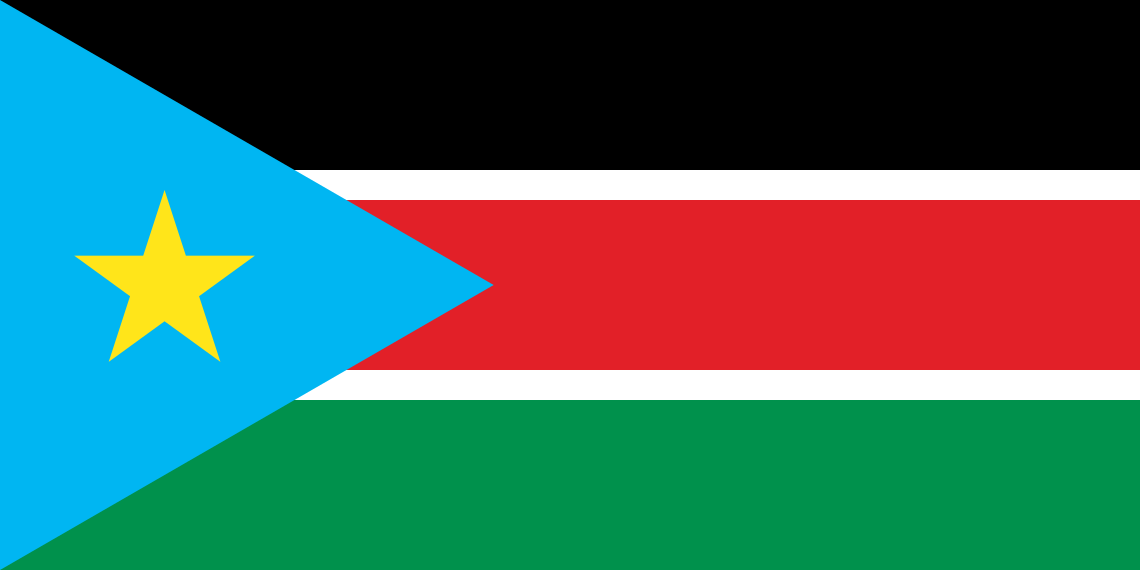
My delegation congratulates you, Madam President, on your country’s assumption of the presidency of the Security Council for the month of March. Our delegation will always cooperate with you and with the Security Council under your presidency. We thank the Secretary-General (S/2019/191) for his most recent report on South Sudan. I would also like to welcome Mr. David Shearer and to thank him for his courageous presentation. And I thank our sister Ms. Jial for her briefing.
I would like to take this opportunity to wish the women of South Sudan, Africa and all around the globe a happy and peaceful International Women’s Day. With regard to the remarks by my friend the Ambassador of Germany, one day we will reach 50 per cent, but 35 per cent is better and far more progressive than much of what is happening in many countries, including a number of member States represented in this Chamber. We will get there.
Since the signing of the Revitalized Agreement, the overall situation in South Sudan on the security, peace and economy fronts has improved noticeably. We are seeing the effect of the confidence-building measures between the signatories, which are a prerequisite for implementing peace, in the return and presence of many of the opposition leaders in Juba. Again with regard to Mr. Heusgen’s comments, Riek Machar’s absence from Juba still falls within the provisions of the Peace Agreement. We have an eight-month period that ends at the end of May. I think Mr. Shearer was the last person to meet with Mr. Machar in Khartoum and Mr. Machar assured him that he will be in Juba before the end of May.
The peace implementation is progressing slowly but surely. President Salva Kiir Mayardit, accompanied by some of the opposition leaders who recently returned to Juba, is currently touring greater Bahr El-Ghazal by land, which is a sign that there is security. The national dialogue regional conferences have started, and the first concluded successfully in Wau just last week. The next will be in Upper Nile in the next few days, and the final national conference will be convened in the greater
Equatoria region before the end of May. Refugees are returning voluntarily in large numbers. Internally displaced persons are leaving protection-of-civilians sites in sizeable numbers. The economy is already showing some early signs of recovery. Consumer goods and commodities have become available, with prices falling in Juba markets.
While these indications are good and positive to announce, we cannot remain silent about the challenges that continue to exist. We all know that peace implementation is moving very slowly, due to inadequate funding. Nevertheless, while we hope that some in the international community will continue to assist, the Government of the Republic of South Sudan will carry on with the implementation process using whatever means and resources are available to it.
In conclusion, the situation in South Sudan has continued to improve since the signing of the Revitalized Agreement, and the signatories are determined to implement it in good faith. Accordingly, we urge the Council, including those who are sceptical, to join with the Intergovernmental Authority on Development and the African Union in convincing the few opposition movements that opted out of signing the Agreement to sign it and join the peace process in South Sudan.
There are no more names inscribed on the list of speakers. I now invite Council members to informal consultations to continue our discussion on the subject.
The meeting rose at 12.20 p.m.