S/PV.8517 Security Council
Provisional
The meeting was called to order at 10.15 a.m.
Expression of sympathy in connection with and condemnation of the attacks in Burkina Faso and California

On behalf of the members of the Security Council, I should like to express our condemnation of yesterday’s attack on a Protestant church in Silgadji, Burkina Faso, and of the shooting that occurred at the Chabad of Poway synagogue in San Diego, in the United States of America, on Saturday.
I ask those present to now rise and observe a minute of silence in solemn commemoration of those who lost their lives in the attacks on their places of worship.
The members of the Security Council observed a minute of silence.
Adoption of the agenda
The agenda was adopted.
The situation in the Middle East, including the Palestinian question
In accordance with rule 37 of the Council’s provisional rules of procedure, I invite the representatives of Bahrain, Bangladesh, Botswana, Brazil, Cuba, Ecuador, Egypt, Finland, Hungary, the Islamic Republic of Iran, Iraq, Israel, Japan, Jordan, Lebanon, Liechtenstein, Malaysia, Maldives, Morocco, Namibia, Norway, Pakistan, Qatar, Saudi Arabia, the Syrian Arab Republic, Tunisia, Turkey, the United Arab Emirates, Uruguay, the Bolivarian Republic of Venezuela and Viet Nam to participate in this meeting.
I propose that the Council invite the Permanent Observer of the Observer State of Palestine to the United Nations to participate in this meeting, in accordance with the provisional rules of procedure and the previous practice in this regard.
There being no objection, it is so decided.
In accordance with rule 39 of the Council’s provisional rules of procedure, I invite the following briefers to participate in this meeting: Ms. Rosemary DiCarlo, Under-Secretary-General for Political and Peacebuilding Affairs; Ms. Nada Majdalani, Co-Director of EcoPeace Middle East; and Mr. Gidon Bromberg, Co-Director of EcoPeace Middle East.
In accordance with rule 39 of the Council’s provisional rules of procedure, I also invite the following individuals to participate in this meeting: His Excellency Mr. Maged Abdelfattah Abdelaziz, Permanent Observer of the League of Arab States to the United Nations; and His Excellency Mr. Cheikh Niang, Chair of the Committee on the Exercise of the Inalienable Rights of the Palestinian People.
I propose that the Council invite the Permanent Observer of the Observer State of the Holy See to the United Nations to participate in the meeting, in accordance with the provisional rules of procedure and the previous practice in this regard.
There being no objection, it is so decided.
The Security Council will now begin its consideration of the item on its agenda.
I now give the floor to Ms. DiCarlo.
Ms. DiCarlo: I would like to express condolences for the attacks at the synagogue in San Diego and at the church in Silgadji, Burkina Faso, as well as previous attacks on religious sites in New Zealand and Sri Lanka. Our sympathy is with the families of the victims and the Governments in question. The United Nations condemns terrorism in all its manifestations.
I should also like to pay tribute, on behalf of the entire United Nations family, to Major General Francis Vib-Sanziri, the United Nations Disengagement Observer Force (UNDOF) Head of Mission and Force Commander, who passed away suddenly on 19 April. His leadership, dedication and enthusiasm were invaluable in commanding UNDOF under difficult circumstances. He will be remembered for his exemplary career in the service of United Nations peacekeeping.
We meet today as the United Nations continues to advance efforts to address the continued humanitarian, economic and political crisis in the occupied Palestinian territory. Yet the continuing absence of a political solution to the broader conflict undermines and compounds our efforts. Under the pressure of violence, settlement expansion, unilateral measures, intra-Palestinian divisions and deepening mutual mistrust, the prospects for a just and lasting peace remains ever more elusive.
Hopes for the realization of a two-State solution continue to be replaced by the rising fears of future annexation. The possibility of establishing a viable
and contiguous Palestinian State continues to be eroded by facts on the ground. The United Nations has repeatedly warned that the conflict cannot be managed in perpetuity. The status quo will lead only to further deterioration of the situation, radicalization on all sides, more suffering and conflict.
Before addressing recent developments on the ground, I would like to congratulate Palestinian Prime Minister Shtayyeh on the formation of a new Palestinian Government. I wish him every success and urge all Palestinian factions and political leaders to work together, in good faith, to unify Gaza and the West Bank under a single, legitimate Palestinian Government.
I also want to congratulate the Israeli people on their democratic general election on 9 April. On 17 April, President Rivlin asked Prime Minister Netanyahu to form a new Government. We stand ready to continue working with the new government when it is formed.
The prolonged absence of a political solution to the conflict has coincided with the steady deterioration of the situation in the occupied Palestinian territory. During the reporting period, Israeli authorities advanced at least 2,100 housing units in Area C settlements and issued tenders for some 950 additional units. One of the plans advanced would retroactively regularize, under Israeli law, the illegal outpost of Haresha by incorporating it into the existing Talmon settlement. Settlements have no legal effect and constitute a violation of international law.
Demolitions and seizures of Palestinian-owned structures also continued across the West Bank, including East Jerusalem. Israeli authorities demolished or seized 37 structures, displacing 49 people, mostly on the grounds that they lacked Israeli-issued building permits, which are nearly impossible for Palestinians to obtain. In addition, on 31 March, the Israeli District Court rejected three appeals challenging demolition orders submitted by Palestinian residents of the Silwan neighbourhood of East Jerusalem.
The situation at Jerusalem’s holy sites has remained relatively calm in the past month. I would like to take the opportunity of the overlapping holidays of Judaism, Christianity and Islam to wish peace and prosperity for the peoples of Palestine and Israel, but also to urge sustained calm, particularly in the holy sites, which can be achieved only by respecting the status quo and relevant agreements.
Regrettably, elsewhere the cycle of violence continues. On 30 March, Palestinians in Gaza marked the first anniversary of the Great March of Return protests, which was commemorated by 50,000 Palestinians demonstrating at the perimeter fence. While the vast majority of the protesters remained peaceful, a small number ignored the calls for restraint and engaged in acts of violence against Israel and attempted to breach the fence. During the reporting period, seven Palestinians, including four children, were killed in Gaza by the Israel Defense Forces (IDF) and 1,316 were injured. I reiterate the previous calls by the United Nations that children should never be the target of violence, nor should they be put at risk of violence or encouraged to participate in violence. I also reiterate the call on Israel that lethal force should be used only in response to an imminent threat of death or serious injury and as a last resort.
During the reporting period. Palestinian militants fired 30 rockets and mortars from Gaza towards Israel. The indiscriminate launching of rockets and mortars towards Israeli civilian populations is prohibited by international humanitarian law and must immediately cease. Several incendiary balloons were also launched from Gaza into southern Israel. These must stop. Hamas must also ensure that protests remain peaceful and prevent provocations near the fence, including attempts to breach it.
Meanwhile, in the West Bank, three Palestinians were shot and killed by Israeli forces, and 63 were injured, including 18 children. On 27 March, a 17- year old Palestinian paramedic was shot by the Israeli security forces near Al-Duheisha refugee camp in Bethlehem, and later died of his wounds. The shooting occurred during clashes following two arrest operations undertaken by the Israeli security forces in the camp earlier that day.
Settler-related violence also continued during the reporting period. According to the Office for the Coordination of Humanitarian Affairs (OCHA), one Palestinian was killed and 19 were injured or had their property damaged by others. On 3 April, two Israeli civilians opened fire in Nablus, injuring two Palestinians, including a 23-year-old man who died later in hospital. On 24 April, following the arrest, tying and blindfolding of a 15-year-old Palestinian boy for allegations of stone-throwing, IDF soldiers shot him twice in his lower body as he attempted to escape while still blindfolded. The IDF said that it was responding to
massive stone-throwing and that one of the the rioters was shot as he tried to flee after being arrested.
In the same period, OCHA recorded 14 Palestinian attacks against Israeli settlers and other Israeli civilians in the West Bank, where Palestinians threw stones at vehicles traveling on roads near Bethlehem, Hebron and Ramallah. One injury and damage to 13 vehicles were reported.
The reporting period also saw a worsening Palestinian financial crisis. Despite the austerity measures announced and the recent pledges of support by Arab States, the risk of a financial collapse of the Palestinian Authority is growing. A sustainable resolution of the Palestinian Authority’s funding crisis is urgently required. Both parties should address the causes of the crisis through dialogue, implement their bilateral agreements and avoid taking unilateral actions that undermine stability and security for both Palestinians and Israelis alike. I urge the members of the Ad Hoc Liaison Committee for the Coordination of International Assistance to Palestinians (AHLC) to use its meeting tomorrow in Brussels to work with Israel and the Palestinian Authority to resolve this crisis, which threatens the viability of the Palestinian Authority.
I would like to turn to the ongoing humanitarian and economic crisis in Gaza and begin by highlighting the plight of women. Seventy per cent of all women in Gaza today are unemployed. As a result, female-headed households are more likely to face poverty and food insecurity. Moreover, we know that poverty and lack of economic opportunities are key drivers behind violence against women in Gaza. The United Nations continues to provide assistance to Palestinian women and girls across a broad range of areas, but much more needs to be done to ensure that their needs are addressed.
The United Nations is also making important progress on the implementation of a package of urgent humanitarian and economic interventions in order to stabilize the situation in Gaza, prevent an escalation, lift the closures and support Egyptian-led reconciliation efforts. Over the past year, nearly $110 million for fuel, health, water, sanitation and temporary employment programmes have been raised. The United Nations and its partners have mobilized nearly $45 million that will allow for the creation of approximately 20,000 temporary jobs in 2019. Since September, approximately $4.6 million in support of the humanitarian response plan have contributed to the delivery of essential
drugs and the performance of some 9,500 emergency surgeries. I also welcome Qatar’s extension of funding for the United Nations to procure and deliver fuel to the Gaza power plant until June.
In a positive development, on 1 April, Israel extended some areas of the Gaza fishing zone up to 15 nautical miles. I welcome this decision and strongly urge that the rest of the fishing zone, which remains limited to 6 to 12 nautical miles, also be expanded.
As we have repeatedly stated, at its core the crisis in Gaza is political. Significant progress on the lifting of the closures and advancing intra-Palestinian reconciliation remains essential. I reiterate my call on all Palestinian factions to engage in earnest with Egypt on reconciliation efforts. I also take this opportunity to thank Member States that have supported the implementation of the AHLC projects to date and urge others to contribute to this important effort, including through critical financial support to the Programme Management Unit, as well as for the humanitarian response plan.
Turning to the situation in the region, Lebanon remains stable, with the continued commitment of political actors to dialogue leading to Parliamentary approval of its long-awaited plan to reform the electricity sector. Discussions continue on the 2019 budget as proposed public sector pay cuts spark protests. Significantly, Minister of Defence Elias Bou Saab and Lebanese Armed Forces Commander General Joseph Aoun visited the United Nations Interim Force in Lebanon (UNIFIL) and southern Lebanon on 24 April, with Minister Bou Saab stating that the Lebanese Armed Forces would increase troop deployment in southern Lebanon.
The situation in southern Lebanon and along the Blue Line remained calm. On 2 April, UNIFIL chaired a regular tripartite meeting attended by senior delegations from the Lebanese Armed Forces and the Israel Defense Forces. On 17 April, a UNIFIL team of technical experts assessed the tunnel located south of the Blue Line near the Israeli town of Zarit, the discovery of which had been announced by the IDF on 13 January. UNIFIL concluded that the tunnel crossed the Blue Line and thereby constituted a violation of resolution 1701 (2006). The following day, the UNIFIL Force Commander informed the Commander of the Lebanese Armed Forces and Minister of Defence Bou Saab of UNIFIL’s findings and requested urgent
follow-up. UNIFIL has now confirmed the existence of five tunnels, three of which it has confirmed cross the Blue Line and constitute a violation of resolution 1701 (2006).
Turning to the Golan, on 25 March United States President Donald Trump signed an official proclamation recognizing Israel’s sovereignty over the occupied Syrian Golan. As previously noted by the Secretary- General, the United Nations position on the Golan is clear. It is reflected in the relevant United Nations resolutions, notably, resolutions 242 (1967) and 497 (1981).
The ceasefire between Israel and Syria has been maintained, with relative calm and low levels of military activity in the areas of separation and limitation on the Bravo side. The United Nations Disengagement Observer Force (UNDOF) continued to observe and hear a relatively low level of small-arms firing in the areas of separation and limitation on the Bravo side. UNDOF assessed that the firing was due to training activities conducted by Syrian security forces. UNDOF also continued to observe the presence of Syrian Arab Armed Forces in different locations in the area of separation, including in the vicinity of United Nations positions.
Yesterday, assisted by the International Committee of the Red Cross, UNDOF facilitated the transfer of two Syrian men who had been detained in Israel for a number of years. Also, the remains of an IDF soldier missing since 1982 were repatriated from Syria to Israel after being located with the assistance of Russian forces.
With regard to the conflict in Syria, the Secretary- General’s Special Envoy for Syria, Mr. Geir Pedersen, continues his efforts to find a negotiated political solution. He is working with all sides and making steady progress on launching a credible, balanced and inclusive constitutional committee as a door-opener to a wider political process that encompasses the full implementation of all elements of resolution 2254 (2015). He will brief the Council on those efforts tomorrow.
As we mobilize to address the critical needs of the Palestinian population, be it in Gaza or the West Bank, we shall not lose sight of the core political issue, namely, the prospect of two peaceful and secure States living side by side in harmony. That imperative compels us all to work with the parties, bring them back to the negotiation table and urge them to avoid unilateral actions that undermine the prospects for
peace. We should also work with both sides to establish an environment conducive to a return to meaningful discussions. However, only determined action by the parties themselves can salvage the two-State solution. Otherwise, Palestinians and Israelis will continue to live their lives knowing only conflict, mistrust and fear, rather than the infinite possibilities that would come with a just and lasting peace.
Finally, I would like to thank EcoPeace Middle East for joining us for today’s debate. Its commendable efforts to promote Israeli-Palestinian-Jordanian collaboration around shared environmental challenges are exemplary. I welcome the ongoing commitment by Member States to generously support and bring attention to such initiatives.
I thank Ms. DiCarlo for her briefing.
I now give the floor to Ms. Majdalani.
Ms. Majdalani: On a hot summer day in 2017, the family of a 5-year-old boy, Mohammad, decided to escape the harsh realities of Gaza by going to the beach. His parents did not realize that the nearby stream flowing into the sea was full of raw sewage. Later that evening all of Mohammed’s family fell terribly ill; within 10 days Mohammad was dead. A virus attacked his brain after he swam in polluted waters.
As we speak today, 97 per cent of the Gaza’s groundwater is not suitable for human consumption, and 30 per cent of illnesses in Gaza are from waterborne pathogens. With an average of four hours of daily power supply, wastewater facilities fail to operate, daily emptying the equivalent of 34 olympic-sized swimming pools of raw sewage into the Mediterranean Sea. After more than 12 years of blockade, consecutive wars and loss of life, including children, and the failure of internal Palestinian reconciliation, a humanitarian catastrophe in the Gaza Strip is happening right now, right before our eyes.
Rather than be negligent, Gidon and I are here before the Security Council, together with Yana, the Jordanian Director of EcoPeace Middle East, as part of a dedicated team that refuses to allow our children and our environment to remain hostage to the conflict. We are here to impress upon members that water and climate security issues are critical for a better future for all the people in our region. While politicians can speak of a disengagement policy, the fact is that we cannot disengage from our shared environment. EcoPeace
revealed to the public that the Ashkelon desalination plant, which provides 15 per cent of the drinking water in Israel, has been intermittently closed due to the pollution carried by the currents from Gaza beaches towards the north. That is a big lesson to us all: water and the environment know no borders or boundaries.
The demise of the Jordan River is another example of the environmental cost we pay for the broader Arab- Israeli conflict. Amin, the father of an EcoPeace activist, lived his childhood on the banks of the Jordan River. He remembers its waters as being clear and fast-flowing. His family used to fish and pump water from the river to irrigate their fields. Following the occupation of the West Bank, in 1967, Amin and his family lost access to the river’s banks and to their rightful share of its waters. Amin visited the Baptism Site with EcoPeace more than 50 years later, and he was in total shock. The mighty river he recalled had become a trickle.
Like other refugees and residents, when Amin and his family look at the Jordan Valley they see a complex political reality that works against even their basic needs. Restricted access to water, the confiscation of land for the expansion of illegal settlements and talk of a looming annexation of Area C makes them even more determined not to give up on a better future.
For the very reasons I have just mentioned, EcoPeace has designed an integrated master plan for the Jordan Valley, which could turn around a valley of poverty and despair into one of shared prosperity for all communities from the Sea of Galilee to the Dead Sea, based on principles of sustainable development and equal opportunities and in the framework of the two-State solution along the 1967 borders.
EcoPeace has advocated that solving water issues cannot wait. We argue that water issues and obtaining Palestinian water rights can no longer be delayed owing to a failure to agree on all other final-status issues. The terms and mechanisms set out in the Oslo Accords on transboundary water and wastewater management are today failing Palestinian, and even Israeli, sustainable development needs.
The impacts of climate change over the past decade have further brought to the fore the importance of our argument and the urgency for policy change. The past 20 years have witnessed recurring drought, the deepest droughts in our recorded history. They have contributed to wider cross-border implications on increased water scarcity, political instability and increased refugee and
humanitarian crises in our region. If no immediate action is taken against the Gaza crisis today, the international community should be ready for more refugee boats.
As a civil society organization, during our latest conference we were able to convene senior representatives from our three Governments, who all agreed that climate change presents itself as a threat multiplier in relation to our water security. While most of the world is fearful of a 2°C increase in average temperatures, the Middle East is concerned about a 4°C increase.
Building on the examples I have presented, we come here with a powerful message to our own Governments and to the members of the Security Council. We together face a common threat due to conflict and climate-induced water scarcity. Climate change does not differentiate between the stronger and weaker side of the conflict. Action is needed today. A reassessment of assumptions, a rejection of unilateralism and an effort to advance cross-border water cooperation is needed as a matter of national and regional stability and security.
I thank Ms. Majdalani for her briefing.
I now give the floor to Mr. Bromberg.
Mr. Bromberg: In my 25 years with EcoPeace Middle East, my most memorable activity was to jump into the Jordan River, together with Israeli, Palestinian and Jordanian mayors. Together we made a big splash but, like today, we also made an important statement. To get the mayors to literally jump into the river, it took us five years of planning. We developed an education programme called “Good Water Neighbours” — please remember that — that worked in schools on all sides of the Jordan River, educating young kids about their water reality and that of their neighbours. They saw a river with little flow and full of pollution, and, for the first time, they began to understand the impact of conflict on water. Quite innocently, those kids and their parents started to ask their mayors “Why is the Jordan River so polluted, and what must we do with the other side to clean up the river?” Empowered by the youth and their parents to take action for the benefit of their communities, the mayors jumped into the river together not as best friends, but as leaders, advocating to national Governments on all sides that only a rehabilitated river would bring economic opportunities to their residents.
Twentieth-century assumptions that dictated water diplomacy led us down a path of conflict and competition over water. We were indeed wholly dependent on natural water during the past century, and therefore each side fought over every drop. That was the mindset that led to the demise of the Jordan River and the drastic reduction in size of the Dead Sea. That was the mindset of how water was negotiated in the Oslo Accords in the mid 1990s. Water was left unresolved as a final-status issue because coming to an agreement over sharing scarce natural water was difficult and would produce winners and losers. But today the advancements in water technologies this century, much of which is led by Israeli innovation, present real opportunities. The utilization of treated waste water for agriculture and the development of desalination technology means that water is under less constraints as a resource.
Today 70 per cent of the drinking water in Israel comes from desalination, and half of the agriculture grown is grown with treated wastewater. The availability of large quantities of manufactured water, complimenting natural water, makes the fair share of natural water between Israelis and Palestinians attainable now. Because of climate change, Mediterranean desalinated water will be pumped by Israel into the Sea of Galilee to guarantee water quality for the lake and fresh water supplies to Jordan, and could be part of the rehabilitation of the Jordan River — a river holy to half of humankind. Based on Government policies, on the one hand, of increased desalination and, on the other, community-led advocacy for the river, for the first time in 50 years some fresh water flows again out of the Sea of Galilee into the Jordan River.
In just the past five years, technological advances in solar power is allowing our region to harness the sun. The Hashemite Kingdom of Jordan has been the regional leader in that regard, investing in large-scale solar energy, owing to its vast desert landscapes. The combination of manufactured water coming from the Israeli and Palestinian coast and sold to Jordan, powered by solar electricity produced in Jordan and sold to Israel and Palestine, is a potential geopolitical game changer. Such an exchange can guarantee water and energy security for all, responds to climate insecurity and creates healthy interdependencies between our economies and societies. Last year, with German funding, EcoPeace led a regional delegation of decision makers and business leaders to Europe to advance the project. Thanks to Swedish funding, a pilot
solar project is in the planning stages in Jordan today to sell green electricity for the first time across the border.
Moving from competition to cooperation over critical natural resources as a means to help create political stability is not a new idea. The post-Second World War coal and steel agreement of continental Europe, led by former enemies France and Germany, laid the foundation for stability in Europe. Harnessing the sea and the sun shared by Israelis, Palestinians and Jordanians can be our engine for achieving peace and stability. Nada Majdalani, Yana Abu Taleb, myself and all of our staff in Amman, Ramallah and Tel Aviv carry with us the voices of young students, residents and mayors. Together we have educated ourselves and the communities in which we work. We have done the research, and we have shown leadership.
We have partners for peace on all sides. Our 25 years of partnership tell us that good water, and not necessarily good fences, make good neighbours. In the spirit of Passover, Easter and the forthcoming celebration of Ramadan, let us set water free to give life and hope to our region.
We call on the Security Council to urge our three Governments — Israel, Palestine and Jordan — to advance cooperation together on water and the environment, including the rehabilitation of the Jordan River and the Dead Sea, meeting Palestinian water rights and needs, and implement a water-energy exchange for our shared future in the face of climate change, all in the context of a two-State solution. We call on the Security Council to invite all the relevant United Nations agencies and international organizations, including the Ad Hoc Liaison Committee for the Coordination of the International Assistance to Palestinians, to help facilitate the implementation of those objectives.
I thank Mr. Bromberg for his briefing.
I would like to recognize the third member from the EcoPeace Middle East here today, Ms. Yana Abu Taleb from Jordan.
I now give the floor to the Permanent Observer of the Observer State of Palestine.

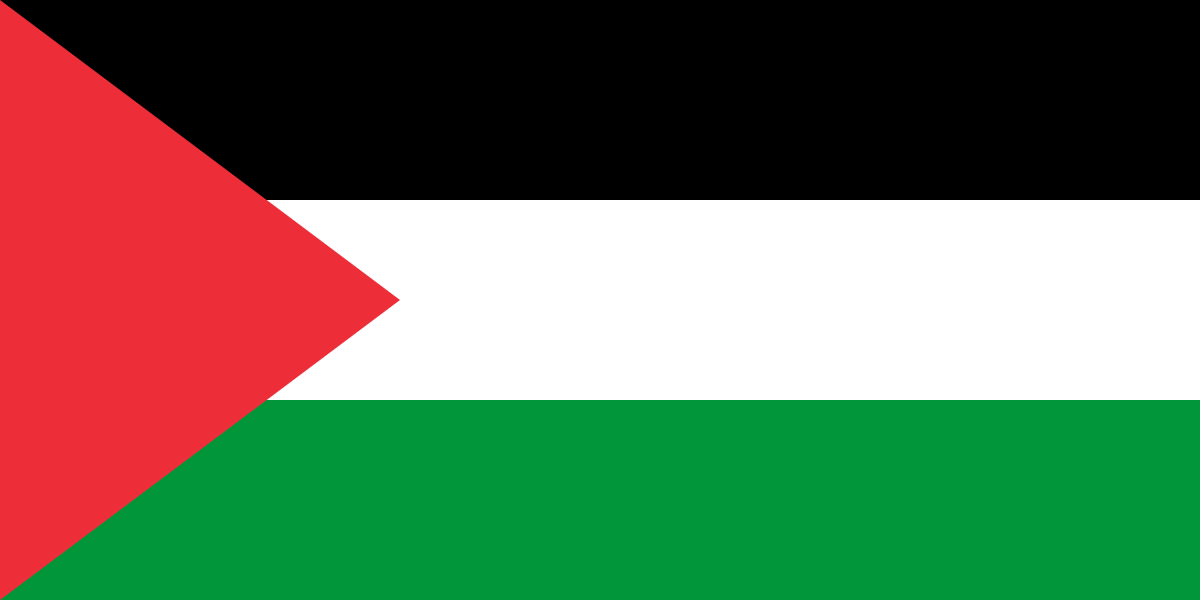
I thank the German and French presidencies of the Security Council for their skilful joint leadership over the past two months. I also thank Under-Secretary-General for Political
and Peacebuilding Affairs Rosemary DiCarlo for her briefing and able guidance of the Department. We also recognize the ongoing efforts of Special Coordinator Nikolay Mladenov and his team, as well as the vital role and support of the United Nations Relief and Works Agency for Palestine Refugees in the Near East (UNRWA) and the efforts of the Office for the Coordination of Humanitarian Affairs, UNICEF, the United Nations Development Programme and all United Nations agencies on the ground at this critical time.
I associate myself, Mr. President, with the comments that you and Under-Secretary-General DiCarlo made in connection with the loss of lives resulting from attacks on houses of worship, including those in Burkina Faso.
I also want to thank Ms. DiCarlo for the congratulations she conveyed to Prime Minister Shtayyeh on the formation of our new Government. I also welcome Ms. Majdalani, Mr. Bromberg and their friend, Ms. Taleb, and thank them for being with us and their briefings.
We meet at a moment of great uncertainty and volatility. The situation in the occupied Palestinian territory, including East Jerusalem, is rapidly deteriorating, despair is increasing and the horizon for peace is being nullified by an occupying Power that insists upon imposing its illegal agenda at any cost. The outlook has become even grimmer following Israeli elections that have further entrenched the extreme right to rule Israel as a racist apartheid State under Prime Minister Netanyahu. The absolute support given to Israel by a permanent member of the Security Council has only emboldened its flouting of the law, further fuelling its human rights violations against our people and the colonization of our land.
Aided and abetted in its crimes, Israel’s expansionist appetite is growing. Members have only to listen to its recent cynical statements on the intention to annex the Israeli settlements illegally constructed in the occupied Palestinian territory, including East Jerusalem, demonstrating a blatant dismissal of Palestinian rights. Such inflammatory rhetoric, let alone the countless war crimes being carried out every single day in broad daylight, is shamelessly bragged about by the Prime Minister and other Israeli officials, in total contempt of the Council’s authority and the international community at large.
We have heard the condemnation from around the world of those provocative statements, incitement
and illegal actions. The rejection has been resounding. We have also heard repeated calls for a halt to Israel’s illegal and destructive policies and compliance with its legal obligations. We are grateful for those principled positions and the solidarity extended to our people and their just cause. However, condemnations alone will not suffice; such calls, whether gentle or firm, will not be heeded by Israel, which continues to trample international law and make a mockery of the international system. By now it should be obvious: appealing to and appeasing Israel have never worked.
Without accountability, how can anyone expect anything other than the unbridled impunity we have witnessed for decades and even worse? It is time to turn words into deeds and solidarity into action. Serious measures must be urgently taken by the international community to hold Israel, the occupying Power, accountable. There must be consequences for violations; that is the only way to stop the unravelling of the peace process and reverse course in order to salvage the possibility of a peaceful and just solution and spare the Palestinian and Israeli peoples decades more of confrontation, conflict, suffering and loss.
That is neither a radical call nor a threat. Taking action is a duty, based on the rules, principles and demands enshrined in the Charter of the United Nations, international law and United Nations resolutions. It is a responsibility that is consistent with long-standing international consensus and commitments — repeatedly made, yet unfulfilled.
The Palestinian people have not suffered for decades and waited nearly a century for their freedom — since they were first recognized as ready for independence — only to resign themselves to limited autonomy. Those who believe so ignore history, international law and the resolve of a people to attain justice and equality. Let me also remind those present that the Palestinian leadership’s acceptance of a State of Palestine on the 1967 borders, with East Jerusalem as its capital, was a historic and painful compromise, and not one that should be dismissed or ridiculed by newcomers to peacemaking.
The Palestinian right to self-determination has long been recognized and supported globally. The International Court of Justice has affirmed it to be a right erga omnes. The Palestinian people hold steadfast to their legitimate national aspirations for independence, the right of return and the realization of
their full civil, political, economic, social and cultural rights, as well as their inalienable human rights, and they will not surrender to a lesser fate.
International consensus in that regard is strong, just as it is strong for a two-State solution on the 1967 borders as the foundation of a peaceful solution that is based on international law; the relevant United Nations resolutions; the Madrid terms of reference, including the principle of land for peace; the Arab Peace Initiative; and the Quartet road map. That position was unequivocally reaffirmed by the Security Council in resolution 2334 (2016) and remains the core of the international community’s position, as reflected in the past weeks, months and years.
Occupation, annexation and human rights violations can never be accepted as just and moral and can never be accepted as the new normal, irrespective of spin, rhetoric or pretext. The wanton killing, injury and terrorization of Palestinian children, women and men by Israeli occupying forces and extremist Israeli settlers and the detention and imprisonment of thousands of Palestinian civilians, including children, constitute gross violations of international humanitarian law and human rights law that amount to grave breaches.
Israel’s 12-year blockade of the Gaza Strip is illegal. Isolating and imprisoning 2 million people is mass collective punishment tantamount to a war crime, as well as the main source of the disastrous humanitarian crisis and despair in the Gaza Strip, as expressed in the protests of the Great March of Return. Israel’s so- called withholding of Palestinian tax revenues is blatant theft that violates bilateral agreements and the Fourth Geneva Convention, which prohibits the pillaging of the resources of occupied peoples.
Israel’s colonization of the occupied Palestinian territory, including East Jerusalem, is illegal. Whether settlements or walls, home demolitions or evictions, forced transfers, threats to the historic status quo of Jerusalem’s holy sites or any annexation measures — all such measures are unlawful, amount to war crimes and cannot be justified under any pretext, including on the basis of security claims, biblical edicts or so- called legislation by the occupying Power. All those illegal policies and practices must end. They will never be accepted as legitimate, will always be rejected and resisted and will never lead to peace and security.
An occupation that has existed and entrenched itself for 52 years through such violations cannot be
considered legal under international law. It is an illegal occupation, and Israel is an illegal occupant. The international community must stop normalizing that occupation and treating it with any deference. It is in every way illegal and must be brought to an end.
It is strange that, when it comes to Palestine, calls for action to uphold the law — whether to stop the colonization, provide protection to the occupied people or even do something as simple as ban illegal settlement products — are viewed as delusional rather than as legitimate tools to remedy injustice. That flawed approach has to change. After almost three decades of negotiations and appealing to the occupying Power — from the Madrid Peace Conference and the Oslo process to the Quartet efforts, the Annapolis Conference, the Paris Conference and every other attempt in between — Israel’s violations, violence and intransigence have only become more flagrant. Only accountability can create the necessary pressure to break that toxic cycle in order to finally end the occupation and establish the rights of the Palestinian people — the cornerstone for a peaceful and secure Middle East.
The Security Council has been patently clear in that regard. It was explicit in resolution 2334 (2016) in its determination not to recognize any changes to the 1967 borders, including with regard to Jerusalem, other than those agreed to by the parties through negotiations, and it directly called on States to differentiate, in their relevant dealings, between Israel and the territories it has occupied since 1967. That is an obligation. I repeat — the differentiation is an obligation.
To Member States contemplating establishing missions in Israel, whether diplomatic, cultural or for trade, and to representatives of Member States undertaking official visits to Israel, that obligation, in accordance with resolution 478 (1980), includes Jerusalem. There are no exceptions. Decisions and declarations signed by others that depart from international law and United Nations resolutions cannot change facts and cannot legitimize what is illegitimate.
The Security Council, in resolution 478 (1980), unequivocally deemed Israel’s annexation of occupied East Jerusalem to be unlawful, null and void and without legal effect. Likewise, in resolution 497 (1981), it deemed Israel’s annexation of the occupied Syrian Golan to be unlawful, null and void and without legal effect. The same applies to any annexation measures
planned or imposed by Israel over any part of the territories it has occupied since 1967.
The prohibition of the acquisition of territory by force stands. Recognition of such annexations by any country, no matter how large and powerful, is without legal effect. We therefore reiterate our condemnation and complete rejection of recent decisions by the United States, taken in violation of the Charter and Security Council resolutions and with zero regard for the inalienable rights and fate of millions of Palestinians. Similarly, as speculation abounds about the pending American so-called peace plan, we reiterate that any initiative detached from international law and the relevant United Nations resolutions and dismissive of human rights can be neither viable nor just, and will not succeed.
International law is abiding, and Security Council resolutions are valid and binding until implemented. Moreover, States have a responsibility not to recognize as lawful a situation created by breach of the law, and a State assisting another State in the commission of internationally wrongful acts incurs liability. That is not our personal narrative; those are established international rules and norms that must be upheld.
Despite the bleak picture, we have not given up hope. Some may say we are living in denial; we are not. We recognize the enormity of the crisis we face — existential, in fact — but we have not abandoned our belief that international law will lead us to justice. On the contrary, despite deep worries about the weakening of the rules-based order and its ability to withstand current challenges, we are reassured of its strength and longevity by the firm statements from across the international community denouncing Israel’s attempts to annex occupied East Jerusalem and the occupied Syrian Golan and affirming that positions in this regard remain unchanged.
We see that strength and longevity also in the firm commitment to the Arab Peace Initiative, affirmed again at the Arab Summit in Tunisia last month, as well as in the strong positions repeatedly reaffirmed by the European Union, the Organization of Islamic Cooperation (OIC), the Non-Aligned Movement and countless capitals around the world. We see it in the ongoing efforts of the Ad Hoc Liaison Committee for the Coordination of the International Assistance to Palestinians and in the generous support of donors, regionally and internationally, who have long assisted
in building and strengthening the institutions of the State of Palestine. We see it in the international community’s strong support for UNRWA’s mandate, pending a just solution for the Palestine refugees and in the response to the Agency’s funding crisis, including the OIC’s establishment of a waqf for the refugees. We see it in the resolute efforts of Jordan as custodian of the Muslim and Christian holy sites in Jerusalem. We see it in the efforts of Egypt and Russia to help us heal our painful division and restore Palestinian unity. And we see it in every principled vote at the United Nations in support of right and justice, despite immense pressure and threats.
Of course, as stressed at the outset, more than words are needed. Business as usual cannot continue. It is time to act; we cannot continue to decry the threats to multilateralism and our international system without seriously acting to protect, restore and revive them based on our shared values, humanity and future. Only then can we overcome the challenges and rectify our course. That is a matter of urgency for Palestine, but also for the international community, which must seize the opportunity now.
On our part, we are ready to do so. We remain committed to a peaceful, political, legal, non-violent path for realizing our rights and bringing an end to the conflict, and President Abbas has once again extended his hand in peace. Prime Minister Shtayyeh, newly at the helm of the Government of the State of Palestine, has committed to working with all partners to address the humanitarian, socioeconomic, security and protection crises affecting the Palestinian people, despite severe austerity measures imposed following Israel’s theft of our revenues. We are coordinating closely with our regional partners, as reflected in the recent League of Arab States ministerial meeting in Cairo, to address the challenges we face.
No one can accuse us of not wanting peace or of not seeking the best interests of our people. Our only condition is that any effort or initiative must be based on international legality and the parameters enshrined over decades in the relevant Security Council and General Assembly resolutions. That is a minimal ask and should be respected, not disregarded, by those who seek to lead peacemaking efforts. We appeal to the international community to rise now to its responsibilities before it is too late.
I thank you, Mr. President, and Council members for your attention and urge you to act.
I now give the floor to the representative of Israel.


I thank Ms. DiCarlo, Under- Secretary-General for Political and Peacebuilding Affairs. I also thank the representatives of EcoPeace Middle East for their statements.
We come together at a painful time for the Jewish people. On Saturday, as Jews everywhere were concluding the holiday of Passover, a gunman ran into the Chabad of Poway, California, and opened fire. Over 100 people in the middle of prayer were forced to duck for cover as bullets flew across the room. Lori Kaye was shot and killed as she jumped into the line of fire to protect Rabbi Yisroel Goldstein, who had founded the synagogue and sustained injuries. Despite having been shot, Rabbi Goldstein continued his sermon. Thirty- four-year-old Almog Peretz and eight-year old Noya Dahan were also shot and injured. That is the second synagogue shooting in six months. It is unacceptable that we live in a time in which worshippers must be on guard or look behind their backs while praying, out of fear of being shot. We pray for Chabad of Poway and stand with the families affected during this painful time.
When we last gathered in the Chamber under this agenda item (see S/PV.8449), the President of the Council, the Ambassador of Germany, asked me to explain how Israel implements international law, specifically with regard to the Jewish communities of Judea and Samaria. Today, I will provide the answers. But before we discuss international law, we must understand the context and facts. Today, I will present to the Council the four pillars that prove the case for Jewish ownership of the land of Israel.
The first pillar is the Bible. The Jewish people’s rightful ownership of Eretz Israel, the land of Israel, is well documented throughout the Old Testament and beyond. The second pillar is history. The Jewish claim to the land of Israel is confirmed time and again, not just through Jewish history, but through the history of the world. The third pillar is a legal claim. Our rights to the land are codified in international law, including in the document that founded this very organ. The fourth pillar is the pursuit of international peace and security. A stronger and safer Israel means a stronger and safer world. It is through those four pillars that I will provide the Council the answers to its questions.
Let us discuss the first pillar of proof, the Bible. The Jewish people’s right to the land of Israel is mentioned over a dozen times in the Tanakh — the Hebrew Bible — which includes the Torah, the Old Testament, the Prophets and the Writings. In the book of Genesis, the very first book of the Old Testament, God says to Abraham:
“And I will establish my covenant between me and you and your descendants after you throughout their generations for an everlasting covenant, to be God to you and to your descendants after you. And I will give to you and to your descendants after you the land of your sojournings, all the land of Canaan, for an everlasting possession, and I will be their God.” (The Holy Bible, Genesis, 17:7-8)
That is the deed to our land. From the book of Genesis to the Jewish exodus from Egypt, to receiving the Torah at Mount Sinai, to the realization of God’s covenant in the holy land of Israel, the Bible paints a consistent picture. The entire history of our people and our connection to Eretz Israel begins right there. It is not just the Hebrew Bible or the 15 million Jews worldwide who accept that right. It is accepted across all three monotheistic religions: Judaism, Christianity and Islam. The Qur’an itself accepts the divine deed of the Jewish people to the land of Israel.
The second pillar is the history of the land of Israel and the Jewish people over the past two millennia. The Jewish kingdom in Eretz Israel comprised 12 tribes, the largest of which — the tribe of Judah — lived in the area now known as Judea. Everyone is familiar with the words “Jew” and “Jewish”. They come from the word “Judea”, a kingdom over which King David and King Solomon ruled. It was a kingdom with Jerusalem as its capital. It was home to the first temple, destroyed by the Babylonians in the year 587 B.C.E. and the second temple, destroyed by the Romans in the year 70 C.E. When the Romans destroyed the Jewish kingdom, they sent our people into a 2,000-year exile that kept most of us from our land. Even the Romans themselves admitted that the land was ours.
Those who have visited Rome may recall that Emperor Titus famously commemorated his victory and the Jewish expulsion by building an enormous arch on the Via Sacra in Rome. The arch includes an illustration of his men carrying away the menorah from the Jewish temple. Even though the Romans knew that the land was ours and we belonged in it, they attempted to erase
our age-old connection to the land by renaming it Syria Palestina. Why Palestina? Because they attributed it as a southern province of the Syrian Empire. That is how the narrow strip of land in Eretz Israel, nestled between Egypt in the south and Lebanon in the north, came to be called Palestine.
For the next 2000 years, the land of Israel was conquered by the Crusaders, followed by the Ottoman Empire, but despite centuries of wars and conquest, the Jewish people never left. A Jewish community remained in Eretz Israel, the land of Israel, throughout that entire time. Although most of our community was forced into exile by the Roman Empire, we knew that someday we would return to our ancient homeland. For two millennia, Jews across the world continue to pray three times every day for our long-awaited return home to Zion, to Jerusalem. As we just said on Passover last week, and as we do every year, “Next year in Jerusalem”.
If the Jewish people’s deep and ancient roots in the land of Israel are not sufficient proof, let us consider international law, the third pillar. In 1917, Lord Balfour, Britain’s Foreign Secretary, issued a statement of British support for the establishment of “a national home for the Jewish people”. The Balfour Declaration designated that national homeland in Eretz Israel. The Balfour Declaration also specifically endorsed the Zionist cause, as Lord Balfour wrote:
“I have much pleasure in conveying to you on behalf of His Majesty’s Government the following declaration of sympathy with Jewish Zionist aspirations which has been submitted to, and approved by, the Cabinet.”
After the Ottoman Empire surrendered in the First World War, the British took legal ownership over the land of Israel. With that legal ownership, they were able to issue the Balfour Declaration and commit to helping establish a national home for the Jewish people in our historical homeland. In 1922, the mandate of the League of Nations not only stated its support for the establishment of a Jewish national home; it also encouraged and facilitated the return of Jews in the diaspora to our homeland. It confirmed
“the historical connection of the Jewish people with Palestine and to the grounds for reconstituting their national home in that country”.
These documents are Zionist documents by definition. Zionism is the realization of the right of the
Jewish people to self-determination and sovereignty in the land of Israel. That is what Zionism means — no more, no less. It appears in international law, in essence and word for word.
In 1945, the Charter of the United Nations, drafted in the wake of the Holocaust, was adopted. It guaranteed the right of people to exercise self-determination. It also refers to “the inherent right of individual or collective self-defence if an armed attack occurs against a Member of the United Nations”. One people’s pursuit of self-determination could not undermine the safety and security of another nation.
Two years later, the United Nations Partition Plan for Palestine called for the establishment of a Jewish State and an Arab State in the land of Israel. What did we do? We accepted it. But the Palestinians did not. Instead of peace, they chose war and opened fire on the Jews. Our small, tiny, newly declared nation was suddenly under attack. In 1948, on the last day of the British mandate, Israel declared independence and was immediately attacked by five Arab armies that joined the Palestinians, hoping to destroy it. Israel won that war, and the hope and future of the Jewish people was saved.
But the war of 1948 did not end with peace. It ended with armistice agreements between Israel and its neighbours. The armistice lines between Israel and Egypt, Jordan, Syria and Lebanon were never considered international borders. They were simply lines designating the end of the first battle in the Arab war against Israel. Jordan maintained control of Judea and Samaria, and Egypt controlled the Gaza Strip. Those agreements were formed in the absence of permanent peace treaties, which would only be signed decades later.
It was the Arabs who insisted that the armistice lines would not be permanent borders. As stated in the Jordanian-Israeli agreement of 1949, those lines “are agreed upon by the parties without prejudice to future territorial settlements or boundary lines.” Because those lines are not borders, the Jewish communities in Judea and Samaria to this day have not crossed any international borders; they are built on strategic land for Israel’s security, which, as agreed by the parties in the Oslo Accords, would be classified as final-status issues.
To support the right of Israel to exist in our homeland is therefore essential to international peace and security — the final pillar. For decades, many Arab
leaders have chosen the sword over the olive branch, long before even one of these so-called settlements was established. Do those here know when the Palestinian Liberation Organization was established? It was established in 1964, three years before 1967. Does that make any sense? What did they need to liberate before 1967? In 1964 not a single settlement existed in Judea and Samaria, and our right to exist was still rejected.
To blame the Jewish communities of Judea and Samaria for the lack of peace between Israelis and Palestinians would be to deliberately overlook the historical facts at best. The Arabs have rejected opportunities for peace time and again: the 1937 Peel Commission report was rejected by the Arabs; the 1947 United Nations partition plan was rejected; the 1948 Israeli offer for a truce was rejected; at the 2000 Camp David Summit, peace was rejected; at the 2001 Taba Summit, peace was rejected; at the 2007 Annapolis Conference, peace was rejected; we are still waiting for an answer on the 2008 offer from Israeli Prime Minister Ehud Olmert; in considering the 2014 peace initiative of Secretary of State Kerry, Abbas chose Hamas; and today, as to the upcoming United States peace plan, the Palestinians say that it is dead on arrival.
It weakens the mandate of this body, which is charged with the task of making our world more peaceful and secure, to continue blaming the side that offers solutions and reward the side that rejects them. It is dangerous to praise the side that encourages hatred and bankrolls terrorism. Palestinian rejectionism is chronic. Palestinian leaders refuse to acknowledge the right of the Jewish people to self-determination in the land of Israel and insist on having their people return to the land in droves. This behaviour directly contradicts all four pillars of the past and keeps us locked out of forging peace in future. There should be no reward for rejectionism. There should be no prize for aggression.
Real peace will be possible when the four pillars of the past are accepted and realized, but real peace will come when the four pillars of the future are put into action. These are the four pillars of the future: first, the Palestinians must accept and recognize the Jewish State of Israel. No Palestinian leader has ever said those words. Secondly, the Palestinians must end the campaign of incitement. Enough is enough. How can the international community expect us to make any concessions to a leader who pays his people to kill ours? Thirdly, in terms of regional cooperation, we are already working together with many of our neighbours
on security, common goals and building relationships. We want these relationships to flourish and present themselves in the open. And fourthly, we will never do or agree to anything that compromises our security. We want a peaceful future with our neighbours, but our security is non-negotiable, and we will decide where to draw the line.
We are ready to work together, we are ready to talk and we are ready to create a better future for our children. It is only when the four pillars of the past and the four pillars of the future are accepted that peace will come.
I shall now give the floor to those members of the Security Council who wish to make statements, and afterwards to representatives of other Member States. I would like to remind colleagues that there are more than 50 countries that wish to take the floor. I would therefore ask speakers to respect the time limits, insofar as possible. I will be using the hourglass here.


We agree with EcoPeace Middle East that the road to stability in the Middle East will be paved by regional cooperation on many levels, and water and energy security are certainly essential for peace in the region. It is indeed heartening to hear that Israelis, Palestinians and Jordanians are working together — sometimes even making a splash, as Gidon said — to address the shared challenges in energy and water. The EcoPeace Water-Energy Nexus project is a great example of this cooperation. It harnesses Jordan’s potential as a large-scale renewable energy provider and utilizes both Israeli and Palestinian expertise in desalinization.
The success and sustainability of projects such as this clearly demonstrates that Israelis and Palestinians can and do work together at the community level every day to improve their lives. A large part of why these projects are so successful is because they focus on what is best for the communities. And while we hear a lot about Israel’s responsibilities, the real culprit depriving the communities of a better life is Hamas. The work of non-governmental organizations like EcoPeace is all the more challenging in Gaza because of Hamas’ insistence on placing its own interests ahead of those of Gaza’s residents. Would Hamas ever permit local communities to band together to form energy-producing cooperatives free of its control and profit-taking? Would Hamas ever allow Israeli desalinization experts to work side by side
with people in Gaza? And, more broadly, will Hamas ever cease the needless attacks on Israeli communities and stop its morally bankrupt war at the expense of the Palestinian people? It is a war that has succeeded only in provoking conflict and leading to poverty and hopelessness, while hampering the ability of the international community to help.
I think we all know the answers to those questions. The future of Gaza cannot be addressed and the people of Gaza cannot be helped in any meaningful way until Hamas is no longer in the picture, or makes the necessary choices for stability and eventually peace.
The United States appreciates the work of EcoPeace, which is dedicated to fostering a community approach to water and energy security, despite a very challenging environment. I think we can all agree that this model of regional cooperation should be replicated to lay the groundwork for peace.


At the outset, I would like to thank Ms. Rosemary DiCarlo for her valuable and comprehensive briefing. I would also like to thank Ms. Nada Majdalani and Mr. Gidon Bromberg for their comprehensive and important briefings.
Today we commemorate 52 years of Israeli occupation, as well as the twenty-fifth anniversary of the Oslo Accords, the twenty-fifth year of the Hebron massacre and the first anniversary of the Great March of Return protests. Meanwhile, Israeli aggression continues to entrench its occupation and undermine any chance for genuine peace that would grant the Palestinian people their legitimate rights. The occupying Power is continuing its arbitrary detentions and the demolition or seizure of Palestinian buildings. It is also continuing its unprecedented illegal settlement activity in the occupied Palestinian territories, including East Jerusalem.
In addition, the occupying Power has continued its forced displacement of Palestinian civilians and its intensification of the siege on Gaza, which has now lasted for 12 years. It continues its acts of aggression and its violations against Muslim and Christian holy sites, while making peremptory and illegal unilateral decisions, such as partially withholding Palestinian tax revenues and refusing to renew the Temporary International Presence in Hebron. Furthermore, it is attempting to change the historical nature, status and demography of Jerusalem and to impose a de
facto policy of entrenching its sovereignty in the occupied territories.
With regard to occupied Golan, it is Syrian territory occupied by Israel, as stressed by Security Council resolution 497 (1981). Israeli laws, control and administration over the Syrian occupied Golan are null and void and have no legal validity. The recognition of Israel’s sovereignty over the Golan is in violation of the Charter of the United Nations, the principles of international law and the relevant Security Council resolutions.
We would like to focus our statement today on the report (A/HRC/40/74) of the International Independent Commission established by the Human Rights Council to investigate violations committed during protests held in the occupied Palestinian territories.
First, with regard to civilian victims, we were not surprised that the report recognized the use by Israeli forces of weapons and live ammunition leading to the deaths of 183 persons, including 32 children, in addition to the injuring of more than 6,000 persons, including 159 women and 940 children. Three paramedics and two journalists were also killed. The Commission concluded that Israeli soldiers had fired intentionally at civilians.
Secondly, with regard to violations of international law, the Commission stressed that the protests were conducted by civilians who had clear political objectives. In addition, it concluded that the sniping operations by Israeli forces using live ammunition led to the killing and injuring of civilian demonstrators, in violation of humanitarian international law and international human rights law. The majority of such acts of aggression against demonstrators amounted to war crimes or crimes against humanity. Even those people protected by the international laws, norms and conventions, such as the Convention on the Rights of the Child, the Fourth Geneva Convention and it Protocol Addional I, among others, were not spared the crimes perpetrated by the Israeli forces.
Thirdly, with regard to the impact of the siege on the medical sector, the Commission found that the siege imposed on the Gaza Strip has had a detrimental impact on the health-care system, representing a violation of the fundamental rights of the population, especially injured protesters, to life and health care. The Commission also concluded that the injuries of Palestinian protesters caused by the Israeli security
forces, which often required specialized medical care, constituted a challenge to the health-care system in Gaza and placed it under overwhelming pressure.
In the light of those documented atrocities, the Commission called upon Israel to undertake an immediate, neutral and independent investigation in accordance with international standards. It also called upon Israel to lift the unjust siege imposed on the Gaza Strip in violation of international laws and norms. Consequently, we call for serious follow-up to those conclusions in order to ensure that the perpetrators of those crimes are held accountable and ensure redress for the victims, especially given the ongoing escalation of violence that places civilians in danger.
That will require the international community to demand that Israel, the occupying Power, cease all acts of aggression against the Palestinian people, while protecting civilians and ensuring respect for international law and all resolutions of international legitimacy. Palestine cannot be the exception to the rule. The international community must be committed to the international mandate of the United Nations Relief and Works Agency for Palestine Refugees in the Near East and provide its budget and activities with the necessary financial resources and contributions.
In conclusion, we are afraid that we may find ourselves commemorating the tenth or twentieth anniversary of the Great March of Return. The conclusions of the first Arab-European Summit, held in Sharm Al-Sheikh in February, and of the Arab Summit held in Tunisia in March create momentum to prevent that from happening by adhering to peace as a strategic choice.
The Arab countries launched the Arab Peace Initiative in 2002, which is based on international law, the resolutions of international legitimacy and the principle of land for peace. We cannot reach a solution to the Arab-Israeli conflict that is not in line with such international terms of reference. Such a solution must be preceded by an end to the Israeli occupation of the Palestinian and Arab territories held since 1967, including East Jerusalem, and by the recognition of the State of Palestine, the inalienable rights of the Palestinian people to self-determination, their right to return and the need to compensate Palestinian refugees while justly resolving their status in accordance with General Assembly resolution 194 (III).


I would like to thank all the participants in today’s briefing, in particular the representatives of Eco-Peace Middle East.
Belgium supports dialogue with civil society and the invaluable input of women and young people in that regard. We wish to emphasize how much their work contributes to creating an environment that is conducive to peace and respect for human rights. The dynamism and plurality of civil society are part of an open and democratic society, and it must be allowed to do its work without hindrance. We are concerned about actions and policies that are hostile to civil society.
I would like to begin my statement by reaffirming our commitment to the two-State solution, despite the developments on the ground that are taking us further away from such a solution every day. Belgium remains convinced that there is no option other than a negotiated solution based on the coexistence of two States, with the city of Jerusalem as their future capital, in accordance with agreed international parameters.
Any credible initiative to relaunch the peace process must be based on international law, put an end to settlement activities and allow Palestinians full and free access to their resources and the enjoyment of their rights, while ensuring Israel’s security. A just, comprehensive and lasting solution that is supported by the international community, in particular by the Security Council, is in the interests of Israel and its security and the stability of the entire region.
With those objectives and principles in mind, we are obliged to observe that the settlement policy in the West Bank and East Jerusalem is continuing and is being accompanied by measures such as forced displacement, evictions and demolitions. In accordance with resolution 2334 (2016), we strongly condemn that policy, which is contrary to international law, undermines the viability of the two-State solution and serves only to exacerbate tensions, as demonstrated by the increased violence between Israeli settlers and Palestinians. Any use of violence, whoever may be responsible, is unacceptable and its perpetrators must be prosecuted.
We are also concerned about the situation in Hebron. The April 2019 report of the Office for the Coordination of Humanitarian Affairs on the subject paints a bleak picture. We recall the responsibility of the parties to respect international law and the responsibility of
Israel, as the occupying Power, to ensure the protection of Palestinians in Hebron and throughout the occupied Palestinian territory.
With regard to the situation in Gaza, I stress that all leaders must respect the fundamental right to demonstrate peacefully. By establishing the Independent International Commission of Inquiry, the Human Rights Council has demonstrated its responsibility in assessing the situation. The conclusions of its report are serious and significant.
While recognizing Israel’s right to ensure its security, we recall that Israel must respect the principles of proportionality and necessity in the use of force. We urge the Israeli authorities to conduct independent investigations into the alleged illegal use of lethal force so that the perpetrators are held accountable.
It is also not acceptable for demonstrations in Gaza to be hijacked by extremist elements. We call on all those responsible not to use or encourage children to participate in demonstrations in Gaza that may become violent.
We call on all parties to respect human rights and international humanitarian law and to ensure unhindered access for humanitarian actors. The United Nations Relief and Works Agency for Palestine Refugees in the Near East has an indispensable role as a humanitarian actor, and Belgium will continue to support its efforts on the ground.
The resolution of the Gaza crisis requires a fundamental change, which includes the lifting of the blockade and the full opening of crossing points, while taking into account Israel’s legitimate security concerns. A political solution to the crisis also requires that control of the territory be returned to the Palestinian Authority.
We call on all parties to constructively engage in intra-Palestinian reconciliation talks. Elections conducted in accordance with international democratic standards can contribute to reconciliation. Unity is in the interest of the Palestinian people and peace in the region.
In conclusion, I would like to reiterate that, in line with the relevant Council resolutions, in particular resolutions 242 (1967) and 497 (1981), we do not recognize Israel’s sovereignty over the territories occupied since June 1967, including the Golan Heights, and we do not consider them a part of the territory of the
State of Israel. We will not accept that the occupation of the Golan Heights serve as a precedent to justify similar possible actions in the occupied Palestinian territory.


I thank Under-Secretary-General DiCarlo for her briefing. I also listened very carefully to the presentations of Mr. Bromberg and Ms. Majdalani.
There are complex and intertwined hotspot issues in the Middle East with ongoing conflicts and confrontations. The developing situation is cause for increased concern. The question of Palestine is at the core of the Middle East issue and is fundamental to the region. It is the common responsibility of the international community to safeguard the legitimate rights and interests of Palestinian people.
The current situation in Palestine remains dire, with the ongoing construction of settlements, the Palestinian-Israeli peace talks at an impasse and a grave humanitarian crisis. China is deeply concerned about the situation. I would like to highlight the following points.
First, we must preserve the two-State solution and resolve the root cause of the Palestinian-Israeli conflict. Based on the Arab Peace Initiative, the principle of land for peace and the relevant Security Council resolutions, the international community should work to resolve the question of Palestine with a view to establishing a fully sovereign State of Palestine based on the 1967 borders with East Jerusalem as the capital. Any new initiative should be in line with the above-mentioned international parameters.
Secondly, we must remain united and strive for an early resumption of the peace talks between Israel and Palestine. The settlement construction must stop. The parties concerned should avoid any action or rhetoric that may exacerbate the situation or any move that may undermine trust so as to create the necessary conditions for the resumption of dialogue. The parties with influence in the Middle East should play a constructive role and refrain from any unilateral action that could further escalate the tension in the region. Greater efforts should be made to accelerate the intra-Palestinian reconciliation process and to actively explore new ways to facilitate peace in the Middle East so as to overcome the deadlock in the Palestinian-Israeli peace talks.
Thirdly, we should pay close attention to and work to improve the economic and humanitarian situation in
Palestine. The withholding by the relevant authorities of the transfer of taxes collected on behalf of Palestine is a matter of concern to China. We welcome the financial support to Palestine reaffirmed at the recent Foreign Ministers meeting of the League of Arab States. We call on the parties concerned to fully implement obligations under international treaties, including the Paris Protocol, and the relevant United Nations resolutions. The international community should increase its support to the United Nations Relief and Works Agency for Palestine Refugees in the Near East and improve the humanitarian situation of the Palestinian refugees.
With regard for other hotspot issues in the Middle East, it is imperative that the international community remain committed to a political solution, facilitate dialogue and negotiations, deal with the situation constructively and take into account the legitimate rights and interests of all parties.
The Syrian Golan is internationally recognized as an occupied territory. The Security Council has adopted several resolutions calling for Israel’s withdrawal from Syrian Golan. China opposes any unilateral action to change that status quo and does not wish to see any further escalation of regional tensions.
Development is the key to achieving peace. In mid-April China hosted the second China-Arab States Forum on Reform and Development. Recently, China also successfully hosted the second Belt and Road Forum for International Cooperation. The Middle Eastern and Arab countries actively participated in those events. China stands ready to leverage extensive involvement in the Belt and Road Initiative to strengthen cooperation and promote mutual benefit for regional countries so as to provide opportunities and a platform for development in the Middle East and to jointly build a community of shared future for humankind.


My delegation condemns in the strongest terms the wave of terrorist attacks seen in New Zealand, Sri Lanka, Burkina Faso and the United States, including on a synagogue in California. We express our solidarity with the Governments of those countries and with the victims’ families. We also express our solidarity with Mozambique over the floods and cyclones in that brotherly country that led to great destruction.
We first thank your delegation, Mr. President, for having convened this very important open debate and for your skill in conducting our work this month. We
also join other members in expressing our gratitude to all the briefers for their detailed and informative updates. In addition, we congratulate the State of Israel on the holding and successful conclusion of the general elections held at the beginning of April. We welcome the presence of the Israeli and Palestinian delegations, as well as others that, in solidarity with the Israelis and Palestinians, are inscribed on the list of speakers for this open debate.
Since the beginning of this millennium, the situation in the Middle East has always been one of our key concerns in considering ongoing international conflicts.
Like other countries, Equatorial Guinea has always hoped that the problems created by the conflicts in the region could be addressed with greater clarity and sincerity, but above all fairly. What has happened in Syria, Yemen, Lebanon, Palestine and other parts of the region explicitly violates the purposes of the Charter of the United Nations with regard to the pacific settlement of disputes. The situation in the region is so sensitive and so likely to deteriorate that it is crucial to ensure that none of the parties enmeshed in those conflicts take ill-advised steps that could plunge the region into a fresh wave of violence, which would do nothing to help achieve a peaceful, sustainable and lasting solution. Every stakeholder in the region should therefore make every effort to avoid any action that could incite further violence among the warring parties.
In addition to the many deaths and injuries caused by the ongoing destruction in the region, it has also produced enormous losses of infrastructure and crops as well as a lack of important services needed for human subsistence, which has meant that their peoples’ development has been set back by decades. That has forced millions to move from their places of origin and to accept the fate of poor migrants, which is to be mistreated all over the world. Among them are the millions of Palestinians who have been involuntarily displaced to various parts of the Middle East and elsewhere, while maintaining the firm hope that one day they and their children will be able to return to where they were born.
While we await the publication of the United States peace plan, which we hope will consider the concerns of the two parties to the conflict and will be an impartial and constructive starting point for a renewed negotiations process, our delegation is very concerned about the possibility that the elections held
in Israel earlier this month will radically influence the decisions, actions and behaviour of the parties to the conflict, a concern that we expressed in our statement in January (see S/PV.8449) and that was evident in the Council’s subsequent discussions in February and March (see S/PV.8466 and S/PV.8489) on Israel’s decision not to renew the mandate of the Temporary International Presence in Hebron and the disagreement between Israel and Palestine on the collection of tax revenues, to mention only a couple of aspects.
The history of this conflict argues against creating further disputes with regard to the few issues that for many years have enjoyed some form of agreement, unless there is a patently clear reason to the contrary. That is something that Israeli and Palestinian politicians must bear in mind if they truly intend to resolve their long-standing differences one day. Equatorial Guinea has always hoped to see the Israelis and Palestinians come to an understanding that a definitive political solution to their conflict would help resolve many of the conflicts that are destabilizing the region today. The establishment of an independent Palestinian State is key to achieving an effective and lasting peace in the Middle East.
The situation of women and children and the entire population of the Gaza Strip remains a matter of concern. For the past decade, Gaza has seen a decline in needed public services and employment opportunities that is entirely the result of the ongoing clashes between Israel and Hamas and of internal Palestinian divisions. We appreciate the work of the humanitarian agencies that support the population, and we urge the international community to encourage such efforts by further contributing to the United Nations Relief and Works Agency for Palestine Refugees in the Near East. Both Israel and Hamas must refrain from any unilateral action likely to aggravate the conflict, which in our view can be resolved only through negotiations and dialogue based on the concept of two independent States, Israel and Palestine, living side by side in peace and security within internationally recognized borders.
We encourage Egypt and other international actors to continue working to foster intra-Palestinian reconciliation, which in addition to its key role in Palestinian consolidation has a crucial part to play in the control and management of the Gaza Strip, which today continues to cause serious security issues alongside neighbouring Israel. We deplore the fact that Israel has taken no steps to immediately and completely cease
all settlement activities in the occupied Palestinian territory, including East Jerusalem, as called for in paragraph 2 of resolution 2334 (2016), as was indicated in the Secretary-General’s report of 26 March (S/2019/251).
We call on the United Nations and the international community to step up efforts to exert further pressure on the parties, so that negotiations between Israel and Palestine can be resumed and lead to a negotiated solution based on dialogue to this conflict that has lasted for so many years.


We thank Under-Secretary-General Rosemary DiCarlo for her report on the situation in the occupied Palestinian territories. We also thank the other briefers from the non-governmental organization EcoPeace Middle East.
We are sorry to have to note that the Middle East is still going through a turbulent period. The region is plagued by many crises, old and new, of which one of the most serious continues to be the terrorist threat. Its scope indicates the need for a concerted effort by the international community to establish the broadest possible counter-terrorism front, which Russia has repeatedly called for. The issue of a Palestinian- Israeli settlement is central to the instability in the Middle East, and we have lately been observing an increase in dangerous trends on that front, in practices such as taking unilateral steps and aggressively revising previously agreed arrangements. For us, the internationally recognized basis for a settlement of the issues in the Middle East, including the relevant Security Council resolutions, the Arab Peace Initiative and the Madrid principles, remains firm.
We have not passed the point of no return. The 2016 report of the Middle East Quartet of international mediators lists the actions that must be taken to restore trust among the parties and revitalize a sustainable political process. First and foremost, Israel’s settlement activity in the West Bank and its policy of demolishing Palestinian property must stop. Violence must be rejected and the terrorist attacks ended. Both Palestinians and Israelis must refrain from aggressive and provocative rhetoric, which is exactly how we view the announcements of plans to annex settlements in the West Bank.
We firmly believe that no one can achieve a breakthrough acting alone, as the history of the
Middle East has repeatedly confirmed. In our view the mechanism of the Quartet, whose function has been approved by several Security Council resolutions, is just as relevant and needed more than ever, and we are willing to mobilize its efforts on the political front. Russia will continue to cooperate in establishing a constructive agenda for a settlement in the Middle East, including by expanding its cooperation with regional actors. The most recent meeting of the Russian-Arab Cooperation Forum, held in Moscow on 16 and 17 April, confirmed that our approaches to finding lasting solutions to the crises in the Middle East coincide. Our proposal for holding a summit in Russia between the leaders of Palestine and Israel remains open. We should point out that the Palestinian leader has repeatedly affirmed his consent to it. It will be important not to give up determined efforts to restore unity in the Palestinians’ ranks. The latest intra-Palestinian meeting in Moscow in February was useful, especially in the context of the efforts of regional players, particularly Egypt and Jordan.
We also need active international efforts to mitigate the dire humanitarian situation in the Gaza Strip. Any assistance in Gaza must be provided in coordination with the legitimate authorities under President Abbas, and should contribute to dealing with the problem of restoring Palestinian unity. That was behind our recent decision to supply Palestinians in Gaza and the West Bank with 2,000 tons of flour. We will continue to support the United Nations Relief and Works Agency for Palestine Refugees in the Near East, whose activities have a political as well as a humanitarian dimension and an important stabilizing effect in the Palestinian territories and the countries of the Middle East.
Collective diplomacy must be urgently intensified in order to prevent the collapse of the international community’s efforts to create the conditions for achieving a two-State solution, the only viable one for the Middle East, through direct talks between Palestinians and Israelis. We believe that sending a Security Council mission to the Middle East would help us strengthen our unity and our cooperation with the parties. We urge our colleagues on the Council to consider creative approaches to relaunching our work on a Middle East settlement. However, any ideas should take into account the agreed-on parameters for a settlement, including the Arab Peace Initiative adopted by the leaders of the Arab States, which enshrines the important principle of land for peace. In that context, we
want to once again affirm that there can be no question that the Golan Heights is Syrian territory, occupied by Israel as a result of the 1967 war and illegally annexed 14 years later.
The instability in the Middle East demands that responsible members of the international community work for unity. However, rather than taking the direction of imposing an outdated bloc mentality, which was how many perceived the Warsaw conference, it should be with a view to creating a platform for dialogue that enables us to pursue a non-confrontational quest for solutions to the security issues in the Middle East. The Secretary-General was directed to make efforts in that regard in accordance with resolution 598 (1987), and there is interest in this possibility among regional players, which was once again affirmed during the recent conference in Baghdad of parliamentarians from Iraq’s neighbours. We believe that the Russian concept of security measures in the Persian Gulf could serve as a good basis for a future regional architecture in that regard.
Improved relations among the countries of the Middle East would give impetus to activities aimed at ending the most acute conflicts, of which one of the most significant is that the concept of a political and diplomatic settlement should continue to be the central direction. Attempts to achieve a solution by force or encourage various illegal armed groups to realize geopolitical goals must be a thing of the past. We are ready to cooperate constructively with partners on every item on the Middle East agenda. We must increase our coordination, develop consolidated approaches and continue taking steps towards unity. Analyses confirm the importance of efforts in that direction.


I would like to start by congratulating Prime Minister Netanyahu on being asked to form a new Israeli Government and Prime Minister Shtayyeh on the formation of the new Palestinian Authority Government. The United Kingdom looks forward to working with both of their Administrations to advance the objectives of peace and prosperity. I also thank our civil-society briefers.
Like other Governments, the United Kingdom continues to encourage a just resolution to the Israeli- Palestinian conflict, in line with international law and the relevant Security Council resolutions. Our understanding, shared by most Council members, continues to be that sustainable peace requires a
safe and secure Israel, living alongside a viable and sovereign Palestinian State, based on the 1967 borders with agreed land swaps, Jerusalem as the shared capital of both States and a just, fair, agreed and realistic settlement for refugees. It will take the support of the whole international community to make such a historic peace possible.
I understand that the Balfour Declaration was raised, and I would therefore like to set out the United Kingdom Government’s position on it. The Balfour Declaration was written in the middle of the First World War. Its 100th anniversary was two years ago, in 2017. It is a product of its time. We understand and respect the sensitivities about the Balfour Declaration and the events that have taken place in the region since 1917. We are committed, as I have just said, to establishing security and justice for Israelis and Palestinians through lasting peace. Just as we fully support and are proud of our role in the creation of the modern State of Israel as a Jewish homeland, so we fully support the objective of a viable and sovereign Palestinian State. There are two halves of the Balfour Declaration, the second half of which has not been fulfilled. The occupation is a continuing impediment to securing the political rights of the non-Jewish communities in Palestine that the Balfour Declaration also envisaged. To that extent, it remains unfinished business.
Today, however, I want to join others who are calling for us to look forwards, not backwards. We urge the new Israeli and Palestinian Governments to seize the opportunity to reverse the current destructive dynamic, improve the immediate situation on the ground and strive to create the conditions conducive to negotiating a lasting peace. That should begin without delay and with renewed direct dialogue in order to find a solution to the current revenue-transfer crisis. The goal of a two-State solution is at stake. The current impasse on the transfer of clearance revenues poses a risk to stability and threatens the viability of a future Palestinian State. The United Kingdom firmly believes that prosperity and strong Palestinian institutions serve Israel’s long-term security interests. We encourage the Israeli Government to reverse its decision to withhold revenues, which undermines the Oslo Accords, as other speakers have made clear, and we encourage the Palestinian Authority to accept the remainder of the revenues on a provisional basis, since refusing all revenues will only harm Palestinians.
The advancement of yet more illegal settlements is eroding the physical viability of a two-State solution. We condemn the Israeli authorities’ announcement on 4 April of intentions to advance plans for more than 4,600 settlement units across the West Bank, which is the single largest settlement announcement in recent years, as many have noted. We are also deeply concerned about the pre-election comments made by Prime Minister Netanyahu in support of the possible annexation of at least some parts of the West Bank. Such a move would be contrary to international law and destructive to peace efforts.
With the current destructive dynamic between the parties, there is nothing to quell the incidences of violence that we continue to witness, which risks hardening extremist positions on both sides. We condemn in the strongest terms, and without equivocation, the terrorism of Hamas and other militant groups in Gaza. Settlement violence should also be wholeheartedly condemned, and the Israeli authorities have a responsibility to provide appropriate protection to the Palestinian civilian population. We are second to none in recognizing Israel’s legitimate need to provide security, but we continue to have concerns about the excessive use of force by the Israel Defense Forces. Measures used should be appropriate and in line with international law. Accountability should be sought through swift, transparent investigations.
The new Israeli and Palestinian Governments have the ability to lead their people to a better future, free from violence. Leaders can either seize the opportunity to move forward and create a new dynamic, or they can continue with short-termism and self-interest, which will lead only to further deterioration for their people. At this holy time of year, following Pesach and before the start of Ramadan, we urge them to use their new mandates to pursue a lasting legacy of peace. It is up to us in the Council and the wider international community to support the parties in their efforts to achieve a just and lasting resolution.


At the outset, let me thank Under-Secretary-General Rosemary DiCarlo for her very comprehensive and insightful briefing, as well as Ms. Nada Majdalani and Mr. Gidon Bromberg, co-Directors of EcoPeace Middle East, for their informative remarks.
Unfortunately, despite our constant calls for a de-escalation in the Middle East, there has been no
progress at all. The latest developments in the Gaza Strip and in the West Bank have reminded us how important it is to continue the de-escalation process. Despite the recent ceasefire between Israel and Hamas, the security situation remains volatile, and any miscalculations could pose the risk of an outbreak of violence. In that context, I want to underline that all sides must fully comply with their obligations under international humanitarian law and human rights law.
Our priority is restoring a political horizon for the resumption of a meaningful peace process. We believe that a negotiated two-State solution and a resolution of all final-status issues, including Jerusalem, settlements, the future of Palestinian refugees, borders and security arrangements, remain a realistic path to fulfilling the legitimate aspirations of both parties and achieving long-term peace. We appeal to both sides to refrain from unilateral steps that prejudge the outcome of final-status negotiations, and we expect them to demonstrate their commitment to peace through their actions and policies. We condemn all acts of violence, which are fundamentally incompatible with advancing a peaceful two-State solution.
I would now like to touch briefly on the political and security situation in the Gaza Strip, which remains volatile. What we are specifically extremely concerned about is the fate of the 2 million people in Gaza. Their limited access to basic services could easily lead to an escalation of social tensions that may destabilize the situation in the region even further. Comprehensive solutions to peace and security must also take into account the threats posed by climate change and environmental aspects such as water stress and competition over natural resources. I greatly appreciate the comments by the co-Directors of EcoPeace in that regard. Creating a safe and secure world for all is not just about our reaction. It is also about anticipation and prevention. We therefore underline the need for better climate-related security risk assessment and management strategies.
We still believe that it will be possible to contribute positively to the process only by returning to meaningful bilateral negotiations, based on the relevant United Nations resolutions and international law, which encapsulate internationally agreed parameters. The creation of a political horizon, as well as of an appropriate framework for political progress, will be possible only together with regional and international partners, starting with the Middle East Quartet.
We have been closely following the discussions led by Egypt on intra-Palestinian reconciliation and hope that the process will be successful. While we take note of the formation of the new Palestinian Government, we continue to urge all Palestinian factions to work together to achieve the sustainable development of that process, enabling the Palestinian Authority to resume its full responsibilities in Gaza. One single and legitimate Palestinian Authority could be an important step for the unity of a future Palestinian State and a basis for a sustainable peace agreement.
Before concluding, I want to underline the crucial role in the region of the United Nations Relief and Works Agency for Palestine Refugees in the Near East, which we should do our utmost to preserve. And last but not least, I would like to reiterate our commitment to the security and stability of the region. Before 2010, Poland’s largest contingents in peacekeeping operations were deployed in the Middle East. We are proud to be able to return to the region by supporting the United Nations Interim Force in Lebanon with a Polish military contingent.


In the wake of our moment of silence, I would once again like to express France’s shock and firm condemnation regarding the attack on the Poway synagogue. Anti-Semitism is the enemy of us all. Anti-Semitism and, more broadly, religious hatred are the complete opposite of all we believe in and constitute an existential threat to us all. We also condemn in the strongest terms the recent terrorist attacks in Burkina Faso. More than ever, the fight against terrorism in that country and throughout the Sahel must be our shared priority.
I want to thank Ms. Rosemary DiCarlo for her very informative briefing, as well as Ms. Nada Majdalani and Mr. Gidon Bromberg, of EcoPeace Middle East. Their briefing gave us a valuable perspective on a dimension of the conflict that the Council has not sufficiently addressed. Their joint briefing, like the work they do together on the ground, is also exemplary and send us all a particularly welcome message of hope. I want to thank them warmly, and I am also grateful to the German presidency for taking the happy initiative to invite them. I would like to emphasize once again that it is more important than ever to ensure that the Israeli and Palestinian authorities work to maintain a pluralistic, open space within their respective civil societies. In our view, that is one of the conditions of dialogue and peace.
Today I will focus on the dangers facing the possibility of a two-State solution. We are close to a point of no return, and the solution is threatening to vanish before our eyes like a mirage in the desert. The developments related to the policy of settlement in the West Bank and East Jerusalem described last month in the Secretary-General’s report on implementation of resolution 2334 (2016) (see S/2019/251) are particularly worrying and are leading inevitably to the erosion of a two-State solution on the ground. That is my first point.
Since the beginning of the year, more than 4,500 new housing units have been approved in the West Bank. That continues the efforts of 2017 and 2018. Last year was marked by a record level of announcements of nearly 16,000 housing units. The increase is even more serious because it is based to an unprecedented degree on the creation or expansion of colonies located deep in the West Bank. At the same time, in recent months the policy of legalizing so-called wild settlements in Israeli law has continued. Similarly, the practices of demolitions of Palestinian structures and expropriations and forced displacements of their inhabitants is intensifying and increased by more than 50 per cent in the first three months of 2019 compared to the same period last year. That trend is particularly alarming in East Jerusalem, especially in the Old City and its surrounding neighbourhoods. It is accompanied by a slow but steady erosion of the status quo in the holy places of Jerusalem, which led to renewed tensions last month around the Esplanade of Mosques. With more than 600,000 settlers in East Jerusalem and the West Bank, we cannot avoid the inexorable reality that we are now close to a point of no return.
That brings me to my second point — the current shift towards de facto annexation of West Bank.
I have just mentioned the settlement policy, which is illegal under international law and fuels a dynamic of de facto annexation. Other trends contribute to this phenomenon, such as the seizure of Palestinian resources, particularly water resources, which was mentioned earlier by our civil society briefers. In addition to the developments on the ground, there have been legal changes that run counter to the Fourth Geneva Convention, including the adoption of several laws in recent years that have extended the prerogatives and powers of the Israeli State, as well as the applicability of Israeli law to residents of West Bank settlements. Palestinians in the West Bank continue to live under Israeli military orders and to appear before
military courts. The territorial grouping that is taking shape before our eyes therefore already manifests the unequal coexistence of two populations within the same territory.
One of the consequences is the ongoing risk of violence. We condemn all forms of terrorism and violence, including the launch of rockets from Gaza into Israel. We must also ensure that violence does not become entrenched.
In accordance with its obligations under international law, France does not recognize any Israeli sovereignty over the occupied territories, be it Jerusalem, the Golan, the Gaza Strip or the West Bank. We have reiterated that position on several occasions, including following the American decisions concerning Jerusalem and the Golan Heights, which are contrary to international law and applicable Council resolutions.
If the trends I have just described were to be carried through to completion, they would make it impossible for Palestinians to fulfil their national aspirations, which requires the establishment of a State. For Israelis, it would mean a fundamental contradiction of the democratic character of the State of Israel, which is an integral part of its DNA. We must recommit to internationally agreed parameters. That was message sent by France and several of its Arab and European partners at the Dublin meeting in February, and it is the takeaway message of my statement.
In the absence of any political perspective, there may be a temptation to break away from the agreed framework based on international law and the resolutions of the Council, and to turn instead towards unilateral decisions. We must all fully appreciate the danger of the temptation of unilateralism. We must remember that any attempt to deviate from the parameters agreed by the international community would be doomed to failure. Those parameters are neither menu options from which to pick and choose depending on political circumstances, nor old software that must be updated. As a whole, they are the basis for any future agreement. That does not mean that we cannot also consider creative means of achieving them, but let us be clear — those parameters have no viable or realistic alternative.
The fates of the Israelis and the Palestinians are intertwined; neither of the two peoples can achieve its aspirations at the expense of the other. The disappearance of the two-State solution would irreversibly signal
that both parties had given up on the national project as each has defined it thus far. France, as a friend to both Israelis and Palestinians, cannot accept that. The Council, which has crafted the parameters and outlines of a future peace agreement, cannot accept it. The increasingly deafening silence of the Council on this conflict since the adoption of resolution 2334 (2016) in December 2016 is all the more incomprehensible, both for the sake of the Council’s credibility and for the world, which is watching the Council. France, for its part, does not intend to abandon its efforts to promote a just and lasting peace in the region.


South Africa wishes to express its solidarity with those who have perished in the recent terrorist attacks in their places of worship in Sri Lanka, the United States of America and, yesterday, in Burkina Faso, which the Council visited last month. May their souls rest in peace.
We also express our solidarity with Mozambique, which has been visited repeatedly by devastating cyclones this past month, setting its development agenda back decades.
The Council deals with the maintenance of international peace and security on a daily basis. It is our primary responsibility to ensure that all peoples of the world are able to live without the threat of the scourge of war and enjoy the ability to live in larger freedom. In carrying out that mandate, the Council must act in a fair and balanced manner. When responding to violations of international law and the Charter of the United Nations, we must act in a consistent manner. When we act, or rather do not act, when it comes to the matter of Palestine, we jeopardize the integrity and credibility of the Council.
The Council must act decisively, as it does on other matters on its agenda, to ensure that there is a resolution to the conflict through a negotiated process. We must reaffirm that there can be no sustainable solution to the crises in the Middle East that does not include two independent States, one for the people of Palestine and one for the people of Israel. The only credible solution must be built on the two-State solution, within the 1967 borders and with East Jerusalem as the capital of the Palestinian State, where Palestinians and Israelis can live side by side in peace and security. The Security Council must make every effort to bring both parties to the negotiating table in order to reach a solution.
The guidelines for those negotiations, as the representative of France pointed out, must be based on the established international legal framework, which includes General Assembly and Security Council resolutions, the Madrid principles, the Arab Peace Initiative and the Quartet road map, to name but a few.
Unilateral actions by Israel, including its refusal to renew the mandate of the Temporary International Presence in Hebron and its continued withholding of the tax revenue that it collects on behalf of the Palestinian Authority have done nothing but exacerbate the security and humanitarian situation in Palestine. As long as the situation remains unresolved and the territories remain occupied, we run the risk of changing the facts on the ground. The recent unilateral developments related to the occupied Syrian Golan are a case in point. Final status issues cannot be pre-empted by changing the conditions and facts on the ground, but must be negotiated by the parties.
We commend the German presidency for highlighting women’s issues during this month. When discussing issues in the Middle East, it is also important to focus on the impact of the conflict on Palestinian women. A recent study indicated that the occupation disproportionately impacts the daily lives of Palestinian women. As we delay action and the Security Council is immobilized, lands and cities are being systematically handed over to Israel. We do not recognize that. United Nations agencies are immobilized and emasculated. More and more settlements are being built in occupied Palestinian territories. We do not recognize them. No people in history have accepted oppression forever. The same is true for the Palestinians.
In conclusion, the United Nations cannot abdicate its responsibility and outsource its core mandate of maintaining international peace and security. The United Nations, its membership and the Security Council cannot sit back and wait for the solution to be presented to it by somebody somewhere. This is not and has never been the role of the United Nations and the Security Council. We must do all we can to carry out this vital responsibility bestowed upon us by the Charter of the United Nations.


We join others in thanking Under-Secretary- General Rosemary DiCarlo for her ever-concise briefing, and Nada Majdalani and Gidon Bromberg for briefing us on the environmental dimension of the
peace process and the precarious situation in Gaza and the West Bank in the face of such challenges as serious water shortages. We are convinced that the transboundary nature of water makes it necessary for it to be included in any attempt to build peace, so we take this opportunity to congratulate them on the admirable work they are doing in helping countries collaborate on such a crucial issue as cooperation on shared waters.
We would like to begin by congratulating the new Palestinian Prime Minister, Mohammad Shtayyeh, on the formation of his Government, in the hope that it will overcome the great challenges facing the Palestinian people and its nation-building project. Similarly, we congratulate Israeli Prime Minister Benjamin Netanyahu on his victory in his recent election to a fifth term of office, hoping that he will continue to lead his country along the path of development.
The exercise of democracy through elections, Government formation and fresh governing mandates marks a new stage of optimism, ideals, hopes and renewed energy, which gives us the opportunity to revive those things that have been stagnant or inert, such as the will to resolve this conflict, which is the pivotal point for peace in the Middle East.
We continue to witness with regret the increase in tensions between the parties because of the persistence of elements that gave rise to it: widespread violence, particularly against civilians, including women and children, provocation and use of inflammatory rhetoric, actions against and in violation of international law and order, and the lack of internal reconciliation. The safety and well-being of the civilian population must be our highest priority, overcoming all differences and obstacles to sustainable peace. We therefore strongly condemn any act of violence and intimidation against the civilian population, especially the indiscriminate firing of rockets, mortars and incendiary devices, and the excessive use of force.
With respect to the population, it is also with great disquiet and concern that we see the persistent deterioration of the humanitarian and economic situation in Gaza, which is experiencing a severe state of insecurity and lack of basic necessities for well-being, including delivery of such key services as electricity, water and health, as well as the lack of jobs. In this regard, we acknowledge the work of the United Nations Relief and Works Agency for Palestine Refugees in the
Near East, in providing, with international support, relief to the inhabitants of Gaza.
The picture described by our speakers today of the impact of water scarcity on the region’s economic and social development exacerbates an already fragile social situation and increases vulnerability to food insecurity, which itself puts at risk the achievement of the Sustainable Development Goals and the human development objectives for the most affected populations. Such aspects as water pollution, overexploitation, urbanization and a long conflict have come together and resulted in the current worrying situation.
Another situation of great concern is the delicate financial situation that the Palestinian Government is going through, with several factors that exacerbate it, including the involuntary withholding of collected taxes and the decrease in international assistance, which have generated a loss of 65 per cent of its income, inducing its leaders to take austerity measures that, in a vicious circle, create greater pressure on the economy, thereby increasing demands on people’s living conditions.
We need to be aware of the critical moment in which we find ourselves if we are to achieve a negotiated and lasting peace in the Middle East that recognizes the right of all peoples to self-determination, independence and sovereignty, and the right to live in peace and security within clearly recognized borders. We must embrace the positions that bring us closest to a definitive solution to the conflict — indeed, the solution that is the most fair and inclusive — based on previous initiatives and consensus agreements, and on a renewed political will, with a view to our future generations and the most vulnerable populations — women and children — while remaining faithful to our responsibilities as individuals and nations of the world that respect the multilateral framework and identify with universal rights and development goals towards the fulfilment of a two- State solution.


Peru would also like to begin by expressing our condolences to the families of the victims of the recent terrorist acts that have taken place in various parts of the world, acts that we strongly condemn.
Peru welcomes the holding of this quarterly open debate on the situation in the Middle East, including the Palestinian question. We thank Under-Secretary- General Rosemary Di Carlo for her comprehensive
briefing and the briefings by the o-Directors of EcoPeace, Nada Majdalani and Gidon Bromberg.
Peru notes with deep concern and regrets that the destructive cycle between Israelis and Palestinians is not stopping, which constitutes an unsustainable and destabilizing scenario for the Middle East and for the international community. We are alarmed that the prospects for a political solution are becoming increasingly vague, and that unilateral decisions and actions, or announcements thereof, may degenerate into an even greater escalation of tension and violence.
Guided by its commitment to multilateralism, international law and the peaceful settlement of disputes, Peru supports the solution of two States with internationally recognized and secure borders, to be negotiated directly between Israel and Palestine on the basis of the pre-1967 borders. These negotiations must also determine the final status of Jerusalem.
We recognize Israel’s right to provide for its own security and existence through the exercise of self-defence, as long as it is exercised in accordance with the principles of legality, proportionality and precaution. The human rights of Palestinian citizens, including minors, cannot be overlooked. To that end, we must recall Israel’s obligation to comply with the resolutions emanating from the Security Council. In particular, we consider it urgent to put an end to the increased-settlement, building-demolition and eviction practices in the Palestinian territories occupied since 1967, in accordance with resolution 2334 (2016). Such practices are contrary to international law, jeopardize the territorial integrity of the Palestinian State and undermine the chances of achieving a two-State solution. We are also dismayed by the increasing deterioration of the humanitarian situation in the Occupied Palestinian Territory, and how it contributes to increased levels of radicalization and extremism among its population.
We emphasize the urgency of ending the blockade of the Gaza Strip, which began prior to the recovery of control of the area by the Palestinian Authority, and of providing Israel with the necessary guarantees for its security. We also consider it important to align humanitarian assistance with development plans that offer hope and opportunities to the youngest. Projects such as those related to water promoted by the EcoPeace seem to us to be very relevant in this regard.
We wish to join in the expressions of concern made by various Council members following the unilateral
decision of the Israeli Government to withhold a significant amount of Palestinian tax revenues, given the humanitarian impact that this has on the afflicted Palestinians. We welcome the announcement by the League of Arab States regarding temporary financial contributions to cover that shortfall, but we believe that should not obviate the need for the Paris Protocol, which governs economic relations between Israel and the Palestinian Authority, from being respected.
We would like to conclude by expressing our full support for the efforts of the Special Coordinator for the Middle East Peace Process, Mr. Nickolay Mladenov, to prevent further escalation and promote dialogue between the parties, as well as by reaffirming our commitment to the search for a solution to the question of Palestine, which will contribute to the achievement of sustainable peace in the region.


Following the minute of silence at the beginning of our meeting today, I would like to join others in expressing our condolences for the victims of the terrorist attacks in Sri Lanka, the United States, Burkina Faso and other countries. We condemn any attack that claims innocent lives.
Let me also begin by thanking the Under-Secretary- General for Political and Peacebuilding Affairs, Ms. Rosemary DiCarlo, for her briefing, as well as the other briefers, who reminded us what is happening on the ground.
Today’s open debate also takes place following the issuance of the report by the Independent Commission of Inquiry on the Protests in the Occupied Palestinian Territory on the violence committed against the Palestinians in Gaza since 31 March 2018. The Commission’s report is a watershed in the history of the occupied territory, as it exposes Israel’s use of extreme violence, including live ammunition at close range, against Palestinians involved in civilian activities. That is a blatant disregard and violation of international humanitarian law and human rights — and there is no guarantee that it will not be repeated given the slightest excuse. Against that backdrop, allow me to start with my first point, which concerns the humanitarian situation in Palestine.
In the light of the financial problems confronting the United Nations Relief and Works Agency for Palestine Refugees in the Near East (UNRWA), we need to pay attention to the humanitarian challenges in Gaza. The blockade must also be put to an end. The suffering of
the Palestinians is also being made worse owing to Israel’s withholding of the tax revenues belonging to the Palestinian Authority. We reiterate our full support for the stance of the Palestinian Authority, which rejects the acceptance of portions of the payment. It is the Palestinians’ money and should be paid in full, and without preconditions. We again call on Member States to maintain and mobilize assistance to the Palestinians. For our part, Indonesia recently pledged to provide additional $1 million to UNRWA.
Secondly, with regard to the resolution of the conflict, we believe that any peace talks and negotiations must have a clear basis and goals. That is explicitly reaffirmed in resolution 2334 (2016), in which the goal of negotiations was also clearly defined as “achieving, without delay, a comprehensive, just and lasting peace” and “an end to the Israeli occupation that began in 1967” (resolution 2334 (2016), para. 9). Based on the well-known parameters, a time frame should be set for achieving a two-State solution, with an independent State of Palestine with East Jerusalem as its capital, and a just solution to the plight of the Palestineian refugees based on the relevant resolutions. For any Middle East peace plan to be successful, it must provide just and permanent solutions to all final-status issues. Furthermore, we caution against the lure of interim arrangements. History proves they can be exploited by the occupying Power to gain time to finalize its settlement, colonization and annexation agenda, and in the end, they make a solution more difficult to achieve.
That brings me to my final point, which concerns the inaction of the Security Council. We have a two- State solution on the table but, at the rate we are going, only one State will exist, and that is not Palestine. If that were to happen, it would be a tragedy not only for the people of Palestine but also for the credibility of this organ and its resolutions. We reiterate that the expansion of settlements, violence and many other violations of resolution 2334 (2016) and other relevant resolutions are a blatant affront to the authority of this body. International and regional efforts to end the Israeli occupation based on United Nations resolutions, the Quartet road map, the Madrid principles and the Arab Peace Initiative must be intensified.
For our part, during Indonesia’s presidency of the Council in May, we will organize a Security Council Arria Formula meeting on the core problem of the Palestinian question, which is the settlements issue.
That exercise is intended to take stock of possible ways the Council can take action in response to that problem.
This is a critical moment in history, and collective efforts are crucial. Indonesia calls for the international consensus to be maintained, strengthened and respected.


At the outset, Côte d’Ivoire would like to vigorously condemn the heinous attacks perpetrated in Burkina Faso and San Diego and express its deepest condolences to the families of the victims, as well as its support to the relevant authorities and its solidarity with the Mozambican authorities. Our thoughts are also with the family of Major General Francis Vib-Sanziri of Ghana, Chief of the United Nations Disengagement Observer Force.
My delegation welcomes the convening of this meeting and congratulates Ms. Rosemary DiCarlo, Under-Secretary-General for Political and Peacebuilding Affairs, on her very informative briefing on the situation in the Middle East, including the Palestinian question. We would also like to thank Ms. Nada Majdalani and Mr. Gidon Bromberg for their briefings.
The Israeli-Palestinian dispute is today one of the most complex conflicts, which the international community has been facing for several decades. Despite numerous mediation efforts by the United Nations and bilateral partners, the crisis remains unresolved. The ongoing political and security challenges in the Gaza Strip and the West Bank, including the situation in Hebron, as well as the serious humanitarian crisis affecting Palestinians have, over the years, eroded the hopes for a lasting peace that were raised by the Oslo Accords, which were signed in 1993. In addition, the shrinking space for possible political compromises between the parties, as well as recurrent inflammatory ideology and rhetoric, are exacerbating armed tensions and confrontations. Notwithstanding that bleak picture, Côte d’Ivoire continues to believe that peace between Israelis and Palestinians is still possible.
My country’s commitment to dialogue as the preferred means of settling disputes between peoples and our unwavering position in support of the security of the State of Israel and the inalienable right of the Palestinian people to self-determination are the foundations of the message of peace that my country has always conveyed to all parties to the Israeli-Palestinian conflict. In short, Côte d’Ivoire strongly supports the
solution of two States coexisting peacefully within the 1967 borders. Given the current impasse and the vicious cycle of violence that it engenders, my delegation supports the international consensus on the need to relaunch the Israeli-Palestinian peace process in order to find mutually acceptable solutions to key issues, such as the status of Jerusalem, the lifting of the blockade on Gaza and the security of the Palestinian population in Hebron. Côte d’Ivoire takes the opportunity of this debate to once again call on the parties to the conflict to engage resolutely in a constructive dialogue and abstain from any unilateral action that could revive tensions.
My country is deeply concerned about the consequences of the Israeli-Palestinian conflict on the humanitarian situation, particularly in Gaza, which is characterized by increasingly difficult access to health-care services, ongoing water shortages and power outages. The humanitarian crisis is aggravated by a difficult socioeconomic situation, marked by irregular payments of civil servants’ salaries and a sharp increase in unemployment, in particular in Gaza, where more than 50 per cent of the working population, most of whom are young people, has been affected. Côte d’Ivoire therefore reiterates its appeal to international partners to continue their material and financial support for the United Nations Relief and Works Agency for Palestinian Refugees, whose work is vital for populations in distress.
Like the Israeli-Palestinian conflict, the ongoing crises in the Syrian Arab Republic and Yemen are also a matter of concern to my delegation. With regard to Syria, Côte d’Ivoire believes that the following three major actions could help to further strengthen the international community’s peace efforts: first, maintaining the ceasefire in Idlib governorate in order to prevent further loss of life and a worsening of the humanitarian crisis; secondly, ensuring the sustainable delivery of aid by removing all obstacles and ceasing hostilities; and, lastly, engaging stakeholders in implementing the relevant provisions of resolution 2254 (2015).
With regard to the conflict in Yemen, my country welcomes the mediation efforts of the international community, including the United Nations, and calls for their continuation in order to reverse the trend of violence, overcome food insecurity and resolve issues of access to drinking water, primary health care and the risk of epidemics.
All such efforts will unfortunately be in vain until the parties to the conflict definitively renounce a military solution to the crisis to engage in talks and make the necessary compromises with a view to building together a future of peace and stability for all Yemenis.
Côte d’Ivoire reiterates its support to the Special Envoys of the Secretary-General for their dedication to peace in the Middle East under difficult conditions. My country remains convinced that there can be no lasting solution to either the Palestinian-Israeli dispute or the armed conflicts in Syria and Yemen except through dialogue.
In conclusion, my country urges all international, regional and national partners to redouble their efforts to restore peace to this troubled region and to put an end to the suffering of millions of people.
I shall now make a statement in my capacity as the representative of Germany.
First, I would like to thank the Israeli Ambassador for responding to the question that I put to him in our most recent meeting (see S/PV.8489). I listened very carefully to the four pillars that he outlined as a basis of Israeli policy. I also positively noted that he included international law among them. I think that is very important. I noted a certain selection among international law. He heard our British colleague speaking with regard to the Balfour Declaration, I also missed referrals to resolutions 478 (1980), 497 (1981) and, in particular, 2334 (2016), which is the most recent and a very comprehensive resolution. With regard to what the resolution says about settlements and so on, I refer to what my French colleague has said previously. But I would also remind the Israeli and Palestinian representative that resolution 2334 (2016) condemns all acts of terrorism, incitement and inflammatory rhetoric and calls for such acts to stop.
Like others, I would like to recommit and state that Germany supports a negotiated two-State solution and is against any annexation. At the same time, Germany is committed to Israel’s security as a democratic Jewish State. I noted that democracy was not mentioned among the four pillars.
I share my Indonesian colleague’s frustration about the inaction of the Council. Also following our last meeting, I took up the suggestion of the Israeli Ambassador to have a closed meeting of the Security
Council with the representatives of Palestine and Israel. I was not able to accomplish that. While it was not much of an issue with regard to substance, I was not able to reach agreement on the formalities for such a meeting.
Given the lack of progress that we have achieved, we took the initiative to try to break out of the ritual repetition of known positions. We wanted to put a glimmer of hope into the Chamber, and we invited representatives of EcoPeace Middle East to present what they are doing in a political landscape that undermines the prospect of a two-State solution and where developments contribute to the entrenchment of a one-State reality.
Let me briefly return to the briefing by the Co-Directors of EcoPeace Middle East. I thoroughly enjoyed what they said and they demonstrated that cooperation was possible. I thank them for their engagement and for the fact that, as civil society, they can play a very important role in building trust and confidence, including regarding the mayors jumping into the Jordan river. That trust that they have built is a prerequisite for a solution that is based on negotiations and cooperation, which we desperately need.
The second point that I wanted to make is that water is not an esoteric issue. It is part of the Oslo Accords and a final-status issue.
Let me conclude with a general point. Humanitarian, resource and water issues are key insofar as they have implications for security. Germany will continue to have the relationship between climate change and security on its agenda. I thank the briefers again in that regard.
On the topic of climate change, I would also add my voice to those who expressed their condolences to the victims of the terrible disaster that we have seen for the second time in Mozambique.
I resume my functions as President of the Council.
I wish to remind all speakers to limit their statements to no more than five minutes in order to enable the Council to carry out its work expeditiously.
I now give the floor to His Excellency Mr. Kiyoto Tsuji, Parliamentary Vice-Minister for Foreign Affairs of Japan.


I thank you, Mr. President, for organizing this important open debate. I am grateful for the informative briefings by Under-Secretary-General
DiCarlo as well as Mr. Bromberg and Ms. Majdalani of EcoPeace Middle East.
Japan continues to support a two-State solution, where the State of Israel and a future State of Palestine live side by side in peace. Japan’s position remains unchanged.
We are concerned about the current impasse in the political process. While there is no easy way towards Middle East peace, it is important to resume direct dialogue among the parties to advance the peace process. In that regard, the continued engagement by the United States is important, and we hope that its peace plan, which will be released in the not-too- distant future, will serve as a constructive basis for direct negotiations between Israel and Palestine.
The conflict should be resolved through confidence-building and negotiations. We strongly condemn violence and terrorism against innocent citizens. The Government of Japan once again urges the Government of Israel to fully freeze its settlement activities, including the construction plan approved by Israel this month, which undermine the viability of a two-State solution. Unilateral attempts to change the status quo by force or coercion are not acceptable. Japan does not recognize the annexation of the Golan Heights by Israel. That position remains unchanged. We attach importance to the rule of law. The issue of unilateral attempts to change the status quo by force or coercion should be properly addressed by the international community.
Japan continues to contribute to creating an environment conducive to the realization of peace by fostering confidence-building measures among the parties through unique efforts such as the Corridor for Peace and Prosperity initiative and its flagship project, the Jericho Agro-Industrial Park. We highly appreciate Israel’s continued support for those initiatives.
Let me finish by reiterating Japan’s continued support to the United Nations Relief and Works Agency for Palestine Refugees in the Near East (UNRWA). The Agency is crucial not only for humanitarian purposes but also for stability in the region. That was reaffirmed at the ministerial meeting on UNRWA that I attended earlier this month. This year we have already contributed approximately $32 million to the Agency. Japan has also been making a significant effort to expand UNRWA’s donor base by boosting Asian nations’ involvement, including through the framework
of the Conference on Cooperation among East Asian Countries for Palestinian Development. The next meeting of the Conference at the senior officials level will be held in the West Bank this summer.
I now give the floor to the representative of Lebanon.


Thank you, Mr. President, for having convened this open debate. I want to thank Under-Secretary-General DiCarlo for her statement as well as the briefers from EcoPeace.
The Book of Books tells us:
“To everything there is a season, and a time for every purpose under heaven. There is a time of war, and a time of peace”.
I am sure that all present have noticed that the time for peace is not upon us yet and that, if one looks at the region, there is no sign of its coming soon, as we heard this morning.
The question of Palestine is still a source of concern for the region and for the world. On this question, the parties are gridlocked on every issue that could lead to peace. The situation on the ground is deteriorating, and instead of the talk of a two- State solution and land swaps that had characterized negotiations between Palestinians and Israelis and was enshrined in agreements and resolutions, we hear talk of annexation of the West Bank or parts of it and of the possible collapse of the whole peace process and the peace paradigm and its basis.
The road to negotiations is blocked, and the main negotiating partner, the Palestinian people, are under tremendous political and economic pressure born of the new political reality that is being imposed on them and a debilitating financial situation coupled with a fragile security one. The Palestinian Prime Minister says that there is nothing left to negotiate about and asks a legitimate question: where are we going to have the Palestinian State?
The Palestinian Prime Minister calls the withholding of Palestinian tax revenues by the Israelis a “financial war” to push the Palestinians to surrender. There is fear on the part of the international community that this is bringing the Palestinian Authority to near financial collapse and threatening its stability. This is coupled with distrust and a total breakdown in communication among the parties. There are no official contacts
between the main parties that are supposed to negotiate peace and discuss the much-promised peace plan.
The bases of a peaceful settlement are under tremendous pressure and a source of concern, especially the status of Jerusalem and the United Nations resolutions that for more than 70 years constituted the international legality on which any equitable, just and comprehensive solution must rest, from resolutions 242 (1967) to 338 (1973) and 478 (1980), ending with 2334 (2016). The Council, as the French Ambassador said, cannot remain silent on this.
On the ground, things are no better. Gaza is still bleeding. The tragic targeting of civilians continues, and despite the international outrage there is no indication that this will come to an end. The Israeli decision not to renew the mandate of the Temporary International Presence in Hebron is yet another threat to stability.
What is missing today is not United Nations resolutions or peace plans or road maps for peace. All of this has been done time and again. What is needed is the political will to choose life and to take the road to peace. That is why the Arab world made its strategic choice for peace in its Arab Peace Initiative and still believes that a comprehensive, just and equitable solution is the only way forward.
But this peace cannot come through annexation or recognition of the illegal annexation of occupied land. Lebanon is seriously concerned about the implications of recognizing the sovereignty of Israel over the occupied Golan Heights. It considers this a flagrant violation of resolution 497 (1981). Lebanon is also concerned about the continued Israeli occupation of the Lebanese territories seized by force in 1967.
I am pleased to report to the Council that over the past three months, important political and institutional developments took place at the domestic level in Lebanon. A new National Unity Government was formed, headed by Prime Minister Saad Hariri, setting a very ambitious and proactive reform agenda. The Government has shown a robust dedication to addressing urgent priorities, especially in terms of the economic and fiscal situation, structural reform and combating corruption. It intends to preserve this momentum with a view to making up for the time lost in the formation process and meeting the many commitments that Lebanon has made under the Paris Conférence économique pour le développement, par les réformes et avec les entreprises — the CEDRE Conference.
However, persistent challenges remain. The continued Israeli occupation of Lebanese territories and the daily violations of Lebanon’s sovereignty and resolution 1701 (2006) are keeping the situation on the southern border fragile. In the past three months alone, Israel has violated Lebanese sovereignty 431 times: 112 times by land, 149 times by sea and 170 times by air. This has to be noted, condemned and stopped.
Lebanon remains committed to the full implementation of resolution 1701 (2006) and to working towards a permanent ceasefire on its southern border. It is also committed to continuing its constructive engagement to settle border issues within the framework of the tripartite mechanism and the good offices of the United Nations and international partners. It also hopes that it can one day soon move to a permanent ceasefire. The Council can contribute greatly to making this a reality by taking all the necessary measures at its disposal to compel Israel to shoulder its share of responsibility in this regard.
Finally, Lebanon remains committed to supporting the United Nations Relief and Works Agency for Palestine Refugees in the Near East and calls on all States to renew their commitments and to help it uphold its responsibility towards the Palestinian people.
I now give the floor to the representative of Jordan.


I would like at the outset to congratulate Germany on its presidency of the Security Council this month and also for having so confidently and professionally led the work of the Council. I want as well to thank the Under-Secretary- General for Political Affairs and Peacebuilding, Ms. Rosemary DiCarlo, for her thorough briefing. I also express my appreciation for the efforts made by the United Nations to achieve peace in the region, and I thank the two Co-Directors of EcoPeace Middle East for their briefings.
Against the backdrop of the troubled regional and international situations following the emergence of several crises of international concern, Jordan, under the leadership of His Majesty King Abdullah II, has continued its tireless efforts in support of our Palestinian brothers in their just and legitimate struggle to realize their national rights and to create an independent Palestinian State across the June 1967 borders, with East Jerusalem as its capital. Jordan continues its coordination with all international stakeholders,
highlighting the constants from which we will not move back. The Palestinian question, with all of its injustice and suffering, is at the top of the priorities of Jordan’s foreign policy this year, as has been the case each year under the leadership of His Majesty King Abdullah II, who said:
“Our Palestinian brothers deserve our full support so that they can hold fast and continue to work with the international community and its institutions to achieve a just and comprehensive solution that redresses the historical injustices they have suffered and realize their right to a State. Jordan will continue to carry out its national and historical duty to support the Palestinian question which is a first priority for Jordan.”
The Hashemite historical custodianship of the Muslim and Christian Holy Sites in Jerusalem is a task that was entrusted to us, and we will continue to carry it out to the best of our ability. The protection and defence of the Holy Sites and their Arab identity, whether Christian or Muslim, is of paramount importance to His Majesty King Abdullah II.
We stress in that regard that Jordan will fully use its capacities to preserve the current historical and legal status of the Holy Sites and to ensure that Israel, the occupying Power, respects its commitment under international law to guarantee the security of the faithful, so as Jerusalem can remain a symbol of peace and harmony. We underscore the freedom of entry to or exit from the Al-Aqsa Mosque.
We condemn the repeated Israeli violations of the Al-Aqsa Mosque, the latest example of which was its being stormed by hundreds of extremists over the past few days under the protection of the Israeli police and special forces. In that context, I recall the final communiqués issued at the Arab-European summit, held in Sharm El-Sheikh in February; the Arab Summit, held in Tunisia in March; the Russian-Arab Cooperation Forum, all of which emphasized the importance of the Hashemite custodianship of Islamic and Christian holy sites in Jerusalem.
As for the issue of Palestinian refugees, the international community must continue to shoulder its legal, political and moral responsibilities in their regard, as their issue remains one of the most important final status issues and must be resolved on the basis of the resolutions of international legitimacy, in particular General Assembly resolution 194 (III) and the Arab
Peace Initiative, in order to ensure the right of refugees to return and be compensated. In that regard, we stress that all final status issues must be resolved through direct negotiations. We also emphasize the need to continue to provide support to the United Nations Relief and Works Agency for Palestine Refugees in the Near East (UNRWA). We recall the visit of the Secretary- General earlier this month to Jordan, where he met with a group of aspiring UNRWA students in the Al-Baqa’a refugee camp. We support the Secretary-General’s call to allow 700 UNRWA schools to continue to provide education to more than 530,000 male and female Palestinian students in its five areas of operation.
With regard to the Syrian crisis, we reaffirm Jordan’s firm position that a political solution to the crisis must be reached. Syria must recover and restore its role as a cornerstone of stability in the region and a key component of joint Arab action. Political approaches should be based on the principle of protecting the sisterly country of Syria, preserving its independence and territorial integrity and ensuring the safe and voluntary return of its refugees to their country, cities and villages of origin. That is the objective around which we must all unite.
On behalf of the international community, Jordan has hosted its brothers from Syria and shared its available resources with them. We will continue to do so until their safe and voluntary return has been secured. In that regard, I wish to emphasize the need to support the host countries of Syrian refugees, which is a shared responsibility.
On the occupied Syrian Golan, it remains our position that it is an occupied Syrian territory, in accordance with all resolutions of international legitimacy, particularly resolution 497 (1981), which was adopted unanimously by the Council.
The escalation in Libya must come to an end, which will require a calm and restrained approach. We stress the importance of reaching a political solution and supporting the efforts of the United Nations to overcome the crisis, guarantee security and ensure the stability and territorial integrity of Libya.
It is important that we pursue our common global efforts to combat terrorism, obscurantism and extremism. In spite of the defeat of Da’esh in Iraq and Syria, the threat of terrorism has not yet ended and remains a challenge. Jordan continues to support Iraq in its counter-terrorism endeavours and will continue
to support the country in its reconstruction and stabilization efforts, given Iraq’s fundamental role as a pillar of security and stability in the region.
Finally, the crises in the region require all of us to show greater levels of cooperation in order to combat common challenges and build a future that our peoples deserve — one that is more secure and stable, that provides our youth with excellent opportunities and prospects, and our societies with sustainable development, and that is full of hope and prosperity.
I wish to remind all speakers to limit their statements to no more than four minutes in order to enable the Council to carry out its work expeditiously. Delegations with lengthy statements are kindly requested to circulate the texts in writing and to deliver a condensed version when speaking in the Chamber.
I also wish to inform all concerned that we will be carrying on this open debate through the lunch hour, as we have a large number of speakers.
I now give the floor to the representative of Turkey.


We have come here on numerous occasions and stated that the Palestinians have the right to live like the rest of us. They have the right to be free and secure, and they have the right to enjoy what is their own. Yet nothing has changed. A systematic effort is being made to undermine the inalienable rights of the Palestine people. The illegal occupation continues. Illegal settlement activities continue. The Israeli security forces use disproportionate force against Palestinian civilians. Gaza is still under blockade.
Since the Great March of Return demonstrations, humanitarian circumstances have become even worse. Thousands of people have been deliberately shot in the kness by Israeli forces and left with devastating wounds. Humanitarian organizations on the ground report that many of the wounds have become infected, preventing reconstructive surgery, which is rarely available in Gaza. The violence continues and recent weeks have seen a further escalation of tension in the area. Inaction in the face of persistent non-compliance with international law and United Nations resolutions further encourages Israel. The international community, in particular the Security Council, cannot turn a blind eye to the situation. There is an urgent need to revitalize the peace process.
The only viable solution to the Israeli-Palestinian conflict is the two-State solution based on the 1967 borders, with Palestine and Israel living side by side in peace. The rights of the Palestinian people, including the right to self-determination, are not up for negotiation. For decades, the basis for peace negotiations has been the relevant United Nations resolutions, the Madrid terms of reference, the Arab Peace Initiative and the Quartet road map. That was explicitly reaffirmed in resolution 2334 (2016). The terms of reference cannot be changed. What is needed now is to define a time frame to realize the two-State solution, with an independent State of Palestine with East Jerusalem as its capital.
Unfortunately, the plight of Palestine refugees is compounded by the financial crisis of the United Nations Relief and Works Agency for Palestine Refugees in the Near East (UNRWA). In the absence of a just, lasting and comprehensive solution to the Arab-Israeli conflict, the Agency’s mandate remains vital to the refugees and to the region and beyond. It is our collective and moral duty to support the Agency and extend its mandate later this year. As Chair of the UNRWA Advisory Commission and the Working Group on the Financing of UNRWA, Turkey will step up its efforts to contribute to the Agency’s work and calls on all actors to do the same.
Recently, one Member State decided to recognize Israeli sovereignty over the Golan Heights. That decision is and should be null and void. It is in contravention of resolution 497 (1981). It violates international law. Unilateral steps will not change the facts. The Golan Heights is territory occupied by Israel. The annexation of territory by force is prohibited under international law, including the Charter of the United Nations, and under the law of State responsibility, States are obliged not to recognize the annexation of territory as a result of force.
In each and every open debate on the Middle East, we are obliged to focus on a gloomy picture. But these problems are not inherent to the history or culture of the region; they are there because of the lack of justice and fair treatment. For a lasting peace, justice must be served, and we should contribute to that by collectively upholding international law. That requires unity, courage and resilience, particularly on the part of the Security Council.
I now give the floor to the representative of Norway.


I will today focus my statement on the Middle East peace process, as I am conscious of the time restriction that the President just mentioned. A slightly longer version of our statement that touches on the situation in Syria, Yemen and Libya can be read online.
There is a strong international consensus on how the Israeli-Palestinian conflict should be resolved. Only a negotiated two-State solution can create durable peace. A political solution cannot be substituted by institution-building and economic development alone, even if those are essential building blocks for a future Palestinian State.
We are deeply concerned about the current fiscal crisis of the Palestinian Authority (PA), especially regarding the clearance revenues of the PA budget, which amounts to two thirds of its entire budget. In March, based on a recent law adopted by the Knesset, the Israeli Government decided to withhold 6 per cent of the revenues it collects on behalf of the PA for Palestinian prisoner payments, which was followed by a Palestinian decision not to accept any clearance revenues unless the entire transfers are reinstated. The PA is currently implementing serious austerity measures that are not sustainable. The donors cannot fill the financing gap, and the existence of the PA could be at stake if the fiscal crisis is not resolved. Norway urges both parties to do their utmost to be pragmatic and find a practical solution.
The situation in Gaza remains of great concern. The people of Gaza will not have a normal life and the economy cannot be sustained without lifting the current closure regime. The PA, Israel and the donors must mobilize support for the humanitarian package and key infrastructure projects for Gaza. A condition for further development is that the PA must return to Gaza.
Norway will chair the next meeting of the international donor group to Palestine, the Ad Hoc Liaison Committee for the Coordination of International Assistance to Palestinians, which will be hosted by the European Union in Brussels tomorrow, 30 April. In addition to addressing the current fiscal crisis of the PA, we will take the opportunity to urge the parties to close some of the outstanding fiscal files. Progress on those files is essential to stabilizing and improving the situation towards a negotiated two-State solution. We call on the parties to demonstrate genuine commitment to the two-State solution and to take credible steps
to reverse the current negative trends on the ground, including settlement activities and acts of violence.
Norway has a long-standing commitment to peace and security in the Middle East, and we will remain an active and consistent partner to achieve that goal.
I now give the floor to the representative of the Syrian Arab Republic.


The Government of the Syrian Arab Republic once again condemns in the strongest terms the illegitimate and immoral decision of the President of the United States of America with regard to Israel’s so-called sovereignty over the occupied Syrian Arab Golan. It constitutes a flagrant violation of international law, the Charter of the United Nations and the relevant resolutions of the Organization, including resolution 497 (1981), which was adopted unanimously by the Council. That resolution acknowledged that the Syrian Arab Golan is an occupied territory and that any actions taken by Israel, the occupying Power, in the occupied Syrian Arab Golan, are null and void and have no legal effect.
That decision by the United States represents an attempt to undermine international legitimacy, revealing the true reality and scale of its criminal scheme to legitimize the occupation, spread chaos and destruction and divide our region. It also revealed a serious abrogation of the United States Administration’s obligations — especially those associated with being a permanent member of the Security Council — and the fact that it is an enemy to all peoples around the world who believe in international legitimacy and reject policies of hegemony, colonialism and depriving people and States of their rights.
The entire international community has rejected the decision of the United States and reiterated its commitment to resolution 497 (1981) and other relevant United Nations resolutions that reaffirm the Syrian Arab Republic’s sovereignty over the occupied Syrian Arab Golan. International positions have shown that the decision will serve only to further isolate the United States, even among its closest allies.
The Security Council has been prevented from discharging its responsibilities and mandate in maintaining international peace and security as a result of the position held by the United States Administration in support of Israel’s occupation policies. The failure
of the United Nations to implement its resolutions on the settlement of the Arab-Israeli conflict has encouraged Israel to continue its aggressive behaviour and its violation of international resolutions by refusing to withdraw from the occupied Syrian Golan to the borders of 4 June 1967, in accordance with the relevant international resolutions. Israel has launched aggression after aggression against the territories of the Syrian Arab Republic, the latest of which took place on 13 April.
Israel continues to perpetrate war crimes and crimes against humanity in the occupied Syrian Golan, including by confiscating land and property, expanding settlements, looting wealth, attempting to falsify the history of the Golan, stealing its monuments, laying mines and depriving the steadfast Syrian citizens of their rights, including their right to bear the identity of their mother country and communicate with their parents in their mother country, Syria.
Moreover, Israel, the occupying Power, continues to exercise its policies of oppression, racial discrimination, arbitrary detention and terrorism against Syrian citizens. It carries out fake trials and hands out long prison sentences, as is the case with the Syrian Mandela — prisoner Sidqi Sleiman Al-Makt — who was arbitrarily detained for exposing Israel’s cooperation with the terrorist Al-Nusra Front and other terrorist groups in the disengagement of forces zone in the Syrian Golan. He was sentenced to 14 years imprisonment, having already spent 27 years in the occupation prisons. We call on the international community to work for the release of Sidqi Sleiman Al-Makt and young prisoner Amal Fawzi Abou Saleh, as well as those under house arrest.
My Government wishes to stress that the occupied Syrian Arab Golan is an integral part of the territories of the Syrian Arab Republic. Recovering the Golan from Israeli occupation by any means under international law remains a priority in Syrian national policy. It is our eternal right that we will not compromise or waive.
Finally, the Syrian Arab Republic remains steadfast in its principled position in support of the right to self- determination of the Palestinian people, as well as the establishment of their independent State with East Jerusalem as its capital, and the right to return for refugees, in accordance with resolution 194 (III) of 1948. We renew our call to grant the State of Palestine full membership at the United Nations.
I now give the floor to the Permanent Observer of the League of Arab States.

Today’s open debate is taking place amid extremely complex regional and international circumstances, in the light of the uncertainty surrounding the future of several key issues in the Middle East region and a number of successive developments and events taking place in many countries of the region, as well as the disregard of certain major Powers for multilateral international legitimacy, which represents the United Nations approach to addressing issues in the Middle East, particularly that of the Israeli occupation of Arab territories in Palestine, Syria and Lebanon.
In that context, the League of Arab States has intensified its activities at the highest level in order to counter those illegal positions. The twenty-ninth Arab League Summit, held in March 2018 in Dhahran, Saudi Arabia — the so-called Jerusalem Summit — as well as the thirtieth Arab League Summit held in Tunis in March — the so-called Summit of Determination and Solidarity — both adopted a number of resolutions and declarations. They have underscored the determination of Arab States to implement international legitimacy in accordance with international law, the Charter of the United Nations and a number of resolutions and declarations of the Security Council and General Assembly on many issues. Those issues have been subjected to fierce attacks through unilateral decisions that have blatantly violated the rules of international legitimacy and multilateral rules of action through the United Nations and the Security Council.
At the two Summits, the League of Arab States underscored its determination to continue to implement the key principles that were adopted in Madrid and Oslo, as well as the Arab Peace Initiative, the principle of land for peace and the two-State solution as the basis for the establishment of a Palestinian State with East Jerusalem as its capital. We also stressed at the Summits that the Palestine Liberation Organization (PLO) will remain the sole legitimate representative of the Palestinian people, under the leadership of President Mahmoud Abbas, and that the main principles of the peace process, together with relevant Security Council and General Assembly resolutions, constitute a firm basis for achieving the desired settlement of the Palestinian question through direct negotiations between the two parties on the five final status issues,
which were agreed to in international multilateral frameworks led by the Middle East Quartet.
At the same time, we reiterated at both Arab League Summits our total opposition to and condemnation of the unilateral decision of the United States Administration to recognize Jerusalem as the capital of the State of Israel. We also rejected its decisions to end its funding of the United Nations Relief and Works Agency for Palestine Refugees in the Near East, to support Israel’s suspension of fundamental transfers to the Palestinian Authority and the closure of the PLO office in Washington, D.C.,. We also condemn the United States attempts to deprive Palestinians of their inalienable rights, including their right to self- determination, the right of return and compensation for Palestinian refugees, and the just resolution of their cause in accordance with General Assembly resolution 194 (III) of 1948. Moreover, we reject the intention of the United States to support Israel’s annexation of illegal settlements established on occupied Palestinian territories, in blatant violation of resolutions 242 (1967), 338 (1973), 497 (1981) and 2334 (2016).
Most importantly, the Arab League Summits unanimously affirmed our rejection of any deal or peace initiative that does not conform with the international terms of reference to the Middle East peace process. We reject the use of any political or financial pressure exerted on the Palestinian people and their leadership with the aim of imposing unjust solutions to the Palestinian question that are incompatible with the international terms of reference of the peace process. We also reiterated our support for and endorsement of the peace plan presented to the Council by President Mahmoud Abbas of the State of Palestine on 20 February 2018 in an attempt to counter the clear United States bias towards Israel (see S/PV.8183). The plan is based on strengthening multilateral international frameworks through the Security Council, and it has not yet received the due attention of the Council.
The most recent Arab League Summit in Tunisia also affirmed our rejection and condemnation of the decision of the United States of America to recognize the sovereignty of Israel over the occupied Syrian Arab Golan. We consider that decision null and void, and we believe that it constitutes a grave violation of the Charter of the United Nations as well as Security Council resolutions, in particular resolutions 242 (1967) and 497 (1981). We reiterate the full support of the League of Arab States for the right of the Syrian Arab Republic to
restore its sovereignty over the occupied Golan, as well as Lebanon’s right to restore its sovereignty over the Lebanese Shaba’a Farms, the Kfar Shuba hills and the northern part of the village of Al-Ghajar.
The Foreign Ministers of Member States have been given a mandate to use all political, diplomatic and legal means to continue to confront the decisions of the United States and intensify bilateral and multilateral communication with the international community, including the possibility of submitting a draft resolution to the Security Council and seeking an advisory opinion from the International Court of Justice stating that the United States position is illegitimate, null and void. The Group of Arab States in New York continues its consultations with a view to implementing those efforts in coordination with many States, international and regional organizations, as well as those that have expressed their rejection of the United States decisions in accordance with their commitment to internationally established positions, which is greatly appreciated by the League of Arab States.
Having referred to the resolutions and declarations of the past two Arab League Summits, I cannot conclude without first expressing our regret on behalf of the Arab League at the shift from dealing with the Middle East issue within the formal international multilateral framework of the United Nations and its Security Council to parties outside the United Nations. We now see that there are leaks, speculations, articles and statements issued via social media platforms. There have even been some press statements calling into question the seriousness and effectiveness of the Arab proposal contained in the Arab Peace Initiative of 2002.
The Arab demands are being ignored. They constitute the basis of the peace process and its objectives, including the settlement of the five final status issues through direct negotiations between the State of Israel and the State of Palestine under international supervision that is neutral and transparent. We call on the Security Council now more than ever before to regain the initiative in dealing with the important issue of the Middle East and reaffirm the foundations of international legitimacy within international multilateral frameworks in order to strengthen the role of diplomacy for peace and enhance the role of the United Nations. The League of Arab States will continue to support the international community represented by this Council until we
achieve our ultimate goal of a just, comprehensive and lasting peace in the Middle East.
I now give the floor to the representative of Namibia.


As your presidency of the Council comes to a close, Sir, I would like to commend you for the manner in which you have led the Council this month. We further thank you for having organized this important debate and for the moment of silence at the beginning of this debate devoted to the victims of terrorism and the recent terror attacks. I would also like to thank the briefers for their comprehensive and detailed briefings.
Since the previous open debate on the Middle East (see S/PV.8449), the Israeli-Palestinian conflict has been dealt new and more devastating announcements. The two-State solution is drifting further and further away as it faces new hurdles. For that reason, I believe that it is important to first highlight the positive developments that have occurred since I last spoke before the Council.
Namibia welcomes the formation of a new Palestinian Government, with Prime Minister Mohammad Shtayyeh at its head. We hope that the formation of that Government will encourage the advancement of intra-Palestinian reconciliation. We further welcome the positive developments in the assistance and delivery of humanitarian aid to the Gaza Strip. The creation of 4,200 jobs, with another 15,000 expected soon, through the implementation of the cash- for-work programme, is encouraging for Gaza and its economic development, which remains restricted due to the imposed Israeli blockade.
Those most recent developments unfortunately represent the only few beneficial steps taken in the past three months. While demonstrations along the perimeter fence in Gaza have continued, on 28 February the independent international commission of inquiry on the protests in the occupied Palestinian territory released its report and presented its findings to the Human Rights Council (A/HRC/40/74). The commission investigated all 189 fatalities and tracked more than 300 injuries caused by the Israeli security forces along the border fence between 30 March 2018 and 31 December 2018, and found reasonable grounds to believe that in all but two cases, “the use of live ammunition by Israeli security forces against demonstrators was unlawful” (A/HRC/40/74, para. 94).
We call on all parties to implement the recommendations made by the commission, especially with regard to the need for Israel to refrain from using lethal force against civilians.
Settler-related violence also increased during the reporting period. As a result of the decision taken by the Israeli Government not to renew the mandate of the Temporary International Presence in Hebron (TIPH), thereby removing an essential element of protection for the local population, a greater number of violent incidents transpired in the H2 area of Hebron. We echo the words of the Secretary-General in our hope that an agreement can be found by all parties to preserve the long-standing and valuable contribution of TIPH to conflict prevention and the protection of Palestinians in Hebron.
As outlined in the Secretary-General’s latest report (S/2019/251) on the implementation of resolution 2334 (2016), Israel continues to expand its settlement activity in the West Bank, including in East Jerusalem. The demolition and seizure of Palestinian-owned structures also continue unabated. On 7 April, Prime Minister Netanyahu vowed to annex settlements in the occupied West Bank. If undertaken, this would represent not only the greatest but the gravest threat to the two- State solution.
Following President Trump’s decision in December 2017 to recognize Jerusalem as the capital of Israel, a month ago he signed an order recognizing Israeli sovereignty over the occupied Syrian Golan. Namibia wishes to recall that this measure goes against resolutions 242 (1967) and 497 (1981), which declared that the Israeli Golan Heights Law is null and void and without international legal effect, and further called on Israel to rescind its action. We urge the Security Council to condemn this decision.
The Council meets on a monthly basis to discuss and receive updates from the Special Coordinator regarding the situation on the ground. Non-Council members are able to take the floor on this matter on a quarterly basis. I have been in my position as Permanent Representative of the Republic of Namibia for a little over two years now. In my time here, as many other Ambassadors have done, I repeat the same words before the Council — that settlement expansion is illegal under international law and represents a threat to the two-State solution; that the two-State solution remains the only viable and realistic solution to this conflict; and that there is an
urgent need for the parties to return to the negotiating table. I reiterate all these words before the Council again today.
But words are simply not enough. Strong political will and desire are urgently required from all parties. The Security Council must also play its vital role and the international community at large must redouble its collective efforts to work more diligently and with greater determination to bring the conflict to an end and to achieve a just, lasting and comprehensive peace between Israelis and Palestinians, with the establishment of two States, ensuring the right to the self-determination, freedom and independence of Palestinians in their sovereign and independent State of Palestine, with East Jerusalem as its capital.
I now give the floor to the representative of Pakistan.


Let me too begin by thanking the German presidency for convening this open debate.
Discussions on this agenda item invariably leave us with a mounting sense of despair at the deteriorating situation in the region. Escalating violence, worsening humanitarian crises and untold human suffering have seriously undermined the long-cherished vision of a peaceful Middle East. In Libya, regional rivalries and external interference have imperilled a United Nations-sponsored peace process, hurling the country towards another protracted conflict and magnifying the threat of a grave humanitarian crisis. International efforts to find a political solution in Syria and ease the humanitarian situation there have yet to accomplish the desired objective. The political crisis in Yemen has also produced an unprecedented humanitarian challenge. Millions remain on the brink of famine.
This situation has been aggravated by the emergence of a dangerous trend — the systematic erosion of the established norms of international law and principles of the Charter of the United Nations, which is worsening an already fragile regional situation. Inclusive political processes founded on respect for international law are being abandoned in favour of military solutions, plunging the region into deeper instability and chaos. Competing interests pursued by external powers are further accentuating regional fault lines.
Another grim manifestation of this trend is evident in attempts to erode the long-standing international consensus on the status of Jerusalem, as well as the
unilateral decision to recognize Israel’s sovereignty over the Syrian Golan. These measures have dealt a severe blow to the rule of law and international norms, besides frustrating the international community’s efforts to find a long-term and peaceful solution to the conflict in the Middle East.
Concern about the plight of Palestinians has resonated in this Chamber for over seven decades now. Regrettably, the suffering of the people of Palestine continues to this day, with no hope of abatement. The demolition of Palestinian homes continues across the occupied West Bank, including East Jerusalem, while Israel’s illegal settlements are expanding in blatant disregard of international law and numerous Security Council resolutions. Israeli control of and restrictions on access to Muslim and Christian holy sites have further inflamed tensions. In the midst of these disturbing developments, the threat of the annexation of the West Bank now looms large.
In the besieged Gaza strip, civilian lives, particularly those of children and young people, remain under threat amid another intensifying cycle of violence that risks a broader escalation of the conflict. These infringements of the collective will of the international community are taking us further from the goal of a two-State solution, which underpins the vision of a peaceful Middle East.
The Secretary-General has often reiterated that there is no plan B. A viable, independent and contiguous State of Palestine, on the basis of the internationally agreed parameters, the pre-1967 borders and with Al-Quds Al-Sharif as its capital, remains the only sustainable guarantee for enduring peace in the region. On the humanitarian front, the mobilization of resources to ensure sustainable funding for the United Nations Relief and Works Agency for Palestine Refugees in the Near East remains critical for over 5 million Palestinian refugees.
The Palestinian question, along with the Kashmir issue, remains on the United Nations agenda and has been so since its very inception. It is indeed regrettable that the international community and the United Nations have been unable to realize just and lasting solutions to these disputes. As a result, the peoples of the occupied lands in Palestine and in Kashmir have endured prolonged repression and the denial of their legitimate right to self-determination.
Lack of progress on the Palestinian issue has not only frustrated the hopes and aspirations of generations
of Palestinians, but has also resulted in endless hostility and dissonance in the region. The continued erosion of international law and the fundamental principles of the Charter of the United Nations seriously undermine the Council’s credibility and further highlight its incapability of resolving long-standing disputes. Lasting peace in the Middle East and elsewhere cannot be accomplished without fully respecting the principles of international law and embracing the fundamental tenets of the Charter, which remains our sole instrument of hope against injustice and oppression.
In conclusion, we would like to call on the international community to uphold these principles and to play its part in realizing the shared goal of a peaceful Middle East.
I now give the floor to the Chair of the Committee on the Exercise of the Inalienable Rights of the Palestinian People.
Mr. Niang: I would like at the outset to congratulate Germany and France on their joint presidency of the Security Council.
In January, we urged the Security Council to take action and make progress on the road to achieving the two-State solution and the full realization of the inalienable rights of the Palestinian people (see S/PV.8449). This call has now become a matter of utmost urgency as we face the expressed intention by Israel to make the occupation irreversible and annex parts of the West Bank territory.
Extending Israeli laws and sovereignty on settlements in the West Bank is a flagrant violation of international law and, if followed through, would thwart the chances of reaching a peaceful solution. These declarations must be condemned by the international community and require urgent action in line with international law and the relevant resolutions, as well as the international community’s long-unfulfilled responsibilities towards the Palestine question. If these worrying trends are left unchallenged, they will contribute to the entrenchment of the occupation, eroding the commitment to a two- State solution, with Israel and Palestine living side by side in peace and security within the pre-1967 borders and with a sovereign and independent State of Palestine, with East Jerusalem as its capital.
The Committee was encouraged to note, during its various activities and, most recently, in its meetings with European Union and Belgian officials and
parliamentarians during the Committee delegation visit to Brussels in March, that a solution based on these long-standing parameters continues to enjoy the overwhelming support of the international community.
Recently, steps have been taken to undermine the permanent settlement of the conflict by unilaterally dismantling the agreed building blocks of the final status issues, including settlement construction, the right of return of Palestine refugees and the status of Jerusalem, among others. Moreover, the obligation under international humanitarian law to protect the Palestinian population is also being disregarded by the occupying Power, including in Gaza. Regrettably, on 29 January, the mandate of the Temporary International Presence in Hebron was not renewed and international monitors left the city, removing an essential element of protection for the local population.
Israeli settlement planning and construction and the demolition and confiscation of Palestinian property, including in East Jerusalem, increasingly accompanied by settler-related violence, are continuing unabated and are illegal and in violation of resolution 2334 (2016), inter alia. As noted by the Secretary-General in his latest written report of 20 March (S/2019/251), the advancement, approval or tender of more than 3,000 units in the occupied West Bank is the largest batch since May 2018. The Committee welcomes the written reports of the Secretary-General on the implementation of the resolution and looks forward to future reports in this format.
Paragraph 5 of resolution 2334 (2016) calls on Member States to apply the principle of differentiation in all their relevant dealings between the territory of the State of Israel and the occupied Palestinian territory. Regrettably, some private companies continue to disregard such provisions. It goes without saying that third-party States must uphold their obligations under international law. It is only by respecting international law that we can ensure accountability and bring 52 years of illegal occupation to an end.
The Committee welcomes the final report of the independent international commission of inquiry established by the Human Rights Council to investigate the demonstrations held between 30 March and 31 December 2018 (A/HRC/40/74), to identify those responsible for violations of international human rights and international humanitarian law. We call on Member States to implement the Commission’s
recommendations, to promote compliance with human rights obligations and to ensure respect for international humanitarian law in the occupied Palestinian territory, including an investigation into possible war crimes and, if appropriate, the prosecution of suspected perpetrators of international crimes.
Meanwhile, the situation in Gaza remains volatile and demonstrations at the fence with Israel are ongoing. On 30 March, the first anniversary of the Great March of Return, 50,000 protestors gathered. Four Palestinians were killed and 207 injured on that day alone. An economy captive and dependent on Israel, de-development and high levels of unemployment among frustrated youth, especially in Gaza, where an environmental disaster is looming, can only lead to disaster. The Committee reiterates its call on Israel to lift the 12-year illegal blockade that is creating dire humanitarian conditions in the Strip.
In the meantime, the Committee reiterates its call for the continuation of funding for the United Nations Relief and Works Agency for Palestine Refugees in the Near East so that it can reliably and predictably continue to deliver crucial services in health, education, protection and social services until the time when the right of return of Palestine refugees is addressed in final negotiations.
Turning now to the newly formed Government of the State of Palestine, the Committee hopes that this will constitute a step towards reconciliation among all political players to safeguard the interests of the Palestinian people and advance the realization of their legitimate national aspirations.
In closing, the Committee would like to call on all members of the Council and all supporters of the rights of the Palestinian people — also represented around this table — to take bold initiatives and move closer to the establishment of a sovereign and independent Palestinian State, based on its territorial contiguity, which is the only recipe for a peaceful, stable and just solution for the Palestinian people.
I now give the floor to the representative of Morocco.


Let me start by congratulating you, Mr. President, on assuming the presidency of the Security Council for this month and on your initiative to discuss the situation in the Middle East, including the Palestinian question. I would
also like to extend our thanks to Ms. Rosemary DiCarlo, Under-Secretary-General for Political Affairs, for her valuable briefing, as well as Mrs. Nada Majdalani and Mr. Gidon Bromberg for their briefings.
The policies adopted by the Israeli occupying authorities against the Palestinian people, including Judaization, settlement-building and oppression, are adding insult to injury in occupied Palestine. Not only is this complicating the situation there, but these policies are also stirring up bitterness and hindering any movement towards initiating a peace process that has been obstructed for years by undermining the possibility of the two-State solution.
Using force against defenceless civilians and continued settlement activity in violation of United Nations resolutions, in particular resolution 2334 (2016), among others, can never lead to peace or the launch of a political process. Rather, these actions merely serve to provoke the Palestinians and the international community. The lack of dignified living conditions does not help to build trust or provide the appropriate framework for launching the peace process to achieve a two-State solution along the lines of 4 June 1967.
Jerusalem holds particular prestige not for Jerusalemites alone, but for all those who believe in the three Abrahamic religions, as the first Qibla and the third of the holy shrines, thereby granting it a special legal status that cannot be altered in any way, in accordance with Security Council resolutions. His Majesty King Mohammed VI, Chairman of the Al-Quds Committee, has always paid close attention to the city of Jerusalem and has always affirmed its historic, legal and political position. He therefore calls on the United Nations, especially the permanent members of the Security Council, to assume their full responsibility in order to avoid any change to that status or impede international efforts to resolve the Palestinian-Israeli conflict.
His Majesty has called on more than one occasion for no efforts to be made to undermine the status of Jerusalem, as this is one of the final status issues. Given this established conviction regarding the status of Jerusalem for the adherents of the three heavenly religions, on 30 March King Mohammed VI, Chairman of the Al-Quds Committee, alongside the Head of the Catholic Church, Pope Francis, signed in Rabat an appeal for Jerusalem. This is an endorsement by His Majesty and the Pope regarding Jerusalem and its inviolability, stressing the spiritual aspects of Jerusalem as a city of
peace. That very unique document seeks to preserve the status of Jerusalem and its special nature as a city of multiple faiths, including its spiritual dimension and unique identity.
The statement issued at the end of the historic visit to Morocco by His Majesty King Abdullah II of the Hashemite Kingdom of Jordan, upon invitation from His Majesty King Mohammed VI, stated that, given their infinite care towards the Palestinian question, they renewed their full support for the Palestinian people. The aim is to restore all their legitimate rights and enable them to establish their independent Palestinian State within the 4 June 1967 borders, with East Jerusalem as its capital, on the basis of the relevant international resolutions, the Arab Peace Initiative and the principle of the two-State solution. His Majesty rejects all unilateral measures taken by Israel, the occupying Power, to change the legal, historic or demographic position, as well as the spiritual nature of East Jerusalem, especially the Islamic and Christian shrines.
As for the Syrian Golan, both His Majesty the King of Jordan and King Mohammed VI affirmed that, in accordance with the resolutions of international legitimacy, the Syrian Golan is an occupied territory and that Israel’s decision to annex it is illegitimate, null and void and constitutes a violation of those resolutions, especially the relevant Security Council resolutions. In the same vein, King Mohammed VI has sent a team architects and artisans to preserve the historic and cultural aspects of Al-Aqsa Mosque, in coordination with Jordan.
In conclusion, Morocco’s position on this conflict remains firmly based on the Arab Peace Initiative and all principles as well as terms of reference aimed at achieving peace. We call for an independent State of Palestine with East Jerusalem as its capital, along the lines of 4 June 1967, living side by side with Israel in peace, security and harmony.
I now give the floor to the observer of the Observer State of the Holy See to the United Nations.
Monsignor Grysa: The Holy See wishes to thank the German presidency for convening today’s open debate to consider the situation in the Middle East, including the Palestinian question.
In his briefings to the Council, the Special Coordinator for the Middle East Peace Process, Nickolay
Mladenov, frequently paints a bleak picture of the situation, in which tensions fester and intercommunity violence has the potential to flare up at any moment. In Gaza, a disastrous humanitarian situation feeds despair among the Palestinian population, at times manipulated by extremist groups that resort to violence, while fear for Israeli security increases. Too many innocent civilians on both sides have paid the price of the indiscriminate use of violence and force.
The formation of a new Palestinian Government, however, offers a glimmer of hope amid the shadows of despair that have for far too long characterized the Israeli-Palestinian conflict. Indeed, unity is essential to a politically stable and economically viable Palestine. In this regard, the Holy See commends the tireless efforts of neighbouring countries in forging talks with the various Palestinian factions and facilitating dialogue among them. These efforts remain important in terms of respecting the inalienable rights and achieving the legitimate aspirations of the Palestinian people, as well as attaining lasting peace and security for Israel.
Real challenges, of course, remain. The increasingly fragmented Palestinian land will, with the passing of time, only make the two-State solution more difficult to realize. Difficulty, however, does not mean impossibility. It is therefore incumbent on the parties themselves, on regional actors and on the rest of the international community to make every effort and use all their political and diplomatic persuasion to prevent this difficulty from becoming an impossibility. If the two-State solution is to become a reality, the cycle of violence needs to be broken and both parties must resolve to avoid unilateral actions that would undermine the two-State solution, as we so often hear repeated in this Chamber.
The United Nations Relief and Works Agency for Palestine Refugees in the Near East, which is experiencing a growth in demand for its services, continues to play an essential role not only in providing basic services for Palestinian refugees, but also as a critical component of wider regional development and security. The Holy See commends those countries that have increased their donations to enable the Agency to carry out its work to ensure that the refugee population, in particular children in the refugee camps, can live with dignity.
Moves to change the identity of Jerusalem and its status quo not only affect the already fragile
populations who live there, but also have potentially detrimental effects on peace and stability in the region. As mentioned by the representative of Morocco, in his recent visit to Morocco Pope Francis and His Majesty King Mohammed VI made a joint appeal on the importance of preserving the Holy City of Jerusalem as the common patrimony of humankind and especially the followers of the three monotheistic religions, as a place of encounter and as a symbol of peaceful coexistence, where mutual respect and dialogue can be cultivated. They expressed their hope that full freedom of access to the followers of the three monotheistic religions and their right to worship be guaranteed, so that in Jerusalem/Al-Quds Al Sharif they may raise their prayers to God, the Creator of all, for a future of peace and fraternity on Earth.
I wish to conclude with a passage from the Easter message of Pope Francis for the Middle East:
“May the light of Easter illumine all Government leaders and peoples in the Middle East, beginning with Israelis and Palestinians, and spur them to alleviate such great suffering and to pursue a future of peace and stability.”
I now give the floor to the representative of Tunisia.


It is my pleasure at the outset to express the appreciation of my country for your leadership, Mr. President, of the Council during the month of April. Likewise, I thank Ms. Rosemary DiCarlo, Under-Secretary-General for Political Affairs, for her very valuable briefing. We also pay tribute to the role of civil society in promoting a just settlement to the conflict in Middle East.
This meeting takes place against the backdrop of a tense and deteriorating situation due to Israel’s ongoing occupation and violation of international resolutions, while establishing a de facto policy through its settlement activities in the West Bank and East Jerusalem — which are all provocations, aggressions and violations of all the rights, shrines, territories and national capacities of the Palestinians— in addition to its suffocating economic siege of the Gaza Strip.
Tunisia reiterates its appeal to the Security Council and the international community to assume their full responsibilities and take serious and urgent action to pressure the occupying Power to comply with the resolutions of international legitimacy,
including resolution 2334 (2016), to end settlements and occupation. This is critical if we hope to achieve any progress towards reaching a settlement to the Palestinian-Israeli conflict, in accordance with international law, the Arab Peace Initiative and the principle of the two-State solution. That would ensure the establishment of an independent and sovereign Palestinian State within the lines of 4 June 1967, with East Jerusalem as its capital, leading to a comprehensive settlement of the Palestinian question and helping to achieve stability and peace in the Middle East.
In the final statement of the Summit of the League of Arab States, held on 31 March in Tunisia, Arab leaders affirmed the central status of the Palestinian question and committed themselves to making every effort to relaunch serious negotiations in accordance with a certain timeframe. They also affirmed that peace, security and stability can be achieved only when it is based on a just and comprehensive solution to the Palestinian question and the Arab-Israeli conflict as a whole. The Arab leaders renewed their rejection of all the unilateral steps and actions of the occupying Power to change the historic and legal position of East Jerusalem.
Moreover, Arab leaders called upon the countries of the world not to recognize Jerusalem as the capital of Israel or move their embassies there, as well as to comply with resolutions 476 (1980) and 478 (1980). They renewed their rejection and condemnation of the so-called Jewish nation-State law as a consecration of racial practices and a denial of the rights of Palestinian people, especially their right to self-determination.
Arab leaders called on the international community and the Security Council to shoulder their responsibilities and provide the necessary protection to the Palestinian people. They also renewed their commitment to contributing financially to the budget of the State of Palestine in order to enable it to cope with its economic and financial difficulties, especially under the arbitrary measures of the occupation authorities. The Arab leaders also called on the international community to continue supporting the United Nations Relief and Works Agency for Palestine Refugees in the Near East so that it can provide basic services to Palestinian refugees.
Tunisia expresses its support for any serious effort to revive the peace process and return to negotiations between the Palestinians and Israelis on the basis of
agreed international terms of reference, the Madrid principles and the Arab Peace Initiative. That would be according to a specific timetable during which an agreement should be reached regarding final-status issues with international guarantees, including the issue of Jerusalem. We reaffirm that any endeavour or initiative to settle the conflict that does not take into consideration the aforementioned criteria and the two-State solution is doomed to fail and will not achieve progress.
Tunisia stresses once again the illegality of recognizing Israel’s sovereignty over the occupied Syrian Golan, which is in violation of the Charter of the United Nations and the resolutions of international legitimacy, including resolution 497 (1981). My country’s delegation emphasizes, in line with the statement of the Arab League summit in Tunisia, that legitimizing the occupation is a totally rejected approach. The most recent United States position on the Golan does not alter the legal status of the Syrian Golan as a Syrian territory occupied by Israel in 1967. That position has absolutely no legal effect and does not give rise to any commitment or create any rights.
In conclusion, my delegation joins international consensus on the need for urgent action by the international community, especially the Security Council, in order to make a real change in dealing with the Palestinian question and to provide a serious and credible opportunity to reach a peaceful, just and comprehensive solution, in accordance with the two- States vision. That would achieve peace, security and stability for all peoples of the region.
I now give the floor to the representative of Iraq.


At the outset, allow me to thank Under-Secretary-General Rosemary DiCarlo for her briefing.
My country fully supports United Nations efforts to achieve peace, and condemns in the strongest terms all terrorist attacks, including recent attacks in New Zealand, Sri Lanka, Burkina Faso and the United States of America. In that regard, we extend our deepest condolences to the families of the victims.
We salute the Palestinian people for their steadfastness and determination to endure the severe economic, humanitarian and political crises they are facing. We fully support the policy of the
Palestinian Authority and congratulate it on forming a new Government.
Since the announcement of the creation of a plan for peace in the Middle East, or so-called deal of the century, the occupying Power has committed a long list of blatant violations with a view to changing the legal and demographic status of the occupied territories. It continues to build illegal settlements and has ended the temporary international presence in Hebron, while freezing part of the Palestinian tax revenues and taking other illegal decisions that are null and void in violation of the international resolutions and that could have serious repercussions in the region.
As peace-loving States that are keen to expedite the deal of the century, we must work together to strengthen the international front against all unilateral decisions that perpetuate the occupation and to block the immunity granted to Israel, forcing it to respect and implement international resolutions and agreements.
Iraq recognizes no solution that clearly and explicitly violates the resolutions of international legitimacy and international law, nor do we acknowledge it as part of the peace process. We renew our rejection of all violations by Israel, the occupying Power, against Muslim and Christian holy sites, especially attempts to change the historical and legal status of the holy Al-Aqsa Mosque with temporal and spatial divides. Iraq commends the Al-Quds appeal, launched by King Mohammed VI of Morocco and Pope Francis, which stresses that Al-Quds Al-Sharif is a symbol of coexistence and mutual respect for human heritage. Jerusalem unites and does not divide. We must therefore work to ensure that Al-Quds remains a symbol of peace.
Iraq deplores the United States declaration of Israeli sovereignty over the occupied Syrian Golan. We stress that Syria has the right to fully recover the occupied Syrian Golan, in accordance with the resolutions of international legitimacy. We reject any decision that entrenches Israel’s occupation of the Syrian Arab Golan or any other occupied Arab territory.
In conclusion, we reiterate our call on the international community to fulfil its commitments and take the steps necessary to revive the peace talks in order to achieve a just and comprehensive solution based on relevant United Nations resolutions. We also call on all countries that have not yet recognized the Palestinian State to do so expeditiously, as that will provide the Palestinians with the support needed to
seek a political, not a military, solution, rather than wait for the occupying Power to annex other parts of the West Bank.
I now give the floor to the representative of Qatar.


I would like to express our appreciation for your tireless efforts, Mr. President, during your presidency of the Security Council this month. I thank Ms. Rosemary DiCarlo for her briefing this morning, as well as Ms. Nada Majdalani and Mr. Gidon Bromberg for theirs.
The Middle East is facing many threats to international peace and security. However, the Palestinian question remains its biggest challenge. It is commonly recognized that a just, comprehensive and lasting solution to the Middle East issue is the two- State solution, with Palestine and Israel living side by side in peace and security. To that end, it is necessary to establish an independent Palestinian State within the 1967 borders, with East Jerusalem as its capital, in line with the relevant Security Council resolutions, the Arab Peace Initiative, and to put an end to the Israeli occupation of the occupied Arab territories, including the Syrian Golan and the occupied Lebanese territories.
The State of Qatar reaffirms its principled and firm position that the Golan is an occupied Arab land and that Israel’s imposition of its laws, jurisdiction and administration on the Golan is null and void with no legal effect. The State of Qatar also rejects any attempt to undermine the status of Al-Quds, especially the Al-Aqsa Mosque, which is enduring the ongoing attempts of the Israeli occupying forces to storm it, which is a clear violation of international legitimacy and conventions.
The State of Qatar is working with the United Nations and the parties concerned to calm the situation and provide an environment conducive to peace while alleviating the humanitarian situation of the Palestinians, especially in the Gaza Strip, which is under a fierce blockade. In that regard, His Highness Sheikh Tamim bin Hamad Al-Thani, Emir of the State of Qatar, has allocated $150 million in emergency aid to address the dire Palestinian humanitarian situation. Qatari aid has secured enough fuel to generate electricity over the last period.
The State of Qatar continues to emphasize its position that the Syrian crisis can end only through
a political solution that meets the aspirations of all the Syrian people, in accordance with the Geneva communiqué (S/2012/522, annex) and Security Council resolutions, including resolution 2254 (2015), thereby maintaining the national unity, territorial integrity, sovereignty and independence of Syria. We will continue to work with the United Nations and our international partners to achieve a political solution based on legal and international terms of reference.
The State of Qatar is gravely concerned about the military escalation in western Libya in advance of the Libyan national conference, which threatens to undermine the United Nations-sponsored political solution. The dangerous escalation of the situation in Libya and the attack on Tripoli have serious implications for the unity of the country and the future of the political situation that require the Security Council to take decisive measures to deter those responsible for the escalation. The State of Qatar fully supports the legitimate Government of National Accord, which is recognized internationally in keeping with Security Council resolutions, as well as the efforts of Special Envoy Ghassan Salamé to reach a just political solution for the brotherly Libyan people.
The nearly two-year-long unjust blockade imposed on the State of Qatar constitutes a flagrant violation of the Charter of the United Nations and the principles of friendly relations among States, which obliges States to refrain from escalating and fuelling conflicts and to resolve disputes by peaceful means. We believe that the fabrication of that crisis — whose objectives are well-known — amid the tensions in our region not only harms the State of Qatar and the vital Arabian Gulf region but also creates a dangerous precedent in international law by legitimizing illegal international measures, violating human rights and undermining the efforts of the Council to maintain international peace and security.
The legal validity of the State of Qatar’s approach to the Gulf crisis was reflected in the ruling issued by the International Court of Justice in July 2018, which demonstrated the determination of the State of Qatar to resort to the mechanisms provided by the international law to resolve disputes.
The two-year-long blockade and the unjust campaign against the State of Qatar have only served to enhance Qatar’s positive international standing and its valuable contributions to international cooperation and
the maintenance of international peace and security. We will continue that approach, which has been acknowledged by the United Nations and the entire world. In that regard, we wish to renew our support and appreciation for the sincere mediation by His Highness Sheikh Sabah Al-Ahmad Al-Jaber Al-Sabah of sisterly Kuwait. We also wish to express our appreciation to the friendly countries that supported that mediation.
We stress that we will continue our efforts to defuse the crises and achieve a lasting and comprehensive peace in the region.
I now give the floor to the representative of the Bolivarian Republic of Venezuela.


The Bolivarian Republic of Venezuela has the honour to speak on behalf of the 120 States members of the Movement of Non-Aligned Countries.
The Movement takes this opportunity to reaffirm its solidarity with the Palestinian people and their inalienable rights and just cause at a time when the situation on the ground in the occupied Palestinian territory, including East Jerusalem, is at a critical and unsustainable juncture.
The Security Council has the responsibility of ensuring the maintenance of international peace and security. The organ must uphold its obligations, as established in the Charter of the United Nations, and take action to implement its own resolutions, which constitute the basis for a peaceful, just and lasting solution to the conflict and are legally binding for all Member States. That is why we are concerned about the fact that the Security Council has been unable to fulfil its own mandate owing to the use of the veto by one of its permanent members.
The Movement continues to believe that resolution 2334 (2016) offers the only viable path to peace , by establishing the requirements for a just settlement on the basis of the two-State solution , and while respecting the terms of reference historically endorsed by the international community, in accordance with United Nations resolutions, the Madrid principles , including the land for peace principle, the Arab Peace Initiative and the Quartet road map. That should ensure that the Palestinian people enjoy their inalienable rights. We therefore call for the implementation of the resolution and for it to be respected by the occupying Power.
We insist on respect for and the implementation of all relevant United Nations resolutions. It is imperative that immediate action be taken to remedy the current situation on the ground, reduce tensions and foster an environment conducive to the quest for peace. We must avoid the adoption of unilateral, provocative or arbitrary measures, which serve only to embolden Israel to continue its illegal policies and practices in the occupied Palestinian territory, including East Jerusalem.
The Movement continues to be concerned about the situation in the Gaza Strip, which is especially grave on the humanitarian front and continues to deteriorate day by day. We therefore call for the Israeli blockade to be completely lifted, which continues to inflict unspeakable humanitarian, social and economic suffering on more than 2 million Palestinian children, women and men in Gaza.
That crisis must be addressed comprehensively and in accordance with international law, including international humanitarian law and human rights law and all relevant United Nations resolutions, in the context of Israel’s continued illegitimate and hostile foreign occupation of Palestinian territory, since 1967, and of all of the calls for an end to an occupation that has lasted for more than half a century.
Given that Israel has renounced its obligations as an occupying Power under the Fourth Geneva Convention to protect Palestinian civilians, the Movement calls on the international community to ensure the protection of Palestinian civilians in the Gaza Strip and the rest of the occupied territories, in order to alleviate the occupied population’s critical situation of insecurity and prevent further losses of innocent lives. Failure to do so could further aggravate the situation and lead to the tragic loss of more civilian lives.
The Movement expresses its indignation at Israel’s impunity for all the violations it has committed, many of which could be considered war crimes. The absence of justice leads to new crimes being committed and further destabilizes the situation on the ground, which in turn diminishes the prospects for peace, as indicated in the report (A/HRC/40/74) of the independent commission of inquiry established by the Human Rights Council to investigate the 2018 Gaza protests. That is why we call for international action, especially by the Security Council, to put an end to the occupying Power’s systematic violations against the occupied Palestinian civilians and hold it accountable for its crimes. Israel
must abide by its obligations and responsibilities under international law.
With regard to the occupied Syrian Golan, the Movement reaffirms that any measures or actions that the occupying Power Israel may take or has taken — such as the illegal decision of 14 December 1981, aimed at altering the legal status, physical character, demographic composition and institutional structure of the occupied Syrian Golan, as well as Israel’s measures to implement its jurisdiction and administration in this area, including attempting to exercise sovereignty over it by calling local elections in four Syrian localities — are null and void and have no legal effect.
Accordingly, and in line with our principled position, we once again demand that Israel comply with resolution 497 (1981) and withdraw completely from the occupied Syrian Golan to the borders of June 1967, in accordance with resolutions 242 (1967) and 338 (1973). We also condemn the unilateral proclamation of the United States on recognizing the Golan Heights as part of Israel and we call on the Security Council to reject that provocative act.
With regard to Lebanon, we reaffirm the need for Israel to withdraw from all Lebanese territories, including the areas of the Shaba’a farmlands, the Kfar Shuba hills and the Lebanese part of Al-Ghajar village up to the Blue Line. We also urge Israel to cease its violations of Lebanon’s territorial integrity and sovereignty, in accordance with international resolutions, particularly resolution 1701 (2006).
To conclude, we call on the international community to uphold international law and the Palestinian cause in a coordinated effort with the aim of ending that injustice. We reaffirm our commitment to a just, lasting, comprehensive and peaceful solution to the Palestinian question, including the suffering of Palestinian refugees. We also express our support for the heroic Palestinian people in their struggle to enjoy their inalienable rights and legitimate national aspirations, including the rights to self-determination, freedom and independence in their State of Palestine, with East Jerusalem as its capital.
I now give the floor to the representative of Uruguay.


Uruguay attaches great importance
to the different matters on the Security Council’s Middle East agenda, which are always complex and multidimensional.
We wish to thank the Under-Secretary-General for Political and Peacebuilding Affairs, Ms. Rosemary DiCarlo, for her informative briefing, as well as the co-Directors of EcoPeace Middle East, Mr. Gidon Bromberg and Ms. Nada Majdalani, for their briefings. We also wish to thank the United Nations Special Coordinator for the Middle East Peace Process, Mr. Nickolay Mladenov, for his continued and dedicated work, which Uruguay fully supports.
The ninth quarterly report (S/2019/251) of the Secretary-General on the implementation of resolution 2334 (2016) — the second report submitted in writing in the permanent format that my country requested when it previously took the floor in the Council — provided a disappointing outlook last month in that we have seen no improvements since December 2016. The few positive measures that have been adopted have been unable to reverse the negative trends on the ground, as a result of which the viability of the two-State solution is in serious jeopardy.
We once again recognize the potential contribution of the different multilateral, regional and unilateral initiatives — both those in force and those that are taking shape — but we are clearly still very far from achieving a solution to a conflict that has already lasted more than seven decades. The two-State solution remains the only viable option; there is no plan B that can replace it. Uruguay maintains strong ties with both the State of Israel and the State of Palestine. We once again reaffirm the right of Israel and Palestine to live in peace within secure and recognized borders, in an atmosphere of renewed cooperation that is free from any threat or act that might breach the peace.
We must return as soon as possible to the table for direct negotiations that can clarify all pending issues. That will be difficult, but to continue in the state of paralysis and stagnation that we are currently witnessing will be even worse. To achieve that goal, we must reverse the current negative trends on the ground that are clearly detailed in Special Coordinator Mladenov’s most recent report, as it will otherwise be extremely difficult, if not impossible, for Palestine to consolidate its State territory.
The intensification of the development, approval and construction of settlements in the West Bank and
East Jerusalem, as well as the illegal measures that sustain them, is extremely worrisome. The eviction of Palestinian families and the continuous demolition and confiscation of their property compound that scenario, while stoking speculation and heightening the risk of plans for a future annexation. We condemn the fresh acts of violence and terrorism against Israeli civilians, including the firing of rockets and explosive devices from Gaza, and the increase in settler violence against Palestinian civilians, as well as the excessive use of Israeli force in response. We categorically reject the incitement and glorification of all violent acts.
For all those reasons, we would once again like to request both sides to adopt measures and make gestures that gradually de-escalate and ease tensions, which is the only way to reach a definitive solution to the conflict in the medium and long terms and a just and lasting peace to this long-standing disagreement.
Last October, Uruguay presented a set of 10 measures in that regard, which we wish to reiterate today, including ending the launching of industrial and homemade missiles from Gaza and ceasing all actions that could be classified as terrorist; refraining from the disproportionate repression of demonstrations in Gaza; suspending the settlement policy in the occupied territories; suspending demolition orders for Palestinian homes; fully recognizing the State of Israel; returning prisoners or their corpses, as a minimum demonstration of humanity in the conflict; consolidating reconciliation agreements between Fatah and Hamas to promote Palestinian unity and dialogue; and working for the economic potential of the region and options for cooperation. The experience demonstrated today by the representatives of EcoPeace Middle East should serve as a role model for that.
Seventy years ago, the General Assembly adopted resolution 181 (II). Thanks to the impetus of that international legal act taken by the Organization, Israel and Palestine have continued to consolidate their identity, rights and obligations as States and recognized legal entities. As was the case 70 years ago, when it was responsive and eager to find a solution, the international community today remains ready and expectant.
A positive outcome is not advanced by leaders taking action without considering their consequences, while the international community supports and promotes them in good faith. It is time to put aside hatred, mental blockages and frustration. Any territory gained
or exercise of misconceived sovereignty is worthless if it is achieved at the cost of peace and prolongs the struggle of the peoples that inhabit the region.
Before concluding, allow me to briefly touch upon the situations in Yemen, Syria and, owing to its geographical proximity, Libya.
The humanitarian crisis in Yemen shows no signs of improvement. While the Stockholm Agreement marked a beacon of hope in the long and bloody conflict, the parties must respect what has been agreed and avoid actions on the ground that harm civilians and carry the risk of increasing famine, cholera and other afflictions. This month’s attack against a school in Sana’a is yet another example of the plight of millions of Yemenis every day.
In Syria, we support the efforts of Special Envoy Geir Pedersen to move forward the peace process and the future integration of a balanced and credible constitutional committee, in line with resolution 2254 (2015).
Finally, the recent military escalation in Libya, encouraged by the support that some Council members and important actors in the region have offered to one of the parties — a party that does not respect binding international agreements — is endangering the United Nations-supported Government of National Accord and pushing the country closer to another civil war.
I now give the floor to the representative of the United Arab Emirates.


I have the honour to deliver this statement on behalf of the member States of the Organization of Islamic Cooperation (OIC).
At the outset, I would like to congratulate Germany and France on their successful and innovative joint presidencies of the Security Council over the past two months. I would also like to thank the Under-Secretary- General for Political and Peacebuilding Affairs, Ms. Rosemary DiCarlo, and the other briefers for their comprehensive and interesting briefing this morning.
I would like to strongly condemn, on behalf of the OIC, the recent attacks against worshippers of the three Abrahamic faiths in New Zealand and Sri Lanka and, in just the past two days, against a synagogue in San Diego and a Protestant church in Burkina Faso, which demonstrate the need to promote greater tolerance
among all communities and faiths. We mourn the incomprehensible loss of innocent life.
What is clear is that the situation on the ground in the Palestinian territories is fragile and cannot be neglected any longer. The conflict has critically destabilized the Middle East, paving the way for extremist groups to spread their messages of terrorism and violence. The international community must take united, practical measures to save the prospects for peace and the two- State solution, on which we are all agreed.
The OIC is committed to an outcome that sees the establishment of an independent Palestinian State, based on the June 1967 borders and with East Jerusalem as its capital, according to the relevant resolutions, the Arab Peace Initiative and the Madrid principles. To reach such a just resolution, with Palestine and Israel living side by side in peace, security and mutual recognition, the OIC calls on the Security Council and Member States to take the following steps as a priority.
First, we must urgently address the dire humanitarian situation in the occupied Palestinian territories, including East Jerusalem. Today’s discussion serves to highlight the ongoing humanitarian, political and economic crisis in the Palestinian territories, while recent reports about the grave conditions in the Gaza Strip are cause for serious concern. The international community has a duty to act to avert a humanitarian catastrophe.
Israel’s near total closure of the Gaza Strip continues to harm the nearly 2 million Palestinians living in the 41 by 11 kilometre territory. For more than a decade, Israel has maintained a generalized travel ban, limiting travel to exceptional humanitarian cases. The result is that travel out of Gaza today is at about 1 per cent of its level 20 years ago. Even in those exceptional humanitarian cases, including those involving medical patients, applicants often face difficulties in obtaining travel permits.
There are also severe restrictions on the entry and exit of goods in Gaza, with significant consequences for Palestinians’ access to essential services. The limited supply of electricity often compromises the local water supply, sewage treatment services and hospital operations, as we heard in this morning’s briefing. Shortages of fuel have led to a partial shutdown of several hospitals for extended periods. Gaza’s unemployment rate today is well over 50 per cent, and
is even higher for women and youth, while 80 per cent of the population relies on basic humanitarian aid.
We must therefore act to support the United Nations Relief and Works Agency for Palestine Refugees in the Near East (UNRWA), which provides aid to the majority of Gaza’s population and to refugees in need throughout the region. As we have heard, at the forty- sixth session of its Council of Foreign Ministers, held in the United Arab Emirates in March, the OIC announced the establishment of an endowment fund for Palestine refugees, which will bolster the financial position of UNRWA and enable it to sustainably deliver relief and humanitarian, educational and health services to Palestinian refugees. However, further mobilization is truly needed to provide UNRWA with sufficient, predictable and sustainable funding. The OIC calls for the continued generous support of Member States to that end.
Secondly, we must all collectively drive international momentum to break the deadlock in the political process. The international community and the Security Council have a crucial role to play in reaching a just and comprehensive solution to the conflict. We must intensify our efforts to launch credible negotiations on all final-status issues in the Middle East peace process, in accordance with the established terms of reference. In that regard, the OIC reiterates that the only viable solution to the conflict is the two- State solution. The OIC reaffirms that safeguarding the prospect for peace requires halting unilateral measures that undermine peace and security. To that end, Israel must stop its illegal settlement activities, in accordance with resolution 2334 (2016), as they pose a major obstacle to the two-State solution.
We reiterate our deep concerns about Israeli control over, and restrictions to, access to Islamic and Christian holy sites. Furthermore, any unlawful attempts to change the legal status of Jerusalem seriously jeopardize international security and must end. The OIC emphasizes that international consensus must be respected and the agreements that underpin the international order enforced. The Charter of the United Nations applies to all without exception.
We reaffirm that our efforts to achieve international peace and security will not succeed without an end to the Israeli occupation of Palestinian and Arab territories. In that regard, the OIC reiterates that the recent recognition by the United States of Israeli
sovereignty over the occupied Syrian Golan does not alter the legal status of the Syrian Golan Heights under international law.
Finally, we must provide the necessary assistance and support for Palestinians to achieve economic and social development in line with the Sustainable Development Goals, to which we have all made a commitment. The international community must ensure that Palestinians are not left behind and are able to build a self-sustaining national economy.
In conclusion, we affirm that the OIC will spare no effort to advance international peace and security through the promotion of a two-State solution whereby Palestine and Israel live side by side in understanding, peace and prosperity.
I now give the floor to the representative of Liechtenstein.


I thank you, Mr. President, for personally presiding over this open debate. We welcome this exchange in the light of developments in different parts of the Middle East and hope that the Security Council will engage in open debates on other countries’ situations as well.
We repeat our view that the two-State solution to the Israeli-Palestinian conflict remains the only viable avenue leading to sustainable peace between Israelis and Palestinians and for the entire region. Our position remains unchanged: settlement activities in the occupied Palestinian territories, including in East Jerusalem, are illegal under international humanitarian law. The decisions taken by the Council in that regard, including resolution 2334 (2016), must be respected and fully implemented by all parties and relevant actors.
With respect to recent developments concerning the Golan, Liechtenstein stresses that the prohibition of the annexation of territory is a cornerstone of the rules- based international order. The annexation of territory as a result of any use of force runs counter to the established norms of international law. Annexation also amounts to an act of aggression — the worst form of the illegal use of force — which is not only forbidden by international law but also subject to individual criminal accountability, including under the Rome Statute of the International Criminal Court.
Last month marked the eighth anniversary of the beginning of the war in Syria. Hundreds of thousands of people have been killed and many more have been
injured and displaced. The country has suffered large-scale destruction. There is an entire generation of children who have not known life without war. The entire region has been destabilized by an armed conflict shaped by foreign actors. The Security Council has failed in the task of addressing the crisis and human suffering in any meaningful manner. Six single and six double vetoes have been exercised, with tremendous human costs and far-reaching negative consequences for the United Nations as a whole.
By creating the Impartial and Independent Mechanism to Assist in the Investigation and Prosecution of Persons Responsible for the Most Serious Crimes under International Law Committed in the Syrian Arab Republic since March 2011, the General Assembly stepped in to counter the Council’s inaction and ensure that the worst crimes committed will not go unpunished. The mechanism is operational and fully part of the institutional framework of the United Nations, as a subsidiary body of the General Assembly. Last week’s submission of the report of the Mechanism (see A/73/741) to the General Assembly made it clear that the Mechanism currently represents the best hope that the Syrian people will one day see justice served.
There can be no sustainable peace without justice, in particular not for a conflict characterized by the use of chemical weapons, the systematic use of torture and summary executions, as well as sexual and gender-based violence and the indiscriminate shelling of civilian areas. Justice must be an integral part of any political settlement, and we welcome the strong signal to that effect emanating from the third Brussels Conference, held in March. Despite the sobering track record of the Council, we continue to call on it to finally refer the situation in Syria to the International Criminal Court.
Like many, we consider the Stockholm Agreement of December 2018 on Al-Hudaydah a milestone that brought hope to the people of Yemen for progress towards an end to the conflict. Its swift and effective implementation is crucial to reaching a sustainable political settlement. Like many as well, we are disappointed by the painfully slow progress to date and call on the Council to put its full weight behind the efforts of the Secretary-General’s Special Envoy to ensure that all parties and stakeholders deliver on their commitments.
The Council has a crucial responsibility to protect civilians from the most serious crimes under
international law, including the deliberate targeting of civilian populations and infrastructure and preventing the delivery of urgently needed humanitarian aid. With more than 20 million people in need of assistance, that responsibility is more acute than ever. We call on the members of the Council, in particular the 10 signatories of the Accountability, Coherence and Transparency Group code of conduct on mass atrocity crimes to live up to that responsibility.
I now give the floor to the representative of Finland.


I have the honour to speak on behalf of Austria, Belgium, Bulgaria, Croatia, Cyprus, the Czech Republic, Denmark, Estonia, Finland, France, Germany, Greece, Ireland, Italy, Latvia, Lithuania, Luxembourg, Malta, the Netherlands, Poland, Portugal, Romania, Slovakia, Slovenia, Spain, Sweden and the United Kingdom. The full written version of these remarks will be circulated in the Chamber.
The situation in the Middle East continues to deserve full international attention. The European Union (EU) wishes to express its serious concern about the current trends on the ground, which threaten the viability of the two-State solution and are dismantling it piece by piece.
As already recalled in recent debates, the Middle East peace process remains a key priority for the European Union. The EU’s position has been consistent and remains unchanged. Our position is determined on the basis of what we believe is in the best interests of peace and stability in the region, as well as our adherence to international law and the relevant Security Council resolutions.
We see no viable alternative to a negotiated two- State solution that falls within the internationally agreed parameters set out in the European Council conclusions of July 2014; fulfils the legitimate aspirations of both parties, including both Israeli and Palestinian security needs and Palestinian aspirations for an independent, democratic, contiguous, sovereign and viable State of Palestine; ends the occupation that began in 1967; and resolves all final-status issues, including the status of Jerusalem as the future capital of both States.
It remains our first priority to keep the two- State solution alive and, to that end, to safeguard the possibility of new peace negotiations being held. We hope that both the new Palestinian Government and
the future Government of Israel will share with us the importance of resuming the peace process. In order to achieve a just and lasting peace, any future plan for Israel and Palestine must recognize and build upon the internationally agreed parameters.
Israeli settlement construction has continued unabated in recent months; plans for more than 4,600 new housing units were advanced by the Israeli authorities only last week. The European Union’s position on the Israeli settlement policy is clear and remains unchanged: we will continue to consider Israeli settlements and their expansion in the occupied West Bank, including East Jerusalem, as illegal under international law. The settlement policy erodes the viability of the two-State solution and the prospects for a lasting peace, as reaffirmed by resolution 2334 (2016).
The EU also expects the Israeli authorities to take steps to restrain the increasing settler violence. The situation in the occupied Palestinian territory has continued to deteriorate, with no clear political horizon in view. The EU firmly condemns all acts of violence, terrorism and incitement to violence and hate, which are fundamentally incompatible with advancing a peaceful two-State solution.
The EU wishes to express its concern regarding the recent funding crisis of the Palestinian Authority, which has been exacerbated by Israel’s decision to withhold a percentage of the revenues it collects on behalf of the Palestinian Authority and the latter’s subsequent refusal to accept any clearance transfers unless the full amount is reinstated. Israel must fully implement its obligations under the Paris Protocol. The EU also supports the Ad Hoc Liaison Committee for the Coordination of the International Assistance to Palestinians, which contributes to safeguarding the two-State solution, and it encourages the parties to closely coordinate with the donors.
The EU reiterates its call upon all Palestinian factions to engage in good faith with a view to reconciliation. A single, legitimate and democratic Palestinian Authority, with a common national vision and full control over the whole Palestinian territory, including Gaza, is critical for fulfilling the national aspirations of the Palestinian people and achieving a viable Palestinian State. We reiterate that there is no State of Palestine without Gaza, or with Gaza alone. In that context, the EU encourages the prompt establishment of a date for the planned Palestinian elections.
We continue to follow the situation in Gaza with great concern. We have repeatedly called on all parties to take swift steps to bring about a fundamental change in the humanitarian, political, security and economic situation in the Gaza Strip, including the end of the closure and the full opening of the crossing points, while addressing Israel’s legitimate security concerns. The EU pays tribute to the efforts led by Egypt and the United Nations Special Coordinator for the Middle East Peace Process to avoid further escalation and attempt to improve the humanitarian situation in Gaza.
We welcome Israel’s decision to increase part of the fishing zone from 12 to 15 nautical miles off Gaza’s coast. We hope that decision will lead to additional steps towards the further lifting of restrictions. As the health system in Gaza continues to be under severe strain, we urge all parties to facilitate the entry of much- needed personnel and medical supplies. The lifting of restrictions on the movement of people, including to benefit those in need of medical care, services and goods — in particular many goods designated as dual-use items — is essential for reconstruction, service delivery and required infrastructure projects.
In addition, the United Nations Relief and Works Agency for Palestine Refugees in the Near East (UNRWA), which supports over 5 million Palestinian refugees, is facing serious financial challenges for 2019. The majority of Gaza’s population is directly dependent upon UNRWA’s food support for their basic needs. The Agency lacks sufficient funds to meet its food delivery to Gaza past June. UNRWA is key to regional stability. We would like to commend UNRWA’s efforts to overcome the recent financial crisis. We firmly support UNRWA’s mandate and encourage others to also demonstrate their support for its work.
The European Union is concerned by the findings in the report of the United Nations Independent Commission of Inquiry (A/HRC/29/52), in particular that there are reasonable grounds to believe that the use of live ammunition by Israeli security forces against demonstrators may be unlawful. The Commission is of the opinion that the Israeli Government has consistently failed to meaningfully investigate crimes and violations committed against Palestinians.
We urge the Israeli Government to carry out meaningful investigations. The EU recalls that compliance with international law, including international humanitarian law and international human
rights law, by States and, when applicable, by non-State actors is a cornerstone for peace and security. All those responsible for non-compliance with those norms must be held accountable. Human rights must be respected on both sides.
The EU recalls the importance of a thriving and diverse non-governmental organization (NGO) sector and broader civil society sector and the vital role that they play in open and democratic societies. We are concerned that, in the current political landscape, the efforts of those on all sides who seek to bridge the gap between Israelis and Palestinians are being undermined. The EU recalls the importance of the unhindered work of civil society organizations, in particular human rights organizations, both in Israel and the occupied Palestinian territory, as they contribute to finding common ground and work towards the achievement of the two-State solution. In that regard, we urge Israel to allow Mr. Omar Shakir and Human Rights Watch to continue their human rights advocacy work unimpeded. The EU will continue to grant financial support to projects proposed by both Israeli and Palestinian NGOs to address issues relating to human rights, equality and peacebuilding, as it does for similar proposals from all over the world.
While upholding its policy of clearly distinguishing between the territory of the State of Israel and the territories occupied by it since 1967, the EU rejects any attempts to isolate Israel and does not support calls for a boycott against Israel. The EU stands firm in protecting the freedom of expression, the freedom of press and the freedom of association, in line with the Charter of Fundamental Rights of the European Union. The EU stresses the importance of ensuring that journalists in Israel, the West Bank, including East Jerusalem, and Gaza can perform their professional duties without undue interference.
Lastly, the position of the European Union on the status of the Golan Heights has not changed. In line with international law and resolutions 242 (1967) and 497 (1981), the European Union does not recognize Israeli sovereignty over the occupied Golan Heights. International law affirms very clearly that borders cannot be changed by military force.
I now give the floor to the representative of Botswana.


At the outset, our delegation expresses its gratitude for the opportunities
to address the Security Council twice this month under your able leadership, Mr. President. We appreciate the convening of this quarterly open debate on the situation in the Middle East, including the Palestinian question.
We thank Ms. Rosemary DiCarlo, Under-Secretary- General for Political and Peacebuilding Affairs, as well as the co-Directors of EcoPeace Middle East, for their invaluable perspectives on the subject matter. Our delegation also acknowledges the outstanding service of the United Nations Special Coordinator for the Middle East Peace Process, Mr. Nickolay Mladenov, in fulfilling what remains one of the most intense yet most important responsibilities of the international community and the Security Council.
We align ourselves with the statement delivered on behalf of the Movement of Non-Aligned Countries; however, we wish to highlight a few points in our national capacity.
As we meet here today, the recent mass suicide bombings at places of worship and hotels in Sri Lanka; the shooting at a synagogue in southern California here in the United States; and another attack at a Protestant church in Burkina Faso are sad reminders that the world is becoming increasingly dangerous and call on us to act together and decisively. We condemn in the strongest terms those acts of violence and offer our condolences to all those affected.
As the world continues to witness the deteriorating situation in Israel and in Palestine, Botswana remains equally concerned about the developments in the region. Without any doubt, the ongoing situation has an adverse impact on the political, economic and security situations of both Palestinians and Israelis. Of further worry is that those trends undermine meaningful negotiations and prospects for achieving lasting peace and the realization of the ultimate goal of a two- State solution. We are especially deeply concerned by reports in Gaza indicating a dire situation that is at risk of major escalation, with retaliatory actions causing severe humanitarian suffering, deaths and injuries of innocent civilians. We therefore call for restraint in the use of excessive and lethal force, for the protection of the lives of all.
Our delegation welcomes the report of the Secretary-General on the implementation of resolution 2334 (2016) (S/2019/251), relating to Israeli settlements in the occupied Palestinian territory. We remain troubled by how little progress was achieved during the
reporting period. We are particularly concerned about the ongoing settlement activities in the Palestinian territories. We reiterate that those actions are in violation of international law and constitute a significant obstacle to achieving a just, lasting and comprehensive peace in the Middle East. We echo the call for complete adherence to obligations under various international instruments, as well as the call to refrain from any steps that could reverse progress towards the resumption of the peace process.
Our delegation fully supports the international community’s continued efforts towards finding a negotiated settlement on the Middle East conflict. We remain optimistic in our collective ability to exert influence on the parties concerned to resume the intra-Palestinian peace talks, with a view to paving the way forward towards relaunching the Israeli-Palestinian dialogue. In that regard, we welcome the momentum maintained throughout several recent gatherings, including the third intra-Palestinian meeting, a conference of a group of Arab and European Foreign Ministers and the first joint summit of the League of Arab States and European Union member States, all held in February.
There is certainly a lot to be gained if the Palestinian leaders and their people can reunite behind their desirable and well-deserved cause for self-determination. But the prevailing rift and divisions among the Palestinian leadership in itself greatly undermines their collective ability to engage meaningfully in the peace process as a united negotiating force.
Allow me to conclude by once again reiterating our delegation’s long-standing position and conviction that there is no alternative to the two-State solution. We believe that bringing about lasting peace in the Middle East, whereby Palestinians and Israelis live side by side in a peaceful and dignified manner regardless of race, religion or otherwise, remains a cause still worth pursuing. That would be the greatest investment and peace dividend by the international community for generations to come.
We take this opportunity to reaffirm Botswana’s solidarity with the Palestinian people, as well as our unwavering support for a sovereign Palestinian State as determined by the pre-1967 international borders, with East Jerusalem as its capital, in line with the relevant Security Council resolutions. We renew our call for the
strengthening of coordination of international efforts to that just end.
I now give the floor to the representative of Saudi Arabia.


At the outset I would like to congratulate you, Mr. President, on presiding over the Security Council for this month. I wish friendly Germany every success.
United Nations resolutions, especially Security Council resolutions, are the basis for relations among Member States in order to achieve the lofty goals of the Organization, in particular maintaining international peace and security, ending occupation and granting peoples their right to self-determination. However, Israel has clearly failed to fulfil its commitments under the Charter of the United Nations. Israel has continued to violate human rights in a blatant manner.
The latest of the Israeli illegitimate practices was enacting a law that would allow the occupying Power to withhold tax revenues belonging to the families of Palestinian martyrs and detainees. Israel has also continued its settlement expansion on Palestinian territory and has continued to violate the sanctity of religious sites.
The Kingdom of Saudi Arabia reaffirms that the Palestinian question is its first priority and that any solution that does not grant Palestinians the right to establish their own independent State along the 4 June 1967 borders, with Jerusalem as its capital, is doomed to fail. The Kingdom of Saudi Arabia remains committed to international legitimacy, including the relevant Security Council resolutions and the Arab Peace Initiative.
We stress once again the need to provide protection for the Palestinian people, to protect occupied Jerusalem and to maintain its Arab, Muslim and Christian identity as well as its legal and historical status. We also stress the need for Israel to end its occupation of all Arab territories, including the Syrian Arab Golan, the Sheba’a Farmlands and all other occupied Lebanese territories.
The Kingdom of Saudi Arabia reiterates its steadfast position on the Syrian Arab Golan as an occupied territory, according to resolutions 242 (1967) and 497 (1981). We reject any decision to recognize Israeli sovereignty over the Golan. We underline that any such recognition does not change the legal status of the occupied Syrian Arab Golan.
Iran continues its provocative expansion approach in the Middle East by supporting the participation of the terrorist Lebanese organization Hizbullah in the fighting in Syria and by supporting the Houthi militias in Yemen, which refuse to implement the Stockholm Agreement.
We welcome the decision by the United States to consider the Islamic Revolutionary Guard of Iran and Hizbullah as terrorist organizations, as well as the decision by the United Kingdom to consider Hizbullah as a terrorist organization. We call on the Security Council to take all the necessary measures to list those two organizations, including the Houthi militias, as international terrorist organizations. We also call on the Council to demonstrate the necessary courage and to name the parties that continue to obstruct the peace process in Yemen, first of which is Iran, which continues to provide the Houthis with weapons, in clear contravention of resolutions 2140 (2014) and 2216 (2015). My country’s Government stresses the importance of reaching a comprehensive political solution in Yemen, in line with Council resolutions, including resolution 2216 (2015), the Gulf Cooperation Council initiative and the outcome of the Yemeni National Dialogue Conference. We also stress the need to implement the Stockholm Agreement as the first step towards a comprehensive political solution.
My country supports the efforts of the Special Envoy for Syria to resolve the Syrian crisis. We hope that Syrians will be able to take the appropriate measures for establishing the suggested constitutional committee, which will be tasked with drafting a new Syrian constitution that guarantees equality for Syrians and fulfils their aspirations to freedom and dignity. We stress the need to put an end to the suffering of detainees, abductees and the disappeared in Syria in order to release them or shed light on their whereabouts and their fate. That remains a humanitarian concern that should not be subject to bargaining.
The countries of the region have long suffered from conflicts and imposed wars, especially the Israeli occupation of Palestine and the Iranian attempt to impose its hegemony on the Arabian Gulf. It is time to put an end to occupation and hegemony in the region and ensure freedom and prosperity.
The Kingdom of Saudi Arabia will always be the first to support the people and their decisions so as to
put an end to their suffering, as is the case in Yemen, the Sudan, Libya and Syria.
I now give the floor to the representative of Ecuador.


My delegation is grateful for the convening of this meeting. We recall that the United Nations has reaffirmed the Security Council’s permanent responsibility
“with regard to the question of Palestine until the question is resolved in all its aspects in accordance with international law and relevant resolutions”,
as set out in the seventh preambular paragraph of General Assembly resolution 73/19, of 2018.
We are also grateful for the informative briefings by Under-Secretary-General Rosemary DiCarlo, the work done in the field by the co-Directors of EcoPeace Middle East, the Secretary-General’s report (S/2019/251) on the implementation of resolution 2334 (2016) and the April report prepared by the Office of the United Nations Special Coordinator for the Middle East Peace Process (S/2019/251).
Nevertheless, this year we once again express our concern about the very serious deterioration of the situation in the occupied Palestinian territory, including East Jerusalem. As of March, the situation has not changed. The reports I mentioned give an account of the persistent factors that threaten the stability of the West Bank and the survival of the aspiration of building a Palestinian State, such as the expansion of illegal Israeli settlements in the occupied West Bank, including East Jerusalem, the demolition and confiscation of properties and the destruction of Palestinian infrastructure. All that is compounded by declining financial support, which has lead to a severe fiscal crisis coupled with growing humanitarian needs and the lack of political prospects for a negotiated solution.
We again appeal to Israel to review its decision on the partial withholding of 6 per cent of the revenues it collects on behalf of the Palestinian Authority. We also condemn the indiscriminate firing of rockets and mortar shells against Israeli civilians, which is prohibited by international humanitarian law. We condemns violence by all actors.
In November 2018, 156 Member States voted in favour of General Assembly resolution 73/19, which reaffirms the need to achieve a peaceful settlement to
the question of Palestine, at the heart of the Arab-Israeli conflict, in all its aspects, and to intensify all efforts to that end, as well as the urgency of safeguarding the prospects for achieving the two-State solution, Israel and Palestine, living side by side in peace and security within recognized borders, on the basis of the pre-1967 borders, and of making tangible progress towards the implementation of that solution and towards a just solution to all final-status issues. In addition, 148 States also shared our position on several provisions relating to occupied East Jerusalem and reiterated that any measures taken by Israel to impose its laws, jurisdiction and administration on the Holy City of Jerusalem are illegal and therefore null and void and have no validity whatsoever, and called upon Israel to put an immediate end to all such illegal and unilateral measures. The Secretary-General’s report nevertheless shows that the evictions and displacements of Palestinians continue and that settlement activity threatens to increase.
In the face of the persistent serious and deteriorating situation, my delegation reiterates its call to the international community to make tangible progress in supporting the advancement of a definitive and just peaceful political solution on the basis of the existence of two States, Palestine and Israel, which, as the Secretary-General has reiterated, is the only way to achieve peace and stability in the Middle East, restore the rights of the Palestinian people and bring about the establishment of an independent State of Palestine as a full-fledged Member of the United Nations.
Our delegation would like to acknowledge the invaluable efforts made by the United Nations Special Coordinator for the Middle East Peace Process, Egypt and all States involved to contribute to stability in the region.
Finally, my delegation expresses its full support for the mandate of the United Nations Relief and Works Agency for Palestine Refugees in the Near East (UNRWA) and its appreciation to the Agency’s Commissioner-General and staff for their tireless efforts and valuable work in assisting Palestine refugees with emergency assistance, which has saved the lives of 1.5 million Palestine refugees affected by conflict and humanitarian crises, especially in Gaza and Syria. We welcome with hope the strategic dialogue of the Ad Hoc Liaison Committee for the Coordination of International Assistance to Palestinians that will take place tomorrow, 30 April, in Brussels, to discuss
sustainable ways to continue to support UNRWA and alleviate tension in Gaza.
I now give the floor to the representative of Malaysia.


First and foremost, I wish to thank you, Mr. President, for convening this important open debate, which allows non-members of the Security Council to express their views on the worrisome situation in the Middle East, in particular in the occupied Palestinian territory. It is our sincere hope that the views expressed here will be considered seriously by the members of the Council for the sake of maintaining peace and security in the region.
Malaysia wishes to align itself with the statements delivered earlier by the representative of the United Arab Emirates, on behalf of the Organization of Islamic Cooperation, and by the representative of the Bolivarian Republic of Venezuela, on behalf of the Movement of Non-Aligned Countries.
Malaysia is greatly concerned over Israel’s recent irresponsible statement on its intentions to annex the West Bank. Given that Israel has managed to expand illegal settlements at an unprecedented scale, continues to demolish Palestinian homes and structures, continues to bring unimaginable death, suffering and misery to the people of Palestine, be they in the West Bank or Gaza, that statement has come as no surprise. It follows Israel’s stated intention to annex the Golan Heights just a few weeks earlier, which regretfully, the United States has recognized.
Malaysia is deeply disappointed that the United States would recognize the forced and illegal occupation of a land that belongs to a sovereign State. We hope that the United States can demonstrate leadership in the Palestine-Israel conflict. As the leader of the free world and the leading country advocating democracy, the United States can certainly bring about the necessary changes so that we can make tangible progress in the peace process. In that regard, the United States, as well as other members of the Security Council, must do their part to allow both Palestine and Israel to resume negotiations on finding a solution to the Palestine and Israel conflict. Malaysia is confident that, with the support of the international community, much more can be achieved than what we have arrived at today.
Malaysia condemns the continuous use of force by Israel against Palestinian protesters during the
rallies in March this year to commemorate the first anniversary of the Great March of Return. The regime’s total contempt and disregard for the findings of the Independent International Commission of Inquiry on the protests in the occupied Palestinian territory, published less than a month ago (A/HRC/40/74), has only proved the intransigence of the Israeli regime. The international community has a duty to collectively ensure that Israel’s continued violations are put to an end. The escalation of violence in the Gaza Strip and the West Bank in recent weeks, leaving dozens more innocent Palestinian civilians dead, paints an even bleaker future for the prospects of a two-State solution.
Malaysia reiterates its call on all States Members of the United Nations and the international community to continue pressing Israel and demand that it immediately and completely cease all illegal settlement activities in the occupied territories as well as the ongoing illegal demolition of Palestinian homes. Israel must end all other violations of international law and international humanitarian law and fully comply with all the relevant Security Council resolutions, including resolution 2334 (2016), and the Charter of the United Nations.
Malaysia strongly condemns the proclamation by the United States to recognize Israel’s sovereignty over the Golan Heights. The Golan Heights are and will always be an indivisible part of Syria. Malaysia finds it unacceptable that the United States would recognize the forced and illegal occupation of land that belongs to a sovereign country. Malaysia calls on the United States to respect and uphold its responsibility under the resolution 497 (1981). Israel must be made to withdraw fully from the occupied Syrian Golan Heights.
The current deadlock in the Middle East peace process needs firm and pragmatic solutions in accordance with international law and norms. It is therefore important that the international community create conditions conducive to peace talks in order to improve prospects for finding a peaceful solution to this long-standing conflict. Malaysia remains steadfast with respect to its long-standing and principled position for the inalienable rights of Palestinians, including the establishment of an independent and sovereign State of Palestine, based on the pre-1967 borders, with East Jerusalem as its capital. We are unequivocal in our conviction that the Security Council must reassume its rightful role as the ultimate broker, particularly with respect to the Palestine-Israeli conflict. The long-
standing trust deficit owing to the Council’s inaction must be overcome now.
I now give the floor to the representative of Bangladesh.


Please accept my heartfelt thanks, Mr. President, for Germany’s successful leadership on the work of the Security Council during the month of April. We join other delegations in thanking the Under-Secretary-General for Political and Peacebuilding Affairs and the other briefers for their comprehensive briefings this morning. I also join other speakers in condemning the recent attack at a synagogue in San Diego in the United States of America.
My delegation aligns itself with the statement made by the representative of the United Arab Emirates on behalf of the Organization of Islamic Cooperation.
We congratulate the formation of new Palestinian Government this month, with Mr. Mohammad Shtayyeh as its Prime Minister.
I would like to speak today on three specific areas of concern. First, with regard to political and human rights situation, for a long time the international community has been overburdened with the recurring violations of international human rights law and humanitarian law in the occupied Palestinian territory, including East Jerusalem. The persistence of patterns of violations cannot be viewed in isolation from measures, statements and provocations by Israel, the occupying Power, or other parties, aimed at further destabilizing the region and beyond and delaying the prospects for a successful outcome of the peace process.
For nearly 5 million Palestinians living under occupation, the degradation of their water supply, the exploitation of their natural resources, the destruction of their environment and denial of right to their health are symptomatic of the lack of any meaningful control they have over their daily lives. The 2018 report (A/73/53) of the Human Rights Council also addressed concerns regarding arbitrary detention, ill-treatment and torture, increasing restrictions on the rights to the freedoms of expression, association and peaceful assembly, the tightening of restrictions on movement, and continued and across-the-board lack of accountability. Such violations weaken the international system and contribute to further deepening the current political impasse and jeopardizing opportunities for making
the two-State solution a reality. People living in the occupied Palestinian territory need to be able to stand up for their rights without being punished for their courageous advocacy and calls for action. The Council must take immediate action to ensure that Israel ceases its violations of international law when responding to any just demonstration by the innocent and unarmed people of Palestine. We must ensure legal accountability and end impunity for the excessive use of force against largely peaceful Palestinian demonstrators.
The second point that I wish to highlight is related to humanitarian concerns. No doubt this volatile situation is exacerbating the humanitarian crisis facing the Palestinian people, particularly in the Gaza Strip. Under the pretext of a security threat to Jewish settlers in the occupied territory, thousands of Palestinian civilians have been rendered homeless and forced to live under tragic circumstances owing to Israeli offensives on the Gaza Strip, which has been tightly closed for almost 11 years now. The dire situation on the ground has grown steadily more dangerous as a result of the illegal Israeli blockade and escalation of military aggression and raids carried out in the occupied territory, including East Jerusalem. This aggression has resulted in the tragic loss of civilian lives and a high number of casualties among Palestinian civilians, including children. The extent of the vulnerability of the Palestinian people and their deepening poverty is responsible for the increase in the number of Palestinian refugees. Programmes undertaken by the United Nations Relief and Works Agency for Palestine Refugees in the Near East (UNRWA) are also facing serious shortfalls. For our part, pursuant to the directive of our Prime Minister Sheikh Hasina, we contributed $50,000 to UNRWA’s programme budget last year. I hope other countries that have championed humanity will also come forward to keep UNRWA going with their voluntary contributions.
My final point relates to the necessity of promoting socioeconomic development for the people of Palestine. We are advocating here at the United Nations under the slogan of leaving no one behin. However, according to the United Nations country team, the Israeli occupation has contributed directly to poverty, unemployment and a prolonged humanitarian crisis. The mere fact of living under occupation for five decades has left Palestinians from all walks of life disadvantaged or vulnerable in some way. An end to the occupation is therefore a must. We cannot be “one people” if we do not help our Palestinian brothers and sisters overcome
their political, social, economic and cultural hardships and pave the way for them to achieve the Sustainable Development Goals.
We believe all barriers to streamlining internal revenue collection should be eliminated. Financial support to Palestine is also required. We strongly suggest that prompt intervention is needed to compel the Israeli authorities to lift the closure that obstructs the freedom of movement of goods and of the 1.8 million civilians of the Gaza Strip.
The international community, with the Security Council at the forefront, must continue to act to ensure accountability for all Israeli violations and provide protection for the Palestinian people as long as Israel’s illegal foreign occupation persists and the inalienable rights of the Palestinian people are denied. As the Israeli colonial settlement policy constitutes blatant contempt and systematic violations of numerous United Nations resolutions, including resolution 2334 (2016), we once again call upon the international community to respect that resolution and ensure that Israel respects it as well, in particular its paragraph 5, which obliges Israel not to deal with settlements.
We reiterate our call upon the Security Council to recommend and positively consider the admission of State of Palestine as full Member of the United Nations.
We urge international actors to engage constructively and effectively to sponsor a multilateral political peace effort to achieve a just and lasting peace in the Middle East based on relevant United Nations resolutions and the Arab Peace Initiative. It is now our — the international community’s — moral responsibility to strive to have an impact with a view to enabling the Palestinian people to live in freedom and dignity in their Palestinian State, with East Jerusalem as its capital.
I now give the floor to the representative of Cuba.


We align ourselves the statement made by the representative of the Bolivarian Republic of Venezuela on behalf of the Movement of Non-Aligned Countries.
The Cuban delegation regrets that since the last open debate on this issue (see S/PV.8449) there has been no progress in favour of the just cause of the Palestinian people. On the contrary, there was a dangerous
worsening in the deterioration of the situation on the ground over the past quarter.
As we commemorate the first anniversary of the Great March of Return, Israel continues to use indiscriminate and disproportionate force against tens of thousands of Palestinian civilians in Gaza, who are peacefully demonstrating for an end to the illegal Israeli occupation, the blockade of the Gaza Strip and the realization of all the rights of the Palestinian people. Israeli air strikes and bombings continue to massacre the Palestinian people, while the Security Council remains silent. It is particularly regrettable that this organ, owing to the repeated obstruction by the United States delegation, has not condemned the escalation of violence and the tragic events that have taken place in the Gaza Strip since 30 March 2018.
The Cuban delegation reiterates its strong rejection of the disproportionate and indiscriminate use of force by Israel against Palestinian civilians in the occupied territories, including East Jerusalem and particularly the Gaza Strip, in flagrant violation of the Charter of the United Nations and international humanitarian law.
We reiterate our condemnation of the illegal construction and expansion of Israeli settlements in the occupied Palestinian territory and the demolition and confiscation of Palestinian property. All of those measures, coupled with the blockade of the Gaza Strip, violate the Fourth Geneva Convention and erode the viability of a two-State solution.
The Cuban delegation expresses its deep concern at Israel’s decision to not renew the mandate of the Temporary International Presence in Hebron. It was very regrettable that the Security Council has also been unable to demand that Israel renew the mandate of the International Presence, in accordance with the relevant Council resolutions, the Oslo II Accords and international law.
We reiterate the call on the Security Council to fulfil its responsibility, conferred to it under the Charter of the United Nations, for the maintenance of international peace and security. The Council must demand an immediate end to the occupation of the Palestinian territories and to aggressive policies and settlement practices, as well as compliance with the resolutions on the situation in the Middle East, including the Palestinian question, adopted by this organ, in particular resolution 2334 (2016).
We reaffirm our full support for a comprehensive, just and lasting solution to the Israeli-Palestinian conflict, based on a two-State solution that allows the Palestinian people to exercise their right to self- determination and their right to an independent and sovereign State with pre-1967 borders and East Jerusalem as its capital, and the right of return for refugees.
We express to the people and the Government of Palestine our unwavering solidarity and support for Palestine’s accession as a full Member of the United Nations.
We reject the unilateral action of the United States Government in recognizing the city of Jerusalem as the capital of Israel and its withdrawal of financial support for the United Nations Relief and Works Agency for Palestine Refugees in the Near East, all of which further exacerbates tensions in the region and deepens the precarious humanitarian situation of Palestinian refugees.
We vigorously condemn the decision of the United States Government to recognize the occupied Syrian Golan as Israeli territory, which constitutes a serious and flagrant violation of the Charter of the United Nations, international law and the relevant Security Council resolutions, in particular resolution 497 (1981). That new manoeuvre by Washington, which violates the legitimate interests of the Syrian people and of Arab and Islamic nations, will have serious consequences for stability and security in the Middle East and will further exacerbate tensions in that volatile region.
We will continue to support the demands of the Government of the Syrian Arab Republic to recover the Golan Heights, and call once again for the total and unconditional withdrawal of Israel from the Syrian Golan and all other occupied Arab territories.
We reject the fabrication of pretexts and concepts to try to legitimize in the Council the unilateral use of force and aggression against sovereign States. We demand respect for multilateralism and an end to double standards, interference in internal affairs, foreign aggression and the sponsoring of terrorist groups that promote instability and conflicts in the Middle East.
I now give the floor to the representative of the Maldives.


My delegation wishes to congratulate France and Germany for the successful
joint presidency of the Security Council for the months of March and April. It is an example of how collaborative partnerships can help to strengthen multilateralism. I would also like to note with appreciation the positive changes introduced in recent months to improve transparency in the workings of the Council, and thereby help to increase the legitimacy of its decisions.
And yet the Council is failing to protect its legitimacy on the question of Palestine, which is probably the most enduring issue in the Council’s history. Since the previous debate on this topic, held in January (see S/PV.8449), more countries have announced their intention to move their embassies from Tel Aviv to Jerusalem. And in recent weeks we heard the disturbing news that Israel’s illegal annexation of the Syrian Golan is also receiving recognition. Such decisions are illegal and in clear violation of the resolutions of the Council and the Charter of the United Nations.
The Council has declared null and void — through resolutions 476 (1980) and 478 (1980) — Israel’s illegal occupation of Palestine, the annexation of Jerusalem, the shifting of Israel’s capital to Jerusalem and the decision by any country to recognize Jerusalem as Israel’s capital. Through resolution 2334 (2016), the Council called upon all States to distinguish, in their relevant dealings, between the territory of the State of Israel and the Arab territories occupied since 1967. Similarly, any action by Israel to exercise sovereignty over the Syrian Golan violates resolutions 242 (1967), 338 (1973) and 497 (1981). The Maldives therefore requests the President of the Security Council to publicly condemn the decisions by any country to recognize Israel’s illegal annexations of Jerusalem and the Syrian Golan and encourage those countries to return to the right side of international law and conduct themselves in a manner consistent with international norms of acceptable behaviour.
Israel’s seven-decades-long illegal occupation of Palestine violates the basic human rights of thousands of men, women and children. Israel’s illegal seizure of Palestinian lands must stop. The illegal blockade of Gaza must come to an end. The racial and religious discrimination against the Arabs must end. The Maldives reiterates its calls on Israel to stop the attacks on Palestinian civilians, including women and children. Palestinians must be treated with dignity and respect, and their inalienable rights must be restored immediately.
The Maldives has always believed that an independent and sovereign Palestine, established on the pre-1967 borders, with East Jerusalem as its capital, living side by side in peace and harmony with Israel, is the best and the only solution to the conflict. The Maldives calls upon the occupying Power, Israel, to fully implement the resolutions of the Council and respect the legal obligations under the Charter of the United Nations. We also urge the Security Council and the international community to redouble their efforts to end the conflict and to bring meaningful and lasting peace to the people of Palestine.
The conflict in Syria has already claimed the lives of hundreds of thousands of people, including children. It has levelled entire cities and towns to the ground and reduced them to rubble.
On Yemen, my Government is encouraged by the Council’s decision to adopt resolution 2452 (2019) on 16 January and to establish a Special Political Mission to support the implementation of the ceasefire. The Maldives calls upon the parties to exercise maximum restraint and bring an end to the long suffering of millions of civilians and children in Yemen. The Council must expedite the pooling of resources to observe the truce, which is still very fragile.
My Government reaffirms its support to the Council and the Secretary-General in all ongoing efforts to bring lasting peace to the Middle East. As we begin to observe the holy month of Ramadan in May, it is also our wish that the people of the Middle East will be able to observe the holy month free from the hardship of conflict, perform their religious duties with dignity and be treated with compassion.
I now give the floor to the representative of Islamic Republic of Iran.


I thank you, Mr. President, for convening this open debate on the world’s longest crisis. It is a given fact that no crisis can be solved permanently without addressing its main root causes. The question of Palestine is no exception. It started as a result of the occupation and can come to an end only by ending it.
The Security Council, whose primary responsibility is the maintenance of international peace and security, has an explicit legal obligation to counter aggression and occupation. It must therefore take the necessary measures to force the occupying Power to end the
occupation. However, the consideration of this issue by the Council over the course of the past seven decades has resulted in the adoption of some resolutions with no actual effect on the fate of Palestinians.
Interestingly enough, relying on the absolute support of a permanent member of the Council, Israel has implemented none of those resolutions. In addition, whenever the Council has determined to adopt a resolution to compel Israel to implement them, the United States has vetoed all such proposals — 44 times thus far. As a result, the Zionist regime has been emboldened to continue, with total impunity, its expansionist policies and illegitimate practices and has systematically committed all four core international crimes, that is, the crime of aggression, genocide, crimes against humanity and war crimes. However, under the current United States Administration, the situation has drastically changed, as the United States itself has also embarked on directly violating the relevant binding resolutions of the Security Council.
The first example was moving the United States Embassy to Jerusalem and the second was recognizing Israel’s sovereignty over the occupied Syrian Golan. Both acts are against the peremptory norms of international law, let alone the Council resolutions According to international law, the territory of a State shall not be the object of acquisition resulting from the threat or use of force and no such territorial acquisition shall be recognized as legal.
Therefore, the acts of the United States in that regard are illegitimate, null and void and have no legal weight and value. The Islamic Republic of Iran once again condemns, in the strongest possible terms, those internationally wrongful acts. We stress that the Golan is, and will remain, an integral part of Syria.
The history of Palestine over the past seven decades teaches us certain important lessons. First, with regard to Israel, the Council has been both inactive and ineffective because of the unreserved support of the United States for Israel. Indeed, the continuation of that situation would further erode the credibility of the Council and increase its existing trust and confidence deficit. Likewise, in addition to the United Nations, international law is another victim of the Israeli intransigence to end its occupation of Palestine.
Secondly, regarding Israeli-related issues, the only principle that guides the United States foreign policy, particularly under its current Administration, is not
“America first” but “Israel first”, even at the price of blatantly violating the basic principles, as well as the peremptory norms, of international law.
Thirdly, the United States has proved to be an unreliable partner, particularly when it comes to all matters regarding Palestine. Therefore, no one should trust its ill-advised proposals regarding the Palestinian question, including with respect to the so-called “deal of the century”. Indeed, the inalienable rights of a nation cannot be compromised by putting it under extreme military, political and economic pressure or bought with petrodollars.
Fourthly, in the past 70 years, Israel has committed numerous crimes, including waging war against all its neighbours with total impunity. The decade-long illegal inhumane blockade on Gaza, the continuation of which is drastically deteriorating the already grave humanitarian situation, is another example in that regard.
Under such circumstances, the international community must continue its long-standing strong support for the just cause of the Palestinians and for the full realization of their inalienable rights, in particular the establishment of the independent State of Palestine, with Al-Quds Al-Sharif as its capital.
Furthermore, the international community should resist any attempt by the United States and some of its allies, including Israel and Saudi Arabia, to change the nature of the real threats in the Middle East. The first and foremost problem in the Middle East is the question of Palestine, and the plan to substitute it with artificial and fabricated threats and crises is designed to divert the attention of the international community from the Israeli illegal occupation of Palestine and the lands of others. It should be rejected by all peace-loving nations.
I now give the floor to the representative of Hungary.


First of all, I thank Germany for organizing such an important open debate. I thank the briefers and the representatives of the Observer State of Palestine and Israel for their very important contributions.
In line with most of the international community, Hungary still considers the two-State formula the best solution to the seven-decade Israeli-Palestinian conflict, as no credible alternatives have been put forward that address both the legitimate security concerns and the
aspiration to statehood by both parties. Over the past three months, however, with Israel having elections and the Palestinian factions still not able to resolve their differences and unite, we saw no progress regarding the relaunching of the negotiations between the parties.
We believe that in the current stalemate the international community should play a positive role in facilitating the relaunch of negotiations. In that regard, Hungary’s awaits the presentation of the United States peace plan with hope. At the same time, we find it important to stress that the Israeli and Palestinian leaders should understand that long-lasting peace requires difficult compromises by both sides. On the one hand, their task is to arrive at such compromises and, on the other hand, to convince their peoples to accept them. We hope that all sides will agree to engage in a renewed dialogue in good faith. As a member of the European Union, we will continue working to achieve peace and stability in the Middle East region.
I now give the floor to the representative of Viet Nam.


First of all, I would like to thank the German presidency for convening this important open debate. I also thank Ms. Rosemary DiCarlo, Under-Secretary-General for Political and Peacebuilding Affairs, for her valuable briefing, as well as Ms. Nada Majdalani and Mr. Gideon Bromberg for their interventions. Viet Nam aligns itself with the statement delivered by the representative of the Bolivarian Republic of Venezuela on behalf of the Movement of Non-Aligned Countries.
Viet Nam is deeply concerned over the continued negative trends on the ground, particularly deadly clashes, incitement to violence, provocations, illegal settlement expansion, displacement of people and the dire humanitarian situation in Gaza and the West Bank. It is ultimately the people who suffer the most. The situation is a denial of the fundamental rights for the people on the ground and undermines all efforts towards a peaceful solution for the Israeli-Palestinian conflict.
Viet Nam condemns all acts of violence against civilians and excessive use of lethal weapons. We urge all concerned parties to exercise restraint and to refrain from all acts that would escalate tensions. We share the concern that Special Coordinator Mladenov expressed in his briefing to the Council last month that no step had been taken by Israel to cease settlement activities in the occupied Palestinian territories and the recent
announcement of the construction of 840 new housing units in Ariel (see S/PV.8489). We are also concerned over the launching of rockets from the Gaza Strip into Israeli civilian areas.
Regarding the ongoing situation in Gaza, we call on Israel and the Palestinian Authority to act seriously to prevent any further deterioration of the humanitarian situation. There can be no lasting solution for Gaza without a lifting of the blockade and the restoration of the power of the Palestinian Authority in Gaza. My delegation highly appreciates the tireless efforts of the United Nations Relief and Works Agency for Palestine Refugees in the Near East to ease the suffering of Palestinians.
A just, comprehensive and lasting solution to the conflict can be achieved only through earnest and constructive dialogue and negotiations, in accordance with international law, including all relevant United Nations resolutions, particularly Security Council resolutions 478 (1980), 2254 (2015) and 2334 (2016).
Viet Nam time and again has reaffirmed its support for the legitimate struggle of the Palestinian people for their inalienable rights, including the right to self- determination and the establishment of an independent and sovereign State. We strongly believe that the two- State solution is the optimal way to end the conflict and to fulfil the aspirations of both Israelis and Palestinians. We wish to see two States, Israel and Palestine, living side by side in peace and security along the pre- 1967 borders.
We call for unity at both the national level, with a genuine intra-Palestinian reconciliation, and the international level, with continued and consistent support in words and in deeds. We highly appreciate the efforts made by Egypt to promote Palestinian reconciliation and call upon all concerned to abide by international law and United Nations resolutions on this issue.
Regardless of the enormous efforts made by the international community, prospects of a sustainable political solution to the conflict seem to be on a dangerous trajectory, as the Secretary-General has warned. Viet Nam urgently appeals to all parties concerned to make greater concerted efforts to put an end to the pain and suffering of the people on the ground and to bring the peace process back on track.
I now give the floor to the representative of Bahrain.


I would like to congratulate the German and French presidency of the Council on the work done this month. I wish also to thank you, Mr. President, for having convened this important debate, which is being held against the backdrop of increasing developments and challenges in our region. I thank you also for allowing Member States to participate in this open debate, which addresses highly complex and sensitive Middle East issues. I would also thank Ms. Rosemary DiCarlo, Under- Secretary-General for Political and Peacebuilding Affairs, for her valuable briefing.
Today more than ever the international community must play a greater role in the implementation of its resolutions in order to achieve peace and stability in the Middle East and create positive conditions for more opportunities for a political settlement. That includes providing protection for the peoples affected and putting an end to any interference in the domestic affairs of States. In addition, it is vital to help States to maintain their sovereignty, security, independence and stability.
In that context, the Kingdom of Bahrain stresses that in order to achieve a just, comprehensive and lasting peace in the region, we must first settle the Palestinian question. The brotherly Palestinian people must be granted their legitimate right, as other peoples, to establish an independent State, along the lines of 4 June 1967, with East Jerusalem as its capital, on the basis of the Arab Peace Initiative, the two-State solution and the various relevant resolutions of international legitimacy. We stress also the importance of maintaining the status of Jerusalem and its historical character.
The Kingdom of Bahrain, as part of the coalition to support legitimacy in Yemen under the auspices of the sisterly Kingdom of Saudi Arabia, is committed to achieving a comprehensive peaceful solution in Yemen. We are committed to achieving security and peace in the sisterly Republic of Yemen and to meeting the aspirations of the brotherly Yemeni people to security and development, in keeping with the Gulf Cooperation Council Initiative and its implementation mechanism, the outcome of the National Dialogue Conference and the resolutions of the Security Council, especially resolution 2216 (2015). All forms of interference in the internal affairs of Yemen that threaten its unity and
territorial integrity along with its neighbours in the region must end.
One of the most serious challenges we are facing in our region is the grave threats posed and excessive damage caused by terrorism. This destructive scourge leads to the loss of lives and the destruction of the infrastructure and the security and stability of States. Once again, we reiterate our firm position in condemning terrorism in all its forms and manifestations, wherever a terrorist act is committed, regardless of the identity of the perpetrators or their motives.
We stress the importance of combating together extremist ideologies and terrorist groups and of drying up their sources of funding. We note that the eleventh meeting of the Counter Da’esh Finance Group was held on 16 and 17 April in the Kingdom of Bahrain. At that meeting we discussed the tireless efforts of the international community to combat the Da’esh terrorist group. Those efforts made possible the defeat of that terrorist group in a number of countries. In addition, its ability to carry out and finance attacks has diminished. However, we must remain cautious and continue our efforts to overcome Da’esh and similar terrorist groups once and for all and stop any financial flows to them. The transfer of funds to terrorist groups outside of the official financial system constitutes one of the greatest challenges we are facing. Indeed, Da’esh, the terrorist group Hizbullah and Al-Qaida, along with other terrorist groups, rely on the receipt and transfer of funds through illegitimate channels.
In conclusion, in order to achieve international peace and security we must be united and devise innovative mechanisms to overcome long-standing and emerging challenges. The Kingdom of Bahrain will continue to cooperate with the international community to settle conflicts by peaceful means in order to achieve peace, stability and security in the region and in the world.
I now give the floor to the representative of Egypt.


I wish at the outset to thank the German presidency as well as Ms. Rosemary DiCarlo for her briefing. I also thank Mr. Nickolay Mladenov, Special Coordinator for the Middle East Peace Process, for the efforts he is making regarding the peace process in the Middle East and to preserve the parameters of the process. I thank him as well for his tireless efforts to contain the deteriorating humanitarian situation in the Gaza Strip and for his
efforts to achieve inter-Palestinian reconciliation. I also thank the representatives of Eco-Peace for their comprehensive briefings.
The occupation of the Arab territories since 1967 is one of the issues that have been discussed by the Council for decades. One generation after another has listened to briefings and presentations that are similar, sometimes identical, to one another. We have been patient, hoping that a day will come when the rights will be restored and peace, security and stability will prevail in the region.
We remain certain that the Security Council and the Organization as a whole, including the Secretary- General, will remain the legitimate guarantors of the inalienable rights of the Palestinian and Syrian peoples. However, we must consider the negative developments concerning the Palestinian question and the occupied Syrian Golan. We had not thought that it would be possible to add even more injustice to the historical injustice suffered by the Arab people, meaning additional injustice after half a century of the injustice already done to them. That is why I would like to reaffirm the content of the communiqué issued by the Arab Kings and Presidents during their summit in Tunisia.
On the issue of the recent United States decision regarding the occupied Syrian Golan, we affirm that in no way will it alter the legal status of the Syrian Golan, which has been occupied by Israel since 1967. It also has no bearing on resolution 497 (1981), which does not recognize Israeli’s annexation of the Syrian Golan.
I will not discuss the suffering of the Palestinian people here, as we all know just how much they are suffering. We heard a briefing on that issue earlier today. Nonetheless, I would like to take this opportunity to draw the Council’s attention to the fact that we are facing a new development in the Palestinian question, particularly with regard to the fate of the two-State solution, which has been adopted by both the Palestinian and the Israeli people, as well as endorsed by the international community, and which benefits and responds to the aspirations of both parties.
The next stage requires us to fully understand that there can be no viable solution to the Palestinian question based on the status quo, which we consider a step backwards that will have serious consequences. Solutions cannot be based on the illegal annexation of occupied territory or on giving Palestinians economic
incentives while ignoring the fact that the real issue is a political one. We are talking about a people who have lost their homeland and generations of whom have been born and have lived under occupation. No one will emerge victorious if the legitimate international terms of reference and norms are violated, because the fact is that the Palestinian and Israeli peoples share a common fate.
The two parties must decide their destinies, especially as we are now at a historic crossroads. They can either live in peace in two States living side by side, through negotiations based on the 4 June 1967 borders, including Jerusalem and under the terms of the Arab Peace Initiative, or they can adopt temporary measures in the hope of achieving political victory under the spectre of a single State, which can only bring enormous challenges for both peoples. There is no third option. Neither party can emerge victorious or realize its aspirations at the expense of the other, whichever road they decide to take.
In conclusion, 40 years have elapsed since the peace treaty between Egypt and Israel was signed. It remains an example for all to follow, as it laid the groundwork for achieving a fair and comprehensive peace in the region. True peace, which serves the people, is based uniquely on the acknowledgement by the parties concerned of the importance of restoring people’s rights and ending the occupation. We are confident that both the Palestinian and Israeli parties are capable of arriving at such a peace, as long as they prioritize the genuine interests and security of their peoples.
I now give the floor to the representative of Brazil.


I thank you, Mr. President, for organizing this important debate.
I would like to begin with some remarks concerning the Israeli-Palestinian conflict. Brazil reiterates its support for a two-State solution, with Israel and Palestine living side by side in peace and security. Brazil encourages the parties to seek a constructive political environment conducive to a return to meaningful negotiations. The situation in Gaza, which has now lasted for a year, continues to highlight the importance of a fair, just and mutually agreeable political solution to the Israeli-Palestinian question. In that spirit, Brazil welcomes the United States initiative for a peace plan. We look forward to its presentation and encourage all the parties involved to engage with an open mind
in constructive negotiations. Peace can be achieved only through difficult decisions and concessions from all sides.
With regard to Syria, Brazil is gravely concerned about the escalation of violence in Idlib and reiterates the importance of fully complying with the ceasefire agreed on last year. Only then can we begin to create conditions on the ground that can enable progress to be made towards a peaceful settlement of the conflict. Brazil would like to underscore its support for the work of Special Envoy Geir Pedersen and its hope that we will soon see further progress on the Geneva track, especially through the speedy convening of a constitutional committee, which will be a crucial step towards an urgently needed political solution, based on the parameters established by the relevant Security Council resolutions, particularly resolution 2254 (2015), and the Sochi declaration. We reiterate that only a political process mediated by the United Nations and owned and led by the Syrian people can bring an end to the conflict and enable the alleviation of Syrians’ humanitarian suffering.
Brazil regrets that the security situation has continued to delay the implementation of the Stockholm Agreement and resolution 2452 (2019) in Yemen. We remain committed to monitoring the ceasefire in Al-Hudaydah, for which we have agreed to deploy Brazilian military and police officers. In our view, the Stockholm Agreement represents only a first step on the way to achieving a comprehensive political solution to the conflict in Yemen. In that regard, while welcoming the recent announcement that the parties have agreed to the concept of operations for the first phase of the redeployment of forces in Al-Hudaydah, we are following with great concern the continued reports of violence, which threaten to undermine the fragile ceasefire in the city and the escalation of violence elsewhere in the country. We call on the parties to continue to work with Special Envoy Martin Griffiths towards the full implementation of the Stockholm Agreement and urge them to refrain from measures that might lead to a halt in the momentum created by its establishment.
Lastly, Brazil is opposed to any military action in Libya and urges all sides to de-escalate the situation, commit to a ceasefire and engage with the United Nations, the African Union and the relevant regional stakeholders in order to ensure a full and comprehensive cessation of hostilities throughout the country. We
continue to believe that establishing lasting peace and national unity ultimately requires an inclusive Libyan- led and -owned political process. We call on all parties to work with Special Representative Ghassan Salamé to achieve a comprehensive political solution to the security crisis and the dire humanitarian situation in Libya.
The representative of Israel has asked to make a further statement. I now give him the floor.

I have asked for the floor to comment on various statements made earlier today, specifically by the representatives of Syria, Iran and Lebanon. I will try to do that in the four minutes I have, as I know it has been a long day for everyone.
If the goal of this open debate were truly to discuss the situation in the Middle East and not just about putting one side on trial, we should be considering broadening the discussion and establishing the underlying causes of the destabilization in our region, which are the destructive activities of Iran and those who do its bidding. In that regard, I would like to remind the Council once again that the Islamic Republic of Iran is one of the world’s main sponsors of terrorism. It spends approximately $7 billion a year to finance its networks, and needless to say at the expense of its own citizens and needs. It uses the arms that it manufactures and sells to fuel and encourage terrorism all over the world, especially in Syria, Lebanon and Yemen.
Furthermore, as it did in Lebanon, it is trying to turn Syria into a launchpad for the ballistic missiles that it produces, in flagrant violation of resolution 2231 (2015). It exports its missiles, foments terrorism and spews out its destructive ideology, in violation of resolutions 1559 (2004), 1701 (2006) and 2216 (2015). Where Israel is concerned, there can be no denying that its main goal is my country’s destruction, sooner or later. The Supreme Leader of the Islamic Republic of Iran has said that Israel will be wiped out in 25 years at the most. I would also like to point out that the Syrian regime has offered its territory as a platform for Iranian terrorism. On 20 January, for example, in complicity, the Iranian Quds Force launched a medium- range ground-to-air missile from Damascus towards the Israeli Golan Heights.
With regard to Lebanon, Hizbullah, which is internationally recognized as a terrorist organization,
is part of the Lebanese Government, in which it plays an open, active and important role, while it has stockpiled more than 130,000 missiles that can be fired at my country at any time, not to mention the six attack tunnels recently discovered across our borders. Hizbullah’s fanatical position clearly poses a serious threat to the stability of the entire Middle East as well as my country’s security.
The international community has a moral obligation to take firm measures against those who continue to fuel violence and promote terrorism and whose only goal is undermining global peace and stability.
The representative of the Islamic Republic of Iran has asked for the floor to make a further statement. I now give him the floor.
Today the Saudi delegation made unfounded allegations against my country that I do not want to dignify with an answer. We are not surprised to hear such fabrications, as they are in line with Israel’s approach to diverting attention from this meeting’s agenda, which is Israel’s occupation of Palestine. They make these accusations to distract from the reality of Saudi’s relations with extremists and terrorists. Saudi Arabia’s Wahhabi ideology is the ideology of major terrorist groups around the world, just as its petrodollars are the main source of funding for global terrorist activities. That is what its patron, the United States, has repeatedly stated. The Saudis are therefore the founding fathers of terrorist groups, ideologically and financially.
As Saudi Arabia pays to remove its name from the list of child killers in the United Nations, it is also trying to portray itself, by making large contributions to United Nations counter-terrorism mechanisms, as a country that is combating terrorists. However, neither its fabrications against others nor such contributions can change the reality of deeds such as its cold-blooded murder and dismemberment of Saudi journalists. And it should stop beheading innocent Saudi minorities on the pretext of fighting terrorism. The reality is that they are brutally killed only because they are minorities.
Last but not least, with regard to the Israeli delegation’s accusation and nonsensical statement, the item on this meeting’s agenda is the Middle East and Israel’s occupation of Palestine. Israel has to answer for that. In its short lifespan, it has already waged 15 wars in our region and has invaded all of its neighbours,
without exception. It must be brought to justice and held accountable.
The representative of Saudi Arabia has asked for the floor to make a further statement. I now give him the floor.

I would like to respond to the statement made by the representative of Iran.
We strongly reject the baseless and erroneous accusations by the representative of Iran against my country. They are not surprising, coming as they do from a representative of the Iranian Government, which is guilty of violating all international humanitarian and ethical laws and customs.
History has shown conclusively that Iran has blatantly interfered in the domestic affairs of Arab countries by supporting armed groups and coup militias. Any Arab country in which Iran has interfered has ended up suffering from division, instability and the spread of armed groups as well as sectarianism. History has also shown conclusively that the strife, divisions and conflicts that the Middle East is suffering from began with the Khomeini revolution in Iran in 1979. The Iranian Constitution states that it is important to export the revolution’s ideology, along with hatred and expansive ambitions. Iran’s policy is clear, as we can see from the formation of armed parties loyal to it in Arab countries that have led to the destruction of State foundations, including in Syria, Lebanon and Yemen, where we see examples of its hostile policies. Its expansionist policies are crystal clear. It is flagrantly interfering in the domestic affairs of neighbouring countries, as well as pursuing hostile policies and persistently threatening to close maritime straits and international trade routes, in blatant violation of international law and the Charter of the United Nations. It is also violating Security Council resolutions on Yemen and supporting the Houthi militias in their coup attempts, thereby prolonging the suffering of our brother people of Yemen.
The Kingdom of Saudi Arabia has an independent judicial system and legislature that respect human rights, while ensuring justice and equality. The representative of Iran has attempted to accuse my country in an effort to distract attention from the crimes committed by Iran in the region. The Arab region is in dire need of stability on the security front if it is to embark on a path of reconstruction and development in a region that is
still suffering from Iranian interference. It is time for
the Security Council and the international community
to take a serious stance against Iran’s destabilizing
policies in the Middle East if we want to put an end to such destabilization and divisions.
The meeting rose at 4.20 p.m.