S/PV.939 Security Council
▶ This meeting at a glance
15
Speeches
3
Countries
0
Resolutions
Topics
General statements and positions
Security Council deliberations
UN membership and Cold War
General debate rhetoric
War and military aggression
Arab political groupings
SIXTEENTH YEAR 939
NEW YORK
The agenda was adopted.

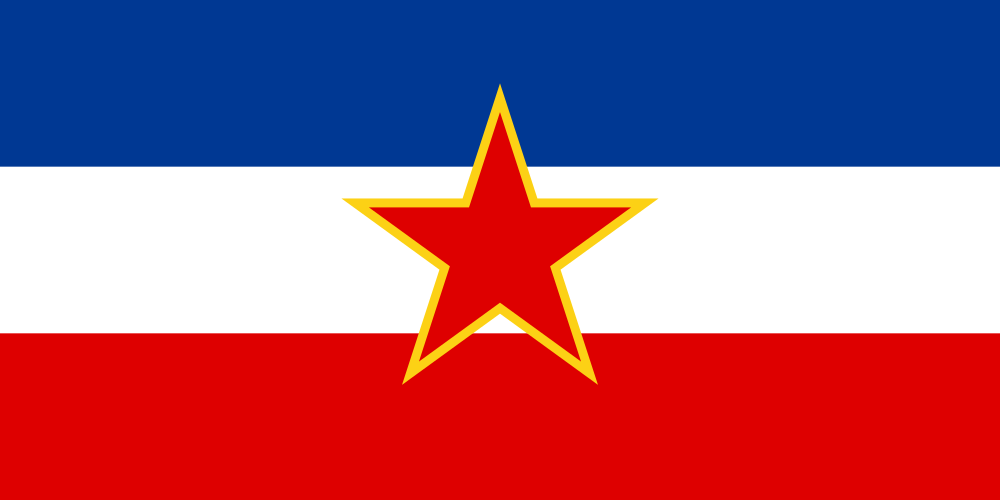
translated from French): During the past few months and weeks, the Government of the Federal People' s Republic of Yugoslavia has on several occasions, through its representatives and inofficial documents, stressed the critical situation with which the United Nations andthe whole world will be faced if the Organization's mistaken policy in the Congo is persisted in, if the foreign colonialist intervention in that country continues to be tolerated, and if the measures required to restore law and order and to safeguard the independence, sovereignty and territorial integrity of the Republic of the Congo are not adopted. Unfortunately, nO such measures have been taken. We find ourselves today in a position where, unless there is a marked and radical change in the policy and attitude of the responsible organs of the United Nations and unless measures are urgently and resolutely adopted bythe Security Council or the General Assembly, it seems inevitable that the most serious and sanguinary armed conflicts may break out in the Congo itself, and that the Congolese crisis will eventually spread and result in an international armed conflict.
2. Responsibilities for such a situationare great, and they are well-known to aIl. Belgium's intervention in the Congo with the support of other colonialist Powers and interests; the activities of the agents ofthis intel'- vention in the Congo and, at the same time, the entirely mistaken and dangerous policyofthe responsible officiaIs of the United Nations, which has led twenty thousand men under the United Nations Command in the Congo to become passive observers ofthe colonialist intervention, of the usurpation of power by illegal and anti-constitutional groups, of the acts ofterrorist violence committeci against the national political movement and its leaders, and of the division of Congolese national territory-these are aIl the facts which have led to the present situation.
4. In this connexion. 1 should like to quote a passage from a letter addressed by the Yugoslav Government to you, Ml'. President, and which bears the signature of Ml'. Popovié. the Yugoslav Secretary of State for Foreign Affairs:
"This crime is, without any shadow of a doubt, an act of the clique Tshombé-Mobutu-Kasa-Vubu. which is in the direct service of foreign interventionists, primarily Belgium.
"The Government of the Federal People's Republic of Yugoslavia concludes that this hideous crime represents an attempt ta legalize the lawlessnesf:! which has been consistently spreading in the Congo since the beginning of the armed action of Belgium, concurrently with constant foreign intervention in this country. At the same time, this crime is a flagra..'lt expression of the intention to give rise to civil war in the Congo. and, as an act of international provocation. it threatens to cause broader international complications.
"The Government of the Federal People's Republic of Yugoslavia considers it its dutY to state that the responsibility for such a tragic course of events in the Congo is borne by aIl thosewho, in spite of manifold warnings, permitted developmentstotake sucha course.
"United Nations organs, chargedwiththefulfilment of the United Nations mission in the Congo, share a full measure of this responsibility. This responsibility is aU the greater in the light of their actions and errors which have damaged the prestige ofthe United Nations." [S/4701.]
5. A number of arguments have been heard here in support of the theory that the policy of the United Nations in the Congo has been correct. But there is a Latin proverb which says contra facta non valent argumenta. The facts are known to aIl. None of the resolutions adopted by the Security Council and the General Assembly has been implemented. The present situation and aIl the results achieved in the Congo are in complete and flagrant contradiction withthe aim set forth in our Organization' s resolutions.
6. 1 further wish to stress that, in the considered opinion of my delegation, the Secretary-Generalofthe United Nations also bears a large share ofthe responsibility for the failure of the United Nations mission in the Congo, for the events which have occurred in that country, and for the tragic situation at present prevailing there.
7. In the present critical state ofaffairs, the Yugoslav Government regards it as particularly important to try
8. It is well known that the Yugoslav Government, in conjunction with the Governments of other countries in Africa and Asia, has made broad and general proposaIs with a view to finding a solutionfor the situation in the Congo. Subsequent events have shown thatthese proposaIs were justified; they have also shown that it is only on those bases that itwill be possible to restore law and peace inthe Congo, and also the prestige of the United Nations in international relations.
9. The Yugoslav Government considers that, in the light of the new situation thus created, these are still the only solutions which, from a higher standpoint, can enable peace to be restored inthe Republic of the Congo and throughout the African continent. Inthis connexion, however, my .delegation wishes to stress certain measures which it regards as of such exceptional importancè that any delay in taking them might be fatal to any development of the Congolese crisis and to the future of the United Nations itself.
10. First, it is essential to avoid a civil war in the Congo. The ·armed groups under the orders of Kasavubu, Mobutu, Tshombé, Kalonji and the like must immediately cease their activities and must, at the very least, retire to the positions and bases from which they began their terrorist action.
11. It is the dutY of the United Nations Force in the Congo to see that the steps aimed at the elimination of the mercenaries of colonialist intervention are urgently put into effect. A general offensive by these bands would, without any doubt, mean the beginning of a general civil war in the Congo. AlI armed action directed against the Congolese people by the colonialist mercenaries who have been completelydiscredited and have lost eventheshadowoftheirso-callediegality, as a result of their illegal and anti-constitutional actions and more particularly of their direct and open participation in the murder of the national leaders, must here and now be rendered impossible.
12. In addition to this urgent measure, it is equally essential, in the opinion of my delegation, to disarm completely all the armed bands of Tshombé, Mobutu and Kalonji, whichare serving the Belgian colonialists. It is obvious today that no return to legality in the Congo is conceivable without the dissolution of the bands who have placed themselves in the service of colonialist intervention.
13. Secondly, it is necessary that all themilitaryand para military personnel, first Belgian and thenforeign and which does not belong to the United Nations Force in the Congo should be immediately eliminated and evacuated.
15. My delegation is of the opinion that the shortest possible time-limit should be fixed for this withdrawal. Simultaneously, the United Nations Command in the Congo should be instructed to see to it, by aIl available means, that this evacuation takes place. If Belgium did not comply with this demand, just as it failed to reply to the appeals previously made to it pursuant to the Security Council and General Assembly resolutions,' in my delegation' s view, effective sanctions should, be taken against Belgium in accordance with the United Nations Charter.
16. The problem of colonialist intervention in the Congo is not, of course, confined to the question of the presence of foreign military and para military personnel in that country. However, these people-particularly the Belgians and the foreign legion in Katanga -at present represent the most aggressive aspect of that intervention, and the greatest danger to peace in the Congo and to the freedom and independence of the Congolese people.
17. My Government insists on the immediate withdrawal of the military and para military personnel and of the so-called Belgian political advisers in the Congo. The word "immediate" is used, by my delegation and several other delegations, to denote an evacuation which must be carried out and completed within the next few days. To avoid any misunderstanding, l must say that what we request is not another resolution on the withdrawal of Belgian personnel. No. We require the urgent evacuation of all the Belgian personnel that we have just mentioned. l should stress that, until the Belgian personnel has been withdrawn, it will be P9intless and ineffective to ask other countries to prevent the dispatch and transit of personnel to the Congo.
18. Lastly, my delegation deems it essential that the United Nations should undertake without delay a thorough and impartial inquiry into the murder of Prime Minister Lumumba and his colleagues, in order not only to determine what the actual facts are but to identify aIl the persons responsible for this cruel and repulsive deed. All those who are guilty should obviously be punished for the crime which they have committed. My delegation is firmly convinced that such an inquiry would help to lay the basis for future political stabilization in the Congo, since it is obvious that those who are guilty of the murder of Prime Minister Lumumba and his colleagues cannot, in view
19. My delegation is convinced-and this opmlOn is shared by many other delegations-that, concurrently with these emergency measures, other steps are essential of which the most important and urgent would be to enable the Congolese Parliament to resume its unusual activities.
20. Those who think that so-called round table conferences, or the so-called expansion of the so-called Iléo Government, would be calculated to resolve the Congolese crisis are gravely mistaken. AlI efforts of that type will be in vain, and for a simple reason: they represent m~moeuvresof colonialist forces. There is no doubt whatéver about that. What they amount to is not an attempt to bring the Congolese people together, but a conspiracy of the Belgian colonialists and their agents, Tshombé, Mobutu, Kasa-Vubu and others.
21. We are not asking for the adoptionofa new resolution merely for the pieasure of adding one more to the list of resolutions on the Congo; we are asking that suitable measures be taken immediately and without delay. That, in the opinion of my delegation, is the minimum which can be done. At the sametime, such a decision would enable us to register a decisive and positive turning-point towards a new roleoftheUnited Nations in the Congo.
22. The reasons which have ledtheYugoslavGovernment to suggest these measures are based on its legitimate and well-known interest in the fate and freedom of the Congolese people, its desire to see peace and security maintained inAfrica and throughout the world, and its profound anxiety about the future of the United Nations, whose purposes and principles have, as everyone knows, been adopted sincerely and unreservedly by the Yugoslav people.
23. If the Security Council did not take these minimum measures, that would be equivale.ntto total capitulation in -the face of the Congolese crisis, andwould open the way to the most ser~ous eve'lts in that country. Thus my délegation appeals to aIl members of the Security CouncH asking them totrytoreachanagreement without delay on the measures suggested. The mere fact of adopting an emergency resolution would obviously not mean the end of the great and serious tasks which the United Nations must face in connexion with the Congo situation. Such a resolution would, for the first time since the beginning of the Congolese crisis, bear only on the preliminary conditions essential to the serious tackling of the tasks thus specified.
25. In conclusion, l should like to state that if the Security Council does notfulfil these hopes-which are, l am sure, those of all humanity-the delegationof the Federal People's Republic of Yugoslavia considers that, as a last recourse to the United Nations, a decision should be taken to calI an emergency special session of the General Assembly, in order that the whole international community may make further efforts to find, after seven months of crisis in the Congo, the necessary solutions for that crisis.
26. MI'. DADET (Congo, Brazzaville) (translatedfrom French): Yesterday, at the conclusion ofmy statement [937th meeting, paras. 37 to 82], the representative of Guinea asked me a number of questions [ibid., paras. 95 to 105], almost all of them concerned the position by my country took in regard to the present situation in the former Belgian Congo. MI'. Diallo Telli ended his remarks in telling me [ibid., para. 106] that he saw no objection tomyreplyingto bim at some other time, so that l might he enabled to consult my technical adviser.
27. Before replying to the representative of Guinea, with your permission, l should like to make a brief comment.
28. l shall begin by pointing out to the representative of Guinea that he and thosewho reasonas he does know full well that l am not in any special need of a technical adviser in order to tell the truth, and that l am perfectly capable, without assistance, of stating what is true. Moreover, l have no technical adviser.
29. Of course, there are various kinds of technical advisers. There are those from whom OD") derives instruction in Prague, Moscow or Peking, as the case may be. There are those who can materially help you to change yourself so radically that you end by losing all your individuality. There are technical advisers who watch what you say so as to establish whether it conforms with the dialectics of a certain school which has nothing African about it-and l could give many other cases.
30. The representatives of Guinea like to indulge in witticisms when they are short of arguments. Thus MI'. Diallo Telli referred ta me yesterday as an apt pupil. He even spoke of co'.\1 lonal freedom.
31. Guinea and its good friend and associate Ghana-it appears that they have been suspicious of one another lately-have long set themselves up as the authentic,
32. In arder ta enlighten Africa, to warn it of the peril in which the Guinean adventurers seek ta place it, we do not need to resort to the sordid methods which the men of Conakry always employ. AIl the peoples of Africa will soon know the truth-the whole truth.
33. Ml'. Diallo Telli, onedoesnotforsakeaparticular master only to throw oneself stupidly into the arms of another, dangerously rapacious one, and then claim to have achieved independence. Nor does one then proceed, blatantly, to refer to others as enjoying only "conditional freedom". You are not free, Ml'. Diallo Telli! What simple-minded people are you trying to convince?
34. In the case of both Guinea and Mali, sorne of us here have decided ta put them in their place whenever the need arises, for Africa never has been, and never will be, the bailiwick of the men of Conakry, Bamako or Cairo. The Africans whose countries serve as a spring-board for Moscow-and that with their deliberate consent-have flung tao many insults in our faces for us to continue to remain in a state of blissful expectation, with folded arms.
35. But let us return ta our topic Ml'. Diallo Telli, l am now going to answer the questions which you were constraïned ta ask to arder ta save the face of sinister communism.
36. Tt is correct that President Fulbert Youlou recently went ta Katanga. He is a Congolese who simply went ta visit another Congolese. As l told you yesterday, President Fulbert Youlou is one of those who, in the heart of Africa, are labouring unceasinglyto bring about a reconciliation between fellow-Africans-those same brother-Africans whom the Guineans and other crypto-communists have so pitted against each other that their disagreement cost the llie of Patrice Lumumba. Tomorrow we shall know who the responsible are for the disappearance of Lumumba. President Fulbert Youlou went to Elisabethville on a mission very far removed from the one you gratuitously ascribed ta him. You will saon learn the results of that mission, for truth will out.
37. Ml'. Diallo Telli, l shall saon in turn be asking you in my turn ta tell me whether Brazzaville has already sent a plenipotentiary ta Elisabethville thus implicitly recognizing the State of Katanga. You will have ta give me a reply sooner or later on that subject. You yourself recognized one whom you would have described as a puppet, a marionette or an agent of the colonialists, li he were not in your camp; l refer to the pOOl' and versatile Gizenga, of whomwe shall soon be hearing in the United Nations, as events are moving rapidly on the left bank of the Congo.
38. 1 will also confirm ta you, Ml'. Diallo Telli, that President Fulbert Youlou did in fact receive Ml'. Tshombé last December attheBrazzaville Conference with the honours ta which you refer; but please wait until the day when we recognize Katanga as a sovereign State before you take the liberty of accusing us publicly on that score.
40. You have alluded to our position on the question of Algeria. But what connexion is there between the Algerian problem and the situation in the Congo (Leopoldville) ?
41. Ml'. Diallo Telli, please allow me to ask you a friendly question concerning the funds we are alleged to have received in Brazzaville for the purpose of paying hired "assassins". Such a question would also be of interest to your "hired informers".
42. Ml'. Diallo Telli, could not the Guinean intelligence machinery supply you with irrefutable proofs concerning plots like the one in which, according to you and your friends, President Youlou was implicated, a plot which resulted in the elimination of Patrice Lumumba? l know that the Communists are past masters in that respect and have no difficulty in exhibiting photostatic documents which settle everything. May l ask therefore that youpresentus with the photostat copy, first of all of the cheque said to have been delivered in Paris or Brussels for transfer to Brazzaville; secondly with the photographs of the aireraft which landed at Brazzaville and carried arms and ammunition for Mobotu and Tshombé; l:hirdly with the photograph of the camp where the Belgian general staff is allegedly located, and the photograph of Belgian soldiers and officers whom President Fulbert Youlou is said to have welcomed to his country' s territory. 43. It is not enough for Ml'. Diallo Telli to tell us that the conspiracy-which, according to him, is centred in Brazzaville-was carefully and meticulously planned. That is not convincing. You must prove it, Ml'. Diallo Telli, and prove it publicly. Mathematics is an exact science and proceeds by way of demonstration as you should know, Ml'. Diallo Telli.
44. As far as the cheque is concerned, assumingthat the transactions went through the regular banking channels, l should like in turn to do Ml'. Diallo Telli a service, not as a voluntary informer, but as a brother African. l should like to informhimthat at Brazzaville there are six banks: the Banque africaine occidentale, the Banque nationale pour le commerce etl'industrie, the Crédit yonnais, the Banque commerciale africaine the Banque centrale and the Société générale. Towhich of these banks was the cheque remitted?
45. In conclusion, l should like to remind the representative of Mali that the echo ofhis mumblings by way of right of reply has already reached Brazzaville and that we shall try to see to what extent we can assist Mali, which is visibly getting into greater and greater difficulties.
46. Finally, let me, as an African, address a word of warning to those boisterous and thoughtless twins, Guinea and Mali. There are certain "apt pupils" who are very soon going to show you that you are not the only ones in Africa entitled to speak on Africa' s behalf, and that the timewhenyoucouldallow yourselves
48. Moreover, the solution resulting from such a meeting of all thG African nations, heldwith the object of drawing up a plan for the final settlement of the Congo question would not be entrusted to the United Nations Conciliation Commission for implementation. It would ba for the leaders of the African nations together to determine ways and means whereby this solution can be put into effect.
49. 1 therefore renew my country' s request that at the end of this discussion any definitive settlement of the Congo question 'be postponed and that the problem be referred, for study, to the General Assembly during the second part of its füteenth session.
50. There is something, however, that needs to be settled immediately in the Congo-the question of famine and disease. We consider that the United Nations should use every means at its disposaI to check these two scourges as quickly as possible.

1 now callon the representative of Guinea in exercise of his right of reply.
52. Ml'. DIALLO Telli (Guinea) (translated from French): You will understand, 1 am sure, that it was with a feeling ofdeep sadness thatllistened to the man whom 1 yesterday called, and still call, my brother from the Congo (Brazzaville)-It is sad to see to what extent colonization can change the very nature of the colonized. 1 shall not reply to the insults which the representative of the Congo (Brazzaville), on behalfof interests that are not African, thought fit, in attacking the Republic of Guinea, to hurl atAfrican nationaliam, African dignity and our continent' s determination to secure complete liberation.
53. Nevertheless, 1 take note of the fact that either he recognizes the truth of what 1 said yesterday or, alternatively, that he prefers to resort to insult where arguments are lacking. 1 am convinced that the members of the Council and everyone here who has listened to the "technical advisers' speech" have already formed their own conclusions.
54. As for myself, the representative of Guinea, 1 merely wish to say that, engaged in the struggle for an ideal, for a just and noble cause, 1 shall not expend my efforts, faith or determination on personal recriminations and sordid bickerings, especially between brothers. Yesterday, 1 already haà occasion to tell my unfortunate Congolese brother that, once his country escapes from the colonial system and the Congo moves
55. Ml'. DEJEAN (Central African Republic) (translated from French): First of aU, on behali of the Government of the Central African Republic, l should like ta thank this Counc!! for having invited the Republic' s Minister for Foreign Affairs ta participate in the debate on the situation in the Republic of the Congo (Leopoldville). May l further take advantage of this opportlmity ta associate myself with the speakers who have preceded me in extending ta you, Ml'. President, my sincere congratulations on your assumption of the prc;\dency of the Council and ta e>..-press ta you my enrnest wishes for the complete success of yourwork in guiding the discussions of this important United Nations organ. Lastly, l should like ta e:ll.iend my cowltry' s friendly greetings ta a distinguished new member of the Council, Ml'. Adlai Stevenson; he brings with him the experience of a manwho has witnessed the almost incredible development of the contemporary worId and who is therefore a firm believer in the ideals of the United Nations.
56. You will readily undel'stand that some of my country's interests may be affected, if they have not been affected already, by the drama which is being enacted in the Republic of the Congo (Leopoldville), when l say that, across the 1,500 kilometres of artificial frontier which separates them, the Central African Republic is closely linked ta the Republic of the Congo by ethnic and linguistic ties. Rence, at a juncture graver than ever before, when the Congolese drama is degenerating into an appalling tragedy, my cowltry cannat remain aloof from a search for the constructive solution which alone will make it possible ta bring national reconciliation ta a torn and divided Congo, where the maintenance of international peace and security is seriously endangered.
57. There can no longerbeanydoubtaboutthe Congo- Iese tragedy. The murder of a man who was to some an African nationalist and ta others the Ieading actaI' in this tragedy speaks for itself. Patrice Lumumba, former Prime Minister of the Republic of the Congo (LeopoldvHle), is dead and, with him, two ofhis faithfuI associates, Joseph Okito and Maurice Mpolo.
58. The Government and people of the Central African Republic deeply deplore the tragic death of these three politicai leaders of the Congo, and extend ta their country and to their grief-stricken families an expression of heartfelt sympathy. The Government of the Central African Republic hopes that an impartial investigation will be undertaken to ascertain who was responsible for these murders and, on that basis, to enable the appropriate steps to be taken.
59. The murder of Patrice Lumumba and his companions has come at a time when certain delegatiç:ms are clamouring, on behalf ofwhat they calliegality, for the immediate liberation of the political prisoners, the immediate convocation of the Congolese ParEament, the Immediate withdrawal of aIl Belgian milital'y and para military personnel and technicians, and the neutralization of the troops of the Congolese National Army.
61. While most States Members of the United Nations have keenly deplored the inhuman treatment accorded to Lumumba and his companions, many of them also feU that a thorough investigation should be made of the brutal acts, violence and murders which the local supporters of the former Congolese Prime Minister were committing against certain persons, both Cong'Olese and non-Congolese, Ùl Kivu and Oriental provinces, where everyone has the right to lüe, liberty and personal security.
62. The Government of the Central African Republic relies on the United Nations to see that light is cast upon the extortions and violence that are given free rein in those areas where de facto local authorities hold away.
63. 80me Member States have also been indignant at the fact that paragraph 2 of the Security Council resolution of 22 July 1960 [8/4405], which requested "aU States to refrain from any action which might undermine the territorial integrity and the political independence of the Republic of the Congo" , has not been observed.
64. Th~ failure of the authorities of the United Arab Republic to comply with this resolution, ifproved to be flagrant, would be aU the more serious in the light of the fact that the General Assembly, at its fourth emergency special session, had considered it necessary to state its position unequivocaUy in resolution 1474 (ES-IV) of 20 September 1960, in the foUowllg words: "The General Assembly, " "6. Without prejudice to the sovereign rights ofthe Republic of the Congo, càUs upon all States to refrain from the direct and indirect provision of arms or other materials of war and military personnel and other assistance for military purposes in the Congo during the temporary period of milital'y assistance through the United Nations, except upon the request of the United Nations through the Secretary- General ..."
65. It emerges, from a report by the Secretary- General' s Special Representative in the Congo [Si 4630], that a United Arab Republic aircraft of the Ilyushin 4 type landed at Lisala on 31 December 1960. The Central African Republic has taken note of the inquiry opened in that connexion by the Secretary- General' s Special Representative in the Congo, for it thinks that both the letter and the spirit of the Council' s decision, as made more explicit by the United Nations Assembly in emergency session, should be respected.
66. Lastly, several Member States, including the USSR, have spoken of further aggressive acts by
"... already on 8 October of last year ..• 1 addressed myself to the Government of Belgium andto Ml'. Tshombé, pointing oùt the necessity to eliminate the Belgian political element in the Congo. 1 do not remember that 1 got any active support from any Member country or from any organ of the United Nations for that stand at that time. 1 was attacked violently by Belgium and by various leaders in the Cong'O. 1 still hold the same view, for which 1 have been trying to get respect all through these months, alas without effect. It is still, in myopinion, as essential a need as it was in the early autumn. May 1 now hope that it may gain the moral support of this Council?" [935th meeting, para. 30.]
67. My Government, for its part, entirely shares the view which the Secretary-General expressed the day before yesterday, and gives himitsfullmoralsupport. It will not be possible to restorepeace in the Congo or to settle the Congolese problem except in so far as Member States refrain from furnishing any unilateral assistance outside of the United Nations. Belgium' s discourteous attitude with regard to the Charter of an Organization to which it has freely and formally subscribed constitutes a grave precedent, whose consequences for the Congo are now known to aIL At long last the time has come for Belgium to withdraw its men from Katanga, without any further shuffling. If it did so, Belgium would show the world in general and Africa in particular that it intended to make an effective contribution to the restoration of public order and internaI security in a free, independent and sovereign country. It would also prove its determination to make its full contribution to the maintenance of international peace and security.
68. The Government of the Central African Republic finds it inconceivable, and inhuman, that great nations, after helping the African States towards emancipation, should destroy their own humanitarian work by inciting, for unavowed reasons, Africans to killotherAfricans.
69. As for the African and Asian States which have hitherto consistently shown a humanitarian concernfor the fate of the young Republic, there can be no doubt that for them, as for everyone else, the time has come to think of the lives of 14 million Congolese over whom hovers the menacing shadow of an imminent and irreparable civil war.
70. In the opinion of the Central African Republic, African solidarity cannot and should not be marked by conflicting positions or by incitements to fratricidal wars. On the contrary-those ofus who claimto be true Africans know how well Africa is aware of the usefulness and necessity of f6rming a solid and coherent bloc which will serve as a counterweight in the compe-
71. Mention has been made of military assistance to the Congo. Is there any needfor me to recall that such proposals contravene the United Nations resolution providing that the world Organization must be consulted before the dispatch of any forces to the Congo? Demands are made. it will be remembered, that the Congolese troops should. be disarmed and disbanded. Is it forgotten that the possession of armed forces is one of the attributes of Congolese national sovereignty? Or is it sought to encourage rebellion and to hasten and complete the Balkanization of the Republic of the Congo'sterritory? The solution to the tragic situation of the Congo lies neither in the disarming and disbanding of the Congolese National Army by the United Nations, nor in unilateral military assistance outside the United Nations. Either type of action would constitute clear interference, contrary to the United Nations Charter and to the recommendations made by the Security Council and the General Assembly.
72. The present juncture in the tragedy of the Congo should give the world 'food for thought, should induce the United Nations to revise its policy of technical and military assistance, and should bring the other African States to ponder ways of providing a prompt, effective and drastic remedy.
73. While the United Nations has certainly given military and technical assistance to the young Republic in its growing-pains, there has no less obviouslybeen a certain lack of effectiveness in the Organization' s action at the very moment when the situation in the Congo called for a definite measure of vigilance and firmness. My Government has keenly deplored this state of affairs, which has inevitably impaired the authority and influence of the United Nations.
74. In any case, the presenthour is grave and critical indeed. Time has come for a rapid but appropriate decision, with a view to finding an adequate and effective remedy for the ills which unfortunately have lasted aIl too long.
75. It would seem, to my Government, that the tragedy of the Congo (Leopoldville) demands an African solution. Where should such a solution begin and end? Clear-thinking and fair-minded African Heads ofState have repeatedly made their suggestion: the United Nations should keep its hands clean with regard to aU questions of African domestic policy, which are, as they have frequently said, a family affair.
76. Thus Mr. David Dacko, the President of the Central African Republic, thinks for his part that, instead of a round-table conference, whichwould already seem doomed to failure, the African solution to the Congolese problem should be achieved by the Congolese leaders themselves, and that aU the African States should cooperate in arriving at such a solution.
78. The Government of the Central African Republic considers that the African solution to the Congolese problem lies in consolidation of Ml'. Kasa-Vubu's authority in deliberations by the two Congolese Assemblies provided for in the "Loi fondamentale" , with a view ta equipping the country with the structures which it now lacks. The Congolese leaders could then turn, for technical or militaryassistance, to whichever States they selected.
As 1 have no more speakers on my list for this afternoon, Iproposenow to adjourn the meeting, unless 1 hear objections.
80. Ml'. STEVENSON (United States of America): We understand that a report was received yesterday by the Advisory Committee from the Chairman of the Conciliation Commission, which was unanimously approved by the members of the Commission and that it is intended for the information ofthe Security Counci!. We understand that it embraces the conclusions ofthe Commission and was forwarded at this time because of the importance of these meetings of the Security Council to the Congo.
81. We also understand that this report contains the conclusions of the members on many subjects that we are here considering, such as the prevention of civil war, the release of prisoners, the convening of the parliament, the possible future political structure of the Congo and the retaining of the Congolese army. It is also our understanding that the Advisory Committee met yesterday in connexion with this report.
82. The Commission was established, lwouldremind members of the Council, under the authority of the General Assembly so as to encourage conciliation in the Congo. We in the Security Council are also charged with the restoration of peace and security. We are seeking the same ends, it seems to me, and we need aIl available advice. Obviously a report, whether this report is in preliminary or final form, prepared by representatives of Members of the United Nations who have been on the spot in the Cargo for more than six weeks is of vital importance to our consideration. 1 would therefore like to ask when we can expect this report to be distributed to the members of the Security Council.
84. As it was impossible to reach a decision in the course of the meeting of yesterday, the question was shelved for the moment, especially in view of the fact that the Conciliation Commission had also informed me that they had the intention of sending a message regarding the assassination of Ml'. Lumumba. This later message was received today and it has been circulated to the members of the Advisory Committee. In accordance with what l undel'stand to be the view of the Advisory Committee, l have asked the Committee to reconvene tomorrow at Il a.m. That is, for the moment, aU the information l can give regarding the status of this paper.
85. Ml'. ASHA (United Arab Republic): l very much regret to take the floor aiter the President has announced his intention of adjourningthemeeting, butmy silence would have been interpreted as meaning that l accepted certain aUegations and accusations leveled at my country in the course of the debate yesterday and the day before, and again this very afternoon. l am referring in particular to statements made bythe representative of the Central African Republic. l do not wish to go into the details of these allegations, which are entirely false from A to Z. My colleague Ambassador Loutfi made a statement to the Council at its 932nd meeting and explained the question of the aircraft. For the benefit of the representative of the Central African Republic, whom l have not previously had the pleasure of seeing here in the Council, l would refer him to the verbatim record ofthat meeting and l would also like to read to him a quotation from it. Ml'. Loutfi said:
fi The authorities of the United Arab Republic, through its delegation to the United Nations, had previously requested from the Secretariat authorization to send by air to Lisala a repair crew to repair another aireraft which had had an accident at the Lisala air-field, and permission for this team of technicians to saIvage the undamaged parts of the aireraft in accordance with the advice of an international technical expert. ft [932nd meeting, para. 129.]
86. l am very astonished that this kind of allegation should be made time and again in this Council, even by certain members. Of course, nobody is going to take them seriously; at least we ourselves do not take them seriously.
87. Another allegation referred to the question of furnishing certain Congolese people with supplies. The proof l can give you is that the Government of the Sudan has entirely denied the truth of 'A 0: allegation. Therefore, l hope that our friends w,",; from time to time wish to criticize and accuse us will be more careful to
89. Ml'. BEN ABOUD (Morocco) (translated from French): 1 do not propose to make a speech. 1 merely wish to draw attention to thefollowingfact: The United States representative has just said that the report he has mentioned had been unanimously approved. This morning, however, we received a note from the Secretary-General giving the names of the members who were present and of those who were absent. Morocco and Senegal were among the absent. Iwished to point this out after hearing it stated that the report had been approved unanimously.
90. My delegation is now studying this report, and aIl that can be said at present is that the report was not unanimously approved, Morocco and Senegal having been listed as "absent" .
Speaking as representative of the UNITED KINGDOM, perhaps 1 may say that 1 too had heard of the report issued by the Conciliation Commission and it seems to me that the debate in the Security Council would be helped enormously if we could, at some stage, see that report. We have been reminded on several occasions by speakers around this table that this may be the last occasion' when the Security Council will be able to make a contribution to the Congolese problem. In that event, it seems to me that a report from a body which was sent out by the United Nations, and which apparently deals with many subjects now being discussed around this table, should, if possible, be made available to us at an early date.
92. Speaking now as PRESIDENT of the Security Council, 1 should like to say that since there are no other speakers on the list of speakers, 1 propose to adjourn the meeting. It may be convenient, in view of what we have heard, for ournextmeetingto take place on Monday.
93. Ml'. PADMORE (Liberia): 1 should once again like to stress to the members of the Security Counr '.1 the importance and the critical nature of the crisis in the Congo. It would be very difficult for me to explain to the African countries, which 1represent, the reasons for these continued delays on the part of the Counci!.
94. In my statement this morning 1 mentioned that we had great doubt as to the effectivenessofthe Conciliation Commission, in view of the present situation in the Congo. We believe that there has been sufficient expression of public opinion in our respective countries, especially in the African countries, to demonstrate how much the Congo crisis has affected them.
95. 1 should like to remind the members of the Security Council that there have been other incidents which resulted in round-the-clock meetings of the General Assembly, and in this respect 1 may refer to the revolution in Hungary. It does seem inconsistent
97. The task of the Conciliation Commission was to achieve conciliation among the main political groups and the main political leaders in the Congo. But one of those leaders and two of his colleagues have now been killed. Those with whom the Conciliation Commission was to reconcile the other political leaders are no longer on the scene, and it is not quite clear what the task of the Conciliation Commission now is; any proposaIs based on the situation as it existed before that tragic event would obviously be of doubtful value. Therefore, it seems to usthatthekeen awaiting of that report is not altogether justified by the facts; in any case, a's the representative of Liberia has rightly indicated, there are no grounds at all for once again postponing a Security Counci! meeting designed to arrive pJ a decision.
98. We have had full discussions, and the various points of view have beenmade sufficientlyclear. There is a draft resolution which was submitted at the very beginning of the debate, and a full discussion of that draft resolution is justified.
99. Accordingly, in the interests of our businesslike procedure, and bearing in mind the comment Ml'. Stevenson made in his first statement in the Security Council at the beginning of the discussion, that he was prepared to work night and day in order to reach an acceptable solution [934th meeting, para. 63], it seems to me that we ought to hold a meeting this evening so as to conclude the discussion ofthe question today and to adopt a resolution, a basis for which already exists in the draft resolution [S/4706] submitted by the Soviet Union. If there are other proposaIs, we are prepared to debate them also, in order to complete the discussion of the acute political crisis at present existing in the Congo and to adopt speedy measures to resolve it.
100. Hence 1 fully endorse the views ofthe representative of Liberia, and think thatwe shouldnot postpone completion of the Council' s work on this question until Monday, since we ca.n easily finish discussion of the question today, if we hold a me'eting this evening.
101. Ml'. ASHA (United ArabRepublic): Mydelegation shares the views just expressed by the representative of Liberia and the representative of the Soviet Union with regard to the urgency of the item under discussion, We believe that the Security Counci! must take immediate action to spare the Congo further hardship and chaos. We are of the opinion that the Council must act without unnecessary delay and do aIl in its power to


We wouldourselves like to read the report ofthe Conciliation Commission, but there is no definiteness as to when this report will be available to us. In viewoftheurgency of the matter now under discussion, my delegation is inclined to believe that it would be dangerous to delay any further meetings of the Council until that report is available. However, as delegations are probably aware, another draft resolution is being prepared and it is likely to be tabled quite soon. In view of this factor, 1 suggest that instead of meeting tonight, we meet tomorrow morning and dispose of the question tomorrow if we possibly cano
May 1 ask the representative of Ceylon whether he has made a formaI proposaI that there should be a meeting tomorrow morning?
Yes,Imakeaformal proposaI.
1 shall now put that formaI proposaI to the vote.
A vote was taken by show of hands.
The proposaI was not adopted, havingfailed to obtain the affirmative votes of seven members.
In the absence of any other formaI proposaI to the contrary, the next meetingwill take place at 10.30 on Monday morning.
lOS. Mr. ZORIN (Union of Soviet SocialistRepublics) (translated from Russian): Excuse me, Mr. President, but, on a point of order, if one proposaI has not been adopted, the second proposaI must be put to the vote.
1 am sorry if the representative of the Soviet Union misunderstood me. 1 made no formaI proposaI that we should meet on Mondaymorning. 1 merely suggestedthat the Council might consider that the hest moment to meet.


Ml'. President, if you did not make a formaI proposaI that the meeting should be postponed until Monday, then the meeting formally continues.
The formaI position, as 1 understand it, is that 1 have no further speakers On my list and no formaI proposaI has yet been made for the date to which we should adjourn.
112. Ml'. PADMORE (Liberia): 1 am only intervening because the main issue at stake is the interest of Africa and ta us this is very important, this is very urgent, and danger is imminent. 1 therefore propose formally that we should meet tomorrow afternnoon at three 0'clock.
It has been formallyproposed by the representa~ive of Liberia that this meeting should be adjourned untilthree 0'clocktomorrow afternoon.
114. Ml'. TSIANG (China): If we could promote the cause of peace in the Congo by meeting tonight, tomorrow morning and tomorrow afternoon, my delegation would be more than glad to come here and meet. It appears to me that further meetings tonight or tomorrow would not promote the cause of peace in the Congo.
115. To be sure, we have had the Sovietdraft resolution [S/4706] from the very beginning of this debate. It is obvious that a vote on that draft resolution would not produce a solution. Now we have a new draft resolution which has just been placed before us conjointly by Ceylon, Liberia and the United Arab Republic [S/4722]. It S8ems to me that this draft resolution deserves careful consideration. So far as my delegation is Cûncerned, 1 would like to cable the substance of this draft resolution to my Government right away, but if we were to meet tomorrow afternoon, Iwould not be in a position to take a stand on the draft resolution. Therefore, it seems to me that for the cause which we all have at heart, if our next meeting were to be scheduled on Monday, we would not be Iacking in zeal or in fact be doing a disservice to the cause.
116. Ml'. ZORIN (Union of Soviet SocialistRepublics) (translated from Russian): 1 am somewhat surprised at the view which has just been expressed concerning the matter of receiving instructions. We can in fact, quite easily, get in touch withourGovernments, within twenty-four hours, and receive aIl the necessary instructions oil such an urgent matter, and 1 do not quite understand how the gentlemanwho has just spoken on that question knows beforehand that he will not
118. In any case there are no grounds for supposing that we cannot receive instructions from our Governments within twenty-four hours-none. Ifthere are any other motives for postponing the meeting, it would be interesting to hear what they are. But the formaI reasons which have been advanced have, in my view, no justification whatever.
119. Accordingly the delegation of the Soviet Union entirely endorses the proposaI submitted by the representative of Liberia, and will vote for the holding of a meeting tomorrow at 3 p.m.
There are two proposaIs before the Council. The first is that we should meet tomorrow afternoon at 3 p.m., and the second that we should meet on Monday at 10.30 a.m. l propose to put those two motions to the vote in that order. We shall now vote on the proposaI made by the representative of Liberia, that the Council should meet again tomorrow at 3.p.m.
A vote was taken by show of hands.
In favour: Ceylon, Liberia, Union of Soviet Socialist Republics, United Arab Republic.
Against: China.
Abstaining: Chile, Ecuador, France, Turkey, United Kingdom of Great Britain andNorthernIreland, United States of America.
The result of the vote was 4 in favour, one against, with 6 abstentions.
The proposaI was not adopted, havingfailed to obtain the affirmative votes of seven members.
l will now put to the vote the second proposaI, that we should meet again at 10.30 on Monday morning.
A vote was taken by show of hands.
In favour: Chile, China, Ecuador, France, Turkey, United Kingdom of Great BritainandNorthernIreland, United States of America.
Against: Union of Soviet Socialist Republics.
Abstaining: Ceylon, Liberia, United Arab Republic.
The proposaI was adopted by 7 votes to one, with 3 abstentions. Alexander Horn, baden. W. E. Saarbach, Kain (1). GHANA Uniyersity Boakshop, of Ghana, Legon, GREECE-GRECE Kauffmann Boakshop, Athénes. GUATEMALA Scciedad Econômico-Financiero, 14·33, Guatemala HAITI Librairie IlA la Caravelle", HONDURAS Libreria Panamericana, HONG KONG - The Swindon Book Kowlaon. ICELAND·ISLANDE Bokaverzlun Sigfusar F., Austurstraeti 18, INDIA·INDE Orient Longmans, dras, New Delhi and Oxford Book & Delhi and Calculla. P. Varadachary & Co., INDONESIA·INDONESIE Pembangunan, lId., Djakarta. IRAN '3uity, 482 Ferdowsi IRAQ·IRAK Mackenzie's Bookshop, IRELAND·IRLANDE Stationery Ollice, ARGENTlNA·ARGENTINE Editorial Sudamericana, S.A., Alsina 500, Buenos Aires. AUSTRALlA.AUSTRALlE Melbourne University Press, 369 Lans· dale Street, Melbourne C. 1. AUSTRIA·AUTRICHE Gerold & Co., Groben 31, Wien, 1. B. Wüllerstorff, Markus Sillikusstrasse 10, Salzburg. BELGIUM·BELGIQUE Agence et Messageries de la Presse, S.A., 14·22, rue du Persil, Bruxelles. 1l0LlVIA-llOLlVIE Libreria Selecciones, Casilla 972, La Faz. BRAZIL-BRESIL Livraria Agir, Rua México 98·B, Caixa Postal 3291, Rio de Janeiro. BURMA·BIRMANIE Curator, GoY!. Book Depot, Rangoon. CAMBODIA·CAMBODGE Entreprise khmère de librairie, Impri· merie & Papeterie Sarl, Phnom·Penh. CANADA The Qusen's Printer/lmprimeur de 10 Reine, Ottawa, Ontario. CEYLON·CEYLAN Lake House Bookshop, Assac. Newspopers 01 Ceylan, P.O. Box 244, Colombo. CHILE-CHILI Editorial dei Pacifico, Ahumada 57, Santiago. Libreria Ivens, Casilla 205, Santiago. CHINA·CHINE The World Book Co., lId.. 99 Chung King Road, lst Section, Taipeh, Taiwan. The Commercial Press, L1d., 211 Hanan Rd., Shanghai. COLOMBIA.COLOMBIE Libreria Buchhalz, Av. Jiménez de Que· sada 8.40, 8agata. COSTA RICA Imprenla y Libreria Trejas, Apartado 1313, San José. CUBA La Casa Belga, O'Reilly 455, La Habana. CZECHOSLOVAKIA. TCHECOSLOVAQUIE éeskaslc;venskySpisovatel, NarodniTrida 9, Praha 1. DENMARK.DANEMARK Ejnar Munksgaard, lId., N"rregade 6, Ktlbenhavn, K. DOMINICAN REPUBLIC. REPUBLIQUE DOMINICAINE Libreria Dominicana, Mercedes 49, Ciu· dad Trujilla. ECUADOR·EQUATEUR Libreria Cientifica, Casilla 362, Guaya. quil. EL SALVADOR~ALVADOR Manuel Navas y Cia., la. Avenida sur 37, San Salvador. ETHIOPIA.ETHIOPIE Internatianal Press Agency, P.O. Box 120, Addis Ababa. FINLAND.FINLANDE Akateeminen Kirjakauppa, 2 Keskuskatu, Helsinki. FRANCE Editions A. Pédane, 13, rue Saufllot, Paris (vel. GERMANY.ALLEMAGNE R. Eisenschmidt, Schwanthaler Str. 59, Frankfurt/Main. Elwert und Meurer, Hauplltrosse lOI, Berlin·Schaneberg. ISRAEL Blumstein's Bookstor~s, and 48 Nachlat ITALY·ITALIE Libreria CommissÎonaria Gino Capponi 26, Azuni 15/A, Roma. JAPAN..JAPON Maruzen Company, Nihonbashi, Tokyo. JORDAN·JO!lDANIE Joseph 1. Bahous Box 66, Amman. KOREA·COREE Eul·Yoo Publishing Chongno, Seoul. LEBANON·L1BAN Khayot's College 92.94, rue BIi.., Beyrouth. LUXEMBOURG Librairie J. Trausch·Schummer, Théâtre, Luxembourg. MEXICO·MEXIQUE Editorial Hermes, 41, México, D.F. MOROCCo-MAROC Centre de diffusion B.E.P.I., 8, rue Michaux.Bellaire, NETHERLANDS·PAYS-BAS N.V. Martinus Nijhoff, 9, 's-Gravenhage. NEW ZEALAND-NOUVELLE-ZELANDE United Notions Association land, C.P.O. 1011, NORWA'(.NORVEGE Johan "'rundt Tonum gusllgt. 7A, Oslo. Orclers ancl inquiries Irom countries not listecl oboye may he Litho in U.N. Priee: $U.S. 0.35: 2/6 stg: Sw. (or equivalent in other eurreneies) sent to: S"/es Sedion, Publishing Sevice, Unitecl Nations, New Yorle, U.S.A.; or Sales Sedion, United N"tions, Palais des N"tions, Genevo, Switzer/und.
The meeting rose at 5.30 p.m.
▶ Cite this page
UN Project. “S/PV.939.” UN Project, https://un-project.org/meeting/S-PV-939/. Accessed .