S/PV.9608 Security Council
Provisional
The meeting was called to order at 10.05 a.m.
Adoption of the agenda
The agenda was adopted.
The situation in the Middle East, including the Palestinian question

I would like to warmly welcome the Secretary-General, Ministers and other high- level representatives present in the Security Council Chamber. Their presence today underscores the importance of the subject matter under discussion.
In accordance with rule 37 of the Council’s provisional rules of procedure, I invite the representatives of Bahrain, Bangladesh, Belgium, the Plurinational State of Bolivia, Brazil, Chile, Colombia, Cuba, Egypt, India, Indonesia, Iraq, Ireland, the Islamic Republic of Iran, Israel, Jordan, Kuwait, Lebanon, Liechtenstein, Libya, Malaysia, the Maldives, Mauritania, Mexico, Morocco, Nicaragua, Nigeria, Norway, Oman, Pakistan, Panama, Peru, the Philippines, Poland, Portugal, Qatar, Saudi Arabia, South Africa, Spain, the Syrian Arab Republic, Thailand, Tunisia, Türkiye, Uganda, the United Arab Emirates, the Bolivarian Republic of Venezuela and Viet Nam to participate in this meeting.
I propose that the Council invite the Special Representative of the President of the Observer State of Palestine to participate in the meeting, in accordance with the provisional rules of procedure and the previous practice in this regard.
There being no objection, it is so decided.
On behalf of the Council, I welcome His Excellency Mr. Ziad Abu Amr.
In accordance with rule 39 of the Council’s provisional rules of procedure, I also invite the following individuals to participate in this meeting: His Excellency Mr. Cheikh Niang, Chair of the Committee on the Exercise of the Inalienable Rights of the Palestinian People; His Excellency Mr. Sven Koopmans, European Union Special Representative for the Middle East Peace Process; His Excellency Mr. Hossam Zaki, Assistant Secretary-General and Chef de Cabinet of the Secretary-General of the League of Arab States; and Mr. Nasser Kamel, Secretary-General of the Union for the Mediterranean.
The Security Council will now begin its consideration of the item on its agenda.
I give the floor to His Excellency Secretary- General António Guterres.

The Middle East is on a precipice. Recent days have seen a perilous escalation in words and deeds. One miscalculation, one miscommunication, one mistake could lead to the unthinkable: a full-scale regional conflict that would be devastating for all involved and for the rest of the world. The moment of maximum peril must be a time for maximum restraint. I want to reiterate my strong condemnation of the serious escalation represented by the large-scale attack on Israel launched by the Islamic Republic of Iran on 13 April. The use of force against the territorial integrity or political independence of any State, or in any manner inconsistent with the purposes of the United Nations, is prohibited under the Charter of the United Nations. And — as I stated earlier this month when I condemned the attack on the Iranian Consulate in Damascus — the principle of inviolability of diplomatic and consular premises and personnel must be respected in all cases, in accordance with international law.
It is high time to end the bloody cycle of retaliation. It is high time to stop. The international community must work together to prevent any actions that could push the entire Middle East over the edge, with a devastating impact on civilians. Let me be clear. The risks are spiralling on many fronts. We have a shared responsibility to address those risks and to pull the region back from the precipice. The way to do so is by advancing comprehensive diplomatic action for de-escalation in the Middle East.
It starts with Gaza. Ending the hostilities in Gaza would significantly defuse tensions across the region. I reiterate my calls for an immediate humanitarian ceasefire and the immediate release of all hostages held in Gaza. The horrific terror attacks on 7 October by Hamas and other Palestinian armed groups, which included mass killings, the use of sexual violence, torture and the taking of hostages, were an intolerable denial of humankind’s most basic values and a breach of the most fundamental rules of international law. In Gaza, six and a half months of Israeli military operations have created a humanitarian hellscape. Tens of thousands of people have been killed. Two million Palestinians have endured death, destruction and the
denial of life-saving humanitarian aid, and they are now staring down starvation. An Israeli operation in Rafah would compound that humanitarian catastrophe. The numbers of casualties are overwhelming and have no precedent in speed or scale during my time as Secretary-General. According to UNICEF, more than 13,900 Palestinian children have reportedly been killed in intense and often indiscriminate attacks.
All of that has happened with severe limitations imposed by the Israeli authorities on the delivery of humanitarian aid to people in Gaza, who are facing widespread starvation. Israel recently made a number of commitments to improve aid delivery, and there have been some examples of limited progress. Three World Food Programme convoys, with a total of 25 trucks, were authorized to use the Erez crossing in northern Gaza on 14, 15 and 16 April to deliver food parcels and wheat flour. The operating hours of the Kerem Shalom and Nitsana crossings have been expanded from the Israeli side, but security concerns have meant that the hours cannot be expanded to the same extent on the Gaza side. Some bakeries have resumed operations in northern and central Gaza, the first to reopen in months. But apparent progress in one area is often cancelled out by delays and restrictions elsewhere. For example, although the Israeli authorities have cleared more aid convoys, the clearances are often granted when it is too late in the day to make deliveries and return safely. Personnel cannot operate in darkness in a war zone littered with unexploded ordnance. The impact is therefore limited and sometimes nil. Even while the clearances increase there are continued obstacles to aid for people who are in desperate need. During the week of 6 to 12 April, Israel denied more than 40 per cent of United Nations requests that required passing through Israeli checkpoints.
We urgently need meaningful, measurable progress, including, for example, through the unrestricted delivery of aid via Ashdod port and by restarting the Nahal Oz water line. If we are to avert imminent famine and further preventable deaths from disease, we need a quantum leap in humanitarian aid to Palestinians in Gaza. Food is essential, as are clean water, sanitation and health care. That means addressing the challenges impeding delivery on the ground. Humanitarian agencies — led by the United Nations Relief and Works Agency for Palestine Refugees in the Near East, which is the backbone of our operations — must be able to move food and other supplies safely and via all possible
routes and crossings, into and throughout every part of Gaza. That requires improved delivery systems around all supply routes and entry points. Humanitarians also need security. Nearly 250 aid workers, including more than 180 of our own staff, have been killed in Gaza, and I repeat my call for thorough investigations into those tragic deaths. Just last week, a UNICEF vehicle travelling with a convoy was caught in crossfire. Delivering aid at scale requires Israel’s full and active facilitation of humanitarian operations, including through a functioning humanitarian notification system and improved and direct communications between humanitarians and military decision-makers on the ground. That is essential and must be implemented immediately.
For the moment, our aid operations face enormous difficulties and are barely functional. They cannot operate in an organized, systematic way. They can only seize opportunities to deliver aid whenever and wherever possible. And humanitarians alone cannot address the enormity of the needs in Gaza. The private sector is critical, and increasing commercial traffic is essential. What is needed is clear — an immediate humanitarian ceasefire in Gaza, the immediate and unconditional release of all hostages and the unimpeded delivery of humanitarian aid. The international community has a shared responsibility to do everything possible to make that happen.
A comprehensive de-escalation approach must also reverse the explosive situation in the occupied West Bank. More than 450 Palestinians, including 112 children, have been killed in the occupied West Bank since 7 October — the majority by Israeli forces in the course of their operations and in exchanges between Israeli forces and armed Palestinians. Others were killed by armed Israeli settlers, sometimes in the presence of Israeli security forces who reportedly stood by and did nothing to prevent those killings.
Last year saw the highest number of such attacks and of incidents of violence and intimidation against Palestinian communities since the United Nations began recording them in 2006. Seventeen Israelis, including one child, have also been killed in the occupied West Bank and Israel since 7 October. In addition to that number, the reported killing of a 14-year-old Israeli boy over the weekend set off another wave of armed settler attacks against at least 37 Palestinian villages in the occupied West Bank. Four Palestinians were killed, including a 17-year-old
boy. I condemn all violence against civilians. I urge Israel to take immediate steps to end the unprecedented levels of settler violence and to hold accountable those who have perpetrated such attacks. I call on Israel, as the occupying Power, to protect the Palestinian population of the occupied West Bank against attacks, violence and intimidation. The backdrop to that appalling surge in violence is the continued expansion of Israeli settlements — in themselves a violation of international law — and repeated large-scale Israeli operations in Palestinian areas. Declarations that areas now constitute Israeli State land, together with legal decisions that strengthen settlements and potentially increase demolitions and evictions, risk undermining the contiguity of a future Palestinian State and deny hope to a generation of Palestinians.
Israel and the international community must sup port and work with the new Palestinian Government to address its fiscal challenges, strengthen its governance capacity and prepare it to assume its responsibilities in Gaza in the future. I urge all actors to recognize the criti cal role the Palestinian Authority should play in Gaza and work towards enabling its return at the appropriate time.
The ultimate goal remains a two-State solution — Israel and Palestine, living side by side in peace and security, with Jerusalem as the capital of both States, on the basis of United Nations resolutions, international law and previous agreements That means an end to the occupation and the establishment of a fully independent, democratic, contiguous, viable and sovereign Palestinian State, with Gaza as an integral part. The international community has a responsibility and a moral obligation to help to make that happen.
Regional de-escalation efforts must also address the extremely fraught situation in Lebanon, particularly along the Blue Line. Exchanges of fire between Israeli forces and Hizbullah are exacting a mounting toll on civilian communities in Israel and Lebanon. Dozens of civilians have been killed, and tens of thousands displaced on both sides of the Blue Line. Those exchanges could take on a momentum of their own. Strikes deep into the territories of Lebanon and Israel could ignite an even more serious confrontation — as we have seen in the past. I call on all parties to exercise maximum restraint and avoid further breaches of the cessation of hostilities under the framework of resolution 1701 (2006). The United Nations stands ready to support the efforts of several countries to encourage de-escalation and work towards a diplomatic solution.
Regional de-escalation efforts must also ensure the safety of navigation on the Red Sea, respecting the rights and duties relating to maritime navigation in accordance with international law. Houthi attacks on merchant and commercial shipping continue to disrupt global trade. They have been met with strikes by the United States and the United Kingdom.
Armed confrontations on that crucial waterway increase risks across the board: risks to supply chains; risks of an environmental disaster from a damaged cargo ship or oil tanker; and risks of a serious escalation and a confrontation between major Powers, with appalling political, security, economic and humanitarian repercussions. All attacks on merchant and commercial shipping on the Red Sea must end immediately. The international community must act together to prevent escalation in the Red Sea that would exacerbate tensions and undermine regional peace and security and international trade. The people of Yemen must be supported towards a political process for a sustainable and just peace.
The Middle East is on a knife’s edge. Recent escalations make it even more important to support good-faith efforts to find lasting peace between Israel and a fully independent, viable and sovereign Palestinian State. Failure to make progress towards a two-State solution will only increase volatility and risk for hundreds of millions of people across the region, who will continue to live under the constant threat of violence.
I urge every Government involved to use its influence and leverage to promote trust-building, mutual security and regional peace. We have a shared moral obligation to advance a comprehensive Middle East de-escalation effort, in order to reduce risks, increase stability and pave the way towards peace and prosperity for the countries and people of the region and beyond.
I thank the Secretary-General for his briefing.
I now give the floor to the Special Representative of the President of the Observer State of Palestine.

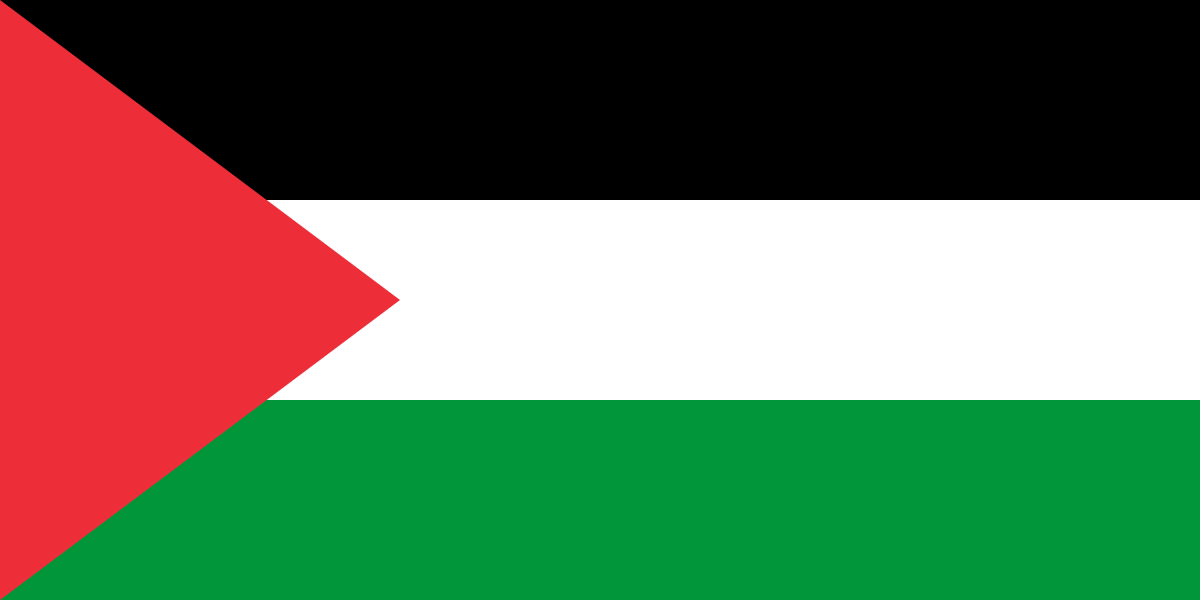
It is my honour to join members today in this important meeting. I would especially like to sincerely thank you, Mr. President, for holding and presiding over this ministerial meeting. I would also like to express
the gratitude of the State of Palestine to the Secretary- General of the United Nations, Mr António Guterres, for his briefing and wise leadership of the Organization, especially given the catastrophe that is currently under way in the Gaza Strip. I would like to sincerely thank our sisterly country Algeria for giving the Palestinian question, including the membership of the State of Palestine in the United Nations, priority on the agenda of the Security Council.
We would also like to express our thanks and gratitude to the countries that have recognized the State of Palestine and to their peoples for believing in our just cause and in our right to self-determination on the territory of our homeland, Palestine. We thank the countries that have developed relations and cooperated with us. We hope that those countries will recognize the State of Palestine as soon as possible, on the basis of the principles of sovereign equality among nations and mutual respect.
We also reiterate our deep gratitude to all countries that supported the State of Palestine receiving the status of Observer State in the General Assembly and the countries that called on the Security Council to look into granting the State of Palestine full membership in the United Nations. We also thank the Arab countries, Islamic countries and countries of the Non-Aligned Movement for joining that request, on the basis of the Riyadh and Kampala summits.
The plight of the Palestinian people began more than a century ago and is still ongoing. The Palestinian people have been the victim of events and international decisions beyond their control. They are the victim of a history that is not of their making. The Palestinian people suffered the Nakba in 1948 and have suffered under Israeli occupation since 1967. We are still longing to practise our right to self-determination, to live in freedom, security and peace in an independent State, as other peoples of the world do. We made and continue to make great sacrifices to achieve that goal.
Since 1988, the leadership of the Palestinian people, represented by the Palestine Liberation Organization, the only legitimate representative of the Palestinian people, has shown full readiness to turn the page on the conflict and sit at the negotiating table to find a just, comprehensive and permanent solution to the Palestinian question. In that regard, the Palestinian leadership made every genuine effort and unimaginable historic concessions to achieve peace based on the two-
State solution in order to guarantee the establishment of a sovereign independent Palestinian State along the borders of 4 June 1967, with East Jerusalem as its capital. It also sought to resolve the issue of Palestinian refugees on the basis of resolution 194 (III) and for the Palestinian State to live with its neighbours in security and peace.
Since 1993, the Palestinian leadership chose the path of negotiations, hoping that those negotiations would result in the desired solution. The international community supported the principle of a two-State solution, culminating in its acceptance of the State of Palestine as an observer member in the General Assembly in 2012 (see A/67/PV.44). Since then, the State of Palestine has sought membership and has called upon the world to accept it as a full Member of the international Organization because we firmly believe that an international resolution to that end will protect the two-State solution and reflect the Palestinian people’s legitimate right to an independent State.
Unfortunately, some have unlawfully obstructed such a resolution under false pretexts. Granting Palestine full membership at the United Nations would redress some of the historical injustice that successive Palestinian generations have been subjected to. It would open wide prospects for achieving true peace based on justice, one that all States and peoples of the region would enjoy.
In that context, we cannot but wonder — How could recognizing the State of Palestine and granting it full membership at the United Nations, like other States around the world, damage the prospects of peace between Palestinians and Israelis? How could that recognition and membership harm international peace and security? We address that question specifically to the United States and other States that oppose granting the State of Palestine full membership while they recognize Israel, the other party to the Palestinian- Israeli conflict, and have granted it full membership in the United Nations?
To those who say that recognizing the Palestinian State must happen through negotiations and not through a United Nations resolution, we wonder aloud how the State of Israel was established and recognized. Was it not through international resolution 181 (II), even though Israel did not honour the conditions of its United Nations membership, namely, the implementation of resolutions 181 (II) and 194 (III)?
The resolution to grant Palestine full membership would be an important pillar in achieving peace in our region because the Palestinian-Israeli conflict, in its various dimensions, now extends beyond the borders of Palestine and Israel and impacts other areas in our region, the Middle East and around the world. We therefore believe that it is high time for the Security Council to shoulder its historical responsibility to render justice to the Palestinian people by adopting a resolution to accept Palestine as a full Member of the United Nations. Those who hinder the adoption of such a resolution are not helping the prospects for peace between Palestinians and Israelis and in the Middle East, in general.
Naturally, such a resolution would not be an alternative for serious, time-bound political negotiations to implement the two-State solution and relevant international resolutions and for resolving the pending issues between Palestinians and Israelis. Nevertheless, the resolution would give the Palestinians hope for a decent life within an independent State. That hope has dissipated in recent years because of the intransigence of the Israeli Government, which has publicly and blatantly rejected that solution, especially following its destructive war against the Gaza Strip and its reoccupation by Israel.
In that regard, the State of Palestine would like to express its deep gratitude to all countries that have recognized the State of Palestine and sincerely and seriously supported granting it full membership in this international Organization.
Over the past 12 years, since it was granted observer status in the General Assembly, the State of Palestine has played a positive role and has adopted constructive stances, proving its full competence in the Organization. We therefore hope to be given the opportunity to become an integral part of the international community working to achieve international peace and security.
Today we are asking for full membership for the State of Palestine in the United Nations. However, that does not mean that we have forgotten what is happening in the Gaza Strip. That comprehensive and destructive war, waged by Israel against our people over the past six months, has claimed the lives of more than 35,000 Palestinian martyrs and wounded 80,000 others — mostly children, women, and the elderly. Israel has destroyed most of the vital facilities in the Gaza Strip, including houses, routes, hospitals,
schools, universities, mosques, churches, electricity infrastructure and water desalination plants. Israel has displaced the majority of the residents of the Strip, who cannot live there anymore because it has become largely uninhabitable.
Gaza will not die. It will come back as a vibrant city full of life. The occupation is the one that will die and disappear. Meanwhile, the attacks of the Israeli army continue, and it continues to let settlers terrorize our people in various cities, villages and camps in the West Bank and in Jerusalem. Is it not high time for this war and for those attacks to stop? Is it not high time for this occupation to end?
Today more than ever, the Security Council is called upon to swiftly intervene and take the necessary measures to compel Israel to put an end to its aggression, to allow the delivery of humanitarian assistance to a starving people, to immediately withdraw from the Gaza Strip and to comply with international law and the resolutions of international legitimacy. The international community must not allow any State to be above international law and enjoy impunity. Israel bears full responsibility for its continued aggression, which has wrought great destruction on the Gaza Strip. That responsibility is also borne by States that have supported Israel with weapons and funds and provide it with political protection in order for it to continue its aggression.
We rely on peace-loving nations and peoples to end this war and aggression and to provide support and humanitarian relief to the residents of the Gaza Strip. Everyone, and Israel in particular, must recognize that security cannot be achieved with endless wars and under occupation. Only a peace that is based on justice will achieve security and stability for all.
Finally, history has taught us that our region will not enjoy stability without the establishment of an independent and sovereign Palestinian State along the 4 June 1967 borders, with East Jerusalem as its capital, that lives in security and peace with its neighbours.
An international resolution to grant Palestine full membership in the United Nations, given the difficult circumstances faced by the Palestinian people and as the war of full destruction continues against the Gaza Strip and its residents, would be a rejection of aggression. It would also represent an insistence on respecting international law, human rights and the right of the Palestinian people to live in freedom and dignity.
There is no time for the international community and the Security Council better than now to shoulder their political, legal and moral responsibilities towards the just question of the Palestinian people and their right to obtain freedom and independence, so that the principles of freedom, justice and peace can prevail. I am fully confident that Council members will stand with the Palestinian right.
I now give the floor to the representative of Israel.


How many times has the Security Council met to discuss ways to advance the release of our hostages held in Gaza? The answer is not even once. How many condemnations has the Council issued against Hamas or their heinous 7 October 2023 massacre? The answer is zero. Yet rather than condemning Hamas’s atrocities or taking real action to bring our hostages home, the Council will be voting on a draft resolution to recommend granting the Palestinian Authority full membership status — a Palestinian State. How detached from reality can the Council be to dedicate its time and resources to supporting a draft resolution so disconnected from the reality on the ground; a draft resolution that will have zero positive impact for any party, will cause only destruction for years to come and will harm any chance for future dialogue?
Six months after 7 October, the most brutal massacre of Jews since the Holocaust, the Council seeks to reward the supporters and perpetrators of those atrocities with statehood. The child-murdering Hamas rapists are watching this meeting, and they are smiling. There is no bigger prize for terror than today’s meeting. Let me remind everyone that the basic requirements for admission to the United Nations are permanent population, defined territory, Government and capacity to enter relations with other States. But above anything else, a very important principle, stated in Article 4 of the Charter of the United Nations, is “[m]embership in the United Nations is open to all ... peace-loving States”. Peace-loving: what a joke. Does anyone doubt that the Palestinians fail to meet those criteria? Did anyone hear any Palestinian leaders even condemn the massacre of our children? The Palestinian Authority has absolutely no control over Gaza; members know that. Everyone knows that. But even in Judea and Samaria, entire neighbourhoods and cities are ruled by other terrorist gangs — Lions’ Den and others — and the Palestinian Authority, ironically, has no authority. So who is the Council voting to recognize today and
give full membership status? Is it Hamas in Gaza, the Palestinian Islamic Jihad in Nablus? Who is going to be in charge?
While that in itself is grounds enough to reject this sick reward for Palestinian terror, the Palestinian Authority is the opposite of a peace-loving entity. Not only has the Palestinian Authority not condemned the 7 October massacre, but they are also paying monthly salaries to all the terrorists who took part in it, rewarding the rapists. It is a genocide-loving entity that does not deserve any status here. But sadly, to some Council members, the Palestinians’ inability to meet the criteria simply does not matter. It does not matter because, to some members, Palestinian statehood has nothing to do with the Charter or legal criteria. All it has to do with is politics and interests. The Charter is important to them only when it can be used against Israel. The report of the Council’s Committee on the Admission of New Members even states it in black and white:
“[s]everal members expressed the view that the admission of the State of Palestine to membership in the United Nations was a political matter rather than a technical or legal requirement.” (S/2024/313, para. 3)
In other words, the Charter be damned, international law be damned. I reiterate: international law and the Charter are only important when they can be weaponized against Israel. But if breaking the law means advancing the unilateral establishment of a Palestinian terror State, a Palestinian Nazi State, then by all means. They are just empty words on paper, right? What the Council has decided to focus on at the expense of all other calamities around the globe is giving a prize to terrorists. Granting the perpetrators and supporters of 7 October full membership status in the United Nations is the vilest reward for the vilest crimes. If the draft resolution is adopted, God forbid, the Council should no longer be known as the Security Council, but as the Terror Council.
The only thing that a forced unilateral recognition of a Palestinian State will do is make any future negotiations almost impossible. As long as the Palestinians feel that they can exploit this politicized body to their benefit, why would they bother at the negotiating table or support any compromise? Do members honestly think that this draft resolution will make a solution more likely or change anything on the ground? The Palestinians have rejected every
peace plan ever made, and they continue to support terror and boycott negotiations. And now they know that their rejectionism pays off. They can say “no” to any American President but still get what they demand here, because the United Nations is guided by politics, not morality or truth. All the Council is accomplishing through this destructive approach is making a solution unattainable. The United Nations is sadly no longer about multilateralism. It is now committed to “multiterrorism”. At the Security Council terror pays off. It is shameful. I have always called out the political rot within the United Nations, that sadly nothing here is based on truth and justice but toxic politicization. And today the mask has finally fallen. The Council has exposed itself. Please do not give in to politics, do not support this dangerous draft resolution. How can members support a resolution that is so destructive and immoral at the worst possible moment?
The Council was not the only entity to expose its true face this week. On Saturday night, with the launch of more than 300 uncrewed aerial vehicles, ballistic missiles and cruise missiles at Israel, the Ayatollah regime’s mask also fell. Iran exposed itself as the terrorist State that it is. But today marks another milestone in the Ayatollah regime’s blood-soaked history. On 18 April 1983, a Chevrolet pickup truck packed with 2,000 pounds of explosives sped through the gates of the United States Embassy in Beirut, crashed into the building and detonated. That blast killed 63 people. We are talking a lot about Embassies and the importance of Embassies. Hizbullah claimed responsibility, and today, 18 April 2024, exactly 41 years later, the Security Council will be addressed by an arch terrorist whose regime funds, arms, trains and directs Hizbullah. The ayatollah regime’s Foreign Minister, Hossein Amir- Abdollahian, is a member of Iran’s Islamic Revolutionary Guard Corps. That terror organization is responsible for carnage, bloodshed and destruction worldwide. From terror attacks in South America and assassination plots on European and American soil to arms trafficking in Africa and terror sponsorship across the Middle East, the Revolutionary Guard Corps is in the business of murder. It is designated as a terrorist organization not only in Israel and the United States but in Bahrain and Saudi Arabia. My Arab and American colleagues and I all agree that the man who will address the Council later today is a terrorist and that his presence here, today of all days, is further proof of how the United Nations has become a haven where dictatorships and terror regimes come to whitewash their crimes.
It was Iran that ensured that Hamas was able to orchestrate the 7 October massacre. It is the ayatollah regime in Tehran that has provided weaponry so that Hizbullah can rain down missiles on Israeli towns and cities. It is the ayatollah regime in Tehran that has equipped the Houthis with cruise missiles to fire at merchant vessels. And it was the ayatollah regime that launched an unprecedented attack at Israel, a fellow Member State, less than a week ago. Yet instead of designating the Revolutionary Guard Corps a terror organization and imposing sanctions on Iran’s evil regime, the Security Council opens its doors to Iran’s Foreign Minister — a terrorist. Can Council members not see what is going on here? Terror Minister Amir- Abdollahian is not here to express sorrow for his regime’s brazen attack or to tell the Council that the Islamic Republic has changed its ways. He is here to make a mockery of the Council. He is here to show Council members, in their suits and with their diplomatic niceties, that his country can launch an attack on another Member State on Saturday and that he can then come here on Thursday to lecture the Council on human rights and international law. His presence here today is making this institution a joke. Sadly, it is clear to every dictator and terrorist State that the United Nations has lost every ounce of justice and is now a blob of politicized plasticine that can be moulded into whatever a tyrant chooses. And the Council plays along with that destructive charade.
If its members still believe that the Council has any relevance, I want to ask — even beg them — to say what action the Council has taken against Iran for its attack on Israel this week. The Foreign Minister of a genocidal regime will speak here today as his country hurtles along a path towards nuclear weapons. Has the Council taken any action to prevent that? Nope, nothing. Instead, we have gathered today to discuss the situation in Gaza. Has it occurred to anyone that the terror Minister Amir-Abdollahian is here to make sure that the Council focuses on Gaza, as opposed to his own regime’s crimes?
Sadly, the Council is being spoon-fed a script. It was written by Khamenei and edited by Sinwar, a script crafted by terrorists. Based on that script, terrorists commit acts of sheer evil against Israel. They exploit civilians by using them as human shields, and when Israel defends itself, the United Nations will pressure Israel into a ceasefire and ensure their survival. The terrorists know that nowhere captures the attention of
the United Nations more than Israel. As long as Israel is defending itself, all other human rights violators can continue committing crimes. The Council’s eyes will remain on Gaza as the rest of the world burns. And that is precisely what is happening today. Council members sit here again, focused on Israel and Gaza. We will hear talk of international law, human rights and many other terms that the Council loves to toss around, but in reality, the Council, as a Council, cares nothing for human rights or international law. The Council even refused to visit our communities in southern Israel — and I invited all Council members to do so — that were devastated by Hamas.
Everything is political and distorted. The Council knows better than most that the ayatollah regime is mere weeks away from nuclear capabilities. That global sponsor has proxies across the region sowing death and destruction. But Iran has immunity here because its rogue regime has allies here on the Council that protect it and its terror proxies. That is why the Council will never designate Hamas and Hizbullah terror organizations, despite the fact that the whole world knows that they are.
A war is still raging in Ukraine, while the country that started it sits here on the Council preaching about peace and the defence of civilians. This is a backwards world. This week we marked the one-year anniversary of the war in the Sudan. Millions have fled their homes, millions more have starved and countless civilians have been murdered. Since the start of the war in the Sudan, has the Council held a single ministerial-level meeting on the atrocities? No, not one. But today marks the fourth ministerial Security Council debate on Gaza — four on Gaza and not one on the Sudan in the past year. The double standards here know no bounds. The amount of time, effort and resources poured into Gaza makes it seem as if the rest of the world is a pure utopia, that outside Gaza we live in a carefree world — hakuna matata. I reiterate that the only people this meeting serves are Ayatollah Khamenei and Yahya Sinwar. Some Council members may think that they are serving the Palestinians, but they are not. By holding this meeting, they are aiding Khamenei and Sinwar. They control the agenda here, and hardly any Council members seem to notice.
If the United Nations cannot prevent wars or defend human rights, it has lost any reason to continue operating. The day will come when this Organization will be shuttered. The United Nations as we know it will cease to exist, and in its place will stand a body
that truly cares about human rights, that truly fights to promote peace and that is capable of putting politics aside for the sake of justice, morality and humanity. And when that day comes — and it will — this meeting and the vote to force the establishment of a Palestinian Nazi State will be remembered as a catalyst of the collapse of the United Nations, a meeting where the world burned but where the only thing that the Security Council was concerned about was helping terrorists in Gaza survive — a meeting where a terror entity could be given full membership status. That is how far the United Nations has fallen, and that is why the United Nations, in its current format, has no future. I truly pray for brighter days — for a time when the United Nations can successfully combat the forces of darkness, not welcome them and be influenced by them.
I shall now make a statement in my national capacity.
I thank the Secretary-General for his presence here today and for his stark and sobering briefing.
The Middle East is experiencing one of its bleakest and most volatile periods in modern history. As underlined by the Secretary-General last Sunday, the Middle East is on the brink of a full-scale conflict, one that we must collectively avoid by calling on all the parties to show restraint. The latest events continue the downward spiral witnessed in the six months since the heinous terror attacks by Hamas on 7 October and the beginning of Israel’s military action in Gaza, providing further proof of the importance of an immediate and permanent ceasefire in Gaza and the need to rebuild a political horizon in the Middle East.
It is deeply worrisome and completely unacceptable that the Council’s demand for a ceasefire, in accordance with resolution 2728 (2024), has been disregarded by the parties. We want to reiterate that under Article 25 of the Charter, the Members of the United Nations agreed to accept and carry out the decisions of the Security Council. Yes, Security Council decisions are binding.
We have consistently condemned Hamas for its reprehensible terrorist attacks on 7 October, including the murder of over 1,200 Israelis, the taking of hostages and any acts of sexual violence committed. The trauma from that dark day will forever haunt the Israeli people, particularly those who still suffer daily, knowing their loved ones are still held hostage by Hamas. We once again reiterate our demand that Hamas release all hostages immediately and unconditionally.
However, in Gaza, it is not only the hostages who are suffering. More than 33,700 Palestinians have been killed, most of them women and children. Thousands have been injured or maimed. Countless others remain unaccounted for, missing under the rubble of ruined neighbourhoods. The prospect of a further escalation in Rafah, where more than 1 million displaced civilians are struggling daily to survive, is unconscionable. We stress our firm rejection of any ground offensive into Rafah and any further displacement of Palestinians.
With over half of the population on the cusp of a man-made famine, coupled with a decimated health system, children are also dying from a lack of food and water. According to UNICEF, today in Gaza, one in three children under 2 years of age are acutely malnourished. Targeted attacks on health care violate all of the unique protections under international law for pregnant, birthing and post-partum women, as well as children.
We stress that all parties have a legal obligation under international law, including international humanitarian law, to protect civilians. In line with that, the provisional measures of the International Court of Justice on 26 January and 28 March must be complied with.
Since the beginning of the conflict, the levels of aid delivered into Gaza have been highly insufficient owing to physical restrictions and bureaucratic impediments. Malta reiterates that the denial of humanitarian assistance is a grave violation of international law, and the use of starvation as a weapon of war may constitute a war crime. Furthermore, we strongly underline that the safety of United Nations personnel, humanitarians and journalists must be guaranteed. We call on Israel to both fully respect and utilize the humanitarian notification system as intended and conduct an independent investigation into all killings of United Nations and humanitarian staff. Commercial trade must also be allowed to resume, as the people of Gaza cannot remain dependent on aid alone.
In the words of the Secretary-General, a paradigm shift is required to adequately address the desperate conditions in Gaza. Just yesterday, the Council held a briefing on the indispensable nature of the United Nations Relief and Works Agency for Palestine Refugees in the Near East and its life-saving services (see S/PV.9607). We maintain that the Agency is a stabilizing force in the region and demands our continued support and resources.
Turning to the wider region, the ripple effect of the war in Gaza, including what we have witnessed over the past days, is deeply troubling. The heightened tensions in the region and the increased escalations and skirmishes in the West Bank, Lebanon, Syria, Iraq and Yemen push the region closer to an untenable conflagration. Immediate de-escalation and restraint are of paramount importance. International law and diplomacy must be our guiding principles.
In the West Bank, rising violence targeting civilians and intensified military operations push the occupied Palestinian territory into further instability. Malta stresses that illegal Israeli settlements, the demolition of Palestinian property and settler violence are obstacles to peace, violate international law and threaten the viability of a two-State solution. We call on Israel to reverse such actions and abide by the relevant Security Council resolutions.
We welcome ongoing efforts towards reinforcing and revitalizing the Palestinian Authority. The international community must support all actions that would allow its effective governance in line with the two- State Solution, and with Gaza as part of an independent Palestinian State. Fundamentally, a just resolution of the conflict demands a reality that embraces the Palestinians’ legitimate aspirations for United Nations membership and statehood. It also demands a reality in which Israelis live in security, without being held hostage by the threat of terrorism. The parameters for a realization of that vision are well-known and must be pursued as a matter of urgency.
Malta reaffirms its unwavering commitment to a comprehensive political solution based on a two-State Solution along the pre-1967 borders, addressing the legitimate aspirations of both sides, with Jerusalem as the future capital of two States living side by side in peace and security, in line with the relevant Security Council resolutions and internationally agreed parameters.
I now resume my functions as President of the Council.
I now call on the Minister for Foreign Affairs and National Community Abroad of Algeria.


I would like to thank you, Mr. President, and to express to you the deepest gratitude of the Algerian delegation for holding this meeting today, which we believe is a right step in the right direction.
We are talking today about granting the State of Palestine the status of full Member in our international Organization, which involves revisiting the Palestinian question, its essence and true grounds. It also involves highlighting its core, which cannot be subject to doubt, alteration or distortion. What I mean by essence and core is the historic and legitimate right of the Palestinian people to create their independent and sovereign State.
That is a historic right, approved by the international community through this Organization 76 years ago. The international community is committed to consolidating that right as a just, lasting and definitive solution for the Palestinian question. It is a historic right that has not been implemented and is the direct cause of the prolongation of the Arab-Israeli conflict and lack of security and safety in our region, a region that has not known peace for more than 70 years.
That historic right is today stubbornly rejected and violently undermined by the Israeli occupation, which clearly and unequivocally rejects it and does everything it can to eradicate it. Gaza, in its ideal steadfastness, has proven beyond a doubt that the aim of the Israeli occupation, whether announced or hidden, is to liquidate the Palestinian question and abort its genuine national objective.
Everybody knows that the genocidal war in Gaza, the suffocation of the West Bank, the policies of settlement and annexation of Palestinian territories, the Judaization of occupied Jerusalem, the campaign of forced displacement of Palestinians and, last but not least, what are known as the Israeli arrangements following the war in Gaza, are all advanced phases of a broader, more comprehensive and more dangerous Israeli plot of reviving Greater Israel in order to eradicate the foundations of a Palestinian State and gradually destroy its pillars.
Just a few months ago, from the rostrum of the General Assembly, the entire world bore witness to the Israeli representative holding up a map of the Middle East where Palestine did not appear at all (see A/78/ PV.10). That map was built upon his hallucinations and desires.
The escalation by the Israeli occupation continues on a number of fronts in our region. The aim is now clear: to divert the international community’s attention away from the Palestinian question and to try to create new regional conflicts through which the rights of Palestinians would be gradually taken away.
After everything I have just said, is it difficult for some to know the truth behind the Israeli settlement occupation that insist on mere delusions, namely, achieving peace and security in the Middle East on the ruins of the Palestinian national objective and Palestinian national State? Even after all of that, a few insist on trying to convince us that it is not yet time for Palestine to become a full Member in our Organization.
The Palestinian question is facing a dangerous situation. The Council has a historical and decisive key responsibility to act immediately in order to impose a two-State solution and to safeguard the foundations of the creation of a Palestinian State. The two-State solution is facing a deadly danger. We must save it before it is too late. That means granting the State of Palestine full-member status in order to safeguard peace, stability and security in the Middle East as a whole. Any hesitation on this point will have grave consequences and would give the Israeli occupation the green light to continue with its plots of stealing, plundering and expansion, on one side, and extremism, exaggeration and stubbornness, on the other.
In that connection, Algeria had the honour of hosting the declaration of the creation of the Palestinian State on 15 November 1988. My country also had the honour of being the first country to officially recognize the Palestinian State. As part of that historical legacy, which my country is very proud of, the President of the Republic, Mr. Abdelmadjid Tebboune, called from the General Assembly rostrum, during its most recent session (see A/78/PV.5), for accelerating the process of granting the State of Palestine full membership in our Organization. To that end, my country swiftly put forward a draft resolution (S/2024/312) to the Council, in full coordination with our Palestinian and Arab brothers and with various regional entities that champion the Palestinian question, namely, the League of Arab States, the Organization for Islamic Cooperation, the Movement of Non-Aligned Countries and the African Union.
The time has come to assume our responsibilities and duties, without faltering or eluding commitments and promises made. We urge all members of the Council to support our efforts. We stress that achieving full membership is not an end in itself, but a means to achieve three genuine objectives.
First, it would establish the internationally agreed two-State solution and protect it from threats that seek to undermine it, disperse it and even dismantle it altogether.
Secondly, it would safeguard the foundations of an independent sovereign Palestinian State along the 1967 borders, with Al-Quds Al-Sharif as its capital.
Thirdly and finally, it would revive the peace process with a solid foundation, thus enabling a mobilization of efforts to respond to the exigencies of the Palestinian question with a view to restoring peace, security and stability throughout the Middle East.
Needless to say, for the representatives of humankind meeting here today, such a step is a very simple one. It is our duty to the thousands upon thousands of Palestinian people who are being martyred in Gaza every day, every hour, every minute and every second in order to ensure that their cause — our cause, the cause of humankind as a whole — lives on. Justice for the Palestinian people is an urgent imperative. It is a legal, legitimate, political, security, human and cultural imperative.


I thank the Secretary- General for his briefing.
We find ourselves at a defining moment for the crisis in the Middle East and for the Council’s role in addressing it. As we face a growing danger of a full- scale regional escalation, we cannot lose sight of the situation in Gaza and the West Bank. I would like to reiterate our firm view that this is where the master key to easing tensions in the region is.
I would like to offer three steps that can help us to move away from the edge.
First, there must be immediate and full compliance with the Security Council resolutions and International Court of Justice orders related to the conflict in Gaza. That should not be an ambiguous call, but a clear demand. All Member States have an obligation to uphold the Charter of the United Nations, including by implementing Security Council resolutions. We condemn the attack of Hamas of 7 October and strongly deplore the fact that the hostages are still being held in Gaza, while their families continue to suffer in anguish over their safety and well-being. Families, homes, schools, hospitals, roads and infrastructure in Gaza are being destroyed. People are helpless while their lives are collapsing, while famine and disease are looming. Women and children bear the brunt of this conflict. We all hear their desperate calls for help. We call on Israel to remove the complex barriers to humanitarian aid and cooperate with the United Nations to organize faster
and safe distribution of assistance. We condemn all violations of international law, including international humanitarian law and human rights law, and we call for accountability, including for sexual violence.
The threat of the military offensive in Rafah, which we strongly oppose, is still present. In recent days, the situation in the West Bank has been escalating. These are the fires that we must extinguish before they engulf the whole region. We need the urgent implementation of resolution 2728 (2024), followed by a comprehensive political solution to the crisis. We believe that a ceasefire in Gaza would be a key element for reducing the boiling tensions in the region, including along the Blue Line, in the Red Sea and elsewhere.
Secondly, all actors and their partners in the region must exercise maximum restraint. We must defuse and de-escalate the situation. Missiles and drones will not address the root causes of the crisis. They are not solutions, just as acts of retaliation are not dialogue. Diplomacy is the only way forward.
Thirdly, we must start and support the political process leading to a two-State solution. We are of the view that the Council must do its part in the political process, and in that regard, we welcome the draft resolution proposed by France. We believe the two- State solution must be based on the sovereign equality of States, and we therefore support their equal status in the United Nations. It would strengthen the role of the Palestinian Authority and would also contribute to the security of Israel.
All of us seated around this table — permanently or not — have a primary responsibility for the maintenance of international peace and security. We should therefore shoulder that responsibility with a clear commitment to stopping this spiral of conflict, with a clear commitment to the Charter of the United Nations and international law. People in Palestine, Israel and the whole Middle East do not ask for the impossible. They want peace and security and a viable vision of a better, dignified future. Let us all do everything in our power to make that happen.


I thank His Excellency Mr. Borg, Minister for Foreign and European Affairs and Trade of the Republic of Malta, for his initiative. My appreciation also goes to the Secretary-General for his briefing.
The conflict that started with the attack by Hamas and others in October 2023 has continued for more than six months. First, let me express my heartfelt condolences to all the victims, including women, children and humanitarian aid workers, and their families. The world does not want to see the loss of lives and the cycle of violence anymore. Yet the conflict endures. I sincerely hope continued discussions and a show of will in the Security Council will lead to a change in behaviour by the parties concerned and an improvement of the situation. Last month, the Council adopted resolution 2728 (2024), which demanded an immediate ceasefire for the month of Ramadan and the immediate and unconditional release of all hostages. Japan has urged all parties to act in good faith based on that resolution. Japan takes note of the improvement, to a certain extent, in the environment surrounding humanitarian assistance, including humanitarian access. However, further effort must be made for a drastic change in the catastrophic situation on the ground. We have not seen a ceasefire realized yet either.
The countries concerned have made serious efforts outside this Chamber to achieve the release of the hostages and a ceasefire. I believe that those who serve best should be honoured most. The Security Council must foster and encourage those efforts. A full-scale military operation in the densely populated area of Rafah would be a disaster that would result in many more casualties. Such an outcome is unacceptable.
We are now witnessing an extremely dangerous situation that could have devastating consequences for the entire region and the world. Japan is deeply concerned about Iran’s attack against Israel, which increases insecurity in the Middle East. We strongly condemn such an escalation. Japan has been urging the parties concerned to calm down the situation and reiterates its determination to continue to make all necessary diplomatic efforts in order to prevent any further deterioration. Furthermore, the spiral of violence between Israel and Hizbullah is continuing, and attacks on vessels in the Red Sea and the Gulf of Aden by the Houthis are impeding the free and safe passage of vessels.
To end the current tragedy and achieve lasting peace and stability in the Middle East, there is no other solution than peaceful coexistence between Israel and Palestine. To reach that goal, mutual trust is indispensable. Building trust is not an easy task. It will not only require time to heal the existing hatred
and grief, but also a clear mutual commitment to confidence-building. Given the situation in front of us, it may even seem an almost impossible mission. However, Japan will not give up and will continuously contribute to the realization of a two-State solution through its own initiatives and efforts. And Japan will remain an “escort runner” for Palestine, Israel and all the people living in the Middle East, in good times and bad.


We thank the Secretary-General for his briefing.
For seven months now, the Middle East has been engulfed in a violent conflict that has already claimed the lives of more than 34,000 civilians in Gaza. The escalation is spiralling daily, spreading to other countries of the region, over which the threat of a full-scale armed confrontation has started to loom for the first time in decades. Today’s meeting is a good opportunity to assess what the international community has been able to do to resolve the crisis and what it has not.
First and most important, has the Security Council, in accordance with its mandate, demanded an immediate ceasefire by the parties? Indeed it has, in resolution 2728 (2024), which formally covered the period of Ramadan, which is over, but also called for a transition to a sustainable and lasting ceasefire. In order to do that, China and the Russian Federation had to veto an American draft resolution (S/2024/239) whose purpose was specifically to ensure that there would be no ceasefire. Was the Council able to monitor the implementation of resolution 2728 (2024) and compel those who ignored it to implement it? Alas, no. Did that happen because we did not try hard enough? Any such assertion would be absolutely untrue. Starting on 7 October the Council has worked around the clock discussing possible products aimed at ending the violence in Gaza. Altogether, delegations have proposed no fewer than 10 different draft resolutions, which we should all agree is a pretty large number. As early as 16 October the Russian Federation submitted a first draft resolution on a ceasefire in the Gaza Strip (S/2023/772), which France, the United Kingdom, the United States and Japan voted against. The next draft, submitted by Brazil on 18 October (S/2023/773), was vetoed by the United States alone, despite the fact that it included what our American colleagues now declare highly important wording condemning Hamas. Just imagine how many lives could have been saved if those proposals had been supported then, including the lives of the hostages, whose release we demanded at the same time.
Since then, Washington has used the veto three more times to prevent the Security Council from taking a decision that would have stopped the Israeli military operation in Gaza. Our American colleagues have made no secret of the fact that they regard the Security Council as an obstacle that must not get in the way of their “effective diplomacy on the ground”, while their real purpose was to give their main Middle Eastern ally free rein to “cleanse” the enclave. We well remember, and hope that the other members of the Council have not forgotten either, how the United States delegation demanded that the slightest mention of the importance of ending the violence be deleted from any draft.
Each United States veto on Gaza is not just another statistic in Security Council votes. We must not forget that it also has a concrete and terrible price — the lives of thousands of civilians in Gaza. It took Washington six months to finally realize that it had squandered almost all of its leverage over Israel and ended up in a situation in which the tail was wagging the dog, with Tel Aviv for all practical purposes dictating its terms and demanding unconditional American support for all its reckless decisions. Then, in March, in an attempt to whitewash itself, the United States — now censured by almost the entire international community for its inhumane use of the veto — authored draft resolution S/2024/239, an extremely strange text that in a philosophical way “determined” a certain “imperative” for a ceasefire without actually demanding one. At the same time, the draft resolution was larded with dangerous “traps” and “landmines” that effectively gave Israel a green light for further military operations, including “cleansing” Rafah. As I said, together with our Chinese and Algerian colleagues, we could not allow the Council to approve such a licence to continue killing Palestinian civilians. Thanks to that, three days later, as I mentioned, the Security Council was able to adopt resolution 2728 (2024), submitted by the 10 elected members of the Council, demanding a ceasefire for the period of Ramadan.
Now the United States is disingenuously blaming Russia and China for vetoing its “excellent” draft. But our veto is in fact an example of why we need the instrument of the veto and, at the same time, a response to those who demand that it be abolished. It is needed to prevent the adoption of unbalanced, devious decisions promoted by Washington.
Unfortunately, Israel has openly ignored resolution 2728 (2024), with encouragement from the United States, which was quick to call it “non-binding”. The
resulting situation has forced Ms. Francesca Albanese, the Human Rights Council’s Special Rapporteur on the situation of human rights in the occupied Palestinian territory, to conclude that Israel has met the threshold for the crime of genocide. She also characterized the Israeli leadership’s claims of compliance with international humanitarian law and its use of pretexts about the right to self-defence and the fight against terrorism as “humanitarian camouflage”.
I would like to ask a second question. Have our collective efforts improved the humanitarian situation in Gaza? Once again, the answer is in the minus column. The Council has adopted two so-called humanitarian resolutions, resolutions 2712 (2023) and 2720 (2023). However, as we warned, in the absence of a sustained ceasefire they have remained mere words on paper. Humanitarian aid workers cannot do their job amid active hostilities. They are unarmed. Not only can they not help civilians, but they cannot even defend themselves. We reiterate that contrary to American disinformation, both of those resolutions, as well as resolution 2728 (2024), contained measures aimed at protecting humanitarian personnel, but they cannot be implemented without a ceasefire. Israel’s cleansing of Gaza has already earned the dubious distinction of claiming the highest number of lives of United Nations humanitarian workers in history. More than 240 people have been killed, including 178 staff of the United Nations Relief and Works Agency for Palestine Refugees in the Near East, and the cleansing is not over yet. Israeli soldiers have been hitting humanitarian convoys, blocking their access and slowing the passage of supplies. Western countries castigate them for those actions only if Western citizens die as a result. All the calls for deconfliction, which rests on the goodwill of field commanders, are empty and will not really change the dire situation of humanitarian aid workers on the ground until there is a full-fledged ceasefire in place.
Lastly, my final question is about whether the international community has succeeded in preventing a spillover of the conflict throughout the region, and again the answer is no. The situation along the Lebanese-Israeli border is extremely unstable. Israel is constantly bombarding Lebanon and Syria. Our Western colleagues, and specifically the United States, Britain and France, are to blame for the fact that the Council was unable to condemn Israel’s strike on the Iranian consular facility in Damascus on 1 April and thereby to reaffirm the sanctity of one of the foundational pillars of international relations — the inviolability of diplomatic
and consular premises and personnel. That triggered a new, extremely dangerous round of regional escalation, with completely unpredictable consequences. That disdainful attitude on the part of the West to certain States and their rights, dividing the world into friends that are above the law and foes whose lawful interests can be ignored, has brought the Middle East to the brink of a major war. That is what our Western colleagues call “effective diplomacy”. The “fruit” that it bears is more victims and more destruction. To sum up, where are we now? Practically speaking, because of one Government’s position, which has blocked all of our efforts, the international community has been unable to protect the Palestinians from Israeli slaughter, relieve their suffering or end the spiral of violence — not to mention the fact that neither has it managed to help Palestinians achieve full statehood since 1948.
Having delivered his fiery statement, whose contents we already know by heart, the Permanent Representative of Israel did not find the time to listen to the members of the Security Council and the Arab and other Ministers who came to the Chamber today. He has long indulged in making insulting remarks about the United Nations and its staff, including the Secretary-General himself. Today he did not hesitate to call the Security Council a “terror Council”. He has clearly forgotten that the State of Israel was itself created on the recommendation of the Council and General Assembly resolution 181 (II). Is he going to call that decision into question as well? And perhaps he will answer my question about whether Israel met the criteria for membership when it was admitted to the United Nations.
I would like to share a small piece of history from a letter from the Chairman of the Security Council Membership Committee to the President of the Security Council, dated 6 December 1948.
(spoke in English)
“The Security Council Membership Committee has discussed Israel’s application for admission to membership of the United Nations.
“As a result of its discussions, the Committee came to the conclusion that it was not at present in possession of the requisite information to enable it to come to any decision. In particular, it was pointed out in the Committee that the General Assembly itself had not yet reached any conclusion on the Palestine question as a whole.
“The USSR and Ukrainian delegates declared, however, that for their part they saw no reason whatever for delaying Israel’s admission to the United Nations. The Syrian delegate, on the other hand, expressed his opposition to the application for admission, and added that the application did not merit consideration.
“The Security Council Membership Committee has instructed me to apprise the Council of the above. The Committee considers that it will be for the Security Council to decide at the proper time whether to refer the matter back to the Committee or take a decision itself.” (S/1110)
(spoke in Russian)
Then, on 7 March 1949, a letter from the President of the Security Council was drafted (A/818), transmitting to the General Assembly the draft resolution on the admission of Israel.
Therefore, based on all moral imperatives, the very least we can — and must — do is to satisfy Palestine’s aspiration for United Nations membership. Palestine has walked a lengthy and agonizing path towards this point. Since 2012, it has enjoyed a singular status at the United Nations as a non-member Observer State. It is one step away from permanent membership.
We call on all Security Council members to vote in favour of the relevant draft resolution (S/2024/312) that was put forward, as I said earlier, on behalf of the Group of Arab States by Algeria. We are convinced that recognizing Palestine and its status on par with Israel will help achieve the long-term settlement of the Palestine-Israeli conflict on the basis of the well- known international legal principles, endorsed by the United Nations and backed by the 2002 Arab Peace Initiative, the goal of which is the establishment of an independent, contiguous, sovereign Palestinian State within 1967 borders, with East Jerusalem as its capital, living side by side with Israel in peace and security.
It is clear that in order to advance towards that goal, in addition to efforts that involve the resolution of the aforementioned and most acute humanitarian issues, we also need the establishment of a collective diplomatic mechanism. We are convinced that a key role in such a mechanism should be played by countries from the region — Arab States and Islamic States — which
probably understand better than others how to achieve a fair solution that would be founded on a mutually agreed international legal basis.
Of course, none of that should overshadow the immutable importance of a ceasefire pursuant to resolution 2728 (2024). If the resolution is not implemented, the Security Council is within its rights to impose sanctions on those who violate and sabotage its decisions. We will be reverting to the issue very soon.
Dame Barbara Woodward (United Kingdom): I thank the Secretary-General for briefing us today.
Let me start by reiterating that the United Kingdom condemns in the strongest terms Iran’s unprecedented attack against Israel, as well as its violation of the airspace of Jordan and Iraq. The United Kingdom continues to call for de-escalation and remains steadfast in our commitment to protecting and upholding stability in the region. Iran’s actions do nothing to advance the prospects for peace in Israel and Gaza.
The United Kingdom condemns the 7 October attacks unequivocally and calls for the unconditional and immediate release of all the hostages. The United Kingdom remains resolved to work with international partners to urgently secure an immediate pause to get aid in and hostages out, and then progress towards a permanent, sustainable ceasefire without a return to fighting and loss of life. We also urgently call for the full implementation of resolution 2720 (2023), to protect civilians and enable humanitarian assistance.
There is a devastating and growing humanitarian crisis in Gaza. Gazans need more aid, and they need it now. We welcome Israel’s commitments to fully open Ashdod port and the Erez checkpoint and to increase capacity through the Jordan land corridor. We are resolved that the international community will work with Israel to see those vital changes fully implemented. As my Foreign Secretary made clear during his visit to the region yesterday, we must maintain our focus on getting more aid into Gaza and getting hostages out.
For our part, the United Kingdom has trebled our aid commitment this financial year. We will keep doing everything we can to get more aid in by land, sea and air to reach people in desperate need in Gaza.
We support a two-State solution that guarantees security and stability for both the Israeli and the Palestinian people. We must give the people of the West Bank and Gaza the political perspective of a
credible route to a Palestinian State and a new future, and it needs to be irreversible. That is not entirely in our gift. However, Britain and our partners can help by confirming our commitment to a sovereign, viable Palestinian State.
Regarding recognition, it cannot come at the start of the process, but it does not have to be the very end of the process. Our long-standing position has been that we will recognize a Palestinian State at a time that is most conducive to the peace process. That pathway must start with fixing the immediate crisis in Gaza.
We must focus collectively on the vital elements for a lasting peace. Those include: the release of all hostages; the formation of a new Palestinian Government for the West Bank and Gaza, accompanied by an international support package; removing Hamas’s capacity to launch attacks against Israel; Hamas no longer being in charge of Gaza; and, as I have mentioned, a political horizon that provides a credible and irreversible pathway towards a two-State solution.
Finally, I would like to address the ongoing settlement expansion and the demolition of Palestinian properties in the occupied Palestinian territories. We have made it clear that settlements are illegal under international law and once again urge Israel to halt settlement expansion immediately. The United Kingdom remains committed to acting robustly to support peace and stability in the region.
Let me end by reiterating the United Kingdom’s commitment to a two-State solution and turning the Council’s words into actions. We must work together to make that vision for peace a reality.
I now call on the Minister for Foreign Affairs and International Cooperation of Sierra Leone.


I thank the presidency of Malta for convening this meeting in the format of a high-level open debate. I also thank the Secretary- General, His Excellency António Guterres, for his comprehensive and sobering briefing.
Today’s debate is being held in the context of the request for admission of the State of Palestine as a Member of the United Nations, 13 years after Palestine’s application was first considered by the Committee on the Admission of New Members. Sierra Leone recognizes the basis for such a request, which in our view is legitimate and would create the pathway
to a political horizon, founded on the principles of the two-State solution, based on General Assembly resolution 181 (II), which recommends an independent Arab State and an independent Jewish State, and in line with Article 4 of the Charter of the United Nations.
Sierra Leone supports the application of the State of Palestine for admission as a Member of the United Nations. Our support is in line and within the context of our consideration of Article 4 of the Charter of the United Nations, rules 58 and 60 of the Security Council provisional rules of procedure and the guidance provided by the International Court of Justice in its 28 May 1948 advisory opinion on conditions of admission of a State to membership in the United Nations.
This request for reconsideration of the State of Palestine’s 2011 application for membership to the United Nations comes six months into the conflict between Israel and Hamas. We have heard first-hand testimonies about what it means to live in the Gaza Strip after 7 October 2023. There are expert reports on the impact of the conflict on women, children, humanitarian workers, journalists and other vulnerable groups and all civilians in Palestine, as well as Israel.
In the Gaza Strip, we are racing against time to prevent farming and infectious disease epidemics. We therefore reiterate our strong call for an immediate and permanent ceasefire in the Gaza Strip and for resolutions 2712 (2023), 2720 (2023) and 2728 (2024) to be fully respected by the parties and implemented.
For six months we have made it unequivocally clear that the 7 October 2023 heinous attacks by Hamas on Israeli civilians was unacceptable. We condemn the taking of hostages, with 134 of those hostages still being held by Hamas and other armed groups. Hostage taking is a serious violation of international law. We repeat our call — the call of the Security Council, the call of the General Assembly and the call of the International Court of Justice — for all hostages to be immediately and unconditionally released.
We have also deemed wholly unacceptable the military response of Israel, characterized by the massive bombardment of the Gaza Strip without distinction, proportionality or the protection of civilians, civilian objects and humanitarian personnel. The killings and suffering and collective punishment must stop. Sierra Leone urges accountability for all violations and international law by the parties.
Sierra Leone continues to urge de-escalation and continuing political and diplomatic engagement following the emergency meeting of the Security Council on 14 April (see S/PV.9602). We recall our condemnation of claimed reprisal attacks not in conformity with international law and the United Nations Charter. We also recall our condemnation of the use of force, in violation of the United Nations Charter, relevant international law, including the development and conduct of friendly relations, diplomatic and consular protections, as well as conduct in the region that may lead to an escalation or exacerbation of the already volatile situation in the Middle East. We regrettably further note, with concern, the rising tensions in the occupied West Bank, and across the Blue Line in Lebanon, with the exchange of rockets, missiles and other attacks. Such developments are dangerous and have the potential to escalate the ongoing conflict into a regional war. We call on all parties to exercise maximum restraint and desist from unilateral actions or retaliation that would be detrimental to the civilian population and peace of the region.
It is especially important at this time that the focus remain on the critical issue at hand — the cessation of hostilities in the Gaza Strip, leading to the peaceful resolution of the Israel-Palestine conflict through the two-State solution.
The level of suffering in the Gaza is unprecedented. It has been reported that more than 33,500 Palestinians have been killed, more than 76,000 more injured and an estimated 1.7 million internally displaced. Yet Israel continues its intense military operation in the Gaza Strip, as well as raids in the occupied West Bank, further escalating tensions and the risk of regional spillover. A prolonged war means that no one group of people in the occupied territory will be spared — not the civilians, humanitarian workers, health-care providers or journalists.
Quite recently, following the reports of the killing of seven World Central Kitchen humanitarian workers, it was reported that a UNICEF convoy was attacked en route to northern Gaza to deliver life-saving aid, including therapeutic food for children at risk of malnutrition and preventable mortality. We are deeply concerned about the findings of the United Nations inter-agency assessment mission in Khan Younis, which indicates that the town has been marred by the profound destruction of homes, schools, hospitals, roads and other infrastructure.
In the face of this critical, challenging situation, we must not renege, as a Council, with regard to the Charter responsibility to maintain international peace and security. The Council must build on its important interventions through the adoption of resolutions 2712 (2023), 2720 (2023) and 2728 (2024) and consider the important issue of the implementation of its resolutions.
In recounting the effort made by the international community to address the plight of the civilians in Gaza and in Israel, Sierra Leone expresses support to the Secretary-General and its representatives and commends their work in difficult circumstances. We commend the humanitarian aid workers, including the staff of the United Nations Relief and Works Agency for Palestine Refugees in the Near East, who have demonstrated exceptional professionalism and empathy in their work, with some paying the ultimate price. Sierra Leone expresses its deepest condolences to their loved ones and families.
At this stage of our engagement and as we collectively work towards finding a lasting solution to this long-standing conflict, Sierra Leone would like to reiterate the following points.
First, we emphasize the need for the parties to the conflict to adhere to the numerous calls for an immediate permanent ceasefire and to allow for the expanded flow of humanitarian assistance, through all modalities, and to implement, in full, resolution 2728 (2024) and previous resolutions 2712 (2023) and 2720 (2023), which are not only still valid, but are also binding. In that regard, we call on all concerned to strengthen the efforts of UNRWA, which cannot be replaced by any other agency or entity, as the work it does for Palestinians — not only in Gaza, but in the wider region — is immeasurable and life-saving.
Secondly, the parties to the conflict must comply with their obligations under international law, including international humanitarian law, to protect civilians and civilian objects.
Thirdly, in recognition of the significance of the above, Sierra Leone calls for the speedy conclusion of the negotiations between Israel and Hamas, involving Egypt, Qatar and the United States, and invite the parties to engage in good faith.
Let me conclude by echoing the need to intensify political engagement in the persistent pursuit of peace
between Israel and Palestine, premised on the two- State solution.


I welcome you, Mr. President, to New York to preside over today’s meeting, and I thank Secretary-General Guterres for his briefing. China welcomes the Special Representative of the President of Palestine and the various Foreign Ministers of Arabic States to today’s meeting.
Over the past six months, since the outbreak of the current round of Palestinian-Israeli conflict, China has stepped up to shoulder its responsibility and worked with the international community to do its utmost to save lives and realize peace. Chinese President Xi Jinping has repeatedly elaborated China’s positions on the current situation in Palestine and Israel, calling for an immediate ceasefire to end the fighting in order to prevent the conflict from expanding and to ensure the safe and smooth flow of humanitarian relief. He has also emphasized that the fundamental way out is to implement the two-State solution with a view to promoting a comprehensive, just and lasting solution to the question of Palestine at an early date.
The conflict continues, and the situation on the ground is precarious. War is a test of conscience and justice, while peace calls for rationality and responsibility. The international community, particularly the Security Council, must demonstrate firm determination and make the right choice by taking vigorous action.
An immediate ceasefire must be promoted with the utmost urgency. Ramadan has ended, but the people of Gaza have still not seen the long-awaited ceasefire. Moreover, the negative effects of the conflict have continued to spill over. The cruel reality of more than six months has made it abundantly clear that continued fighting will not make either side safer. Rather, it will only result in more innocent civilian casualties and drag the entire region into an even greater holocaust. We urge Israel to properly implement resolution 2728 (2024), immediately reverse its course, cease its military operations against Gaza and abandon any plans to attack Rafah. We urge countries with significant influence on the parties to the conflict to take an impartial position and make concrete efforts to promote a ceasefire. And we call on the parties concerned to exercise restraint and refrain from taking any action that could exacerbate tensions, with a view to preventing a further widening of the conflict.
There must be concrete action to alleviate the humanitarian disaster in Gaza. Even if the people of Gaza are lucky enough to escape the shelling and air strikes, they are still facing a human-made famine. The possibility of such a catastrophe in the twenty-first century is a new low for the global moral conscience. Israel must act in accordance with the orders of the International Court of Justice and the relevant Security Council resolutions, lift the blockade on Gaza, open all land crossings and guarantee adequate and rapid access for humanitarian supplies and their safe and orderly distribution within Gaza. The United Nations Relief and Works Agency for Palestine Refugees in the Near East (UNRWA) is the pillar of humanitarian relief in Gaza, and its role is irreplaceable. We oppose any malicious attacks on UNRWA or attempts to suppress it and call on the countries concerned to resume funding the Agency as soon as possible.
The two-State solution must be revitalized with firm determination. The fundamental way out of the Middle East problem lies in implementing such a solution so that both Palestinians and Israelis can realize their common security and both the Arab and Jewish peoples can achieve common development. The current round of the conflict is an extremely tragic warning to the international community that it can no longer evade the Palestinian people’s aspiration for independence and statehood and perpetuate the historical injustice inflicted on them. China calls for intensified international diplomatic efforts to revitalize the political horizon for a two-State solution. In that connection, we advocate for the convening of an international peace conference that is larger, more comprehensive and more effective, so that we can develop a timeline and a road map for the realization of that solution.
The Palestinian-Israeli conflict has dragged on for more than 70 years. Israel long ago achieved its independence and statehood, but the rights of the Palestinian people to self-determination and their own State have long been disregarded. Full membership in the United Nations is an important step for Palestine to establish an independent State. Palestine has requested renewed consideration of its application for full membership in the United Nations. China calls on all members of the Council to take a responsible attitude in the light of history and to cast a favourable vote this afternoon to support Palestine in joining the United Nations family as a full Member.


I thank the Secretary-General for his briefing this morning, and I also acknowledge the presence of the Ministers who have joined us in the Chamber today.
The Security Council has held quarterly open debates for a number of years on the situation in the Middle East, including the Palestinian question, allowing all Member States to express their views on this important issue. Today’s debate comes half a year after an unprecedented explosion of violence that has brought death and pain to both the Israeli and Palestinian peoples. More than six months have passed since the terrorist attacks perpetrated by Hamas on 7 October 2023, which Ecuador once again condemns unequivocally. The horrors of that day have not been forgotten — the massacre of innocent civilians, the indiscriminate firing of rockets and sexual violence. Nor have we forgotten the hostages who have yet to regain their freedom. My country reiterates the demand that all hostages be released immediately and without conditions.
We have also seen more than six months of a steady deterioration in the humanitarian situation, which is severely affecting the civilian population in Gaza. Earlier today we once again heard a briefing on that grim reality. The numbers of dead and wounded continue to grow, and we must not forget that every number represents a human being who was worth just as much as those of us in this Chamber today. Hunger, overcrowding and disease have gained the upper hand, and humankind is struggling. All Council resolutions must be fully implemented if we are to alleviate the hardships facing the civilian population in Gaza. We must facilitate the safe arrival of sufficient and timely humanitarian aid to all who need it. For that a humanitarian ceasefire is essential, as the Council demanded in resolution 2728 (2024). Meanwhile, violence also continues in the West Bank. The events of recent days are worrisome and remind us that resolution 2334 (2016) must also be fully implemented.
Violence is not the solution to the Palestinian question. The almost eight decades of conflict, the thousands upon thousands of deaths and the suffering of entire generations are proof of that. Ecuador therefore reiterates its commitment to working for a peaceful, definitive and just solution for the parties, with the existence of two States, Palestine and Israel, based on the 1967 borders and the relevant resolutions.


I thank the Secretary-General for his briefing, and I welcome the participation of the many Ministers and senior officials in today’s meeting.
The region experienced a major development on the night of 13 and 14 April with the unprecedented attack by Iran and its proxies on Israel. France has condemned it in the strongest possible terms. The attack poses a serious threat to international peace and security and to the stability and security of the region. France reiterates its solidarity with the Israeli people and its commitment to the security of Israel, our partners and regional stability. It calls on the parties to show maximum restraint to avoid any escalation, which would have damaging consequences for the region. The attack reminds us — if we needed reminding — of the urgent need to resolve the various crises in the Middle East in order to prevent a further rise in tensions. In Gaza, as President Macron has said, it will be essential to reach an agreement on a ceasefire that can guarantee the protection of all civilians without further delay.
France reaffirms the Security Council’s demand for all obstacles to the delivery of humanitarian aid to be lifted and for Israel to open and facilitate the use of all crossing points for the delivery of humanitarian aid, including in the north of the Gaza Strip and via a direct land corridor with Jordan, as well as by sea. France reiterates its solidarity with the Israeli people and its condemnation of the terrorist attacks and sexual violence committed by Hamas and other terrorist groups on 7 October. Like all the Council members, it demands the immediate and unconditional release of all hostages.
It is also essential to put an end both to settlements, which are illegal under international law, and to the cycle of violence in the West Bank. France condemns in the strongest possible terms the acts of settler violence targeting Palestinian civilians in the West Bank, as well as the murder of a young Israeli. Those attacks are unacceptable, and the settlers who commit such attacks on the Palestinian population must be held accountable for them. That violence is a consequence of the continuing settlement policy, which is fuelling tensions and constitutes a serious violation of international law. We call on the Israeli authorities to ensure the protection of all civilians, in accordance with their obligations under international law. France has already taken measures against violent settlers and is considering new ones together with its partners.
France is also gravely concerned about the continuing clashes on the Lebanese-Israeli border. It is incumbent on all the parties to exercise the utmost restraint in order to prevent a regional conflagration from which Lebanon cannot recover. These clashes also affect the security of the United Nations Interim Force in Lebanon, whose capacity for action and security must be maintained. France reiterates its commitment to Lebanon’s sovereignty and to the full implementation of resolution 1701 (2006) by all the parties concerned, and France will continue its efforts to that end. That is the commitment of our President, through his contacts with his regional and international counterparts.
In Yemen, the Houthis must end their attacks in the Red Sea, which are an unacceptable attack on freedom of navigation and seriously obstruct international maritime traffic. We reiterate our condemnation of these attacks in the strongest possible terms, and we call for the full implementation of resolution 2722 (2024). The Houthis must put an immediate end to their destabilizing actions and finally commit to the peace process, under the auspices of the United Nations Special Envoy.
In Syria, only a political solution based on resolution 2254 (2015), which the Security Council adopted unanimously, can provide Syrians with the lasting peace they need.
In the face of rising tensions, France is working actively with its regional and international partners to bring about a swift de-escalation and lasting political settlement of the Israeli-Palestinian conflict. It is against that backdrop that we have proposed a draft resolution on the situation in the Middle East to the Security Council, because a two-State solution is the only way to build a just and lasting peace in the region. France reaffirms its commitment to ensuring Israel’s security and to building a State for the Palestinians. The Palestinian Authority has a central role to play in that process, both in the West Bank and in Gaza.


I want to thank the Secretary-General for his appearance here and for his briefing.
We are meeting at a moment of great peril in the region. Iran and its militant partners, including Hamas, have driven us to the precipice of a broader conflict. The United States condemns Iran’s direct attack on Israel, which we, along with Israel and other partners, helped to defeat. There is no doubt that Iran’s aim in launching more than 300 munitions at Israel was
to inflict significant damage and loss of life. The commitment of the United States to Israel’s security is ironclad — I repeat, ironclad — and our contributions to Israel’s defence against Iran are a clear manifestation of that commitment.
It is vital to ensure that the international community is united in condemning Iran’s reckless escalatory acts, which pose a direct threat to international peace and security, destabilize the region and endanger its own people. This morning, in response, the United States announced sanctions against several actors involved in Iran’s uncrewed aerial vehicle programme, suppliers and customers of one of Iran’s largest steel producers and Iranian automobile companies with connections to the United States-designated Islamic Revolutionary Guard Corps and Iran’s Ministry of Defence and Armed Forces Logistics. We anticipate that our allies and partners will soon follow with their own sanctions, and we will continue to disrupt the networks that support Iran’s reckless proliferation of weapons, which are destabilizing the Middle East and beyond.
Neither must the Security Council let Iran’s actions go unanswered. Iran has flagrantly violated its international legal obligations for far too long, notably through the actions of the Revolutionary Guard Corps. The evidence is clear. Iran has armed Hizbullah, in violation of resolution 1701 (2006). It has also armed, facilitated and enabled Houthi attacks on Saudi Arabia and the United Arab Emirates, and more recently on merchant and commercial shipping in the Red Sea, in clear violation of resolution 2216 (2015) and in defiance of resolution 2722 (2024). Iran has transferred Shahed one-way attack drones to be used in attacks on multiple Member States at a time when such transfers are in clear violation of resolution 2231 (2015). Iran also has repeatedly violated international law by targeting with mines and seizing commercial ships in international waters of the Persian Gulf and surrounding waterways, just as it did on 12 April. Iran has provided significant funding and training for the military wing of Hamas, which, as we know, perpetrated unspeakable acts of cruelty on 7 October against Israelis, Americans and citizens of countries all over the world. That long- standing Iranian support continues to contribute to the current crisis in Gaza. While Iran’s Foreign Minister will offer excuses for those actions today, we have a collective responsibility to set the record straight on Iran’s nefarious actions, in order to ensure that Iran both complies with the Council’s resolutions and ceases its violations of international law.
The United States is committed to strengthening its cooperation in order to end the crisis in Gaza, including by continuing to work towards an immediate and sustainable ceasefire as part of a deal to release the hostages held by Hamas and deliver additional, increased humanitarian assistance to Palestinian civilians in need. However, Hamas has continued over and over and over to reject offers from Israel that would halt fighting and release hostages. If it accepted the offer Israel has made, it would permit an immediate ceasefire that would benefit Palestinians immediately. Hamas should take that deal. If not, they should explain to the world and the Palestinian people why they have yet to do so, because right now, Hamas is the sole obstacle to a ceasefire in Gaza — the sole obstacle. The extent to which Hamas has been almost erased from the story of what is happening in Gaza is extraordinary. None of what we have seen in Gaza would have happened had Hamas released the hostages, put down its weapons, stopped hiding behind civilians and in tunnels and surrendered. It has an opportunity now to agree to the proposal on a ceasefire and on hostages. The ball is in Hamas’s court, and the world is watching to see what it does.
President Biden has called on Israel to announce and implement a series of specific, concrete and measurable steps to protect civilians from harm, address humanitarian suffering and ensure the safety of aid workers. Israel must do more to prevent civilian casualties. Far too many lives have been lost, and the President has made it clear that United States policy with respect to Gaza will be determined by our assessment of Israel’s immediate and sustained action on those steps.
We welcome Israel’s decision to open more land crossings. We need immediate implementation of those commitments and immediate results. With Gaza facing imminent famine, lives depend on it. We reiterate our support for Senior Coordinator Sigrid Kaag and call on Israel to cooperate with United Nations efforts to facilitate the delivery of humanitarian assistance at scale. More than 240 humanitarians have been killed, and there must not be any more. We reiterate our call for Israel to implement immediate measures to remediate deficiencies within its deconfliction procedures so that humanitarian personnel can safely do their life-saving work.
The United States also remains gravely concerned about the tensions in the West Bank. We strongly condemn the murder of 14-year-old Israeli Binyamin Achimair and the violence against Palestinian civilians
and their property that ensued after his disappearance, resulting in dozens of injuries, property damage and the killing of two Palestinians, 24-year-old Jihad Abu Aliya and 17-year-old Omar Ahmad Abdulghani Hamed. We strongly condemn those murders, and our thoughts are with the young men’s loved ones.
Civilians are never legitimate targets. We call on the authorities to take measures to protect all communities from harm, and we urge Israel and the Palestinian Authority to do everything possible to de-escalate tensions. Additionally, the United States will continue to impose its own sanctions on people involved in violent activities in the West Bank.
The United States reiterates its commitment to continuing to work to address the multiple challenges we are facing in the Middle East today. We will support Israel as it confronts unprecedented threats from Iran, and we reiterate that Iran must comply with all the relevant resolutions and the Charter of the United Nations. At the same time, we will also continue using direct diplomacy to advocate for a normalization of the ties between Israel and its neighbours, as well as a political horizon aimed at reaching a two-State solution that will enable Palestinians and Israelis to live side by side in peace. We are committed to achieving credible, time-bound and irreversible steps toward a two- State solution.
The representative of the Russian Federation has criticized a draft resolution that the United States put forward on the situation in Gaza (S/2024/239). As many in this Chamber know, the draft resolution was an effort by the United States to try to promote a realistic pause in the conflict and help facilitate humanitarian assistance. No country has worked harder to improve the prospects for peace in the region. Russia has frankly done nothing other than to promulgate lies and disinformation about the United States and its partners. I have said this many times, but Russia is in no position to criticize any member of the Security Council given the war crimes and other atrocities that it is committing on a daily basis in Ukraine. For Russia, the tragic situation in Gaza is nothing more than an opportunity to distract attention from the horrific war it is conducting against the people of Ukraine.


Mozambique would like to thank Malta’s presidency for convening this important open debate on the situation in the Middle East, including the Palestinian question. We are deeply grateful to Secretary-General António Guterres for
the important insights he shared with the Council. We welcome the presence at today’s meeting of the Special Representative of the President of the State of Palestine as well as of the other ministers and dignitaries.
The recent events in the Middle East have heightened our concerns about the possibility of a calamitous catastrophe in the region if the Council is not united in addressing this urgent matter. As Members of the United Nations, we have a shared responsibility to prevent escalation and strive for a just and fair solution to the problem. It is crucial to ensure that urgent actions are taken. They include securing an immediate humanitarian ceasefire in Gaza, releasing all hostages and ensuring the unimpeded delivery of humanitarian aid. We should also point out that one of the negative factors exacerbating tensions is the presence of Israeli settlements in the occupied Palestinian territory, which is contrary to international law. More importantly, it is undermining the prospects for a viable, independent Palestinian State.
Since the Council adopted resolution 2728 (2024), demanding an immediate ceasefire, the conflict in the Gaza Strip has continued unabated. The number of victims is growing steadily. Reports indicate that in the past six months more than 33,000 Palestinians have been killed and thousands injured, a majority of them children and women. In addition, we have seen a senseless and unwarranted destruction of civilian infrastructure, all of it in blatant violation of international humanitarian law and international human rights law. At this critical juncture, the pursuit of peace and stability in the region is of paramount importance. The Council has a primary responsibility to pursue that aim.
The Gaza Strip, home to approximately 2 million Palestinians, is grappling with an unprecedented humanitarian crisis. The situation is precarious, and if it gets any worse it could have devastating consequences for the civilians who are already bearing the brunt of the ongoing conflict in the occupied Palestinian territories, in Syria, Lebanon and the entire region.
Mozambique defends actions aimed at arriving at a comprehensive response from all the parties involved in order to mitigate the impact of the hostilities, in accordance with resolutions 2712 (2023), 2720 (2023) and 2728 (2024). In the context, we call on Israel to comply with those and other Security Council resolutions and with the International Court of Justice’s decisions on the matter. The Court’s decisions require Israel to take all available measures to minimize the
possibility of civilians’ and humanitarian workers’ deaths and to increase vital humanitarian assistance. To that end, the opening of more corridors for the entry of aid for the population of Gaza is a top priority. In that connection, we once again express our strong support for the work of the United Nations Relief and Works Agency for Palestine Refugees in the Near East (UNRWA) and its entire staff. The right to life and dignity of the people of Gaza and Palestine depends to a large extent on UNRWA’s efforts and dedication. We condemn and express our deep sorrow about the tragic loss of the humanitarian workers from the World Central Kitchen. They were brave in providing essential food aid to civilians in Gaza. Their selflessness and dedication to helping others are highly commendable.
Mozambique stands firm in its recognition of the Palestinian people’s inalienable right to self- determination, political independence and sovereignty. That right is deeply anchored in the Charter of the United Nations, the principles and norms of international law and the right of peoples and countries to govern themselves. It is not dependent on plebiscites, referendums or the judgments of other peoples or Governments. Mozambique firmly defends the vision of a two-State solution of two independent and sovereign States, Israel and Palestine, with both as Members of the United Nations, coexisting as good neighbours, living side by side in peace and security, as prescribed by the Charter.


I thank you, Mr. President, for convening this meeting, and the Secretary-General for his briefing. I acknowledge the presence of Honourable Ministers and other high-level officials in this historic meeting, including the Special Representative of the President of the State of Palestine, His Excellency Mr. Ziad Abu Amr.
The Council has held hundreds of meetings to discuss the Palestinian question since it was first seized of the matter in 1947. For Guyana, at its core, the Palestinian question is a question of justice. Thus far justice has been delayed and, therefore, denied to the people of Palestine for more than seven decades. That injustice was born in violence and has continued to be manifested in further cycles of violence, with perhaps the worst manifestation beginning on 7 October 2023, and continuing as we meet here today. It has also manifested in repression of a kind that has put a stranglehold on the Palestinian nation and seriously imperilled its right to exist.
The international community and the Council have consistently rejected those designs on the Palestinian people, reaffirming their inalienable rights, including their right to live in freedom and dignity in a State of their own. Notwithstanding, the injustice continues, necessitating greater efforts by the Council and other United Nations entities in order to bring about compliance with their decisions on the Palestinian question. That is the fundamental difficulty in addressing the injustice against the Palestinian people — non-compliance with legally and morally binding decisions and the lack of accountability for that non-compliance. The Council needs a new approach that can yield sustainable results.
The latest cycle of violence against the Palestinian people in the Gaza Strip has created a crisis of catastrophic proportions. It may take generations for the consequences to be addressed. Homes, schools, hospitals, roads and other critical infrastructure have been destroyed, concomitantly depriving more than 2 million Palestinians of their right to be free from arbitrary interference in their homes, education and health care and their right to a dignified existence.
This war is also leaving a devastating human toll, with nearly 34,000 Palestinians killed and close to 80,000 injured since 7 October. The occupying Power, Israel, has described this war as a war to destroy the capabilities of Hamas. In reality, however, it is a war that is destroying women and children at a disproportionate rate. Women and children represent almost 70 per cent of those killed. It is also a war that has created fatal levels of insecurity for civilians and humanitarian personnel, including United Nations personnel, with more humanitarian workers killed over the past six months than in any single conflict in a single year.
Having considered all of the deprivations to which the population in the Gaza Strip has been subject to since 7 October, one can justifiably conclude that a deliberate strategy of collective punishment of the worst kind is being inflicted on the Palestinian people. That strategy involves indiscriminately wounding civilians while simultaneously shrinking their access to health care. It also involves a systematic decrease in the safe places to which they have access, cramming them into smaller and smaller spaces while simultaneously threatening to bomb those same spaces. The strategy has also incorporated starvation as a method of warfare, as evidenced by, inter alia, attacks on those attempting to meet the needs of starving Palestinians. Palestinians
themselves have been fatally attacked while seeking sustenance. The results of this strategy have been malnutrition, famine, disease and death. It must stop.
The occupying Power has obligations under international law, including international humanitarian law, with which it must strictly comply. In that context, Israel is obligated to implement the orders issued by the International Court of Justice on 26 January and 28 March, and Guyana calls for full compliance.
Guyana reiterates its call for an immediate and sustained ceasefire in Gaza, as demanded in resolution 2728 (2024). Without a ceasefire, humanitarian efforts in Gaza will not have the desired impact of alleviating the suffering. We stress the importance of additional routes into Gaza in order to scale up humanitarian relief and call on Israel to immediately implement its decision in that regard, without impediments.
Guyana also underscores the importance of the work of agencies providing critical support to the Palestinian people. In that regard, we stress the importance of the United Nations Relief and Works Agency for Palestine Refugees in the Near East (UNRWA) as an indispensable lifeline for Palestinians. We further stress the need to ensure adequate funding for UNRWA.
As we discuss the current catastrophic situation in Gaza as a result of the violence unleashed by Israel since the 7 October attacks by Hamas — both of which we condemn — we must not forget that this is a symptom of the failure to address the core issue: a two- State solution, where the peoples of Palestine and Israel live side by side.
As the Council prepares to consider the admission of the State of Palestine as a Member of the United Nations, Guyana sees a perverse paradox. We see, on the one hand, a State of Palestine that continues to believe in the United Nations, despite the horrors its people continue to face under decades of occupation, and is therefore here before us, once again, to seek membership. On the other hand, we see the State of Israel, a full Member of the United Nations since 1949, which is relentless in denigrating and denouncing the United Nations, including today, ardently opposing the State of Palestine’s application for membership.
Guyana will not let such a perverse paradox derail our support for Palestine’s United Nations membership. We must end this injustice and deliver on the decades-old commitment made by the international community — by the Council and the
General Assembly — for the creation of a free and independent State of Palestine. The admission of the State of Palestine as a Member of the United Nations is a critical and necessary step in that direction, and we hope that when the question is put to us later, all hands will be raised to vote in favour of the legitimate and just request of the Palestinian people.
The resolution of the Palestinian question requires political will and decisions based in principles of truth, justice and fairness. Guyana is prepared to work with the Council and all members of the United Nations in order to make those decisions to secure the freedom and dignity of the Palestinian people.
I end by expressing Guyana’s full and unwavering solidarity with the Palestinian people.


Almost 200 days has now passed, and we are appalled by the enormous and unfathomable suffering of the Palestinians in Gaza. The world is closely watching the situation in the Middle East, with growing concern of possible wider conflicts.
In spite of the withdrawal of ground operations from Khan Younis earlier this month, we are not witnessing any clear sign of an end to the tragedy. Unfortunately, the Council’s demand for an immediate ceasefire during Ramadan was not heeded, and the holy month has already ended. Diplomatic efforts by Egypt, Qatar and the United States are ongoing, but the discrepancy between parties is not narrowing enough to reach a final deal. The strong will of the international community is urgently needed to end this conflict.
When we think about a solution to this conflict, we also have to keep in mind that the direct cause of the current situation was the terrorist attacks by Hamas against Israeli citizens on 7 October 2023. Those attacks, the worst in the history of Israel, deepened the agony, mistrust and cycle of violence in Israel and Palestine. Those terrorist attacks against innocent civilians cannot be justified and must be condemned.
We also take note of the call of the international community to settle the Palestinian question, not only to achieve the just and right aspirations of the Palestinian people but also to guarantee the security of Israel and to prevent a recurrence of similar attacks against its citizens.
To end the vicious cycle in the region, we need to take a long-term approach to realize the two-State solution. The day after the conflict should not be the
day prior to the outbreak of terrorist attacks by Hamas. Rather, it should be the day on which two democratic States live side by side in peace, security and dignity within secure and recognized borders. For a permanent peace in the Middle East, the two-State solution is not an option, but a necessity.
To resume the dialogue between the parties, an immediate ceasefire, leading to a lasting and sustainable one, should be achieved at the earliest possible juncture. Too many people have been killed, including over 13,000 children, and it is time to end the atrocities that have now continued for half a year. In that regard, any ground operation into Rafah is unacceptable. And based on the ceasefire, the entire global community should focus on the reconstruction of the Gaza Strip and the rehabilitation of the surviving Gazan civilians. As the Council discussed yesterday (see S/PV.9607), the United Nations Relief and Works Agency for Palestine Refugees in the Near East, which is the backbone of humanitarian efforts in Gaza, should play a pivotal role in that process. Afterwards, there should be vigorous negotiations between both parties to find a just, lasting and comprehensive solution to realize the two-State solution. Settlement activities, which are a major obstacle to the achievement of the two-State solution, should be completely halted.
Let us be clear: the two-State solution is beneficial not only for Palestinians but also for Israelis, and both peoples justly deserve the right to live in peace, security and dignity. As a member of the Security Council, the Republic of Korea will constructively and proactively engage in all Council efforts to take further steps towards peace in Israel and Palestine.


I would like to thank Secretary-General Mr. António Guterres for his briefing, and especially for his repeated calls for de-escalation in the region. Switzerland unequivocally endorses those calls and reiterates its support for the robust commitment of the United Nations in the region.
Switzerland has strongly condemned Iran’s coordinated attacks against Israel and, prior to them, the Israeli strike against the Iranian Consulate in Damascus on 1 April.
The spiral of violence has been dangerously triggered. We insist on respect for international law as the compass for resolving any dispute and preventing an even more serious regional escalation. Respect
for the Charter of the United Nations, international humanitarian law and human rights must guide all parties to conflicts.
The implementation of the Council’s resolutions is a first step in that direction and towards peace. Since Hamas’s acts of terror on 7 October — condemned by Switzerland — we have adopted three resolutions that have not been implemented. The ceasefire demanded by resolution 2728 (2024) has not been respected — it must be respected, immediately — not all hostages have been released — they must be released, immediately — and many civilians fall victim to the fighting every day. Tens of thousands of them, including many children, continue to die, disappear or be mutilated every day. That must cease, immediately.
The humanitarian situation, already catastrophic, continues to deteriorate. Levels of food insecurity affect the entire population of Gaza, and famine is imminent. We welcome the Israeli announcements to increase humanitarian aid to Gaza and look forward to their implementation as soon as possible. That is an obligation under international law. It must be possible for humanitarian aid to flow unhindered through all possible crossing points and be distributed throughout Gaza, including in the north. As the occupying Power, Israel has an obligation to meet the basic needs of the population under its control. We recall that the International Court of Justice has called on Israel to take all necessary and effective measures to ensure, without delay, in full cooperation with the United Nations, the unhindered provision at scale of urgently needed basic services and humanitarian assistance.
As for the hostages, we reiterate our demand that all of them be released immediately and unconditionally.
We must not lose sight of the situation in the West Bank, where violence has reached record levels. The Palestinian population in particular is prey to violent acts by Israeli settlers, as illustrated by the attacks around Ramallah and Nablus last weekend. Switzerland condemns those acts and their consequences. The perpetrators must be held accountable. Such acts create a coercive environment that leads to the forced displacement of entire communities.
As we can see, all parties to the conflict in the Middle East continue to commit violations of international humanitarian law. Switzerland calls for strict compliance with international humanitarian law and for the protection of the civilian population and persons hors de combat by all parties. This year marks the
seventy-fifth anniversary of the Geneva Conventions. Universally ratified, those Conventions are the fruit of the political will of all States. They establish minimum standards of humanity to be respected in all situations of armed conflict.
War takes a disproportionate toll on an entire generation of children and young people, woman and men. We must stop the sacrifice of the civilian population and help to build a better future.
Switzerland is convinced that the foundation of a lasting peace remains a two-State solution, a democratic one, Israel and Palestine, of which Gaza is an integral part, living side by side in peace, within secure and recognized borders. Only that solution, negotiated by both parties in accordance with international law and internationally agreed parameters, including the resolutions of the Council, can lead to lasting peace between Israelis and Palestinians. Switzerland is ready to make a constructive contribution to such a solution.
I wish to remind all speakers to limit their statements to no more than three minutes in order to enable the Council to carry out its work expeditiously. Flashing lights on the collars of the microphones will prompt the speakers to bring their remarks to a close after three minutes.
I now give the floor to the Deputy Prime Minister and Minister for Foreign Affairs and Expatriates of Jordan.


Israel destroyed Gaza. It displaced two thirds of its population. Israel turned its schools into rubble, its homes into wreckage and its streets into debris. Israel’s aggression has exposed a mentality of barbarism, racism and vindication, a mentality that disregards human values and disrespects international law. It is fuelled by hatred. Its crimes point to international failure and selectivity in the application of international instruments.
Israel has killed nearly 34,000 Palestinians, 13,000 children and a similar number of defenceless mothers. Some of them were killed with Israeli bullets, others by the siege leading to starvation that was used as a weapon and by torture for revenge. It is a scene of falsehoods. The world has never seen such arrogance and inhumanity in modern history.
Israel destroyed Gaza, but it did not break the will of its people, their will to liv. And neither did it kill the hope of Gaza’s children for freedom. That will can be seen in the face of an elderly man from Gaza, who
defies oppression and insists that he will never leave the land of his forefathers and ancestors because that is where he was born, and that is where he will die. That hope can also be seen in the smiles of children from Gaza who were deprived of their childhood by Israel. However, Israel failed to steal their dreams of a free Palestinian homeland. Israel displaced the Gazan child Mohammed Khalil Abu Shra from the Nuseirat refugee camp to Rafah, where he fetches water and bread every morning — that is, if he finds any — and brings it to his family. Israel deprived him of his school. But every day he attends a lesson in a refugee tent with peers who insist on learning. Mohammed says he does not want war; instead he wants future. He wants life and dignity.
A free homeland is a right of the Palestinian people — one that will not die — because an entire people demand a homeland. They will not be slain by the occupation’s oppression, or deterred by its wars, settlements, the terrorism of its settlers or its attempted change of the historical and legal status of Islamic and Christian holy sites in Jerusalem, or by its restricting of the freedom of worship. Peace, stability and security will not be achieved until the dream of Palestinian children — their right — is embodied in an independent and sovereign Palestinian state on Palestinian national soil. That is the Palestinians’ right. And that is the truth that must be recognized by all those who seek security and peace for our region.
Occupation and peace are two extremes that cannot go together. There is no peace as long as the occupation remains. There is no security as long as the Israeli injustice continues to deny the humanity of the Palestinian people and their right to life, freedom, dignity, security and statehood. Let the Council recognize the independent Palestinian State along 4 June 1967 borders, with occupied Jerusalem as its capital, and let it accept the State of Palestine as a full-fledged Member of the United Nations. Let the Council do so to uphold justice, to champion peace and to reject injustice. That would be a clarion call against falsehood. Council members must not leave the future of the region, the future of Palestinians, Israelis and all the peoples of the region hostage to the obscurantism of racist extremists in the Israeli Government. They are only pushing the region towards the destruction of war and disastrous chaos. They besiege it with hatred, injustice and more hatred.
The danger of an escalation and expansion of the war in Gaza to the larger region is on the rise with every moment of continued aggression and profound oppression, as embodied in the occupation of the West Bank, including
occupied Jerusalem, with the prospects for a political solution seeming further away. Signs of that escalation were evident a few days ago when Iran responded to Israel’s bombing of its Consulate in Damascus. Iran has said it will not escalate further. The Israeli Government must also be prevented from escalating further and from dragging the West into a regional war, one that would distract attention away from the disaster in Gaza and the increasing international pressure demanding an end to it. De-escalation is a regional and international necessity. It must begin with an end to the aggression on Gaza and an end to the humanitarian crisis that continues to be exacerbated. That is the fundamental issue. Furthermore, the oppression, tyranny and cruelty in the West Bank, including occupied Jerusalem, must end. The focus should be on finding real prospects for just peace.
We in the Hashemite Kingdom of Jordan stress the need to work collectively to prevent further escalation. We will not allow anyone, neither Israel nor Iran, to turn Jordan into an arena for conflict. We will protect our security and the security of our citizens. We will counter with all our capabilities and potential any attempt to breach our airspace and endanger the security of our citizens, whether by Israel, Iran or anyone.
The Hashemite Kingdom of Jordan will continue to stand with the brotherly Palestinian people. It will remain a voice for Palestinian rights and a force for just peace — an independent and sovereign Palestinian state established on Palestinian national soil, living in peace and security alongside Israel.
The falsehood in Palestine has lasted for too long. Injustice has gone too far. And oppression has transcended all limits. Israeli extremism, no matter how oppressive and unjust, will not be able to kill the will of the Palestinian people for freedom. The aggression on Gaza will not bring security to Israel. And peace will not be achieved by perpetuating the occupation in the West Bank and East Jerusalem or by threatening the Arab and Islamic identity of the Blessed Al-Aqsa Mosque/ Al-Haram Al-Sharif. Only peace can end occupation, fulfil rights and guarantee peace and security for Palestinians and Israelis. The Security Council must adopt a binding resolution for a ceasefire in Gaza. That resolution is necessitated by the Council’s legal responsibility and by the devastation caused by the war against Gaza.
Israel cannot be allowed to storm into Rafah. That would mean allowing a new massacre to be committed against 1.5 million Palestinians trapped in the city.
We warn against that attack and its repercussions. The Security Council must oblige Israel to not invade Rafah. We call on everyone to support the efforts undertaken by the Arab Republic of Egypt, the State of Qatar and the United States of America to reach a deal that resolves the hostage issue and ensures a ceasefire. Nothing justifies the fact that the Council did not adopt a draft resolution that compels Israel to open all crossings for humanitarian aid. The famine in Gaza is real, and the humanitarian needs of the people of Gaza will not be met unless all crossings are opened and United Nations agencies, especially the United Nations Relief and Works Agency for Palestine Refugees in the Near East, are able to operate freely, including receiving and distributing aid. We in the Hashemite Kingdom of Jordan are ready to send more than 500 trucks per day once Israel removes the impediments and allows United Nations agencies to receive and distribute aid.
The international community must launch effective and immediate international action that puts the region on the path to implementing an integrated plan to realize the two-State solution, with specific time frames and binding implementation guarantees. We and our brothers will be active partners in that endeavour. We will spare no effort to make it a success and put an end to the conflict so that our region can enjoy peace and security as it deserves. Once again, we call upon the Council to impose that peace, recognize the Palestinian State and ensure peace, security and stability for the entire region and all its peoples.
I now give the floor to the Minister for Foreign Affairs of Brazil.


I thank the Secretary-General for his detailed briefing on the situation in Gaza, which remains deeply unsettling.
As we convene once again to address the protracted Israeli-Palestinian conflict, we must confront the escalating violence in Gaza and beyond, as well as the humanitarian catastrophe that continues to unfold unabated in the Gaza Strip. We must heed the call by President Lula da Silva and refuse to remain indifferent in the face of human tragedy. Such suffering can never be accepted as normal.
A widespread, catastrophic regional war in the Middle East is in no one’s interest. As the world witnessed in disquiet the concrete possibility of the spillover of the conflict to the Middle East over the weekend, many horrifying thoughts crossed our minds: the potential destruction of various countries
in the region, the loss of thousands more innocent lives and the social and economic consequences of the intensification of hostilities to the whole world. In the past six months, this agony has been recurring. We watched in disbelief the assault of 7 October, which claimed the lives of many innocent people in Israel. We still mourn the loss of our duo-nationals who fell victim to the terrorist attacks. And we still worry for those held hostage by Hamas, including a Brazilian national.
Since then, we have also been watching in great distress the unprecedented level of destruction of almost the entire region of Gaza in a very short period of time, from schools to hospitals, from mosques and churches to cemeteries, from shelter facilities to aid convoys. We have been dismayed by the assessment of the Food and Agriculture Organization that the level of food insecurity to which the population in Gaza is subjected is the highest that the entity has ever recorded for any area or country in the world. We have been registering an intolerable and disproportionate number of civilian casualties in Gaza, which today adds up to more than 33,000 people, including 14,500 children. Disheartened, we have watched the fate of 2.2 million people being displaced amid the collapse of essential services, including health services, and the complete destruction of crucial infrastructure. We have witnessed the unjustifiable killing of United Nations staff, media professionals and humanitarian workers. In sum, we have watched with indignation the frequent assault on the basic principles of international law in various countries in the region.
The Security Council has a moral and legal obligation to stop this bloodshed and prevent the Middle East from plunging into widespread social unrest, political instability and a war with unpredictable consequences for the world. The key word here is de-escalation. A credible commitment to de-escalation requires the immediate end of hostilities in Gaza, the unconditional release of hostages, sustainable humanitarian aid to Gazans and actions that promote dialogue — not more confrontation. The immediate establishment of a permanent ceasefire to stabilize the situation in Gaza and the region and to prevent the further loss of innocent civilian lives can no longer be postponed on account of the mindset of war, which has taken us to the brink of regional escalation and widespread war.
The escalation of events in the past weeks has sent us an important reminder: a world without rules, or with rules that we pick and choose, is a much more dangerous world. What is in everyone’s interest is for all
States to fully adhere to the principles of international law, including international humanitarian law and international human rights law. Therefore, we call upon all parties and relevant actors in the Middle East to fully abide by their international obligations, including that of respect for the sovereignty, territorial integrity and political independence of every State in the region. Brazil also calls on all parties to refrain from any actions that are not in compliance with international obligations or that may amount to further escalation.
Last but not least, Brazil also recalls the obligations of Member States to comply with the rulings of the International Court of Justice. While accepting the request and recognizing the plausibility of the case brought before it, the Court issued provisional measures demanding that Israel take all steps within its power to prevent all acts considered genocide under the Convention on the Prevention and Punishment of the Crime of Genocide in order to avoid irreparable harm. The implementation of the Court’s decision is obligatory and is to be done immediately. We call on the Security Council to take action to ensure respect for erga omnes norms, including by voting in favour of — and not against — preventing serious violations of the Convention on the Prevention and Punishment of the Crime of Genocide.
What is in everyone’s interest is for the international governance system, including the United Nations and its Security Council, to duly and effectively discharge its responsibilities. That is why Brazil calls on the Security Council not to shy away from its main responsibility of addressing threats to international peace and security. A credible commitment to peace and security in the Middle East requires the international community to take every step necessary to uphold the self- determination of the Palestinian people and implement the two-State solution, in accordance with General Assembly resolution 181 (II) of 1947.
The international community must embrace actions that prioritize dialogue and diplomacy when considering ways to facilitate a just and lasting resolution of the protracted conflict between Israel and Palestine. While commending Algeria’s efforts on behalf of the Group of Arab States to advance the application of the State of Palestine to join the United Nations as a full Member, Brazil encourages the Security Council to assess such a request on its main merit — to redress by peaceful means the historical injustice committed against Palestine’s legitimate aspiration for statehood. As President Lula Da Silva stated before the League
of Arab States in Cairo in February 2024, the decision on the existence of an independent Palestinian State was made 75 years ago by the United Nations itself. Therefore, there are no excuses to further prevent the State of Palestine from joining the United Nations as a full Member. In addition, 139 States Members of the United Nations have already recognized the sovereignty of the State of Palestine. Brazil did so in 2010, recognizing its territorial sovereignty along the 1967 borders.
Finally, the State of Palestine is already a full member of various regional and international organizations and of relevant United Nations agencies. By way of illustration, I cite UNESCO, the United Nations Industrial Development Organization, the United Nations Conference on Trade and Development, the United Nations Framework Convention on Climate Change, the Organization for the Prohibition of Chemical Weapons, the Movement of Non-Aligned Countries, the League of Arab States, the Organization of Islamic Cooperation and the Group of 77 and China, among others. Within those entities, the State of Palestine has acted responsibly and in accordance with the main tenets of international law and diplomatic practice. In 2019, Palestine took up the challenge of chairing the Group of 77, the largest coalition of developing countries in the United Nations.
We therefore reiterate our unwavering support for Palestine in its quest for further international recognition via diplomatic channels. While encouraging the remaining 54 countries that have not yet acknowledged Palestine as a sovereign State to do so, we also welcome the recent announcements by countries that have expressed a willingness to do so in the near future.
The time has come for the international community to finally welcome the fully sovereign and independent State of Palestine as a new Member of the United Nations. As for the ongoing hostilities in Gaza, it is long past time for the international community to stop further suffering of civilians. As we are held accountable by young generations to fulfil the main promise enshrined in the Charter of the United Nations of sparing more innocent lives from the scourge of war, our focus should be on moving towards healing wounds and rebuilding the future.
We have laid the normative basis for the consolidation of the territorial sovereignty of the State of Palestine through various United Nations decisions that outlaw occupation and annexation. We should now
discuss ways to ensure the implementation of such norms through the engagement of the United Nations. Large-scale investment in economic development and infrastructure will be essential to ensuring that Palestine achieves the long-term prosperity and stability that its resilient people deserve. Sustainable development and economic empowerment are pillars of any lasting peace settlement.
The latest events in the Middle East are yet further testament to the fact that a lasting and sustainable solution for the Palestinian question is not only a moral imperative, but it is also a strategic prerequisite for regional and global stability. Peace and stability in the Middle East can be achieved only by meeting the legitimate aspirations of the Palestinian people for self-determination and statehood. Let us summon the courage and determination to forge a path towards a just and lasting resolution to this decades-long conflict. Only through dialogue, mutual respect and a commitment to shared prosperity can we hope to achieve the vision of a future where Israelis and Palestinians can coexist in peace and security. We should not — and need not — depend on the whims of so-called rational actors that calculate, and often miscalculate, our future. All we need to do is abide by the law.
I now give the floor to the Minister for Foreign Affairs of the Plurinational State of Bolivia.


I would like to thank you, Mr. President, for convening this meeting of the Security Council, and I also thank the Secretary-General for the comprehensive and thorough report he provided today on the situation in Gaza and the people of Palestine.
Every day we see, with much pain and indignation, the bodies of innocent girls and boys, women and men buried under the rubble, bodies torn to pieces without a second thought by the weapons and bombs of the occupying Power, Israel. Since 7 October 2023, more than 33,634 Palestinians have been killed, more than 80,000 wounded and more than 1.7 million displaced with the false pretext of the right to defence of the occupying Power. Moreover, Israel shamelessly, in this same Security Council, accuses humanitarian organizations and the United Nations itself of being financiers of terrorism, which is absolutely unacceptable. It is clear that Israel has decided to disavow all the principles of the Charter of the United Nations, international law, human rights and international humanitarian law in order to perpetrate a genocide against the Palestinian people.
The escalation of tensions in the Middle East is deeply rooted in Israel’s illegal occupation and provocative actions in the occupied Palestinian territories, which constantly violate and disregard United Nations resolutions. The genocide of the Palestinian people not only jeopardizes peace in the region, but also world peace. Therefore, the United Nations has the responsibility to contribute decisively to the definitive resolution of that bloody conflict.
Bolivia echoes the voices that demand an immediate ceasefire. The Palestinians of Gaza cannot continue to be imprisoned in their own territory, without food, water, medicine or the most basic services required by a human being.
Respect for life, peace and security must be the fundamental principles in relations between States and peoples. We insist on the need to declare the world a territory of peace, as has been stated on numerous occasions by our President Luis Alberto Arce Catacora. The arms race must end.
At this meeting of the Security Council, I reiterate my country’s historic position: the Palestinian people have the legitimate right to self-determination and to exercise their sovereignty. Palestine must become a free, independent and sovereign State, within the pre- 1967 borders and with East Jerusalem as its capital.
Therefore, Bolivia embraces the Palestinian cause and will defend its rights in all multilateral forums and courts. In that context, we fully support the admission of Palestine as a Member State of the United Nations with full rights.
Bolivia will always stand on the side of justice, life and the self-determination of peoples.
Our Palestinian brothers and sisters are not alone, because solidarity has no borders or distance. The Bolivian people stand with them, and the peoples of the world stand with them.
I now give the floor to the Minister for Foreign Affairs of the Islamic Republic of Iran.


First of all, I congratulate Malta on assuming the presidency of the Security Council. I also thank you, Mr. President, for holding this important and timely meeting.
I am here today at this meeting of the Security Council to share with Council members my country’s positions with regard to the important developments in West Asia, including the developments in Palestine and Gaza.
Now I would like to present my country’s position and a statement in the Persian language.
(spoke in Persian; English interpretation provided by the delegation)
Over the past months, the Security Council has held several meetings to address various types of war crimes and genocide committed by the Israeli regime against Gaza, which, despite the adoption of three resolutions (resolutions 2728 (2024), 2720 (2023) and 2712 (2023)) and a press statement (SC/15608) requesting an immediate ceasefire and extensive and unrestricted delivery of aid to the people, have yielded no practical result.
During the same period, the Israeli regime has continued to kill and destroy with the utmost brutality, resulting, among other things, in more than 34,000 Palestinian civilians being killed, mostly women and children, and the injury of tens of thousands of others, the forced displacement of the population of Gaza and the deliberate destruction of more than 70 per cent of residential areas and infrastructure, including the vast majority of hospitals. Those are only some examples of the enormous destruction for which the Israeli regime is responsible.
The missile attack on 1 April on the Iranian diplomatic premises in Damascus showed yet again that the regime does not hesitate to violate the fundamental principle of the immunity of such people and places, as well as the known and well-recognized Vienna Convention on Diplomatic Relations. As the majority of the members of the Security Council declared at the meeting on 2 April in this Chamber (see S/PV.9593), the attack was a clear violation of the Charter of the United Nations, international law and the 1961 Vienna Convention on Diplomatic Relations and therefore is strongly condemned.
Regrettably, the Security Council had not taken any action during the previous months in response to our official and repeated requests to prevent further attacks by the Israeli regime against Iran’s interests, centres and official military advisers, who were at that location to combat terrorism, and owing to the unfortunate and completely irresponsible behaviour of the United States, the United Kingdom and France in response to that illegal attack, failed to even issue a simple statement of condemnation.
No Member State would remain silent in the face of such a brazen and serious military attack on its Embassy,
which is considered a symbol of its sovereignty, as well as in the face of the killing of its legal, official and diplomatic agents. The Islamic Republic of Iran, which until recently had shown considerable restraint against other terrorist missile attacks in consideration of the dire situation in the region and our willingness to give the role of the United Nations a chance to prevent the escalation of the conflict, was facing the White House continuing to grant a green light to the Israeli regime, as well as the continued inaction of the Security Council with regard to preventing such attacks. My country could therefore no longer be patient in the face of the attack on its Embassy and its sovereignty.
Iran’s 13 April military attack was therefore necessary, first and foremost, because Iran had no other option. Secondly, it was carried out in response to a series of missile attacks and recurring aggressions by the Israeli regime on Iran’s interests, especially on our Embassy in Syria. Thirdly, it took place in the fulfilment of Iran’s right to legitimate defence under international law. Fourthly, it was conducted by observing the criterion of non-aggression to civilian people and places. Fifthly, it focused solely on the two military bases of the Israeli regime that had been used in the attack on our Embassy and was therefore completely limited and proportionate in terms of scope and military requirements.
Moreover, since it was very clear that some of the supporters of the Israeli regime, who are unrelenting and full partners in its carnage in Gaza, would assist the regime in neutralizing the Iranian attack, our legitimate defence was carried out in a manner that would achieve our goals. The attack by my country’s armed forces was limited and minimal, targeting only military bases and was in line with international law and the principle of non-aggression against civilian areas so as to ensure proportionality and accurate execution in the achievement of our goals.
I emphasize again — Iran’s legitimate defence and countermeasures have concluded. The terrorist Israeli regime must be compelled to stop any further military adventurism against our interests. If the Israeli regime uses force to violate our sovereignty, the Islamic Republic of Iran will not at all hesitate to assert its inherent right to respond decisively and properly so as to make the regime regret its actions. That is an unchangeable decision.
I would like to say loudly and make abundantly clear, in New York, that Iran has always been a positive
part of regional developments, treading the path of stabilizing peace and lasting security, including in the fight against terrorism, and will have no reservations or compromise at all, with any party, regarding our national security and interests or the collective security of the sensitive region of West Asia. The Security Council must compel the rogue and rebel Israeli regime to immediately stop the war in Gaza.
I would like to assure you, Mr. President, that the Islamic Republic of Iran will remain committed to promoting peace and stability in the region. As a matter of fact, when we talk about sustainable security and stability in the region and countering terrorism, it is impossible not to mention the very significant and prominent role played by Iran’s Islamic Revolutionary Guard Corps (IRGC) in the fight against terrorism. One cannot fail to praise the dedication and selfless sacrifices made by its commanders, especially Major General Qasem Soleimani and Generals Zahedi and Rahimi, and their companions, who were killed in the recent missile attacks against our mission in Damascus. There is no doubt that the sacrifices made by Major General Soleimani and the IRGC in restoring peace to the region and rushing to the aid of the Governments of the people of Iraq and Syria are well known by all. Iran’s counter-terrorism military advisers will continue their mighty and undiminished efforts in that regard in order to achieve lasting security in the region.
The crimes of the Israeli regime during the past days in Gaza and other areas of occupied Palestine, as well as its attacks on other countries of the region, are indicative of several undeniable facts.
First, the attacks of this regime have all the elements of crimes of aggression, war crimes, crimes against humanity and genocide. The regime and its allies are fully responsible, and all the commanders, perpetrators and supporters of those crimes must therefore be held accountable and brought to justice for their atrocity crimes.
Secondly, the essence and nature of the Israeli regime is based on aggression, occupation, terror and genocide. Therefore, all of its past actions, such as the so-called peace negotiations, the conclusion of the Abraham Accords and the normalization of relations, were not only not peaceful, but inherently and completely deceptive and, as a result, lacked any practical way to realize the inherent rights of the Palestinian nation.
Thirdly, six months of developments in Gaza once again showed that the destruction of the Palestinian resistance and Hamas, as a liberation movement, is nothing more than an illusion. The support of all the nations of the region and the freedom seekers of the world for the praiseworthy resistance of the Palestinian nation also proved that this nation is hardly alone in realizing that inherent right. Israel is not a legitimate State; it is only an occupying Power. The passage of time does not and will not give legitimacy to the occupying Power because, pursuant to the well-known principles of international law, the occupation of a land is temporary, even if it lasts for decades.
The Security Council is strongly expected to shoulder it responsibility and adopt a comprehensive and decisive resolution, under Chapter VII of the United Nations Charter, addressing a number of matters. First, it should establish an immediate, complete, unconditional and permanent ceasefire in all areas of Gaza, including Rafah and the West Bank. Secondly, it should fully lift the inhumane blockade against Gaza.
Thirdly, it should address the exchange of prisoners for humanitarian purposes.
Fourthly, it should obligate the regime to immediately, completely and unconditionally withdraw all military forces and equipment from Gaza and ensure the safe return of people to their homes and land.
Fifthly, it should enforce a comprehensive and immediate arms embargo against the Zionist regime.
Sixthly, it should support the legally binding provisional measures of the International Court of Justice and also provide the legal basis for trying and holding accountable all the commanders, perpetrators and supporters of the Israeli crimes in Gaza and other occupied Palestinian territories, who are responsible for widespread and heinous crimes of genocide, the targeted killing of journalists and United Nations humanitarian workers, and the repeated use of non-conventional weapons, including phosphorus bombs, against the people of Gaza, in addition to repeated threats by Israeli regime officials of the use of nuclear bombs in Gaza.
I would like to reiterate that the root of the Middle East crisis lies in the occupation of the historical land of Palestine, and its comprehensive, just and permanent solution also lies in providing the necessary basis for the complete and free realization of the inalienable right of the Palestinian people to self-determination through the holding of a referendum of all the original
residents of Palestine, including Muslims, Christians and Jews, with the help of the United Nations, leading to the establishment of an inclusive Government in the historical and modern land of Palestine, with Al-Quds as its capital.
I would like to conclude my remarks with the universal poem by the world-renowned Iranian poet, Saadi, a verse of a poem that is engraved on the carpet donated by Iran to adorn the wall of the United Nations building, the very same Iranian carpet that symbolizes the strategic patience, science, knowledge, art and strength of Iran and all Iranians all over the world:
“Human beings are members of a whole In creation of one essence and soul If one member is inflicted with pain Other members uneasy will remain.”
I now give the floor to the Minister for Foreign Affairs, European Union and Cooperation of Spain.


The Palestinian people have a right to hope, and the Israeli people have a right to security. That is the path to peace, and that is what brings us here today. I believe that there is an alternative path, other than unending violence and pain between peoples destined to live together.
Last Saturday, Iran’s unacceptable attack on Israel, which we strongly condemned, brought us one step closer to the abyss. In the coming weeks, all parties must show restraint to curb the violence and lay the foundations for the peaceful future that brings us to the Council. The risk of regional escalation is more real than ever. There is no alternative but to direct our efforts towards a political solution. To secure that peace, everyone around this table knows what we must do: implement the two-State solution. To make that solution irreversible is to make peace in the region irreversible. And there is a way to achieve that: to recognize Palestine as a Member of the United Nations. That is why today my voice, and that of my country, joins those who call for and support that membership. The only way to put an end to the cycle of recurrent violence is the two-State solution, embraced by the international community as a whole. And now is the time to make it possible, the time for what we all recognize as the solution — a Palestinian State living side by side with the State of Israel, in peace and security — to finally become a reality. May peace between Israelis and Palestinians finally become a reality.
The establishment of a Palestinian State alongside the State of Israel is undoubtedly a matter of justice, but also the only viable option for peace. Spain has therefore decided to join the 139 countries that have already done so and will recognize the Palestinian State and support its admission to the United Nations today in the Council.
Spain will recognize the Palestinian State because the Palestinian people cannot be condemned to be a people of refugees, because it is the path to peace in the Middle East, and because it is good for Israel’s security. Spain will recognize the Palestinian State, because it has the right to a future with hope, just as the people of Israel have the right to a future in peace and security. After so many decades of pain, we know that there cannot be one without the other: security in Israel and peace in the region are intertwined with the hope of the Palestinian people for a State. Both have the right to that, exactly the same right.
Spain has proposed that an international peace conference be held as soon as possible, with the aim of moving towards the realization of that solution. The European Union has endorsed our proposal, as have the League of Arab States and the Organization of Islamic Cooperation — in total, more than 80 countries. I invite the Council and the Secretary-General of the United Nations to endorse the proposal, so that multilateral diplomacy in action can contribute to opening a new page in the history of the Middle East: one of lasting peace. And the best way to assure and guarantee that the two-State solution will be implemented is to admit the State of Palestine as a full Member of the United Nations. That implies all States recognizing it, as the vast majority of Members have already done, and as Spain is going to do. We can wait no longer.
In May 1948, three years after the San Francisco Conference that gave birth to the Organization, the United Nations launched its first peacekeeping operation, the first in history. It was 76 years ago, and that first peacekeeping mission was indeed in Palestine. This Organization has faced no older problem — how much longer must we wait to resolve it? Hundreds of thousands of people — entire families and children — are currently deprived of food, water, medicine and shelter. How much longer must they wait? There are more than 100 hostages being held by Hamas. How many more days must they and their families wait to return home? Since that horrific 7 October, violence has taken the lives of 1,200 Israelis and more than 32,000 Palestinians. How many more innocent lives must be destroyed?
Today, moreover, there is a risk of conflict spillover and regional destabilization with unpredictable geopolitical, economic and humanitarian consequences. The escalation must stop. The spiral of violence must stop. The Palestinian people must have their place in this Organization and a State of their own, and Israel’s place and existence must also be recognized by all those who have not yet done so. That would be justice for Palestine, the best guarantee of security for Israel and the foremost and fundamental condition for a peaceful future in the region. And those things — peace, justice, hope and future — constitute the values that are worth defending and supporting in the Council. Spain will continue to do so in the name of peace, justice and simple humanity.
There are still a number of speakers remaining on my list for this meeting. Given the lateness of the hour, I intend, with the concurrence of members of the Council, to suspend the meeting until 3 p.m.
The meeting was suspended at 1.40 p.m.