S/PV.9620 Security Council
Provisional
The meeting was called to order at 3 p.m.
Adoption of the agenda
The agenda was adopted.
Reports of the Secretary-General on the Sudan and South Sudan

In accordance with rule 37 of the Council’s provisional rules of procedure, I invite the representative of South Sudan to participate in this meeting.
The Security Council will now begin its consideration of the item on its agenda.
Members of the Council have before them document S/2024/347, which contains the text of a draft resolution submitted by the United States of America.
The Council is ready to proceed to the vote on the draft resolution before it. I shall put the draft resolution to the vote now.















A vote was taken by show of hands.
The draft resolution received 13 votes in favour, none against and 2 abstentions. The draft resolution has been adopted as resolution 2729 (2024).
I shall now give the floor to those members of the Council who wish to make statements after the voting.

I have the honour to deliver this explanation of vote on behalf of the three African members of the Security Council plus one (A3+), namely, Algeria, Guyana, Sierra Leone and my own country, Mozambique.
The A3+ expresses its appreciation to the penholder, the United States, for its efforts aimed at producing a balanced text and for addressing the main concerns
raised during negotiations. It is, however, our belief that additional effort could have been made in order to fully reconcile the positions of Council members and foster a unanimous voice within the Council regarding this pivotal matter.
When we met earlier this year to discuss the situation in South Sudan (see S/PV.9564), we had an almost unanimous assessment that South Sudan, the youngest Member of the United Nations family, was at a critical moment in our history. In our view, that assessment remains valid. In that context, as the country prepares to hold its first democratic elections, it is also compelled to address several compounding challenges. Those include the economic crisis, the appalling humanitarian situation, the influx of refugees and returnees from the Sudan, intercommunal violence and the effects of climate change. Those challenges limit the country’s ability to effectively carry out the activities necessary to hold elections that can ensure an outcome broadly reflective of the will of the electorate, as per the Revitalized Agreement on the Resolution of the Conflict in the Republic of South Sudan.
As a consequence, we believe continued and strengthened assistance from the United Nations Mission in South Sudan (UNMISS) is vital now more than ever. The A3+ voted in favour of the resolution (resolution 2729 (2024)) so as to ensure that South Sudan continues to have the assistance it needs to prepare for the elections while addressing other challenges facing the country.
While we recognize the importance of UNMISS support, we also call on the South Sudanese stakeholders to honour their commitments and expedite the implementation of the Revitalized Agreement. That is critical for achieving progress that is truly South Sudanese-led and -owned. We take this opportunity to reiterate our strong support to UNMISS and to the troop- and police-contributing countries for their efforts, and sometimes ultimate sacrifice, for the peace and stability of South Sudan.
In conclusion, the A3+ stands in firm solidarity with the people and the Government of South Sudan at this critical juncture in their history. Our unwavering commitment remains steadfast as we continue to support that young nation in overcoming its challenges and building a more just united, stable and peaceful society.

As a major troop-contributing country to the United Nations
Mission in South Sudan (UNMISS), China has always actively participated in the work of the Mission and remains committed to making greater contributions to the realization of lasting peace and stability in South Sudan. China supports UNMISS in fulfilling its mandate. However, the resolution that has just been adopted (resolution 2729 (2024)) puts undue pressure on the Government of South Sudan in many ways, and the arrangements for the UNMISS mandate are out of touch with reality, which compelled China to abstain in the voting.
I would like to make the following explanations.
First, the resolution makes harsh accusations against the Government of South Sudan on issues such as general elections and even passes judgement on the internal affairs of South Sudan, which clearly goes beyond reasonable limits. Having achieved its statehood not long ago, South Sudan lacks experience in organizing general elections. China supports the efforts of UNMISS to take into account the actual situation and specific needs of the country to provide constructive electoral assistance to South Sudan. In doing so, it should fully respect the sovereignty and ownership of South Sudan and consult with South Sudan fully to avoid imposing external solutions and unrealistic standards.
Secondly, the primary responsibility for the protection of civilians rests with the country concerned, and peacekeeping missions should not overstep their mandate or overemphasize the use of force. The repeated push by the penholder to give UNMISS an offensive mandate will not only put peacekeepers at risk but will also ultimately jeopardize the Mission’s cooperation with South Sudan. The principles of the consent of the parties, impartiality and the non-use of force except in self-defence or defence of the mandate are consensus views reached by all parties in the long-term practice of peacekeeping operations. They should be respected rather than overstepped.
Thirdly, during consultations, China put forward reasonable amendments on issues such as climate change, human rights and the UNMISS assessment of the protection of civilians. However, the penholder did not listen with care or take them on board. It placed the draft into blue to be voted on even when there were still divergences. We are concerned about such a practice, which is not conducive to promoting consensus or maintaining the Security
Council’s unity. The penholdership is not a privilege, but a responsibility. The penholder should show inclusiveness, remain objective and impartial, fully listen to the views of the countries concerned and address the legitimate concerns of all parties.

Russia abstained in the voting on the United States-proposed Security Council resolution on renewing the mandate of the United Nations Mission in South Sudan (UNMISS) (resolution 2729 (2024)).
We have consistently supported the work of UNMISS and its Head, Mr. Nicholas Haysom. We believe that the Mission is making a significant contribution to stabilizing the situation and the further implementation of the Revitalized Agreement on the Resolution of the Conflict in the Republic of South Sudan. However, we could not agree with several American proposals on the expansion of the already complex mandate of UNMISS; exercises in fine-tuning the Mission’s powers regarding the preparation and convening of elections. It is important to realize that UNMISS is not a pocket gadget and, moreover, it does not belong to the penholder. As we warned during the rollover of the UNMISS mandate on 14 March (see S/PV.9575), the sponsors decided to saturate the text with language pertaining to domestic policy issues. Although much of the language was softened, it still contains urgent appeals to Juba to quickly organize the political process as the West sees fit. The authors of the resolution proposed many of the amendments without any coordination with South Sudanese authorities. The overemphasis on elections has another implication. It turns out that the success of the Mission’s work depends on whether elections will be held in South Sudan by December, while the Mission cannot — and should not — influence such a decision. In other words, UNMISS is called upon to work with its hands tied.
We believe that calls for the South Sudanese authorities to show due political will are an oversimplification and an attempt to find someone to blame. The problem is that Juba is faced with large-scale tasks. The authorities are focused on not extending the transition period again, and for that to happen, elections must be held.
In the current circumstances, the Security Council should take into account the efforts of the authorities of South Sudan — a country with young State institutions — to advance the political process. It is
crucial to support any solution that is acceptable to the South Sudanese themselves, rather than seeking new grounds for criticism. Of course, such decisions must be inclusive and supported by the population.
The renewed unwillingness of the American penholder on the South Sudanese file to negotiate in good faith with all members of the Council and abuse of its status for the sake of promoting national interests is yet more proof of the deep crisis in the current system of penholdership, which may as well undermine confidence of host countries of United Nations peace operations in the activities of the peacekeepers. That once again confirms the need for a more equitable distribution of such responsibilities among the members of the Council.
I now give the floor to the representative of South Sudan.

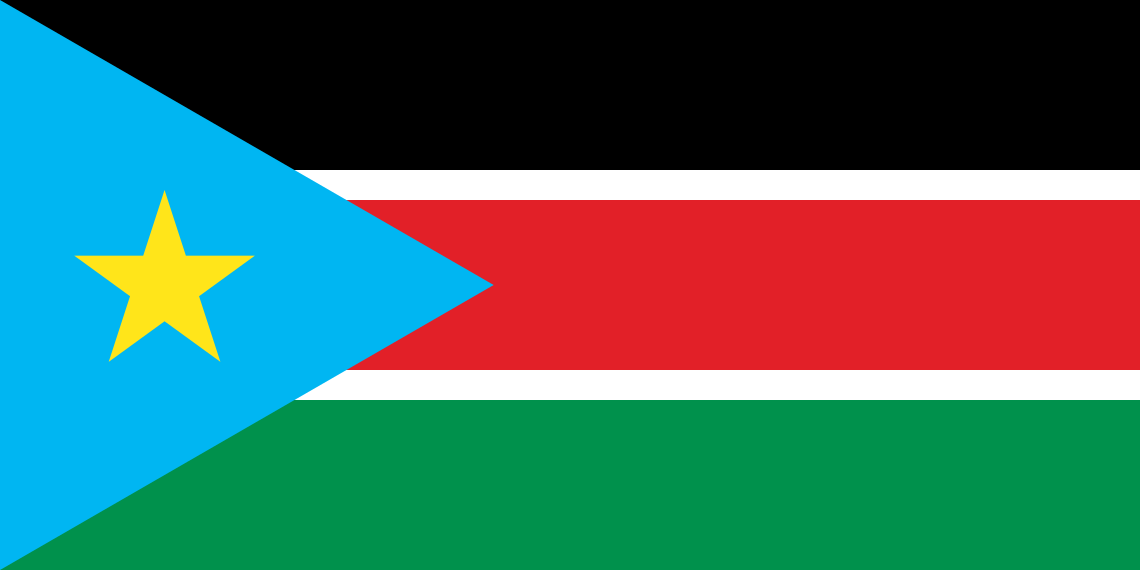
South Sudan acknowledges the concerns outlined in the Secretary- General’s recent letter regarding the delays in implementing critical benchmarks outlined in the Revitalized Agreement on the Resolution of the Conflict in the Republic of South Sudan (S/2024/297). We are pleased to report that some funding has been availed for the electoral bodies, the civil society and other stakeholders dialogue has concluded and presented their recommendations and an ongoing political parties’ dialogue is making progress on key challenges, such as the type of elections to be held, constitution-making modalities, electoral timelines and voter registration modalities.
We appreciate the continued support and engagement of the Security Council, particularly the insights provided during the open briefings and closed consultations. Those discussions underscore the importance of realizing the aspirations of the people of South Sudan for credible and peaceful elections. We also extend our gratitude to the United States, the penholder, the African members of the Security Council plus one, China and Russia for their efforts during the mandate renewal negotiations. We appreciate their trying their level best to align approaches with the situation on the ground and supporting a text that benefits the people of South Sudan,
Regarding the mandate renewal of the United Nations Mission in South Sudan (UNMISS), South Sudan acknowledges the importance of creating conducive conditions for supporting a peaceful transition. We recognize the need for a strategic approach that encourages and ensures lasting impact beyond the electoral period and promotes democratic development, progress and stability in South Sudan. South Sudan remains committed to the electoral process, as demonstrated by the establishment of necessary institutions, the legislation and the funding that availed so far. Despite differing views among parties on election preparedness, we reaffirm our commitment to holding elections. We welcome constructive dialogue and collaboration on remaining challenges.
South Sudan values the cooperation and support of the Security Council, and we look forward to continued collaboration in advancing the democratic transition and sustainable development in our country.
The meeting rose at 3.20 p.m.