S/PV.9622 Security Council
Provisional
The meeting was called to order at 10.05 a.m.
Expression of thanks to the outgoing President

I should like to take this opportunity to pay tribute, on behalf of the Council, to Her Excellency Mrs. Vanessa Frazier, Permanent Representative of Malta, for her service as President of the Council for the month of April. I am sure I speak for all members of the Council in expressing deep appreciation to Ambassador Frazier and her team for the great diplomatic skill with which they conducted the Council’s business last month.
Adoption of the agenda
The agenda was adopted.
Reports of the Secretary-General on the Sudan and South Sudan Report of the Secretary-General on the situation in Abyei (S/2024/354)
In accordance with rule 37 of the Council’s provisional rules of procedure, I invite the representatives of South Sudan and the Sudan to participate in this meeting.
In accordance with rule 39 of the Council’s provisional rules of procedure, I invite the following briefers to participate in this meeting: Mr. Jean- Pierre Lacroix, Under-Secretary-General for Peace Operations; and Ms. Hanna Serwaa Tetteh, Special Envoy of the Secretary-General for the Horn of Africa.
The Security Council will now begin its consideration of the item on its agenda.
I wish to draw the attention of Council members to document S/2024/354, which contains the report of the Secretary-General on the situation in Abyei.
I now give the floor to Mr. Lacroix.
Mr. Lacroix: I thank you, Mr. President, for the opportunity to brief the Security Council on the United Nations Interim Security Force for Abyei (UNISFA), including its support to the Joint Border Verification and Monitoring Mechanism (JBVMM). I will use this opportunity to update members on the latest political, security, humanitarian and operational developments in Abyei.
Political progress towards the determination of the final status of Abyei and the resolution of issues related to the border between the Sudan and South Sudan remain stalled since the outbreak of the war between the Sudanese Armed Forces and the Rapid Support Forces in the Sudan in April 2023. Despite the positive engagement demonstrated in the months before the start of the crisis, the ongoing fighting is likely to continue to have a serious impact on the chances for constructive dialogue between the two countries on those topics. Nonetheless, the United Nations continues to monitor the conditions that allow for a resumption of talks and stands ready to support the parties, in close coordination with the African Union, once the parties are in a position to return to the political process. Special Envoy Tetteh will provide members with further updates regarding the political situation in the Sudan and South Sudan, as well as other regional issues.
On the ground in Abyei, UNISFA has continued to prioritize efforts aimed at improving intercommunal relations. We have witnessed a welcome reduction in violence between the Ngok Dinka and Misseriya communities, with only one clash recorded during the reporting period. Amid challenges, such as the Sudan conflict, that have also affected intercommunal relations, UNISFA has been at the forefront of efforts to maintain reconciliation, including working with United Nations agencies, funds and programmes and other partners to facilitate a pre-migration conference between the two communities in Noong, in central Abyei, in December 2023. The conference, which included women and youth representatives, led to an agreement that included mechanisms to monitor and resolve disputes during the seasonal cattle migration. The mission’s continued focus on relations between the Ngok Dinka and Misseriya communities is critical to ensure that progress is sustained.
Simultaneously, clashes between the Ngok Dinka and Twic Dinka communities increased, as tensions related to the ownership of the land in Abyei south of the Kiir River continued to have an impact on the security situation. The attacks and reprisals in southern Abyei, which led to significant loss of life earlier in the reporting period, have tapered off in recent months. However, tensions remain high, and UNISFA continues to be on alert to protect civilians should clashes recur. We urge the Government of South Sudan to strengthen its engagement with the relevant communities so that further violence can be prevented.
We are deeply concerned about the presence of South Sudanese security forces in southern Abyei since October 2022, including additional troop deployments of the South Sudan People’s Defence Forces (SSPDF), which took place in late March and early April of this year. That presence is in violation of the 2011 Agreement between the Government of the Republic of the Sudan and the Sudan People’s Liberation Movement on temporary arrangements for the administration and security of the Abyei Area and of the relevant Security Council resolutions. The presence of the SSPDF has caused fear and has led to repeated violations of UNISFA’s freedom of movement, thereby limiting the latter’s ability to implement its protection-of-civilians mandate. If left unaddressed, the presence of the SSPDF in Abyei may fuel tensions in a region that is already faced with deep political divisions. We call on the Government of South Sudan to withdraw all security personnel from the Abyei Area as soon as possible and to ensure full freedom of movement for UNISFA, in line with the status-of-forces agreement.
Also of concern were the series of clashes, primarily between Ngok Dinka and Nuer community members, in southern and central Abyei in January and February, which resulted in significant civilian casualties. During that period, UNISFA moved proactively to protect civilians, increasing patrols and sheltering community members who had sought refuge at the mission’s bases. Last Friday, the mission reported that several Misseriya and Nuer were killed during cattle rustling incidents south of Rumamier, in southern Abyei. Over the weekend, UNISFA held a meeting with Misseriya, Nuer and Ngok Dinka representatives to extend support for a peaceful resolution of the conflict. With tensions running high, political support for dialogue between the Nuer and other communities in Abyei is critical.
During the response to the clashes of late January and early February, two of our peacekeeping colleagues lost their lives. We strongly condemn the attacks that led to their deaths and express our most sincere condolences to the families of those who lost their lives. Peacekeeper safety remains a top priority for the United Nations, and investigations by boards of inquiry are ongoing into those incidents. We reiterate the Secretary-General’s call upon the relevant authorities to investigate those responsible and hold them to account, in line with the status-of-forces agreement.
The humanitarian situation in Abyei remained difficult, with communities facing challenges in acquiring essential services and commodities, and
continued inflows of people displaced by the conflict in the Sudan. United Nations agencies, funds and programmes and their partners have continued to provide support to those in need, even as their operations have been affected by the volatile security situation associated with continued intercommunal violence. Four off-duty humanitarian personnel were killed during the uptick in clashes in late January and early February, and roughly 20,000 people in Abyei are estimated to have been displaced during that period. We express our deep condolences to the families of those who lost their lives.
Despite delays associated with the conflict in the Sudan, the reconfiguration of UNISFA into a United Nations multinational peacekeeping force is expected to be completed before the onset of the upcoming rainy season. As of 1 May, all contingents of military personnel have been deployed and the remaining contingent- owned equipment is en route. Owing to the crisis in the Sudan, all cargo movements must enter Abyei via South Sudan. We call on the Government of South Sudan to work with UNISFA and other United Nations presences to facilitate the smooth passage of cargo, including the removal of recently imposed taxes and levies, which have seriously affected their operations.
The fighting in the Sudan continues to affect the operations and resupply of JBVMM headquarters in Kadugli, the Sudan, and its two team sites, where airspace closures have forced aerial monitoring to cease. Nonetheless, ground monitoring from its team sites in Tishwin and Abu Qussa/Wunkur continues. UNISFA also continues to monitor the security situation in the area of Kadugli, where sporadic clashes between the Sudan People’s Liberation Movement-North Abdelaziz Al-Hilu faction and the Sudanese Armed Forces continue to be reported. The JBVMM Sector 1 headquarters in Gok Machar, South Sudan, and its two team sites remain non-operational following the mission’s forced withdrawal in 2021. UNISFA continues to engage with the Government of South Sudan to work to enable the re-establishment of those locations as soon as possible.
We welcome the support of the Government of the Sudan for the deployment of 10 additional individual police officers, meaning that now up to 60 will be present in Abyei. However, that still falls well below the full 148 individual police officers and three formed police units mandated by the Security Council. With the Sudan crisis resulting in the continued movement of displaced people into Abyei and insecurity associated
with ongoing intercommunal violence in the box, rule of law support for the people of Abyei remains as important as ever. In the absence of the Abyei police service, the United Nations police support for community-based mechanisms, such as the community protection committees, continues to be vital. To ensure coordinated, whole-of-mission support to the rule of law in the box, the Mission developed a rule-of-law support strategy and its associated action plan in November 2023 after consultation with key stakeholders. The strategy covers responses to serious crime and associated detention by UNISFA and the handover of suspects to the respective authorities, as well as support for on-the-ground dispute resolution, including through the community-based protection and customary justice mechanisms in Abyei. Amid strained relations between communities, the Mission also continues its efforts to promote human rights, including advocacy and the monitoring of violations and abuses.
The United Nations country teams in the Sudan and South Sudan, in coordination with UNISFA, continued the implementation of the Joint Programme of the Resident Coordinators in the Sudan and South Sudan in Abyei projects with the goal of helping to build an environment conducive for peaceful coexistence. Despite some challenges in northern Abyei owing to the Sudan crisis and the limited availability of implementing partners, UNISFA, jointly with United Nations agencies, funds and programmes, and national partners, delivered services, training and other support in priority areas, such as health care and gender-based violence prevention.
We want to thank all personnel of UNISFA and the United Nations agencies, funds and programmes, along with the acting Head of Mission and Force Commander Major General Benjamin Olufemi Sawyerr, for their dedication to peace and security in Abyei, especially in the face of additional challenges and uncertainty. We would also like to express our appreciation to the troop- and police-contributing countries for their important contributions in an insecure environment, as well as to the members of the Security Council for their continued support for UNISFA.
I thank Mr. Lacroix for his briefing.
I now give the floor to Ms. Tetteh.
Ms. Tetteh: I thank you, Mr. President, for allowing me to brief the Security Council on the progress made in the implementation of resolution 2046 (2012), which
relates to the outstanding bilateral issues between South Sudan and the Sudan and the situation in the South Kordofan and Blue Nile states.
The Sudan crisis, which began a year ago on 16 April, remains a pressing issue. The conflict in the Sudan continues to be determined by military developments on the ground, and yet, in our view, no warring party has the military means to achieve victory. Despite numerous mediation efforts, the civilian population continues to suffer the consequences of the violent confrontation between the Rapid Support Forces (RSF) and the Sudanese Armed Forces (SAF). That conflict not only impacts bilateral relations between the Sudan and South Sudan, but also has far-reaching implications for the security and humanitarian situation in the Sudan’s neighbours, in the Sahel and in the Horn of Africa as a whole.
South Sudan has been actively engaging in regional mediation efforts for the resolution of the conflict in the Sudan, as the country is already facing a dire humanitarian situation and fears being dragged even further into the Sudanese war. The influx of more than 630,000 refugees and returnees from the Sudan conflict has increased pressure on the population’s limited access to food, water and basic health services owing to years of armed conflicts, intercommunal violence and environmental shocks.
Therefore, the conflict in the Sudan is not only a humanitarian crisis, but a severe economic challenge for South Sudan. The country, heavily reliant on its oil exports, has seen a direct impact on its economy owing to the conflict. An incident in an area controlled by the RSF in White Nile state in early February led to a suspension in loadings and a subsequent gelling that solidified oil, halting oil production and delivery. On 16 March, the Sudan’s Minister of Petroleum declared force majeure on oil deliveries to Port Sudan. On 26 April, the Sudanese authorities announced that the export of South Sudan’s crude oil through the Jabalyn pipeline would likely resume in two months. However, the severe disruption of oil delivery, the flooding of oil fields, and the uncertain security situation in the Red Sea have exacerbated an already dire economic situation in South Sudan.
I made this introduction because the conflict in the Sudan has impeded potential progress in resolving outstanding bilateral issues between the Sudan and South Sudan. The high-level committee of the Sudan and
South Sudan on Abyei met last year on 9 and 10 April. That was the first time it was able to meet in many years. Since then, it has been impossible to organize another meeting. The lack of progress has resulted in growing frustration among the Abyei population, which feels that neither the Sudan nor South Sudan is committed to resolving the final status of Abyei. At the same time, they continue to face severe security and humanitarian challenges of their own.
The intercommunal violence involving the Ngok Dinka, Twic Dinka and Nuer communities has threatened security in the Abyei Area. In January and February, violence, primarily between the Ngok Dinka and Nuer communities caused the death — as was mentioned by my colleague, Under-Secretary-General Lacroix — of more than 60 people, including two United Nations peacekeepers and four humanitarian staff. About 3,000 people have been displaced from Abyei and about 20,000 from southern Abyei into Abyei town. In Diffra, the oil installations were left unsecured following the withdrawal of the Sudanese oil police.
The security situation in the Sudan has caused a complete collapse of basic services in northern Abyei. It has also affected the delivery of basic services in southern Abyei, with health facilities and schools last supplied in April 2023 and some of the facilities occupied by the South Sudan’s People Defence Forces (SSPDF). People seeking health services come from Diffra, in northern Abyei, to access the already limited and overstretched facilities in southern Abyei. Due to intercommunal violence, Abyei has had two consecutive years of unsuccessful harvest, a situation exacerbated by the impact of climate change.
In February of this year, Under-Secretary-General Lacroix and I conducted a joint visit to Abyei, and we met with the Abyei administrators from the Sudan and South Sudan, respectively. Both deplored the hardship that the population faces. We are also concerned that the Presidential order from South Sudan that authorized a troop deployment to quell insecurity by maintaining a buffer zone between the two contesting Dinka communities has not been adhered to appropriately. The South Sudanese co-Chair of the Abyei Joint Oversight Committee deplored that the newly arrived SSPDF troops were seen engaging in direct confrontation in Rumamier against local Government officials. Repeated security incidents prompted recent demonstrations in Abyei, demanding the withdrawal of SSPDF troops and justice for the victims of the killings.
Given the status of Abyei as a demilitarized and weapons-free area, I would like to second Under- Secretary-General Lacroix’s call on the Government of South Sudan to redeploy SSPDF troops outside the Abyei box. I will also continue — with the Force Commanders of the United Nations Interim Security Force for Abyei and other United Nations colleagues working in the Abyei Administrative Area to encourage leaders of the Twic and Ngok Dinka communities to de-escalate tensions and resolve their differences amicably and peacefully. During our engagement in Juba, the interlocutors also called for additional police to be deployed in Diffra in order to secure the oil infrastructure abandoned by the Sudan’s oil police.
The war between the SAF and the RSF is compounding the humanitarian and security situation in the Blue Nile and South Kordofan states and fragmenting further those two territories. While large areas of South Kordofan, including the towns of Kauda and Kulugi, are under the authority of the Sudan People’s Liberation Movement (SPLM)-North, led by Abdelaziz Al-Hilu, the city of Dilling is disputed by both the SPLM-N and the SAF.
A similar fragmented situation prevails in Blue Nile state. While most of Blue Nile state, including its capital, Damazin, is controlled by the SAF, portions of its southern territory are under the SPLM-N’s authority. In neighbouring North Kordofan state, mostly under the RSF’s control, the fighting between the RSF and the SAF could also spill over into South Kordofan and the Blue Nile.
In December, the RSF attacked the village of Tukma, around Dilling, the second-largest city in South Kordofan. In early January, following attacks by the RSF in Dilling’s residential areas, repelled by both the SPLM-N and the SAF, the SPLM-N took control of the city. In addition, the SAF conducted air strikes on an RSF camp in the Al-Dabaibat area, north of Dilling.
Partially addressed by the 2005 Comprehensive Peace Agreement between the Government of the Republic of the Sudan and the SPLM/Sudan People’s Liberation Army, the conflict in South Kordofan and Blue Nile cannot be resolved without a permanent ceasefire in the rest of the Sudan and a political solution to the violent confrontation between the SAF and the RSF. Negotiations between the warring parties should pave the way for an inclusive political agreement leading to a reformed security sector and the building
of a unified professional army, new institutional arrangements redefining the relationship between the so-called centre and its peripheries and, ultimately, the recovery and reconstruction of the Sudan.
In line with my Office’s mandate, I will continue to support the joint mediation efforts of the Secretary- General’s Personal Envoy, Mr. Ramtane Lamamra, the African Union High-level Implementation Panel on the Sudan, led by Mr. Mohamed Ibn Chambas, and the Intergovernmental Authority on Development. Mindful of the conflict’s consequences on the Sudan and the whole region and of the fragile internal situation in South Sudan, I will continue to engage with Sudanese and South Sudanese stakeholders in order to address outstanding bilateral issues and, hopefully, the final status of Abyei.
I thank Ms. Tetteh for her briefing.
I shall now give the floor to those members of the Council who wish to make statements.


I would like to thank Under-Secretary-General Lacroix and Special Envoy Tetteh for their briefings on Abyei. I also welcome the participation of the representatives of the Sudan and South Sudan in our meeting today.
At the outset, I would like to commend the tireless efforts of the United Nations Interim Security Force for Abyei (UNISFA) in carrying out its mandate — the stabilization and demilitarization of Abyei. The issues in Abyei are not just local. They have broader implications for regional stability and security.
In that regard, I would like to highlight three points.
First, it is crucial that UNISFA and the Joint Border Verification and Monitoring Mechanism are able to operate at their full capacity in a safe and secure environment. In that regard, the Republic of Korea strongly condemns all attacks on United Nations peacekeepers and reiterates our call for investigations and ensuring the accountability of those responsible.
It is also imperative that UNISFA be able to carry out its mandate without restriction on the freedom of movement. All parties should respect the demilitarized status of Abyei, in line with the Agreement between the Government of the Republic of the Sudan and the Sudan People’s Liberation Movement on temporary arrangements for the administration and security of the Abyei Area, of 2011.
In the meantime, we look forward to the completed construction of UNISFA’s smart camps, which can improve the safety, security, and efficiency of the mission. The Republic of Korea has been supporting the Organization’s smart camp projects and has launched its own pilot project in the Hanbit Unit of the United Nations Mission in South Sudan (UNMISS). We believe that an expansion of smart camps in peacekeeping operation missions can improve peacekeeping operational environments.
Secondly, every effort is needed to address the ongoing intercommunal violence in Abyei. We are deeply alarmed that the new clashes involving Ngok and Twic Dinka and Nuer communities have resulted in more displacement and have impeded the safe and timely delivery of humanitarian assistance. In that regard, we welcome the South Sudanese Government’s engagement with the relevant authorities in Warrap and Unity states, and the administration in Abyei. The Republic of Korea also fully supports the work of UNISFA to facilitate intercommunal dialogues, engaging relevant communities and local actors, including women and youth. Alongside those efforts, the establishment of the Abyei police service should remain a priority to meet the security needs of the region.
Last but not least, as was outlined in the briefing, we are deeply alarmed by the adverse impacts of the ongoing fighting in the Sudan on security and the humanitarian situation in Abyei. Violence in the Sudan is impeding the political process on the final status of Abyei, which can exacerbate insecurity in Abyei. Also, an influx of approximately 18,000 displaced persons from the Sudan has put additional pressure on basic resources, including food, water and medical facilities. We repeat the call on the Sudanese Armed Forces and the Rapid Support Forces for an immediate cessation of hostilities leading to a sustainable ceasefire and urge all warring parties in the Sudan and the Government of South Sudan to ensure unimpeded humanitarian access to Abyei.
Given that the situation in Abyei is closely interrelated with the situations in both South Sudan and the Sudan, it is important that close cooperation between UNISFA and UNMISS be sustained and that dialogue among all relevant parties be maintained. The Republic of Korea remains committed to playing a constructive role in achieving that end.


Since this is the first official Security Council meeting for this month, I would like to express our appreciation and congratulations to our colleagues from Malta for a successful presidency in April, which was not easy. At the same time, I would like to renew our commitment of full support for the presidency of Mozambique, working closely together with our colleagues in the Council for the peace and security of the world.
I thank Under-Secretary-General Lacroix and Special Envoy Tetteh for their insightful briefings. I also welcome the presence of the representatives of the Sudan and South Sudan at this meeting.
I would like to make four points.
First, Japan applauds the United Nations Interim Security Force for Abyei (UNISFA) for its tireless efforts, despite the challenging environment, to implement its mandated tasks, including the protection of civilians and facilitating the delivery of humanitarian aid, as well as promoting the rule of law, human rights and the women and peace and security and youth, peace and security agendas. Japan strongly condemns the attacks that killed 60 people, including two peacekeepers and four humanitarian aid workers, and injured four more peacekeepers in January and extends its deepest condolences to the families of the victims. We call on the appropriate authorities to investigate and to hold those responsible for the attacks accountable.
Secondly, we are deeply concerned about the negative impact the protracted conflict in the Sudan is having on the situation in Abyei. Political progress towards the resolution of the final status of Abyei and border issues is blocked, safe and timely delivery of humanitarian relief is hindered, and an influx of refugees and returnees is exacerbating the already dire humanitarian situation. Japan once again calls upon the Sudanese Armed Forces and the Rapid Support Forces to agree and implement a lasting ceasefire without preconditions and to engage with international, regional and subregional efforts to resolve the conflict.
Thirdly, we remain concerned about the continued presence of South Sudanese security forces in Abyei, which is a clear violation of the Area’s demilitarized status. Japan calls on the need for South Sudanese authorities to address the issue without delay and also to ensure freedom of movement of UNISFA troops and personnel.
Fourthly, Japan is pleased to see a reduction in intercommunal clashes between Ngok Dinka and Misseriya communities and commends their endeavours to engage in dialogue. At the same time, we are concerned about the increase in clashes among Ngok Dinka, Twic Dinka and Nuer communities. We urge the Government of South Sudan, with support from UNISFA, to undertake further efforts to promote improved relations among the communities towards peaceful coexistence.
In conclusion, Japan remains committed to working with all stakeholders to achieve peace and stability in Abyei and reiterates its full support for United Nations efforts in the region.


First of all, on behalf of the Permanent Mission of China, I would like to commend the Permanent Representative of Malta and her team for successfully steering the Council’s work in April. I congratulate Mozambique on its assumption of the presidency of the Security Council for this month. China will lend its full support to Mozambique.
I thank Under-Secretary-General Lacroix and Special Envoy Tetteh for their briefings. I also welcome the representatives of the Sudan and South Sudan to today’s meeting.
In connection with the report of the Secretary- General (S/2024/354), I would like to emphasize the following three points.
First, we must maintain security and stability in Abyei. Intercommunal conflict remains the main security problem in Abyei. China welcomes the agreement reached between the Ngok Dinka and Misseriya communities on transhumance.
During the reporting period, the security situation in central and southern Abyei was critical with intercommunal armed clashes resulting in civilian casualties and displacement, which threatened the overall stability in Abyei. We support the United Nations Interim Security Force for Abyei (UNISFA) in working, in accordance with its mandate, to diffuse differences through dialogue with a view to achieving peaceful coexistence among communities. The United Nations country team and UNISFA should work together to carry out more peacebuilding and livelihood development projects in Abyei and focus on addressing the root causes of the conflict.
Secondly, we must do our utmost to ensure the effective implementation of UNISFA’s mandate. China commends UNISFA for the tremendous efforts it has made to overcome challenges and to maintain peace and stability in Abyei. The Secretary-General noted in his report that UNISFA has been attacked recently on several occasions while carrying out its mandate, resulting in a number of Blue Helmet casualties, which is deplorable. We call on the United Nations to attach great importance to the issue, draw lessons from it and do its utmost to ensure the safety of UNISFA peacekeepers. We hope that the Sudan and South Sudan will work closely with UNISFA and provide it with the greatest protection possible and help to facilitate the transportation of equipment, logistical supplies and safety for personnel.
Thirdly, we must create conditions for the resumption of the political process. The prolongation of armed conflict in the Sudan has had a multifaceted impact on the situation in Abyei. The massive influx of refugees has exacerbated the humanitarian challenges and resource scarcity, thereby impeding the Abyei political process. China expects the Sudan to bring the conflict to an end as soon as possible and resume dialogue and cooperation with South Sudan at an early date, so as to lay the basis for relaunching the Abyei political progress. We commend and support the efforts of the United Nations, the African Union and the Intergovernmental Authority on Development to resolve the Abyei issue and encourage Special Envoy Tetteh and UNISFA to continue to maintain contact with the parties concerned in order to build momentum for a political settlement of the Abyei issue.
At the end of last year, the fourth batch of Chinese peacekeeping helicopter units successfully deployed to Abyei to carry out its mandate. It has provided important support to UNISFA in troop deployment, air patrols and casualty evacuation.
China stands ready to work with the international community to continue to make further contributions for peace and stability in Abyei.


We thank the Under-Secretary-General for Peace Operations, Mr. Jean-Pierre Lacroix, and the Special Envoy of the Secretary-General for the Horn of Africa, Ms. Hanna Serwaa Tetteh, for their briefings. We welcome the presence at this meeting of the Permanent Representatives of South Sudan and the Sudan.
We carefully read the report of the Secretary-General on the situation in Abyei (S/2024/354). Unfortunately, in recent months there has not been significant progress in the political settlement. However, that was owing to objective factors.
The Sudan remains in a situation of serious armed conflict. That has affected a large proportion of the country and has had devastating humanitarian consequences for the entire region. Juba faces the challenge of having to host refugees and South Sudanese people returning from the north; there are tens of thousands of them in Abyei. We should recognize that South Sudan is coping with that challenge successfully. However, the country is facing an uphill struggle to implement the provisions of the Revitalized Agreement on the Resolution of the Conflict in South Sudan, to complete the transition period and to hold the first-ever general elections, scheduled for December 2024.
We are pleased that the security situation in Abyei over the past six months, although still complex, has basically been under control. That has been helped by the responsible approaches taken by the Sudan and South Sudan in regard to Abyei, which should be highly commended. We particularly note Juba’s efforts to promote intercommunal reconciliation, which has decreased the tension between the Misseriya and Ngok Dinka communities. Nonetheless, we are concerned about clashes between the Ngok Dinka and Nuer communities as well as between the Ngok Dinka and Twic Dinka communities. We welcome the willingness of both Governments to establish multifaceted cooperation regarding, inter alia, joint exploitation of potential oil resources in Abyei. We still believe there is a need for joint efforts by both parties to resolve the Abyei issue.
We believe it is important for the Sudan and South Sudan to uphold their commitment to support the demilitarized status of Abyei, but a settlement is probably going to take some time, and there is a need for patience and for parties to refrain from any unilateral attempts to change the status of the disputed region in violation of existing international legal rules and agreements between the two States. We believe that criticizing the parties for paying insufficient attention to a settlement, and even worse, pressuring them, including through sanctions mechanisms, is not helpful.
The United Nations Interim Security Force for Abyei (UNISFA) remains an important factor for stability. We welcome the role played by peacekeepers
in resolving current security issues, in upholding law and order and in fostering good relations between the local communities. We underscore that any aggressive actions against United Nations peacekeepers are unacceptable. We would also like to convey our condolences to the families of peacekeepers who died during the events in January and of civilians killed or injured during intercommunal clashes. We trust that the mission will continue to clearly carry out its mandate, focusing on providing assistance to the two States in their efforts to achieve a mutually acceptable solution to the border dispute.
A significant stabilizing role is being played by the Joint Border Verification and Monitoring Mechanism (JBVMM), inter alia in the supply and rotation of UNISFA personnel. We pay tribute to the Sudanese authorities for their constructive cooperation with the JBVMM. However, although the Sudanese side is continuing to properly issue one-off authorizations for overflights to supply and rotate staff and personnel from the mission, monitoring possibilities remain limited owing to the closure by the Sudan in April 2023 of the airspace around Kadugli airport.
We believe that maintaining a peacekeeping presence in the region is still very important. We urge the leadership of the mission to work further to resolve the situation with the authorities of both States.


Let me briefly join others in thanking Malta for steering the Council during the month of April and in welcoming you, Mr. President, to the presidency in May — we express our best wishes to Mozambique.
I thank Under-Secretary-General Lacroix and Special Envoy Tetteh for their comprehensive briefings. I also welcome the presence of the representatives of the Sudan and South Sudan at today’s meeting.
The situation in Abyei remains deeply intertwined with broader regional instability, especially following the year-long fighting in the Sudan. Heightened security risks and disrupted crucial supply routes for the United Nations Interim Security Force for Abyei (UNISFA) and humanitarian aid are intensifying humanitarian challenges and placing vulnerable populations at an even greater risk. Let me make three remarks in that regard.
First, despite the current standstill, dialogue and diplomacy remain the only viable path for determining Abyei’s final status. Therefore, we share concerns
over the impact of conflict in the Sudan, particularly the fact that efforts towards a peaceful and permanent resolution of Abyei’s status have stalled. Let me at this point reiterate our call for an immediate cessation of hostilities in the Sudan. In that regard, we support the efforts of the African Union and the Intergovernmental Authority on Development, along with the Special Envoy, and call on the Sudan and South Sudan to resume discussions as soon as conditions permit.
The implementation of the joint mechanisms outlined in the 2011 Agreement remains imperative. The Joint Border Verification and Monitoring Mechanism requires the sustained commitment and support of both sides, including for its aerial monitoring operations. We also emphasize that Abyei must remain demilitarized and weapons-free. We urge the withdrawal of any security forces that are not in line with the 2011 Agreement.
Establishing the Abyei police service is critical until the final status is agreed, and therefore it is also of concern that no progress has been achieved in that area. The lack of a cohesive criminal justice system and enforcement capabilities also remain of concern. We emphasize the urgency of those critical measures as soon as circumstances allow.
Secondly, our focus remains on the protection of civilians. Vast humanitarian needs, scarcity of essentials, escalating intercommunal violence and the influx of displaced persons further strain already limited resources. Conflict in the Sudan and the adverse effects of climate change-induced land and water shortages additionally exacerbate civilian hardships.
We condemn in the strongest terms the deadly attacks on aid workers, as well as attacks on their facilities and the looting of their supplies. We wish to reiterate that humanitarian aid provision and the safety of aid workers are essential.
We remain deeply concerned about the persistent intercommunal tensions. The increasing violence, particularly among the Ngok Dinka and Twic Dinka, and new clashes between the Ngok Dinka and Nuer communities is profoundly troubling. We are particularly alarmed that the increased tensions, clashes, kidnappings and sexual and gender-based violence and other incidents are greatly affected by the continued proliferation of arms in the region.
We acknowledge the constructive progress made between the Misseriya and Ngok Dinka communities, particularly the agreement to ensure peaceful transhumance signed in December. It is a noteworthy development, and we encourage both communities to sustain and build upon it.
Thirdly, we commend the bravery and sacrifices of UNISFA troops. We strongly condemn the attacks on UNISFA personnel in January, which resulted in the deaths of two peacekeepers and injuries to several others. That is unacceptable, and perpetrators must be held accountable.
All impediments to, and violations of, the status- of-forces agreement should be immediately addressed and removed. Freedom of movement of UNISFA personnel and troops is essential to enable the mission to effectively execute its mandate.
Regarding the delays in UNISFA’s reconfiguration owing to setbacks in equipment deployment, we commend the collaboration between the Government of South Sudan and UNISFA in rerouting equipment and supplies. We also call for continued cooperation on cargo transit efficiency and the elimination of obstacles hindering that passage.
We highly commend UNISFA’s efforts in fostering dialogue, trust and support reconciliation among the communities. We emphasize the importance of the full, equal, meaningful and safe participation of women and youth in those efforts. Slovenia appreciates the ongoing enhancement of the mission’s early-warning system and corresponding early-response measures. UNISFA’s efforts in a wide range of human rights- related activities, ongoing engagement with youth and climate-sensitive conflict responses and peacebuilding remain crucial. We commend the advocacy for gender inclusivity in joint community committees, the promotion of women’s participation in security and conflict management structures and the adoption of the UNISFA rule-of-law support strategy.
We cannot allow the crisis in Abyei to fade into obscurity. The people of Abyei deserve to live in peace, and they deserve to have access to essential State services, justice, security and economic and educational opportunities.


Like my colleagues, as this is the first public meeting this month, I would like to assure you, Mr. President,
of our full support during your presidency, and I would also like to congratulate Malta on its successful presidency last month. I would also like to thank Under-Secretary-General Lacroix and Special Envoy Tetteh for their briefings, and I welcome the presence of the representatives of the Sudan and South Sudan here today.
Allow me to begin by expressing our sincere condolences to the families of all the victims of the attacks in southern and central Abyei last year and earlier this year. The considerable number of civilian casualties, including humanitarian personnel, and the attacks against the United Nations Interim Security Force for Abyei (UNISFA), which itself lost two Blue Helmets, as we heard, are unacceptable. The Security Council was quick to denounce that violence. In that context, we also deeply deplore last week’s attack on the International Committee of the Red Cross in South Darfur. The perpetrators of all those attacks must be held accountable. Those who risk everything to assist others must be protected, as required by international humanitarian law. Switzerland is committed to that end, in particular through its current draft resolution.
Abyei continues to be a victim of the deteriorating security situation in the southern part of the Area, as well as the ongoing impact of the current conflict in the Sudan and the persistent tensions in South Sudan. I would therefore like to highlight three priorities.
First, we must do everything we can to protect the civilian population from further violence. That applies in particular to the intercommunal clashes in southern Abyei, especially between the Ngok Dinka and the Twic Dinka. While we welcome South Sudan’s political engagement, we are concerned about the significantly increased presence of the South Sudan People’s Defence Forces. As the Under- Secretary-General reminded us, that presence restricts UNISFA’s freedom of movement, and therefore its ability to protect civilians and facilitate the delivery of humanitarian aid. That is especially important now that the vital supply route through the Sudan has been cut off because of the conflict. In addition, the proliferation of weapons must be urgently addressed. Abyei must remain a demilitarized and weapon-free zone, in line with the 2011 Agreement between the Government of the Republic of the Sudan and the Sudan People’s Liberation Movement on temporary arrangements for the administration and security of the Abyei Area and with the Security Council’s demand.
Secondly, as my colleagues have already underscored, UNISFA plays a crucial role in contributing to peace and security in Abyei. We therefore call on the authorities of the Sudan and South Sudan to continue to respect the status of forces. That requires all parties to ensure that UNISFA and the Joint Border Verification and Monitoring Mechanism can continue to move freely and operate in safe and secure conditions. We welcome South Sudan’s support for the transit of goods through its territory, and we hope that that process can continue in an efficient manner.
Thirdly, we must continue to restore a climate of confidence and promote dialogue in order to address the current long-term challenges. In that regard and in the absence of the Abyei police service, the community protection committees and the joint community peace committee play an essential role in terms of early warning to address issues relating to human rights and sexual and gender-based violence. We commend their work and the support provided by UNISFA, particularly in facilitating meetings between the joint peace committees and women’s committees. While we congratulate the Sudanese authorities for agreeing to deploy 10 additional police officers, we reiterate our call to facilitate the full deployment of the mandated police capacity.
The deteriorating situation in Abyei requires a collective effort. We reaffirm our full support for the work of UNISFA, the Special Envoy, the African Union and the Intergovernmental Authority on Development. We remain committed to working with all stakeholders to achieve peace and prosperity in Abyei.


I would like to thank Jean-Pierre Lacroix and Hanna Tetteh for their briefings, and I welcome the presence of the representatives of the Sudan and South Sudan at today’s meeting.
I would like to emphasize four points.
First, the conflict in the Sudan is hampering a political settlement on the final status of Abyei and is exacerbating fragilities. It is urgent that the warring parties in the Sudan resume dialogue, without preconditions, and that all external actors involved stop fuelling the conflict. That was one of the messages of the declaration of principles adopted in Paris on 15 April. In the past few weeks, the intensification of fighting between the parties to the conflict in the states of Darfur, Gezira, Khartoum and Kordofan has had
catastrophic consequences for the Sudanese population and continues to destabilize the entire region. We are particularly concerned about the ongoing escalation around the town of El Fasher, in North Darfur, and we reiterate our call on all parties to immediately cease hostilities throughout the country.
The Paris conference of 15 April mobilized €2 billion to support the scaling up of humanitarian aid in the Sudan and in neighbouring countries hosting refugees. We thank all our partners for their efforts. France will remain attentive to achieving the objectives and commitments set, in conjunction with the United Nations. All parties to the conflict must respect their obligations under international humanitarian law, which requires them to protect civilians and humanitarian and health personnel and to facilitate humanitarian access. In that regard, we condemn the violence that resulted in the deaths of two International Committee of the Red Cross humanitarian staff on 2 May in South Darfur.
In that fragile regional context, the work of the United Nations Interim Security Force for Abyei (UNISFA) is essential to protecting civilians in Abyei and to preserving the conditions for a settlement of the conflict. The intensification of intercommunal violence and the proliferation of weapons are cause for great concern. At the end of January, a resurgence of that violence between communities claimed the lives of more than 50 people, including two Blue Helmets. We reiterate our condemnation of that violence and that attack on UNISFA. We call for restraint, and we welcome all efforts to ease the tensions between local communities, including the high-level mobilization of the United Nations and the South Sudanese authorities. We call on the South Sudanese authorities to withdraw their forces deployed in Abyei. The Abyei Area must be demilitarized, in accordance with the 2011 Agreement between the Government of the Republic of the Sudan and the Sudan People’s Liberation Movement on temporary arrangements for the administration and security of the Abyei Area. We also urge the South Sudanese authorities to remove all obstacles to the work of the United Nations, whether in South Sudan or in Abyei. In that regard, we welcome the decision announced on 3 May to lift taxes on humanitarian aid provided by the United Nations, and we also call on South Sudan to lift taxes on other United Nations entities, including the United Nations Mission in South Sudan, in accordance with its international obligations.
We reiterate our support for the Special Envoy, Hanna Tetteh. The United Nations has a major role to play in supporting local peace efforts in the Horn of Africa. We encourage the States of the region to resolve their differences through dialogue, particularly regarding the Grand Ethiopian Renaissance Dam and in accordance with the principle of territorial integrity.


I congratulate Mozambique on assuming the presidency this month and thank members of the Security Council for their constructive engagement during our presidency. I thank Under- Secretary-General Lacroix and Special Envoy Tetteh for their briefings, and we also welcome the representatives of the Sudan and South Sudan to today’s meeting.
We would use this occasion to highlight the selfless courage that is continuously displayed by the United Nations Interim Security Force for Abyei (UNISFA) peacekeepers in Abyei. We reiterate our strong condemnation of the attacks on 27 and 28 January that resulted in the deaths of two peacekeepers, one Ghanaian and one Pakistani, as well as injuries to several other UNISFA personnel and wider civilian casualties.
We call for accountability for those responsible for these attacks and underscore that attacks against peacekeepers may constitute a war crime. We sound the alarm about the increasing violence in Abyei, which has exacerbated the significant loss of life, displacement and human rights abuses and violations, especially against women and children.
Malta is concerned about the lack of progress towards Abyei’s political settlement and encourages both the Sudan and South Sudan to revive discussions when the time is opportune. The establishment of the Abyei police service and a cohesive criminal justice system are also critical.
We call for the withdrawal of all security forces that stand in violation of the Agreement between the Government of the Republic of the Sudan and the Sudan People’s Liberation Movement on temporary arrangements for the administration and security of the Abyei Area and Abyei’s demilitarized status. In particular, the continued military use of schools and occupation of community protection facilities threatens education and intercommunal peace.
In moving forward, Malta commends the recent series of intercommunal talks, which engage local authorities, traditional leaders and civil society,
including women and youth representatives. We are encouraged by the work of the community Joint Peace Committee, facilitated by UNISFA, which has improved conflict resolution efforts through inclusivity and proactive responses.
Malta continues to strongly support the full, equal, meaningful and safe participation of women in security and conflict management structures in Abyei, including in UNISFA’s engagements. The internal gender focal point system operationalized within all UNISFA units remains integral to implementing a whole-of-system approach to the women and peace and security agenda. The role played by the gender focal point system as a referral mechanism for survivors of sexual and gender- based violence is also significant. The protection of women and girls from sexual and gender-based violence and child marriage must remain a priority.
UNISFA’s presence in Abyei remains crucial — both as a deterrent to armed conflict and an effective enabler of security. It is therefore unacceptable when its freedom of movement is not respected. We remind the relevant authorities of their obligations under the status-of-forces agreement, including respect of the freedom of movement of UNISFA and the Joint Border Verification and Monitoring Mechanism.
Despite Abyei’s immense security challenges and humanitarian needs, exacerbated by the conflict in the Sudan, we recognize the vital role played by the United Nations country teams in the Sudan and South Sudan. Vaccination roll-out programmes for children under the age of five and women and girls, facilitated by the International Organization for Migration, as well as screenings for children and pregnant and breastfeeding women, provided by Save the Children, in coordination with the World Food Programme, are critical examples of restricting the spread of diseases in areas of limited health-care services. In that regard, we reiterate our call for an immediate and sustainable ceasefire between the warring parties in the Sudan in order to further facilitate transportation of humanitarian aid to Abyei.
Abyei is no stranger to the most intense impacts of climate change. Following two years of unsuccessful harvests due to flooding, erratic rainfalls and crop infestations, it will soon enter its lean season. As climate-related shocks and intercommunal violence heighten food insecurity, we call for the full, rapid and
unimpeded access of humanitarian aid, and condemn all attacks against humanitarian personnel, health facilities and humanitarian warehouses.
In conclusion, we should spare no effort to support all endeavours that seek to meaningfully engage in a peace process for Abyei — one that places its people at the forefront of its future.
We reiterate our congratulations to Malta for its excellent presidency during the month of April.


I begin by extending my congratulations to Malta’s outstanding work in leading the Council during the month of April. I take this opportunity to extend my best wishes to Mozambique, which assumes the presidency of the Security Council for May. I thank Under-Secretary- General Jean-Pierre Lacroix and Special Envoy for the Horn of Africa Hanna Tetteh for their briefings. I also acknowledge the presence in the Chamber of the representatives of the Sudan and South Sudan.
In line with the Security Council’s 8 February press statement (SC/15584), I reiterate our condemnation of the attacks on the personnel of the United Nations Interim Security Force for Abyei (UNISFA), which resulted in the death of two Blue Helmets, wounded several others and caused a significant number of civilian casualties. The targeting of United Nations peacekeepers is absolutely unacceptable; the perpetrators must be brought to justice.
The Secretary-General’s report on the situation in Abyei (S/2024/354) shows a deterioration in the security situation, with an increase in intercommunal clashes, which have caused numerous civilian casualties and the displacement of the population.
The continued presence of South Sudanese security forces in Abyei runs counter to the demilitarized status of the area established in the 2011 agreement. That presence has restricted UNISFA’s freedom of movement, thus hindering the fulfilment of its mandate. The Government of South Sudan must withdraw its forces and fully respect Abyei as demilitarized territory.
The safe resupply, rotation and freedom of movement of the Joint Border Verification and Monitoring Mechanism must be facilitated by the parties. Dialogue on the final status of Abyei and border issues should resume between the Sudan and South Sudan, with the support of the African Union and the Intergovernmental Authority on Development.
Abyei has received thousands of displaced persons from the Sudan, generating tensions due to the scarcity of resources and aggravating the humanitarian situation in the region. Humanitarian aid must arrive unhindered. The support provided by the Government of South Sudan for that purpose must also continue.
Strengthening the early-warning mechanisms of community reconciliation initiatives is a task that would benefit from greater political will to address the underlying causes of conflict in Abyei, such as the proliferation of weapons.
We encourage the expansion of women’s full, equal and meaningful inclusion and participation in all spheres, including the political process, as a critical step towards achieving sustainable peace.
In challenging circumstances like these, the work of UNISFA and its personnel is key to promoting peace and stability in Abyei. Since 2005, 151 Ecuadorians have contributed as military observers and staff members to missions in Abyei, the Sudan and South Sudan, and we are committed to continue strengthening our presence in the region.


Let me first congratulate you, Mr. President, on assuming the presidency for the month of May, and thank Malta for its excellent stewardship in the month of April. I also thank Under-Secretary-General Lacroix and Special Envoy Tetteh for their briefings today, and I welcome the participation of the representatives of the Sudan and South Sudan at our meeting.
First, I commend the United Nations Interim Security Force for Abyei (UNISFA) for its efforts to maintain peace and security in Abyei in challenging circumstances, including through collaboration between the mission, non-governmental organizations, local authorities and communities.
The United Kingdom is deeply concerned about the alarming rise in intercommunal clashes between the Ngok Dinka and the Twic Dinka. Violent clashes over the past six months have led to hundreds of civilian casualties and claimed the lives of two peacekeepers. We take this opportunity to express our heartfelt condolences to the families of all victims and to the Governments of Ghana and Pakistan, as well as to the families of the two International Committee of the Red Cross workers killed on 2 May in South Darfur.
Secondly, the United Kingdom calls on the Sudanese and South Sudanese authorities to create the necessary conditions for UNISFA to fully implement its protection mandate. We further urge community leaders and influential figures to take steps to de-escalate tensions. The rise in South Sudanese troop deployments in and around Abyei has actively contributed to insecurity and the proliferation of arms in the area. We call on South Sudan to withdraw its armed forces from southern Abyei immediately, in accordance with its obligations under the status-of-forces agreement. We call on the Sudan to urgently ensure the safe resupply and freedom of movement of the Joint Border Verification and Monitoring Mechanism. And we further urge the local authorities to enhance coordination to ensure humanitarian assistance reaches the most vulnerable people across Abyei.
Thirdly, for real progress to be made in addressing Abyei’s dire humanitarian situation and its unresolved political status, the fighting in the Sudan must end now. We reiterate our calls to the Sudanese Armed Forces and the Rapid Support Forces to immediately cease hostilities and make way for a political transition.
In conclusion, civilians continue to bear the brunt of the military clashes in the Sudan and intercommunal conflict across Abyei and South Sudan. Peacekeepers and humanitarians are risking their lives to try to the alleviate suffering. They must not be targets.


Since this is the first meeting of the month, I would like to thank Malta for its well-run and efficient presidency and to extend my well wishes to Mozambique with the beginning of its presidency. I would also like to recognize the participation of the representatives of the Sudan and South Sudan in today’s meeting. Secondly, I thank Under-Secretary- General Lacroix and Special Envoy Tetteh for sharing the progress on mandate implementation of the United Nations Interim Security Force for Abyei (UNISFA) and for their updates on Abyei.
The United States again extends its deepest condolences to the families of the fallen peacekeepers after a series of attacks on 27 and 28 January. We reiterate our condemnation of those attacks, which also resulted in injuries to several UNISFA personnel and wider civilian casualties. We express unwavering solidarity with the Governments of Ghana and Pakistan, both of whom have suffered the loss of their brave peacekeepers serving in Abyei.
We denounce any targeting of United Nations peacekeepers and provocations against UNISFA personnel. As we all know, deliberate attacks against peacekeepers undermine the mission’s mandate and also may constitute war crimes under international law. We call for the immediate investigation by the South Sudanese transitional Government into the January deaths of the two peacekeepers and for those responsible for those reported attacks to be held accountable, as appropriate.
While we express our appreciation to UNISFA for its efforts to quell tensions between intercommunal groups since the attacks in January and February, it is imperative to underscore that the protection of civilians remains of paramount importance. The recent outbreak of violence involving Nuer and Ngok Dinka on 27 April that resulted in the killings of three Nuers in Abyei underscores the continued vulnerability of civilians in the region and the need for robust civilian engagement. We urge UNISFA to intensify its civilian engagement efforts and collaborate closely with relevant stakeholders, including women and youth, to implement robust measures aimed at enhancing the safety and the security of civilians.
As criminality appears to be the main driver of violence in Abyei, it is critical that UNISFA be adequately equipped and supported to implement its mandate without hindrance. The United States underscores the urgent need for concerted efforts by the transitional Government of South Sudan and the Government of the Sudan to immediately cease any actions that obstruct the deployment of new formed police units or delay visas, the deployment of contingent-owned equipment or the appointment of a civilian deputy head of mission. Any delays or impediments to the deployment process, including freedom of movement restrictions on UNISFA throughout the Abyei box, only exacerbate the challenges faced by local communities and undermine efforts to restore stability. The United States condemns the freedom of movement restrictions and emphasizes the paramount importance of enhanced cooperation among UNISFA, the South Sudanese transitional Government and the Sudanese Government to promptly demilitarize the Abyei box.
Lastly, we reaffirm our unwavering support for UNISFA amid the challenging circumstances and commend the dedication and sacrifices of troop- and police-contributing countries to restore peace, security and stability in Abyei.
I shall now make a statement in my capacity as the representative of Mozambique, and in fact as the representative of the three African members of the Security Council, namely, Algeria, Sierra Leone and my own country, Mozambique, as well as Guyana (A3+).
We express our appreciation to the Under-Secretary- General for Peace Operations, Mr. Jean-Pierre Lacroix, and the Special Envoy of the Secretary-General for the Horn of Africa, Ms. Hanna Tetteh, for their insightful briefings and, more importantly, for their extraordinary work for peace and stability in Africa and beyond. We welcome the participation of the Permanent Representative of the Sudan and South Sudan to this meeting.
It is with grave concern that we are discussing once again the alarming situation in the Abyei Area, in a context of persisting security challenges, particularly involving intercommunal clashes, kidnappings and cattle rustling. The insecurity in that region, which is being aggravated by the proliferation of small arms and light weapons, has been responsible for casualties among civilians, including the peacekeepers of the United Nations Interim Security Force for Abyei (UNISFA). Meanwhile, negotiations on the final status of Abyei remain stalled.
It is against that backdrop that the A3+ would like to underline the following points.
First, the demilitarized status of Abyei must be respected by all parties. Although negotiations on the final status are stalled, it is crucial that both parties remain guided by the letter and spirit of the 20 June 2011 Agreement. Those agreed temporary arrangements are critical for the security and protection of civilians in the Abyei Area until the determination of its final status.
In the same vein, we call on the parties to grant the Joint Border Verification and Monitoring Mechanism all facilities. We note the efforts deployed by the authorities of the Sudan and South Sudan to assist the Mechanism in delivering its mandate despite all the challenges on the ground. We further call on the relevant authorities to guarantee the freedom of movement of UNISFA personnel and troops to allow them to carry out their duties in line with the status-of-forces agreement.
Secondly, attacks against civilians, humanitarian actors and peacekeepers are totally unacceptable. They constitute gross violations of international humanitarian law and human rights law. In that context, we encourage all parties to coordinate their efforts to de-escalate tensions and protect civilians.
We commend the efforts of South Sudan to engage local authorities regarding the cessation of hostilities and accountability for those who incite violence. We also commend UNISFA for promoting intercommunity dialogue involving local authorities, traditional leaders, civil society, women and youth. The agreement of last December between the Ngok Dinka and the Misseriya communities, facilitated by UNISFA, to ensure peaceful transhumance constitutes a commendable initiative that needs to be replicated. We believe that those initiatives will create the necessary conditions for stability through dialogue and reconciliation between communities.
Thirdly, the humanitarian situation in Abyei deserves our particular attention. The compounding challenges faced by the people of Abyei, which include the effects of climate shocks and the influx of displaced persons fleeing the Sudan conflict, are exacerbating an already dire situation. In that regard, we call on the relevant partners to increase their support to the people of Abyei. We further encourage UNISFA and other United Nations agencies to strengthen their assistance to the most vulnerable.
The A3+ further reiterates that it is crucial to define the final status of Abyei in order to bring sustainable peace and prosperity to Abyei. To that end, we encourage the parties to re-engage on the final status of Abyei and border issues once conditions permit, with a view to holding the planned referendum that will provide the region with the right to self-determination.
The A3+ wishes to express its heartfelt condolences to the families and friends of those who lost their lives owing to violence in Abyei. We also pay sincere tribute to UNISFA’s personnel and all humanitarian workers for their sacrifice. We take comfort in the fact that their sacrifice was not in vain, as they were contributing to efforts to safeguard the well-being of Abyei and its people.
I resume my functions as President of the Council.
I now give the floor to the representative of the Sudan.


At the outset, I would like to congratulate you, Mr. President, and your friendly country on your assumption of the presidency of the Security Council for the month of May. We commend your leadership and management of the work of the Council to date and its active agenda. We also express our appreciation to Malta for its presidency of the Council last month.
I thank Mr. Jean-Pierre Lacroix, Under-Secretary- General for Peace Operations, for his briefing on the implementation of the United Nations Interim Security Force for Abyei (UNISFA). I also thank Ms. Hanna Serwaa Tetteh, Special Envoy of the Secretary-General for the Horn of Africa. We have taken note of the report of the Secretary-General (S/2024/354).
The Sudan reaffirms its commitment and adherence to the political and legal terms of reference governing the current situation in Abyei and considers the presence of UNISFA to be one of the manifestations and results of those references. The most important of those terms of reference is the June 2011 agreement on temporary arrangements for the administration and security of the Abyei Area and the cooperation agreements between the Sudan and South Sudan. Those terms of reference require the implementation of several political, security and administrative arrangements and measures, including the composition of the joint administration, the joint legislative council and the Abyei joint police, pending agreement between the Sudan and South Sudan on issues relating to a final resolution in Abyei in a realistic and reasonable manner in addressing the situation in a way that is trusted and acceptable to the social groups in the region and that ensures them sustainable peace and social harmony. At present, the Sudan sees no alternative to abiding by, and adhering to, those terms of reference and to implementing their provisions in letter and in spirit. The Sudan has repeatedly declared its desire, ability and commitment to establish those temporary administrative, police and legislative arrangements, and we expect our brothers in South Sudan to implement what they pledged in the 2011 Agreement.
I would like to reiterate the following four points.
First, while the Sudan reiterates its commitment to maintaining peace, stability and security in Abyei, we stress that unilateral measures should not be taken that may threaten the stability within the context of UNISFA’s work. We also stress the need for Abyei to be a demilitarized area in the buffer zone north and south of the zero line, in accordance with the agreements signed between the two countries. In that regard, we are concerned about the presence of military elements in the region. We call for them to be withdrawn to maintain the demilitarized nature of the zone.
We are also deeply concerned by attacks on our citizens from the Dinka Ngok communities by neighbouring tribes. We urge UNISFA to play its role in line with its mandate to protect those people. We note
that the failure to resolve community clashes and tensions in the region is the main cause of the proliferation of weapons in the Abyei Area, and that will have negative impacts if not addressed. In that context, we express our condolences to the families of those who have lost their lives in Abyei during last months, whether Sudanese citizens, peacekeepers or people from local communities.
Secondly, the Government of the Sudan reiterates its commitment and readiness to establish the temporary administration and security mechanisms stipulated in the 20 June 2011 Agreement. It also remains committed to the demarcation of borders in the region and to refraining from undermining the demographic reality that currently exists in Abyei. Moreover, we affirm that there is no way to resolve the issue of Abyei apart from an agreement between the two States that enjoys the acceptance of societal groups and stakeholders.
Thirdly, we call on UNISFA to implement joint projects between the two country teams in the Sudan and in South Sudan. Such peacebuilding projects have a positive direct impact on the people in the region. As many people have returned to the Abyei Area following security developments in some Sudanese cities, we call on UNISFA, in collaboration with the country team and specialized agencies, to provide them with assistance and meet their humanitarian needs.
Fourthly, UNISFA continues to play an important role in maintaining security and stability in Abyei until consensus is reached on issues relating to a final resolution in Abyei. The Sudan will spare no effort in enabling the mission to fulfil its role, as stipulated in the relevant Security Council resolutions.
In conclusion, I reiterate the commitment of the Government of the Sudan to promoting cooperation with the Government of South Sudan with a view to strengthening the work of the Joint Political and Security Mechanism and the Abyei Joint Oversight Committee, as well as to ensure the establishment of joint mechanisms between the two countries, based on the terms of the agreements signed by the two sides, leading to a solution to the final-status issues in Abyei, in accordance with agreed terms of reference.
I now give the floor to the representative of South Sudan.

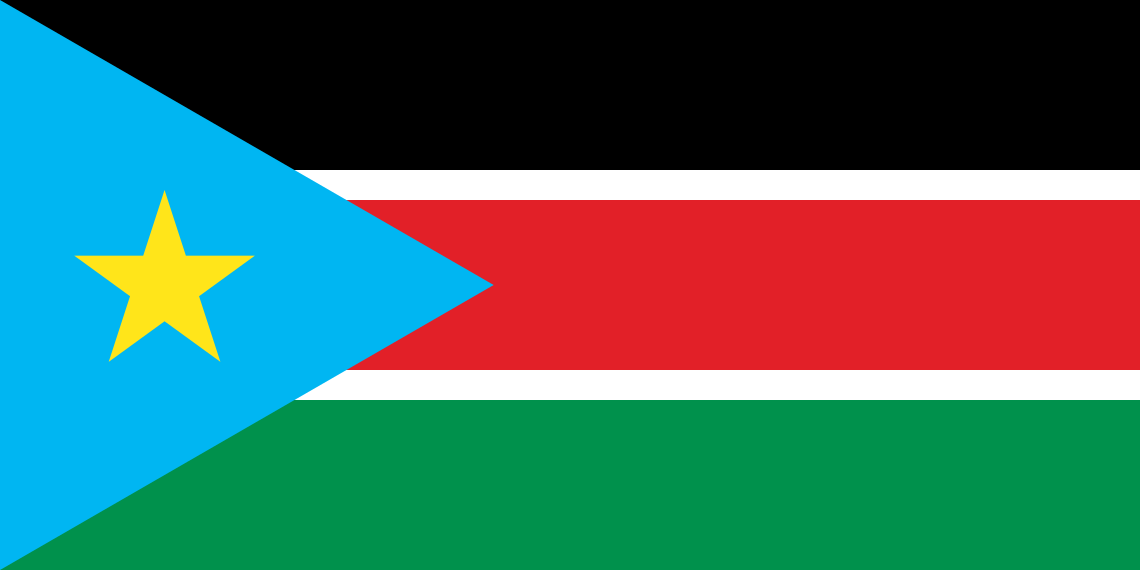
I congratulate you, Mr. President, on your presidency of the Security Council for the month of May, and I assure you of our delegation’s full support and cooperation. I would also like to thank,
and express my appreciation for, all members of the Council for their input. I would also like to acknowledge the presence of the Under-Secretary-General for Peace Operations, Mr. Lacroix, and the Special Envoy of the Secretary-General for the Horn of Africa, Ms. Hanna Tetteh. I also thank her for her trip to South Sudan, which has shed light on the real situation on the ground in the Sudan and South Sudan, in particular in the Abyei Area and the communities there. I hope that that will be put forth in all the agreements as we move forward on addressing the issues in Abyei.
South Sudan stands ready to work with the United Nations Interim Security Force for Abyei (UNISFA) and other relevant stakeholders to address the challenges in Abyei and advance the peace process in the region. The Government of South Sudan acknowledges the submission of the report detailing the implementation of UNISFA’s mandate (S/2024/354). We recognize the challenges posed by the ongoing conflict in the Sudan, which have had an impact on the political process in Abyei. Despite all those challenges, South Sudan remains committed to engaging in dialogue and promoting peace within its borders and with its partner, the Sudan.
The efforts of His Excellency President Salva Kiir Mayardit in addressing intercommunal tensions in South Sudan must also be commended and supported. Regarding the case before us, the President’s efforts can be seen in his meetings with the Juba-appointed Chief Administrator of Abyei and the Governors of neighbouring states and the issuance of a presidential order calling for peace and accountability.
Regarding troop deployments in Abyei, we acknowledge the concerns raised and reaffirm our commitment to adhere to the 2011 Agreement between the Government of the Republic of the Sudan and the Sudan People’s Liberation Movement on temporary arrangements for the administration and security of the Abyei Area.
The Government of South Sudan acknowledges the complex security situation outlined in the report regarding Abyei, characterized by intercommunal clashes, animal rustling and kidnappings, which are particularly exacerbated by the proliferation of arms. We are deeply concerned about the loss of life and injuries resulting from those clashes. We condemn all
acts of violence and reaffirm our commitment to working towards lasting peace and stability and the final status of Abyei.
Regarding the attacks on UNISFA peacekeepers, South Sudan condemns such acts in the strongest terms. The safety and security of United Nations peacekeepers are paramount, and we call for swift and thorough investigations. We hope that we can work together to investigate the perpetrators and bring them to justice.
The Government of South Sudan acknowledges the observation made by the United Nations regarding the impact of the conflict in the Sudan on Abyei. We reiterate our commitment to protecting citizens and territories against threats or violations, as mandated by our duty to ensure the safety and security of our people.
South Sudan recognizes the importance of ensuring humanitarian access to Abyei, especially in the light of the ongoing intercommunal violence and the influx of displaced persons from the Sudan. We pledge to cooperate with relevant parties to facilitate humanitarian assistance and ensure the safety of the aid workers operating in the region.
South Sudan welcomes the reduction in intercommunal violence and supports efforts towards peaceful coexistence. We are committed to engaging in dialogue and reconciliation initiatives to resolve conflicts and promote harmony among communities in the Sudan and South Sudan. Regarding the proliferation of arms in Abyei, South Sudan condemns all acts of violence and urges armed groups and all actors to disarm in accordance with Abyei’s weapon-free status.
In conclusion, South Sudan appreciates the tireless efforts of UNISFA, the Special Envoy for the Horn of Africa and all United Nations personnel in Abyei, and we remain committed to working collectively with the United Nations, the African Union and other stakeholders to promote peace, security and stability in Abyei.
There are no more names inscribed on the list of speakers.
I now invite Council members to informal consultations to continue our discussion on the subject.
The meeting rose at 11.35 a.m.