S/PV.9777 Security Council
Provisional
The meeting was called to order at 10.05 a.m.
Adoption of the agenda
The agenda was adopted.
Reports of the Secretary-General on the Sudan and South Sudan Report of the Secretary-General on the situation in Abyei (S/2024/740)

In accordance with rule 37 of the Council’s provisional rules of procedure, I invite the representatives of South Sudan and the Sudan to participate in this meeting.
In accordance with rule 39 of the Council’s provisional rules of procedure, I invite Ms. Martha Ama Akyaa Pobee, Assistant Secretary-General for Africa in the Departments of Political and Peacebuilding Affairs and Peace Operations, to participate in this meeting.
The Security Council will now begin its consideration of the item on its agenda.
I wish to draw the attention of Council members to document S/2024/740, which contains the report of the Secretary-General on the situation in Abyei.
I now give the floor to Ms. Pobee.
Ms. Pobee: I thank you, Mr. President, for this opportunity to address the Security Council on the implementation of resolution 2046 (2012), which relates to outstanding bilateral issues between the Sudan and South Sudan and the situation in Southern Kordofan and Blue Nile states. My briefing today will also provide an update on the United Nations Interim Security Force for Abyei (UNISFA), including its support for the Joint Border Verification and Monitoring Mechanism (JBVMM) and the most recent political, security and humanitarian developments in Abyei.
The war in the Sudan continues to have a profound impact on the security, economic and humanitarian situations in both the Sudan and South Sudan, including in the Abyei box. In South Sudan, oil production and exports were, until recently, disrupted owing to insecurity. That has resulted in putting a heavy budgetary strain on South Sudan’s already fraught financial situation, as oil sales account for the bulk of the Government’s revenue. On the humanitarian front, hundreds of thousands of refugees have fled the fighting in the Sudan and crossed into South Sudan.
Just like the South Sudanese themselves, refugees face dire conditions, with inadequate access to clean water, food, health services, and other critical services.
In the Abyei box, there has been a continued proliferation of small arms and heavy weaponry. In addition, on 21 October, South Sudanese officials reported an incursion of a group of Rapid Support Forces combatants, which looted Aman-Aguak and Mijak counties.
The movement of armed groups is also compounding the fragile security situation in South Sudan and Abyei, particularly in relation to the pre-existing tensions between the Twic Mayardit and Ngok Dinka communities across Warrap state and Abyei. I will refer to those in more detail shortly. As the destabilizing impact of the war in the Sudan reverberates through the region, climate-related challenges have created additional complications. Populations in South Sudan, the Sudan and Abyei have all been deeply affected by the heavy rains and flooding that occurred in September and October. In Abyei alone, more than 18,000 people have been displaced and more than 3,000 houses washed away by the rains. The floods have destroyed crops and infrastructure and have disrupted health and education services, increasing the risks of related diseases.
The populations in the South Kordofan and the Blue Nile states, as in other parts of the Sudan, continue to be deeply affected by the war in the Sudan. Although the Sudan People’s Liberation Movement- North (SPLM-N), led by Abdelaziz Al-Hilu, has sought to maintain a neutral stance in the conflict between the Sudanese Armed Forces and the Rapid Support Forces, it has been engaged in political and security talks with the Sudanese Armed Forces, mediated by the Government of South Sudan. The talks, which among other things were aimed at facilitating humanitarian access, have not translated into a formal agreement. Hostilities between the Sudanese Armed Forces and the SPLM-N resumed in late July in Dilling, South Kordofan’s second-largest city. The situation in and around Dilling remains volatile. On 13 August, the SPLM-N declared a famine in the areas under its control in South Kordofan and Blue Nile states, affecting an estimated 3 million people. The SPLM-N has deplored a number of problems, including road closures, aerial bombardments, locust infestations, an outbreak of measles and lack of access to seeds and fuel.
The war between the Sudanese Armed Forces and the Rapid Support Forces has now entered its nineteenth month. It remains a major source of destabilization in the Horn of Africa and the Sahel regions, with dire security, humanitarian and economic consequences for the Sudan’s neighbours. The full implementation of resolution 2046 (2012) is impossible without resolving the conflict in the Sudan. The impact of this war on the region is such that it requires a coordinated response among all the relevant United Nations entities and international partners. The Office of the Special Envoy for the Horn of Africa will continue to support the mediation efforts of the Personal Envoy of the Secretary-General for the Sudan in his quest to secure a speedy ceasefire that is viable and sustainable. It will also continue to support the stabilizing role of the United Nations Mission in South Sudan (UNMISS) and UNISFA, in coordination with the African Union, the Intergovernmental Authority on Development and other partners.
I will now to turn to UNISFA, including its support to the Joint Border Verification and Monitoring Mechanism and the stabilization of Abyei. Amid the ongoing armed conflict in the Sudan and political uncertainty in South Sudan, no progress can be reported this year on the dialogue between the Sudan and South Sudan on the final status of Abyei and border issues. UNISFA continues to monitor the situation for conditions that might be conducive to renewed talks. It also maintains close contact with the parties with a view to offering support for a resumption of the Joint Political and Security Mechanism, which last met in January 2023, and the Abyei Joint Oversight Committee, which has not held a meeting since 2017. In the meantime, UNISFA has remained focused on the critical task of supporting stability on the ground in Abyei. The improvement in relations between the Ngok Dinka and Misseriya communities in the previous period gained momentum, with the mission reporting no clashes during the reporting period. UNISFA has taken a prominent role in promoting and deepening reconciliation between the two communities, working with United Nations agencies, funds and programmes and other partners to facilitate pre- and post-migration conferences in Noong in central Abyei in December 2023 and May 2024. The conferences ensured the inclusion of women and youth representatives and have led to agreements designed to further peaceful coexistence, particularly during the cattle migration season.
In the light of reports that UNISFA has received of the Misseriya traditional leadership declaring support for the RSF, the mission is monitoring the situation and its potential implications for Abyei, while continuing to focus on intercommunal reconciliation efforts on the ground. The reporting period also witnessed a decrease in violence between the Ngok Dinka and Twic Dinka communities. However, while that decline is very welcome, it has largely coincided with the rainy season and its associated mobility challenges. Tensions between the Ngok Dinka and Twic Dinka continue to be high, and UNISFA has remained in close contact with community leaders, in coordination with UNMISS, in order to calm tensions and forestall any new violence.
Another critical challenge is the continued presence of South Sudanese security personnel in southern Abyei, which violates the 2011 Agreement between the Sudan and South Sudan on Abyei’s administration and security. It has also resulted in repeated restrictions on UNISFA’s freedom of movement, in contradiction of the status of forces agreement. While the numbers of the security personnel involved are difficult to estimate, their continuing presence in Abyei is a cause for concern, and the mission has continued to engage with the Juba authorities in calling for their withdrawal.
The JBVMM continues to be affected by the conflict in the Sudan, with the ongoing closure of the Sudanese airspace preventing the conduct of aerial monitoring and creating challenges for resupply. Despite that, UNISFA has continued to support the implementation of the JBVMM mandate through ground monitoring missions and assessment patrols. In June, local authorities threatened to attack the JBVMM team site in Abu Qussa/Wunkur, repeating demands made in January — which are in violation of the status of forces agreement — for the mission to pay rent and other compensation. UNISFA continues to engage with the South Sudanese authorities to ensure that the JBVMM team site can operate unhindered. No progress was made in the reoperationalization of the JBVMM Sector 1 headquarters in Gok Machar in South Sudan and its two team sites following the mission’s forced withdrawal in 2021. However, in an encouraging development, UNISFA received a letter in July from community leaders in Gok Machar indicating their agreement with the re-establishment of the JBVMM presence in its former location. We urge the South Sudanese authorities to work with UNISFA to facilitate the reoperationalization of JBVMM Sector 1 as soon as possible.
The arrivals of displaced people fleeing the fighting in the Sudan have added to the strain on the already limited resources in Abyei. The local population continues to face economic hardship as basic goods and commodities have become scarce. The ongoing disruption of supply lines via the Sudan has also resulted in additional logistical challenges and increased costs for UNISFA as it continues to rely on alternative deployment routes and supply arrangements. The strain on resources has led to a reported increase in crime. In the absence of the Abyei police service as envisioned in the 2011 Agreement, the mission has continued to work to promote the rule of law, including via the support provided by United Nations police to the community protection committees and the Joint Protection Committee. However, the mission’s capacity to provide support to the rule of law in Abyei is constrained, in the absence of formed police units and with the lack of support from the parties for the deployment of additional individual police officers beyond the 60 currently in place. At a time of increased need for such support, the deployment of the full total of 148 individual police officers and three formed police units mandated by the Security Council is much needed. We ask the members of the Council to reiterate their support by echoing UNISFA’s ongoing calls to the host countries to enable the fully mandated United Nations police deployment.
UNISFA has also worked to facilitate humanitarian assistance to meet the increased needs in the region, including supporting the transportation of humanitarian personnel and cargo to Abyei. It has also continued its efforts to establish the conditions necessary for peace in Abyei through its support to the joint programme for Abyei of the United Nations country teams in the Sudan and South Sudan. Projects carried out by United Nations agencies, funds and programmes and their implementing partners in areas such as health and nutrition, livelihoods and skills development and psychosocial services have remained critical to UNISFA’s long-term peace efforts and vision for the future of United Nations support to Abyei.
In conclusion, I would like to reiterate my appreciation to the Acting Head of Mission and Force Commander, Major General Robert Yaw Affram, and to all the personnel of UNISFA and its partners, for their work in support of peace and security in Abyei. I would also like to thank the former Special Envoy of the Secretary-General for the Horn of Africa, Hanna Serwaa Tetteh, who has now completed her term in the
position, for her constant efforts in support of Abyei throughout her assignment. Finally, I want to express my gratitude to the troop- and police-contributing countries for their valuable support during challenging times in Abyei and the region and to the members of the Security Council for their continued support to the cause of peace and stability in Abyei.
I thank Ms. Pobee for her briefing.
I shall now give the floor to those Council members who wish to make statements.


I would like to thank Assistant Secretary-General Pobee for informing us about the progress that the United Nations Interim Security Force for Abyei (UNISFA) has made in implementing its mandate, and for her updates on Abyei. We also thank the personnel of UNISFA, who are working actively to advance peace and security in the Abyei Area every day, even amid the ongoing challenges created by the crisis in the Sudan and the political uncertainty in South Sudan. I welcome the representatives of South Sudan and the Sudan to this meeting. We also want to express our appreciation for the work of Hanna Tetteh, the Secretary-General’s Special Envoy for the Horn of Africa, who recently concluded her time in that position, and for her dedication to peace during her term.
As we work towards the renewal of UNISFA’s mandate, we are obliged to note that the unresolved tensions between the Sudan and South Sudan continue to limit the prospects for engagement between the parties on the Abyei political process, with no real progress regarding the resolution of Abyei’s final status. The comprehensive report of the Secretary-General on the situation in Abyei (S/2024/740) sheds light on how the ongoing conflict in the Sudan and the political uncertainty in South Sudan risk further damaging security and governance in the region. The conflict in the Sudan is jeopardizing UNISFA’s work and impeding the mission’s ability to carry out its mandated tasks, including protecting civilians, facilitating humanitarian efforts and supporting a peaceful settlement of the final status of Abyei and its border issues and the establishment of the Abyei police service. In South Sudan, the delayed elections, the presence of South Sudanese security forces in the southern part of Abyei and restrictions on peacekeepers’ freedom of movement have also interfered with UNISFA’s ability to carry out its mandate.
We once again express our regret that no progress has been made on determining the final status of Abyei, appointing a civilian Deputy Head of Mission for UNISFA, agreeing on border demarcation or establishing joint institutions such as an Abyei police service. At the same time, we must stress that the Sudanese authorities’ refusal to grant visas for UNISFA police is compromising UNISFA’s ability to carry out its protection-of-civilians and rule-of-law tasks. While the Sudan approved visas for individual police officers, we note that the Mission is still awaiting the deployment of the three formed police units approved by the Council. In that environment, the intercommunal violence involving the Ngok Dinka, Twic Dinka and Nuer continues to pose major risks in southern Abyei and significant risks to civilians. We hope that the overall trend of reduced intercommunal violence will continue, and we recognize the representatives of the Ngok Dinka and Misseriya communities for their willingness to engage in dialogue. Unfortunately, the presence of South Sudanese People’s Defence Forces personnel is a violation of the 2011 agreement on temporary arrangements and is further undermining security in the area.
Unfortunately, the Joint Border Verification and Monitoring Mechanism (JBVMM) continues to be affected by the conflict in the Sudan. The closure of the Sudanese airspace has been preventing aerial monitoring operations, while ground monitoring and mission assessment patrols have continued, to the extent that they are not impeded by poor infrastructure and flooding. UNISFA’s continued engagement regarding the JBVMM Sector 1 headquarters in Gok Machar, including with community leaders, women and young people, has led to a re-establishment of the JBVMM presence there, which is an important accomplishment. We further stress the need for country support for the JBVMM.
We are gravely concerned about the millions of civilians in need of life-saving humanitarian assistance in the Sudan and condemn any attacks on humanitarian workers there. Coupled with the arrival of displaced people from the Sudan, that is putting an immense strain on the already limited humanitarian resources in Abyei. Once the Council approves the renewal of UNISFA’s mandate, we will want to focus on addressing the issue of taxation that is affecting UNISFA and humanitarian assistance, the disruption of supply lines, the closure of the airspace and the inability to deploy formed police
units, as well as the presence of South Sudan People’s Defence Forces personnel inside the Abyei box, in contravention of various agreements.
The United States reiterates its call to all parties to respect the safety and security of all United Nations staff, facilities and humanitarian and medical personnel. We strongly urge the parties to ensure that UNISFA and its humanitarian partners have immediate, full, safe and unhindered access throughout Abyei to carry out their life-saving work. We also urge the Sudan and South Sudan to facilitate freedom of movement for the JBVMM so that it can carry out its mandate.
We continue to stand in solidarity with the people of the Sudan in their desire for democracy, and we call on the Sudanese Armed Forces and the Rapid Support Forces to implement and uphold a permanent nationwide ceasefire. We urge the parties to the war in the Sudan to end the conflict, commit to the safety, security and protection of civilians and enable a transition to civilian rule, which will also support the full implementation of UNISFA’s mandate. We also call on the transitional Government of South Sudan to ensure the removal of impediments to the UNISFA mission’s success such as the presence of Government armed troops inside the Abyei box.


I would like to thank Assistant Secretary-General Martha Pobee for her briefing.
The report of the Secretary-General on the situation in Abyei (S/2024/740) makes clear the major effects of the conflict in the Sudan on the situation in Abyei. The conflict is undermining the political process, exacerbating local intercommunal conflicts, encouraging the proliferation of weapons and creating an influx of displaced persons. The parties to the conflict in the Sudan must renew their dialogue in order to conclude a ceasefire. A political process involving all the parties and the whole of Sudanese civil society must be set in motion in order to enable a return to a lasting peace. It is imperative that the parties to the conflict respect their commitments under the Jeddah Declaration and act to protect civilians. In that regard, I would like to recall the declaration of principles adopted on 15 April in Paris at the international humanitarian conference for the Sudan and its neighbours, which calls on all the parties to the conflict and the actors concerned to facilitate unhindered access to civilian populations in need of humanitarian aid. We also
welcome the fact that the British presidency of the Security Council will be convening a meeting on the situation in the Sudan this month.
The economic and humanitarian situation in South Sudan is also difficult and has been exacerbated by the floods affecting the country. France regrets the fact that elections have been postponed for two years. We remain ready to support South Sudan and call on all stakeholders, in particular the South Sudanese authorities, to use dialogue to work for the holding of peaceful, transparent and inclusive elections as soon as possible. That is the best way to preserve the principal gains of the 2018 Revitalized Agreement on the Resolution of the Conflict in the Republic of South Sudan, that is, the end of the civil war and a return to peace.
In Abyei, the efforts of the United Nations Interim Security Force for Abyei (UNISFA) are essential to protecting civilians, contributing to the resolution of local conflicts and preserving the conditions for a settlement of the conflict in a fragile regional context. We call on the South Sudanese authorities to withdraw their forces deployed in Abyei in violation of the Agreement of 20 June 2011, and to remove all obstacles to the work of the United Nations in the region, including impediments to the freedom of movement of its personnel. We also call on the Sudanese and South Sudanese authorities to grant all necessary visas to United Nations personnel, especially police officers mandated within the framework of UNISFA and humanitarian personnel.
The work of the United Nations in Abyei, and also in South Sudan, is essential to maintaining regional stability. It must continue, and we must focus our efforts on supporting the political progress that is essential to a lasting improvement in the people’s humanitarian and economic situation.


I would like to begin by thanking Assistant Secretary-General Pobee for her briefing. I also welcome the representatives of the Sudan and South Sudan to today’s meeting. I want to make three points.
First, we are concerned about the fact that Abyei’s final status remains unresolved, with the political process affected by the conflict in the Sudan and political developments in South Sudan. We reaffirm our support in that regard for the efforts of the African Union, the Intergovernmental Authority on Development and the Special Envoy for the Horn of Africa, urging the Sudan and South Sudan to recommence discussions as soon
as the situation allows. In the interim, implementing joint mechanisms as per the Agreement of 20 June 2011, including the establishment of an Abyei police service, is crucial to stability and the provision of essential services. Sustained commitment from both the Sudan and South Sudan is vital. The effective implementation of the Joint Border Verification and Monitoring Mechanism continues to be hindered by the conflict in the Sudan. Its success relies on sustained cooperation from both countries, including through support for aerial monitoring operations. Both countries must remain engaged in advancing its effective implementation.
We stress that Abyei must remain demilitarized and weapon-free, and we therefore urge South Sudan to withdraw its security forces, as their presence clearly violates the 2011 Agreement. We are also gravely concerned about reports indicating the presence of suspected Rapid Support Forces elements in Abyei. Any actions that compromise the region’s neutral status could potentially have broader implications for stability in the region. The proliferation of small arms and light weapons in Abyei fuels crime and increases the risk of intercommunal violence. The recent discovery of higher- calibre weaponry only underscores the urgent need to maintain Abyei as a weapon-free zone in order to ensure safety and stability.
Secondly, while serious concerns about Abyei’s security remain, we are encouraged by the reported decrease in clashes among the Ngok Dinka, Twic Dinka and Nuer communities. We welcome the lack of incidents between the Ngok Dinka and Misseriya during the latest reporting period, hopefully signalling progress towards stability and reconciliation. We commend the United Nations Interim Security Force for Abyei (UNISFA) and partners for their reconciliation efforts, notably the post- migration conference in May, which concluded with an agreement on peaceful coexistence, a development that both communities should continue to uphold. The voices of women and youth are vital to those peacebuilding processes, and enhancing their active involvement in reconciliation efforts must remain a priority.
The ongoing conflict in the Sudan continues to exacerbate security risks, hinder development and deepen economic hardship in Abyei, a situation that we view with deep concern. The adverse effects of climate change on the availability of land and water are compounding those challenges, as scarce resources drive further competition and hardship among communities.
Thirdly, UNISFA’s presence in Abyei is essential to maintaining stability, deterring conflict and fostering community resilience. Through human rights and rule-of-law advocacy, youth engagement and conflict resolution, UNISFA is playing a vital role in peace and reconciliation. Its support for joint peace committees, the prevention of gender-based violence and the promotion of gender inclusivity empowers communities, particularly women and young people. However, the ongoing violations of the status of forces agreement continue to hinder UNISFA’s mission. While cooperation on facilitating the movement of equipment is commendable, we call on the Government of South Sudan to remove its forces and ensure UNISFA’s unrestricted freedom of movement. We also call on the parties to support and facilitate the full deployment of UNISFA’s mandated police units and the civilian Deputy Head of Mission in order to support operations on the ground.
Determining Abyei’s final status remains imperative and requires strong political will and stability in both the Sudan and South Sudan. We renew our urgent call for an immediate, sustainable ceasefire in the Sudan as a critical step towards achieving long- term stability in the region.


I have the honour to deliver this statement on behalf of the three African members of the Council, namely, Algeria, Sierra Leone and my own country, Mozambique, as well as Guyana (A3+).
We want to express our deep appreciation to the Assistant Secretary-General for Africa, Ms. Martha Pobee, for her insightful briefing on the situation in Abyei. We welcome the participation of the Permanent Representatives of the Sudan and South Sudan in this meeting.
Abyei is a region that offers great opportunities for the development and prosperity of both the Sudan and South Sudan. Addressing the compounded challenges plaguing Abyei is the only way to ensure that its people can take full advantage of the opportunities that the region has to offer. The A3+ believes that priority should be given to the definition of the final status of Abyei and border issues, with a view to holding the planned referendum, which will provide the region with the right to self-determination. While acknowledging the challenges that the current context poses to a resumption of the Abyei political process, we would like to highlight the following points.
First, the Agreement of 20 June 2011 must be respected by both countries. As long as Abyei’s final status remains unresolved, ensuring the implementation of the Agreement and respect for the demilitarized and weapon-free status of Abyei is fundamental. In that context, we call on the parties to refrain from maintaining security personnel in the Abyei area.
Secondly, greater efforts must be made to deter and prevent intercommunal violence. The drop in intercommunal violence during the reporting period is a positive development, even as we note the continued tensions between the Dinka communities with deep concern. In that regard, we encourage all stakeholders to make sustained efforts to maintain that positive trend and increase the participation of women and young people in peacebuilding initiatives.
Thirdly, investing in development initiatives is crucial to stabilizing the region. We commend the United Nations Interim Security Force for Abyei (UNISFA) and the United Nations agencies, funds and programmes operating in the Abyei box for their implementation of the United Nations Joint Programme in Abyei. We underscore the Programme’s potential for addressing the challenges faced by the people of Abyei, which includes capacity-building, infrastructure needs and building resilience to the adverse effects of climate change. We call on partners to extend their support to its implementation, while maintaining humanitarian support for those in need.
Fourthly and lastly, addressing the impact of the conflict in the Sudan is urgent. It will require a comprehensive and coordinated approach among all stakeholders that encompasses strengthening community- based reconciliation and protection mechanisms, increasing support for refugees and returnees and managing the proliferation of small arms and light weapons. Ensuring that the necessary conditions are in place to enable UNISFA to fully carry out its mandate is therefore fundamental. The A3+ wishes to commend the continued support provided by the Government of South Sudan through its facilitation of the movement of equipment and cargo to Abyei via South Sudan, which is essential for UNISFA’s operations. We note with appreciation the deployment of all peacekeepers as part of the reconfiguration process. We further call on the relevant authorities to ensure the freedom of movement of UNISFA personnel. That is in line with the status of forces agreement and the work being done with local communities to allow the full operationalization of the Joint Border Verification and Monitoring Mechanism.
While the final status of Abyei remains unsettled, UNISFA continues to play a pivotal role in promoting peace, stability and community reconciliation in Abyei. Our sustained support for the mission is therefore essential. In that context, Algeria, Guyana, Sierra Leone and Mozambique reiterate their full support to UNISFA. We pay tribute to the troop- and police-contributing countries for the sacrifices that they continue to make for the security of the people of Abyei. And the A3+ would like to take this opportunity to extend our deepest gratitude to Ms. Hanna Tetteh for her excellent work, commitment and tireless efforts as Special Envoy of the Secretary-General for the Horn of Africa.


I am grateful to Ms. Martha Pobee, Assistant Secretary- General for Africa in the Departments of Political and Peacebuilding Affairs and Peace Operations, for her briefing. I acknowledge the presence of the representatives of the Sudan and South Sudan in the Chamber.
I would like to make three points about today’s briefing and the Secretary-General’s detailed report on the situation in Abyei and the work of the United Nations Interim Security Force for Abyei (UNISFA).
First, with regard to the security and political situation, the escalation of violence that has affected communities in and around the Abyei Administrative Area is worrisome. We should not fail to mention the shocking assassination of the Deputy Chief Administrator of Abyei a few months ago as a tragic representation of that escalation. Furthermore, at the beginning of the year we mourned the death of two Blue Helmets and dozens of people in intercommunal conflicts. It is unacceptable that so many peacekeepers, United Nations personnel and humanitarian workers operating in Abyei have been targeted. Given the serious threats made against operations base 22 of the Joint Border Verification and Monitoring Mechanism, the Government of South Sudan must address the situation in accordance with the status of forces agreement. We join with the parties in calling for supporting and facilitating the full deployment of the UNISFA police force.
The stalemate in the political process in Abyei, aggravated by the conflict in the Sudan, is worrisome, and the lack of progress in resolving final status and border issues is evidence of that. We urge the parties
to resume a dialogue as soon as possible, taking into account the mechanisms established with the support of the United Nations and the African Union. The constant presence of security personnel in southern Abyei is unacceptable, as it violates the 2011 Agreement for the administration and security of the Abyei Area and Abyei’s demilitarized status, and the forces present there must be withdrawn.
Secondly, with regard to intercommunal violence, we recognize UNISFA’s efforts to reduce tensions, especially between the Ngok Dinka and Misseriya communities. However, we are concerned about the fact that those tensions are persisting in southern Abyei, despite the mission’s efforts to facilitate intercommunal dialogue and implement confidence-building measures. The protection of civilians is at the heart of UNISFA’s mandate. For that reason, we appreciate the robust patrols it conducts and the fact that it is strengthening its rapid-response capacity. We urge UNISFA to continue to facilitate intercommunal dialogue and implement measures to prevent possible future conflicts, taking into consideration the full, equal, meaningful and safe participation of women and women’s organizations in all political processes.
Thirdly, with regard to the impact of the conflict in the Sudan, the influx of displaced people struggling with limited resources and the proliferation of weapons continue to have a negative impact on Abyei. Ecuador urges the international community to comprehensively address the crisis in the Sudan, recognizing its repercussions for the region. We also call for ongoing coordinated support in the Area to respond to urgent humanitarian needs.
As this is the last briefing that our delegation will receive on this dossier during our term on the Security Council, I would like to thank Ms. Hanna Tetteh for her outstanding work and encourage Major General Robert Yaw Affram to continue his efforts to work for peace in the region. For our part, we will take decisive action in renewing UNISFA’s mandate in order to support stability in Abyei.
In conclusion, I would like to highlight that 151 Ecuadorians have contributed their efforts as military observers and staff members in the missions in Abyei, the Sudan and South Sudan, in a sign of Ecuador’s firm commitment to building peace in the region, and we will continue to strengthen that cooperation.


I thank Assistant Secretary- General Pobee for her briefing.
Malta is deeply concerned about the fact that no progress was reported towards the resolution of the final status of Abyei in this period. We recognize that Abyei’s settlement hinges on the political will of the Sudan and South Sudan to engage and discuss the issue. But the ongoing conflict in the Sudan and the political uncertainty in South Sudan have only further postponed those goals. We strongly encourage both of them to revive discussions. We also reiterate our call for an immediate and sustainable ceasefire between the warring parties in the Sudan and call on South Sudan to meaningfully commit to elections in the context of the recent transitional extension. A clear pathway towards governance and stability in both nations is essential to regional security.
As we begin negotiations for renewing the United Nations Interim Security Force for Abyei (UNISFA) this month, we strongly support its mandate to protect civilians and strengthened initiatives to support local peace committees, including by women and youth-led organizations. We commend the mission for remaining committed to facilitating community-led dialogue while completing its reconfiguration. In that context, we welcome the post-migration conference facilitated by UNISFA, in collaboration with the International Organization for Migration, the Food and Agriculture Organization of the United Nations and other partners, which highlighted the declining trend in intercommunal violence between the Ngok Dinka and the Misseriya communities. We regret, however, that no progress has been made in establishing an Abyei police force, which is an integral element of a cohesive criminal justice system. The lack of progress is undermining Abyei’s security and stability, and we call for the full mandated deployment of UNISFA’s police units to fill those gaps.
Malta strongly supports the full, equal, meaningful and safe participation of women in security and conflict management structures in Abyei. Advocacy sessions on women and peace and security — held at joint community protection committee meetings and workshops in coordination with women leaders in Abyei to address harmful practices such as child marriage and female genital mutilation — are key examples of UNISFA’s important role in operationalizing the women and peace and security agenda. We also support UNISFA’s community-based gender desk acting as a referral system for survivors of sexual and gender-
based violence. The protection of women and girls must remain a priority, and those efforts must be matched by strengthened local capacity and resources dedicated to addressing gender-based violence.
The impacts of climate change in Abyei are manifested in the spread of disease and acute malnutrition, as well as damaged infrastructure. As many as 23,000 people were affected by flooding from torrential rains, in addition to the influx of displaced persons from the conflict in the Sudan. Those figures add to Abyei’s already dire humanitarian needs. We reiterate our support for the partnership between UNISFA and the United Nations country teams in the Sudan and South Sudan, including the facilitation of the transport of humanitarian personnel and cargo.
We are deeply concerned about the proliferation of weapons, which is increasing the likelihood of intercommunal violence and crime, exemplified by UNISFA’s discovery and eventual dismantling of an armoured personal carrier in a non-functional condition, linked to suspected Rapid Support Forces elements and a clear threat to Abyei’s weapon-free status. The need for sustained vigilance and stronger measures to prevent arms flows into Abyei cannot be overstated. It is also critical that South Sudanese security forces end their occupation of schools and community protection committee detention facilities, specifically in Agok. We call on all security forces to withdraw from the region and to uphold the 2011 Agreement. The relevant authorities also have their status of forces agreement obligations, including respect for the freedom of movement of UNISFA and the Joint Border Verification and Monitoring Mechanism.
In conclusion, the people of Abyei remain trapped by the status quo, while facing immense humanitarian needs and threats of intercommunal violence. They deserve better. They deserve peace, stability and prosperity and the Council’s support in achieving those aspirations.


I thank Assistant Secretary-General Pobee for her briefing and welcome the presence of the representatives of the Sudan and South Sudan in today’s meeting in connection with the report of the Secretary General (S/2024/740). I would like to make three points.
First, every effort should be made to maintain peace and stability in Abyei. China is aware that the security situation has improved somewhat recently, with fewer
violent incidents. At the same time, intercommunal relations in southern Abyei remain tense. Armed clashes break out from time to time. The prolonged conflict in the Sudan and the influx of refugees and displaced persons have exacerbated the security situation and economic hardships. The potential risk of the proliferation of arms is concerning. China welcomes the efforts of the Ngok Dinka and Misseriya to further bridge their differences and improve relations. We call on other communities to cease hostilities, strengthen their engagement and communication and work to achieve peaceful coexistence. China sincerely hopes that the conflict in the Sudan will end as soon as possible and that the Sudan and South Sudan will continue their dialogue and cooperation to revive the political process in Abyei and create the conditions for a resolution of Abyei’s final status and border issues.
Secondly, it is essential to strengthen support for the United Nations Interim Security Force for Abyei (UNISFA) so that it can deliver on its mandate. China appreciates UNISFA’s efforts to maintain security and promote intercommunal reconciliation, but it is currently dealing with many challenges in carrying out its peacekeeping activities. We look forward to seeing South Sudan, the Sudan and the other parties concerned doing as much as possible to facilitate UNISFA’s fulfilment of its mandate. We also support the Secretariat and UNISFA in strengthening their coordination with the parties concerned to ensure the movement of equipment, resupply and other logistics. In addition, UNISFA should work to strengthen protection measures effectively in order to ensure the safety and security of peacekeepers and prevent more casualties.
Thirdly, joint efforts should be made to promote long-term peace and security in Abyei. Economic development and social stability are interlinked. Abyei is hampered by a weak economic foundation and limited resources, which can easily lead to competition and intensified intercommunal clashes. China appreciates the close cooperation between UNISFA and the United Nations country teams in the Sudan and South Sudan in implementing quick-impact projects and providing humanitarian assistance. We call on all parties to increase their assistance and investment, especially in support of the development of agriculture and livestock, healthcare, education, training, infrastructure and disaster prevention and mitigation, among other things, so as to effectively improve the economy and people’s livelihoods and lay down a solid foundation for easing intercommunal tensions and realizing lasting peace and security.
The Security Council is conducting consultations on UNISFA’s mandate renewal, in which China will participate constructively and strive to reach a consensus. As a troop-contributing country to UNISFA, China will continue to support it with concrete action and contribute to peace and stability in Abyei.


I thank Ms. Pobee for her insightful briefing. I also welcome the participation of the permanent representatives of South Sudan and the Sudan at today’s meeting. With regard to the observations in the report of the Secretary-General (S/2024/740), I would like to make three points.
First, despite the challenging environment, Japan applauds the United Nations Interim Security Force for Abyei (UNISFA) for its tireless efforts to implement its mandated tasks, including protecting civilians, facilitating the delivery of humanitarian aid and promoting the rule of law, human rights and the women and peace and security and youth, peace and security agendas. In particular, Japan reiterates its deep concern about the multiple negative impacts of the ongoing fighting in the Sudan on the situation in Abyei. Political progress towards a resolution of the final status of Abyei and border issues has been blocked. The influx of returnees and refugees into Abyei has created additional difficulties for UNISFA’s implementation of its mandate. Logistics and rotations of peacekeepers have been hindered. In the light of that, we will continue to closely follow the situation in the Sudan. We once again call firmly on the parties to stop fighting immediately and return to serious negotiations towards a ceasefire, which will pave the way for a resumption of a peaceful political process.
Secondly, we are pleased to see a reduction in violence as a result of the continued efforts of stakeholders among the Misseriya, Ngok Dinka and Twic Dinka, and with the support of UNISFA. However, we remain deeply concerned about the continuing intercommunal tensions and the risk of further violence. We call on all stakeholders to continue working for de-escalation and peaceful reconciliation.
Thirdly, Japan remains concerned about the continued presence of South Sudanese security forces in Abyei, which is a clear violation of the Area’s demilitarized status. We highlight the need for South Sudanese authorities to address the issue without delay. We also call for their support in ensuring the reoperationalization of Sector 1 of the Joint Border
Verification and Monitoring Mechanism. In addition, we further call on both sides to work on establishing the joint institutions envisaged in the 2011 Agreement. Japan underscores the importance of deploying the three formed police units and individual police officers, as well as the civilian Deputy Head of Mission, as mandated by the Security Council.
In conclusion, Japan remains committed to working with all stakeholders to achieve peace and stability in Abyei and reiterates its full support for United Nations efforts in the region. We are ready to work constructively towards the renewal of UNISFA’s mandate.


I thank the Assistant Secretary-General for Africa, Ms. Pobee, for her presentation, and I welcome the participation of the representatives of the Sudan and South Sudan in today’s meeting.
As the Secretary-General emphasizes in his report (S/2024/740), Abyei remains a victim of a fragile and tense security situation, especially owing to the ongoing conflict in the Sudan and the political uncertainty in South Sudan. In the absence of any progress in the past few years on a political solution to Abyei’s final status and border issues, and with little prospect for change in the near future, I would like to reiterate three priorities for improving the situation of the people affected.
First, and as my colleagues have also highlighted, Abyei must remain a demilitarized and weapon-free zone, in line with the Agreement of 20 June 2011 and the binding resolutions of the Security Council. We remain concerned about the continued presence of South Sudanese security forces in southern Abyei and call for their withdrawal. Their presence impedes the freedom of movement of the United Nations Interim Security Force for Abyei (UNISFA) and therefore its ability to protect civilians and facilitate the delivery of humanitarian aid. That is even more important when we consider that the vital supply routes through the Sudan are still blocked as a result of the conflict there. We also call on the Sudan and South Sudan to respect the status of forces agreement and address the related issues concerning the Joint Border Verification and Monitoring Mechanism.
Secondly, it is essential to ensure the protection of civilians, as required by international humanitarian law and human rights. We welcome the significant decline in violence between the Ngok Dinka and Misseriya communities in the past few months and commend
their commitment to dialogue and reconciliation and UNISFA’s crucial support in that regard. Given the ongoing tensions between the Ngok Dinka, Twic Dinka and Nuer communities in the southern part of Abyei and the warnings of the possibility of renewed clashes as the dry season approaches, we emphasize the need for a preventive commitment to dialogue and respect for human rights at all levels. Furthermore, the proliferation of weapons, which has been exacerbated by the conflict in the Sudan, must be urgently addressed.
Thirdly, the promotion of dialogue and inclusive peace is fundamental to addressing the long-term challenges in Abyei. In that respect, and in the absence of an Abyei police service, the community protection committees and the joint community peace committee play an essential role in sending early warnings regarding human rights issues and sexual and gender- based violence. We commend their work and the support provided by UNISFA, which ensures that women and youth continue to play a key role. As our President pointed out during last month’s open debate on women in peacebuilding (see S/PV.9760), women must not be relegated to secondary roles in political processes or peacebuilding.
The fragile security situation in Abyei and its impact on civilians demand our continued attention, especially since the recent floods, aggravated by climate change, have intensified the humanitarian challenges there. We welcome UNISFA’s firm commitment and, in preparation for the renewal of the mandate next week, we underline the mission’s essential role in ensuring peace and security and protecting civilians in Abyei.


I would like to thank Assistant Secretary-General Pobee for her comprehensive briefing today. I also welcome the participation of the representatives of the Sudan and South Sudan in today’s meeting. I would like to highlight three points.
First, we remain concerned about the impact of the ongoing Sudan conflict in Abyei on the security and humanitarian fronts. We are particularly alarmed about the proliferation of arms inside Abyei, which could heighten the risk of intercommunal disputes quickly escalating into violent confrontations. We reiterate our call on all parties in the Sudan to respect the arms embargo in order to prevent further destabilization in the region. Besides that, the influx of displaced persons from the Sudan has further strained resources in Abyei,
aggravating an already dire humanitarian situation. We commend the efforts of the United Nations Interim Security Force for Abyei (UNISFA) to ensure that humanitarian assistance is both accessible and effective.
Secondly, we urge both the Sudan and South Sudan to enable UNISFA to fully carry out its mandate to maintain security and protect civilians. With no progress made on establishing an Abyei police service, United Nations police support is essential for community protection and strengthening the rule of law. We call on all parties to facilitate and support the full deployment of UNISFA’s police officers and formed police units approved by the Security Council. We welcome South Sudan’s ongoing support in facilitating the movement to Abyei of equipment and cargo, which is essential for sustaining UNISFA’s operations. However, we also urge South Sudan to ensure the full freedom of movement of UNISFA personnel and to withdraw all of its security forces, in line with the Agreement of 20 June 2011 and the status of forces agreement.
Thirdly, addressing intercommunal violence is key to long-term peace in Abyei, and we call on all stakeholders, including local authorities and community leaders, to increase their efforts for peaceful reconciliation. In that regard, we commend UNISFA’s role in supporting peaceful coexistence among communities, especially its facilitation of a post-migration conference between the Ngok Dinka and Misseriya. We also support the Joint Programme of the Resident Coordinators in the Sudan and South Sudan in Abyei, which addresses the root causes of intercommunal violence by improving access to essential resources and services and supporting livelihood skills in local communities.
We support UNISFA’s invaluable efforts towards achieving a peaceful and inclusive resolution for Abyei, and we are committed to engaging constructively in its upcoming mandate renewal.


We thank Ms. Martha Pobee, Assistant Secretary-General for Africa, for her briefing, and we welcome the participation in today’s meeting of the representatives of the Sudan and South Sudan.
As noted in the Secretary-General’s report (S/2024/740), the past few months have brought no political progress in the Abyei settlement. However, in the current circumstances, there are objective factors that prevent us from expecting more. The Sudan is in the grip of an intense armed conflict whose epicentre is
shifting increasingly to Darfur. South Sudan is facing major challenges in delivering on its obligations under the Revitalized Agreement on the Resolution of the Conflict in the Republic of South Sudan in the context of the authorities’ decision to extend the transitional period for two more years and to postpone the first-ever general elections to December 2026. Both countries are also dealing with a lack of financial resources and with humanitarian problems, as well as with political blackmail and external interference, including through the use of illegitimate unilateral measures.
On the whole, however, the situation in Abyei has not greatly worsened over the past few months. We welcome the responsible approach demonstrated by both States regarding Abyei. We commend the steps taken by South Sudan to host Sudanese refugees and South Sudanese returnees. We also note Juba’s efforts to facilitate intercommunal reconciliation in Abyei. At the same time, we are concerned about the sporadic outbreaks of ethnically motivated violence, although in general their intensity has significantly decreased, as the report of the Secretary-General notes. We still believe that there is a need for joint efforts by the parties in relation to Abyei. We regard as unacceptable any destructive external interference in the affairs of the Sudan and South Sudan, which are our friends. We are convinced that the peoples of the two countries can and must independently solve all internal problems, including the final status of Abyei. Any initiatives to restore peace and resolve bilateral disputes without the participation of Port Sudan and Juba are doomed to failure. We believe that the role of the international community should be confined to providing assistance to both capitals in making sovereign and mutually acceptable decisions regarding the disputed region. At the same time, we consider it important for both parties to discharge their obligations to uphold the demilitarized status of Abyei. Against that backdrop, UNISFA remains a critical factor in ensuring stability. We welcome the Blue Helmets’ contribution to addressing current security challenges, maintaining law and order and strengthening relations between local communities.
We are concerned about problems in the work of the Joint Border Verification and Monitoring Mechanism, including the operation of supply routes and the rotation of UNISFA personnel, which are delaying the establishment of the Mechanism’s headquarters in Gok Machar, South Sudan. We call on the UNISFA leadership to engage more actively with the authorities of both States.
We are of the view that the continued presence of the Blue Helmets in the Area remains pertinent. We trust that the UNISFA configuration, including in terms of military-to-police ratio, will factor in the situation on the ground and the views of the parties. We believe that, given that the status of Abyei is still unresolved and the overall tensions between the two Sudans persist, we should refrain from any drastic steps to reconfigure the Mission’s activities and reduce its footprint on the ground.
I shall now make a statement in my capacity as the representative of the United Kingdom.
I thank Assistant Secretary-General Pobee for her briefing. I welcome the participation of the representatives of the Sudan and South Sudan in this meeting.
I will make three points.
First, we underscore the importance of the work of United Nations Interim Security Force for Abyei (UNISFA) in maintaining peace in a fragile region. We note that, despite ongoing tensions, the Secretary- General’s report (S/2024/740) states that there have been no intercommunal clashes since April. That signals an improvement, given the alarming number of serious security incidents reported earlier this year. We must ensure that the positive trend continues. That means providing the necessary support for UNISFA so that it can fulfil its mandate. It is important that the Government of South Sudan and the Sudanese authorities remove obstacles to UNISFA’s operations. We call on the Sudanese authorities urgently to issue visas for United Nations civilian and police personnel to help UNISFA address increasing crime-related threats in Abyei. We also reiterate our calls on the leaders of South Sudan to withdraw the South Sudan People’s Defence Forces from Abyei. Those forces compromise Abyei’s demilitarized status and violate the 2011 status of forces agreement.
Secondly, we note with regret the impact of the conflict in the Sudan on the humanitarian and security situation in Abyei. Approximately 24,000 refugees and returnees have arrived in Abyei since the outbreak of the conflict. We have also seen in the Secretary-General’s report credible evidence of arms proliferation, which compromises the security of Abyei. We urge the parties to open the Athony airstrip to facilitate humanitarian access and to enable UNISFA’s operations.
Thirdly, we remain concerned at the lack of progress on a political solution for Abyei. The Sudan and South Sudan must re-engage in dialogue towards the resolution of Abyei’s political status.
In conclusion, the United Kingdom looks forward to engaging constructively on the upcoming mandate renewal for UNISFA. The deteriorating conflict in the Sudan and the challenges in South Sudan make the work of the mission more important than ever.
I resume my functions as President of the Council.
I now give the floor to the representative of the Sudan.


At the outset, I would like to congratulate you, Mr President, on presiding over the Security Council during November.
I also thank Ms. Martha Pobee, Assistant Secretary- General, for her briefing on the implementation of the mandate of the United Nations Interim Security Force for Abyei (UNISFA). The Sudan also has taken note of the Secretary-General’s report (S/2024/740) on the subject.
The Sudan reaffirms its unwavering commitment to the political and legal terms of reference governing the current situation in Abyei. It acknowledges that the presence of UNISFA is a result of those terms of reference. We note in that regard that the agreement on temporary administrative and security arrangements for Abyei, signed by the Sudan and South Sudan in June 2011, and the cooperation agreements between the Sudan and South Sudan form an indispensable basis for governing the Area and achieving security and stability thereof until the final status of Abyei is resolved. In that context, we reaffirm the Sudan’s readiness to implement all the agreed political, security and administrative arrangements and measures, which include the establishment of the joint administration, the joint legislative council and the Abyei joint police. We are committed to implementing those arrangements as a transitional phase until we reach a definitive solution to the issue of Abyei — a realistic solution that heeds the aspirations of the local population and promotes mutual trust among all actors concerned.
I would like to highlight the following five points.
First, the Sudan stresses its commitment to maintaining peace and security in Abyei. We underscore our objection to any unilateral measures that would
threaten stability in the region, especially in the areas where UNISFA is operating. We further underscore the need for Abyei to remain demilitarized north and south of the zero line, in accordance with the agreements signed. In that context, we are concerned about the presence of military elements in the Area and call for their withdrawal so that the Area remains demilitarized. We also express our concern about sporadic attacks on some of the population there. We call on UNISFA to assume its responsibilities under its mandate to protect those people and guarantee their safety.
Secondly, the Government of the Sudan reaffirms its complete readiness to establish the temporary administrative and security mechanisms stipulated in the June 2011 agreement. The Government undertakes to not compromise the current demographic composition of Abyei or to not encroach on the land. We believe that a solution for the final status of Abyei must be achieved through a joint agreement between the two States that is accepted by local communities and direct actors.
Thirdly, we urge UNISFA to continue implementing projects that promote dialogue and social cohesion in the region. Those projects directly contribute to improving and promoting peacebuilding efforts in the region. With the return of many families and displaced people to Abyei as a result of the security situation in some cities in the Sudan, we call on UNISFA to cooperate with humanitarian agencies so as to provide the necessary assistance and meet the basic needs of those people.
Fourthly, we underline the pivotal role played by UNISFA in maintaining security and stability in Abyei until a solution on its final status is reached. The Sudan is committed to enabling UNISFA to discharge its tasks in accordance with the relevant Council resolutions and we will spare no effort in supporting it to achieve that goal. In that regard, we welcome the recommendation to renew UNISFA’s mandate.
Fifthly, some Council Member States expressed concerns over the current situation in the Sudan and its repercussions for Abyei and for the work of UNISFA. Other countries called for ending the fighting in the Sudan. We would like to emphasize that the Government of the Sudan is working to achieve those goals. No one is more concerned for the Sudanese than the Government of the Sudan, because innocent Sudanese civilians are paying the price and being subjected to all kinds of atrocities and international crimes, perpetrated by the
militia of the Rapid Support Forces. Citizens in Gezira were recently attacked, and thankfully certain Council Member States condemned those attacks.
To ensure that the Security Council is constructive when calling for an end to hostilities in the Sudan, two things are necessary.
First, the commitments agreed by the stakeholders in Jeddah last year must be implemented. Those commitments included detailed provisions that would guarantee an end to the war, the safety of civilians and the unhindered flow of humanitarian assistance.
Secondly, the Security Council must adopt arrangements to end the aggression of the State that is sponsoring the militia of the Rapid Support Forces by providing them with all forms of military, political and diplomatic support, as well as media support, and by recruiting mercenaries and foreign fighters from neighbouring countries in the Sudan and the Sahel region. That sponsorship and that aggression are directly reflected in the merciless acts of killing, looting, raping and displacing the Sudanese people.
In conclusion, I reiterate the commitment of the Government of the Sudan to strengthening its cooperation and coordination with the Government of South Sudan in order to operationalize the security and political joint mechanisms between the two countries and support the efforts of the Joint Oversight Committee in Abyei until a final and comprehensive solution for Abyei is reached, based on agreed terms of reference, that leads to stability and sustainable development for the people of the region.
I now give the floor to the representative of South Sudan.

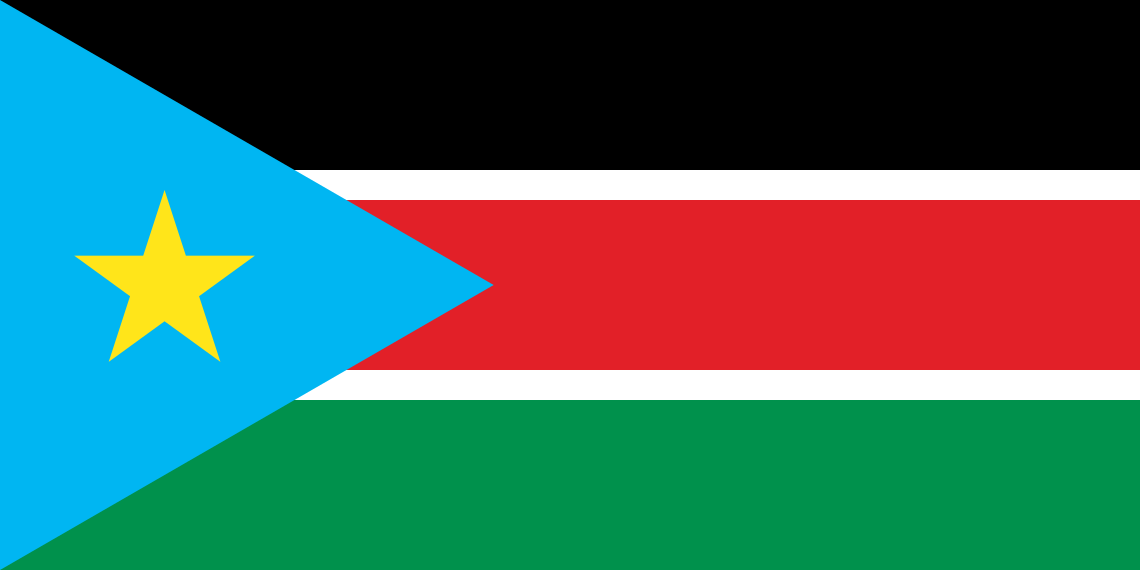
I would like to take this opportunity to congratulate the United Kingdom for its presidency of the Security Council for the month of November. I assure you, Sir, of our Government’s full support and cooperation. I also would like to thank Assistant Secretary-General Pobee for her full briefing on the situation in both the Sudan and South Sudan.
South Sudan welcomes the opportunity to address the Security Council regarding the report of the Secretary-General on the situation in Abyei (S/2024/740). We thank the Council for its continued support for the critical issues facing the Abyei region on the Sudan-South Sudan border. We further express our appreciation for the mandate of the United Nations
Interim Security Force for Abyei (UNISFA), because those efforts remain central to ensuring peace, security and stability along our shared border with the Sudan, and particularly in the Abyei region.
Since 2011, UNISFA and the Joint Border Verification and Monitoring Mechanism (JBVMM) have played indispensable roles in conducting monitoring and verification activities, easing tensions and facilitating conditions for constructive dialogue. South Sudan reaffirms its commitment to collaborating with the United Nations in its neighbour, the Sudan, to support the mandate of UNISFA and the vital role of the JBVMM. We recognize that the continued presence of the United Nations in Abyei contributes significantly to safeguarding communities and reducing intercommunal tensions. The mission’s efforts to protect civilians and maintain order in a complex environment are deeply appreciated, and we are committed to working alongside UNISFA to help ensure the safety and well-being of all civilians in Abyei.
In addition to supporting the Council’s efforts, we urge it to address the humanitarian needs in Abyei. The region has been affected by the recent floods, food insecurity and an influx of returnees and displaced persons from the Sudan that has intensified the humanitarian crisis. I cannot emphasize enough how severe the humanitarian crisis in Abyei is. South Sudan calls on the international community to increase its support to address that urgent crisis. We express our gratitude to UNISFA’s personnel, who continue to support those communities under such difficult conditions, and we emphasize that their work is essential to stabilizing the region.
South Sudan remains steadfast in its commitment to peace and to the peaceful resolution of the final status of Abyei. Recognizing the complexities and the sensitivities involved, we call on all stakeholders to engage in sustained and diplomatic efforts towards a comprehensive, long-term solution that respects the rights and safety of the communities involved.
The deployment of South Sudan security personnel has been a temporary measure aimed at safeguarding lives and preventing the escalation of intercommunal violence. Our intent has been de-escalatory and focused on the protection of civilians. We are open to collaborating with UNISFA to explore an alternative security arrangement that meets the needs of our communities while protecting the demilitarized status of the region.
Finally, South Sudan supports the strategic review of UNISFA’s mandate, to ensure it aligns with current political and security realities in Abyei. We are confident that a new and collaborative mandate, developed in consultation with all relevant parties, would enhance the mission’s effectiveness and ensure that the perspectives and needs of Abyei communities are addressed.
In conclusion, South Sudan reaffirms its commitment to working closely with the United Nations, UNISFA and all parties concerned to secure a peaceful stability and prosperous future for the people of Abyei and the region. We remain hopeful that our shared commitment to peace will guide our actions in the days ahead.
The meeting rose at 11.25 a.m.