65/277 GA
Political Declaration on HIV/AIDS: Intensifying our Efforts to Eliminate HIV/AIDS
65
Session
| Draft symbol | A/65/L.77 |
|---|---|
| Adopted symbol | 65/277 |
| UN Document | 65/277 ↗ |
Vote Consensus — A/65/PV.95
Speeches following this vote (20)
The President
I appreciate the applause in the Assembly for the resolution we have just adopted. I believe everyone here is entitled to take pride in it.
A number of Member States have asked to speak in explanation of position. Before giving them the floor, may I remind delegations that explanations of vote or position are limited to 10 minutes and should be made by delegations from their seats.
 Mr. Niknam
While the Islamic Republic of Iran remains fully committed to providing the widest possible access, without stigma and discrimination, to care, treatment and support for people living with HIV and AIDS and their families, we find the tone and setting of the Declaration discriminatory against the health care of the general public.
Governments have the responsibility to ensure health and support f…
 Mr. Padilha
It is my pleasure to address this Assembly and to call its attention to the fact that, through the global framework for health sector response to HIV/AIDS 2001 to 2015, we have established, in this Political Declaration on HIV/AIDS, a strong commitment in the United Nations system.
For us, it is very important that for the first time, targets have been clearly set, such as eliminating mother-to-…
 Mr. Heller
The Mexican delegation would like to welcome the adoption of the Political Declaration on HIV/AIDS. We wish to acknowledge the work of all the delegations and the fact that a consensus was reached.
We believe it is very important that the final text includes sections that express the fundamental concerns of Governments as well as those of non-governmental organizations and civil society. These i…
The President
We have heard the last speaker in explanation of position.
I now give the floor to the representative of the Holy See to make a statement after the adoption.
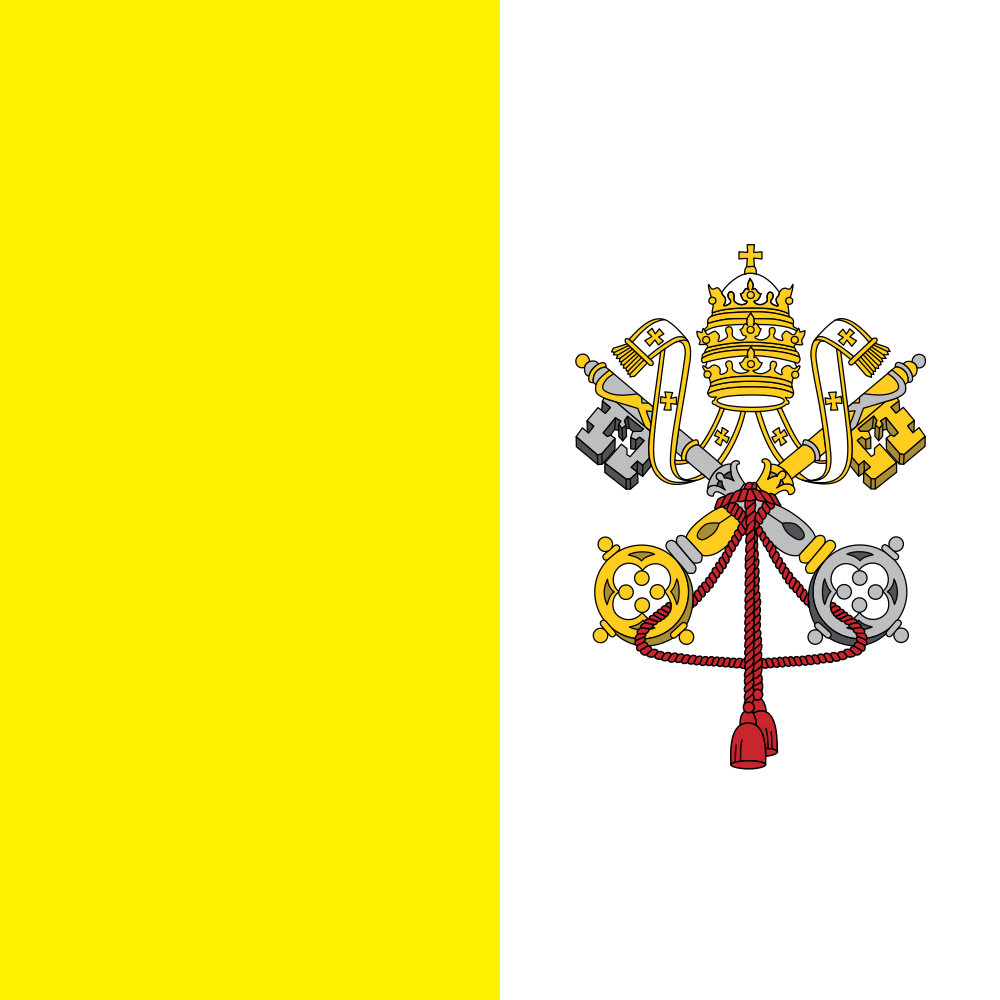 Ms. Adolphe
On the adoption of the Political Declaration on HIV/AIDS (resolution 65/277, annex), the Holy See offers the following statement of interpretation, which explains the official position of the Holy See.
In providing more than one fourth of all care for those who are suffering from HIV and AIDS, Catholic health-care institutions know well the importance of access to treatment, care and support for…
The President
Following the adoption of the Political Declaration, allow me to make a certain number of remarks.
First, this has been a very important week in the fight against HIV/AIDS. The world has watched as we forged a new declaration that will shape the endgame of the AIDS epidemic. In this declaration, Member States committed to clear targets to ensure that by 2015 no more children will be born with HI…
 Mr. Douglas
Panel 1 met to discuss the theme “Shared responsibility — a new global compact for HIV”. The Panel provided a unique opportunity to build consensus on a global agreement for the AIDS response that could serve as a pathfinder for a new deal for health and development. This discussion focused on a compact based on shared but differentiated responsibility to reach universal access.
Joining me on th…
The President
I now give the floor to the representative of Luxembourg, whose Minister for Development Cooperation and Humanitarian Affairs chaired Panel 2.
 Mr. Maes
It is a great honour for me today to present on behalf of the
Minister for Cooperation and Humanitarian Affairs of Luxembourg, Ms. Marie-Josée Jacobs, the main conclusions that, under her chairmanship, Panel 2 arrived at on the subject of prevention, under the theme “Prevention — What can be done to get to zero new infections?”
During a very lively and interactive discussion characterized by fr…
The President
I now give the floor to His Excellency Mr. Ratu Epeli Nailatikau, President of the Republic of Fiji and Chair of Panel 3.
President Nailatikau: The response to HIV/AIDS has been innovative in many ways: in treatment technology with the development of antiretroviral therapy and improved diagnostic tools; in prevention technology with the promising recent research findings on the use of antiretrov…
The President
I now give the floor to the representative of Estonia, whose Minister of Social Affairs chaired Panel 4.
 Mr. Kolga
I am happy to report to the Assembly on Panel 4, which was held yesterday and was dedicated to women, girls and HIV. The Panel was chaired by Estonia’s Minister of Social Affairs, Mr. Hanno Pevkur, on whose behalf I am privileged to brief the Assembly on the results. The Panel had very
distinguished participants, starting with Mr. Aaron Motsoaledi, Minister of Health of the Republic of South Af…
The President
I now give the floor to His Excellency Mr. Gervais Rufyikiri, Second Vice-President of Burundi and Chair of Panel 5.
 Mr. Rufyikiri
In Panel 5, we had productive and fascinating discussions on the various opportunities for expanding and strengthening the response to AIDS through integration, and on the way in which the AIDS response could be used to improve other challenges to health and development. I would like to recall the most important issues raised during the discussions.
First, the response to AIDS is the result of a…
The President
The Assembly will now continue to hear statements in the general debate of the High-level Meeting.
I give the floor to the observer of the Observer State of the Holy See.
Ms. Adolphe
As we gather here today in this High-level Meeting of dignitaries from around the world, we do so in the recognition that we stand as one family with those living with HIV and AIDS and remember in our thoughts and prayers those whom this disease has taken from the world.
In the end, policies, programmes and political statements are without meaning if we do not recognize the human dimension of th…
The President
In accordance with resolution 49/2 of 19 October 1994, I now call on the observer of the International Federation of Red Cross and Red Crescent Societies.
Mr. Jilani
Since the onset of HIV pandemic, the International Federation of Red Cross and Red Crescent Societies (IFRC) has supported Governments’ efforts to address the challenges posed by HIV and AIDS. The IFRC efforts have been focused on implementing comprehensive HIV programmes at the community and household levels through empowering and involving community members.
The main areas of action include em…
The President
In accordance with resolution 47/4 of 16 October 1992, I now call on the observer for the International Organization for Migration.
▶ Cite this page
UN Project. “65/277.” UN Project, https://un-project.org/votes/resolution/65-277/. Accessed .