A/49/PV.93 General Assembly
The meeting was called to order at 10.30 a.m.
37. Strengthening of the coordination of humanitarian and disaster relief assistance of the United Nations, including special economic assistance (a) Strengthening of the coordination of emergency humanitarian assistance of the United Nations Report of the Secretary-General (A/49/177, Corr.1 and Add.1) Draft resolutions (A/49/L.19/Rev.1, A/49/L.57) (b) Special economic assistance to individual countries or regions Reports of the Secretary-General (A/49/158, A/49/263 and Corr.1, A/49/356, A/49/376, A/49/387 and Corr.1, A/49/388, A/49/396, A/49/397, A/49/431, A/49/456, A/49/466, A/49/470, A/49/516, A/49/562, A/49/581, A/49/683) Draft resolutions (A/49/L.26/Rev.1, A/49/L.32/Rev.1, A/49/L.34/Rev.1, A/49/L.36/Rev.1, A/49/L.37/Rev.1, A/49/L.39/Rev.1, A/49/L.41/Rev.1, A/49/L.42/Rev.1, A/49/L.48/Rev.2, A/49/L.50) (c) International Decade for Natural Disaster Reduction Note by the Secretary-General (A/49/453) Report of the Secretary-General of the World Conference on Natural Disaster Reduction (A/CONF.172/9 and Add.1)

I call on the representative of El Salvador to introduce draft resolution A/49/L.37/Rev.1.


On behalf of the original sponsors of draft resolution A/49/L.37/Rev.1, whose names appear at the top of that document, and of the additional sponsors — Chile, Colombia, the Philippines, Peru, Spain and Uruguay — I have the honour to introduce this draft resolution, which is entitled “Special Plan of Economic Cooperation for Central America”. It
This issue is of signal importance for Central America, particularly because its origins are closely linked with efforts to free the region from the grave crisis that has beset it since the beginning of the 1980s. From the outset, the Special Plan had specific objectives based on the philosophy of the peacemaking process reflected in Esquipulas II, which was intended to serve as a complement to measures to promote peace, with a view to tackling simultaneously all the root causes of conflict. In other words, this marked a tremendous step towards nearly concurrent support for the process of establishing a firm and lasting peace in Central America and for the process of ensuring equitable economic development.
Nearly six years after the adoption of the Special Plan, the situation in Central America has changed significantly. Central America has moved from war to peace, from authoritarianism to strengthened democracy, from antagonism to reconciliation and concertation, from destruction to national reconstruction. It was possible to achieve these goals thanks not only to national efforts but also to the solidarity and sustained support of the Secretary- General of our Organization, of the international community and of multilateral agencies, among which I must highlight the United Nations Development Programme (UNDP) as manager and coordinator of the implementation of the Plan.
The Central American Governments believe that there has been substantive progress towards the attainment of the various objectives set by the Special Plan, which in turn has contributed to the process of peacemaking and democratization in the region.
In June 1994 the last meeting of the Follow-up Committee of the International Conference on Central American Refugees, which marked the end of the emergency programme, was held. But at the same time a new initiative was adopted at Mexico City in the Declaration of Commitments, whose goal is to conclude pending programmes relating to displacement, social exclusion and extreme poverty and to formulate and implement new, broader programmes of sustainable human development.
Moreover, other programmes under way under in the context of the Special Plan will conclude on
“UNDP decided, in coordination with the Central American authorities, to assign the small outstanding balance to finance some preliminary activities directed to the preparation of a new regional programme for the subregion”. (A/49/397, para. 70)
We know that much remains to be done to address the pressing economic and social needs and problems of our majority populations, in particular efforts to combat extreme poverty and social exclusion, to finalize pending activities to put an end to displacement, to meet long-term structural needs, to reactivate the economy and social development, and to ensure social investment, food security, environmental protection and the consolidation of democratic institutions, among other areas that ultimately constitute the challenges that must be tackled if we are to maintain stability, social peace, democracy and sustainable development.
With the end of the Special Plan, the Central American Governments agree on the need to prepare a new programme of cooperation for Central America on the basis of the new strategy of sustainable human development, in accordance with the priorities set in the Declaration of Commitments adopted at Mexico City, at the Central American Environment Summit for Sustainable Development, held at Managua, and at the International Conference for Peace and Development, held in Honduras. The objective is to avoid a reversal of what has been achieved and to consolidate regional peace and democracy.
Before speaking of the content of draft resolution A/49/L.37/Rev.1, I wish to note a small change agreed upon in the course of informal meetings. Operative paragraph 4 of part B of the draft resolution should begin as follows:
“Requests the Secretary-General of the United Nations system and in particular the United Nations Development Programme ...”.
I now turn to the draft resolution itself. It consists of two parts. The first relates specifically to the Special Plan, which is about to come to an end, and the second relates to the new framework for assistance to and cooperation with Central America.
In the operative part of part A, the Assembly would express its thanks to the Secretary-General and its appreciation to all States, to the donor community in particular, to international financial institutions, the United Nations system and other organizations for the support and solidarity offered in the execution of the Special Plan of Economic Cooperation for Central America, and would stress the importance of maintaining international cooperation in order to consolidate peace, democracy and sustainable development.
Part B of the draft resolution concerns international assistance to and cooperation with the Alliance for the Sustainable Development of Central America. The preambular paragraphs refer to resolutions regarding the importance of cooperation during the period of transition to a consolidated peace, and they include a reference to the final conclusion of the Special Plan and to the International Conference on Central American Refugees. They recognize that progress has been made but that it is necessary to continue monitoring the problems in Central America until the underlying structural causes that gave rise to the crisis have been overcome.
In the preamble, the draft resolution also recognizes the validity of the commitments adopted at recent Central American summits, and it takes note of the report of the Secretary-General, as well as of the efforts of the Central American Governments to resolve economic and social inequalities and to promote broader forms of participation within the new strategy for sustainable development. It recognizes, too, the financial and material limitations that prevail in the region, and takes into consideration the new national and regional strategy entitled “Alliance for Sustainable Development”.
In its operative part, the draft resolution emphasizes the compelling need for a new programme for international economic, financial and technical cooperation and assistance for Central America geared to the new circumstances and based on the priorities laid down in the Declaration of Commitments, the Alliance for Sustainable Development and the additional commitments undertaken at the International Conference for Peace and
In conclusion, I believe that it is important to remember the link between peace, democracy and development. In Central America this trilogy has been evolving successfully, thus contributing to the peacemaking process. We consider that democracy is fragile, especially in our countries, which are trying to extricate themselves from a period of transition in order to consolidate peace, whose strengthening requires greater efforts day by day. To this end we need the support of the international community.
We request that the draft resolution be adopted by consensus.
I call on the representative of Guatemala to introduce draft resolution A/49/L.39/Rev.1.


I have the honour of introducing draft resolution A/49/L.39/Rev.1, which is entitled “Assistance for the reconstruction and development of El Salvador”, on behalf of its 15 original sponsors, as well as Brazil, Chile, Colombia, Croatia, the Philippines, Italy, Peru, Spain, Trinidad and Tobago and Uruguay, which joined those sponsors today.
As you, Mr. President, and other representatives know, the General Assembly adopted resolutions with the same title at its last two sessions. I refer to resolutions 47/158 and 48/203, which were adopted by consensus both in the Second Committee — where they originated — and in the General Assembly.
In the aforementioned resolutions, the Assembly noted with satisfaction the signing in January 1992 of the Chapultepec Agreement between the parties to the conflict that had ravaged El Salvador since 1969, the Agreement that put an end to that tragic conflict. The Assembly expressed grave concern at the devastating effects of the conflict and stressed
“the need for greater involvement of the international community in the reconstruction and development of El Salvador through the granting of economic, technical and financial assistance”. (resolution 47/158, sixth preambular para.)
In that resolution the General Assembly, among other things, also appealed to States and organizations of the United Nations system
“to provide the requisite assistance, on the most favourable terms possible, for the reconstruction and development of El Salvador” (ibid., operative para. 4)
and requested
“the Secretary-General to encourage the international community to increase the level of [its] assistance to El Salvador”. (ibid., operative para. 5)
In the resolution on this subject adopted last year, the General Assembly, among other things, recognized that El Salvador was
“at a critical stage of transition and that international cooperation will help overcome the difficulties that have arisen and to implement fully the commitments assumed under the Chapultepec Agreement”. (resolution 48/203, fourth preambular para.)
Less than a month ago the representative of the United States of America, speaking in the Security Council, paid a well-deserved tribute to El Salvador when she said that its people had
“persevered, sometimes at great risk, to bring about real change in their society”. (S/PV.3465, p. 11)
Despite that admirable perseverance and the institutional reforms that have been introduced and the free and fair
Furthermore, El Salvador still needs international assistance both for the development of the peace process and for purely economic purposes. With respect to assistance of the former type, it should be recalled that on 23 November 1994 the Security Council adopted a resolution in which, among other things, it urged
“all States and the international institutions engaged in the fields of development and finance to contribute promptly and generously in support of the implementation of all aspects of the Peace Accords, as requested jointly by the Government of El Salvador and FMLN”. (Security Council resolution 961 (1994), para. 6)
On a purely economic level it must be noted that, as the Secretary-General indicates in paragraph 19 of his report (A/49/562) on assistance to El Salvador, there is still a need for the international community to provide technical and economic assistance to El Salvador, especially since, as is also pointed out in the report, financial support for El Salvador from outside the country has fallen off.
El Salvador’s needs can be clearly understood if we take into account the more than 75,000 human lives lost in the recent civil war, and the more than 1 million refugees and displaced persons and the enormous material damages that resulted from it.
In the light of the background just described, the various provisions of the draft resolution that I have the honour to introduce need no explanation.
The first four paragraphs of the preambular part are an updated version of the corresponding preambular paragraphs of resolution 48/203 and are self-explanatory. The last paragraph of the preambular part refers to an event that took place two months ago, an event worth highlighting because it reflects the firm resolve of the Government of El Salvador and the Frente Farabundo Martí para la Liberación Nacional to continue complying with the Chapultepec Agreement, which is the basis of the peace process.
In the first two operative paragraphs of the draft resolution the General Assembly reiterates its
Allow me to express my delegation’s fervent hope that the draft resolution I have just introduced will be adopted, like its predecessors, by consensus.
I call on the representative of Guinea to introduce draft resolutions A/49/L.41/Rev.1, A/49/L.42/Rev.1 and A/49/L.48/Rev.2, and revisions to draft resolution A/49/L.26/Rev.1.


I have the honour, under agenda item 37 (b) and on behalf of the African Group, to introduce the three draft resolutions contained in, respectively, the following documents: A/49/L.41/Rev.1, “Emergency assistance to the Sudan”; A/49/L.42/Rev.1, “Assistance for humanitarian relief and the economic and social rehabilitation of Somalia”, sponsored by my country, as Chairman of the African Group, and the Sultanate of Oman; and A/49/L.48/Rev.2, “Special assistance to front-line States and other neighbouring States”; and to make some revisions to draft resolution A/49/L.26/Rev.1, “Assistance to Mozambique”.
The language used in the draft resolutions is so clear and, therefore, understandable that our statement will be brief. Indeed, they have been the subject of broad consultations and have been endorsed by the African Group. Although these draft resolutions have been updated to correspond with the socio-political developments that have taken place in some of the countries concerned, and because of the success of multilateral actions under the aegis of the United Nations, such as in Mozambique and South Africa, in general they have not been changed substantially vis-à-vis the corresponding resolutions adopted last year.
In the operative paragraphs the draft resolutions stress the need to ensure the safety of personnel providing relief assistance to all in need, and expresses the wish that humanitarian assistance be comprehensively integrated with economic assistance for national reconstruction. In addition, the Secretary-General is requested to continue his efforts to mobilize international assistance for national reconstruction and the development of these countries devastated by war, which continue to suffer total economic stagnation.
In this light, the sponsors of these draft resolutions believe that Somalia should continue to benefit from international solidarity in the area of humanitarian assistance, particularly because the United Nations forces are about to leave that country; that in Mozambique the recent democratic reforms should be preserved; that in Sudan it is urgent to implement all available means to eradicate malaria, which kills thousands of people; and, finally, that with regard to the front-line States and other neighbouring States, it is necessary to combat the after- effects of apartheid and especially to halt desertification, which is getting worse day by day.
I wish now to submit a slight revision to operative paragraph 8 of draft resolution A/49/L.26/Rev.1, “Assistance to Mozambique”. That paragraph should now read as follows:
“Appeals to the international community to extend its support to the Government and people of Mozambique in order to establish lasting peace and democracy and to promote an effective programme of national reconstruction and development in that country”.
In conclusion, we hope that, as in the past, these four draft resolutions will be supported by all Member States and that, acting in solidarity with the people of Mozambique, Somalia, Sudan and the front-line States, they will adopt them by consensus.


I have the honour to speak on behalf of the European Union and Austria, Finland and Sweden.
When the Declaration of Principles was signed between Israel and the Palestine Liberation Organization in September last year it was generally accepted that for the thus invigorated peace process to be successful it would take an important international effort to improve the economic and social situation of the Palestinians. It was in this spirit that less than three weeks after the signing of the Declaration of Principles the Conference to Support Middle East Peace was held in Washington and substantial pledges were made there.
On that occasion the Ad Hoc Liaison Committee was established to coordinate the activities of the donors. Most important among the steps taken under the auspices of the Secretary-General to ensure the achievement of a coordinated mechanism for United Nations activities throughout the occupied territories was the appointment of the Special Coordinator in the occupied territories. The importance of the question of assistance to the Palestinian people has lost nothing of its urgency in the meantime. Indeed, the recent tragic events in Gaza have demonstrated the overriding need to consolidate and speed up the process begun by the historic Declaration of September 1993.
The European Union is convinced that during the particular phase in which autonomy is being created and Palestinian institutions set up it is vital for the inhabitants of the territories to see concrete evidence in their daily lives of the positive effects of the political changes that took place over a year ago. This objective requires efforts on all sides, whether it be by the donor community as a whole or by the regional parties.
The European Union is also convinced that the donors’ efforts to help the civilian population must be accompanied by the reactivation of the peace process, particularly with regard to the full implementation of the Declaration of Principles of 13 September 1993. In this context the European Union welcomes the decision by Israel and the Palestine Liberation Organization (PLO) to resume their negotiations on the implementation of the autonomy agreement. It is essential that these discussions open the way as soon as possible to new progress on the issues
As the largest contributor of aid to the Palestinians, the European Union reaffirms its determination to continue its economic and financial efforts, and its willingness to examine ways and means of meeting the needs of the Palestinians more effectively.
The European Union is therefore glad to introduce and to be a sponsor of draft resolution A/49/L.50, entitled "Assistance to the Palestinian people". We note with particular satisfaction that, as one result of the new spirit of cooperation in this area, the draft resolution on this subject has become a matter of consensus since last year.
I now call upon the representative of Sweden to introduce draft resolution A/49/L.57.


Before introducing draft resolution A/49/L.57, I should like to announce that Canada, Monaco, Poland, the Republic of Korea and Turkey have become co-sponsors.
On behalf of the co-sponsors I now have the honour to introduce draft resolution A/49/L.57, entitled “Strengthening of the coordination of emergency humanitarian assistance of the United Nations”. The draft resolution recognizes the increasing need for humanitarian assistance and adequate financial resources to ensure prompt, timely and effective response by the United Nations to natural disasters and other emergencies, both for relief and for the continuum to development. It also recognizes the need to strengthen further coordination of humanitarian assistance, in particular in the field.
The draft resolution takes note of the report (A/49/177) of the Secretary-General dated 21 June 1994 on the strengthening of the coordination of emergency humanitarian assistance of the United Nations dated 21 June 1994 and its addendum (A/49/177/Add.1) of 1 November 1994. The main emphasis in the operative part of the draft resolution is on three issues that, in accordance with Economic and Social Council decision 1994/291 of 27 July 1994, were referred to the General Assembly for consideration: first, measures for strengthening field coordination of humanitarian assistance; secondly, the Central Emergency Revolving Fund; and, thirdly, funding of rapid coordination arrangements in the field.
Secondly, the draft notes that the usefulness of the Central Emergency Revolving Fund has been fully recognized by the operational agencies, in particular for enhancing their capacity to address promptly the urgent requirements of the initial phase of emergencies. It recognizes the need to maintain an adequate level of funds in the Central Emergency Relief Fund and requests the Emergency Relief Coordinator, when the resources fall below this level, to bring the matter to the attention of States. Furthermore, the Secretary-General is requested to continue consultations regarding an increase of resources in the Fund, taking into account the need to secure contributions on an assured, broad-based and additional basis.
Thirdly, regarding the issue of funding rapid coordination arrangements in the field, the draft resolution endorses the recommendation of the Inter-Agency Standing Committee that the interests earned by the Central Emergency Relief Fund continue to be used for this purpose. It urges all operational agencies to collaborate fully with the Department of Humanitarian Affairs in providing sufficient financial and human resources for rapid coordination arrangements in order to enhance the rapid-response capability of the system as a whole.
Before concluding I would like to pay a tribute to Mr. Peter Hansen, Under Secretary-General for Humanitarian Affairs, and his staff, as well as to the operational agencies involved, for their dedicated endeavours to alleviate the suffering of the victims of natural disasters and other emergencies.
We, the co-sponsors of draft resolution A/49/L.57, support the continued efforts by the Department of Humanitarian Affairs to strengthen the coordination of the emergency humanitarian assistance of the United Nations.
We shall now proceed to consider the remaining draft resolutions under agenda item 37, namely, A/49/L.19/Rev.1, A/49/L.26/Rev.1, as orally revised, A/49/L.29/Rev.1, A/49/L.32/Rev.1, A/49/L.34,Rev.1, A/49/L.36/Rev.1, A/49/L.37/Rev.1, A/49/L.39/Rev.1, A/49/L.41/Rev.1, A/49/L.42/Rev.1, A/49/L.45, A/49/L.48/Rev.2, A/49/L.50 and A/49/L.57.
I wish to announce that the following countries have become sponsors of draft resolution A/49/L.19/Rev.1: Albania, Azerbaijan, Benin, China, the Republic of Moldova and Turkey.
Costa Rica has become a sponsor of draft resolution A/49/L.36/Rev.1. As a result of a technical error, Slovakia was omitted from the original list of sponsors of that draft resolution.
Bhutan has become a sponsor of draft resolution A/49/L.29/Rev.1.
The following countries have become sponsors of draft resolution A/49/L.45: Albania, Azerbaijan, Bangladesh, China, Costa Rica, the Czech Republic, Egypt, Georgia, Honduras, India, the Islamic Republic of Iran, Kazakhstan, Latvia, Lithuania, Malaysia, Pakistan, the Philippines, Portugal, the Republic of Korea, the Republic of Moldova, Romania, Slovenia and Tajikistan.
The Assembly will now take decisions, one at a time and under the respective sub-item, on the 14 draft resolutions remaining under item 37.
Under sub-item (a), there are two draft resolutions.
Draft resolution A/49/L.57 is entitled “Strengthening of the coordination of emergency humanitarian assistance of the United Nations”.
May I take it that the Assembly decides to adopt draft resolution A/49/L.57?
Draft resolution A/49/L.57 was adopted (resolution 49/139 A).
Vote:
A/49/L.57
Consensus
Draft resolution A/49/L.19/Rev.1 is entitled “Participation of volunteers, White Helmets', in activities of the United
May I take it that the Assembly decides to adopt draft resolution A/49/L.19/Rev.1?
Draft resolution A/49/L.19/Rev.1 was adopted (resolution 49/139 B).
Under sub-item (b), there are 10 draft resolutions.
Draft resolution A/49/L.26/Rev.1 is entitled “Assistance to Mozambique”.
May I take it that the Assembly decides to adopt draft resolution A/49/L.26/Rev.1, as orally revised?
Vote:
A/49/L.19/Rev.1
Consensus
Cooperation between the United Nations and the Caribbean Community: draft resolution (A/49/L.62/Rev.1)
Vote:
49/141
Consensus
Draft resolution A/49/L.26/Rev.1, as orally revised, was adopted (resolution 49/21 D).
Draft resolution A/49/L.32/Rev.1 is entitled “Assistance for the rehabilitation and reconstruction of Liberia”.
May I take it that the Assembly decides to adopt draft resolution A/49/L.32/Rev.1?
Draft resolution A/49/L.32/Rev.1 was adopted (resolution 49/21 E).
Draft resolution A/49/L.34/Rev.1 is entitled “Assistance for the reconstruction and development of Djibouti”.
May I take it that the Assembly decides to adopt draft resolution A/49/L.34/Rev.1?
Draft resolution A/49/L.34/Rev.1 was adopted (resolution 49/21 F).
Vote:
A/49/L.32/Rev.1
Consensus
Draft resolution A/49/L.36/Rev.1 is entitled “International cooperation and assistance to alleviate the consequences of war in Croatia and to facilitate its recovery”.
Draft resolution A/49/L.36/Rev.1 was adopted (resolution 49/21 G).
Draft resolution A/49/L.37/Rev.1 is entitled “Special Plan of Economic Cooperation for Central America”.
May I take it that the Assembly decides to adopt draft resolution A/49/L.37/Rev.1?
Vote:
A/49/L.34/Rev.1
Consensus
Draft resolution A/49/L.37/Rev.1 was adopted (resolution 49/21 H and I).
Draft resolution A/49/L.39/Rev.1 is entitled “Assistance for the reconstruction and development of El Salvador”.
May I take it that the Assembly decides to adopt draft resolution A/49/L.39/Rev.1?
Draft resolution A/49/L.39/Rev.1 was adopted (resolution 49/21 J).
Vote:
A/49/L.36/Rev.1
Consensus
Draft resolution A/49/L.41/Rev.1 is entitled “Emergency assistance to the Sudan”.
May I take it that the Assembly decides to adopt draft resolution A/49/L.41/Rev.1?
Draft resolution A/49/L.41/Rev.1 was adopted (resolution 49/21 K).
Draft resolution A/49/L.42/Rev.1 is entitled “Assistance for humanitarian relief and the economic and social rehabilitation of Somalia”.
May I take it that the Assembly decides to adopt draft resolution A/49/L.42/Rev.1?
Vote:
A/49/L.37/Rev.1
Consensus
Draft resolution A/49/L.42/Rev.1 was adopted (resolution 49/21 L).
Draft resolution A/49/L.48/Rev.2 is entitled “Special assistance to front-line States and other neighbouring States”.
Draft resolution A/49/L.48/Rev.2 was adopted (resolution 49/21 M).
Vote:
A/49/L.39/Rev.1
Consensus
Draft resolution A/49/L.50 is entitled “Assistance to the Palestinian people”.
May I take it that the Assembly decides to adopt draft resolution A/49/L.50?
Draft resolution A/49/L.50 was adopted (resolution 49/21 N).
Under sub-item (c), draft resolution A/49/L.29/Rev.1 is entitled “Early warning capacities of the United Nations system with regard to natural disasters”.
May I take it that the Assembly decides to adopt draft resolution A/49/L.29/Rev.1?
Vote:
A/49/L.41/Rev.1
Consensus
Draft resolution A/49/L.29/Rev.1 was adopted (resolution 49/22 B).
Under sub-item (e), draft resolution A/49/L.45 is entitled “Emergency international assistance for peace, normalcy and reconstruction of war-stricken Afghanistan”.
May I take it that the Assembly decides to adopt draft resolution A/49/L.45?
Draft resolution A/49/L.45 was adopted (resolution 49/140).
Vote:
A/49/L.42/Rev.1
Consensus
I shall now call on those representatives who wish to speak in explanation of position. May I remind members that explanations of vote are limited to 10 minutes and should be made by delegations from their seats.
Allow me on behalf of the European Union to use this particular moment, after the adoption by consensus of the last draft resolution submitted under agenda item 37, briefly to assess the work of this session of the General Assembly on the cluster of items entitled “Strengthening of the coordination of humanitarian and disaster relief assistance of the United Nations, including special economic assistance”.
The European Union supports the efforts being made in order to achieve a consistent approach to the issues taken up this year under agenda item 37. In this context, we welcome the clustering of items, which seems to be well under way, and hope that it can be completed in the near future. In order to avoid undue duplication of work, we would appreciate it, furthermore, if draft resolutions addressing individual country situations were analysed and gradually standardized so that eventually an omnibus draft resolution might be achieved.
Since delegations must at all times be given the opportunity to participate actively in the process of consideration of texts of draft resolutions, we would also urge the Assembly to explore ways and means that might help to avoid duplication of negotiating mechanisms in the coming years.


Israel fully supports and encourages economic, financial and technical assistance to the Palestinians in the West Bank and the Gaza Strip. Peace and prosperity are indivisible. Economic development and improved living conditions in the territories will encourage peace and stability in the region. We welcome the concerted efforts of Member States, international financial institutions and intergovernmental and non-governmental organizations to extend economic and social assistance to the Palestinian people in order to aid in the development of the West Bank and Gaza.
For many years now Israel has been fully cooperating with the United Nations Development Programme (UNDP), the United Nations Relief and Works Agency for Palestine Refugees in the Near East (UNRWA) and the United Nations Children’s Fund (UNICEF), and with other international organizations as well, in implementing programmes aimed at improving
It is our view that the United Nations should increase its efforts and funding to assist the Palestinians in the territories, and to facilitate the successful implementation of the Declaration of Principles.
We have made a genuine effort to reach a consensus on draft resolution A/49/L.50, which addresses such an important issue as assistance to the Palestinian people. We believe that economic and social progress can be advanced only through cooperation, not confrontation. However, Israel’s participation in the consensus on this resolution should not be construed as implying any position regarding the present status of the territories referred to in the fourth and fifth preambular paragraphs as “the occupied territory”; nor does it carry any implication regarding Israel’s position concerning the permanent status of those territories which, in accordance with the Declaration of Principles signed on 13 September 1993, are a matter to be negotiated between Israel and the PLO. With regard to operative paragraph 9, we do hope that the proposed United Nations-sponsored seminar will be organized by an appropriate United Nations body acceptable to all parties.
The Declaration of Principles signed by Israel and the PLO, the subsequent Agreement on the Gaza Strip and the Jericho Area signed in Cairo, the subsequent Agreement on Preparatory Transfer of Powers and Responsibilities, and the Israel-Jordan peace treaty are momentous breakthroughs that open new vistas for economic and social progress. The concrete implementation of economic projects as identified in the agreements will lay the social and economic foundations that can bring us into a new era of cooperation, prosperity and peace in our region.
Vote:
A/49/L.48/Rev.2
Consensus


My delegation welcomes the adoption of draft resolution A/49/L.29/Rev.l, entitled “Early warning capacities of the United Nations system with regard to natural disasters”, which it co-sponsored. We wish to pay special tribute to Ambassador Sucharipa of Austria, the Coordinator designated by the President of the General Assembly, for his success in fashioning a consensus; and we thank the other delegations that made a contribution to this end. My delegation sincerely hopes that the work we have initiated with this resolution will enable us better to prevent and prepare against natural and similar disasters,
Japan joined the consensus on this resolution and co- sponsored it in a spirit of cooperation, but it is not fully satisfied with the final wording of the title. While we address the early warning capacities of the United Nations system with respect both to natural disasters and to similar disasters with an adverse impact on the environment, the title of the resolution refers only to the former. My delegation would have preferred that the title more precisely reflect the content of the resolution. As operative paragraph l provides, the Secretary-General is to address the subject of “similar disasters” as well in the report he is to submit to the General Assembly at its fiftieth session. It should therefore be understood that despite its abbreviated title, this resolution does not limit the scope of the discussion next year to natural disasters.


My delegation joined the consensus on draft resolution A/49/L.50. However, I would like to express my delegation’s reservation regarding those parts of the resolution which might be construed as any recognition of Israel.


While we highly value all international efforts for the provision of assistance to the Palestinian people in the form of the programme outlined in draft resolution A/49/L.50, my delegation expresses its reservations on the third preambular paragraph of the draft resolution.
Vote:
A/49/L.50
Consensus

My delegation joined the consensus for the adoption of the resolution contained in document A/49/L.50. Nevertheless, we wish to put on record a reservation with regard to any indication that could be construed as recognition of Israel or as welcome for the peace process in the Middle East.


The United States Government remains extremely concerned that the draft resolution on emergency assistance to the Sudan (A/49/L.41/Rev.1), just adopted, reflects a situation in the Sudan that takes very little account of the reality that exists in a vast part of that country — a reality that, as the Secretary-General’s report in document A/49/376 points out, depicts a Government which has done very little in these areas to facilitate international humanitarian aid to its most needy citizens; a reality which, again as indicated in the Secretary-General’s report, depicts efforts
We strongly urge the Government of the Sudan to cease and desist its efforts denying access by United Nations and other humanitarian relief organizations to populations in need.
We have heard the last speaker in explanation of position.
I now call on the representative of Austria, Coordinator of the informal consultations on agenda item 37.
Vote:
A/49/L.29/Rev.1
Consensus


As we come to the conclusion of our debate on agenda item 37, I wish to make a few comments in my personal capacity as Coordinator of the informal consultations that were conducted in conformity with the procedure set out in resolution 48/162, “Further measures for the restructuring and revitalization of the United Nations in the economic, social and related fields”.
Starting on 28 November, we held a total of nine meetings, in which 50 delegations participated. A number of separate negotiations were conducted parallel to these consultations.
This process led to the General Assembly’s adoption by consensus, both this morning and earlier, of 20 draft resolutions — a fact which I think reflects the importance of United Nations activities in this field. Seventeen of the resolutions deal with countries’ specific situations and three with conceptual issues in connection with the coordination of humanitarian assistance activities carried out by the United Nations system.
I should like to thank delegations that were kind enough to refer to my role in these consultations. In turn, I am happy to acknowledge the active cooperation which I enjoyed from many delegations throughout this process. I should also like to express my sincere appreciation to the members of the Secretariat, and in particular to Miss Nora Benary of the Department of Humanitarian Affairs, for their valuable assistance.
May I conclude with a few remarks on the procedure established by resolution 48/162 in so far as it is relevant to agenda item 37. We managed to maintain and further develop the idea of clustering of all resolutions dealing with
With regard to some of the resolutions adopted, we also agreed on biannualization. At the same time, we must realize that, for obvious reasons, each and every one of these resolutions is of greatest importance to the affected and other interested countries. Last year’s decision to elevate the discussion on these issues to the plenary Assembly reflected this fact.
As far as the process of taking action on these resolutions is concerned, I believe that utmost care should be taken to ensure the best coordination of valuable time and to avoid as much as possible any duplication with other relevant meetings.
The early introduction of all draft resolutions — if at all possible, at the time of the discussion in the plenary Assembly of the agenda item — would be very helpful in facilitating the negotiating process so that due justice could be done to all the draft resolutions presented.
I hope that these remarks will be viewed by delegations as helpful suggestions for next year’s deliberations.
Once again, I should like to thank all the colleagues who worked with me on the draft resolutions adopted today for their cooperation and the constructive spirit that prevailed throughout our work.
I now call on the representative of Sudan, who wishes to make a statement.


Following the adoption of draft resolution A/49/L.41/Rev.1 entitled “Emergency assistance to the Sudan”, my delegation wishes to thank all the delegations that sponsored that draft resolution, particularly our brethren in the African Group, as well as Bangladesh, China, Indonesia, the Islamic Republic of Iran, Jordan, Malaysia, Oman, Pakistan, Sri Lanka, the Syrian Arab Republic, and Yemen. Operation Lifeline for Sudan has
Following the completion of informal consultations on draft resolution A/49/L.41/Rev.1, we noted that some delegations sought to foist political issues into humanitarian questions. This is a tendency that has serious implications for future humanitarian assistance efforts by the United Nations, efforts that have to do with the very lives of vulnerable people to whom we should extend a helping hand in line with the teachings of religion and the dictates of morality. We have noticed that a certain delegation has continued to voice reservations over all such draft resolutions and has consistently refused to join in the consensus unless certain paragraphs that serve its political goals were inserted therein.
My delegation wishes to draw the attention of the General Assembly to the importance of underscoring the need to refrain from politicizing humanitarian assistance operations and from embroiling such operations into conflicts between States as they have to do with the lives of innocent people who need help. These are points that have been stressed time and again by the General Assembly in many of its resolutions.
Sudan has always contributed to the efforts of United Nations relief agencies. It has donated 80,000 tonnes of maize for distribution among the needy. It has also provided containers and vessels for transporting humanitarian assistance and established a special emergency-assistance commission under a Minister of State with a view to providing food to those in need.
Despite this, the report of the Secretary-General (A/49/376) contains information that is not factual and that describes the situation in Sudan as
“one of the most enduring and serious humanitarian crises on the face of the globe”. (A/49/376, para. 83)
That is unacceptable and has no basis in fact. We would call on the Secretariat to be more careful in the future and to submit a more factual and impartial report.
We wish to thank all our brethren who participated in the informal consultations on this draft resolution for their valuable efforts, which produced the draft resolution The delegation of the United States has referred to the draft resolution on the Sudan. I want simply to inform the Assembly that I myself contacted the delegation that made this statement here today 20 days before the informal consultations and provided it with a copy of the draft resolution on the Sudan. The representative of that delegation who has spoken here today was present at the informal consultations where the draft resolution was adopted. Some days later, that representative came to us and said that her Government was concerned about part of the draft resolution and would like to change it. We changed the draft resolution in accordance with her wishes. We were therefore very surprised to hear that representative speak today of humanitarian assistance to the Sudan. This is unfortunate in the light of the fact that we had broken consensus and brought the draft resolution back to the informal consultations, even though we thought that the issue she was raising was purely political and should not have been brought into a text on humanitarian assistance.
Vote:
49/140
Consensus
Spoke in English
In accordance with General Assembly resolutions 3237 (XXIX) of 22 November 1974 and 43/177 of 15 December 1988, I now call on the observer of Palestine.

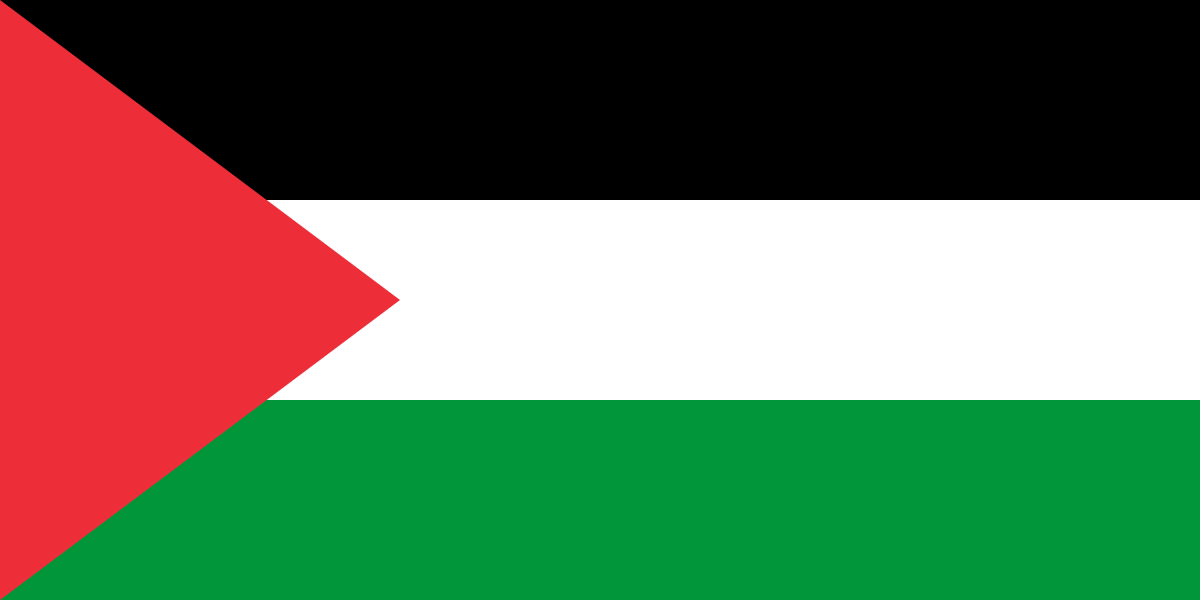
Draft resolution A/49/L.50, on assistance to the Palestinian people, which was adopted this morning, resembles the resolution that the General Assembly first adopted unanimously last year under the same item. It also resembles Economic and Social Council resolution 1994/29 of 27 July 1994.
The Palestinian delegation worked hard with all the parties concerned to make it possible, this year and in the past, to adopt these draft resolutions by consensus. We thank the members of the European Union and the delegations of Austria, Finland and Sweden, all of which were among the sponsors of this year’s draft resolution.
The resolution the Assembly has just adopted is particularly important in view of the difficult situation faced by the Palestinian economy after many long years of destruction resulting from continued Israeli occupation.
The preambular part of the resolution notes to the difficult economic conditions facing the Palestinian people throughout the occupied territory. The operative part urges coordination of efforts and for cooperation with the Palestine Liberation Organization, and calls upon the donor community to expedite the delivery of assistance it has undertaken to provide to the Palestinian people in order for them to meet their urgent needs.
In recent years, the Committee on the Exercise of the Inalienable Rights of the Palestinian People has organized two seminars on various aspects of providing assistance to the Palestinian people. The resolution just adopted suggests the convening in 1995 of a United Nations-sponsored seminar on Palestinian administrative, managerial and financial needs and challenges in the light of recent developments. In the light of the experience of the past two years, we think that the Committee on the Exercise of the Inalienable Rights of the Palestinian People is the appropriate body to organize the 1995 seminar, because of its experience in the field and because the proposed seminar falls within the Committee’s new programme to support the peace process.
We shall welcome consultations with all the parties concerned, and we accept the idea that any other United Nations body can play a role in organizing the seminar. We shall strive, together with all the parties, to begin the preparations for it as soon as possible, and all efforts to this end will be welcome.
The creation of a climate of stability in the occupied territories is a prerequisite for success in the economic development process. But this will require honest implementation of the Declaration of Principles, as well as the continued implementation of its main provisions, including the withdrawal of Israeli forces from the main towns of the occupied territories, with a view to the creation of conditions conducive to the holding of free
We wish, on behalf of the Palestine Liberation Organization, to express thanks to all United Nations Members and bodies and to governmental and non- governmental organizations for their continuing support for the Palestinian people.
Before the Assembly concludes its consideration of agenda item 37 I wish to thank Ambassador Sucharipa of Austria very sincerely for the effectiveness with which he coordinated the informal consultations on it. I should like also to congratulate all the delegations whose efforts led to the success of those negotiations.
May I take it that it is the wish of the Assembly to conclude its consideration of agenda item 37?
It was so decided.
7. Notification by the Secretary-General under Article 12, paragraph 2, of the Charter of the United Nations: note by the Secretary-General (A/49/390)
As members are aware, in accordance with the provisions of Article 12, paragraph 2, of the Charter of the United Nations and with the consent of the Security Council, the Secretary-General is mandated to notify the General Assembly of matters relative to the maintenance of international peace and security that are being dealt with by the Security Council and of matters with which the Council has ceased to deal.
In this connection, the General Assembly has before it a note by the Secretary-General issued as document A/49/390. May I take it that the Assembly takes note of that document?
It was so decided.
I call on the representative of Belize to introduce draft resolution A/49/L.62/Rev.1.


I have the honour to speak on agenda item 161 on behalf of the following Members of the United Nations that are also members of the Caribbean Community (CARICOM): Antigua and Barbuda, Bahamas, Barbados, Belize, Dominica, Grenada, Guyana, Jamaica, Saint Kitts and Nevis, Saint Lucia, Saint Vincent and the Grenadines, and Trinidad and Tobago. The delegation of Belize also has the honour of introducing draft resolution A/49/L.62/Rev.1, under this agenda item, on behalf of the 12 members of CARICOM and the following other Members of this Organization that are generous co-sponsors: Algeria, Argentina, Austria, Belgium, Benin, Bolivia, Brazil, Burkina Faso, Cambodia, Canada, Chile, Colombia, Costa Rica, Cuba, Denmark, Ecuador, El Salvador, Fiji, Finland, France, Gambia, Germany, Greece, Guatemala, Haiti, Honduras, Iceland, India, Ireland, Italy, Kenya, Luxembourg, Malaysia, Marshall Islands, the Federated States of Micronesia, the Netherlands, Nicaragua, Panama, Papua New Guinea, Portugal, Samoa, Seychelles, Singapore, Solomon Islands, Spain, Sweden, the United Kingdom of Great Britain and Northern Ireland, the United States of America, Vanuatu and Venezuela. The sponsors would like to introduce the following oral amendment to the draft resolution: delete the first three words — “international cooperation as” — from the third line of the third preambular paragraph. The third preambular paragraph would then read as follows: “Recalling further that the Charter of the United Nations contemplates the existence of regional arrangements or agencies for dealing with such matters as are appropriate for regional action and other activities consistent with the purposes and principles of the United Nations”. The draft resolution invites the Secretary-General of the United Nations, in consultation with his CARICOM counterpart, to promote appropriate meetings between their representatives to facilitate and broaden cooperation and coordination. It also urges cooperative relations between the specialized agencies and other organizations and programmes of the United Nations system, on the one hand, and CARICOM and its associated institutions, on the other hand. The Assembly granted observer status to the Caribbean Community in October 1991. Since that time there has been a substantial degree of cooperation between the United Nations and the specialized agencies, on the one hand, and, the Caribbean Community, on the other, in the areas of economic and social development and political and humanitarian affairs. In particular, the Community has cooperated with and complemented the United Nations in such specific areas as poverty alleviation, job creation, human-resources development, trade and economic diversification, the empowerment of women in the economic and legal fields, health, the sustainable development of small island developing States, the freedom of peoples and countries of southern Africa and the promotion of democracy and human rights in Haiti. Not many years ago doubts were expressed about the capacity of the so-called mini-States to participate in the international system. Hence, proposals were mooted to establish forms of participation less than that of full membership in this Organization. Today, however, two of the CARICOM Member States have been full and active Member States of the United Nations for 32 years. They and other CARICOM members have made positive contributions to this Organization. Thus, we are happy and proud to note that Jamaica is the host country of the International Seabed Authority, that Barbados was the venue of the United Nations Conference on small island developing countries and that the Bahamas was the venue of the first Conference of the Parties to the Convention on Biological Diversity. It may be the Assembly’s view that the coordination and cooperation between the Caribbean Community and the United Nations are establishing patterns which are distinct and likely to continue. This is probably reflective of the fact that as CARICOM is now a few months short of its twenty-first anniversary it is one of the more established comprehensive international organizations. As such, it has commenced to deepen the integration process in the Commonwealth Caribbean. Now the subregion boasts such organs as a university and other arrangements for educational development, a development bank and numerous other common services. At the same time, the Community recently commenced to widen the integration process by agreeing with its non-English-speaking and certain other neighbours in the wider Caribbean to establish an Association of Caribbean States (ACS) with a comprehensive mandate. The vitality of such entities as the Caribbean Community, the developing Central American community, the ACS and other arrangements demonstrates that diverse regional and subregional arrangements must presently coexist in this dynamic new era of world order. The CARICOM member States believe that such arrangements have the potential to subserve and further the interests and objectives of the United Nations. In fact, in this period of rebirth and discovery these developments challenge us to reflect on the utility to this Organization of alliances with other entities. Such arrangements conserve resources and facilitate economization. They contribute to overall efficiency, particularly in view of the specialization provided by organizations of friendly and cooperative neighbours. Furthermore, as the draft resolution intimates, CARICOM is a regional arrangement or agency for dealing with such matters as are appropriate for regional action and for other activities consistent with the purposes and principles of the United Nations. More generally, this Organization might well benefit from further examination of the utility of collaboration with regional and subregional arrangements or agencies. In that context, it would probably be useful to explore the It is important to point out that the draft resolution before us requests the Secretary-General to submit a report on its implementation. However, that report would not be due until the fifty-first session of the Assembly, when this item would next be on the Assembly’s agenda. On behalf of the States members of the Caribbean Community, I would like to thank the generous co- sponsors of this draft resolution. I would also like to express the hope that it will be adopted by consensus.
Mr. Arzoumanian (Armenia), Vice-President, took the Chair.
I should like to propose that the list of speakers in the debate on this item be closed in half an hour.
It was so decided.
I therefore request those representatives wishing to participate in the debate on this item to inscribe their names on the list of speakers as soon as possible.


The members of the Latin American and Caribbean Group, on whose behalf I am speaking, take special delight in endorsing this draft resolution (A/49/L.62/Rev.1). The logic is simple: a group is only as strong as its weakest link, and we commend the activities of the Caribbean Community (CARICOM) secretariat to the Assembly for the sole reason that it has a strong tradition of service in the protection of the weakest members of the 13 States it represents.
The CARICOM secretariat was not born with the signing of the Treaty of Chaguaramas. It metamorphosed from an earlier grouping known as the Caribbean Free Trade Association (CARIFTA) secretariat, which originated with only three members: Barbados, Guyana and Antigua. That fledgling organization spawned the CARICOM secretariat, which boasts a history of distinguished Secretaries-General, such as William Demas, Sir Alister McIntyre, Kurleigh King and Roderick Rainford.
CARICOM comprises States in varying stages of development, and the concept of the protection of the small vulnerable States known as the “least developed countries” is built into the structure of the CARICOM Agreement. This alone is an appropriate justification of the draft resolution that was introduced and so ably
The Group of Latin American and Caribbean States endorses the draft resolution on the understanding that it would deepen the integration process, not only among the CARICOM States but in the hemispheric sense and at the level of the United Nations itself. Our Group is extremely conscious of the need to achieve a notion of equality and cooperative give and take among its members, and the closer networking of the secretariats of CARICOM and the United Nations will carry the distinct fringe benefit of a closer networking within our Group itself.
This United Nations-CARICOM Cooperation Agreement enters fully into the current mood of hemispheric integration, and the Assembly would do well to savour the possibilities of a Caribbean and Latin American cultural mix, which has included the names of Octavio Paz of Mexico, Vidia Naipaul of Trinidad and Tobago, Gabriel Garcia Marquez of Colombia, Paolo Frere of Brazil and Derek Walcott of Saint Lucia. This multiculturalism is quite consistent with the regional functional cooperation that the United Nations itself seeks to foster between its richly endowed Member States. The CARICOM secretariat, for its part, enjoys a fine track record in functional cooperation and is extending its membership to embrace other CARICOM territories like Suriname, which we hope will become part of CARICOM in the New Year in the same way that Palau took its place in the United Nations as recently as last week. Incidentally, Suriname is also a co-sponsor of the draft resolution.
The Group of Latin American and Caribbean States must perceive itself as an instrument for effecting the hemispheric cohesion which the Summit of the Americas so sharply italicized. Only in this way can we unlock the storehouse of productive and creative energy that abounds in the Americas. The Secretariat of the United Nations and the CARICOM secretariat are the implementing arms of the policies that we devise and formulate. There seems to be a
On behalf of the Group of Latin American and Caribbean States, I endorse the draft resolution on the subject of a United Nations-CARICOM Agreement as recommended by the Heads of Government of the CARICOM States.

I have the honour to speak on behalf of the European Union; Austria, Finland and Sweden support this statement.
Although the United Nations is steadily enhancing its capacity to meet the global challenges facing us today, there is a growing awareness that not all tasks can be shouldered by the United Nations alone. The Caribbean Community (CARICOM) has in the past been instrumental in fostering economic integration between its member States, in enhancing cooperation with a view to achieving sustainable development, and in coordinating foreign policy, especially with regard to regional affairs. Its constructive role in Haiti is only one of the most recent examples. A closer working relationship between the secretariats of CARICOM and the United Nations, as proposed in the draft resolution before us, can indeed only be beneficial. We have therefore co-sponsored the draft resolution and hope that it will be adopted by consensus.
I would like to reiterate the support of the European Union for the Caribbean Community as a whole. We propose to undertake common efforts to bring about a new partnership of the two regions aimed at ensuring universal respect for human rights, increasing balanced economic trade, fostering sustained development and strengthening cultural and scientific bonds. We propose to share our experience in the process of regional integration and are determined to seek, together with our Caribbean partners, the cooperation outlined in the Lomé Convention. Lomé IV has been concluded for a period of 10 rather than the usual 5 years — and this is proof of our long-term commitment. Within its framework, 350 million ECU are committed to the Caribbean region.
We recognize the specific problems of CARICOM members, most of which are small island developing States — their vulnerability to climate change, the challenge of managing coastal zones and marine resources, and their economic and ecological fragility.
In this respect we would like to recall the Barbados Conference on the Sustainable Development of Small Island Developing States, held in April this year. It represented a landmark in strategic planning and should have a strong and long-lasting impact on the development of the Caribbean region. We welcome this important initiative, which we supported from a very early stage.
Let me conclude by saying that we look forward to even closer cooperation both within the United Nations system and between CARICOM and the European Union, and in the future between the European Union and the newly founded Association of Caribbean States.


On behalf of the Papua New Guinea delegation, it is my extreme pleasure to lend our support to draft resolution A/49/L.62/Rev.1, which relates to cooperation between the United Nations and the Caribbean Community (CARICOM). In so doing, we further associate ourselves with the statements made by the representatives of Belize and Saint Lucia, who eloquently outlined the rationale and principles underlying the move to establish a cooperative arrangement between a regional entity such as CARICOM and the United Nations system.
In recognizing the invaluable and constructive contributions made by CARICOM to regional and international development efforts and the promotion of international understanding, the General Assembly, at its forty-sixth session in 1991, granted observer status to this important regional organization.
It is the view of my delegation that CARICOM has undeniably proved its leadership capacity and competence in the articulation of issues, and continues to offer constructive contributions in regional and international forums in determining policy options towards resolving the wide-ranging socio-economic issues confronting the world community. In particular, we further recognize the region’s role in the maintenance of peace and security with regard to the situation of democracy and human rights in Haiti.
From the perspective of our region, the Pacific, we share many similarities with the Caribbean Community in terms of size and vulnerability. It is therefore extremely important for the international community to take a positive and innovative approach to ensure the continuity of needed international support to bring about healthy international development cooperation in the areas of trade and investment, aimed at achieving sustained economic growth in small island developing States.
Perhaps one of the achievements with the most significance for small island States this decade has been the Global Conference on the Sustainable Development of Small Island Developing States, which was hosted by Barbados, a member of CARICOM. This Conference, from its preparation to its conclusion, with the fullest cooperation and support of the Government of Barbados, was hailed as a great success. It was indeed a notable contribution by a CARICOM nation towards global partnership for sustainable development.
We are also pleased to recognize the role that the United Nations system played in the overall outcome of this important Conference. In this regard, we particularly acknowledge and welcome the ever-increasing activities of the United Nations Development Programme (UNDP). We are confident that in establishing this new arrangement UNDP and other agencies of the United Nations will continue to maintain their vigilance and prudence in discharging their important responsibility to carry out the goals and objectives of CARICOM vis-à-vis the realization of international development strategies.
My delegation is hopeful that this new cooperative arrangement will, among other things, allow CARICOM and the United Nations system to ensure that the Barbados Programme of Action that was agreed to by the international community is effectively implemented, not
In conclusion, we stress the importance of coordination and integration of the efforts of regional entities and the United Nations system as a catalyst in bringing about effective and meaningful international cooperation for the purpose of fulfilling the development and aspirations of our people.


I am pleased to speak in support of the draft resolution contained in document A/49/L.62/Rev.1, entitled “Cooperation between the United Nations and the Caribbean Community”.
A small nation, particularly a small island nation, faces problems which, when faced by that nation alone, may prove insurmountable. However, when faced by a regional community of nations with similar experiences, histories and goals and with close ties to one another, these problems become more manageable. Indeed, the strengthening of regional organizations is critical to the effective implementation of the objectives of the United Nations at a time when streamlining and cost-effectiveness are of primary concern.
The Heads of Government of the Caribbean Community have expressed their desire to strengthen cooperation and coordination between their secretariat and the Secretariat of the United Nations. The draft resolution therefore invites the Secretary-General of the United Nations to take the necessary measures, in consultation with the Secretary-General of the Caribbean Community, to promote and expand cooperation and coordination between the two secretariats in order to increase the capacity of the two organizations to attain their common objectives.
The goals of the Caribbean Community and those of the United Nations are parallel, and the implementation of closer ties between the two will be very fruitful for all concerned. The Government of the Federated States of Micronesia, as a member of a Pacific regional intergovernmental organization similar to the Caribbean Community, fully supports maximizing the utilization by the United Nations of existing regional intergovernmental organizations in all aspects of its work. The South Pacific Forum, in recognition of the need for closer links with the United Nations, sought and obtained United Nations observer status in September this year.
For those reasons, my Government is pleased to co- sponsor the draft resolution and encourages all Member States to support it.


Some 21 years ago at Chaguaramas, Trinidad and Tobago, a number of Caribbean nations agreed to work more closely to advance their common interests. These nations established the Caribbean Community, CARICOM, to serve as a permanent body for intraregional cooperation, consultation and coordination with a view to enhancing political relations and economic, social and cultural development.
Since then, CARICOM has worked effectively to achieve these objectives. It has developed a range of activities that have increased coordination on foreign policy, deepened and extended economic integration, and promoted development. Through the Association of Caribbean States, the members of CARICOM are extending their links to other States and territories of the Caribbean. These efforts have made a positive contribution to enhancing peace, stability and development in the region.
Canada enjoys a very positive relationship with CARICOM and its member States. Ties of family, culture and commerce form an interrelated network linking us closely together. These bonds form the basis of our common efforts to address the evolving political, economic and social challenges facing the region. CARICOM and Canada work actively and closely in a number of areas at the United Nations; fisheries and the international criminal court are just two examples. We would also note our mutual cooperation in preparation for
At the 15th meeting of the Conference of Heads of Government of the Caribbean Community, held at Bridgetown, CARICOM leaders agreed to seek closer cooperation with the United Nations to achieve the common goals of the two organizations. The United Nations Secretary-General, Mr. Boutros-Ghali, has underlined the utility and importance of intensified links between the United Nations and regional organizations as a way of meeting the challenges of a changed world. In this context, it is entirely appropriate and timely for the General Assembly to endorse the draft resolution before us that would formalize these links. Canada is convinced that closer cooperation between the United Nations and CARICOM will be beneficial to both. We fully endorse this initiative and have added our name to the list of sponsors of the text that we will consider today.

The United States is pleased to co-sponsor draft resolution A/49/L.62/Rev.1, entitled “Cooperation between the United Nations and the Caribbean Community”.
The countries of the Caribbean are our neighbours. Among these neighbours, those that are members of CARICOM include some of the oldest democracies in this hemisphere. We are very proud to say that the troops and police monitors dispatched by CARICOM nations are working side by side with those from the United States and other countries in the multinational force which is helping to restore democracy to another Caribbean neighbour, Haiti.
Since the formation of CARICOM in 1973, the organization has worked to improve and integrate the economies and political structures of the nations of the English-speaking Caribbean. The United States has supported CARICOM’s work, agreeing with the idea that economic and political integration increases prosperity and strengthens interregional relations, and relations with countries outside the Caribbean.
Besides trade, the United States is committed to working with our friends in CARICOM on a variety of other issues. Illegal drug trafficking is an increasing problem faced by CARICOM members. As the scourge of narcotics affects every nation on Earth, we must and will work in unison to solve this problem.
The countries of CARICOM have a rich and diverse culture. From the calypso and steel bands of the eastern Caribbean to the reggae of Jamaica, from the work of Saint Lucian playwright Derek Walcott to Trinidadian author V. S. Naipaul, the Caribbean countries have added much to the world’s cultural life. Many immigrants to the United States have come from the English-speaking Caribbean, and they have enriched the United States.
The United States is proud to co-sponsor draft resolution A/49/L.62/Rev.1, pledging cooperation between the United Nations and the Caribbean Community. We know that CARICOM will continue to carry out its important mission, and the United States will, as friend and supporter, do everything it can do to ensure CARICOM’s success.
We shall now proceed to consider draft resolution A/49/L.62/Rev.1.
I should like to announce that the following countries have become co-sponsors of the draft resolution: the Democratic People’s Republic of Korea and Uganda.
The Assembly will now take a decision on draft resolution A/49/L.62/Rev.1.
May I take it that the Assembly decides to adopt draft resolution A/49/L.62/Rev.1?
Draft resolution A/49/L.62/Rev.1 was adopted (resolution 49/141).
It was so decided.
46. Declaration of the Assembly of Heads of State and Government of the Organization of African Unity on the aerial and naval military attack against the Socialist People’s Libyan Arab Jamahiriya by the present United States administration in April 1986
It is my understanding that, following the necessary consultations, consideration of item 46 can be deferred to the fiftieth session of the General Assembly.
May I take it that is the wish of the General Assembly to defer consideration of the item and to include it in the provisional agenda of the fiftieth session of the General Assembly?
It was so decided.
May I take it that it is the wish of the General Assembly to conclude its consideration of agenda item 46?
It was so decided.
8. Adoption of the agenda and organization of work: request for the inclusion of an additional sub-item submitted by the Secretary-General (A/49/239) Inasmuch as agenda item 15 of the forty-ninth session of the General Assembly does not include a sub- item relating to the election to fill this vacancy, it is proposed that a sub-item entitled "Election of a member of the International Court of Justice" be included in the agenda of the forty-ninth session. If I hear no objection, I shall take it that the General Assembly agrees, under the circumstances of the present case just described, that the provision of rule 40 of the rules of procedure that would require a meeting of the General Committee on the question of the inclusion of this sub-item on the agenda should be waived.
It was so decided.
May I also take it that the Assembly wishes to include an additional sub-item under agenda item 15 to read as follows: "(c) Election of a member of the International Court of Justice"?
It was so decided.
The meeting rose at 12.40 p.m.