A/64/PV.42 General Assembly


Today, as increasing technological and cultural interconnectedness brings us all closer, it is imperative to reflect on both the shared differences we have and the deeper, more lasting universal similarities that we all share. These similarities are grounded in peace and coexistence and form a stronger historical backbone than strife between diverse groups and religions.
In this regard, we must firmly resist the hard- dying thesis of an inevitable clash of civilizations, a thesis that still lingers around us. It needs to be rejected, as the world should be defined not by our differences and conflicts, but by our mutual humanity and similarities. Tolerance among various religions, civilizations and cultures, as well as among those within certain societies, must be a cornerstone of that necessary vision and a reality of the world moving forward. Against that backdrop, my delegation is happy to see the United Nations, through various forums, leading the way through a sustained and multifaceted vision under a culture of peace.
The Republic of Korea supports the multilateral endeavours furthering the culture of peace among Member States and other various actors, including international organizations and civil society. They include a broad range of efforts that promote interreligious and intercultural dialogue, such as the Alliance of Civilizations and notable UNESCO initiatives geared towards fostering a culture of peace through education, via the implementation of the Programme of Action on a Culture of Peace.
In that regard, my delegation wholeheartedly supports the mandate and continuing activities of the Alliance of Civilizations. The Alliance of Civilizations has, in a short amount of time, become a successful initiative to foster cooperation and understanding of religious and cultural differences through interfaith dialogue and the Group of Friends of the Alliance of Civilizations. As a member of the Group of Friends, the Republic of Korea notes the success of the Istanbul forum last April and looks forward to the further gains that will be made at the third forum, to be held in Brazil in 2010. With that in mind, it is my delegation’s hope that the Alliance of Civilizations can continue to become even more action-oriented, expand its scope of activities in Asia and continue to bolster its work in the key area of migration.
Other recent activities, as highlighted in the report of the Secretary-General (A/64/325), are also important to mention. The Republic of Korea supports the continual educational, academic and research-based activities undertaken in the spirit of a culture of peace by the United Nations University. Further extending its visibility and forging additional joint initiatives with other institutions of higher learning will only facilitate a more robust dissemination of the ideals of a culture of peace.
Furthermore, my delegation commends the dynamic activities of the United Nations Population Fund (UNFPA), as elucidated in the report of the Secretary-General. These activities brought together diverse faith-based partners to address the multifaceted universal challenges that population presents for larger development and human rights issues. UNFPA work at the international, regional and national levels should continue to be supported under the culture of peace banner.
With regard to the report of the UNESCO Director-General on the International Decade for a Culture of Peace and Non-Violence for the Children of the World, 2001-2010, transmitted by the note by the Secretary-General (A/64/312), the Republic of Korea notes with satisfaction the gains made by UNESCO on that important issue. We support the promotion by UNESCO of education as the driving force to provide a base of understanding for children around the world to defuse and recognize potential conflicts and to actively promote a culture of peace and non-violence, in line with the human rights perspective. It should continue to be supported in every way possible. The UNESCO
interfaith and anti-violence programmes, technical capacity-building in the field of information and communication technologies and promotion of gender equality and human rights are equally critical to achieving a culture of peace through cultural education.
My delegation notes with deep satisfaction that the Asia-Pacific Centre for Education for International Understanding, located in Korea, since its establishment as a UNESCO category-2 institute, has been very much active and successful in this field throughout the UNESCO International Decade for a Culture of Peace and Non-Violence for the Children of the World, 2001-2010. The Centre has made significant contributions to promoting the culture of peace by implementing various education, training and exchange programmes for international understanding and cultural diversity in the Asia-Pacific region.
Religion is a significant aspect of many societies and consequentially is a source of values for individuals. For that very reason, we should view religion as a source of peace and an underlying connector as we seek common ground. All societies must reject the dangerous exploitation or misuse of religion by extremists who seek to use various interpretations of religious doctrine as justifications for violence, war, terror and separation. Interfaith and intercultural dialogue should replace divisiveness and mistrust as we move forward and strive for common ground. In that connection, my delegation recommends utilizing regional approaches in fostering meaningful dialogue and cooperation.
Korea has a long tradition of upholding the peaceful and harmonious coexistence of Western and oriental religions. We have been participating in regional interfaith dialogues in such regional forums as the Asia-Europe Meeting (ASEM) and the Conference on Interaction and Confidence-building Measures in Asia. As part of our contribution to regional efforts for interfaith dialogue, we successfully co-hosted, together with Finland, the fifth ASEM Interfaith Dialogue, held in Seoul from 23 to 25 September 2009. In the Seoul statement, adopted at the meeting, participants reaffirmed that the promotion of intercultural and interfaith dialogues and the peaceful and harmonious coexistence of different religions contribute significantly to the maintenance of international peace and security.
The Republic of Korea will continue to support the activities of the United Nations with a view to achieving a comprehensive culture of peace built on interreligious and intercultural tolerance and understanding. Now is the time to consolidate cross- cultural bonds as a sustainable building block for achieving better social development, increased human rights and more robust international security for the generations of tomorrow.


Thailand associates itself with the statement by the representative of Egypt on behalf of the Non-Aligned Movement (see A/64/PV.41), endorsing the initiative to declare 18 July of every year as Nelson Mandela International Day. It is indeed fitting and appropriate that the United Nations recognize this great man’s values and his dedication to the service of humanity. He is truly an international icon of a culture of peace, equality and democracy.
At the outset, my delegation wishes to thank the Secretary-General for his comprehensive report (A/64/325) on the activities carried out by the United Nations system and on other major regional and global initiatives to promote a culture of peace, which is a critically important issue of our time. We welcome and commend the role of the various United Nations entities — UNESCO, the United Nations Population Fund, the Joint United Nations Programme on HIV/AIDS (UNAIDS), the Office of the High Commissioner for Human Rights and the United Nations University, among others — in supporting intercultural and interreligious cooperation worldwide.
Our thanks also go to the Director-General of UNESCO for his annual report (see A/64/312). My delegation congratulates UNESCO and other agencies concerned for the activities undertaken during the past year to commemorate the International Decade for a Culture of Peace and Non-Violence for the Children of the World, 2001-2010.
My delegation highly appreciates the ongoing efforts to raise awareness on issues relating to interreligious and intercultural dialogue, particularly the proclamation of the year 2010 as the International Year for the Rapprochement of Cultures. We note that UNESCO has prepared a draft action plan. We agree wholeheartedly with the UNESCO Director-General on the need for a holistic approach that would incorporate various United Nations agencies, Member States, civil
societies and non-governmental organizations. We look forward to cooperating closely with UNESCO to translate the plan into concrete results.
Thailand appreciates consultations under way on the possibility of proclaiming a United Nations decade for interreligious and intercultural dialogue. As one of 23 Member States that responded to the Secretariat’s invitation to submit views on the matter, Thailand wishes to reaffirm its full support for such an initiative. We see it as another important initiative to promote substantial action on interreligious and intercultural dialogue.
In our view a culture of peace, like peace itself, must be built, continuously supported and sustained. Here, Thailand welcomes the active role of the Alliance of Civilizations, especially the increased contribution of its Group of Friends and the development of its global civil society network. As an original member of the Alliance of Civilizations Group of Friends, we are pleased that, as noted by the Secretary-General, its membership has increased from 85 to 103. This 21 per cent increase clearly demonstrates the wide support of the international community for the Alliance of Civilizations and its activities.
Of equal importance are efforts at the regional and multinational levels aimed at interfaith and intercultural cooperation. Thailand has always and will continue to actively participate in such efforts. In February 2009, we hosted an Interfaith Cultural Youth Camp under the auspices of the Asia-Europe Meeting. Next year, 2010, Thailand will host the Third Asia- Middle East Dialogue aimed at fostering mutual understanding between the two regions.
It is our firm belief that efforts to promote a culture of peace must start at home before it can be expanded and extended elsewhere. A solid foundation of institutional and legislative regulations and frameworks needs to be firmly laid to ensure the rights of people to enjoy cultural diversity and non-discrimination. Thailand’s Constitution ensures the rights of all of our citizens to preserve their local customs, local wisdom, arts and cultures. The Government’s economic, social and judicial policy frameworks also place great importance on promoting solidarity and understanding between peoples of different religious and cultural backgrounds.
Thailand is firmly committed to promoting a culture of peace, both at home and abroad. Here in the United Nations, we have consistently supported and sponsored all resolutions on the agenda item “Culture of peace”. We will continue to work closely with the General Assembly, the various United Nations bodies and all concerned in building a culture of peace based on cultural and religious tolerance and cooperation.


A culture of peace cannot be promoted without efforts aimed at bringing different cultures, traditions and ideas together in an alliance with the common goal of peace, justice and development. Recognition and acceptance of diversity can contribute to an enriched, peaceful and harmonious society. In this sense, the choice by the President of “Dialogue among civilizations for international peace, security and development” as one of the main themes of his presidency is timely and pertinent.
This is important, because we often see the misuse of diversity in order to fuel discontent and conflict for spurious reasons. We have witnessed instances when people of different ethnic, racial or cultural backgrounds clashed and did not reach mutual understanding. Those situations should not, however, detract from the fact that diversity, when well managed, is not a liability; on the contrary, it is an asset. In order to realize the positive impact of diversity, respect for human rights, fundamental freedoms and democratic values must be at the core of Government policies. This is especially true in the area of education. By promoting knowledge about others, education has a fundamental role in allaying misperceptions, mistrust and conflict.
For Brazil, a culture of peace is a culture of tolerance and respect for human rights, including economic, social and cultural rights. We have to recognize that on many occasions, lack of progress in realizing those rights is at the root of discord among different ethnic or cultural groups. The quest for better mutual understanding will have fewer chances at success if poverty and hunger continue unresolved.
Brazil is proud of the different races, traditions and cultures that have contributed to what we are today and shaped the Brazilian identity. We dare say, therefore, that diversity can work for the well-being of the society as a whole. It thus seemed natural that the Third Forum of the Alliance of Civilizations will take place in Brazil. We are happy to announce that it will
be held in Rio de Janeiro on 28-29 May 2010, when the general theme, “The Alliance of Civilizations: cultural diversity as the path to peace”, will be discussed.
As the Alliance moves from the Mediterranean to the Atlantic for its Third Forum, we will have an opportunity to discuss ways to promote intercultural dialogue from the perspectives offered by a plurality of cultures. We are sure that the Third Forum of the Alliance of Civilizations will make a significant contribution in our efforts towards a culture of peace.


I am pleased to make a statement on the agenda item under consideration. My delegation would like to express its appreciation and thanks the Secretary-General for his comprehensive report (A/64/325), which provides a broad overview of the various major activities carried out in pursuance of General Assembly resolutions 63/22 and 63/113 over the course of the past year.
My delegation associates itself with the statements made by the distinguished representatives of the Sudan and Egypt on behalf of the Group of 77 and China and the Non-Aligned Movement.
As has been well described in the report of the Secretary-General, durable peace and prosperity can only be secured through a continuous process of dialogue among peoples of different views and interests. We all agree that, in our time as well as in the past, numerous conflicts have taken place among peoples in various parts of the world, partly owing to a lack of tolerance of differences in outlook, and it is only through dialogue that such intolerance of differences can be overcome. The promotion of interactive dialogue and understanding between and among the world’s major religions and cultures is a noble idea to which we must all pay due respect and towards which we must exert our concerted action and sustained commitment, so that we can attain our hope for a peaceful world, where tolerance, respect and accommodation, rather than rejection and confrontation, prevail, and where misunderstandings based on ignorance and fear between and among peoples are removed.
For us in Ethiopia, a spirit of tolerance and respect among different cultures, ethnicities and faiths is fundamental to our way of life. As a matter of fact, given our multitude of languages, colours, religious beliefs and customs, we even consider it a matter of survival, required in order to make sure that the nation
can continually hold itself together, as it has always done throughout its long history. Nurturing mutual accommodation, understanding and respect between and among peoples of different cultures and faiths has indeed remained an engrained tradition.
The Ethiopian Federal Constitution is firmly anchored on, among others, the principle of according genuine recognition to and safeguarding individual identities and rights, as well as ensuring the full representation and participation of all groups and peoples in the country, along with an enshrined commitment to the objective of promoting unity in diversity. Thus, accommodating diverse identities, ensuring the right to self-determination and the establishment of a federal structure that effectively gives power to the grass-roots on the basis of those principles are but some of the major remarkable features of the political system in place in Ethiopia today.
With the adoption of the Ethiopian Federal Constitution, the peoples of Ethiopia have succeeded in further entrenching their age-long tradition and culture of peace and peaceful coexistence as a tolerant society, embracing and accommodating all sorts of differences in terms of cultural identity and religious beliefs. The principle of peaceful coexistence is one of the major pillars upholding the Federal Constitution and the foreign policy of Ethiopia, which is currently, and will remain, the hub of peace and cooperation for mutual benefit and development in its own region and beyond.
It is indeed gratifying to know that, since its establishment in 2005, the Alliance of Civilizations has made considerable progress. My country had the opportunity to attend the Second Forum of the Alliance of Civilizations, which took place in the great historic city of Istanbul, in which many dignitaries, high- ranking officials and scholars participated. I have the great pleasure and honour to extend our profound gratitude to the Government of Turkey, as well as to the United Nations, for having organized the meeting.
I am pleased and honoured to state before this gathering that my country’s request to join the Group of Friends of the Alliance of Civilizations has been warmly welcomed by the United Nations High Representative for the Alliance of Civilizations. The Government of Ethiopia deems it a high honour for our country to have joined the Group. Indeed, there is no greater task for humanity than to work for a common
purpose and enhance the noble aspirations of humanity for an all-inclusive peace and mutual progress.
In conclusion, I would like to reassure this body that Ethiopia will always remain firmly committed to and will continue to be active in the pursuit of the paramount global objective of forging a true and meaningful alliance among all the world’s great civilizations.


The United States is proud to be among the sponsors of the draft resolution creating Nelson Mandela International Day (A/64/L.13). It is particularly fitting that we consider a day to honour that great man as part of our discussion about the culture of peace.
Nelson Mandela faced a regime of deep cruelty. In the days of apartheid, the Government of South Africa was not content to reign as autocrats. They created institutions with the semblance of democracy to cloak the most iron-fisted control. They warped science and faith to justify the most basic bigotry. They enshrined discrimination and called it law. And from the sprawling townships to the city where the oceans meet and the clouds nestle on a mountain top, to the mines dug deep to plunder the nation’s gold and to the haunting veldt of the beloved country, the dream of democracy was denied.
Mandela saw a great evil and dedicated himself to bringing it down. In the long years spent jailed off the coast of Cape Town, he continued to cherish the ideal of a democratic and free society, in which all persons live together in harmony and with equal opportunities. That was the ideal that he lived for and for which he was prepared to die.
A few months after Mandela’s arrival at the prison on Robben Island, his lawyer visited him there, only to have his client march forth to meet him surrounded by a phalanx of uniformed guards. With exquisite politeness, Mandela introduced his lawyer to his so-called guard of honour. Mandela had already chosen to live in prison as if he were a free man. He demanded to be treated with dignity, and he thereby reminded his foes of the common humanity shared even between victim and oppressor. What Mandela did for his immediate captors, he would also do for those who made his country a prison. Over time, Mandela persuaded his jailors to surrender the key.
The years of confinement would surely have driven most of us to despair and bitterness, but those years on Robben Island were the time that he used to prepare, to sharpen his powers of persuasion and to plan his course. Apartheid was conceived in deceit and violence, but it ended in truth and reconciliation.
Mandela used his moral power for moral purpose. He turned enemies into partners, fear into trust, hatred into forgiveness, and discrimination into democracy. And when Mandela walked out of prison free, he strode forth with smile flashing, back straight and shoulders unbowed.
There was no easy road to freedom for South Africa, nor was the road easy for its great emancipator. Mandela paid a high price over his long life: decades lost, personal happiness sacrificed, and a son lost to a disease whose stigma Mandela was determined to end. South Africa became the rainbow nation of which Mandela had dreamed — its flag today a tapestry of interwoven colours. It still faces great challenges, some new and some old, from the fight against HIV/AIDS that Mandela championed to the struggle for deep, broad and lasting prosperity. But South Africa faces them with the great power of democratic rule and the great resources of its liberated citizens. The Republic of South Africa is finally a republic.
My own nation was founded on the belief that all people are created equal, and it still works to make real the full promise of its founding. We see a hero and a kindred spirit in Mandela — a breaker of shackles, a bringer of forgiveness, a creator of hope. He knew that just and decent government requires the power of the mind but that reconciliation is a matter of the heart.
So let me conclude by saying, in the words of the great anthem, Nkosi Sikelel’ iAfrika — God bless Africa. God bless our work together to build a world of justice, peace and human dignity, to make real the ideals to which Nelson Mandela dedicated his extraordinary life. Madiba, we thank you.


The Cuban delegation associates itself with the statement made by the Permanent Representative of Egypt on behalf of the Non-Aligned Movement (NAM) (see A/64/PV.41) and supports the adoption of the important draft resolution that declares 18 July as Nelson Mandela International Day (A/64/L.13). Cuba fought against apartheid and all forms of racism, racial discrimination and other forms of intolerance in the world. Cuba also participated, together with our African brothers, in the historic fight for liberation and self-determination of the people of that continent. Mandela’s ideas and his example were present in that fight.
The purpose reflected in the United Nations Charter is the maintenance of international peace and security. Further, the Charter makes clear that in order to achieve that and other purposes, the Organization and its Members shall act in accordance with the principles of sovereign equality, the peaceful resolution of international disputes, the non-use or threat of use of force and non-intervention in the domestic affairs of States. Cuba believes that strict respect for the Charter and its principles by all States is the essential basis for achieving a culture of peace.
This Assembly declared 2001-2010 as the International Decade for a Culture of Peace and Non-Violence for the Children of the World. We are now at the end of that decade and must recognize today with all frankness that we have not achieved the objectives we set out to achieve.
It is ever more clear that dialogue and multilateralism are the only options for confronting the neoliberal globalization and unilateralism that endeavour to keep the countries of the South in underdevelopment and impose homogeneity and domination upon our cultures. Cuba reiterates its adherence to multilateralism and multilaterally agreed solutions, in conformity with the United Nations Charter and international law, as the only way to address international problems. Only in that manner will there be peace and development for all.
We support the Declaration and Programme of Action on a Culture of Peace, as well as the Global Agenda for Dialogue among Civilizations and its Programme of Action. We also back the programmes and practical initiatives of UNESCO in this matter.
As can be seen in the final document of the fifteenth Summit of Non-Aligned Countries, held last July in Sharm el-Sheik, Egypt, it is necessary to maintain dialogue among cultures, civilizations and religions as an essential tool for the promotion of economic and social development, peace and security, human rights and the rule of law in order to ensure a better life for all. We hope that the importance of dialogue will be consolidated during the 2010 NAM ministerial meeting on interreligious dialogue. Further, Cuba recognizes the first and second Forums of the Alliance of Civilizations held in Madrid and in Istanbul in 2008 and 2009, respectively, where a call was made for cooperation among the various stakeholders and
interested parties in the promotion of dialogue among civilizations.
Peace is not merely the absence of conflict. Promoting a culture of peace requires the promotion of education at all levels, the promotion of sustainable economic and social development and respect for all human rights for all. There can be no culture of peace without the promotion of understanding, tolerance and solidarity, or without the promotion of respect for cultures, history, the various religions and the unique characteristics of each nation. Fostering respect for cultural diversity is our duty and our right. We must reject any action that involves prejudice, discrimination, stereotypes, racial profiling and the defamation of religions, against human dignity, equality and justice. Any doctrine based on racial or cultural superiority must be vehemently rejected.
The trend seen in some countries in recent years to identify certain cultures and religions with terrorism and violence is unacceptable. Cuba reiterates that there must also be respect for the diversity of political, social, cultural and religious systems in order to help establish a just and equitable world order.
In order to bring about a culture of peace in the world, there must be clear commitments and concrete actions to promote sustainability of the environment. Obstacles that hamper the achievement by peoples of their right to self-determination must be eliminated.
There can be no culture of peace if there is no recognition of the inadmissibility of the acquisition of territory by war, if States act unilaterally and in a manner contrary to the Charter and international law. A culture of peace cannot be promoted when there are threats to the sovereignty and independence of other nations, when military bases are maintained in other countries or when new military bases are being established, as the only super-Power is doing today in countries of our America with clear goals of threatening and intimidating. That can only serve to strengthen the military presence of the only super- Power in our region, threatening our peoples and placing them closer to American military power.
How it is possible to achieve a culture of peace when, on the one hand, military expenditures increase at a dizzying rate, having reached a staggering figure of over $1.46 trillion, almost 60 per cent of which is concentrated in one country, while, on the other hand, this year the number of hungry people has reached a
record of 1.2 billion — one sixth of our global population? How can there be peace when some 90 million additional people will be plunged into poverty this year, and another 50 million into unemployment? How can we talk about a culture of peace when 10 million children will die this year of preventable diseases? If the rich countries of the West are genuinely committed to achieving a culture of peace — as we heard them proclaim in their speeches — they should stop betting on the preservation of an international order that is based on the use of force, technology and economic power against the weakest; that distributes wealth unequally and relies on irrational patterns of consumption; that is destroying the environment and threatening life on the planet; an international order that enables a few to concentrate political and economic power and then make decisions for all of us. Together, we can share the hope that a better world is possible. As wisely set out in the Constitution of the United Nations Educational, Scientific and Cultural Organization, since wars begin in the minds of men, it is in the minds of men that the defences of peace must be constructed. The solution is in our hands. There is not a minute to lose. We must act without delay to ensure that the culture of peace at last replaces the culture of violence and war.
Mr. Mohamed (Maldives), Vice President, took the Chair.


The delegation of Nigeria wishes to express its appreciation to the Secretary- General for his report contained in document A/64/325, which highlights the various activities carried out by the United Nations system to promote the agenda item under consideration. We would also like to thank the UNESCO secretariat for the informative documents made available on that item. We urge Member States to cooperate with the Secretariat by including Alliance of Civilization goals in their national agendas, as well as by implementing those goals in their national plans and through intercultural dialogue.
In its pure form, the divine world was expected to accommodate the nuances of all civilizations. Unfortunately, that has not been the case. However, with the forces of globalization shrinking the world into a global village, contacts between peoples of different cultures, races and religions have increased. The way we manage those differences requires greater
attention than ever before; improving the interaction among the peoples of the world must receive greater global attention if we are to bring about dialogue and mutual understanding — without which we will continue to experience the consequences of ignorance.
Notwithstanding the contradictions of the present, we have ample opportunity for a fresh beginning to collectively reconstruct a better world for future generations. That reconstruction should start in our minds and thoughts and our faiths and religions, which can turn hatred into love, despair into hope, intolerance into tolerance, chaos into order and strife into peace. Let us talk and work for the change we deserve.
Instead of a clash of civilizations, let us work towards the convergence of pluralism. Despite the differences between and among us, let us appreciate each another and respect and recognize the basic dignity of man, including the right to the necessities of life and the protection of the family. That understanding can best be achieved through dialogue to promote non-violence — including the prevention of armed conflict — religious and cultural understanding, harmony, cooperation and the promotion of interreligious dialogue.
As a multi-ethnic and multireligious society, it is perhaps only natural for us to continue to encourage the promotion of a culture of peace — not only for that reason alone but also because, over the years, we in Nigeria have been able to live together despite our cultural, linguistic and religious diversity. Of course, that has not been a smooth journey for us as a people; however, it has brought about a better understanding and appreciation of who we are, thereby strengthening nation-building.
We believe that the strategy for building a culture of peace should focus on broad parameters. That includes devising means to resolve ongoing conflicts so that they do not degenerate further, developing institutional frameworks and relevant capacities for peace initiatives, and mobilizing resources at national and regional levels for peace initiatives.
The media also have a significant role to play in promoting a culture of peace by targeting programmes that promote peace and religious tolerance and dialogue among all faiths. We also believe that the media could serve as a catalyst in preventing the defamation of religious and cultural values.
Nigeria holds dear the right of every citizen to free speech, freedom of religious practice and healthy respect for each other’s convictions. In that regard, we wish to reiterate our call for continued meetings between inter- and intra-faith organizations and for periodic seminars on topical issues that facilitate the elimination of intolerance, disunity, conflict and violence.
The issue of promoting peace and understanding through mutual dialogue, tolerance and respect for each other requires a collective effort. It is therefore pertinent for us to join hands in that endeavour in order to propel our world towards being a more peaceful and prosperous planet. We should also unite to de-emphasize the agents of strife and conflict among us while paying greater attention to those issues that create a harmonious atmosphere, in order to guarantee for all the peoples of the world full and fundamental human rights.
We are convinced that our diversity has been created by the divine Creator for our benefit and not for our destruction, for our strength and not for our weakness, and for our peaceful coexistence and not for war. But until we see it that way, that diversity will continue to be a negative force rather than the positive one that we all talk about and desire but never attain. We need to put in more effort in promoting interfaith dialogue, as we believe that it will bring about an understanding of our differences and enable us to tap into our rich cultural and common diversity.
We must overcome intolerance, hatred and all false notions about our different ethnic, cultural and religious affiliations so that we can truly live together in an atmosphere of peace and love that can strengthen growth and development for all. Let us make this millennium conflict-free, thereby promoting the principles and purposes of the Universal Declaration of Human Rights.
In conclusion, I urge members of the General Assembly to take to heart the significance of the simple but captivating story told by one of my compatriots — a young lady by the name of Chimamanda Ngozi Adichie — in referring to what she calls “the danger of a single story”. Adichie pleads for patience and tolerance from each and every one of us. She cautions that we must not focus on a single story because it could lead to stereotyping — not because the single story is untrue, but because a non-collective tale is incomplete. The consequence of the single story is that
it robs a people of their dignity, robs them of their differences and ridicules their similarities. What is more, it is unbalanced. When we reject the single story, we realize that there is never a single story about any place, people or ideology. Then we regain a kind of paradise that empowers and humanizes us.


I am deeply honoured and privileged to participate in today’s discussion under the agenda item entitled “Culture of peace”. Please allow me to express our sincere thanks and appreciation to the Secretary-General for his comprehensive report on interreligious and intercultural dialogue, understanding and cooperation for peace (A/64/325), which outlines the ongoing processes and future initiatives envisaged in that field. In that context, we are happy to co-sponsor the draft resolution on the International Decade for a Culture of Peace and Non-Violence for the Children of the World, 2001-2010 (A/64/L.5). We were also happy to co-sponsor another major initiative in that area of the Alliance of Civilizations. India is a member of the Group of Friends of the Alliance, an initiative that, we are pleased to note, has gained momentum.
We are also extremely satisfied to co-sponsor the draft resolution on the Nelson Mandela International Day (A/64/L.13), which was endorsed by the special declaration adopted at the fifteenth Summit of the Non-Aligned Movement, at Sharm el-Sheikh. We express our rich tribute to Nelson Mandela, a visionary and great leader of our time whose life has been deeply influenced by Mahatma Gandhi — the greatest apostle of peace and non-violence. The adoption of that draft resolution will be a fitting complement to the incessant struggle of that living legend in his dedication to the service of humankind, the struggle against racial discrimination and the promotion of reconciliation and democracy internationally, as well as in the promotion of a culture of peace throughout the world.
The Charter of the United Nations says that the peoples of the United Nations are determined to practise tolerance and live together in peace. Peace and tolerance therefore form the core set of values that the United Nations has painstakingly promoted ever since its inception. Those values, attitudes and ways of life underscore freedom, justice, solidarity and respect for diversity, dialogue and understanding.
Much of the conflict in today’s world is driven by the absence of tolerance. Forces that would like for the
language of violence to replace the language of dialogue and peace fuel that conflict. Violence is spreading its tentacles and threatening to destroy the moral values and the fabric of tolerance and composite culture that has propelled progress for humankind. More than ever before, the magnitude of those problems requires that all human beings work together to find new solutions.
We need to create an environment conducive to fostering dialogue among diverse cultures, faiths and religions that inculcates the values that promote the transition from force to reason and from conflict and violence to dialogue and peace. Global efforts towards peace and reconciliation can succeed only with a collective approach that is built on trust, dialogue and collaboration. Albert Einstein rightly noted that peace cannot be kept by force, it can only be achieved by understanding.
Dialogue among different cultures and religions is also important because it is precisely in the absence of such dialogue and understanding that intolerance, bigotry and violence flourish. That is the reason that extremist ideologies, violence and terrorism have grown in a world in which we seem to be moving away from dialogue and understanding.
There can be no disputing that terrorism — which is a manifestation of extremism, intolerance and violence — is the antithesis of all religions. All acts of extremism and intolerance run counter to the central teachings of every religion, as all faiths are based on the universal values of peace, goodness and humanity. No religion condones violence or the killing of human beings.
The history of India is a story of conversations between different civilizations. We have a tradition of respect and give-and-take between faiths and cultures. India is today home to the most diverse mix of people professing different faiths. In our midst are some of the largest populations of the great religions of the world.
The interaction between India and the West goes back to the time of ancient Greece. Millenniums ago, the interaction between our two civilizations produced the Milindapanha, a record of the conversations between the Greek King Menander and the Buddhist sage Nagasena. It also produced the exquisite Gandhara art form. India’s contact with Islam produced the great edifice of the Indo-Islamic culture, including the beautiful traditions of Sufism. We in India
understand the importance of building alliances among religions, cultures and ethnic groups. As a nation of unparalleled diversity, Indians would not have succeeded in holding together and strengthening a composite Indian identity unless they practised tolerance and were determined to live together in peace.
India supports all efforts to build bridges of understanding among nations, peoples, religions and cultures across the many fault lines that exist. India feels that initiatives that further and expand on those objectives are both timely and valuable. Mahatma Gandhi rightly said that intolerance is itself a form of violence and an obstacle to the growth of a true democratic spirit.
In India, we are disturbed by the rise of intolerance worldwide. We are troubled by the increase in resources, financial and other, being made available to violent and intolerant groups that misuse religion to justify and propagate their extremist agendas. The effort to counter such tendencies diverts attention and much-needed resources from development efforts in the developing world, including India. Moreover, the destructive activities of such groups have potentially serious consequences for social stability, peace and tranquillity. It is therefore imperative that the nations of the world come together to tackle the menace of terrorism and extremism, which are anathema to modern societies.
We need to be clear that abetting, knowingly or even unknowingly, the spread of pandemic fundamentalism and terrorism is like feeding a monster that will turn around and consume us.
The dialogue also needs to send out a strong message about the responsibility of nation States to do all that they can do to promote tolerance and respect. They must do so at all levels, within nations, within regions and within the broader international community.


We have before us today several very important and meaningful draft resolutions concerning democracy, human rights and cooperation for peace. They are all linked by the common desire to reinforce the conditions leading to a more peaceful world and a more stable, prosperous and equitable international society.
In that context, allow me to specifically address two of them. The first is the draft resolution designating 18 July as Nelson Mandela International Day, as contained in document A/64/L.13, thus paying rightful tribute to one of the most outstanding personalities and statesman of our times, and the second is draft resolution A/64/L.14, acknowledging the role of the Alliance of Civilizations as an important tool to reinforce peace, stability and mutual respect and understanding among peoples and countries.
These two subjects are closely related, and Portugal is proud and honoured for having actively supported both initiatives from their inception. Portugal aligns itself with the statement made by Ambassador Lidén of Sweden on behalf of the European Union. Allow me now some further comments in my national capacity.
Nelson Mandela has fought all his life for justice, peace, democracy and human rights and against all discrimination, whether it be based on colour, religion or sex. He has also given a new meaning to the concepts of fairness, reconciliation, forgiveness and understanding.
His fight and towering example are imbedded in contemporary history and constitute an inspiration for all those who strive for a better world, a more equal and just world, a world respectful of human rights, of difference, of equality and equal opportunities for all; a world where mutual understanding and active solidarity among peoples and countries should be the rule; a world where everyone should have an equal right to economic and social development, without which stability, peace and democracy cannot thrive; a world free of discrimination.
He has, indeed, been the champion of Africa’s struggle for liberation and for its unity. But this fight, to which he has committed himself without any concession since his youth, through nearly 30 years of incarceration by a ruthless regime and as the leader of a free nation, has projected itself far beyond his country and continent, to encompass the world and set the standard for a new international culture of peace.
Nelson Mandela has been the recipient of many highly symbolic and important prizes. For its part, Portugal has acknowledged the international role and example of Nelson Mandela by recently awarding him the first Geremek Prize for Outstanding Achievement in the Promotion of Democracy. Yet, the tribute of the
international community as a whole was missing. We are happy that this day has finally arrived and that his name, his fight and example will get the recognition they deserve as elements of a necessary and constant reflection on the path to peace, democracy and the fulfilment of human rights for all.
The second draft resolution, has, as I said, a close linkage to Nelson Mandela and to the promotion and pursuance of the ideals for which he has fought.
I wish to thank Spain and Turkey for their efforts in preparing and coordinating this draft resolution. I also wish to thank the Secretary-General for having nurtured this ideal, helping to make it a reality. Allow me a special word for Portugal’s President Sampaio, whose leadership, vision and relentless personal commitment have been decisive in launching and consolidating this very important initiative. The Alliance of Civilizations, in the few years since its inception, has rallied the support and the enthusiasm of many friends, Governments, civil society and international and regional organizations around its ideals and objectives.
It has become much more clear in recent years the importance of mutual understanding among cultures and civilizations in bringing about a more peaceful and stable world — the importance of dialogue, respect for difference, dialogue and of bridge-building in this context.
These are the objectives that the Alliance is pursuing by devising and implementing concrete national and regional strategies around four decisive thematic pillars — youth, education, media and migration — as well as promoting country and regional inclusive synergies among all actors involved.
Albeit still in its youth as an international initiative, the Alliance has already demonstrated its maturity and strength, launching an important number of activities and projects, actively supported by a significant and growing number of countries and other international actors. Let me underline the adoption of many national plans, of the two biennial implementation plans, the network of focal points and the increasing number of national and regional initiatives as reflected in the outcome of the two annual forums held in Madrid and in Istanbul.
I do not doubt that this trend will be reinforced in future meetings to be held in the coming years in
Brazil, Qatar and Austria, widening the scope and strengthening the effectiveness of the Alliance’s role in the promotion of peace and dialogue worldwide.
Portugal believes that the recognition by the General Assembly of the importance of the role of the Alliance, and of the work it has been doing, are appropriate and timely. I do not doubt that it will be viewed as an important element of the commitment to the Alliance’s purposes and endeavours on the part of the international community, and I trust that all delegations in the General Assembly will rally in support of the draft resolution.
I believe today is indeed a happy day for this Assembly. By approving both draft resolutions, as well as those pertaining to promoting interreligious and intercultural dialogue, the protection of children and the consolidation of new and restored democracies, we pay tribute to an outstanding man, Nelson Mandela, and his work. At the same time, we support and encourage an initiative which reflects and pursues so many of his ideals and aims.


Today, we are seeking to promote a culture of peace in societies and nations and across nations, which is meant to make peace a way of life through positive education, social cooperation and enlightened political leadership. Starting this year and every year hereafter at the United Nations, let us also celebrate President Nelson Mandela, the man, the visionary leader and above all, the incarnation of peace as enshrined in the United Nations Charter.
Nelson Mandela is the icon of the struggle for freedom, racial equality and democracy against apartheid, one of the most iniquitous oppressive political systems of the twentieth century. At 92, Nelson Mandela is at the twilight of his life, which has been the ultimate definition of peace in South Africa, the African continent and the world as a whole.
He is a symbol of courage in the face of violence, heroism in the face of death, dignity in the face of humiliation and magnanimity in the face of injustice. Nelson Mandela is synonymous with peace and reconciliation which the United Nations seeks as the desired end result of every conflict.
From his youth and as a young leader of the African National Congress, Nelson Mandela chose the path of non-violent mass action to fight the juggernaut
of apartheid. That was the chosen path of the ANC since its inception in 1911. It was after the Sharpeville massacre of innocent demonstrators in 1959 that Nelson Mandela and the people of South Africa realized that the path of a non-violent approach to freedom was blocked by a concrete barrier, that the door to peaceful negotiations was bolted by a steel bar and that apartheid oppression was being intensified. The Soweto atrocities against peaceful demonstrations in 1976 were yet another affront to peaceful means to end apartheid. As a means of self-defence, armed struggle was therefore the only option on the ground if the political struggle was to continue.
Mandela was thrown into jail in 1964 for 27 years, most of which was in solitary confinement. During his trial, Mandela said,
“I have fought against white domination, and I have fought against black domination. I have cherished the ideal of a democratic and free society in which all persons live together in harmony and with equal opportunities. It is an ideal which I hope to live for and to achieve. But if needs be, it is an ideal for which I am prepared to die.”
Mandela continued to count on the pressure from the international community, including the United Nations, against apartheid. On his release from prison on 11 February 1990, Mandela said,
“We thank the world community for their great contribution to the anti-apartheid struggle. Without your support, our struggle could not have reached this advanced stage.”
The support of the front-line States will be remembered by South Africans forever.
Indeed, from 1948 to 1994, countless speeches were delivered from this rostrum and countless resolutions were passed denouncing apartheid and seeking to rally international action against apartheid until it was dismantled. While incarcerated — doing hard labour and kept in solitary confinement on Robben Island — Nelson Mandela continued to be an inspiration and hope to the world in the fight against apartheid until he was released and led the last mile in the march to freedom and democracy in South Africa.
It must be put on the record that among the greatest achievements of the United Nations since 1945 is its contribution to freedom and independence from
colonialism and apartheid in Africa. Nelson Mandela spoke from this rostrum after his release to thank the United Nations for this great achievement. It is therefore fitting that we should also honour him from this rostrum. As the last living legend of the liberation struggle in Africa, he has joined the ranks of his predecessors: Nkrumah, Kenyatta, Nyerere, Azikiwe, Senghor and others.
Mandela’s call for reconciliation, for peace with the former oppressors, and for democracy and multi-racial coexistence in South Africa is probably the most outstanding and indelible contribution to world peace we can imagine. It is the living example that should be emulated by the international community, and the United Nations should pass it on to future generations by observing and celebrating Nelson Mandela International Day, which we inaugurate today as part of the culture of peace.


Following important forums on the Alliance of Civilizations, including regional events such as the one scheduled to be held in Sarajevo, our capital, on 14 December, the stage has been set for concrete dialogue and actions designed to deepen mutual understanding and trust in the region and beyond.
We salute the 2005 World Summit Outcome (resolution 60/1), in which heads of State and Government welcomed the Alliance of Civilizations initiative announced by the Secretary-General in 2005. As a result, a considerable number of valuable projects have contributed to the expansion of goals set by the Alliance. Taking into consideration the importance and results of the last two forums held in Madrid and Istanbul, we are looking forward to the next forum, expected to take place in Brazil in 2010, with high hopes and dedication. We commend the reports of the United Nations High Representative for the Alliance of Civilizations and intend to participate actively in that initiative as a member of its Group of Friends.
Despite the brave advances made in many global areas since the end of the cold war, we are facing an increase in social, cultural, religious and other kinds of tension and confrontation. Some of them — too many of them — have quickly turned into full-scale armed conflicts. Too many fundamental human rights have come under assault. Too many lives have been lost. Unfortunately, that has been the case in my country, too.
Thus, the need to bring about advanced intercultural and interreligious dialogue to promote tolerance and peace is of the highest importance for my homeland. We recognize that the protection and safeguarding of cultural heritage and the free exercise of religion while respecting tradition are among the basic fundamental rights for achieving a comprehensive peace.
Bosnia and Herzegovina is also a State that is committed to freeing itself from the disputes of the past and to practising a culture of peace and dialogue.
Peace is indivisible from dialogue. As has been said so many times before, the challenge we face every single day is to replace fear and harassment with acceptance and tolerance. We should all learn that tolerance is the ability to exercise a fair and objective attitude towards those whose opinions, practices, religions, nationalities and so on differ from our own.
We in Bosnia and Herzegovina have also come to the realization that dialogue must be conducted on a platform comprised of democracy, the rule of law and respect for human rights and dignity of the individual. We are fully aware that without an open dialogue there can be no true reconciliation either.
We are committed to dialogue among cultures and civilizations because we are also determined to cope with new vulnerabilities that have come to light in this era of globalization. With other countries in its region, Bosnia and Herzegovina shares a goal: to secure our integration into a unified Europe, which we believe holds the promise of stability and prosperity and freedom from interreligious and inter-ethnic conflict.
We would like to reaffirm here our belief that mutual respect, rooted in dialogue and nourished by multi-ethnicity, multiculturality and a multiplicity of religions, is indispensable for our strategy to preserve peace, regional stability and, very importantly, the resolution of conflicts.
We are now addressing the commitment of all States, united in favour of a peaceful future, to fulfilling our potential for promoting universal respect for and the observance of human rights, fundamental freedoms and global tolerance, based on our shared values and mutual experiences.


Canada is pleased to participate in this morning’s
debate on the culture of peace. This agenda item covers a large number of initiatives that advance the cause of peace by encouraging dialogue between cultures and religions. We would like to thank Bangladesh, the Philippines and Pakistan for submitting draft resolutions that will contribute to progress in this direction.
Canada would also like to thank Turkey and Spain for the efforts they have devoted to the Alliance of Civilizations. Canada supports the Alliance and the draft resolution (A/64/L.14) before the Assembly this morning. We have recently demonstrated our own commitment to the Alliance by organizing here, at the United Nations, in September, a round table on the management of multi-ethnic cities, with the support of the Italian Mission, the Secretariat of the Alliance and the International Organization for Migration.
(spoke in English)
Canada is pleased to co-sponsor the draft resolution before us today entitled “Nelson Mandela International Day” (A/64/L.13). Nelson Mandela is rightly considered one of the greatest statesmen of our times. During his almost three decades in prison he became a unifying symbol of resistance to the racism, intolerance and injustice that characterized South Africa’s apartheid regime. A man of courage, he was willing to sacrifice his own life for the freedom of all South Africans. When he emerged from prison, it was as a tower of strength and forgiveness, a leader committed to peace and reconciliation. With wisdom and determination, he united his divided nation through the creation of a new and democratic South Africa.
As we all know, he and Frederik de Klerk received the Nobel Peace Prize in 1993 in recognition of that remarkable accomplishment and its contribution to world peace. When Nelson Mandela left office, he did so with grace and dignity, under the terms of a new South African Constitution. But he was not finished. He went on to demonstrate that truly great men do not need to hold public office to be leaders. Through his efforts at conflict mediation and his work with children, he led by example, guided by his sense of justice and his deep compassion and caring for his fellow human beings.
Canada has honoured Nelson Mandela with its highest awards. In 1998, he was made an honorary Companion of the Order of Canada. Three years later, in 2001, in recognition of his great moral leadership of
South Africa and indeed all humanity, he was granted honorary Canadian citizenship by unanimous consent of the House of Commons. This is a mark of respect reserved for the few we hold in highest esteem. Nelson Mandela is a role model for our times, and we welcome this draft resolution, as it seeks to ensure that his values, including his commitment to democracy and the protection of human rights, as well as his dedication to the service of humanity, will continue to guide us and our children for years to come.


A lot of things have been said about Mr. Mandela — before his arrest, during the 27 1/2 years of his incarceration and since his release in 1990. Many of those things were said within these same hallowed walls of the United Nations. Friends, allies, adversaries and total strangers have felt entitled to say something about Mr. Mandela. Some of what has been said is complimentary and flattering to him — and he deserves all of these and more. Many of the other things said about him have been uncomplimentary, unfair and untrue. As a human being he probably deserves some of these too.
Today, through draft resolution A/64/L.13, we want to honour the man but, more importantly, we want to honour the principles and the ideals he has always stood for: courage, perseverance, peace, justice, reconciliation, freedom, endurance, human dignity. Mandela is special. He is one of the few people we all feel entitled to claim as ours. He is a world treasure. My delegation is proud to be one of the sponsors of this draft resolution proclaiming 18 July, his birthday, as Nelson Mandela International Day.

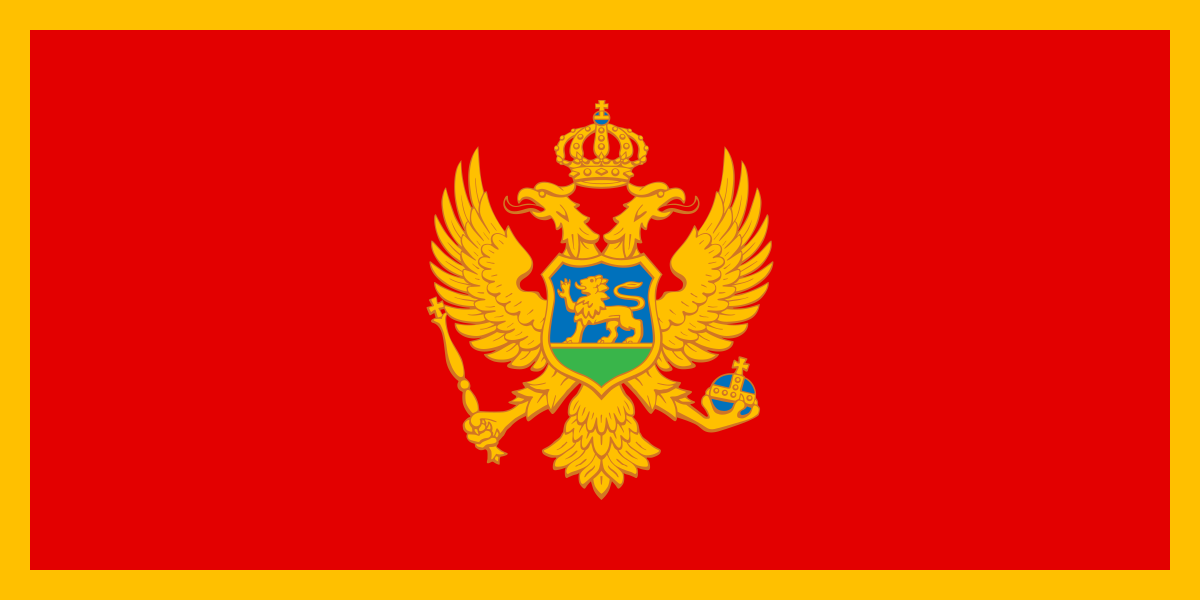
In these trying times of various crises, where our future is uncertain, spillover negative effects have the potential to create volatile environments and increase social, religious and cultural tensions. We, like all nations, need to work together to strengthen our common human heritage, reject violence and prevent conflict through solidarity, dialogue, tolerance and understanding, breaking away from the stereotypes and intolerances of the past. We welcome the report of the Secretary-General on “Interreligious and intercultural dialogue, understanding and cooperation for peace” (A/64/325), which highlights the activities carried out by the key United Nations bodies and other major regional and global initiatives in this field, as well as the recommendations contained therein.
The Alliance of Civilizations has been instrumental in engaging Governments, civil society and international organizations in advancing intercultural and interreligious dialogue and in countering division, polarization and extremism within and between societies. I would, therefore, like to express our sincere gratitude to Ambassador Apakan of Turkey and Ambassador Yáñez-Barnuevo of Spain and their respective countries for their continuing efforts to promote the goals of the Alliance.
In the space of four years, the Alliance has significantly increased its reach and scope and has achieved rapid progress in implementing its objectives. This clearly shows the strong and growing support and goodwill of many countries and partners in the promotion of peace, tolerance, mutual understanding and coexistence, leading to a better world. As an innovative and dynamic initiative, the Alliance has been very effective in fostering cross-cultural cooperation between religious, national and cultural communities. It has advanced its goals and shaped its agenda for the good governance of cultural diversity at the global level, as well as in introducing concrete projects, results-oriented policies and practical actions that deliver, as was demonstrated by the successful outcome of the Madrid and Istanbul Forums. It still remains a strong forum for an open, inclusive and global dialogue. We are sure that the third Forum, to be held in Brazil in 2010, will give the Alliance additional impetus.
Many members of the Group of Friends, including my own country, have taken it upon themselves to advance the goals of the Alliance through national strategies, focusing on tangible outcomes in the fields of education, youth, migration and the media. I would also like to highlight the importance of incorporating the Alliance into regional processes through the creation of regional strategies, where priority is given to cross-cultural polarization in relations between Muslim and Western societies. Regional strategies are an important tool designed to help countries facing similar challenges to create common opportunities to address them, to compare their approaches and share information about shortcomings, successes and lessons learned, as well as to boost regional initiatives and regional coordination. Bearing this in mind, we look forward to the approval of the regional strategy for South-East Europe during the conference to be held in Sarajevo in December.
Montenegro remains a very enthusiastic member of the Group of Friends and a proud co-sponsor of draft resolution A/64/L.14, introduced here yesterday. We strongly believe that the draft resolution will reinforce interaction and coordination of the Alliance with the United Nations system for a results-oriented approach, strengthening the initiative and furthering its objectives. We thus reiterate the hopes expressed by its main sponsors, Spain and Turkey, as well as other co-sponsors, that the draft resolution will be adopted by consensus and its purposes embraced by the entire membership.
In closing, I would like to once again confirm our readiness and commitment to continuing to work with the Alliance and other forums established to forward innovative ideas, initiatives and actions designed to develop peace through intercultural and interreligious cooperation and understanding.


My delegation would like to thank the President of the Assembly for his efforts in convening this important meeting on agenda item 49, “Culture of peace”.
Fostering a culture of peace, protecting human rights and the rule of law, and dialogue among cultures and peoples are essential to all effective strategies. It is clear that respect for international law and its principles is the only means to solve international conflicts and eliminate hotbeds of tension. While positive developments in information and communication technologies have improved the quality of life around that world, some extremist minorities within every cultural or religious group seek to take advantage of that progress to propagate hatred, racism and exclusion by way of such technology.
Under the aegis of the United Nations, we wish to strive to create a healthy atmosphere that promotes the values of dialogue, tolerance, moderation and a relationship of cooperation and peace among cultures, States and peoples. The increasing responsibility of the media to avoid stereotyped images and preconceived notions of others and to portray positive images of them instead will enhance dialogue among cultures and lead to positive results.
With those noble goals in mind, the King of Saudi Arabia has sincerely called for the promotion of dialogue among the religions and cultures that make up the international human family. Those initiatives have had two separate trajectories: political and cultural. At
the political level, a special Muslim summit was held in Mecca at which all participants were urged to reject violence, extremism and terrorism and instead propagate mutual respect, dialogue and tolerance. A high-level meeting was held at the United Nations in November 2008 aimed at offering the greatest possible political support to all initiatives to foster dialogue, understanding and a culture of peace.
The second trajectory is more cultural and social in nature. Muslim clerics and scholars of all religious stripes have met in Mecca to underscore the tolerant nature of Islam and its message of dialogue and peace. An international meeting on dialogue among civilizations was held in Madrid in July 2007, bringing together representatives of all major religions. Other efforts are under way to establish a world centre for dialogue among representatives of all major religions, free from all political influence and intervention.
The President took the Chair.
The Kingdom of Saudi Arabia wishes to express its deep concern regarding hatred, discrimination, intolerance and the persecution of any religious group or community. We have stressed the importance of dialogue, understanding and tolerance of others, whatever their religion, culture or beliefs. The history of our part of the world offers a shining example of peaceful coexistence, intermixing and communication among the three monotheistic religions, Islam, Judaism and Christianity. We seek today to perpetuate this history of peaceful coexistence through the United Nations, which brings together representatives of all of those religions, beliefs and cultures.
Our goal is to promote dialogue that underscores all the positive aspects of those religious cultures while rejecting their negative aspects, and to overcome all obstacles in the path of dialogue so we can reach our desired goals. We underscore the importance of not exploiting extremism and of avoiding clashes among cultures and civilizations. The King of Saudi Arabia has stressed on numerous occasions the importance of peaceful and positive coexistence in order to avoid a clash of cultures and to create avenues for understanding among peoples.
In closing, the propagation of a culture of peace and tolerance is a global effort to which we must all contribute. That would allow us to ensure peace for future generations, allowing them also to enjoy development, progress and cooperation.


My delegation would like to make a general statement on draft resolution A/64/L.14, entitled “The Alliance of Civilizations”. Japan appreciates the efforts and commitment of Spain and Turkey in presenting this concise draft resolution on the Alliance of Civilizations, which promotes greater understanding and respect among civilizations.
Japan attaches great importance to dialogue among civilizations, and for this reason supports the work of the Alliance of Civilizations. We hope that, in cooperation with other organizations working in the same field, the Alliance of Civilizations will produce concrete results. UNESCO has long been active in the field of intercultural dialogue. At the 181st session of UNESCO’s Executive Board in April, the High Representative of the Secretary-General for the Alliance of Civilizations, Mr. Sampaio, confirmed the importance of strengthening cooperation with the Alliance, and we welcome his statement.
We are also pleased that the new Director- General of UNESCO, Ms. Irina Bokova, will continue and strengthen her organization’s partnership with the Alliance of Civilizations, which was established by former Director-General Koichiro Matsuura. Indeed, Japan hopes that cooperation between UNESCO and the Alliance will yield even more in the way of tangible results.
From this perspective, Japan happily supports and joins the co-sponsorship of this draft resolution and hopes that it will be adopted by consensus.

I now call on the observer of the Holy See.
Archbishop Migliore (Holy See): At the outset, my delegation would like to congratulate the Secretary- General on his report (A/64/325) highlighting the activities carried out by key United Nations entities involved in the field of interreligious and intercultural dialogue.
The question of religion and the contribution of religions to peace and development has resurfaced in the United Nations in recent years because it has become urgent and inevitable in the opinion of the world. A century and a half ago, at the beginning of the industrial revolution, religion was described as the opium of the people. Today, in the context of globalization, it is increasingly regarded as the vitamin of the poor.
The unique contribution of religions and the dialogue and cooperation among them lies in their raison d’être, which is to serve the spiritual and transcendental dimension of human nature. They also tend to raise the human spirit, protect life, empower the weak, translate ideals into action, purify institutions, contribute to resolving economic and non-economic inequalities, inspire their leaders to go beyond the normal call of duty, and permit people to attain a fuller realization of their natural potential and traverse situations of conflict through reconciliation, peacebuilding processes and the healing of memories scarred by injustice.
It is well known that, throughout history, individuals and leaders have manipulated religions. Likewise, ideological and nationalistic movements have taken religious differences as an opportunity to garner support for their own causes. Recently, the manipulation and misuse of religion for political purposes have given rise to debates and deliberations at the United Nations on this theme, placing it in the context of human rights.
Indeed, the debate within the United Nations on the role of religions has continued for quite some time now and the need for a coherent vision of and appropriate approach to that phenomenon is deeply felt. My delegation would like to offer some considerations on the matter with a view to contributing to a suitable and effective interaction of religion and religions with the United Nations goals and activities.
Interreligious or interfaith dialogue aimed at investigating the theological and spiritual foundations of different religions in view of mutual understanding and cooperation is increasingly becoming an imperative, a conviction and an effective endeavour among many religions. I am pleased to call to mind the leadership taken by the Catholic Church some 40 years ago in reaching out to other religious traditions with the promulgation of the conciliar document “In Our Age”. Today, many Christian denominations and other religions are engaged in dialogue with programmes of their own, and in this way have continued to make progress towards greater understanding among each other.
In that regard, the Holy See has implemented a number of initiatives to promote dialogue among Christian denominations and with Jewish believers,
Buddhists and Hindus. The Pontifical Council for Interreligious Dialogue was set up more than 40 years ago and, more recently, an initiative that is the first of its kind was launched with the signing by 138 Muslim representatives of the document “A Common Word Between Us and You”. That engagement seeks to foster greater respect, understanding and cooperation among believers of various denominations, to encourage the study of religions, and to promote the creation of persons dedicated to dialogue. That type of theological and spiritual dialogue requires that it be conducted by and among believers and adopt a proper methodology. At the same time, it offers the indispensable premise and basis for the much broader culture of dialogue and cooperation that different academic, political, economic and international institutions have launched in past decades.
Recent social and political events have renewed the engagement of the United Nations in integrating its reflection and action on affirming a culture of respect, with a specific concern for interreligious understanding. The protagonists of that dialogue are Member States in their interaction with civil society. Their approach and methodology stem from the very mission and purpose of the United Nations.
However, keeping in mind the spirit and the words of the United Nations Charter, as well as core juridical instruments, it is safe to say that the specific and primary responsibility of the United Nations vis-à- vis religion is to debate, elucidate and help States to fully ensure, at all levels, the implementation of the right to religious freedom, as affirmed in the relevant United Nations documents, which includes full respect for and the promotion not only of the fundamental freedom of conscience, but also of the expression and practice of everybody’s religion, without restriction.
Indeed, the ultimate goal and achievement of the United Nations in pursuing interreligious understanding and cooperation is to be able to engage States, as well as all segments of human society, in recognizing, respecting and promoting the dignity and rights of every person and each community in the world.
We have heard the last speaker in the debate on this item.
Before proceeding further, I should like to inform members that, at the request of the sponsors, action on draft resolutions A/64/L.5 and A/64/L.15 will be taken at a later date, to be announced.
We shall now proceed to consider draft resolution A/64/L.13, entitled “Nelson Mandela International Day”. Finland, the Republic of Korea and Andorra have joined the list of sponsors.
May I take it that the Assembly decides to adopt draft resolution A/64/L.13?
Draft resolution A/64/L.13 was adopted (resolution 64/13).
Vote:
64/13
Consensus
We would like to pay tribute to what the great fighter Nelson Mandela has done for the freedom and dignity of humankind. We all know Mandela’s story; we know his struggle and that he was imprisoned for dozens of years. Today, by adopting the draft resolution honouring Nelson Mandela, we express our attachment to freedom and dignity and our appreciation for that great man, who has dedicated his life and suffered for the sake of all humankind. We would like to express our utmost appreciation and gratitude for that great man.
The General Assembly will now take action on draft resolution A/64/L.14, entitled “The Alliance of Civilizations”, as orally revised.
The following countries wish to add their names to the list of sponsors: Cameroon, Côte d’Ivoire, Hungary, Japan, Mozambique and the Sudan.
May I take it that it is the wish of the General Assembly to adopt draft resolution A/64/L.14, as orally revised?
Draft resolution A/64/L.14, as orally revised, was adopted (resolution 64/14).
We have thus concluded this stage of our consideration of agenda item 49.
The meeting rose at 12.20 p.m.