S/PV.1444 Security Council
▶ This meeting at a glance
21
Speeches
5
Countries
0
Resolutions
Topics
General statements and positions
Security Council deliberations
War and military aggression
Global economic relations
General debate rhetoric
Arab political groupings

The provisional agenda for this afternoon’s meeting is before the Council in document S/Agenda/1444. If I hear no objrction, I shall take it that the agenda is adopted.


Mr. President, yesterday, or, to be more exact, early this morning at the previous meeting of the Security Council, the Soviet delegation already set forth its views and expressed its opinion concerning the new draft resolution [S/8767] 1 which, on the initiative of certain delegations, was submitted by the representative of Canada.
3. After the detailed debate on the question of the so-called situation in Czechoslovakia, imposed on the Security Council contrary to all common sense, without any real need for it, and in contravention of the Charter and the rules of procedure, and after the failure of the attempt to impose a resolution on the Security Council, a new attempt is now being made to employ diversionary tactics and drag not only the Security Council, not only the United Nations Organization, but even the Secretary- General of the United Nations into this scheme which is being launched by certain Powers in connexion with the
events in Czechoslovakia.
4. Thus, an open, direct and cynical attempt is being made by the imperialists to impose on the Council the customary imperialist practice of using the United Nations as a
1 See 1443rd meeting, para. 293.
camouflage for the accomplishment of their hidden aims. That is what happened in the days when attempts were made, under the United Nations flag and under cover of the high authoritative name of this Organization-which was created to strengthen world peace and to guarantee the peace of all peoples-to achieve their imperialist aims, to perpetrate their bloody misdeeds in Korea, for example. Attempts were repeatedly made to use the United Nations and shelter behind its high authority, behind the United Nations Organization’s blue flag of peace in other cases as well. That is why the originators of the unsuccessful scheme have sought a new diversionary manoeuvre.
5. Having failed in the Security Council, the representatives of the Western countries are now engaging in a new provocatory action essentially designed to achieve the same ends. There’s no doubt about it, this action is detrimental to the cause of peace and international security, and is directed against the interests of Czechoslovakia, of the Czechoslovak people, and against the countries and peoples of the whole socialist community.
6. The imperialist Powers and their monopolistic propaganda organs have decided to take advantage of the temporary situation in and around Czechoslovakia for their own nefarious ends. They decided to act on the principle: if they have thrown us out of the door, maybe we can sneak back through the window. This, as is well known, is a method characteristic of people of a very specific category. And those are the methods they have decided to use in this case,
7. As a result of such tactics a new draft resolution has emerged, submitted by the representative of Canada behind whom-there’s no doubt about it, everybody knows it, it is no secret-we can clearly perceive the aims of the United States representative first and foremost, while further in the background also looms the shadow of the representative of the United Kingdom.
8. Although the wording of this draft is different from that of the draft resolution presented previously which was rejected by the Council, nevertheless this draft is in essence derived from the same aims hostile to the socialist camp and to the peoples of the socialist countries. It is based on the same slanderous inventions, misrepresenting the true situation in Czechoslovakia. This draft resolution constitutes a new attempt by the imperialist Powers to interfere in the internal affairs of Czechos!ovakia and in the common affairs of the countries of the socialist community which are both able and in a position to settle any problem arising in their mutual relations within the framework of the friendly fraternal co-operation of the socialist countries.
10. Obviously, according to established practice and the rules of procedure, after the rejection this very day, 23 August, of the above-mentioned draft resolution hastily concocted by the Anglo-Americans, it is impossible to put to the vote any new draft on the same question-a draft which they are trying to justify by the same unsubstantial arguments as those previously rejected by the Security Council. The essence of the matter and the aims of the sponsors of these proposals are not altered in the least just because the sponsors of the draft act in a way described in the well-known Russian proverb: “Pour the same soup, but a bit thinner”.
11. The Soviet delegation, on instruction from the Soviet Government, has declared repeatedly in this Council that the Soviet Union has considered and continues to consider the discussion of the question imposed on the Security Council and inscribed on the agenda earlier as unjustified, wholly without foundation, and contrary to the Charter of the United Nations. Consequently, not a single Article, not a single Chapter of the Charter of the United Nations provides any basis for consideration of this question, and this was essentially confirmed by last night’s meeting.
12. The new diversionary attempt which is being made is just as contrary to the United Nations Charter as was the draft submitted by the United States and some other countries and which was rejected at last night’s meeting. This time, a new attempt is being made to impose a decision on the Council at any price; a decision which, apart from anything else, is designed, in violation of the Charter, to deprive the socialist countries of the possibility of-or rather, to hinder the socialist countries from-settling the problems which have arisen among them in a calm and peaceful atmosphere.
13. In the light of all these considerations set forth in the brief statements of the Soviet delegation yesterday and reiterated today, the Soviet delegation sees no basis for discussing this matter in the Security Council, and it addresses an appeal to the President of the Counci! requesting that this opinion and view of the Soviet delegation be taken into account.
I wish to clarify the procedural situation. I thought that the provisional agenda was before
Point of order.
I call on the representative of the Soviet Union on a point of order.
But who suggested that tile question be settled by a vote, Mr. President?
Before calling on the representative of the United States, I should like to draw attention to the procedural situation as I see it. When a document is before us, and when I say, “if I hear no objection I shall t&e it that the document is adopted” and then I hear a objection, the only way for the President to proceed normally, unless the objection is withdrawn, is to proceed to a vote. I see no other way of settling the situation,


I see no reasell why we should play the same bad comedy every other night. We had this problem before us, I think, two ni@ ago. The Soviet Union objected to the inscription of certain items on the agenda, and then, when it come to the question whether the Council should express its will on tile inscription of those items, the Soviet Union took the position that it did not want to vote.
20. Now, I see no alternative except the one you have expressed, Mr. President; and to clarify the procedural situation I make a formal motion that, since we have heard an objection from the Soviet representative, this matter of the adoption of the agenda should now be put to a vote.
Before proceeding to the vote, 1 call on the representative of the Soviet Union.
Mr. President, during the debate on the question, imposed on the Council by the delegations of the United States and the United Kingdom, we have already been repeatedly convinced that the most absurd comedies were being performed here by the American representative. He is the one who has bee11 the leading comedian here. So much for comedies.
23. As for the substance of the matter, I did not conclude my remarks by a formal proposal for a vote; consequently, I did not insist on a vote, nor make a proposal for one. Therefore, it seems, Mr. President, that you did not exactly understand my objections. I object in principle to a discussion of this question, but I do not propose that it be put to a vote.
24. Mr. American delegate, your impatience is utterly incomprehensible. Yesterday you lost your patience; but al least keep it today.
26. Therefore, I stress once again that I do not insist on a vote, I do not propose a vote, and I see no grounds for the American delegate again to show his impatience, his particular fondness for voting, and for insisting on voting. Unless a proposal is introduced not to inscribe the question on the agenda, there is no reason to vote.
27. Mr, BALL (United States of America): Let me say first that I do have a great fondness for votes. We have a democratic tradition in this country, and I can well understand the allergy which my Soviet colleague feels for the resort to democratic processes.
28. On the matter of procedure I think the situation is this-if I may make a suggestion to you, Mr.President. There has been an objection, The normal way to resolve an objection is to have an expression of view by the Council. If the Soviet representative does not wish to have an expression of view by the Council on his objection, then he should withdraw his objection, I think it is as simple as that.
I should like to state that I agree with the representative of the Soviet Union to the extent that in some cases, although objections have been raised, representatives have stated that they do not press for a vote. But in those cases it is obvious that the representatives do not insist on their objections. We could proceed that way if there is a general agreement. However, a motion has been proposed by the representative of the United States that we vote on the agenda. If the representative of the United States drops his motion and agrees that we should proceed without a vote, with the understanding that the representative of the Soviet Union does not press for a vote,
we could consider the agenda as adopted.
30. I shall thus again state that if I hear no objection I shall take it that the agenda is adopted,
3 1. Mr. TARDOS (Hungary): I feel that my knowledge of procedure is considerably less than yours, Mr.President. But I feel that there is a slight disagreement between US now.
32. It seems to me that someone may have an objection in principle to the discussion of a matter but that, at the same time, it may not be necessary to insist on a vote-on the
34. As I hear no objection, the agenda is adopted.
The agenda was adopted.
Letter dated 21 August 1966 from the representatives of Canada, Denmark, France, Paraguay, the United Kingdom of Great Britain and Northern Ireland and the United States of America addressed to the President of the Security Council (S/6758)
In accordance with the decision previously taken by the Security Council, I now propose, if there is no objection, to invite the representatives of Czechoslovakia, Bulgaria and Poland to take seats at the Council table.
At the invitation of the President, Mr. M. Tarabanov, (Bulgaria) and Mr. L. Kasprzyk (Poland) took places at the Council table.
In addition, I should like to inform the members of the Security Council that I received a letter a short time ago from the Deputy Permanent Representative of Yugoslavia, which reads as follows:
“Upon instructions from my Government, I have the honour to inform you that in accordance with Article 31 of the Charter, I should like to participate in the debate on the question now before the Security Council.
“(Signed) Zivojin JAZIC “Deputy Permanent Representative”
37. In view of the contents of this letter I propose now, if I hear no objection, to invite the representative of Yugoslavia to take a seat at the council table, in order to participate without vote in the discussion.
At the invitation of the President, Afr. 2. Jazic, (Yugoslavia) took a place at the Council table.
The Security Council will now continue its consideration of the question before it. Before I give the floor to the first speaker on my list, I should like to draw attention to document S/8767, a draft resolution submitted at the last meeting by the delegations of Brazil, Canada, Denmark, France, Paraguay, Senegal, the United Kingdom and the United States.
39. The first speaker on my list is the representative of Canada.


In the early hours of this day I had the honour to introduce a draft resolution,
41. As I explained at that time, members of this Council cannot help but be concerned about the fate of acknowledged leaders of the Czechoslovak Socialist Republic. In the light of the armed invasion of Czechoslovakia by the Soviet Union and some of its Warsaw Pact allies, this proposal is essentially a humanitarian one and, as I said earlier today, it represents the minimum the Council can do in the light of the blocking of more substantive action by the Soviet Union through the use of its veto.
42. Mr. President, as you rightly noted in referring to this draft resolution, which is now being distributed, it is tabled on behalf of eight Member States, who are acting in this case with the utmost seriousness and determination to have some positive action taken by this Council if at all possible.
43, The representative of the Soviet Union, Ambassador Malik, unfortunately immediately took exception to this straightforward, uncomplicated, humanitarian proposal, putting the whole issue to the Council in the context of a “dirty game”, charges which he repeated today with further, I may say, embellishments. He went on to describe me as “the main spokesman and representative of Anglo- American circles” [1443rd meeting, para. 31OJ. This may have been intended as a compliment, or it may not have been, but whatever it is I want to make it quite clear that it is not accurate.
44. I am very proud of the fact that 1 was authorized and requested by representatives from four continents-not the very narrow Anglo-American group, but the four continents-to introduce the draft resolution now circulated in the document to which I have referred. It must be recognized that the overwhelming weight of world opinion does not accept the Soviet version of events in Czechoslovakia in the last three days.
45. Now I have no intention of following the representative of the Soviet Union, whose personal qualities I greatly respect, in an exchange of incivilities and accusations in which he has tried to characterize as an “illegal” intervention the legitimate interest of members of this Council in the intervention undertaken by the Soviet Union and some of its allies in the internal affairs of Czechoslovakia. I shall let the records of the Council speak for themselves in answer to this contention by our Soviet colleague.
46. I will only say this, however, as regards the Canadian position. First, we have scrupulously avoided any interference of any kind in any aspect of the developments in Czechoslovakia. Second, we have no interest in promoting unrest in Central Europe or anywhere else by efforts to influence the type of government which may exist there. What is at issue here is not whether Czechoslovakia should be a communist State. The issue has been, and continues to be, the inadmissibility under the Charter of intervention in the internal affairs of any State by any other State. Third,
I understand that the representative of Hungary has asked for the floor to speak on a point of order, and I call on him for that purpose.


My point of order is prompted by the statement of the representative of Canada, He emphasized to us at great length the humanitarian character of the proposal before the Council. He is one of the co-sponsors who introduced this draft resolution; therefore, we have to take at face value the characterization given by the co-sponsors, and it seems to me that to deal with humanitarian questions the United Nations has some
other Councils and bodies and, therefore, that this proposal would belong to them and not to the Security Council.
50. Mr. BERARD (France) (translated from BenchJ: 1 should like to explain briefly the position of my delegation,
51. Nothing, in fact, has happened as yet to calm the feelings of international opinion, shared by our Govern. ments, at the announcement of the arrest by the foreign military forces which have invaded and are occapyisg Czechoslovakia, of Mr. Dubcek, the First Secretary of tire Czechoslovak Communist party, Mr. Cernik, and several other political personalities and senior public officials of that country, We still have no news of these officials. Sonic press agency reports suggest they may have been taken by force to an unknown destination; others have stated that they have been molested. In any case, it seems they are sot free either to communicate with their countrymen, or to travel, nor to carry out their official duties.
52. We would be the first to rejoice greatly if it could be established beyond question that this information is iacor. rect. In the meantime, internatibnal opinion remains deeply troubled concerning the fate of these persons. That is why the French delegation has joined the co-sponsors of the draft resolution asking the Secretary-General to send a special representative to Prague immediately with a mission to seek the release and ensure the safety of these Czechoslovak public figures.
53. Such a measure, the essentially humanitarian aspect of which, I may say in turn, needs no emphasis, is justified by a situation we cannot disregard. Therefore the French delegation hopes that the draft resolution before US will
receive the widest possible support from the members of the Council.
55. The Council, as a result of the negative vote of the Soviet Union, could not adopt the draft resolution presented to this Council yesterday by eight countries from Africa, North America, Latin America and Europe. That draft resolution applied to the political situation arising from the illegal occupation of Czechoslovakia by forces of the Soviet Union and certain of its allies in the Warsaw Pact. In the circumstances, my delegation considered that the next step must be an effort to have the Council pronounce itself on the humanitarian aspects of the intervention in the internal affairs of Czechoslovakia. I refer, first and foremost, to the arrest of leading personalities in the lawful Czechoslovak leadership which clearly enjoys the support and confidence of the overwhelming part of the people of that country.
56. It was therefore not only with pleasure but as a matter of necessity that my delegation joined the group of sponsors of the draft resolution introduced this morning. This draft resolution is, indeed, very brief and certainly directed to the point. It really needs no belabouring.
57. I must say that I have listened with regret to the first reactions to this draft resolution by the representative of the Soviet Union, I do not want to engage in any way in polemics, but I must say I find it very difficult to communicate on a matter of this sort, I, however, leave it with confidence to the judgement of all those who listen to what intervention is-your invasion of Czechoslovakia or our request to the Secretary-General to dispatch to Prague a special representative to seek the release and ensure the personal safety of the leaders under detention.
58. At this stage I think it is absolutely essential for the Council that we act with a sense of urgency and efficiency, and that we adopt the draft resolution before us as soon as possible and with as broad a support as possible. In this respect, may I express the hope that it will find an even broader support than the draft resolution of this morning,
SO that others may lend their invaluable support to the defence of the elementary rights and interests of the true representatives.
59. Lij Endalkachew MAKONNEN (Ethiopia): AS the Council prepares to consider yet another proposal regarding the grave matter under consideration, I ask for your indulgence, Mr.President, and that of my colleagues to restate and explain our basic approach to and position on this grave issue of the situation in Czechoslovakia. I do this because I sense the emergence of all sorts of interpretations and insinuations which have tended to ascribe to the actions of one or another of us significances or motives which are both incorrect and irrelevant.
60. Attempts have been made, for instance, to characterize and categorize the actions of some of US as having been dictated by considerations other than the earnest desire to uphold the principles of the Charter, thereby defending the right to independence and territorial integrity
62. During our debate on this item, repeated references have been made to the cold war and to the existence of military blocs, an existence which is itself but the direct and inevitable consequence of the former development. It is needless for me to say that Ethiopia has had nothing to do with these unfortunate developments of the post-war era. On the contrary, Ethiopia finds itself in the forefront of that group of countries which has rightly and justifiably come to assume the name of non-aligned, a group which has deliberately kept itself out of involvements and commitments of all military pacts. We have refused to recognize the division of the world into spheres of influence, zones of interest or military camps, because we feel that such policies are based on out-dated concepts of power politics, which we consider ngt to be in keeping with the universal spirit and collective responsibility of the United Nations Charter and with the mortal dangers of our atomic age.
63. And so, whenever and wherever a crisis faces the world, we endeavour to look at it through the perspective of the United Nations Charter when we try carefully to examine and scrutinize it, making United Nations principles and the cause of world peace our sole inspiration and guideline. This, I repeat, is the consideration and preoccupation that has guided and that will always continue to guide our policy on all matters and problems that, in our view, affect international peace and security.
64. Turning now to the draft resolution submitted by eight delegations, and contained in document S/8767, first of all, I wish to say that my delegation has full confidence and faith in the Secretary-General and fully recognizes the value of his peace-meking role in all situations of world difficulty and crisis. The unique position of his office, coupled with the respect and acceptability that he enjoys within the community of nations, gives to the Secretary- General and to the high office which he so ably occupies a special standing and importance in playing a unique role in the essential process of the peaceful settlement of international disputes.
65. On the other hand, we cannot fail to realize that, for the Secretary-General’s efforts to be at all effective and successful, the special mission we entrust to him, and through him to his special representatives, must enjoy the widest possible, if not the unanimous, support of the membership of the Security Council. To entrust the Secretary-General with a mission based on controversy and divided counsel would amount to putting him in the
The controlling interest of the Security Council tonight must necessarily be the freedom and welfare of the people of Czechoslovakia, and in the press which we have all been reading so avidly there are indications of negotiations that are now going on between some representatives of the Government of Czechoslovakia and the Government of the Soviet Union. There is a suggestion that out of these negotiations may come some agreement, and if it should be that the Soviet Union, particularly when it is confronted, as it has been, with a very overwhelming expression of world public opinion, has second thoughts about the action it has taken, second thoughts which would permit it to come to an understanding with the Government of Czechoslovakia, so that the people of that beleaguered country were able to salvage the freedom to live their own lives, to organize the political arrangements of their own choosing-then obviously this Council should do nothing to interfere with that hopeful and commendable process.
68. But we cannot be at all sure that that is going to happen. In fact I would suggest that the prognosis based on experience is not very encouraging, and meanwhile we must all feel a deep and honest concern for the brave men who, in defence of freedom, of decency, of their country’s honour, are defying the tanks and the troops-including, I may say, those of the East German military who are invading Czechoslovakia again, this time as agents of their ancient Russian enemy. We must in all conscience feel concern for these men, for their fate and for their future, for there is a history and logic to give us that deep concern.
69. Last night, during the long and, if I may say so, squalid interval when the Soviet representative was seeking ‘by the sheer lever of his own extraordinary verbosity to hold back the solemn condemnation of this Council, he disclosed many things-many things, that I suspect, he did not intend to disclose: among them was the conception which he holds, and which I think it is fair to assume his Government holds, of what the world is, the nature of the cosmos in which we live. What came through crystal clear was that the Soviet representative and his Government dwell in a strange land of dim lights and dark shadows which bears only a distant relationship to the reality with which the rest of us are familiar. For the dark forest of the Soviet night is apparently filled with strange and grotesque figures quite unrecognizable to men who live in freedom. These are not figures, I may say, drawn from Russian
70. But I found a quite different theme in what the SoGe representative had to say last night; it is a theme not 0 realism but of fantasy, for he conjured up two prlncipa fantasy figures. First was the imperialist, an obsessive figltn who stalks through prose of the Soviet representstivf montonously, rearing his head every sentence or two, ~hal is this strange shadow figure? As far as I have been able 10 perceive, an imperialist, quite clearly, is anyone the Sovig[ Union does not like-anyone with a mind of his OWB, anyone with a will of his own. There is also a second fantasy figure-the counter-revolutionary. Now, who is the counter-revolutionary? Well, quite obviously he is anyone who gets in the way of the Soviet Union’s aggressive designs.
71. The dreams of the Soviet representative are rich arld vivid. They are filled with variegated figures that never existed on land or sea, and all of this would not be very serious if it remained only in the realm of fantasy and fiction, of dreams and talk. But there is much more to it than that. For the Soviet Union has begun to apply these epithets to the legitimate leaders of the Czechoslovak Government, and to talk as though the leadership of thal Government were peopled by grotesques of this kind. Thus the matter is serious, for history has shown that when the Soviet Union has denounced individuals subject to its physical power as imperialists or counter-revolutionarier, those individuals have all too often disappeared.
72. Stalinist terror, we are told, has vanished long ago, Yet even now when the Soviet Union speaks of certain Czechoslovak leaders as counter revolutionaries one cannot help but be deeply concerned. And this concern is given foundation and reality by the shocking information which has come from many presumably authoritative sources that several of the leading members of the Czechoslovak Government have been arrested-“detained” is the nicer word. A day or two ago, I think it was on Wednesday, the representative of the United Kingdom addressed some questions to the representative of the Soviet Union [1442nd meeting/, and he asked specifically for information as to the fate and welfare of certain individuals. He asked specifically, as I recall, for assurances that those individuals would not be harmed and that their freedom would not be taken away from them [ibid., para. 131, but we have had no answers, we have had no reply, and that obviously only deepens the concern we all feel.
73. I hope that I have confused vocabulary with intention; I hope that I have not over-emphasized these visions which have been conjured up and which have a certain historica! background which gives them a rather terrifying credence. But I think that we who have the responsibilities aS members of the Security Council are obligated now to do everything possible to assure the welfare of these leaders of the Czechoslovak Government whose only fault is that &t’Y did stand for freedom when freedom was being taken aWaY from their people.
8 5. Mr. MALIK (Union of Soviet Socialist Republics) (translated from Russian): Mr. President, yesterday and at the beginning of today’s meeting the Soviet delegation expressed its point of view, its opinion and its position concerning this new scheme by the sponsors of the draft resolution to drag this question into the Security Council, and showed that, after failing in their first scheme, they will stop at nothing, but have shifted to a new line of action and are attempting to apply new diversionary tactics. This is a secondary tactic and methods as unworthy as the previous one are being employed.
76. In the statement that he has just completed Mr. Ball declared the real intentions of the sponsors of this new action with utmost clarity. He presents himself here in the role of a protector concerned with the freedom and welfare of the Czechoslovak people. But who believes this?, He himself announced during the previous discussion that he is an enemy of socialism and communism. The Czechoslovak people, who have chosen the socialist form of development, have no need of the care and protection of the representative of American monopoly capital who is accustomed to dictate, command, exploit and pillage, and who presents all that as freedom, Instead of hypocritically talking about concern over the Czechoslovak people, Mr. Ball ought to show concern in other directions, The peoples of the socialist countries will take care of themselves; they do not need the representatives of monopoly capital to look after them. Such concern is a rope around the neck.
77. Mr. Ball has tried to present matters here as thou& anything the Soviet Union does not like is imperialism. But Mr. Ball has really gone too far here in his inventions. Mr. Ball, it seems you have a public opinion research poll system: Gallup, Harris and a number of others. Take a poll. Put the question not only to your citizens, but to everybody present here: who likes imperialism? It’s a short question: three words. Do you really think that only the representative of the Soviet Union will give a negative response to this question? I am profoundly convinced, Mr. Ball-you, representative of the large-scale finance capital of the United States-that a negative reply to this question will be given by the representative of Algeria, the representative of Burma, all the representatives of the Arab countries, all the representatives of the Asian countries, and all the representatives of the Latin American countries. The
79. And we are proud that any patriot of any country in all the earth’s continents who fights for freedom and independence against imperialism, against imperialist aggression and intervention is called a communist by imperialist propaganda. Your propaganda, the Pentagon, and all who are waging the bloody war of aggression in Viet-Nam call the entire Viet-Namese people communists; those people who are courageously defending the freedom ,and independence of their homeland, who wish to be free and sovereign, you call them all communists. It is not so. Naturally, not all the hundreds and thousands of killed and wounded heroic Viet.Namese patriots, all those fighters for the interests of their homeland, its freedom, its honour, its dignity and its independence are communists. But they are all patriots. All of them cherish the interests of their people. Your newspapers, your communiques call them all communists, all of them without exception. We, as communists, are proud of this. It means that, according to YOU, as representatives of imperialist powers, anybody who fights by any means whatever against imperialism is a communist. All honour and glory to these patriots, even though they are not communists. We are always on their side in heart, in soul and mind and with something more substantial as well. You’re feeling that in Viet-Nam.
80. You cast doubt on the announcement about the counter-revolutionary forces discovered in Czechoslovakia. I am sorry that in view of’ the lateness of the hour yesterday, that is, during last night’s meeting, you evidently got tired and left the meeting, and in any case you left this chamber when I was naming names and giving specific facts about these counter-revolutionaries; when, giving concrete names and facts, I showed the ties of these countcrrevolutionaries with your Central Ihtelhgence Agency and with the British intelligence services. You did not hear this. I do not want to hold us up and take the time of the members of the Council to repeat it. I suggest you read the record, especially this part of my statement, and you will
81. Citing the clandestine radio transmitters which disseminate insinuations, slander and falsehoods from Czechoslovakia, you try to spread hostile versions of the situation in Czechoslovakia and about the socialist countries of Eastern Europe. We have official information that the President of Czechoslovakia is in Moscow at present with a large group of Czechoslovak ministers and is holding talks with the Soviet Government about the settlement of the problems which have arisen. And this will be accomplished without your interference, Mr. Ball, and without the interference of your Government. The less you interfere in this business, the less you try to exploit the Czecho- Slovak question to the hilt in your imperialist interests-to cover up the bloody aggression in Viet-Nam, to cover up the terror and cruelties being adopted by the aggressor towards the Arab population on Arab territories enslaved by a foreign aggressor who is an occupier, to divert attention from the hostility and hatred towards Cuba being spread daily in your country, to cover up the misdeeds of the Cuban reactionaries in your own country from which not only Cuban patriots and revolutionaries, but many foreign missions in your country and particularly in New York, are beginning to suffer as evidenced by the fact that more than ten foreign missions have suffered damage by explosives in New York City itself, where the international organization, the United Nations, has its headquarters-the less you do all this, the better it will be for all peoples. And you are not even in a position to handle this rabble of the Cuban counter-revolution, They are the ones you like. You wine them, dine them, clothe them, equip them, protect them and afford them freedom of action. Can the American police and its secret organizations possibly be so helpless, so impotent that they can’t handle that gang of bandits, of counter-revolutionaries?
82. You asked: what is counter-revolution? Well, this is concrete counter-revolution, which you nourish, which commits misdeeds not only against Cuban patriots, against the Republic of Cuba, and prepares subversion with your protection, but which also disturbs the normal life and work of foreign representatives in your country. The same kind of counter-revolutionaries also appeared in the 231 Club in Czechoslovakia, in the heart of the country, in the capital, linked to British and American intelligence and performing tasks aimed at undermining the socialist system and designed to return Czechoslovakia and its people once more to the fold of capitalism and imperialism.
83. Of course, we understand your nervousness, and you showed it here at this table, especially yesterday. But this matter does not depend on you. The peoples of the socialist countries, as I said earlier, will manage their own affairs without the interference of imperialists and monopolists. You said you would like to sleep soundly. Go right ahead, sleep in peace. Nobody is touching you, nothing is threatening you provided you do not meddle in other
85. Therefore everybody can understand the aims of both the first action and of that first resolution submitted by you, Mr. Ignatieff. The intent and aims of the second resolution are just the same. True, it is milder, more flexible and in a more covert form. But, no matter how you may explain the lofty, noble, supposedly humanitarian aims of this draft resolution, the substance is the same, The substance of the resolution is interference in the &echo. Slovak question, contrary to the interests of the peoples of this country, contrary to the common interests of the peoples of all the socialist countries and the socialist commuriity.
86. Mr. Ignatieff, you mentioned polemics which have taken quite a sharp form here, at this table. But who started this? The co-sponsors of your draft resolution, Mr. Ball and Lord Caradon. In the last few days they have brought into the Security Council, as I have already had the honour to point out, the evil stench of the worst days, the very coldest days of the cold war. The initiative they took was such that, naturally, neither the Soviet delegation nor the delegations of the other socialist countries could ignore this slander, insinuation, these attacks, these coarse epithets which aroused legitimate protests against the American representative from the representative of Hungary, the representative of Poland, and from many others. So much for polemics.
87. Mr. Ball, speaking here and losing all sense of proportion, spared no epithets, no slanderous inventions against the socialist countries and their peoples. Therefore we could but answer him in kind. And if he continues that practice here, he shall always receive a fitting rebuttal.
88. The representative of Denmark stressed, practically as his main argument, that the draft is brief. But a lot can be said even in a brief phrase. I apologize for making a personal reference, but I recently had a medical check-up with a highly experienced American doctor. After all the tortures to which he subjected me in order to determine the state of my health, he said: “Mr. Ambassador, I’ll tell You briefly: you are a very healthy person.” “Doctor”, I replied, “you have said a whole lot.” Therefore, both ia s
94. To suggest that there is an animus or an ill will directed against the Soviet Union is a travesty of the truth; and, indeed, when we speak of the tragedy we think of the tragedy for Czechoslovakia, certainly, and the tragedy for Europe. But we are, all of us, concerned primarily perhaps at the tragedy that the effort which appeared to be making such progress in the world, of better understanding between East and West, has been driven back by the evil action which is now being taken. And this is no concern only of members of this Council; this is a concern of people throughout the world. Rightly so: it is not only for the Soviet Union to be concerned with Czechoslovakia; we all have a right to be concerned for the progress of freedom and for the right of the duly selected leaders of any people to continue to act and to speak and to work in the .posts for which they have been chosen.
89. Lord CARADON (United Kingdom): I had not thought it necessary to speak in support of the draft resolution of which my delegation is a co-sponsor, The draft has been ably presented, well supported, and easily understood. I can imagine that the representative of the Soviet Union, who has no affection for brevity, should feel uneasy about the clarity and simplicity of the language which is there set out. But it did not seem to be necessary to speak further to such a simple proposition, particularly because I had spoken before-yesterday-on this particular subject.
90. I want to appeal to the representative of the Soviet Union to be ready to believe that we are serious in this matter. I would hope that he would come to understand that we-all of us, I think-feel deeply on the question which has been raised. I would remind him of the questions I put to him yesterday morning. They were very simple and very short. I said then: “Let Ambassador Malik tell us now that the President and the First Secretary of the Communist Party, and other acknowledged leaders of Czechoslovakia are free and safe. Let Ambassador Malik confirm that they will not be arrested and will not be molested. Let him confirm that they will be permitted to continue to speak and work for their people ” [1442nd meeting, paru. 131.
95. We are about what we put to him; we are serious in what we put forward. We asked a simple question, and we hoped to get a straight reply. but what did we get? I am sorry to have to say that we have got nothing but contemptuous personal insult and contempt for his colleagues and contempt for the majority and contempt for the democratic process.
96. But it is not too late, knowing the personality of the representative of the Soviet Union-it is not too late for him to consider the matter again in a new light. He can desist from fighting shadows. I would again appeal to him: we wish to have an answer to the questions; we shall not be content unti1 we get an answer. The purpose of the draft resolution is to get an answer to the questions I put yesterday morning. Would it not be possible that the representative of the Soviet Union, instead of searching the vocabulary for new adjectives of insult, would be prepared to consult with us-a serious consultation; a genuine consultation-in order to give us some satisfaction, if he will pay us the compliment of believing that we are concerned, as he is concerned, as we both are concerned in the matter that we raise? I can only speak for myself, but if there were a readiness to consult together to achieve an honourable answer to the question we have put, I should be the first to recommend it to my co-sponsors. And I would also say that if he would respond to such an appeal, then I believe he would be not only serving the best interests of the people of Czechoslovakia, and indeed of his OWII Government, but also the best interests of the United Nations.
9 1. We have had no reply. Had there been a reply, even a very short reply, to the questions which I asked yesterday morning, there would have been no need for this draft resolution, and no need for this debate. The shortest speech that the representative of the Soviet Union has ever made would have been sufficient. If he could have said “Yes” to the questions I put to him yesterday, then all of us would have been content. And ,I would ask him again to believe that we mean what WC say. We care about political arrest; we care about political internment; and we care about political duress.
92. I would ask him to believe that there are many of us who believe that there is nothing so contemptible as political persecution. I would ask him to believe, too, if he will, that there is no trick in this; there is no plot in this; there is no diversionary tactic, as he suggests; there is no ill-will; there is no animosity.
93.. I would wish to remind him that during the time since his return to the United Nations, and before that, in the time of his predecessor, in this Council, and in particular in the relationships between my country and his, representatives of my country have worked tirelessly and persistent- Iy in order that there should be a better understanding and a better co-operation between East and West. I paid tribute to the personal qualities which he has brought to that task. I remember that it was not so very long ago that he and I,
97. If it could be seen that the representative of the Soviet Union; in a spirit of mutual respect and co-operation, was willing to consult with his fellow members of this Counc&all of us have the right to speak, and we are not going to be intimidated by the classifications which he applies-if it could be seen in the world that he was ready to consult on the dimple and direct and genuine questions which have been put to him in the determination to find an answer which satisfies the opinion and conscience of the world,
99. In putting those questions to him again, and in asking him to reflect on what I have said and to realize that I say it not in any spirit of ill will but in a spirit of hope that we can resume before long, God willing, the effort to agree between East and West, on which the future of the world depends, I believe that if we can both approach these simple questions in that spirit, then we can be of some genuine service to our countries and to this Organization.
I now call on the representative of Yugoslavia.

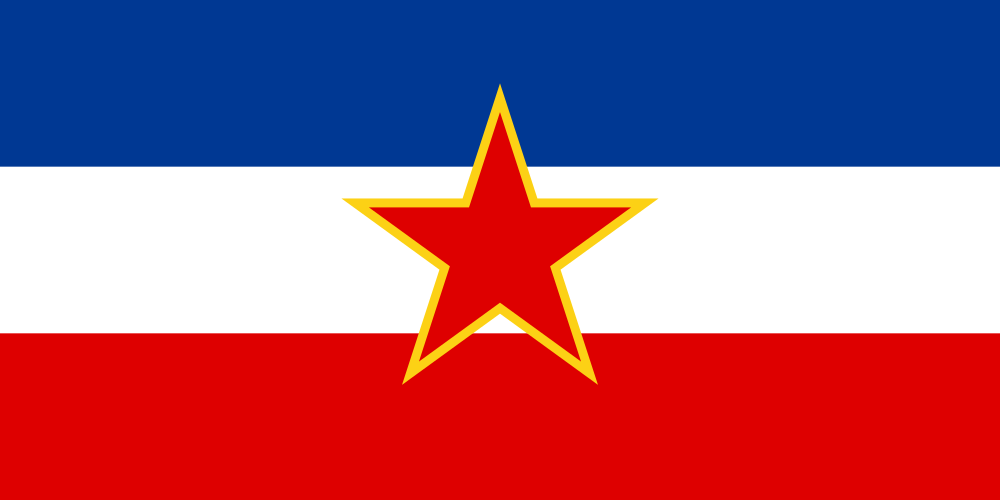
First of all, I should like to express the gratitude of my delegation to you, Mr. President, and to the members of the Council for enabling me to participate in the deliberations of the Security Council.
102. The Government of the Socialist Federal Republic of Yugoslavia issued, on 22 August 1968, a statement concerning the situation in the Czechosltivak Socialist Republic, which reads as follows:
“The Federal Executive Council expresses its grave concern over the illegal entry of the armed forces of the Union of Soviet Socialist Republics, the Polish People’s Republic, the German Democratic Republic, the Hungar ian People’s Republic and the People’s Republic of Bulgaria into the Czechoslovak Socialist Republic and condemns the occupation of its territory,
“The armed intervention by the aforementioned countries, which has taken place without invitation and against the will of the Government and other constitutional organs of the Czechoslovak Socialist Republic, constitutes a gross violation of the sovereignty and territorial integrity of an independent cpuntry, as well as a direct denial of generally recognized principles of international law and the Charter of the United Nations.
“The Government of the Socialist Federal Republic of Yugoslavia is of the opinion that no State, or a group of States, has the right to decide the fate of another country
“The Governments of those countries that are taking part in the military intervention against the Czechoslovak Socialist Republic are assuming the full responsibility for the far-reaching consequences of their actions. The armed intervention agamst the Czechoslovak Socialist Republic constitutes a diiect encouragement of the policy bf force, of aggression and of dangerous practice of continuous interference in the internal affairs and unhampered development of other countries. The negative conse. quences will not only affect the Czechoslovak Socialist Republic, but also the interests and relations of other countries, their internal security and stability of peace in Europe and in the world.
“Expressing its full solidarity-in these grave moments-with the people of Czechoslovakia, the Government and other constitutionally and legally elected leading forums of the country, the Government of the Socialist Federal Republic of Yugoslavia, extends its full support to the demands of these legitimate representatives of the Czechoslovak Socialis; Republic, for the withdrawal of the occupation forces for the respect of independence and territorial integrity of the Czecho- Slovak Socialist Republic, for the respect of the sovereignly expressed will of the people of Czechnslovakia and for making possible the normal functioning of the constitutional bodies and political forums of the Czechoslovak Socialist Republic.
“The Government of the Socialist Federal Republic of Yugoslavia addresses itself to the Governments of the Union of Soviet Socialist Republics, the Polish People’s Republic, the German Democratic Republic, the Hun. garian People’s Republic and the People’s Republic of Bulgaria, in the expectation that they shall undertake urgent measures so as to end, without delay, the occupation of the Czechoslovak Socialist Republic.” [S/8765./ =
103. Mr. President, you were kihd enough to circulate the statement of the Yugoslav Government to the members 0f the Security Council. Therefore, its contents are known.
104. Now, with your permission, I should like to add some further comments to explain the Yugoslav position concerning the situation that has been created with the illegal entry of foreign armed forces into the Czechoslovak Socialist Republic,
106. With the intention of influencing the course of development in the Czechoslovak Socialist Republic, the armed forces of the five countries are attempting to deprive the people, the Government, and other constitutional bodies of the Czechoslovak Socialist Republic of the inalienable right sovereignly to decide the course of their development. The armed intervention against Czechoslovakia and the occupation of its territory have once again, in the most acute form, given rise to the question of security and safeguarding of national independence of small countries.
107. It suits the protagonists of a policy of spheres of interest, it encourages the use of force and the right of the stronger in international relations, and violates the very foundations of the policy of peaceful coexistence. No principle of socialism whatsoever can be used as a screen and justification for a gross violation of the sovereignty’of a State and occupation of its territory. It has once again been confirmed that blocs cannot guarantee the security and free development of their members. On the contrary, blocs create conditions for subjugation of the interests and independent policy of a member of an alliance to the interests of another or others.
108. The resistance of the people and States to such relationships must be complete, and it is necessary to oppose the theory and practice of spheres of interests and doctrines which essentially embody also implications of the freedom of action within such spheres.
109. The action of the five countries is inherent with a serious danger to peace and stability in Europe and elsewhere. Europe had made significant progress in the direction towards intensification and consolidation of political, economic and other forms of co-operation. This progress has receilred a heavy blow, since peace and co-operation in Europe and in the world in general are indivisible.
110. The reactions in Europe and in the world towards the invasion of the Czechoslovak Socialist Republic, as well as the resistance to the armed intervention of the United States in Viet-Nam, clearly show that the protagonists of the policy of force must realize that there can be no peace in the world as long as there are instances of arbitrary recourse to force in international relations.
againSt intervention and interference and who are prepared to defend their independence at all costs-cannot reconcile themselves with the policy of force which they resolutely condemn.
112. In this connexion, I should like to express our desire that the legitimate representatives of the Czechoslovak Socialist Republic and the Governments of the five countries will be able to find a peaceful solution on the basis of, the principles I have referred to earlier. Our position on this question reflects the very essence of the consistent, independent policy of Yugoslavia, which has been using equal standards and the same yardstick in judging every policy applied from the posit,ion of force, and every recourse to force in relations among States, whether it be in Viet-Nam, in the Middle East, or in the Czechoslovak Socialist Republic.
113. The policy of the use of force and pressure that we have witnessed during recent years renders imperative the need for the international community to examine most urgently the question of collective security and safeguarding of the national security and territorial integrity, above all of small States and peoples as well as of other States and peoples in the world.
114. Full security of small and medium States, first of all, cannot be provided by any kind of umbrella, nor through guarantees given to them if they are considered as mere objects. Hence, the greater the responsibility of the international community for the defence of the independence, sovereignty and unobstructed development of every country.
In response to a comment of the representative of the Soviet Union I would simply say this. We are concerned with the fate ,of brave men, the victims of-the armed intervention in their country by the Soviet Union and certain of its allies-what the speaker we have just heard described as foreign intervention in the internal affairs of Czechoslovakia, which is a legitimate concern of this Council. This is a humanitarian question because it concerns the release, the safety, of the Czechoslovak leaders. The deeply humanitarian issues involved are self-evident.
116. Considering the importance of the issues involved in the question before us, the co-sponsors of the draft resolution would not quibble about each and every one of its words, provided its basic objectives are pursued. I say this in response to the representative of Ethiopia, whose instructi-te comments we duly took note of. I would, of course, be happy to consult with him and any other representatives interested in reaching a positive and constructive conclusion on this matter, having, of course, due regard to the urgency.
The meeting rose at 8.35 p. tn.
HOW TO OBTAIN UNITED NATIONS PUBLlCATlONS
United Notions publications may be obtained from bookstores and dirlributorr throughout
the world. Consult your bookstore or write lo: United Nations, Sales Section, New York
or Geneva.
COMMENT SE PROCURER LES PUBLICATIONS DES NATIONS UNIES
Les publications des Notions Unies sonf en vente dons les librairier et ler ogences
dipositaires du monde entier. Informer-vow oupr& de votre libroirie ou odrersex-vow 6:
Notions Unies, Section des venter, New York ou GenBve.
COMO CONSEGUIR PUBLICACIONES DE LAS NACIONES UNIDAS
Las publicaciones de lar Nociones Unidas eslbn en vento en librerias y cosos dirtribuidoros
en todar partes del mundo. Consulte e su librero o dirljase o: Nocioner Unidos, Seccibn de
Ventor, Nueva York o Ginebra.
Litho in United Nations, New York Price: $U.S. 0.50 (or equivalent in other currencies) 3521 &-October 19’72~-2,050
▶ Cite this page
UN Project. “S/PV.1444.” UN Project, https://un-project.org/meeting/S-PV-1444/. Accessed .