S/PV.1932 Security Council
▶ This meeting at a glance
50
Speeches
22
Countries
0
Resolutions
Topics
Global economic relations
Southern Africa and apartheid
General statements and positions
War and military aggression
Arab political groupings
Security Council deliberations

I have also received a letter, this afternoon, from the representatives of Benin, the Libyan Arab Republic and the United Republic of Tanzania [S/12121], which reads as follows:
2. Admission of new Members: Report of the Committee on the Admission of New Members concerning the application of the People’s Republic of Angola for membership in the United Nations (S/12109)
“We have the honour to request that in the course of the Council’s current consideration of the application of the People’s Republic of Angola for admission Co membership in the United Nations an opportunity be given to the representative of the People’s Republic of Angola, Mr. Elisio de Figueiredo, to present his Government’s views on the matter.”
The meeting was called to order at 4.05 p.m.
Adoption of the agenda
The agenda was adopted.
Admission of new Members: Report of the Committee on the Admission of New Members concerning the application of the People’s Republic of Angola for membership in the United Nations (S/12109)
I therefbre propose, subject to the concurrence of the Council, to invite the representative of the People’s Republic of Angola to make his statement at the appropriate stage.
It was so decided.
I have received a letter dated !l May 1976 from the representative of Portugal in which he requests, in accordance with the provisions of Article 31 of the Charter and with rule 37 of the provisional rules of procedure, an invitation to participate in the Security Council’s discussion of the application of the People’s Republic of Angola for admission to membership in the United Nations [S/12064]. Subsequently, similar requests were received from the representatives of Algeria, Bulgaria, Cuba, the German Democratic Republic, India, Liberia, Madagascar, Mongolia and Yugoslavia. In accordance with the usual procedure, I propose to invite these representatives to participate in the discussion without the right to vote.
The Council has before it the report of the Committee on the Admission of New Members concerning the application of the People’s Republic of Angola for membership in the United Nations [S/22109]. I should like to draw attention to the draft resolution sponsored by Benin, Guyana, the Libyan Arab Republic, Romania, the Union of Soviet Socialist Republics and the United Republic of Tanzania [s/121 101.
5. The first speaker on the list is the representative of Liberia. I invite her to take a place at the Council table and to make her statement.


Fifteen years ago, on the initiative of the Liberian Govemment taken through its representative in the Security Council, Ambassador George Padmore, the Council was convened to consider the situation in Angola.
2. In view of the limited number of places available at the Council table, I invite those representatrves to take the places reserved for them at the side of the Council chamber, on the understanding that they
“I believe that there is still time for us to help to build in Angola a future of which neither the Portuguese nor the Africans need be afraid. But we no longer have centuries, or even decades, in which to accomplish what should be a simple humanitarian task. The 5 million unenfranchised and almost forgotten inhabitants of this vast area cannot wait an eternity before achieving the freedom which their brethren to the north have already won in the pulsating context of this present generation.
“For this once let us be bold in experiment; let us show courage instead of timidity, wisdom of foresight instead of hindsight, the ability to concede enough and in time rather than too little and too late-in brief, the imagination which may rescue a few people from more folly than they intend and many people from more indignity than they can bear.” [1934th meeting, paras. 7 and 8.1
7. It is striking that, 15 years later, Liberia again finds itself in the position of representing the African States as a whole to support in the Council the application of Angola for membership in the United Nations, for we are convinced that Angola meets the requirements for membership as laid down in Article 4 of the Charter of the United Nations.
8. ‘As of this moment 112 nations, including Liberia, have recognized the Government of Angola.
9. On 13 February 1976, President William Tolbert of Liberia sent a telegraphic message to Mr. Agostinho Neto, President of the People’s Republic of Angola, to the effect that his Government granted full recognition to the Angolan Government, appealing to him in the spirit of the utmost fraternal concern and sincerity to exemplify that great leadership quality of magnanimity at that crucial moment in the history of the young Angolan nation in order to bring about the national cohesion which is indispensable to the development of the nation.
10. I believe that the Council was wise when, at its 1930th meeting on 19 June, it adopted resolution 392 (1976) on the situation in South Africa by consensus. The draft resolution on the admission of Angola could be adopted in like manner, and this. would obviate extraneous political considerations and place emphasis on the need in our day and time to implement fully the spirit of the Charter regarding the universality of the Organization.
“. . . I appeal for encouragement and succour from the new representative of the United States, whose . appearance among us has aroused such buyoant hopes in the bosom of every African representative. I am sure I shall not exhort him in vain to remember President Kennedy’s declaration that in intemational affairs there are some things which must be done, not because they are convenient, not because they are advantageous, not because some rival for world power insists on doing them, but simply because they are right.” [943rd meeting, para. 20.1
12. Finally, the Angolan people look to the Council for added strength and encouragement in their task of building a new nation. Any rejection of their application for membership on the part of any member of the Council should be viewed in the light of the fact that we are concerned here with no transient problem which the mere passage of time will palliate. You may seek to avoid the issue today, but the problem will come to haunt you tomorrow and for a series of tomorrows until eventually you are driven to take a positive stand. Why not, then, take an a.fIirmative stand today?
The next speaker is the representative of Algeria. I invite him to take a place at the Council table and to make his statement.


I have asked to be allowed to participate in this meeting of the Council not only as representative of Algeria but also as spokesman of the Group of Non-aligned Countries. The long-standing friendship of Algeria and the People’s Republic of Angola is well known, as indeed is our fraternal support for the struggle of that country, and the sustained interest of the non-aligned countries in Angola’s struggle for independence and the constant support that they have given that country before and after independence account for their desire to speak out today as the Council considers the application for membership of the People’s Republic of Angola. I wish to thank the Council for having acceded to my request, thereby giving me a chance to discharge a pleasant duty, both as representative of Algeria and as representative of the Group of Non-aligned Countries, by expressing our complete support for Angola’s application and to appeal to the members of the Council to recommend unanimously to the General Assembly that the People’s Republic of Angola be admitted to our Organization.
15. The attainment of independence by a colonial country is a happy event for us, and one which repre-
20. Those are the conditions which Article 4 of the Charter imposes on all States desirous of entering our Organization. No other consideration should be taken into account in the tinal recommendation formulated by the Council, but those which should steam from your sense of justice and human solidarity, and from the clear duty of the Organization to give the Angolan people, which was so sorely tried by the tragic events leading to its independence, the assurance of our solidarity and the comfort of our friendship.
16. The long struggle that the Angolan people waged against Portuguese colonialism has always had the understanding, sympathy and support of the intemational community; many documents of the General Assembly, the Security Council and other United Nations bodies reflect this unswerving attitude in support of the liberation of colonial peoples. The sacrifices made by the Angolan people in waging that unequal fight were incalculable, because, as we should recall, it was in Angola that Portuguese colonialism had to fight its last battle. Thus the path towards Angola’s independence was long and difficult, and few peoples indeed have had to pay so high a price for the right to choose their own future.


Consideration by the Security Council of the application of the People’s Republic of Angola for admission to membership in the United Nations is fresh confirmation of the positive, beneficent influence of the easing of international tensions in improving the political climate of the world. The Soviet Union and its delegations in United Nations organs have already repeatedly stated that further detente, that is, the easing of international tension, is in keeping with the vital interests of the peoples of all continents, including the African continent.
17. While we do not wish to reawaken all too painful memories of the past, it might perhaps be helpful today to mention the further trials and tribulations imposed upon the Angolan people before it could enjoy the independence finally granted by the former colonial Power. The confrontations which took place in that country, sending it into mourning, dividing its population, destroying its economy and ravaging its infrastructure are still present in everyone’s mind. Only a few months ago, the Security Council was discussing the aggression in Angola by South African forces and the threats that such intervention posed, for the present and for the future, to that country and to the entire region. On the very threshold of independence and after centuries of resistance to the Portuguese colonial presence, the Angolan people saw its freedom already in jeopardy, its unity endangered, and its wealth again coveted by others.
22. The Soviet Union, as was once again confirmed at the recent Twenty-fifth Congress of the Communist Party of the Soviet Union, believes that the struggle for peace and the strengthening of international security, the triumph of the principles of peaceful coexistence and the development of comprehensive mutually advantageous co-operation among States are some of the most important elements of its foreign policy. The members of the Security Council and, indeed, all States Members of the United Nations are well aware that the Twenty-fifth Congress produced a programme of further struggle for peace and intemational co-operation, and for the freedom and independence of peoples. At that Congress, the General Secretary of the Central Committee of the Communist Party of the Soviet Union, Comrade Brezhnev, expressed confidence that these lofty aims would be received with understanding and support from all the peace-loving forces and all honest people on earth. It must not be otherwise, since the issue here is that of putting into international practice the principles of equality, respect for sovereignty, territorial integrity, non-interference in the internal affairs of States, the non-use of force and the right of peoples of freely to determine their own fate.
.18. Now that that country is finally recovering from its long agony and a responsible Government is devoting itself to reconciling the people, restoring the economy and forgetting the past in order to turn towards the constructive tasks of building the future, the People’s Republic of Angola has taken its rightful place in the international community. The recognition which Angola has spontaneously received, not only in Africa and the entire third world, but also in the socialist and Western countries, is more than a mere commonplace legal act whereby it is noted that that country has satisfied certain conditions of international law. That recognition is a manifestation of fraternal and generous sympathy with a people that has suffered so much and has known so many misfortunes.
23. However, the process of the easing of international tension and the development among States of
24. For the second time this year, the Security Council is considering a question connected with Angola, but what striking changes have occurred in that short space of time in the Angolan question. While, the first time, the Council came out decisively in defence of the independence and sovereignty of the People’s Republic of Angola, which was being threatened with deadly danger by the racist regime of South Africa and its two well-known allies which think along the same lines as it does, today however, having driven the racist occupants out of Angola and having brought to trial the mercenary murderers sent by imperialism, the Government of the sovereign and independent People’s Republic of Angola has applied to the Council for membership in the United Nations. In this application, the President of Angola has offtcially stated that the People’s Republic of Angola “accepts all the obligations contained in the Charter of the United Nations and solemnly undertakes to fulfil them”.
25. Along with other countries which have recognized Angola and which have established diplomatic relations with that country, the Soviet Union categorically and with the greatest pleasure supports the application of the People’s Republic of Angola for admission to membership in the United Nations. We do this not only because relations of friendship, mutual understanding and co-operation have been established between the Soviet Union and the People’s Republic of Angola, but also because we are fully convinced that this State fulfils all the necessary conditions for becoming a State Member of the United Nations. This young sovereign State has in actual fact proved not only its faithfulness to the lofty principles contained in the Charter but also its firm resolve to ensure their application in the face of any threat. In the short history of its independent existence, the Government of this young republic has convincingly demonstrated its sovereign nature and has skilfully and effectively led the social, economic and cultural life of the country from the very first day of its proclamation of independence.
27. How is it that the fate of the people of Angola is not a matter of indifference to the Soviet Union, or, indeed, to the other socialist countries? This is an easy question to answer. On the basis of our position of principle, which is to support the struggle of the peoples of the world for liberation from colonial oppression and for their freedom and independence, the Soviet Union has, from the very outset, supported the struggle of the patriotic forces of Angola for the freedom and independence of that country and its people. The Soviet Union gave assistance to the Angolan people in the course of its national liberation struggle, and at the present time is continuing to give it moral, political, diplomatic and other forms of aid. This is being done on a legitimate basis and is entirely in keeping with the anti-colonial decisions of the United Nations and of the Organization of African Unity. Assistance to the People’s Republic of Angola was granted at the request of the lawful Government of that country, which was the victim of imperialist aggression. In its resolution 387 (1976) the Security Council rightly and unreservedly condemned the aggression against the People’s Republic of Angola by the racist regime of South Africa. The Council demanded that South Africa scrupulously respect the independence, sovereignty and territorial integrity of the People’s Republic of Angola. This decision was equally binding on all other Member States.
28. The assistance given to the People’s Republic of Angola by the socialist countries is. entirely in keeping with the provisions of General Assembly resolution 3328 (XXIX) on the implementation of the Declaration on the Granting of Independence to Colonial Countries and Peoples. In that resolution, the General Assembly, on behalf of the United
“I would like to stress that Angola and the Angolan people are grateful to the Soviet people for the assistance they have given us from the very beginning of our fight and for the contribution which the USSR has made in the attainment of our victory.”
29. The opponents of the freedom and independence of peoples and those hostile to peaceful international co-operation are striving to reveal what they call a contradiction between a policy of peaceful coexistence and a policy of support for peoples defending their right to free and independent development, but that attempt is doomed to failure. The policy of peaceful coexistence and of easing international tension would lose all its point if peace-loving forces were not firmly to resist the designs of the aggressors and the attempts of the imperialists and pro-imperialist reactionary forces to prevent peoples from waging a just struggle for their national liberation and social progress. _.
Speaking on 27 February last, at the Twenty-fifth Congress of the Communist Party of the Soviet Union, the head of the Angolan delegation attending the Congress, a member of the Political Bureau of the Central Committee of the MPLA, the Minister of Internal Administration of the People’s Republic of Angola, Alves Batista, expressing his gratitude to the socialist countries, made the following statement:
“We shall not attempt to name all the countries that have given and continue to give us moral and material support, but we should particularly like to mention the selfless assistance of the Soviet Union and the boId practical deeds of our Cuban brothers, and we regret that one socialist country sided with imperialism against our people.”
30. At the Twenty-fifth Congress of the Communist Party of the Soviet Union the General Secretary of the Central Committee, Comrade Brezhnev, exhaustively and most clearly set forth the position of principle of the Soviet Union on the question of supporting the struggle of the People’s Republic of Angola to strengthen its independence, sovereignty and social progress, against foreign imperialist intervention in the affairs of that young African republic. He stated:
32. At the end of May the Prime Minister of the People’s Repubhc of Angola, Lopo do Nascimento made an official .visit to the USSR, and his talks with Soviet leaders were a new and important contribution to the further deoeIopment of friendship, co-operation and mutual understanding between the Soviet Union and the People’s Republic of Angola, a contribution to the ‘strengthening of peace throughout the world. As a result of the Soviet-Angolan talks, a declaration was signed laying the foundations of friendly relations and co-operation between the Soviet Union and the People’s Republic of Angola, as well as a number of agreements on the development of co-operation in the economic, trade, scientific, technological, cultural and other fields.
“The attitude of the Soviet Union to the complicated processes taking place within the developing countries is clear and definite. The Soviet Union does not interfere in the internal affairs of other countries and peoples. It is an immutable principle of our Leninist foreign policy to respect the sacred right of every people, every country, to choose its own way of development. But we do not conceal our views. In the developing countries, as everywhere else, we are on the side of the forces of progress, democracy and national independence, and regard them as friends and comrades in struggle.
33. In the course of the meeting and the talks between the Prime Minister and the General Secretary of the Central Committee of the Communist Party of the Soviet Union, Comrade Brezhnev, the envoy of the Angolan people expressed his gratitude to the Communist Party of the Soviet Union and the Soviet people for the unselfish assistance and support they had extended to the people of Angola and its legitimate Government in their difticult struggle for freedom and national independence and to repel aggression by international imperialists and reactionary forces against the young People’s Republic of Angola. Comrade Brezhnev whole-heartedly congratulated the MPLA and the people of Angola on the historic victory they had won over the forces of colonialism and international and internal reaction, expressed the
“Our Party supports and will continue to support peoples fighting for their freedom. In so doing, the Soviet Snion does not look for advantages, does not hunt for concessions, does not seek political domination, and is not after military bases. We act as were are bid by our revolutionary conscience, our communist convictions.”
The whole workd knows that the words of our Party and our Government are consistent with their deeds.
31. We feel the greatest satisfaction at the fact that the support and assistance of the Soviet Union, Cuba
34. Those hostile to the freedom of Angola, however, have not reconciled themselves to their inevitable defeat and ignominious collapse on the Angolan question. They continue to threaten the People’s Republic of Angola, and in accordance with their usual imperialist habits, they are issuing absurd and, one might say, senseless demands and ultimatums .to that country. There must, therefore, be great vigilance on the part of the Angolan people and its Government and of all their friends concerning these intrigues and dangerous designs of the opponents of the People’s Republic of Angola which have so far not recognized it and have not yet established diplomatic relations with it.
35. I should like to take this opportunity to assure the representatives of the Angolan people and Govemment that the Soviet policy of support and assistance for the People’s Republic of Angola will continue unswervingly now that the youngest of the African republics is to become a member of the United Nations.
36. The Soviet Union supports the application of the People’s Republic of Angola for admission to membership in the United Nations, and has joined the sponsors of the draft resolution presented by a group of members of the Security Council which recommends the admission of the People’s Republic of Angola [S/12110]. In the declaration that laid the basis for friendly relations and co-operation between the Soviet Union and the People’s Republic of Angola, signed at the conclusion of the Soviet-Angolan talks, it is pointed out that both parties “will give every support to the United Nations Organization and will promote the enhancement of the effectiveness of the Organization in strengthening international peace and security on the basis of the strict observance of the Charter”.
37. The delegation of the Soviet Union is firmly convinced that with the admission to membership of the People’s Republic of Angola, the United Nations will find a faithful and firm supporter in the struggle for peace, international security, mutual understanding and friendship among peoples and in the realization of the lofty ideals incumbent upon Member States under the Charter, “to save succeeding generations from the scourge of war” and “to live together in peace with one another as good neighbours”.
38. With the admission of the People’s Republic of Angola to membership in the United Nations, an important new step will be taken towards the final consummation of the revolutionary process of the liberation of the peoples of the long-suffering con-
“Consider as crucial the international task of completely eliminating all vestiges of the system of colonial oppression, infringement of the equality and independence of peoples, and all seats of colonialism and racialism.”
The admission of the People’s Republic of Angola to membership of the United Nations will also be a new and important step towards the implementation of the principle of the universality of the United Nations, towards changing this Organization into a genuinely universal international body.


On 11 November 1975 the Angolan people solemnly proclaimed their independence. This was the result of the Angolan people’s perseverance in heroic struggles against Portuguese colonialism, particularly in arduous armed struggle over a long period with the support of the people of Africa and the whole world. This was also a great victory of the entire Angolan people. In this connexion, the Chinese Government extended warm congratulations to the Angolan people and the liberation movements of Angola.
40. Although Angola has won its independence, flagrant interference in the interenal affairs of Angola is still continuing; the national unity of Angola and its independence and sovereignty are still being seriously encroached upon as a result of the policies of aggression and expansion frantically pushed by Soviet social-imperialism.
41. Proceeding from the fundamental interests of the people of Angola and the rest of Africa in their struggle against imperialism and colonialism and against super- Power rivalry for hegemony, we are firmly opposed to the continued armed intervention in Angola by Soviet social-imperialism. In view of the fact that Soviet social-imperialism is still hanging on in Angola, the Chinese delegation is firmly against providing it with a pretext for prolonging its acts of aggression and interference. Based on the principled position we have consistently held on this question, we will not participate in the vote on the draft resolution contained in document S/121 10.
42. The Chinese Government and people have always firmly supported the Angolan people in their just struggle for national liberation. Through our common struggle we have established a profound friendship with the Angolan people, a friendship which will certainly continue to develop and grow stronger in the


First of all I should like to thank the many Council members who have supported us publicly or privately in our desire to postpone consideration of Angola’s application until a more propitious time. I do not have to name the many Council members who have been helpful; we all know who they are. Regrettably, we also know who on this Council has unhelpfully ignored the interests of Angola and instead yielded to the temptations of short-term political gains.
48. Besides formalizing our bilateral relations, my Government has taken other concrete initiatives. During the visit which the Italian Minister of Transport made to Luanda in March, an agreement for the development of the Angolan Airlines was signed between the Angolan and the Italian Governments. In the course of that visit the two sides proceeded also to a preliminary study of the prospects for co-operation opened to the two countries in other fields. Financial and technical plans are now under active consideration for the improvement of the economic and administrative structures of Angola. This friendly line of action follows what by now has become a tradition of confidence placed by us in the Angolan people, since, we held this confidence long before the conclusion of their long struggle towards independence, a long struggle which has been so eloquently recalled today by the representatives of Liberia and Algeria. In fact, Italy never ceased, during the years of Portuguese rule in that territory, to press the authorities of Lisbon to meet the rightful aspirations of the people of Angola as well as the peoples of the other Portuguese territories.
44. The United States feels obliged to vote against Angola’s application at this time because we remain convinced that Angola does not yet meet the requirements for membership set forth in Article 4 of the Charter. The continuing presence and apparent influence of Cuban troops, massive in number in the Angolan context, is the basis of our view. There is no justification for such a large and armed foreign presence in a truly independent African State: major hostilities have been terminated; South Africa has withdrawn its troops; and neighbouring African States have begun normalizing relations with Angola.
45. We regret that the Angolan Government has seen fit, in an apparent spirit of confrontation, to press its application now, before time and developments in Angola might have permitted a resolution of our concerns. This is particularly regrettable since the application cannot be acted upon by the General Assembly in any event for another three months.
49. More recently, Italy took a very clear and strong position on the events which brought about the convening of the Council meetings at the end of March. We stated on that occasion that there was no better way for all Member States and the world community to help the people of Angola to build their new nation peacefully than by abastaining from any outside interference in Angola which would negatively affect the prospect for a peaceful development of the Angolan nation.


The Italian delegation welcomed the application presented by the People’s Republic of Angola for admission to membership in the United Nations and fully supports it. In our view, this application submitted by a new sovereign and independent African country is consistent not only ‘with the relevant Articles of the Charter and the rules of procedure, but also with the principle of universality, which my country firmly upholds. We shall consequently vote in favour of the six-Power draft resolution contained in document S/12110, which recommends to the General Assembly that at its next session this friendly State be admitted to membership in the United Nations.
50. My delegation looks forward to establishing in the near future with the delegation of Angola in this world Organization the same constructive and fruitful cooperation as our two countries have built up on the bilateral plane.
51. Mr. de GUIRINGAUD (France) (inferpretution from French): The French delegation will support the draft resolution recommending the admission of .the People’s Republic of Angola to the United Nations. France recognized the new State on 17 February last. Since that time Angola, which has had to face the thorny problems of an independence acquired with some difficulty, has affirmed its international standing. After having applied for and recently obtained admission to the World Health Organization, it is now asking to become a Member of the United Nations.
47. The Italian Government has officially recognized the accession of the Angolan people to independence on 11 November 1975. On 18 February 1976, a spokesman for the Italian Government expressed the conviction that the participation of all Angolans in the
52. The President of the People’s Republic of Angola, Mr. Agostinho Neto, solemnly announced, in his letter of 22 April to the Secretary-General, the intention of his country to fulfil the obligations incumbent upon all States seeking admission to the United Nations. This reference to Article 4 of the Charter, pursuant to which membership in the United Nations is open to all peaceloving States which accept the obligations contained in the Charter and, in the judgement of the Organization, are able and willing to carry out these obligations, meets with the concerns of countries which, like France, attach the greatest importance to respect for, the principles of international law, whether they relate to the sovereignty and territorial integrity of States or to non-intervention in the internal affairs of each country. Since all the necessary conditions laid down by the Charter had been met for the admission of Angola, the French delegation, faithful to the principle of universality, to which we should like to reaffirm our attachment, could not but support the application of Angola.
53. When the Security Council met last March, the French delegation noted with interest that the special envoy of the Angolan Government informed the Council that his country was determined to establish relations of friendship and co-operation with all Member States and to observe the fundamental principles of non-alignment. My delegation has no doubt that a country with the great human and economic potential of Angola, after having won its independence following a long struggle, will make its mark in the international community and determine its own destiny, free from all intervention, in the full exercise of its sovereignty.
54. Finally, I should like to state that the French admission to-the United Nations would be in keeping
delegation has no doubt that the People’s Republic of with the right of all peoples to be represented in this
Angola will make the same warm and generous coninternational forum, and in this way a new step would
tribution to our Organization as we have been accusbe taken towards the total universality of this Grganizatomed to receiving from other countries of the African tion-something which, in our view, is one of the most
continent. important conditions for its effective functioning.


In a spirit of solidarity with the peoples engaged in the national liberation struggle against colonialism and neo-colonialism, the Romanian people have supported from the very beginning the just struggle of the Angolan people for the triumph of their ideals of liberty and national independence.
56. Socialist Romania welcomed with great satisfaction the proclamation of the independence of Angola
58. The Romanian delegation believes that there are adequate political, legal and moral reasons for the Security Council to take a favourable decision on the application of the People’s Republic of Angola for membership in the United Nations. I should like very briefly to explain some of those reasons.
59. First, Angola fulfils all the conditions laid down by the Charter for the admission of new Members. By the declaration bearing the signature of its President, Mr. Agostinho Neto, Angola has shown itself ready to assume the obligations flowing from the Charter which are incumbent on all Member States and has solemnly undertaken to fulfil those obligations.
60. Secondly, it seems to us that there can be no doubt that the admission of Angola would constitute an act of justice to the Angolan people, which won its independence after a long heroic struggle, marked by heavy sacrifices, against the policy of domination and colonial oppression. In recovering its independence, the Angolan people has at the same time obtained the right which properly belonged to it in this universal Organization.
61. Thirdly, it should be stressed that Angola’s independence, its admission to the United Nations and its participation in the work of this Organization are all factors which will have a positive effect on the development of the situation in southern Africa. In recommending Angola’s admission, the Security Council would thus be reiterating determination to continue to support the struggle of peoples against foreign domination and oppression, their struggle to recover and keep their freedom and independence.
62. Fourthly, the decision to recommend Angola’s
63. Finally, by acceding to Angola’s request for admission we would be giving that country the opportunity to enjoy the fruits of international cooperation and the support from our Organization. Furthermore, the very fact that all newly independent States immediately apply for membership in the United Nations is the most striking proof, if that were needed, of the fact that the United Nations represents a vital, irreplaceable instrument of intemational co-operation. We think that the international
I should like to inform members of the Council that I have just received a letter from the representative of Kenya in which he asks to be invited to participate in the discussion. Accordingly, I propose, if the Council agrees, in accordance with the usual practice to invite the representative of Kenya to participate in the discussions without the right to vote.


My delegation considers it a privilege to speak forcefully in support of the admission to membership in the United Nations of the People’s Republic of Angola. This morning Tanzania supported the Angolan application in the Committee on the Admission of New Members. In supporting Angola’s candidature, my delegation believes that the People’s Republic of Angola fully meets the requirements for admission as laid down in Article 4 of the Charter.
At the invitation of the President, Mr. Maina (Kenya), took the place resewed for him at the side of the Council chamber.


We have before us this afternoon the report of the Committee on the Admission of New Members and a draft resolution formally recommending to the General Assembly the admission of Angola to the United Nations.
71. Our support for the Angolan cause is a further recognition of the tremendous sacrifices made by the heroic Angolan people in their struggle for national liberation and against foreign aggression. During the years of the liberation struggle, Tanzania, like other African States, has unflinchingly rendered support to the struggle led by the MPLA. The success of the Angolan people islthus the success of the Tanzanian people, as well as of the African people. For, as we have said all along, Tanzania is not free so long as a part of Africa is not free. So Angola’s independence and freedom have extended our own country’s freedom.
66. The report sets out clearly, though in summary form, an account of the discussion the Committee had this morning. It records that the United Kingdom delegation saw merit in the suggestion made by the United States for a deferral. I must make it clear that we came to that conclusion not because we wished to delay by a single day the entry of Angola into this Organization. On the contrary, we did so because a deferral of the kind indicated by the United States would not in fact have delayed the actual entry of Angola into the United Nations and because an unequivocal sign was given by the United States delegation that to defer would in fact maximize the chances of a favourable outcome.
72. In this respect, we wish to pay a tribute to the Angolan people for their victories over Portuguese colonialism and South African aggression. For 15 years the people of Angola made sacrifices, both human and material, so that Angolans might live in dignity. Against many odds the Angolan freedom fighters, under the leadership of MPLA, successfully defeated Portuguese colonialism and effectively thwarted the attempts of those who wished to see the Angolans continue to suffer humiliation and degradation in a new form. MPLA, the vanguard of the Angolan people, under the leadership of its heroic leader, President Agostinho Neto, has clearly demonstrated its determination to lead Angola as a genuinely free, sovereign and non-aligned State. We are now witnessing that moment of triumph culminating in the recommendation for the admission of Angola to the community of nations.
67. So far as concerns the draft resolution now before the Council, my delegation will vote for it. This will come as no surprise. The United Kingdom is a firm believer in the universality of this Organization; we are therefore happy when a new Member is enabled to join us, since this constitutes a further step towards the fulfilment of our common ambition. Members of the Council will recall that last August we voted to admit three other former Portuguese colonies: the Republic of Cape Verde, the Democratic Republic of SZio Tome and Principe, and the People’s Republic of Mozambique. We had earlier welcomed the Republic of Guinea-Bissau as a Member.
68. Of the territories which once formed the Portuguese empire in Africa only Angola remains outside this Organization. In my delegation’s view, it is right that Angola, the largest in area of those territories, should now become a Member too.
73. It gives my delegation great satisfaction to commend the admission of the brother African, nonaligned State of Angola. It is a shining example of a
74:. By acceding to independence Angola has changed the geo-political setting of southern Africa. The torch of its independence is now shining beyond its borders. The so-called buffer zone which used to separate free Africa from apartheid South Africa and the intemational Territory of Namibia has gone. The freedom fighters of the South West Africa People’s Organization (SWAPO) now have a rear base from which they can consolidate their efforts to end the illegal occupation of Namibia. This victory of Angola will spur on the freedom fighters in Nambia and indeed in South Africa proper. It is a warning to the minority regimes that the time for reckoning has come.
75. After very many years of suffering, the valiant people of Angola are now witnessing peace in their country. Through their indomitable courage and boundless determination, the Angolan people have made a tremendous contribution in pursuit of freedom, justice and peace-something for future generations to learn from. Their victory is a victory for peace, a victory for economic and social development. The world has expressed solidarity with and admiration for the noble Angolan cause of peace and liberty.
76. ‘it is with this consideration in mind that my delegation has the honour and privilege to introduce formally, .on behalf of the delegations of Benin, Guyana, the Libyan. Arab Republic, Romania, the Union of Soviet Socialist Republics, and my own delegation, the draft resolution contained in document S/12110. It is a very simple and straightforward draft resolution, which takes as its guidelines previous precedents by which the Council has decided to make recommendations on the question of admission.
77. It is the expectation of the Tanzanian delegation, as well as the expectation of the other sponsors of the draft resolution, that the Security Council will take a ,decision in keeping with its wisdom and authority. Such a positive decision will symbolize a recognition of the inalienable right of the Angolan people to contribute to international co-operation after their long and glorious armed struggle against the forces of evil and injustice. Such a decision will furhter contribute to the realization of universality in the United Nations. My delegation, like the other sponsors, is convinced that the admission of Angola to the United Nations will enhance the climate for international understanding. We are therefore deeply moved in commending the admission of Angola. Through their sacred struggle and willingness to accept the obligations of the Charter, the Angolan people and their Government have more than earned their right to full membership in the United Nations.


When the People’s- Republic of Angola is admitted as a Member of the United Nations, this will signify the closing of one of the most dramatic and also one of the most decisive chapters in the history of the liberation of Africa from foreign domination. The long history of Portugal’s colonial presence in Africa will then have come to a definite end after the more than 10 years of intensive struggle and human sacrifice. The liberation struggle against the colonial Power in Guinea-Bissau, Mozambique and Angola, after many setbacks, will have been crowned with ultimate success.
80. Guinea-Bissau was the first of the former Portuguese colonies in Africa to be admitted to membership in the United Nations. Last year, the People’s Republic of Mozambique, the Republic of Cape Verde and the Democratic Republic of SBo Tome and Principe were accepted as Members of the United Nations. Angola was the last of the former Portuguese colonies in Africa to have attained independence.
81. Now, after a difficult period fraught with conflict, the Angolan people is enjoying peace. The independence of Angola underlines the isolation and the ever more desperate situation of the remaining forces and interests trying to dominate the peoples in southern Africa. Time is running out for the white minority rule in Rhodesia and Namibia. In the very bastion of racist domination, South Africa itself, the stability of a system of injustice, apartheid, is coming under severe strain. The process of liberation today, as exemplified by Angola, is gaining force.
82. The Government of the People’s Republic of Angola has now applied for membership in the United Nations, and it is for the Security Council to consider that application and make its recommendation to the General Assembly. The Swedish Government, having recognized the People’s Republic of Angola on 18 February 1976, unreservedly supports the application before us, all the more, since Sweden, for the many years that preceded Angolan independence, gave, support to the liberation struggle in Angola through humanitarian and educational assistance. The relations now established between Sweden and the People’s Republic of Angola have from the outset been characterized by friendliness and by increasing cooperation in a great number of fields.
89. The Security Council has considered on many occasions in the past the problem of territories under Portuguese administration and has condemned unjust coIonia1 situations and adopted many decisions of great historic significance in the struggle of colonial peoples, a struggle to which Portugal, correcting the errors of a recent past, has made a positive and important contribution. The question before the Security Council today is a matter of great importance because of its symbolic value. It is also of great importance because of the future prospects which are thereby opened up.
The next speaker is the representative of Portugal, whom I invite to take a seat at the Council table and to make his statement.
90. In our constantly changing world, particularly in this Organization which only recently adopted the fundamental principles relating to a new international economic order and which is also involved in the overhaul of its machinery so that it may better meet the needs of our times, it would be of great interest and, indeed, would be very helpful if we could enjoy the full participation of all peoples in the building of a new order and in formulating a more precise definition of what institutions that new order should be based on. With these thoughts in mind, I am convinced that Angola, having benefited from the experience of a struggle for the freedom of peoples and the dignity of men, and with the natural enthusiasm of a country which has just joined the community of independent and sovereign States, could make a very positive contribution to this collective undertaking.


Mr. President, first of all, I should like to convey to you the thanks of my delegation for being allowed to speak in the Council on the application of the People’s Republic of Angola for United Nations membership. I also wish to say that the Portuguese delegation is very pleased to see you presiding over this meeting. I am. sure that your experience and your devotion to the cause of intemational peace and justice will serve you in good stead as you carry out the important tasks assigned to the Council during the month of June.
86. The admission of Angola if approved, will represent the last page of the record of decolonization of the African territories under Portuguese administration, which, after a long and painful struggle for liberation, during the last few years, have obtained their independence and their right to be admitted to the United Nations as full members of the international community.
91. Portugal, which is also committed to the building of a better world, is convinced that its kinship with countries to which it is bound by a common language and by feelings of friendship and solidarity that are more important than the passing events of history will bring about conditions that will promote close co-operation and a deep understanding among our respective peoples. In the circumstances, the Portuguese delegation expresses the hope that among those countries there may be fruitful co-operation, based on mutual respect for the independence of each State and directed towards the promotion of the well-being of our respective peoples and of the intemational community as a whole.
87. Following Guinea-Bissau, Mozambique, Cape Verde and S5o Tome and Principe, which are already Members, the time has come to open wide the doors of our Organization to Angola and give it a chance to take part in the work of the United Nations, thereby contributing to the universality of the Organization and to its greater effectiveness as it pursues its objectives of peace, justice and international co-operation.
The next speaker is the representative of Yugoslavia. Accordingly, I invite him to take a seat at the Council table and to make his statement.
88. As the delegation of Portugal has already done in the Council in connexion with the application for membership of the other African countries I have already mentioned, we should like to say that we also feel that it is a matter of great importance for Angola, as a sovereign, independent State, to take this step towards full and constructive participation in intemational affairs. Today Angola is free of colonial domina-


At a recent meeting of the Council when we dealt with,and condemned the aggression of the racist regime of South Africa against Angola, I had the honour to express the satisfaction of my delegation at the presence of the representative of
94. My delegation feels that the People’s Republic of Angola deserves to be admitted to the United Nations, as it fulfils all the conditions set out in Article 4 of the Charter and, as an independent and sovereign State, accepts all the obligations laid down by the Charter. The proclaimed objectives and principles of its policy are in harmony with ‘the objectives and principles of the Charter, as Angola has opted for the strengthening of peace and international security and as it supports the process of decolonization.
95. My country has, from the very outset, lent full support and assistance to the national liberation struggle of the Angolan people, and it .recognized the Government of the People’s Republic of Angola, headed by Mr. Agostinho Neto, immediately after the ’ proclamation of Angola’s independence, in November 1975. In so acting, my Government was aware of the fact that the victory of the Angolan people not only meant the liberation of a country but also constituted a significant contribution to the fight of the African and other peoples against colonialism, neo-colonialism and all other forms of foreign domination and hegemony. The victory of the Angolan people has also provided a strong incentive to the struggle of African peoples against racism and against the racist regimes in southern Africa, those most sinister anachronisms of this century whose criminal nature is being demonstrated again in all its fury these days in South Africa. As we all know, the People’s Republic of Angola has incorporated its adherence to the policy and posture of non-alignment in its Constitution as one of its fundamental principles. That is a great contribution to world peace and security that Angola is making together with all the newly-liberated countries which, as a rule, opt for the non-aligned movement. It means a further extension of non-alignment. To this, Africa has made a particularly notable and historic contribution by having all members of the Organization of African Unity adhere to the policy of non-alignment, thereby opting for the liberation of practically the whole vast African continent from great-Power blocs, their rivalry, spheres of influence and so forth.
96. My delegation believes that the United Nations and the international community have a duty to help Angola to strengthen and consolidate its independence and national sovereignty and to ensure its unhampered economic development so as to eliminate as soon as possible the heavy legacy of age-long political subjection and colonial exploitation, of a long war of
97. The admission of the People’s Republic of Angola, which would make possible its involvement in the activities of all the programmes and projects of the Organization, is the only proper response that the world Organization-all of us-can now make. The admission of Angola would not only be a gesture of the intemational community aimed at encouraging the People’s Republic of Angola to persevere along the road it has chosen, but it would also contribute to the achievement of universality by the United Nations.
98. Let me also, as we must, stress the other side of the matter-namely, that Angola’s decision to become a Member of the United Nations constitutes a contribution on its part to the strength, prestige and effectiveness of the Organization. It is indeed a positive characteristic of our times that the desire of countries to become Members of the United Nations is now taken as being in the nature of things. That this is so is the best answer to all those who would denigrate the world Organization despite all the overwhelming evidence against their position. It is in that context also that we must recognize and appreciate the contribution that the newly liberated and independent countries are making by joining our ranks.
99. Proceeding from the aforesaid, and bearing in mind the strong support of the member States of the Organization of African Unity and of non-aligned countries, my delegation had hoped that the Security Council would be in a position to vote in favour of Angola’s admission to the United Nations. We expect, however, that the position of the United States will be reversed in the very near future and a positive stand will be taken so that the Council may recommend the admission of the People’s Republic of Angola in accordance with the provisions of the Charter.
The next speaker is the representative of the German Democratic Republic. I invite him to take a seat at the Council table and to make a statement.

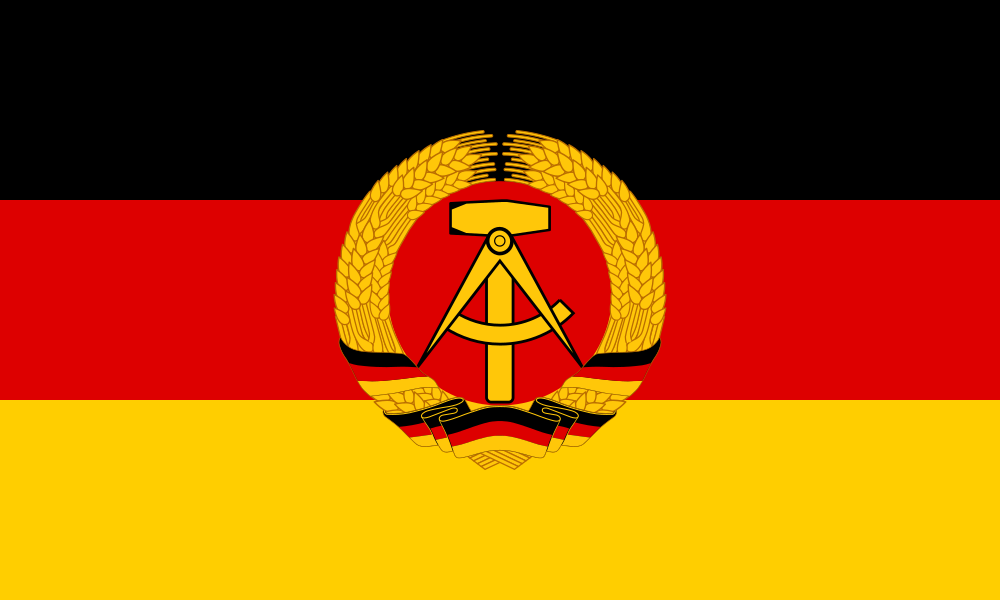
I am grateful to the members of the Council for the opportunity afforded the delegation of the German Democratic Republic to address the Council on the question on its agenda.
102. The Council has before it an application from one more independent African State, the young People’s Republic of Angola, for admission as an equal Member to the world Organization. The statement signed by the President of the People’s Republic of Angola is entirely in keeping with the Charter. The People’s Republic of Angola is pursuing a policy of peace, as is required by the principles and purposes of the United Nations. It intends and is able to
103. The people of the People’s Republic of Angola have been forced to wage a difficult struggle, in which they have had to make many sacrifices, against the colonial domination of the Portuguese regime of Salazar so as to be able, in accordance with General Assembly resolution 1514 (XV), to exercise its right to independence and self-determination.
107. The heroic struggle of the young State against the aggressor, South Africa, a struggle which required so much sacrifice, has won recognition, but to this very day Angola, like other independent African States, is the target of threats from the racist regime of South Africa and those which egg it on.
108. The People’s Republic of Angola is today a recognized member of the Organization of African Unity. The recently concluded Meeting of the Coordinating Bureau of the Non-Aligned States in Algiers made a high assessment of the role of the People’s Republic of Angola in the struggle of the peoples of Africa. Today the People’s Republic of Angola has diplomatic relations with more than 100 States. Delegations of the young People’s Republic of Angola have already taken part in many international conferences on an equal footing with other States.
104. The proclamation of the People’s Republic of Angola of 11 November 1975 was a further important step towards the final elimination of the vestiges of colonialism and racism for which the world Organization also strives, as is reflected in numerous decisions of the Security Council and the General Assembly. Being from its very inception the reflection of the free exercise of the right to self-determination, the young People’s Republic of Angola was the target of open armed aggression from that bulwark of racism and colonialism in South Africa, the illegal apartheid regime. That disturber of the peace, which openly violated and is still violating the peace and security of that part of the world, found support from those forces which want to break the wheel of history and which are denying the peoples of southern Africa the right to self-determination and fundamental human rights, forces doing everything they can to continue oppressing and exploiting those peoples by means of racism, colonialism and neo-colonialism.
109. There exist close ties of friendship between the German Democratic Republic and the People’s Republic of Angola. At the recently held Ninth Congress of the Socialist Unity Party of Germany, the General Secretary of the Central Committee, Erich Honecker, stated:
“We categorically condemn any imperialist policy of aggression and we resolutely favour the political settlement of all conflicts in the interests of peace and the right of the peoples of the world to selfdetermination. !The sacred right of the peoples has always been and remains the right to offer resistance to imperialist aggression and to do everything in their-power to fight for national and social liberation and to decide their own fate. We support all peoples waging a struggle for their national independence, for equality in international relations, for economic development and for social progress... 106. The German Democratic Republic noted with satisfaction Security Council resolution 387 (1976), which condemns the aggression of South Africa against the People’s Republic of Angola. In that resolution, the Council
105. . The .trial in Luanda of the mercenaries of certain imperialistic States, and the fact that arms were delivered there from North America, Western Europe and one Far Eastern country, arms which were used by gangs of mercenaries, racists and neocolonialists who murdered and burned-all indicate the scope and also the monstrousness of the crimes committed against the peoples of Angola.
.
“Along with the other progressive forces of the entire world, we support the struggle of the people of Angola for their independence. We support all the peoples of Africa fighting against racism, neocolonialism and imperialist aggression and thereby defending their right to national sovereignty and social progress.”
“‘Demands that South Africa scrupulously respect the independence, sovereignty and territorial integrity of the People’s Republic of Angola”
110. More than 15 years have passed since the adoption, on the initiative of the Soviet Union, of the Declaration on the Granting of Independence to Colonial Countries and Peoples. In that time many colonial peoples have achieved independence and, in implementation of the right of self-determination, have set up their own States. They have all been admitted to membership in the United Nations. Thus, we were able at the last session of the General Assembly to welcome the former Portuguese colonies of Guinea-Bissau, Cape Verde, the Democratic Republic of Sao Tome and Principe, and Mozambique. There
and
“CulZs upon the Government of South Africa to meet the just claims of the People’s Republic of Angola for a full compensation for the damage and destruction inflicted on its State and for the restoration of the equipment and materials which its invading forces seized.”
The Security Council was thus acting in accordance with the Charter, which calls for action to be taken
111. My country, the socialist German Democratic Republic, is still a young Member of the United Nations. The decision of the General Assembly to admit the German Democratic Republic to the United Nations was of significance to the strengthening of peace in Europe and for the further implementation of the principles and purposes of the United Nations; that is universally acknowledged today. There can be no doubt that the admission of the People’s Republic of Angola will also serve to strengthen international peace and security and will, at the same time, enhance the authority of our Organization and promote its universality. The admission of the People’s Republic of Angola will be an expression of the recognition of the political facts in Africa. The history of the United Nations teaches us that attempts, in contravention of the Charter, to deny the right of membership to any State are in the final analysis doomed to failure.
112. Certain elements of the press in the United States have disseminated the idea that the assistance granted in solidarity by Cuba to the People’s Republic of Angola to resist the armed intervention of South Africa and ensure its sovereignty could be a stumbling block to the admission of the People’s Republic of Angola. But if they look at the Charter: they will see that Article 51, for example, gives the People’s Republic of Angola the right to request disinterested assistance from any State. I should, incidentally, like to remind the Council that those who drafted the Charter and founded the Organization had in mind the fundamental idea of preventing a repetition of the fascist policies of expansion and aggression along the lines of German fascism.
113. Mr. Vorster himself went to the Federal Republic of Germany and, as he had done during his visit to Israel, made himself out to be in favour of a policy of what he calls “dialogue’*. But that same Mr. Vorster, who so bloodily oppresses the non-white population of his own country and is striving to expand nuclear co-operation with the Western European monopolies, was, as we are all aware, arrested during the Second World War for his active work for fascist Hitler-he Germany and its racist, fascist theories. At the present time, Mr. Vorster, as the Head of Government, is among those primarily responsible for the armed aggression against a peace-loving African State, an aggression that has been condemned by the Security Council. Since the apartheid regime is still clinging to its principle of arms and expansion--and this is evident from the debates in Parliament and the bills drafted there-the People’s Republic of Angola has every right to take measures that it deems necessary to defend its sovereignty and its territorial integrity; that is particularly true because it is a neighbour of Namibia, which is illegally occupied by South Africa.
114. I should like at the same time to remind those who are laying down certain additional conditions for
115. Any attempt to delay the admission of the People’s Republic of Angola is entirely without foundation and is entirely unjustified. To link the admission of the People’s Republic of Angola with problems having nothing whatsoever to do with the criteria applicable to admission to membership in the United Nations is illogical and contrary to both the spirit and the letter of the Charter. The admission of the People’s Republic of Angola is a moral, political and juridical necessity and is entirely in keeping with the facts of today. It is also called for by world public opinion.
116. The delegation of the German Democratic Republic is convinced that an appropriate recommendation by the Security Council to admit the People’s Republic of Angola will meet with the approval of the overwhelming majority of the General Assembly.
The next speaker is the representative of India. I invite him to take a seat at the Council table and to make his statement.


Mr. President, my delegation is grateful to you and to the other members of the Council for giving us this opportunity to express our views on the question of the admission of Angola to membership in United Nations.
119. The criteria for the admission of new Members are set out in Article 4 of the Charter. First, the applicant must be a peace-loving State. Secondly, it must accept the obligations contained in the Charter. Thirdly, it must be able and willing to carry out those obligations. In our judgement, Angola fulfils those three conditions and is therefore eligible for admission to the United Nations.
120. We feel that each application for admission should be considered and decided on its own intrinsic merits and that extraneous considerations should not be brought in, however important they may appear to be at the moment.
121. In Angola we have a country whose people at immense sacrifice liberated themselves from colonial rule after a prolonged and bitter struggle. They desire now to seek the protective shelter of membership, to subscribe to the principles and purposes of the United Nations, to carry out the obliga?ions~f membership and to join the mainstream of the movement for the maintenance of international peace and security. Membership in the United Nations is as much in the interests of Angola’s consolidation of its own inde-
122. The fact that on Angola’s southern border there is an international Territory called Namibia, which continues to be under the illegal military occupation of the white minority Pretoria regime and that that regime, after invading Angola, has withdrawn its forces and maintains them still in Namibia, entitles Angola surely to seek such security as is available to it through membership in the United Nations.
130. As I indicated, the victory of the MPLA and of the Angolan people is also, in a way, a victory for the United Nations and for all the forces which struggle for the benefit of peoples still subject to colonial and foreign domination. In saying this, I intend simply to place that victory within the global context of the purposes, objectives and principles of our .Organization, and to emphasize the significant contribution made by the Angolan people to the structure of peace, freedom and international justice, which it is the task of the United Nations to build. Any victory won against the common enemy, represented by colonialism, racism, apartheid and imperialism, can only strengthen the entire international community, whose ideals are defined in the Charter.
123. The fact that Angola is a member of the Organization of African Unity and has been recognized by a very large number of Members of the United Nations is proof enough of its sovereign equality. It is clearly entitled to the rights and benefits resulting from United Nations membership, one of which is the protection of its territorial integrity and the safeguarding of its political independence from external interference. In these circumstances, denial of United Nations membership would be denial of the legitimate expectations of the people of Angola, whose aspirations naturally derive from the fulfilment of the objectives of Chapter XI of the Charter.
131. There is, of course, a concomitant duty which consists of doing everything within and outside the Organization, but particularly within it, to strengthen the opposition to the forces of reaction whose determination to hold on to a decadent system of domination and exploitation has been denounced in this forum more than once. The efforts we are making for decolonization and against discrimination of every kind would be meaningless were we to lose sight of that objective and to fail to admit into our ranks countries like Angola and Viet-Nam, which wish to defend peace, promote freedom and establish justice among nations in a realistic and constructive manner.
124. Angola obviously considers its admission to the United Nations to be necessary in its own national interests. It will also help the promotion of the purposes of the United Nations in southern Africa. We would therefore strongly support its application for membership.
The next speaker is the representative of Madagascar. I invite him to take a seat at the Council table and to make his statement.


Mr. President, I should like to thank you and the other members of the Council who have been so good as to allow my delegation to participate in this debate.
132. In the case of Angola, we are convinced that that country, which has accepted the obligations under the Charter and undertaken to fulfil them, is likely to bring a rich contribution to our work on the basis of its experience in fighting and of the choices it has made in accordance with the principles of non-alignment. How many countries attach more importance than does Angola, a recent victim of aggression, to non-interference in the affairs of others? Who can better appreciate the price of an independence so dearly won?
127. Nothing could better demonstrate the aspiration to universality of our Organization and nothing could do more honour to it than for it to admit a Member whose anti-colonialist movement it has supported and whose independence it has always unequivocally favoured.
128. The history of Angola is too well known to all for me to need to recall it here. Only last March the Council had to take a decision on the latest developments in the long struggle for liberation waged by the Angolan people, first against Portuguese colonialism and then against international imperialism and the South African racists later.
133. It seems to us that those are guarantees which warrant our admitting to our Organization the People’s Republic of Angola. It will then become an enthusiastic and enlightened advocate of cooperation based on the sovereign equality of States, with no ulterior motives, and directed only towards common advantages for the partners. In a word, the participation of Angola in the life of the United Nations will strengthen our Organisation’s universality and representativeness, while at the same time increasing its effectiveness.
129. In contrast to the efforts made earlier to achieve, consolidate and defend the independence, sovereignty and territorial integrity of Angola, the
135. Be that as it may, for young countries such as ours, beyond material considerations and economic and other factors, it is to the image of the United Nations, which guarantees our independence and security, that we are most attached. We are certain that the same holds true for the Angolan authorities, one of whose first acts after independence was to submit to the Security Council the problem of South African aggression.
136. Having been among the first to recognize and establish diplomatic relations with the People’s Republic of Angola, my Government feels most honoured to be able to lend its support to the just And legitimate request which has been submitted to the Council for its consideration today. We believe that this application is in accordance with the law since Angola, beyond any doubt, complies with the restrictive conditions provided for in Article 4 of the Charter.
137. We also believe that this application corresponds to reality, because the People’s Republic of Angola has been recognized by the vast majority of Member States and has been admitted as a full member to the Organization of African Unity; it is also a member of the World Health Organization, where it was admitted by acclamation. The United Nations itself cannot ignore those facts without transgressing the spirit and letter of its Charter.
138. Above all, we believe that the admission of Angola would constitute a political act which would benefit both that country and the United Nations itself. In these circumstances, we consider that any obstacle placed in the way of its admission at this stage constitutes an unjustifiable and unjustified political expedient over which the rights of the Angolan people will finally triumph.
The next speaker is the representative of Bulgaria. I invite him to take a place at the Council table and to make his statement.


First of all, I want to thank you, Mr. Presi-
141. The youngest African State, the ‘People’s Republic of Angola, has submitted to the Security Council its application for admission to membership of the Organization, and this is perfectly normal and logical. In that context, the Government of that Republic has repeatedly stressed that it will adhere to the principles of the Charter; that it will fight for their implementation and for respect for them. And it has declared that it is prepared to initiate relations of friendship and co-operation with all States on the basis of common respect ,for the principles of national sovereignty, territorial integrity, equality, mutual benefit and non-interference in each other’s domestic affairs.
142. The Government of the People’s Republic of Bulgaria, which recognized the independent and sovereign People’s Republic of Angola from the very outset, having established full diplomatic relations with that Republic, definitely feels that the People’s Republic of Angola and its Government fully meet all the normal requirements for admission to membership in the United Nations. The Government of the People’s Republic of Angola exercises effective control and government over the whole expanse of the country. It has set in motion a programme of national reforms and new and successful policies for the economic, social and cultural life of the country. The foundations are being laid for a young African State which has deservedly taken its place among other African countries which have already acquired their freedom and independence. The People’s Republic of Angola is one of the most shining examples of the implementation of one of the most important principles of our Organization: the principle of recognition of the legitimacy of the struggle of colonial peoples for the implementation of their right to self-determination and independence by all the means and with all the resources at their disposal, as provided in the historic Declaration on the Granting of Independence to Colonial Countries and Peoples.
143. For all these reasons, the Government of the People’s Republic of Bulgaria is convinced that the People’s Republic of Angola, beyond any doubt, deserves to be admitted to membership in the United Nations. Despite the fact that it has existed for a very short time as an independent State, the People’s Republic of Angola has already proved its vitality by the soundness of its policies, both domestic and foreign. The international authority which it enjoys, based on the principles and policies followed unswervingly by the MPLA from the beginning of its heroic struggle, has grown to meet new conditions in a constant process of consolidation. And now the People’s Republic of Angola is a full member of the
148. Not only the existence of the new Republic but even the achievements of the Angolan people in their struggle for a free and independent existence were thus threatened. By their aggression against Angola, colonialism and imperialism were endeavouring to preserve colonial domination over the people of Angola-the same kind of domination to which the peoples of Namibia, Zimbabwe and South Africa are still subjected.
149. Recent events in Soweto and other areas of South Africa have shown once again to the whole world the true face of the racists of Pretoria, who did not hesitate to perpetrate a massive massacre of schoolchildren, students and young Africans so to halt any attempt to oppose apartheid and colonial slavery. The Security Council’s unanimous condemnation of this fascist act of terrorism by the South African authorities must finally convince those who have not yet recognized that the practices and policies of the South African regime constitute a crime against humanity and, as such, a grave threat to peace not only in the region but in the whole world.
144. No one can deny that right to this young State, which has shown such iron will, so much courage and so much self-denial, and which, under the leadership of the MPLA, has borne so many painful sacrifices during the long years of its national liberation struggle against Portuguese colonialism and has thus written one of the most glorious pages in the history of the national liberation struggle of the African peoples.
145. The militant union of the people of Angola with the MPLA, which came into existence during the national liberation struggle against colonialism and imperialism, had as its logical sequel the creation of the independent State which is the People’s Republic of Angola. The struggle of the Angolan people and of the MPLA was part and parcel of the struggle of other African peoples, such as those of Guinea-Bissau, Cape Verde and Mozambique, and of others which also suffered under the colonial yoke of the Portuguese empire; and they certainly have made a very important contribution to the elimination of Portuguese fascism.
150. The allies and protectors of the Pretoria regime actively support it and, in particular, by strengthening its military capacity so as to enable it to commit its acts of aggression against the African peoples. Thus, for example, in its aggression against the People’s Republic of Angola, South Africa used the Territory of Namibia, which it continues to occupy illegally in flagrant violation of every United Nations decision on the subject.
151. The victory over imperialist aggression was made possible by the alliance of the people of Angola and the MPLA. The strong and consistent position taken by the MPLA in the national liberation struggle determined, in the final analysis, the broad support it received and is still receiving from all strata of the Angolan people. As a result, colonialism and imperialism were forced to yield before the heroic onslaught of the Angolan people, a people which knows the price of its freedom and independence, has true friends in the struggle and believes in its own future.
146. The liberation struggle of these peoples was, and continues to be, part of the common struggle of the progressive and democratic forces throughout the world, the countries of the socialist community and the non-aligned countries to achieve the complete and final elimination of colonialism, racial discrimination and apartheid, as well as to combat neo-colonialism and imperialism. That struggle derives its inspiration and its strength from the continuously expanding process of the strengthening of co-operation between States with different social systems and from the general detente and the strengthening of international peace and security.
152. From the very outset, the People’s Republic of Bulgaria, side by side with the Soviet Union, Cuba and other socialist countries and hand in hand with all progressive and democratic forces throughout the world, has unreservedly assisted and supported the struggle for national liberation waged by the Angolan people under the leadership of the MPLA. We shall continue to provide such assistance and support, thus carrying out our international duty of solidarity with the national liberation movements of the colonial peoples of Africa.
147. Angola’s path to independence was hard-won and it proved to be equally hard after the establishment of the People’s Republic of Angola. Recognizing that the emergence of the People’s Republic of Angola had considerably weakened the position of colonialism in Africa, the colonial and racist regime in South Africa extended the armed aggression it had undertaken even before Angola had proclaimed its independence. As is evident from so many facts, this was a well-prepared act of aggression on the part of
153. This is our constructive policy of principle and it was once more expressed and duly appreciated
“The People’s Republic of Bulgaria and the United Republic of Tanzania warmly congratulate the peoples of Angola, Mozambique, Guinea- Bissau and the Cape Verde, which have won their freedom and national independence and have followed the path of economic, social and political development.
“Both countries have a high estimation of the effective assistance given by the Soviet Union and Cuba, which facilitated the victory of the Angolan people over imperialist aggression. They express full support for the peoples of Namibia, Zimbabwe and. South Africa in their struggle against colonialism and racial discrimination and for the free national and social development of those countries; they confirm their determination and their readiness to continue to give support to the national liberation movements in Africa, as both countries have categorically condemned the racist regimes of the Republic of South Africa and of Southern Rhodesia.”
154. The People’s Republic of Bulgaria will continue to provide disinterested assistance to the People’s Republic of Angola to enable it to heal the wounds inflicted by Portuguese domination and imperialist aggression and to build its future in an atmosphere of peace and independent development. We are convinced that the links of friendship and co-operation forged between our two countries and our two peoples during the freedom struggle of the Angolan people will continue to grow and to gain strength, thus serving our common interests.
155. The People’s Republic of Bulgaria wishes’ to declare before this most responsible and most important body of the international Organization its unshakable belief in the desire of the Government of the People’s Republic of Angola to exert every effort, under the guidance of the MPLA, to attain the ideals of the United Nations and to strengthen universal peace and security. Our Organization must accept the People’s Republic of Angola as one of its members. We urge the Security Council to make a positive recommendation to that effect.
156. Judging from today’s discussion, most of the members of the Council are in favour of admitting the People’s Republic of Angola to membership in the United Nations. We cannot but regret that one of the members of the Council, taking a very dish stand, and under cover of its trite phrases and slogans, has seen fit to attack, without any justification, the countries which have given and continue to give effective
157. We believe that these two countries, both permanent members of the Council, are ,taking on a very heavy responsibility, not only vis-ri-vis the Angolan and the other African peoples but also in the eyes of the democratic world community. Let us hope nevertheless that good sense and a sound understanding of the interests of the peoples of those two countries and also of the general interests of peace and international co-operation throughout the world will triumph and make it possible for us to welcome here in our ranks, in the very near future, the representatives of the heroic people of the People’s Republic of Angola.
The next speaker is the representative of Cuba. I invite him to take a seat at the Council table and to make his statement.
159. Mr. ALAR&N (Cuba) (interpretation from Spanish): Mr. President, may I express to you and, through you, to the members of the Council our gratitude for having invited Cuba to participate in this important debate. I should also like to welcome the presence of the representative of the People’s Republic of Angola, Ambassador de Figueiredo.
160. The admission of a new Member should always be an occasion for rejoicing and unanimity in the United Nations. The fact that new sovereign States have emerged from colonial oppression, become independent and joined the United Nations as Members should be a reason for happiness because it confirms the irreversible movement towards decolonization and the trend towards the universality of the Organization.
161. When, as in the case of Angola, the people which now comes knocking at our door is one that has travelled a long road full of troubles and sacrifices before attaining its independence, the Organization has before it an opportunity to do itself credit by receiving thosewho, with va&r and~dign~y~&e’ embodied and defended the purposes and principles of the Charter.
162. The entry of the People’s Republic of Angola into the United Nations will make the Organization stronger, more representative of the peoples of the world, more sensitive to the clamour of the exploited masses of an Africa that is still awaiting liberation.
168. As regards the status of the People’s Republic of Angola as a peace-loving State, obviously the decision can only be in favour of admitting that country. The People’s Republic of Angola threatens no one. Its foreign policy is peaceful and based on the principles of peaceful coexistence, non-alignment and solidarity with national liberation movements and revolutionary peoples. Its entry into the Organization of African Unity and the non-aligned movement confirms all this and also indicates that that is how independent, sovereign Angola is viewed by the peoples of Asia, African and Latin America. The People’s Republic of Angola represents a people which loves peace based on freedom and justice. It has struggled for freedom many centuries. It overcame Portuguese colonialism at the cost of countless sacrifices. It resisted and defeated the criminal aggression of the racist regime of South Africa. Through its heroic struggle, the people of Angola won independence and the right to build a peaceful future. Thus, also, it made an invaluable contribution to the cause of peace and security on the African continent and throughout the world.
164. The Council is today being invited to recommend to the General Assembly that it admit the People’s Republic of Angola. The criteria to be taken into consideration by the Security Council and the General Assembly when adopting the relevant decisions are clearly defined in Article 4 of the Charter, which makes three points: first, that the applicant must be a peace-loving State; second, that it must accept the obligations contained in the Charter; and, third, that in the judgement of the Organization, it is able and willing to carry out those obligations. And let it be noted that the Charter reserves the authority to judge the capacity of a State for the Organization alone and not for any of its individual members. It follows from this that the Council must consider whether the State is peaceloving and whether it accepts the obligations contained in the Charter, and, above all, that the Council must take into account the opinion of the Members of the Organization which, according to the Charter, are those which are authorized to pass judgement on the State that wishes to become a Member.
165. The Government of the People’s Republic of Angola has solemnly expressed its acceptance of the obligations contained in the Charter and its willingness to carry them out. This is apparent in the letter from Comrade Agostinho Neto, President of the People’s Republic of Angola to the Secretary-General. In the Constitution of the People’s Republic of Angola and in other important documents submitted by the Angolan authorities, the attachment of that country and its Government and people to the ideals and purposes of the United Nations is confirmed.
169. Neither Article 4 nor any other Article of the Charter prescribes other requirements for admission to the United Nations. To attempt to impose other conditions would be completely illegal and discriminatory and would violate the Charter itself. To use the power of the veto for this purpose -is tantamount to an abuse of the prerogatives accorded certain Powers whose special responsibilities are recognized in the Charter. Such conduct by a permanent member of the Security Council would be proof of its inability to exercise its privileges responsibly.
166. The members of the Council have, furthermore, abundant proof of the opinion of the quasi-totality of the international community in regard to the peaceloving character of the People’s Republic of Angola and its ability and willingness to comply with the obligations-laid down in the Charter. This is a State that has been recognized by and maintains diplomatic relations with more than 100 States in every area of the world; it is a full member of the Organization of African Unity and the non-aligned movement. Furthermore, the People’s Republic of Angola has just been admitted to the International Labour Organisation and to the World Health Organization. At the United Nations Conference for Human Settlements, in which 130 States participated and which recently ended in Vancouver, the presence of the People’s Republic of Angola was enthusiastically welcomed by the vast majority of delegations present.
170. The admission of new Members is too important to be governed by petty interests or political shortsightedness. The interests of peace and international security, because they are universal, should be protected from chauvinistic influences or the effect of electoral setbacks.
171. On behalf of the Revolutionary Government of Cuba, I wish to place on record our total support for the application for admission of the People’s Republic of Angola. Between the peoples of Angola and Cuba there is a deep solidarity rooted in the struggle of the slaves brought to the lands of the American continent by European colonists. The bonds were further strengthened by our joint struggle against foreign opression and for independence and were for ever sealed in the blood shed by Cubans and Angolans fighting side by side against the South African racists
172. Prompted by the spirit of solidarity with the Angolan people, my delegation urges the Council to respond favourably to Angola’s application for admission to the United Nations; We urge this, as do many States of Africa, Asia and Latin America which are also solidly behind the just cause of the Angolan people. In this respect I should like to quote the relevant part of the final communique adopted at the beginning of this month in Algeria by the Co-ordinating Bureau of the non-aligned countries at ,its ministerial meeting. It reads as follows:
“The Bureau emphasizes the historic significance of resolution 387 (1976), adopted by the Security Council on 31 March 1976 condemning South African aggression against Angola, and fully supports the application of the People’s Republic of Angola for admittance to the United Nations.“’
173. At the time of voting, Council members should bear in mind that outside the Council chamber intemational public opinion is awaiting the Council’s decision and that beyond this meeting, history will judge the Councilon the,basis of how it acts today...;. , . . . . . is _.
174. That is as far as I had intended to go in my statement this afternoon. The Council will, however, realize that, after having listened to some Council members, I should perhaps add a few additional comments.
175. First of all, I wish the record of the Security Council to reflect the position of the Revolutionary Government of Cuba in connexion with the military assistance we gave our brothers, the people of Angola. In this respect I should like to quote what the Prime Minister of the Revolutionary Government of Cuba, Commander Fidel Castro, said only two weeks ago:
“It is absurd to think that our fighters went to Angola with the idea of staying in the country indefinitely. Our fighters went there with the intention of remaining in the People’s Republic of Angola, at the request of its Government, so long as an invader remained on the soil of the fraternal Angolan people. As that task ends, in accordance with the agreements signed between the Governments of the People’s Republic of Angola and Cuba, our military personnel in Angola is gradually being withdrawn. Let this be understood: gradually being withdrawn.
“Now, how long will it take for our forces to be withdrawn? This is how we describe the situation
Later, Comrade Fidel Castro said:
“But let our enemies not be deceived. The withdrawal will take all the time necessary to comply with those requirements; it will be gradual. We issue the warning that the men and the essential equipment to guarantee, together with the Angolan people, that country’s external security will remain in Angola for as long as they may be needed. “ ‘How long? ’ the imperialists ask although they have no right to ask that question. The answer we give our people is this: as long as they may be needed while the People’s Army of Angola is being organized, equipped and trained-not a day more and not a day less.”
176. Frankly, it seems very cynical for certain delegations to try to use as an excuse for vetoing the admission of the People’s Republic of Angola the military co-operation agreements which that country’s legitimate Government has signed, in the exercise of its sovereign rights and prerogatives, with the Govemment of Cuba or the Government of any other sovereign State. It seems particularly cynical when such allegations are made by the North American representative, and- .a11 the .more .so .when we remember .something which must be in the mind of all the members of the Council-that is, that the North American Govemment has troops and military installations from the Caribbean to the Pacific, from the Far East to Western Europe. In some cases, those troops are in those countries on the basis of agreements with the Govemments concerned; in other cases, they are there against the will of the peoples and Governments concerned. If there were any logic in the North American reasoning, then we should have to question the legitimacy of the presence in this Organization of some of its Members.
177. The United States has had millions of soldiers stationed abroad. It has sent tens of thousands of soldiers to Indo-China, to Europe, to Korea, to Taiwan and to many other countries, not to defend the sovereignty or territorial integrity of a young and weak State-as was the case of Angola at the time of its accession to independence-but to extend the application of its imperialist policy. The United States has entered into pacts of aggression all over the planet. The United States was the first country in history to export troops. It has been the largest builder of offensive bases and it has been the mainstay of all forces of aggression, oppression, colonialism and racism. It has been the prime interferer, the master of internal subversion. How dare it give lessons about the right of a small State that has been the victim of
178. I wish to point out, furthermore, that when I spoke in the Council in March this year in connexion with the South African aggression against Angola [1902nd and 1906th meetings], I referred to the activities of foreign mercenaries, the white mercenaries recruited in the United States and in other Western countries who went to sow destruction and crime on Angolan soil. At that time I showed the Council a publication which was circulating in this country and which was openly aimed at recruiting mercenaries to fight against the Angolan people. A few moments before coming to this meeting I obtained a copy of another number of this publication, which seems to be last year’s summer issue. The cover of the publication bears the words “American mercenaries in Africa”, and in smaller type, it mentions the attempts of “Colonel Mike Hoare and his mercenaries” to invade Angola. An article in the publication gives abundant details showing that not only in March but also in June there was open encouragement in this country of activities by mercenaries against African peoples. In that article, referring to mercenary activities against Angola, the author seems to indicate that it is no longer so easy to organize these disgraceful activities against the Angolan people. This does not mean, however, that these wretched activities against the peoples of Africa have been completely abandoned. The author mentions the so-called Wild Geese group, a group of mercenary commandos with long experience from the Congo to Angola over the past decade and a half in connexion with attempts to organize activities against the People’s Republic of Angola. The attempts appear to have come rather late in the day but the intention was the same as before. The article ends with these words: “Will the ‘Wild Geese’ fly again? The mercenaries feel II that it is not ‘if but ‘when’ and ‘where’.“*
181. Events in Angola certainly indicate that that is not the thinking that now governs the foreign policy of the Chinese leadership. It is interesting to note in these articles on mercenaries I have mentioned how, 15 years ago, according to the account published in this issue of the magazine, Colonel Hoare’s mercenaries in the Congo captured Chinese weapons held by Congolese patriots. Now in Angola, Colonel Hoare and his henchmen did not have to fight to obtain Chinese weapons. This time they were on the same ‘side. How has this 180-degree volte-face come about over a period of 15 years? That is something the Chinese delegation should consider before preaching revolutionary action.
182. It seems that the statements of President Mao that I quoted are no longer valid today and that the conduct of the delegation of China is governed by a new book which is unknown to me and which I therefore cannot! quote: it is probably entitled “Thoughts of Chairman Kissinger”.
183. I conclude my statement by repeating that we support the application of the People’s Republic of Angola for admission to the United Nations, and that we are convinced that, despite the new American veto we are about to witness some day-and we think it will be soon-the People’s Republic of Angola will occupy its lawful place in this Organization.
The next speaker is the representative of Kenya. I invite him to take a seat at the Council table and to make his statement.


Mr. President, I thank you and the other members of the Council for making it possible for me to address the Council on the question of the admission of the People’s Republic of Angola to the United Nations.
179. The Government of the Unitd States, which encourages the racists and colonialists in Africa and openly tolerates the scandalous recruitment of hired assassins to interfere in the life of African States and to organize aggression such as that suffered by the Angolan people, obviously has no right to speak in the manner in which its representative has spoken this afternoon.
186. When I examined the report contained in document S/12109, I did not feel inclined to address the Council because I thought there was a misunderstanding only on the procedure for the admission of Angola. The report gave the impression that simply by its postponement for approximately 50 days, Angola’s application for admission would receive the unanimous support of the Council. However, when I listened to the debate as it progressed, I felt that I ought to add the voice of my delegation in support of the application, because issues that I thought had been cleared before were raised anew. My delegation
180. Turning to another point, I should like to make a brief comment on the statement made by the representative of China. In March we had to refer to the allegations of the delegation of China concerning the co-operation of Cuba and the Soviet Union with the Angolan people. At that time I presented to the Coun-
* Quoted in English by the speaker.
187. In urging this Council to recommend the admission of the People’s Republic of Angola, my delegation wishes to salute the people of Angola for the determined struggle that they waged against Portuguese colonialism. We are all familiar with the cruel colonial wars that the Portuguese carried on for more than 13 years against the people of Guinea-Bissau, Mozambique, Cape Verde, Sao Tome and Principe and Angola. In the end, and after a bitter struggle against imperialism and colonialism, the Portuguese misrule in Africa collapsed. Those States are now independent and have joined the United Nations to promote the principles of freedom and peace enshrined in the Charter.
188. Angola is now free and has a Government that exercises control over all its territory. It is a member of the Organization of African Unity and it has been recognized by the majority of Member States of the United Nations. The People’s Republic of Angola qualifies for admission to the United Nations under Article 4 of the Charter. It fulfils all the conditions of a sovereign State. Its application to become a Member of this Organization is vivid testimony of its willingness to accept the purposes and principles of the United Nations as contained in its Charter.
189.. I should like to emphasize that the admission of Angola should not be blocked on spurious grounds. We have heard some say that Angola should not be admitted as long as there are foreign troops in its territory. To this we say: Angola is an independent country. It has the right, like any other sovereign State, to invite its friends to its territory.
190. No Member State has any right to determine who should be the friends of Angola. Angola alone, as a sovereign State, should decide on its own affairs. If one of the criteria for membership of this Organization were the absence of foreign troops in sovereign States, then indeed the present membership of the Organization would have to be reviewed. Therefore, let us not apply any special conditions for the admission of Angola; let us admit Angola solely on the criteria that have been applicable to other States in the past.
191. Angola is already a member of the Organization of African Unity, an organization which my country supports fully. If Angola is good enough to associate with in that organization, surely it cannot be anything else at the United Nations. .A11 the members of the Organization of African Unity support this application. But we understand that this application will be turned down, possibly by the use of the veto by one of the members of the Council. We would ask to be told the basis for that irresponsible use of the veto on this occasion.
193. On those grounds, I appeal to all the members of the Council to consider the application without any unnecessary prejudice based on domestic political considerations or any other extraneous considerations.
I should now like to make a statement in my capacity as representative of GUYANA.
195. The issue of which the Council is seized today-the application of the People’s Republic of Angola for admission to membership in the United Nations-is of special importance, not only to the Angolan people but to the entire international community, for this application symbolizes the onward march of the forces of freedom in Africa. The victory of the heroic Angolan people after a long, arduous struggle signalled the virtual end of one of the oldest colonial empires of modem times and, as some have said elsewhere, significantly contributed towards the introduction of a breath of freedom into the metropolitan country itself, Portugal.
196. The people of Angola have endured a long nightmare. Like other former colonial Territories, Angola was subjected to ruthless exploitation, to cultural suppression and to processes and practices which debase the human personality. Yet, when on the threshold of independence the people of Angola were called upon to resist a fierce onslaught by the racist forces of South Africa which sought to make nugatory the fruits of the successful struggle of the Angolans against Portuguese colonialism, that fascist attempt to stem the tide of progress in Angola was of course completely smashed. Now the people of Angola are faced with the difficult task of rebuilding their society and of fashioning it in a manner which would be consistent with their true aspirations. The intemational community has a responsibility to support the people of Angola in those efforts.
197. Guyana is committed to the goal of universality of membership of the United Nations. We believe
The Cuban representative and I had the opportunity to engage in debate last March and I do not want to take up more of the Council’s valuable time with a repetition of such an exchange. I would, however, like to note with pleasure his statement that Cuban troops will remain in Angola only so long as there is an invader in that country. My delegation is not aware that any invaders are now in Angola-unless, of course, the “golden geese” or other such science-fiction characters can be so described.
198. We are fully satisfied that the application of the People’s Republic of Angola conforms with the requirements of Article 4 of the Charter. Angola’s membership in the Organization of African Unity, its impending entry into the fold of the non-aligned movement and its recognition by so many Members of the United Nations are factors which without a doubt enhance its suitability for membership in the United Nations.
The representative of Cuba has asked to be allowed to make a further statement. I invite him to take a place at the Council table and to make his statement.
199. We should not allow the strategic defence perceptions and the global military and political outreach of some States to lead us to adopt a selective approach to the question of membership in the United Nations. We should not confer any semblance of legitimacy on postures which question the undiluted application of the fundamental principle of sovereignty. Such postures, or indeed any others, which go beyond the provisions of Article 4 of the Charter should not be imposed upon our consideration of the application of any State for membership and certainly not on Angola’s. .
205. Mr. ALAR&N (Cuba) (inferpretation from Spanish): I wish only to say that my quotations of the words of the Prime Minister of the Revolutionary Government of Cuba will no doubt appear in the verbatim records, and I adhere to the text I quoted.
206. I do not wish at this stage to reopen polemics with the representative of the United States with regard to his attitude towards the right of the people of Angola to receive assistance from abroad in exercise of its sovereign will. I said that in March, and that is all I shall repeat here now. The United States Government recognizes that right to other Governments which are its allies and which as a rule are located in the developed capitalist white part of the world. The only basis for denying the Government of the People’s Republic of Angola the sovereign right to request the military assistance it needs from another sovereign State is a racist one; it can be explained only by racist attitudes.
200. The Government and people of Guyana salute the Government and people of the heroic nation of Angola. My delegation looks forwards to working in close co-operation with the delegation of that sister Republic as we seek to grapple with the problems which confront today’s troubled world. It is our firm hope that the bonds of friendship which bind us will be further strengthened by that co-operation.
207. I cannot accept that what the United States considers protected by international law in the case’of a Western European State, let us say, should not apply equally to an African State, for the simple reason that its rulers do not have as white a skin as the illustrious representative of Washington. This racist conception ’ is not consonant with international law, nor is it accepted by the majority of mankind.
201. I could not close without noting that the victory of the Angolan people over the forces of colonialism and fascism provides a source of strength for the valiant freedom fighters in Zimbabwe, Namibia and South Africa. My delegation is acutely conscious of the gathering of the storm clouds over the remaining bastions of racism and colonialism in southern Africa. We urge all Governments, indeed all Governments and peoples, to join fully in the struggle which will put an end to human degradation and injustice in the remaining colonial territories.
If no other member of the Council wishes to speak at this stage, may I take it that the Council is ready to vote on the six-Power draft resolution contained in document S/12110? As there has been no objection, I now put the draft resolution to the vote.
202. My delegation is happy to be among the sponsors of the draft resolution contained in document S/12110, which seeks to have the Council recommend to the General Assembly that the People’s Republic of Angola be admitted as a Member of the United Nations. We deeply regret that it does not now appear possible that the draft resolution will be adopted. We none the less look forward to the day, in the near
A vote was taken by show of hands.
In favour: Benin, France, Guyana,. Italy, Japan, Libyan Arab Republic, Pakistan, Panama, Romania, Sweden, Union of Soviet Socialist Republics, United
Against: United States of America.
The result of the vote was 13 in favour and 1 against.
The draft resolution was not adopted, the negative vote being that of a permanent member of the Council.
One member (China) did not participate in the voting.
I shall now call on those delegations wishing to speak in explanation of their vote after the voting.


Mr. President, you have just announced the result of the voting: 13 in favour, 1 against, and no abstentions. Thus, a draft resolution which was sponsored by Benin, Guyana, the Libyan Arab Republic, Romania, the Union of Soviet Socialist Republics and the United Republic of Tanzania [S/12110] has been rejected. Thus, once again the Council is compelled to bow to the dictatorship-that is indeed the appropriate word-of a minority which enjoys the inestimable privilege of the veto. And thus, contrary to the wish of the overwhelming majority of the members of the Council, it will not be possible to admit a sister country of ours, Angola, to the United Nations because of the ill will shown by one of the permanent members of the Council. At least, let us hope that its admission is simply postponed to a later date.
211. But why then this incomprehensible act of injustice? Because this new country does not meet the requirements of Article 4 of the Charter? Certainly not. Many delegations have very eloquently explained this, and we all know that when the young Angolan State applied for admission the authorities of Angola solemnly declared their acceptance of the provisions of the Charter. The representative of France and the representative of Cuba were kind enough to read out to the Council the provisions of Article 4. My delegation will not go into detail as regards the conditions which must be met under that Article by a prospective Member of this Organization; we shall simply confine ourselves to stressing one.single aspect. To become a Member of Organization, it is necessary that the State be judged a peace-loving State. Now, the fact that the People’s Republic of Angola fulfils this condition is something which needs no further proof, because everyone knows that this is so. The Ambassador-atJarge of Angola, who spoke before the Council in March, aftirrned this, saying that once the civil war had ended, the authorities of Luanda had made and were continuing to make every effort to normalize relations with Angola’s immediate neighbours.
213. Everyone here knows the vicissitudes that preceded the birth of the Angolan State. We all know that the existence of that State is the fruit of the unshakable will of the overwhelming majority of the Angolan people, united behind President Agostinho Neto within the MPLA in order to oppose the manoeuvres of international imperialism, which had no desire to see the large Angolan State, so recently liberated from the colonial yoke, become unified, independent and free.
214. The sufferings of the people of Angola during its struggle for liberation and its civil war-a war which was also unjustly imposed on them by the imperialists-should be a major argument in favour of the admission of the new People’s Republic of Angola. Instead of the criteria laid down in Article 4 of the Charter and the specific conditions in this country, whose long and bloody struggle cannot but arouse the admiration of the international community, what arguments are being put forward to justify a decision which is as nonsensical as it is unacceptable? It is said that this decision would be in conformity with the interests of the Angolan people; but who can arrogate to himself the right to decide what the interests of the Angolans are better than the Angolan people themselves? Then the alleged presence of foreign troops was used as an argument also. In other words, the idea seemed to be that the Angolan authorities should take certain measures if the doors of the United Nations were not to remain closed to them. What does that mean, other than an inadmissible interference in the internal affairs of a State?
215. Angola is a ‘free and independent State. The authorities in Luanda are consequently free to take whatever measures they deem necessary to protect and safeguard the unity and integrity of their territory. And in doing so, the authorities of Luanda have not committed any reprehensible act that violates the Charter. On the contrary, whatever they have done has been done in accordance with Article 51. In passing, let us say that it is rather amusing to see with what facility arguments are found to justify something which is unjustifiable. Yesterday it was said that the principle of universality had not been attained; today reference is made to Article 4 of the Charter!
216. The Angolan State was, as we all know, the victim of external aggression, as we already had the opportunity to prove here during the month of March. Left to itself and faced with an international con-
217. This is to say that the arguments which have been put forward to bar from the United Nations a State which certainly deserves to take its here in this Organization are absolutely unacceptable to my delegation. My delegation can but protest vehemently against this dictatorship by the minority, while we hope, at the same time, that the United States will reconsider its position in the very near future in order to facilitate a new development towards the implementation of the principle of universality which is so dear to the heart of this Organization.
222. The resolution on Angola adopted last February by the Council of Ministers of the Organization of African Unity, at its twenty-sixth session, reiterated the solidarity of all the African countries with the people of Angola and recommended the admission of the People’s Republic of Angola to the United Nations and its specialized agencies.
218. In concluding, I should like to assure the representative of Angola, who is here in this chamber, of the vigorous support of my delegation, a support which is consistent with that which the military and revolutionary Government of the People’s Republic of Benin has always given to the defence of the just and noble cause of the People’s Republic of Angola. In the face of such an unjust decision, the Angolan people can only rejoice because it knows how to fight and how to wait, and because it knows that although it may have lost a battle, it has not lost the war. This is to say that my delegation is convinced that the final victory will be won by the the People’s Republic of Angola, which sooner or later will occupy the seat it so richly deserves within the family of nations.
223. In submitting its application for admission in accordance with Article 4 of the Charter, the Govemment of Angola has declared its acceptance of all the obligations contained in the Charter and has solemnly undertaken to fulfil them. Despite all these efforts and sacrifices by the Angolan people, and against the unanimous wish of all African and other peace-loving States to see the People’s Republic of Angola occupy its legitimate place in the United Nations, there are still some who ignore this wish and raise obstacles ahd invent manoeuvres designed to prevent the admission of the People’s Republic of Angola to membership in the United Nations.


It gives my delegation great pleasure to speak before the Council on an important issue, namely, the admission of the African State of the People’s Republic of Angola to membership in the United Nations.
224. The report of the Committee on the Admission of New Members and the vote on the draft resolution before the Council very clearly show that the vast majority of the members of the Council support the admission of the People’s Republic of Angola. My delegation regrets that a single State member of the Security Council has just cast a negative vote on the draft resolution submitted by the representative of Tanzania on behalf of several members of the Council, including my own delegation, thus opposing the wish of the overwhelming majority of the intemational community. This veto is a dramatic example of the misuse of the veto, a trend we have witnessed many times during the last few years.
220. In accordance with its consistent stand of upholding the principles of the Organization and of justice and progress for all peoples, the Libyan Arab Republic declared on 5 January 1976 its recognition of the Government of the MPLA as the legitimate authority representing the fraternal people of Angola and their aspiration for complete emancipation and unity. The long heroic and successful struggle by the Angolan people for freedom and independence is eloquent testimony to the determination of the African nations to rid their continent of the ugly remnants of colonialism and imperialism. The people of Angola have suffered tremendous bloodshed and destruction as the result of a long period of colonialism and of the ravages of war. It is high time for this heroic people to join the international community embodied in this Organization and to live in peace with no external threat in order to be able to consolidate their national independence and to reconstruct their country. I should like to avail myself of this occasion to convey my Government’s full and unlimited political and material support to the Government and people of Angola in their struggle against imperialism and racism and in their efforts to develop and reconstruct their country.
225. We are convinced that time is on the side of the heroic people of Angola and that they will occupy their seat in the United Nations with the active support of all peace-loving countries and peoples throughout the world.


The delegation of Japan voted in favour of the draft resolution in document S/12110, which has regrettably failed to obtain the approval of the Council. While it supported and continues wholeheartedly to support the admission of the People’s Republic of Angola to membership in the United Nations, my delegation felt it would be better for the
25 . . .
227. In examining Angola’s application, the delegation of Japan noted Angola’s declaration accepting the obligations incumbent upon Member States under the Charter and expressing its solemn undertaking to carry out those obligations. The delegation of Japan has .full confidence in Angola’s ability and willingness to do so. In the view of my delegation, this newly independent State is qualified for membership in this Organization under Article 4 of the Charter.
228. The Government of Japan recognized the People’s Republic of Angola on 20 February 1976. In his congratulatory message to Mr. Agostinho Neto, President of the People’s Republic of Angola, the Prime Minister of Japan stated that the Government and people of Japan sincerely hoped for the reconstruction and development of Angola and ardently wished to promote friendship and co-operation between the two countries. We look forward to strengthening our close and friendly relations with the Government and people of Angola in every possible field. We strongly hope that the’ obstacles which today prevented this Council from recommending to the General Assembly the admission of the People’s Republic of Angola will be removed, thus enabling it to join the United Nations as early as possible.
229. -Mr. AKHUND (Pakistan): The independence of the People’s Republic of Angola virtually completed the process of ending the European colonial empires in Asia and Africa, a process which began with the achievement of independence by the subcontinent that includes my country in August 1947.
230. The peoples of the Protuguese colonies had to wage a bitter, difficult and protracted struggle. The determination, courage and unity they showed in their struggle rightly provoked world-wide tribute and admiration. In the particular case of Angola, whose people strove with great valour for the common goal of freedom, accession to independence came under circumstances of great difficulty, internal discord and external intervention. My delegation had occasion to express its views on that subject when it spoke in the Council on South Africa’s aggression against Angola. I shall not, therefore, repeat myself, except to reiterate the hope that national reconciliation will help Angola to consolidate its independence.
231. My country believes Angola has a great role to play, materially and morally, in the final triumph of the struggle for independence and human dignity which is gathering strength in southern Africa.
233. Rearing these considerations in mind, my delegation supported the application in the Committee on Admission of New Members and voted in favour of the draft contained in document S/l21 10. We greatly regret that consideration of this item at the present juncture did not lead to a positive decision.
234. The report of the Committee on the Admission of New Members records the view of some members that deferral of the consideration of this item might have led to a different outcome. The members of the Committee were not all of one mind on this question, and as a result it was not able to make a unanimous recommendation to the Council. In the Committee my delegation was one of those which favoured the immediate consideration of the Angolan application. In doing so, we were not disregarding the considerations which motivated the request for deferral. However, in view of the wish of the Government of Angola to seek an immediate decision, and since every Government must be presumed to be capable ofjudging its own best interests, we saw no justification for opposing its desire. Nor do we see any reason why Angola should not become a Member of the United Nations, and, as I have said, we regret the rejection of its application on this occasion.
235. We should like to express the hope that circumstances will enable the Council to reconsider the application in time to permit Angola to take its due and rightful place as a full Member of the United Nations by the time the thirty-first session of the General Assembly convenes. We believe that the admission of Angola could contribute to the strengthening of Angola’s independence and to the stabilization of the situation in the region.


On this question Panama has from the very beginning been at the side of Angola and of our African friends. Exercising their rights and privileges under the Charter, they urged that a decision be taken on Angola’s application so that the Security Council could recommend to the General Assembly that country’s admission to the United Nations. They desired that decision to be taken immediately, without any further delay. Panama fully supported them.
237. We have made that explanation because we would not wish to leave any room for doubt about our position. The delegation of the United States
It is the view of the Tanzanian delegation that this is a sad moment in the history of our Organization. For every time a permanent member of the Security Council uses its veto in order to obstruct the principle of universality, so necessary for the strength and efficacy of our Organization, the United Nations becomes the poorer. My delegation very much regrets the decision of the United States to veto Angola’s admission to the United Nations. This veto is clearly against the wishes and expectations of the international community, the overwhelming majority of whose Member States have recognized the People’s Republic of Angola. The veto also reflects an insensitivity to the wishes of the overwhelming majority of the members of this Council who voted in favour of the admission of the People’s Republic of Angola.
243. I need hardly remind members of this Council that the International Court of Justice, in an advisory opinion in the 1948 admissions case,* held that the foregoing conditions were exhaustive and that no Member was juridically entitled to make its consent to the admission dependent on conditions not expressly provided by Article 4 (1) of the Charter. The Court went on to state:
“The natural meaning of the words used leads to the conclusion that these conditions constitute an exhaustive enumeration and are not merely stated by way of guidance or example. The provision would lose its significance and weight, if other conditions, unconnected with those laid down, could be demanded. The conditions stated in paragraph 1 of Article 4 must therefore be regarded not merely as the necessary conditions, but also as the conditions which suffice.”
239. My delegation voted in favour of the .admission of Angola and was indeed privileged to be a sponsor of the draft resolution. The admission of this new State would, in our opinion, have been a fitting tribute to it for all it has done to achieve justice and peace in Africa. Its admission would also have been a further step towards a realization of the principle of universality, for which we are all working.
244. I have quoted extensively from the Couri’s opinion in order to show that once an applicant State has fulfilled the five conditions to which I have referred, refusal to admit it is tantamount to a violation of the Charter. Alien considerations based on conditions of political expediency defeat the aim of Article 4 of the Charter. In fact, it was a former Permanent Representative of the United States who stated on 11 August 1975 before this Council: “But we must not apply partisan political tests to membership” [1&?6th meeting, para. 116.1 It is therefore contradictory that political considerations should have been used ‘to refuse to admit Angola to the United Nations.
240. I should like to add that the negative vote just cast is certainly contrary to the spirit of international co-operation and accommodation that many, both in the Council and outside, have worked so hard to defend and to promote.
241. It will be recalled that Angola’s application, in a letter from President Neto to the Secretary-General was issued as a General Assembly and Security Council document on 30 April 1976. The consideration of that application was postponed for several weeks in deference to a request by a member of this Council. It was hoped that the spirit of accommodation shown by the majority, and in particular by Angola and the African members of the Council, would find some reciprocal response at this time. Unfortunately, that has not been the case. Indeed, I could not agree more with this relevant observation from an editorial, : entitled “No Veto on Angola”, in today’s New York Times:
245. And what are these extraneous considerations? We are told that the reason for opposing Angola’s admission is that there are Cuban troops in Angola. I say that that argument does not stand up to examination. For if we were to use the absence of foreign troops as a criterion for United Nations membership, many States would not qualify. Moreover, some members of the Council, including some permanent members, have troops stationed in certain foreign countries which are Members of the United Nations:Be that as it may, the foregoing argument is beside the point.‘It is irrelevant, legally untenable and morally unsound,
“The United States could give African leaders a vivid and much-needed display of good faith in its new-found sympathy for African concerns by withdrawing the long-standing threat to veto Angola’s application for membership in the United Nations.”
246. At the beginning of my statement I said that this was a sad day for the United Nations. The blocking of Angola’s admission means that it is the Security Council and the United Nations that suffer. It is our Organization’s credibility which is put to the test. But, despite this, my delegation believes that justice will finally triumph and that Angola, sooner rather than later, will be recommended by the Council for admission.
247. In this respect we urge the Government of the United States to reconsider its position. That reconsideration is called for in the interests not only of Africa-United States understanding and co-operation but also, and above all, in the interests of justice for Angola and of our Organization’s effectiveness.
The delegation of the Soviet Union was a sponsor of the draft resolution on the admission of the People’s Republic of Angola to membership in the United Nations and it voted in favour of that draft resolution. It therefore expresses its deepest regret at the fact that, because of the negative vote cast by one of the permanent members of the Security Council, the question of the admission of the People’s Republic of Angola to the United Nations has not received a positive solution. The United States has erected a barrier which prevents that new young African State from joining the Organization, a State which gained its freedom and independence after a cruel struggle with the Portuguese colonialists and which defended that freedom aainst the aggression of the South African racists and their hired assassins, who were supported by the United States and China.
249. The refusal to admit the People s Republic of Angola is a challenge to the whole of the international community and to all of Africa. It is also a challenge to the more than 100 States which have recognized Angola and which have diplomatic relations with it. It is also a defiance of the overwhelming majority of the members of the Council which have also recognized that young African State and now maintain friendly relations with it. The refusal to admit the People’s Republic of Angola is a new blow to the prestige and authority of the United Nations. It is also a blow to the prestige of those who like to speak about the necessity of achieving universality of membership in the United Nations and who appeal for respect for human rights but who, at the same time, act very selectively in deciding who should be admitted to the Organization and who should be barred from it.
250. In the statements of the overwhelming majority of the members of the Security Council and of the
25 1. The delegation that voted against the admission of the People’s Republic of Angola used as an argument to explain its use of the veto, which was totally unjustified, the presence in Angola of Cuban troops. No one has denied their presence, neither the representative of the People’s Republic of Angola nor the representative of Cuba, who explained to the Council, very clearly and circumstantially for what purpose and at whose request these troops are now on the territory of Angola. There is every reason to raise the question: since when and on what legal grounds can a member of the Council take the liberty of interfering in the domestic affairs of a sovereign State and arrogating to itself the role of an arbiter to determine the legitimacy of decisions taken by this State to defend its sovereignty and national independence? The whole world knows that the Cuban troops were sent to the territory of the People’s Republic of Angola in accordance with the wish and at the request of the legitimate Government of that sovereign State, to assist it in’ repelling the aggression of the South African racists who, together with the imperialist murderers and mercenaries, were trying to stifle that young African State. Is not the position of the United States an attempt to dictate its will to an independent State, the People’s Republic of Angola, and also to courageous Cuba, and to tell them how sovereign States should conduct themselves in their relations, whom they should select as their friends and whom they should ask for assistance if they are threatened by some danger?
252. We all know that the representatives of the United States have long been pressing for the admission of South Korea to membership in the United Nations, a country on whose territory United States troops and military bases are to be found. Thus, for the United States and its representatives there are two yardsticks and two criteria for judging the applications of States for membership in the United Nations. One is valid for South Korea, which in the view of the United States, despite the presence of over 40,000 United States troops on its soil, meets the criteria for admission. However, as to the People’s Republic of Angola, whose Government had invited a very small number of Cuban troops to assist it in its cruel struggle against
253. It is also well known to all of us that the United States did not put forward this new criterion about foreign troops, which is not recognized by the Charter-as was pointed out by the representative of the German Democratic Republic-when the admission of other States was discussed, States on whose territory American troops and even atomic weapons are to be found.
254. The veto which was exercised today and which barred the admission of the People’s Republic of Angola is unjustified and unworthy. It is one of the most flagrant abuses of the right of veto in the history of the United Nations and the Security Council. However, we are convinced that the question of the admission of Angola will find a positive and just solution in due course and that the just cause of that country will triumph. Its right to this has been supported by the overwhelming majority of the States Members whose words carry weight. They are the countries which are members of the Organization of African Unity, the non-aligned countries, the socialist countries, and the many countries of Western Europe which long ago adopted a very positive approach to the People’s Republic of Angola and its .application for admission to the United Nations.
258. China’s position on the question of Angola is the most shameful and scandalous act of its diplomacy, for it is a clear case of providing assistance and support for imperialist and racist forces against a national liberation movement. That fact has shown very clearly to all African countries and peoples-and not only to them-that China’s leaders and its representatives in the United Nations merely pay lip service to the struggle for the liberation and independence of colonial peoples while they are in fact conducting a policy which aims at undermining the liberation struggle. They are in the same camp with imperialism and racism; they are assisting pro-imperialist and counter-revolutionary elements-elements which are selling out and betraying the interests of the national liberation movements. Gus Hall, the General Secretary of the Communist Party of the United States, was one hundred per cent right when, at the Twentyfifth Congress of the Communist Party of the Soviet Union, he described the position of today’s China as follows:
255. A few words now about the retrograde statement of the representative of the mono-super-Power. What can one say about the most recent slanders, the vicious and groundless fabrications and the scurrilous aspersions that poured out of his mouth, all directed at the Soviet Union?
256. Our main statement on the item under discussion already contains a reply to these attacks and fabrications. However, a few additional comments and clarifications are required. Why did the representative of the mono-super-Power indulge in these slanders? It was in order to conceal the well-known fact that in Angola the mono-super-Power itself, together with another super-Power, somehow found its way into the camp of Angola’s foes. It was on the side of the pro-imperialist elements and it helped them in their fierce struggle against the revolutionary and patriotic forces which were fighting the good fight for. the freedom and independence of the people of Angola.
“Maoism is the classic example of where the path of opportunism leads to, if it goes unchecked. At the murky bottom of the swamp of opportunism there is counterrevolution. Maoism has reached to that bottom.
The CIA-U.S. corporate and Maoist alliance in support of the fascist butchers in Chile is counterrevolution.
257. As has already been pointed out many times, that mono-super-Power is trying to achieve world hegemony and impose its will on other States. From the example of Angola, the whole world-and above all Africa-has become convinced that the mono-
“The Maoist-CIA and the racist South African conspiracy against the people and government of Angola is counterrevolution.
“To be silent about these outrageous acts is to be neutral. To be neutral in such a basic struggle is itself an accommodation to opportunism.
“There are problems and there are momentary setbacks, but by any yardstick the central fact, the hard core .reality of this epoch, is the continuing victorious flow of the world revolutionary process and the growing power, and the unity of forces that propel it.”
259. The shameful part played by China in Angola has also been completely unmasked at the trial now taking place in Luanda, where 13 British and American mercenaries are being tried for having taken part in the criminal neo-colonialist and racist war against the patriotic forces of Angola and the Angolan people. The prisoners at the bar are not only the mercenaries and murderers themselves but also those who helped them-and this includes China, which placed the weapons in their hands. On 17 June, Manuel Monteiro, the Public Prosecutor for the Angolan people, drew attention at the trial to the matter of the participation of China in the conspiracy with outside foI;ces hostile to Angola against the country’s freedom and independence. Indeed, according to the report published in The New York Times on 18 June, in his statement, the Public Prosecutor stressed in particular “China’s shameful position when Chinese arms made by Chinese workers are found in the hands of men paid by American imperialism”.
7,. ! 260. Of course, the logical question arises: why did the representative of China have to repeat these hackneyed and slanderous fabrications directed against the Soviet Union, as he did during the discussion of the question of Angola in the Council last March and again today during the consideration of Angola’s application for United Nations membership? The obvious answer which must occur to everyone is that this was done in order to divert the attention of the Council and of the United Nations from the shameful role and the scandalous failure of the Peking leadership in the Angolan affair. All these slanders are used by the Chinese representatives to distract attention from the well-known fact that, as I have already pointed out, China has not yet recognized the young sovereign State of the People’s Republic of Angola. This means that China is displeased because Angola has become a free, sovereign and independent State. Peking would have preferred Angola to remain a profitable appendage of the transnational monopolies and a useful place for the investment of Chinese capital in order to perpetuate their exploitation of the Angolan people and their looting of the country’s natural resources. By not recognizing this country, China ranges itself on the side of imperialism and racism in the matter of Angola. -
262. It is a fact that China has helped the proimperialist elements in Angola, as is shown by the boastful statement made by Roberto Holden on 5 June 1975, when he said:
“All my soldiers have been trained by the Chinese. I greatly admire the Chinese because they have unreservedly helped me.”
And last February he said:
“I regularly meet with the Ambassador of China in Kinshasa and often receive friendly delegations from China; and I can confirm that China has not abandoned its traditional friendship with us.”
These statements contradict the version given by the head of the Chinese delegation in the General Assembly and by the representative of China at the March meeting of the Council, namely, that China had allegedly ceased its assistance to all three factions in Angola.
263. We, the Soviet people, are proud that, together with other socialist countries, the Soviet Union has given real assistance to the Angolan patriots in their heroic struggle for the freedom and independence of their fatherland; and, as was already pointed out, the President and Prime Minister of Angola have expressed deep gratitude to the Soviet Union and to its people for that help. That is the best and most convincing answer to the Chinese slanderers.

China’s open and above-board position on the question of Angola cannot be distorted. Mr. Malik’s lies can only serve to expose him.
265. Soviet social-imperialism has been frantically interfering in the internal affairs of Angola for the purpose of aggression and expansion. Its criminal acts and historical record are clear for all to see and cannot be obliterated. They were fully exposed and criticized by the Chinese delegation during the Council’s deliberations in March. I am not going to repeat the arguments I then put forward.
266. As to the clumsy tactics of a thief crying, “Catch the thief’ employed by the Soviet representative to whitewash his actions, they are beneath contempt. The naked truth is that his hands are stained with the blood of the Angolan people. As pointed out by many African spokesmen, the Soviet Union has become a blood-thirsty international gendarme.
268. Soviet social-imperialism’s armed aggression against Angola is an important step in this connexion. Are not these expansionist acts totally incompatible with its daily propaganda about so-called dCtente? It is crystal clear that it is Soviet social-imperialism which has flagrantly committed armed aggression against Angola. However, Mr. Malik has the nerve to state here that no one has the right to interfere in the internal affairs of Angola. That is to say, if there is to be interference, only its interference, that of Soviet social-imperialism, is permissible. What is this if not the typical voice of hegemony?
272. As to the Cuban representative’s slanderous attack on China, I shall not deign to refute it, for a very simple reason: first, everyone knows what role Cuba is now playing in the whole Angolan incident; secondly, we all know that the speech of the Cuban representative is nothing but the voice of Moscow speaking through Havana.
269. Mr. Malik has kept on saying that the Soviet Union does not seek any special advantages or military bases. This reminds us of an ancient Chinese fable which runs like this: Having stolen 300 ounces of silver from others, a thief buried the silver underground in his backyard; but, fearing ihat others might suspect he was the culprit, he erected a marker at the place where he buried the silver with the inscription: “There are no 300 ounces of silver in this place”. See how similar this performance is to the justification put foyard by Soviet social-imperialism for its own aggression and expansion.
I do not want to divert the attentioc of the members of the Council from the problem under discussion. The shameless and inept slanders and fabrications of the representative of the mono-super-Power are something which is peculiar to him and his delegation. Nobody in the Council is supporting him. China and its representative in the Council are completely isolated internationally on the question of Angola. China is on the opposite side from Africa, Asia, Latin America-the whole of the world. It is in the same camp as imperialism and racism and is not on the side of the non-aligned countries, the socialist countries or the national liberation movements. If Mr. Lai Ya-li really believes all the things he said, then I can only pity him. And if anyone here in this chamber can believe what he said, I can only pity him too.
270. Furthermore, I wish to point out that while continuing its interference in the internal affairs of Angola, the Soviet Union is actively preparing to go a step further in sabotaging the national liberation movement in various parts of southern Africa and in intensifying its aggression and expansion there under the hypocritical banner of “assisting the national liberation movements”. In the speech he delivered at the Twenty-fifth Congress of the Communist Party of the Soviet Union, Brezhnev, the chieftain of Soviet social-imperialism, said that the Soviet Union would “take into consideration in some form” any area in the world. This further revealed its wolfish design of seeking world hegemony. The words and deeds of the Kremlin clearly show that its ambitions surpass those of Peter the Great. The Kremlin is dreaming of founding an empire on which the sun never sets, through which it can control every comer of the world. In these circumstances, would it not be closer to the truth to pin the new lable of “mono-super-Power” invented by Mr. Malik on the Soviet Union itself? The broad masses of the people in Africa and throughout the world are well aware of this.
Mr. Malik has not refuted the facts I gave, he could only repeat his slanders, that will be of no help to him.
I shall confine myself to quoting a Russian proverb: “The hunchback will be put straight only by the grave.”
There is an old Chinese saying that “the donkey is coming to its wits’ end”. That is the best portrayal of Mr. Malik.
Since no other member of the Council apparently wishes to speak at this stage, I invite the representative of the People’s Republic of Angola to take a seat at the Council table, in accordance with the decision taken by the Council at the beginning of this meeting, and to make a statement.
279. Mr. de FIGUEIREDO (Angola): It is a great honour and privilege for me to be given this opportunity to speak in this debate.
280. I have listened very carefully to the eloquent and succinct statements of the representatives of the Soviet Union, Sweden, Italy, Romania, the German Democratic Republic, Cuba, the United Kingdom, France, Portugal and all those countries that have recognized my Government. I was greatly encouraged by the constructive views expressed and their useful approach to the problem of the admission of the People’s Republic of Angola into the United Nations.
281. I have also followed with admiration and understandable attention the brotherly interventions of the representatives of Tanzania, Benin and the Libyan Arab Republic, as well as those of Algeria,’ Liberia, Madagascar and Kenya, who, in their collective wisdom, put forward a good many of my own thoughts on this matter.
282. For my part, I would not have wished to intervene in this debate, especially after the statements of my African comrades, but, as the Council is aware, this is a matter which touches the very existence of the People’s Republic of Angola and is inextricably linked with the very existence of the United Nation as an organization made up of sovereign and independent States, irrespective of size, race or political ideology.
283. I should like to believe that the United Nations exists to promote justice, peace and security throughout the world. Indeed, those noble objectives are clearly set out in the Charter. It seeks to ensure the co-existence of all States with one another. It seeks to promote the dignity of and good-neighbourliness between States. It seeks to promote the dignity of man and to guarantee the political independence of all States.
284. Let us get one basic point very clear. The matter of the Cuban forces, which are composed of civilians and some military personnel, is strictly an internal affair of the People’s Republic of Angola. Angola is an independent and sovereign State, and it will not tolerate the United States or any other country dictating its domestic and foreign policies. The Cubans and other friends have come to Angola at our
285. Our international policy is fundamentally one of non-alignment. It is therefore natural that the United Nations should base the admission of all sovereign independent States on the principle of universality. Views have been expressed about the importance of ensuring that that principle is not diluted by short-term political gains designed for domestic consumption, and efforts have been made to attain that goal.
286. The people of Angola were, even before independence, engaged in a struggle against Portuguese colonialism, aggression and exploitation. When independence was finally won, the Portuguese imperialists fled the country and left it in confusion. Accordingly, my Government was compelled to hold the country together in order to maintain its territorial integrity. This was a huge problem which the Angolan people contained with considerable difficulty and with the support of their brothers and sisters in Africa and carefully chosen friends abroad such as Cuba and the USSR, Sweden and some other socialist countries which have love and considerable affection for the Angolan people. However, because of the diabolical racist intervention of the military forces of the illegal regime in South Africa, considerable damage was done to the fragile infrastructure left behind by the Portuguese colonialists. The Angolan Government is therefore now engaged in a massive rehabilitation and reconstruction programme in order to provide essential services for its people and to ensure that Angola is safe not only for its people but also for all who seek shelter under its jurisdiction.
287. As the Council is aware, Angola is a multiracial society and my Government intends to keep it that way.
288. Finally, from this brief statement representatives will no doubt have a clear idea of the thrust of the policy of the Angolan Government, its non-aligned position, its love of freedom and justice for all peoples who respect its territorial integrity and sovereign independence. I should also like to believe that the totality of the statements made in the Council in this debate will enable those Governments which still have some lingering doubts about the political direction of the Government of the People’s Republic of Angola to admit it to the community of nations. Such a noble gesture will have the effect of stemming the drift in contemporary political morality towards bigotry and selfish national grand designs reminiscent of the gunboat diplomacy which precipitated the demise of the League of Nations. A vote against Angola is a vote against Africa and the African peoples.
In reply to the Cuban representative, I will only quote another Chinese saying: “When the wolf is in power, why blame the fox?“.


The representative of China seemed to find some similarity between my statement and that of the representative of the Soviet Union. There was indeed such a similarity, and that should not come as a surprise to anyone. Statements by the representative of the Soviet Union and the representatives of Cuba and the socialist countries on the question of Angola are indeed similar to the statements expressing the position of the vast majority of States in the world. What would be difficult would be for the representative of China to find a statement of mine similar to statements by the imperialists, colonialists and racists. He could not do that.
As the Council has failed to adopt the draft resolution which was before it, I should like to remind members that in accordance with the provisions of the third paragraph of rule 60 of the provisional rules of procedure, the Council must submit a special report on this matter to the General Assembly.
295. Therefore, as soon as the voting on the draft resolution had been concluded, I requested the Secretariat to prepare a brief factual report. That draft report is now before members, and I would venture to express the hope that it could be quickly approved by the Council. The Council would thus be in a position to act speedily in reporting on the matter to the Assembly.
292. Regrettably, the United Nations and the Security Council have had many opportunities to note that in words and deeds China’s present position is no different from that of what it formerly called its enemies. That reminds me of another Chinese proverb: “We must oppose everything the enemy defends and defend everything the enemy opposes”. That is not my statement; it is taken from something Mao Tsetung wrote some decades ago, at a time when it was perfectly clear to the Chinese Communist Party who their enemies were and who their friends and allies were. Unfortunately, the policy of the present leadership of China has made mere fables out of ideas such as the one I have just quoted. That is both bad and good. It is bad because it is sad to observe the present international conduct of that great country which some decades ago played an important role in the antiimperialist struggle and which today is at the service of
296. If no member of the Council wishes to make any comments or!observations, I shall take it that the Security Council, adopts the special report to the General Assembly called for in rule 60 of the provisional rules of procedure.
’ A/31/110, annex, p. 5. 2 Admission of a State to the United Nations (Charter, Art. 4). Advisory Opiniok I.C.J. Reports 1948, p. 57.
It was so decided.
The meeting rose at 9 p.m.
Notes
HOW TO OBTAIN UNITED NATIONS PUBLICATIONS
United Nations publications may be obtained from bookstores and distributors throughout the world. Consult your bookstore or write to: United Nations, Sales Section, New York or Geneva.
COMMENT SE PROCURER LFlS PUBLICATIONS DES NATIONS UNIES
Les publications des Nations Unies sent en vente dans les librairies et les agences depositaires du monde entier. Informez-vous aup& de votre libraire ou adressez-vous a : Nations Unies, Section des ventes, New York ou Get&e.
KAK. IIOJIY’IHTb ZI3AAHIiII OPTAHM 3AQSiSi OIS%EAHHEHHhIX HAUIIR
kI3pui~a Opramioauwn 06-ueganerirrbrx Haswfi momsro xynnrb a minmnbrx Mat-aaunax w areurcTuax no ncex paRoHax mupa. HaBOAriTe cnpamcw 06 HJAaHHIIX B t Bawebs KHW~WOM ?.saraxwe WISH nnmwre no aapecy: Opranwsauwa 06zennuenuhrx ‘. HaunB, CexqnR no npozu~me wsAauefi, Hum-Ffop~ HJIW xeueea.
COMO CONSEGUIR PUBLICACIONES DE LAS NACIONES UNIDAS
J-as publicaciones de las Naciones Unidas estin en venta en librerias y casas distribuidoras en todas partes de1 mundo. Cons&e a su librero o dirijase a: Naciones Unidas, Section de Ventas. Nueva York o Ginebra.
Litho in United Nations, New York 00500 83-60801-September 1984-2.200
▶ Cite this page
UN Project. “S/PV.1932.” UN Project, https://un-project.org/meeting/S-PV-1932/. Accessed .