S/PV.1996 Security Council
▶ This meeting at a glance
8
Speeches
3
Countries
0
Resolutions
Topics
Southern Africa and apartheid
War and military aggression
Arab political groupings
Security Council deliberations
UN procedural rules
General debate rhetoric

In accordance with the decisions previously taken by the Council /1988th-1991st and 1994th meetings/, I invite the representatives of Algeria, Bahrain, Botswana, Cuba, Egypt, Ghana, Guinea, Indonesia, Kenya, Liberia, Madagascar, Mauritania, Mongolia, Nigeria, Senegal, Sierra Leone, Sri Lanka, the Syrian Arab Republic, Togo, the United Republic of Tanzania, Yugoslavia, Zaire and Zambia to take the places reserved for them at the side of the Council chamber, on the usual understanding that they will be invited to take a place at the Council table when they wish to address the Council.
At the invitation of the President, Mr. A. Rahal (Algeria), Mr, S, M. Al Saffar (Bahrain), Mr. T. Tlou (Botswana), Mr. R. Alar& (Cuba), Mr. A. E. Abdel Meguid IEgYpt), Mr. T. B. Sam (Ghana), Mr. M. S. Camara (Guinea), Mr. A. Marpaung (Indonesia), Mr. F. M. Kasina (Kenya), Mrs. A. Brooks-Randolph (Liberia), Mr. H. Rasolondraibe (Madagascar), Mr. M. El Hassen (Mauritania), Mr. T. Puntsagnorov (Mongolia), Mr. L. 0. Harriman (Nigeria), Mr. M. Fall (Senegal), Mrs. S. Y. Gbujama (Sierra Leone), Mr. 1. B.
Fonseka (Sri Lanka), hfr. M. Al1a.f (Syrian Arab Republic), Mr. A. Kodjovi (Togo), Mr. S. A. Salim (United Republic of
Tanzania), Mr. J. PetriC (Yugoslavia), Mr. Umba di Lutete (Zaire) and Mr. D. W. Kamana (Zambia) took the places reserved fbr them at the side of the Council chamber.
‘2. The PRESIDENT: In addition, I should like to inform members of the Council that letters have been received from the representatives of Burundi, the German Democratic Republic, Jamaica, Lesotho, Somalia and Sweden, in which they request to be invited to participate in the discussion of the question on the Council’s agenda. Accordingly, I propose, in accordance with the usual practice and with the consent of the Council, to invite those representatives to participate in the discussion, without the right to vote, under the provisions of Article 31 of the Charter and rule 37 of the provisional rules of procedure.
3. In view of the limited number of places available at the Council table, I invite those representatives to take the places reserved for them at the side of the Council chamber, on the understanding that they will be invited to take a place at the Council table whenever they wish to address the Council.
At the invitation of the President, Mr. 2. Banyiyezako (Burundi), Mr. P. Florin (German Democratic Republic), h!r. D. 0. Mills (Jamaica), Mr. C. D. Molapo (Lesotho), Mr. A. H. Hussen (Somalia) and Mr. A. I. Thunborg (Sweden) took the places reserved for them at the side of the Council chamber.
The first speaker is the representative of Sweden. I invite him to take a place at the Council table and to make his statement.


While thanking the Security Council for giving me the opportunity to speak, I should also like to congratulate you, Mr. President, on your assumption of the important office of President of the Security Council. You are carrying with you high expectations, being identified in your own country with humanitarian and political principles of the highest importance.
6. When, during the last session of the General Assembly, Sweden, together with a number of other delegations, took the initiative to urge the Security Council to take steps with regard to foreign investments in South Africa, it was the intention of the Swedish delegation to pursue that initiative in the Council later that year. However, owing to other urgent problems, it was not possible for the Council to meet on the South Africa question Until now. Though no
7. The question of South Africa has always been one of great concern to all political parties in my country. OnIY a few days ago (199&d meeting/, a distinguished compatriot of mine, Mr. Olaf palme, former Prime Minister, made a statement in the Council which demonstrated the unanimous feeling in Sweden about the apartheid policy of the South African rigime. There is now a very clear and imminent risk of racial war in southern Africa. That also goes for Rhodesia, where the minority regime is supported by the South African Government in defiance of decisions of the Security Council, and for Namibia, where the situation is rapidly developing into an explosive one.
8. The explosive situation, however, exists also in South Africa itself where the mounting oppression by the white minority of the black majority is creating tension and violence to an escalating degree. As early as 1967, the Swedish Government, as well as the other Nordic Governments, supported the view that the situation in South Africa itself was a threat to international peace and security. The tension is now so great that only drastic change of the South African racist policy, together with a rethinking regarding the South African policies in Zimbabwe and Namibia, can avert the threat to peace.
9. Sweden strictly applies the voluntary arms embargo against South Africa 2nd has urged the Security Council to make the embargo mandatory. In Reykjavik, the Foreign Ministers of the five Nordic States-Denmark, Finland, Iceland, Norway and Sweden-declared on 23 March that the apartheid system constituted the core of the racial conflict in southern Africa. The Ministers stated that they would welcome a decision by the Council on a mandatory arms embargo and on the prevention of new foreign investments in South Africa. I quote the declaration:
“The South African Government’s brutal repression of the majority of the people was condemned. An appeal was made for the expression of solidarity with the struggle of the African people against the system of apartheid, which constitutes the very essence of the racial conflict in southern Africa. A decision by the Security CounciI on a mandatory arms embargo would be welcomed. lt would be a significant action if the Security Council, as a first step towards applying economic Pressure against South Africa, took decisions aimed at preventing new foreign investments.”
The Ministers ~SO said, regarding Zimbabwe and Namibia:
“The parties to the Zimbabwe conflict must be brought back to the negotiation table. The Nordic countries Pledge their full support for the continued efforts to reach a Peaceful settlement providing for the substitution of majority rule for the illegal minority rbgime.
“South Africa’s continued occupation of Namibia is iIIegaI. Free elections should be held under the control
“Appreciation and support was expressed for the work of voluntary organizations in stimulating public opinion on the situation in southern Africa.”
10. During the thirty-first session of the General Assembly, the Swedish delegation, together with a number of other delegations, introduced a draft resolution concerning the investments in South Africa. In that text, which WEIS adopted by an overwhelming majority [resolution 3116 K], the General Assembly urged the Security Council, when studying the problem of the continued struggle against the apartheid policies of South Africa, to consider steps to achieve the cessation of further foreign investments in South Africa. It would be of great political importance if the Council could take a decision against new foreign investment with the concurring votes of major economic partners of South Africa. Thus a warning would be issued to the regime at Pretoria that those countries whose influence was crucial were indeed willing to follow up general declarations against apartheid with concrete action.
11. Now the Security Council has an opportunity to consider such actions. The Swedish approach has been to find ways which could get the full support of major investor countries. Therefore we have tried to suggest formulas which will not collide with legal and other considerations in the Western industrialized countries. At the same time, however, the steps to be taken should be followed by careful studies in order to evaluate the effect of the international efforts.
12. The idea of taking some internationally co-ordinated steps with the aim of achieving the cessation of further investments has been referred to in several statements during the debate, especially by African delegations. Some of the statements have shed much light on its central elements and given the reasons for such a proposal. These statements and documentation on the South African economy make it clear that South Africa during recent years has launched long-term programmes for the expansion of different sectors of its economy to create a much higher degree of self-sufficiency than hitherto, and specifically in the rapidly expanding military sector and the energy sector. This economic strategy of South Africa, combined with other developments concerning the price of gold and oil, has led to serious balance of payments problems in the South African economy. South Africa is trying to cope with the difficulties by heavy borrowing abroad and by inviting foreign investments into South Africa.
13. New inflow of foreign capital in the form of investments and loans is crucial for the expanding programmes of South Africa. Therefore the cessation of further foreign investments would have a serious impact on South Africa’s
15. The investor in South Africa, using for his own benefit the abhorrent apartheid policies, is taking a grave moral responsibility upori himself while assisting in the overall economic efforts of South Africa. Thus, however benevolent the decision of some foreign companies to improve conditions for black labour in their subsidiaries in South Africa, we must clearly understand that this can hardly have any impact on the essence of the problem.
16. Sweden considers that both practical and moral considerations strongly favour internationally co-ordinated steps with the aim of achieving a halt to further foreign investments in South Africa. If we managed to achieve a general limitation of the flow of investments to South Africa, its Government might better understand that the international community is serious in its demands that the policy ofapartheid must bc abolished.
17. The Security Council could take a first step by recommending that Governments actively discourage all further investments in South Africa. That would give the Governments of potential investors a broad framework and flexibility in the choice of measures to be taken. Fbllow-up machinery could provide Governments with information concerning the effects of the steps taken and give indications for further action.
18. The South African question has now been on the agenda of the (Jnited Nations for many years. We are unanimous in our view of the apartheid policy as totally inhuman. South Africa’s policy has a direct bearing on international peace and security. Nowever, the measures taken have so far not produced any results. There is now a challenge to act in a constructive way. Discord in the Council can only serve the interests of the South African Government.
The next speaker is the Minister for Foreign Affairs of Lesotho. I welcome him and invite him to take a place at the Council table and to make a statement.
20. Mr, C. D. MOLAPO (Lesotho): Mr. President, there are few occasions when history and circumstance conspire to create a great event. Your chairmanship of this debate js one such event. Your personal contribution to the civil rights struggle in your country, your untiring efforts for the betterment of the human condition and your role jn the struggle against racial bigotry and for human rights need no testimony. Therefore it is proper and fitting that this
21. The system of apartheid practised by the white minority Government of South Africa has long been recognized by the international community as a crime against humanity. It is a direct threat to the peace of southern Africa and to international security. Of all the evils that Western colonialism brought to the African continent, none is more insidious than the racism that the Afrikaner settlers brought to the Cape in the seventeenth century. Racism has been developed into a dogma by the Afrikaners. They have built legal, social and political institutions based on the belief that the Afrikaner is a chosen race, a superior breed that enjoys a God-given right to suppress other peoples. The African in South Africa is confronted with a whole series of laws that circumscribe his every activity, laws that deny his very humanity.
22. The problems of southern Africa are caused by a philosophy of arrogance, of racism, of apmtheid. Nothing demonstrates the logic behind the problems of southern Africa more clearly than a draft constitution of South Africa written by Daniel Malan, a former Prime Minister of South Africa. On the authority of a South African President, the draft asserted “The State President is further directly and only responsible to God and is altogether independent of any vote in Parliament.” Again, it was Mr. Malan who, speaking of the Afrikaner, said “Ask the nation to lose itself in some other existing or as yet non-existent nation, and it will answer ‘By God’s honour, never’.” More recently, the South African Minister for the Interior and Information said:
“Many things are negotiable within the apartheid system, but two things we will fight and die for are the identity of our Afrikaner nation and our right to be in Africa. Political decisions affecting these will remain in our hands exclusively in order that someone else cannot decide that we-the Afrikaner-are swept away.”
From the spokesmen of apartheid we are accustomed to nothing except the language of conflict, a language born out of fear.
23. Any discussion on southern Africa must take into account a basic reality. That reality is that the key to any solutjon of the problems of southern Africa lies at Pretoria. The bar to the exercise of fundamental human rights by the peoples of Zimbabwe, of Namibia and of South Africa itself is the Government of South Africa. It is Pretoria that supports the Smith rbgime. If is Pretoria that supports the Rhodesian economy. It is the South African Government that supplies a defence umbrella to the white minority of Smith. It is Pretoria that denies basic rights to the people of Namjbja. It is the whjtc minority Government of South Africa that is balkanizing Namibia and South Africa. It is
24. In principle, my Government supported the Geneva talks on Rhodesia, We did so in spite of the fact of Smith’s chicanery and perversity. We did so despite his dishonesty. We supported the Geneva talks ,in the face of the well deserved reputation he gained at the’talks aboard the Tiger of being unreliable. We knew of his tricks at the J’earkss talks. My Government was well aware of the fact that the Smith rigime had spurned all efforts towards a peaceful solution to its rebellion. And yet we supported the talks because we believed that all peaceful means for solving the problem must be exhausted. If was clear to us that Smith’s participation at the Geneva talks was not a voluntary act. The talks were occasioned by the liberation struggle of the people of Zimbabwe.
25. Once again the Smith regime has rendered a peace initiative abortive, It is a matter of public record that that regime is responsible for the breakdown of the Geneva talks. In’ the view of my Government, all peaceful avenues for solving the Rhodesian problem are almost closed. It is clear to us that the Smith r6gime finds no value in negotiations except to buy time. The international community thus has a clear duty to help the Zimbabwe liberation movements to put an end to the Smith rebellion.
26. It is a serious indictment of the United Nations system that it has permitted 12 years of Smith’s rebellion. Over a decade of Smith’s suppression entitles the people of Zimbabwe to freedom now. The people of Zimbabwe rightfully expect the Council to take effective measures against the Smith r&me. The path to their liberation no longer lies through Geneva. That path is now clearly in the direction of toppling the Smith rigime by all means possible.
27. The Organization of African Unity, in a search for a peaceful solution to the problems of southern Africa, adopted the Lusaka Manifesto in 1969.1 The peace initiatives in that manifesto were contemptuously turned down by the white minority regimes of southern Africa. Africa does not believe in war for its own sake. Africa is prepared to accommodate the white minorities in a framework of non-racial societies. We are fully conscious of the tragic consequences of a racial war. We have tried all conceivable means of averting racial confrontation. In 1975 the Organization of African Unity adopted the Dar es Salaam Declaration on Southern Africa. That Declaration contained proposals for solving the problem of Namibia and for ending South Africa’s illegal occupation of that Territory. Now we know South Africa’s answers to those proposals. Instead of talking to SWAPO, the authentic and legittiate representative of the people of Namibia, instead of grasping the SWAP0 offer of talks, South Africa is attempting to continue its control of Namibia through the so-called Turnhalle Conference-a conference of persons
1 See Orficial Records of the Geneml Assembly, Twenty-fourth Session, Annexes, agenda item 106, document A/7754.
28. A week ago, the international comtnunity commemorated Sharpeville Day in memory of the 67 Africans who were brutally massacred by agents of the South African Government. Since last June, almost 4,000 people have lost their lives in South Africa at the hands of South
African police. Since the Soweto demonstrations, hundreds of children have become refugees and others are languishing in South African gaols. If anything, apartheid has become more and more brutal. Thousands of Africans are being dispossessed of their South African citizenship. Against their will, they are being dumped into bantustans. To be black in South Africa today is to live in a twilight of terror, to be dehumanized, to live in perpetual fear of loss of liberty and life, to live in endless danger of unemploymerlt and to live in fear of a gaol tenancy. hi short, it is to live without any rights whatsoever. For even in gaol there is no safety. Since 1963, according to the South African press, 37 detainees held in South African gaols for politica reasons have died, and of these, 16 have lost their lives in the last 12 months. Asked to explain this strange phenomenon of the demise of the political prisoners, the South African Minister of Justice, Mr. Jimmy Kruger, expressed his regrets and, in a remarkable admission, said “the deaths were unavoidable”. He further alleged that all the deatlls were suicides. In reply to press inquiries into how tile
suicides could have occurred, Mr. Kruger is reported to have said, “The facts of each case, in our view, show that there was all the supervision present that can reasonably be expected from the police and the prison authorities.” I cnn do no better than to list 13 questions ‘that a South African paper has put to Mr. Kruger in connexion with these deaths:
(a) Why is there apparently so little supervision over detainees as to allow suicides to occur with such regularity?
lb) Why is there apparently so little supervision that detainees are able to jump to their deaths down stairwnys and out of buildings?
(c) To what extent are. the circumstances surrounding deaths investigated by external, independent authorities rather than by the police and prison officials in whose custody the detainees were when they died?
(d) In view of the growing number of deaths, what precautionary measures are being instituted to protect tile lives of those taken into custody?
(el Does the Minister agree that such precautionary measures are especially necessary when people are being held incommunicado-to ensure that justice, if it cannot be seen to be done, is being done?
“Where detainees are concerned, no policeman should allow his diligence to lag for a moment. He is the custodian of the detainees under his charge who have been deprived of their freedom of movement and whose capacity to make their own decisions and carry them out has not only been restricted but completely neutralized.”
(g) On 28 October last year Mr. Justice James, in acquitting four security policemen accused of culpable homicide arising from the death of detainee Joseph Mdluli, said accounts before the court had not satisfactorily explained all Mr. Mdluli’s injuries. The problem of how Mr. Mdluli met his death was a problem of the greatest importance and should be solved, said the judge. On 25 January, Mr. Kruger told Parliament that after Mr. Mdluli’s body had been given to an undertaker, it had been mutilated and photographs of it taken. That was why the judge wanted a further investigation, he said. Could Mr. Kruger explain the apparent disparity between what Mr. Justice James said and what Mr. Kruger said Mr. Justice James had said?
(h) On 25 January, Mr. Kruger said in Parliamentreferring to incisions made on the corpse of detainee Naboath Ntshuntsha-that the incisions had been made without explicit authority, following a practice that had apparently developed in some mortuaries. But Johannesburg’s State Pathologist, Professor J. J. F. Taljaard, who had performed the Ntshuntsha post-mortem, said “I have done many postmortems in my time, both in Johannesburg and in the Southern Transvaal, and I have never encountered such an incident.” Could Mr. Kruger ,,explain this anomaly?
(i) Of the 37 political detainees known by the press to have died since 1963, 17 have died, according to the police, from causes other than suicide. Of those 17, 9 are said to have died from natural causes, 3 from accidents-2 slipping in showers and 1 falling downstairs-and 5 for reasons as yet undisclosed. In view of Mr. Kruger’s assertion that Communist detainees are under instructions to commit suicide, does he not view with concern the number of detainees whose deaths are attributed by the police to other causes?
(i) Why has compensation been paid in at least two cases to the relatives of dead detainees if the State admits no culpability?
(k) According to press reports, 37 detainees held for political reasons have died since 1963 and, of them, 16 have died since March last year. Does Mr. Kruger have a fuller list, and, if so, who is on that list?
(1) Can Mr. Kruger explain why all the detainee deaths have been of blacks? During the same period of time, numbers of whites have been detained and subsequently
(m) Finally, can Mr. Kruger explain why the Government is SO determined not to appoint a full-scale judicial commission of inquiry into detainee deaths?
29. Those are certainly grave questions which must be answered with all seriousness. So far, the South African Government has dismally failed to answer those questions fully. My Government, has consistently called for the release of all political prisoners. That call has never been more urgent than now, when “accidental deaths” have apparently replaced judicial process of law.
30. The Council should bear with me if I have to quote the South African press again, but it knows that the news media in South Africa are themselves in danger of being muzzled. According to a report of 18 March in the South African press:
“The story of Mr. Tembani Phantsi, who has been released after 513 days in solitary confinement, must have shocked even those South Africans whose initial sense of outrage at the country’s detention laws has been dulled by time. It should be investigated without delay by the Minister of Police, Mr. J. Kruger.”
According to reports, Mr. Phantsi was arrested on 16 October 1975, under section 6 of the Terrorism Act, while a student in Amanzimtoti. Mr. Phantsi, now 21, was released from prison in East London last Saturday without being charged. In all that time, he claims, he was not given the reason for his arrest, though he was interrogated in the first weeks of his detention about people who had left the country for military training. He was also questioned about a banned couple who had left the country. Mr. Phantsi says he was not interrogated at all from late November 1975 until his sudden release. Even by South African standards, this is a horrifying story. Why was he ke$ in solitary confinement for more than 15 months after his interrogators had apparently finished with him? How many more people arc being heId in similar circumstances?
3 1. Month in, month out, there are reports of arrests under the detention laws. There are no announcements, no explanations. The security police are not obliged to give any. People simply disappear and then turn up again. For example, it was also reported this week that a young woman, held during the unrest in August, was freed last Wednesday after 210 days of detention, She claims that she had to beg in the streets for her rail fare home to Krugersdorp. Mr. Phantsi, too, was allegedly freed without any money or even a rail warrant. Three other people are known to have been released last week, one after 240 days in detention. How can a society, which calls itself civilized, endure such a situation? I should like to appeal through this august Council to the Government of South Africa to let the sons and daughters of Africa in Robben Island and other gaols go free in the interests of morality and humanity.
33. By a combination of historical accident and colonial design, the independent countries of southern Africa are confronted with the critical situation of exporting labour to South Africa. My country supplies 22 per cent of the mining labour in South Africa. Migrant labourers are at the bottom of the scale where human rights are concerned in South Africa. In 1936, a white wage was 11.5 times a black one. By 1969, it was 20 times the size. The migrant labourer has no right to participate in labour unions. There are for him no avenues of negotiation for a better wage. The investment of his labour has no reward, His stay in South Africa divorces him from his family and friends. In the mines, he is housed in compounds. His contract has no terminal benefits. He is not covered by any insurance schemes. He is at once the most brutally exploited worker ever. Once again, I should like to appeal to the international community to consider, as a matter of extreme urgency, an international convention on the rights of migrant workers.
34. Last December, the Security Council adopted resolution 402 (1976) in response to the appeal of my Government following the closure of the south-eastern border of my country. Since the adoption of that resolution, the Secretary-General has dispatched a Special Mission to my country to assess our problems. The Mission had cxtensivc discussions with tis and toured the south-eastern sector of our border. I should like to place on public record my Government’s appreciation for the objective manner in which the Mission conducted its work and express the hope that its report2 will reflect the very serious situation facing my country.
3.5. Since the events of last October, when Pretoria granted its bogus independence to the Transkei, my country has faced serious problems that continue to threaten our very existence as an independent State., In an effort to create hardship for our people, the Government of South Africa has, in violation of outstanding agreements, lifted what it called “subsidies” on the price of imports into Lesotho of wheat, maize and flour. This act, coming soon after the adoption of resolution 402 (1976), was clearly calculated to exact revenge. It will result in an additional impact bill of approximately $2.5 million to my country. It is hitting the very poor of my country. It is an act of bitter vengeance. However, I should like to inform the Council that no act on the part of South Africa, however punitive its conception or bitter its motivation, will induce any acceptance of bantustans on our part. In their desperation, the Transkei bantustan leaders are preparing to legislate capital punishment for opponents of their bogus state. To them, I need only observe that the murder of any person simply because he does not recognize the farce of the Transkei’s independence will be a criminal act-a criminal act that will one day have to be answered for to the people of South Africa.
2 Issued on 30 March 1977 as document S/12315.
37. Despite the repression to which the Africans are subjected, they have not lost their will or spirit. The events of Soweto and Langa clearly demonstrated that the black spirit was indomitable: that nparfheid had not vanquished the spirit of the vast majority of the people of South Africa. The strikes by workers at Durban and in the mines also showed that the struggle for a decent livelihood was not dead and that Robben Island had not broken the will for the quest for liberty.
38, The vast majority of the people of South Africa reject bantustans and know that the white minority is simply using the so-called homelands to throw around the white laager a co&n sanituire behind which they hope to retreat.
39. General Assembly resolution 3 l/6 A on the bantustans is clear and unequivocal. Its wording is simple and clear. It calls on all States to give no succour to the bantustans. Yet there are States which, for purposes of petty cash and for petty profit, are acting in collusion with the Pretoria Administration in its territorial disintegration of South Africa. Reverend Smangaliso Mkhatshwa, an executive member of the Black People’s Convention, a few days ago posed this question: “But how often do we have to tell you Westerners that the deprived majority in this country-the Indian, the black, the Coloured-identifies all its suffering with the capitalist system? Where would South Africa be withcut your investment? ” To those States which have put profit above morality and which arc putting value on petty cash above the human rights of the people of South Africa, I need only observe that the struggle for the liberation of southern Africa is irreversible and that its victory is not in doubt.
40. For too long, the countries that claim to be the mainstay of Western civilization, the countries that have articulated the basic rights of man, have been the main supporters of the white minority Government of Sollth Africa, They are the countries that have become indifferent to the rights of the btack man in South Africa. They have led the white minority Government into believing that it Can count on their continuing support. Some have gone SO far as to equate the liberation struggle with cold-war slogans. I do hope that they will realize that their long-term interests will best be served by supporting those on the side of justice and human rights.
41. Last October in the General Assembly3 1 warned that the establishment of bantustans next to Lesotho was an act
42. The establishment of those bantustans on land that beiongs to the Basotho nation is a most irresponsible act, On the south-eastern border of Lesotho, the Transkei bantustan occupies part of the territory of Lesotho, Oh the north-western sector of the Lesotho frontier, the Qwaqwa bantustan is already being constructed on Lesotho land. On the western sector, yet another bantustan, Bophuthatswana, has been created. The intention is clear; the signs are unmistakable. South Africa is creating bantustans on our land in all sectors of our common frontiers with South Africa, in an effort to strangle my country, Two centuries ago, the founder of the Basotho nation, King Moshoeshoe I, said in a reference to the unjust and illegal boundary agreements which were being imposed on Lesotho that, in his opinion, nothing had contributed more to racial disharmony in past years than a single factor-Warden’s line. He considered it unfair, entirely impracticable and an affront to the Basotho.
47. South Africa has come up with promises of abolition of petty apartheid. The very phrase “petty apartheid” is, however, an indication of a grander scheme to entrench apartheid and preserve white domination and privilege. South Africa has come up with the concept of bantustans. Bantustans are, however, nothing less than the reintroduction of colonialism and the creation of large reservoirs of cheap black labour. South Africa has proposed d6tente with independent Africa and yet Pretoria refuses to build bridges of communication to Robben Island. It refuses to talk to the authentic leaders of the majority of the people of South Africa. South Africa has opted for .dialogue. To Pretoria, dialogue is no more than an explanation of the basis of white rule.
48. There are only two options open to the white minority Government of South Africa, The first option leads to war and bloodshed. That option is the road that will inevitably have to be followed if the champions of apartheid have their way; it is the path that will have to be chosen if those who cling to power and white domination and privilege continue their strangIehold on South Africa. Already that group has chosen the path of war and racial confrontation. It is that group which wants South Africa to pay the price of racial conflict for the sake of outdated notions of racial superiority. What, then, is in store for South Africa if the racists carry the day? Internal insurrection and armed struggle, the buildup of revolutionary forces both inside South Africa and on its borders. What is in store for South Africa is the ghastly prospect of bloodshed on a scale not seen before in Africa. What this choice portends is the beginning of the end of the promise of racial harmony in South Africa and the end of the future of the white man on the African subcontinent. South Africa will end up in ruins. But at least it will be a new South Africa, one in which the evil of apartheid will have been finally exorcised. But the price will be high.
43. The persistent refusal by South Africa to deal in a spirit of neighbourliness with the question of our lands, is bound to sour the relations between the people of Lesotho and South Africa for the foreseeable future, for no generation of Basotho is going to forget my country’s just claims. What, after all, is Pretoria afraid of? Is it the risk of arbitration? Is its case so patently weak that it cannot stand up to judicial scrutiny? Why has South Africa rcncgcd on its original proposals for a joint boundary commission to settle the question of those lands? We for our part are prepared to abide by any decision based on law. We are prepared to assist in shortening the agenda of southern African problems. We are prepared to avoid confrontation and to seek peaceful solutions to our problems. But we are not prepared to become orphans of colonialism and unequal treaties and victims of apartheid.
44. This debate is not a gratuitous discussion of the internal affairs of South Africa. It is a debate on the issues of war and peace. The massive intervention by South Africa in the Republic of Angola in 1975 demonstrated beyond any shadow of doubt the aggressive nature of apartheid and white minority rule. This Council is well aware of the numerous acts of aggression committed against the Republics of Zambia, Botswana and Mozambique. Indeed, the white minority regimes in southern Africa derive their strength from apartheid.
49. The second option leads to peace in southern Africa and away from war, That option requires Pretoria to take a series of steps now before it is too late. Pretoria must abolish apartheid and all the evils ,that go with it. It must recognize the common humanity of man. It must restore to the majority of the people of South Africa their human dignity. Pretoria must agree to imprement majority rule in South Africa. It must create conditions of equitable sharing of the fruits of the resources of South Africa. There is a readiness on the part of the African majority to follow this option. Lately, a few white voices have also indi’cated their support. Will the majority of the whites forfeit this chance
45. Only last year, the Minister for Defence of South Africa made a startling claim that, for purposes of defence, the boundaries of South Africa extended to the equator. That claim has now been formulated into South African
50. The Council must heed the call for assistance from the majority of the people of South Africa. Their agony lies on all our consciences and their suffering indicts all of us. Their condition contains the seeds of disaster. The world cannot afford another racial holocaust.
The next speaker is the representative of Somalia. I invite him to take a place at the Council table and to make his statement.


Sir, my delegation wishes to thank you and the members of the Security Council for affording us this opportunity to take part in the debate on the question of the racist and illegal policies of the white minority regime in South Africa.
53. I shall first of all join with numerous other colleagues in wishing you every success in your new post as Permanent Representative of the United States of America to the United Nations, and in welcoming your assumption of the office of President of the Security Council for the current month. You have shown, by both word and deed, a keen and sympathetic interest in African affairs. I am confident that, within the limitations in which you can act, you will try your utmost to fulfil the promise of a new approach and a new concern for those questions which have for so long threatened the peace and security of the African continent and, indeed, of the world at large.
54. Allow me also to express my delegation’s heartfelt sympathy and solidarity with the Governments and peoples of Romania and Iran with regard to the recent tragic natural calamities which have caused great losses in both human lives and property.
55. The question uppermost in the minds of many of us here is whether or not the Security Council will continue shadow-boxing on the question of South Africa as it has done for the past 17 years.
56. In 1963, the Council acknowledged that .the situation in South Africa was seriously disturbing international peace and security, and yet it stopped short of exercising fully its ’ responsibility, as spelled out in Article 1 of the Charter, namely, to take effective measures for the prevention and removal of threats to the peace. The non-mandatory arms embargo it imposed at that time has of course been scandalously flouted over the years, and the Council has consigned to oblivion its own expert committee’s finding that economic sanctions would be feasible if scrupulously observed by the small group of States constituting South Africa’s main trading partners.
57. In more recent times, the triple vetoes exercised by permanent members of the Council to block resolutions calling for a mandatory, arms embargo have been particularly disappointing in view of the steadily deteriorating situation in southern Africa. The situation in that region
58. Inside South Africa, we have begun to see the most pessimistic predictions of racial conflict becoming reality. The United Nations, which has a special responsibility for the oppressed people of South Africa, cannot and should not be indifferent to the rising tide of violence and bloodshed in that country. Soweto and its aftermath indicate that the frustrations of the non-white people can no longer be contained. The continuing pattern of brutal retaliation against legitimate protest-even to the extent of killing hundreds of schoolchildren and other unarmed and defenceless people-is evidence of the dismal failure of the approaches that have been tried by the United Nations to combat apartheid since the time of the Sharpeville massacre.
59. Another aspect of the deteriorating situation in southern Africa is the massive arms buildup in South Africa, which is a grim reminder of the failure of tile non-mandatory arms embargo. The intensive militarization of South Africa is a factor which adds immeasurably to the tensions and insecurity of the southern African region. It indicates clearly that the Vorster rCgime intends to uphold and defend its racist policies and, if possible, extend its evil influence beyond the borders of South Africa proper.
60. Those who have taken the lead in arming South Africa, or who continue to condone that abrogation of tile responsibilities of United Nations membership, are clearIy on the side of injustice and tyranny. The open-ended supply of arms to the Vorster r&me, including patents for the manufacture of sophisticated weapons, has without doubt increased the capability of the South African Government for oppression internally and aggression externally.
61. Vorstcr’s support of the illegal Ian Smith rCgime i11 so-called Southern Rhodesia undermines the legitimate struggle of the people of Zimbabwe for self-determinatiotl and true national independence, engenders acts of aggression against Zambia and Mozambique, and flouts the authority of the world Organization.
62. South Africa’s open and large-scale armed aggression against Angola is a matter of record. The Council, which recently had before it the complaints of Lesotho and Botswana, does not need to be reminded that those two countries have been added to the list of front-line States which are under economic and other pressures because of their opposition to the minority regimes and because of their determination to support international efforts to end the unjust situation in Zimbabwe and to refuse to recognize the so-called independence of the Transkei.
63. The deep concern of the international community over such problems is even more strongly felt in the case of Namibia, because of the United Nations special responsibility for that Territory. South Africa’s intransigence on the question of Namibia alone provides sufficient grounds for
64. No aspect of the southern African situation reflects more clearly the failure of the Security Council to act with credibility than the Namibian question. It is perhaps the only southern African problem on which tliere is unanimity, in principle, on the issues and their implications. And yet one ultimatum after another has been handed to the Pretoria rBgime in this context. In each case the predictable non-compliance of the Vorster r@gime has been met with further extensions of time, further expressions of sympathy for the people of Namibia and further inaction on the part of the Council.
65. I turn now to yet another grave political consideration that calls for decisive action by the Security Council. The bloodshed, violence and tension that are now rife in southern Africa should provide the Council with a sense of urgency. The Council would be acting well within its mandate to prevent threats to the peace before they occur, if it took measures which would both support the just aspirations of the people of the area and remove a dangerous source of international conflict. Certainly, if the Rhodesian situation could be judged a threat to international peace and security, it is difficult to see how South Africa, which has always been at the root of that burning question, can continue with impunity to impose its illegal and inhuman policies on millions of people and defy the authority of the United Nations.
66. The basis of the political turmoil in southern Africa is, of course, the denial of the fundamental human rights of the non-white majorities by the white minorities of South Africa and Zimbabwe. At the time of Sharpeville and in the years immediately following that event, the aparrkeid plan for the separation of the races in South Africa had only just begun to be implemented. But even then the membership of the United Nations was able to discern that the scope and intensity of apartheid’s racist philosophy was so extraordinary that its existence was rightly a matter for international concern and international action.
67. During the years since Sharpeville, we have all become aware of the effects of the full implementation of apartheid on the lives of the non-white people of South Africa and Namibia. We know that those people have been stripped of all political rights and all the rights of citizenship, a discriminatory system of education and employment aims at keeping them in subjection, and hundreds of thousands are being callously uprooted and dumped-as though they were garbage-in barren areas where they are often left without basic services, employment opportunities or hope. In many cases the uprooting caused by the separation of the races has been accompanied by great loss of life, particularly among children. At the present time, 30,000
68. The international community is fully aware that, without external assistance, the regime at Pretoria would not have survived for the years it has. It has survived because of the substantial economic, military and technological assistance that it continues to receive from certain countries of the Western world and, in recent years, from the racist r&ime at Tel Aviv. The United Nations is well aware of that co-operation. Many reports have been published by the Special Committee against Apartheid and by the Commission on Human Rights indicating the extent and nature of that unholy collaboration. Last year the General Assembly discussed the sinister collaboration between Tel Aviv, Salisbury and Pretoria-collaboration which has been carried out in complete disregard of United Nations resolutions and to the peril of the African population of South Africa and Zimbabwe on the one hand and the Palestinian people and other Arabs in the occupied Arab territories on the other.
69. My delegation has not been surprised by this recent development because all three regimes share common features in that they not only support but also practise colonialism and racism in the areas under their despotic rule, That racist axis is directed towards the exploitation of the peoples which have the misfortune of falling under their domination and is aimed at maintaining in perpetuity racial and political supremacy, no matter what tha cost. A few weeks ago, the first Afro-Arab Summit Conference Meeting, held at Cairo, discussed the threat posed by those three r6gimes for Africa and the Arab world. It was unanimously agreed that the most effective way of bringing pressure on those three evil rCgimes was by political and economic isolation. To this effect, the Conference affirmed the necessity of continuing to impose a total boycott-political, diplomatic, cultural, sporting, economic and, in particular, an oil embargo-against those regimes [S/12298, III~IEEX, para. 81.
70. The United Nations campaign to eliminate apartheid-a crime against humanity-and to remove a real and present threat to peace and security, not only in Africa but also in the world at large, has obviously failed. The reason for this failure is no secret. South Africa’s trading partners, after Sharpeville, contented themselves with expressions of abhorrence for apartheid even while they were reaping the economic benefits of their burgeoning trade with and investments in South Africa. To cover up their unwillingness to carry out so unprofitable a course of action as economic sanctions, they declared that the measures which they alone could have made effective were impractical. The economic, financial and moral support of its trading
72. When the question arises of legitimizing and supporting the liberation struggle of the populations which have tried every avenue of peaceful change without success, some of those trading partners of South Africa show their true colors. They are the first to insist that the policies of friendly persuasion and of gradual social change through economic prosperity must be continued, although they know that those policies have failed to have any significant effect on apartheid and indeed have fed its monstrous growth. Those States, which have great power to influence the nature and the outcome of racial confrontation in southern Africa, must recognize that they are witnessing the development of an inevitable process-a process experienced in the past by many peoples-for example, the people of the United States. Americans once proclaimed to the world that whenever any form of government became destructive of the inalienable rights of the people to life, liberty and the pursuit of happiness, it was the right of the people to alter or abolish that government. These sentiments were expressed to justify the first colonial rebellion, where the grievance ‘was a tax on tea. 1 hope I shall be forgiven for further paraphrasing the American Declaration of Independence when I observe that, if one considers the long train of abuses and usurpations designed to reduce the non-white people of southern Africa to submission under absolute despotism, it must be concluded that, like those early Americans, they too have the right and duty to provide for their future security.
73. Of course, the members of the Security Council and the countries with the greatest economic and military involvement in South Africa are not being asked here to promote revolution. They are being asked to take peaceful but firm and effective measures now, so that further violence and bloodshed of incalculable proportions can be averted. This is the wish of the overwhelming majority of Member States which have been frustrated in the past by the failure of the Council to take such minimal action as to support the isolation of the Vorster regime in the ways long recommended by the General Assembly. Those ways require action under Chapter VII of the Charter, namely, to make the arms embargo mandatory, to impose an embargo on the supply of petroleum and other strategic raw materials to South Africa and to put the Council’s weight behind measures to stop the flow of investment into South Africa. As a recent study of the Special Committee against
Apartheid” has shown, the South African economy is extremely vulnerable at the present time to such actions, and these proposals should not be brushed off as being
4 A/AC.lU/L.456.
“The Security Council should be the expression of a united political will. Therefore the oppressed peoples look towards the Council with hope and expectation.
“It is sometimes said that there is no higher moral purpose than to preserve peace. Rightly so. But as long as there is apartheid and racism there can be no peace.” [I 992nd meeting, para. 9 7.1
My delegation fully subscribes to that viewpoint.
The next speaker is the representative of the German Democratic Republic, whom I invite to take a place at the Council table and to make a statement.

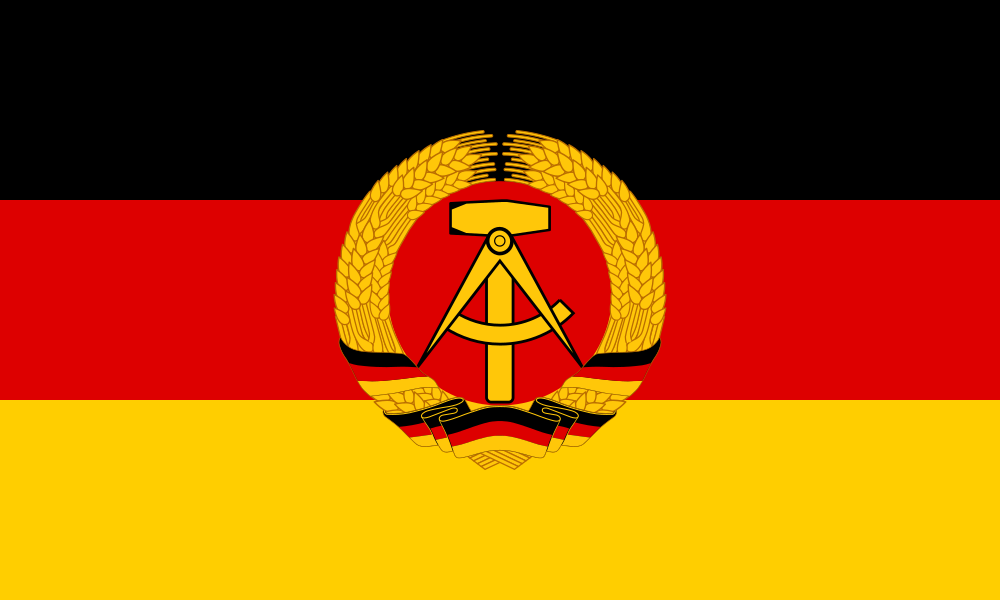
Mr. President, it is an honour for me to welcome you, a well-known political figure of your country, to the presidency of the Security Council for the month of March. I greet in your person the representative of a State with which the German Democratic Republic, on the basis of the principles of peaceful coexistence enshrined by the representatives of our States in the Final Act of the Helsinki Conference, strives to develop many-sided relations to our mutual advantage. I should like to express the hope and the confidence that the discussion of the questions on the agenda of the Council this month will bc conducted successfully by you on the basis of the principles of the Charter of the United Nations.
76. I wish to thank the members of the Council on behalf of the delegation of the German Democratic Republic, a member of the Special Committee against Apartheid, for this opportunity to take part in the discussion on the question of South Africa, in accordance with the request of the African Group.
77. The situation in southern Africa is known to all. The representatives of the African peoples have described in detail and analysed here in the Security Council the situation in that par-t of the world. World public opinion has every reason to be alarmed. The racist regimes in southern Africa continue to perpetrate shameful crimes in practising the policy of apartheid. It is not simply a question of the violation of the human rights of individuals; we are talking about crimes against humanity of a kind for which, in their time, the German Fascists were sentenced to death at Nuremberg. The racist regimes of Pretoria and Salisbury are in effect waging a race war against millions of people and taking a toll of many victims, They do not even stop at the murder of women and children. In allowing those militarists to continue their devilry, WC are witnesses of even more terrible crimes. It is not a question of whether
79. The racist rdgime of South Africa is daily increasing its armaments. Its arms expenditure has risen dramatically in recent years, thanks to the financial assistance from imperialist circles and from the international institutions under their influence. It is no secret that it was not without the assistance of certain NATO circles and their monopolies that the establishment in South Africa of the largest military and industrial complex on the African continent was effected. According to statistical data, for each white in South Africa there are more than two firearms. Furthermore, the racist rBgime has heavy and super-heavy arms the number of which they intend to increase in the future. It is not difficult to guess against whom those weapons are aimed. They are aimed against the citizens of their own country who will never reconcile themselves to oppression and exploitation, and against South Africa’s peaceful neighbours who concentrate their efforts on creating for their peoples a life worthy of human beings.
80. The very existence of free Angola, where the people govern, is seen by the Pretoria racists as a threat to their rigime. Therefore they try by force to direct in their own way the development of that former Portuguese colony. They have not succeeded in that, and now they are arming for a big war.
81. The apartheid regime in South Africa is a threat to peace and security. The dangerous exacerbation of the situation in that region is becoming unavoidable unless serious steps are taken to root out that danger. The situation is serious but not hopeless. It is different from that which faced us when the United Nations first dealt with the crimes of apartheid in South Africa. The 60.year old Great Socialist October Revolution, which showed all peoples the example of a successful liberation struggle, eliminated, with the exception of a few pockets, the old imperialist colonial system, and we are witnesses to the successful activities of the powerful liberation movements.
82. The oppressed and exploited peoples of South Africa are rising up to fight. They would be happy if it were possible peacefully to bring about thoroughgoing changes in the situation. The leaders of the liberation movements have tried on many occasions to achieve a peaceful settlement of the conflict, but it was illusory to try verbally to convince Vorster and his accomplices of the need to put a halt to the policy of apartheid Only a few weeks ago, in Time magazine, Vorster stated that he was not considering granting political rights to the Coloured population of South Africa, Therefore the freedom fighters are forced to have recourse to arms. The oppressed people are entitled to
83. The Charter of the United Nations provides for all necessary measures to be taken against a Member of the Organization which violates its principles as flagrantly as does South Africa.
84. In his statement on the occasion of the International Day for the Elimination of Racial Discrimination, the President of the General Assembly stated:
“Year after year resolutions are adopted by the United Nations and associated organizations calling for concerted action against the regimes that practise racial discrimination and apartheid. The world is entitled to ask why these resolutions have not been implemented. The answer is easy to find. There are still in this world too many nations which proclaim their opposition to apartheid and racial discrimination and unctuously denounced all acts of racial discrimination but those very nations contrive to give moral and financial support, either surreptitiously or with open and contemptuous disdain for world public opinion, to the very r&gimes whose policies and practices they pretend to condemn.“s. 6
It is well known which are the States whose Governments act in that manner. They are named in resolutions adopted by the General Assembly at its thirty-first session. They have also been named during the present discussion in the Security Council. And they have been named by those who are sufficiently familiar with this question. Of course, those Governments feel somewhat embarrassed when reference is made to their conduct, and they therefore try verbally to criticize the policy of npartheid or to atone by making financial contributions to one or another assistance fund, or else to refute the accusations in one way or another.
85, One fact seems to me very illustrative of what I have been talking about. A few weeks ago, at Nairobi, a conference was held of representatives of a so-called development service of a certain Western country. The participants in the conference were persons who worked in various African countries and were all well aware of the official policy of their Government towards Africa. In the resolution adopted by the conference, the participants state, among other things, that it is extremely difficult to defend the policy of their Government so long as that Government “not only tolerates but even supports rCgimes that economically exploit the indigenous population and deprive that population of all its basic human rights”. The participants in the conrerence therefore demanded a review of their Government’s policy with regard to South Africa. In particular, they demanded the rescinding of cultural agreements with South Africa which, they said, were of’
5 Quoted in English by the speaker.
6 See A/AC.1 15lL.462.
86. Indeed. what we require is not words; we require the will to act in regard to the apartheid r6gime in South Africa in accordance with the relevant General Assembly resolutions. It is useless to start looking for violations of human rights where they do not exist. It is useless to try to divert the attention of world public opinion from the crimes of the racist regime and those who support it-for, unfortunately, support is till being given to that rCgime. What is necessary is that there be respect for the international Convention on the Suppression and Punishment of the Crime of Apartheid [General Assembly resolution 3068 (XXVI1I)/ and that action in accordance with it be taken. The German Democratic Repubiic was one of the first States to sign and ratify the foregoing Convention. Subsequently, through the delegation of the German Democratic Republic, it took the necessary initiatives at the thirty-first session of the General Assembly.
87. It is for the United Nations to give special attention to the many flagrant violations of human rights and the threats to the peace that exist in South Africa. It is for the United Nations to take all the necessary measures to prevent the prolongation of the situation. Let us not be deluded by the manoeuvres used by Pretoria and its foreign protectors to influence international public opinion.
88. The foreign monopolies which obtain profits by exploiting the black workers do not wish to give up, and will never voluntarily give up, the possibilities that the apartheid rdgime offers them, In South Africa there are more than 500 branches of British monopolies, more than 400 branches of monopolies of the Federal Republic of Germany and more than 350 branches of United States monopolies.
89. The Governments of the capitalist States have said that they are not able to curtail the activities of their monopolies in South Africa. That is only an excuse. We have often seen the Governments of those States taking economic sanctions as a means of exerting pressure on the progressive States. And even today they are practising economic discrimination against such States.
91. The German Democratic Republic, like many other States, has no relations with South Africa, just as it has no relations with the illegal racist rkgime at Salisbury. Tile German Democratic Republic believes, generally speaking, that all political, military and economic relations with the racist rbgime must be severed.
92. My delegation supports all the just demands of the African States and the black freedom fighters in South Africa that are designed to ensure that the people of that State will be allowed to exercise their right to selfdetermination. We regard as of great importance unity of action between the African States and the liberation movements in regard to the total implementation of the resolutions on South Africa and Namibia adopted by the General Assembly at its thirty-first session.
93. As regards the Eastern European Socialist States and peoples, in their joint statement made in November 1976 [S/12255, annex I], their representatives at the highest possible level reaffirmed their willingness to give support and assistance in the future to the peoples of Zimbabwe, Namibia and South Africa in their selfless struggle against the racist rkgimes, against apartheid and the neo-colonial plots and in support of the implementation of United Nations resolutions with respect to the elimination of colonialism and racism. The General Secretary of the Central Committee of the Socialist Unity Party of Germany and Chairman of the Council of State of the German Democratic Republic, Erich Honecker, stated in his message to the Chairman of the Special Committee against Apartheid, on the occasion of the International Day for the Elimination of Racial Discrimination:
“I assure you that the German Democratic Republic, just like the other socialist States, will also in future make an active contribution towards putting an end to racial discrimination which has brought so much suffering to mankind. The German Democratic Republic will always be a reliable ally of peoples fighting for national and social liberation.“7
lke meeting rose at 12.55 p.m.
7 Ibid.
HOW TO OBTAIN UNITED NATIONS PUBLICATIONS
United Nations publications may be obtained from bookstores and distributors throughout the world. Consult your bookstore or write to: United Nations, Sales Section, New York or Geneva.
COMMENT SE PROCURER LES PUBLICATIONS DES NATIONS UNIES
Les publications des Nations Unies sont en vent@ dans les librairies et les agences depositaires du mondc entier. Informez-vous nupres de votre libraire ou adressez-vous B : Nations Unies. Section des ventes, New York ou Cen+ve.
ICAK. IIOJLYYPZITL H3flAHHfI OPl-AHH 3A4HH Ol3%E&NHEHHhIX HAII,HH
COMO CONSEGUIR PUBLICACIONES DE LAS NACIONES UNIDAS
Las public&ones de las Naciones Unidas e&in en venta en librerias y casas distribuidoras en todas partes de1 mundo. Consulte a su librero o dirfjase a: Naciones Unidas, Secci6n de Ventas. Nueva York o Ginebra.
Litho in United Nations, New York Price: $U.S. 1.00 (or equivalent in other currencies) 77-7OOOl-March 1978-2,200
▶ Cite this page
UN Project. “S/PV.1996.” UN Project, https://un-project.org/meeting/S-PV-1996/. Accessed .