S/PV.2109 Security Council
▶ This meeting at a glance
20
Speeches
10
Countries
0
Resolutions
Topics
War and military aggression
Security Council deliberations
East Asian regional relations
Global economic relations
General statements and positions
General debate rhetoric


Mr. President, the delegation of Kuwait would like at the outset to extend to you its warmest congratulations upon your assumption of the presidency of the Council for the month of January. It is a difticult month, but you have so far conducted the Council’s business with noble skill and efficiency. You and I have worked together in various organs of the United Nations for many years-in the Group of 77, the Committee of the Whole and the-Group of Non-Aligned Countries-and I have come to appreciate your dedication and devotion very much. We pledge our utmost co-operation under your guidance.
Provisional agenda (S/Agenda/2109)
1. Adoption of the agenda
2. Telegram dated 3 January 1979 from the Deputy Prime Minister in charge of Foreign Affairs of Democratic Kampuchea to the President of the Security Council (S/13003)
l?ze meeting was called to order at 3.55 p.m.
Adoption of the agenda
5. I should like also to welcome the new members of the Council-your country, Jamaica, and Bangladesh, Norway, Portugal and Zambia. My delegation is certain that we shall benefit significantly, nay enormously, from their contribution and wisdom. Our sense of loss at the absence of the outgoing members of the Council is adequately made up for by the presence of the new members.
IlIe agenda was adopted.
Telegram dated 3 January 1979 from the Deputy Prime Miier in charge of Foreign Affairs of Democratic Kampuchea to the President of the Secmity Council (S/13003)

In accordance with the decisions taken at the 2108th meeting, I invite the delegation of Democratic Kampuchea to be seated at the Council table. I invite the representatives of Cuba and Viet Nam to take the seats reserved for them at the side of the Council chamber.
6. My Government supported the request for convening the Council to consider the situation in Cambodia, as we believe that it is the right of every Member State to seek action from the Council whenever it feels that it is in need of such action. Furthermore, my Government also believes that the Council should meet when conditions in any region warrant such meetings. It would have been an abdication of responsibility on the part of the Council had it not met to consider the situation in Cambodia. It would have given additional ammunition to those self-appointed critics who have no other advice to offer the United Nations except what amounts to ridicule of the effectiveness of the Organization and undermining of its work.
At the invitation of the President, the delegation of Democratic Kampuchea took a place at the Council table; Mr. Roa Kouri (Cuba) and Mr. Ha Van Luu (Viet Nam) took the places reservedfor them at the side of the Council chamber.
I wish to inform members of the Council that I have received letters from the representatives of the German Democratic Republic, Hungary, Indonesia, Malaysia, Singapore, the Sudan and Thailand in which they request to be invited to participate in the discussion. In accordance with the usual practice, I propose, with the consent of the Council, to invite the representatives I have just mentioned to participate in the discussion, without the right to vote, in accordance with the provisions of the Charter and rule 37 of the provisional rules of procedure.
7. Now that the Council is seized of the situation in Cambodia, the question is, what can it do? The fact that the Council is meeting is important in the sense that it allows the parties concerned to ventilate their grievances, to present their views and to seek collective advice. This in itself is a step in the right direction. Yesterday’s debate was important, as it revealed information which we had not had before because of the confusion in the region.
At the invitation of the President, Mr. Zachmann (German Democratic Republic), Mr. Ha& (Hungary), Mr. Anwar Sani (Indonesia), Tan Sri Zaiton Ibrahim (Malaysia), Mr.
9. What can we do in these circumstances? My delegation believes that there are principles embodied in the Charter which should be emphatically reaffirmed.
10. First, my Government is against interference by any State in the domestic affairs of any other State. This is the quintessence of the Charter, and it is the basis of international law. No country should be allowed to interfere in the domestic affairs of others, neighbours or far-away, allies or potential adversaries. If such interference is not checked, it is bound to create tension with incalculable consequences.
11. Secondly, my delegation believes that it is important to reaflirm the obligation of Member States in accordance with the Charter to resolve disputes by peaceful means. It is not acceptable that Member States should resort to force when they feel that, through the use of superior force, they can wring concessions and obtain territorial gains. The territorial integrity of States, as well as their sovereignty and political independence, must be reafftrmed. It is true that we do not live in an ideal world and that States maintain their independence by means of armed deterrence, but it is also true that the Charter and the Security Council have a moral and political force which we cannot overlook simply because some of us are armed to the teeth and find protection in this fact. My delegation believes that the foreigninspired Lon No1 Government installed in Cambodia in 1970 collapsed because of the incisive effect of the isolation which the non-aligned countries were able to impose on it, notwithstanding the superior military force of its backers.
12. Thirdly, in the situation in Kampuchea, it is essential to call upon all foreign elements involved scrupulously to observe an immediate cease-fire and to withdraw forthwith to the areas they were in before the eruption of armed clashes. It is not in line with the reality of the situation to assume that tranquillity is prevalent inside Cambodia. There are elements fighting each other. There is foreign interference from identified and unidentified elements in the situation in Cambodia and, as long as those foreign elements have a hand in the Cambodian problem, the situation will remain explosive.
13. The immediate concern of the Council should be the creation of an atmosphere conducive to stability in the region. This cannot be brought about by the unnecessary exchange of polemics and acrimony. We have not come here to participate in a competition, to score points. The stability of the region is irreconcilable with power politics. That luckless and hapless region, which has not witnessed stability for the last three decades, deserves a more serious approach than the one accorded to it so far. My delegation believes that preservation of the sovereignty, territorial
14. Mr. &CARD (Norway): Mr. President, I should like to extend to you our sincere congratulations on your accession to the presidency of the Security Council for this month, and on Jamaica’s election to the Council. We are convinced that our very close cooperation in other organs of the United Nations will continue and be further strengthened as a result of our joint participation in the work of the Council. My congratulations also go to the other new members of the Council.
15. I should also like to take this opportunity to thank previous speakers for their kind words of welcome to my country upon our election to this highly important body of the United Nations. I can assure all members of my delegation’s full and close cooperation during the next two years.
16. It must be deplored that the troubled region of Indo- China has once more been subjected to war and human suffering. This region is in particular need of reconstruction and reconciliation between countries and peoples. This fact has been recognized by the whole international community, including Norway, which has felt committed to assist in this enormous and pressing task of reconstruction. The Norwegian Government has therefore witnessed the recent developments in Indo-China with increasing concern.
17. The situation that we are facing in Kampuchea today is an example of armed conflict and foreign intervention as well as interference in the internal affairs of another country in violation of fundamental principles of the Charter. The present conflict also has repercussions which may influence peace and stability beyond the region itself.
18. The Norwegian Government and public opinion in Norway have expressed strong objections to the serious violations of human rights committed by the Pal Pot 3 Government. However, the domestic policies of that Government cannot-we repeat, cannot-justify the actions of Viet Nam over the last days and weeks. The Norwegian , Government firmly rejects the threat or use of force against the territorial integrity or political independence of any ‘, State and wishes to emphasize the obligation of Member States under the Charter to resolve disputes by peaceful means.
19. It is imperative that peace, security and stability should be restored to the region in accordance with the principles of the United Nations. This requires an immediate end to hostilities, the withdrawal of all foreign forces and strict observance of the principle of non-interference in the internal affairs of another country.
20. Mr. I-IULINSKq (Czechoslovakia) (inrerprerutionfic~ R&m): In the course of the unofIicial consultations among members of the Council, Czechoslovakia already warned of the danger of involving the United Nations in an attempt to intemationalize the internal conflict being experienced by one of its Member States, in order to impose upon that State, through .the intermediary of the Council, a solution to its
21. The Khmer people did not acquiesce in the antipeople policies of the Pol Pot-Ieng Sary regime and rose up under the leadership of their genuine representative, the United Front for the National Salvation of Kampuchea. The declarations made by the United Front on 2 and 26 December 1978 have been published as document S/13006. We have been informed that the people of Kampuchea have now proceeded to a final offensive against the barbaric r&me, which practised a policy of mass annihilation of the population thus threatening the very existence and the future of the entire Khmer people.
22. The documents and the information which are available to members of the Council adequately reflect the tragic plight of Kampuchea in recent years. But those documents and that information also make it clear that this is an internal crisis whose solution is not within the purview of the Council. It is the Khmer people alone who can solve this crisis and who are in fact solving it. The telegram from the President of the People’s Revolutionary Council of Kampuchea which was addressed to the President of the Security Council [S/13023, annex I. once again confirmed that fact. The Pol Pot regime was overthrown on 7 January and the People’s Revolutionary Council started to exercise effective control over the entire territory of the country. Conseuently, as the telegram emphasizes,
“any meeting of the Security Council for the purpose of hearing the representative of the Pol Pot clique or, in other words, of the non-existent government constitutes flagrant intervention in the internal affairs of the Kampuchean people and a violation of the principles of the Charter of the United Nations*‘.
The Czechoslovak delegation shares that view.
23.. At the same time, the Czechoslovak delegation would like to express its conviction that the Security Council should protect itself from any slanderous fabrications by the representatives of the People’s Republic of China against the Socialist Republic of Viet Nam. The people of Kampuchea have been able to distinguish their genuine friends and allies from those who, from outside, strengthen that r&me which is at variance with the interests of its own people. The Khmer people must surely be put on its guard also by the fact that the same foreign militaristic circles that have involved it in a bloody conflict, that for many years bombed Kampuchean cities and villages and brought death and tragedy into the streets of Phnom Penh, are now showing concern about the independence of the Khmer State. Is it not an eloquent fact that those who so often have shown alleged concern for human rights are now in agreement with those who became accomplices in the crimes of the regime of Pal Pot against the people of Kampuchea? No, the Khmer people will never forget the countless graves; it will not forget the lessons of history, nor will it be able to forget those who attempted to stem its national liberation movement. ^ 24. I should like to take this opportunity, on behalf of the delegation of the Czechoslovak Socialist Republic, to
“The Czechoslovak people was glad to hear of the creation of the People’s Revolutionary Council of Kampuchea. Together with you and all progressive forces in the world we rejoice in the victory which was scored by the Kampuchean people for liberty, progress, democracy and international solidarity and also at the fact that the Kampuchean people have now become the true masters of Kampuchea.
“On behalf of the Czechoslovak people and Govemment, we would warmly congratulate the People’s Revolutionary Council of Kampuchea, the only legal repreentative of Kampuchea, and the entire people of your country on this important event of historic signifcance.
“We are convinced that the restoration of democratic rights and the liberty of the Kampuchean people in an independent and democratic country will make a positive contribution to the further deepening of friendship, co-operation and good-neighbourly relations between the countries of Indo-China and other countries in South-East Asia and will help to consolidate peace and stability in that part of the world.
“It is our belief that the traditional links of friendship between our countries will be further strengthened for the well-being of our peoples and in the interests of progress and peace throughout the world.
“We ask you, therefore, to accept our wishes for further successes in your struggle to realize the age-old dreams of the Kampuchean people as expressed in the programme of the United Front for the National Salvation of Kampuchea.”
25. At the end of my statement I cannot refrain, albeit briefly, from responding to the vicious attacks of the representative of the People’s Republic of China. His statement is part and parcel of the anti-Vietnamese campaign and the provocations of the Government of the People’s Republic of China against socialist Viet Nam.
26. As can be seen from the statement of the suokesman of the Ministry of Foreign Affairs of the Socialisi Republic of Viet Nam dated 7 January 1979 [S/13009, rmnex], the blatant campaign of Peking against the heroic people of Viet Nam and against its external security is becoming more and more dangerous in nature. The concentrations of Chinese troops near the Vietnamese frontier, border provocations, territorial claims on Viet Nam, slanderous stereotyped
27. It was at the behest of Peking that the former Phnom Penh leadership started to stir up conflicts on the Viet Nam-Kampuchea frontier. For approximately three years, China and its tens of thousands of “advisers” have done everything to remodel Kampuchea along Maoist lines and turn it into a spring-board for provocations against neighbourini States, primarily socialist Viet Nam. Behind the executioners of Kampuchea, now overthrown by their own people, stood the leaders of the People’s Republic of China with their nationalistic, chauvinistic and expansionist policy in Asia. Since they carried out one of their usual adventures in Cambodia and were defeated, they are now trying to confuse public opinion by imposing this debate on the Security Council and making references to the Vietnamese people. However, some eminent Chinese have grasped the deleterious effects of that policy for China itself. In the middle of the 19% the former President of the People’s Republic of China, Liu Chao Tchi, warned:
“If one follows the bourgeois-national% concept of the nation . . ., opposes the Soviet Union instead of uniting with it, opposes the people’s democracies instead of uniting with them, opposes the communists, the proletariat and the people’s democratic forces in all countries instead of uniting with them, opposes the national liberation movements . . ‘ instead of uniting with all the oppressed nations . . ., then one will of course unite with .the imperialists . . ., will of course line up with the .imperialists . . ., will of course fail to achieve national liberation, will never accomplish anything in the cause of socialism, will of course make one’s own nation prey to the deception and aggression of the imperialists, with the result that that nation will lose its independence and become a colony of the imperialists.“’


First of all I should like to bid you, Mr. President, a very warm welcome to the Council. Jamaica and France have long enjoyed very good relations. Although new here, you have been very well known to all of us for a long time. By chance you have been called upon immediately to assume the presidency of the Council, and I welcome that fact. I am aware of your great experience in United Nations affairs and, therefore, am confident that you will conduct our Mpioceedings expertly.
29, My welcome goes also to Bangladesh, Norway, Portugal and Zambia, countries which are all friends of France, and I welcome their presence here in the Council.
30. To those who have left us-Canada, the Federal Republic of Germany, India, Mauritius and Venezuela-I wish to say how much we have valued their co-operation over the past two years that were full of important events.
31. I cannot conclude without paying a tribute to my friend and colleague Baron Riidiger von Wechmar for his
* Quoted in English by the speaker.
32. I should like at the beginning of this new year to express my best wishes for peace and prosperity to one and all.
33. The Security Council has before it a question of particular importance and undeniable gravity. Its various aspects and its implications over the short and long term inight first seem forbiddingly complex, and truly it ,is a very complex situation. However, in France’s opinion, a consideration of the situation yields a rather simple and clear response, and that is why my statement will be brief.
34. At the very beginning of the conflict between Viet Nam and Cambodia, towards the end of 1977, France made known that it deplored the hostilities between two peoples with which it had enjoyed long-standing ties of friendship. We considered that only a peaceful settlement of their differences would make it possible for their peoples to tackle their essential tasks and turn their attention to their economic and social well-being. Now, a year later, it is with sadness that we note the outcome of the situation which, from the very beginning, we thought was fraught ‘tith major perils, both for Vief Nam and Cambodia as well as for the whole of South-East Asia. 2
35. On a number of occasions and specifically in the United Nations we have condemned the excesses of the ruling team at Phnom Penh and their frantic efforts to force Cambodia into the mould they had created. The Council of Ministers of the French Republic, meeting on 10 January, has evoked once more the suffering endured by the Camb& dian people and expressed the sympathy of the French people in that regard.
36. For all that, bearing in mind those excesses and that suffering and having heard the statement by Prince Sihanouk, whose patriotism has been recognized by everyone, we cannot condone occupation of a sovereign country by a foreign Power. The notion that because a rbgime is detestable foreign intervention is justified and forcible overthro\F! is legitimate is extremely dangerous. That could ultimately jeopardize the very maintenance of, international law and order and make the continued existence of various r&imes dependent on the judgement of their neighbours. It is important for the Council to affirm, without any ambiguity, that it cannot condone the occupation of a sovereign couni try by a foreign Power.
37. Our friendship with all the peoples of the area and our concern for their future prompt us to conclude that it is indispensable for Kampuchea to keep its territorial integrity under a genuinely independent, democratic and peaceful rtgime; and we hope that the Council will take a clear stand on that point. It is not only the well-being of the Cambodian people-which has already been so sorely tried--that is at issue; the stability of South-East Asia is at stake. There can be no genuine peace and cooperation iimong the nine States in the area if the fate of one of them arouscs suspicion and fear and if we stray from the promising course of action opened by the talks which h&e be&m between the Prime Minister of Viet Nam and the leaders of the Association of


Mr. President, your dtbut in this august body has been a baptism by fire, not only as a new member but also in your capacity as President of the Council. You have our fullest sympathy and our wholehearted support. In the brief time that you have served as President, you have already aflirmed your leadership abilities, diplomatic skills and a wealth of proven qualities which, I am confident, will enable the Council effectively and successfully to fulfil its tasks in the course of this month. Bangladesh is particularly proud to serve under the leadership of a representative of Jamaica, a country with which we have the friendliest relations and the closest identity of interests as fellow members of the non-aligned group and the Commonwealth and as developing States.
39. I wish to thank you and the other members for the warm welcome accorded to me and to the members of my delegation. We sincerely reciprocate the sentiments and hopes that have been expressed. I consider it a great honour and privilege to work in close association with the estab liihed members of the Council whose experience and advice will be of immense benefit to us. I welcome also the opportunity of working in close concert with the newly elected members, who, we believe, will add enormously to the effectiveness of this body in its deliberations.
40. Bangladesh is immensely proud of this opportunity to serve in the Council. We are equally conscious of the heavy responsibility that has befallen us. We are firmly resolved to contribute to our utmost and to spare no efforts, in a spirit of constructive co-operation, in the furtherance of our work. It is our belief that it is only in an atmosphere of harmony, flexibility and mutual restraint that our efforts can be most productive and that our active concern should be tempered by moderation and decorum in language.
41. Bangladesh sought membership of the Council because of our confirmed belief not only that the United Nations serves, in particular, the interests of smaller nations such as our own, but also that the latter have a duty and responsibility to contribute actively to the promotion and furtherance of its objectives: the resolution of conflicts by peaceful means; the achievement of a disarmed world, free from domination and interference; the elimination of colonialism and racial discrimination in all its manifestations; the acceleration of social and economic well-being in a new international economic order; the promotion of elemental human rights and respect for the rule of law.
42. President Ziaur Rahman has repeatedly affirmed that adherence to the purposes and principles of the Charter of the United Nations is not merely an article enshrined in our Constitution, but a fundamental article of faith of the Government and people of Bangladesh; a crucial comerstone of our policy is strict adherence to the principles of non-alignment. A cardinal imperative is to ensure that sovereignty and genuine freedom of action will not be compromised by external interference from any source whatsoever. We have also placed particular emphasis on principles underscoring freedom from subjugation and exploitation,
43. It is in this spirit that I now turn to the item on our agenda. The Government of Bangladesh supported the inscription of the item regarding the consideration of the situation in Kampuchea, in keeping with our stand of principle that every Member State which claims that it faces a situation likely to endanger peace and security has the inherent right to be given a hearing and that the Council, in keeping with its mandate under the Charter, has a clear responsibility to examine the question. We also believe that discussion in the Council provides that necessary safetyvalve that would encourage defusion rather than exacerbation of tension.
44. Bangladesh has viewed with the utmost dismay the disturbing events that have unfolded in Viet Nam and in Kampuchea. We have listened with the closest attention to the statements that have been made in the Council by parties directly concerned, and our sense of concern and grief over these developments has been compounded, as has ~ also our appreciation of the fact that the situation is indeed fraught with danger to international peace and security.
45. This is so because Bangladesh has the closest of relationships and an identity that binds it with the peoples of both Kampuchea and Viet Nam. We are Asian neighbours, bound by numerous ties of history, culture, geography, and by the common hopes, fears, aspirations and expectations of our peoples. Not the least of these bonds is our shared experience of numerous economic adversities that we must strive to overcome. We are all developing countries faced with the urgent task of national reconstruction and rehabilitation that has remained a legacy of our struggle for nationai liberation and genuine independence. We are all politically affiliated as fellow members of the non-aligned movement seeking an independent path to national selfexpression and a constructive role in the world comity of nations For the people of Bangladesh, this sense of identity and friendship is heightened not only by our close geographical proximity but also by a universal regard for the courage and determination displayed by the peoples of Kampuchea and Viet Nam in their fight to free themselves from foreign bondage and intervention. The leaders of those countries in their protracted fight for liberation have long been revered persons for the people of Bangladesh and an example to which we have pointed with pride.
46. Unfortunately, however, the travail of conflict and war seems to continue to haunt this area, which only a short
serious consequences for the whole of Asia.
47. In touching on the recent events afflicting this region, it is not our intention or inclination to point an accusing finger at one or the other party. That a conflict exists has been evidenced by numerous media reports and the statements of various parties directly concerned in the region and of leaders around the globe. That the situation is complex, confusing and extremely fluid is now an accepted fact. That blood has been shed and fighting continues is also an incontrovertible fact. That the situation can further escalate, involving additional countries in the region and, indeed, potentially a great Power entanglement, remains an ever present danger. The role of the Security Council in containing and dampening tension is therefore all the more urgent.
48. Bangladesh is solely motivated by a concern to assist in the task of mobilizing all efforts and all countries committed to peace to defuse the tension, to restore peace and tranquillity in the region and to promote reconciliation and the settlement of the problems within and between the two countries involved.
49. In approaching this task, I wish to reiterate that Bangladesh’s primary concern is to play a positive and constructive role that can contribute to, rather than detract from, a peaceful solution. In so doing, Bangladesh is governed by its strict adherence to and respect for the principles of the Charter of the United Nations and of the non-aligned movement, including the cardinal principle that States shall refrain, in their international relations, from the threat or use of force against the territorial integrity or political independence of any State and the principle that States shall settle their international disputes by peaceful means in such a manner that international peace and security and justice are not endangered.
50. Bangladesh is prepared to join other members of the Council in supporting measures aimed at restoring peace and stability in the region. To this end, we believe that in any solution it may adopt on the issue before us, the Council must include the following basic elements: first, thecouncil must take cognizance of the deteriorating situation; secondly, it must reaffirm the principle that States must fully respect the sovereignty of other States and the right of peoples to determine their own destiny, free from external intervention, coercion or constraint, especially involving the threat or use of force, overt or covert, and refrain from any attempt at the partial or total disruption of the national unity and territorial integrity of any State or country; thirdly, it must call for the scrupulous observance of an immediate cease-fire, an end to all hostilities and the withdrawal of all foreign elements involved in the situation to the areas they were in prior to the outbreak of hostilities; fourthly, it must call upon the parties concerned to refrain
51. In submitting these suggestions, it is our earnest hope that the unfortunate situation brought before the Council will find a very speedy resolution. Bangladesh remains committed in any and every way to furthering all efforts directed towards this end.


Sir, I should like to bid you a sincere and cordial welcome in your capacity both as President and as representative of an esteemed country of the Latin America group, as well as an enlightened diplomat and a person of great experience and pleasant character. Bolivia has many reasons to feel bound to Jamaica, and my country will cooperate with you in a most forthright and determined manner.
53. On behalf of Bolivia, I wish also to voice our great pleasure at the election of the new members of the Council. We bid welcome to the representatives of Bangladesh, Norway, Portugal and Zambia, who will wisely and dispassionately be assisting us in the difficult work of the Council in 1979, a year which already is fraught with problems.
54. At the same time, my delegation wishes to express its appreciation to our colleagues who have left the Council but who demonstrated wisdom and talent during the period of their mandates. I would also voice my admiration and friendship for the representative of the Federal Republic of Germany, who did effective work as President for the month of December.
55. MY delegation feels that the convening of this meeting of the Counciiis appropriate because a question of principle is involved: Cambodia-or Kampuchea-a Member State of the United Nations, has requested that the Council should meet to examine a conflict which its Government has described as interference by another State with its security and its right to self-determination. Subsequently, further events have occurred which reveal that the tension, far from abating, has become more acute, to the point where a situation not merely critical but also confused has been created, inasmuch as there are two governments which claim the right of representation: the Pol Pot regime, which apparently continues in existence somewhere in the country, and the People’s Revolutionary Council, which has set itself up in the capital.
56. In the circumstances, it is difficult to determine which one is in power and has the acceptance of the people of Kampuchea, who alone will ultimately determine its legitimacy. Until this is clear, whether one side or the other is recognized will depend on how the various countries are
57. Bolivia, as I need hardly mention because it is so well. known to everyone, believes that its greatest contribution to the Security Council will always be based on the fundamental tenets of humanism as set forth in the principles of the Charter. As a genuinely non-aligned country, my country is extremely understanding of the situation in Kampuchea, a heroic country that has fought for many long years for freedom, yet once again is involved in a war which has all the serious features of those conflicts that exceed the defence capabilities of weak nations and make them the victims of the hegemonic ambitions of more powerful countries. Bolivia, like many other dependent nations in the world, is familiar with the frightening implications of this kind of misfortune, and we feel for the people of Kampuchea in its suffering.
62. We make that appeal to Kampuchea and Viet Nam because they are countries similar to those which, like Bolivia, have suffered from the evils of underdevelopment and will continue to be victims of dependence, unless they learn to live in peace and relinquish desires not in the interests of their nations.
-63. Therefore, we support the initiative of the President of the Association of South-East Asian Nations and we believe that the Secretary-General should visit Kampuchea and Viet Nam and, with their leaders, consider how best to reach agreement to bring about the withdrawal of all the forces that have invaded Kampuchea, as a measure prior to any peace agreement and in order to permit free elections under United Nations control.
58. That, then, is the reason for our position. That is why we have joined the members of the Council who felt that it was useful to hear the representative of the Government of Kampuchea. But I think that it should also be made perfectly clear that our hearing of his testimony should not by any means be taken as support for or solidarity with the acts of the r6gime of Pol Pot, an individual who tried to impose on Kampuchea a palaeolithic system of government whose harshness and cruelty in no way accorded with respect for human dignity.
59. Our position is also based upon full respect for the, principle of non-intervention proclaimed by the Charter. For that reason, we cannot help but feel concerned, and we view with apprehension the fact that, in that embattled area of the world, where we had thought that after so many sacrifices peace and justice would come, coercion continues to be employed to defeat a people and deprive it of its inalienable right to freedom and to elect its leaders. It is distressing to see that the long years of war and the ardent yearning for freedom demonstrated to the entire world by, the peopie of Viet Nam have not led to guarantees for peace in that area or made It possible for the sister nations of Indochina to stanch their wounds and work together for the well-being of their peoples.
60. For those reasons, we believe that the Security Council must fulfil its functions and discharge its responsibility under the Charter. Until the true situation in Kampuchea becomes clear, the Council must continue-as the President has so wisely and firmly done-to gather whatever information it can, and, when that course of action has been completed, a formula promoting reconciliation and peace must be agreed upon. But that must not mean capitulation to interventionism or acceptance of faits accomplis. No, a decision must be adopted that will once again render unequivocally effective the essential principles of peaceful coexistence, the right to peace, territorial integrity, and self-determination and freedom for the people of Kampuchea in accordance with the Charter.
The next speaker is the representative of the German Democratic Republic. I invite him to take a place at the Council table and to make his statement.

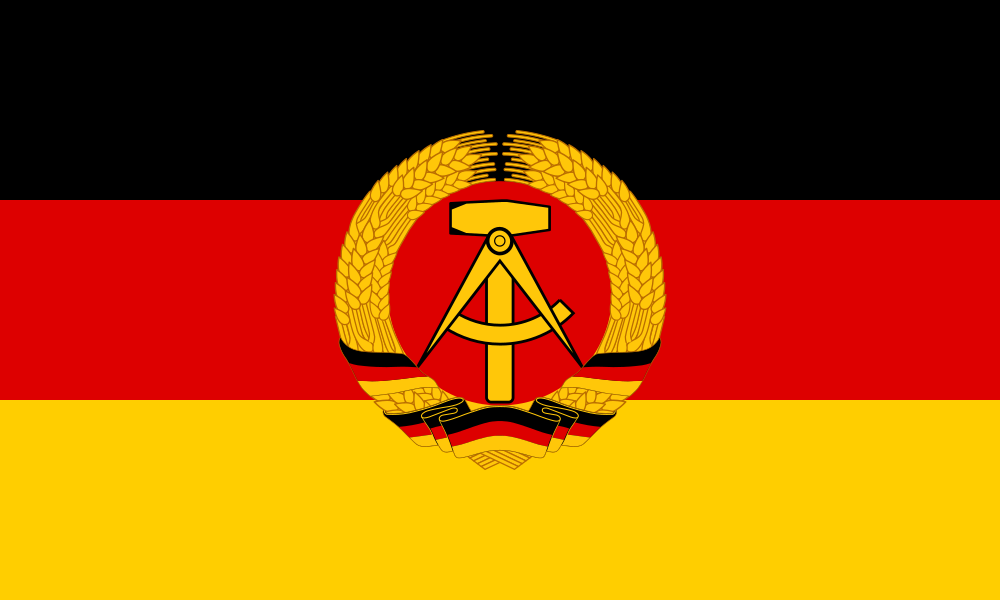
Mr. President, permit me to congratulate you on your assumption of the responsible office of President of the Security Council and express my belief that, under your presidency, the Council will take decisions on matters within its competence that will serve the interests of international peace and security. Your wealth of experience and your great diplomatic skills are the best guarantee of that. Your personal and untiring efforts towards a solution of the problems facing the United Nations are also highly respected by my delegation. We are all the more pleased by your assumption of thii office, since the German Democratic Republic maintains manifold and friendly relations with your country. I should also like to take this opportunity to welcome the new members of the Council.
66. My delegation profoundly regrets that the Security Council is considering a matter which is exclusively of concern to the people of Kampuchea. This only opens the door to interference in the internal affairs of the People’s Republic of Kampuchea, interference which contradicts the declared purposes of the United Nations and represents a violation of the Charter. The delegation of the German Democratic Republic is, like other delegations, participating in the debate of the Council in order to raise the voice of truth and to speak out against those forces which try to misuse the United Nations for their own selfish aims and to use the rostrum of the world Organization to slander socialist States.
67. In the German Democratic Republic the just struggle of the people of Kampuchea is being followed with great
68. Now power is in the hands of the people of Kampuchea. The progressive forces of the world sincerely welcome its victory. Of special importance are the first and consistent steps of the People’s Revolutionary Council of Kampuchea towards the restoration of the most elementary human rights in that country. All discriminatory measures of the former regime have been annulled. The objectives contained in the progressive programme of the United Front for the National Salvation of Kampuchea aimed at peace, freedom, independence, national dignity and social progress are welcomed by the people and supported energetically. They should also be welcomed and supported by all those who earlier spared no words to complain about the massive violations of human rights by the Pol Pot-Ieng Sary r&me. This is indeed a touchstone of one’s seriousness about the struggle against massive violations of human rights.
69. Through the victory of the Khmer people, the policy of great-Power chauvinism, hegemony and brutal suppression of a small people has suffered a defeat. The cause of peace, of the right of the peoples to national independence and self-determination and of humanity has prevailed. This is the true reason why international reaction is spreading many lies, why the liberation struggle of the Khmer people is defamed, and why socialist countries are slandered. Is it not the height of unscrupulousness when a permanent member of the Security Council makes shameless use of a person who until recently was himself a prisoner of the Pol Pot regime, in order to pursue its hegemonic aims?
70. The people of Viet Nam which has for decades waged a sacriticial struggle for its freedom and independence against imperialist colonialists and aggressors and which is at present engaged in a struggle to overcome the consequences of a barbaric war needs peace as a flower needs light. It is striving for good-neighbourly relations with the other peoples in the region, relations which are a decisive prerequisite for the peaceful construction of a free and sovereign Viet Nam.
71. The activities of the Socialist Republic of Viet Nam in the field of foreign policy vividly demonstrate that the Vietnamese Government does everything it can to achieve these objectives. For this reason, Viet Nam has already, months ago, rightIy rejected the border provocations of the Pal Pot regime and has done everything necessary to achieve a peaceful settlement of the conflict by way of negotiations, Eventually, in view of the policy of those who were behind the aggressive acts of that regime, it was
72. The nolicv of the Socialist Renublic of Viet Nam is aimed at eliminating sources of con&t in the region and at guaranteeing stable peace and security. This apparently does not please those forces whose schemes suffered an ignominious defeat in Kampuchea. Neither by slandering the just struggle of the Khmer people against the barbaric regime nor by spreading lies about the Socialist Republic of Viet Nam can international reaction make it any less true that a new stage has been initiated in the political life of the people of Kampuchea by the elimination of the terrorist regime in Kampuchea and the victory of the people under the leadership of the United Front for the National Salvation of Kampuchea, a stage of friendly relations and cooperation between Kampuchea and Viet Nam as well as the other States of South-East Asia. This opens up new perspectives for the maintenance ofpeace and security in the region.
73. The German Democratic Republic vigorously objects to any attempt to accuse the Socialist Republic of Viet Nam of a policy of interference in the internal affairs of another State. If in connexion with the people’s insurgence in Kampuchea there can be any talk at all of outside interference in internal affairs, it comes only from those forces which have long tried to stir up tensions in South-East Asia and which, as is known, are themselves preparing aggression against peaceful Viet Nam. In the statement of the Ministry of Foreign Affairs of the Socialist Republic of Viet Nam of 7 January 1979 [S/Z3OOa reference is made to the intensified border provocations and massive troop concentrations of China. These are facts which speak for themselves.
74. The German Democratic Republic welcomes the objectives of the People’s Revolutionary Council which envisage the construction of a peaceful, democratic, neutral and non-aligned Kampuchea and has, consequently, recognized the Council. The people of the German Democratic Republic feels itself fraternally allied with the struggle of the people of Kampuchea and is prepared to establish comprehensive relations and deveiop all-round co-operation.
75. The People’s Revolutionary Council has taken over power in the country and is the sovereign ruler over its domestic and foreign affairs. That Council, headed by its President Heng Samrin, is the only authentic representative, the legitimate representative of the people of Kampuchea. Neither any representative of the regime ousted by the people nor any private person has the least right to represent ’ the people of Kampuchea. ,The People’s Revolutionary Council alone is authorized to represent the interests of the people of Kampuchea. The German Democratic Republic urges strongly that, in accordance with Article 31 of the Charter and rule 37 of the provisional rules of procedure, a representative of the legitimate Government of the People’s Republic of Kampuchea should be given the opportunity to speak before the Council.
76. We are convinced that ail manceuvres to hah orozress are doomed to failure, and that the just cause of the p&ple of Kampuchea will triumph.
The next speaker is the representative of Hungary. I invite him to take a seat at the Council table and to make his statement.
84. The Front and the later-established People’s Revolutionary Council of Kampuchea have liberated their country and its capital, Phnom Penh, with the support of the people. The former r&ime, having lost all popular support and having discredited itself in the eyes of the inhabitants of the country, rapidly collapsed and ceased to exist.


Mr. President, I wish first of all to thank you for giving me the opportunity to speak in the discussion of the item on the agenda. We hope that our contribution to this debate can help all of us better to understand the situation prevailing in Kampuchea.
85. The Hungarian People’s Republic has recognized the United Front for the National Salvation of Kampuchea as the only legitimate representative of Kampuchea and wishes to state on this occasion that, in its opinion, all debate on the Kampuchean issue in the Security Council should take place in the presence of the representative of the Front.
80. I should also like to seize this occasion to tell you, Mr. President, how pleased we are to see in the Chair of the Security Council the representative of a friendly country with which Hungary maintains excellent relations in all walks of life. I would express to you our conviction that the links which so happily exist between Jamaica and my country will further develop in the future, to the benefit of our two peoples.
86. During the debate we heard Prince Sihanouk whom we consider to be an individual who has no right to represent Kampuchea. We know Prince Sihanouk from earlier times for his contribution to hi country’s independence and development. However, when listening to his statement yesterday [2Z08th meeting], we could not help feeling that he had been misled as a result of the isolation and ignorance in which he was kept during the past years by the same regime which he now tries to defend in this forum, the regime which has met with universal reprehension and condemnation. The true dimension and impact of the arbitrary and inhumane actions of that regime are probably not yet known to him or to the outside world. We are actually sorry that the Prince plays-or is compelled to play-that role. In the light of his political career, we cannot believe that his assessment of the Pol Pot-Ieng Sary regime and of the conditions prevailing in his own country is authentic, genuine and sincere. That is not his voice, but that of the defunct r&ime and of its protectors.
8 1. Since the Security Council is now discussing the question of Kampuchea, I should like to take this opportunity to state my country’s position on this issue. It was with deep satisfaction that the Hungarian Government and public opinion learned of the victories of the Indochinese peoples in their historic fight to restore genuine national independence and freedom. It was in that spirit that we hailed the victory of the armed resistance of the Kampuchean people ,four years ago.
82. Unfortunately, the development of events in Democratic Kampuchea as time went by caught us more and more by surprise and caused us sorrow. We had to come to the conclusion that the leadership of that country was conducting the land and its people down perilous paths of conflict with its neighbours and of human suffering and material waste inside the country. We were forced to realize that those who were in power at Phnom Penh had little to do with the national interests of the people and that they had completely failed to rebuild long-suffering Kampuchea, to restore its normal economic, social and cultural life, and to lay the foundations for the prosperity of its ancient people.
The next speaker is the representative of the Sudan. I invite him to take a place at the Council table and to make his statement.


On behalf of my Government, I wish to express to you, Mr. President, and through you to the other members of the Council my gratitude for allowing me to participate, without the right to vote, in the deliberations of this august body.
83. In those circumstances-which lasted for several years and were dangerously aggravated by a senseless border war against the Socialist Republic of Viet Nam, a country which aspired to peace more than anything else in order to reconstruct its war-tom economy-it came as no surprise that the latent confusion and anger of the inhabitants of the country as a result of the ruthless oppression and unprecedented obscurantism of the leaders of Kampuchea had led to resistance to the Pol Pot-Ieng Sary regime and to the formation of the United Front for the National Salvation of Kampuchea. The Front whose aim is to take Kampuchea along the road of genuine independence, economic and social pro gress, democracy and non-alignment, to promote goodneighbourly relations and co-operation, and, hence, further stability in the region of South-East Asia, unites the broad masses of Kampuchean patriots who wish as soon as possible to turn over the dark pages of their contemporary
89. We are prompted to intervene in this discussion by our deep concern over the events that have taken place in the past few days and by the manner in which the Security Council has been pressured to ignore a situation which, in our view, constitutes a threat to international peace and security and which involves the sovereignty and territorial integrity of a country, a Membeiof the United Nations and a member of the non-aligned group, to which we belong.
90. Democratic Kampuchea is a Member of the United Nations and, until a few days ago, its Government enjoyed the recognition of the full membership of the world Organi-
91. The affairs of Kampuchea can only be settledby the people of Kampuchea. The United Nations or its Member States cannot pass value judgements on the performance and policies of Member Governments. If we choose to ignore that basic principle then we run the risk of condoning intervention in the internal affairs of Member States.
92. We, as members of the Group of Non-Aligned States, consider strict adherence to that principle to be the main and indeed only guarantee for small Powers having to face up to the exigencies of the rapidly changing gee-political map of the world. The genuine members of the Non- Aligned Group cannot be swayed in their firm adherence to the principles and objectives of the non-aligned movement by constant changes in the policies of the major Powers vis-a-vis the small Powers in the course of their rivalries to control the international waterways or the potential locations of sources of energy, or by other factors and considerations which nowadays seem to influence the strategies of major Powers.
93. We feel that the eloquent plea by Prince Sihanouk, one of the founders of the non-aligned movement, on behalf of the people and the internationally recognised Govemment of Kampuchea should be given the serious consideration it deserves by the members of the Council. What is involved is both grave and vital and, if we allow the present drift towards lawlessness in international affairs to continue unchecked, then perhaps other representatives of small Powers whose misfortune or geographical location places them within the orbit of an evolving strategy of one major Power or the other may find themselves occupying the very chair which is occupied today by the representative of the legitimate Government of Kampuchea.
94. My Government considers it a matter of the utmost importance for the Security Council to adopt whatever measures it deems necessary to alleviate the suffering of the people of Kampuchea, redress the deteriorating situation in the region, uphold the principles of the Charter and of the non-aligned movement, including the principle of noninterference in the internal affairs of Member States, and use all its power and authority to maintain the sovereignty and territorial integrity of all countries, especially the small ones.
I call on the representative of Democratic Kampuchea who has asked to be allowed to speak in exercise of the right of reply,
97. I have been trying since yesterday to restrain myself from responding to their unjustified attacks. I have tried not to reply to their insults, especially the insults of Cuba. I even ventured barely a few hours ago to announce to the intemational press that I would not exercise my right of reply. I had hoped that that would give the Council all the time it needed to pursue its work, but, having heard the somewhat sarcastic “tribute” paid to me by the head of the Hungarian delegation and having heard him say that I was acting a part here in this respected gathering, I believe that the time has come for me to speak out.
98. First, allow me to tell the Council’ an old story. Between 1970 and 1975, we in Cambodia were engaged in an armed struggle with United States imperialism, which, with the complicity of General Lon No1 and his clique at Phnom Penh, had committed aggression against us. They had sent out against us many aircraft, tanks and United States and South Vietnamese infantrymen. China immediately made its services available to us and offered help in every way. It even said that it was prepared to send us volunteers to try to drive the Americans out of our country-using guns if necessary. We took advantage of all the assistance offered to us by the Chinese, except the offer of volunteers, since our entire people, with the exception of the Lon No1 traitors, was prepared to fight, if necessary, to the last man against the American invaders. On 17 April 1975, five years and one month after 18 March 1970, we finally got rid of the Americans and of Lon No1 and all the traitors and thus recovered our freedom, our territorial integrity, our national sovereignty, our national independence, our national dignity and our national honour.
99. It was not just China that was helping us. There was the Democratic People’s Republic of Korea; there was an overwhelming majority of Arab and African countries which were doing their utmost to help us. They did whatever they could to come to our assistance. There was Cuba, too, and Chile-Allende’s Chile. So that is what the situation was like then-all those noble countries were helping us, and our victory was indeed theirs as well. Please forgive me if I have overlooked any countries. There were surely others which helped us. I may not have mentioned them, but I should like to pay a tribute to them as well. But the’ Soviet Union and all its satellites in Eastern Europe, with the exception of Romania-what did they do? Apropos of Romania, I remember that in Europe there were exactly three countries that helped us: Romania, Yugoslavia and Albania, and I thank them once again and wish to pay them a most earnest tribute. But the Soviet Union, Czechoslovakia and all the satellites of the Soviet Union in Eastern Europe-what did they do for us? They did something. In Prague, Czechoslovakia, all Cambodian diplomats who said that they were going to fight against the Americans and Lon No1 were expelled from the Cambodian Embassy, while the remaining Cambodian diplomats and the traitorous Ambassador were well looked after because they were for Lon No1 and the American aggressors. The entire Soviet
100. That was the role played by the Soviet bloc between 1970 and 1975. And today the Soviets and their cohorts are still taking turns occupying that seat, right over there, trying to prevent the Security Council and the United Nations from coming to the assistance of the small Cambodian people-the weak Cambodian people-which has been the victim of the savage aggression of the great and powerful Viet Nam, supported, as everybody knows, by the Soviet Union. Without the Soviet Union Viet Nam could not have done a thing to us, because Viet Nam was almost literally starving to death, unable to produce enough rice for its people, whereas in the time of French colonialism it had been wealthy and prosperous. But ever since Vietnamese communism has held sway, that country has been in a state of bankruptcy: financial, economic and social-total bankruptcy. It is thanks to the Soviet Union that Viet Nam today has managed to conquer nearly the whole of my country.
104. I turn now to the question of my alleged collaboration or co-operation with the Pol Pot regime. As President Jimmy Carter has correctly said, the Pol Pot regime is “the worst violator of human rights in the world”. Yes, it is true. But, in this connexion, I would quote a few passages from the statement just made by the representative of France. France spoke out in the following manner:
“On a number of occasions and specifically in the United Nations we have condemned the excesses of the ruling team at Phnom Penh and their frantic efforts to force Cambodia into the mould they had created. The Council of Ministers of the French Republic, meeting on 10 January, has evoked once more the suffering endured by the Cambodian people and expressed the sympathy of the French people in that regard.
101. As a patriot, as former King of Cambodia, as a man who loves his people more than his own life, I cannot sit idly by as my country loses its own personality; I cannot condone the prospect of my country becoming Vietnamized. I cannot bear the thought of seeing my country under the boot of the Soviets, of the Czechoslovaks, of the Hungarians, of the Cubans, of the East Germans. During the Second World War, did France allow itself to become Hitler-he? It even condemned the former hero of Verdun, Marshal Pitain; France sentenced him to death for collaboration with the German occupier. And what about Heng Samrin, Hun Sen and Samay? They are no P&tams-far from it: they are unknown in our country. Nobody in our country has ever heard of these puppets of Moscow and Hanoi.
“For all that, bearing in mind those excesses and that suffering and having heard the statement by Prince Sihanouk, whose patriotism has been recognized by everyone, we cannot condone occupation of a sovereign country”-1 repeat “a sovereign country*‘--“by a foreign power”-1 repeat “a foreign power”. “The notion that because a r&ime is detestable foreign intervention is justified and forcible overthrow is legitimate is extremely dangerous. That could ultimately jeopardize the very maintenance of international law and order and make the continued existence of various r&imes dependent on the judgement of their neighbours. It is important for the Council to affirm, without any ambiguity, that it cannot condone the occupation of a sovereign country by a foreign Power.” [See above, parer. 35 and 36.1
102. Would you accept that kind of person? If you would, Von Ribbentrop and Keitel should not have been hanged; Rudolf Hess should not have been condemned to life imprisonment, either. What is the point of maintaining the vast Spandau Prison, at such great expense to the four occupying Powers, including the Soviet Union, merely to keep poor Rudolf Hess in captivity for his whole life, when you would accept here, as representatives of a so-called sovereign Cambodia, people worse than Rudolf Hess? If you associate with them, what will become of you? You would be stooping to their level and would lose your stature.
105. That is the crux of the problem which the Security Council must consider and resolve. I am like France. I came here to request the Council to solve the Cambodian problem along the lines indicated by France and other delegations of friendly countries-Bangladesh, Kuwait, the Sudan, among others.
106. I now return to the subject of violations of human rights by Pol Pot. The representative of Cuba yesterday cracked some sinister jokes at my expense. According to the lackey of the Soviet Union, it would seem that I am unfeeling about the sufferings of my people, that I have accepted to plead for the archcriminal Pol Pot and the archcriminal Ieng Sat-y in order to be in a position to play a parthere, for the sheer love of acting and for love of Peking duck and the luxury and comfort that is being atforded me by the Peking r&me. I am not as bad as all that. True, I have always been a nobleman, an aristocrat who refuses to be turned into a communist+ven in China, even in Pol Pot’s domain. I have never accepted being turned into a communist. During
103. I, for one, would never collaborate with collaborators, whether they collaborate with American imperialism, Russian imperialism or Cuban imperialism; I would never collaborate with such individuals. And although today I have just embraced His Excellency Andrew Young, it is because he represents an America which today respects our territorial integrity, our sovereignty and national independence. As a Buddhist, I can say that we Buddhists have nothing against a particular country merely because it calls itself X, Y or Z, no. I am against countries that hurt my
107. But there are matters that are more serious than that. As members of the Council know, I have suffered much, but not because Mr. Pol Pot kept me under house arrest, not because I could not communicate with my friends by mail or other means-foreigners who paid visits to Mr. Pol Pot and Mr. Ieng Sary were not allowed to see me in spite of their repeated requests to the Government of Mr. Pol Pot. And Mr. Pol Pot even went so far as to tell my friends that Prince Sihanouk refused to see them. Yesterday the Ambassador of Guinea came to tell me that when he visited Phnom Penh several months ago he brought with him a book which my dear and beloved friend President Ahmed SCkou Tour6 had dedicated to me. My Government in Phnom Penh never allowed me to receive that book. Hence, President SCkou Tour6 may perhaps have thought that I had become an unfaithful friend. And even the Chinese people might have thought that I was ungrateful, for, immediately after the death of Chairman Mao Tsetung, mountains of telegrams and letters of condolence were received in China; missing from among them were the condolences of Sihanouk. I had written a long letter of tribute to the memory of Chairman Mao, a long letter in which were expressed my deepest feelings for the Chairman, to whom I owed so much and who had done so much for my country in order that it might defeat the aggression and neocolonialism of the United States. But my Government never allowed me to express my condolences to the great Chinese people. So, when I arrived in Peking, many Chinese asked me: “Prince, why did you not send the merest expression of condolence upon the death of our Father, Chairman Mao?”
108. And that caused me much distress. For three years and some months, my Government made it appear that I was an impolite, ungrateful individual with no understanding of international life. Does the Council believe that in those circumstances I did not suffer7 Does it believe that I came here to act a part, that I would be satisfied with Peking duck, as has been claimed by that Cuban gentleman whose name I am not even aware of?
109. But even sadder than that is the fact that the Pol Pot Government, on our arrival at Phnom Penh, directly after our common victory over United States imperialism and Lon Nol, separated me from many of my children and grandchildren. I lost two elder sons, two elder daughters, and about 10 grandchildren. They were sent to cooperatives, and we lost contact. I could not write to them and they could not write to me. I did not know what had happened to them. Never was I successful in finding out exactly what had happened to them. And then came the Vietnamese invasion, a crypto-Soviet invasion, so I have no idea what has happened to my children and my grandchildren. I have only two of my children here with me now, the youngest two, the
110. That is why the insults addressed to me by the Soviet bloc, beginning with Cuba, are unfair; for deep inside me there is much suffering. I simply cannot enjoy life. But yesterday the representative of Cuba said, “If you are truly a patriot, since you are a Buddhist, you should set fire to yourself, as the Vietnamese Buddhists did at Saigon, under the Fascist dictatorship of Ngo Dinh Diem.” I think the Council is aware of what happened. The Vietnamese Buddhists poured gasoline over themselves, all over their bodies; they prayed; and then they set tire to themselves and they died. To those who are unfamiliar with Buddhism I would say that the Buddha-our Jesus Christ in a sense, the man with clairvoyance, who understands life and who in his infinite wisdom can bring us to wisdom first and then to a better world where there is no suffering-forbids suicide. I believe that in many other religions suicide is outlawed. I can fight against the Russians and die at the hands of the Russians if necessary, but I do not have the right to commit suicide, for that would be to betray my religion. The Vietnamese Buddhists who committed suicide betrayed Buddhism. They did not really understand Buddhism. They were ignorant Buddhists. True Buddhists do not commit suicide.
111. I am a patriot like Fidel Castro, although Fidel Castro has now sold out to the Russians, while I have not sold out to the Chinese-certainly not. If I am a friend of the Chinese, it is because they respect my independence. If I were Fidel Castro I would not be proud. Cuba, which had so much prestige after its victory over Bat&a, has become. truly a small nation, a very small nation indeed. The mercenaries of Soviet imperialism in Africa have become the mercenaries of Soviet imperialism in diplomatic and other activities, in the United Nations in particular. Cuba is no. longer anything at all.
112. At the Conference of Non-Aligned Countries at Al: giers, when Castro took the rostrum, we were expecting a major address filled with Cuban pride. Does the Council know what Castro said from the rostrum of the Conference of Non-Aligned Countries, a conference presided over masterfully by my dear departed friend President Bourn&l&e? All he spoke about was the Soviet Union. After his speech, I asked to be allowed to speak right away. The rules of procedure did not allow me to speak. I spoke anyway. I flouted the rules. I shouted out, “Mr. Castro, since you are on such fine terms with the Soviet Union, tell them to stop cooperating with United States imperialism and the treacherous Lon Nol, and tell it to recognize us, the Government of anti-imperialist national resistance. Tell it to abandon Lon No1 and come to us.” Castro did not like that at all. He blushed red as a tomato. That evening there was a reception in honour of the delegations of the non-aligned countries given by President Houari Boumtdiene and during that memorable event President Muammar Al-Qadhafi of Libya came to me and said: “Congratulations Sihanouk, you have exposed Castro. Judging solely from his speech one might
113. I shall conclude my statement. The Soviet Union has not forgotten that incident at the Conference of Non- Aligned Countries. The Soviet Union has not forgotten what I wrote in one of my books, My War with the C.ZA2 I denounced the Soviet Union and its co-operation with United States imperialism, with the CIA and with Lon Nol. Naturally, the Soviet bloc goes along with the Soviet Union in its desire for revenge against Sihanouk. Neither have Castro and his delegation forgotten what I said at the Conference of Non-Aligned Countries. There is a certain desire for vengeance which has reared its head here; that is why they are attacking me personally. They hate me more than they hate Pol Pot. Their attack on Pol Pot regarding violations of human rights is nothing but a smoke-screen to conceal their hostility towards Sihanouk. They fear me. I have no atomic bombs but I have the courage to confront them, to denounce them in words, in writing and in actions, though I do not have the atomic bomb.
118. Ruben Martinez Villena, a Cuban poet of whom Mr. Sihanouk is surely also unaware, said that revolutionaries are born to serve from below and in silence. That is the life of revolutionaries. We are not gram& seigneurs nor great actors nor great cowards. I must say, of course, that Mr. Sihanouk recognizes that Cuba helped the people of Kampuchea in its war against Yankee imperialism and the Lon No1 clique. That is absolutely true, as also we offered our modest brotherly assistance at the expense of our own Cuban citizens to other fraternal countries in other continents. But Mr. Sihanouk, in his account of the countries which helped in the liberation of Kampuchea, forgot one very important country. I am referring to the Viet Nam of Ho Chi Minh. It would seem that during those nocturnal guitar concerts in Kampuchea he forgot that important contribution, yet it was movingly recognized by Ieng Sary and the Central Committee of the Kampuchean party at the time when victory was achieved. These moments of forgetfulness are perhaps Freudian, as is also perhaps the explanation of Mr. Sihanouk’s conduct.
114. What does this question of human rights really amount to? Should the Soviet Union preach to others about violations of human rights? Should Czechoslovakia lecture people about violations of human rights? And what about Castro? Of how many crimes was he guilty right after his victory over Batista? It is said that Pol Pot killed many followers of Lon No1 but did not Castro kill hundreds, nay, tens of thousands of supporters of Bat&a? Of course, there is Solzhenitsyn, there is Professor Sakharov, and there are the dissidents in Prague etc., who represent the will and desire of the Soviet people and the Czechoslovak people that their countries should cease to violate human rights. But the existing r&imes are in favour of violations of human rights; they are not in favour of human rights. They should be put in the same category as Pol Pot and Ieng Sary.
119. We do not hate the poor Prince Sihanouk; actually, we feel sorry for him. His pathetic statement today, from a purely human point of view, deserves much compassion, because he has explained his personal misfortunes, the personal, intimate sufferings, including the loss of his children, inflicted upon him by the Pol Pot-Ieng Sary clique. That is very sad. For that, in a human sense, we can feel sorry for Prince Sihanouk. We may wonder what he is doing here representing Pol Pot and Ieng Sary. Can it be that the credentials given him by Mr. Ieng Sary, Vice-Prime Minister of Pol Pot, are really still valid, now that he has confessed to the horrible crimes that clique’ committed against the people of Kampuchea and has admitted that he was under house arrest, that he was held incommunicado, and after he has described the trials, tribulations and humiliations he suffered? How can he still sit here in the Security Council, saying “my Government”-the Pol Pot-Ieng Sary Government? One must be truly abject or totally devoid of shame to be able to perform in this manner.
115. That is all I have to say. Perhaps it has been violent but it is the brutal truth. I am accustomed to saying what I think. I call a spade a spade, and that is perhaps why I have earned the hostility of part of the world.
The representative of Cuba has asked to speak in exercise of the right of reply. I invite him to take a seat at the Council table and to make his statement.
120. The attacks on the Cuban revolution do not surprise me. If they had come from a fighter we might have discussed them. But they come from an aristocrat, from someone who exploits others, a gentleman who has always led a soft and extravagant life, and, therefore, do not deserve consideration.


Obviously in the statement I made yesterday [Zlbsth meettig] I described the captive Prince Sihanouk as he is. Today he has given us evidence of his great theatrical ability. Only a few days ago there was a United Nations show with the participation of, among others, the Bee Gees. Today we have the great actor Sihanouk posing as a patriot
121. I should like to remind Mr. Sihanouk that the Cuban revolutionaries defend in every sphere the honour of the Cuban revolution, an honour that we upheld during our hundred years of struggle, first against Spanish occupation, next against the pseudo-republic imposed by the Yankees,
* Norodom Sihanouk and Wilfred G. Curchett, My War wirh rhe C&k Cambodia’s Fightfor Survival, Middlesex, Penguin Books, Ltd.,
122. Mr. Sihanouk tries to pretend that we are afraid of him. HOW can we be afraid of someone who causes only laughter and inspires ridicule? What moral authority can Mr. Sihanouk have after all his open confessions? As we say in law, “since the confession is made by the accused party no proof is needed”.. To think that Cuban revolutionaries, who have not been daunted by thermonuclear bombs, would be afraid of the pipsqueak crooner Prince is too much. His vanity is way out of bounds. He is a self-styled “patriot”. But if he were truly such, he would have fought, weapons in hand, for his people, as we Cuban revolutionaries have done in every time and every place. Mr. Sihanouk, courage is needed to defend ideas, but you lack even a shred of courage.
123. I shall withdraw from this table so as not to waste the Council’s time and mine over this fraudulent Prince.
The representative of Democratic Kampuchea has asked to be allowed to speak in exercise of his right of reply.
125. I first call on the representative of the Soviet Union on a point of order.


The Soviet delegation objects to allowing the gentleman who is hiding behind the name-plate on which is written “Democratic Kampuchea” to speak again. His statement would be detrimental to the dignity of the Security Council. If the members of the Council wish to prolong this shameful spectacle, let it be on their consciences. The Soviet delegation has no intention of taking part in it.
A point of order has been raised.
128. I should point out that, as far as the provisional rules of procedure relate to this issue, those who are given the opportunity of addressing the Council under rule 37 may exercise the right of reply. However, we must take account of the interests of the Council’s work.
129. Before proceeding in the matter of the point of order I call on the representative of Kuwait.
Litho in United Nations, New York Price: W.S. 1.50 79-70002-December 1981-2,250
I believe that the representative of Kuwait has expressed the view that should command the Council’s attention. I myself, as President, would urge that we accept the notion-which I hope is acceptable to all concerned-put forward by hi.
132. If there is no further comment on that matter I shall then proceed.
133. I have no more speakers for today. The Council must therefore address itself to the question of when the next meeting will be held to continue consideration of the item on its agenda. In this matter I wish to hear suggestions from members.


Solely on that point, since I must say that I do not wish at this moment to decide whether my dignity has. been demeaned this afternoon-personally, I do not feel it has been particularly demeaned-it would seem to me that everything we heard this afternoon would lead one to believe that perhaps the Council should continue with its deliberations as speedily as it can. I understand that some countries would be able to speak tomorrow afternoon, but not tomorrow morning. As far as the United Kingdom is concerned, we would, indeed, wish a meeting of the Council to be held tomorrow, if that met with general approval; but we are quite happy to meet the views of other members of the Council and of other Members of the United Nations that the Council should meet tomorrow afternoon rather than tomorrow morning.
135. Mr. CHEN Chu (China) (interprerarion from Chinese>: I fully agree with the representative of the United Kingdom. In view of the fact that a considerable number of Member States have already indicated their desire to speak tomorrow and in view of the extreme urgency of the matter now under consideration, we maintain that, according to the practice of the Council, we should decide to continue the formal meeting tomorrow to hear the statements of the Member States concerned.
1.36. The PRESIDENT: It would seem that there is a strong desire on the part of some members to continue tomorrow. In light of the comment made by the representative of the United Kingdom, I then propose that we should meet tomorrow afternoon at 3 o’clock.
The meeting rose at 6.35 p.m.
▶ Cite this page
UN Project. “S/PV.2109.” UN Project, https://un-project.org/meeting/S-PV-2109/. Accessed .