S/PV.2137 Security Council
▶ This meeting at a glance
14
Speeches
5
Countries
0
Resolutions
Topics
Southern Africa and apartheid
War and military aggression
Security Council deliberations
Global economic relations
Arab political groupings
African Union peace and security

In accordance with the decisions taken by the Council at previous meetings [213Oth, 2132nd 2Z33rd and 2135th meetings], I invited the representative of Angola to take a place at the Council table, and the representatives of Algeria, Benin, Botswana, Bulgaria, the Congo, Cuba, Egypt, Ethiopia, the German Democratic Republic, Ghana, Guinea, Guyana, India, Liberia, Madagascar, Mozambique, Romania, Sierra Leone, Somalia, Sri Lanka, the Sudan, Togo, the United Republic of Tanzania, Viet Nam and Yugoslavia to take the places reserved for them at the side of the Council chamber.
At the invitation of the President, Mr. de Figueiredo 5. On 6 May last year, the Security Council strongly con- (Angola) took a place at the Council table and Mr. Bouayaddemned, in resolution 428 (1978), the armed invasion perpe- Agha (Algeria), Mr. Houngavou (Benin). Mr. TIou (Botstrated on 4 May by the South African racist regime against wana), Mr. Yankov (Bulgaria), Mr. Mon@o (Congo), the People’s Republic of Angola, which constituted a fla- Mr. Roa Kouri (Cuba), Mr. AbdeI Meguid (Egypt), grant violation of the sovereignty and territorial integrity of Mr. Worku (Ethiopia), Mr. Florin (German Democratic Angola. It condemned also the utilization of the intema- Republic). Mr. Sekyi (Ghana), Mr. Yansank (Guinea), tional Territory of Namibia as a spring-board for armed Mr. Sinclair (Guyana), Mr. Jaipal (India), Mr. Tubman invasions of the People’s Republic of Angola. It decided to (Liberia), Mr. Rabetajika (Madagascar), Mr. Honwona meet again in the event of further acts of violation of the (Mozambique), Mr. Marinescu (Romania), Mr. Gelaga-King sovereignty and territorial integrity of the People’s Republic (Sierra Leone). Mr. Hussen (SomaIia), Mr. Rodrigo (Sri of Angola by the South African racist regime in order to Lanka). Mr. SahIouI (Sudan), Mr. KoGovi (Togo), Mr. ChaIe consider the adoption of more effective measures, in actor-
(United RenubIic of Tanzania), Mr. Ha Van Lau (Viet Nam) and Mr. K~matina”(YugosIavia) took the places reservedfor them at the side of the Council chamber.
In accordance with the decision taken at the 2132nd meeting, I invite the representative of the South West Africa People’s Organization (SWAPO) to take a place at the Council table.
At the Invitation of the President, Mr. Muyongo (South West Africa Peopie’s Organization) took apIace at the Council table.
The first speaker is the representative of the German Democratic Republic. I invite him to take a place at the Council table and to make his statement.

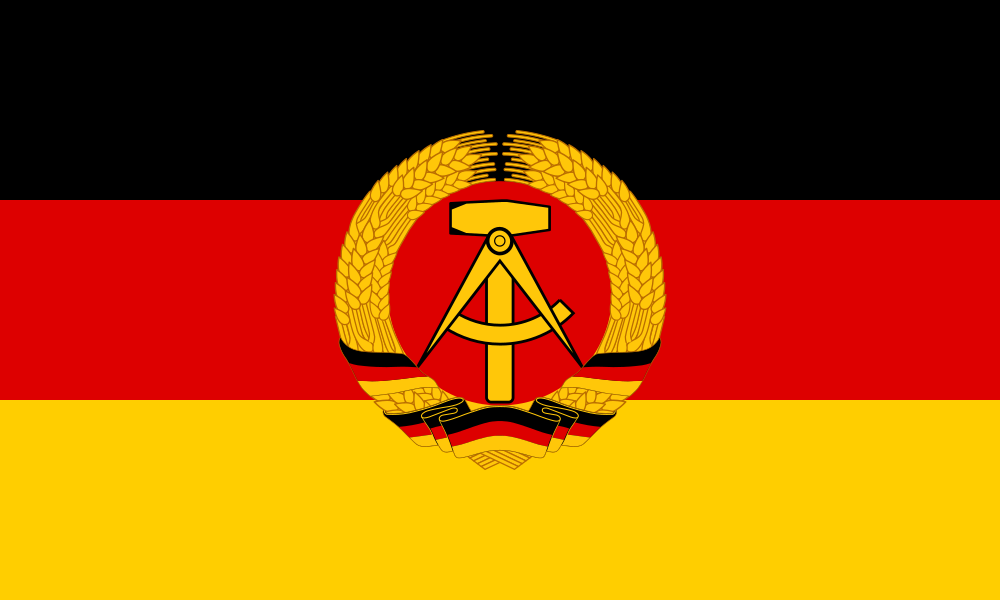
On 19 February 1979, the General Secretary of the Central Committee of the Socialist Unity Party of Germany and Chairman of the Council of State of the German Democratic Republic, Mr. Erich Honecker, and the President of MPLA [Movimento PopuIar de Liberta@ de Angola] and President of the People’s Republic of Angola, Mr. Agostinho Neto, signed at Luanda a State treaty of friendship and cooperation between the German Democratic Republic and the People’s Republic of Angola. Fully determined to provide mutual support for the cause of the creation of conditions for the strengthening and development of revolutionary social and economic conquests and achievements of both peoples, and loyal to the ideals of the struggle for national independence and social progress and against imperialism, colonialism, neo-colonialism and racism, in all its forms and manifestations, the German Democratic Republic and the People’s Republic of Angola decided to conclude that treaty. In accordance with the treaty, the delegation of the German Democratic Republic has asked tobe allowed to speak today and we are grateful to the members of the Security Council for affording us this opportunity to set forth our views on the question on the agenda.
6. The facts are known to all. Over the past few weeks aircraft of the Pretoria regime have repeatedly bombed peaceful Angolan villages and the camps of Namibian refugees who were forced to flee from the terror of the racists in illegal occupation of the Territory and who found refuge in the People’s Republic of Angola. Napalm bombs have been used. Furthermore, on 11 March, squads of infantry, sup ported by six helicopters crossed the Angolan frontier. On 13 March tank and infantry units penetrated into the territory of the People’s Republic of Angola to a depth of 17 kilometres. According to a’ report of 21 March from the Ministry of Defence of Angola, during 10 days of this month alone the South African Army carried out 70 attacks on the People’s Republic of Angola, in the course of which six aircraft of the South African Air Force-of the Mirage and Canberra types-were shot down. Official reports from Pretoria confirm these repeated armed penetrations into Angolan territory. So it is quite obvious that the sovereignty and territorial integrity of the People’s Republic of Angola have been violated by the South African racist regime in a deliberate and planned fashion.
7. The delegation of the German Democratic Republic shares the view of the African Group in the United Nations, which, in its important statement of 8March [S/Z3ZSQ1, that is, immediately after the bombing raids on Angola by Pretoria and even before tanks had actually penetrated into the territory, called upon the Security Council to take all possible effective measures to put an end to South Africa’s acts of aggression against Angola. In this regard, the African Group referred to resolution 428 (1978). Clearly, the present situation requires that the arrogant defiance by the ruling circles of South Africa should be met with the-use of the sanctions provided for under the Charter of the United Nations. South Africa should be forced to make retribution for the damage done to the People’s Republic of Angola. 8. The question whether to use effective measures with regard to the acts of aggression committed by Pretoria, in violation of international law, or to confine ourselves to mere condemnations accompanied by a possible threatthat is, to adopt one more resolution on the lines of resolution 428 (1978)-has in actual practice become one of the most important issues of war or peace in South Africa. Any delay by the Council can only provide encouragement for the commission of new crimes by the unbridled racists of South Africa. Without any doubt, the policy of the ruling circles of Pretoria has become a serious danger to the cause of peace and security in southern Africa. I would assert that Pretoria bears the responsibility also for the air raids undertaken by the Ian Smith racists against the People’s Republic of Mozambique-an air raid reported by Maputo. However, anyone who thinks that armed invasions can exert pressure on the African States that have been subjected to colonial domination is seriously mistaken. The communique issued on 4 March by the summit conference of the so-called front-line States [see S/23141] demonstrates that the intentions of the racists have been identified. The world community will not leave these States without support.
9. Like many other States, the German Democratic Republic will in any case, to the fullest extent possible, do its
10. There are certain circles that constantly harp upon a so-called peaceful settlement, saying that they intend to use their influence to incline the racist regime towards renouncing its barbarous policy. However, the racists, in flagrant violation of United Nations decisions, have secretly been supplied with oil, arms and, as was demonstrated at the United Nations Seminar on Nuclear Collaboration with South Africa [see S/Z3157 of 9 March 19793 South Africa has been furnished with technology permitting it to produce an atomic weapon. Economic and other relations with South Africa not only continue but are even being expanded. There is the idea of making the puppet Governments of the racists acceptable so that they can be recognized later. That is shown by the various so-called observation missions coming from capitalist countries for theelectoral farce to be held in Zimbabwe this April.
11. Whoever wants peace and a peaceful settlement of the problems of southern Africa should support the disarming and weakening of the aggressor and the strengthening of those forces that are striving to ensure for their peoples a dignified existence, free from colonialism and foreign enslavement and exploitation. These are the Governments of the so-called front-line States and the national liberation movements such as the Patriotic Front in Zimbabwe and SWAP0 in Namibia.
12. As concerns Namibia, it should be pointed out that that Territory, which is illegally occupied by South Africa, is being used to attack peaceful neighbouring States. At the same time Pretoria is continuing its policy of setting up a puppet regime at Windhoek in order to prevent the people of Namibia from. exercising their right to selfdetermination. Such a regime would allow Pretoria to go on lording it over Namibia. .However, the interests of peace in Africa require the liberation of Namibia from all kinds of colonialism and its being admitted, at an appropriate time, to membership in the United Nations as an independent State whose people freely determine their own future.
13. But here again we are faced with all kinds of manaeuvres by Western circles to try to fend off the inevitable. It is difficult to rid oneself of the impression that the imperialist States are trying to use the participation of the United Nations in resolving the Namibian problem to disguise the electoral farce staged by the racists.
14. The only author&d representative of the people of Namibia recognized by the United Nations is the SWAP0 liberation movement, and it has sufficiently demonstrated its readiness to strive for mutual understanding towards the
15. ExDerience of struaalina against the shameful racist r&me of South Africa hii sh&&r that we should not count on the honest goodwill and co-operation of the monopolistic circles of Western States. It is obvious that they need the racist regime as a source of profits running into the millions, as a constant threat to free Africa, and for military bases in the South Atlantic and the Indian Ocean.
16. One point is really noteworthy. Certain imperialistic States are refusing the racists neither considerable credit nor political support or even the very latest type of weapons. Nor are they stopped by the fact that the domination of the racist regime is being accompanied by the most flagrant violations of human rights. It is understandable that the African States are expressing mistrust towards the various plans that are being propagated on all hands by imperialistic circles.
17. The basis of the work of our Organization is the resolutions of the Security Council and the General Assembly. Their purpose is the final elimination of colonialism, and that includes its last remaining bastion in South Africa. To abide by those resolutions means to ensure peace and international security. The delegation of the German Democratic Republic has the honour to appeal to the Security Council to do just that.
The next speaker is the representative of the United Republic of Tanzania. I invite him to take a place at the Council table and to make a statement.


Sir, allow me to take this opportunity to associate myself with those delegations which have extended to you their sincere and warm congratulations on your accession to the presidency of the Security Council for this month. Indeed, at so crucial a stage in the work of the Council on the delicate issues on the agenda, your assumption of the presidency could not be more timely and opportune. Nigeria, a country closely associated with the liberation process in southern Africa, has made an immense contribution to the struggle. Besides,. your personal qualities of devotion, tact, diplomatic skill, experience and courage are well known. Therefore, having you in the chair gives us renewed hope and expectation. My delegation looks forward to an atmosphere of greater co-operation as your able guidance has always been a source of strong inspiration.
20. At this juncture I wish also to express my deep appreciation and gratitude to you and, through you, to the other Council members for affording our delegation the opportunity to take part in the present debate.
21. It is indeed tragic that the Council should be convened once again to consider acts of aggression committed by the racist regime of Pretoria in total defiance of the wishes of the international community. The latest acts of aggression by South Africa against the territorial integrity and sovereignty
22. Although repeated acts of aggression against the front-line States have recently become quite fashionable among the racist rkgime of Pretoria and Salisbury, the recent attacks on Angola, SWAP0 and Zambia cannot be considered only as part of the general plan of “striking deep” into those territories. It is of particular significance that the attacks have escalated when there has been intensification of the consultations by both SWAP0 and the front-line States to secure the implementation of the relevant Security Council decisions regarding Namibia. It is also by no means an accident that such callous attacks, which resulted in the destruction of property and the wanton killing and wounding of innocent civilians and children, should come at the crucial stage of the initiative of the Secretary-General to effect a ceasetire and to pave the way for the assumption by the United Nations Transition Assistance Group of its duties in Namibia. It is rather a premeditated attack designed to forestall the peace process and an attempt to frustrate the efforts of the international community. We denounce such a display of arrogance and of total contempt for international opinion manifested through such blatant and naked acts of violence and aggression as those unleashed by the racist regime against the People’s Republic of Angola, SWAP0 and Zambia.
23. Also, the latest attacks on Angola came at the height of South Africa’s rejection of some of the vital components of the plan for a peaceful transition to Namibian independence in accordance with resolution 435 (1978). The obstinacy of the racist regime and the subsequent military raids are attempts to dislodge the SWAP0 forces and to destabilize the rear bases of the liberation struggle, thus reducing almost to nothing the chances of a peaceful negotiated settlement. We consider these contemptuous acts of aggression a clear manifestation of the South African campaign to frustrate the efforts of front-line States like Angola which have embarked on the process of construction and reconstruction after the war of aggression perpetrated by the racist regime.
24. We wish equally to assure South Africa that this will not alter our unwavering commitment to the liberation of southern Africa. The heads of front-line States, meeting at Luanda on 4 March 1979, reiterated their commitment to the struggle and strongly condemned the coordinated acts of aggression committed by the racist regimes of Pretoria and Salisbury. To this end, we wish again to echo their condemnation of all the manceuvres of South Africa aimed at frustrating the effective implementation of resolutions 435 (1978) and 439 (1978).
26. Is it not becoming increasingly clear that the indications that South Africa’s intensification of attacks into Angola and front-line States is aimed at destroying SWAP0 in order to install a puppet r&me in Namibia that will dance to its tune are not merely speculative but are becoming a positive reality? Should these be mere allegations, the obvious way to refute them is to demonstrate co-operation that will be verified in fact.
27. This is why, aposteriori, we are saying that the violations of the sovereignty and Jerritorial integrity of Angola shbuld hot be viewed as isolated incidents but as part of a much larger conspiracy to disrupt the peace process and perpetuate the obnoxious racist policies in the region of southern Africa. The escalation of the attacks on Zambia and Mozambique is part of the Pretoria-Salisbury syndrome to torpedo the efforts of the international commtinity to achieve peace and, further, to slacken the tempo of the liberation struggle.
28. The provocative attacks are attempts to extend the area of conflict into Angola and to use it as a scapegoat in a bid to use Namibia as a spring-board in this war which it is waging against Angola because of its stand in the liberation struggle and because of the help it renders to the displaced sons and daughters of Namibia who are struggling to get back their dwelling place and their birthright-which is Namibia. Namibia glitters with diamonds, not to mention amazing quantities of other precious minerals. Of this diamond-rich land,’ the following has been said: “Dig with your toe in the sand here and you may be arrested. Build a house and the police will watch every detail of the excavation.” Shall we therefore wonder at the intransigence and attacks launched by the illegal regime of South Africa?
29. These attacks not only jeopardize the prospects for peace in the area, but constitute total defiance by South Africa of all Security Council resolutions. This should be a test of the viability of the Council as a guarantorof peace to nations and of its ability to enforce its decisions. This is as much a challenge to the five Western countries, which have supposedly found logic and reason in the actions of South Africa to warrant their present initiative to bring it to a negotiating table as it is to the other members of the Council. The present Council meetings should serve to illustrate the evil designs of the m&t @me and should be understood as an eloquent testimony to the obstinacyand obduracy of South Africa and to its hypocrisy in handling the Namibian question. When attempts are&eing made to exert pressure on the front-line States and on,SWAPO to negotiate with South Africa, tie should bear in mind that the Pretoria regime is not only demanding unacceptable concessions but, even more, is not prepared to see the establishment of genuine majority rule in Namibia and in southern Africa as a whole.
31. In this context, the United Republic of Tanzania requests the following: first, that the Security Council should unanimously adopt a resolution unequivocally condemning South Africa’s latest acts of aggression against Angola, which are a clear manifestation of its contempt-
UOUS disregard for the sovereignty of independent African States; secondly, that the Western Powers that are at present involved in negotiations with South Africa on the future of Namibia should use their power to defuse the ever-charged situation and to bring South Africa to heed world opinion and make use of their super-power by speaking a language that South Africa can understand and thus prevail on it.
32. I should like to pause here and define “super-power’*- Wbat is “super-power”, what is perfection of “superpower’? It is the same perfection that an eye has in seeing and an ear has in hearing. Therefore,‘the perfection of “super-power” is the moral power exercised in persuading and telling the wayward that what they are doing is not what should be done. The Western Powers should stop arming South Africa; they should exercise their influence on behalf of the implementation of the settlement proposals and the United Nations plan for Namibia’s proper electoral process and its independence and thus complete the work which their fellowman, the Reverend Michael Scott, the English missionary, so ably performed. I am told that it was his voice, mandated by the Namibians. that for years helped to keep the Namibiap issue alive, with the result that a resolution was adopted in 1953, giving the United Nations a kind of a watching brief over the so-called South West African affairs. The role of the Western countries at this point and time is that of completing tbe work that was started by the Reverend Michael Scott. Do not let him down. Be tough with South Africa. The Council could show its toughness towards South Africa by saying .what Horace said 65 years before Chriit:
“If you do not know how to live aright with your neighbours, make -way for those who do. You have played enough, you have eaten enough and drunk enough. It is time for you to leave the scene.”
Why cannot the Council tell South Africa that it is time for it to leave.and leave Namibia in peace? Tell them that their civilizing mission is over-if it was ever a civilizing mission. It is over and the people now wish to handle their own affairs and to steer their own destinies. I repeat to the Western Powers: please do not let the Reverend Michael Scott down. Complete the work that he started.
33. As to the other Member States in the international community we would say that, while it is good to express moral outrage and condemnation of South Africa’s latest aggression, it is far better to take concrete and effective measures to secure the immediate withdrawal of South Africa from its illegal occupation of Namibia.
34. Regarding the bombings and attacks recently carried out by the Pretoria r&me against Angola, Member States may wish to refresh their memory on what was resolved by the Security Council in its resolution 428 (1978), by which,
35. What should the Council do now to keep its commitment to move forward, thus preserving its credibility and its prestige and the honour of the Organixation? Surely, we must move at least a step forward.
36. Also, the Tanzanian delegation appeals both to Member States and to the international community to provide material and moral support to victims of the wars of aggression perpetrated by the racist regime against the People’s Republic of Angola and to the front-line States, in the cause of the liberation of southern Africa and to safeguard their sovereignty and territorial integrity.
37. We believe that the Council will unanimously adopt a strong and effective resolution so that South Africa will cease such premeditated and naked acts of aggression.
38. Filly, the United Republic of Tanzania extends its condolences to the bereaved people of Angola, SWAP0 and Zambia and reaflirms its unflinching support for the solidarity with SWAPO, the People’s Republic of Angola, Mozambique, Zambia and all liberation movements in sourthem Africa as they confront yet another cowardly act of the racist r&irne in Pretoria.
The next speaker is the representative of the Sudan. I invite him to take a seat at the Council table and to make his statement.


Mr. President, permit me at the outset to thank you and, through you, the members of the Council for permitting me to participate in the dlcussion of the item placed on the agenda in response to the request of the representative of Angola for an urgent meeting to be convened in connexion with the question of South Africa’s aggression against the People’s Republic of Angola.
41. This meeting has been requested because the South African regime continues to commit acts of aggression against neighbouring African States in spite of all the resolutions and decisions adopted by this august body, calling on that r&me, and on the other racist r&ime at Salisbury, to desist from any acts of aggression against the neighbouring African States. Members of the Council will recall that it was only on 8 March that resolution 445 (1979) was adopted, condemning similar acts then being perpetrated by the illegal minority racist @ime at Salisbury against Angola, Mozambique and Zambia.
42. The similarity of the acts committed by the regimes at Salisbury and Pretoria and the timing of those acts prove, beyond any doubt, that the two regimes maintain full consultations between themselves and co-ordinate their moves in such a way as to wreakhavoc in the bordering States and, most of all, to demonstrate to the world the ineffectiveness, or rather the inability, of the international community to
43. The African countries have been closely following the proximity talks which have been taking place in New York in the past few days, not because those talks will lead to any positive results, but because they feel that the Western Powers concerned will have to face their responsibilities, when they reach the ultimate conclusion that all these, attempts at a dialogue with the South African authorities are leading us nowhere. I feel that it is imperative for me at this juncture to stress our disappointment that the proximity talks did not include the Organization of African Unity, which, in the final analysis, is the instrument for African solidarity and the Co-ordinator of their joint political action vis-a-vis outstanding African problems. Our disappointment is keener because the participants were not limited to those directly involved and the confrontation States. We hope that this oversight will not be repeated in future because the Organixation of African Unity is the main support of the confrontation States and the liberation movements which are involved in the struggle to liberate all the captive African territories and continues to be the most effective framework for action on behalf of the African countries in their dealings with other groups and with the major Powers.
44. Africa cannot stand by and watch the recent develop ments or the strong-arm tactics applied by the racists with equanimity or indifference, for the fate of Africa is one and indivisible. The perpetuation of the rule of white minority r@imes in Zimbabwe, Namibia and South Africa cannot be maintained. Sooner or later the African resistance movements will gain enough experience and strength to shift the balance, which at present seems to be tilted in favour of the white minority r@imes. ‘It is not?li&ult to foresee such a situation in the not-too-distant future. Meanwhile, the confrontation States will continue to be subjected to acts of aggression, bombing raids, and infringements of their sovereignty and territorial integrity. The African States have reatlirmed their previous pledge to assist the confrontation States. I am confident that this pledge will be honoured if the military situation in the confrontation States continues to deteriorate as a result of such acts of aggression. Should this situation develop, then we shall be heading towards a racial war-a spectacle which will be viewed with concern by all those who are involved in the South ~African scene.
45. It is therefore imperative that the Council should make an effective pronouncement on these acts of aggression and demonstrate its resilience and capability by translating its resolutions and decisions into action, thus introducing an element of respect for those decisions and ushering the captive people of Zimbabwe, Namibia and South Africa on to the road of equality, human rights and independence.
47. The positive settlement of the Namibian question, which in our view has reached a very delicate stage, has become a matter of urgency. The resolution of the problem, one way or another, will have far-reaching implications for deciding the question of war or peace in the region. The recent attacks on Angola and previous attacks on Angola. Mozambique and Zambia are all inextricably linked to’the political developments in both Namibia and Zimbabwe. Resolutions by which the Council condemns acts of aggression by the racist r&imes have to be seen in their true perspective, namely, the exertion of more political will by all concerned to achieve positive progress towards Namibian and Zimbabwean independence and the dismantling of the edifice of apanheid in South Africa.
48. The African countries commend the valiant stand of the People’s Republic of Angola in the face of armed aggression by a militarily superior adversary and, above all, the sacrifices of the Angolan people along with those of the peoples of Zambia, Botswana and Mozambique, because these sacrifices are being made in the cause of African freedom and in the cause of establishing a new political order in the continent by means of which Africa will be for the Africans only.
The next speaker is the representative of Guyana. I invite him to take a place at the Council table and to make his statement.


Mr. President, I should like first of all to thank you and, through you, the other members of the Council for having afforded my delegation this opportunity to participate in the debate on the issue of which the Council is now seized. My delegation has every confidence that you, a distinguished son of Africa, will continue to preside over the work of the Council with the same dignity and sense of justice which you have brought to bear upon the Council’s consideration of those issues to which it has already addressed itself during the course of this month.
51. The gravity of the situation in southern Africa increases with eaclrpassing day. Not only are the peoples of Zimbabwe, Namibia and Azania still being prevented by the racist minority regimes at Pretoria and Salisbury from exercising their legitimate rights to self-determination and independence, but this denial is now compounded by a series of naked acts of aggression, wanton murders and brutal oppression wreaked upon the black peoples of southem Africa as a whole by the racist regimes-acts which have assumed a new dimension of impudence and presumption during the past two months. For even as the rebel Smith engages in unprovoked acts of aggression against Angola, Mozambique and Zambia, his counterpart at Pretoria relent- \
52. When we recall the role played by racist South Africa in Angola on the eve of that Territory’s independence, we recognize that South Africa’s present nefarious activities represent the continuation of a policy of hostility towards the Government of the People’s Renublic of Angola. These repeated acts of aggression reflect the unwillingness of the Pretoria regime to reconcile itself to the accession to power in Angola of a Government which is genuinely committed to the eradication of colonialism in whatever form, and rooted in that perception of the scenario in southern Africa lies South Africa’s persistence in striving to impede the consolidation of Angola’s hard-won independence.
53. We should not lose sight of the special significance of the fact that these acts took place precisely at a time when conclusive arrangements were being formulated for installing a United Nations presence in the usurped Territory of Namibia. The adoption by the Security Council of a plan for a settlement of the situation in Namibia, as negotiated by South Africa’s five major trading partners, sought-and this is the understanding of my delegation-to usher in a new era in the southern part of the African continent, an era in which it was assumed that the Pretoria regime would cooperate with the decisions of the Council in an effort to ensure that the legitimate rights of the Namibian people to self-determination would be effectively realized.
54. That assumption was predicated upon the belief that South Africa had negotiated “in good faith” and would “co-operate” in the implementation of Council decisions on the issue of Namibia. It is apposite for me to recall that at that time my delegation has expressed some reservations with regard to the potential for success offered by the plan, since we were unconvinced then, as we continue to be now, that there was or would be any change of heart on the part of the Pretoria regime.
55. Today it appears that our misgivings and reservations have been justified. We recall how reluctantly, how grudgingly the South Africans finally came around to professing an acceptance of that plan. The Secretary-General endeavoured to begin its implementation by proposing conditions for a cease-tire to take effect on 15 March. South Africa’s response was a rejection of these proposals on rather spurious grounds and its most recent acts of aggression against Angola. Where, then, lies the “good faith’* and “willingness to co-operate” of the Pretoria regime?
56. The unprovoked acts of aggression against the People’s Republic of Angola unleashed by the Pretoria racists must be roundly condemned for what they are. This is not a
57. My delegation condemns South Africa% wanton acts of aggression against the Angolan and Namibian peoples in the strongest terms. With these acts the chances for peace in Namibia and in southern Africa in general recede frighteningly. They demand a positive, vigorous response by the Council. How much more must Botha do; how many more attacks must Angola and other neighbouring territories be subjected to? How much more suffering must the innocent victims of apartheid endure before this august body, in its wisdom, can make a determination that a situation of threat to peace and security exists in southern Africa? How much more, do I ask?
58. If the Security Council should once again fall short of taking the appropriate action as provided in Chapter VII of the Charter, then we must recognize that the racist South African regime will naturally take strength in the knowledge that its nefarious activities can continue with impunity. And my delegation is convinced that some of the permanent members of the Council possess enough leverage with the Pretoria regime to influence the actions of those racists by merely demonstrating in this forum that they are prepared not to impede the adoption by the Council of resolutions calling for action under Chapter VII of the Charter.
59. In conclusion, I should like to take this opportunity to reaffhm Guyana’s solidarity with the Angolan people in their struggle against the apartheidmonolith. Their struggle is symbolic of the wider struggle taking place within southem Africa today for peace, justice and freedom from colonialist and imperialist oppression. They have turned to the Security Council in the faith that this body is able and prepared to come to the assistance of States which are victims of aggression. The Council therefore has a solemn obligation to uphold that faith.
The next speaker is the representative of Somalia. I invite him to take a place at the Council table and to make his statement.


Mr. President, I thank you and the members of the Council for giving my delegation the opportunity to participate in this debate.
62. The communique issued by the Ministry of Defenceof Angola and the supplementary information supplied by the representative of Angola in the most eloquent statement that he made last Monday [213&h meeting] show once again, without any shadow of a doubt, that the apartheid policies of South Africa’s racist minority r&ime seriously damage the peace and security of Africa and pose a grave threat to international peace and security.
63. African States and indeed all States which look to the United Nations for “peace with progress’* have a right to
., 7
64. The recent attacks on the people, the sovereignty and the territorial integrity of Angola are, of course, only the latest in a long series of similar acts of aggression. Members of the Council will surely recall that the Council was obliged to condemn South Africa for its invasion of Angola at the time when the lattei,achieved independence, back in 1975. Only last year, South ;Africa’s savage attack on the refugee camps at Kassinga, Angola, in which 700 people were killed, was the occasion for yet another condemnation by the Council, which also warned that further acts of aggression would I+ met by enforcement measures under Chapter VII of the Charter. There have indeed been further acts of aggression, so the responsibility of the Council to act in accordance with its own decision is clear. ., 65. The need for strong action is also supported when we view the attacks on Angola in a broader context. South Africa’s acts of armed aggression, must be seen as part of a wide-ranging conspiracy, directed by the Pretoria and Salisbury r&imes, against the front-line.States and the liberation movements which are struggling to contain and eliminate the evil forces of racism and colonial oppression in southern Africa.
66. Again we must ask: How long will the Security Council remain passive while those r&imes turn the air space and the national territory of AngoIa, Zambia and Mozambique into playgrounds for their vicious war games? In those operations, as we are all well aware, hundreds of Namibians and Zimbabweans who have fled from oppression and injustice, together with innocent citizens of the front-line States, have lost their lives. There has, of course, been extensive damage to property and disruption of the lives of the people in the border areas. \ 67. The representative of Angola has rightly posed the question of whether attacks like those directed against his country would have gone unpunished and virtually unnoticed in Western capitals if they had been perpetrated by non-white r6gimes lacking close ties to Western countries. My delegation has no doubt about the answer. The reaction would have been loud and vigorous. But there has been no such reaction in Western circles to the armed aggression against Angola, carried out with the use of weapons condemned as inhuman by the international community.
68. In ‘the past .few weeks there have been sensational revelations in the international press showing the deepseated corruption and bribery within the South African Government. Those reports have also shown the extent of South Africa’s plans and financial outlay for the purpose of selling to the Western world its illegal and inhuman policies directed against the non-white people of Namibia and South Africa itself. We are resisting the temptation of attributing this indifference to the success of South Africa’s pocket-money concept of public relations. We do not believe that South Africa, with all the gold and diamonds at its disposal, could buy up enough influence to save it: doomed internal and external policies of aparzheid. Such bribery progaganda ‘can and has indeed managed to make some noise and perhaps influence some who are weak-
69. Certainly there should be no illusions about the motivation behind the recent attack on Angola. Similar attacks by the racist minority regimes have been launched in the past as. counterpoints to efforts aimed at achieving just solutions to southern African problems through peaceful negotiations on the basis of United Nations principles and resolutions. Those acts of aggression have always had as their central aim the strengthening and maintenance of illegal rule in Namibia and Zimbabwe and the entrenchment or apartheid in South Africa.
70. The Council must face the fact that South Africa is violently opposed to the establishment of a free Namibia, led to independence by SWAPO, its indigenous and authentic liberation movement. South Africa’s strategy can easily be discerned. First, it pretended to negotiate in good faith while having no intention of relinquishing its control of the Territory of Namibia. We have seen the various ill-founded charges put forward by the Pretoria regime to delay and subvert the Namibian independence process. Secondly, South Africa has attempted to install a puppet regime in Namibia through which it could continue to controlthe rich resources of the Territory. The so-called internal settlement has also been used-as the General Assembly noted in its resolution 33/.182 A-as an excuse for fostering civil war and to propagate the fiction that the liberation struggle of the Namibian people constitutes aggression from outside.. Thirdly, South Africa’s strategy includes the most serious of all international crimes-the wanton violation ofthesovereignty: and, territorial integrity of a State through armed aggression. It also includes the attempt to destroy a liberation movement recognized by the United Nations as the sole authentic representative of the Namibian people.
71. The negotiations initiated by the five Western Powers two years ago undoubtedly brought the international community to believe that its responsibility towards the Namibian people could at last be discharged. The hidden reef of those negotiations has always been the unwillingness of the five Powers to make a clear and unequivocal commitment to take the enforcement measures available under the Charter if South Africa continues to threaten international peace and security by its bad faith and its intransigence. The negotiations have now foundered on that reef-and not for the first time. My Government sincerely hopes that the proximity talks now being carried on will succeed,.but the evidence of the past indicates that South Africa will fmd a way to defy the United Nations as long as it is aware that it can do so with no more severe penalty than a verbal condemnation.
73. In conclusion, at this stage of the world situation it is no time to encourage aggressors and play the “Munich game”.
The next speaker is Mr. Makatini, representative of the African National Congress of South Africa, to whom the Council extended an invitation at its 2133rd meeting. I invite him to take a place at the Council table and to make his statement.
75. Mr. MAKATINI: The African National Congress of South Africa sees the repeated and universally condemned aggression committed by the Pretoria and Salisbury r6gimes against Angola, Zambia, Botswana and Mozambique as the direct consequence of the inhuman and anachronistic system that the people of southern Africa are lighting, weapons in hand, to eliminate. It is for that reason that we deem it necessary to join in the debate now going on in the Council. Our thanks go to you, Mr. President, and to the representatives of Gabon and Zambia for making it possible for our movement to put on record its position at this crucial stage in the struggle for the liberation of southem Africa and the security of the continent.
76. Mr. President, it is singularly significant ‘that the Council is meeting under your presidency to examine the question of wanton aggression against the People’s Republic of Angola by the South African apartheid regime. Your personal dedication to the fight against the monstrous system of apartlreid is well known. The depth of the commitment of your country, as clearly demonstrated in 1975 when the then newly-born People’s Republic of Angola was the victim of premeditated and full-scale invasion by the same Fascist upartheid regime, has since been a source of encouragement to our oppressed and struggling people. For, like all true Africans and true friends of Africa, they know that this imperialist-backed invasion,was intended to reverse the course of history and to facilitate the perpetuation of their enslavement. And they remember with pride the uncom-
77. In their lucid statements, the ‘representatives of Angola, Zambia, Botswana and Mozambique and the representatives of other countries who have already spoken, as well as the Vice-President ofSWAP0, have characterixed the situation prevailing in southern Africa with pointed clarity and have called for immediate and appropriate action by the Security Council.
78. The African National Congress of South Africa fully endorses the viewpoint that the root cause of the explosive situation in southern Africa that is now before the Council lies in the tenacious determination of the Pretoria regime and its imperialist allies to arrest the unfolding .process of decolonixation in the region by imposing fictitious and neocolonialist solutions in Namibia and Zimbabwe in order to ensure the preservation of the status quo in South Africa. The wanton aggression by the apartheid regime against the People’s Republic of Angola is part of the imperialist-backed strategy which is character&d by equally wanton aggression against Zambia by the same racist regime and against Botswana and Mozambique by the Smith regime.
79. Speakers who have preceded us have underscored the undeniable historical fact that the root cause of the problem of which the aggression against the People’s Repubfic of Angola is part, and of which it marks the watershed, is the imperialist-backed strategy of the Pretoria-Salisbury tigimes. Many representatives have stressed the fact that the catalogue of events in the past few months shows that, each time the talks towards a negotiated settlement in Namibia and Zimbabwe reach an advanced stage, the minority racist regimes intensify their acts of aggression against the neighbouring States. And their allies, the Western countries involved in the talks, not only fail to condemn this and to use their collective economic and political leverage but, instead, multiply their ‘sermons preaching tolerance and patience to SWAPO, the Patriotic Front and the front-line States and call for new rounds of talks. This has led a growing number of countries which were initially convinced of the good faith of the Western initiatives, and the Pretoria- Salisbury regimes’ acceptance of the proposed plans, to question seriously the sincerity of these commitments. Indeed, the number of countries that suspect the existence of a conspiracy towards the betrayal of the struggle for genuine independence in Namibia and Zimbabwe is also growing.
80. That is the position that is firmly held by the struggling masses in the region and is shared by the African National Congress. It is strengthened by the conviction that is based on our long experience, which shows that the Pretoria- Salisbury axis and some Western Powers are resolutely opposed to genuine independence iu Namibia and Zimbabwe. For they see it as inimical to their strategy for the perpetuation of the stati quo in South Africa in particular
81. If we sound pessimistic or negative, the onus is on the parties concerned to prove us wrong by strongly condemning South Africa’s aggression against the People’s Republic of Angola and by facilitating the belated imposition of punitive measures against the Pretoria regime, especially mandatory comprehensive sanctions under Chapter VII of the Charter. And to cleanse their past record of helping the racist regimes to sow death and destruction in South Africa by their supplying of genocidal weapons to a regime that has legal&d aggression against all African countries, these Western countries must’go further and join the struggling peoples of southern Africa and progressive mankind by commending the role played by the African, the nonaligned and the Nordic countries, as well as the socialist countries, which have always rendered humanitarian, financial and material assistance to the liberation movements and the front-line States. They should also put an end to their involvement in what we see and condemn asthe game of deception by the South African regime-a game which is designed to gain time towards the imposition of a puppet regime in Namibia through what we view as the imminent proclamation of the so-called unilateral declaration Of independence by the Democratic Tumhalle Alliance, following the envisaged endorsement of the fraudulent elections and the lifting of sanctions in Southern Rhodesia.
82. We have in the past voiced our reservations about, and sometimes our opposition to, proposals that are based on the Pretoria regimes being amenable to change or playing the role of an-honest broker. The recent events go along ’ way towards strengthening our suspicions. And it is for that reason that, in the face of the systematic sabotaging of the Y negotiated settlements, we believe that the time hasperhaps - come for this august body to consider seriously going back to its original position of regarding the South African presence in Namibia as illegal and consequently resorting to the policy of confrontation towards its immediate and unconditional withdrawal. ‘Such a position would help save the United Nations from the maze of contradictions in which it is now caught because,of its agreement to negotiate with the illegal occupant, which position towards the United Nations and SWAP0 is well known. Such a position would, ’ we maintain, also clarify a position that we tind.extemely .confused and that we suspect has been created by some forces that are bent on robbing the people of Namibia and Zimbabwe of their inevitable, if not imminent, victory.
83. It is important ‘to note that our suspicions have been further reinforced .by the ongoing revelations pointing to . ’ the financing of big operations towards the shaping of public opinion and pro-upmhefd policy in some countries, including the traditional allies of the apmzheid regime. The buying of influential newspapers, editors and legislators in
84. Finally, we wish to pay a tribute to the brotherly people of Angola, who under the leadership of the MPLA- Workers’ Party, continue to write a golden page inthe grim history of our common and indivisible struggle in southern Africa.
85. For our part, we pledge to spare no effort to intensify the armed struggle for the seizure of power by the people and the establishment of a democratic State in South Africa, a democratic State that will guarantee the inalienable rights of all the people of that country regardless of colour, race or political belief.
The next speaker is Mr. Sibeko, representative of the Pan Africa& Congress of Axania, to whom the Council extended an invitation at its 2135th meeting. I invite him to take a place at the Council table and to make a statement.
87. Mr. SIBEKO: Mr. President, our great respect for you as a distinguished diplomat and a humane champion of justice for all people on earth is well known. That is why we are proud to serve on the Special Committee against Aparthefdas observers. Under your chairmanship, that Committee continues to distinguish itselfin mobilizing international public opinion in support of the just struggle of the Azanian people against apartheid, oppression and imperialist exploitation.
88. Your country, the Federal Republic of Nigeria, is respected the world over for its crusading role in the struggle for the total liberation and unity of Africa. Nigeria has been generous in its support of the struggle for freedom in Azania, and our movement enjoys very close relations with your country and its militant people. These relations have deep ened ever since the time the Pan Africa& Congress was invited to open a representative office at Lagos by the Federal Military Government, in 1976.
89. As has been stated by speaker after speaker during this debate, the Security Council is once again meeting to consider a complaint against apartheld South Africa lodged by the People’s Republic of Angola. Some two weeksago the South African apartheid regime began yet another act of aggression against Angola, using Mirage jet lighters to bomb civilian targets and refugee camps deep inside Angola. These piratical and cowardly attacks have caused massive losses in human life and wanton destruction of property. Reports from Angola tell us that the aerial invasion has been followed by daily attacks by ground soldiers using artillery pieces and supported by gunboats and helicopters and other military aircraft. Armoured cars have also been thrown into the attacks on Angolan villages.
90. Apartheid South Africa’s sordid rationale for its repeated criminal attacks against Angola is that that country provides bases and staging-zones for the war of liberation that SWAP0 is conducting in Namibia against the illegal occupation of that international Territory by the South African racists.
92. In supporting SWAPO, Angola is discharging its sacred duty as a’Member of the United Nations. The People’s Republic of Angola therefore has every reason to expect the United Nations promptly and fittingly to punish South Africa. Accordingly we are hopeful, Mr. President, that under your wise guidance and respected wisdom the Security Council will not shirk its responsibility. South Africa’s repeated acts of aggression against Angola and its violation of its sacred territory’s airspace and sovereignty are the worst crimes that can be committed against any country. It is meet that the culprits should receive a punishment that fits the crime.
93. We all know that when despotic regimes are confronted with domestic crises they often start wars outside their borders in the hope that they can stimulate patriotism at home. Right now the South African apartheid regime is shaking from the colossal scandal about the theft of taxpayers’ money and the use of those funds to promote apartheid at home and abroad. By picking on Angola, Botha and his coterie of warmongers vainly hope that their..aggression against Angola will push the scandal into the background. As of now it does not look as though that intrigue will succeed.
94. However, of greater concern for the members of the Council must be South Africa’s ever increasing contempt for the United Nations. Nowhere‘is this monumental contempt more manifest than in the concoction that Botha’s representatives here in New York have been circulating as a so-called draft resolution to condemn SWAPO. Through this cynical slap in the face for the United Nations, Pretoria shows that as far as it is concerned this debate and the whole exercise of dealing with a Member’s legitimate complaint is nothing more than an amateur circus show.
95. Those Member States which have become notorious for protecting South Africa from international action through their negative votes in the Security Council must question themselves very closely on whether it was in the interest of the honour and dignity of the United Nations to be so permissive with the’gangster regime of Vorster and Botha. For its crimes against the Azanian people and crimes such as those committed against Angola and other frontline States such as Zambia, Mozambique and Botswana, the South African apartheid regime has more than earned punishment under Chapter VII of the Charter. This punishment must be directed to the place where it .will be felt most-to the economy that sustains apartheid colonialism.
96. It pains us, the people of Azania, to know the truth that our enslaved labour and stolen natural resources are used by the apartheid regime to build the war machinery it. uses to murder our brothers and sisters in Angola and in other neighbouring States. In addition to our unequivocal condemnation of these dastardly crimes against the Angolan people, we pledge that we will intensify the struggle to free Azania from this barbaric rule.
Zhe meeting rose at 6.50 p.m.
-
~?~l~~bPBBBYM1BRf~I~~~~~~ ~CdS~BQSQ~ff~~HE~~R~~~~~~
HOWTOOBTAiNUNITEDNATIONSPUBLICATIONS
Unite 1 Nations publicatiotm may be obtained from bookstores and distributors throughout the wodd. Consult your bookstore or write to: United Nations, Sales Section, New York or Geneva.
CONI~~~?IiC)CUltBBLBSPUBLICATfONSDESNATI0NS UNIES
Levi p~b&ati~ d&s Nations Unies aont en vente dans les librairies et les agences d@pWtaires du monde entier. Informez-voua aup& de votre libraire ou adressex-vous i : Nations Unfea Se&i&i dea ventes. New York ou Geneve.
RAk fr(lfLJrq#fTIi ii3AAHX-I OPPAHH3AUWi OL;‘bE~NHEHHhIX HAUHI?
E%%laRhk h%HHSllqHH 06meAmeHHsIx HattaR MOXHO XyIIHTb a KHH~(R~IX Harastutax H annic%%x ilo ace% pafionax unpa. HaEOAHTe cffpasxn ot5 n~~anxsx a BaIueY ~~1Ixtnml uarasnne HIH nwmfTe no anpecy : Oprann384siR 06meARReRXblX WtttwR. Cektwt no npoaame nsgannit, Hato-Fiopx nna )Kexena.
~~MO~~NS~X%~~P~~B~~~A~I~N~DELAS NACIONES UNIDAS
Las pubIk%ion~ de Ias Naciones Unidas e&n en vents en librerias y casas distribuldofa# en t&t prirtes de1 mundo. Cons&e a su libtero o dirfjase a: Naciones Unidaa, &%x!f6n de VetWa. Nueva York o Ginebra.
Litho in United Nations, New York Price: su.s. 1.50 79-70002-Febrnary 1982-2350
▶ Cite this page
UN Project. “S/PV.2137.” UN Project, https://un-project.org/meeting/S-PV-2137/. Accessed .