S/PV.2153 Security Council
▶ This meeting at a glance
12
Speeches
4
Countries
0
Resolutions
Topics
Global economic relations
Security Council deliberations
UN procedural rules
War and military aggression
General statements and positions
Arab political groupings

In accordance with the decisions taken at previous meetings, I invite the representative of Morocco to take a place at the Council table and the representatives of Algeria, Benin, Madagascar, Mauritania and Zaire to take the places reserved for them at the side of the Council chamber.
At the invitation of the President, Mr. FiIah(Morocco) took a place at the Council table and Mr. Bouayad-Agha(AIgeria), Mr. Houngavou (Benin), Mr. Rabetafika (Madagascar), Mr. Taya (Mauritania) and Mr. Buketi Bukayi (Zaire) took the places reserved for them at the side of the Council chamber.
I wish to inform members of the Council that I have received letters from the representatives of the Congo and Democratic Yemen in which they request to be invited to participate in the discussion of the question on the agenda. In accordance with the usual practice, I propose, with the consent of the Council, to invite those representatives to participate in the discussion without the right to
vote, in conformity with the relevant provisions of the Charter and rule 37 of the provisional rules of procedure.
At the invitation of the President, Mr. Mona’jo (Congo) and Mr. Ashtal (Democratic Yemen) took the places reservedfor them at the side’of the Council chamber.
The first speaker is the representative of Benin. I invite him to take a place at the Council table and to make a statement.


The delegation of the People’s Republic of Benin is happy to have been invited to participate in this important debate on the question of Western Sahara. We are grateful to the members of the Council for the opportunity given us to contribute our point of view on this important matter.
5. Mr. President, I should like most warmly to congratulate you on your assumption of the presidency of the Council. Knowing you personally as a seasoned and honest diplomat, well versed in the question before the Council, I have no doubt whatsoever that there will be a successful outcome to this debate, which you have been conducting so objectively and with such a sense of responsibility. Your great and beautiful country, the Soviet Union, aware of its immense responsibilities for the maintenance of international peace and security, is playing a primary and positive role on the international scene. The delegation of the People’s Republic of Benin appreciates your political, diplomatic and material support for the cause of the liberation of peoples throughout the world, and in particular in southern Africa, that important part of our great, rich and beautiful continent, which is occupied by white colonial racist minorities. The excellence of the relations between the USSR and Benin is highly appreciated by our people and the party of the people’s revolution of Benin.
6. The question before the Council today is in essence none other than the crucial question of the self-determination of a frustrated people, the Saharan people, who in the face of the blind intransigence of the new Moroccan conquerors have taken up arms and intensified their attacks against those aggressors who have refused to listen to reason. Any other interpretations of this objective reality, such as those some people are resorting to in order to camouflage matters, are nothing but excuses and a crude method of diverting the attention of the Council in order to mislead it. They are also a clever way of _ “... duping public opinion, not only Moroccan pubhc opin-
7. What in fact is the issue here? Since 1975, it has been the struggle for survival of a whole people, the selfdetermination, the freedom and the political independence to which every people has a sovereign right within the framework laid down by international law, the very foundation of which is constituted by the Charter of the United Nations.
8. The case presented by Morocco with regard to the so-called aggression on the part of Algeria is a very feeble one. The contradictions it contains and its objectives cannot possibly be hidden from anyone. Morocco, the new conqueror of Africa, is using the same stratagems as the imperialist Powers and the minority racist and colonialist regimes of southern Africa. Those methods consist in refusing to recognize the right of people to selfdetermination, in disregarding national liberation movements and in lumping them together with vulgar everyday terrorists, the dregs of certain decadent societies. That is why those regimes have been resorting to sophisticated military methods and have developed a thesis known as the right of pursuit, which permits them to commit aggression against neighbouring countries or any country which supports national liberation movements. Morocco’s objective, in this case it is now staging, is to find excuses to justify and legitimize an act of aggression that will shortly take place against Algeria, which, ever since its independence, won by force of arms, has been supporting all the national liberation movements, including the POLISARIO Front.
9. My country, the People’s Republic of Benin, which from the very beginning has believed the national inalienable rights of the Saharan people to be well-founded and which will always support that people until final victory, has been the indirect victim of aggression at the hands of the Kingdom of Morocco, which offered training facilities and facilities for officers at Benguerir as well as supplying some of the arms for the mercenaries led by Bob Denard who savagely attacked the People’s Republic of Benin on Sunday, 16 January 1977. The United States magazine Esquire published an article by John Bradshaw, on 27 March 1979, on the background of the criminal career of the international mercenary Bob Denard, and brought out the important role played by Morocco in that affair.
10. The people of Benin are perfectly aware of the fact that by that shameful crime against their national independence Morocco intended to punish Benin for its unswerving support of POLISARIO and the Saharan Democratic Arab Republic. But far from being intimidated, we have ever since that time seriously intensified and developed our militant co-operation in all areas with the valiant Saharan people. We in Benin, jealous of our national independence, feel closely bound to that
11. As the Latin proverb goes, it is human to err but it is diabolical to persist in error. The fact that Morocco is so obstinately opposing the national aspirations of such a determined people and the fact that it is persisting in past errors naturally creates tension and an explosive situation in that part of Africa. Morocco at present is alone responsible for this situation and it must be ready to bear the consequences.
12. What should the Council do? For our part, after having heard those qualified to speak on this question, we feel that the Council should know where it stands. But we do think that the Council, which bears responsibility for the maintenance of international peace and security, should tell Morocco that the peace and the security it is seeking must be brought about by the cessation of the military occupation of Western Sahara and of acts of aggression against that people and by the creation of the necessary conditions to permit the full development of the Saharan people.
13. But if Morocco persists in disregarding the inalienable rights of the Saharan people, it is obvious that there will be no tranquillity, no peace and no security for Morocco and that the Saharans will continue to strike staggering blows against Morocco until they have completely achieved all their national aspirations. The victory of the Saharans is certain.
14. My delegation would like to present its condolences to the representative of POLISARIO to the United Nations, who lost his brother in recent engagements.
15. The struggle continues. Victory is certain.
The next speaker is the representative of Madagascar. I invite him to take a place at the Council table and to make his statement.


Mr. President, the consistently cordial relations between our two peoples and Governments, in the most varied fields, certainly authorize me today to tell you how satisfied my delegation is to see you presiding over the Security Council. We extend to you our heartfelt congratulations. We have long been aware of your eminent qualities and .of your acute awareness that you
18. The question now before the Council has todo with those groups of problems where the opposing interests are so clear cut that they obviously give rise to passions on all sides, although not to the point where things are allowed to get out of hand or to become exacerbated. My delegation would be the last to seek to poison the atmosphere in which the present initiative of the Moroccan Government has been taken. In our statement we should like, first of all, to try to place in the correct perspective the various elements submitted to the Council for its’ examination. Indeed, we think that the comfort of silence and abstention is not fitting when there are at stake principles which it seems to us essential to respect in the quest for a solution to an African problem that is so important to us. We would be very happy if our contribution to the discussion could help the Council to decide on its responsibilities, to take its decisions in full knowledge of the facts and not in the dim light of partial facts.
23. The facts show that what has happened in the Sahara and in Morocco since the occupation, including the military operations since 31 May 1979, cannot be peremptorily assimilated to a simple act of aggression. We think that, on the contrary, these are “privileged operations**, explicitly excluded by article 7 of the Definition of Aggression, contained in General Assembly resolution 3314 (XXIX). That article lays down the following:
“Nothing in this Definition, and in particular article3, could in any way prejudice the right to selfdetermination, freedom and independence, as derived from the Charter, of peoples forcibly deprived of that right . . . , particularly peoples under colonial and racist regimes or other forms of alien domination; nor the right of these peoples to struggle to that end and to seek and receive support, in accordance with the principles of the Charter and in conformity with the.. . Declaration [on Principles of International Law concerning Friendly Relations and Co-operation among States].”
19. Peace and security in the north-western part of Africa cannot be maintained or respected if we do not try to find a comprehensive solution to the question of Western Sahara, a solution requiring the simultaneous, objective consideration of all the facts. In other words, any partial debate, taking into account only selective-and therefore arbitrary-aspects of the problem can lead only to partial, unbalanced solutions. That, it must be recognized, would be intolerable in a situation where the most promising solutions have often been rejected and where procrastination, subterfuge and wiles of all kinds have already done too much harm to many interests, and particularly those of the Saharan people.
24. We maintain that instead of censuring the operations and struggle of the POLISARIO Front, States have the duty to support them, and the contribution to that end of several countries, including Algeria, is all the more laudable.
25. In the light of what I have just stated, what can be said of this idea of self-defence, which also occupies an important place in the letter from the representative of Morocco? To our mind, when the operations of the POLISARIO Front cannot be legally assimilated to an act of aggression, and when the idea of aggression is neither well founded nor justified, the claim of exercising the right of self-defence cannot be defended.
20. Submitting to the Security Council a request that is limited to a specific place and time requires, we feel, a certain dose of cynicism, knowing full well that the Council is aware of all the ins and outs of the question of Western Sahara, since it discussed that question three times in 1975, on the occasion of the famous “Green March” ordered by the Government of Morocco. It is an approach which also seems to us unacceptable since the Saharan people has not entirely regained its rights to freedom and independence nor wiped from its national territory the traces and consequences of the occupation and dismemberment perpetrated by the successors of Spanish colonialism.
26. If, in these circumstances, this right is still invoked against POLISARIO, do not those who do so become aggressors themselves? In that respect, it seems to us particularly timely to point out that Article 51 of the Charter gives the Security Council the right of control over the exercise of the right of selfdefence, which some are perhaps tempted to invoke improperly.
21. It will surprise no one if I say at this stage that our approach is entirely different from-in fact, it is opposed to-the intellectual initiative expressed in the letter dated 13 June 1979 from the representative of Morocco, containedin document S/l 3394. That letter stresses so-called acts of aggression of which Morocco complains it has
27. The same line of reasoning should be applied, we think, to the right of pursuit, that means which other oppressive and colonialist regimes have misused and still misuse in order to stifle the aspirations of peoples who are fighting for their freedom and to hamper the momentum of solidarity.
29. When it is called upon to take a decision on the three points mentioned by the Moroccan Government, that is to say, the so-called acts of aggression, the exercise of legitimate self-defence and the right of pursuit, the Security Council must, we feel, take all the necessary precautions and avoid being led into denying to the Saharan people, what has been granted to others, that is to say, justice, peace, freedom and independence.
30. Further comments should be made on the Moroccan document issued under the symbol S/.13394, in which responsibility for the military operations that the POLISARIO Front conducted to defend its just cause is wrongly attributed to Algeria. The reason for that, we suspect, is that POLISARIO cannot be accused, in fact or in law, of acts of aggression and the only possible trick that can be used to give foundation to the Moroccan allegations is to implicate Algeria.
31. In the same way, they try to present the problem of the Sahara as a bilateral matter confined to “a specific place and time” concerning only two countries, Morocco and Algeria. But there are other parties concerned in the dispute, not the least of which are the United Nations, the Organization of African Unity and the Group of Non- Aligned Countries, which still maintain that the principles elaborated in regard to decolonization should be applied to the Saharan people. We fear that those who have fought tooth and nail to reduce this problem to a bilateral one simply wish to deny the existence of POLISARIO and the Saharan people from which that movement sprang and that is tantamount to rejecting all the resolutions on Western Sahara which POLISARIO has recognized. The international community could not commit itself to the same path which would surely lead to the’collapse of any edifice that serves as the basis of all the initiatives taken since 1966 and renewed in 1975 to try to resolve the question of Western Sahara.
32. His Excellency the Minister of State of the Kingdom of Morocco has spoken before the Council [2ZSlst meeting’] of the concerns of his Government about the preservation of the security of his country and the safeguarding of peace and security in the region. There is nothing more legitimate and more understandable than that. But it is not enough to show restraint in this difficult affair where countries of the region are at odds. We must think about respecting international norms and rules. It is in the light of those rules that the Moroccan Government could perhaps re-examine its policy as well as its concerns, since the latter should in no way provide a pretext for denying
33. The trouble that was taken not to mention the POLISARIO Front likewise deserves comment. The shady actions of Morocco since the “Green March” and the annexation have compelled POLISARIO to organize politically and militarily at the nationai level. ‘It has become a force which the Moroccan Government cannot come to terms with, but there is no point in seeking to deny their keenness in the struggle and even less the fact that they do exist, by using derogatory terms like “armed bands’* or “mercenaries”. Those whom Morocco describes in this way in order to deny to them any international hearing have by others been recognized either as a legitimate government or as a national liberation movement worthy of being assisted in the best possible way. In fact, the insinuation that these “armed bands” are only supported by Algeria, is only an cldhocargument which is disproved by the existence throughout the world of a network of support for the struggle of POLISARIO.
34. Neither document S/13394 nor the statement made by the Moroccan delegation referred to resolution 1514(XV) which contains the Declaration on the Granting of Independence to Colonial Countries and Peoples. The decolonization of Western Sahara is at the very heart of our debate and it is above all within the context of that Declaration that we must place our disctissions.
35. But such is the determination of the Moroccan delegation that we are ourselves compelled to recall those unanimously accepted principles, which are applicable to the situation in Western Sahara and which they deliberately omitted to.mention. Those principles are the following: abstention from any military or repressive action which would hamper the accession to independence of colonial peoples; the non-use of force to deprive peoples of their national identity; the unacceptability of the subjection of peoples to subjugation, domination and foreign exploitation; the legitimacy of the struggle of liberation movements and their right to use all means at their disposal to achieve independence; the right of liberation movements to seek and to receive assistance and support in conformity with the purposes and principles of the Charter, the inviolability of the integrity of colonial territories; the non-use of force to acquire territory; the duty of States to assist liberation movements with a view to bringing about the speedy elimination of colonialism.
36. Those principles, as I have already recalled, are enshrined in all the solemn declarations of the United Nations that the Moroccan delegation.referred to in its statement. They form a whole, for it-is a fact that decolonization, international security and friendly relations between States cannot be arbitrarily dissociated the one from the other.
38. We have recalled a number of principles which should enable the Council to decide on responsibilities here and to help the parties discharge their obligations concerning, on the one hand, the need to ensure for the Saharan people the exercise of their inalienable rights to liberty and independence and, on the other, the need to restore peace to the region.
44. Cur people, which has great hopes of the international community’s putting an end to the crimes from which it has been suffering, finds in the Council’s decision not only grounds for pride but also encouragement for peoples struggling to recover their sacred right to independence; for it is true that the struggle of the Saharan people against the criminal aggression of Morocco and Mauritania is objectively and historically identifiable with the common struggles of other peoples of Africa and throughout the world to regain their independence and to defend their dignity.
39. At the present stage, the obligations of the Council cannot be limited solely to Articles 34 and 35 of the Charter, which the Moroccan Government chose as the framework for its statement. It must go further on the way to finally resolving the problem by requiring immediate cessation of the illegal occupation of Western Sahara. It is in duty bound to restore the rights of the Saharan people, to put an end to the injustice and oppression imposed on it, to state that that people has fallen victim to an act of aggression and to condemn the authors of that aggression.
45. The question of Western Sahara is clear; it is at a stage which gives rise to no possible ambiguity. Morocco and its accomplices have embarked on a colonial expedition against the Saharan people, which is waging a liberation struggle in legitimate self-defence against foreign occupation. The question of Western Sahara is thus exclusively one of decolonization and, as such, it comes under resolution 1514 (XV), Article 73 of thecharter and the provisions ‘of the Charter of the Organization of African Unity relating to the right of peoples to selfdetermination and to respect for frontiers inherited from the colonial period. It is on that understanding that the United Nations has been dealing with this question, entrusting it to the General Assembly and the Committee of 24. It is also because of its character as a question of decolonization that the non-aligned movement and the Organization of African Unity have been dealing with the grave situation.in Western Sahara. There is no need to recall in this cotinexion that a just and genuine process of decolonizing Western,Sahara is the major concern of the General Assembly, one to which it has devoted resolutions with which the Council is familiar. The General Assembly wants the issue to be taken up by the United Nations in the proper framework. It is for this reason that this question falls within the competence not only of the Assembly but of the Fourth Committee and the Committee of 24. This responsibility stems from the nature of the question as one of decolonization. But in the face of our people’s determination to pursue its struggle until total independence and of the inability of the criminal Moroccan army of 40,009 men, the Rabat Government has been resorting to the classic stratagem of all colonialists accused by struggling peoples, that of twisting the truth. In this regard, the request it addressed to the Security
I thank the representative of Madagascar for his kind words about the friendly relations existing between his country and my own.
41. The next speaker is Mr. Madjid Abdallah, to whom the Council extended an invitation at its 2151st meeting under rule 39 of its provisional rules of procedure. I invite him to take a place at the Council table and to make his statement.

First of all, Mr. President, I wouid request you to be good enough to convey the thanks of the POLISARIO Front and of the Government of the Saharan Democratic Arab Republic to the members of the Security Council for having taken the historic and most legitimate decision to invite me, in my capacity as representative of the POLISARIO Front, to address the Council.
43. The participation of a delegation from POLISARIO, the sole and legitimate representative of the Saharan people, demonstrates, if demonstration were needed, the fidelity of the Security Council to’the unswerving policy followed by the United Nations to bring to a successful end the process, of decolonization in the Western Sahara, in accordance with the desire of its people for independence. The participation of a delegation of my ‘Govemment in these meetings is of particular interest and significance at this stage of our people’s struggle to
’ Special Committee on the Situation with regard to the Implementation of the DecIaration on the Granting of Independence to Colonial Countries and Peoples.
46. The decision of the criminal Rabat regime to put the matter before the Security Council is doubly grave and inadmissible, because the King of Morocco, having failed to impose a fait accompli in the field through military violence, is now seeking the santion ofthe Council for his intransigence and for his genocidal action committed against a small African people, as well as for his refusal to .’ permit any just and lasting political solution to the problem.
47. Is there any need to recall the dynamic peace process begun hardly a year ago between two parties to the conflict following the cease-fire decreed by the POLISARIO Front in Mauritania? Instead of participating in and encouraging the thaw in the situation engendered by that peace process, Morocco has chosen a policy of intransigence in its criminal course of occupation and expansionism, whereas the POLISARIO Front has declared that on the basis of the peace process Morocco must rejoin the other two parties-POLISARIO and Mauritania-in discussing together a political solution. 48. The Moroccan aggressors today tell ‘us that the situation is serious. Yes, it is very serious, and we must ask ourselves who is responsible for it. Whereas the process of decolonization in Western Sahara was clearly outlined by the international community as a whole, Morocco and its accomplices have assumed a very heavy responsibility by invading the Territory of Western Sahara, occupying it, dividing it up and oppressing its people, thus compelling the latter to take flight and go into exile. This shows what the real aggression consists in and who are the true aggressors. This aggression is directed not only against the people of Western Sahara but also against the international community, whose principles and decisions are being flouted.
49. After more than three long years of veritably murderous warfare imposed on the Saharan people by the aggressive troops of Morocco and Mauritania, the Moroccan Government now recalls for us deeds of war and mentions forces which it still refuses to name but which it knows and which are the true and valiant lighters of the POLISARIO Front.
50. There is a reality, therefore, which in the final anaiysis the aggressors must accept, and recent events have shown us that peace, security and stability are unattainable in the region as long as the intolerable denial of justice of which our people is the victim continues. To refuse, then, to look this reality in the face is to acquiesce in the deliberate flouting by Morocco and its accomplices of one of the most valuable principles of the United Nations, to allow the role of the United Nations to be held Up to ridicule and also to assume the responsibility for all those who will die.
51. The situation remains explosive and serious and Morocco, which in spite of the disproportionate strength of the forces it can muster is incapable of overcoming our fighters, is attempting, as has often been done in the
52. Since 1966 the General Assembly has been constantly dealing with this distressing problem and affirming the inalienable right of the Saharan people to self-determination and independence. These rights,, attained thanks to ceaseless struggling on all continents, are part of the most precious acquisitions of the common heritage‘ of nations. Such rights have been definitively e1aborafe.d and find their most authentic expression in resblution 1514 (XV), which lays down that: “All peoples have rhe right to self-determination”. From 1966 to 1978 * the Assembly has been adopting resolutions in which it has steadfastly reaffirmed the right of the people of-western Sahara to selfdetermination and independence. Thus, in 1966, it reaffirmed the inalienable right of the people of Western Sahara to self-determination and independence and called upon the administering Power to guide the Territory towards independence in accordance. with Article 73 of the Charter. This resoiution-resolution 2229 (XXI)-subsequently served as a model for a series of other resolutions, identical in substance and which, up to resolution 33/31 of 13 December 1978, have each time reiterated in ever more vigorous terms the need for the total liberation of Western Sahara through the exercise by our people of its right to self-determination and independence and established that the POLISARIO Front is the sole and legitimate representative of the Saharan people.
53. It is within the United Nations itself that the Moroccan aggressors entered into the most solemn commitments to respect the right to selfdetermination and independence of the Saharan people. I would venture to mention here some of the statements made by representatives of His Majesty the King of Morocco. Speaking on 8 November 1965 in the Fourth Committee, the representative of Morocco stated:
“‘the only course to follow is that of permitting the people to participate freely, without any foreign domination, in the management of their own affairs”.2
On 7 November 1966, he stated before the Committee of 24 that
“since June 1966, Morocco has urged that the people of the Territory should be allowed to exercise their right to’independence and selfdetermination”.3
On 24 November 1972, in the Fourth Committee, he stated again:
“Morocco wants to come to the United Nations to discuss in good faith the question of self-determination under the control of the United Nations.“’ Those are solemn commitments made by Morocco before the international community, and no political manceuvre can possibly free Morocco from them.
a Oflciat Records of the General Assembly, Twentieth Session, Fourth Commirree. 1550th meeting, para.19. ’ Ibid., Twenty-first Session. Annexes, addendum to agenda item 23, chap. X, para. 205. 4 Ibid., Twenty-seventh Session, Fourth Committee, 2004th meeting., para. 17.
58. Morocco, seeing its arguments rebuffed one by one, thought it would at least benefit from using force, that is, from the possibility of gaining a rapid victory and presenting the world with a fait accompli. That military adventure in Western Sahara, like any lost cause, needed to deck itself out with the appearance of international legitimacy.
59. The so-called Madrid agreement, on which Morocco relies to legitimize its military adventure in Western Sahara, lapsed first in the Territory because of the very inability of the aggressive troops to occupy Western Sahara and the determination of the Saharan people to free their country, and then by reason of the change of attitude of two of its signatories, Spain and Mauritania.
55. In invading the Territory of Western Sahara, the Government of Morocco has issued the gravest possible challenge to the international community. This invasion was carried out first of all under the cover of the so-called criminal “Green March”, which was in fact nothing but a thinly disguised military invasion. On 31 October 1975, the Royal Moroccan Army went directly into action in the Territory of Western Sahara. By continuing its invasion, Morocco once again defied the international community and the Security Council. The Council will recall that it considered this matter and urged the King of Morocco to call off the invasion of the Territory of Western Sahara.
60. Morocco has committed too many crimes against a small people which aspires only to peace in freedom and dignity. The first of those crimes-which would give rise to others-was its attempt to erase from the face of the earth a people and their land by dividing it up and annexing it by force. Then there was the whole procession of horrors of foreign occupation of the most inhumane kind: genocide, brutal repression, reprisals against the civilian population, blind napalm bombing, mass executions, concentration camps and so on. From the testimony given by many reporters of the international press and many international humanitarian organizations, I shall recall here for example, that of Mr. Denis Payot, Secretary-General of the International Federation of Human Rights, who said:
56. The criminal and barbarous action perpetrated by Morocco occurred at a time when the reports of the 1975 United Nations Visiting Mission and the advisory opinion6 of the International Court of Justice had revealed the vanity of the Moroccan claims.
*‘Morocco and Mauritania, by penetrating the Territory of Spanish Sahara contrary to all the resolutions of the United Nations, have violated one of the fundamental principles of the rights of man, that of the self-determination of peoples.. ., the rights of man and the rights of peoples, inasmuch as the rights of peoples ‘are only the collective expression of the rights of man.
The Court concluded, in paragraph 162 of its advisory opinion:
“On the other hand, the Court’s conclusion is that the materials and information presented to it do not establish any tie of territorial sovereignty between the Territory of Western Sahara and the Kingdom of Morocco or the Mauritanian entity. Thus the Court has not found legal ties of such a nature as might affect the application of resolution 15 14 (XV) in the decolonization of Western Sahara and, in particular, of the principle of self-determination through the free and genuine expression of the will of the peoples of the Territory.”
“But there is more. That invasion was accompanied by innumerable sufferings inflicted upon persons of all ages and in all conditions. The Commission found overwhelming proof regarding the situation of the Saharan people. Hundreds of photographs taken on the spot and testimony gathered there leave no room for doubt. From their very arrival, the soldiers of those two occupying’ Powers slaughtered hundreds, even thousands of Saharan citizens who refused to swear allegiance. Some saw their own children slaughtered before their eyes as a.:way of intimidating them. It would appear that there was not a single Saharan refugee or temporarily displaced person who had not seen or known suffering inflicted upon his own family by one of those soldiers, not to mention the bombings by the air force of refugee camps of totally defenceless people at Amgala, Tifariti and Guelta.”
57. The Court left no room either for ambiguity or misinterpretations, and the arguments which Morocco in cowardly fashion is trying to foist on public opinion are vain and futile. Furthermore, the United Nations Visiting Mission under the chairmanship of Ambassador Simton AkC, now Foreign Minister of the Ivory Coast, after having examined on the spot all the information and facts of the situation in Western Sahara, made a clear and circumstantial report in which it noted that the unani-
‘Ibid., Thirtieth Session, Supplement No. 23, vol. III, chap. XIII, annex.
61. The attempt to liquidate with napalm the 2,500 inhabitants of Oum Dreiga, almost exclusively women
6 Western Sahara, Advisory Opinion. I.C.J. Reports 1975. p, 12.
62. Morocco and its accomplices have used and abused the good faith of the international community for four years, denying not only the gravity of the war but also its very existence. It is a story familiar to the Council, told by the Moroccan Government and the Government of Moktar Ould Daddah, which used to claim in intemational forums that there was no war.
63. But the magnitude of this war of liberation which is growing every day and the resistance of our people show that Morocco has embarked upon a criminal venture, plunging a whole region into a colonial war. However, as in all other colonial wars, the military expeditions to Western Sahara will meet with the same fate and end by consuming the aggressors themselves.
64. Hassan II bears total responsibility for this war of aggression against the Saharan people which is also ruining Morocco despite all its military and economic potential. All its forces are committed to the war without, however, being able to attain the ignoble goal of colonizing the Sahara. The request of the King of Morocco for a meeting of the Security Council is part and parcel of his attempts to distract Moroccan public opinion from the tragic war.
65. The annexation of Western Sahara has caused tremendous “blood-letting*’ in the Moroccan economy. More than 40,000 soldiers are committed against the POLISARIO Front, as acknowledged in The New York Times of 1 May last. It was reported in that issue that forces from POLISARIO were enjoying total freedom of movement and the initiative in the field.
66. While the Saharan people are consolidating their resistance and strengthening their national institutions, the enemies are digging their own graves and getting bogged down in this unjust war. Today our people, organized under the sole legitimate leadership of the POLISARIO Front, have liberated most of their homeland over which they exercise sovereign control. The people’s liberation army of the Sahara has retained the initiative in the combat zone.
67. We are sure, for our part, that the proliferation of plots and criminal enterprises and the Moroccan Government’s recourse to the policy of escape by desperately plunging into the fray against our people will only serve to strengthen the latter’s national unity and its determination to win back its sovereignty and to strengthen the international solidarity that it enjoys. This international solidarity, which<is becoming more and more active and is growing every day, has been reflected in the strengthening and expansion of political and diplomatic relations between the Saharan Democratic Arab Republic and other States and political organizations in the world. We wish to greet here the friendly countries and organizations which, at this time of grave ordeal for our people, have recognized the POLISARIO Front and the Saharan Democratic Arab Republic. We would also recall here that 23 States recognize the Saharan Democratic Arab
68. The Saharan people’s army, reflecting the dignity of our people and fighting with dignity strengthened by the justice of its cause, is capable of imposing respect for our national independence and territorial integrity. I should also like to stress that every day it is winning from the enemy tons of sophisticated equipment of every calibre. In other words, Morocco is our best arms supplier.
69: The POLISARIO Front, aware of its responsibility in the region, ever since the Mauritanian Government expressed its willingness to respect the inalienable rights of our people has decreed a temporary unilateral ceasefire in Mauritania. The situation has thus been thawed and a momentum towards peace engendered. .Better conditions have been created to promote the bringing about of a just and lasting political settlement of the question of the decolonization of Western Sahara. Initiatives have been taken in order to consolidate this momentum towards peace. On the strength of these tactics of Chahid El-Ouali Mustapha Sayed, the Saharan people’s liberation army is attacking in legitimate self-defence the rear bases and strongpoints’ of the enemy without which Morocco cannot possibly maintain its military posts in occupied areas of the Saharan Democratic Arab Republic:
70. The repeated defeats suffered by the Moroccan army at Khnefis, Assa, Tantan, Zag, Foum Lahcen, Leinseid, .Abbatih and Tifariti demonstrate the military weakness of the Moroccan expansionist and colonialist regime in the face of the unshakable determination of our army to continue its ‘heroic struggle in legitimate selfdefence until it brings about the total liberation of our country.
71. The Saharan Democratic Arab Republic is already administering more than two thirds of the Territory. In the course of just the first few weeks of 1979, a series of important towns and strategic’positions, such as Tifariti, Amgala and Jderia, were liberated by our army and many visitors have had an opportunity to go there, including, recently, an important delegation of Spanish members of parliament.
I 72. ~Faced with these reneated failures. the Government of Morocco is forced to resort to a policy aimed at hiding from its own and international public opinion the actual facts of its defeats in the field. I
73. I The current Moroccan manceuvrings are aimed at imputing to an outside country the failure of its policy of invasion and annexation, and should not be allowed to make us forget the facts of the question of thedecolonization of Western Sahara, concerning which process the General Assembly is quite rightly continuing its deliberations.
74. I should like to repeat here before members of the Council the ‘fact that the POLISARIO Front is
75. Mr. President, I should like to thank you once again, as well as the other members of the Council, for having permitted me to acquaint you with the views of the POLISARIO Front in the hope that we contributed to enlightening you with regard to the actual state of affairs in Western Sahara. I am available to the Council to give it any additional information if members so wish.
The next speaker is the representative of Democratic Yemen. I invite him to take a place at the Council table and to make his statement.

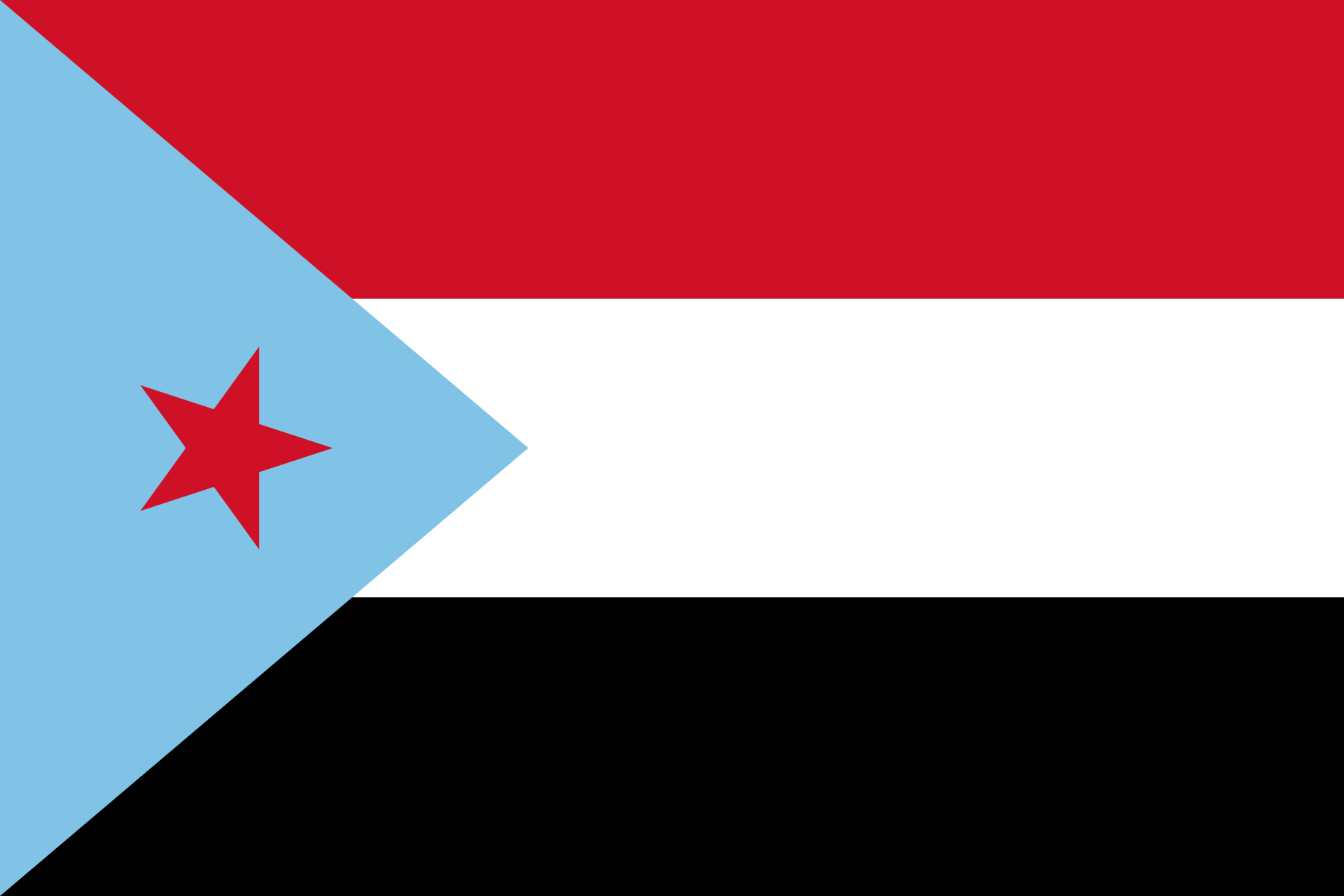
Mr. President, since you have assumed the presidency of the Security Council you have guided its deliberations with distinction, thanks to your vast experience and wisdom. My delegation is happy to address the Council under your eminent leadership, for you represent a country, the Soviet Union, with which we maintain excellent relations based on an unbreakable bond of friendship.
78. It is with a certain hesitation that I make this brief statement because the question under discussion involves fraternal Arab parties whose co-operation at this time is all too important to circumvent the notorious Camp David sell-out. Even at this point, Israeli warplanes are bombing the civilian population in Southern Lebanon, while Zionist zealots are bulldozing Palestinian homes and establishing new alien settlements with the full support of the Israeli Government.
79. We have no doubt that certain imperialist circles are doing their utmost to subvert the anti-Sadat, anti-Zionist Arab solidarity forged at the Baghdad summit. Certainly, this debate serves neither the Palestinian cause nor the well-being of our brothers in the Maghreb. That is why it was the overwhelming view of the Arab Group that this question should be dealt with in another context. For somewhat similar reasons, the African Group unsuccessfully tried to prevail on the Moroccan delegation not to insist on this debate in the Security Council.
80. On a more substantive level, my delegation believes that the question before the Council is essentially one of decolonization. As such, it is now in the hands of the AdHoc Committee established by the Organization of African Unity, whose forthcoming summit conference
81. My delegation, upholding the right of peoples to self-determination in accordance with General Assembly resolution 1514 (XV), has consistently supported the right of the Saharan people to self-determination. Furthermore, my Government has recognized POLISARIO as a genuine national liberation movement, and the Saharan Democratic Arab Republic as an independent sovereign State. It is our earnest hope that the Moroccan Government will do likewise, thus averting bloodshed among brothers and containing this unnecessary regional confrontation between Arab States whose stability, prosperity and well-being are so intertwined and whose common heritage and fraternal bonds are unshakable by what we hope are only passing incidents.
I thank the representative of Democratic Yemen for his kind words with regard to the friendly relations existing between our two countries.
83. The next speaker is the representative of Mauritania. I invite him to take a place at the Council table and to make a statement.


Mr. President, allow me first to extend to you the sincere congratulations of my delegation on your assumption of the presidency of the Security Council. I do this with great pleasure, since the country you represent, the Union of Soviet Socialist Republics, and mine enjoy friendly relations of lasting co-operation based on mutual interest and respect.
85. I should also like to thank all Council members for having permitted me to take part in their deliberations in order solemnly to recall the position of my Government on the Saharan issue. This position has been voiced repeatedly by various leaders of my country at the highest possible levels. The latest reaction expressed by my Government on this issue was contained in a communication addressed to the Secretary-General by a letter dated 23 May 1979, issued as a document of the General Assembly.’
86. In adopting this stand, the Islamic Republic of Mauritania has clearly shown its will for peace and its burning desire to help to bring about better understanding in the region. In taking that position, the Islamic Republic of Mauritania has extended its hand to all peoples and countries of the region. That fraternal hand is
’ A/34/276.
87. Quite recently the President of the French Republic said that Mauritania was a noble country worthy of respect. My people are faithful to their traditions, their dignity and their worth and wish fully to play their part as a link between all countries in the north-west African region; but without thereby denying their commitment, they hope to play that part in a north-west Africa at peace, in a region of solidarity.
89. Mauritania remains convinced that dialogue and joint efforts are the best way of finding a peaceful solution, a just and lasting solution, to all the problems facing the region. We make an urgent appeal to all the parties concerned to refrain from any action that might compromise peace and security in the region.
The meeting rose at 12.50 p.m.
▶ Cite this page
UN Project. “S/PV.2153.” UN Project, https://un-project.org/meeting/S-PV-2153/. Accessed .