S/PV.2193 Security Council
▶ This meeting at a glance
5
Speeches
2
Countries
0
Resolutions
Topics
Southern Africa and apartheid
Arab political groupings
Security Council deliberations
Syrian conflict and attacks
UN procedural rules
War and military aggression

The first speaker is Mr. Tirivafi J. Kangai, representative of the Patriotic Front of Zimbabwe, whom the Security Council, at its 2192nd meeting, invited to participate in the discussion, pursuant to rule 39 of the Council’s provisional rules of procedure. I invite him to take a place at the Council table and to make his statement.
2. Question concerning the situation in Southern Rhodesia: Letter dated 25 January 1980 from the Chargk d’affaires a.i. of the Permanent Mission of Malawi to the United Nations addressed to the President of the Security Council (S/13764)
The meeting was called to order at 12.25 p.m.
4. Mr. KANGAI: Mr. President, on behalf of the Patriotic Front and the heroic people of Zimbabwe, we wish to thank you and the members of the Security Council for giving us this opportunity to appear before this august body. We are happy that you have invited us to participate in this discussion concerning the grave situation in our country, Zimbabwe, in particular, and southern Africa, in general.
Adoption of the agenda
The agenda was adopted.
Question con’cerning the situation in Southern Rhodesia:
Letter dated 25 January 1980 from the Charge! d’affaires a.i. of the Permanent Mission of Malawi to the United Nations addressed to the President of the Security Council (S/13764)
5. It is regrettable that this series of meetings has had to be convened at this point to take decisions on the threat to peace and security caused by the ceasefire violations on the part of the United Kingdom, the administering Power in our country. It was our hope that by now we should have been moving in top gear as far as the implementation of the Lancaster House Agreement’ was concerned. The chances are there, the end of the tunnel is near, and the will on our part is there. It is well known that we have fought for years in order to establish peace, security, selfdetermination and national sovereignty for ourselves in Zimbabwe. We therefore signed the Lancaster House Agreement on the clear understanding that what we have been fighting for should be not only achieved but also protected. That is why we have done everything we possibly could do to comply with that Agreement, despite its shortcomings.
In accordance with the decision taken at the 2192nd meeting, I invite the representatives of Botswana, Cuba, Egypt, Liberia, Malawi, Mozambique, Somalia, the United Republic of Tanzania and Viet Nam to participate in the discussion without the right to vote.
At the invitation of the President, Mr. Tlou (Botswana), Mr. Ron KourI (Cuba), Mr. Ahdel Meguid @wpt), Mr. Dennis (Liberia), Mr. Muwamba (Malawi), Mr. Monteiro (Mozambique), Mr. Sha$ (Somalia), Mr. Mkapa (United Republic of Tanzania) and Mrs. Nguyen Ngoc Dung (Viet Nam) took the places reserved for them at the side of the Council chambes.
I should like to inform the members of the Security Council that I have received letters from the representatives of Algeria, Nigeria and Yugoslavia in which
-
6. For its part, the British Government has left no stone unturned in its efforts to please, favour and bolster the Smith-Muzorewa clique.
8. So it is unbelievable to hear some people saying that things are going very well; that Africa is content. Is that why there are distinguished ministers in this chamber?
9. During the past few weeks we have observed several violations of the Lancaster House Agreement by Lord Soames, the British Governor now in Zimbabwe. The following are the most serious.
10. First is the presence of South African troops, the continued presence, deployment and use of South African troops by Lord Soames, who is now administering Southern Rhodesia in preparation for the elections. The Patriotic Front, the Organization of African Unity (OAU), the non-aligned movement and the whole progressive world community have been shocked by the flagrant use of racist South African troops. This action by Britain, in collaboration with the Smith- Muzorewa clique and the South African racist regime, stands condemned. The British Government has admitted the presence of what it calls a small contingent which is guarding the Beit Bridge. We shoufd like to dispute that understatement of the actual number of South African troops in our country. Our, information, based on field observation, is that there are at least 6,000 South African troops extensively deployed in strategic areas throughout Zimbabwe. Our observation is that those highly equipped South African troops fall into three main categories: those which operate under South African command, wearing South African uniforms, and are based mainly in the southern part of Zimbabwe, including Beit Bridge; a large number on secondment to the Rhodesian Army, wearing Rhodesian uniforms, deployed throughout Zimbabwe as pilots, policemen and so on; and a large number of South African mercenaries who have been there since the date of the unilateral declaration of independence.
11. We should observe that the presence of those troops is used to manipulate the political environment in favour of Bishop Muzorewa and the white community. Their presence has created an atmosphere in which free and fair elections are impossible. Intervention by South Africa in Zimbabwe, in the event of our victory-which is sure-is almost certain. The British Government has shown its true coIours by extending an invitation to South African troops and by deploying them to surround the Patriotic Front forces., The British Government has demonstrated that it is not an impartial administrator but openly discrimi-
12. The net effect of the presence of South African troops is that there is a serious threat to peace and security in that region. We call, in very strong terms, for their immediate withdrawal. They should be withdrawn quickly, under a specific form of international supervision,
13. We were told last month, in London, that those forces would withdraw as soon as the Governor arrived. Two days ago we were told that they had been withdrawn, We think that their withdrawal should be verified by an international body. Was it not our argument at Lancaster House that thousands of troops would be needed to maintain law and order and to enforce a cease-fire in Zimbabwe? If the British need more forces to maintain law and order in Zimbabwe, they should simply request more Commonwealth forces. Surely many Commonwealth countries represented here would be happy to contribute forces for that purpose. Certainly our several thousands of soldiers now in assembly areas would be happy to guard the Zimbabwe side of Beit Bridge. Are we 10 believe that South African troops are now part and parcel of the Commonwealth monitoriug forces?
14. Secondly, there is the redeployment of Rhode- Sian troops and auxiliaries. Lord Soames has redeployed Rhodesian troops, mercenaries and the private army of Muzorewa. That private army is known in 1 Rhodesian military jargon as the “auxiliaries”. Lord ’ Soames redeployed those troops in areas previously liberated by Patriotic Front forces. Those auxiliaries are terrorizing civilians and attempting to coerce them into supporting Muzorewa. That action by Lord : Soames is a clear violation of the Lancaster House Agreement which specifies that the Rhodesian troops i ! should be confined to their bases. The auxiliaries ’ should have been disbanded, because they are the personal army of an individual.
15. The British Government should order the return of Rhodesian troops to their bases and the disbandment of the auxiliaries and all mercenaries in our country. We request the Security Council to see that this is done immediately, so that all political parties can campaign freely, without threat of death at the hands of those unruly auxiliary bandits.
16. Yesterday the representative of the British Government told this body [2192nd jneeting] that he firmly rejected the statement that there had been ceasefire violations relating to the implementation of the Agreement. In the same breath he told this body that the auxiliaries were part of the Rhodesian forces and
‘2
17. Yesterday we were also told that Rhodesian forces were now monitoring the cease-fire. This concern is the basis of our request for the convening of the Security Council. The Rhodesian forces, which include large numbers of foreign mercenaries, should be confined to their bases and should themselves be monitored by Commonwealth forces. That is what the Agreement calls for. The British Government has thus admitted that it has deployed Rhodesian forces, including mercenaries and auxiliaries, to monitor Patriotic Front forces. Why, then, does the British Government reject the allegation of the African Group? That is a very serious breach of the Agreement by the administering Power which must be corrected immediately.
18. Yesterday we were told, too, that South African forces had withdrawn from Beit Bridge. We consider that to be a smokescreen, a cover-up for decades of involvement in our country.
19. Thirdly, there is the unequal treatment of the Patriotic Front forces. The Lancaster House Agreement clearly specifies that the British Governor will treat the Rhodesian forces and the Patriotic Front forces equally. We noted earlier that he has redeployed the Rhodesian forces and reinforced them with South African forces, Muzorewa’s auxiliaries or private army, and mercenaries. That is a gross violation of the Agreement, which places the Patriotic Front forces at the mercy of their opponents. That type of bias has spoiled the political environment. It creates a situation which is bound to threaten the cease-fire. We request that the Governor rectify this situation before it is too late. We should also like to point out that, were it not for the heroic battles fought by the Patriotic Front forces, the battles which pushed Smith and Muzorewa against the wall, the British would not have returned to Zimbabwe today. Our forces should be treated with the honour they deserve.
20. Muzorewa did not give up much by signing the Lancaster House Agreement. He had failed to deliver the goods. Before the internal settlement was signed, Muzorewa promised the people of Zimbabwe and the world that he would deliver a cease-fire, that sanctions would be lifted and that there would be international recognition. None of those promises was fulfilled, and the people continued to support the Patriotic Front. So no credit whatsoever should be given to Muzorewa for signing the Agreement. He failed, and he is a thing of the past, if he ever was anything at all.
21. The white community in our country did not give up much by signing the Lancaster House Agreement.
22. The British media and those of their allies have teamed up with Lord Soames in putting the blame on our forces for whatever goes wrong in Zimbabwe today. The idea has been and still is to paint our forces as the “bad guys” and those of Muzorewa and South Africa as the “good guys”.
23. Yesterday [ibid.] there was an attack by Sir Anthony Parsons on our liberation movement. That is nothing new. Most of the members of the Council remember the detente in southern Africa during 1974 and 1975. Our liberation movement was singled out and attacked, harassed and almost wiped out by the British and their allies. That is nothing new; we are used to it; and if this continues, we shall take stock. Of course we are going to play a major role in the new Government in Zimbabwe. We want good relations with our friends in the United Kingdom, but, if this continues, we shall have to think otherwise.
24. During the Lancaster House talks, the British and the Rhodesian regimes estimated that the Patriotic Front had only 12,000 to 15,000 men. We have, however, been able to assemble over 23,000 men. Was that not good faith on our part? Scattered fighting broke out because our forces came into contact with auxiliaries and Rhodesian forces which should have disengaged before our forces could move to their assembly points. Our forces should not be asked to remain in the assembly areas if the auxiliaries and Rhodesian troops are not confined to their bases. Our forces should not be asked to disengage and to’remain in their bases if South African troops are in our country extensively. We object to that.
25. Fourthly, there is the Governor’s bias in the campaign. The return of Patriotic Front co-leaders Robert Mugabe and Joshua Nkomo was delayed purposely in order to give Muzorewa a head start in the campaign. We view that very seriously, because the Governor is required to be impartial. The reasons given in each case were not sound at all.
26. We are still recognized by OAU, by the nonaligned movement and the United Nations and all its agencies. But yesterday we heard Sir Anthony Parsons trying to stop us from speaking here. We should like to remind him that we are not at Lancaster House or in Salisbury; we are in the Security Council chamber.
28. Fifthly, there is the delay in the return of refugees. The speedy return of all refugees from neighbouring .countries is being deliberately frustrated for political reasons, because it is assumed that refugees will vote for the Patriotic Front rather than for the Bishop. No effort is made to facilitate the return of refugees, despite the clearly stated position that they need to be repatriated as soon as possible. We request that the Security Council should see to it that the British Government commits itself to facilitating the return of refugees who are victims of a situation beyond their control.
29. Sixthly, there is the state of emergency and martial law. We wonder why the Governor saw fit to extend the state of emergency for another six months, when he knows that he is supposed to leave shortly after theelections are held? He is using emergency powers to detain large numbers of our supporters without trial. If that continues unchecked, we can assure the Council that thousands of Patriotic Front supporters will be behind bars before the election dates.
30. We agreed at Lancaster House that all political prisoners should be released so that they, too, could participate in. the political process. We regret to inform this body that there are still several hundred Patriotic Frontpolitical prisoners being detained, throughout Zimbabwe. Just before this meeting began, wereceived a message to the effect that others were detained yes,terday. ‘It,is wei known to us that Zimbabweans who ,had committed even criminal offences while in Zambia and Mozambique have since been released.
31. The Patriotic Front has adhered to the letter and the spirit of the Lancaster House Agreement. We have drawn the attention of the British Government to
32. We recommend to the Security Council that corrective measures should be taken immediately under international supervision. The Patriotic Front is willing to co-operate in rescuing the Agreement from collapse. Those measures should include: first, immediate verification of the withdrawal of South African troops and mercenaries; secondly, confinement of Rhodesian troops to their barracks; thirdly, disbandment of auxiliaries; fourthly, termination of the unequal treatment of forces; fifthly, an end to partiality in the administration of the country and the treatment of different political parties; sixthly, speedy return of refugees and an end to their harassment, searches and humiliating screening; and seventhly, an end to emergency regulations.
33. The Patriotic Front has observed that the Rhodesian Civil Service, taking directives from Ian Smith, Muzorewa and Peter Walls, is still running the show in Zimbabwe. At the beginning, I did mention that there were short-comings in the Lancaster House Agreement. Now we see that the Governor is using the instruments that Ian Smith had used-the civil service, the judiciary, the army and now the police. Lord Soames seems either helpless or co-operative. We place the responsibility for correcting the situation on the shoulders of the British Government. Since the British Government has not corrected the situation for over four weeks now and actually demonstrated partiality by retaining foreign troops, we have no choice but to ask the Security Council to take the necessary measures.
34. It is our hope that the members of the Council will not fail the heroic people of Zimbabwe, which suffered for 75 years under British racist domination and 15 years of repression under an illegal minority regime. We feel that we are being sold down the river by the administering Power, which has added more fire by inviting the racist South African troops to our motherland. Time is of the essence. If corrective measures are not taken soon, we shall not have any alternative besides that of continuing the armed liberation struggle.
35. We have struggled for years since the introduction of colonialism in our country. We are prepared to struggle for more years to come. We should like to


We are meeting today to consider a particularly serious situation that has developed in Southern Rhodesia since the arrival of the British Governor Lord Soames in that Territory. .4dmittedly, his arrival signalled the return of the illegal rkgime to legality. But Rhodesia can only become independent Zimbabwe if the British Government has the political will to ensure that the Lancaster House Agreement’ is implemented fully and faithfully. This meeting is indeed in accord with Security Council resolution 460 (1979), by which the Council decided to keep the situation in Southern Rhodesia under constant review until the Territory attained full independence under genuine majority rule.
42. Paragraph 2 of the pre-independence arrangements, contained in annex D to the report of the Constitutional Conference on Southern Rhodesia’ held at Lancaster House from September to December 1979, reads as follows:
“Rhodesia continues to be part of Her Majesty’s dominions, The Government and Parliament of the United Kingdom have responsibility and jurisdiction for and in respect of it. It is for the British Parliament to grant legal independence to Rhodesia.”
This is a restatement of Britain’s recognized international responsibility as the legal administering Power with power over Rhodesia. In addition, the Agreement provided that an Order in Council, to be promulgated by the British Government, was to appoint a Governor on whom it would confer, and in fact did confer, executive and legislative authority. This’ pro-,” vision was indeed fulfilled by the British Government. The Order in Council requires the Governor to ,act according to the instructions given to him’ by the British Government for the fulfillment of his task: There is no doubt, therefore, as to the responsibility that Britain is expected to discharge in Southern Rhodesia. We are only judging the performance of the British Governor by using a yardstick which the appointing authorities set for themselves.
38. Resolution 460 (1979) took into account the negotiations that had taken place at Lancaster House on the independence of Southern Rhodesia. Shortly thereafter an agreement was signed by all parties to the conflict.
39. It is an accepted fact that the Lancaster House Conference was itself the direct result of the war of national liberation which the heroic people of Zimbabwe, through the Patriotic Front, had relentlessly waged against settler racist domination. Contrary to British propaganda, the capitulation by the illegal rigime was not the result of Muzorewa’s alleged magnanimity. Neither was it a result of a voluntary change of heart by the settler racists. Victory has indeed resulted from the armed struggle prosecuted by the Patriotic Front. It should be remembered that over the years, several attempts to resolve the Rhodesian problem, on the HMS Tiger, on the HMS Feo&ss, at Malta, at Geneva or through the Anglo- American shuttle diplomacy, had all failed to yield any fruitful, desirable results.
43. As the Council is aware, the British Governor, acting on instructions from the British Government,, had allowed the continued presence of South African. troops inside Rhodesian territory. That was contrary. to the Lancaster House Agreement, which stipulated,, infer &a, that South African and mercenary %forces were to be withdrawn from the Territory as soon as the Governor arrived in Southern Rhodesia. Security Council resolution 460 (1979), on Rhodesia; also urged the United Kingdom to ensure the removal from Rhodesia of South African and mercenary forces. During the talks in London, the British Government admitted that there were some South African troops in Rhodesia. The British Commander of the Commonwealth Monitoring Force in Salisbury, a Major- General Acland, did in fact place the number at just under a thousand. Certainly the British wanted to underplay the impact of the presence of South African and mercenary forces. The British should know that the presence of even one South African soldier or mercenary in Southern Rhodesia raises eyebrows among concerned members of the international community who favour genuine independence for Zimbabwe.
40. In their just struggle against colonialism and settler racist rule, the people of Zimbabwe received the support of OAU and the front-line States, the nonaligned movement, the United Nations and progressive members of the international community. The international community, through those bodies, refused to accept anything that was aimed at depriving the people of Zimbabwe of their right to genuine independence or their right to choose their own leaders on the basis of free and fair elections. ACcordingly, the international community steadfastly refused to accord any recognition to successive SOcalled internal settlements which were concocted in Southern Rhodesia after the unilateral declaration of independence in the then rebel colony. The decision not to recognize the Muzorewa-Smith regime played a very important role in thwarting the evil intentions
45. Why did the British Government find it necessary to issue a joint statement with the South African Government to the effect that South African troops would be withdrawn from the Rhodesian side of the Beit Bridge as soon as Rhodesian forces were available to guard that bridge? As far as we know, the Lancaster House Agreement does not in any way provide that the United Kingdom and South Africa will administer Southern Rhodesia jointly. In any case, it is reported that South Africa itself has said that to guard the bridge, one does not have to sit on the bridge itself. Zambia is therefore perplexed and puzzled by the British reasoning and indeed by the timing of the announcement.
46. Yesterday’s announcement by the British Government that South African troops had been withdrawn was meant to take the steam out of the deliberations of the Security Council. My delegation views that announcement just as we viewed the announcement of the British Government in the mid-1960s that sanctions would bring down the illegal Smith rkgime in a matter of weeks rather than months. And, of course, in its wisdom the Council should know what it means.
47. The implications of this episode of the South African presence in Southern Rhodesia must be viewed in a broader international perspective. If it is not checked fully, it can have serious consequences for the future of the region. We in Zambia can at least humbly claim that we know the mentality of the South African Boer, who was, regrettably, highly praised by the British Government after the joint announcement on the so-called South African troop withdrawal.
48. The international community must be sensitive to the numerous utterances that have been made by the leaders of npnrtheid in Pretoria, who have threatened to intervene in Zimbabwe should the outcome of the forthcoming elections not accord with South Africa’s expectations. Who are they, anyway, to dictate the outcome of the elections in Zimbabwe?
49. Against this background, we view with suspicion the motives of the British and South African Governments in this matter. By way of a slight digression, let the Council be reminded of the granting of inde-
50. South Africa continues to meddle in the affairs of Zimbabwe in more ways than one. They are spending millions of dollars and supplying material in support of the puppet candidates. As we are aware, South Africa aided and abetted the Smith-Muzorewa rt?gime in its wars of aggression against the people of Zimbabwe and the front-line States for several years. South African forces and mercenaries today remain inside Rhodesia, beyond the Beit Bridge. They are also reported to have been deployed by the Governor to border areas for patrol purposes.
51. South Africa has no right to arrogate to itself the responsibility for determining the form of government in the neighbouring independent African States. The Pretoria rkgime should not rely on the principle of invincibility on account of its military strength. South Africa should not forget the humiliating defeat that its forces suffered a few years ago, when it chose to intervene militarily in the affairs of another State. Britain must therefore ensure that South Africa accepts the outcome of a free and fair election in Southern Rhodesia. The international community must remain vigilant in ensuring that South Africa does not again intervene in the affairs of the British colony of Rhodesia or in an independent Zimbabwe after its forces and mercenaries have been expelled from Rhodesian territory.
52. The British Governor also continues to violate the terms of the Lancaster House Agreement in respect of the status of the military forces inside Rhodesia. Much has already been said about this aspect, and my task is therefore to highlight the dangers inherent in the British attitude. It was the understanding that all the armed forces in Rhodesia would be accorded equal status. Yet, while the forces of the Patriotic Front have been confined to assembly points, those of Rhodesia continue to be deployed and used by the Governor instead of the police units stipulated in the Agreement. Furthermore, there are other devices for monitoring the cease-fire, which Rhodesian forces are not required to police, since those blood-thirsty forces are well-known outlaws who have been fighting against the people of Zimbabwe for many years. The misuse of the forces is therefore a matter of serious concern, as it has the effect of further eroding the carefully worked out Agreement. The Governor should be working to defuse the situation and not to inflame the tensions. The same can be said of the notorious private armies or the auxiliary forces that belong to Muzorewa.
54. Paragraph 4 of the pre-independence arrangements, contained in annex D to the report of the Constitutional Conference on Rhodesia,’ reads in part as follows:
a.. The question now at issue is who is to form the future independence Government. The British Government’s position is that this must be decided by the people of Zimbabwe, in free and fair elections in which all parties will be able to take part on equal terms.”
“
55. The British Government’s thinking on the issue, as set out in the Agreement, is the same as that of the international community, which was set out in General Assembly resolution 1514 (XV) of 1960, on the granting of independence to colonial countries and peoples. My country is fully committed to supporting any measures that are aimed at the implementation of resolution 1514 (XV) in all its aspects. We believe that it is through this process that the international community could bring peace to Southern Rhodesia and to the region of southern Africa as a whole.
56. It should be recalled that the British Government’s representatives had expressed strong views in their pronouncements during the thirty-fourth session of the General Assembly on their Government’s commitment to bring about an internationally acceptable solution to the problem of Southern Rhodesia. It was against this background that we assumed that the British Government had worked hard towards ensuring the successful conclusion of the Lancaster House negotiations on Rhodesia. The Lancaster House Agreement sought to give a semblance of free and fair elections, but the gross violations during the Lancaster House talks and after the signing of the Agreement contradict the principles previously stated. First, the Governor was sent to Salisbury before the signing of the Agreement and without consultation with the Patriotic Front. Secondly, sanctions were lifted unilaterally by the United Kingdom and some of its allies before the Agreement was signed. Thirdly, the Governor set the date for the registration of voters without prior consultation with all the parties concerned.
57. It is also regrettable that available information on the breaches of the terms of the Agreement since
58. First, the British Government has created difficult conditions for the return to Southern Rhodesia of Zimbabwean refugees, who inchide men, women and children. Many of these Rhodesian refugees are still unable to go back to Southern Rhodesia to participate in the elections in order to bring in a Government of their choice.
59. The front-line countries from which the refugees are being repatriated have complained to the British authorities, that not enough is being done to facilitate the return of refugees and exiles. These people are Zimbabwean nationals, and they have the inalienable right to return to their homeland.
60. In Zambia, for instance, the first phase in the programme for the return of refugees to Zimbabwe involves some 14,000 refugees and exiles. The programme has, however, not been started, because the British authorities in Salisbury have been giving lame excuses about the inadequacy of reception centres. They have, for example, put the rate of return at 3,000 persons a week, a rate that will not allow all the refugees to return in time for the elections, especially since the exercise of repatriation has not yet been put in motion. Zambia has been ready to transport the refugees by road at Chirundu, Victoria Falls and Kariba and also by rail and by air. However, the British authorities in Salisbury are insisting. that refugees should go to the small coal-mining town of Wankie instead of to Bulawayo and Salisbury. The British strategy obviously relies on the fact that Wankie, being a smaller place, can only take a limited number of refugees. The objective, therefore, is to ensure that as few refugees as possible return at this time and that the majority of refugees have a slim chance of participating in pre-independence elections. The British authorities have also insisted on unnecessary security checks on refugees returning to Rhodesia and on flimsy excuses such as the alleged cholera outbreak in countries where the World Health Organization has not declared the existence of cholera, or the alleged lack of water supplies in areas where this has never been a problem before. In our view, it is within the power of the British authorities, with the assistance of the ever willing United Nations High Commissioner for Refugees, to expedite the return of Zimbabwean refugees and exiles.
62. Thirdly, the Governor appears to have allowed Muzorewa to make seditious statements publicly. For example, Muzorewa has on many occasions threatened that there would be civil war in Rhodesia if the Patriotic Front won the elections. Thus far, Muzorewa has not been rebuked by the Governor for his utterances. Besides, it is reported that many Rhodesian blacks and whites who enjoy the sympathy of Governor Soames have not been disarmed. How can the British Government justify these actions as being in line with its professed goal of conducting free and fair: elections’?
63. Fourthly, on 1 January 1980, in the Chitunha and Maembure areas, a civilian was shot dead and his wife seriously wounded. In the same areas, a Rhodesian security aircraft dropped pamphlets praising the auxiliaries and saying “We are back. Vote for us and not for the terrorists”. ‘!
64. Fifthly, on 4 January, reports were confirmed that an exchange of gunfire in the Mtoko and Nanhunga camps was started by a group called “Trekker”, which poses as forces of the Zimbabwe African National Liberation Army (ZANLA). This happened in the Zone Dl liberated area.
65. Sixthly, on 5 January at 1000 hours, Rhodesian forces occupied areas evacuated by ZANLA forces in F, Fl, F2, F3 and F4 liberated areas. At 1040 hours, the same day, in Fort Victoria, Rhodesian security forces were deployed in various areas in Makombe and Mushana mission. On the same day, it was confirmed that auxiliaries were intimidating the villagers in Nyamahubogo. Activity by security forces was confirmed in .Rushinga, Darwin and Chatungama, which are protected villages. The liberated. areas of Kairo and Karuya in A, B and C areas were also occupied by *security forces.
66. Seventhly, on 6 January, auxiliaries arrested Mr. Chimwanda, Vice-Chairman of the Zaka district. In Shabani, police were confiscating Zimbabwe African National Union (ZANU) T-shirts and auxiliaries were harrassing,people.
67. Eigbthly, on 7 January, auxiliaries arrested Mr. Manyika Bikita and the Bikita police station was
68. Ninthly, on 8 January, two whites of the Rhodesian forces, together with auxiliaries, shot a youth in the legs. On the same day, in the Chigodora area, auxiliaries were propagating Muzorewa slogans and saying that the terrorists had been defeated and that people should vote for Muzorewa. At Manica bridge, Rhodesian forces and auxiliaries occupied the area and started harassing people and propagating Muzorewa slogans. Again on 8 January, in Zimunya area, Madzimbewa, Gombakomba and Gweshe schools could not open because of the activities of the auxiliaries; in the Dora Reserve, Rhodesian security forces shot cattle belonging to the local people, while in Rusape, Rhodesian forces and auxiliaries intimidated the masses.
69. Tenthly, on 9 January, 27 freedom fighters were detained after being disarmed at Rusape, Inyazura and Headlands. They were supposed to be taken to the assembly points. On the same day auxiliaries and Rhodesian forces stopped and disarmed freedom fighters at F and F4 liberated areas on the Governor’s orders. Particulars were taken of the freedom fighters and they were later taken to the Rhodesian forces camp and asked to conform to the rules of the old Muzorewa amnesty. Further, branch chairmen and secretaries of ZANU were eliminated and freedom fighters were forced to join the party of Muzorewa or face detention.
70. Eleventhly, on 10 January, auxiliaries were reported camping at various places in the Gutu area. Nine people were arrested.
71. Twelfthly, on 11 January, the Governor signed an order extending the controversial state of emergency until 26 July.
72. Thirteenthly, on 21 January, the Rhodesian Information Ministry issued a booklet entitledZANU’s PNI.I.V Policy, which was intended to persuade voters not to choose ZANU-Patriotic Front.
73. Fourteenthly, on 25 January, the Government of Botswana complained of the seizure of Botswana trucks and the arrest of Botswana Government drivers, which hindered the return of refugees. Refugees Were screened at reception centres. Systematic press and radio propaganda was stepped up to discredit the Patriotic Front.
74. Fifteenthly, on 28 January, three days ago, Rhodesian authorities objected to the airlift of 5,000 refu-
75. One wonders that the British response would be to all these obvious breaches.’
76. My delegation wishes to place on record its appreciation of and praise for the Patriotic Front for the co-operative spirit with which it has adhered to the Lancaster House Agreement under very difficult conditions. The Patriotic Front has done whatever was possible to facilitate the implementation of the Agreement in good faith. Indeed, the leadership of the Patriotic Front has demonstrated remarkable statesmanship. The Patriotic Front has now put down its guns and is eager to participate in the elections, contrary to what its adversaries had wished. The people of Zimbabwe should now exercise their right to choose their leaders. For our part, we want this process of elections to be free, fair and democratic. Let the British be seen to be allowing other people to exercise their democratic rights and not to be obstructing the democratic process. That is our plea. We hope it will be heeded, in the interests of all.
80. In other words, we believe that, if taken, these measures would contribute greatly to ensuring the effective implementation of the Lancaster House Agreement. We want a free and independent Zimbabwe that is born peacefully.

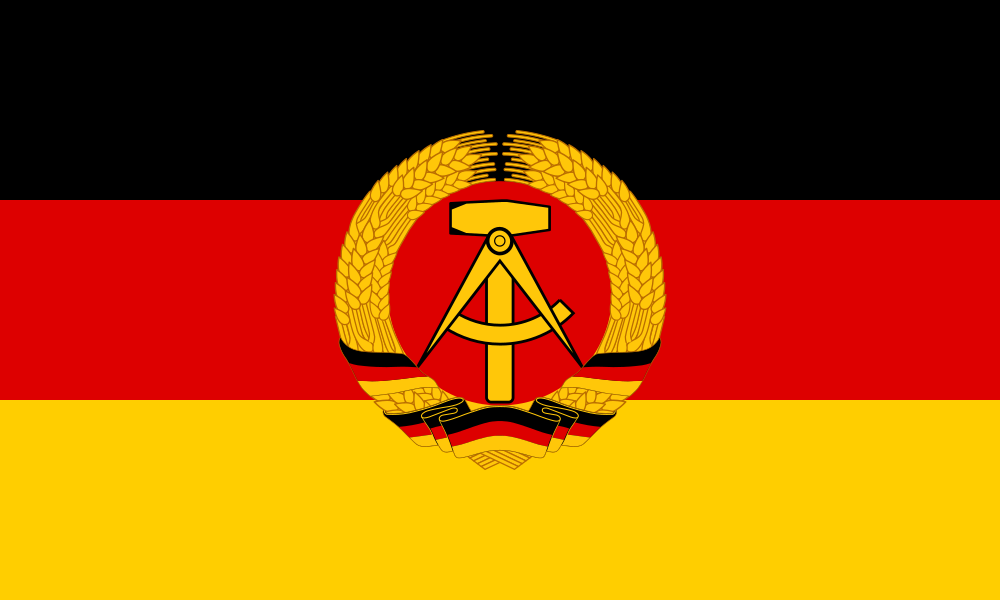
The delegation of the German Democratic Republic wishes to express its whole-hearted sympathy with the raising by the African Group of the question referred to in document S/13764. That question has been very convincingly set forth by representatives of African States. We share the serious concern of the members of OAU at the explosive situation in Southern Rhodesia, the persistence of which has created a threat to international peace and security.
77. Zambia, together with the other African States, has always been ready to co-operate in the full and successful implementation of the Lancaster House Agreement. Our suggestions are therefore being made in a constructive spirit, because we want to see peace in Zimbabwe. We want some of these conditions for peace to take root now. In this regard, Britain as the Administering Authority has a key role in the matter. There is still time to prevent disaster. That could be done if the British Government had the political will to do ‘it. We wish to remind it of the spirit of the Meeting of Commonwealth Heads of Government, held at Lusaka from 1 to 7 August 1979, which contributed to the Lancaster House meeting. We want the British Government to be impartial and fair. The Security Council should ensure that conditions are created for free and fair elections to be held in Zimbabwe. Only then can permanent peace come to that troubled country and region.
82. The straightforward foreign colonial domination of Southern Rhodesia was replaced by the Smith racist rkgime, which, in turn, was replaced by a puppet rggime. However, the armed struggle of the Zimbabwean patriots, international support for that struggle and, last but not least, the actions of the anticolonialist States in the United Nations forced those concerned to hold talks that were to create the conditions for solving the problem of Southern Rhodesia in a way that would promote a free and independent Zimbabwe. ,,j
83, The representatives of the Patriotic Front displayed a sense of high responsibility, a willingness for accommodation and a readiness to compromise. They acted constructively in order to achieve agreement. It is precisely the repres’entatives of that movement who today are faithful to the Agreement and who, despite the many difficulties they have faced, are doing everything they can to bring about the peaceful liberation of the country. Nevertheless, their African brothers find themselves compelled to turn to the Security Council-and they have excellent grounds for doing so. ,,‘,I ,m
78. Finally, I wish to appeal to the Security Council to prevail upon the Government of the United Kingdom to abide by the provisions of the Lancaster House Agreement and to take corrective measures which will ensure that the forthcoming elections are fair and free and thus bring &bout a genuinely independent people’s Government. The Council should reiterate its calls contained in paragraphs 6 and 7 of its resolution 460 (1979). It should also call upon the British Government as the administering Power in Rhodesia to take appropriate measures to contain the situation, because it has to succeed in this mission.
84. During the thirty-fourth session of the General Assembly, many delegations, including that of the German Democratic Republic, were already pointing to the dangers threalening the free exercise bjl the people of Zimbabwe of their right to Self-determiiation, due
79. To recapitulate: the British Government should ensure that all South African troops and foreign mercenaries in Rhodesia are withdrawn sind expelled imme-
85. The racist troops of the former white minority 16gime have been allowed to leave their strongpoints and to occupy regions liberated by the Patriotic Front forces. Those troops, guilty of murdering thousands of innocent men, women and children in Southern Rhodesia and neighbouring countries-Zambia, Mozambique, Botswana and Angola-are being used today, as was pointed out by the Minister of State of Mozambique [2/92ntl rneetirlg], for the purpose of what is officially described as maintaining “order and security”. Among them are thousands of foreign mercenaries. At the side of the racist army units and police units, auxiliary troops of the former puppet rkgime are operating-troops that are terrorizing and intimidating the population of Zimbabwe and conducting an electoral campaign in their own way. The racists and their puppets are still freely using the old machinery of oppression.
86. This question naturally arises: What kind of free and democratic elections are these when one of the parties taking part in the elections-a party that, as we know, has been condemned for its racist and inhuman policy of oppression-is organizing the elections with the help of its administrative apparatus and under the protection of its terrorist police and mercenaries? It is easy to imagine what it will take in these circum-
88. The South African crpcrrtheid rCgime not only claims the right to intervene militarily in large areas of the African continent, but has repeatedly attempted to put these claims into effect. It is precisely South Africa which for 14 years has played a decisive role in maintaining the racist minority rkgime in Southern Rhodesia.
89. Nor can we forget that this South African rCgime is able to continue its aggressive policy solely because of the support it receives from imperialistic circles, and it is only the repeated use of the veto by certain permanent members of the Security Council that has prevented the application of broadly based sanctions against South Africa, despite the fact that those sanctions have been called for by an overwhelming majority of States Members of the United Nations. The German Democratic Republic maintains the view that serious measures must be taken against the rrpnrlheid rkgime, which constitutes a threat to peace under Chapter VII of the Charter of the United Nations,
90. We should like to ask why South Africa is not given a direct ultimatum immediately and unconditionally to withdraw its troops from all parts of Southern Rhodesia. After all, the ultimatum to the Patriotic Front was very swiftly put into effect in the interests, it was said, of an early solution of the Zimbabwe problem. Maybe behind this policy is the desire to see to it that, if the imperialist manOeuvres fail, South Africa will have its hands untied.
91. The following words of the Foreign Minister of Tanzania were extremely illuminating in regard to the South African troops in the Territory of Southern Rhodesia: “ . . . It must be clear that their aim was to serve notice that the South Africans would prepare a roup against a duly elected Zimbabwe Government and then set up a puppet rCgime in the territory as a buffer.” [2192ntl meeting, pnra. 76.1
92. In accordance with this position of principle, the German Democratic Republic will continue whole-
94. The delegation of the German Democratic Republic believes it necessary that the Security Council, in accordance with its resolution 460 (1979), should remain se’ized of this question until Zimbabwe has achieved total independence.
93. The delegation of the German Democratic Republic shares the view of the African States that, in order to ensure a peaceful solution of the problem of Southern Rhodesia, the following are especially necessary: unswerving compliance with agreements entered into; the neutralization of the army and auxiliary forces of the former rkgime in Southern Rhodesia; the immediate and unconditional withdrawal of South
NOTE
1 See Soutllero R/rode,sir~: Report of’ the Cor~stif~r/ionc~/ Cm- ,jercwcv. Lnncrt,sfcr Hortsc’, Lo~~thr, Scpterllb~r-Decoll/,~~ 1979, Cmnd. 7802 (London, Her Majesty’s Stationery Office, 1980).
Ii
COMMENT SE PROCURER LES PUBLICATIOSS DES NATIONS UNIES
Les publications des Nations Unios nont en vente clans les librairies et lea agencea d&ositaires du mondc entier. Informez-vour auprhr do votre librnire ou adressez-vous I : Nations Unies, Section des ventes, NEW Tork ou Genive.
ICAIC HOJIYVHTb 3I3AAWHJI OPI‘AIIII 3AXIlII! Oc’bEAAHEHHbIX HAqllA
Hmawrr OpraxH3auiiH 06aearlHeilHbIx Hau~ri YOXKIIO XYllHTb B KIfHXRblX xara- BUH~X x aretiTcTaax 80 acex pn80~1x uflpa. Hnnon~re cnpaaK,a 06 1~3nami~x n 8aureH xm1xw0M hmra3me Km ninullre no anpecy: OpraKK3aqxs 06ae~KKeKKbw Hatwit, CeKqlrrc no npo~~~e HWIaHHn, HbM-FIopK llnlf ~KeKesa.
COMO CONSEGUIR PUBLICACIONRS DE LAS NACIONES UNIDAS
Las publicaciones de las Naciones Unidas e&in en venta en librellas y casas distribuidoras en todas partes de1 mundo. Consulte a su librero o dirIjase a: Naciones Wnidas, Seccidn de Ventas. Nueva York o Ginebra.
Litho in United Nations. New York 00300 83-61462-December 1985-2.42s
▶ Cite this page
UN Project. “S/PV.2193.” UN Project, https://un-project.org/meeting/S-PV-2193/. Accessed .