S/PV.2210 Security Council
▶ This meeting at a glance
11
Speeches
6
Countries
0
Resolutions
Topics
Southern Africa and apartheid
War and military aggression
Security Council deliberations
Diplomatic expressions and remarks
Global economic relations
Middle East regional relations

I should like to draw the attention of the members of the Council to document S/13886, which contains the text of a letter dated 10 April from the representative of South Africa addressed to the President of the Council.
2. Complaint by Zambia against South Africa: Letter dated 8 April 1980 from the Permanent Representative of Zambia to the United Nations addressed to the President of the Security Council (S/13878)
4. The first speaker is the representative of Yugoslavia, whom I invite to take a place at the Council table and to make his statement.
The meeting was called to order at I I. I5 a.m.
Adoption of the agenda
5. Mr, KOMATINA (Yugoslavia): The Security Council is faced once again with a dangerous problem resulting from the continued policy of aggression of the South African regime, and from the apparent inability of the United Nations and the international community as a whole to put an end to the terrorist acts perpetrated by that regime-acts that pose a threat to the security of the whole African continent.
The agenda was adopted.
Complaint by Zambia against South Africa: Letter dated 8 April 1980 from the Permanent Representative of Zambia to the United Nations addressed to the President of the Security Council (S/13878)
I. The PRESIDENT [interpretation from Spanish): In accordance with the decision taken at the 2209th meeting, I invite the representatives of Angola, Cuba, Liberia, Mauritius, Nigeria and Yugoslavia to participate in the discussion without the right to vote.
6. We are intervening in this debate in order to express our full solidarity with friendly, non-aligned Zambia, which is again the victim of the South African soldiery, who are armed to the teeth and do not shrink from using their Fascist methods against the unarmed and innocent civilian inhabitants of Zambia in order to destabilize the situation in that peaceloving country. We are also intervening in order to contribute to the universal condemnation of the anachronistic South African regime whose very existence is a slur on contemporary civilization.
At the invitation of the President, Mr. de Figueiredo (Angola), Mr. Roa-Kouri (Cuba), Mr. Tubman (Liberia), Mr, Ramphul (Mauritius), Mr. Clark (Nigeria) and Mr. Komatina (Yugoslavia) took the Places reserved for them at the side of the Council chamber,
7. It is obvious that by such treacherous raids the South African racists are trying to regain selfconfidence, in the hope that they will thus be able to forestall their own internal disintegration. The racists harbour vain hopes that by sabre-rattling they will be able to put off the day of their final collapse and succeed in weakening international solidarity with the
1 wish to inform the members of the Council that 1 have received letters from the representatives of Algeria, Guyana, the United Arab Emirates and Zaire in which they request to be invited to participate in the discussion of the item on the agenda. In accord-
8. The most recent acts of aggression against Zambia provide yet another proof that the system now in power in South Africa constitutes a cancerous tissue which poses a constant threat to peace and security in the region and beyond. That system constantly spurns, as in the past, the decisions and stands taken by the Security Council, the General Assembly and the whole international community.
9. Needless to say, such a form of State terrorism, which is striving to become legal and is relying on the short-sighted interests of transnational corporations and their imperialist appetites, engenders further complications in international relations, thus creating a favourable climate for the expansion of the area of confrontation between extra-regional forces in the region, and this can only have a negative impact at a broader international level. It is all the more important, therefore, to prevent such developments, in view of the fact that the international situation in general is constantly deteriorating, owing to a widespread use of force, military intervention and interference in internal affairs, and bloc rivalries-all aimed at disrupting the independent development of peoples and countries and at drawing them into spheres of interest.
10. Such behaviour on the part of the South African regime calls for a proper and energetic response from the United Nations, which is again confronted with an open challenge. The Security Council must react to the most recent acts of provocation in accordance with the Charter-that is, in a way expected of it by the international community.
1 I. We are faced in this case with a dangerous situation which is of neither a narrow African nor a regional nature, but of a global character. The Council’s reaction must, in our view, be such as to prevent the current attacks on sovereignty and integrity, and the present provocation, and to remove the danger of aggression once and for all. All the greater, therefore, is the responsibility of the Council and the United Nations as a whole to put a stop to the constant rampaging of racists who, by provoking new tensions, endeavour to ensure their own survival, and to safeguard the security of non-aligned and peace-loving Zambia, which is a perennial victim of aggression because it pursues policies that are in harmony with the provisions of the Charter.
12. The responsibility of all of us is therefore most directly involved, as these acts of aggression are being committed at a time when another country in the region-Zimbabwe-is on the point of enjoying its first days in the freedom and independence it won as a result of tremendous sacrifices made by its people
13. We are particularly concerned over the fact that the aggressive actions in question were launched also from the Territory of Namibia-a Territory that South Africa continues to occupy illegally, in contravention of the relevant decisions of the United Nations and in defiance of world public opinion. This fact further dramatizes the existing situation and calls for the adoption of urgent measures in the direction of the liberation of Namibia, implementation of the plan of the United Nations and support for the South West Africa People’s Organization (SWAPO) as the sole authentic representative of the people of that country.
14. The non-aligned countries, whose support for the liberation struggle against colonialism and racism was and has remained one of the basic postulates of their policy, have persistently expressed their solidarity with the victims of aggression and have, in the United Nations and at their various meetings, called for the adoption of comprehensive and effective measures for the total elimination of racial discrimination and aggression in southern Africa. Zambia is deserving of OUI solidarity. My country will, in accordance with the principles of our foreign policy and our traditiona friendship with the people of Zambia, and within the limits of our possibilities, offer Zambia all necessary moral, political and material support.
IS. To this end we shall support every action taken by the Council aimed at restraining the aggressive racist regime and at preventing a repetition of its provocative acts against the neighbouring African countries and peoples. In doing so, we are contributing not only towards extinguishing a fire but also towards improving the international situation in general.


Mr. President, first of all, on behalf of the Chinese delegation, I should like to express our warm congratulations to you on your assumption of the presidency of the Council for the current month and I should also like to extend our warm welcome to Mr. Reuben C. Kamanga, member of the Central Committee of the United Independence Party of Zambia and Chairman of the Political and Legal Committee of the Central Committee, who has come specially to attend these deliberations,
17. Since early this year, the troops of the South African racist authorities have repeatedly been guilty of military harassment and invasion of Zambia from the Territory of Namibia they are illegally occupying,
18. The ever-escalating armed aggression by the South African racist authorities against Zambia is not a coincidence. It has occurred under circumstances in which southern Africa is witnessing tremendous change. As is known to all, late last February an election for independence was held in Zimbabwe and the Zimbabwe African National Union led by Mr, Robert Mugabe and other patriotic forces won a brilliant victory. This is the result of the Zimbabwean people’s perseverance in a prolonged and valiant struggle and the result of the full support and assistance given by the many African countries and peoples, the front-line countries in particular. It is also a result ofthe smooth implementation of the agreement reached at the London Conference convened by the United Kingdom. The Zimbabwean people are now looking forward to the forthcoming independence celebrations with pride and joy. The peoples of various countries also heartily rejoice at the victory of the Zimbabwean people. The independence won by the Zimbabwean people has given encouragement to the Namibian and Azanian peoples who are waging arduous struggles and is serving as a powerful impetus to their struggles for national independence and liberation. It has also dealt a heavy blow to the South African racist forces, forcing them into even greater isolation. Nevertheless, the South African authorities have never been reconciled to their defeat, and instead of accepting it they are putting up a desperate struggle. In Namibia, they are continuing brutally to suppress the nationalist forces, to step up their schemes for an “internal settlement” and stubbornly to obstruct the implementation of the relevant resolutions and the plan of the United Nations. At the same time, they have been committing military incursions into Zambia and other front-line countries, in an attempt to coerce them into abandoning their assistance to Namibian nationalist forces. All these hostile acts of the South African authorities are aimed at maintaining their illegal occupation and colonial rule in Namibia,


Mr. President, it gives me particular pleasure to extend to you, as a fellow member of the Latin American group, my delegation’s warmest congratulations on your assumption of the presidency of the Council for this month. You assume this responsibility at a time when the Council is seized of issues of paramount importance in world affairs which require firm and decisive action. We are certain that your wide experience as a statesman in the service of your country, your profound understanding of international affairs and your outstanding skills in diplomacy will guarantee effective leadership of the Council during the month of April.
22. your country, Mexico, has always been a strong supporter of the United Nations and its principles. This is amply demonstrated by the important initiatives that Mexico has taken towards the strengthening of international co-operation to promote peace and development. It is a source of great SatiSfaCtiOn to Jamaica that warm relations of friendship and COoperation continue to grow between our two countries in a spirit of partnership and for the promotion of the common interests of the peoples of our region.
23. Since this is’the first time that I have spoken in the Council this month, I also wish to thank YOU, Mr, President, and the other representatives who have spoken for their kind words concerning the conduct of the presidency during the month of March.
19. However, the sinister designs of the South African racist authorities are doomed to failure. The :ontinued victories won by the African people in their struggle to achieve and safeguard national indepenhce have proved that no one can check the struggle
20. The Chinese Government and people firmly support the Zambian Government and people in their just struggle to safeguard their national independence, State sovereignty and territoriai integrity; they support their just position of assisting in the struggle of the Peoples in southern Africa and they support all the necessary measures the Zambian Government and people have taken to counter the aggression by the South African racist authorities. In the view of the Chinese delegation, the Council should strongly condemn the acts of aggression by the South African racist r&gime and demand that it immediately and unconditionally cease its aggression against Zambia and that it withdraw forthwith all its aggressor troops from the territory of Zambia. The Council should also demand that the South African authorities implement immediately and unconditionally the resolutions and the plan of the United Nations on the solution of the Namibian question so as to put an end to their illegal occupation and colonial rule in Namibia.
25. Jamaica strongly condemns the racist regime of South Africa for these latest acts, a series of wanton and unprovoked acts of aggression, which taken together constitute a flagrant violation of the sovereignty and territorial integrity of Zambia. They are a most serious violation of the principles of the Charter and the norms of international behaviour. The facts presented to us once more demonstrate the pernicious nature of the apartheid regime and its arrogant contempt for international law and the principles of the Charter. They confirm that the white minority regime is a dangerous menace to the security of African States and poses a serious threat to international peace and security. The tactics of intimidation through violence and terror used against the front-line African States indicate the determination of the racist regime to undermine the efforts of the United Nations towards achieving self-determination and independence for the people of Namibia. The front-line States and SWAP0 have co-operated fully in this effort, but South Africa continues to use every strategy it can to cause delay and to create tensions in the region.
26, The responsibility of the Council is clear: it is to ensure the maintenance of international peace and security and to impose its authority, using its powers under the Charter. Zambia, a peace-loving country, has shown patience and restraint in the face of naked aggression. It has appealed to the Council for action, with the faith and trust that the international community will act in accordance with its principles to terminate the invasion of Zambia’s territory. There is every reason for the Council to act with firmness and unanimity, on the basis of the facts presented,
27. Jamaica fully supports the proposals made yesterday in the statement of the representative of Zambia. They represent the absolute minimum the Council can do in the present grave situation, The clear and unambiguous message must be sent to South
28. The Council cannot afford simply to condemn and make empty threats that undermine its authority. These acts of aggression have to be stopped. This objective will not be achieved if some members of the Council continue to prevent this body from acting effectively and decisively against the racist regime. We join together in a determined effort to bring to an end all the suffering and bloodshed that white racism has inflicted on southern Africa. We owe this duty both to the people of Zambia and to Africa.
The next speaker is the representative of Zaire. I invite him to take a place at the Council table and to make his statement.


Mr. President, I should like, first, to thank you on behalf of the delegation of Zaire for having given me this opportunity to address the Council on a matter affecting both human dignity and the maintenance of international peace and security. Before entering into the substance of the matter, I should like to tell you how happy my delegation is at seeing an experienced diplomat and a representative of Mexico, a country with which my own enjoys excellent relations, presiding over the Council in April. The Zairian delegation is convinced that you will conduct the proceedings of the Council to a successful conclusion.
31. I should also like to congratulate the representative of Jamaica for the efficient way in which he conducted the proceedings of the Council last month,
32. The Zairian delegation endorses the statements made yesterday in the Council [ibid.] condemning the dangerous actions constantly being taken by the Pretoria regime.
33. If my delegation is speaking, even though highly qualified persons have spoken on behalf of all Africa, it is to stress once again that it is important for Zaire, situated as it is in the vicinity of the frontline countries, to see Zambia and Angola living in peace and security; and the security of those countries is affected by the independence of Zimbabwe and Namibia.
34. Once again the racist and backward South African regime is in the dock. It will be recalled that in November 1979 the Republic of Zambia addressed the Council to complain of the escalation and intensification of the acts of aggression committed by the former illegal regime of Rhodesia in collusion with
35. For some time now, some people have been wondering why South Africa, in spite of the many measures adopted by the United Nations, continues to defy the international community. The uportheid rhime that is in such disgrace, instead of learning the lesson of the irreversibility of history, is strengthening itself to the point where there is no longer the shadow of a doubt of its nuclear capability. This dangerously increases tension in southern Africa and constitutes a serious threat to the peace and security of the African continent, in particular, and the world, in general.
36. Are we not ourselves encouraging South Africa in its stubbornness by failing to respect the numerous resolutions we have adopted with sd much clamour? HOW many times have we listened to moving statements condemning the racist rCgime of Pretoria, while at the same time the countries concerned have been acting as its accomplices through transnational and other private companies and giving it support and reinforcement? We will one day have to decide before it is too late to abandon this two-faced policy.
40. Indeed, how else could we expIain the arrogance with which Pretoria defies the decisions of the United Nations if there were not a much deeper underlying reason that we have not perceived and which justifies the incorrigible stubbornness of the South African leaders? Let it suffice to refer to the way in which South Africa has sabotaged the plan of the five Western Powers on Namibia.
37? We must denounce the much-used and oftinvoked subterfuge of an argument according to which the official Government effectively does not cooperate with South Africa but, by virtue of the principle of freedom of action, private companies cannot be brought within the ban, The time to shed crocodile tears and to wring one’s hands about the plight of the poor Africans is gone for ever. All Africa is awaiting from the rest of the world sincere and loyal co-operation free from all political and economic restraints. Ever since the legitimization of the struggle of the oppressed peoples by the Declaration on the Strengthening of International Security [General Assembly t-esolutiorl 2734 (XXV)], it has become an imperative moral duty for all States which love peace and freedom to assist and support liberation movements.
41. For its part, Zaire believes that the interests of the principal partners of Pretoria do not lie solely in South Africa but also, and particularly, in the rest of the continent. Satisfying the liberation aspirations of the 280 million Africans is the only way of guaranteeing them Iong and fruitful co-operation in the enlightened self-interest of all.
42. South Africa must learn the lesson of Zimbabwe’s independence, which has tolled the knell for its disgraceful policy. On 4 October 1973 General Mobutu, President of Zaire, said the following in the General Assembly:
38. By helping Zimbabwe yesterday and by continuing today to assist the freedom fighters of Namibia, Zambia is simply acting in accordance with that principle and responding to the historic appeal issued by Africa. At this crucial time in the struggle for the total liberation of the African continent, Zaire would like to take this opportunity to pay a tribute to the p&ple and Government of Zambia and the other frontline countries for the indescribable sacrifices they have made for the sacred cause of Africa.
“Why are there countries that continue assisting a country which practises a policy that has been affirmed to be a crime against humanity? Is it solely for economic and commercial reasons? Is it because South Africa-in which there prevails an insecurity inherent in its political system-is a more interesting and important market than that constituted by the rest OF the independent African States, which represent approximately 280 million persons and a whole range of resources and raw materials in demand throughout the world? Is it because protection and surveillance of the route to the Indies is of more concern than all the other interests of Europe in the rest of free Africa?
“No. We have the impression that apcrr/heid is a policy in the service of a policy whose name one does not wish to utter. Indeed, we have the impression that, between Pretoria and its principal partners . . . there is an identity of views and a convergence of interests concerning the purpose sought but a divergence on the means used by Pretoria, namely ffpartlzeid.“’
“Despite the huge organization created to perpetuate the slavery of the black man, the whites of Europe could not extinguish the flame of freedom and dignity of black Africa. Thus, about 1960 an irresistible and irreversible feeling for freedom seized all the peoples of Africa and led to disarray among the colonialists who were not prepared for it. The black man broke his shackles and said ‘No’ to exploitation and to his alienation by the West.
43. Twenty years have elapsed since the wave of African independence. With the independence of Zimbabwe, the storm of history has opened a breach in the last bastions of colonialism and racism, situated chiefly in southern Africa. Tomorrow it will be Namibia and, finally, the abolition of apartheid.
44. In conclusion, Zaire, through my humble voice, is making a solemn appeal to South Africa’s principal partners, asking them to undertake to do everything in their power to ensure that the crisis in southern Africa is brought to an end by peaceful means; otherwise, their continual support will serve only to increase the resentment of the African peoples which aspire to freedom and dignity. It is for them to choose where their true interests lie.
45. For the time being, South Africa must be strongly condemned and compelled to leave Zambia’s territory as soon as possible so as to create a propitious climate which could lead to a positive approach that would free Africa for ever from all humiliations.
The next speaker is the representative of the United Arab Emirates, who wishes to make a statement in his capacity as Chairman of the Group of Arab States at the United Nations for the month of April. I invite him to take a place at the Council table and to make his statement.


First of all, I should like to thank you, Mr. President, and the other members of the Security Council for giving my delegation an opportunity to take part in the discussion of this important question. Since this is the first time that I have spoken in the Council in this month of April, I should like to extend to you and to your country, Mexico, my sincere congratulations on your assumption of the presidency of the Council.
48. I should also like to point out that I am speaking in this debate on behalf of the Group of Arab States, which I have the great honour of presiding over this month.
49. It is obvious-and I think the representatives have all noted this-that this is not the first time that Zambia has been a victim of criminal aggression at the hands of the racist rkgime of South Africa; but this time South Africa has carried its aggression to the point of large-scale penetration and even occupation of Zambia’s national territory. Yesterday, we heard a detailed presentation by the head of the Zambian delegation containing an astounding list ‘of acts of aggression by South Africa against his country since the beginning of the year. I shall not go over that list
50. We are convinced that the continuation of the policy of apurtheid and aggression pursued by the Government of Pretoria constitutes not only a threat to peace and security in southern Africa but also a threat to international peace and security. The Council must therefore take effective action to put an end to this flagrant violation of the Charter. We think that it should adopt the following measures: first, a categorical condemnation of the racist South African rkgime for its violation of the sovereignty and territorial integrity of the Republic of Zambia; second, a request for the immediate withdrawal of South African armed forces from the Republic of Zambia; third, a serious study of the possibility of implementing the measures contained in Chapter VII of the Charter against the racist South African regime with a view to forcing it to abandon its policies of aprtrthcid and aggression.
51. Finally, I wish to renew the appeal that has so frequently been made for all international organizations and all countries that love peace and justice to offer effective assistance to Zambia and the other front-line countries in order to put an end to the criminal and racist aggression of South Africa.
The next speaker is the representative of Algeria. I invite him to take a place at the Council table and to make his statement.


Mr. President, when His Holiness Pope John Paul II went to your beautiful country in January of last year, to the applause of your Government and of throngs of Mexicans, he spoke to all those who throughout the world continue to flout the individual OI collective dignity of man.
“It is our era”-he said-“that man and anthropocentrism have been talked about most. However, paradoxically, this is also the era of man’s deepest anxieties regarding his own identity and his destiny, the era when human values have been trampled underfoot as never before.”
54. Alas, we do not have the slightest hesitation in placing South Africa in the forefront of the countries stigmatized by His Holiness for that policy of contempt for man by reason of its domestic policy of apartheid and its policies of colonization in Namibia and of destabilization in neighbouring States.
55. A compatriot of John Paul II, Copernicus, once had the fantastic power of mind to immobilize the sun and to make the earth revolve around it, Today, the racist and aggressive South African Government, in its madness, wants to do the opposite, to immobilize
56, Every day we hear the unanimous condemnation of the bellicose and aggressive policy of South Africa, whose contempt for the independence of the African States of the area and of their territorial integrity is matched only by its obsessive faith in the suicidal logic of apartheid, which will inevitably lead it to a historical dead-end. As Mussolini said in his raving cynicism, “Distrust the deadly trap of consistency”. well, in its headlong forward course in obedience to this absurd logic, South Africa, born from the same fascist matrix, has never allowed itself to be burdened by scruples. For South Africa, the end justifies the means and truth depends on circumstances; there is only its own truth, fed from the poisoned springs of racism and aggression.
61. Today’s struggle in Namibia is supported not only by all the African peoples but also by the entire international community. The assistance given to the national liberation movement in Namibia by the neighbouring countries, and in particular by Zambia, is therefore not only the expression of a natural solidarity with another African country involved in a struggle whose ideals they share, but also a duty which they discharge as members of the international community committed to giving their full support to national liberation movements.
62. One might therefore be tempted to see a link between the intensification of South African aggression against Zambia and the attitude of Zambia to the question of Namibia. But South Africa has only itself to blame. It owes its failure to its continuing illegal occupation of Namibia. SWAP0 is recognised today by the General Assembly as the sole and legitimate representative of the Namibian people; it has become the only legitimateauthority for the people ofNamibia.
57. That is why, as they take up their consideration today of the situation arising from the continuation and intensification of South African aggression against Zambia, the members of the Councii, like the entire international community, will no doubt make the connection between the stark facts which the Zambian delegation reported here and the threats that the leaders-I was about to say the misleaders-of South Africa have not ceased to utter publicly against the front-line countries. These threats are to be found even in official letters which the Minister for Foreign Affairs of the apartheid regime has recently addressed to the Secretary-General and which have been issued as Council documents.
63. The recent victory in Zimbabwe, endorsed by the massive vote of the people of that country, not in support of the puppets who were forced upon them one by one during the colonial period, but in support of the true patriots, has finally placed South Africa in a position of political and diplomatic isolation which it has never known before. This has been accentuated by the collapse of the Southern Rhodesian colonial bastion, which had been its only ally in the southern part of Africa.
58. We know from experience that, following the insane logic of a secure and dominating country and for the moment assured of relative impunity, South Africa is pursuing a policy of intransigence which has the merit of leaving no doubt or illusion as to its aggressive intent. South Africa has made defiance a rule of international conduct, the arrogant use of force a tool for intimidation and domination, and racism a philosophical belief and State ideology. With its recent acts of aggression against the sovereignty of Zambia, South Africa is today still persisting in its criminal defiance, thus openly showing its determination to follow through on all the threats of reprisal which it
64. But it is not likely that the Namibian question, or even that of Zimbabwe, could have served 01 could now serve as a pret.ext for South Africa to intensify its acts of aggression against Zambia. Zambia, like all the other front-line countries, and even SWAPO, has been ever ready to seek the peaceful solution of the Namibian decolonization problem. More recently, as stated in the Secretary-General’s report of 31 March concerning the implementation of Security Council resolutions 435 (1978) and 439 (1978) [S/l3862], the United Nations mission, after going to South Africa, held constructive talks with the Governments of the front-line countries, including Zambia, and with SWAPO. All those concerned in the talks, with the exception of South Africa of course, clearly stated that their primary objective was to secure the
iS constantly making to intimidate the front-line COUntries and, by extension, all the countries of the African continent.
59. The act of aggression against Zambia is therefore not an isolated matter. It is only one link in a long chain of acts of war which have been regularly cornmitted by South Africa against the territorial integrity of the States of the region.
speedy implementation of resolution 435 (1978), and they assured the mission of their full co-operation in this connection. The front-line States also made it quite clear that, if the South African Government committed itself firmly to the speedy implementation of the
60. Zambia, as the natural logistic hinterland for African nationalist movements, has long been a choice
“I should like to take this opportunity to place on record my deep gratitude and appreciation to the heads of State and the Governments of the countries visited by the mission for the co-operation and facilities extended to it.” [Ibid., pnra. 20.1
65. Obviously, there can be no mistaking the full responsibility of South Africa for this entire situation, which is a constant threat to international peace and security. The international community, and more particularly the Council, whose primary responsibility is the maintenance of international peace and security, must no longer tolerate such provocative, arrogant and aggressive behaviour as that persistently displayed by the South African regime.
66. The Algerian delegation believes that it has a duty to remind the Council that today’s challenge to Zambia concerns not only that country, but also all of Africa and, by extension, the entire third world. The facts before the Council today, which involve the loss of innocent human lives and the destruction of economic centres and large communication networks which are of vital importance to a land-locked country with serious economic problems, are challenges which cannot be met unless the Council fully understands the gravity of those deliberate acts of aggression. It is our profound belief that the Council must put an end to those repeated acts of aggression, which are orchestrated in order to destabilize a frontline African country and thereby also to undermine the natural solidarity among the African peoples. To put an end to those many acts of aggression which today are being committed against Zambia, the Council must, as Africa and practically the whole international community have long been demanding, apply the binding sanctions provided for in Chapter VII of the Charter.
67. This constant aggressive and arrogant attitude of the South African racists has unfortunately been fostered and encouraged by those who, notwithstanding the decisions of our Organization and the appeals of the international community, continue to supply South Africa with all the types of military, technological and nuclear assistance which it needs for its military build-up. Recent information confirming that South Africa now has! the nuclear weapon only increases our concern and clearly shows that the South African regime is undeniably an obvious threat and a danger to international peace and security.
68. But we have hope and we shall continue to hope, for it is in the dark of night that it is glorious to believe
69. While looking forward to the adoption of the realistic measures demanded by the situation as the outcome of the Council’s deliberations, the Algerian delegation, which followed with emotion and respect the statement of the head of the Zambian delegation to the Council, wishes to reiterate here Algeria’s complete solidarity wit.h the people and the Government of Zambia and to assure them that it will act in accordance with its firm commitment to the liberation of our continent, in this cruel period which they are living through.

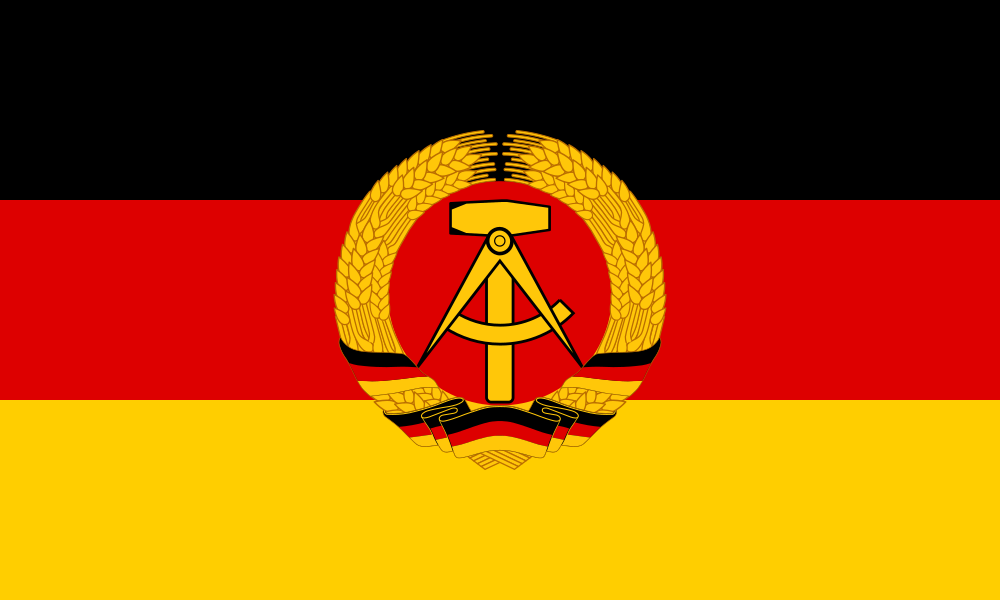
Once again the Council is seized of the question of the acts of aggression of the racist regime of South Africa against a sovereign African State. Those acts are well known. The representative of Zambia, a member of the Central Committee of the United National Independence Party of the Republic of Zambia and Chairman of the Political and Legal Committee of the Central Committee, Mr. Kamanga, gave the Council a detailed and cogent account of those acts yesterday. The sovereignty and territorial integrity of the Republic of Zambia are being violated deliberately and systematically by the racist regime of South Africa. Aircraft of the South African racists have repeatedly penetrated the airspace of Zambia and have bombed peaceful villages. Mercenaries of the apartheid regime have invaded defenceless villages, murdered many people and destroyed roads and bridges. Today, South African troops are still to be found on the sovereign territory of Zambia.
71. The German Democratic Republic most vigorously condemns the barbarous acts of aggression of South Africa and calls for the immediate withdrawal of all mercenaries of the racist regime from Zambian territory. We are aware of the innumerable losses sustained by the people of the Republic of Zambia, led by the United National Independence Party, in their struggle for the liberation of the African continent from the last remaining bastions of colonialism and racism, And once again, aggression and terror are being used to prevent the Zambian people from coming to the assistance of the other peoples of Africa in their struggle for liberation. Today, the Government and people of Zambia can rest assured of the firm solidarity and unshakeable support of the Government and people of the German Democratic Republic.
73. Disregarding the Council’s numerous appeals to the Government of South Africa to desist forthwith from its acts of aggression and provocation, Pretoria, in flagrant violation of international law, is continuing its acts of aggression to this very day. Moreover, those acts of aggression have also been extended to other African States.
74, With the electoral victory of the patriots in Zimbabwe, it has become impossible for the South African racists to use their stooges in Salisbury as accomplices. They have therefore embarked on the course of a further strengthening of their military presence in Namibia. At the present time there are 70,000 South African mercenaries in that Territory. The task of that army is to do just one thing: ruthlessly and pitilessly to continue its campaign to suppress the struggling people of Namibia and its national liberation movement, SWAPO, and by constant acts of aggression to intimidate neighbouring African States, particularly Zambia and Angola. The South Africans are doing everything possible to retain Namibia, to keep it in the fetters of colonial oppression by means of the apartheid regime and with the assistance of imperialist monopolies.
75. What credence can be given to the assurances of the South African Government that it is interested in a peaceful settlement, in view of its arrogant defiance of world public opinion?
76. The front-line States and SWAPO, the sole legitimate representative of the Namibian people, have once again shown, by their constructive policy and their readiness to compromise that they are ready to do everything possible to bring about a genuine SOlUtion to the Namibian problem.
77. But why have the resolutions of the Council, which have shown us the way to independence for Namibia, not been implemented? The brunt of the responsibility must of course be borne by the ruling circles of Pretoria. We have heard statements in connection with the situation in southern Africa in which a supposed rivalry between blocs has been alleged. Of course what has been happening in southern Africa cannot be explained that way. Everyone knows who is the aggressor there. Nor can a solution to the conflict there be promoted by our remaining silent about the responsibility of not only the ruling circles in Pretoria hut also certain imperialist circles. It is a pleasure to he able to point out that this responsibility is becoming ever more widely acknowledged.
81. South Africa, like Israel in the Middle East, is attempting to justify its constant acts Of aggression by invoking the liberation struggle of the peoples of Namibia. That, however, is a liberation struggle waged by an oppressed people, a struggle supported by the United Nations and by the majority of its Member States. No one can curb this just struggle. Peace and security for all-including the white population of Namibia and South Africa-will be ensured only when Namibia becomes independent and when apartheid comes to an end in South Africa.
82. In the course of an official visit to Zambia by a delegation of the Party and the Government of the
“The Western Five, the countries that initiated the Proposal for a settlement, have not demonstrated any willingness to pressure South Africa in a meaningful way to co-operate in the implementation of the relevant resolutions of the Security Council for Namibia’s independence. It is also in the nature of the Western Five to be ambivalent in their reaction to South Africa’s acts of aggression against independent African States.” [22&&h meefirza, para. 22. I
79. The delegation of the German Democratic Republic concurs in that assessment. Indeed, South Africa is able to disregard and scorn the vital interests of whole peoples only because it can rely on the economic, political, military and also nuclear cooperation of the forces of imperialism at all levels. It is those same circles which are doing everything in their power to prevent the Council from taking a decision to adopt effective measures. As recent events have once again confirmed, imperialist circles in the United States, for example, do not hesitate for a moment to impose sanctions against States in which revolutionary changes have been occurring, but will not do so against Fascist regimes such as the one in power in South Africa.
80. The delegation of the German Democratic Republic believes that the time has come not only to comply strictly with the prohibition of arms deliveries to South Africa-indeed, to extend the relevant provisions of that prohibition-but finally to apply the sanctions provided for in Chapter VII of the Charter against the racist regime, measures which should have been adopted long ago. Any delay by the Council will only serve to encourage the insensate racists to commit new crimes.
Litho in United Nations. New York 00400 X3-hl46?-August 1986-44~~
The meeting rose at 12.35 p.m.
NOTES
▶ Cite this page
UN Project. “S/PV.2210.” UN Project, https://un-project.org/meeting/S-PV-2210/. Accessed .