S/PV.2227 Security Council
▶ This meeting at a glance
15
Speeches
8
Countries
0
Resolutions
Topics
Southern Africa and apartheid
War and military aggression
Security Council deliberations
Global economic relations
General debate rhetoric
UN procedural rules

In accordance with the decision taken at the 2225th meeting, I invite the representative of Nigeria to take a place at the Council table and I invite the representative of Mozambique to take the place reserved for him at the side of the Council chamber.
At the invitation of the President, Mr. Clark (Nigeria), Chairman of the Special Committee against Apartheid, took a place at the Council table; and Mr. Lobo (Mozambique) took the place reserved for him at the side of the Council chamber.
1. should like to inform the members of the Council that I have received letters from the representatives of Botswana, Cuba, Egypt, Ethiopia, Seychelles and Yugoslavia in which they request to be invited to participate in the discussion of the item on the Council’s agenda. In accordance with the usual practice, I propose, with the consent of
the Council, to invite those representatives to participate in the discussion, without the right to vote, in accordance with the provisions of the Charter and rule 37 of the Council’s provisional rules of procedure.
At the invitation of the President, Mr. Legwaila (Botswana), Mr. Oramas (Cuba), Mr. Abdel Meguid (Egypt), Mr. Ibrahim (Ethiopia), Mr. Bonnelame (Seychelles) and Mr. Komatina (Yugoslavia) took the places reserved for them at the side of the Council chamber.
I should like to draw the attention of members of the Council to document S/13986, which contains the text of a letter dated 5 June from the representative of South Africa to the President of the Council.


It is several years now since it was recognized that the United Nations and the international community have a special responsibility concerning the South African people and its liberation movements in their daily struggle against apartheid and the persistent and growing repression that prevails in South Africa in the form of imprisonment, torture, summary execution and the assassination of opponents of upartheid. Similarly, it is several years since the Organization, justly and because of the concern it felt, recognized the legitimacy of the struggle of the oppressed people of South Africa for freedom and equality. A long time ago an international consensus was secured and recorded that the adoption of economic and other sanctions against South Africa under Chapter VII of the Charter of the United Nations was indispensable, provided those sanctions were universally implemented, to remedy the serious situation that had been created in that country, and thus avoid an international conflict with unforeseeable consequences.
5. Unfortunately, with every passing year South Africa becomes more insolent and arrogant; the upartheid regime becomes more active and more heavily armed; it defies the world because the international community is bogged down in contradictions, tom between defence of its principles and inordinate consumption of South African resources; it checks and re-checks its accounts and is clearly embarrassed by the relevant resolutions which it adopts and then consigns to oblivion. The result is that the situation in South Africa in this month of June 1980 is as
6. Today, in Pretoria, Cape Town and elsewhere on South African territory, there is not a moment when patriots-and they now include churchmen-are not dying or being thrown into horrible prisons merely because they want a little more freedom and dignity; there is not a moment when the racist South African regime is not assaulting our Platonic concepts, if not our silence-with mutilated corpses and torture of all kinds, cynically presented to our indignant and disgusted eyes, to our revolted consciences. There is not a moment when one or another of the front-line States is not the victim of South African incursions on its territory, or when peaceful inhabitants of its villages are not assassinated. There is not a moment when this “glass house”, the living sanctuary of the most noble ideals, is not vibrating with diatribes from Pretoria against human rights, international morality and peace.
7. Yet here we are again, almost overcome by embarrassment and impotence, discussing yet another time the question of what sanctions to take against this Africa which has noisily disowned the true Africa, this Africa whose deeds and gestures are all in flagrant and constant contradiction with the Charter that we defend.
8. In the Niger’s opinion, South Africa has by now profited long enough from the Council’s indulgence. It fully deserves the admonitory sanctions for which Africa has been waiting for a long time and which the exasperated international community has repeatedly prescribed and announced.
9. Thus, on that basis, we must demand the immediate cessation of all the arbitrary police measures that the South African rigime has been using to put down the rebellion which that rkgime itself has caused in the ranks of the nationalists, schoolchildren, disillusioned churchmen and all the other opponents of apartheid. These sordid measures in fact contribute only to maintaining, justifying and developing the guerrilla action, the desperate acts of economic sabotage and the terror which today have become the replies of the harried and harassed patriots, exercising their right of self-defence.
10. We have a saying in the Niger that once the sun 15. That is only logical, and it should not come as has risen it is impossible to hide it with the palm of a surprise to those who are familiar with the South one’s hand. The South African sun is freedom; it is African scene. Apartheid, which is the highest and the restoration of human dignity; it is the equitable worst form of institutionalized racism, adversely participation of all citizens in the management of affects the lives of the oppressed people from birth local affairs; it is the death of apartheid; it is the to death. Apartheid cuts across all age groups, making rehabilitation of the victims of racism-and at the foreno distinction between male and female, father and front of those victims is the glorious figure of the son, mother and daughter. The oppressed men and political prisoner Nelson Mandela; in a word, women, together with their children, daily feel the lash it is the dawning of a democratic society where only of national oppression.


The Zambian delegation congratulates you, Mr. President, on your assumption of the high office of President of the Council for this month. My delegation is confident that the Council is in good hands because of your well-known, characteristic precision and long diplomatic experience. It is our hope that Norway’s opposition to racism will constitute a positive contribution to our struggle to remove the last vestiges of racist oppression and domination, which is the issue before the Council.
12. I should also like to pay a well-des&ved tribute to my good friend Ambassador Oumarou of the Niger, who presided over the Council last month with distinction.
13. The Council is meeting at a critical time in the long and cruel history of South Africa. It is significant that the events in that country are taking place at the opening of a new decade which we hope will usher in a new era for the people of South Africa. Indeed, this is the time for serious reflection on the part of all, as the oppressed people of South Africa continue to demonstrate their resolve to free themselves at all costs.
14. What is equally significant, and indeed unique in the history of the liberation of South Africa, is the fact that even children are an active part of the struggle against apartheid-that is, in addition to men and women. They have joined their fathers and mothers in the just struggle for national liberation, independence and genuine democracy. Since early April 1980, schoolchildren who are racially classified in South Africa as “Coloureds” have risen against the apartheid system of education, following in the footsteps of their brothers and sisters in Soweto. As I speak today, the mass student boycotts have the active participation of black, Coloured and Indian children. The protest against inferior racist education has continued to spread like a bush fire, despite the increasingly repressive and inhuman reaction of the Pretoria rigime .
17. In 1976, the children of Soweto were protesting against the imposition on them of Afrikaans, which is the language of the oppressor. They rejected this outright because they recognized it as part of their oppressor’s machinations to keep them for ever exploited and subjugated. We are all familiar with the tragic results of the Soweto uprising. The lesson of Soweto is that the South African regime is sitting on an active volcano, which is bound to explode-an explosion that can come from any angle.
18. In 1980 the protests started with so-called Coloured schoolchildren rejecting the inferior racist education. From a few hundred schoolchildren in a few “Coloured” schools, the conflagration spread to schools in all racial areas all over South Africa and the numbers of schoolchildren involved swelled by the thousands daily.
19. The reaction of the South African regime to this challenge to its oft-repeated empty claims that only a few disgruntled people are causing trouble is typical and not surprising. As it did in Soweto, and has done throughout its shameful history, it has sought to stop the tide by even more repressive force.
20. The apartheid regime has intensified its ruthless system of oppression by utilizing all its military and police might. We count the very young among those who have perished from bullets of the apartheid
regime. Schoolchildren have been killed in cold blood by the regime. Thousands of men, women and children who have peacefully protested against the various manifestations of apartheid have been arbitrarily arrested, detained or imprisoned. The prisons are almost bursting at the seams with people who have not committed any crime. All they have done is dare to say no to apartheid.
21. On 20 April 1980, the Sunday Times of Johannesburg reported that
“South Africa has more prisoners for its population than any country in the Western or third worlds. Every day some 100,000 people pack its gaols.”
The newspaper went on to say:
“During the past 10 years, the daily prison population in South Africa has increased by 12 per cent a year, while its population has grown by an annual
7 per cent.”
In recent years the prison population figures have been swelled by children as well as adults.
23. The intensity of the opposition to apartheid in South Africa should not be minimized. The oppressed people as a whole have lost patience with the system, and the unrest in all spheres of life has been escalating. In addition to the student boycotts, black workers in various industries have gone on strike. The general unrest in the country has been accompanied by other serious incidents occurring inside South Africa itself.
24. The recent events in South Africa, like those at Sharpeville and Soweto, are steps on the inevitable road to the eradication of apartheid.
25. The apartheid regime has from the start been maintained by a series of repressive laws designed to maintain white plunder and exploitation of the natural and human resources while relegating the owners of the country-that is, the African people-to the status of poverty-stricken aliens with neither birthright nor basic human rights and freedom.
26. Since the Natives Land Act of 1913, the regime in South Africa has passed and enforced a series of increasingly stringent security laws to suppress black opposition and consolidate apartheid. Through the years we have seen the so-called Suppression of Communism Act of 1950, the so-called Public Safety Act and the so-called Criminal Law Amendment Act of 1953. We go on to the Unlawful Organizations Act of 1960, under which the African National Congress of South Africa (ANC) and the Pan Africanist Congress of Azania (PAC) were banned. Throughout the 1960s a series of far-reaching security laws was enacted. A series of General Laws Amendment Acts was passed, which, among other things, created the offence of sabotage, which caused the death penalty and allowed house arrest, arrest without warrant and detention without trial.
27. Those were not the actions of a Government concerned with the maintenance of law and order for all its people but the desperate responses of a regime determined to perpetuate the most inhuman form of racism in the face of continued resistance by the people it oppressed and exploited. What the South African regime never learned while it was busy passing ,that barrage of repressive laws is that no amount of brutality, repression, torture or death will defeat a people’s genuine desire for human dignity and democracy.
28. A long history of anti-colonial and anti-apartheid
struggles.by the black people of South Africa exists.
3 ,
29. Under that Act, and the many previous ones, thousands have been arrested, detained, tortured and imprisoned and many others have even been killed. Many have been imprisoned for life at Robben Island, and many have been in prison for almost two decades, merely for seeking a more socially and politically just society.
30. The international community has condemned apartheid as inhuman and abominable. I have not heard anyone outside the apartheid clique say anything to the contrary. The General Assembly has condemned apartheid as a crime against humanity. The Security Council has adopted numerous resolutions aimed at changing the situation in South Africa. Despite all that, the apartheid regime is intensifying its ruthless system of oppression. Of course, the oppressed continue to oppose apartheid.
31. As if the repressive laws already on its books were not enough, the South African regime has continued to pass even more stringent ones. In 1976 it replaced the Suppression of Communism Act by the Internal Security Act. This wider and stricter version allows the regime to detain potential State witnesses in political trials for an indefinite period. Of course, these potential witnesses are held incommunicado. The Internal Security Act also allows the regime to detain anyone it regards as a threat to State security without trial for an indefinite period. In the first year of that Act’s ope’ration, at least 135 people were detained under its provisions. That figure has risen to thousands, as it is reported that the daily prison population in South Africa is 100,000.
32. South Africa continues to outlaw all forms of peaceful protest even by the clergy. We are all familiar with what has happened to Bishops Tutu and Bavin, Reverend Thome and several of their fellow clergymen.
33. Apartheid in South Africa is as dangerous a doctrine for the white South Africans as it is for the black majority. It is evident that this notion of continued white dominance and supremacy has dangerously intoxicated them to the extent that their minds and general outlook have been poisoned. Thus, only yesterday, there were reports about the Minister of Posts and Telecommunications of South Africa, a man by the name of Hennie Smit, having made an outrageous statement before the so-called South African Parliament to the effect that blacks were excluded from
34. The ultimately legitimate rationale for the struggle in South Africa is not only to eradicate upartheid but also to institute a genuinely democratic State in South Africa based on universal adult suffrage. It is ironic that, even in this twentieth century, Africans, who constitute the overwhelming majority of the population of South Africa, are denied even the basic political right to vote. Zambia supports the legitimate struggle of the people of South Africa for freedom and justice for all.
35. The South African regime must be made to realize that there can be no peace in South Africa as long as the vast majority of that country are denied their inalienable political rights. No amount of oppression and repression will reverse the tide of freedom and justice in South Africa.
36. Sduth Africa’s continued illegal occupation of Namibia and its repeated acts of aggression against independent African States, particularly Angola and Zambia, cannot and will not divert attention from the problem of apartheid in South Africa itself. The illegal occupation of Namibia and the repeated acts of aggression against the front-line States moreover highlight the threat to international peace and security that the situation in South Africa poses.
37. Zambia and Africa as a whole want justice and peace in southern Africa. The Security Council has a vital role to play in this regard in view of its primary responsibility under the Charter for the maintenance of international peace and security. It is our hope that the Council and the international community as a whole will fully contribute to the endeavour of bringing about freedom and justice to all the people of southern Africa. That is our plea.
38. We look to the Council to take effective measures which can force the Botha clique to. abandon apartheid, leading to the establishment of a democratic State based on universal adult suffrage. In the

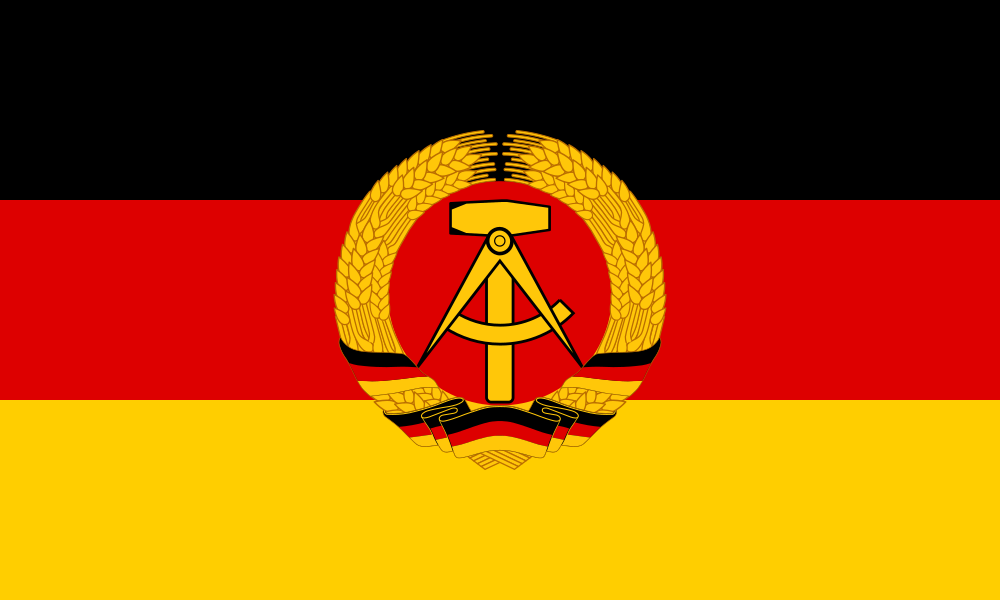
The Council has once again met to discuss the agenda item dealing with the criminal policy of the apartheid regime in South Africa; which represents a growing threat to intemational peace and security. Despite the protests that’ have been voiced by international public opinion and the condemnation expressed by the overwhelming majority of Member States, despite the repeated demands of the Council that South Africa put an end to its inhuman policy of enslaving the peoples of South Africa and Namibia, the Fascist regime in Pretoria is further intensifying its policy of apartheid. Daily, news reaches us about new crimes. A new wave of Fascist terror and violence has engulfed the entire country. Aggressive acts against peaceful neighbouring African States have caused alarm among all nations. The barbaric Pretoria regime has not even flinched at using military violence against schoolchildren. But, just as it is impossible to prevent the eruption of a volcano, no one can constantly hold down the will of peoples for freedom.
40. There is growing resistance on the part of the people of South Africa against the Fascist terror, and it is headed by the liberation movement ANC. There is also active growth in international solidarity with the long-suffering people of that country. The apartheid regime has been condemned throughout the world. Its days would have been numbered long ago had it not been able to rely on the political, military, economic and even nuclear co-operation offered by imperialist circles, which by that token are also responsible for the crimes-committed by the apartheid regime. It is typical of the policies of those circles that, on the one hand, they impose sanctions against Iran, which is resisting foreign tutelage, and, on the other hand, they have prevented sanctions being imposed against Fascist South Africa. What price words of condemnation for violence if at the same time the racist regime is virtually being encouraged to continue its policy of violence?
41. The present situation in South Africa gives the lie to the, assertion that apartheid is gradually being eliminated. The so-called reforms that have been pro-
42. The Council should long ago, in accordance with the United Nations Charter, have taken far-reaching steps against the racist regime in South Africa. We know who is blocking these decisions. It is not surprising that, as a result of an absence of any enforcement measures against the Fascist regime, the freedom fighters are directing their attacks precisely against those strategic focal points that have been set up with the direct support of the imperialist monopolies that serve to expand the military potential of the rulers in Pretoria.
43. We can learn a lesson from history. It would be impossible by simple appeals to compel Pretoria to end its policy of apartheid. Fascist regimes to this day have never voluntarily given up their racist and military policies. They always had to be forced to do so. The furtherance of such an enforcement would be in harmony with our responsibility to the peoples of South Africa and consonant with the mandate vested in us by the peoples of the world.
44. I should like to remind members of the Council of the following fact: as early as 4 February 1972, the Council-which at that time was meeting on African soil-stated in resolution 311 (1972) that “the situation in South Africa seriously disturbs intemational peace and security in southern Africa”. The Government of South Africa was condemned because it continued to practise its policies of uparrheid and an appeal was thereafter made to it to release all persons imprisoned as a result of the policies of apnrfheid. All States were called upon strictly to observe the arms embargo against South Africa, and a fundamental view was expressed in the resolution that
“urgent measures must be taken by the Security Council to secure implementation of its resolutions and thereby promote a solution to the grave situation in South Africa and southern Africa”.
Eight years have since passed. The demands contained in that resolution speak for themselves even today.
45. The German Democratic Republic wholeheartedly supports the request that enforcement measures be introduced with the aim of completely isolating the apartheid regime and favours the convening as soon as possible of the international conference on sanctions for that purpose in accordance with General Assembly resolution 34/93 C.
47. The people and Government of the German Democratic Republic demand that Nelson Mandela be immediately released, together with all other political prisoners being held by the Fascist regime in South Africa.
48. Recognition of the right of peoples to selfdetermination necessarily entails the duty of constant support for efforts for its implementation. We stand fully behind the struggle being waged by the people of South Africa under the leadership of its liberation movement, ANC, and also that of the people of Namibia under the guidance of the South West Africa People’s Organization.


Mr. President, first of all, I should like to convey to you the warm congratulations of my delegation on your accession to the presidency of the Council. Since we became a member of the Council, we ‘have been able to appreciate your outstanding personal and professional qualities, your tact and your diplomacy, and no one can doubt that we will draw fully on your skill and wisdom during this month, which looks as if it is going to be a busy one. The Council has to consider some of the most disquieting items on its agenda.
50. I should also like to express our very warm appreciation to your predecessor, our brother Ambassador Ide Oumarou of the Niger, for the skill, competence, devotion and spirit of co-operation with which he conducted the work of the Council during the month of May.
51. The urgent nature of this meeting of the Council in itself emphasizes the seriousness of the situation at present obtaining in South Africa. The alarming news that has reached us from South Africa seems to indicate that the recent events there reveal the true underlying intentions of racist leaders of South Africa. These events are a cogent reconfirmation of their determination to pursue their policy ofapartheid. They remind those of us who had ventured to hope against all hope that some change would take place in Pretoria’s behaviour that it is vain to continue to harbour such an illusion. Finally, they are part and parcel of the implacable logic underlying the very system of apartheid, which is unable to survive without repression.
52. The stubborn attempts of the racist regime of Pretoria to maintain the odious system of apartheid are unquestionably at the origin of the present tragic situation. The apartheid regime is the very root of the ills that have been visited upon South Africa and
53. Institutionalized racism and years and years of oppression and merciless exploitation have engendered a backlash of bitterness and confrontation. The persistent arrogance of the white minority in power in its flagrant refusal to bow to decisions of the international community and to hand over to the African majority the means of exercising its fundamental right to self-determination has led to revolt and resistance. By refusing to comply with the requirements of an evolution by which it is condemned, South Africa is compromising any possibility of a peaceful settlement and forcing South Africans to resort to armed struggle in order to ensure the triumph of their legitimate cause.
54. Undoubtedly, 1960 and 1976 will for ever be linked in South African history with the memory of the innocent victims of Sharpeville and Soweto whose sacrifices demonstrated the permanent willingness of the South African people to struggle against and resist .the system of domination, oppression and segregation. Indulging in reprisals and brutal aggression is simply the last-ditch refuge of the South African regime.
55. The infernal machine of racial discrimination which was set in motion at the very creation of South Africa in 1909 has undoubtedly continued to turn in the opposite direction from that of history, but has nevertheless turned inexorably, violating the most elementary human rights and attempting to stifle resistance, crushing minds and spuming the condemnations of the international community. Whenever voices are raised; here or elsewhere, denouncing its demented policy, South Africa plunges ever deeper into its folly and its alienation.
56. Today, once again, we can witness that Pretoria is in disarray. It is striking out blindly, tracking down innocent people, carrying out collective punishment and executing South.Africans whose sole crime is that they are fighting for a more just social and political order.
57. The savage brutality of the South African forces has been very clearly illustrated by the representatives of the liberation movements, and we should like to reiterate to them here and now that Tunisia, fully aware of the rightness of their cause, will always stand at their side to help the people of South Africa recover their freedom and dignity.
58. The arbitrary and repressive measures thathave been. taken against the opponents of aparrheid are becoming .ever more frequent: bannings, house arrest, exile, illegal imprisonment, torture and murder continue to be the daily lot of those who dare to speak out in favour of freedom and justice. Political, trade union and religious leaders are the main targets of those
59. The Minister of Police, Louis Le Grange, stated that his Government was resolved to maintain law and order at whatever price. In other words, Pretoria is determined to strengthen its racist laws and to pursue inexorably its strategy of oppression which has kindled emotion and called forth the condemnation of the international community, even amongst those countries which still maintain relations with the Government of South Africa.
60. Pretoria is bordering on childishness if it believes that it can contain, by its repressive policies, the liberation struggle being waged by the people of South Africa. The vicious circle of repression and ensuing resistance demonstrates the bankruptcy of those who today are the stronger. The cycle which it continues to engender will, little by little, finally destroy them.
61. No one can be misled about the underlying significance of what is occurring in South Africa at present. But what we should be mindful of above all is the purport and the real impact of those events which are only a single episode, just one part of the long struggle which has been waged by the people of South Africa in the face of State terrorism which has been cynically institutionalized and glorified by a specialized repressive machine.
62. Today we are witnessing the extraordinary reawakening of a national awareness which is resolved to maintain international opinion constantly alert until apartheid has been totally uprooted--apartheid, which ‘is an insult to our most sacred values. A people of more than 19 million men, women and children who have been enslaved and humiliated are now rebelling and dying in defence of their dignity. They are resolved to regain their inalienable rights, and to do that they will balk at no sacrifice. The merciless repression and mass arrests of recent weeks have only reinforced their firm determination to struggle and to win. That determination has been proved by Sharpeville, Soweto and those who have died there, and recent events have demonstrated that, henceforth, no force, however powerful, can stem the irreversible march of the people of South Africa towards freedom, nor stifle their legitimate quest for the re-establishment of justice and equality.
63. Surely the time has now come for Pretoria to face up to the facts, to understand that it is now more than ever vain to seek to impose its policy of apartheid through collective repression and generalized terrorism. Pretoria is fighting against the ineluctable. No force can break the resistance of the South African people, and that is particularly true since the international community is solidly behind it.
65. The participation of the liberation movements in any settlement efforts should be regarded as fundamental. Any attempt to reach a settlement without them must be unsuccessful. But the Pretoria racists are stubborn enough to envisage such a possible alternative. They continue, with the customary arrogance, to refuse to abide by the decisions of the United Nations.
66. It is high time for the international community to react effectively to impose peace on that part of Africa-a lasting peace that would make it possible for the people of South Africa to regain their dignity and to build a multiracial State based on freedom, justice and equality.
67. The times are sufliciently serious, and the flood of violence which at present permeates South Africa seriously threatens international peace and security. The situation is threatening to lead to a confrontation fraught with unforeseeable consequences. The Security Council is in duty bound to put an end to this before it is too late.
68. In the face of the obstinacy of South Africa, it -is up to the Council to take every appropriate step envisaged in the Charter to force the racist regime of South Africa to put an end to its policy of apartheid. Chapter VII of the Charter in particular contains provisions which are designed to enforce strict respect for decisions taken by the United Nations.
69. Any measure which the Council takes must have the support of all Member States. It is up to us to organize a common front in order to undertake actions which will permit the replacement of oppression and the law of force by brotherhood and the force of law so as to introduce a new era based on equality, justice, freedom and respect for human rights.


Mr. President, my delegation is pleased to see you occupying the presidency of the Security Council for the month of June. You are an old hand in the United Nations and we in my delegation have come to know you as a skilful diplomat, objective in your consideration of the issues before the United Nations. That knowledge gives us trust and confidence that during this month you will bring to the Council leadership and wisdom to help us to resolve the many problems and difficulties that will confront us in the days ahead. I assure you of the full co-operation of my delegation in your worthy endeavours.
72. Today we are once again confronted with the question of South Africa. This question has had a long and unsavoury history in the Security Council. Now recent events in South ‘Africa have elicited grave concern and fear for the maintenance of international peace and security, concern and fear that are indeed well founded given the past history of social unrest and uprisings in South Africa that is directly traceable to the abhorrent policies of uparrheid in that country, the principal objective of which is racist separation -an odious policy which postulates the superiority of one race over another and is thus an affront to human dignity.
73. The black majority in South Africa has been in a state of ferment and turmoil ever since the Sharpeville massacre of 1960. We know that the massacre was followed by even more repressive and oppressive treatment of the black peoples in South Africa by the white racist minority regime. The tragic incident in Sharpeville has become a rallying point against the evil apartheid policies of South Africa and has evoked strong feelings of anger and resentment among members of the international community. Nelson Mandela and Steve Biko are names that will always be recalled in the continuing and .intensifying struggle of an oppressed people against uparrheid. Soweto also takes its place as a milestone in the struggle, along with Sharpeville, for the demonstrations of Soweto spilled the blood of countless schoolchildren protesting against the imposition of a language with racist connotations as a medium of instruction.
74. During the past weeks there has been a renewed wave of protests and demonstrations, also by schoolchildren fighting against the inequality and inferiority of the education that they are receiving under the apartheid system. Recently too, high-ranking religious personalities have been arrested for expressing their views against a. repressive regime. Urban guerrillas have begun to act and have destroyed by violent means important and vital oil plants. All these are ominous signs that could very well lead to more serious events and trigger an ever-escalating cycle of violence ,between the black and white peoples of South Africa.
75. We have listened closely [2225th meeting] to the Chairman of the African Group, to the Chairman
76. The widespread repression and oppression in South Africa must end. The oppressed people should be enabled to participate in the establishment of a democratic government based on majority rule. Those are the basic measures to be considered and undertaken immediately.
77. In the context of the recent developments in the African continent and with the attainment of majority rule in Zimbabwe, South Africa, despite its almost total isolation in the United Nations, continues to remain impervious to what is. obvious: that its apartheid policies are doomed. If it persists in its intransigence, it will bear the brunt of the world’s condemnation.
The next speaker is the representative of Cuba. I invite him to take a place at the Council table and to make his statement.


Mr. President, first of all, I should like to congratulate you on yourassumption of the presidency of the Council for the month of June and, at the same time, to pay a tribute to the representative of the Niger for his accomplishments during his presidency last month.
80. It has been more than 25 years since the General Assembly first placed on its agenda the item of upurtheid, and year after year nearly the entire intemational community has systematic.ally expressed its condemnation and repudiation of that odious regime spawned by a group of twisted minds which have always had a kind of umbilical link with the Western Powers.
81. Todav, as in the past, I take the floor to,denounce the new wave of bestial repression to which the South African black. majority has. been subjected, their only crime being that of fighting for their freedom an-d for, racial equaIity. The international press has, over the past few days, been reporting the savage cruelty of the violence.unleashed by the South African Fascist hordes. How right, indeed, was the Sixth Conference ‘of I-Ieads of State or Government of Non-Aligned Countries, when it pointed out “the; urgency of
82. When human dignity has been wounded as deeply as it has in South Africa, the solution cannot be based on mere cosmetic reforms, such as Herr Botha has tried, or on reforms which do not involve the abolition of racial discrimination. The crisis is deeper, and is
rooted in the rotten system which created it.
83. The waves of protests and strikes, characterized by the press in the United States as the most powerful anti-racial acts an-d movements ever to have occurred in South Africa, are a sign that the South African masses-have reached the point where they now have the last word in determining the future of that country. The explosion began because, in a secondary school -the Crystal High School, attended by blacks and whites-the regime had been spending four times -more on the white students than on the blacks. The desks of the blacks are in poor condition, there are no lights and the teachers beat the students to silence protests. That was the spark that ignited the student boycott against apartheid on that occasion. But there can be a similar outbreak in any city, because this is a reaction to the discriminatory r&me. To fail to weigh theseriousness of these facts would be to deny history itself. When black students in Cape Town, Durban and other cities go out on strike and mount protests, it is because they are being discriminated against. When black textile workers go out on strike, it is because of the system that stifles them. And when black parents take to the streets, it is because their chiIdren are being killed. But white teachers and white students also are protesting, and the Church has joined the movement. For that reason, some Church leaders ,have been arrested, accused of collaborating with ANC. What does all this mean? It means that the eradication of the unnatural system of apartheid is today a need that is now felt by all decent men living in South Africa. But Herr Botha’s regime responds by attacking demonstrators with dogs-as can be seen from the photographs published in Newsweek-and by striking those arrested, throwing them into prison, torturing them and killing them.
87. The Non-Aligned Movement, at its various summit conferences, has repeatedly stressed the need to call on all countries collaborating with the Pretoria regime to refrain from continuing to support it, and has demanded the implementation of Chapter VII of the Charter of the United Nations to force the South African clique to heed the voice of reason and justice. After scrupulous consideration of the situation, the Sixth Conference of Heads of State or Govemment of Non-Aligned Countries stated: 84. The South African Fascists may imprison and kill patriots-men, women and children-but the ideas of freedom, justice and racial equality are today mightier than ever, and sooner or later will hold sway; although the price exacted by the racist minority may be very high. Those ideas, which are instrinsic to man himself, can never be incarcerated or destroyed. To ignore the heartfelt clamour of the people-of those who have-been courageous enough to take to the streets in defiance of the powerful repressive apparatus of the’ Fascists-is to remain blind to the yearning for freedom of an entire people. Let those who speak of human rights speak out now; let them at least blush; let them at least stop arming the criminals who have committed those acts of genocide; let them stop providing those
85. The entire international community must rise up as a single man and stay the murderous hand of . Herr Botha and his gang. It is high time that we demanded the release of all prisoners-not only those detained as a result of these recent events, but also those who, throughout the decades, have constantly, in very adverse circumstances, fought for freedom and racial equality. Let us wage a world-wide campaign for the release of that distinguished fighter, Nelson Mandela, who for a number of years has been languishing in the inhuman dungeons of Robben Island. Let us mobilize all our energies to prevent further crimes from being committed in South Africa.
86. The flames of the coal refinery which we saw on television highlight the frustration of the oppressed masses. Those flames light the path that the South African patriots have resolutely decided to follow, for they know from their own experience that other ways have been closed to them. To fail to realize in time what these events mean is to be an accomplice of Fascist barbarism and to condone a regime which numerous resolutions of the United Nations and other international organizations have vigorously condemned.
“The Conference declared that southern Africa as a whole constituted one single theatre of operations, in which apartheid South Africa was the central strategic issue. Freedom, peace, security and progress cannot be achieved in southern Africa unless the apartheid system of institutionalized racial discrimination, exploitation and oppression is crushed and is replaced by a democratic State whose policy will conform to the principles of the Organization of African Unity, the Non-Aligned Movement and the United Nations.“2
88. We are solidly behind the struggle of the heroic ‘South African people, led by its vanguard, ANC, and
89. We are at a dramatic crossroads. Peace and security are once again being tested by the South African racists. The Council must adopt effective measures to force Pretoria and its imperialist protectors to cease their acts of genocide against the majority black masses, and to cease brandishing their sword against the independent peoples and States of southern Africa. If we fail to do that, we shall only be condoning the philosophy of war and plunder.
The next speaker is the representative of Ethiopia. I invite him to take a place at the Council table and to make his statement.


Mr. President, first of all, I should like to thank you and the other members of the Council for acceding to my delegation’s request to address the Council on the explosive situation obtaining in South Africa. , 92. The Ethiopian delegation is particularly gratified to see the current debate presided over by you, Mr. President, a distinguished representative of Norway, a country which has shown sympathetic understanding for the aspirations of the black masses of South Africa. We have no doubt but that the Council’s deliberations on this and other questions before it during the current busy month will be crowned with success under your able and wise guidance.
93. It has been quite some time since the Council considered the anachronistic system of apartheid, a system which should have had no place in this enlightened age of ours. The Ethiopian delegation believes that it is incumbent upon the Council to give more frequent attention henceforth to the plight of the oppressed masses of South Africa, with a view to hastening the day of their eventual liberation.
94. The liberation of the subjugated and exploited people of South Africa is not only inevitable but, indeed, imminent. The current manifestations of popular resistance are sufficient indications of the ever-increasing determination of the African people to make the necessary sacrifice, to dismantle apartheid and reassert the dignity and freedom of the African personality.
95. The racist regime of Pretoria, motivated by the immoral and misguided notion of racial superiority, has endeavoured to build a fortress of white privilege in South Africa, the foundation of which was to be apartheid, an inherently unjust and explosive system
96. A fortress without foundation as wellas a system without popular support, however strongly it is reinforced by military might, cannot last. The fate of apartheid is therefore sealed. That conclusion on our part is not the result of wishful thinking, but is based on the lessons of history. We in Ethiopia sincerely hope that the whites of South Africa and their supporters in the West will come to this conclusion sooner rather than later.
97. The tides of freedom are already washing out, with ever-increasing force, the walls of the racist fortress on almost all sides. It is high time, therefore, for white South Africans to realize that the African majority will accept neither second-rate citizenship nor pseudo-citizenship of impoverished and dependent bantustans. Now is the time for white South Africans to reverse the course of the impending racial conflagration in South Africa. And we submit that this can be achieved only through the total dismantling of the evil system of apartheid. Cosmetic embellishments to improve the ugly face of apartheid will only be futile. Nothing short of a determined move towards the establishment of a democratic society, based on racial equality and majority rule, could constitute a basis for an acceptable and lasting solution.
98. One must admit that the realization of the goals of freedom and equality in South Africa have hitherto proved to be both elusive and difficult. This undoubtedly has been the result of the support, both political and material, given to the racist regime by certain Governments and the multinational corporations. Much can be said about this aspect of the South African problem. But the more we comment on the collusion of certain Western Governments and their corporations with Pretoria, the more we seem to strengthen their propensity to get closer together.
99, We believe that such a total disregard,of world public opinion poses a serious threat to international co-operation and understanding. A still greater threat is the perception in some Western circles of the human tragedy in South Africa as being exclusively within the context of cold-war politics. In this regard, it is distressing to note a former President of a leading Western country presenting the South African problem ‘in his newly published book in the following manner:
“We must not, out of a misplaced idealism, allow our policies toward southern Africa to become
106. However, one thing appears certain to us, and history has shown this: as was once true of colonialism, apartheid is a greater long-term threat to those who practise it than to those who are subjected to it. All that the whites of South Africa have today to ensure their future are their police, their dogs and their weapons. They are using them. But other countries have done the same thing, and the people have survived. Zimbabwe is a shining example. People are the sole decisive force of history.
100. While the import of such a perception is at once revealing and frightening, it also goes a long way towards explaining why apartheid, as abhorrent and unjust as it is, is being sustained and supported. Clearly, such wasthe policy pursued by the author while he was in office. Now that he is no longer in office, the propagation of this distorted and dangerous view through his book can only be taken as an attempt to influence his successors and ensure the preservation of apartheid. We can only hope that such a misconception of the problem of South Africa is not shared by those currently holding office.
107. The people of South Africa bear within themselves their own liberating force: the youth of Soweto, the workers in the factories, Nelson Mandela and all the other militants that have been imprisoned, exiled and murdered. They represent the people of South Africa in all its strength. They represent the strength not only of South Africa but also of all mankind, for they are stmggling for more justice, more humaneness and more dignity in the world, while their executioners grow ever weaker.
101. Finally, the Ethiopian delegation would like to appeal to everyone to respond positively and not react negatively to the plight of the African masses and to the incessant call by the international community for more effective measures. My delegation also hopes that the resolution which the Council will adopt at the end of its current debate will measure up to the expectations of the South African people and will adequately meet the exigencies of the times: Ethiopia, for its part and within its means, will spare no effort to render all moral and material assistance towards the total emancipation of the black masses in South Africa.
108. The people of South Africa, who are now shaping their history, are today appealing to us, through ANC, to cement our solidarity in the building of a new future. Seychelles considers it its duty to respond, for it too depends on the solidarity of brotherly peoples. Thus it joins with all other delegations to appeal to the Council once more to condemn the South African regime.
The next speaker is the representative of Seychelles. I invite him to take a place at the Council table and to make his statement.
109. South Africa must stop killing children, young people, workers and clergymen. Nelson Mandela and his comrades must be released. The political organizations of the people of South Africa must enjoy freedom of action and movement. The militants and their exiled leaders must be able to return to their country.


My delegation wishes to express its deep gratitude for having been allowed to speak at this meeting on the question of South Africa. This is for us an event of special importance for two reasons. First of all, today is the first time that Seychelles is privileged to speak in the Security Council-a body which is constantly playing a decisive role in the history of the peoples of the world. But, above all, it is important because the situation of our brothers and sisters in South Africa affects us directly, as that of Zimbabwe did at one time and that of Namibia in southern Africa still does today.
The next speaker is Mr. Johnstone Makatini, to whom the Council has extended an invitation under rule 39 of its provisional rules of procedure at the 2225th meeting. I invite him to take a place at the Council table and to make his statement.
111. Mr. MAKATINI: Mr. President, it gives me great pleasure to see you presiding over this important series of Council meetings. The oppressed people of South Africa, whose struggle has now entered a decisive stage, expect unequivocal support from this body. The well-known position of your Government and your personal commitment to the struggle against apartheid inspire us with optimism that these meetings will represent an important milestone towards the just and lasting resolution of the conflict raging in South Africa, one which seriously threatens international peace and security. The African National Congress is highly indebted to you for giving us the opportunity to share with the honourable members of the Council the view of our organization on the highly explosive situation prevailing in South Africa today.
104. We are all familiar with the facts in South Africa: a people deprived of its most elementary rights and suffering the most despicable exploitation which the whites, by striving to justify it in their own eyes by the theory of apartheid, have made even more disgraceful.
105. Apartheid is an evil, but, in our eyes, it conceals a much more pernicious evil which is the exploitation of an entire people by a minority both within and outside the country, the Western capitalists and their allies, such as Israel. It is this presence of foreign interests which in part accounts for the survival of apartheid, for the white minority is thus enjoying the
113. In June 1976, soon after the victory of FRELIMO in Mozambique, hundreds of thousands of schoolchildren and students took to the streets protesting the slave education imposed on them and designed to prepare them “to minister to the needs of the whites”. Thousands were killed, maimed, crippled, detained, tortured and imprisoned. Today, in the wake of the Zimbabwean victory and on the eve of the fourth anniversary of that savage massacre, the Pretoria tigime has once again resorted to escalating repression. That is an attempt to muzzle the legitimate protest by patriotic forces in our country.
114. Again the schoolchildren and students have played a pivotal role in what is now a general ferment which reflects a rapidly unfolding revolutionary situation obtaining in the country. For seven weeks now the entire country has been caught up in an unprecedented upsurge in which the so-called Coloured youths have fearlessly challenged the racist ideology of the rkgime as manifested in the educational system. Hundreds of thousands in cities and rural areas have boycotted schools, demanding equal remuneration for their teachers, objecting to the practice of interrogation on school grounds by secret police and indicting the racist character of the educational system. They are in fact rejecting the blatant racist formulation that “there is no place for the blacks in the white community above the levels of certain forms of labour*‘. The traditional educational budget of South Africa clearly demonstrates that for the ruling clique the education of our people is intended to ensure the master-servant relationship. The Pretoria regime spends 654 rand on each white child, while the breakdown for the Asian, the so-called Coloured and the African children was, according to the 1979 statistics, 220, 158 and 48 rand respectively.
115. These figures show that, in pursuit of the divideand-rule policy, the lion’s share is spent on the white child. The discrimination between Coloured, Asian and African children is clearly intended to polarize the beleaguered majority population and also falls into line with the artificial racial hierarchy instituted by apartheid. The rkgime proffers a larger share of the crumbs to the so-called Coloured child and the Indian child, yet they too have unequivocally rejected this racist imperative by aligning themselves with the cause of the majority. This valiant act is a barometer of the militancy of the people and a vindication of the ANC policy of forging a broad patriotic front comprising the democratic whites as well as the oppressed blacks and thus effectively isolating the real enemy-namely the white supremacist apartheid regime. It is in keeping with the policy of ANC and its allied organizations as reflected in the Freedom Charter,’ whose twentyfifth anniversary we hope will be commemorated by committed Member States on 26 June.
117. P. W. Botha’s call for a conference of all races to deliberate on matters affecting South Africa was an example of such manceuvres. Citing as the reason for this decision -the fact that the Patriotic Front of Zimbabwe victory had changed the strategic situation of South Africa, he went on to pledge the maintenance of white domination, declaring “The Nationalist Party will defend the white man, his political rights and culture, and his right to self-determination”. He went further and rearmed that there would be “no one man, one vote” in South Africa.
118. While the racist rkgime obstinately persists in embracing retrogressive racial ideologies, the masses of black oppressed people, who constitute the principal, central instrument of change, every day show their, determination to carry through the task of the struggle until victory is achieved. The militancy of our people is heightened’to an unprecedented degree by the extension of freedom frontiers to the very doorstep of the last bastion, the collapse of the last buffer, and the completion of the encirclement of the Pretoria tigime. The fact is that in South Africa today there is, first, a steady enlargement of the so-called operational areas within the country, resulting, among other things, in the enforced removal of 9O;OOO of the Batlokwa people in the northern Transvaal; secondly, a spateof political trials characterized by the singularly high political awareness qf the accused, who defigntly raise the ANC clenched-fist. salute and sing freedom songs, while contesting the authority of the racist courts; thirdly, desertion by large numbers of white draftees who refuse to take up arms in defence of apartheid; fourthly, failure by the rigime to till IO per cent of the vacancies in the police force, which analysts within the country attribute to systematic ANC attacks on police stations and other facilities plus the liquidation of informers-and, in view of the all-timehigh unemployment figure, 25 per cent of the labour force, this inability to fill police. vacancies is highly significant; fifthly, the mass removal of blacks
119. On 12 June 1964, Nelson Mandela, the outstanding ANC Ieader, was sentenced to life imprisonment together with Walter Sisulu, the former secretarygeneral of ANC; Govan Mbeki, a leading economist and historian; Ahmed Kathrada, a veteran ANC member of Asian extraction; and others for their leading collective role in challenging the illegal apartheid regime.
120. In his defence, after eloquently articulating the ideas enshrined in the Freedom Charter, Nelson Mandela declared:
“During my lifetime I have dedicated myself to this struggle of the African people. I have fought against white domination, and I have: fought against black domination. I have cherished the ideal of a democratic and free society in which all persons live together in harmony and with equal opportunities. It is an ideal which I hope to live for and to achieve. But if needs be, it is an ideal for which I am prepared to die.‘**
121. Seventeen years have elapsed since Nelson Mandela made that statement-17 years, during which there has been enacted a maze of oppressive iegislation designed to perpetuate institutionalized racism, plunder and exploitation overseen by an army of Gestapo-type police equipped with the most modem and lethal weapons advanced Western technology can provide; 17 years during which over 2 million black people have been forcibly moved from their homes to desolate arid bantustans, during which go-day and 180-day renewable detentions have become commonplace, during which over 50 freedom fighters have been killed in the prison cells and torture chambers of the secret police, during which the Pretoria regime has earned the record of being responsible for 60 per cent of the world’s executions.
122. During those 17 years the uparrheid regime has not only developed a nuclear capability but also arrogated to itself the right to intervene militarily in all African countries south of the equator. It has carried out a full-scale invasion of Angola and on several occasions threatened and committed aggression against Zambia, Angola and Mozambique. It frustrated the efforts of the international community by bolstering the erstwhile Smith regime. It has continued its illegal occupation of Namibia in defiance of nu-
123. But today that power is changing hands in South Africa, ‘and, in response to Botha’s manceuvres designed to prepare for a Muzorewa-type so-called internal settlement, the people have imposed on South Africa’s political agenda the question of the unconditional release of Nelson Mandela and his colleagues. Following an editorial by Percy Qoboza of the Sunday Post and endorsement by Bishop Desmond Tutu, Secretary-General of the South African Council of Churches, as well as support from a cross-section of the South African population, including a section of the white student population, the campaign to free Nelson Mandela and all political prisoners, including Toivo Ja Toivo of Namibia, has gained tremendous momentum in South Africa and abroad.
124. But the cancerous system of apartheid is still threatening to embroil the whole world in a conflagration whose repercussions will be far-reaching and immeasurable. Like the Fascist, militaristic and expansionist Hitler regime, which plunged Europe and the world into the Second World War, the upurtheid regime must be stopped and crushed despite its attitude that everyone else is out of step.
.125. Who is to blame? Is it those against whom armed forces have been mobilized in an attempt to cow and terrorize peaceful protesters, those whose legitimate demands have been met with ever-increasing violence at each turn? Nelson Mandela’s prophecy that “by resorting continually to violence, the South African regime will breed in this country violence among the people” has been proved true.
126. The formation of the military wing of ANC, Umkonto Sizwe-the spear of the nation-marked the closing of the chapter of non-violence. The people, under the leadership of ANC, have today taken up arms and they will not lay them down until final victory is achieved, that is, the overthrow of the apartheid regime and the seizure of .power by the people. Suffice it for me to quote from The Wushington Post:
“Black nationalist guerrillas have struck a telling blow at the security, physical and psychological, of white South Africa. From hit-and-run raids on random targets, they have moved up to a well planned and co-ordinated attack on three formidably
127. Who is responsible for the Pretoria regime’s intransigence? It is the transnational corporations that continue to provide the life-blood to this inhuman system; it is some Western countries-especially the United States, France, the United Kingdom, Japan and Israel-which continue to pay lip-service to United Nations resolutions while bolstering the South African regime through economic, military and even nuclear collaboration. We can no longer stop at accusing the apartheid regime of threatening peace and international security. Those countries which support South Africa have become active accomplices in all the crimes committed by that regime against the South African people and against neighbouring States.
128. Mr. President, in paying a special tribute to the Scandinavian countries, including your country, for the unstinting role they have played in the struggle against uparrheid, we regret to say that our attention has been drawn to incidents involving a Danish shipping company. According to the newspaper Politiken, ships of that company have been collecting arms and ammunition from various European ports. The ships’ names have been painted out and all marks of identity erased. We are pleased that the Danish Government has instituted an investigation into this flagrant violation of the international arms embargo. We regret, however, that our attention has been drawn to another report alleging that a Norwegian shipping company is involved in transporting oil from the Persian Gulf to South Africa. We are highly appreciative of the Norwegian Government’s policy of not selling South Africa any of its oil, but we deeply regret to learn that Norwegian ships are undermining the oil embargo imposed by the Organization of Petroleum Exporting Countries (OPEC) and other oilproducing countries.
129. Notwithstanding what may appear to be a very gloomy picture, characterized by a surprisingly high degree of collaboration with the South African regime, we remain very confdent that the exemplary position taken by Nigeria against British Petroleum will be emulated by a growing number of countries in the near future.
Litho in United Nations. New York 00300 83-61462-Scptembcr i9&2,030
131. We will not at this stage dignify R. F. Botha’s letter of 5 June [S/J39861 by a rebuttal. Suffice it to say that we do not expect the enemies of progressive mankind to endorse the enlightened position adopted in support of the principles and ideals enshrined in the Charter of the United Nations and the’ Universal Declaration of Human Rights.
132. We are encouraged by the growing awareness of some Western countries that the downfall of apartheid is inevitable, We note that a growing number of the traditional partners of the South African--r&me are moving towards a realistic position vis-d-vis the just cause,of our people. We hope that that attitude will coalesce into a full commitmentto the aspirations of all our people in this matter.
133. We urge the Council to support the campaign to free Nelson Mandela and all other politicalprisoners in South Africa. We urge all the members of the Council to ensure that their countries ‘and the international community strictly observe the arms embargo and respect the oil embargo imposed by OPEC countries, and to step up the campaign for the isolation of the apartheid regime, strengthen the striking. power of ANC and thereby hasten the downfall of’the apurrheid regime.
134. Itis our well-considered opinion that the virulent system of apartheid can-not be reformed; it must be destroyed. Our people, young and old, have taken up arms to break the chains of bondage, not to strengthen them.
The meeting rose at 1.40 p.m.
NOTES
t A!34/542, annex, sect. I, para. 33. 2 Ibid., para. 78. 3 Oficial Records of the General Assembly, Tenfh Session. Supphment No. 14, para. 29% ‘Ibid., Nineteenth Session, Annexes, annex No. 12. document A15825lAdd. 1, para. 76.
▶ Cite this page
UN Project. “S/PV.2227.” UN Project, https://un-project.org/meeting/S-PV-2227/. Accessed .