S/PV.2252 Security Council
▶ This meeting at a glance
10
Speeches
5
Countries
0
Resolutions
Topics
General statements and positions
War and military aggression
Global economic relations
Peace processes and negotiations
Security Council deliberations
Haiti elections and governance

In accordance with previous decisions [2247rh, 2248th and 2250th meetings], I invite the representatives of Iran and Iraq to take places at the Council table and I invite the representatives of Cuba and Japan to take the places reserved for them at the side of the Council chamber.
At the invitation of the President, Mr. Ardakani (Iran) and Mr. Kittani (Iraq) took places at the Council table and Mr. Roa Kouri (Cuba) and Mr. Nisibori (Japan) took the places reserved for them at the side of the Council chamber.
Members of the Council have before them the following documents: S/14224 and S/14226, which contain the texts of letters from the Charge d’affaires of the Permanent Mission of Iran addressed to the Set-, retary-General, dated, respectively, 17 and 21 October; and document S/14227, which contains the text of a letter dated 22 October from the representative of Iraq to the Secretary-General.
3. Mr. I-IUQ (Bangladesh): Mr. President, as a member of the Security Council, Bangladesh views this meeting of the Council as being of crucial importance. We are happy to see you presiding over these meetings
and we sincerely believe that, as in the past, the Council will profit immensely from your wise guidance. I should also like to take this opportunity to thank you for the welcome that you were gracious enough to extend to me the other day.
4. The war between Iran and Iraq is a matter of grave concern to Bangladesh and, for that matter, to all peace-loving countries. This war has already continued for a month and taken a heavy toll of life and property. Enormous precious resources that could have gone to the development of those countries have been destroyed. President Ziaur Rahman of Bangladesh, in his appeal to the Presidents of Iran and Iraq to end the hostilities, stressed that this suicidal conflict between two third world countries which were also Islamic and non-aligned was hurting deeply not only Iran and Iraq but also the Islamic world, the third world, the non-aligned countries and, for that matter, the world as a whole.
5. Bangladesh is bound to Iran and Iraq by fraternal ties rooted in a shared history, religion and culture. Our hearts bleed to find brothers killing brothers. On the occasion of Id Al-Adha, just celebrated throughout the Islamic world, the thoughts of 90 million people of Bangladesh were with their brothers and sisters who were the victims of this grim tragedy. The people of Bangladesh pray for an immediate end to this fratritidal war and for restoration of peace and harmony to those troubled lands.
6. The Iran-Iraq conflict is not an isolated phenomenon. On the contrary, it shows an emerging trend of widening areas of tension and conflict, all located in the third world. We are therefore naturally both disturbed and alarmed. Unless this trend is halted immediately, besides the appalling loss of life and propeity, an inevitable repercussion will be a serious setback to the development of those countries, crippling the efforts of the people in the war we are now waging against hunger and poverty and undermining the objective of securing for our people a life of human dignity.
7. The continuing war between Iran and Iraq has already rendered the entire region highly explosive. The longer it continues the greater is the threat to the peace and security not only of that region but also of the world. The restoration of peace in the region through the immediate ending of the conflict is therefore imperative in the interest of global peace and security.
9. As I stressed in my statement to the General Assembly,’ one of the prerequisites for easing tension, ending conflicts and ensuring peace and security on a global basis is clearly that Member States honour their sacred commitment to the principles of the Charter. These principles are unequivocal in requiring Member States to respect the sovereignty, territorial integrity and independence of other States, to refrain from the acquisition of territory by force, to renounce the use of force or the threat of use of force in the settlement of disputes, and not to interfere overtly or covertly in the internal affairs of other States. The Charter also recognizes the right of a people freely to choose its own political, economic and social system. In our view, these principles provide a solid framework within which the efforts of the Council can be directed towards ending the hostilities between Iran and Iraq and also towards finding a just and honourable solution to the probfem.
10. Bangladesh assures the Council of its fullest co-operation in fulfilling its responsibility, under the Charter in the ending of hostilities between Iran and Iraq and ensuring peace and security. In this connection, we should like to point out that time is of the very essence and we must move immediately and unitedly in our efforts to end further shedding of blood and to establish lasting peace and fraternal relations between these two Member States.


During these eventful days, Mr. President, you have added to your prestige as a diplomat of exceptional quality and the representative of a great country, the Soviet Union, with which Mexico has maintained relations of mutual respect and fiiendship for more than a half century.
12. Our work this month has been co-ordinated in a consistent manner with that accomplished when Ambassador TaIeb Slim presided over our work during the initial phases of the conflict, and my delegation would like to reiterate its appreciation and gratitude to him.
13. We cordially welcome the Minister for Foreign Affairs of Bangladesh, whose personal contribution as well as that of his delegation has been of such significance in the search for a peaceful settlement.
14. It is now more than 31 days since the conflict began, a conflict which involves two developing countries, is a threat to global security and does not promote in any way the interests of the third world. This bloody confrontation is particularly absurd in
15. It is regrettable that old rivalries and unresolved strife have in such a dramatic manner undermined the essential norms of international life. It is also regrettable that two countries, in a war without prospects, have sacrificed both their people and the fruits of their productive efforts, and that over and above military objectives there is the possibility of mutual economic and human annihilation.
16. The ‘coexistence of two neighbouring countries inevitably 1 involves some friction, especially when both share strategic river basins, vital resources and ethnic and religious communities. This is particularly true when,economic and political interests alien to the area have contributed to increasing tension and poisoning relations between the two peoples.
17. Whatever the extent of the links between the .peopIes of two countries, regardIess of the dynamics involved in their internal political processes, nothing justifies interference in the internal affairs of another State or attempts to undermine established political regimes. However, such interference, though reprehensible, is no reason to resort to the use of force, for the prohibition of the use of force was the reason for the origin of the United Nations and is the very essence of the Charter.
18. There must be a cease-fire and negotiations must begin to bring this war to an end. This would not be the first time that the complex questions involved were the subject of dialogue and agreement. Indeed, a few years ago, in different circumstances, the parties reached an agreement in formal terms-although, judging from what both sides have said, the agreement was not fully implemented.
19. Regardless of what changes have occurred or what violations have taken place, regardless of diiferences of opinion about the earlier agreements, it seems quite clear that the political will to negotiate which made those earlier agreements possible must be restored.
20. We are well acquainted with the views of the two countries on the subject under dispute and we know that, although it is not easy to redefine or restore the terms of a global agreement acceptable to both sides, that is the sole path to peace. At this stage no party could claim that it is going to force the other to accept its conditions from a position of strength; nor
21. The delegation of Mexico has insistently stated its conviction that nothing relieves the Council of its duty to carry out its primary responsibility. Therefore, we support the appeal of the President of the Council* for a cease-fire, and we support the mediation endeavours of the Secretary-General, whose devotion and efforts we appreciate. We would request that the Council consider the matter and issue a formal pronouncement, as occurred in the case of resolution 479 (1980). i 22. Furthermore, intensive good-will contacts with both sides have taken place during these weeks. It is only fair, in this regard, to pay a tribute to the efforts of the leaders of the countries of the Islamic Conference and of the non-aligned movement. Actions taken by the Council and attempts at mediation by Member States have been concurrent, and have never constituted interference.
23. We are not aware of any specific plan put forward by a country or group of countries within the Council to bring about an end to the conflict. What does exist is the will shared by all members to abide by our duty.
24. The steps that must be taken in the future must derive from dialogue and consensus. The political and moral value of our decisions has been erhanced because those decisions have thus far been adopted unanimously.
25. This forum has been opened once again, so that the members of the Council and other delegations can express the feelings of their respective Governments and so that we can together find expeditious means of solution through a broad international consensus.
26. As a result of the continuing exchange that has taken place among the Members of the Organization, it would seem that some points have emerged which might constitute the basis of a settlement. They are: that the Council should define accurately the principles in line with which this conflict could be settled; that those principles should be established in a balanced manner and take into account the specific circumstances so as effectively to promote peace; and that a specific framework for negotiations in accordance with the Charter must be established and all efforts at mediation must continue to be encouraged.
27. The appeal which we made a few days ago to all States to refrain from interference in this conflict not only pertains to concrete forms of material assistance, but also to a neutral attitude that would prevent international political polarization in connection with this conflict.
28. No short-term or long-term consideration should make us depart from the line we have followed thus
29. Mr. McHENRY (United’States of America): For one month Iran and Iraq have been at war. Despite the Council’s urgent call on 28 September for a cessation of hostilities [resolution 479 (f 980)], the tragic conflict continues, bringing anguish and loss to countless innocent families in its wake.
30. Representatives of Iran and Iraq have both presented their views to the Council. Islamic, non-aligned and other States continue their efforts to bridge the gap between the two sides and to lay the basis for a peaceful settlement of this tragic dispute. Their efforts deserve our vigorous support. But, as we are all aware, the responsibilities which the Charter imposes upon us cannot and must not be delegated to others.
31. We are deeply concerned that this conflict be resolved with respect for the cardinal principles of international law that territory must not be seized by force and that disputes should be settled peacefully and not by armed invasion. The work of the Security Council in matters of peace and war is premised on the adherence of Member States to such undisputed principles of international law and these principles have direct relevance to the actions which the belligerents must, as Members of the Organization, undertake without delay.
.
32. First, Member States have renounced war as a tool of national policy. Whatever the provocations adduced by Iran and Iraq and whatever they may understandably regard as the imperatives of selfdefence, their obligations under the Charter and the distress of their own citizens require them to cease hostilities.
33. Secondly, as Members of the United Nations, Iran and Iraq have undertaken not to seek the acquisition of territory by force of arms. This is the law of the Charter and it is the rule that all Members solemnly reiterated in 1970 when the entire membership of the United Nations adopted the Declaration on Principles of International Law concerning Friendly Relations and Co-operation among States in accordance with the Charter of the United Nations [General Assembly resolution 2625 (XXV)]. The Declaration provides that
“The territory of a State shall not be the object of acquisition by another State resulting from the threat or use of force. No territorial acquisition resulting from the threat or use of force shall be recognized as legal.”
34. Thirdly, as Members of the United Nations, Iran and Iraq are bound to seek to settle their disputes by peaceful means. We in the Council, charged as we are with the primary responsibility for the maintenance of
35. In this connection, contrary to a widely read newspaper story and as members of the Council know, at our informal consultations yesterday I di$ not outline a plan for a settlement of this question.’
41. Centpries of armed disputes the world over have surely taught us that the peace which is imposed by military superiority is no more than a truce. Only a settlement which Iranians and Iraqis can both regard as fair and equitable will create the conditions for lasting peace, which is their objective and the objective of all of us in the Council, where it is our task to act on behalf of all the Member States.
36. Finally, we believe that a fourth universal principle of international law should also guide the parties in their search for a peaceful settlement of their diiferences. It seems to us essential to a lasting iesolution of this conflict that both sides should solemnly undertake not to interfere in the internal affairs of the other.


On behalf of the Norwegian delegation, I extend a warm welcome to the Foreign Minister of Bangladesh. The Council is honoured by his participation in this very important debate.
37. All of us must be opposed to the dismemberment of Iran. The United States believes that the cohesion and stability of Iran are in the interest of the stability and prosperity of the region as a whole. The national integrity of Iran is today threatened by the Iraqi invasion.
43. Mr. President, we are happy to see you in the Chair for this challenging month. Your diplomatic experience ensures that under your presidency even the most difficult and delicate ofmatters will be in the best of hands.
38. We would also recall that every State has the right to choose its own form of government and to organize its domestic society subject only to the obIigations of international law. Statements and actions by national leaders intended to incite civil strife in another country cannot be condoned by the world community even in time of war; they gravely ungermine the efforts of those seeking to establish the foundations for a peaceful world order.
44. I also want to express the deep appreciation of my delegation to your predecessor, the Ambassador of Tunisia, for the exemplary way in which be discharged his duties as President for the month of September.
39. The position of the United States from the beginning of this dispute has been clear. owe will not take sides. But to declare that we will not take sides is not to declare that we remain aloof or that we do not recognize our responsibilities or the responsibilities of the Organization. Tbe political ramifications of a continuing war need no elaboration. Nor are we indifferent to the threat which the conflict presents to a region which is of vital concern to the economic health of the world. We believe strongly that there must be no infringement of the intemationally recognized freedom and safety of navigation in the Persian Gulf, which is of such importance to the international community. We regard the assurances of both Iran and Iraq in this regard as most welcome.
45. The Norwegian delegation welcomes the fact that finaIly both parties to the tragic conflict between Iraq and Lran have appeared before the Council. It is at this table and not on the battlefield that the settlement of international conflicts should be sought.
46. Our acceptance of the Charter makes it incumbent upon us to redress grievances through peaceful means. An elaborate machinery for that purpose has been established by the United Nations. To resbrt to armed force instead of this machinery is a violation of the basic principles of the Charter. Thus, Norway appeals once more to both parties as a first step to cease forthwith all armed hostilities and to make use of the machinery for me-diation provided by the United Nations, the Islamic Conference and the non-aligned movement, which have all come forward to assist the parties in reaching a peaceful settlement.
40. The United Nations was founded on a noble ideal: to save succeeding generations from what the

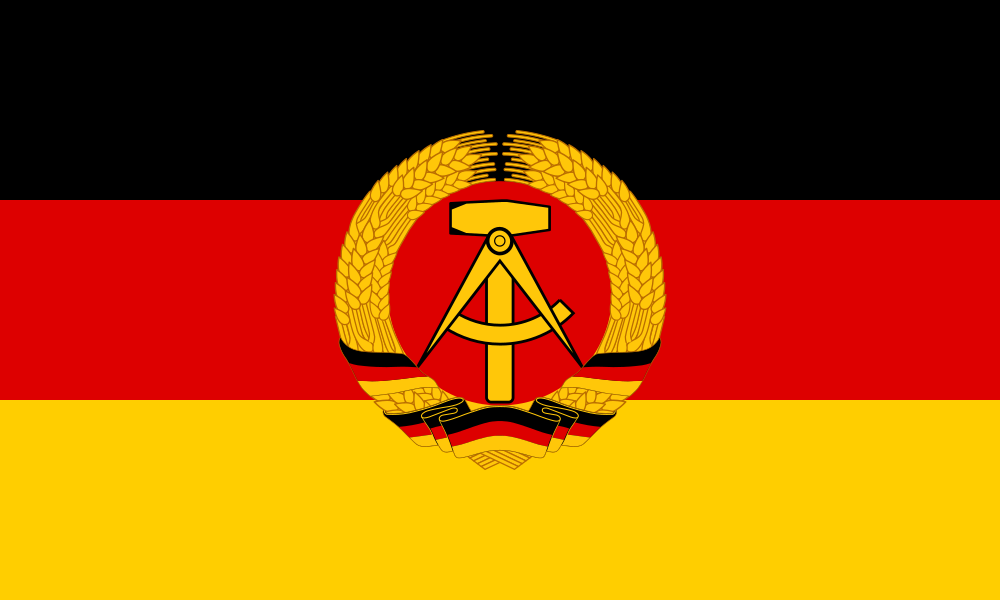
It is a great honour for me to congratulate you, Mr. President, on your assumption of the responsible post of President of the supreme organ of the Organization for this month. Our countries are linked by ties of firm friendship. In fact, it is an indissoluble friendship and one ofthe basic elements of peace and security in Europe, as everyone is aware.
50. I should like to take this opportunity also to express our appreciation to the President of the Council for September, the representative of Tunisia, for his very able guidance of our work.
51. Moreover, my delegation is honoured to welcome the Minister for Foreign Affairs of Bangladesh.
52. As a result of the struggle of the national liberation movements, many peoples have freed themseIves from the colonialist yoke and from direct depe.ndence on imperialist Powers. That fact somehow symbolizes all the progress made during the second half of this century. On the other hand, we are obliged to state ‘that there are certain controversial political and economic, and sometimes territorial, issues that arise between certain States in the sphere of national liberation. Usually these issues have been inherited from colonialist times. They have been inherited from the policy of imperialism which adhered to and applied the principle of “divide and rule”.
53. Such complex issues must and have been resolved by political and diplomatic methods, through a patient search .for just and mutually acceptable settIements. If, instead, there is a one-sided attempt to defend national interests, without taking into account the interests of other nations or the common tasks of the anti-
54. The African States took the wise decision to preserve the frontiers inherited from colonial times, and not to enter into conflict .with each other over any territorial disputes. That decision was in accordance with historical experience, which shows that conflicts between newly independent, States-not to speak of military clashes--are used by those who want to turn back the clock of history. The conflict between Iran and Iraq simply confirms that.
55. The delegation of the German Democratic Republic notes with concern that the armed conflict between Iran and Iraq is continuing, and that there has been a further exacerbation of tension. That is all the sadder because the conflict pits against each other two non-aligned countries whose peoples have a great deal in common as a result of their history and also have a ,great deal in common at present. I am referring, inter alia, to the tasks of strengthening their independence that face them today.
56. We ,share the view expressed by many delegations in the Security Council, and also during the general debate at the thirty-fifth session of the General Assembly, that this conflict is an extremely serious threat to the peoples involved in it. The gravity of the situation was also emphasized in the statements made here by the representatives of the two countries concerned.
57. The General Secretary of the Central Committee of the So&list Unity Party of Germany, and Chairman of the Council ,of State of the German DemocratiG Republic, Erich Honecker, stated recently in connection with the conflict between Iran and Iraq that the German Democratic Republic, together with other socialist countries, is making every ~effort to ensure peace. The German Democratic Republic is following with great concern the continuing military clashes between Iran and Iraq, as well as the attempts being made by imperialism to take advantage of those armed conflicts for their own purposes. It is the view of the German .Democratic Republic that disputes between .States must be resolved through peaceful negotiations and without outside intervention.
58. One would like to hope that an end will soon be put to this military conflict and that the state of tension between the two countries, with both of which the German Democratic Republic has relations of many kinds, will be relaxed by peaceful means. As Erich Honecker has emphasized, the present situation is a serious threat to the further development of Iran and Iraq, and also to the further development of the entire region.
59. At the Council meeting held on 28 September [2248th meeting’], my delegation pointed to the danger ;
“We have in the Arabian Sea the most powerful concentration of naval force, including naval air forces, that have ever been in that area, in that ocean. We have more capability than all the other countries in the region put together.“*
60. The question naturally arises: what need is there for such a concentration of military capability in that region, if the intention is to remain neutral? Reports about joint manoeuvres by imperialist fleets in that region also bring to mind tragic events from the past.
61. Evidently, certain circles are trying to make use of a complex situation in order to carry out the plans that they hatched long ago to acquire control over the oil in that region. Arab and other Islamic States are being kept within the range of deadly weapons so as to make it possible to control their natural resources and wealth. Against this background it becomes obvious why imperialist forces so insistently oppose United Nations deciiions confirming the sovereign right of States to dispose of their own national natural resources.
62. Concern over this policy was expressed by a number of States in the general debate of the thirtyfifth session of the General Assembly. As an example, I have in mind the statement made by the Minister for Foreign Affairs of Algeria, who said:
“This is the background of the re-emergence of gunboat diplomacy and the practice of policies of destabilization and pressure on our countries in the name of doctrines based on so-called vital interests and aimed at securing control or even expropriating raw materials in general and energy resources in particular”.3**
Such statements deserve ‘serious thought on the part of the parties directly concerned in the conflict, as well as on the part of others.
63. While the Security Council, the Secretary-General and a number of Member States are doing all they can in order that the guns may fall silent as soon as possible and to open the doors for negotiations, certain imperialist circles clearly want to create durable situations that mn counter to the interests of the peoples of the region. On trumped-up pretexts they are
* Quoted in English by the speaker. ** Quoted in French by the speaker.
64. The Council should continue in future firmly to oppose any escalation or expansion of the conflict which is the subject of our agenda. In its Article 33 the Charter states that the parties to any dispute must, first of all, seek a solution by negotiation, inquiry, mediation, conciliation, arbitration, judicial settlement, resort to regional agencies or arrangements, or other peaceful means of their own choice. My delegation feels that these principles, if fully applied, will make it possible to resolve the conflict in a manner acceptable to both sides.
65. It might be asked what would be the basis of such a solution. The Charter gives an answer to this question also, for the Charter requires the application of and respect for the principles of equality and self-determination of peoples, the sovereign equality of Member States, territorial integrity and non-interference in the internal affairs of other States, justice and the preservation of general peace and international security.
66. The delegation of the German Democratic Republic has taken note with great interest of the very carefully thought-out steps taken by the Chairman of the non-aligned movement, and we welcome the decisions taken by the Co-ordinating Bureau of the movement to set up a committee whose mandate will be to facilitate a peaceful solution to the conflict between Iran and Iraq.
67. The delegation of the German Democratic Republic would like to take this opportunity of expressing to the Secretary-General our appreciation and our thanks for his tireless efforts to bring both parties in the conflict to the negotiating table.
The next speaker on my list is the representative of Cuba. I invite him to take a seat at the Council table and to make his statement.


Mr. President, I should like first of all to thank you and the other members of the Council for giving me this second opportunity to speak in the consideration of the serious problem currently before the members of the Council.
70. My statement will be very brief because its sole purpose is to inform the members of the Council of the decision adopted a few days ago by the Co-
71. It gives me great pleasure to say that the representatives of Iran and Iraq in the Co-ordinating Bureau of our movement gave their consent to the agreement in principle to create that committee and authorized me, as Chairman of the Bureau, together with the representative of the PLO, Mr. Terzi, to contact both parties and to decide on the membership of that ad hoc committee, on the basis of acceptance by both sides, as well as to define other important aspectsof the work of the committee. We have already begun those talks and we hope that they will be successful in the coming days.
78. My second observation is as follows. The representative of the United States began his statement by referring to resolution 479 (1980). I want to refer to two paragraphs of that resolution. The first is paragraph 1, which reads as follows:
“Culls upon Iran and Iraq to refrain immediately from any further use of force and to settle their dispute by peaceful means and in conformity with principles of justice and international law.”
That is what we have accepted and what Iran has rejected. The second, which is indeed pertinent to the present stage of the deliberations of the Council and perhaps will be more so in the future, is paragraph 3, which reads:
72. Finally, I should like to assure the President and members of the Council that the initiative of the nonaligned countries is in no way intended-nor could it be intended-to take the place of any action which the ‘Council might deem appropriate to take in keeping with the mandate of the Charter and in accordance with its primary responsibility to maintain intemational peace and security.
“Culls upon all other States to exercise the utmost restraint and to refrain from any act which may lead to a further escalation and widening of the conflict.”
The representative of Iraq has asked to be allowed to speak and I now call on him.
This appeal is addressed to all States. It is important in our view that all States should respect it-“all other States”, as it reads-and particularly important that members of the Council should respect it. And it is of the utmost importance that the permanent members of the Security Council, which bear a special responsibility for international peace and security, should respect that appeal, which was approved unanimously by the Council.
74. Mr. KITI’ANI (Iraq): At this stage of the Council’s deliberations, my delegation wishes to make a number of comments, and we sincerely hope that they will contribute to the search for a solution of this unfortunate conflict, which we all desire and which, I am sure, is the concern of the members of the Council.
79. The last observation I want to make concerns a comment about the dismemberment of Iran which occurred in the statement of the United States representative. I do not think it would serve any useful purpose for me to repeat at length the position of my Government on the substance of the matter, what we are seeking and what we are trying to achieve. This has been stated repeatedly. The Foreign Minister of my country has told the Council at length what our objectives are, and to repeat those would not serve any useful purpose. In reply to what the representative of the United States said, I should simply like to read the last sentence of the last statement by my Foreign Minister before the Council:
75. I must say that we are not at all discouraged; on the contrary, we are heartened by the statements we have heard this afternoon because, if we detect one common ground and consensus, it is the strong and fervent desire of those who have spoken so far to bring this conflict to an end without further bloodshed and to begin the difficult task of negotiating a settlement of all outstanding problems and disputes between Iran and Iraq, which have indeed led to the present conflict.
76. That happens to be our position, which we have stated in the Council more than once. We have said that the realistic way and the only way to settle it is to stop the fighting and start negotiating all outstanding differences and that a permanent solution should be sought on the basis of the principles that have been enunciated here this afternoon.
“Despite the military situation that we are now in, we reaffirm again that we have no territorial ambitions in Iran, but we insist on the territorial integrity of Iraq in land and water and non-interference in our internal affairs.” [2251st meeting, para. 48.)
77. That is our position. The Council has, of course, heard the Iranian position and what concerns us in that


I should like to thank representatives of member countries of the Council who have expressed their views, especially those reaffirming the principles upon which the United Nations is based and on which the Council works.
82. With respect to war, I think that the world knows that the acts and deeds of the aggressor, the invader, the violator of the Charter and its principles, do not match its claims. Its claims here certainly do not match the claims of its invading forces. Only yesterday the Deputy Prime Minister of the Iraqi Government stated that his country intended to occupy a portion of my country and to stay in it in order to use it as a negotiating weapon. I think what they have stated here is intended only to deceive the world body. But, as history has shown, those who try to deceive the world cannot do so; the truth cannot be disguised.
83. It is nothing more than a diplomatic trick, if I may say so, to call for and talk about peace and negotiations while the invasion is happening before the eyes of the whole world. It is nothing but talking out of both sides of the mouth in view of the atrocities and crimes of that Government whose representatives attempt to play the role of the dove here, and I would like to caution the Council about the difference between that Government’s statements and its deeds.
84. There can be no doubt that the invasion of Iran by the Iraqi armed forces constitutes a premeditated act of aggression as defined in the annex to General Assembly resolution 33 14 (XXIX). That invasion is no less a breach of international peace and security.
85. I shall not waste words in elaborating on how our territory has been occupied or our sovereignty infringed, our cities devastated, our people butchered and our economy damaged. The barbarism of the act of invasion has been compounded by the savagery of Iraqi methods. This war is an outrage in all its aspects and not least in the terroristic and indiscriminate bombardment of Iranian cities with modem missiles and on a scale not seen since the Second World War.
86. The Iraqi regime is daily committing war crimes against the Iranian people; The war criminals will not go unpunished. I must add that the acts of aggression not only violate the territorial integrity of Iran but are intended to bring about a change in its boundaries in violation of the most basic principle of international law. The boundaries between Iran and Iraq were recognized and established in the 1975 Algiers agreement4 between the two countries. That agreement remains valid and binding under international law. Neither of the parties to the agreement has the right under international law to change those boundaries unilaterally. Moreover, nothing in the agreement
87. The aggression and breach of international peace and security that have taken place can neither be excused on false pretexts nor camouflaged by the falsification-of the facts. The Security Council has a clear duty to perform in the present situation, a duty given it by the Charter. It is incumbent upon the Council to live up to its responsibilities and to act in accordance with its mandate. The Council should condemn the premeditated act of aggression that has taken place, call for the immediate withdrawal of the Iraqi forces from Iranian territory and call upon Iraq to compensate Iran for damages. It should also condemn the Iraqi authorities for war crimes.
88. In saying that we shall expel the aggressor, we are aware that the struggle may take time. We the people of Iran are prepared for a long and arduous struggle, regardless of the sacrifices that it will entail. If the international community fails to make its appropriate contribution in putting an end promptly to the invasion, it will have only itself to blame for the consequences.
89. What is at stake here in the Council is not the territorial integrity of Iran but the moral integrity of the United Nations. There can be no silence or neutrality in the context of aggression and invasion. There is nothing fair or objective in a formula that purports to be even-handed between victim and aggressor, between right, and wrong. Each organ of the United Nations is in duty bound to carry out its responsibility under the Charter. Any organ that fails to do so will have betrayed the ideals upon which its own existence is based. In fact, given the~present flagrant breach of international peace and security and the aggression committed, if the Security Council fails to act in accordance with its mandate as proposed by us, it will be abdicating its responsibilities and further lessening its credibility. If the Council chooses, whether through omission or commission, not to discharge properly its responsibilities in the present context, can any State be expected to take it seriously in other contexts? If, on the other hand, the Council carries out its mandate, will it not have given ample proof of its moral worth and thereby justified its being heeded in other contexts? It is for the Council to choose which path to follow. The world will be watching. In the meantime, we for our part will continue to fight until the aggressor has been expelled from our fatherland.
I call on the representative of Iraq, who has asked to exercise the right of reply.
92. I will make three points.
93. First, he repeated the well-known, worn-out accusation that Iraq is guilty of premeditated aggression. In three statements-one in the General Assemblys and two -b&fore the Council [225&h and 2251~ : tneecingsj-the Foreign Minister of my country has gone to great lengths to prove beyond any shadow of a doubt that this conflict was forced upon us, that absolutely no peaceful or legal means were left to us, that we had exhausted all such means, and that the actual fighting was started and escalated by Iran. -All that is a matter of record, and for me to repeat it would only bore members and waste the paper on which the documents of the Council are reproduced.
95. The third and last point I want to make is this. Once again the Council has heard a statement by the representative of Iran, and I simply want to end with this question, In all fairness, does the Council really believe that such statements and the maintenance of such positions are likely to contribute to the ending of the conflict and the beginning of negotiations? I leave the answer to the Council.
‘94. The second thing also was not new. It is ironic that Iran should keep going back to something that does not exist any more-and it is Iran’s own fault that it does not-and that is the Algiers agreement. Again, both the Foreign Minister, in.particular, and the President of my country have explained at considerable length how it came about that the Algiers agreement no longer exists. Iran is solely responsible for that: Iran had violated the agreement by act, by deed
’ Officiul Records oj.the Genrrul Assembly, Thirry-jiffh Session, Pknury Meetings, 15th meeting. 2 See Resolutions und Decisions of thr Security Council, 1980, p. 23.
’ OfJiciul Records uf the Generd Assembly, Thirty-jiffh Session, Pkenury Meetings, 19th meeting, para. 61. 4 See United Nations, Treaty Series, vol. 1017, No. 14903.
5 OfJiciul Records of the General Assembly, Thirty-Jifrh SeSsion, Plenury Meetings, 22nd meeting.
The meeting rose at 5.25 p.m.
NOTES
,
HOW TO OBTAIN UNITED NATIONS PUBLICATIONS
United Nations publications mai be obtained from bookstores and distributors throughout the
world. Consult your bookstore or write to: United Nations, Sales Section, New York or Geneva.
COMMENT SE PROCURER LES PUBLICATIONS DES NATIONS UNIES
Les publications des Nations Unies sont en vente dans les librairies et les agences dkpositaires du monde entier. Informez-vous aupr& de votre libraire ou adressez-vous B : Nations Unies, Section des ventes. New York ou Geneve.
COMO CONSECUIR PUBLICACIONES DE LAS NACIONES UNIDAS
Las publicaciones de las Naciones Unidas e&n en venta en librerias y casas distribuidoras en todas partes de4 mundo. Cons&e a su librero o dirijase a: Naciones Unidas, Secci6n de Ventas, Nueva York o Ginebra.
Litho in United Nations, New York c!o300 83-61462-October 1987-2,050
▶ Cite this page
UN Project. “S/PV.2252.” UN Project, https://un-project.org/meeting/S-PV-2252/. Accessed .