S/PV.2584 Security Council
▶ This meeting at a glance
11
Speeches
4
Countries
0
Resolutions
Topics
Southern Africa and apartheid
Security Council deliberations
Arab political groupings
Foreign ministers' statements
War and military aggression
Global economic relations

In accordance with the decision taken at the 2583rd meeting, I invite the Acting President of the United Nations Council for Namibia and the other members of the delegation to take a place at the Council table.
Present: The representatives of the following States: Australia, Burkina Faso, China, Denmark, Egypt, France, India, Madagascar, Peru, Thailand, Trinidad and Tobago, Ukrainian Soviet Socialist Republic, Union of Soviet Socialist Republics, United Kingdom of Great Britain and Northern Ireland, United States of America.
At the invitation of the President, Mr. Akyol (Acting President of the United Nations Council for Namibia) and the other members of the delegation took a place at the Council table.
Provisional agenda (S/Agenda/2584)
In accordance with the decision taken at the 2583rd meeting, I invite Mr. Nujoma to take a place at the Council table.
1, Adoption of the agenda
2. The situation in Namibia: (a) Letter dated 23 May 1985 from the Permanent Representative of India to the United Nations addressed to the President of the Security Council (S/17213); (b) Letter dated 23 May 1985 from the Permanent Representative of Mozambique to the United Nations addressed to the President of the Security Council (S/17222); (c) Further report of the Secretary-General concerning the implementation of Security Council resolutions 435 (1978) and 439 (1978) concerning the question of Namibia (S/17242)
At the invitation of the President, Mr. Nujoma took a place at the Council table.
In accordance with the decision taken at the 2583rd meeting, I invite the representatives of Algeria, Angola, Bangladesh, Bhutan, Cameroon, Canada, Cuba, Democratic Yemen, Ethiopia, the German Democratic Republic, the Federal Republic of Germany, Ghana, Guyana, Indonesia, Jamaica, Kuwait, Mexico, Morocco, Nicaragua, Nigeria, Pakistan, Panama, South Africa, the Sudan, Turkey, Uganda, the United Republic of Tanzania, Yugoslavia and Zambia to take the places reserved for them at the side of the Council chamber.
The meeting was called to order at 11.20 a.m.
Adoption. of the agenda
At the invitation of the President, Mr. Bessaieh (Algeria), Mr. de Figueiredo (Angola), Mr. Wasiuddin (Bangladesh), Mr. Tshering (Bhutan), Mr, Engo (Cameroon), Mr. Lewis (Canada), Mr. Mabnierca (Cuba), Mr. Al-Ashtal (Democratic Yemen), Mr. Dinka (Ethiopia), Mr. Ott (German Democratic Republic), Mr. Lautenschlager (Federal Repub lit of Germany), Mr. Asamoah (Ghana), Mr. Karran (Guyana), Mr. Alatas (Indonesia), Mr. Barnett (Jamaica), Mr. Abulhassan (Kuwait) Mr. Mufioz Ledo (Mexico)), Mr. Alaoui (Morocco), Mr. Icaza Gallard (Nicaragua), Mr. Gambari (Nigeria), Mr. Shah Nawaz (Pakistan), Mr. Kam (Panama), Mr. von Schirnding (South Africa), Mr. Birido (Sudan), Mr. Tiirkmen (Turkey), Mr. Otunnu (Uganda), Mr, Mkapa (United Republic of Tanzania), Mr. Golob (Yugoslavia) and Mr. Lusaka (Zambia) took the places reserved for them at the side of the Council chamber.
The agenda was adopted
The situation in Namibia: (a) Letter dated 23 May 1985 from the Permanent Representative of India to the United Nations addressed to the President of the Security Council (S/17213); (f~) Letter dated 23 May 1985 from the Permanent Representative of Mozambique to the United Nations addressed to the President of the Security Council (S/17222); (c) Further report of the Secretary-General concerning the implementation of Security Council resolutions 435 (1978) and 439 (1978) concerning the question of Namibia (S/17242)
I. The PRESIDENT: In accordance with the decision taken at the 2583rd meeting, I invite the representative of Liberia to take a place at the Council table.
5, The PRESIDENT: I should like to inform the Council that I have received letters from the representatives of Afghanistan, Kenya, the Libyan Arab Jamahiriha, Malaysia, Poland, Sri Lanka and the Syrian Arab Republic in which they request to be invited to participate in the discussion of the item on the agenda. In conformity with the
At the invitation of the President, Mrs. Osode (Liberia) took a place at the Council table.
At the invitation of the President, Mr. Zalif (Afghanistan), Mr. Kiilu (Kenya), Mr. Azzarouk (Libyan Arab Jamahiriya), Mr, Zain (Malaysia), Mr. Nowak (Poland), Mr. Wgewardane (Sri Lanka) and Mr. Al-Atassi (Syrian Arab Republic) took the places reservedfor them at the side of the Council chamber.
11. In accordance with the Charter and the Declaration on the Granting of Independence to Colonial Countries and Peoples, the settlement of the Namibian question should be based on the following two principles: termination of South Africa’s military occupation and colonial rule of Namibia and the attainment of national selfdetermination by the Namibian people through free elections. It is precisely in keeping with those two principles that the Chinese delegation has actively supported the Secretary-General’s efforts in consulting with the parties concerned and the United Nations plan approved by the Council in its resolution 435 (1978), namely, the realization of Namibian independence through a cease-fire in Namibia, complete withdrawal of South African troops and free elections under United Nations supervision. We have consistently held that these principles form’the basis for a political settlement of the Namibian question.


Mr. President, we are very glad to see the Minister for Foreign Affairs, an outstanding representative of the Republic of Trinidad and Tobago, assuming the high office of President of the Council for the first time. I wish to extend to you our warmest congratulations. I am convinced that with your wisdom, talent and rich experience in diplomacy you will surely be able to guide this Council in the accomplishment of its tasks for the month of June.
7. I wish also to take this opportunity to convey our respect and thanks to your predecessors, the Minister for Foreign Affairs and the representative of Thailand, for their excellent performance in discharging the heavy duties of the Council last month.
12. The course of events, however, in the past two years has further proved that South Africa is solely responsible for the failure to implement the relevant Council resolutions. The South African authorities have not only clung to the linkage of the two unrelated issues of Namibian independence and Cuban troop withdrawal from Angola, making it their pretext for delaying the implementation of the resolutions, but also intensified their efforts to prop up pro-South African forces in Namibia and declared the setting up of an “interim government” based on a “multi-party conference”. They have even planned an inauguration for the puppet rCgime on 17 June in Windhoek. This once again reveals the true intention of South Africa to bypass the United Nations, exclude SWAP0 and impose a fait accompli of its own making in Namibia on the international community.
8. Owing to the obstruction and sabotage by the South African authorities, the solemn resolutions adopted by the Council on the issue of Namibia-resolution 435 (1978) in particular-have yet to be implemented. The Council was seized of this issue twice in 1983 and adopted resolutions which condemned the aforementioned actions of the South African authorities, rejected South Africa’s insistence on linking the independence of Namibia to irrelevant issues and decided that, should South Africa continue to obstruct implementation of resolution 435 (1978), the Council would consider the enforcement of appropriate measures provided by the Charter of the United Nations. Two years have elapsed since then. The South African authorities have not only refused to carry out the said resolutions, but have gone so far as to step up their new schemes of bypassing the United Nations with the so-called internal settlement in Namibia and to continue their sabotage activities against military and economic facilities of other countries in southern Africa, thus posing a serious threat to the peace and security of the whole region. It is therefore absolutely essential for the Council to be holding these urgent meetings to consider the question of Namibia.
13. Such acts of the South African authorities have aroused the indignation of more and more countries of the world. The international community has strongly condemned South Africa’s obstinate stand of rejecting resolution 435 (1978). The Governments of many countries have issued statements in which they strongly condemn South Africa for trying to set up a so-called interim government in Namibia. The President issued a statement on 3 May on behalf of the Council members in this connection [S/17I51], declaring that the actions and measures taken unilaterally by South Africa were null and void. The meeting of the Council of Ministers of the Organization of African Unity (OAU) held last March, the Extraordinary Ministerial Meeting of the Co-ordinating Bureau of Non-Aligned Countries held in April, the extraordinary session of the Special Committee on the Granting of Independence to Colonial Countries and Peo-
9. The African and non-aligned countries attach great importance to these urgent meetings, as has been demonstrated by the presence of many ministers from those countries and President Nujoma of the South West Africa People’s Organization (SWAPO). Their participation will certainly contribute a great deal to this meeting. The Chinese delegation wishes to extend its warm welcome to the ministers and President Nujoma.
14. On the other hand, the Namibian people, under the leadership of SWAPO, have won widespread international sympathy and support in their struggle for independence. The front-line States have all along provided powerful backing for the Namibian people, and they have made significant contributions to their struggle. The great majority of African and third world countries have stood firmly on the side of the Namibian people and given all kinds of support and assistance to SWAPO. Many Western countries with political vision have also provided moral support and material assistance to the Namibian people. In addition, various international or regional organizations, as well as non-governmental organizations, have done a large amount of work in support of the Namibian people’s struggle, The forces fighting for the independence of Namibia are growing and expanding steadily.
15. Early realization of Namibian independence is the urgent demand and strong desire of the Namibian people as well as all the peace-loving and justice-upholding people of the world. The Chinese delegation is of the view that the Council should promptly take the following actions.
16. First, it should demand that South Africa immediately stop its engineering of the “interim government” and unconditionally carry out resolution 435 (1978); should South Africa continue to delay its implementation, the Council should consider the imposition of comprehensive mandatory sanctions against it in compliance with the Charter.
17. Secondly, it should demand that all members of the Council, the permanent members in particular, truly discharge their responsibilities and make genuine efforts to achieve implementation of its resolutions. It should point out that it is in contravention of the United Nations resolutions either to insist on linking the independence of Namibia with irrelevant issues or to advocate and conduct constructive engagement with South Africa.
18. Thirdly, it should entrust the Secretary-General with urging the South African authorities promptly to enter into negotiations with SWAP0 on the implementation of resolution 435 (1978) and request him to report to the Security Council.
19. Fourthly, it should call on all countries to exert greater political and economic pressure on South Africa through strict arms and oil embargoes.
20. Fifthly, it should appeal to all countries to provide greater support and assistance to SWAP0 and to the front-line States.
21. I wish to reiterate here that the Chinese Government and people consistently and fjrrnly oppose and strongly
The next speaker is the Minister for@o&zign. Affairs iof Cuba, Mr. Isidoro Malmierca. I welcome him and invite him to take a place at the Council table and to make his statement.


As one who comes from Latin America and the Caribbean, at this moment so crucial for our peoples, I should like, Sir, to congratulate you on your assumption of the presidency for this month. Your presence at the helm of the Council will doubtless provide additional proof of your commitment to the peoples and to just and noble causes.
24. I should also like to thank the representative of Thailand, for his dedicated work as President of the Council last month.
25. At the outset I should like to express the acknowledgement of the Government of Cuba of the stalwart work of the Secretary-General to promote implementation of the decisions of the Security Council and the United Nations, which should enable the people of Namibia to achieve independence.
26. Yesterday [2583rd meeting], in various statements before the Council, we heard a narration of various events characterizing the shame felt about the attitude of the racist rtgime of Pretoria in rejecting and flouting decisions of the international community aimed at ensuring Namibian independence.
27. In order to complete that historic narration we think it would be useful to draw attention to the fact that this year, as we celebrate the commemoration of the 100 years that have elapsed since the Berlin Conference, where the colonialist partition of the African continent took place and the colonial domination of Namibia began-now, 100 years later, the illegal occupation of its territory is being perpetuated by the Pretoria regime.
28. 1 must confess not to know whether 77ze Guilzrless Book oJ’ Records contains the world’s record for cynicism; if so, it needs to be updated, because the speech made yesterday afternoon by the racist representative undoubtedly set a new record for cynicism. But that does not matter, for we all know that a single drop of truth is
29. The Council is meeting again to denounce the situation in southern Africa, specifically the situation in Namibia, which is the result of the provocative actions of the odious apartheid rCgime. Between 1978 and 1985 the Council has held more than 130 meetings to consider the problems of the southern tip of Africa. At many of those meetings the representatives of the United States did not vote; nine times they abstained on draft resolutions on Namibia or related conflicts; and on five occasions they vetoed draft resolutions. It is a lengthy history which reveals the disdain of the racist rCgime of South Africa for the decisions of the Security Council and the General Assembly, as well as the loyalty of its imperialist allies.
30. At its last five sessions, held between 1981 and 1985, the General Assembly adopted 31 resolutions relating to the question of Namibia. In no case did the United States vote in favour of adoption, In 31 cases, the United States never voted in favour: it abstained 27 times and voted against 4 times.
31. It is easy to identify the most stubborn enemies of the independence of the Namibian people, the most steadfast allies of the racist regime of Pretoria, and the supporters of the odious system of apartheid. The United States imperialists and the South African racists walk hand in hand, in what they euphemistically call constructive engagement. They are on one side; on the other, along with the Namibian patriots, are all of us, the entire international community.
32. The Council is meeting at the request of the Movement of Non-Aligned Countries, because the situation in south-west Africa, which itself was already dangerous, has now been exacerbated by the racist rigime of Pretoria, which, protected, as usual, by its counterparts in Washington, has taken the ominous unilateral decision to establish an interim government in Namibia, in open defiance of repeated international agreements designed to prohibit such manoeuvres.
33. The interests and objectives of imperialism are fundamentally similar and related, though not identical, to those of uparrheid. Imperialist support for the racists is intended not so much to support aparrheid, but rather to defend the strategic military advantages gained by imperialism because of the important geographical location of the region. That location guarantees, among other things, control of nqvigation in the South Atlantic and continued exploitation of the region’s natural resources, in particular minerals such as uranium which make a crucial contribution to the development of its military industries and its ability to destabilize independent, democratic antiimperialist Governments in the area. The following confirms those assertions.
35. The objectives of the South African racists too are clear: to consolidate the apartheid rCgime and to legalize and perpetuate their illegal occupation of Namibia and extend their political, economic and, if possible, military domination to all African States south of the equator. In order to achieve this, and doing the bidding of their partner in these manoeuvres, they perpetuate terror in South Africa against the black people; they pursue the combatants of the African National Congress of South Africa (ANC); they attempt by all means to thwart the action and relations of other peoples and Governments in solidarity with SWAPO, which is struggling for the independence of Namibia; and they attempt to destabilize and destroy the front-line States and to establish in their place rCgimes allied with apartheid, as exemplified by their support for counter-revolutionary bands in Angola and Mozambique. Continuing the illegal occupation of Namibia is a basic, decisive factor in the joint strategy of Pretoria and the Pentagon.
36. Just over two months ago, on the occasion of the twenty-fifth anniversary of the founding of SWAPO, an Extraordinary Ministerial Meeting of the Co-ordinating Bureau of Non-Aligned Countries on the question of Namibia was held at New Delhi to consider and state its views on the problem of Namibia.
37. We participants-Ministers for Foreign Affairs and participants-were still on our way to New Delhi or had only just arrived when we heard the news of the decision of the South African Government to create an “interim government” in Namibia, a monster which the Pretoria regime had been fashioning for months. That was no new decision. Some years ago, and for a similar purpose, the South African Government had established the so-called Democratic Turnhalle Alliance, which was outlawed by the international community in the United Nations which declared the attempt to be null and void. The Alliance died a natural death upon its rejection by the international community.
38. Countless resolutions of the United Nations and its various bodies systematically denounce, condemn and reject South Africa’s illegal occupation of Namibia. On 27 October 1966, in its resolution 2145 (XXI), the General Assembly unequivocally ended South Africa’s Man-
“its objective is the withdrawal of South Africa’s illegal administration from Namibia and the transfer of power to the people of Namibia with the assistance of the United Nations in accordance with Security Council resolution 385 (1976)“.
39. Since then, seven difficult years have passed, in which attempts to implement the United Nations plan for Namibia have invariably stumbled over the various obstacles erected by the South African Government.
40. That was the case regarding the establishment of a demilitarized zone of 50 kilometres on either side of the Namibia-Angola border; it was the case in the lengthy discussion in 1980 and 1981 of the electoral system to be employed; and it was the case of the most recent manoeuvre, the so-called linkage which seeks to connect the beginning of the independence process for Namibia with the withdrawal of Cuban internationalist forces from Angola.
41. On 17 November last, the Angolan Governmentdetermined to find a solution to the tension in the southern part of the continent and in view of the new deadlock caused by the rejection of “linkage” by the front-line States, by Africa in general, and by the international community-put forward a well-thought-out, rational, just proposal as the basis for negotiations within the United Nations framework on this complex problem. In spite of the thoughtf~ll position of the Government of Angola, the Pretoria riggime responded hastily and raised new conditions, verging on insolence. No Government faced with such difficult conditions-and certainly not the People’s Republic of Angola-could accept anything like this without losing its dignity and sovereignty.
42. One must ask why South Africa, in the period of approximately 20 years since the termination of its Mandate over the Territory, has continued to maintain illegally its occupation of Namibia, thereby aggravating the differences the hateful system of apartheid already has with the international community. We might repeat what was stated in the report submitted by the United Nations Council for Namibia to the General Assembly at its thirtyninth session:
“Namibia is endowed with abundant natural wealth, including uranium, gem diamonds, copper, lead, zinc, manganese and other metals, as well as agricultural and fishery products. The Territory’s human and natural resources, however. are exclusively controlled by the illegal South African rCgime and other foreign, economic, financial and other interests which exploit and plunder Namibia’s resources.
“The breakdown of Namibia’s gross domestic product (GDP) by sector reveals the Territory’s unbalanced and precarious economic structure. Although mining constitutes almost half of the Territory’s total
43. The same report of the Council indicated the difficulty in obtaining statistics regarding the economy of Namibia since South Africa combines figures on the Territory with those on South Africa. It states:
“Figures that are released are carefully selected to give the impression that Namibia is an economically unviable Territory which is heavily dependent on South Africa.“*
44. Over 60 per cent of Namibia’s gross domestic product is appropriated as company profits, which shamefully deprives the country of the payment of taxes which would augment its financial resources.
45. Approximately 90 per cent of goods exported consist of minerals, in the exploitation of which large ecdnomic and financial firms and institutions well known throughout the world participate, and these have their headquarters in South Africa, They operate under licences granted by Pretoria; their investments were attracted by the huge earnings made possible by the abundant and cheap slave labour guaranteed by the apartheid system imposed on Namibia.
46, The Namibian financial services are based principally in South Africa although the majority of foreign banks have a particularly close relationship with the South African Department of Defence. However, the Namibian economy has also experienced some imbalances because of the internal crisis of the capitalistic system. That has been demonstrated by the lack of growth and the paucity of investments, both private and public, resulting from the Territory’s uncertain political future. Over the past two years there have been cuts in employment; in 1983 there were 75,000 unemployed. To these must be added some 100,000 persons-in other words, almost half the non-white labour force who are migratory workers on short-term contracts, mainly from the northern part of the country. That does not take into account the employment discrimination and other obstacles erected against the black majority by the apartheid system. The instability of this labour force has an adverse impact on the productive process and the development of skills, already slowed by the limited educational system available to the black population.
48. The policy of the “Namibianization” of the war, which began with the establishment of the so-called South West Africa Territorial Force, has brought Namibia into South Africa’s strategy of total militarization. Compulsory military service has been extended to all blacks between the ages of 18 and 25. This has been protested by the population, and as a result hundreds of young men have fled the Territory and joined SWAPO.
49. Much could be said about exploitation in Namibia, the flouting of basic human rights and the unsanitary overcrowding in the “traditional” territories or “homelands”, the so-called bantustans, where thousands of black workers have been obliged to reside, separated from their families. That is the source of the vast profits reaped by the big consortiums and transnational corporations operating in that country.
50. Cuba, as is well known, provides every support to the people of Namibia in their efforts to achieve independence and also to prepare them to undertake the future reconstruction of the country and to combat the terrible inheritance of colonial domination which has lasted for more than 100 years, preventing them from becoming masters of their own land and fate. For that reason we have provided opportunities for more than 1,000 Namibians to study in our country. Those schools were visited some years ago by the then Secretary-General, Mr. Waldheim, and more recently by the present Secretary-General, Mr. Ptrez de Cutllar. On that occasion, when he spoke to the Namibian students, the Secretary-General said that he hoped that Namibia would be the 160th State Member of the United Nations. At that time President Fidel Castro reiterated Cuba’s confidence in the achievement of independence by Namibia, which in the near future surely will become an additional member of the family of independent States in the Organization.
5 1. That visit to the Namibian students on 29 May virtually coincided with one of South Africa’s terrorist actions, in which it violated the most fundamental norms of international law, carrying out a commando operation, led by South African officers, to destroy the petroleum installations in the northern Angolan province of Cabinda. That new act of aggression against the sovereignty of Angola occurred at a time when the United States was attempting to act as mediator between Angola and South Africa in negotiations designed to speed up the implementation of Council resolution 435 (1978) on the independence of Namibia, The attempt was paralysed by the intransigence of the South African racists and their allies, who for eight years have been resisting the implementation of that resolution and now want to establish a so-called interim government composed of groups that would be subject to South Africa’s dictates, ignoring SWAPO, the sole. legitimate representative of the Namibian people. They have
52. In recent years they have tried to link the beginning of the process leading to Namibia’s independence with the withdrawal of the Cuban internationalist forces from Angola. Although those attempts have been categorically rejected by the international community, it is worth recalling that the Cuban combatants went to Angola, at the request of the people and Government of Angola, to fight, together with the Popular Movement for the Liberation of Angola, against the invasion of the racist army and other acts of aggression aimed at smothering the newborn People’s Republic of Angola. Their presence in Angola is not connected with Namibia. It is a matter entirely within the sovereignty of Angola and Cuba.
53. Cuba’s position is well known; it has been clearly expressed in the statements of 4 February 19823 and 19 March 1984 [S/16427, annex], in our support for the Angolan platform presented by President dos Santos to the Secretary-General in his letter of 17 November 1984 [see S/16838], in my recent statement as Minister for Foreign Affairs of Cuba condemning Pretoria’s decision to install a puppet Government in Namibia, and in our support for the decisions of the Organization and other international bodies-in particular, those of the Movement of Non-Aligned CoLintries.
54. We are taking part in these meetings of the Security Council, meetings that the Movement of Non-Aligned Countries requested, to demand that urgent measures be taken to permit the implementation of resolution 435 (1978~the only basis for a peaceful resolution of the Namibian questionmeasures such as the imposition of mandatory sanctions against South Africa, under Chapter VII of the Charter of the United Nations.
55. The Council must reject the establishment in Namibia of a puppet Government imposed by South Africa, which is trying by that means to present fairs accomplis to delay or impede the independence of the Territory and to deny the legitimate rights of the Namibian people.. Those events are a new challenge by the racist rCgime that the international community cannot permit,
56. Essential conditions for bringing about a climate of peace and security in South West Africa arc the indcpendence of Namibia, the complete and unconditional withdrawal of South African troops from Angola. the ending 01’ aid for the counter-rcvolutionnry LJNITA (National Union for the Total Independence OF Angola) bands and an international guarantee that ;Igrccments will be rcspccted. Only if those conditions were met could AI@:I :lnd Cuba consider the possibility ol‘rccit~ing the n~iiiiber of illtcrnationalist Cub;ln I’orccs in Angola.
57. However, if Pretoria and Washington persist in impeding a just and peaceful solution to the conflict through the mechanisms we have created over the years,
“A war for the independence of a people and the honour of humiliated men is a sacred war, and the creation of a free people that wins the war is a service to mankind as a whole.”
Those words of Josi Marti retain today, with regard to the conflict that we are meeting to consider, all their reason, truth and topicality.
58. JosC Mar&-whose name is being blemished today by those against whom those words were directed, through its use as the title of a provocative radio broadcast created to attack, ineffectively, of course, the Cuban revolution-dedicated his life to the struggle for the independence, freedom and sovereignty of all the peoples oppressed by imperialist domination, and made clear the justice of the struggle to ensure that those elementary human rights should be exercised in every case where they had been violated. Those words of Marti are absolutely valid today and completely applicable to the situation in Namibia and throughout southern Africa, wherever the rights of a people have been violated.
59. That is why on 29 May, before the Secretary- General and the Namibian students in Cuba, President Fidel Castro declared:
“As you know, the United Nations has been making a great effort to speed the independence of Namibia. The Secretary-General has expressed here his hope that it will become the 160th Member State of the United Nations. But what is the United States doing?
“While it is having talks with Angola and while there are contacts and negotiations, in which the Yankees say that they are intermediaries, mediators, full of good faith and good will-despite the fact that they are the very people who organized and supported Savimbi, as well as the South Africans-it is trying treacherously to destroy the basic, vital economic resources of Angola. What can one expect of Fascists? What can one expect of racists? What can one expect of oppressors?
“Angola has been seeking, with our support and cooperation, a peace formula, which would have to be preceded by the implementation of Security Council resolution 435 (1978) and Namibia’s independence. What arc the South Africans doing now? They are trying to organize bantustans in Namibia. I ask, do bantustans in Namibia have any future?”
The young Namibians answered no! President Fidel Castro asked again:
“Are the Namibian people going to permit the establishment thcrc or bantustans?”
Later he added:
“There will be no solution in southern Africa without resolution 435 (1978) and without the independence of Namibia. And Angola is so much in agreement with this-and I do not doubt in the slightest that this is Angola’s position-that so long as resolution 435 (1978) is not implemented and so long as Namibia is not independent, or at least while all the concrete, necessary steps are not being taken for the implementation of the resolution and the genuine, effective attainment of its independence, not a single Cuban soldier will be withdrawn from Angola. If there is a need for more soldiers, we shall send more, because when confronted with each act of aggression by imperialism and racists, we have always reacted by strengthening Angola.”
President Fidel Castro concluded as follows:
“We shall stay there until Namibia is independent, and the friends of Africa and Namibia will support you until you attain independence.
“Nobody can say for certain whether you will be the 160th Member State of the United Nations or whether one of those little islands that the colonialists hoid, scattered around .the world, will gain independence and take the number 160. I would not dare say what it will be-perhaps number 162, 163 or 164-but I do dare to say that you will be independent.”
The next speaker is the representative of Pakistan, whom I invite to take a place at the Council table and to make his statement.
61. Mr. Shah NAWAZ (Pakistan): I begin by expressing my gratitude to the members of the Council for according me the opportunity of participating in this important series of meetings, which has been convened to consider the question of Namibia.
62. I should also like to extend my felicitations to you, Sir, on your assumption of the presidency of the Council for the month of June. The relations between Pakistan and Trinidad and Tobago have traditionally been close and cordial. We share a common approach in the pursuit of international peace and progress and a common concern over major international issues and problems. I am confident that your great experience and diplomatic skill, and your special qualities as a distinguished statesman and Minister for Foreign Affairs of your country, will prove to be an asset to the Council as it deals with the important issue before it and enable it to take appropriate decisions to ensure the early independence of Namibia.
64. The Council last met to consider the question of Namibia in October 1983, when it undertook a comprehensive examination of the situation in the Territory and adopted resolution 539 (1983). By thjt resolution, the Council condemned South Africa for its continued illegal occupation of Namibia and for obstructing the implementation of resolution 435 (1978) which, it declared, was the only basis for a peaceful settlement of the Namibian problem. Furthermore, by that resolution, the Council unequivocally rejected linking the independence of Namibia to extraneous issues incompatible with resolution 435 (1978), such as the presence of Cuban troops in Angola.
65. Since the adoption of resolution 539 (1983) one and a half years ago, the Secretary-General, the front-line States and SWAP0 have made strenuous efforts to secure the early independence of Namibia through the implementation of resolution 435 (1978). All those efforts remain infructuous, while the situation inside occupied Namibia continues to deteriorate.
66. In exercise of the mandate entrusted to him by the Council in resolution 539 (1983), the Secretary-General held consultations with the representatives of the South African Government. His talks, as detailed in his report of 29 December 1983 [S/162377 and his recent report of 6 June 1985 [S/172&], underlined once again South Africa’s stubborn refusal to proceed with the implementation of resolution 435 (1978).
67. Demonstrating a continuing sense of responsibility, restraint and statesmanship, the front-line States and SWAP0 engaged in diplomatic moves throughout 1984 to secure South Africa’s co-operation in the implementation of the United Nations plan for the independence of Namibia. When South Africa called for political talks between all the concerned parties on the future of Namibia, SWAP0 agreed to participate in such a conference, which was held at Lusaka in May of last year under the joint chairmanship of President Kenneth Kaunda of Zambia and the South African Administrator-Genera1 for Namibia. Again, motivated by its good faith in negotiations and cognizant of its responsibility to work for the early independence of Namibia, SWAP0 agreed to the presence at that conference of the representatives of the so-called “Multi-Party Conference”, a political coalition wholly contrived and sponsored by South Africa in an attempt to set up a rival to SWAP0 in the occupied Territory.
68. The Lusaka conference ended without results when the “Multi-Party Conference”, a proxy of South Africa, refused to join SWAP0 in supporting resolution 435 (1978). SWAPO, undeterred, agreed to yet another meeting with South African representatives, which took place in July of last year in the Cape Verde islands. At those
69. The year-long, strenuous diplomatic efforts by SWAP0 and by some African States have revealed more than ever before the intransigence of Pretoria over the question of implementation of the United Nations plan, as well as its refusal to co-operate with the Secretary- General. In blatant defiance of resolution 539 (1983), South Africa continues to hold the independence of Namibia hostage to the extraneous issue of the presence of Cuban troops in Angola. In paragraph 45 of his report of 6 June, the- Secretary-General has concluded, ink alia:
“As members of the Security Council are aware, in my report to the Council on 29 August 1983 [S/15943], I stated that in regard to the implementation of Security Council resolution 435 (1978), virtually all outstanding issues had been resolved as far as the United Nations Transition Assistance Group was concerned. However, I also made clear in that report that the position of South Africa regarding the issue of the withdrawal of Cuban troops as a pre-condition for the implementation of resolution 435 (1978) still made it impossible to launch the United Nations plan. There has been no change in the position of South Africa in regard to this particular issue.”
70. Even if the Cuban troops were to be withdrawn, there is no assurance that South Africa will loosen its stranglehold on Namibia. The actions by Pretoria in the past one and a half years are a clear testimony to its design to keep Namibia permanently under its control.
71. Throughout last year Pretoria made feverish attempts to put together a surrogate political entity and to create a facade of “internal rule” for the Territory. Simultaneously, it has intensified its repression in the Territory and is pursuing a systematic policy of terrorizing the local population by using military and paramilitary security forces.
72. Pretoria, in a politically bankrupt move, attempted last April to put together the political coalition of the “Multi-Party Conference” and launched a new scheme of “interim self-government “* in total disregard of the United Nations plan embodied in resolution 435 (1978). Pretoria has now announced its decision to install a puppet rCgime in Namibia on 17 June, a move that has already been strongly denounced by the extraordinary plenary session of the United Nations Council for Namibia held last week at Vienna.
73. The Secretary-General has noted in his report of 6 June that the prevailing difficulties have been compounded and given a new dimension by the recent deci-
74. Since last October the South African occupation army in Namibia has imposed compulsory military conscription on all Namibian males between the ages of 17 and 55, forcing them to serve in the occupying colonial army. Those who refuse are subjected to prosecution. Clearly, the Pretoria regime intends to use Namibians against Namibians.
75. The South African campaign of repression and its schemes to divide the Namibian people are doomed to failure and can never succeed in undermining the heroic struggle for national liberation being waged under the leadership of SWAPO. Similarly, Pretoria’s political manoeuvres or terrorism will not deflect the African States from helping the Namibian people and SWAP0 in their noble cause, which enjoys the unreserved support of freedom-loving peoples throughout the world.
76. The latest expression of the international community’s solidarity with the cause of Namibia’s independence was the Extraordinary Ministerial Meeting of the Coordinating Bureau of Non-Aligned Countries, held at New Delhi last April specifically for the purpose of evaluating the situation relating to Namibia and for considering ways and means by which the non-aligned countries could help the freedom struggle of the Namibian people. Indeed, this series of Council meetings attended by high-level delegations, led by Ministers for Foreign Affairs in many cases, has been convened in compliance with the decision taken at that ministerial meeting.
77. After careful consideration of the situation, ministers of the non-aligned countries meeting at New Delhi called upon the Security Council to give effect to its resolutions on Namibia, particularly resolution 435 (1978), and recommended the imposition of mandatory sanctions against South Africa under Chapter VII of the Charter of the United Nations. Pending such action, the Bureau’s Programme of Action [S/17184, annex, parus. 48-64] has recommended the following voluntary measures to be implemented by all Member States against South Africa: first, severance of diplomatic relations; second, observance of an oil embargo; third, disinvestment of existing interests, prohibition of new investments and application of disincentives to this end; fourth, withholding of overflight and landing facilities to aircraft and docking rights to ocean vessels; fifth, prohibition of the sale of krugerrands
78. The Ministers also called for the strict enforcement of the mandatory arms embargo imposed against South Africa by Council resolution 418 (1977), as well as the scrupulous observance by all States of the subsequent resolution 558 (1984).
79. Pakistan strongly endorses the interim measures recommended by the Co-ordinating Bureau of Non- Aligned Countries, and firmly believes that nothing short of the imposition of mandatory sanctions under Chapter VII of the Charter would force South Africa to comply with resolution 435 (1978). The Council must fulfil its obligation to the people of Namibia by doing all within its power to implement its plan, thus ending the dark chapter of colonialism in Namibia and the tragic sufferings of the Namibian people.
80. The five Western States which authored the United Nations plan, as well as those having influence with South Africa, bear a special responsibility to co-operate with the Council for the attainment of this objective. Their continued tolerance of South Africa’s present behaviour would only serve to prolong the denial of freedom to the Namibian people and aggravate the danger to peace and security in the entire southern African region,
81. The year 1985 marks the fortieth anniversary of the United Nations and its promise of peace, freedom and progress for the peoples of the world. The Council debate on Namibia this year is also a poignant reminder of the fact that the question of Namibia remains unresolved, although it has been on the agenda of the Organization for the entire 40 years of its existence. Namibia’s independence is long overdue. The Council must now prescribe a concrete plan of action based on a specified time frame for the implementation of its resolution 435 (1978).
82. The year 1985 also marks the twenty-fifth anniversary of SWAPO, the sole authentic national liberation movement of the Namibian people. The courage, sagacity and patience with which Mr. Sam Nujoma, the President of SWAPO, has guided the struggle of the Namibian people deserve our special tribute and respect. The Government and the people of Pakistan salute the heroism of SWAP0 and the people of Namibia and commit their unswerving support to the cause of Namibia’s independence.
The next speaker is the Minister for Foreign Affairs of Ghana, Mr. Obed Asamoah, I welcome him and invite him to take a place at the Council table and to make his statement.


I have come before the Council today to add my voice, as the representative of Ghana, to those of my colleagues of the Organization of
85. Before 1 delve into the heart of the matter, however, allow me to express to you, Sir, the pleasure and satisfaction of the Ghana Government and my own at your assumption of the presidency of the Council. The country which you represent-Trinidad and Tobago-is not only historically related to Ghana, but our two countries have also enjoyed very close diplomatic, ethnic and cultural ties for many years. But more than that, I wish to recognize in particular your achievements both as an outstanding politician and as a negotiator-qualities that are essential for success, In more ways than one, the Council-indeed the whole international community-is advantaged to have you preside over this important debate.
91. Thirdly, it would serve the Council well to bear in mind yet another fact in the matter, and that is that the situation in the Territory has deteriorated since the Council was last seized of the problem, with grave consequences for domestic and international peace and security. South Africa is bent on an internal settlement that ignores the concerns of the United Nations and the entire international community. Men, women and children continue to perish unnecessarily as a result of the violence unleashed on the people of Namibia by the Pretoria rtgime.
86. May I take this opportunity also to greet and thank most sincerely all members of the Council for making it possible for me to deliver this statement today on behalf of my Government and the peoples of Africa.
87. The question of Namibia’s independence has been with the United Nations, and especially the Security Council, for over 20 years, But what distinguishes this debate from all other previous ones is the fact that, owing to recent developments in the Territory, almost the whole world-certainly the overwhelming majority of the international community-is looking to the Council to bring the Territory to independence immediately.
92. Fourthly, we should recognize that the decolonization of Namibia, in accordance with the plan approved in resolution 435 (1978), has continued to elude us because of the insincerity of the Pretoria rCgime. In its dealings with the United Nations and the people of Namibia that r&gime has shown an unmistakable propensity to prevaricate, thus preventing meaningful action that would bring about independence in the Territory, We have all witnessed recently, for example, the claim of the Pretoria rtgime to have withdrawn all its forces from Angola while at the same time furtively despatching its agents into that country for the dastardly purpose of committing sabotage. Certainly, such ambivalence hurts the image of a rCgime that claims to be seriously involved in the search for a settlement of the Namibian question.
88. To clear the air for the decisive action that the Council is now called upon to take, it would be useful to bear in mind a few facts that are germane to the consideration of the matter in the Council-facts that time and a multiplicity of events have tended to obscure lately.
89. First, in our opinion, whatever action is taken now or in the future in respect of Namibia should be based on the undisputed understanding that South Africa’s continued presence in the Territory is illegal and an impediment to the enjoyment of freedom by Namibians. Some of the parties involved lately in the search for solutions to the Namibian impasse have helped the Pretoria rCgime by perhaps not highlighting this fact sufficiently, thus even making the rCgime feel that it is being hounded unjustly. With due respect to the Governments involved, their favoured treatment of the Pretoria rCgime constitutes a shift from United Nations policy and the earlier pronouncements of the Council. Indeed, the United Nations has requested the Pretoria rtgime to vacate the Territory of Namibia immediately, so as to enable Namibians to enjoy their rights under the Charter of the United Nations in larger freedom. Past resolutions of the Council and the General Assembly and decisions of the ,, International Court of Justice all affirm this view, and it should remain a basis for decisions in the Council now and in the future.
93. In our opinion, the facts I have just outlined should be basic to the Council’s consideration of this vexed question, in order to evolve a solution that will not only ensure movement in the Council’s efforts in the matter but also assist the exercise of the right political will in favour of the principles enshrined in the Charter.
94. If we are agreed on the legitimacy of the struggle of the people of Namibia for independence and on the responsibility of the United Nations since the adoption of General Assembly resolution 2145 (XXI) in 1966, then why has it taken so long to bring the Territory to independence? The primary reason is that the Governments of the Western world, especially, have lacked the political will to do for Namibia and Namibians what they have lost no time in doing for other parts of the world and under less oppressive and threatening situations. It is not necessary to elaborate on the reasons for this discriminatory tieat-
95. Constructive engagement, as the so-called policy of persuasion was christened, has turned out to be a waste of everybody’s time. Its inventors are the only ones impressed by its functioning. In its true form it is at best an initiative that bought time for illegitimacy a,nd oppression and enabled the racist rtgime to defy the United Nations. Under such circumstances, we have no choice but to continue to condemn the policy of constructive engagement because it is ineffectual and frustrates the wishes of the international community.
‘96. Along with the very unconstructive constructive engagement policy has been the “linkage” of the independence of Namibia to the presence of Cuban troops in the neighbouring Republic of Angola. For our part, we have never agreed with this position since it-undermines the sovereignty of Angola, a Member State of the United Nations. It is no longer a secret that the linkage of the two issues was not really the brainchild of the Pretoria rbgime but rather of others who had their own ideological axes to grind, and therefore the Council should decline any further involvement with it. We are more than convinced that it is extraneous to the need for the rapid decolonization of Namibia, and the Council should no longer provide the platform for either a direct or indirect peddling of this theory to the detriment of the oppressed people of Namibia.
97. In any case, this policy should be considered somewhat outdated because the Angolan Government has made its position on troop withdrawals from its Territory quite clear by offering a very sensible and practical formula for the purpose. There is therefore no reason why anyone should still cling on to the discredited Iinkage theory. I wish at this juncture to express our full support for the Government of Angola for its understanding, co-operative spirit and political maturity in the matter, and I hope that others will learn from its constructive attitude.
98. The patience and tolerance of the United Nations, especially the Security Council, has been overtaxed in the last three years especially through the parallel actions initiated on the Namibian conflict by some parties outside the United Nations. Today the international community has nothing to show for those initiatives, about which most Member States have expressed doubts from their very inception. It is now time to return to the plans meticulously formulated and agreed to by the Council, plans which neither time nor innovations have eroded. I
99. In deciding on the next course of action, we urge the Council to take the pertinent comments of the Secretary- General in his report into serious consideration since they address the obstacles to progress. In his concluding remarks, the Secretary-General identifies three reasons for the present impasse. The first is that: “the position of South Africa regarding the issue of the withdrawal of Cuban troops as a pre-condition for the implementation of resolution 435 (1978) still made it impossible to launch the United Nations plan” [S/17242, para. 44. The second reason is that the Pretoria rCgime has failed: “to communicate to the Secretary-General its choice of the electoral system, in order to facilitate the immediate and unconditional implementation of the United Nations plan”(ibicl., para. 46). The third stumbling-block, according to the Secretary-General, has been: “the recent decision of South Africa to establish an interim government in Namibia” (ibid., para. 47). In our opinion, these are areas in which the Pretoria rCgime is unlikely to change its attitude.
100. We are aware that the Council has in the past tried other means of persuading the Pretoria rCgime to end its illegal occupation of Namibia and its defiance of the United Nations, but it is now abundantly clear to all that the racist rCgime cannot be trusted to bring the Territory immediately to independence. In the circumstances, the Council should have no alternative but to resort to othet measures under the Charter to achieve its goal. For too long have we appeared before the Council to request the imposition of comprehensive mandatory sanctions against South Africa only to find our pleas ignored.
101. As the Council is no doubt aware, many Governments, parliaments, non-governmental organizations and companies in many parts of the Western world have begun making their own decisions in favour of sanctions. In our view the image of the Council would be badly tarnished, and the authority of the United Nations damaged, if it were to be seen to contemplate sanctions only after all others had introduced them in one form or another. Sanctions are the last pacific means of saving Namibia and southern Africa from being involved in further violent racial conflict. If comprehensive sanctions would be difficult to police and implement immediately, the Council could at least agree on selective but effective economic sanctions.
102. I could hardly let this occasion slip by without paying our sincerest tribute to the Secretary-General and his team of experts who have served us so well and continue
103. In conclusion let me paraphrase our contributions to this historic debate. The events of the last few years convince ~1s that we should eschew rhetoric and embark on action-oriented procedures based on the Charter. To do this, we urge the Council to regain the leadership role in the matter, which it is in danger of losing to certain countries. We wish respectfully to recall that the United Nations was created 40 years ago as an answer to the dire need for peace. Its focus has not changed over the years, and therefore its highest body should not give the mistaken impression that the threat to and violation of peace in Namibia is not of sufficient concern for it to act decisively. As colonialism, the illegal occupation of a territory, defiance of the Council, the cost in human lives and racism are the undisputed ingredients of the Namibian problem, the Council cannot remain neutral or indecisive. To do so would be indirectly to condone injustice. This debate is being followed by the whole world, and we hope the international community will not be disappointed in the Council’s capacity to uphold freedom, justice and human life.
109. As an impudent challenge to all forces committed to the struggle for Namibia’s independence, the regime in Pretoria has started a new attempt to create “facts”, “facts” clearly aimed at circumventing the United Nations and the pursuit of neo-colonialist interests. In other words, they intend to keep Namibia within the claws of the South African rulers and to turn it into a puppet State. The term “internal settlements” is only a synonym for maintenance of the existing relations of exploitation, for the further misuse of the Territory of Namibia as a starting-point for South African acts of aggression, for destabilization and State terrorism against neighbouring countries, Alarming, in this context, is the growing militarization of the illegally occupied Territory.
110. My country, the German Democratic Republic, resoiutely rejects the manoeuvres of the racists because they are directed against United Nations decisions, against progress, peace and security, not only in the region of southern Africa.
The next speaker is the representative of the German Democratic Republic. I invite him to take a place at the Council table and to make his statement.
111, The latest action of South Africa is the last link in the chain of attempts to exclude SWAP0 from the process of solving the question of Namibia. All that is accompanied by unjustified accusations and slander against the liberation organization and by attacks against the United Nations because of its support for the only legitimate representative of the Namibian people.

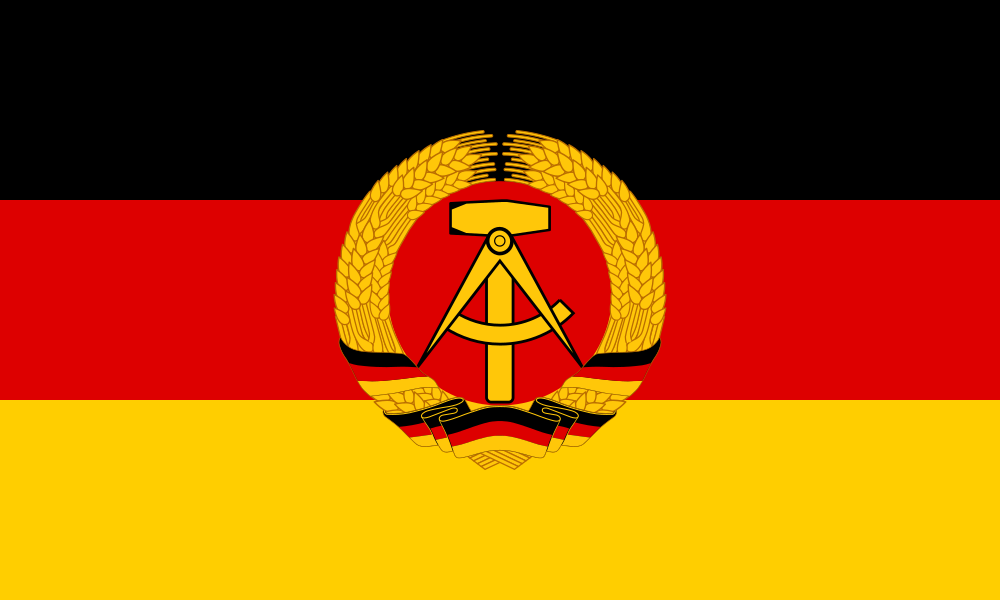
Allow me at the very outset to state that the delegation of the German Democratic Republic extends to you, Sir, its congratulations on your assumption of the presidency for the month of June. We are confident that your rich diplomatic experience will greatly contribute to the successful work of the Council and to bringing this extremely important series of meetings to a fruitful conclusion,
112. In the 25 years of its existence, SWAP0 has gained respect and recognition from the progressive international public. It has shown the highest possible flexibility in the political and diplomatic spheres and demonstrated steadfastness in the required armed struggle.
106. Our appreciation goes also to your predecessor, the representative of Thailand, for his wise guidance of the Council in the month of May.
113. Circumvention of the liberation organization renders a just settlement of the question of Namibia impossible. The Socialist Unity .Party of Germany and the Government and the people of the German Democratic Republic will continue to stand firmly by SWAP0 in its battle to secure genuine independence and self-determination for the Namibian people. Our solidarity with and support for SWAP0 as the sole authentic representative of the Namibian people serves the elimination of a hotbed of conflict and the safeguarding of peace. We regard solidarity with SWAP0 as well as with the ANC and the front-line States as an important contribution to the struggle against the apartheid regime.
107. My delegation would like to thank you and the members of the Council for giving me the opportunity to explain the position of the German Democratic Republic on the situation in Namibia. We regard the convening of these meetings on the request of the Co-ordinating Bureau of Non-Aligned Countries and of the Group of African States as highly imperative. The world has become witness to the increasing murderous terror of the South African racist rtgime inside the country, to continued acts of aggression and sabotage against neigh- :bouring States and especially to aggravation of the k,ampaign of terror against the Namibian people.
114. There is clear agreement among States that resolution 435 (1978) forms the basis for settlement of the question of Namibia. Since its adoption in 1978, however, we have repeatedly been witness to massive activities aimed
8. We have followed with great interest the course of Is debate. Many speakers have rightly pointed to the gravated situation in southern Africa caused by the
115. The truth is that Pretoria has always had its hands free for manoeuvring. Once before, it made the attempt at such an internal settlement in Namibia, but the socalled Democratic Turnhalle Alliance installed at that time met with inglorious failure. Then with “linkage” another artificial obstacle was raised to the implementation of resolution 435 (1978). And now, in view of the overwhelming rejection of that “linkage” and in view of the growing mass movement in South Africa and of international action for the liquidation of apartheid, the racists are resorting to new red herrings to counteract the crisis in their own system and to break the anti-apartheid front, or at least to weaken it. Empty promises of reforms inside the country are intended to serve that aim, as, with regard to Namibia, is the latest idea of a socalled interim government composed of the “Multi-Party Conference”. Our answer to this is unambiguous: no solution to the Namibian problem is possible with puppets and collaborators. Any sucli attempt will be doomed to failure. But it is our duty not to allow things to take their own course. What is imperative now is coordination ofjoint international action through the Security Council. The time for merely paying lip-service and for a pretense of optimism is long past.
116. We advocate the United Nations shouldering its responsibility, on the basis of its plan for Namibia. The
COIAO~ of the Extraordinary Ministerial Meeting of the Co-ordinating Bureau of Non-Aligned Countries on the question of Namibia, and the final document unanimously adopted there [S/17184, annex], show the way in which that plan can be implemented. The German Democratic Republic supports the demand of the non-aligned countries for increasing international pressure on South Africa, including the imposition of sanctions in accordance with Chapter VII of the Charter of the United Nations, since these are an effective means of forcing the racists to respect the will of the international public.
118. This year, 1985, we are observing a number of important anniversaries, including the fortieth anniversary of the United Nations, the founding of which was a direct result of the victory of the anti-Hitler coalition. At the same time, that victory over fascism and nazism opened up the road to the liquidation of colonialism and to the selfdetermination of peoples. That struggle received decisive impetus through the historic Declaration on the Granting of Independence to Colonial Countries and Peoples. Impressive proof of this is furnished by today’s free and independent States of Africa, Latin America and Asia. The twenty-fifth anniversary of General Assembly resolution 1514 (XV) must cause us to do everything to make 1985 a decisive year on the road to a free atid independent Namibia.
119. Let me conclude by quoting from the message sent by the Head of State of the German Democratic Republic, Erich Honecker, to the OAU on the occasion of Africa Liberation Day:
“Africa Liberation Day is an occasion for me to affirm that the German Democratic Republic attaches great importance to unity of action among the African States and National liberations movements within the Organization of African Unity in the struggle for the preservation and safeguarding of international peace, the strengthening of national independence and the settlement of the question of Namibia, as well as against colonialism, neo-colonialism, racial discrimination and apartheid. The German Democratic Republic will continue its solidarity and support in this just struggle.”
The meeting rose at 1 p.m.
NOTES
Supplement No. 24, (A/39/24), paras. 250 and 251.
2 Ibid., 252. para.
’ NV/82/4 of 12 February 1982.
▶ Cite this page
UN Project. “S/PV.2584.” UN Project, https://un-project.org/meeting/S-PV-2584/. Accessed .