S/PV.4289 Security Council
Provisional
The meeting was called to order at 6.45 p.m.
Adoption of the agenda
The agenda was adopted.
Letter dated 4 March 2001 from the Permanent Representative of the former Yugoslav Republic of Macedonia to the United Nations addressed to the President of the Security Council (S/2001/191)

I should like to inform the Council that I received letters from the representatives of Albania, Bulgaria, Croatia, Greece, Slovenia, Sweden, the former Yugoslav Republic of Macedonia and Yugoslavia, in which they request to be invited to participate in the discussion of the item on the Council’s agenda. In conformity with the usual practice, I propose, with the consent of the Council, to invite those representatives to participate in the discussion without the right to vote, in accordance with the relevant provisions of the Charter and rule 37 of the Council’s provisional rules of procedure.
There being no objection, it is so decided.
On behalf of the Council, I welcome the Minister for Foreign Affairs of the former Yugoslav Republic of Macedonia, His Excellency Mr. Srgjan Kerim.
At the invitation of the President, Mr. Kerim (the former Yugoslav Republic of Macedonia) took a seat at the Council table.
At the invitation of the President, Mr. Nesho (Albania), Mr. Sotirov (Bulgaria), Mr. Šimonović (Croatia), Mr. Gounaris (Greece), Mr. Petrič (Slovenia), Mr. Schori (Sweden) and Mr. Mladenović (Yugoslavia) took the seats reserved for them at the side of the Council Chamber.
The Security Council will now begin its consideration of the item on its agenda. The Council is meeting in response to the request contained in the letter dated 4 March 2001 from the former Yugoslav Republic of Macedonia addressed to the President of the Security Council (S/2001/191).
I give the floor to the Minister for Foreign Affairs of the former Yugoslav Republic of Macedonia, Mr. Srgjan Kerim.


Allow me to begin by expressing my great
satisfaction at seeing you, the representative of Ukraine, presiding over this very important meeting of the Security Council, which was requested by the Government of the Republic of Macedonia. I also want to thank you for your prompt response in organizing this meeting.
I am here to inform the Council on the disturbing developments on the northern border of the Republic of Macedonia. In the past few weeks, my country has been confronted with a serious problem caused by unidentified extremist militant groups stationed on the northern border of the Republic of Macedonia. These groups have occupied the village of Tanusevci, and from this stronghold they have continuously provoked armed incidents for some time now. On 4 March of this year, three soldiers of the Macedonian army were killed.
The extremists have not put forth their demands or their requests. They are consciously holding the local Albanian population hostage, and in view of the fact that the border belt with Kosovo is inhabited mostly by ethnic Albanians, they are also affecting the inter-ethnic relations in my country. Tanusevci is a serious warning that the Macedonian border area with Kosovo can be used constantly for provoking these kinds of incidents, thus threatening the peace, security and stability of Macedonia and the entire region.
The problem we are facing requires political, diplomatic and security measures. The Government and the President of the Republic of Macedonia are undertaking numerous activities with the aim of finding a peaceful solution, in close cooperation with the international community. The coalition Government of Macedonia, including the Democratic Party of Albanians, speaks with one voice and has condemned all attempts made to disrupt the inter-ethnic balance in the country. The Republic of Macedonia undertook a measured security response to the provocations, and only when provoked. The Government of Macedonia appreciates very much the clear signals of support it has received in the statements made by the Security Council, the United Nations Secretary-General, the European Union Presidency, the North Atlantic Council, the Organization for Security and Cooperation in Europe and other international forums. The activities of the Kosovo Force (KFOR) in the initial stage were not as effective as necessary, thus causing additional problems for the operations of our security forces. In the meantime, the lack of cooperation between
Macedonian security forces and KFOR has been overcome.
With the aim of resolving this situation, the Government of the Republic of Macedonia adopted an action plan. Its main elements are, in fact, preventive measures against a spillover of the conflict from both sides of the border. The action plan proposes the full observance of Security Council resolution 1244 (1999); the immediate establishment of a ground safety area along the entire Kosovo side of the Macedonian- Yugoslav border, by KFOR and by countries willing to make their contribution if necessary; the undertaking of urgent actions by KFOR for strict compliance of the provisions related to the movement of military and paramilitary formations, arms shipments and a ban on the movement and gathering of larger groups in the ground safety zone; strengthening the permanent coordination of activities between the armed forces of the Republic of Macedonia and KFOR, for the purpose of dealing with the conflict situation in the border area, disarming paramilitary extreme groups and bringing them to justice; and creating conditions for the return of the inhabitants of the village of Tanusevci to their homes.
The action plan also proposes the strengthening of the existing measures and the undertaking of additional ones by the Macedonian Government on the border in order to prevent a spillover of the conflict, in particular by reinforcing police control with new border police units.
The seriousness of the problem I have just elaborated on and the timing of its occurrence demand that we act preventively. In this case, to act preventively means to act promptly. We believe that this plan can work, and that is why we are advancing it before the Security Council.
For the last decade, Macedonia has affirmed itself as a factor of stability in the region, in spite of the challenges presented by the regional crisis. Now that a new page is finally being written in the history of the region, the new climate of cooperation and regional integration is again under threat. This new approach was best articulated at the Skopje summit of heads of State and Government of South-eastern Europe, at which the leaders of the countries of the region committed themselves to a new era of development, cooperation and stability in their relations.
In that context, the Republic of Macedonia signed the agreement with the Federal Republic of Yugoslavia on the demarcation of the border. All countries in South-eastern Europe and the international community as a whole strongly supported this agreement. They have acknowledged its important contribution to the peace and stability of the region.
However, it is evident that there are persons and forces in the Balkans who still believe that the time for creating so-called greater national states and drawing ethnic border lines has not passed. The incident in Tanusevci and in the border area of the Republic of Macedonia with Kosovo must be understood also in this light — as a warning for all of us to react and oppose these kinds of activities without hesitation.
The Security Council should be aware that the incident in Tanusevci must be seen in a broader context. This is not just about Tanusevci or about the Republic of Macedonia. This is about the region of the Balkans and its transformation into a peaceful, stable, democratic and prosperous European region.
Some say that Macedonia is being tested once again, particularly as regards its inter-ethnic relations, which are a crucial element of its stability. But they should not forget that this time the international community is also facing a serious test. Nobody today can claim to have been caught by surprise. The spill- over mission of the Organization for Security and Cooperation in Europe was established almost 10 years ago. I can assure the Council that Macedonia will pass this test in these difficult times, in spite of the fact that a group of people — whom some call guerrillas and others extremists or terrorists — has tried to take hostage not only the local Albanian population but inter-ethnic relations in Macedonia in general.
But in order to be effective, Security Council resolution 1244 (1999) must be fully implemented, and KFOR has to act according to its basic mandate, to prevent spill-over effects and to secure the northern border of Macedonia from the Kosovo side. In this context, I am pleased to note the conclusions reached today by the North Atlantic Council on measures to be undertaken in regard to my country.
Before I conclude, I would like to emphasize once again the role of the United Nations Interim Administration Mission in Kosovo and of KFOR in the period ahead of us. The eyes — and hopes — of the Macedonian population are turned towards KFOR and
the measures it will undertake. It should be clear that at this time we are endeavouring to protect not only the stability of our northern border, but also the values we share with the peoples of the countries represented here — peace, freedom and democracy, in a multi- ethnic and multicultural country like the Republic of Macedonia.
I call upon the Council to support the measures we are proposing. In this fashion, we can work together in reaffirming the preconditions for a peaceful and democratic development of the Balkans, with inviolable, stable and transparent borders. The support of the Council for the case I have had the honour to present to it, on behalf of the Republic of Macedonia, is of crucial importance at this moment. I strongly believe that today’s endeavours and the message that the Security Council will send will serve as a basis for undertaking adequate measures for the stabilization of the northern border of my country — the Republic of Macedonia — in the period to come.
I stand ready to answer any questions Council members might have.
I thank the Minister for Foreign Affairs of the former Yugoslav Republic of Macedonia for his important statement and for the kind words he addressed to me.


It is a pleasure to welcome Foreign Minister Kerim to the Security Council, although I wish it were under slightly happier circumstances, but it is good to have him here and to hear his views on the situation in his country and in the border area.
I will make my remarks brief, because there is little disagreement in this room about the responsible and careful way that his Government has handled the violence in the northern part of his country, about the need for it to cease and about the desire for the Council to provide support for future actions that can help respond to the problem in a way that is consistent with the Government’s responsibility to the rule of law.
My delegation is encouraged that the international community is assisting his Government in managing this problem, and we recognize the important roles that the United Nations, the North Atlantic Treaty Organization (NATO), the Organization for Security and Cooperation in Europe (OSCE) and the European Union are all playing in that regard.
Several days ago members of the Council heard from NATO Secretary General Robertson, who noted the difficulty of responding to the problems in the region and described to us some of NATO’s efforts to help. It is certainly not easy to balance the different and not always well-grounded or rational perceptions on the ground with the need to take action as the situation requires, and as this situation requires.
I understand that Minister Kerim will be proceeding to Brussels later this week for discussions at NATO, and I am confident that it will be a productive visit.
As the Council will make clear in the statement that the President will read out at the end of this meeting, there is considerable concern about the violence that has spilled over into Macedonia, and there is much support for the efforts of its Government, with the help of the Kosovo Force (KFOR) and others, to deal with it. I should like the Foreign Minister to please take a message back to his Government: that the Security Council understands the seriousness of the problem, that it understands the prudence with which the Government has responded; that it sees the country as an example of democracy based on the rule of law and inter-ethnic cooperation; and that the United Nations will do all it can, in cooperation with other international organizations, to ensure that these accomplishments are not undermined.


I should like to welcome Minister Kerim to the Council Chamber.
In addition to the statement which will be made in a few moments by the Ambassador of Sweden on behalf of the European Union, I should like to make a few comments in my national capacity.
The Council, as the Minister has emphasized, is meeting in his presence at a time when small armed groups have for several days been provoking serious incidents at the border between the Federal Republic of Yugoslavia and Macedonia. The destabilization attempts undertaken by such groups at the regional level must be most strongly condemned. The extremists must understand that the international community will not allow them to continue carrying out those deeds. They must be isolated, and their actions must be stopped. This is indeed what the Kosovo Force has undertaken to do with great determination by deploying
all the way to the border and cooperating more closely with Macedonia.
Macedonia is a key element in the regional balance. Its sovereignty and territorial integrity must be respected. Its borders, confirmed by the agreement of 23 February, must be defended. Its internal stability must be preserved. Since its independence, and with wisdom, its leaders have implemented a policy designed to ensure harmonious coexistence among all of the communities that together make up Macedonia. Everything must be done to maintain harmony in this pluralistic society.
What is at stake is the future of a country as well as the future of all of south-eastern Europe. France resolutely supports the policy that is so consistently and moderately being maintained by all the authorities of the country to foster a pluralistic and democratic Macedonia and peace in the region. President Chirac said so when he received President Trajkovski in Paris. Minister for Foreign Affairs Védrine will say it again in a few days in Skopje. In this test France is firmly at the side of Macedonia.


First I would like to join in those words of welcome that have already been addressed today to the Minister for Foreign Affairs of Macedonia, Mr. Kerim, who is taking part in the meeting.
The Russian Government strongly condemns the deterioration of the situation provoked by armed Albanian extremists in the Kosovo portion of the Yugoslav-Macedonian border and within Macedonia. We fully support the legitimate requests of the Macedonian Government on the need to put an end to these provocations, which were presented in detail by the Minister of Macedonia today. We are particularly concerned about new reports of coordinated activities combining the sharp intensification of Albanian fighters’ activities in Macedonia with terrorist activities in Kosovo and the Presevo Valley. It is time for the international community to draw lessons from the sad experience of aiding and abetting separatist elements of the Albanian extremists. Recent events show that they are not interested in dialogue and intend, through provocation and stirring tensions, to achieve their nationalistic ideas through methods of force. The fighters’ activities are clearly intended to destabilize the internal situation in Macedonia. The extremists are going from isolated terrorist acts to
attempts to involve Macedonian army and law enforcement units in broad-scale hostilities using various types of weapons.
This calculation is, as in the past, to provoke a disproportionate reaction and then the North Atlantic Treaty Organization (NATO) will supposedly protect them. However, we already see the signs today that everyone, both in NATO and in the Islamic world, have caught on to the provocateurs and have prepared to rebuff their activities, which are causing great harm to the Balkans and are in violation of the basic interests of all Albanians living there. We must immediately put an end to the high-handedness of the extremists, disarm and dissolve the illegal armed groups remaining in Kosovo, and isolate their leaders politically.
The increasing nationalism in Kosovo, the escalation of tension in the Presevo Valley, where once again today a Yugoslav soldier died, and the outbreak of violence in northern Macedonia are, without exaggeration, a threat to peace, security and stability throughout the Balkan region. The international community must stem terrorism and violence on an ethnic basis, ensure respect for the territorial integrity and sovereignty of all States in the Balkan region.
In practical terms, this means in particular the need for the Kosovo Force (KFOR), as required by resolution 1244 (1999), to close the Kosovo portion of the Macedonian-Yugoslav border to the transfer of weapons and fighters from Kosovo. The weapons, including heavy weaponry, that is being used to undermine stability in Macedonia is coming there from Kosovo. In fact, yesterday this was reaffirmed by the Secretary-General of NATO at a meeting with members of the Security Council. So we are all reaping the fruits of aiding and abetting the constant and flagrant violations of the Security Council arms embargo in Kosovo. although Russia has repeatedly called for ultimately ensuring strict compliance with resolution 1160 (1998).
The leadership of the United Nations Interim Administration Mission in Kosovo (UNMIK) must also take additional decisive steps with a view to stemming the continuing illegal activities in Kosovo aimed at stirring up militant nationalism, including the attacks we have heard from the mouths of Kosovo Albanian figures on the Yugoslav-Macedonian border demarcation agreement and the territorial integrity of Macedonia. The United Nations Administration
Mission in Kosovo and KFOR bear a special responsibility for preventing the spread of extremism from Kosovo and for retaining stability in the Balkans, and the Security Council must heighten its attention to issues involving compliance by the international presence with their mandates.


The Chinese delegation warmly welcomes Foreign Minister Kerim among us to brief us on the situation along the Macedonian-Yugoslav border. We thank him for his detailed briefing.
Like all previous speakers, the Chinese delegation condemns the acts of violence provoked by the Albanian extremists. China believes that currently the violence of the Albanian extremists has escalated, spilling over into the former Yugoslav Republic of Macedonia, along the border with Kosovo. China supports the issuing of a Security Council presidential statement and supports a timely response by the Security Council to prevent the situation from spinning out of control. China support the efforts of the Government of the former Yugoslav Republic of Macedonia to safeguard its sovereignty and territorial integrity and encourages it to seek peaceful means of resolving the dispute.
China also hopes that all concerned will undertake political and diplomatic efforts to bring an early negotiated end to this armed conflict and to restore stability to this region.
Easing tension along the border of Kosovo and the former Yugoslav Republic of Macedonia is linked to resolution of the Kosovo question. China believes that the United Nations Administration Mission in Kosovo (UNMIK) and the Kosovo Force (KFOR) need to take further measures to curb the activities of the Kosovo Albanian extremists. Security Council resolution 1244 (1999) must be implemented in its entirety. In particular, we call on KFOR to take into account the views of the Government of Macedonia and take effective action to beef up border patrols so as to stop the Albanian extremists from crossing the border and to stop the trafficking of illicit weapons.
The current situation shows once again that in the long term durable peace can only be realized in the region by fostering cohesion, reconciliation and tolerance among the ethnic communities and by promoting inter-ethnic harmony. Countries and parties
in the region and the international community should strive for this goal.


I would like to join you, Mr. President, and our colleagues in warmly welcoming the Foreign Minister. Given the lateness of the hour I will be brief, but I hope that our brevity will not be misunderstood as any lack of sympathy or lack of support for the concerns that are being expressed by the Foreign Minister.
It is clear that the Council is seized of the difficult situation that you have described. This week the Council has met the Secretary-General of the North Atlantic Treaty Organization under the Arria formula. He met with the Prime Minister of Yugoslavia, and now we are meeting with you. I think we have had three high-level meetings in one week to discuss the Kosovo situation. It is, I believe, unprecedented and indicates how seized we are of the situation.
As you have also heard, Mr. Minister, there seems to be a high degree of consensus in this room. All of us condemn the Albanian extremists, and this will be clearly stated in the presidential statement that we will be adopting immediately after this meeting.
On our part, we would like to quickly agree with two points that the Foreign Minister made in his speech. The first point relates to his statement that the problem his country is facing requires political, diplomatic and security measures. The only point we would add is that it might also require economic measures as a long-term solution. We were pleased to note that the Foreign Minister said that the leaders of the countries of the region have committed themselves to a new era of development, cooperation and stability in their relations. We believe that this is the best long- term formula.
The second point the Foreign Minister made was that it should not be forgotten that, this time, the international community is also being seriously tested. I believe that that is a very clear hint that the Council faces a serious test on this issue. Certainly, we will ultimately be judged not by the press statements we make, nor by the presidential statements we issue, nor by the resolutions we adopt, but by results on the ground. We hope that, as a result of the Council’s actions, there will be results on the ground. If there are not, we hope that the Foreign Minister will keep us posted.


Yesterday, the Council had the opportunity to meet with the Prime Minister of the Federal Republic of Yugoslavia and with the Secretary General of the North Atlantic Treaty Organization. Today’s meeting with the Foreign Minister of the former Yugoslav Republic of Macedonia emphasizes that the issues affecting peace and security in the Balkans must be dealt with in a regional context.
Allow me to welcome Mr. Kerim and to thank him for outlining his Government’s plan of action aimed at preventing a further deterioration of the situation. I extend to him my country’s sincere condolences for the loss of the lives of the three Macedonian soldiers that occurred as a result of the violence along his country’s border with Kosovo.
Last Friday, my delegation joined other members of the Council in the condemnation of the recent violence by extremists seeking to undermine stability and security in the region. At that time, the Council welcomed the initial steps taken by the Kosovo Force (KFOR) to control the border and urged KFOR and the United Nations Interim Administration Mission in Kosovo to consider further steps in this regard. We are therefore pleased to note the close cooperation between KFOR and the Government of Macedonia that has emerged in the past few days, aimed at preventing further escalation of the violence. We note, too, the assistance being provided by other Governments and international organizations.
The new Special Representative of the Secretary- General in Kosovo, Mr. Hans Haekkerup, has also held meetings with officials of Macedonia to offer support for the Government’s attempts to reduce tensions along the border. The Special Representative of the Secretary-General and UNMIK have pledged to do all that is possible to help to stabilize the situation. We encourage the Government of Macedonia to continue this close collaboration and to seek a political solution to the tensions.
We note the Foreign Minister’s suggestions regarding additional measures to be taken to prevent further escalation and we look forward to future discussions of this matter. It is essential that future action to reduce tensions along the border be undertaken, bearing in mind the ultimate goal of reconciliation. We continue to hope for the peaceful coexistence of the various ethnic groups in the Balkan
region, an environment of peace and stability and their integration into the wider European community.
Jamaica joins in supporting the statement which you, Mr. President, will make on behalf of the Council.


We, too, are very pleased to have this opportunity to meet with the Foreign Minister of the former Yugoslav Republic of Macedonia and to hear his views on the issues of peace and security in the region, which are important to the Council.
First of all, Norway would like to commend Macedonian authorities for having successfully maintained peace and stability and developed democracy in their country during a decade of independence under difficult circumstances. This has been achieved not least thanks to a consistent policy of constructive cooperation between the various ethnic groups, Macedonian Slavs and Albanians. Norway appreciates the former Yugoslav Republic of Macedonia’s achievements and we will work to ensure that the international community actively supports the Foreign Minister’s efforts to maintain peace and stability in the future as well.
At the outset, we must make it clear that the Foreign Minister’s country has legitimate security concerns which must be addressed and that its sovereignty and territorial integrity must be fully upheld and respected. Norway strongly condemns all violent activities of extremist armed groups in the region, including the Albanian extremist attack last Sunday, which tragically caused the deaths of three Macedonian soldiers. Such activities constitute a threat to internal as well as regional peace and stability and must be firmly rejected. It is, not least, important that leaders in the region isolate the extremist forces and clearly condemn acts of violence.
We support the Macedonian authorities in their legitimate efforts to restore internal peace and security, including confidence-building measures on the Macedonian side of the border with Kosovo. It is important that the measures used be proportionate to the challenges on the ground and we commend the responsibility and restraint shown by the Foreign Minister’s Government in responding to this situation.
My Government notes with interest the plan of activities proposed by the Macedonian authorities. Norway agrees that the Kosovo Force (KFOR) must
intensify its activities to control the border areas in Kosovo. We also agree on the importance of keeping close contact between the Macedonian army and KFOR in order to achieve the best possible control of these border areas.
In conclusion, we firmly believe that today’s presidential statement will provide important support for the Foreign Minister’s future efforts.
Sir Jeremy Greenstock (United Kingdom): We, too, warmly welcome Minister Kerim’s presence. I think that he is finding that the Council is pretty unanimous in what it is saying to him in support of the proposals he has put forward and on the situation his country finds itself in. We certainly condemn the recent violence that ethnic Albanian extremists have perpetrated in northern Macedonia, including the tragic killing of the three soldiers at the weekend.
We very much welcome the dialogue that has now sprung up between the Macedonian Government and the North Atlantic Treaty Organization (NATO) and the Kosovo Force (KFOR) on practical steps to address the immediate situation and to provide a basis for intensified, longer-term cooperation. I entirely echo the commendation of my colleagues around this table for the prudent action taken so far by the Macedonian Government. The Foreign Minister’s visit to NATO on Friday will be an important occasion for operationalizing the proposals for action that he has presented today. Resolution 1244 (1999) gives KFOR a broad mandate to act and the operational decisions are for it to make. We welcome the measures that have already been agreed — for instance, tougher KFOR control of the boundary and closer liaison between KFOR and the Macedonian armed forces. These should soon translate into more effective combined response on the ground.
We in the Council will continue to monitor the situation closely from here, in parallel with the operational action taken by our colleagues in the North Atlantic Council. There is strong United Kingdom support for the presidential statement that we are adopting today, which should send a clear message to the extremists that the violence will not be tolerated.


Ireland joins with others in welcoming Foreign Minister Kerim to the Security Council today. We, too, strongly condemn the recent violence by armed extremists along the border region between the Federal Republic of Yugoslavia and the
former Yugoslav Republic of Macedonia, including the attacks on Sunday near Tanusevci that resulted in the deaths of three Macedonian soldiers. These incidents endanger the stability not only of the former Yugoslav Republic of Macedonia, but of the entire region, and they contradict the positive signals of the recent South East European Cooperation Process summit in Skopje.
Ireland fully subscribes to the statement that will be delivered by the Permanent Representative of Sweden, representing the Presidency of the European Union. I would like to take this opportunity to highlight just a few points of particular significance and to ask the Foreign Minister a question. We encourage the political leaders in the former Yugoslav Republic of Macedonia and Kosovo to take action aimed at establishing peace and stability in the region. We commend the sensible restraint displayed to date by the Skopje authorities and take note of the action plan that Foreign Minister Kerim outlined today; we will be examining it carefully.
Ireland supports the dialogue between the authorities of the former Yugoslav Republic of Macedonia and the Kosovo Force aimed at taking further practical steps in controlling the border region. We believe it is essential that the efforts of all relevant international organizations, including the European Union, the United Nations, the Organization for Security and Cooperation in Europe and the North Atlantic Treaty Organization aimed at establishing stability should be properly coordinated. Ireland fully supports the territorial integrity of the former Yugoslav Republic of Macedonia, a partner in our common European endeavour, and expects all parties to respect the border demarcation agreement signed in Skopje on 23 February.
Finally, the current situation serves to underline the importance of reinforcing ethnic relations in the former Yugoslav Republic of Macedonia, and I would be interested to hear from the Foreign Minister if there is anything further that the international community can do to assist the efforts of the Skopje Government in this regard.


I would like to welcome Mr. Kerim, the Minister for Foreign Affairs of the former Yugoslav Republic of Macedonia. His presence among us demonstrates the importance of the question under consideration today. Indeed, the violence on the border of Kosovo is threatening the
stability and ethnic balance of the former Yugoslav Republic of Macedonia. Furthermore, this violence is in danger of destabilizing the region as a whole and of compromising the efforts made to date by the international community.
We strongly condemn the attacks perpetrated against the army of the former Yugoslav Republic of Macedonia, which have resulted in the death of soldiers. We believe that such acts of violence must be brought to an end throughout the entire region, especially in the border areas. We reaffirm the territorial integrity and sovereignty of the former Yugoslav Republic of Macedonia and the right of its people to a peaceful life within its borders. In this regard, we welcome the border demarcation agreement of 23 February signed in Skopje between the Federal Republic of Yugoslavia and the former Yugoslav Republic of Macedonia. We urge the Kosovo Force to make further efforts in order to halt the crisis and to prevent it from spreading throughout the region creating new hotbeds of tension.
Furthermore, we believe that it is essential to deal with the root causes of violence in the region, especially the economic and social causes, and to take adequate steps for the restoration of lasting peace in the region. We are convinced that the settlement of all disputes through peaceful means and dialogue might help the parties to embark upon the path of lasting ethnic reconciliation.


I should like to begin by welcoming Mr. Kerim, Minister for Foreign Affairs of the former Yugoslav Republic of Macedonia, and expressing the support of my country for the quest for a solution to the problems that have brought us together today.
Colombia condemns all forms of violence; we cannot accept any justification for it. We therefore join with those who have already condemned the acts that have taken place in recent days near the town of Tanusevci, on the border between Kosovo and Macedonia. My country believes that respect for the sovereignty and territorial integrity of States is one of the most important principles of international relations. We therefore reject the continuing threats by extremists to the territorial integrity of Macedonia.
We support the request of the Minister with regard to the need for the Kosovo Force to act immediately to halt such terrorist activities and prevent
them from spilling over to the rest of the country and the region. As the Minister rightly pointed out, it is necessary for the international community to continue to maintain a meaningful presence in the area so as to avoid a deterioration of the situation and contribute to the restoration of trust between the parties. We must spare no effort to find a political way out of this crisis, which in our view is the only viable solution.
I should like to conclude by expressing the support of my delegation for the presidential statement that we will adopt after this meeting.


I, too, would like to thank Mr. Kerim, Minister for Foreign Affairs of the former Yugoslav Republic of Macedonia, for his statement. I note that the information he gave to the Council confirms that there has been a deterioration of the situation on the border between the former Yugoslav Republic of Macedonia and Kosovo. Like other delegations, we are deeply concerned over the escalation of tension in the Presevo Valley and the increase in violence in the north of Macedonia. We strongly condemn the violent and illegal terrorist acts committed by extremist groups in the region, especially the death of three soldiers last week. We also support the sovereignty and territorial integrity of the former Yugoslav Republic of Macedonia, and we urge all the parties concerned to show restraint, because we are convinced that the current situation can be resolved only through political means.
My delegation also welcomes the signing, on 1 March 2001, of a border demarcation agreement between the Federal Republic of Yugoslavia and the former Yugoslav Republic of Macedonia.
Finally, I would like to say that my delegation remains committed to the search for a comprehensive solution to the problem in the Balkans and expresses its support of my delegation for the presidential statement that we will adopt after this meeting.


My delegation welcomes the Foreign Minister of the former Yugoslav Republic of Macedonia to the Security Council Chamber, and thanks him for the briefing he has given us. My delegation condemns the acts of violence in northern Macedonia by Albanian extremists. We appreciate the fact that the Government of Macedonia has exercised great restraint in addressing the situation resulting from the action of the Albanian extremists. We have no doubt that the Kosovo Force and the
United Nations Interim Administration Mission in Kosovo will provide full support to the Government of Macedonia in addressing the situation.
Macedonia is an example of a stable, multi-ethnic democracy and deserves the full support of the Security Council for the proposals that the Minister presented to manage the crisis imposed on it by the Albanian militants. We assure the Minister of our total support, and we endorse the presidential statement that will be issued at the end of our meeting.
I shall now make a statement in my capacity as the representative of Ukraine.
The rapid deterioration of the situation in the Republic of Macedonia, which prompted the convening of today’s emergency meeting, is a matter of close attention in my country. On 5 March, the Ministry of Foreign Affairs of Ukraine issued a statement, which reads as follows:
“Ukraine is deeply concerned at the recent acts of violence perpetrated by the extremist armed groups in the border area between the Republic of Macedonia and Kosovo (the Federal Republic of Yugoslavia), which claimed human lives. Of particular concern is the continuation of activities by the Albanian extremist forces, which have not given up the methods of terror and violence. A series of armed incidents that have been recently provoked by these forces are fraught with a new escalation of tensions in the whole region.
“Ukraine notes the immediate steps taken by KFOR with a view to reinforcing the control of the situation on the border between the FRY and Macedonia and supports the UN Security Council in its call on UNMIK and KFOR to consider further measures aimed at easing the situation.”
In addition to that statement, I would like to put on record a few more points.
First, we strongly condemn attacks against the Macedonian soldiers and deplore the violent deaths of three of them a few days ago.
Secondly, we reaffirm our full support for respect for the sovereignty and territorial integrity of the Republic of Macedonia.
Thirdly, the armed clashes between the Albanian fighters and the Macedonian troops that broke out on the border between the Federal Republic of Yugoslavia at its Kosovo section and the Republic of Macedonia should be seen as a direct consequence of the critical situation in southern Serbia. It is therefore obvious to us that remedying the situation on the border between the Federal Republic of Yugoslavia and the Republic of Macedonia will be impossible without finding a viable solution to the problem of restoring proper security conditions in the ground safety zone.
In our view, further enhancement of cooperation between the United Nations Interim Administration Mission in Kosovo (UNMIK) and the Kosovo Force (KFOR), on the one hand, and the Yugoslav Government, on the other, remains indispensable.
We are encouraged by the ongoing dialogue between the North Atlantic Treaty Organization (NATO) and the Yugoslav Government on the problems in southern Serbia. We support NATO’s intention to carry out a reduction in the size of the ground safety zone as a good step forward. In our view, swift implementation of the plan by the Yugoslav Government, aimed at achieving a political solution to the existing problems in southern Serbia through confidence-building measures, will contribute to significantly curbing the current dangerous developments in the Republic of Macedonia as well.
Fourthly, Ukraine commends the Macedonian Government for its measured response to the situation so far and for its inclination to seek a solution through political means. In our judgement, the plan of activities aimed at preventing a spillover of the conflict, as presented today by the Foreign Minister of the Republic of Macedonia, makes a lot of sense and deserves our support.
Fifthly, we welcome NATO’s commitment to support the security, stability and territorial integrity of that country, as was stated by the Secretary-General of NATO on 2 March 2001. We also welcome steps already taken to assist the Macedonian Government in protecting its frontiers.
We applaud the measures currently being put in place by NATO to reinforce existing KFOR capabilities to monitor the border between the Federal Republic of Yugoslavia at its Kosovo section and the Republic of Macedonia, as well as the announcement by the European Union about the increase in the number of its
monitors in the area. In our view, the Council should encourage further joint efforts by KFOR and other relevant international organizations, in coordination with the Macedonian Government, towards the implementation of that Government’s plan of activities presented today.
I now resume my functions as President of the Council.
The next speaker inscribed on my list is the representative of Sweden. I invite him to take a seat at the Council table and to make his statement.


As you know, Mr. President, I have the honour to speak on behalf of the European Union. The Central and Eastern European countries associated with the European Union — Bulgaria, the Czech Republic, Estonia, Hungary, Latvia, Lithuania, Poland, Romania, Slovakia and Slovenia — as well as the associated countries of Cyprus, Malta and Turkey and the European Free Trade Association countries of the European Economic Area, Iceland and Liechtenstein, align themselves with this statement.
The European Union welcomes the visit of Foreign Minister Kerim to the Security Council and thanks him for his statement on the situation in the former Yugoslav Republic of Macedonia.
The European Union is deeply concerned about the recent escalation of violence in the border region between the Federal Republic of Yugoslavia/Kosovo and the former Yugoslav Republic of Macedonia. The European Union strongly condemns the growing number of violent incidents in this area, including the ethnic Albanian extremist attack of Sunday, 4 March, near the village of Tanusevci, which led to the death of three soldiers. Violent acts such as those endanger the stability and security of the former Yugoslav Republic of Macedonia and its citizens and should stop immediately.
The European Union calls upon all political leaders in the former Yugoslav Republic of Macedonia and Kosovo to isolate the forces behind those violent acts and to shoulder their responsibility for peace and stability in the region.
The European Union reiterates its strong attachment to the principle of the inviolability of all borders in the region, including the territorial integrity of the former Yugoslav Republic of Macedonia.
The European Union welcomes the efforts initiated by the Kosovo Force (KFOR) aimed at increased control of the border area in the region, and the further strengthening of coordination between the authorities of the former Yugoslav Republic of Macedonia and KFOR to contribute to the stabilization of the situation in the area.
A peaceful and stable former Yugoslav Republic of Macedonia within internationally recognized borders is an important condition for furthering the integration of that country with the European Union, as well as a key factor for stability in the region.
I should like to inform the Council that I have received a letter from the representative of Turkey in which he requests to be invited to participate in the discussion of the item on the Council’s agenda. In conformity with the usual practice, I propose, with the consent of the Council, to invite that representative to participate in the discussion, without the right to vote, in accordance with the relevant provisions of the Charter and rule 37 of the Council’s provisional rules of procedure.
There being no objection, it is so decided.
At the invitation of the President, Mr. Göktürk (Turkey) took the seat reserved for him at the side of the Council Chamber.
The next speaker inscribed on my list is the representative of Bulgaria. I invite him to take a seat at the Council table and to make his statement.


I feel privileged to congratulate you, Mr. President — our former colleague and friend — on your assumption of the presidency of the Security Council for the month of March. I wish you and your colleagues every success in the fulfilment of your important tasks.
My delegation welcomes the valuable participation of the Foreign Minister of the Republic of Macedonia, Mr. Srgjan Kerim, in the present debate. The action plan he introduced today merits careful consideration. We believe that its realization would create conditions for a reduction of the tension in that part of the region and for the strict implementation of resolution 1244 (1999), as the only basis for lasting solution to the existing problems.
Bulgaria has associated itself with the statement just made by the Permanent Representative of Sweden on behalf of the European Union. However, as a neighbouring country we asked for the floor to reiterate our strong concern with regard to the recent acts of violence in the northern part of Macedonia, along its border with the Federal Republic of Yugoslavia. The Bulgarian Government has already adopted two declarations strongly condemning the activities of terrorist groups that violate the territorial integrity and sovereignty of the Republic of Macedonia. The latest tragic incidents led to the death of three Macedonian soldiers.
The Bulgarian Government considers that the activities of the armed Albanian extremists in the area of the village of Tanusevci amount to opening up a new front in the war over Kosovo, and believes that they impede the efforts of the international community to find a lasting, peaceful solution to the problem on the basis of the provisions of Security Council resolution 1244 (1999). These attacks do not stem from an inter- ethnic conflict in the Republic of Macedonia, but represent attempts to initiate such a conflict in that country.
The attacks came at a time when, after a 10-year effort, the Republic of Macedonia and the Federal Republic of Yugoslavia had concluded an agreement on the delimitation of their common border. The Bulgarian Government welcomed this agreement as an additional factor for regional stability. Therefore, we strongly reject any attempts to question a border recognized by international law. We consider that the recent events affect the security of the Republic of Macedonia and may generate a new source of destabilization in this part of the region. Serious concerns exist that the undermining of the borderline in the area serves the interests of certain organized crime elements that finance the extremist circles on both sides of the border. Only a total isolation of the extremists can put an end to their illegal activities.
The stability of the Republic of Macedonia is of key importance for the national interests of Bulgaria and the other countries in the region. Therefore, the Bulgarian Government renders strong moral and political support to the efforts of the Macedonian authorities to use political and diplomatic means and refrain from seeking a military solution. My Government maintains permanent contacts with the Government of the Republic of Macedonia. We have
already expressed our readiness to provide any assistance on a bilateral and multilateral basis, including military and technical, that the Macedonian authorities may deem necessary for the management of the existing crisis. Tomorrow, Prime Minister Ivan Kostov will pay an official visit to the Republic of Macedonia.
Bulgaria considers that the active involvement of the international community is vital for reducing the existing tension. It is still possible to prevent the spillover of the conflict to other parts of the border area. Otherwise, if the escalation of tension is not curbed in due time, the United Nations might be forced to resort to a much larger-scale and costly operation. We commend the readiness of the North Atlantic Treaty Organization to support the stability and security of the Republic of Macedonia. As a participant in the Kosovo Force (KFOR) and the United Nations Interim Administration in Kosovo, Bulgaria expects further measures to be taken in order to strengthen the control of the Yugoslav border between Kosovo and Macedonia and to disrupt the supply sources of the extremists. A case in point is to find ways for guaranteeing the implementation of the provisions of the Military Technical Agreement signed in Kumanovo on 9 June 1999, entrusting KFOR with control over the Yugoslav border with the Republic of Macedonia and Albania.
Bulgaria will continue to closely follow the situation on the border between the Federal Republic of Yugoslavia and the Republic of Macedonia and will spare no efforts in promoting stability and cooperation in southeastern Europe. My Government will welcome any decision by the Security Council that could reduce the tension and facilitate the full implementation of resolution 1244 (1999).
I thank the representative of Bulgaria for his kind words addressed to me.
The next speaker inscribed on my list is the representative of Greece. I invite him to take a seat at the Council table and to give his statement.


I have the honour to speak on behalf of my Government on the situation in the former Yugoslav Republic of Macedonia. I would like to associate myself with the statement of the European Union delivered by the Permanent Representative of Sweden, Ambassador Schori.
I wish to welcome the presence of Mr. Kerim, Minister for Foreign Affairs of the former Yugoslav Republic of Macedonia, in the Security Council and express our appreciation for his statement. We believe that the points he outlined should be taken into serious consideration.
Greece, along with the international community, strongly and unequivocally condemns all acts of violence and terrorism both across the northern borders of the former Yugoslav Republic of Macedonia and in southern Serbia.
In his visit yesterday to Skopje, the Minister for Foreign Affairs of Greece, Mr. George Papandreou, conveyed a message on behalf of the Greek Prime Minister that underlines that the sovereignty and territorial integrity of the former Yugoslav Republic of Macedonia, within its internationally recognized borders, is essential for the stability in our region.
Furthermore, Greece reiterates its full support for all measures already undertaken and welcomes further measures by the United Nations, the North Atlantic Treaty Organization and the European Union, ensuring the former Yugoslav Republic of Macedonia’s inviolability of borders, territorial integrity and unitary character.
Greece firmly believes that the international community, at this very moment, should not hesitate to address, immediately and effectively, the fragile security situation along the borders of the former Yugoslav Republic of Macedonia. The escalation of acts of violence could destabilize that country’s very foundations as a multi-ethnic, multicultural and multi- religious State, in which so much has been successfully invested by the international community.
Greece encourages a continuous regional dialogue, aiming at preventing any spillover of violence and promoting democracy, more tolerance, less fragmentation, respect of existing borders and prosperous development of the whole region.
The next speaker inscribed on my list is the representative of Slovenia. I invite him to take a seat at the Council table and to make his statement.


Slovenia aligns itself fully with the statement of the European Union that was delivered by the distinguished representative of
Sweden on behalf of the European Union and associated countries.
It is an honour to greet among us Mr. Srgjan Kerim, the Foreign Minister of a country that has in a decade of crisis and wars in the Balkans showed great restraint, maturity and persistence in resolving peacefully complicated and dangerous situations. His country has participated actively in a set of initiatives to stabilize the region and to promote cooperation and development — such as the Southeast European Cooperative Initiative, the Stability Pact for Southeastern Europe, the South East European Cooperation Process and others. Let me mention that Minister Kerim himself has been one of the most outstanding promoters of the Stability Pact for Southeastern Europe. His personal engagement has contributed to the success of this important international initiative.
To keep Macedonia out of conflicts during the last decade has not been an easy achievement in an often unfriendly environment and in extremely difficult economic circumstances. In spite of the negative effects on Macedonia’s economy of the sanctions established against the Federal Republic of Yugoslavia and in spite of its delicate ethnic composition, Macedonia has successfully protected not only its territorial integrity but also its internal stability, democratic process and economic progress. During the times of Kosovo crisis Macedonia has, at great sacrifice, given refuge to hundreds of thousands of Albanian refugees from Kosovo, victims of ethnic cleansing, and has extended its full support to the United Nations, the North Atlantic Treaty Organization and other international organizations in their involvement to resolve the Kosovo crisis.
And most importantly, in the years when aggression and ethnic and religious conflicts seemed to be a normal state of affairs in parts of former Yugoslavia, Macedonia has successfully integrated its Albanian population and other minorities in political, economic and social life.
In the last weeks, we have witnessed violence by extremists and terrorists near the border of the Federal Republic of Yugoslavia and Macedonia. The acts of the extremists endanger the stability of Macedonia and could provoke a new crisis. Indeed, the escalation of violence, if not checked immediately, can endanger not only Macedonia, but the larger region as well. We
should not underestimate the extremely dangerous consequences, if the extremists are not checked and if de-escalation of tensions is not achieved.
It goes without saying that Slovenia strongly condemns the violent acts. Slovenia urges political leaders, in particular the leaders of the Albanian community in Macedonia and the leaders of Kosovo Albanians, to isolate the extremists and perpetrators of violent acts in Kosovo, in the Presevo Valley and now in the border region of Macedonia. Slovenia also urges leaders to shoulder their responsibility and show active support for peace and stability in the region. Kosovo Albanian leaders should not forget that only through the support of the international community, including the support of Macedonia, have they successfully sustained the onslaught of the Milosević regime on the Albanian community in Kosovo.
The presence and involvement of the international community in Macedonia and in the Balkans in general in the past decade has brought peace to the region. Let us now, through timely and vigorous action and through full support for Macedonia, prevent the results achieved from being endangered. We are sure that with the active involvement of the international community, and with the activities of the Macedonian authorities — which should, as they have up to now, remain measured and restrained, and political rather than military — a de-escalation of the situation can be achieved and an emerging crisis avoided.
I thank the representative of Slovenia for the kind words he addressed to me.
The next speaker inscribed on my list is the representative of Croatia. I invite him to take a seat at the Council table and to make his statement.


We welcome the presence of Macedonia’s Minister for Foreign Affairs, Mr. Kerim, at this meeting.
The Government of the Republic of Croatia condemns the extremist attacks and expresses concerns about the possible escalation of violent conflict in Macedonia. Accordingly, the Croatian Foreign Ministry issued a statement yesterday voicing concern that such attacks are destabilizing the security situation in Macedonia and impairing the process of normalization in Kosovo, thereby leading to the deterioration of relations in the entire region.
We regret deeply the loss of life resulting from these terrorist acts. We condemn the incidents along the northern border of Macedonia as well as the threats directed at representatives of the international community in the area. At the same time, we salute the restraint demonstrated by the authorities of the Republic of Macedonia. Unified and determined action on the part of the international community to prevent any further deterioration of the situation in the region — still corrupted by the negative legacy of the former Milosević regime — remains indispensable.
The sufferings of the Albanian population in Kosovo should not be forgotten, but violence only breeds more violence. Together with their brethren elsewhere in the region, the Albanians in Macedonia must strive, as the majority of them do, to protect their rights and interests through democratic institutions. In such efforts they enjoy our full support.
The Republic of Croatia wishes to reiterate that its primary interest and commitment remains the maintenance of peace and overall security in the area, for the benefit of all citizens of Macedonia as well as all peoples of South-eastern Europe.
It remains very important, for the long-term stability of South-eastern Europe, to clarify the tragic events of the recent past, to establish responsibility for them and to break the cycle of impunity by punishing the persons responsible, first of all Mr. Milosević, for committing war crimes, crimes against humanity and genocide. At the same time, it is absolutely crucial to depart from the tradition of using violence to achieve political aims and to accept dialogue as the only legitimate means for resolving the remaining differences and disputes.
The next speaker inscribed on my list is the representative of Yugoslavia. I invite him to take a seat at the Council table and to make his statement.

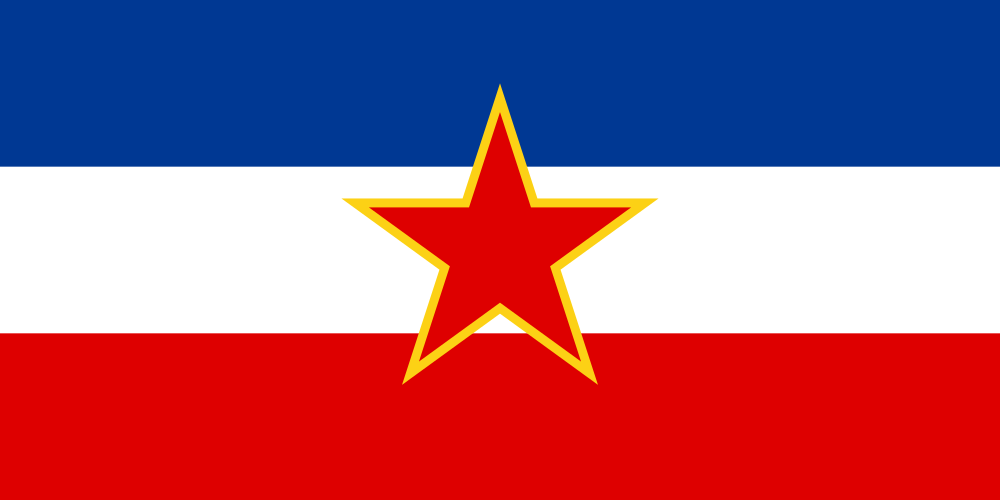
The Federal Republic of Yugoslavia is seriously concerned at the escalation of ethnic Albanian terrorism, which has now spread to Macedonia, threatening the security of the broader region. The consistent efforts of the countries of the region and the international community to stabilize conditions and strengthen confidence are being seriously jeopardized.
The latest armed attacks committed by ethnic Albanian terrorists in the village of Tanusevci in Macedonia have resulted in the loss of three lives. The Federal Republic of Yugoslavia, as a neighbour country, is following with particular attention the developments in Macedonia. We fully support the sovereignty and territorial integrity of Macedonia. We consider that the Government of Macedonia is entitled to take all legitimate measures to preserve its territorial integrity and stabilize the situation on its sovereign soil. The Federal Republic of Yugoslavia fully supports the plan of action for resolving the crisis on the border between Macedonia and Yugoslavia which the Macedonian Government adopted on Monday and Foreign Minister Srgjan Kerim outlined in his statement just now.
My Government condemns most strongly the latest armed terrorist attacks against the army of Macedonia. It is evident that this is an attempt to provoke a new conflagration in the Balkans in order to achieve political goals by violence. We are faced with the same problems on part of our own territory, on the other side of the Yugoslav-Macedonian border. This afternoon, a vehicle of the army of Yugoslavia ran over a landmine activated by a remote-control mechanism and planted by Albanian terrorists on the road near the village of Orahovic in southern Serbia, outside of the ground safety zone. In the explosion, two soldiers were killed instantly, and two officers were gravely wounded. I was informed prior to the beginning of this meeting that one of the officers has succumbed to his wounds and that the other is fighting for his life. It is high time that resolute and concrete measures be taken against Albanian extremism. It is obvious that all these extremist actions are coordinated on a larger scale and that they are a function of greater Albanian goals and objectives.
Yugoslavia continues to be consistent in its conviction that the troubles that beset the region can be solved only in a peaceful way, through dialogue and with full respect for the territorial integrity and sovereignty of all States. There is no denying that the responsibility for the security situation in Kosovo and Metohija lies squarely on the Kosovo Force (KFOR) and the United Nations Interim Administration Mission in Kosovo (UNMIK), as provided for by Security Council resolution 1244 (1999).
The tragic events in the village of Tanusevci on one side, and the village of Orahovic on the other side
of the Yugoslav-Macedonian border, as well as those that took place recently in the ground safety zone along the administrative boundary of Kosovo and Metohija, confirm in the most apparent way that the demilitarization of Albanian armed groups has not been carried out as provided for by Security Council resolution 1244 (1999). Likewise, the uncontrolled crossing of armed extremist groups and weapons from Kosovo and Metohija to southern Serbia and Macedonia has not been stopped yet. Yugoslavia and Macedonia, as democratic States, are fully entitled to expect the Security Council to address a clear and resolute message to Albanian extremists.
The Federal Republic of Yugoslavia and its democratically elected Government will continue to call for a peaceful solution. We are convinced that this is in the best interest of the stability of the region and the development of good-neighbourly cooperation. The recent signing of the agreement on the demarcation of the State border between Yugoslavia and Macedonia is a result of the efforts of our two countries to make a contribution towards these goals.
We are convinced that the Security Council should support the Macedonian Government in its efforts to defeat the present attempts to destabilize its country, thus contributing to the stability of the entire region.
The next speaker inscribed on my list is the representative of Albania. I invite him to take a seat at the Council table and to make his statement.


Mr. President, it is a great pleasure for me to see you back in this Chamber, and I wish you every success in your new responsibilities.
My delegation welcomes the participation of the Foreign Minister of Macedonia, Mr. Srgjan Kerim, and has listened with great interest to his statement.
I should like to read the statement of the Albanian Government adopted in response to the events that took place in Tanusevci.
“The Albanian Government has observed with attention and concern the latest developments in different parts of our region, as in Kosovo and southern Serbia. It is deeply concerned over the latest violent episode in the village of Tanusevci, in Macedonia, where, according to a news agency, three Macedonian soldiers were killed. Expressing its regret over
the victims of the violence, the Albanian Government reiterates its denunciation of the acts of violence of extremist groups or individuals, acts which run counter to the aspirations of Albanians and Macedonian Albanians throughout the region. We believe that the Macedonian Government will continue to show proper restraint and wisdom in treating and resolving the situation created. The Albanian Government has constantly supported the resolution of the Albanians’ problems in Macedonia through institutional and democratic means.
“The Albanian Government has commended the positive step taken by the Macedonian Government during the past year aimed at the affirmation of the Albanian population’s rights, in the spirit of tolerance and cooperation. In this light, the acts of violence run counter to the interests of the Albanians and the position of the Albanian political faction in Macedonia. Such acts are aimed at damaging the image of the Albanian people all over the region and at depriving them of the international support and sympathy won during the war in Kosovo.
“Therefore, the Albanian Government calls upon all Albanian political parties, in Macedonia as well as in Kosovo, to distance themselves from such extremist acts wherever they occur and whoever their perpetrators are. In the meantime, the Albanian Government shares the concern of the international community and expresses its high consideration for the commitment of the international community to the peaceful solution of the problem in our region. Finally, the Albanian Government will continue to commit itself to the democratic stability of Macedonia and of the whole region, in cooperation with the international community, the Governments of the countries of the region and the Albanian political forces in Macedonia, Kosovo, Montenegro and southern Serbia.”
I thank the representative of Albania for his kind words addressed to me.
The next speaker inscribed on my list is the representative of Turkey. I invite him to take a seat at the Council table and to make his statement.


I shall be brief at this late hour. It is a pleasure for us to see here the Foreign
Minister of Macedonia, a country that is a close friend of Turkey.
We have already aligned ourselves with the statement delivered by the Ambassador of Sweden. As a neighbouring country and a close historical friend of Macedonia, I took the liberty of taking the floor in order to make a few additional comments.
Yesterday the Turkish Foreign Ministry issued a statement deploring the recent violence in the Kosovo section of Macedonia’s northern border. Today the Turkish President called his counterpart, President Trajkovski, to express his sympathy for the loss of life and to reassure his counterpart of Turkey’s resolve to support Macedonia’s security and territorial integrity. The Deputy Under-Secretary of the Turkish Foreign Ministry will be on his way early tomorrow morning to Skopje to have a first-hand view of the situation evolving there and have extensive discussions with the Macedonian authorities.
We stand by Macedonia in its hour of distress. We stand resolutely against all acts of terrorism. We likewise condemn the escalation of acts of violence perpetrated by extremist elements on the northern border of Macedonia. We have full respect for the territorial integrity and the internationally recognized borders of the Republic of Macedonia. We also support the measures being taken by the Government of Macedonia and by the international community, aimed at arresting and remedying the situation.
I now call on the Minister for Foreign Affairs of the former Yugoslav Republic of Macedonia, Mr. Kerim, for final comments.
I would like to thank you personally, Mr. President, and all the representatives of the members of the Security Council and of the other countries that joined today’s discussion for the condolences expressed concerning the deaths of three innocent soldiers of the Macedonian army. They were victims of violence, but their lives are an invaluable asset, as a part of the peaceful policy of Macedonia in the region and in Europe. I can assure the Council that Macedonia’s peaceful policy and the philosophy behind it, based, among other things, on the inter-ethnic balance, will continue.
Nothing in this world will prevent us from pursuing this policy. The fact that our security forces
did not intervene proportionally is not a matter of political tactics on the part of my Government and the President. It is a matter of deepest conviction that we do not regard our own population, including the Albanian part of it, as targets. If there are any targets at all, targets have to be terrorists and extremists. I am very glad to state today that they have been regarded as a target in this discussion, and I would like to thank the Council very much for its support for the measures we have presented here on behalf of my Government and for the policy that my country is pursuing in the region. I am grateful for the support expressed in the President’s statement and in all the other statements made in this discussion.
Finally, in response to the question of the representative of Ireland, I would like to stress that my country is pursuing a policy of inter-ethnic relations based on concrete measures, and these measures imply
further measures in higher education for the various nationalities, particularly the Albanian nationality, and in local government. In this respect, I would like to call on the European Union and all friendly Governments and other friendly partners to support these efforts with concrete measures and concrete projects. This is how we can carry out preventive diplomacy and fight successfully against extremists. I can assure all those people who still believe that they can turn the wheel of history backwards in the Balkans that my country will not support or participate in such actions. On the contrary: we will pursue our policy that was outlined in my statement today.
The Security Council has thus concluded its business for this meeting. The Council will reconvene immediately to continue its consideration of the item on its agenda.
The meeting rose at 8.10 p.m.