S/PV.6771 Security Council
Provisional

I thank Mr. Inzko for his briefing.
I shall now give the floor to the members of the Council.


Let me begin by welcoming High Representative Inzko back to the Security Council. I also thank him for his comprehensive briefing and his service and support of the Dayton Peace Agreement.
The United States remains committed to the success of Bosnia and Herzegovina, where we and our
European Union (EU) allies have invested much over the 16 years since the signing of the Dayton Peace Agreement. We are very encouraged by the progress made in recent months, and hope to see the leaders of Bosnia and Herzegovina build upon that momentum to resolve the remaining obstacles on the path towards Euro-Atlantic integration, and to develop governing institutions that will deliver results for all citizens regardless of ethnicity.
I would like to make three points in reaction to High Representative Inzko’s report (see S/2012/307).
First, the United States welcomes Bosnia and Herzegovina’s significant progress on forming a national Government since the last report (see S/2011/682). We applaud the diligence with which the new Government has approached its responsibilities, including adopting a State budget and pursuing EU-required reforms. The Parliamentary Assembly’s adoption of two key EU-required laws — the Law on State Aid and the Law on Population Census, Households and Apartments — also are welcome and critical milestones on the road to full European integration. With that goal in mind, we encourage Bosnia and Herzegovina’s compliance with the European Court of Human Rights ruling in the Sejdic- Finci vs. Bosnia and Herzegovina case, which would allow the EU stabilization and association agreement to enter into force. The United States strongly supports the European Union’s increasing engagement under EU Special Representative Peter Sørensen. The Office of the High Representative and the EU complement one another’s important roles in helping the Bosnian people find a path forward. We welcome their excellent cooperation on the ground.
Secondly, we share the High Representative’s positive views on the 9 March political agreement on principles to be used to resolve the issues of defence and State property. We urge Bosnia and Herzegovina to implement as soon as possible the defence property portion of the agreement, through registration of defence properties, in order to meet NATO’s condition for participation in the membership action plan. The implementation of both State and defence property deals would complete two outstanding 5+2 objectives, bringing Bosnia and Herzegovina closer to meeting the Peace Implementation Council’s criteria for closing the Office of the High Representative. Until the 5+2 criteria have been met, it is critical that that Office
receive sufficient resources and political support to uphold its mandate under the Dayton Peace Agreement.
Thirdly, the United States remains steadfastly committed to preserving Bosnia and Herzegovina’s sovereignty and territorial integrity. We remain deeply concerned by ongoing rhetoric challenging Bosnian sovereignty and attempting to roll back past reforms. The High Representative’s latest report highlights continued nationalistic statements made by senior Republika Srpska officials acknowledging deliberate obstruction of Dayton institutions and referencing the dissolution of the State. Such statements do not help the country move forward and are unacceptable.
Rather than attack the Dayton Peace Agreement and the constitutional basis of the State, we hope that all parties will continue to engage in political dialogue with a view to serving the needs of all Bosnian citizens. In that regard, it is imperative that Bosnians work together responsibly in advance of October’s municipal elections, to contribute to reconciliation and strengthen Bosnian democratic institutions.
As Secretary Clinton stated in July 2010, on the fifteenth anniversary of the Srebrenica genocide,
“a prosperous, free and unified Bosnia and Herzegovina is the most worthy monument to those who lost their lives at Srebrenica, and the best guarantee against such a tragedy ever repeating itself”.


I should like to thank Mr. Valentin Inzko, High Representative of Bosnia and Herzegovina, for his briefing. France certainly fully echoes his statement on the unity of the international community.
I would like to associate myself with the statement to be made by Mr. Mayr-Harting on behalf of the European Union.
A 15-month period during which an outgoing Government was only able to deal with daily business has come to an end in Bosnia and Herzegovina. The situation on the ground has remained calm and stable in spite of the nationalist rhetoric intended to challenge the sovereignty and territorial integrity of Bosnia and Herzegovina. Unfortunately, the process of reforming and strengthening the country’s institutions lost momentum long ago.
As Mr. Inzko highlighted, however, the establishment of a Government led by Prime Minister Bevanda, the vote on the State Aid Law and the Census Law and the agreement reached on 9 March on principles to be used to resolve the issues of ownership and use of defence and State property are steps that have served to place the country back on track towards Euro-Atlantic integration. Progress has also been made towards establishing a budget for 2012 and a fiscal framework for the period 2012-2014.
Mr. Bevanda’s statement during his swearing in speech that his country’s European perspective and, in particular, the entry into force of a stabilization and association agreement would be his Government’s priorities deserves our encouragement. We call on Bosnian authorities to pursue their efforts to bring their Constitution into line with the European Convention for the Protection of Human Rights and Fundamental Freedoms. We also encourage them to prepare for the local elections of 7 October as well as possible and to find lasting compromises for particular local situations, such as specifically that in Srebrenica.
I also welcome, as High Representative for Bosnia and Herzegovina Inzko has done as well, the efforts deployed since September by Mr. Peter Sørensen, European Union Special Representative and Head of its Delegation to Bosnia and Herzegovina, who has contributed to that country’s progress towards a European future. The European Union’s commitment is bearing fruit and must continue.
As in any other place where the Council is engaged, it is important that the United Nations adapt is presence to developments in the political and security situation. For its part, the European Union has understood that in adjusting its civilian and military presence. The Office of the Special Representative will be further strengthened this summer, in particular with regard to the rule of law. Contingents to the European Union Force and Operation Althea will be further reduced, with refocus on training and advice for Bosnian armed forces while of course retaining the capacity to take on tasks in support of Bosnian authorities, should that become necessary.
Taking into account that the security situation has been calm for several years now and that there has been progress on political dialogue and reforms, including moving towards the five objectives and two conditions established by the Peace Implementation
Council (PIC) in 2008, there is justification for enhanced commitment by the European Union, and it calls for the continued reconfiguration of the international presence in Bosnia and Herzegovina.
The High Representative is the guarantor of peace agreements on behalf of the international community. His efforts and his dialogue with Bosnian political representatives have our full support. His mission and the resources available to him obviously have to develop in accordance with the situation. We trust that a first step in that direction will be taken when the PIC Steering Board meets in Sarajevo next week. A first step would be to decide on the end to international supervision on the Brcko district.
Five months after the European Union Council of Foreign Ministers adopted clear conclusions on reducing the size of Office of the High Representative in Bosnia and Herzegovina, on 5 December 201l, it is time to move on to action. We should recalibrate the work of the Office with a view to creating complementarity vis-à-vis the work of the European Union.
In conclusion, I would like to reassert our commitment to the independence, unity and territorial integrity of Bosnia and Herzegovina. Like other countries in the Balkans, that country has cast its sight towards the European Union and its values. As a Security Council member, it recently demonstrated that it is also a responsible member of the international community and of the United Nations. It has become an important factor in regional stability, as was shown by its hosting in April of the International Donors Conference on Durable Solutions for Refugees and Internally Displaced Persons. At a time when we have just commemorated, among other events, the sad anniversary of the beginning of the siege of Sarajevo, we can only be grateful for the road travelled since those terrible days.


South Africa welcomes Mr. Valentin Inzko, High Representative for Bosnia and Herzegovina, to the Security Council once again, and we thank him for his comprehensive briefing.
We congratulate Bosnia and Herzegovina on the upcoming twentieth anniversary of its membership in the United Nations.
We have seen notable progress during the reporting period, which we hope will bode well in resolving outstanding issues in Bosnia and Herzegovina. South Africa is pleased that, after 16 months without a Government, the Council of Ministers was appointed by the House of Representatives on 10 February. We also welcome the signing of the agreement on 9 March on defence and State property. Those are positive developments towards addressing two of the outstanding objectives of the 5+2 agenda established by the Peace Implementation Council (PIC) Steering Board. We are hopeful that those important agreements will allow the country to focus on fulfilling the remaining obligations of the 5+2 agenda. In that regard, my delegation calls on all sides to actively engage in the completion of the process, which would result in the people of Bosnia and Herzegovina gaining full responsibility for their country.
It is our view that peace and stability in Bosnia and Herzegovina is dependent upon a number of elements. It is imperative that all parties respect the rule of law and the legal instruments that underpin the political structures in the country. The political leadership and the international presence should remain focused on recognizing the balance contained in the Dayton Peace Agreement and the subsequent political structures, and exert all efforts to ensure that this balance is respected and maintained.
My delegation has noted the adoption of the 2011 budget at the end of last year and encourages all parties to compromise and focus on adopting a budget for 2012 without delay, in order for the country to be able to begin to respond to economic challenges, including poor growth prospects and high unemployment.
We are reminded of the fact that the Dayton Peace Agreement should be replaced by a permanent constitution in Bosnia and Herzegovina. All parties should commit to constitutional reform, the purpose of which is to establish strong and representative State structures.
No considerable progress can be made in establishing lasting peace and stability without constructive dialogue among the many ethnic groups and entities, as well as between the various Bosnian structures and the High Representative. It is only through political dialogue that it will be possible to resolve outstanding issues, such as the reform of the
Constitution and the adoption of the country’s 2012 budget. A decision should also be made on whether the Office of the High Representative should be closed as soon as the outstanding objectives and conditions set by the PIC Steering Board are met.
Reconciliation should be the ultimate aim of continued dialogue. An essential aspect for reconciliation is a commitment by all parties to fight impunity by bringing to justice those accused of committing war crimes. We call on the Government to make resources available to the bodies authorized to carry out that task.
My delegation reiterates that reconciliation is jeopardized by provocative, divisive and nationalistic rhetoric and by actions aimed at undermining the sovereignty and territorial integrity of the Bosnian State and the authority of the High Representative. We call on all parties to refrain from actions that will further undermine State institutions and prolong the current tensions.
In conclusion, my delegation wishes to encourage all parties in Bosnia and Herzegovina to recommit themselves to the full implementation of their obligations under the peace accords and agreements. Political will is essential in moving forward the process of long-term peace, stability and reconciliation. South Africa remains dedicated to its task as a member of the Security Council to support Bosnia and Herzegovina in those efforts.


I would like to thank Mr. Valentin Inzko, High Representative for Bosnia and Herzegovina, for his briefing.
At the moment, the situation in Bosnia and Herzegovina is generally calm. China commends the progress made by Bosnia and Herzegovina in safeguarding peace, achieving national reconciliation, rebuilding the economy and establishing the rule of law. We welcome the agreements concluded by the parties through dialogue and consultation, the formation of the Council of Ministers and the signing of an agreement on the ownership of defence and State property.
China respects the independence, sovereignty, national unity and territorial integrity of Bosnia and Herzegovina. We also respect the choice of its people on the future of the country. We support the
harmonious coexistence of its many ethnicities in seeking common development. We hope that the country’s various ethnic groups will proceed from a concern for the well-being of the nation and its long- term interests. We also hope that they will resolve their differences through dialogue and enhanced mutual political trust, promote national reconciliation, implement the comprehensive Dayton Peace Agreement and work towards accelerated progress in all areas.
China welcomes the efforts made by High Representative Inzko to promote the political process in the country. We hope that, in accordance with his mandate, he will continue to play a positive and constructive role in implementing the Dayton Peace Agreement. We have noted the decision to reduce the size of the European Union Force (EUFOR). We hope EUFOR will expand its support for the Armed Forces of Bosnia Herzegovina so that the country can soon assume comprehensive responsibility for safeguarding its sovereignty, security and stability.
Maintaining peace and stability in the country and promoting its economic and social growth are common interests of all parties concerned. At the same time, the question of Bosnia Herzegovina is complex and sensitive. It does not only involve the country itself, but also the peace and stability of the entire Balkan region. When dealing with this issue, the international community should exercise prudence and listen attentively to the views and concerns of all countries. China will work with the international community and continue to provide support and assistance, within our capacity, to help the country achieve lasting peace, stability and development.


We would like to join other Council members in thanking High Representative Valentin Inzko for his report (see S/2012/307) and for his briefing this afternoon.
Pakistan is fully committed to the sovereignty and territorial integrity of Bosnia and Herzegovina. We therefore support all efforts to strengthen the State at the national level, while preserving the rights and privileges of all communal entities. It is important for all parties to recognize and abide by the international and legal frameworks for the division of power.
We welcome the positive developments and the progress achieved during the current reporting period, which have included the formation of the State-level
Government and the adoption of the 2011 budget. The authorities should now focus on the economic development of the country, which, among other factors, was affected adversely by the long stalemate over the formation of the Government and over the adoption of the budget. Amid poor growth prospects, the country’s deteriorating fiscal position and its high unemployment call for serious action by the authorities, supported by the international community.
The agreement reached on the principles to be used for resolving the issues of the ownership and the use of public and military assets is a significant development. We hope there will be progress on the implementation of the agreement, which requires the adoption of the necessary legal acts and the conclusion of separate inter-Governmental agreements.
Pakistan shares the concern expressed by the High Representative in his report over the trend of nationalist politics and the statements by some challenging the Dayton Peace Agreement, and in particular challenging the sovereignty and territorial integrity of the country. The reported legal and political actions challenging State-level institutions, competencies and laws, and challenging the authority of the High Representative, are also a cause for serious concern. Those developments can vitiate the atmosphere and undermine the prospects for long-term, peaceful coexistence. Challenges to the Dayton Peace Agreement and its institutional arrangements, as well as divisive rhetoric, should therefore be avoided.
We would urge the leaders of Bosnia and Herzegovina to resolve their differences through dialogue. The Office of the High Representative should play an enabling role in that regard. We take note of the fact that, while there were some signs of progress on two issues, none of the outstanding items, out of the five objectives and two conditions necessary for the closure of the Office of the High Representative, was fulfilled during the reporting period. Under the circumstances it is only logical and imperative that the High Representative continue his important work, supported by an Office with adequate resources.
Pakistan supports all efforts to ensure a safe and secure environment in Bosnia and Herzegovina and sincerely hopes that the political leadership will join hands, in a spirit of dialogue and cooperation, to overcome the political and economic challenges facing the country. We hope that we will see many more
positive developments by the time of the next report of the High Representative.


I would like to welcome the High Representative, Ambassador Valentin Inzko, and convey to him Portugal’s appreciation and support for his important and demanding work and that of his Office, in the interest of peace and stability in Bosnia and Herzegovina. I also thank him for his very comprehensive report (see S/2012/307).
Portugal naturally shares the views expressed in the statement that will be made later by the observer of the European Union, but allow me to underline some issues of particular concern for my country.
Bosnia and Herzegovina has undertaken significant efforts to overcome the political impasse following the October 2010 elections, which affected the development of national policies, its progress towards meeting the 5+2 agenda to close the Office of the High Representative for Bosnia and Herzegovina, and its European Union and NATO integration. In that regard, the constructive attitude of the political leaders and the relevant authorities is much to be appreciated and encouraged so that the positive momentum towards the adoption of relevant reforms is not lost.
Among those reforms, the economic reforms are of particular importance, given the difficult situation of the country. In that context, we reiterate the urgent need to adopt the 2012 State budget and the 2012-2014 global fiscal framework, as they would contribute to the strengthening of Bosnia and Herzegovina’s social and economic stability and, ultimately, to peace and security throughout the region. Challenges to the fiscal structure of Bosnia and Herzegovina at its different levels, as we have witnessed over the past months, directly threaten the operation and sustainability of the federal Government and risk creating new obstacles for a Government, and indeed for an entire country, that faces a very complex situation in that regard.
In conclusion, the international community, and notably the European Union, must continue to be fully engaged with Bosnia and Herzegovina. We welcome the reinforcement of the European Union presence in the country and we support the European Union forces, particularly the European Union Police Mission, the competencies of which will soon be assumed by the European Union Special Representative and by the European Union Force-Operation Althea, the mission and presence of which, we believe, continue to be of
significant importance for Bosnia and Herzegovina. We also bear in mind the ongoing discussions on the reconfiguration of the international presence with a view to reflecting on the specific needs of Bosnia and Herzegovina and responding to them in an adequate, constructive and open-minded manner.


I would first like to thank Mr. Valentin Inzko, High Representative for Bosnia and Herzegovina, for presenting his report (see S/2012/307) on the situation in Bosnia and Herzegovina and on the progress achieved in the implementation of the Peace Agreement. I assure him of our full support.
Today’s Security Council debate is taking place at an important moment in the history of Bosnia and Herzegovina, because it coincides with the anniversary of the admission of the country to the United Nations. Mr. Inzko has described for us, with great eloquence and passion, the symbolism attached to that event.
The latest report of the High Representative comes at a time when national politics are difficult in Bosnia and Herzegovina, but there are nevertheless some significant and encouraging developments, from the formation of a new Council of Ministers to the adoption of the budget, the progress on the question of military and public assets and the adoption of laws on the census, public assistance and the distribution of property. Those developments reflect a spirit of dialogue, compromise and reconciliation, which we welcome. It is a spirit that augurs well for the future of the country and of the entire region. The progress to date, however, is unfortunately overshadowed by real threats, including those targeting the territorial integrity of Bosnia and Herzegovina, the cancellation of laws and regulations adopted at the federal level and the non-recognition of federal authorities by certain regions. Should they continue, such machinations threaten to undermine the efforts made in Bosnia and Herzegovina and by the international community since the Dayton Peace Agreement to put the country back on the path of peace, harmony and reconciliation.
We therefore call on the various protagonists in the Bosnian political arena to abstain from any word or act that might undermine the current process of national reconciliation or the efforts of Bosnian authorities to establish a viable and peaceful country. It is not in the interest of any community to exacerbate the tension and sow discord and divisiveness at a time
when Bosnia and Herzegovina needs unity and the support of the communities making it up in order to take up the vast challenges of reconstruction and development that it is facing.
As an ambassador accredited to Bosnia and Herzegovina between 1995 and 1999, I was able to take stock first hand of the extent of the destruction and suffering in the aftermath of the war, but at the same time I also witnessed the spirit of openness and tolerance and the love of life of the people. Morocco has always firmly believed in peace in that region and it has contributed thereto and will continue to do so. It is hard to establish such peace, and it will take a long time to consolidate it, but it is vitally necessary and beneficial for each of the peoples in the region.
The young Republic of Bosnia and Herzegovina has travelled a long way on the path to reconciliation and the establishment of a democratic State. All Bosnians feel protected by the rule of law. It is up to us to help this country by every means possible to build and develop.


I would like to join colleagues in thanking the High Representative for Bosnia and Herzegovina for his comprehensive and informative briefing.
Germany aligns itself with the statement to be made by the observer of the European Union (EU).
Seventeen years after a devastating war that put Bosnia and Herzegovina on the brink of violence and disintegration, the security situation remains calm and stable. We acknowledged that fact already during our last debate six months ago (see S/PV.6659). At that time, however, the country was in a state of political paralysis.
Today we can welcome significant improvements. The political process in the country has tangibly gained momentum. A new State-level Government has finally been formed, more than 15 months after the elections. With the budget for 2011, the country has started to regain its capacity to act at a fiscal level. The recent laws on State aid and on the census to take place in 2013 are equally important and prerequisites for the EU accession process. The decision on the distribution of State and military property between the State and the entities has laid the groundwork for the activation of Bosnia and Herzegovina’s NATO membership action plan.
Germany commends Bosnia and Herzegovina’s political leaders for beginning to overcome their differences and for cooperating constructively in the search for compromises. However, significant challenges still lie ahead. The most imminent is the long overdue implementation of the ruling by the European Court on Human Rights on the Sejdic-Finci vs. Bosnia and Herzegovina case, concerning the right of minorities to be elected to the Bosnian Presidency and to the second chamber of Parliament. A credible effort in that regard is the prerequisite for the next step towards EU membership, namely, the entry into force of the stabilization and association agreement with the European Union.
Bosnia and Herzegovina must remain firmly anchored on the reform track, not least to catch up with its neighbours on the path towards Europe. The responsibility lies first and foremost with Bosnia and Herzegovina’s political leaders. They should place front and centre the interests of their country as a whole and the well-being of all of its citizens.
The European Union has the proven political will and the instruments necessary to support Bosnia and Herzegovina in that task. The EU approach is based on a clear and simple concept — in order to benefit from what the EU has to offer, Bosnia and Herzegovina needs to assume ownership of a comprehensive reform process that will, step-by-step, lead the country towards accession. Based on that approach, the EU Special Representative in Sarajevo has worked tirelessly to facilitate the positive developments of the past months.
Close and far-reaching monitoring and supervision by the international community was undoubtedly a necessity in the past. It has not succeeded, however, in creating incentives for politicians in Bosnia and Herzegovina to seek compromise solutions rather than advancing their nationalist agendas. Germany wholeheartedly welcomes the indispensable contribution to peace and stability in Bosnia and Herzegovina that the High Representative and his Office have made during the past 17 years.
It is now time, however, to focus on concepts and instruments that have shown to initiate positive developments, rather than on obsolete approaches. The EU perspective is finally occupying centre stage in Bosnia and Herzegovina; we can now afford to relieve
the Office of the High Representative of tasks that are fulfilled by the EU and its representatives on the ground.
With regard to the question of immunity from legal proceedings of present and former staff of the Office of the High Representative, we continue to favour a sustainable and comprehensive solution at some stage.
Let me conclude by underlining once again our commitment to a sovereign and united Bosnia and Herzegovina that enjoys territorial integrity, contributes to peace and stability in the region and is willing and able to conduct the EU accession process by its own strength.


First of all, I would like to welcome Mr. Valentin Inzko, High Representative for Bosnia and Herzegovina, and thank him for his briefing, to which we listened carefully.
We are committed to the Dayton Agreement and to defending and maintaining the sovereignty and territorial integrity of Bosnia and Herzegovina. We believe that it is vitally important for political leaders and the international presence to remain focused on the balance afforded by the Dayton Agreement and the subsequent political structures. We are sure that all of the parties to those agreements will continue to realize the importance of the achievements of the past 15 years and defend the General Framework Agreement for Peace. The Agreement is a living document whose meaning has evolved together with Bosnia and Herzegovina over time.
We would just like to make four comments on Mr. Inzko’s report. First, we are pleased that the formation of the Government has been completed, albeit 15 months late. It is obvious that the resumption of a political dialogue is essential if tangible progress is to be achieved. During the stalemate, Bosnia and Herzegovina did not only suffer from political instability, but also from economic instability. In that regard, we trust that the important step of forming a Government will provide a basis for institutional progress and the groundwork for Bosnia and Herzegovina to become a stable, economically prosperous and democratic country. A clear example is the recent adoption, on a first reading, of the budget for 2012, particularly since it allocates resources for holding local elections this year and for the first census
to be conducted since 1991 for the following the year. We welcome the enactment of the country’s Law on Population Census, Households and Apartments in Bosnia and Herzegovina in 2013. We believe it is important given the large number of people displaced since the war.
Secondly, we also have a positive view of the agreement adopted on 9 March on the principles to be used to resolve the issues related to the ownership and use of defence and State property. It should undoubtedly facilitate the achievement of the five objectives and two conditions necessary for the transition from the Office of the High Representative. We should take advantage of current political circumstances and encourage all parties to redouble their efforts to that end. We believe that at this stage of the settlement of the Bosnian conflict the time is ripe for transferring responsibility for the future of Bosnia and Herzegovina to Bosnians themselves.
That brings me to our third point, on Brcko district. We realize that it is vital to the stability of Bosnia and Herzegovina. We await with interest the forthcoming meeting of the Peace Implementation Council Steering Board next week. There are various issues to consider, in particular the possible adoption of a decision on terminating the supervision of Brcko. That requires an assurance that the local institutions are functioning effectively and reliably. Similarly, it also requires that the Arbitral Tribunal established under annex 2 of the General Framework Agreement for Peace be maintained as a mechanism for guaranteeing all the important and binding obligations imposed by the Final Award.
Fourthly, we should recall the fact that the Dayton Peace Agreement is supposed to be replaced by a permanent Bosnian constitution. We urge all the parties involved to focus once again on constitutional reform. Its goal is to establish strong and representative State structures. We note the establishment of the Parliamentary Interim Joint Committee for Implementation of the European Court of Human Rights ruling. We will follow with interest the results of that important undertaking.
As we can see, peace and stability in Bosnia and Herzegovina depend on various factors. The report (see S/2012/307) treats the twentieth anniversary of Bosnia and Herzegovina’s independence and its unanimous admission to the United Nations as an opportunity for
reflecting on lessons learned and on the road still to be travelled. There is no doubt that the situation in Bosnia and Herzegovina and the region is better today than it was 20 years ago. The success of our mission will depend on whether all the parties, including the international community, respect the rule of law and the legal instruments that support the country’s political structures.


Colombia thanks the High Representative for Bosnia and Herzegovina, Mr. Valentin Inzko, for his clear and detailed briefing on recent developments regarding the implementation of the General Framework Agreement for Peace in Bosnia and Herzegovina. Similarly, we would like to express our support for his work relating to annex 10 of the Agreement.
We would like once again to reiterate our support for the Dayton Peace Agreement and its annexes, which we believe paved the way for peace and coexistence in that important part of the world. We note with satisfaction that out of this has evolved a political dialogue among the parties, and progress has been made in areas such as the appointment of the Council of Ministers by the Bosnia and Herzegovina House of Representatives on 10 February. That is the spirit that we believe marks the path of reconciliation and lasting peace.
We are aware that progress still has to be made on other issues in order to achieve the five objectives and two conditions necessary for the closure of the Office of the High Representative. One step in that direction is the agreement on the principles to be used to resolve the issues of ownership and use of defence and State property, signed on 9 March by the leaders of the six political parties that make up the State-level governing coalition and ratified by the Council of Ministers on 21 March. The implementation of the agreement on defence property constitutes another step in Bosnia and Herzegovina’s progress towards full participation in the membership action plan of the North Atlantic Treaty Organization, which is unquestionably a very important goal.
It is regrettable, however, that after several years have gone by, and despite the support that the international community has provided throughout the process, political actions and legal measures are still being put forward by regional entities that defy institutions and undermine the implementation of the
Peace Agreement. It is a matter of concern that the constitutional order is contested by actions such as those seeking to repeal laws on the Court and the Prosecutor’s Office of Bosnia and Herzegovina.
We therefore urge the parties to commit politically to ensuring that their administrative and legislative acts align with the State institutions established under the General Framework Agreement for Peace, and to end those that might weaken, duplicate or take over the competencies of State-level institutions, taking into account that strengthening institutions and peacebuilding are responsibilities that belong to the people and the authorities of Bosnia and Herzegovina as a whole.
No less prejudicial is the nationalistic rhetoric employed by some senior officials of those same entities, challenging the territorial integrity and unity of Bosnia and Herzegovina and alluding to the possible dissolution of the State. Once again, we call for the avoidance of any aggressive rhetoric and urge the parties to work to strengthen institutions and achieve a political solution to such differences, preserving the country’s sovereignty and territorial integrity.
There are other issues, such as macroeconomic affairs, that while not peculiar to Bosnia and Herzegovina nonetheless require special attention in view of the deterioration of the country’s financial situation, poor prospects for growth, unemployment levels and social problems associated with a difficult economic situation. One step towards dealing with such challenges has been taken with the Fiscal Council’s progress on adopting a global fiscal framework for 2012-2014 for its budget. We are convinced that through hard work and leadership the authorities can overcome these and the other challenges I have mentioned. Colombia is determined to lend every support, in a spirit of cooperation and friendship, to their just desires for the peace and prosperity they deserve.


At the outset, I would like to welcome High Representative Valentin Inzko to the Council and to thank him for his comprehensive briefing and for the report on the situation in Bosnia and Herzegovina (see S/2012/307).
It is a matter of satisfaction that there were positive political developments in Bosnia and Herzegovina during the reporting period. The parties reached a broad agreement that facilitated the
formation of a new Council of Ministers after nearly 15 months of stalemate following the October 2010 elections. The Presidency of Bosnia and Herzegovina has been meeting regularly and has taken a number of foreign policy decisions that should promote the country’s eventual Euro-Atlantic integration.
It is also commendable that progress was achieved on a global fiscal framework and that two key European Union-related laws on State aid and the census were adopted. The agreement on unblocking the State-owned electricity transmission company was also a welcome development.
The joint declaration of the Ministers for Foreign Affairs of Bosnia and Herzegovina, Croatia, Montenegro and Serbia on cooperation to protect and promote the rights of refugees, returnees and internally displaced persons should serve as an important confidence-building measure. Such cooperation will not only promote regional cooperation but also facilitate those countries’ common aspirations for Euro-Atlantic integration.
We have noted that none of the outstanding items among the five objectives and two conditions necessary for the closure of the Office of the High Representative has been fulfilled so far. However, we are glad that the 9 March agreement on State property and defence property has the potential for an acceptable and sustainable resolution of the issue of the apportionment of property that will meet two of the five objectives and two conditions. In addition, progress in the ongoing discussion on the future of supervision of Brcko can help to meet another of the five objectives.
We hope that the Bosnian parties will, in the spirit of compromise and maturity, continue their commitment to addressing fiscal problems so that the current trend of deteriorating economic prospects is reversed and the country returns to the path of high growth of the pre-recession years.
Through their continued presence in Bosnia and Herzegovina, the European Union and NATO military missions have played an important role by ensuring the safety and security of the country’s citizens, even when the political situation has been tense. We commend those efforts.
As we have said in previous Security Council meetings, Bosnia and Herzegovina is a novel
experiment in building a new nation from the rubble of a civil war that the peoples of the former Yugoslavia had to endure in the 1990s. It is never easy to build a multi-ethnic, multilingual, multicultural and multi- religious country. The problems discussed in the High Representative’s report and briefing are those bound to be encountered on the path of building a nation inhabited by people of different faiths, ethnicities and languages. Our own experience over the last six decades has convinced us that, although the path towards building such a nation is long and arduous, the fruits are well worth the efforts.
Resolving the problems facing the Bosnian peoples therefore calls for patience, determination and mutual accommodation. Unilateral actions, mutual suspicion, rhetorical statements and violation of the General Framework Agreement for Peace will only vitiate the political and social atmosphere and delay the achievement of the peoples’ goals. We would therefore urge the leadership of Bosnia and Herzegovina and the international community to persevere in spite of the problems encountered.
In conclusion, I would like to highly commend the work being done by High Representative Inzko in assisting the people and leadership of Bosnia and Herzegovina in their nation-building endeavours. We fully support his efforts.


I, too, welcome High Representative Inzko to the Security Council and thank him for his report (see S/2012/307). The United Kingdom would like to express its gratitude to the High Representative for the tireless and principled efforts he has undertaken to ensure the implementation of the General Framework Agreement for Peace and to promote stability and reform in Bosnia and Herzegovina.
We welcome the High Representative’s assessment of recent developments and join him in welcoming Bosnia and Herzegovina’s tentative steps forward on both European Union (EU) and NATO paths. In February, we finally saw the formation of a new State-level Government, focused on the common goals of EU accession and economic stability. We quickly saw positive results, with the passage of laws on State aid and the census. The Government of Bosnia and Herzegovina has made it a priority to secure the entry into force of the stabilization and association agreement with the European Union. It also hopes to
lodge a formal application for EU membership this year. Both are achievable if the remaining criteria are met. We join the High Representative in encouraging political leaders to demonstrate their commitment by delivering reforms through hard work and compromise.
We also welcome progress towards the completion of some of the five objectives and two conditions necessary for the closure of the Office of the High Representative. We urge the full implementation of political agreements on the registration of defence property and State property.
As the High Representative makes clear, it is early days in the life of the new Government, and progress remains fragile. Promises were made and not delivered on in the past. There are still signs of politicians putting their nationalist political agendas above the needs of the country and its citizens. Of particular concern are statements challenging the sovereignty and territorial integrity of Bosnia and Herzegovina, references to the dissolution of the State and attempts to refer to entities as States. Such statements are unacceptable and go against the interests of the people of Bosnia and Herzegovina. Those threats are a stark reminder of the continued importance of the High Representative’s role in upholding the General Framework Agreement for Peace.
We also note the rising tensions related to municipal elections in October, in particular in Srebrenica and Mostar, and call on leaders from all parties and ethnic groups to refrain from divisive rhetoric that increases tensions and instead serve the interests of all people and promote reconciliation.
Twenty years since the start of the war in Bosnia and Herzegovina, it is important to remember the appalling human cost of that war and to commemorate its victims. But we must also recognize that Bosnia and Herzegovina today has much to be proud of and, looking forward, it is clear that 2012 is a year of opportunity for the country. In order to realize that, we need to see urgent progress towards implementing the judgement in the Sejdic-Finci vs. Bosnia and Herzegovina case, so that Bosnia and Herzegovina’s EU stabilization and association agreement can enter into force.
We fully support the European Union’s strategy for Bosnia and Herzegovina. EU Special Representative and Head of Delegation Peter Sørensen has done an excellent job. We commend his
collaborative relationship with High Representative Inzko. There is no reason that the Office of the High Representative and the EU cannot work together in a complementary fashion, and every reason that they should do so.
The European Union should provide the incentives to lead Bosnia and Herzegovina forward and, in response to genuine progress, increasingly take the lead in the country, with the Office of the High Representative gradually reducing its presence. That Office will nevertheless retain a crucial role in upholding the Dayton Agreement until the 5+2 conditionality is met. In the meantime, the executive powers of the Office remain a crucial safeguard. We must not lose patience or rush into significant changes prematurely.
The United Kingdom strongly supports High Representative Inzko’s assessment that the executive mandate of the European Union Force-Operation Althea continues to provide critical reassurance to the Bosnian people and that it plays a central role in supporting Bosnia and Herzegovina’s own efforts to maintain a safe and secure environment. International safeguards against instability remain essential alongside a strong EU presence. We look forward to the Security Council renewing European Union Force- Operation Althea executive mandate for an additional year in the autumn.


I would like to thank the High Representative for Bosnia and Herzegovina, Mr. Valentin Inzko, for his presentation of the biannual report on the situation in that country (see S/2012/307).
Togo welcomes the important political progress in Bosnia and Herzegovina, in particular the formation, on 10 February, of a central Government, more than 16 months after the general elections held in October 2010.
My country followed with great concern the ongoing political impasse that slowed the normal functioning of Bosnia and Herzegovina’s institutions and led, in particular, to the slower implementation of the national and international obligations of that country. The compromise reached by the political leaders of the country is proof that, with political resolve, Bosnia and Herzegovina is able to meet the challenges facing it. The numerous actions undertaken by Bosnia and Herzegovina, including the adoption of
measures pertaining to the European Union integration process, show that a new momentum is at work and should be supported.
My country would also like to commend the progress made by political leaders towards achieving the five objectives and two conditions required for the closing of the Office of the High Representative, and the signing in March 2012 of an agreement that opens the way to the resolution of questions concerning the ownership of defence and State property. We hope that the relevant authorities, at their respective levels, will very swiftly take the appropriate measures to implement this agreement.
Moreover, we welcome the ratification on 30 March 2012 by Bosnia and Herzegovina of the International Convention for the Protection of All Persons from Enforced Disappearance. By this ratification, the country is committed to carrying out investigations to locate those who have disappeared, to prosecute the perpetrators of the disappearances, and to provide families of the disappeared with access to full compensation, which represents considerable progress in terms of combating impunity.
These major achievements should not lead us to ignore the remaining obstacles and challenges to building a truly functioning, multi-ethnic State. Indeed, according to the report, the political situation between the different communities remains tense, and the Dayton Peace Agreement is coming up against the desire of some leaders to strengthen the autonomy of their entity and to move towards independence, circumstances allowing, while others call for the creation of a third entity with a Croat majority.
In this respect, Togo deplores nationalist rhetoric that undermines central State institutions and the efforts of the international community to bring peace and stability to the country and the region as a whole. We continue to believe that only frank and sincere dialogue and the quest for compromise will lead to a lasting and definitive settlement of differences. That is why we invite all Bosnian political leaders to refrain from all unilateral and sectarian solutions and to combat extremism, religious hatred and violence, which destabilize the country. By the same token, Togo urges them to work together in order to adopt the reforms necessary to move the country onto the path towards greater national and regional integration. It is
only in doing so that they will be able to ensure peace and prosperity for their citizens.
I would like to conclude by expressing my country’s full support for the efforts of the High Representative in his mission in Bosnia and Herzegovina and to the civilian and military staff who work to promote respect for the Dayton Peace Agreement and stability in the country.


We welcome High Representative Inzko. We must unfortunately note that his analysis today and on previous occasions has not been objective. His analysis of the situation in Bosnia and Herzegovina is still tainted by a biased criticism of the leadership of the Bosnian Serbs.
For a more objective picture of the processes taking places in Bosnia and Herzegovina, we would recommend that members of the Security Council also read the seventh report of the Republika Srpska to the Security Council, in which the Bosnian Serbs’ commitment to international law and the spirit of the Dayton Peace Agreement is self-evident. The points cited in the document clearly confirm the significant contribution made by Banja Luka to the positive progress made in the country, as noted in the High Representative’s report (see S/2012/307). They also show that, in comparison with the Federation of Bosnia and Herzegovina, the Republika Srpska has developed more successfully in all areas, ranging from the economy to inter-ethnic reconciliation and respect for human rights.
We believe that the main responsibility of the international community at this stage of the Bosnian settlement is to transfer responsibility for the fate of Bosnia and Herzegovina to the Bosnians themselves. In practical terms, this means abolishing the Office of the High Representative, and to that end, returning to the five objectives and two conditions established by the Steering Board of the Peace Implementation Council.
We note that, for several years now, the security situation in Bosnia and Herzegovina has remained stable. This also reflects the maturity of the Bosnian State. In recent months, progress has been made in intra-Bosnian dialogue. The establishment of Bosnia- wide institutions has been completed. A compromise has been reached on the 2012 budget. The political leaders of Bosnia and Herzegovina have agreed to the terms and timetable for the allocation of property,
including defence property, between the State and the entities. Of particular importance is the recent agreement that the issue of ownership of State property is, in essence, the main condition that has yet to be met under the international community’s five objectives and two conditions agenda, the implementation of which will enable the Office of the High Representative to be closed.
Despite the ongoing differences, dialogue is moving forward. This proves the Bosnian leaders’ ability to find compromises to current problems on their own, without external involvement. In this context, we would underscore the Russian Federation’s principled opposition to interference by the international community in the internal Bosnian negotiation process. Any external support to one side could undermine the fragile political balance in the country. This fully pertains to the demands made by the leaders of the Bosniak parties to amend the Electoral Law through a decision of the High Representative, bypassing the Dayton-mandated procedure. This is an attempt to extend the term of the temporary arrangements, enabling those citizens who do not live in the enclave of Srebrenica to vote in municipal elections in October 2012.
We are categorically opposed to the arbitrary use by the High Representative of his Bonn powers. Our fundamental position is that the use of emergency measures can be justified only in exceptional circumstances of gross violations of the Dayton Peace Agreement that are likely to destabilize the situation in Bosnia and Herzegovina.
We consider it realistic to contemplate the end in the near future of the supervisory regime in the Brcko district and the closure of a separate office of the High Representative. We believe that the pertinent decision should be taken at the forthcoming meeting of the Steering Board of the Peace Implementation Council on 22 and 23 May.
In this regard, we are concerned by the recent step taken by Mr. Izetbegović, current Chairman of the Presidency of Bosnia and Herzegovina, to ask the representatives of the member countries of the Steering Board of the Peace Implementation Council for a decision not to be taken in May on the closure of the mission in Brcko under the specious excuse that the district is apparently not able to function independently. This is acceptable neither in form or nor
in substance. Mr. Izetbegović, in violating the Dayton Peace Agreement, has put forward his personal opinion, which does not conform to the positions taken by the other Governments of the constituent entities and conflicts with both the international and the intra- Bosnian dialogues.
We consider the possibility of strengthening the European Union (EU) military operation in Bosnia and Herzegovina as a step in the direction of closing down the Office of the High Representative. We welcome in this context the partition of the post between the High representative and the EU Special Representative. We are convinced that a precondition for the successful work of these two international presences in Bosnia and Herzegovina should be the strict respect of their mandates. We believe that they should not overstep their respective responsibilities.
We acknowledge the importance of incorporating amendments to the Constitution of Bosnia and Herzegovina in line with the ruling of the European Court of Human Rights on the Sejdic-Finci vs. Bosnia and Herzegovina case. A compromise is possible in this matter. We consider that decisions on key settlement issues should be taken in international forums such as the Security Council and the Steering Board of the Peace and Implementation Council.
I shall now make a statement in my capacity as the representative of Azerbaijan.
At the outset, I would like to thank Mr. Valentin Inzko, High Representative for Bosnia and Herzegovina, for presenting the forty-first report on the implementation of the Peace Agreement on Bosnia and Herzegovina (see S/2012/307).
Azerbaijan welcomes the progress registered during the reporting period, including the resumption of political dialogue and the conclusion of a number of significant agreements by the leaders of six political parties. The positive developments also included important steps towards meeting some of the objectives for the closure of the Office of the High Representative.
At the same time, we are concerned about a number of remaining threats to the General Framework Agreement for Peace. Azerbaijan condemns any action to challenge the sovereignty and territorial integrity of Bosnia and Herzegovina and attempts to roll back past
reforms related to the implementation of the Peace Agreement.
As the High Representative notes in his report, cooperation with the International Criminal Tribunal for the Former Yugoslavia was satisfactory during the reporting period.
The economic and social situation in the country is still complex. At the same time, we note with satisfaction that the economic data for 2011 showed some signs of improvement compared to 2010. We call on all political factions of Bosnia and Herzegovina to focus on its economic and development priorities.
We take positive note of the joint declaration signed in November 2011 by the Foreign Ministers of Bosnia and Herzegovina, Croatia, Montenegro and Serbia committing their respective Governments to cooperate in a spirit of good faith to protect and promote the rights of refugees, returnees and internally displaced persons, to end their displacement, and to enable them to live as equal citizens in those four countries. In that regard, it is of the utmost importance to address and to resolve all outstanding problems, in particular those relating to property, in a way as to ensure that the inalienable rights of returnees are fully guaranteed and implemented.
I resume my functions as President of the Council.
I now give the floor to His Excellency Mr. Thomas Mayr-Harting.
Mr. Mayr-Harting: I have the honour to speak on behalf of the European Union (EU). The acceding country Croatia; the candidate countries the former Yugoslav Republic of Macedonia, Montenegro and Iceland; the country of the Stabilization and Association Process and potential candidate Albania; the European Free Trade Association country Norway, member of the European Economic Area; as well as Ukraine and the Republic of Moldova align themselves with this statement.
I would like to join other speakers in welcoming High Representative Valentin Inzko back to the Council.
We welcome the recent positive developments in Bosnia and Herzegovina and reaffirm our strong support for the country on its path towards European integration. We commend the relevant authorities and
political leaders for their concrete efforts to take decisions in a spirit of compromise. After a prolonged period of stagnation, the European Union perspective has finally begun to dominate the political agenda. The European Union welcomes the formation of the State- level Government, as well as the adoption of the State Aid Law and the Census Law. The timely and proper implementation of those laws will not only facilitate further progress towards European Union membership, but also contribute to the peace, stability and prosperity of Bosnia and Herzegovina.
The momentum in Bosnia and Herzegovina is positive and must be maintained. In particular, Bosnia and Herzegovina needs to urgently bring its Constitution into compliance with the European Convention on Human Rights. The implementation of the ruling by the European Court of Human Rights in the Sejdic-Finci case would be a key element for the European Union to consider a membership application credible in the foreseeable future.
Among other goals, socio-economic reforms are also urgently needed. In that regard, we look forward to the adoption of the 2012 State budget and the 2012- 2014 global fiscal framework, which are essential to the country’s ability to develop growth-oriented policies, as well as to receive and utilize international economic and financial assistance, including the sizeable support provided by the European Union.
The European Union also welcomes and supports further progress in the implementation of the five objectives and two conditions, in line with the agreement, in principle, among the political leaders on defence and State property. The European Union expects the Peace Implementation Council Steering Board to take a decision on ending supervision of the Brcko district at its meeting next week. It is important to underline that it is the prime responsibility of Bosnia and Herzegovina’s political leaders to achieve concrete and tangible progress, and thus allow for the further transformation of the international presence, including the Office of the High Representative.
The European Union looks forward to continuing discussion with the international community on the reconfiguration of the international presence, including its downsizing and the possible relocation of the Office of the High Representative, in the appropriate forum. In that regard, it notes the ongoing discussions on
overlapping tasks between the Office of the High Representative and the European Union.
The European Union has recently strengthened its engagement and political presence in Bosnia and Herzegovina so as to facilitate its progress towards European integration. The new single European Union Special Representative and head of delegation, Peter Sørensen, who leads the support for Bosnia and Herzegovina in EU-related matters, has increasingly engaged with its authorities and political leaders.
The two crisis management missions on the ground are also an expression of the European Union’s commitment. First is the European Union Police Mission, which will be closed by the end of next month and whose remaining strategic tasks will be transferred to the European Union Special Representative and a technical assistance programme. The second mission is the EU-led force (EUFOR) Operation Althea, which remains an important element of the European Union’s overall strategy for the country. Operation Althea continues to focus on capacity-building and training, while maintaining situational awareness and a credible reserve, in case it is called upon to support efforts to maintain or restore the safe and secure environment, as stipulated by resolution 2019 (2011).
The overall security situation in Bosnia and Herzegovina remains stable. Security and political stability need to be maintained during the upcoming electoral period. In that regard, the European Union encourages Bosnia and Herzegovina’s political representatives to continue to act in a spirit of compromise, to work for the long-term interests of the country, and to refrain from divisive rhetoric and actions that harm the interests of the citizens.
We stand fully behind the authority of the High Representative and welcome the close cooperation with the European Union Special Representative. Moreover, we reiterate our unequivocal commitment to the territorial integrity of Bosnia and Herzegovina as a sovereign and united country.
Bosnia and Herzegovina has travelled far since the end of the war in the 1990s. Its ongoing transformation away from reliance on an international presence into a position of being a responsible and contributing member of the international community, as represented by its 2010-2011 participation in the work of the Council, is primarily a Bosnia and Herzegovina-owned and -led process. The European
Union will proactively continue to support progress towards a stable, viable, peaceful, multi-ethnic and united Bosnia and Herzegovina cooperating peacefully with its neighbours and irreversibly on track towards membership of the European Union.
I give the floor to the representative of Serbia.

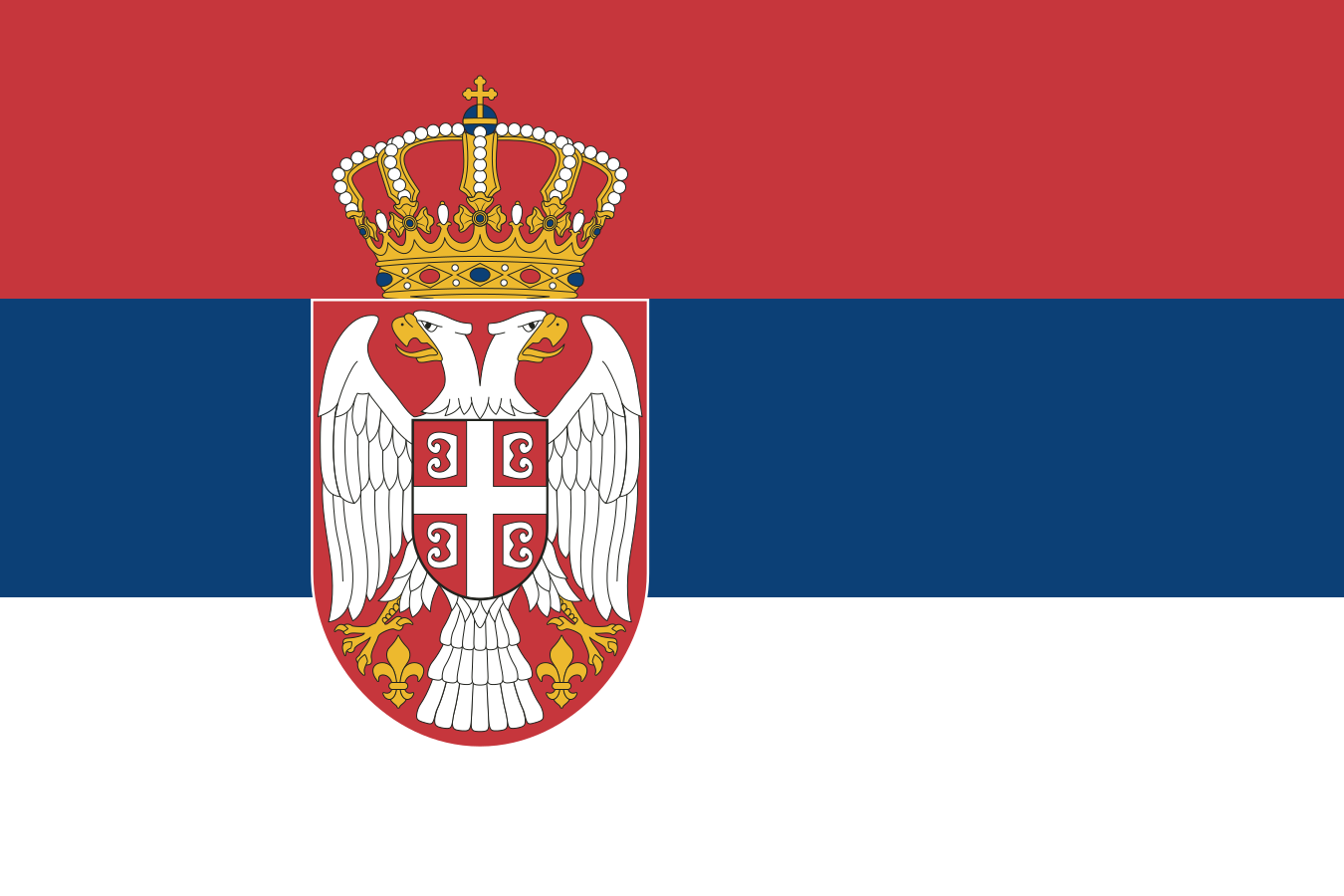
It is a pleasure to see the representative of friendly Azerbaijan in the chair of the President of the Security Council. At the outset, allow me to welcome Mr. Valentin Inzko, High Representative for Bosnia and Herzegovina, and to thank him for his report (see S/2012/307).
On this occasion too, I wish to point out the consistent respect of the Republic of Serbia for the Dayton Peace Agreement as the basis of stability in Bosnia and Herzegovina and the whole region of the Western Balkans. Serbia is committed to the territorial integrity and sovereignty of Bosnia and Herzegovina and to non-interference in its internal affairs. We shall support any agreement on the change of the internal system defined by the Dayton Agreement so long as it is reached by full consensus between the two entities and the three constitutive peoples.
We expect that the recently completed process of the establishment of all governmental bodies in Bosnia and Herzegovina will make an additional contribution to stabilization in Bosnia and Herzegovina and give impetus to its faster European integration.
Serbia welcomes the decisions adopted recently in Bosnia and Herzegovina and deems them important steps forward on that country’s road to the European Union. We believe that additional, concrete encouragement from the European Union is needed to further stabilize the situation in the country.
We appreciate and are very pleased by the fact that Belgrade was the destination that Bosnia and Herzegovina’s Foreign Minister Zlatko Lagumdžija visited on his first trip abroad. On that occasion, the two countries reiterated the importance they attach to bilateral relations and expressed their desire to promote further comprehensive advancement of their relations and cooperation. We are ready to continue to promote cooperation with Bosnia and Herzegovina in the exchange of experiences and in rendering reciprocal support with respect to European integration in order to
achieve our common goal of joining the European family of nations.
In our opinion, sustainable solutions can be achieved only through dialogue and compromise between the two entities and the three constitutive peoples. We believe that the international community should treat relations between the three constitutive peoples of Bosnia and Herzegovina with great care and respect for their interests. Serbia encourages all sides in Bosnia and Herzegovina to invest additional efforts in reaching sustainable solutions on all outstanding issues.
We consider it counterproductive to criticize one of the entities and to label it as anti-Dayton when the representatives of the people of that entity are sometimes vocal in their reactions to situations that they consider detrimental to the rights of their people. Further detailed analyses are needed in such situations in order to find proper solutions. The unilateral use of such situations in an attempt to effect potentially punitive measures will certainly not help to build confidence or to improve the functioning of institutions in Bosnia and Herzegovina.
Serbia has demonstrated its full readiness to confront the past and to contribute to the better future and well-being of the region. It has done everything necessary in that respect. In our view, all war crimes committed in the territory of the former Yugoslavia must be prosecuted in order to establish lasting stability and reconciliation in the region.
We believe that steps should be taken towards closing the Office of the High Representative and terminating the so-called Bonn powers, because the legitimately elected representatives of all peoples and entities have the ability and capacity to take over the responsibility for independently managing the affairs of the State.
Serbia is developing its relations with the Republika Srpska on the basis of the Agreement on Special Parallel Relations, but we are concentrating at the same time on strengthening relations with the Federation of Bosnia and Herzegovina. By actively participating in and chairing numerous regional initiatives, the Republic of Serbia has confirmed its commitment to regional cooperation. Successful cooperation with Bosnia and Herzegovina within, among others, the South-East European Cooperation Process, the Central European Initiative, the Regional
Cooperation Council and the Adriatic-Ionian Initiative contributes to further strengthening good-neighbourly relations and to the common European future.
Serbia is fully committed to the achievement of a just, comprehensive and sustainable solution to the problem of refugees. We commend the excellent organization of the International Donors Conference on Durable Solutions for Refugees and Internally Displaced Persons, organized in Sarajevo on 24 April. The Conference fulfilled the expectations of all participants and is a good example of the successful cooperation of the four countries of the region — Bosnia and Herzegovina, Croatia, Montenegro and Serbia — in achieving lasting housing solutions for the most vulnerable refugees, with the assistance of international organizations and the donor community. This will no doubt contribute to the promotion of good- neighbourly relations and the achievement of lasting stability and reconciliation in the region.
I give the floor to the representative of Croatia.


Let me extend our welcome to Mr. Valentin Inzko, High Representative for Bosnia and Herzegovina, and thank him for his briefing and his report (see S/2012/307). Croatia aligns itself with the statement of the European Union (EU), but I would like to deliver a statement in my national capacity as well.
Reflecting on the past six months since the last report of the High Representative (see S/2011/682), our general conclusion is that while there are still reasons for concern with the pace of progress of important political and economic processes in Bosnia and Herzegovina, there have also been important and encouraging developments.
The meeting of six political parties in Banja Luka on 9 March yielded tangible political results regarding the distribution of defence and State property. Croatia reads the successful agreement on the principles to be used in resolving the property distribution issue as a demonstration of political will and commitment to the processes of Euro-Atlantic integration. We welcome this breakthrough as an encouraging message to the North-Atlantic Alliance in view of the forthcoming Chicago summit. Croatia is convinced that a clear perspective on NATO membership is of the highest importance to the further strengthening of Bosnia and Herzegovina. At the same time, the positive or negative
impact of Bosnia and Herzegovina’s stability on the region of South-East Europe and beyond should not be underestimated.
The six parties of the State-level governing coalition also discussed on 9 March the constitutional changes that need to be undertaken for compliance with the verdict of the European Court of Human Rights in the Sejdic-Finci case. Despite the current absence of concrete results, we can acknowledge that the leaders recognized the importance of that issue and that they succeeded in agreeing on the basic principles that would have to be respected. We are hoping for concrete results at tomorrow’s meeting in Mostar. An agreement on constitutional changes that would substantially address the identified weaknesses of the election system would make a major contribution to the political stability of Bosnia and Herzegovina.
The progress of 9 March, however limited, creates momentum, and the international community should strongly encourage Bosnia and Herzegovina to maintain its level of demonstrated effort and commitment. It is our strong belief that this encouragement should take the form of constant attention and support, especially in the Euro-Atlantic integration process, as that path provides the best framework for strengthening institutions, the rule of law and democratic life itself. The integration process should take into account all the specificities of Bosnia and Herzegovina and respect the basic principle of the country’s political existence, namely, the equality of the three constitutive peoples and all its citizens. Politicians in Bosnia and Herzegovina, as well as representatives of the international community, have acknowledged that Croats, as one of the three constitutive peoples of Bosnia and Herzegovina, do not enjoy the same level of institutional rights as the other two, and have expressed their willingness to work towards solutions that would remedy that situation.
We strongly support all developments that would ensure that every citizen of Bosnia and Herzegovina feels equally protected and respected throughout the country’s territory. We particularly encourage further energizing the process of the return of refugees to their pre-war homes. Unfortunately, there is still ground for concern when it comes to the atmosphere and language in the public space, especially calls for separatism or any kind of extremism. Such language should not be tolerated, and the international community should send that message very clearly.
We are also concerned by the lack of full functionality of institutions and of coordination between the two entities, which are prerequisites for the advancement of the European Union (EU) integration process. Croatia strongly supports a more robust presence of the European Union mission in Bosnia and Herzegovina, as well as all efforts that contribute to the further harmonization of laws and practices within Bosnia and Herzegovina and with the European Union.
Croatia and Bosnia and Herzegovina are two neighbouring and friendly countries with significant trade relations and a long common border that will soon become the longest external border of the European Union. In recent months, we have witnessed increased dynamics in political contacts, ranging from meetings by Croatian President Ivo Josipović with his counterparts to the first official visit to Bosnia and Herzegovina by the new Croatian Prime Minister Zoran Milanović in February, which was followed by direct working meetings at the line ministry level. In all bilateral exchanges, Croatian officials encouraged greater coordination and support of EU efforts to assist Bosnia and Herzegovina in reaching European standards and, in a constructive spirit of cooperation, in finding ways of mitigating any possible negative consequences of Croatia’s future membership in the EU on Bosnia and Herzegovina’s economy and society.
Our own experience tells us that the process of European integration goes hand in hand with the process of institution-building, and we are confident that it will enhance Bosnia and Herzegovina’s stability and cohesion. Croatia has already started to share its unique know-how with the leadership, State administration and citizens of Bosnia and Herzegovina. For that reason, we proposed to Bosnia and Herzegovina a treaty on Euro-Atlantic partnership, covering many areas of cooperation. For many of the activities involved, Croatia and Bosnia and Herzegovina will seek wider support and collaboration.
Let me conclude by stressing that Bosnia and Herzegovina is a country with a burdened history and a complex political system. Admittedly, it requires the ongoing attention and support of the international community. However, Croatia intends not to assume a mentoring role, but rather to encourage the democratic process to develop from within, as that is the only way to reach long-lasting stability and prosperity for Bosnia
and Herzegovina and for the region of South-Eastern Europe as well.
There are no further names inscribed on my list of speakers. The Security Council
has thus concluded the present stage of its consideration of the item on its agenda.
The meeting rose at 4:55 p.m.