S/PV.2185 Security Council
▶ This meeting at a glance
20
Speeches
11
Countries
0
Resolutions
Topics
General statements and positions
Global economic relations
War and military aggression
Arab political groupings
Security Council deliberations
Humanitarian aid in Afghanistan


Mr. President, indeed 1 want to speak on the question of the adoption of the agenda. But first of all, I should like to welcome you, an eminent diplomat of France, and to wish you success in the exercise of your responsible functions as President of the Security Council. I should like to express the hope that your outstanding diplomatic talents and experience will be displayed to the utmost in the course of the consideration of those extremely complicated questions which will of course be facing the Council during its work under you1 presidency in January.
7. It is a particular pleasure for me to welcome the new members of the Security Council, especially the representative of the fraternal German Democratic Republic, a new non-permanent member of the Council. The German Democratic Republic is successfully building a society of developed socialism in close and mutual co-operation with other socialist States.
8. I should also like to welcome most cordially the representatives of the Niger, Tunisia and the Philippines and to wish them success in the implementation of the responsible tasks to be performed by the Security Council.
9. At the same time, we cannot fail to express our concern at the fact that as a result of the behindthe-scenes manauvrings of the United States, which is not concealing its wish to hinder the election of Cuba to the Security Council, this United Nations body, which bears the primary responsibility for the maintenance of peace, still does not have its full complement of 15 members.
10. On behalf of the delegation of the Soviet Union, I should also like to express my sincere gratitude .to the representatives of the outgoing non-permanent members of the Security Council-the Czechoslovak Socialist Republic, Bolivia, Gabon, Kuwait and Nigeria-for their valuable contributions to the work of the Council.
11. The ,delegation.-of the Soviet Union most vigorously objects to the consideration in the Security Council of the so-called question of the situation in Afghanistan, as is proposed in the letter dated 3 January of this year from the representatives of the United States, the United Kingdom, China and the countries supporting them. The proposal to involve the Council in the consideration of the events occurring in Afghanistan is entirely unfounded and inadmissible, inasmuch as it would be tantamount to intervention on the part of the United Nations in questions relating exclusively to the domestic competence of the people and Government of that country. The events in Afghanistan are the internal affair of Afghanistan and relations between Afghanistan and the Soviet Union are based on the relevant mutual treaty obligations.
12. As is pointed out in the telegram from the Foreign Minister of Afghanistan, Mr. Shah Mohammad Dost, dated 3 January 1980, addressed to the President of the Security Council [S/13725], the Government of Afghanistan most vigorously protests against the proposal for the consideration in the Council of the question of the situation in Afghanistan, describing such consideration as “direct and clear interference in its internal affairs”.
13. We should also like to draw the attention of members of the Security Council to the statement of the Government of the Democratic Republic of Afghanistan dated 31 December 1979, which vigorously
“The Government of the. Democratic Republic of Afghanistan will not permit anyone to encroach upon the inalienable right of the Afghan people to do everything possible to protect the achievements of the April revolution, the territorial integrity and the national independence ‘of,the country. No one can deprive a sovereign State the right to selfdefence, enshrined in Article 51 of the Charter of the United Nations, nor prevent it from turning for necessary assistance to those’ dountries with which it has appropriate international, treaties. The Government and people of AfghaniStan view the campaign being waged against them as interference in their internal affairs and as an attempt to prevent them from taking the course indicated by the April revolution.”
14. As the members of the Council are well aware, from the first day of the victory of the April 1978 revolution, Afghanistan became the target of various acts of provocation and designs by imperialist and reactionary forces. Throughout a lengthy period of time, those forces carried out flagrant acts of intervention in Afghanistan’s internal affairs, including the use of armed force. The purpose of that intervention was to overthrow the popular democratic regime in Afghanistan and restore the old rkgime in that country and transform it into a weapon of their own aggressive policy.
15. The Afghan people and its armed forces rebuffed all those acts of aggression and actively defended the sovereignty, independence and national dignity of Afghanistan. However, acts of aggression and of military provocation and subversive activity by external forces against Afghanistan continued on an ever larger scale. Armed formations and weapons continued to be infiltrated into the territory of Afghanistan, and imperialist and reactionary forces did everything possible to prevent the building of a new life in that country.
16. Over the last two years, the Government of Afghanistan repeatedly appealed to the Soviet Union for support, including the affording of military assistance, in order to repel armed intervention from outside. The decision of the Soviet Union to send a limited military contingent to Afghanistan-exclusively for those purposes-was taken in response to those repeated requests by the Government of Afghanistan and based on the appropriate provisions of the Treaty of Friendship, Good Neighbourliness and COoperation between the Union of Soviet Socialist Republics and the Democratic Republic of Afghanistan of 1978.’
18. Attempts to wage a campaign of slander around the question of the grantmg. by the Soviet Union of assistance to Afghanistan,. can be viewed only as attempts to prevent the people of Afghanistan from taking the course that was. opened up for it by the April 1978 revolution.
19. As regards the proposal that the Security Council consider the situation in Afghanistan, it is in keeping only with the interests of those imperialist and hegemonistic circles which are carrying out armed intervention in Afghanistan’s internal affairs. Obviously, in putting forward this question, those circles are attempting to divert attention from their attempts to change by force the democratic regime established in Afghanistan and to deprive .the people of Afghanistan of the achievements they have won as a result of the April revolution. The present attempt to involve the Security Council in a discussion of the question of the situation in Afghanistan demonstrates that some people still cherish the hope of re-establishing in the world the cold-war atmosphere, which, as they see it and according to their calculations, will make it easier for them to achieve their imperialist and hegemonistic designs.
20. In the light of those circumstances, the Soviet delegation calls upon the members of the Security Council to display good sense and circumspection. and to prevent the use of the Security Council for unsavoury purposes which have nothing whatsoever in common with the tasks of maintaining international peace and security.

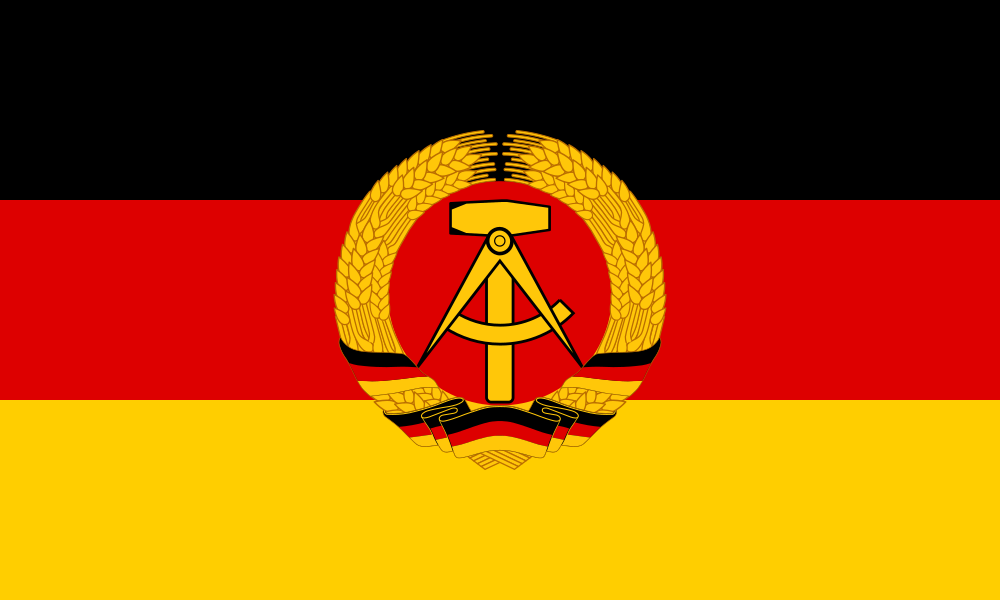
Mr. President, on behalf of the delegation of the German Democratic Republic, I should like to congratulate you on your assumption of the presidency of the Security Council for the month of January, In you the Council has a President whose diplomatic skills are very well known. I am very happy to point out that there exists a very good and promising relationship between the German Democratic Republic and France.
22. I should like to thank all those who have congratulated my delegation, which is taking part for the first time in a meeting of this important body as the representative of a non-permanent member of the Security Council. For its part, the delegation of the German Democratic Republic would like to congratulate the delegations of the Philippines, Tunisia and the Niger on their election as non-permanent members of the Security Council.
24. The fact that one seat of the group of Latin American States-or in this particular case, it would be more correct to say one seat belonging to the nonaligned States in the Council-remains, if only temporarily, unoccupied does not help to enhance the effectiveness of the United Nations. We call upon all who cherish the noble ideals of the United Nations to do everything possible to see to it that the General Assembly, at its thirty-fourth session, is able to conclude successfully the election of the fifteenth member of the Security Council, in accordance with the Charter and the well-tried practice which has proved itself since the adoption on 17 December 1963 of Assembly resolution 1991 A (XVIII).
25. Since this is the first time I have spoken in the Council, I should like to thank the many.,Members of the United Nations that voted in favour of my country’s membership in the Security Council. We regard that convincing vote of confidence as an expression of faith in the peaceful foreign policy of our socialist State.
26. I should like to assure you, Mr. President, that the German Democratic Republic will consistently be guided-and this apphes of course to its capacity as a member of the Security Council-by its policy-a policy of principle-of peace, disarmament, the deepening and expanding of the process of detente, the elimination of all forms of colonialism, racism and opcwtheid, and the peaceful coexistence of States with different social systems. The purposes and principles of the Charter have been and remain the foundation of our actions. Indeed, as the General Secretary of the Central Committee of the Socialist Unity Party of Germany and President of the Council of State of the German Democratic Republic, Mr. Erich Honecker, stated in a New Year’s message: “For the happiness of peoples what we need above all is peace; peace is the most valuable thing of all”.
27. On the basis of the fact that the Security Council, within the United Nations system, bears particular responsibility for the maintenance of peace, the delegation of the German Democratic Republic will participate in the common search for political solutions to international conflicts and disputes, and also in the search for measures to strengthen international
28. Convinced that the Security Council can and must take effective decisions to ensure peace throughout the world, we wish to express our desire constructively to co-operate with all delegations on the Council in the performance of the tasks enjoined upon us by the Charter.
29. So far as the questions raised in document S/13724 are concerned, the request for an urgent meeting of the Security Council is in our view totally unfounded. The Democratic Republic of Afghanistan poses no danger whatsoever either to international peace and security or to neighbouring States-still less to those which are situated thousands of kilometres away from that country and yet have signed this letter. The request for a discussion of the situation in Afghanistan is direct interference in the internal affairs of that country and is in contradiction with the Charter.
30. In a telegram from the Foreign Minister of the Democratic Republic of Afghanistan [ibid.], transmitted to members of the Council, the Government of that country categorically protests the discussion in the Council of the situation in Afghanistan. The delegation of the German Democratic Republic supports that protest and cannot agree to the Security Council’s being used for interference in the internal affairs of a Member of the United Nations.
31. In order to justify the requests contained in document S/13724, certain assertions have, as we know, been made. In this regard, the delegation of the German Democratic Republic would like to highlight certain facts.
32. Immediately after the April 1978 revolution in Afghanistan, imperialist agents and other reactionary forces of all sorts attempted from outside, by means of armed force, to block the route to progress for the Afghan people, to prevent the implementation and exercise of their right to self-determination and to create in Afghanistan a rkgime which would be obedient to imperialistic circles. This, of course, was resisted by the patriots of Afghanistan, who were eager to create a new life in an independent, progressive Afghanistan State. Since foreign attempts at intervention were being intensified, the Government of the Democratic Republic of Afghanistan repeatedly appealed to the Government of the Soviet Union for military assistance. Now the Government of the Soviet Union, in response to those requests, has sent to Afghanistan a limited military contingent the sole task of which is to assist the people of Afghanistan in
“The High Contracting Parties, acting in a spirit of the traditions of friendship and good-neighbourliness and in the spirit of the Charter of the United Nations, shall consult with each other and shall, by agreement, take the necessary steps to safeguard the security, independence and territorial integrity of the two countries. In the interest of strengthening their defensive capacity, the High Contracting Parties shall continue to develop their co-operation in the military field.”
That Treaty and the limited military assistance granted by the Soviet Union on the basis of it are both in keeping with the Charter of the United Nations, which confirms the inalienable right of States to individual or collective self-defence.
33. The developqents in Afghanistan and the relations between Afghanistan and the Soviet Union are exclusively the business of the Governments concerned. There is no juridical basis whatsoever for the request made in document S/13724 to convene a meeting of the Security Council. Furthermore that request is itself tantamount to interference in the internal affairs of States Members of the United Nations, something which the German Democratic Republic most vigorously repudiates.


Mr. President, in view of the constraints of time, my delegation reserves the privilege of extending our felicitations to so distinguished a President as you and to the new members, and also of paying a tribute to the retiring members, at a later stage when I take part in the proceedings.
35. Bangladesh is a signatory to the letter submitted by 50 Members States requesting an urgent meeting of the Council. The Government of Bangladesh has in a statement declared that it viewed recent developments in Afghanistan with deepest concern and considered the situation to pose a serious threat to international peace and security. I myself had occasion to repeat that view in the Council itself on 31 December 1979 [218&h n~cting]. In the circumstances, my delegation believes that the discussion of. this agenda item is both urgent and necessary.


I have asked to speak merely to support the point of view just expressed by my colleague from Bangladesh. We are meeting here today on the basis of a letter to the President of the Security Council signed by one third of the membership of the Organization, and, in my opinion, it is the duty of this organ to debate the question before us,


The recent massive invasion of Afghanistan

In the light of the consultations which members of the Council have held on this matter and the views which have been expressed here and which will be contained in the records, may I take it that the agenda is adopted?
The rrgeruln WI/S rrclopted.
Letter dated 3 January 1980 addressed to the President of the Security Comicil by the representatives of Australia, the Bahamas, Bahrain, Bangladesh, Belgium, Canada, Chile, China, Colombia, Costa Rica, Denmark, the Dominican Republic, Ecuador, Egypt, El Salvador, Fiji, Germany, Federal Republic of, Greece, Haiti, Honduras, Iceland, Indonesia, Italy, Japan, Liberia, Luxembourg, Malaysia, the Netherlands, New Zealand, Norway, Oman, Pakistan, Panama, Papua New Guinea, the Philippines, Portugal, Saint Lucia, Saudi Arabia, Senegal, Singapore, Spain, Suriname, Sweden, Thailand, Turkey, Uganda, the United Kingdom of Great Britain and Northern Ireland, the United States of America, Uruguay and Venezuela (S/13724 and Add.1)
I should like to inform the members 6f the Council that I have received letters from the representatives of Afghanistan, Australia, Bulgaria, Canada, Colombia, Democratic Kampuchea, Egypt, Japan, Malaysia, New Zealand, Pakistan, Poland, Saudi Arabia and Singapore, in which they request to be invited to participate in the discussion of the item on the agenda. In accordance with the usual practice, I propose, with the consent of the Council, to invite those representatives to participate in the discussion, without the right to vote, in conformity with the relevant provisions of the Charter and rule 37 of the Council’s provisional rules of procedure.


The absence of objection by my delegation to the invitation


My delegation would like to stress that the decision we have just taken with regard to the presence,, here in our work of the representative of Afghanistani. can in no way be taken to mean any recognition on our part of the Government that has assumed power in Kabul in circumstances which underlie this very meeting of the Council.
0 $2. Mr. McHENRY (United States of America): I should like to say at this stage that the fact of our meeting today is a reflection of the concern of the international community over events in Afghanistan. We join others in recording the view that in not objecting to the request of Afghanistan to be heard, we are in no way according status to the rkgime that has been put in place there by foreign troops.
In the view of the Chinese delegation, the permission for the representative of Afghanistan to participate in and address today’s meeting can in no way be interpreted as acquiescence in the situation created by Soviet armed intervention in Afghanistan.
We have noted the comments of previous speakers. In fact, the question at issue is under consideration by my Government. But in view of the gravity of the situation, we should like the debate to proceed urgently and without hindrance-but without prejudice to the outcome of the deliberations on the question by my Government.

The decision we have just taken in no way prejudices my Government’s position with regard to the events in Afghanistan.
The Soviet delegation sees no basis right now for replying to the absurd statements which have been made with regard to the authority of the legitimate Government of Afghanistan. I should like merely to stress that the Soviet delegation considers that the Security Council has taken a correct decision in inviting the Minister for Foreign Affairs of Afghanistan to take part in our work.
.I 48. Members of the Council have before them also the text of a letter dated 31 December 1979 from the representative of China to the Secretary-General [,s/137/7], the text of a letter dated 4 January 1980 to the President of the Security Council from the representative of Afghanistan [S/13725] and the text of a letter dated 4 January 1980 from the representative of Democratic Kampuchea to the Secretary-General [S//3727].
49, Mr. YANG0 (Philippines): Mr. President, my delegation acknowledges with deep appreciation the warm words of welcome extended to my country, as an incoming member of the Security Council, by you and by the representatives of the Soviet Union, the German Democratic Republic and Bangladesh.
SO. As this is the first time we have taken our seat in this august body since the 196Os, I want to avail myself of this occasion to thank ail those who made it possible for my country to become a member again and to assure everyone that we consider membership in the Council to be an honour and privilege that carries with it a heavy responsibility to the world community. We are committed to discharge this responsibility under the Charter of the United Nations, and to extend our full co-operation to all the members of the Council. To this end I should like to begin by wishing everyone a happy New Year, with the fervent hope that the coming year will bring success to our endeavours,
51. To you, the representative of France, as you take your seat as the President of the Security Council for this month, I want to extend our felicitations and our best wishes for a successful tenure, and our assurances to you of our unstinted co-operation. We have every reason to believe that you. will need the fullest support and co-operation of everyone in the Council, for this is a time of world crisis when decisions of the Council will be a test of its relevance to the world community and of its ability to perform its role in the peaceful solution of problems involving international peace and security that may come before it. Fortunately, you bring to the presidency a wealth of knowledge and experience of the United Nations which, 1 am certain, will stand the Council in good stead.
52. 1 should like to take this opportunity also to express our admiration and our warm congratulations to Your predecessor, Mr. Chen Chu of the People’s RePublic of China, on the great skill with which he steered the Council through a most difficult period.
53. My country becomes ,a member of the Security Council at a time when issues of justice among nations and growing threats to the disadvantaged and lessdeveloped nations are shaking the foundations of the international order. My delegation, and the Government and the people we represent, are mindful of the special heavy responsibility we bear, along with the other non-permanent members, to protect the interests of the vast majority of the world’s peoples, whom we represent, for it is they who will suffer most should we fail to discharge our obligations during these times of crisis.
54. But at the same time, we are also aware that these issues are themselves a test of the effectiveness of the Council on questions concerning the maintenance of international peace and security. As the sole and final arbiter on these questions under the Charter, it is imperative that the Council demonstrate its competence to resolve these issues through peaceful means as provided under Chapter VI of the Charter. Hence, we consider it of the utmost importance that the Council perform its task with care and circumspection in every instance, so that when the time comes to take action it can do so with decisiveness and with authority.
55. We have before us a matter of great urgency, a matter which compels the Council to act wisely and decisively. My delegation welcomes this meeting of the Council to consider the situation in Afghanistan, because we believe that the Council is duty-bound to examine all situations and conditions that have an important and potentially injurious bearing on international peace and security. Coming as we do from a developing country, we are among those who have a high stake in the continuing effectiveness of the Council, whose judgements and decisions should, we believe, be beyond reproach, sacrosanct and respected by all.
56. International law-such as those precepts and principles and statutes embodied in the Charter and decisions of the United Nations-cannot be enforced except through voluntary acts of goodwill among nations and a sense of participation in a universal consensus. Such a consensus, and the moral suasion that it affords, can be possible only by the airing of issues and discussion that the various forums in the United Nations, principally the Security Council, afford everyone, strong and weak alike. To my mind, this is the first step in the resolution of any issue. The situation in Afghanistan is such a case.
64. I wish also to pay a tribute to the President of the Council for the month of D,ecember 1979, Mr. Chen Chu, who steered the proceedings of the Council with ability and wisdom. With our great neighbour, China, we have traditional ties of close friendship and CO- OPeration, and China has always extended to Pakistan resolute support in its just struggle to safeguard its national independence and State sovereignty.
65. Permit me also to congratulate the new member’s that have been elected to the Security Council-the German Democratic Republic, the Niger, the Philippines and Tunisia. We also express our deep app,recisrtion to the retiring members of the Council-Bolivist, Czechoslovakia, Gabon, Kuwait and Nigeria-for their valuable contributions to the work of the Council -
66. Pakistan joined the other Member States in requesting this meeting because the people arid Government of Pakistan feel deeply concerned over the grave situation in Afghanistan resulting from the armed intervention by outside forces in that country - The recent introduction into Afghanistan of foreign troops, numbering, according to the latest reports. nearly 50,000, constitutes a serious violation of the norms of peaceful coexistence and the sacrosanct principles of the sovereignty of States and noninterference in their internal affairs, enshrined in the Charter of the United Nations. This external military intervention in Afghanistan poses a serious threat to peace apd stability in our region and, indeed, the entire world.
58. It is our view that in disputes between States, especially between nuclear and non-nuclear States, the Security Council affords the best forum for the peaceful solution of issues. When there arises a situatio,n in which the peace, stability and security of any State is threatened, the Council can and should act in the best interests of all parties concerned, without overlooking the interests of the world community.
59. In the final analysis, it is our grave responsibility not to allow any dispute involving any State to escalate into a conflict that would bring the nuclear Powers into aggressive confrontation with one another, for the consequences would indeed be irreparable for us all.
67. The people and Government of Pakistan have profound sentiments of fraternity and brotherhood towards the people of Afghanistan. Since time immemorial the two peoples have together struggled in the cause of maintaining their freedom and indeperxdence. In this spirit, Pakistan has always extended its hand of friendship and co-operation to Afghanistan and has consistently followed a policy of developing: cordial relations with that country on the basis of OUIcommon heritage of faith and culture, our shared objectives and aspirations as developing non-aligned countries, and mutual adherence to the principles of peaceful coexistence.
60. I should like to reserve our right to speak again should the need arise.
The next speaker is the representative of Pakistan. I invite him to take a place at the Council table and to make his statement.


Mr. President, I am grateful to you and to the members of the Council for affording me this opportunity to express the views of my Government at this urgent meeting, which has been convened at the request of 51 States Members of the United Nations.
68. That policy remained unaltered following the change of Government in Kabul in April 1978 _ Pakistan was the first Islamic country to recognize the new rtgime headed by the late President Noor Mohammad Taraki. ThePresident ofpakistan, General Mohammad Zia-ul-Haq, was the first Head of State to visit Kabul on his own initiative to have exchanges with the new Afghan leaders. The President of
63. May I take this opportunity to express our deep gratification at seeing you Mr. President assume the
69. This policy of co-operation and friendship was reiterated more than once by the President and the Government of Pakistan in formal communications and contacts with the Afghan Government as well as in public statements. I shall now quote from President Zia-ul-Haq’s address delivered on 6 September 1979 at the Sixth Conference of Heads of State or Government of Non-Aligned Countries in Havana:
“With our neighbour Afghanistan, Pakistan has age-old ties ofhistory, culture and faith. The Government of Pakistan has consistently sought the establishment ofgood-neighbourly relations with Afghanistan on the basis of the principles of peaceful coexistence-namely, respect for each other’s sovereignty and territorial integrity, non-aggression, equality and mutual benefit and non-interference in each other’s internal affairs.”
70. Unfortunately, however, the development of mutual trust such as we had desired was inhibited by a large influx into Pakistan of Afghan refugees seeking shelter in our territory following the violent changes and the instability in their homeland. Since April 1978, there has been an increasing flow of Afghan refugees into our country. According to the latest figures indicated by United Nations sources, by 1 January 1980, the number had reached 387,575.
71. This influx of refugees has directly affected Pakistan and imposed a considerable burden on our already strained and scarce resources, But we have not shirked and we cannot shirk providing them with asylum and the basic necessities of life, which we regard as our humanitarian, Islamic and internationalist responsibility. Our humanitarian concern for the Afghan refugees is fully in keeping with universally accepted values and principles.
72. Certain quarters have been making baseless allegations against my country, to the effect that it has been providing arms and training to those refugees to instigate and promote insurgency against the Government of Afghanistan. It is a matter of deep regret that our humanitarian concern for the afflicted Afghan People uprooted from their homeland should have been misconstrued as alleged interference by Pakistan in the internal affairs of Afghanistan. The Government of’ Pakistan has repeatedly and categorically refuted
,73, Our scrupulously rnainta$ed policy of noninterference and neutrality towards Afghanistan is also consistent with Pakistan’s record of defending the universally recognized rights of the people of every country, big or small, to determine their internal affairs in accordance with their own free will and without interference or dictation by any external Power. It is our profound conviction that disregard for’this basic principle of international relations would undermine the aspirations of the international community to create and maintain q civilized world order.
74. Since the last week of Dk.&mber 1979, Afghanistan has been subjected to an’ ,&xternal military intervention of the gravest proportions. This massive military intervention has been justified on the pretext of protecting Afghanistan from a hypothetical outside interference. This is a gross misrepresentation of actual events. The latest developments in Afghanistan are well known. They are as follows.
75. First, as widely confirmed by reports in the international press for more than a year, the uprising by the people of Afghanistan is spontaneous and is spread throughout the length and breadth of the country. It is an entirely internal phenomenon of Afghanistan’s current political crisis, and it is inconceivable that it could have been prompted or sustained by any outside Power, especially Pakistan. The problem of Afghan refugees is also not of Pakistan’s making. As the President of Pakistan made clear in his statement on 30 August 1978, what the Government of Afghanistan was required to do was to create such conditions in its country as could enable the Afghan refugees to return to their homes with honour and with a sense of security.
76. Secondly, the international press first reported the movement of Soviet troops to the Afghan border on 21 December 1979. On 26 December, there were reports that a rapid and large-scale influx of Soviet troops into Afghanistan had taken place on the preceding day, that is, on Christmas. On 27 December, President Hafizullah Amin was dislodged and executed along with members of his family. It was not until 28 December that a statement, attributed to the new Afghan rkgime and quoted by the Soviet news agency TASS mentioned for the first time that the Afghan Government had invoked the Treaty of Friendship, Good Neighbourliness and Co-operation of December 1978,’ and that it had approached the Soviet Union to request military aid to counter the alleged interference and provocations of external enemies of Afghanistan. Obviously, such a request should have emanated from the Government of Hafizullah Amin, who headed the Afghan Government until the arrival of the Soviet troops in Kabul,
77. Pakistan hasbeen’ watching with concern the continued instability over the past two years in our neighbouring country of Afghanistan. During that period, there were thret changes of rkgime in that country. Each change led to increased instability and greater bloodshed. The last change, brought about by a massive introduction of foreign troops into Afghanistan, presents a qualitatively different situation. It has added a new international dimension to the crisis in Afghanistan.
82. The Security Council, which has the primary responsibility for maintaining international peace and security, must respond to this grave situation and must call for the immediate and unconditional withdrawal of all foreign troops from Afghanistan. It must call for the creation of conditions which could enable the people of Afghanistan to decide democratically their internal affairs without foreign interference or domination. It must call for respect for the sovereignty, territorial integrity and independence of Afghanistan and for strict non-interference in the internal affairs of that country. It must also call for the creation of stable and tranquil conditions which can enable the Afghan refugees to return voluntarily to theil homeland with a sense of security.
78. We have always firmly opposed external military intervention, which, in our view, cannot be justified on any pretext and under any circumstances. Our concern is now all the more profound since the country which has been subjected to military intervention this time is an Islamic country which is our immediate neighbour, a member of the Organization of the Islamic Conference and one of the founding members of the non-aligned movement. In an official statement issued on 29 December 1979, the Government of Pakistan therefore expressed the hope “that the far-reaching negative consequences of such foreign intervention would be clearly realized and that the foreign troops would be removed from Afghan soil forthwith”.
83. It is Pakistan’s earnest hope that the people of Afghanistan, who have a glorious tradition of freedom and independence and who are passing through a tragic period of their history, will be able to achieve internal peace and stability without external interference or domination.
79. Pakistan is not alone in expressing its concern over the external military intervention in Afghanistan. This outrageous action against a sovereign, independent State has aroused the indignation of people who love freedom throughout the world. A great majority of nations, including many countries of the Islamic world and of the non-aligned movement, shareour concerns and sentiments. They, have issued statements expressing their opposition to the external military intervention in Afghanistan. The strong feelings of the international community in that regard are indicated by the number of countries which have joined in the request for the convening of this urgent meeting of the Security Council.
-‘841’- The PRESIDENT (i,lterprettrtim jim~ French): The next speak&r is Mr.,..Shah Mohammad Dost, the Minister for Foreign Affairs df flie Democratic Republic of Afghanistan. I invite him to take a place at the Council t&le and to make.his statement.


Mr, President, despite the strong objection of my delegation to the convening of the Security Council, I should like to congratulate you on your assumption of the presiclency of the Council for the month of January.
80. Any attempt to impose a solution of the internal political crisis in Afghanistan by the use of force and the despatch of foreign troops is bound to be counterproductive and will have negative consequences. It will aggravate the situation and prolong the agony of the Afghan people. Only yesterday, in the corridors of the United Nations, we heard an echo of the pain and anguish through which the people of Afghanistan are passing at this ti’me. A renowned Afghan personality, Mr. Tabibi, who is a member of the International Law Commission and who has been a cabinet minister of the Afghan Government, resigned from his post in protest against the violation of the sovereignty and independence of his country.
86. We are here to record our protest and disquiet at the convening of the Security Council as a result of a wide-ranging, pressure-filled campaign and approaches by world imperialism and international reaction, which seem to have been able to rally a number of authors for this unwarranted undertaking. No matter how many votes the authors of this unjustified initiative scraped up for the contrived appeal on this score, such an action still remains objectionable. Bringing such issues to this forum constitutes a clear departure from the established practice of the Council and a disturbing example of misinterpreting the relevant provisions of the Charter and other rules of international law.
81. Mr. Tabibi made an impassioned appeal to the world community to raise its voice in the defence of his country, since on such international support
88. The convening of this meeting of the Council therefore in our view constitutes open interference in the internal affairs of Afghanistan, contrary to the provisions of Article 2, paragraph 7, of the Charter.
89, Following the victory of the great revolution of the people of Afghanistan on 27 April 1978, which liberated the Afghan people from the tyranny of a medieval type of rkgime connected with imperialism and international reaction and which transferred political power from the exploiting classes to the exploited in the country, drastic revolutionary measures were taken in the interest of the working people of the country and aimed at totally eliminating the vestiges of economic and social backwardness and feudalistic relationships from the socio-economic structure of the country. Unfortunately, but understandably, imperialism and the war monger circles related to it, as part of their large anti-peace and antipeoples designs and conspiracies, increased their armed attacks and infiltrations into Afghan territory, causing the loss of the lives of thousands of innocent women, children and old people. This situation continued until 27 December 1979. To supplement this carefully planned conspiracy and these plots against our people and revolution, on 16 September 1979, Hafizullah Amin, playing into the hands of American imperialism, cowardly engineered a plot, with the helping hand of anti-revolution and anti-people reactionary elements, which resulted in the assassination of the late Noor Mohammad Taraki, the founder of the People’s Democratic Party of Afghanistan and President of the Revolutionary Council, by Amin and his terrorist band.
90. In the wake of increasing foreign interference in the internal affairs of Afghanistan and armed attacks on Afghan territory, the conspiratorial coming to power of Hafizullah Amin opened a new dark era of fascist oppression in Afghanistan, which brought infinite suffering and bloodshed to the Afghan people.
91. During Amin’s fascist rkgime, arbitary arrests and imprisonments, torture, inhuman and degrading treatment of political prisoners under various pretexts and in various forms had become daily practice, a fact which has been reported and confirmed by several international organizations, among them Amnesty international a
92. At this juncture, I should like to invite such international organizations as Amnesty International and the International Red Cross to come to Afghani-
93. Amin and his clique ‘did not care at all for the established standards of human conduct or human rights. He let loose a reiin of terror and bloodshed in the country similar to ‘rlie atrocities committed by Pol Pot and his fallen clique. In such circumstances and before such miscondtibt, the gains of the April revolution were being seriously threatened and the principles of our revolution, were distorted for Amin’s fascist personal ambitions’ in the interest of imperialism. I 1 ,’ 94. As the oppression. of the Amin rhgime reached its inhuman height inside the country, foreign aggression, armed attacks by groups from abroad and interference in the internal -affairs of the Democratic Republic of Afghanistan continued and considerably intensified against our sacred soil and the April revolution, the Afghan National Liberation Army rose, as I have said, on 27 December 1979, against Amin’s tyranny and overthrew his fascist rCgime.
95. Having toppled the despotic rbgime of Amin, his accomplices and their reign of terror, the great national democratic Saur revolution entered a new phase geared towards safeguarding the gains of the Saur revolution and reflecting the aspirations of the majority of the Afghan people, thus putting the Saur revolution in the right direction. The new Government is putting an end to mass repression and persecution in the country and is vigorously restoring democratic institutions.
96. Inspired by the values of this new gain of the great Saur revolution, the new’ Government of the Democratic Republic of Afghanistan considers it its historical national duty to,expand and consolidate the progressive social and political pillars of the Democratic Republic of Afghanistan.
97. It is neither my intention nor desire to record rhetoric or exaggerations in the proceedings of the Council about what the new Government has done since it came to power on 27 December 1979, or what it intends to do in the future for the well-being of the Afghan people. However, I consider it miy duty to state the following.
98. Immediately after the victory of the second phase of the great Saur revolution, Babrak Karmal, General Secretary of the Central Committee of the People’s Democratic Party of Afghanistan, President of the Revolutionary Council and Prime Minister of the Democratic Republic of Afghanistan, declared general amnesty, on behalf of the Central Committee of the Party and the Revolutionary Council, for all political prisoners, irrespective of any consideration
99. At present an atmosphere of confidence, security and faith has returned. to the country. Other measures of the new Government include the following: abolition of all anti-democratic and inhuman laws, arbitrary arrests, persecutions $and searches; respect for the principles of Islam, freedom of conscience, religious belief and performance of religious rites, protection of the family, observance of the principle of lawful possession of property, lincluding private property; restoration of individual rights and security for all and peace and revolutionary, order in the country; creation of favourable conditions for the implementation of democratic rights and freedoms, including freedom of the press and of assembly and the right to form progressive patriotic parties, mass organizations and public demonstrations; the right to work and education; freedom and privacy of correspondents; freedom of travel inside the country, and the right to legal protection of the home,
100. With reference to the presence in Afghanistan of limited contingents of armed forces of the Soviet Union, I should like to emphasize that those contingents have been sent to Afghanistan in response to a request by the Afghan side, initially made during the official visit of the late Noor Mohammad Taraki to Moscow in December 1978, when Amin was also present, and in conformity with the provisions of the Treaty of Friendship, Good Neighbourliness and Cooperation, signed in Moscow between the leaders of the two countries on 5 December 1978.’ That request for military assistance was repeated by the Government of the Democratic Republic of Afghanistan during Amin’s rule. A request for Soviet assistance, including military aid, was also made by the new Government, and we are grateful to the Soviet Union for its positive response.
101. The main purpose of this limited military assistance is to remove the threats posed from abroad to the independence, sovereignty and territorial integrity of Afghanistan and to repel foreign armed attacks and acts of aggression against our country. The dispatch of limited contingents of armed forces of the Soviet Union had nothing to do with the developments of 27 December 1979, including the change of Government and its leaders, which are entirely an internal matter of Afghanistan.
103. The Government of the Democratic Republic of Afghanistan, like that of any other country in the world, has the inherent right of individual or collective self-defence and to request aid from a friendly country, in accordance with the provisions of Article 51 of the Charter of the United Nations, in the wake of continued armed attacks and interventions from abroad.
104. As a matter of fact, these acts of armed attacks and interference in the internal.affairs of my country from abroad compelled the Government of the Democratic Republic of Afghanistan to apply Article 51 of the Charter in self-defence.
105. I should like to emphasize that when foreign interference and armed attacks against Afghanistan from abroad cease, there will be no need for limited contingents of Soviet armed forces on Afghan soil and they will immediately withdraw from Afghanistan.
106. The history of Afghanistan is a good witness to the courageous struggle of the Afghan people for freedom and independence. They will never compromise on their national independence and sovereignty.
107. The 62 years of traditional and sincere friendship, good-neighbourliness and mutually beneficial co-operation between Afghanistan and the Soviet Union have constituted an excellent example of friendship and co-operation among States in the world, based on the principles of mutual respect for one another’s independence, national sovereignty and territorial integrity. These relations of sincere friendship have contributed positively to peace in the region and in the world. The long and brilliant record of exemplary friendship between Afghanistan and the Soviet Union leaves no room for doubt or concern by the people of Afghanistan about the friendly and peaceful attitude of the Soviet Union towards the Afghan people and their country.
108. The new Government has officially reaffirmed its strict adherence to the principles of the Charter of the United Nations and to the policy of active and positive non-alignment. The Government of the Democratic Republic of Afghanistan is desirous of
110. The new Government of Afghanistan will continue firmly to support the liberation struggle of peoples and their national liberation movements.
111. The new Government of Afghanistan has firmly set the lofty goals for the Saur revolution aimed at building a prosperous society in the country with the unreserved support and staunch determination of the Afghan people. No power can divert us from the right course the Afghan people has chosen for itself.
112. We understand that some Western countries and other reactionary circles are trying to create a wedge between the Democratic Republic of Afghanistan and the Islamic countries. Their attempts will certainly fail. The fraternal Islamic countries know that it was during the oppressive Amin’s rule that most of our patriotic religious,leaders and compatriots were eliminated. It was he and his followers who firmly stood against Islam and the lofty tenets of Islam. The new Government has full respect for Islam and the freedom of Islamic rites in the country.
113. During Amin’s rule some Western countries expressed concern about the killing and mass murder of innocent Afghan people. Today, when that dictator has met his fate, they cry for him, This is clearly a doubled-faced attitude.
114. The presence of limited contingents of the armed forces of the Soviet Union shall not be used by the United States and other circles for seeking to preserve and expand the world military system of imperialism nor as a pretext for strengthening its military presence in various parts of the world, particularly in the Indian Ocean, as well as for expediting the provision of military equipment to Pakistan, thus creating a situation of crisis, without any consideration for its implications for peace in the region and in the world.
11.5. The reason imperialist countries and reactionary circles are misinterpreting the purpose of the presence of the limited contingents of the armed forces of the Soviet Union is that their conspiracies against the people of Afghanistan have been exposed and foiled.
I thank the Minister for Foreign Affairs of Afghanistan for the kind words he has addressed to me. The next speaker is the representative of Japan, whom I invite to take a place at the Couficil table and to make his statement.


Mr. President, I should like, first of all, to congratulate you on your assumption of the presidency of the Security Council for the month of January. It is indeed fortunate that, particularly at this crucial time,“g man with your experience and abilities will be gtiiding the work of the Council. On this occasion I &&Id also like to express my gratitude to the outgoing President, Mr. Chen Chu, who so skilfully presided over the Council in December. During the course of that month, my delegation was twice afforded the opportunity to present its views on another serious issue. Now, once again, my delegation is grateful for being permitted to speak on the vital issue which is at present under deliberation.
119. Recognizing that the present situation in Afghanistan poses a threat to international peace and security, Japan joined other countries in urging that the matter be brought before the Security Council as soon as possible. The fact that 51 countries signed the letter requesting this meeting demonstrates the seriousness with which the problem is regarded by the international community.
120. My Government’s views on the Afghanistan situation were clearly outlined in a statement made by the Minister for Foreign Affairs, Mr. Saburo Okita, on 29 December 1979, which is summarized as follows:
“The deployment by the Soviet Union of its military troops in Afghanistan is not only inconsistent with the position of the Japanese Government but contrary to international justice and is utterly deplorable. The Government of Japan expresses its deep concern that the recent military action by the Soviet Union will harm international peace and security.
“The Japanese Government strongly urges that the Government of the Soviet Union cease immediately its armed intervention in Afghanistan, and act from the standpoint of respect for the independence and sovereignty of that country. The internal problems of Afghanistan should be solved by the people of Afghanistan themselves.”
122. The internal problems of Afghanistan should be solved by the Afghan people themselves. It should be emphasized at this time. that the principles of nonintervention and the right to self-determination are among the cardinal norms of the contemporary international community and,,indeed, are the main pillars of the Charter. I
123. My delegation whole-heartedly welcomes the prompt convening of this meeting. We believe that the Security Council, whose primary responsibility is the maintenance of international peace and security, would enhance the prestige of the United Nations by taking effective and appropriate steps with regard to this matter.
The last speaker for this meeting is the representative of Egypt. I invite him to take a place at the Council table and to make his statement.


Sir, I should like first of all to convey to you, on behalf of the Egyptian delegation, our most sincere congratulations on your assumption of the presidency of the Security Council for the month of January 1980. I am pleased to see an eminent representative of France, a nation friendly to Egypt, presiding over the deliberations of the Council during a difficult and delicate period. Your exceptional qualifications are a guarantee for all of us that the work of the Council will be carried out successfully. I am very happy also to express our appreciation to your predecessor, Mr. Chen Chu, for his important contribution last month. I avail myself of this opportunity to extend most sincere congratulations to the new members of the Security Council.
126. Egypt joined the group of countries which requested this emergency meeting of the Security Council to consider the grave situation in Afghanistan. We believe that cardinal principles and basic provisions of the Charter have been violated by a Member State of the Organization., Egypt, together with the overwhelming majority of Members, firmly adhering to the principles of international law governing coexistence among States, regards the situation in Afghanistan with deep concern. Egypt considers this situation a threat to international peace and security in the region and the whole world. As stated in Article 1, para-
127. The invasion of Afghanistan is a flagrant violation of the principles of international law, the Charter of the United Nations and the principles for which the Organization stands. It runs contrary to accepted norms of international relations and international morality. It constitutes a threat to international peace and security which could lead to a serious aggravation of the international situation. This action is an infringement upon the sovereignty, political independence and territorial integrity of Afghanistan. It is a clear intervention in the domestic affairs of another country and constitutes disregard of the right of each people to choose its political, economic and social regime freely and without any external interference. It is a violation of the principle of sovereign equality among States and of the principle of non-use of force in international relations.
128. The invasion and the occupation of Afghanistan constitute a breach of the principle of non-intervention, to which the Soviet Union itself professes to subscribe. It will be recalled that at the twentieth session of the General Assembly, the Soviet delegation took the initiative of introducing an item entitled “The inadmissibility of intervention in the domestic affairs of States and the protection of their independence and sovereignty”. In introducing that item on 3 December 1965, Mr. Fedorenko said in the First Committee:
“The peace-loving countries must combine their efforts to remove from international relations arbitrary conduct and interference in the affairs of others. It was imperative to protect the small countries against the aggressive attacks of the rapacious imperialists. Under its Charter, the first duty of the United Nations was the maintenance of peace and security. Guided by the principle of peaceful coexistence of States with different social systems, the founders of the United Nations had undertaken to refrain from the threat or use of force against the territorial integrity or political independence of any State, or in any other manner inconsistent with the purposes of the United Nations.“2
129. Later, the General Assembly by its resolution 2131 (XX), overwhelmingly adopted the Declarntion on the Inadmissibility of Intervention in the Domestic Affairs of States and the Protection of Their
Paragraph 5 states:
“Every State has an inalienable right to choose its political, economic, social and cultural systems, without interference in any form by another State.”
130. The same principle was reaffirmed in General Assembly resolution 2625 (XXV), entitled “Declaration on Principles of International Law concerning, Friendly Relations and Co-operation among States in accordance with the Charter of the United Nations”.
131. Those United Nations resolutions, and many others, state the obvious--that is, that no State or group of States has the right to intervene, directly or indirectly, for any reason whatever, in the internal or external affairs of any other State.
132. The principle of non-use of force in international relations is the corner-stone of the system articulated by the Charter to regulate inter-State conduct, as stated in its Article 2, paragraph 4, as well as in General Assembly resolutions 2160 (XXI) and 2625 (XXV). The Assembly, upon a Soviet initiative, adopted resolution 32/150 to establish a “Special Committee on Enhancing the Effectiveness of the Principle of Non-Use of Force in International Relations”, with the goal of drafting a world treaty on the non-use of force in international relations.
133. The Soviet delegation, in that Special Committee, on 22 August 1978 introduced a draft treaty” which states in article I, paragraph 1, that:
“The High Contracting Parties shall strictly abide by their undertaking not to use in their mutual relations, or in their international relations in general, force or the threat of force against the territorial integrity or political independence of any State, or in any other manner inconsistent with the purposes of the United Nations.”
Paragraph 3 of the same article reads as follows:
“NO consideration may be adduced to justify resort to the threat or use of force in violation of the obligations assumed under this Treaty.”
134. In this regard, the Soviet Minister for Foreign Affairs had said previously, at the twentieth session r of the General Assembly, on 24 September 1965, that:
135. I cannot but agree with that statement of the Foreign Minister of the Soviet Unjqn. But I would like to remind the Soviet Delegatibn,bf the stand of the non-aligned countries in this ,regard by quoting from the Final Declaration of the, Sixth Conference of Heads of State or Government of Non-Aligned Countries held in Havana in September 1979:
L‘,,. The Sixth Conference, p’f Heads of State or Government appealed to all peoples of the world to participate in efforts to free the world from war, the policy of force, blocs and bloc politics, military bases, pacts and interlocking alliances, the policy of domination and hegemony, inequalities and oppression, injustice and poyerty and to create a new order based on peaceful coexistence, mutual co-operation and friendship, an order in which each people may determine its ‘dwn future, attain its political sovereignty and promote its own free economic and social develbpment, without interference, pressures or threats’of any kind.“s
136. Those are cardinal principles of contemporary international relations, It is therefore intolerable that any State may make exception, in adhering to them under any pretext, for without such adherence we shall be back to the dark ages’.
137. The Soviet delegation introduced at the thirtyfourth session of the General Assembly, as an urgent and important question, a request for the inclusion of a new item entitled “Inadmissibility of the policy of hegemonism in international relations”.
138. On 25 September 1979, the Minister for Foreign Affairs of. the Union of Soviet Socialist Republics categorically stated:
“The Soviet Union believes that in present-day conditions the elimination from the conduct of international relations of any manifestation of the policy of hegemonism, that is, the desire of some States to dominate other States and peoples, is becoming one of the most important aspects of the struggle for detente and peace. The policy of hegemonism leads to the creation of hotbeds of tension and destabilizes the international situation.“6 , 139. Annexed to that document was the Soviet draft resolution, which requested the strict observance by all States of the principles on which the United Nations was based. It also noted that the policy of hegemonism, that is to say, the desire of some States to dominate other States and peoples, is in flagrant contradiction to these principles and first and foremost the principle of the sovereign equality of ,States. The same draft resolution condemned the policy, of hegemonism and
140. In his speech delivered to the First Committee on 16 October 1979,’ the’ Soviet representative warned-to use his own wor&-against the dangers of a policy of hegemonism,wliich resides in the fact that it disregards the rights *of peoples and, in the first instance, of peoples of’ small and medium-sized developing countries, and. it rules out democratic principles, upon which international relations are being built today. ‘,.‘, (’ ,
145. In my statement to the Security Council on 2 December 1979, I said: “As a Moslem and a representative of a Moslem country, I must confess that all Moslems are concerned and even disturbed by certain adverse propaganda which Islam is receiving at present.” [2176th meeting, pnrn. 31.1
146. Today I must say that the attempt to subjugate’ the deeply’ rooted Moslem nation of Afghanistan through an alien ideology against its free will is a further reason for concern, I am sure, for all 800 million Moslems throughout the world. We believe that the international community, and in particular the 50 Moslem countries, should mobilize all efforts to stand behind the legitimate struggle of the people of Afghanistan.
141. In the same statement ;‘he Soviet representative said: ,’ .‘a(,
“From the very first days of its existence, the Soviet State resolutely came out against the imposition of the will of one State upon other countries and peoples and against, anybody acting in hege, monistic fashion and someone else being subordinated to the will of the .first.”
147. It was the grave situation in Afghanistan and its serious implications for the Moslem countries, the nonaligned movement and the international community at large that prompted the Egyptian Ministry of Foreign Affairs on 28 December 1979 to issue the following statement:
At this juncture I would respectfully wish to ask the representative of the Soviet Union if the course of action now being followed by.his country in Afghanistan constitutes a departure .from the declared and traditional position of the USSR.
“The Arab Republic of Egypt strongly and resolutely condemns the Soviet military intervention in Afghanistan which is considered:
142. It is not long-in fact, it is less than one monthsince the Soviet delegation cast an affirmative vote on the draft resolution presented by a group of members of the non-aligned movement on the same item, calling upon States to refrain in their international relations from military, political, economic and any other form of coercion, denouncing the use or threat of uSe of force, all forms of foreign aggression, occupation, domination and interference, as well. as the creation of spheres of interest and the division of the world into antagonistic political and military blocs [General Assembly resolution 34/103].
“1. A flagrant violation of the Charter of the United Nations and the principles of international law, which call on all States not to intervene in the internal affairs of other States;
“2. A new attempt to impose a Marxist regime on the people of Afghanistan, the purpose of which is to destroy this people’s personality and pure Islamic identity-a matter Egypt cannot tolerate owing to Egypt’s cardinal responsibilities towards the Islamic world;
143. We find ourselves regretfully compelled to state that the Soviet invasion of brotherly Afghanistan is nothing but a manifestation of the policy of hegemonism in that sensitive region of the world. Using the words, the logic and the deductions of the Soviet delegation in the deliberations on this item on hegemonism, we find no excuse for such a flagrant violation of the principles and provisions of the Charter of the United Nations-an act that has undoubtedly created a hotbed of tension that will systematically endanger international peace and security.
“3. An attempt to weaken the non-aligned movement by detaching Afghanistan from it and forcing Afghanistan into the Soviet bloc.”
Furthermore, the Egyptian People’s Assembly on 31 December unanimously issued another statement that denounced the Soviet invasion of Afghanistan and expressed the grave concern of the Egyptian people regarding it.
144. The fact is that Afghanistan, a Moslem non- 148. In conclusion, my delegation firmly believes aligned and peace-loving nation with a great history that the United Nations has a special role to play in and civilization, is faced with an invasion from its safeguarding the sovereignty, political independence super-Power neighbour aimed’at imposing by force a and territorial integrity of all countries, especially
149. We are sure that the leaders of the Soviet Union are aware of the dangerous impact on world peace and security of their action and the serious consequences resulting therefrom. We hope that the Soviet attitude
.-.. .
NOTES
I To be printed in “United Nations, Tw~ty Serie.s”, under
No. 17976.
HOWTOORTAINUh?TEDNATXOXSPUDLICAI'IOSS
Unitad Nations publicntionl may bc obtained from bookstores and distributors throughout the world. Consult your. bookstore or write to: United Nations, Sales Section, New York irr Geneva.
COMMENTSEPROCURER LES PUBLlCATlONSDESNATIONSUNIES
Les pubIicntions des Nations Unies sent en venle dnns les librairiea et lea agences ddpositaires du monda entier. Inforrnez-vous aup& de votre libraire ou adresaez-vous A : Nations Unies. Section des ventes, New York ou Gcnbve.
XAIC IlOJIYrIHTb W3AAlKRfI OITAIIH 3AH.llH OD’bE~HHEHHbIX HAWUi
J.fJ~a?inn OpraHH3nUHW Obzeunxemsrs Hau~il YCMIIO xynnrb a XHHYKRE.IX: Maraax~ax H areHTcTaax BO acex pailopiax x~pn. Hanoflilfe cnpanKs 06 HsqaHHax a sawex xnnmnoht Mara3nne nnv n:imn-re no anpecy : OpranH3aqHn Obzefiff~emfb~x HaqsR, CexqHa no nponame HsnaHHA, HEXB-RO~K WIM Xeueaa.
COMOCONSEGUlRPUBLICAClONRSDELAS NACIONESUNIDAS
Las publicaciones de las Naciones Unidaa estan en venla en librerlas y casas distribuidoras en todas partes de1 mundo. Consulte a su librero o dirfjaee a: Naciones Unidas, Secci6n de Ventas, Nueva York o Ginebra.
-...,I
Litho in United Nations, New York
00400 8%61462~Dcccmilw~ 3-s
▶ Cite this page
UN Project. “S/PV.2185.” UN Project, https://un-project.org/meeting/S-PV-2185/. Accessed .