S/PV.2188 Security Council
▶ This meeting at a glance
13
Speeches
6
Countries
0
Resolutions
Topics
Global economic relations
War and military aggression
Security Council deliberations
UN procedural rules
General statements and positions
Arab political groupings

In accordance with decisions taken at the 2185th to 2187th meetings, I invite the representatives of Afghanistan, Australia, Bulgaria, Canada, Colombia, Costa Rica, Czechoslovakia, Democratic Kampuchea, Egypt, Hungary, Italy, Japan, Liberia, Malaysia, Mongolia, New Zealand, Pakistan, Poland, Saudi Arabia, Singapore, Somalia, Spain and Turkey to take the places reserved for them at the side of the Council chamber.
A? rhe invitcrtion of the Pre.videtzr, Mr. Sahok (Afghanisfon), Mr. Anderson (Attstt~~ii~t), Mr. Yrrnkov (Buigda), Mr. Barton (Catda), Mr. Lie’vmo (Colombia), Mr. Piza Escuictnte (Costa Rim), Mr. Huiinsk$ (C~echosiovcrkia), Mr. Thiounn Prasith (Democratic Kampuchea), Mr. Ahdel Meguid(EgyptJ, Ms. Hoiiai (Hungary), Mr. LN Roua (Italy), Mr. Nisihot? (Jcrpsn), Mr. Tuhtwn (Lihesia), Mr. Zctiton (Mctinysia), Mr. Dnshtseren (Mottgoiia), Mr. Francis (New Zeaitrtd), Mr. Ncrik (Pokist(ttl), Mr. Jaroszek (Poinnd), Mr. Aiingany (Snsrtii A tubia), Mr, Koh (Singapore), Mr. Shorlf (Sotnuiia), Mr. Piniks (Spain) und Mr. Etwip (Turkey) took rhe places reserved fog them crt the side of the Council chamber.
I wish to inform members of the Council that I have received letters from the representatives of the Federal Republic of Germany, the Netherlands, Venezuela and Viet Nam in which they request to be invited to participate in the discussion. In accordance with the usual practice, I propose, with the consent of the Council, to invite those representatives to participate in the discussion, without the right to vote, in conformity with the relevant provisions of the Charter and rule 37 of the provisional rules of procedure.
At the invitation of the President, Mr. Jeionek (Germany, Federal ReplthiiL’ oj>, Mr. Boddens- Hosang (Nethedrrtzds), Mr. Na\‘rr Ccwiiio (Venezuela) and Mr. Ha Vun Lau (Viet Nrrm) look the places reserved for thetn of rhe side of the Council chamber.
Members of the Council have before them document_ S/13728, containing the text of a letter dated 4 January 1980 addressed to the President of the Security Council by the representative of Chile.

As members are aware,
5. I should like most warmly to welcome Mr. Shah Mohammad Dost, the Minister for Foreign Affairs Of the Democratic Republic of Afghanistan, and mY delegation would like to thank him for his cogent testimony about the events occurring in Afghanistan and their true causes. We share his assessment of the situation and support his demands.
6. In April 1978 there began in Afghanistan a national, democratic and anti-feudal revolution aimed at bringing about profound social and economic reforms in that country. Democratic agrarian reform and the elimination of illiteracy, unemployment and hunger were proclaimed as the priority tasks of the revolution and step by step a start had been made on performing these tasks. It was intended to convert Afghanistan into a country governed by its people, one in which a new social order would be established on the basis of justice and social progress.
7. In the light of the historical experience of other revolutions, the then Prime Minister, Mr. Taraki, as long ago as 9 May 1978 warned that:
66 .a. the exploiter classes, which have been overthrown, supported by international imperialism and internal forces of reaction, are preparing a conspiracy against the people’s Government and opposing the reforms aimed at bringing about improvements in the lives of the working masses.”
All too soon his words became a tragic reality, As a result of a conspiracy, a counter-revolutionary plot, organized with the helpaf foreign forces, Prime Minister Taraki was killed and power was seized by a usurper who b trayed the revolution and established a bloody dicta orship against the progressive forces of 8 Afghanistan. The traitorous designs of Amin and his henchmen played into the hands of those imperialist and reactionary forces abroad that were organizing counter-revolutionary actions on an ever-growing scale within the countrYA Understanding, as they did, this danger, with the utmost consistency the revolutionary forces that had begun the April revolution overthrew the Amin regime.
8. Under the leadership of the President of the Revolutionary Council and Prime Minister of the Democratic Republic of Afghanistan, Babrak Karmal, who, after the successful April 1978 revolution, assumed the post of Deputy Prime Minister, a new phase of the Afghan revolution began,
10. In so far as concerns Afghanistan, the imperialistic and other hegemonistic forces armed and trained numerous counter-revolutionary gangs and masterminded their criminal actions in Afghanistan from abroad. There was an unbridled propaganda campaign in the imperialist mass media and a hue and cry was raised favouring intervention in the internal affairs of Afghanistan, All this recalled the worst periods of the cold war. As to how this all actually happened, we learned a considerable amount from the press of the United States. Openly, and in detail, reports were communicated about various centres and command headquarters that were leading the counterrevolutionary actions and acts ‘of aggression. Data about the geographical locations of those centres also indicated that certain countries were behind those machinations against the Afghan revolution. The expansion of flagrant intervention in the internal affairs of Afghanistan and massive foreign support for counter-revolutionary forces led to a direct threat to the peace and security of that country.
11. We understand very well why the new Government of Afghanistan, because of these developments, in accordance with the Treaty of Friendship, Good Neighbourliness and Co-operation between the Union of Soviet Socialist Republics and the Democratic Republic of Afghanistan of 5 December 1978,’ turned once again to the Soviet Union for political, moral and economic assistance, including military assistance, in order to avert the danger that threatened the territorial integrity and national independence of Afghanistan and peace in that region.
12. Conditions were established that permitted the Afghan people to continue a course of development of its own choice, conditions that helped to stabilize peace in the Middle East. As the Council is aware, the Soviet Union stated that Soviet troops would be withdrawn from Afghanistan immediately when the reasons for their presence there had been eliminated.
13. The measures agreed upon between the Governments of the Democratic Republic of Afghanistan and the Soviet Union were adopted in accordance with the Charter of the United Nations, which confirms the inalienable right of States to collective or individual self-defence. Therefore, in a statement published on
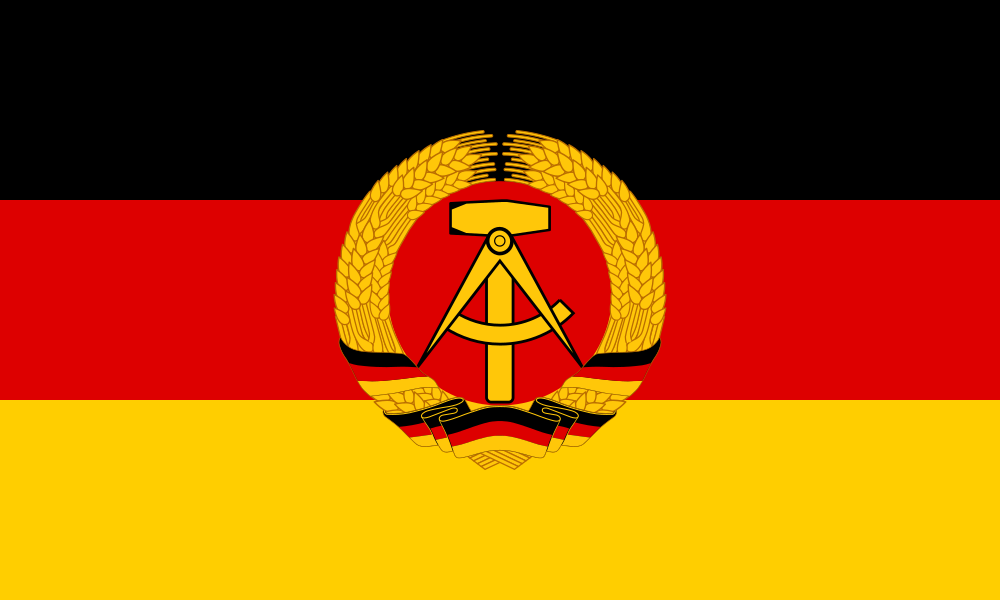
14. The German Democratic Republic also believes in strict observance of the right of any State itself to determine its own internal and external relations, and it repudiates all attempts to challenge exercise of that right by the Democratic Republic of Afghanistan.
19. The delegation of the German Democratic Republic is of the view that the work of the Security Council should be aimed at reducing rather than exacerbating international tension. We therefore resolutely oppose any attempts, in any form whatsoever, to condemn the measures agreed upon between the Soviet Union and the Democratic Republic of Afghanistan or to put forward demands inimical to the sovereign rights of those States. We are convinced that the progressive forces of the world will support the just struggle of the Afghan people to carry out this new phase of its revolution. That will also serve the cause of peace, which is also a cause supported by the Democratic Republic of Afghanistan.
15. The delegation of the German Democratic Republic views the campaign launched by imperialist and other reactionary forces against the Democratic Republic of Afghanistan as one of the attempts of the opponents of d&ente to intensify tension in general, and in the Middle East in particular, and to ignite the arms race. It is typical that, in this regard, NATO is playing a particular part. It suffices to take a look at the signatures on the request for the convening of this series of meetings of the Security Council. From press reports we know that, on the initiative of the United States, questions relating to the Middle East were officially discussed in NATO organs. Undoubtedly, there is here a link with the recent decisions of NATO, which, in disregard of the proposals put forward by the Soviet Union and other socialist countries, were, in practice, aimed at expanding the arms race.
20. As far back as 27 December 1979, Babrak Karma1 stated in a message to his people:
“Revolutionary Afghanistan will continue its peace-loving foreign policy, a policy of positive and active neutrality. On the basis of the principles of the policy of peace and friendship among peoples Afghanistan will continue to develop friendly relations with all nations and States in the world and primarily with its neighbours. Afghanistan will attempt to dispel misunderstandings in relations with other States. In the international arena, the Democratic Republic of Afghanistan will work together with the forces of peace for the freedom of peoples, the independence of nations and progress and against the forces Gf war, reaction and imperialism and those who sow enmity and violence,.Ii will also be a’fiithful and active Member of the United Nations and the non-aligned movement and the loyal friend and ally of the working masses of Moslems in the world.”
16. Now attempts are being made to embroil the Security Council in the campaign against the Democratic Republic of Afghanistan and, among other things, to divert attention from the imperialist policy of interfering in the internal affairs of Afghanistan and to consolidate spheres of influence in that area. The concentration of the military potential of the United States of America in the Persian Gulf, which has been going on for months, as well as the open threat by that country to use military means to ensure its socalled strategic interests in various parts of the world should make all peace-loving States, and particularly the States of the Middle East, stop and think.
17. The policy of a targeted campaign of propaganda has led to unbridled and slanderous attacks that are apparent to all, as can be seen from document S/13717. It is being quite seriously asserted that in the case of Afghanistan, the Soviet Union wants to attempt to isolate Europe and to gain control over the sea lanes of the Indian Ocean, although it suffices to glance at the map to realize that the central Asian country is thousands of kilometres away from Europe, and, as a land-locked country, is almost 1,000 kilometres from the Indian Ocean.
21. In so far as concerns the position of the Government of my country, I might refer to the statement made on 2 January 1980 by the Politburo of the Central Committee of the Socialist Unity Party of Germany and the Council of Ministers of the German Democratic Republic-a statement which stresses that the German Democratic Republic
LL I . I welcomes the measures taken by the Party and State leadership of Afghanistan to protect the sovereignty and independence of the country and is firmly in favour of respect for the inalienable rights of the Afghan people to collective and individual self-defence. The German Democratic Republic, together with the Union of Soviet Socialist Republics and other socialist fraternal countries and all peace-loving forces, will continue consistently to
18. In that regard, we should like’ to remind representatives that there was a time when a revolution was carried out in China itself-a revolution which was unreservedly supported by all progressive, antiimperialistic forces-and a time when the Chinese revolutionaries rendered internationalist assistance


The bonds of friendship which join Portugal and France have roots which extend back t0 the founding of our two countries in Europe. Throughout the centuries, despite the vicissitudes of history, our peoples have remained fundamentally faithful to those bonds. We have been brought together by the same culture and by the same principles and values. That is why we have profoundly friendly feelings towards you, Mr, President, as you assume the presidency Of the Security Council for this month. Your distinguished qualifications as a diplomat, along with the breadth of your experience and your knowledge, guarantee that you will conduct our proceedings ably and efficiently.
23. I should like also to thank your predecessor, Mr. Chen Chu, for the exemplary skill and wisdom with which he carried out his tasks in the course of the month of December. I also welcome the new members of the Council and express the appreciation of my delegation to those who have left the Council; their co-operation was particularly valued by us.
24. My delegation, with 51 others, signed the letter contained in document S/13724 and Add.1 and 2, which called for a meeting of the Security Council to deal with the situation in Afghanistan arising from the Soviet military intervention in that country. That situation has been followed with the greatest apprehension by my Government since it constitutes, in our eyes, a serious threat to international peace and security. The violation of elementary principles of international law which we have witnessed in Afghanistan, the use of force, the interference in the internal affairs of a State, the scorn for its territorial integrity and all the human suffering that those violations entail, are intolerable and unjustifiable.
25. Attempts to justify Soviet aggression have failed to convince my delegation. The lack of logic in invoking a treaty of friendship to render admissible military assistance aimed at bringing down the very Government which allegedly called for that assistance has already been mentioned in our debate, and I need hardly revert to that now.
26. What is of particular concern to my delegation is the flagrant violation of the fundamental principles of the Charter, which must be condemned and causes US considerable concern. It not only has dramatically upset the stability of the area but has set a new and dangerous precedent in this increasingly interdependent world, where distances have become neg& gible in view of the military resources of the major
27. It is against that background that we see the present drama in Afghanistan taking place. The repercussions of the conflict might be disastrous if the Soviet Union fails fully to live up to its responsibilities in the international community as a permanent member of the Council. Those responsibilities require that it put an end to its alggression immediately by withdrawing its forces from Afghanistan so as to allow the people of that country freely to determine their political or religious, economic or social future, without interference of any kind.
The next speaker is the representative of Venezuela, whom I invite to take a place at the Council table and to make his statement.
29. Mr. NAVA CARRILLO, (Venezuela) (Dzferpeetation from .Spanislz): Mr. President, I should like to thank you and, through you, the members of the Security Council for allowing Venezuela to take part in this meeting called for by 52 Members of the United Nations, including my country, to consider the situation that has arisen in Afghanistan and its consequences for international peace and security. My delegation joins in the praise which has beeu expressed to you and the best wishes put forward for yout success as President of the Council.
30. We joined in the initiative of calling for this series of meetings fully convinced that the events in Afghanistan require action from the international community, in accordance with our commitments under the Charter of the United Nations and the many decisions that have been adopted by the various bodies of the Organization. Furthermore, Venezuela belongs to a part of the world that has fought and continues to strive for the full guarantee of the right of all peoples, from any nation and any State, to determine freely their own future and to choose their own ways to and plans for development, without external interference, pressure or obstacles, subject only to respect for the rule of law both domestically and internationally.
31. The facts concerning the events in Afghanistan have been a matter of public knowledge since 1978, when representatives of a certain ideological tendency took over the Government of the country. General information shows that a struggle began between various institutions and political and social currents, which is obviously part of an internal Drocess to determine the political, economic and social direction of the country in response to the aspirations of Afghan society. -
37. The objective part appears obvious to us and matters of interpretation should not lead either to abandoning or to postponing obligations of clear ethical and legal foundation, nor should they lead to violations of the Charter, as State commitments in that area must not, as we have said, affect the idea of the compatibility of the obligations imposed upon all Member States, by the Charter.
33. In recent times, if there have been external threats to that process, the international forum has been open to the presentation of appropriate complaints, and the international community has suitable corrective machinery whereby any State that feels threatened by external aggression that is impeding the normal course of events under its domestic jurisdiction can use the Organization and its bodies to denounce that aggression and call for action. Respect for the Charter implies that such situations, which violate the principles enshrined in it, should not be concealed. To condone events which have not been condemned, but which could and should be condemned, and to agree that those events have caused certain situations, is tantamount to distorting reality.
38. Considering the events which have occurred and the general situation which has arisen, the Organization, and primarily the Security Council, has an obligation to put an end to interference in matters which basically come under the domestic jurisdiction of Afghanistan and which should be determined solely and in complete freedom by that country’s nationals.
The next speaker is the representative of Czechoslovakia. I invite him to take a place at the Council table and to make his statement.
34. Venezuela firmly supports the principle of nonintervention, because of our regional persuasions and continental and worldwide commitments. We cannot compromise in this area. Because of our history and the bases and characteristics of our political development, Venezuela cannot tolerate an outside presence settling domestic political disputes, nor can we accept this in international commitments, as our basic point of reference is that there must be compatibility between our commitments and the obligations of the Charter of the United Nations, which must prevail in all cases. That includes non-intervention in the internal affairs of States and goes beyond merely national provisions.


I should like to thank you, Mr. President, and the other members of the Security Council for granting the request of the Czechoslovak delegation and giving us an opportunity to speak today. In congratulating you, an experienced diplomat of a country with which Czechoslovakia is linked by ties of traditional co-operation, on your assumption of the presidency, I should also like to thank you and the other representatives for the kind words addressed to my delegation as an outgoing member of the Council,
41. The Democratic Republic of Afghanistan is going through difficult times. The confluence of internal and external circumstances and events have posed a threat to the gains of the revolution which in April 1978 opened up encouraging prospects for the people of that country. Against revolutionary power, the most reactionary, feudal and capitalistic forces of the old rBgimes united and exploited even the mistakes made by the revolution, which undoubtedly weakened it internally, With active support from abroad aimed at re-establishing military strategic positions which had been lost in Iran, they attempted to turn back the clock of history. At a difficult, critical time, when the revolution was faced with mortal danger at the very end of last year, a new Government appeared on the political scene in Afghanistan, determined to resolve the situation in a principled manner.
35. We are very much concerned over the emergence of certain situations which show imperialistic and hegemonistic tendencies that seriously compromise the life of smaller countries and endanger international relations and our system of values.
36. Objectively speaking, the situation in Afghanistan calls for serious reflection and is particularly worrying for the future of international relations between the great Powers and the developing countries. Debate within a society as it endeavours to determine its own political future cannot be an excuse for using force or other outside elements to interrupt the normal process of choosiAg political rkgimes, forms of government or certain political ideologies that are
s
“The Czechoslovak people sincerely welcomed the victory of the April revolution in Afghanistan and has been following with great sympathy the struggle for the implementation of its goals. I am sure that the people of Afghanistan, under the leadership of the People’s Democratic Party, will successfully defend the gains of the revolution and the sovereignty and independence of their country. I am sure that the traditional ties of friendship and international co-operation between our two Parties and countries will be developed further and grow deeper, for the good of the peoples of both our countries, far the sake of progress, socialism and peace throughout the world.”
43. The new leadership of the Democratic Republic of Afghanistan has taken decisive measures for defence purposes and to ensure the development of the further phase of the people’s democratic revolution. Afghanistan has also exercised its inalienable right as a sovereign State in requesting the Soviet Union to render it general assistance, including military assistance, for the sake and in the interest of the Afghan people, not against it.
44. The dangerous plans for converting Afghanistan into a beach-head against the Soviet Union have failed. The internationalist assistance of the Soviet Union will be understood and supported by all who cherish the goals of the Afghan revolution, respect the efforts of the Afghan people to bring about social progress and genuinely feel strongly about the interests of preserving peace and security in that part of the world.
45. Recent events in Afghanistan have been the target of crude attacks by world reaction, which has been exploiting misinformation and confusion. Today when plans for a counter-revolutionary colrp in Afghanistan have failed, the enemies of progress have been doing everything in their power at least to whip UP an anti-Afghan and anti-socialist campaign. The initiators of that campaign are trying at the same time to divert the attention of world public opinion from the military threat hanging over Iran from their aggressive policy in the Middle East and in the far East and other Parts of the world; from the new phase of the feverish arms race into which the members of NATO have plunged Europe; from their attempts to prevent the entry into force of the Treaty between the United States of America and the Union of Soviet Socialist Republics on the Limitation of Strategic Offensive Arms (SALT II),* and in general to whip up a wave of attacks against the stabilization of the process of international detente.
47. The Czechoslovak delegation is sure that both the people and the Government of the Democratic Republic of Afghanistan have given a compelling answer to all those who have been attempting to bring about a counter-revolutionary cnuy in their country and the peace-loving peoples of the world will, in the final event, thwart the plans of reactionaries who are aiming, inter &-and this inciudes the method of distorting the recent development of events in Afghanistan-at turning back the course of peaceful coexistence and detente in international relations to the years of the cold war. At the same time, I should like to express my conviction that members of the Security Council, too, will not permit the Council in its practices to slip into the rhetoric of the cold war.
48. To conclude, I should like briefly to talk about the not-very-new attacks by the Chinese representative against my country. The representatives of today’s China are obviously embarrassed by the fact that, with the internationalist support and assistance of allied countries in 1968, it was possible in Czechoslovakia to defend the socialist system and to avert bloodshed and the emergence in central Europe of a situation fraught with the most serious dangers to international peace. As we know, there still exist certain foreign circles, which in 1968 encouraged attempts at bringing about a counter-revolutionary coup in Czechoslovakia-attempts radically to change the very foundations of our internal and foreign policy, and to tear Czechoslovakia out of the family of socialist countries. Even now, more than 10 years later, those forces apparently cannot resign themselves to the fact that their goals and hopes were dashed. We can understand their disenchantment but it cannot change the reality of the situation. The Czechoslovak Socialist Republic was, is and will remain a firm and reliable link in the Socialist community.
The next speaker is the representative of the Nether-p lands, whom I invite to take a place at the Council table and to make his statement.


Mr. President, I wish at the outset to join previous speakers. in expressing our appreciation to you as President of the Security Council for this month. The
51. The Government of the Netherlands is deeply concerned about the recent events in Afghanistan. For reasons I will set out, my Government felt that an urgent meeting of the Security Council was necessary in order to consider these developments. We therefore supported the request pertaining thereto, together with a great number of Member States from different parts of the world. My delegation is grateful for being enabled to present its views on a matter which could not only affect stability in the area but also seriously endanger peace and security in the world.
57. Seen from a wider perspective, the use of‘ force in international relations cannot be tolerated by the community of nations. The Netherlands regards the Soviet action as a grave setback for international dCtente, a concept which by its very nature is both indivisible and of a global character. It is our earnest expectation that the Soviet Union will live up to its commitment to respect the principles of the Charter and not interfere in the internal affairs of other nations.
52. The Government of the Soviet Union provided us, on 27 December 1979, with an explanation for its intervention in neighbouring Afghanistan. After careful examination, the Netherlands Government has, however, reached the conclusion that it cannot accept the argumentation contained therein. The explanation by the Government of the Soviet Union states that the leadership of Afghanistan itself turned to the Soviet Union with a request for assistance to defend itself against foreign aggression. It refers to long-standing outside intervention in the internal affairs of Afghanistan, with the use, among others, of armed elements, and to acts of foreign aggression.
58. My Government therefore launches an earnest appeal to the Government of the Soviet Union to withdraw its forces from Afghanistan immediately and to cease forthwith its interference in the internal affairs of that country. The people of Afghanistan should be allowed to determine their own future freely, without outside interference or “assistance”, in accordance with their own laws and Constitution, and with the right to self-determination.
53. However, on the basis of all available information, it seems less than obvious that such was the case. On the contrary, we have reason to believe that we are faced with military intervention by the Soviet Union in Afghanistan, an independent and sovereign country. From the unfolding of events from early December on, we cannot but draw the conclusion that the real aim was to overthrow the Government in power in Afghanistan and to replace it with a rCgime more responsive to Soviet interests.
59. Finally, I should like to draw the attention of the Council to the plight of the Afghan refugees. It is to be feared that their number will rapidly increase unless the Soviet presence in that country is quickly brought to an end. My Government views that aspect with concern and is aware of the inflow of Afghan refugees into neighbouring countries-in particular, Pakistanwhich will inevitably cause considerable problems for the authorities of those countries.
54. Such was the sequence: the change of power in Afghanistan on 27 December was preceded by a buildup of Soviet troops in that country. The alleged outside threat to the security of Afghanistan was in reality non-existent, and neither could it be argued that the security interests of the Soviet Union itself were in any way at stake.
The next speaker is the representative of Viet Nam, whom I invite to take a place at the Council table and to make his statement.


Mr. President, 1 wish first of all to thank the members of the Security Council for having given the delegation of Viet Nam this opportunity to participate in the debate. I wish also to congratulate you on your assumption of the presidency of the Security Council for this month. I am also very pleased to greet the new members of the Council and wish them every success in their important mission.
55. The Government of the Soviet Union in its statement justified its action by referring to Article 51 of the Charter. It should, however, be clear from what I have just said thpt recourse to individual or collective self-defence ‘,was neither called for nor justified. Here we are’ $resented with an unjustified recourse to one of the dtisic provisions of the Charter. What else, therefore, have we witnessed but interference by military force in the internal affairs of a Member State, in violation of the basic principles of the Charter and of international law? T,he Netherlands
62. Before expressing my views on the substance of the matter before us, I should like to make a few preliminary comments on these meetings of the
63. Secondly, it is regrettable that the Council has allowed an individual, the would-be representative Of “Democratic Kampuchea”, to speak in this lofty body. The words “Democratic Kampuchea” are enough to make men of conscience throughout the world shudder as they think of the heinous crimes committed by the anti-democratic genocidal rigime overthrown exactly a year ago by the people of Kampuchea. It is for that very reason that one permanent member of the Council had to withdraw recognition following the demands of the people and public opinion in that country. It is truly ironic that the Organization has tolerated the presence in our midst of that butcher in “democratic” garb stained by the blood of 3 million innocent Kampuchean% he is nothing but the spokesman of his masters in Beijing coming to disrupt important meetings of the United Nations. The delegation of Viet Nam hopes that an end will be put to this absurdity, which only damages the prestige and honour of the United Nations, and that the seat of the People’s Republic of Kampuchea in the United Nations will be returned to its legitimate owner, the Revolutionary People’s Council of Kampuchea.
64. Thirdly, this is a matter of principle under the Charter: in spite of the strong protests by the Government of the Democratic Republic of Afghanistan, the Council is none the less meeting to consider the situation in Afghanistan, a sovereign country which is in the process of settling vital questions successfully without calling on the United Nations for action. That is clearly direct and obvious interference in the internal affairs of a State Member of the United Nations, just as during the same period a year ago [2/081/r 10 2112/h ~?rceti~s], the Council discussed the situation in Kampuchea without a request from the Revolutionary People’s Council of Kampuchea, the genuine and legitimate representative of the people of Kampuchea.
65. Having stated those reservations and made those remarks, my delegation would now like to set forth in the Council the position of the Government of the Socialist Republic of Viet Nam on the recent events in Afghanistan.
66. First of all, the delegation of Viet Nam warmly welcomes the presence here of Mr, Shah Mohammad Dost, the Minister for Foreign Affairs of the Democratic Republic of Afghanistan, and, in particular, his clear and precise statement with regard to the situa-
67. The delegation of Viet Narrr hopes that the voice of the genuine and legitimate representative of the people of Afghanistan will be heard by those who cherish the truth, for he has shed light on the real situation in Afghanistan, which has been deliberately distorted in’a biased manner by a propaganda campaign inimical to the people of Afghanistan and their revolution.
68. The Socialist Republic of Vjet Nam considers that recent events in Afghanistan, namely, the retaking of the reins of power by the people’s forces of Afghanistan, led by President Babrak Karmal, is part of the development of the 27 April 1978 revolution in Afghanistan, which had been thwarted by imperialist and international reactionary forces.
69. With the April 1978 revolution, the people of Afghanistan, exercising their right to self-determination, overthrew the regime of the dictator Mohamed Daoud and set for themselves the task of building a new society in keeping with the aspirations of the vast majority of the population, thereby actively contributing to the cause of peace and stability in the area.
70. The toll in human lives paid by that courageous people for their political and social emancipation says a good deal about their determination to put behind them centuries of injustice and put an end to an archaic tyrannical kingdom supported by imperialism -which had too long maintained the people of Afghanistan in slavery, poverty and ignorance-with a view to founding for the first time the Democratic Republic of Afghanistan. That has been a serious defeat for imperialism and international reaction, and that is why they have tried by every means to plot against the young Republic-as indeed they have done with respect to other revolutions-because it is so difficult for them to accept the fact that oppressed peoples dared to overthrow the old established order.
71. Unlimited support on all levels has been given to the reactionary elements of the fallen regime to overthrow revolutionary forces and to ensure control over the country. Attacks have been launched from outside the country; there have been terrorist operations, disruptive actions, subversion and sabotage against the new regime-all carried out by military men trained and equipped by the agents of American imperialism and by Maoist groups, agents from Beijing, in various centres in the territory of a neighbouring country.
72. For the past year and longer they have deliberately perpetrated more than 250 acts of rebellion
73. Yesterday,iri ‘the Council the delegation of the Soviet Union pres’ented irrefutable evidence of those plots hatched by the United States of America and China against the Democratic Republic of Afghanistan. That evidetieeirjas revealed even in the American press. I might ju’st”add a few particularly significant facts. The commander of the air forces of China, in one of his visits to a neighbouring country of Afghanistan, cynically declared that Beijing intended to supply arms to rebellious Afghan troops and to train groups of saboteurs in the city of Beijing itself.
79. That request from Afghanistan and the positive response of the Soviet Union, for which the people and lawful Government of Afghanistan are grateful, are in keeping with the provisions of the Treaty of Friendship, Good Neighbourliness and Co-operation signed in Moscow by the leaders of the two countries on 5 December 1978.’ The limited military assistance that the Soviet Union has given is also in keeping with Article 51 of the Charter, which refers to “the inherent right of individual or collective self-defence if an armed attack occurs against a Member of the United Nations”.
74. Yesterday United Press International in New Delhi gave us further proof of this shameful interference by the Beijing authorities in the internal affairs of Afghanistan. According to that agency, Chinese military advisers have already arrived in Pamir to train rebellious, Afghan forces. Diplomats from Kabul also report tliat tlie Chinese are in the process of training Afghan rebels in the north-eastern part of Afghanistan and are giving t.hem weapons and munitions.
80. Once ‘again, the aim of crushing the young Afghan Republic has been thwarted. The bitterness of that failure may explain the anger of the sponsors of the aborted attempt which has caused them to slander the Soviet Union, arguing that the presence of Soviet troops in Afghanistan is a threat to the peace and security of the area. The sole threat to peace and security in the area is unquestionably the feverish activities of the United States of America in collusion with the expansionist authorities in Beijing, who are trying to submit the peoples of that world nerve-centre to their will with a systematic policy of military buildup, destabilization of the area and interference in its internal affairs.
75. In addition to those political and military activities, the Government in Washington and the expansionist authorities in Beijing have been intensifying economic pressure, cutting off material assistance and trying to threaten other countries and to force them to agree to an embargo or to cause further difficulties for the revolution in Afghanistan. They try to whip up political prejudice; to poison the religions in the country, with the aim of dividing the people in the revolution and slandering the revolutionary power with allegations of violations of human rights or freedom of religion.
81. On 30 December 1979, President Babrak Karma1 Stated,
76. While the Afghan revolution was trying to deal with the various difficulties caused by imperialism and international reaction, as was stated in the Council by the Foreign Minister of Afghanistan, the traitor Amin, playing precisely into the hands of the imperialists, carried out his counter-revolutionary plot, which led to the assassination of President Noor Mohammad Taraki and the imprisonment and killing of thousands of revolutionary patriots and militants, thereby lending himself to imperialism and international reactionism and their designs to destroy the revolution in Afghanistan.
82. According to the Agence France Presse in Moscow, on 4 January 1980, President Babrak Karma1 denounced:
77. In the face of the imminent danger of losing what the revolution had gained as a result of aggression by armed groups from abroad, and given the destabilizing activities that had oc‘ctirred within the country, on 27 December 1979 the forces of the authentic Afghan revolution, led by President Babrak Karmal, overthrew the fascist Amin rbgime, restored the people’s power and thereby ensured the progress of the Democratic Republic of Afghanistan.
“The present policy of the Government of the Democratic Republic of Afghanistan is to move the April revolution in the right direction in order to eliminate poverty and backwardness, to bring about equality among peoples and societies, to build an independent economy and to pursue a foreign policy based on the principles of active neutrality and peaceful coexistence.”
. . . the lies of the United States, which is using this technique to try to justify its defeat. The United States must realize that the changes that have taken place in Afghanistan have been brought about by our Party, by our national armed forces, that the material, moral and even military assistance given us by the Soviet Union is entirely in keeping with
“
83, Whereas imperialistic and reactionary circles are stressing the fact that the Democratic Republic of Afghanistan has been enjoying military assistance from the Soviet Union to protect the revolution, they have been very careful to avoid uttering a word about their own conspiracies. How, for how long have they been financing, training, equipping and supplying commando reactionary units from neighbouring countries or areas far from Afghanistan in an attempt to interfere in the internal affairs of Afghanistan and to sweep away the Afghan revolution?
84. Their hostile activities towards the Democratic Republic of Afghanistan are part and parcel of the traditional policies of imperialist, reactionary circles, which have clung to the old, established order on the flimsy pretext of defending the principles of the Charter, in an attempt Lo maintain their privileges and to uphold their sordid interests, Wherever the oppressed peoples of the world succeed in winning their political, economic or social emancipation after a great struggle, the forces of imperialism and international reactionism continue to pursue a relentless revanchist policy in an effort to regain their “lost positions” or, at the very least, to destabilize permanently those countries which have dared to stand up to them. The case of Afghanistan should only be added to the long list of countries that have been victims of that policy of revanchism and hegemony in Asia, Africa and Latin America.
85. The methods of coercion and of destabilization which have been employed by imperialism and international reactionism over the past two years in Afghanistan are the very same methods which have been used elsewhere in the world. They are really part of a classic policy, namely: the strangulation of economies by blockade; the assassination of political leaders; the recovery of military debris and the police apparatus of the fallen rhgime; the provision of assistance to refugees as a cover for training them as agents of infiltration and commando attack units; the promotion of psychological warfare among various ethnic and religious groups to sow racial hatred and division; and the colonization of minds by the dissemination of distorted information through the mass media.
86. These evil efforts are so many time bombs on an international scale which represent a constant threat to the peace and security of the peoples of the world. First and foremost, they threaten the peoples of the small countries and the young, revolutionary r&imes which have not yet had time to recover from their wars of liberation or from long years of social disruption.
87. The people of Viet Nam and the oppressed peoples of alI continents, who have personally suffered
88. Fdr their part, imperialist and expansionist circles are fully aware of the fact that, unless they can isolate their victims from the support of progressive forces in the world, their aim of putting down revolutions will be doomed to failure. That explains their systematic, frenzied efforts to slander and distort the reality regarding the international assistance of progressive forces to peoples struggling for their emancipation. Those attempts go so far as cynically denying to their victims the sovereign inalienable right to enjoy solidarity and international assistance.
89. From the .standpoint of Viet Nam, the events of 27 December 1979 represent a major victory for the people of Afghanistan, safeguarding what the revolution of April 1978 had accomplished, thwarting the maneuvres of American imperialism, of the Beijing reactionaries and of other reactionary forces that have tried to liquidate the Afghan revolution.
90. The strong, timely, positive and generous assistance of the Soviet Union is entirely justified and necessary, in keeping with the aspirations of the people of Afghanistan, with the Treaty of Friendship, Good Neighbourliness and Co-operation between the two countries signed on 5 December 1978,’ and with Article 51 of the Charter of the United Nations. This is a purely internal affair of the people of Afghanistan, regarding bilateral relations between two sovereign countries. No one has the right to interfere.
91. The people and the Government of Viet Nam wish to assure the Democratic Republic of Afghanistan of their unfailing support. In the face of the premeditated attempts of certain circles to rally world public opinion to their own concerns, and considering the total failure of their adventurous and criminal plans to subvert the young Democratic Republic of Afghanistan, may I make an appeal for calm and serene reflection.
92. In this constantly changing world, and in view of the victory of the Afghan revolution and the irreversible forward march of the oppressed peoples, if the United Nations has not already made its contribution, willingly or unwillingly, it must at least refrain from any action which could cause harm.
93. Our international community will be able to prove its lucidity, if that is its desire. To lend our support to the efforts of the martyred peoples of the world in


Mr. President, I should like at the outset to extend my delegation’s sincere congratulations on your assumption of the presidency of the Security Council for this month. It is clear that the Council will be confronted with a variety of complex iss.ues and a fairly heavy workload throughout this month. With your renowned diplomatic experience, dedication and quiet efficiency, I am sure that you will perform the duties of the presidency in an exemplary manner. I should also like to pay a tribute to your predecessor, my colleague from China, who guided our deliberations during the month of December with his customary astuteness and wisdom.
95. It is appropriate that I avail myself of this opportunity to welcome the new members of the Council: the Niger, Tunisia, the German Democratic Republic and the Philippines. These are all countries with which Jamaica has excellent relations, and my delegation looks forward to continued friendly, co-operative and constructive working relations with them in the Council.
96. We wish to express our warmest thanks to those countries and their delegations which have left the Council. It was a privilege to have worked with them and to have enjoyed the close, friendly co-operation which they showed. My delegation acknowledges the significant contribution they all made to the work of the Council.
97. As we begin a new year and a new decade, we must all be aware of the very serious economic and political circumstances which have emerged in the world in recent times, and which pose a threat to peace, to progress and to development. In spite of these formidable manifestations of trouble and conflict, many have dared to hope that the international community would enter the new decade with a new spirit of determination, balanced by the necessary restraint, in order to overcome the major problems we face and to set a new and more just and peaceful era on its way. The vision, the concepts which emerged and which were being examined so thoroughly over the past few years, could now be the subject of purposeful action towards their realization.
98. Recent developments in central Asia have been a source of grave concern to my delegation. In spite of the fact that Jamaica is relatively far away from that area, the manifold implications of developments in the region leads us to the view that a serious threat exists to the maintenance of peaceful and cordial relations, as well as of international peace and security.
99. The Security Council is now seeking to exercise its responsibility under the Charter of the United
“The evidence available to date fails to establish that there was at the time of Soviet intervention any threat of external aggression directed against Afghanistan. Jamaica regards the massive movement of Soviet troops into Afghanistan as being a case of intervention in the internal affairs of a sovereign non-aligned State and is of the view that this action represents a potential danger to international peace and the security of that region.”
100. Jamaica, as a small developing country and a member of the non-aligned movement, has consistently taken a firm stand, in the various international forums, against any form of interference, direct or covert, in the internal affairs of States. The peculiar circumstances surrounding the latest change of Government in Afghanistan are thus a matter of grave concern to the Government and people of Jamaica. We are unequivocally opposed to any action by a State which is not based on full respect for the sovereignty, equality and independence of States. We particularly oppose any action which circumscribes the right of a people to choose freely its own sociopolitical system as well as its own Governme,nt.
101. It is imperative that peace, security and stability be restored to Afghanistan in accordance with the principles of the United Nations. This requires, in the view of my Government, the immediate withdrawal of Soviet troops from Afghanistan as a necessary and indispensable step to enable the peoples of that country to determine freely their own destiny, free from outside intervention, coercion or constraint of any kind whatsoever.
102. Finally, we would urge all States, especially those with a direct interest in that region, to exercise the utmost restraint and not to see the situation as the occasion for intervention in Afghanistan by foreign troops from any other source. The sovereignty, territorial integrity and non-aligned character of Afghanistan must be respected and the internal problems of Afghanistan solved by the Afghan people themselves.
NOTES
I To be printed in “United Nations, Twrr/y Series”, under No. 17976
2 See CD/53/Appendix IlI/vol.l, document CDL%
HOW TO OBTAIN LJ,XfTED NATIONS PUBLICATIONS
United Nations publications may be obtained from bookstores and distributors throughout the world. Consult your bookstore or write to: United Nations, Sales Section, New York or Geneva.
COMMENT SE PROCURERLESPUBLICA'MONSDESNATlONSUNIES
L,es publications des Nations Unies nont en vente dnns les librairies et les agences d6positaires du mondo entier. Informez-ooua aopr& ric vatre libraire ou sdressez-vow B : Nations Unies, Section clea ventes, New York ou GenLve.
XAX JfOlIYWfTb ff3~AHNII OPI’AIIfI 3AIllIlf O~-frEL0fHEHHbIX HAWfR
COMOCONSECUIRPUBLICACIONESDELASNACIONES UNIDAS
Las publicaciones de Iss Naciones Unidaa estin en venta en libredas y casas distribuidoras en todas p&es de1 mundo. C-onsulte a su librero o dirijaae a: Naciones Unid_as, Seccidn de Ventas, Nueva York o Ginebra. ..-. “.
Litho in United Nations, New York 00300
▶ Cite this page
UN Project. “S/PV.2188.” UN Project, https://un-project.org/meeting/S-PV-2188/. Accessed .