S/PV.2232 Security Council
▶ This meeting at a glance
16
Speeches
8
Countries
1
Resolution
Resolution:
S/RES/474(1980)
Topics
Israeli–Palestinian conflict
Peacekeeping support and operations
General statements and positions
Peace processes and negotiations
Security Council deliberations
War and military aggression

I should like to inform the members of the Council that I have received letters from the representatives of Ireland, Israel, Lebanon and the Netherlands, in which they request to be invited to participate in the discussion of the item on the agenda. In accordance with the usual practice, I propose, with the consent of the Council, to invite those representatives to participate in the discussion, without the right to vote, in accordance with the relevant provisions of the Charter and rule 37 of the provisional rules of procedure.
At the invitation of the President, Mr. Tue’ni (Labanon) took a place at the Council table und Mr. Mrrlloy (Ireland), Mr. Blum (Lsruel) and Mr. Scheltemu (Netherlunds) took the places reserved for them ut the side of the Council chamber.














The members of the Council have before them the report of the Secretary-General on the United Nations Interim Force in Lebanon (UNIFIL) for the period from 11 December 1979 to 12 June 1980; the report is contained in document S/13994. The Council also has before it the text of a draft resolution, circulated as document S/14001,
which was drawn up in the course of consultations among members of the Council. I should also like to draw attention to document S/14002, which contains the text of a letter dated 16 June from the representative of Italy addressed to the Secretary-General.
3. It is my understanding that the Council is ready to proceed to the vote on the draft resolution which is before it. Unless I hear any objection, I shall put it to the vote now.
A vote IVUS tuken by show qf hands.
In fusow: Bangladesh, France, Jamaica, Mexico, Niger, Norway, Philippines, Portugal, Tunisia, United Kingdom of Great Britain and Northern Ireland, United States of America, Zambia
Aguinst: None
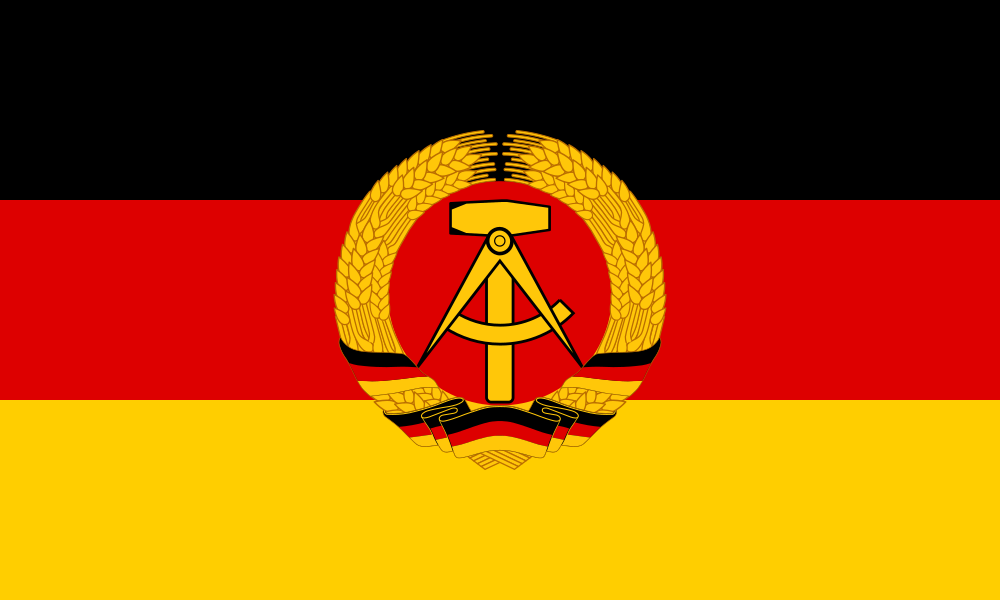
Abstuining: German Democratic Republic, Union of Soviet Socialist Republics
The druft resolution wus adopted by 12 votes to none, with 2 ubstentions (resolution 474 (I 980)).
One member (Chinu) did not purticipute in the voting.
I now call on the Secretary- General.

I have taken careful note of the resolution just adopted by the Council and of its decision to extend the mandate of UNIFIL for a further period of six months, until 19 December 1980.
6.. As indicated in my report [S/13994], I am convinced that, despite all the difficulties encountered by UNIFIL, the Force is performing an indispensable service to peace not only in Lebanon but also as regards the Middle East situation as a whole. It provides a vital mechanism for conflict control in an extremely volatile situation which, without it, would almost certainly escalate very quickly into a wider conflagration.
7. I shall of course continue to exert every possible effort to ensure that UNIFIL will implement the objectives set forth by the Council. To that end, it is imperative that violence of the kind which occurred
8. Following the serious incidents of April, the Council, in its resolution 467 (1980) commended UNIFIL “for its great restraint in carrying out its duties” and also called attention “to the provisions in [its] mandate that would allow the Force to use its right to self-defence”. As indicated in my report, I have reviewed this question very carefully with the Force Commander and I am examining new measures to reinforce the defence capability of UNIFIL, in particular with a view to improving the security of its personnel and to making the Force headquarters in Naqoura less vulnerable. Measures are also being considered to enable the contingents of UNIFIL to react firmly and consistently to threats or actions designed to interfere with the discharge of the duties of the Force. I shall keep the troop-contributing countries and the Council fully informed in this regard.
9. In accordance with the wishes of the Council, I shall also pursue my contacts with the parties concerned with a view to reactivating the 1949 Genera! Armistice Agreement and the Israel-Lebanon Mixed Armistice Commission (ILMAC) at the earliest possible date.
10. May I emphasize once again that the basic condition for UNIFIL’s success is and will continue to be a reasonable degree of co-operation from a!! the parties concerned. I firmly believe that the successful implementation of UNIFIL’s mandate is in the best interests of al! concerned. In that spirit, I appeal once again for their co-operation.
11. In concluding, I should like to express my deep appreciation to the Government of Lebanon for the co-operation it has extended to UNIFIL. My gratitude also goes to the troop-contributing countries for their unswerving support in often difficult circumstances. I should like also to reiterate my appreciation to the Commander, the officers and the men of UNIFIL and to their civilian colleagues, as well as the military observers of the United Nations Truce Supervision Organization assigned to the area, for the exemplary manner in which they have carried out their tasks.
12. Finally, I wish to pay a special tribute to the memory of those soldiers of UNIFIL who have given their lives in the cause of peace.
I now call on the representative of Lebanon.


This is the first time the Council has met to renew the mandate of UNIFIL -now a regular and almost repetitive exercise-
15. The political wisdom that you, Mr. President, have personally displayed all through your presence in the Council and more particularly in the Chair has always been a precious contribution not only to the spirit of consensus so important for the success of UNIFIL, but also to the formulation of the specific message that each resolution on UNIFIL must carry. May I therefore, while congratulating you in the customary manner on your assumption of the presidency of the Council, add a word of thanks on behalf of Lebanon-the Lebanon for which you have developed a unique concern and love and where soldiers from your country so gallantly defend the cause of peace. May I add that the assumption of the presidency of the Council during this debate by the representative of a major troop-contributing country should in itself make us a!! more eager to preserve the credibility of this august body. We, for one, refuse to consider the Council as a mere forum for rhetoric -often of doubtful quality--or a theatre for a special kind of humour, a very special kind of humour indeed, in questionable taste. Indeed, those of us who still believe in the international rule of law will continue to look to the Council with trust and confidence as a point of encounter between practical ideas and responsible commitments, a!! legally and truthfully binding.
16. That is the spirit in which we address ourselves to the agenda before us, hoping, not without candour, that others wi!I act’ likewise, for we are al! called upon to deal here not with words but with human lives, with the fate of a country, and the future of international peace and security in the most sensitive area of the world today.
17. The Secretary-Genera!, in paragraph 71 of his report, has stated unequivocally his “conviction that UNIFIL is performing an indispensable service to peace, not only in Lebanon but in the Middle East as a whole”. Emphatically, yet so serenely, Mr. Waldheim states also:
“While continuing to strive to fulfil a!! the terms of its mandate, UNIFIL provides a vital mechanism for conflict control in an extremely volatile situation which, without it, would almost certainly escalate very quickly into a far wider conflagration. . . . if the functioning of UNIFIL were to be seriously eroded or if the Force were to be withdrawn, we should very rapidly face in southern Lebanon” -and I beg to emphasize this-“a resumption and a widening of hostilities, with grave consequences far beyond the borders of Lebanon.”
18. A statement after the vote on a resolution can at best claim to be an interpretation and a pledge.
19. First, a further renewal of the mandate, despite the fact that “the fifth mandate of UNIFIL has come to an end without significant progress being achieved . . .‘* [ibid., put-u. 631, should not be an inducement to accept the present srurlrs yrro as an irreversible fait accompli. Nor should we be led to consider an incapacitated UNIFIL as a permanent fixture of the Middle East politico-military landscape. Israel must understand, once and for al!, that it should withdraw totally and unconditionally from Lebanon; that it must at once stop al! its direct and indirect activities within our international borders; and that it must enable UNIFIL to operate effectively and with fu!l military credibility as the sole instrument capable of putting an end to a!! hostile activities in southern Lebanon, in accordance with the objectives of resolution 425 (1978).
20. Secondly, enhancing the military capabilities of UNIFIL, mustering diplomatic support and energizing political action, as required, should be taken very seriously by a!! those concerned; and so should the establishment of immediate and total control by UNIFIL over its entire area of operation, up to the internationally recognized boundaries, as explicitly called for by the troop contributors at their meeting in Dublin on 2 May [see S/1392/] and, of course, by the Security Council. Needless to say here, by their meeting in Dublin, the troop-contributing countries have stressed to a!! concerned that their interest, not to say their involvement, in the implementation of the mandate is commensurate with their military and diplomatic commitment. Rarely has so much been invested in a peace-keeping operation, which none the less has been challenged with such arrogance, such disregard for the most elementary rules of international law, and such disrespect for the worth and dignity of human lives.
21. Thirdly, the various steps outlined in the Secretary-General’s report and called for by both resolution 467 (1980) and the resolution the Council has just adopted, as well as by the Dublin meeting, should in our view be integrated into a comprehensive plan of action to be negotiated, as previously called for, between the Secretary-Genera! and the Government of Lebanon; that new plan of action would replace and absorb the previous plans of implementation. It must be related, of course, to a relatively rigid time-
22. Fourthly, the reactivation of the General Armistice Agreement of 1949, by virtue of which ILMAC must be reconvened, is not only a necessity for the attainment of the objectives of the Council’s resolutions; it must be viewed-and is indeed viewed by my Government-as a major step towards the achievement of the “just and comprehensive settlement” of the wider problem of the Middle East called for by the Secretary-General in paragraph 71 of his report. Success in solving the Lebanese question will become a test of the ability of the United Nations to bring the peace process back into the framework of the international Organization. It should also be a test for the validity of the guarantees of security that the United Nations will eventually be called upon to give.
23. I should like at this point to go beyond the Secretary-General’s report and the resolution the Council has just adopted into a topic which the Council will see is not totally unrelated to our agenda, since the Secretary-General has reiterated in paragraph 71 of his report the commonly held view that “it bears repeating that the very complex situation in southern Lebanon is interrelated with the wider problem of the Middle East, which still awaits a just and comprehensive settlement.”
24. When I spoke of “guarantees of security” a moment ago, I was referring to the declaration solemnly made at Venice on 13 June by the heads of State and Government of the European Community. With so many representatives of the Community sitting on the Council, I hardly need to draw members’ attention, or that of those present in this chamber, to the fact that no party thus invited to share in the making of peace will trust United Nations guarantees if the one country in the Middle East, my country, which has never waged war should be allowed to be occupied, raped and almost dismantled while the international community accepts impotently the arrogant, cynical and defiant challenge of the one unpunishable, unharnessed Member State, Israel. I
25. There was another declaration issued at Venice last week which, alas, received no great publicity until it was circulated this very morning as an official document of the Council [S/14002] by my colleague, the representative of Italy. Allow me .to express Lebanon’s gratitude to the Nine for their solidarity, their concern for peace and stability in my country and their support for the total implementation of UNIFIL’s mandate.
“denounces publicly some manoeuvres of international politics, the indifference of certain countries and the duplicity of others concerning projects, mostly of Israeli inspiration, tending to make Lebanon bear, in a definitive manner, the weight of a Palestinian presence on its territory”.
27. The public, solemn and absolute rejection of Palestinian implantation in Lebanon, as proclaimed by President Sarkis, is indeed the gravest indictment of Israel’s policy, both towards Lebanon and towards the Palestinians-not to speak of the policy of those, friends and foes alike, who might have found it convenient to wage their wars in Lebanon, even if it should be destroyed.
28. This “sideshow*’ concept was recently denounced in an article by United States Congressman Toby Moffett reflecting on a fact-finding mission he had led into his ancestors’ homeland, Lebanon. Writing in The Christian Science Monitor of 11 June, Congressman Moffett said:
“Peace in Lebanon should not be regarded as a sideshow to ostensibly greater issues. The question is whether there will be a Lebanon when the time arrives to solve its problems.”
Congressman Moffett concludes by answering his own question:
“Lebanon deserves to have its problems treated with the immediacy they demand . . . Ironically enough, once Lebanon is no longer considered a sideshow, it can assume a pivotal role. The sideshow could become the catalyst.”
29. The Council has often been treated to interpretations of ancient history. I should like to conciude, therefore, by referring to my country’s past experience in response to the anxiety of our friends-a!] our friends-that we shall not overcome and survive the “sideshow war”.
30. Long ago, in the year 146 B.C., a Roman senator who left his indelible mark on ancient history was Iobsessed with Punic power to the point of haranguing his fellow senators daily with the words: “Carthage must be destroyed’*, for Carthage, though defeated, was still a challenge to the pax rumunu. But when Carthage was at last reduced to ashes and the Phoenicians massacred and dispersed, Tyre and Sidon and Beirut survived, and so indeed did the whole of Lebanon, to witness the fall of the Roman Empire. From the ruins of Carthage, Tunisia-now strong and prosperous-was born.
32. Once more we say to friends and foes alike, with serenity and trust, Lebanon has survived, and there will be peace in Lebanon before long; there will be unity and stability and sovereignty. We shall neither cede nor forget. And we are convinced that peace in Lebanon will not, and indeed, should not, wait for peace everywhere else or for the conclusion of everybody else’s wars.
The next speaker is the representative of Israel. I invite him to take a place at the Council table and to make his statement.


The Council has renewed once again the mandate of UNIFIL.
35. Israel’s positions with regard to some of the more problematic issues which arise in this context are well known. Likewise, the members of the Council are also familiar with our positions on various points contained in the resolution, adopted today. Our positions on all these questions remain consistent. They have been set out in detail in several of the statements which I have made in the Council, both at the time of previous renewals of UNIFIL’s mandate and in the frequent debates which have been held in the Council between such renewals. I would refer members in particular to my statements of 12 June and I9 December 1979 [2/47rh and 2180th meetings]. Hence;1 shall confine myself today to some very brief observations.
36. The central problem confronting Lebanon has been and remains the presence of alien forces throughout the length and breadth of its territory. As in the north, so in the south, the presence of thousands ,of PLO [Pulestine Liberution Orgunizutiun] terrorists is a primary cause of the tension and strife in that battletorn country. Their activities both within the area under UNIFIL’s direct control and in the “Tyre pocket” constitute a direct threat to three tangible targets: to the Lebanese villagers in the south, to UNIFIL in the implementation of its mandate and to the citizens of Israel-particularly in the north of our country. In this connection, I wish to refer to my letter of yesterday’s date [S/13999].
37. There will be no long-term improvement in the situation in Lebanon until the fundamental problem facing Lebanon as a whole is tackled, that is to say, there wilI be no real change for the better until ail the alien elements remove themselves or have been removed from Lebanese soil so that Lebanese independence, sovereignty and unity can be restored. Simi-
38. For its part, the Government of Israel continues to support the independence, sovereignty, territorial integrity and unity of Lebanon within its-internationally recognized boundaries. Israel wants peace in and with Lebanon. Israel has no territorial claims on Lebanon. Israel is prepared to open discussions with Lebanon at any time and place with a view to improving the relations between our two countries and also to promoting peace between our countries and in the region in genera!. To these ends, and given the prevailing reality in Lebanon today, Israel is prepared to consider the possibility of using the good offIces of the United Nations.
43. We note also that certain armed elements have tried to introduce weapons and personnel into the Force’s area of operation.
39. In concluding, I should like to take this opportunity of paying a tribute to the Commander of UNIFIL, Major-Genera! Emmanuel Erskine, and his staff, as wet! as to the soldiers of all ranks serving with UNIFIL. They carry out their duties in difficult and sometimes arduous circumstances. Israel also wishes to express its appreciation to the countries contributing contingents to UNIFIL. Beyond that, we would like to take this opportunity of expressing our condolences to the families of-the men who have made the ultimate sacrifice in the cause of peace during the period under review, and of wishing ti speedy and full recovery to those of UNIFIL’s men who have been injured in the same cause.
44. Such actions only increase the difficulties the Force has to face in carrying out its mandate. They are obstacles to what remains the objective: restoration of the territorial integrity, unity and sovereignty of Lebanon. We therefore share the Secretary-General’s conclusion that it is absolutely essential that at! concerned co-operate fully with the Force in the achievement of the objectives of its mandate. We believe that it is essential for at! the parties to allow the Force fully to carry out the tasks that have been assigned to it, including control over the territory up to the international boundary.

The Council has just renewed the mandate of UNIFIL for six months. In joining in that decision my delegation wished to stress the importance of the mission of the Force in southern Lebanon, which the nine countries of the European Community have just recalled in Venice. We wish also to reaffirm the value we attach to the attainment of the objectives set for the Force in the mandate just given it by the Council in its resolution 425 (1978). Essentially, there are three objectives: to confirm the withdrawal of Israeli forces; to restore international peace and security; and to help the Lebanese Government ensure the restoration of its effective authority in the area. The troop-contributing countries formally recalled those objectjves in Dublin in May.
45. It is indeed necessary that conditions be created that would allow the Force to operate effectively and its security and the security of its personnel to be fully assured in accordance with the terms of the mandate and the guiding principles laid down -by the Council itself. It is in that context that we should consider strengthening UNIFIL’s capacity, and it is in that context that we should consider any plan prepared by the Secretary-Genera! to reorganize its deployment.
46. I listened very carefully to the statement made by Mr. TuCni, the representative of Lebanon. I should like to say that we welcome the programme of action announced by the authorities of his country. That decision strengthens the confidence France has always had in this friendly country.
41. In paragraph 63 0: his report the Secretary- Genera! notes that
47. In conclusion, I should like to pay a tribute to the Secretary-Genera! for the .perseverance with which he has acted with regard to UNIFIL over the last few months. I should also like to express once again the confidence the French authorities have in the delicate and difficult task he has undertaken. He may rest assure’ of our support.
“in spite of strenuous efforts at all levels, including those of the Security Council itself, the fifth mandate of UNIFIL has come to an end without significant progress being achieved in implementing fully the objectives of resolution 425 (1978)“.

We meet today to extend the mandate of UNIFIL for a sixth time. We do so because ail of us who support the work of the Organization in international peacekeeping are convinced that UNIFIL has made and continues to make an indispensable contribution to peace. It is true, of course, that UNIFIL has been unable to carry out fully the mandate entrusted to it by the Council in resolution 425 (1978). This is a matter of deep regret to my Government. We believe that a!! parties should co-operate with UNIFIL in assisting the Government of Lebanon to restore its legitimate authority throughout southern Lebanon.
50. At the same time, we must not allow our impatience at the problems faced by UNIFIL to obscure its real achievements and essential role. For over two years the Force has been a buffer between bitter enemies. It has worked to prevent infiltration attempts and to resist harassment and encroachment on its area of operation. It has provided an added measure of security to the long-suffering people of the area and has prevented local clashes from escalating into a regional confrontation. It has maintained an area of operation within which Lebanese army forces have been deployed, holding out continued hope to the population of the restoration of the authority of the Lebanese Government and an end to fighting and violence. In the highly charged atmosphere of southern Lebanon, those are signal achievements.
51. Let us not forget that these achievements have been purchased at a very heavy cost. During this most recent mandate, the long list of UNIFIL’s casualties has grown still longer. Eight men have died in the performance of their duties and 22 others have been wounded. In a particularly repugnant crime, two members of the Irish contingent were brutally murdered. We extend our condolences to the families of those who have given their lives in the cause of peace.
52. Those who interfere with UNIFIL in the impiementation of its mandate bear a heavy responsibility. As the Secretary-General’s report makes clear, attempts to infiltrate armed men into and through UNIFIL’s area of operation continue, and have even increased in recent months. Some Palestinian and Lebanese elements continue to seek to launch attacks on Israel from Lebanese soil, and ignore the cease-fire. These elements would do well to reflect on the grave consequences of such lawless behaviour. At the same time, militia forces in the border area continue to use violence in indiscriminate ways. They
53. In this connection, we want to express the admiration of our delegation for the skill and diligence which Genera! Erskine and his staff have continuously exhibited in the very trying circumstances confronting the Force.
54. The views of the United States on resolution 467 (1980) are a matter of record and remain unchanged, and our vote today should not be construed as an endorsement of it. We were pleased to vote for the present resolution; it condemns the acts of violence which have prevented UNIFIL from implementing its mandatein full. We support the resolution’s call on the parties to co-operate with the Secretary-Genera! in convening a meeting of ILMAC, and we stand ready to assist in this process. We hope that al! Member States will join us in fuhiiiing the obligation to support UNIFIL.

Resolution 467 (1980) condemned the violation of Lebanese sovereignty and territorial integrity, and in particular Israel’s military intervention in Lebanon and its provision of military assistance to the Haddad gang, which is seeking to wrench. away the south’ of Lebanon. The report of the Secretary-Genera! contains a number of further facts testifying to continued acts of aggression by Israel against Lebanon and new crimes by the Haddad gang. Indeed, it is no secret that Israel is maintaining that gang.
56. Members will reca!l the Council’s indignation at the criminal attacks on UNIFIL in southern Lebanon. Nothing has changed. The delegation of the German Democratic Republic has repeatedly demanded that serious measures be taken by the Council. Deveiopments have confirmed that that demand has been, and remains, justified.
57. It is not difficult to answer the question why the situation in that region is so serious and dangerous: the main reasons are the aggressive policies pursued by the ruling circles of Israel, their refusal to respect the sovereignty of Lebanon and their desire to prevent a comprehensive political solution of the Middle East conflict. Nothing is being done to implement the relevant resolutions of the Security Council and the Genera! Assembly. Indeed, everything is being done to sabotage their implementation. In this, Israel enjoys &he support of the imperialist circles of the United States.
64. All those facts are fresh proof that Israel, sometimes openly and sometimes under cover of the actions of the Haddad separatists, is continuing its traditional policy of gross and scornful disregard for the Council’s resolutions and is preventing UNIFIL from discharging the duties entrusted to it by the Council.
59. We are firmly convinced that the resolution just adopted has a number of weaknesses. It does not provide for decisive measures which would end the collusion between Israel and the Haddad gang. The delegation of the German Democratic Republic abstained in the vote on that resolution because our reservations regarding the definition of UNIFIL’s mandate, the composition and the financing of the Force are still valid.
65. The Soviet delegation has noted that in view of the provocations by Israel and the de facto forces it maintains, the Secretary-Genera!, as he states in his report, is considering measures to enable the contingents of UNIFIL to react firmly and consistently to threats or actions designed to interfere with the discharge of the duties of the Force. The Soviet delegation understands that if such measures are elaborated, and if they could have a bearing on the nature or the continuation of the effective functioning of the Force, the Secretary-Genera! will place this question before the Council for a decision, as provided in paragraph 4 (a) of his report regarding the establishment of UNIFIL [S/12611 of 19 March 19781.

For the umpteenth time in the last two years, the Council has met to examine the question of the renewal of the mandate of UNIFIL, which was established to secure the complete withdrawal of Israeli troops from Lebanese territory. But thus far UNIFIL has been unable to carry out the tasks entrusted to it. Furthermore, in recent months the situation in the region has become even more tense and explosive.
66. One cannot fail to note that in stepping up its policy of provocation and aggression against Lebanon, Israel, notwithstanding the widespread indignation of the international community, has at the same time been increasing its expansionist policy vis-&is the occupied Arab territories, intensifying its acts of repression against the indigenous population of those territories and openly and defiantly continuing to create settlements on Arab lands. This blatant disdain manifested by the ruling circles of Isreal for the numerous resolutions of the Security Council and the Genera! Assembly can be expIained by the unswerving support given to Israel by the present United States administration. Thanks to that support, Israel has managed to conclude separate agreements at Camp David and to sign a treaty with Egypt, thus leaving itself free to embark on a more aggressive and expansionist policy against Lebanon and the indigenous poputation in the occupied Arab territories.
61. Throughout this period, Israel has not ceased its gross armed provocations against Lebanon and the Palestinian camps on Lebanese territory. The armed forces of Israel have intervened on Lebanese territory whenever they wished. In a two-month period, UNIFIL noted 95 and 45 violations, in May and June respectively, of the Lebanese borders by Israeli troops, on the ground, in the air and on the sea. Scarcely a week has passed when Israel has not bombarded Lebanese towns and the Palestinian camps situated in Lebanese territory.
62. Israeli troops have repeatedly infiltrated the UNIFIL area of operation. The Secretary-General’s report which is now before the Council notes that on 30 May Israeli troops infiltrated the Irish battalion area, abducting two Lebanese civilians and that on 2 June a unit of the Israeli forces made an incursion into the area of deployment of the Dutch battalion.
67. One must note with regret that the resolution just adopted by the Council does not contain any precise, clear-cut condemnation of Israel for its armed provocation against Lebanon or for its support of the separatist Haddad forces. We believe that the Council should have drawn the most serious conclusions from the fact that Israel is continuing its acts of aggression against Lebanon, thus creating an explosive situation in the region.
63. Israeli troops still hold a number of positions in enclaves which are controlled by units of Haddad’s separatists. In paragraph 65 of the Secretary-GeneraI’s report we find the following statement: “In the period under review, the most serious problems have been with the de facto forces, that is to say, with the Haddad separatists. Haddad’s forces, which are dependent on Israel-and this is pointed out in the Secretary-General’s report-have over recent months mounted armed provocations which seriously complicate the situation in the region. In continuing to
68. The delegation of the Soviet Union abstained in the vote on the basis of its policy of principle in respect of the Force. The Soviet position remains unchanged, on the mandate given to the Force by the Council, the principles for the selection of national contingents and the method of financing the Force.


Mr. President, first of all may I thank you, and through you the other members of the Council, for your courtesy in giving me this opportunity to express my country’s views on the subject of UNIFIL. May I also congratulate you, on your assumption of the presidency of the Council and express the view that it is particularly fitting that this debate on the extension of the mandate of UNIFIL should be chaired by a representative of Norway, as you not only bring characteristic wisdom to bear on these proceedings, but also represent a country with which mine feels particularly close ties of friendship and solidarity, not least in view of our common participation in UNIFIL.
71. When Ireland addressed the Council at this time last year, we pointed out that it was not usual for the Irish representative to seek to intervene in the debates of the Council. Nevertheless, Ireland has felt impelled to ask for the floor in five of the last six Council meetings on UNIFIL. That is a measure of the concern with which we, as a troop-contributor, have viewed and continue to view the problems faced by the Force, a concern that is reinforced by the latest report of the Secretary-General, in paragraph 63 of which he states that
“the fifth mandate of UNIFIL has come to an end without significant progress being achieved in implementing fully the objectives of resolution 425 (1978)“.
72. I do not, at this stage, intend to rehearse the mandate of the Force. Rather it is my intention to focus on the particular problems which continue to beset UNIFIL in attempting to implement its mandate.
73. The root of the problems faced by UNIFIL is well known and has been fully outlined by the Secretary-General in his report, from which I quote paragraph 64:
“When UNIFIL was established, it was widely felt that the progressive achievement of those objectives would be in the interest of all concerned and would be conducive to the return of peace and normality to southern Lebanon and the restoration of full Lebanese sovereignty and authority in the area. It was therefore assumed that UNIFIL would have the co-operation of all concerned in fulfilling its mandate. This assumption remains unrealized. Not only has UNIFIL been denied the co-operation required, but it has even on occasion been actively opposed or attacked in trying to perform its duties.”
What is equally well known is that the principal, though by no means the only, source of such efforts to frustrate and attack UNIFIL continues to be the I 8
I
75. Following the upsurge in harassment and attacks by the & j&to forces in April, which involved the killing of one Fijian soldier and the fatal wounding of an Irish soldier, and which culminated in the brutal murder on 18 April of two Irish soldiers, the Council, in its statement of 18 April, reaffirmed
“its intention to take such determined action as the situation calls for to enable the Force to take immediate and total control of its entire area of operation up to the internationally recognized boundaries” [2217th meeting, prrru. 151.
In its resolution 467 (1980), the Council reaffirmed its determination to implement previous resolutions on UNIFIL in the totality of the area of operation assigned to UNIFIL, up to the internationally recognized boundaries.
76. Despite those clear indications of the Council’s wishes, the de facto forces have, as the Secretary- General points out in paragraph 65 of his report:
“not only prevented a further deployment of UNIFIL in the enclave, but they have maintained four positions previously established in the UNIFIL area and have attempted to establish additional encroachments”.
Furthermore, the Force continues to be denied that freedom of movement which is necessary for it to carry out its duties effectively. That denial, and in particular the closure of roads on a selective basis and the isolation of individual contingents from UNIFIL headquarters, is clearly intolerable. We feel sure that this aspect will be of particular concern to the Council in ensuring that UNIFIL continues to function as an integrated Force.
77. The troop-contributing countries have played their part in diplomatic efforts to support UNIFIL. After the tragic events of 18 April, Ireland suggested a meeting at ministerial level of troop-contributingcountries which would, on the basis of the solidarity
78. Ireland fully supports the independence, sovereignty and territorial integrity of Lebanon and the authority of its Government. My authorities are glad to see the efforts of the Lebanese Government to increase and make more effective the Lebanese presence, both civilian and military, in UNIFIL’s area of operation. We are heartened, too, by the joint humanitarian efforts in the area, in which UNIFIL plays a full part, efforts which are relieving, to some extent, the suffering of the people of southern Lebanon.
79. In the course of a debate on UNIFIL in the Irish Parliament on 8 May last, the Minister for Foreign Affairs made a number of points which I should like to repeat here on behalf of my Government.
80. Over the last two years of its existence, and despite many difficulties, UNIFIL has made a significant contribution towards the prevention of an outbreak of general hostilities in the Middle East. A withdrawal of the Force would have the most serious consequences and might easily lead to a wider war, and we do not want to see such a withdrawal. At the same time, we are entitled to insist that if a peacekeeping force is to operate it must be given the necessary conditions to do so effectively. The most basic condition is that the Force should operate with consent. UNIFIL must be allowed to carry out its mandate in every respect and it must have freedom of movement throughout the area assigned to it and in conditions of adequate security for its personnel. As the representatives of the troop-contributing countries stated in their communique following their meeting in Dublin, unless rapid progress is made in creating these conditions, the continued viability of the Force may be brought into question.
81. Those remain the views of my Government. I would endorse the appeals which have been made to all concerned, particularly the Government of Israel, for full co-operation to enable the Force to implement its mandate and to continue to perform what the Secretary-General has described as an indispensable service to peace not only in Lebanon but also in the Middle East as a whole.
The next speaker is the representative of the Netherlands. I invite him to take a place at the Council table and to make his statement.


Mr. President, thank you for having allowed me to participate in this debate. As the representative of one of the countries contributing troops to UNIFIL, we feel the need to take this opportunity to express our deep concern about the continuing undesirable situation in which UNIFIL finds itself.
85. As is stated in the Secretary-General’s report, UNIFIL not only has been denied the co-operation required for the fulfilment of its mandate but has also on occasion even been actively opposed or attacked. This constitutes an unacceptable threat to UNIFIL, to the lives of the men serving with it and, in particular, to the authority of the Security Council. It is essential that United Nations peace-keeping operations be respected by all parties concerned.
86. I note in this context that both Israel and the Palestine Liberation Organization have -restated their acceptance of UNIFIL and given their assurance of co-operation with the Force. Unfortunately, those assurances have not been carried out in practice.
87. The de facto forces of Major Haddad continue to obstruct UNIFIL in an intolerable way; not only have they prevented UNIFIL from taking control of its entire area of operation but they have even attempted to establish additional encroachments in the UNIFIL area. Israeli defence forces themselves have carried out incursions into the UNIFIL area.
88. The Netherlands recognizes the legitimate concern of Israel for the safety of its population, but we note at the same time that harassment from the south will divert UNIFIL’s attention from dealing with illegal infiltrations from the north.
89. At the same time, attempts by armed elements to infiltrate personnel and weapons into the UNIFIL area of operation are incompatible with assurances by the leadership of the PLO of co-operation with UNIFIL. Although UNIFIL has made every effort to prevent these infiltrations, as is shown in the Secretary- General’s report, they necessarily create tensions in the area. The conclusion can only be that all the parties concerned, in their own interest, have to cease their obstruction of UNIFIL in order to break the
90. I should like to repeat the call of the 11 troopcontributing countries, following their meeting in Dublin on 2 May, urging all parties to co-operate fully with UNIFIL. This means that all attacks, harassment and infiltrations have to cease, that full freedom of movement in the enclave must be granted and that UNIFIL must be allowed to expand its area of operation up to the internationally recognized boundaries. Only thus can UNIFIL fulfil its mandate and can the security of its personnel be guaranteed; only thus will the Force be able to contribute to the gradual restoration of Lebanese sovereignty and authority and of peace in the region.
91. The Netherlands supports the Secretary- General’s efforts to convene a meeting of the Israel- Lebanon Mixed Armistice Commission as one of the possible avenues to help improve the situation in southern Lebanon.
92. My Government holds the view that UNIFIL performs an essential peace-keeping task and that its withdrawal would create a grave risk of a new explosion in the area. However, some basic requirements, including the safety of its personnel, have to be fulfilled.
93. Now that the Council has renewed the mandate, I am in a position to state that my Government is prepared to continue its contribution to UNIFIL for a new period of six months.
94. Finally, I would commend the officers and men for their courage, firmness and restraint in the fulfilment of their most difficult task; and, if I may, I wish, to express my respect for and extend my compliments to the Commander of the Force, who is present today at this meeting of the Council.
I shall now make .a statement in my capacity as the representative of NORWAY.
96. Only two months ago the Council held an extensive debate on the situation in southern Lebanon, during which I had the opportunity to present the views of the Norwegian Government [22/5th meeting]. On this occasion I should like to limit myself to some brief remarks in connection with the Secretary- General’s report on the activities of UNIFIL during the past six months.
97. The report notes the regrettable fact that UNIFIL is not yet receiving the full co-operation of the parties concerned. We have even experienced again the’ Force being actively opposed or attacked when it is trying to perform its duties. That is clearly unacceptable.
98. The most serious problems continue to be with the defaclo forces. In this connection I should like to
Litho in United Nations, New York 00300 8361462-September 1986-2,OSp
99. For the continued functioning of UNIFIL, it is important that further progress be made towards the full implementation of its mandate as set out in resolution 425 (1978). The full deployment of UNIFIL in its entire area of operation, up to the internationally recognized boundaries, is indispensable for the proper functioning of the Force. It is also our firm conviction that that will increase the security of all the parties involved.
100. The Council, in its resolution 467 (1980), called for a meeting of the Israel-Lebanon Mixed Armistice Commission. We commend the Secretary-General for the steps he has taken to that end, and we should like to endorse the call in the resolution just adopted on the parties concerned to extend to him their full co-operation in this respect.
101. We would also welcome whatever further steps the Lebanese Government might take to increase its military and civilian presence in the area.
102. Although no significant progress has been made towards the implementation of the objectives of resolution 425 (1978), the Secretary-General recommends the extension of UNIFIL’s mandate for another six months. The Norwegian Government supports this recommendation because we share his view that UNIFIL performs an indispensable service to peace not only in Lebanon but also in the Middle East as a whole. We agree with him when he states that the withdrawal of UNIFIL would lead to a resumption and widening of hostilities with grave consequences far beyond the borders of Lebanon.
103. In this situation we see no alternative to the continued presence of UNIFIL, in spite of its difIiculties. Norway therefore voted in favour of the extension of the mandate for another period of six months and is ready to continue to participate in the Force. In this connection, I should, however, like to reiterate our concern about UNIFIL’s financial situation. It places a heavy burden on the troop-contributing countries over and above the extreme hardships endured by their contingents. We urge all Govemments to assume their share in the financing so as to enable UNIFIL to continue to play its vital role in maintaining peace in the area.
104. In conclusion, I should like to pay a tribute to the Commander of UNIFIL, Major-General Erskine, and his staff and to the officers and men of UNIFIL, who carry out their duties in extremely difficult and dangerous situations.
The meeting rose at 5.50 p.m.
▶ Cite this page
UN Project. “S/PV.2232.” UN Project, https://un-project.org/meeting/S-PV-2232/. Accessed .