S/PV.2244 Security Council
▶ This meeting at a glance
25
Speeches
15
Countries
1
Resolution
Resolution:
S/RES/477(1980)
Topics
Diplomatic expressions and remarks
Southern Africa and apartheid
Global economic relations
UN procedural rules
Security Council deliberations
General debate rhetoric

In paragraph 4 of its report, the Committee on the Admission of New Members has proposed that the Security Council request the inclusion of an item entitled “Admission of New Members to the United Nations” in the supplementary list of items for the agenda of the eleventh special session of the General Assembly.
The meeting was called to order at II .35 a.m.
Adoption of the agenda
The agenda was adopted.
Admission of new Members: Report of the Committee on the Admission of New Members concerning the application of Zimbabwe for membership in the United Nations (S/14076)
5. I understand that the proposal was made in the light of the wishes expressed by the Prime Minister of Zimbabwe in submitting the application of his country for admission to membership in the United Nations, and that it was made in conformity with rule 59 of the provisional rules of procedure of the Security Council and rule 18 of the rules of procedure of the General Assembly. May I take it that the proposal of the Committee to request the inclusion of the supplementary item meets with the approval of the Security Council?
Vote:
S/RES/477(1980)
Recorded Vote
✓ 15
✗ 0
0 abs.














I should like to inform the members of the Security Council that I have received letters’from the representatives of Algeria, Egypt, the Federal Republic of Germany, Japan and Romania in which they request to be invited to participate in the Security Council’s discussion of the application of Zimbabwe for admission to membership in the United Nations. I propose, with the consent of the Council, to invite those representatives to participate in the discussion, without the right to vote, in accordance with the provisions of Article 31 of the Charter and rule 37 of the provisional rules of procedure.
At the invitation of the President, Mr. Semichi (Algeria), Mr. Elaraby (Egypt), Mr. von Wechmar (Germany, Federal Republic OJ), Mr. Nisibori (Japan) and Mr. Marinescu (Romania) took the places reserved for them at the side of the Council chamber.
The Security Council will now consider the report of the Committee on the Admission of New Members concerning the application of
A vote was taken by show o;f hands.
The ‘draft resolution was ?dopted unanimously. ’
It was so decided.
I shall immediately convey these decisions to the Secretary-General for transmission to the General Assembly in accordance with the provisions of rule 60 of the provisional rules of procedure of the Security Council.
7. A number of representatives have expressed the wish to be allowed to speak following the voting and I now call on ‘them.

In my view it is most appropriate that this meeting of the Security
9. I was very glad to have the honour to vote, as I have just done, on behalf of the United Kingdom delegation in favour of the admission of Zimbabwe as a Member of the United Nations. The adoption of the resolution marks a historic day for Zimbabwe and for the Council, which, for many years, was concerned with the situation in Southern Rhodesia. Today’s vote also represents for me, it so happens, the final act in a long preoccupation with the establishment of majority rule in Zimbabwe. It is a source of particular satisfaction that this came about through the holding of free and fair elections in fulfilment of the Lancaster House Agreement.z
10. The role of the Council today should be to look to the future, not to rake over the problems of the past. We all know that for a variety of reasons the achievement of independence in Zimbabwe was more painful and protracted than in any other former British territory. .But it was, nevertheless, a milestone in the history of Africa. There were many, black and white, who contributed to that achievement, which demonstrated that even the most intractable problems can eventually be resolved if all parties are fully and patiently determined to find a satisfactory negotiated solution. This example set by the people of Zimbabwe should serve as inspiration for the solution of the similar problem which faces us today in Namibia.
11. The struggle for independence in Zimbabwe was long and bitter. The country’s infrastructure and industry, its educational system, its agriculture and its health services suffered severely throughout those years. It is remarkable how, despite that struggle, which continued up to the Lancaster House Agreement, the Government of Zimbabwe, under the farsighted leadership of Mr. Robert Mugabe, has already made such impressive efforts to restore and to build up the country’s economy and to promote reconciliation. Inevitably, the tasks ahead are formidable. But I am confident that those efforts will provide a firm basis that will enable Zimbabwe to play a significant role in international affairs in general and in southern African affairs in particular.
12. The British people have many links with and a strong affection for Zimbabwe. They have great admiration for the outstanding courage, patience and good humour which have always been remarkable
13. In addition to a substantial aid programme over three years, my Government has written off a large proportion of outstanding debts and has rescheduled the remainder. We have also provided considerable technical assistance in the fields of military training, education and agricultural development. But after a long war, the needs are great. We hope that other countries will make generous contributions to help Zimbabwe through the period of readjustment and consolidation following independence.
14. Zimbabwe has already taken its place in the group of front-line States concerned with the problems of southern Africa and has become a significant member of the Organization of African Unity (OAU) and of the Commonwealth. The contribution which the Government of Zimbabwe has so far made as a member of those bodies leaves me in no doubt that its application for membership in the United Nations will enable it to play its rightful and, I am sure, its constructive role on the international scene. My Government is therefore in full support of Zimbabwe’s application to join the United Nations. We look forward to continuing with the Zimbabwean delegation, when it is established here, the close and fruitful collaboration we enjoyed with the representatives from Zimbabwe who were here during the Lancaster House Conference and during the electoral period.

Mr. President, I wish, on behalf of the Zambian delegation, to congratulate you on your Presidency of the Security Council for the month of July. As you are one of the founding fathers of the United Nations and an outstanding diplomat, we are certain that the work of the Council is in very capable hands. I wish also to pay a tribute to your predecessor, Mr. AlgHrd of Norway, whose presidency last month was marked with maximum success.
16. It is my most pleasant duty to be associated today with the process of admitting Zimbabwe to membership in the United Nations. That has been long overdue because the people of Zimbabwe have all along demonstrated their willingness and ability to take charge of their destiny.
17. For Zambia, this is a historic occasion. We have always anticipated the day when Zimbabwe would assume its rightful place among this family of nations, a place denied to them by the forces of domination. The people of Zimbabwe, under the able leadership of Prime Minister Mugabe, deserve universal congratulations for the victory of their heroic struggle, which culminated in the independence of their country on 18 April 1980.
18. The admission of Zimbabwe to United Nations membership is a natural fulfilment of a people’s right
24. At the same time, we warmly welcome the presence at today’s meeting of Mr. Mashingaidze, the distinguished representative of the new-born Republic of Zimbabwe and of the heroic people of Zimbabwe.
b 19. The independence of Zimbabwe marked yet another step forward in the whole process of decolonization for the region of southern Africa, and in particular for the oppressed peoples of Namibia and South Africa. Zimbabwe’s independence was, and continues to be, a source of inspiration to the oppressed people of the region. Zimbabwe’s independence means that the chances for the process of decolonizing the remaining countries of southern Africa have been enhanced. We therefore look forward to the day when Namibia will also be admitted to membership in the United Nations.
20. My delegation firmly believes that the newly independent Republic of Zimbabwe has an important role to play in the United Nations. It will no doubt contribute to the achievement of the objectives for which the United Nations was founded. This commitment has been demonstrated in more ways than one.
21. Members ‘of!the international community should increase assistance, to Zimbabwe to help in the reconstruction of that country’s economy. We have no doubt that this will be the case, since the majority of Member States have had a good record of supporting the cause of liberation in southern Africa.
22. Finally, Zambia is delighted to support wholeheartedly the application of Zimbabwe for membership in the United Nations. The people of Zimbabwe have, through their legitimate and authentic representatives, expressed their wishes-and those wishes must be respected. We are confident that the General Assembly will unanimously admit Zimbabwe to membership in the United Nations.
23. Mr. CHOU NAN (China) lintermetation from Chinese): First of all, iu the name of the Chinese delegation., I should like to express our appreciation to Mr. Alghrd for the exemplary skill and calm way in which he smoothly handled the extremely difficult tasks during his term as President of the Security Council for the month of June. We also wish to express our warmest congratulations to you, General Romulo, on your assumption of the presidency of the Council for the current month. As one of the founding fathers of the United Nations, General Romulo made outstanding contributions to the historic Asian-African Conference held at Bandung in 1955. You are also a good friend of the Chinese people and of the late Premier Zhou Enlai. We are greatly honoured by your presence in New York to preside personally over the work of the Council for the current month. During the short period since your arrival here, you have
25. On 18 April 1980, Zimbabwe proclaimed its independence. On 17 July Mr. Robert Mugabe, Prime Minister of Zimbabwe, sent a telegram [S/14064] to the Secretary-General, applying for United Nations membership, with a declaration that Zimbabwe accepts the obligations contained in the Charter of the United Nations and undertakes to fulfil them. In the view of the Chinese delegation, in accordance with the relevant provisions of the Charter, Zimbabwe is qualified for admission to membership in the United Nations. We fully support its application and are in favour of the Security Council’s recommending to the General Assembly the admission of Zimbabwe to membership in the United Nations.
26. The independence of Zimbabwe is a great historic victory won by the heroic people of Zimbabwe, who have waged protracted and unremitting struggles with the support of the African countries and peoples. The Chinese people sincerely rejoice over this brilliant victory achieved by the people of Zimbabwe.
27. The successful experience of the people of Zimbabwe in winning their independence shows that as long as the oppressed nations are united, they can certainly achieve their independence and liberation through valiant and tenacious struggle. While carrying out armed struggle, the people who are striving for liberation do not preclude the search for a political solution through negotiations. However, a political solution in the interest of the people can be achieved only on the basis of protracted and effective struggles. The victory of the people of Zimbabwe is a major historic event having a far-reaching impact in Africa and the world. It’constitutes a heavy blow to the racist forces in the whole of southern Africa and a great encouragement to the peoples of Namibia and Azania, who are engaged in the struggle for national liberation. It can be ‘predicted that following the independence of Zimbabwe, there will be a new upsurge in the national liberation struggles in southern Africa. At the same time, the independence of Zimbabwe has provided favourable conditions for consolidating the national independence of the African front-line States and developing their national economy, and is of great importance to stabilizing the situation in the region and maintaining the security of the whole of Africa.
28. Under the leadership of Prime Minister Mugabe, the Government of Zimbabwe is .taking active and

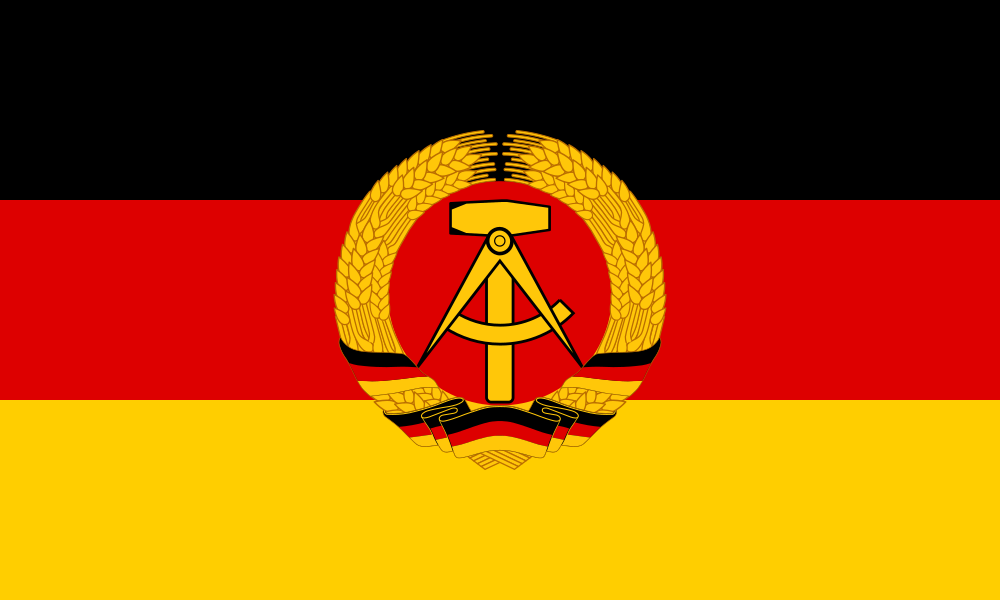
Mr. President, it is with pleasure that my delegation extends congratulations to the Minister for Foreign Affairs of the Republic of the Philippines, a country with which the German Democratic Republic maintains ever closer relations of friendly co-operation, on the assumption of the responsible office of President of the Security Council for the month of July. We are convinced that your great diplomatic skill and the rich experience you have gathered during your activities in the United Nations, of which you are among the founding fathers, will be of extraordinary value for dealing with the issues currently before the Security Council. We are looking forward to further fruitful .co-operation with you. At the same,time, I wish to use this opportunity to thank Mr. Ole Alg%rd for the comprehensive work which he performed in a circumspect manner as President of the Council in the month of June, when work was so plentiful.
‘32. The. delegation of the German Democratic Republic notes with pleasure that the Security Council has adopted a unanimous decision recommending to the General Assembly that the Republic of Zimbabwe should be admitted to membership in the United Nations.
33. True to the basic principles of its foreign policy aimed at peace, detente and social progress, and
34. The admission of the Republic of Zimbabwe to membership in the United Nations crowns with success the sacrificesand struggle of the’people of Zimbabwe, waged over many years on the political and diplomatic levels as well as in the military se&or, for its national ‘independence and self-determination. The proclamafion of the Republic of Zimbabwe effected the elimination of one of ‘the last dolonial territories in the African continent. The historic.vititory won by the people of Zimbabwe became possible also because of the active solidarity displayed by its friends in the African continent and throughout the world, who, in contrast to certain States that collaborated with the Southern Rhodesian racist regime, stood by the side of that people in the hard times it had to go thropgh.
35. The German Democratic .Republic has always attached great importance to developments in the African continent and to the struggle for peace of the African peoples, including the people of Zimbabwe, and from the very beginning has rendered support and assistance to them. Anti-imperialist solidarity with all peoples struggling for their national and social liberation constitutes an inseparable part of the socialist foreign policy of the German Democratic Republic.
36. As a result of the victory won by the Zimbabwean people, the liberation struggle waged by the peoples in southern Africa has scored fresh successes. The German Democratic Republic welcomes the overwhelming election victory recorded by the Zimbabwe African National Union and regards it as a clear expression of that people’s striving for justice, national independence and sovereignty. The German Democratic Republic is and always will be prepared to assist the Republic of Zimbabwe in its development.
37. There can be no doubt whatsoever that the Republic of Zimbabwe, fully in line with the principles and objectives of the United Nations, will conscientiously abide by the obligations arising from the Charter. My delegation expresses its conviction that the Republic of Zimbabwe, as a Member of the Organization, will make a valuable contribution towards the realization of the fundamental goals which th,e Organization pursues in its activities, namely the preservation and strengthening of ,peace and security on our globe.
38. Already today, the elimination of the Southern Rhodesian racist regime and the developments in the Republic of Zimbabwe have produced a favourable impact on international relations. At the same time, the Republic of Zimbabwe strengthens the ranks of
39. The German Democratic Republic welcomes the representatives, of freeZimbabwe to the forum of the United ,Nations and, wishes them much success in the performance of the ,tasks .they will face in the framework ‘.of the Organization. From this rostrum, the German Democratic Republic wishes to assure, the representatives of the Republic of Zimbabwe of its readiness and preparedness to co-operate with them in the’quest for the triumph of peace, .dCtente, liberty and independence.of peoples. :, .’
44. The independence of Zimbabwe was above all a victory of the people of that country and a testimony to the maturity, good sense and wisdom of its leaders. To them we extend our most fraternal and warm greetings on this,occasion, and*we avail ourselves .of ‘this opportunity to renew our pledge of co-operating with Zimbabwe in the difficult tasks that lie ahead.
46. ’ Mr. FUTSCHER PEREIRA (Poi-tugal): Mr.$President, it, is a great honour and privilege for me to address to you the warmest greetings of the Portuguese delegation. As a signatory of the Charter and one of the. ‘founding fathers of the Organization, General Carlos Romulo could hardly be a more fitting representative to preside over the deliberations of this body. We have witnessed over the years the extraordinary skill and statesmanship with which you have steeied the foreign policy of your country through periods of great international tension, to the extent that your counsel is highly esteemed everywhere in the world. We $re therefore extremely happy to see you presiding over our deliberations. Mr. President, I should also like to pay a tribute to your predecessor, Mr.’ &gird, of Norway, for the very remarkable qualities he displayed in conducting the business of the Council during his term of office. I would request his delegation kindly to convey to him our appreciation and thanks.
4.1. Now turning to the item on our agenda today, the application of Zimbabwe for admission as a Member of the United Nations, I cannot help expressing our great satisfaction at seeing the disappearance from aui agenda of the item dedicated to the question of Southern Rhodesia. But in our view, even more important than that-certainly much more important than that-is the fact that after long years of suffering, ‘the peoples of Zimbabwe have finally found peace.
42. All people of good will hailed with great joy the signature of the Lancaster House Agreement in London in December 1979* which put an end to the rebellion in Southern Rhodesia, thus opening the way for the accession of Zimbabwe to independence. A war-stricken country could, thenceforward, concentrate ail its efforts on promoting the welfare of its people in peace and harmony; that this was undertaken in a spirit of mutual understanding and reconciliation in such a way that no segment of its population was left out of the task of national reconstruction is in itself a feat that deserves our admiration and praise.
43. The independence of Zimbabwe constitutes, in our view, a milestone in the history of the struggle of
45. With this in mind, the Portuguese ,delegation supported whole-heartedly the application .of Zimbabwe for membership in the,United Nations, because we are confident that Zimbabwe will make a noteworthy contribution to the cause of peace and justice in the world-one of the fundamental aims of the Organization.

Mr. President, first of all, I should like to welcome you most warmly as a distinguished diplomat and statesman of the Philippines and one of the deans of the United Nations. I wish you every success in carrying out the very exalted and responsible functions of President of the Security Council. I should also like to express the hope that relations between the Soviet Union and the Philippines will continue consistently to develop for the benefit of the peoples of our two countries.
47. On behalf of the Soviet delegation, I also wish to express appreciation to the President of the Security Council for the month of June, Mr. Algbrd, under whose able guidance the Council discussed a number of important issues relating to the situation in the Middle East, in southern Africa and in Cyprus.
48. The Soviet delegation was extremely happy to support the application of the Republic of Zimbabwe for United Nations membership. We are convinced that Zimbabwe will meet fully all the criteria for membership in the Organization.
49. On 18 April 1980, after the long and difficult struggle of the people of Zimbabwe for their independence, final victory came to the national and patriotic forces. Rhodesia, one of the citadels of racism, whose very name implied that it was the preserve of the colonialists and was an insult to the indigenous black population of the .country, has now disappeared from the map of Africa. The resounding victory of the patriots of Zimbabwe, won under the leadership of the Patriotic Front, has failed all the attempts by the racists and imperialists to impose a puppet regime on that people. The victory has turned a new page in the history of Zimbabwe and has established the necessary pre-conditions for building a truly independent and sovereign State.
“On behalf of the Presidium of the Supreme Soviet of the USSR, the Soviet Government and the people of our country and on our own personal behalf, we address to you and to all the people of Zimbabwe most sincere congratulations on the proclamation of the independence of your country, and we wish you every success in the building of ypur new life.
“The victory of the people of Zimbabwe and the heroic struggle against colonialist and racist oppression waged by that people under the leadership of the Patriotic Front of Zimbabwe, with the support of progressive forces throughout the world, has written a bright new page in the history of the liberation of Africa from the yoke of colonialism and racism. The Soviet Union has constantly stood side by side with the people of Zimbabwe and, in word and in deed, has demonstrated its solidarity with that people during the long liberation struggle.
“Pursuing a peaceful Leninist foreign policy and guided in its inter-State relations by the principles of equality and of mutual respect for sovereignty, territorial integrity and non-intervention in internal affairs, the Soviet Union solemnly declares that it recognizes the Republic of Zimbabwe as a sovereign and independent State and that it is willing now to establish diplomatic relations with it and to exchange diplomatic representatives at the ambassadorial level.
“We trust that relations of friendship and cooperation will develop between the Soviet Union and the Republic of Zimbabwe for the benefit of our peoples and in the interests of the strengthening of peace and international security.”
51. Now that the Security Council has decided to recommend to the General Assembly that it should admit the Republic of Zimbabwe to membership in the United Nations, we cannot fail to recall that, along with the decisive contribution made to the struggle for their liberation by the people of Zimbabwe themselves, under the leadership of the Patriotic Front, a significant role in the victory was also played by international support from progressive forces throughout the world. As far as the Soviet Union is concerned, it has provided comprehensive assistance to the people of Zimbabwe in their struggle for freedom and independence. This support was provided through the United Nations and other channels. The Organization, including the Security Council, has adopted
52. The transition from a colonial past to the achievement of true independence is never easy. The young Republic now has to face urgent and acute problems inherited from its colonial past. Even now, the racist regime of Pretoria has not abandoned its plans for direct armed intervention in the affairs of Zimbabwe; it has openly threatened to use force if it feels that Zimbabwe’s policies are not to its liking. Accordingly, OAU, in welcoming the victory of the Patriotic Front, quite correctly drew attention to the continuing threat to the independence of Zimbabwe. In the circumstances, the future of the people of that country and their further successful progress along the path towards constructing their new life will depend to a large extent on the unity and cohesion of the Patriotic forces and on their ability to reject and overcome the designs of the imperialists and racists.
53. The Soviet delegation expresses its conviction that, with its membership in the United Nations, the Republic of Zimbabwe will be taking an important step forward towards completing the decolonization of the continent of Africa. Its admission will also help to implement the principle of the universality of the United Nations.
54. The Soviet delegation warmly greets the representatives of the Republic of Zimbabwe who are here in this hall on the unanimous endorsement of the recommendation by the Security Council. We trust that our delegations in the United Nations will establish relations of fruitful co-operation that will serve to achieve the lofty purposes and principles of the United Nations.

Mr. President, I should like, in turn, warmly to congratulate you on your accession to the presidency of the Security Council for July. You are more familiar than anyone with this institution, because you were one of the Statesmen who participated in its creation. No one has forgotten that in 1945 you were one of the fathers of the San Francisco Charter which created the United Nations of which your country is a founding Member. In addition, you have presided over the Council with particular distinction on several occasions, and everyone recognizes the qualities you have demonstrated as chief diplomat of your country. My delegation is privileged to participate in this debate under your Presidency.
56. We should also like to convey our congratulations to Mr. Alghrd, who assumed the presidency of the
57. The ‘Security Council has just unanimously recommended to the General Assembly the admission of Zimbabwe to the United Nations. France welcomes with great satisfaction the application for admission submitted by the Salisbury Government. This is an important date in the history of Africa and in that of the Organization; it closes a painful chapter in the history of decolonization and also a difficult chapter, but one that provided a useful lesson in the activities of the Security Council.

Mr. President, my delegation is pleased and honoured to congratulate you and to express to you our appreciation for your having assumed the presidency of the Security Council for the month of July. Although we have not had many meetings, we have benefited greatly from your wise counsel and experience during our informal contacts, and your very presence here has added dignity and prestige to the Council.. We also extend congratulations to Mr. Algbrd of Norway for his able conduct of the presidency during the month of June.
58. The cessation of hostilities, then the organization of free elections and finally the accession of the country to independence were carried through as a result of an immense effort at mutual understanding, which called for intelligence, determination and faith in the future. The Prime Minister of Zimbabwe and his Government are to be unreservedly congratulated for the masterly way in which they have assumed responsibility for what was Southern Rhodesia, for the spirit of conciliation they have shown and for the way they have assumed responsibility for all the people whose intention it is to share in good faith the future of that new country. My delegation, in paying this tribute, extends it to those responsible for bringing about those events: to the Government of the United Kingdom, which, in circumstances with which we are all familiar, shouldered its responsibilities as the administering Power; to the front-line States and those of the Commonwealth for the important and realistic part they played as a mediating body; and, finally, to the African leaders of all the political movements of Zimbabwe who for many long years fought for the independence of their country and who finally gave the world an example of wisdom and democracy that we shall not forget.
63. Today we are participating in an historical process which, for Africa, began in earnest a little over two decades ago and in the ensuing years has resulted in the achievement of independence for 50 States, which have been admitted to the United Nations. The decolonization process in Africa has in some cases been smooth and peaceful; in others, difficult and protracted. In the case of Zimbabwe, the road to independence has been marked by suffering, ‘bloodshed and sacrifice by the people of Zimbabwe and also by the neighbouring States which stood in solidarity with them in the struggle. We are glad that this unhappy chapter in African decolonization is now closed and that the hopes expressed on so many occasions in debates and resolutions of the United Nations have been fulfilled. The Jamaican people have always strongly supported the people of Zimbabwe, and we take the opportunity once more to salute them on the occasion of their great victory.
64. After the many years of war that have ravaged the country, Zimbabwe faces many problems, and we expect that the international community will assist it in solving them. We are also aware of the efforts of its leadership under President Mugabe to heal the wounds of war and to rebuild and reconstruct the nation. Jamaica is confident that the statesmanship displayed in confronting the challenges of war will be effectively employed in meeting the problems of reconstruction, rehabilitation and development in the nation of Zimbabwe. As we welcome Zimbabwe into our ranks, we are also mindful of the fact that the quest for freedom and independence for the peoples of Namibia and South Africa cannot continue to be denied. It is becoming clearer and clearer every day that white racist minority rule in Africa is doomed, and that the struggle will continue from strength to strength until this scourge is completely removed from Africa.
59. In admitting Zimbabwe as a new Member State, the United Nations is coming closer to one of its fundamental objectives, that of universality. The new State, independent since 17 April, has undertaken to abide by the provisions of the Charter. Not only does it meet the required conditions for admission to the United Nations, but it will become, my delegation is sure, an active and influential Member.
60. France, for its part, is ready to respect the sovereignty and independence of Zimbabwe together with the goals and the kind of society that its people will choose. It is in this spirit that it offers to cooperate with this new State in whatever measure it may desire. Moreover, France hopes that this new State will soon join the States of Africa, the Caribbean and the Pacific who have signed the LomC Conventions with the European Economic Community.
65. The application of Zimbabwe for membership in the United Nations is one that my delegation and the Government and people of Jamaica whole-heartedly and unreservedly support. Zimbabwe’s admission will further contribute to fulfilling the principle of universality to which the Organization is committed,
61. Before concluding, my delegation would like most warmly to congratulate the Prime Minister and

’ Mr. President, I should like to congratulate you most warmly on your assumption of the presidency of the Security Council for the month of July, all the more so because of the close and cordial relations existing between our two countries, which .were amply demonstrated during the recent visit of President Ziaur Rahman of Bangladesh to your great country, the Philippines.
67. With your presence here as President of the Council, you have not only brought your wisdom and leadership but also added a new dimension to the dignity of the debate in that you are one of the original signatories of the Charter of the United Nations. To Bangladesh, to the other members of the Council and to the family of nations, your presidency is of particular significance in the changing situation in the world since the signing of the Charter, whose principles and objectives are now being challenged. We look upon you not only as the representative of a friendly country but also as testimony to the continued necessity of upholding the principles and purposes of the Charter for the maintenance of peace and security in the world.
68. I should like to take this opportunity to extend our grateful thanks to Mr. &gird, a personal friend, a man of great eminence and distinction, the representative of Norway, a country with which mine shares the common purpose of maintaining peace and stability in the world and the cause of the progress of mankind. We are beholden to Mr. &g&r-d, who conducted the proceedings of the Council with such wisdom and skill last month.
69. “Bliss was it in that dawn to be alive, but to be young was very heaven”, said a bard at a time of history which was unfolding in not so distant a past, giving meaning and purpose to those values which we ail cherish as civilized human beings. Today is a day to rejoice and .not to recriminate; it is a day of accomplishment; it is a day of pledging ourselves anew; it is a day to pay a tribute to the freedom fightersof Zimbabwe who laid down their lives to achieve an independent sovereign home: Zimbabwe. It is a day when we salute the heroic fighters who, by shedding their blood and by their steadfast determination, brought a new dawn of freedom to the human spirit for peace and progress. We salute all the people of Zimbabwe, irrespective of their caste, colour and creed, on ,being free and masters of their own destiny.
71. We pay a tribute to the front-line States of Angola, Zambia, Botswana, Mozambique ’ and the United Republic of Tanzania, which have borne the brunt of the merciless assault from so-called Zimbabwe- Rhodesia and South Africa. The front-line States have set a rare example in the annals of history by paying in terms of human lives and material for the independence of another fraternal country. We record our gratitude and appreciation to the people of those great nations for the epic -struggle they havewaged against the illegal regimes by standing at the side of the suffering people of Zimbabwe. They did not ,flinch; they did not waver; they remained undaunted. It is a watershed in the history of human civilization, in that peace has been achieved and the peaceful transfer of power has been possible through the democratic process of elections with adult suffrage--after martyrs had laid down their lives for that goal. ‘A new chapter has been opened and a bright page of history written by the freedom fighters of Zimbabwe, the leaders of the front-line States and, above all, the peoples of the whole of Africa. Bangladesh is proud to have made its humble and constructive contribution in this achievement.
72. In the United Nations itself, we appreciate the constructive role played by the President of the General Assembly, Mr. Salim of the United Republic of Tanzania, the Secretary-General, Mr. Clark of Nigeria, Mr. N’Dong of Gabon and Mr. Oumarou of the Niger. ,._ : _.
73’. We can ill afford to be oblivious to the role played by the United Kingdom Government, as the colonial authority, in its handling of the situation in the Lancaster House negotiations; it demonstrated extraordinary statesmanship and vision and thus brought an end to the unilateral declaration of independence through peaceful means. The Lancaster House Agreement* has again driven home the lesson that dialogue with a positive attitude towards longterm achievement is the path of statesmanship to be taken rather than a myopic view of short-term, selffulfilling aggrandizement.
74. The achievement of independence by Zimbabwe and the vindication of its rights point to the fact that there is no place for racism in this world; racism is anachronistic, unacceptable and invidious. We have therefore rejected it before and we do so again in the Council. It is in that context that our delegation has consistently supported the heroic struggle of, the people of Namibia-their patience, perseverance,
75. The lesson’of history is clear: exploitation, prej&dice, injustice ‘and intolerance will be defeated as forces of darkness.’ I need not be a sodthsayer to prophesy that, as the sun will rise tomorrow, the peoples of Namibia and South Africa will soon be free-and may it be without the travail of death and destruction.
76. The Bangladesh delegation considers it a privilege to be associated in the Security Council’s decision ,to recommend to the General Assembly the admission of Zimbabwe as the 154th State Member of the United Nations. It has been a consistent policy of my Government, in furtherance of the objective of self-determination and in pursuit of.the goal of universality, to extend its full support to any State seeking admission to the United Nations. We have welcomed the application of Zimbabwe for membership in the firm belief that it is fully qualified to become a Member of the United Nations in accordance with the relevant provisions of the Charter.
77. I will not take the time of the Council. If I have been emotional, you will surely understand that; this is a time for exuberance and a moment of bliss. We have had a similar experience, hence our appreciation is all the more perceptive. As I look to my right, I see my brother, Paul Lusaka; we understand how he feels today. The gleam of hope and expectation that I can see in the eyes of brother Paul Lusaka should be the beacon of light for all of us to look to the future, the future not only of Zimbabwe, which is ensured, but that of Namibia, South Africa and of the whole world. We hope and pray for a future marked by peace and stability, a future free from State rivalries and fear, a future where nations, big or small, can live together and above all, where people irrespe.c;tive of their colour, caste or creed and irrespective of their social; cultural or economic differences, can share common values and live without fear or prejudice in peace and harmony.

Mr. President, first of all I should like to congratulate you, not only on your assumption of the Presidency of the Security Council, but also because of the rare faith in the United Nations that you have demonstrated. Coming here from the distant Philippines and despite your advanced age, for the last month you have been very busy making contacts, consulting people and putting forward suggestions to enhance the effectiveness of the United Nations system. Your
80. Zimbabwe’s independence does indeed deserve a separate chapter in the history of the liberation of Africa: as in the case of Angola, Mozambique, Guinea- Bissau arid Cape Verde, its independence was won in blood and tears, all kinds of torture, arbitrary imprisonment and blind : repression which spared neither civilians nor villagers. We have had the opportunity to comment heie on the vanity of such actions, ori their inhumanity and on how they are in contradiction with the ideals of the Charter. We have said that the course of history is irreversible, and although a -people’s struggle for freedom may be firolonged for a long time, it always ends triumphantly in liberation.
81. The merit of the new Zimbabwe, which we ‘are today preparing to welcome, is that since the proclamation of its independence, it has given a fine lesson in maturity and responsibility to those who, at home and abroad, continued to believe that in Zimbabwe the blacks were simply seen as wolves by the whites, and that an independent Zimbabwe, deprived of the skills of the white settlers, would simply founder and sink .into chaos.
82. But another merit of this young State is that it has shown its pragmatism in assuring the whites of their democratic rights, in protecting their security and property and in trying to involve them as much as possible in the running of the country. Let us therefore pay a tribute to Mugabe, his team and his people. Let us pay a tribute to the statesmanship of that patriot who was misunderstood for too long, but who today is demonstrating qualities worthy of leaders who have fought and learned in war.
83. Africa certainly does not regret having given its full support, assistance and solidarity to the Patriotic Front and to Zimbabwe as embodied in thai Front. It welcomes the way things are going in the country and would like to express once again its admiration to the leaders that Zimbabwe has freely and democratically chosen. This is also the time for Africa to express its gratitude to the overwhelming majority of the international community, particularly the United
84. Lastly, it would not be fair to pass over in silence on-such a solemn occasion the role played by the United Kingdom, which, decisively carrying out its responsibility, courageously facilitated and speeded up the final resolution of the situation in Zimbabwe.
85. Africa, through me, is formally and unanimously calling for the admission of Zimbabwe to the United Nations. Africa is convinced that Zimbabwe, which has shown such noble qualities and has fought so hard for freedom, dignity and sovereignty, will work in the spirit of the Charter and will thus make an invaluable contribution to the defence of the principles and ideals that we defend.

Today our work is presided over by a man who is a very symbol of the United Nations, General Carlos P. Romulo, whose unstinting and imaginative efforts are closely linked to the life of the Organization and its democratic drive. Please accept, Mr. President, the sincere tribute of the Mexican delegation. Do you know how much you are respected and loved in our country and to what extent your person for us is identified with the Philippines? We recognize in you the prime mover of the relations of friendship and co-operation that have been established between our two nations in recent times.
87. To Mr. Ole Algird of Norway, we should like to reiterate the expressions of genuine gratitude that we have heard here for the exceptional skill and authority with which he guided our work in the month of June.
88. We have been called together to carry out a pleasant duty. The Security Council, pursuant to Article 4, paragraph 2, of the Charter, is to recommend to the General Assembly the admission of Member States. In this case it is Zimbabwe, whose people have not only proved to be peace-loving, but have also heroically demonstrated their full adherence to, the principles of the Organization.
89. With the admission of Zimbabwe to the United Nations, we bear witness to the fact that a long struggle towards political independence has ended and that a new State is joining the efforts towards equality and human freedom to which we are all committed. Now what we must do is scrupulously to respect and support, through disinterested international co-operation, Zimbabwe’s efforts to promote its own development.
90. Our action today is also a recognition of the negotiating capability shown by the parties concerned, in a conflict which endangered international security, as well as of the sacrifice and resolute solidarity demonstrated by the African peoples in their struggle for freedom, against racism and secular oppression.
92. As the representative of a Latin American country, I must stress once again what has been done by our region, since the very inception of the United Nations, in resolute support for the independence movements in all continents-movements that have met such resistance in the recent past, but that have finally been able to change the political and moral geography of the world.
93. My delegation thus joins enthusiastically in the unanimous decision taken by the Security Council, and offers the people of Zimbabwe its most active and close co-operation in this new stage of that people’s national life. We warmly congratulate their Govemment on the victories gained and wish them every success.

The delegation of Tunisia is happy to extend to you, Mr. President, its warmest congratulations on your assumption of the presidency of the Security Council for this month, and to tell you once again that we shall co-operate with you as you diligently guide our work. We are sure that, thanks to your distinguished qualities as a diplomat and an experienced statesman, your efforts will be crowned with success. We wish to take this opportunity to express our admiration and respect to your predecessor, Mr. Ole Alg%rd, representative of Norway, for .the efforts he deployed as President of the Council in discharging a task which was particularly difficult and which he carried out with authority and great confidence.
95. Zimbabwe’s admission to membership in the United Nations has been a long-cherished hope. Although we never doubted the outcome of Zimbabwe’s struggle or the legitimacy of its aspiration, we have always been rather apprehensive about the traps laid by colonialism, which has set up so many obstacles and made it necessary for Africa to ensure so much sacrifice and delay in its ceaseless fight.
96. Zimbabwe, in the very heart of southern Africa, was directly subjected to the trials of colonialism, backed by a racially oppressive regime. It won an exemplary and indisputable victory over both. The United Nations offered the support of a large and consistent majority to Zimbabwe’s tenacity and
102. The main credit, however, goes to those whose political courage and wisdom brought about the Lancaster House Agreement.z We are thinking of the British Government, which acted as host of and provided leadership to that historic conference; we are thinking of the Commonwealth countries and the front-line States, which constructively contributed to a difficult negotiating process; and we are thinking, above all, of the leaders of the Patriotic Front, who made difficult compromises possible.
97. In endorsing Zimbabwe’s admission to membership in the United Nations, the Security Council is also undertaking to extend to that young nation the rights and guarantees to which all Member States aspire-namely, the preservation of their independence, security and development, free from foreign intervention. The Council must also assume its full responsibility in regard to violations of the principles of the Charter which hamper the advent of peace in that region-in particular, it must assume its responsibility in connection with the implementation of the settlement plan for Namibia approved by the United Nations, the imperative need for respect for human rights, and the preservation of the security of ail the States and peoples of the region. In that connection, Zimbabwe’s admission to the United Nations will enhance the ability of the Organization to discharge its obligations and to ensure implementation of its decisions relating to the peoples of the region, as well as respect for the universal principles of the Charter.
103. Zimbabwe now needs more than the good wishes of all nations. It also needs the active and material support of the world community in the difficult task of resettling thousands of refugees and of rebuilding the nation politically, socially and economically.
104. Norway, for its part, has already contributed financially towards the resettlement of the refugees. As in the past when we tried to alleviate the sufferings of war through humanitarian assistance to the Patriotic Front, we now intend to make further assistance available for the reconstruction process. An amount of 60 million Norwegian kroner, the equivalent of more than !§US 12 million, has already, subject to parliamentary approval, been allocated for this purpose by the Norwegian Government. And I pledge to the Government and the people of Zimbabwe our continued co-operation and support.
98. Tunisia supports in particular the proposal to include an additional item in the agenda of the next special session of the General Assembly, so as to ensure Zimbabwe’s admission to membership next month, before the opening of the thirty-fifth session of the Assembly.
105. Mr. McHENRY (United States of America): All too often, the Security Council convenes to deal with sombre matters. Today, however, we assemble in celebration of a welcome and long-awaited development: the application of Zimbabwe for admission as a Member of the United Nations.

Mr. President, my delegation is happy to see you in the Chair. It certainly adds to the prestige of the Security Council to have as President such an outstanding, experienced and highly respected diplomat and statesman. I should also like to thank you, Mr. President, as well as other members of the Council for the kind words addressed to Mr. Algird. I shall be happy to convey to him your words of appreciation, and I feel confident that he will be thankful to you all.
106. It is fitting, Mr. President, that you should be presiding over the Security Council on this occasion, when we are once again demonstrating that one of the signal achievements of the United Nations is selfdetermination, for you were so active in the founding of the Organization and you have continued to contribute to it.
100. It gives my delegation deep satisfaction to support the application of the independent Zimbabwe for membership in the United Nations. We consider this meeting of the Security Council to be a historic one. The application of Zimbabwe for membership in the United Nations marks the end of a heroic struggle for independence and represents a new major step forward in the liberation of southern Africa.
107. Zimbabwe’s admission to the United Nations will be the culmination of a long and difftcuh effort to establish in a former African colony a democratic Government representative of all of the people of that nation. The United States is proud to have supported the process that led to free and fair elections in Zimbabwe and to the birth of this new Member of the family of nations. We are pleased that the United
101. The attainment of independence by Zimbabwe should give satisfaction to all Members of the United
109.. But proudest of ‘all should be the people of Zimbabwe, for they have demonstrated to a sceptical world that it is possible to resolve long-standing racial and political grievances and to establish a society based on the principles of democracy and racial equality.
110. The United States welcomes the determined efforts of Prime Minister Mugabe and his Government to create in Zimbabwe a nation where those ideals will be .translated into an everyday reality. We will do everything we can to encourage and support those efforts. We encourage all Members of the United Nations, and the United Nations itself, to contribute to those efforts, especially those directed at Zimbabwe’s economic and social development.
111. ‘For its part, Zimbabwe can make an important contribution to the world community through its participation in the United Nations. Zimbabwe has already begun to play an important role in the affairs of southern Africa. It has joined with other States in the region to promote economic development. And it is participating, together with the other front-line States and the five Western nations and others, in efforts to find a peaceful solution to the vexing problem of Namibia.
112. Equally important to the cause of world peace is the contribution that Zimbabwe has already made and,continues to make by its example. As the Members of the United Nations seek solutions to the pressing;political and economic problems that confront the ‘nations of the world,. we should see Zimbabwe as a beacon light. Its unique experience signals to us all that swords can be turned into ploughshares, and enemies can join as brothers to work towards a common good.
113. The’ PRESIDENT: The next speaker is the representative ,of Japan,. to whom the Council has extended an. invitation under rule 37 of the provisional


-Mr: President,, let me first express my gratitude to you.and to the members of the Security Council for giving Japanthe; apportunity to speak before the Council on the admission of Zimbabwe to the United Nations. Further, the Japanese delegation wishes to congratulate you, Mr. President, on your assumption of the presidency of the Council for the month of July. Your long and illustrious career as a prominent statesman and diplomat has ‘our deep admiration, and we are happy to note the friendly and co-operative relationship which our two countries enjoy. My delegation is particularly pleased that the important question of Zimbabwe’s admission to the United Nations is being discussed under your able guidance.
115. The United Nations has long endeavoured to contribute to the realization of an independent Zimbabwe under genuine majority rule. The fact that this body is now able to discuss Zimbabwe’s application for membership in the United Nations is a source of profound satisfaction. Japan is especially pleased because the independence of Zimbabwe was finally achieved through peaceful means following many years of armed conflict. We are confident that the resolution of the so-called Southern Rhodesian question will surely contribute to the solution of the southern African question in general and to peace, not only in Africa but in the entire world.
116. As a reflection of this belief, the Government of Japan sent Mr. Sadanori Yamanaka, Ambassador Extraordinary, on special mission to .attend the ceremonies on 18 April 1980 celebrating the independence of Zimbabwe. At that time Mr. Yamanaka presented the President of Zimbabwe with a letter informing him of Japan’s official recognition of Zimbabwe. It is aiso a measure of the regard in which we hold Zimbabwe that my delegation has asked to participate in the present deliberations.
117. My delegation heartily endorses the decision just taken by the Council to recommend to the General Assembly the admission of Zimbabwe to membership in the United Nations. We believe that this step is most appropriate now that Zimbabwe has assumed its rightful and important place as an independent nation in the world community. We are confident that Zimbabwe will make a valuable contribution to the work of the international Organization.
118. Zimbabwe is a country of tremendous potential. If its people, in a spirit of national ,reconciIiation, are united in building their nation, its possibilities will be boundless. My country fulIy recognizes the importance of Zimbabwe and is prepared to co-operate to the best of its abilities with Zimbabwe’s nationbuilding efforts.


Mr. President, first of’all, I should like to address my cordial thanks to you and to the members of the Security Council for granting me the privilege of taking part in this truly memorable meeting. The ,Romanian delegation is most pleased to see it presided over by an eminent personage in the.United Nations and a prestigious representative of the Govemmerit-of the Philippines, a country with which Romania has the most friendly relations. It is fortunate indeed that one of the illustrious signatories of the Charter should be presiding over these discussions of a brilliant manifestation of the right of peoples to self-determination--one of the fundamental principles of the United Nations and of the contemporary international order.
126. The people of Romania, which itself has experienced lengthy struggles against foreign domination in defence of its identity and for its national and social liberation, naturally has followed the heroic struggle-of the people of Zimbabwe with deep sympathy and solidarity. In the spirit of its unswerving policy of solidarity with the struggle of all peoples for national independence, Romania has accorded multilateral support to the liberation movement of Zimbabwe throughout its heroic struggle-morally, politically, diplomatically and materially-so that its just cause might triumph. The firm support of my country for the’, struggle of the Zimbabwe people has found its most eloquent expression in the many meetings and discussions hetd at Bucharest and in various .African countries between the President of Romania, Nicoltie Ceausescu, and the leaders of the liberation movement of the’zimbabwe people. These meetings have led to relations of mutual respect and friendly co-operation between our two peoples and the documents signed on those occasions have heightened the international political and diplomatic prestige of the Patriotic Front of Zimbabwe and contributed to the strengthening of its authority as the legitimate representative of the people of Zimbabwe.
122. The special meaning of this meeting of the Council derives from the fact that it was convened to mark an event of historic importance in the life of the Zimbabwean people-the crowning of a long and difficult struggle for the achievement of its unshakable desire to live and develop as a free and independent nation.
123. Our’ admiration for the victorv of the Zimbabwean people .is all the greater since, because of its heroism, its resolve and its political maturity, it has written a glorious page in the annals of the historic movement of national liberation which in a single generation has completely changed the political face of the world and, of course, of the United Nations.
124. The President of the Socialist Republic of Romania, Nicoiae Ceausescu, in the message he addressed on behalf of the people of Romania last April to the Prime Minister of Zimbabwe, Robert Mugabe, warmly hailed Zimbabwe’s proclamation of independence as an historic event of decisive importance in the life of the people of Zimbabwe and one which had farreaching implications for the African continent and for international affairs, while at the same time representing an outstanding contribution to the general cause of peace, detente, independence and cooperation among peoples.
127. The establishment of -diplomatic’ ” relations‘ between Romania and Zimbabwe from the very first day of that newly independent African State’s existence opens vast prospects for fruitful multilateral co-operation between. our two countries. The”Zim-. btibwean people, now as in the future, particularly in the new stage of national reconstruction and the building of a new life of freedom and independence, can rely on the full support of the Romanian people. The Romanian Government is convinced that friendly, co-operative relations between our two countries will continue to develop without let or hindrance to the advantage of both and in the interests of-peace and
125. The victory of the Zimbabwean people, without doubt, confirms yet again the unquestionable fact that
128. In supporting today the application of Zimbabwe for membership in the United Nations, Romania wishes to pay a tribute to the political wisdom of the leaders of the Patriotic Front, who, while engaged in armed struggle, did not hesitate to go to the people with the movement’s programme. As is well known, during the general elections in February, the patriotic forces won a dazzling victory; the people of Zimbabwe thus categorically expressed by their votes what they had amply demonstrated on the battlefield: their choice and their unswerving determination to exercise their inalienable right to free and independent development.
129. I avail myself of this opportunity to express also the admiration of the Government and people of Romania at the spirit of unity which inspired the patriotic forces in their struggle against colonial domination and racial inequities and which finally won them a well-deserved victory. As was pointed out by Prime Minister Robert Mugabe, that unity of action among the patriotic forces will continue to represent a safeguard for the achievement of the fundamental objectives of the people of Zimbabwe in this new stage of the revolution-that of reconstruction and national reconciliation.
130. The admission of Zimbabwe as a Member of the United Nations, which Romania most warmly supports, is an event of historic significance in the life of its people, of Africa and of the world. There is no doubt that the presence of Zimbabwe as a Member of the United Nations will strengthen the Organization’s authority and capacity to act in the common endeavour to establish a better and more just world based on relations of equality, co-operation and mutual respect among al! States.
The next speaker is the representative of Egypt, to whom the Council has extended an invitation under rule 37 of its provisional rules of procedure. I invite him to take a place at the Council table and to make his statement.


Mr. President, I should like at the outset to express the gratitude of my delegation to you and to the members of the Security Council for having made it possible for Egypt to participate in this historic debate. It is, indeed, a great pleasure to see you, a founding father and an original signatory of the Charter of the United Nations, presiding over the deliberations of the Council. The presence of a distinguished and prominent world statesman of your calibre and unique diplomatic experience is the best assurance a Member State can offer
133. It gives Egypt great pleasure to reafftrm its unreserved support for the application of Zimbabwe for membership in the United Nations. My delegation welcomes the recommendation of the Security Council in this respect. Egypt is firmly convinced that the sister African State of Zimbabwe is peace-loving, that it accepts the obligations contained in the Charter and that it is able and willing to carry out those obligations. We therefore sincerely hope that Zimbabwe will assume as soon as possible its rightful place amongst other Members of the Organization, as it has already acquired its well-deserved place among the members of OAU. Egypt is deeply convinced that the admission of Zimbabwe to the Organization will not only constitute a significant step towards the fulfilment of the universality that is one of the main objectives of the United Nations, but that it will also enable the Organization to benefit from the positive contributions of that new African State to the construction of a more prosperous and just world order. In this regard, my delegation listened with interest to the proposal made by the representative of Tunisia, namely his country’s support for the inclusion of a new agenda item at the special session of the General Assembly to be held next month, and my delegation would like to declare now its full support for this proposal.
134. This historic occasion marks a happy ending to the long and heroic struggle waged by the people of Zimbabwe by force of arms and by peaceful means, against colonialism and racism. The victory of Zimbabwe is, indeed, a victory for Africa and also a victory for all humanity, for freedom and justice all over the world. It reaffirms the positive role of the United Nations in support of self-determination, freedom and national independence for all oppressed peoples.
135. It is beyond doubt that the decision of. the Security Council to impose sanctions against the racist regime of Southern Rhodesia and the support of the international community for the valiant peopIe of Zimbabwe bolstered their determination in their pursuit of victory. Moreover, it was that international support which helped the patriotic leaders to forge ahead on the road towards a peaceful settlement in their country, thereby demonstrating to the whole world their courage and vision and reaffirming that they were determined freedom fighters as well as astute statesmen.
136. Africa will never forget ail the Governments, institutions and individuals that provided support and assistance to the people of Zimbabwe before independence. At the same time, my delegation appeals to all of them to continue extending every possible assistance to the new-born State to enable it to face the great challenges of reconstruction and deveiopment. Zimbabwe will need aid and assistance to dis-
United Nations, the struggle of those oppressed British Government for its courageous initiative and peoples will soon culminate in the complete eradifor its able leadership in the negotiations at Lancaster
cation of colonialism and racism throughout the whole House as well as during the’ transitional period. We
world. owe respect also to the leaders of the front-line States and to the leaders of the Commonwealth who, through 138. In conelusion, and as Zimbabwe is about to join their decisions at the Meeting of Commonwealth
the United Nations, we look forward to working Heads of Government held at Lusaka from 1 to
closely and co-operating fully with its representatives 7 August 1979, set the stage for the negotiating process.
for the benefit of Africa and of the international community as a whole. 145. But I should like, above all, to congratulate Mr. Robert Mugabe, who, through his decisions, con-
The next speaker is the tributed considerably to the success of Lancaster
representative of the Federal Republic of Germany House and whose Government has received an
to whom the Council has extended an invitation under unequivocal mandate to represent the people of Zimrule 37 of its provisional rules of procedure. I invite babwe through the free exercise of its right to selfhim to take a place at the Council table and to make determination.
his statement.
146. The Government of the Federal Republic of Germany has always supported the efforts to arrive at a negotiated settlement to the Rhodesian conflict and it thinks that the recent developments in that country should encourage the efforts to achieve peaceful solutions to conflicts in southern Africa and, in particular, promote the current endeavours to bring about independence for Namibia through free and fair elections under United Nations control. To underline our commitment to the principle of free self-determination, the Federal Minister for Foreign Affairs, Mr. Hans- Dietrich Genscher, was happy to attend the independence celebrations in Salisbury, to establish diplomatic relations on the first day of independence and to open a politicai dialogue with the freely elected Government of Zimbabwe. In the meantime considerable progress has already been made in intensifying the relations between the two countries in the political, economic, cultural and other fields, and the official visit to Zimbabwe of another member of the Federal Government, Minister Rainer Offergeld, was successfully concluded only a few days ago.
140. Baron von WECHMAR (Federal Republic of Germany): Mr. President, it gives me particular pleasure to see you-one of the founding fathers of the Organization and the Minister for Foreign Affairs of a great State Member of the United Nations, with which my country enjoys close and cordial relationspresiding over this debate of the Security Council. The application for membership of newly independent Zimbabwe, a non-aligned country, indeed testifies to the vitality and undiminished importance of the United Nations, to which you have so actively contributed throughout the 35 years of its existence. I should like also to pay a tribute to Mr. Alghrd of Norway, who guided the Council through the busy and difficult month of June.
141. I wish to thank you, Mr. President, and the members of the Council for having given me this opportunity briefly to express my Government’s satisfaction about a development which will find its logical conclusion in the admission by the General Assembly of Zimbabwe as a Member of the United Nations.
147. My Government therefore looks forward to increasing and mutually beneficial co-operation with
.14g:,. ‘The PRESIDENT: The next. &eaker is the representative of Algeria, in his capacity as Chairman ._ of ‘the’ Arab Group of States, to whom the Council has extended an, invitation under rule 37 of its provisional rules of procedure. I invite himto take a place at the Council table and to make his statement.
I49. I&. SEMI&II (Algeria) (interpiefation from .Frqch): Mr. President, on behalf of Algeria and.on behalf of the Arab’ Group, of which my country has the honour to be ,Chairman for this month of July, .I ,should like to thank you and all the, members of the Council for having ,allowed me to participate in this solemn meeting convened to take .a decision on Zimbabwe’s application for membership in the United Nations; My delegation is particularly happy to see you presiding over this solemn meeting, for your experience:and your wisdom have always been put at the service of the .freedom of peoples and their right to self-determination and independence. Indeed, through your tireless personal efforts in..the service of the United Nations,. in whose founding you participated fully and which you have persistently worked to promote,, you have contributed to fostering decoionization as: a whole, thus enabling the Organization to move closer to its goal of universality. Your presence here as President of the Council is a fitting tribute to the ideals which you have always defended in the service of both your country and mankind as a whole. ,.
150. In the atmosphere of tension prevailing today in international relations, and while international peace and security are constantly threatened in many regions of the world, particularly in the southern part of .the African continent, today we nevertheless have some grounds for satisfaction as we welcome Zimbabwe’s application for membership in the United Nations.
151. Indeed, we cannot but bear in mind the sacrifices made by the people of that African country and the heroic struggle it waged for more than 15 years against the illegal regime of Ian Smith. The success achieved by that people, and the political maturity of its leaders have earned the respect and the admiration ‘of the whole world. ,The final victory won by the Patriotic Front has clearly demonstrated that the armed struggle,apd the political and diplomatic struggle are’one and that the emancipation of peoples always triumphs over the forces of oppression and exploitation. ’
152. In welcoming today the adoption by the Security Council of the resohttionrecommending to the General Assembly the admission of Zimbabwe to the United Nations, the Algerian delegation and the Arab Group
153. In conclusion, we express the ‘hope ,that the Security Council, .which has today welcomed the liberating ,struggle of the people of Zimbabwe, will redouble its efforts to promote the speedy and genuine independence of .the Namibian people. That lshould be one of the priority tasks of the, Council,:.all the more so since,. South Africa, ,while constantly defying this organ and the decisions it has taken with regard to the question of Namibia, has continued to intensify its oppression. of the Namibian people and to multiply its acts of aggression against neighbouring African countries. ,. . 154. The PRESIDENT: I should like to inform the members of the Council that I have just received letters from the representatives of Austraha, Pakistan and Sierra Leone in which they request to be invited to participate in the discussion. In accordance .with the usual practice, I propose, with the consent. of the Council, to invite those representatives to participate in the discussion without the right to vote,. in conformity with the relevant provisions of the Charter and rule 37 of the provisional rules of procedure.
At the invitation of the President, Mr, Joseph
(Australia), Mr. Ahmad (Pakistan) and Mr. Getaga- King (Sierra Leone) took the places reserved for them at the side of the Council chamber. .
The next speaker is the representative of Pakistan, speaking in his capacity as Chairman of the Islamic Group, to whom the Council has extended an invitation under rule 37’ of the provisional rules of procedure. I invite him to take a seat at the Council tabie and to make his statement.,
156.. Mr.. AHMAD (Pakistan): My first word on behalf of my delegation must be one of sincere felicitations to you, Mr. President, for my -delegation is very happy to see you preside over this important meeting of the Security Council. We hold you in great esteem for your long diplomatic experience, ‘your outstanding qualities of statesmanship and your dedication to the cause of the independence of all countries and peoples in the world. I should also like to avail myself of this opportunity to express our appreciation‘to the representative of Norway, Mr. Algird, who presided over the proceedings of the Council in the month of June with great ability, wisdom and diplomatic skill.
157. It is,a matter of great pleasure and honour for my delegation, in its capacity as Chairman of the Islamic Group at the United Nations, to join other representatives in welcoming the brotherly country of Zimbabwe to the Organization.
158. It is indeed a momentous and historic occasion for the free world to be joined today by a free country
163. In July this year, OAU, of which my President is the current’chairman; very warmly and’unanimously admitted Zimbabwe as a member: The Prime Minister of Zimbabwe was present in Freetown on that occa- ,sion. The euphoria-indeed, almost hysteria-with which he was greeted made it clear that he is one of the most popular leaders on the continent of Afrida. It therefore gives my delegation great pleasure to come here this afternoon and warmly indorse the’decision just taken by’the Council to recommend the admission of Zimbabwe to the United .Nations. 2’. -’
159.’ The valiant struggle of the people of Zimbabwe also conclusively proves the irresistible trend of history which ensures that the just struggles of peoples inevitably will triumph. The forces of imperialism, colonialism, exploitation, alien domination and racial discrimination which relentlessly try to obstruct that trend of history are doomed to failure. I take this opportunity to reaffirm, on behalf of the members of the Organization of the Islamic Conference, our total support for the just struggle of the peoples of South Africa and Namibia for self-determination, against all forms of racial discrimination, apartheid and minority rule. We shall continue to.remain in total solidarity with all those oppressed peoples who are engaged. in the heroic battle against the forces of racial intolerance, exploitation and foreign oppression, wherever and in whatever form those odious crimes against human dignity, equality and freedom may be manifested. Our stand is in accordance with the basic principles of Islam, which uphold the dignity of all peoples, irrespective of race, colour or creed.
164. It is perhaps fitting for my delegation to’r&all the efforts made by various bodies to achieve the result we are witnessing today: the’Genera1 Assembly, the Security Council,’ and perhaps most parti&ilarly .the Special Committee on the Situation with regard’to the Implementation of the Declaration on the Granting of Independence to Colonial Countries and Peoples because of the various resolutions’it adopted on this matter at its ‘session in Belgrade in April 1979. We wish also to commend the British Commonwealth for the efforts it made at Lusaka, when it recommended to the British Government the course that Goveinment should take at Lancaster House. And of course our appreciation goes also to the British Government for the efforts it made at Lancaster House to bring an end to the war and bloodshed in Zimbabwe.
160. My delegation takes this opportunity strongly to endorse the recommendation just adopted by the Security Council for transmission to the General Assembly in favour of the admission of Zimbabwe as a Member of the United Nations. It is our conviction that the participation of the brotheriy country of Zimbabwe. will enrich the international Organization and will strengthen. the forces of peace, justice and freedom.
165. I think our greatest praise ought to go to the leaders of Zimbabwe and the front-line States, who made so many sacrifices in pursuit of the dourse of self-determination. The fact that Mr. Mugabe has shown such great statesmanship after winning the elections in Rhodesia so overwhelmingly should not be forgotten. There is a lesson to be learned from this: that bloodshed could be stopped and many innocent lives could be saved if only the parties on the opposite sides of a question could come together to discuss their differences.
The next speaker is the representative of Sierra Leone, speaking in his capacity as representative of the Chairman of the Organization ’ of African Unity, to whom the Council has extended an invitation under rule 37 of the provisional rules of procedure. I invite him to take a seat at the Council table and to make his statement.
166. The hour is late and we ‘shall therefore limit ourselves to stating that we wish Zimbabwe well, we look forward to welcoming it in the General Assembly, and we hope and trust that the lessons learned in Zimbabwe will be applied in Namibia and the rest of southern Africa.


On behalf of Sierra Leone and on behalf of the Chairman of the Organization of African Unity, my delegation wishes to express its gratitude for the invitation that you, Mr. President, and the members of the Security Council have extended to us to participate in the discussion relating to the.admission of Zimbabwe to membership of the United Nations. My delegation wishes also to congratulate you, personally, Mr. President, on your
The next speaker is the representative of Australia, to whom the Security Council has extended an invitation under rule 37 of the provisional rules of procedure. I invite him to take a place at the Council table and to make his statement.
169. The situation in Zimbabwe preoccupied the international community for over a decade and a half. It formed part of a constellation of southern African problems that continue to occupy the United Nations today and that have brought suffering and hardship to the peoples of the area.
170. For many years the question of Southern Rhodesia-as it was known-appeared intractable, defying easy solution. But when change came, it came quickly. The Commonwealth Meeting at Lusaka last year was followed by the long and intensive consultations in London, and finally elections and independencein Zimbabwe.
171. We believe a tribute should be paid to the leaders of the new nation, and in particular to Prime Minister Mugabe, for high statesmanship. We think a tribute should be paid also to the British Government for its role, particularly during the long days-and, I might add, nights-at Lancaster House; and also to OAU, and especially to the front-line States, for the support they gave at crucial stages in the negotiating process.
172. It gives Australia pleasure now to join others in supporting the application of Zimbabwe for membership in the United Nations. We hope that the success achieved in relation to Zimbabwe will serve as an inspiration for those working towards solution of the other pressing problems in southern Africa.
173. Zimbabwe’s independence and its imminent assumption of a seat in the United Nations is a euphoric occasion. But I would note that its problems are not over. The task of rehabilitation and national development after years of conflict is just beginning. The new nation needs generous help from the intemational community. My own Government has recently announced assistance of $US 11 million to Zimbabwe.
174. We are confident that Zimbabwe has an honoured role to play in the United Nations, and we look forward to close co-operation with its delegation in the years to come.
As there are no further names on the list of speakers, I should now like, in
176. This event is of .particular significance to the international community, as it is to my country. The story of Zimbabwe’s accession to full nationhood is a modem epic, unmatched in the pain, the suffering and the eventual triumph it represents for the people of Zimbabwe, and many other communities as well. It is a saga in which all people stood to gain in the end, for each time progress stopped short of the goal, all of us suffered.
177. The international community has every cause to celebrate this event. Former colonial countries rejoice in it, but so must former colonial Powers. If this is a victory of a national liberation struggle, it must also count as an achievement, indeed a unique example, of a former colonial Power coming back to set things right, and, by the power it once wielded, to liberate the peoples that were once its subjects. Credit for it must therefore not be denied the United Kingdom; to the distinguished and heroic list of participants in this achievement must be added the names of Prime Minister Thatcher and Lord Canington, both of whom played such leading roles in bringing about the Lancaster House Agreement.*
178. We have many reasons to celebrate this event. The United Nations has championed the cause of decolonizatinn ever since it was fouqded. The fact that today we usher i.n the 154th Member, 35 years after the founding of the United Nations when there were only 51 Members, is vivid proof that the United Nations has not failed and that it has indeed accelerated the decolonization process. But progress has not been easy. Since 1945 there have been far too many instances of peoples becoming independent only .after having paid a tremendous eost in lives and property, threatening the peace, and leaving in its wake ruined economies and crippled political institutions. Indeed Southern Rhodesia, now Zimbabwe, started out that way.
179.. For 75 years under colonial rule, Zimbabwe became a problem 14 years ago, when a rebel regime sought to establish white minority rule over a black majority. For the past 10 years the country was in a state of civil war. For 7 years, until recently, continuous warfare raged.
180. Who can forget those anxious years when it appeared that Zimbabwe would fqrever remain a lost cause? Who among the parties concerned, who among all of us did not despair as the situation deteriorated and began to embroil the neighbouring States in an internecine and racial war? As the attempts by the international community, particularly the African
181. Success in Zimbabwe is, for those reasons, all the more remarkable. That is why our congratulations to all who contributed to Zimbabwe, and to those who have kept it a success after the initial flush of victory, must go beyond the ordinary. Zimbabwe is a tour de force in diplomacy and in the primacy of reason. In the contemporary world, where entropy in relations among States and between communities is the rule rather than the exception, Zimbabwe comes as a refreshing reversal of trends. We have many lessons to learn from its example.
183. It is therefore with undisguised pleasure that my delegation congratulates the leaders and people “. of this new nation, the Secretary-General and the United Nations for the role they played in its emergence, and extends to Zimbabwe a most cordial welcome and best wishes as it is about to join the : United Nations as a full-fledged Member.
182. One of them is the power of the democratic process to enforce justice and to effect a consensus among bitterly antagonistic interests. Another is the possibility of resolving conflict, not by the force of arms but by means of fair and free elections. By those means a people, no matter how unaccustomed it is to having its wishes consulted, is able to determine who should lead it and what should be the nature of its political institutions. That fulfils the democratic ideal, in which all parties have the opportunity of putting their case before the people, in a peaceful competition for power. Zimbabwe before the elections demonstrated the immorality of racism and, after the elections, its obsolescence, in a society where peoples of all races, creeds and political beliefs can live together in toleration because they need each other and because the country needs all of them equally. That is a lesson that should be of particular cogency to South Africa, to whose leaders the recent events in Zimbabwe
184. I now resume my functions as PRESIDENT of the Security Council. I note that the list of speakers for this item has been exhausted. I therefore take it that the Council has concluded its consideration of the matter before it.
’ See resolution 477 (1980). 2 See Southern Rhodesia: Report of the Constitutional Conference, Lancaster House, London, September-December 1979. Cmnd. 7802 (London, Her Majesty’s Stationery Office, 1980).
The meeting rose at 2.05 p.m.
NOTES
: .
1 ;
.:
.’ ..,
HOW TO OBTAIN UhlTED NATIOSS PUBLICAROSS
United Nations publications may bc obtained from bookstores and distributors throughout the world. Consult your bookstore or write to: United Nations, Sales Section. New York or Geneva.
COMMENT SEPROCURERLESPUBLICATIOSSDESHATIONSUNIES
Les pub&&ions des Nations Units sent en v.e@e dam les libsiries et tes sgences dt$ositaires du mondo entier. Informez-vour oupm de votre libraire ou adressez-vous h : Nations Unies, Section des venps. K-w York .ou Gcntve.
X3naumf ‘Opratus3a~srii 06aenrtHenHbrx Waudt ~0~x0 rynmb B ~xsnx~bfx sfarasssxax R areurcmax so acex pafionax x~rpci. Haeonrfre cnpatiau 66 n3&aHHax 33 aanl~x KmuKWOH uaramne xnx nntumre no anpecy: Opraux3~H~ 06ae~s#rrennbrx HamR. CeKuux no nponae n3xannfi. Hbro-Rope 8tnx XeaeBa.
COMO CONSECUIR PUBLICACIONES DE LAS NACIONES UNIDAS
Las pubticaciones de las Naciones Unidas estin en venta en libredas y casas distribuidoras en todas partes de1 mundo. Cons&e a su librero o dirfjase a: Naciones ; Unidas. Seccidn de,Ventas. Nueva York a Cinebra. _’
Litho in United Nations, New York 00400 836146~Decemher 19x5-2.425
▶ Cite this page
UN Project. “S/PV.2244.” UN Project, https://un-project.org/meeting/S-PV-2244/. Accessed .