S/PV.2571 Security Council
▶ This meeting at a glance
15
Speeches
11
Countries
0
Resolutions
Topics
Southern Africa and apartheid
War and military aggression
Diplomatic expressions and remarks
Global economic relations
General statements and positions
Peace processes and negotiations


I wish lirst of all, Sir, to express to you, on behalf of the Group of African States and on my own behalf, our warm congratulations on your assumption of the presidency of the Council for the month of March. Thii gives me particular pleasure as you represent a fraternal country. a great country. Madagascar, which has been ennobled in the struggle for freedom and dignity. Who, then, could be better placed than you. Sir. to understand the tragedy now being played out in South Africa? We are fully aware of your great iplomatic skills, and-without. of course, prejudging the Council’s decision-the Group of African States remains convinced that you will be able. unambiguously and calmly. to shoulder your responsibilities in the struggle against apartheid.
7. I wish also to pay a tribute to your pndecessor. Mr. Natarajan Krishnan of India. for the remarkable skill with which he organized and guided the Council’s debates last month.
8. I cannot fail also sincerely to thank you, Sir, and the mernbm of tlw Council for having kindly invited me to make a statement in my capacity as Chairman of the .Group of African Staccr.
9. The Group wishes to raise up its voice in unquestioning support of justice and in untlagging faith in the defeat of qmrt~&i. The Council is meeting today to corWcr the
very serious situation of South Africa: the proponents of upurthe/d have been brandishing so-called constitutional
reforms, organ&g massive repression, carrying out arbitrary arrests followed by detention without trial, and
continent; it is also, and above all, the struggle of every man, of every woman, of all mankind. That is why collusion with the Pretoria regime is a crime against the black people of South Africa, against the entire African continent, against all mankind. This collusion need not be manifested in deeds toexist. Whether it takes the form of
abdication of responsibility, of abstention, or of nonparticipation, it remains perceptible; and the Charter of the United Nations requires that it come to an end. The
time has come for the peoples of the world, whodeclared in 1945 that they were determined to safeguard international peace and security, to put an end to Pretoria’s racist tyranny by countering its poisonous and draining
ideology with the more human and life-giving ideology of the equality of men and of races.
IO. Racism, to lull Its conscience, has cast about for
justifications. The form known as upurtheid is based on the colour of the skin in order to hold sway, to exploit and
to kill pitilessly and on a massive scale.
II. Several decades ago, when mankind emerged from
the holocaust of the Second World War and committed itself resolutely to establish a new world order, the neo
Nazis of South Africa vowed their determination to resist the winds of change. That is the fundamental reason for
these parodies of constitutional reform, for the violence at Crossroads, for the hunting down of militants and leaders
of liberation movements and for the massi*- carnage which has bathed in blood more than one place in South Africa.
12. ‘There is no further need to prove the aberrant
nature of these deceptions. Whether it is called fascism or upurtheid, racism is still an expression of contempt for
mankind. One would have to be ignorant of the ancient and modern history of mankind to believe that a people
can be forced to its knees with impunity or that the international community can be detied endlessly. In the end,
like a bee drowning in its own honey, the Pretoria regime will be undone by its own handiwork. The recent events at
Crossroads prove clearly that the racist regime of South Africa really believes that it can bring the liberation movements to heel and perpetuate its regime of oppression.
13. Apurrheid cannot be reformed; it must be rooted out.
That is why it is imperative for the international community to keep up and increase its pressure to force Pretoria to respect the legitimate rights of the South African
people.
14. Only the elimination of upurtheid and the establish- P _ , ..__- . .._- ‘_ J ._ ~CII~ #II a ut~m.s~du~ dou bwii-raciii S&ij ki.%d ilii
inter-community dialogue within the framework of unitersal suffrage exercised by all can lead to a just solution of the painful problem of South Africa. That is why the
Group of African States vigorously opposes all forms of
collusion and subtcrfupc. which seek to keep putting oll indefinitely the advcn: of’ a democratic and non-racial society in South Africa.
doms for all. For nearly half a century. the Organizuion has stood as the guarantor of international peace and
security. I know that its victories have already been many. Nevertheless. one great deed must still bc added to its
laurels, and that is the elimination of upurtheid. With the
help of your lucidity and wisdom, Sir. there can be no doubt that the days of upartheid are numbered.


Sir. the Security Council has
now met three times on three different issues in the lirst
eight days of your presidency. That is indeed an impressive presidential record. We would like you to know, once
again, that while the frequency of our meetings in recent days is a sad commentary on the current international
situation, we are fortunate to have in the Chair the benelit of your dynamism, sense of responsibility and diplomatic
skill. We have full confidence in your ability to shoulder the burden cast upon you and reiterate to you our pledge of co-operation.
17. May I also express a word of thanks, on behalf of
my delegation and on Mr. Krishnan’s personal behalf, for the kind and appreciative references made to his presidency of the Council for the month of February during the debate in the Council yesterday afternoon as well as
by the preceding speaker today.
18. This is the third time in the last seven months that the Council has met to consider the situation in South
Africa, an item that has prompted so many other meetings of the Council in the past and engaged so much
gtobal concern and attention. That so much of the Council’s time and energy should be spent on this question is hardly surprising. As long as the scourge of upurtheid remains in South Africa, the Council will be obliged to
meet again and again. Apartheid lies at the root of the
serious threat to peace and security that continues to exist in southern Africa, whether it be by way of the humiliation and repression unleashed by the racist regime upon
the majority community in South Africa, South Africa’s
continued illegal occupation of Namibia. or Pretoria’s repeated acts of aggression, interference and dcstabilization directed against independent African States. Pretoria’s primary motivation behind all these transgressions of the Charter of the United Nations and international law is
its obsession with preserving and consolidating upartheld, which the international community has declared a crime
against humanity.
19. The position of the non-aligned countries--on whkhalf it ic mu hr.tvmr tn crwnC+~ !k mwctinn . . . ..F.._ .-w.. e.. . . . . . “., ..-..__. -- .“r---- -I-------.- of upartheid is well known. and It 15 not my intention IO spell that out once again at length this afternoon. While
the general question of upar/heid will remain a mattc. of perennial concern until that abhorrent system is completely eradicated. of immediate concern to the Council
today are the particularly grave dcvclopments of recent days. Among them is the indiscriminate murder bythe
20. The Coordinating Bureau of the Movement of Non-Aligned Countries met in urgent session in New York on 6 March to consider, inter aliu, the grave develop merits in South Africa to which 1 have just alluded and issued a communique which has been circulated as a Security Council document. Allow me to quote from it the following extracts:
[ 7%e speaker read out paragraphs 2 to 7 of the text contahed in document s/17009.]
21. The aforementioned communique is a clear and unequivocal expression of the Non-Aligned Movement on the question before us today.
22. I would like formally to introduce to the Council the draft resolution contained in document S/170)3. This draft resolution is sponsored by all six non-aligned members of the Council-Burkina Faso, Egypt. India, Madagascar, Peru and Trinidad and Tobago. We believe that it encapsulates all the aspects of immediate concern and the principles that the Council must uphold, even if the text does not go as far as its sponsors would have liked it to do. In the interest of securing the maximum possible support, the sponsors have made significant efforts to accommodate the concerns of others. We hope that this text will enjoy the support of all delegations around this table.
23. There is a peculiar and poignant significance that lies in the name of the township in South Africa that has been so prominently and tragically in the news in recent days and to which I have referred earlier in my statement. The name, of course, is Crossroads. We believe that for a long time now the Security Council has been at a crossroads on this question. Racist !South Africa has continued to fling defiance before the Council. It is high time that the Council decide what path it should take from this crossroads-the path towards imposition of suitable enforcement measures against Pretoria, which we believe is the correct path, or a path which could only serve to push South Africa and southern Africa as a whole closer to the kind of violence which all of us wattId wish to avoid. If South Africa does not mend its ways, the Countil %i! h;;VC ii2 GZk ihii ctiiitii Gke,

The next speaker is the representative of the United Republic of Tanzania. who wishes to make a statement in his capacity as representative of the current Chairman of the Organisation of African Unity. I invite him to fake a place at the Council table and to make his statement.
26. At the same time, I want to convey our appreciation to your predecessor, the representative of India, who was President of the Council last month.
27. The Council has been convened to consider the current escalation of violence by the upurtheid regime against the black people of South Africa. The killing of innocent African demonstrators at Crossroads’and other places, the arrest of and preferment of high treason charges against some leaders of the United Democratic Front are but part of a grimmer picture of the situation inside South Africa. At its thirty-ninth -ion, the General Assembly expressed its condemnation of the institution on the part of the regime of the various insidious measures aimed at entrenching racist oppression and perpetuating apurtheid [resolution 39/2 of 28 Sepremfw 1984.
28. Apurtkeid is an evil system. The General Assembly, the Movement of Non-Aligned Countries, the OAU and the entire international community recognize that system as a crime against humanity. It poses a threat to international peace and security. It is therefore within the framework of the international consensus that concrete measures should be taken to force the upartheid regime to abandon its evil policies.
29. Since the latest General Assembly session, the fottyfirst session of the Council of Ministers of the OAU, which ended early this week at Addis Ababa, and the Co-ordinating Bureau of the Movement of Non-Aligned Countries have reiterated their condemnation of the most recent escalation of aparrheid violence. Yet, the repeated condemnation of the policy of uparfkeid. the measures adopted and the appeals for constructive dialogue launched by the OAU and the United Nations to bring an end to racial conflict have all been arrogantly rejected by the apor/heid &time. Instead, the international community is presented with more wanton killings of innocent and defenceless men, women and children whose sin is simply to protest their forced removal from their homes.
30. The r&me, in its stepped-up violence, has also resorted to mass arrests. The preferment of high treason charges against those leaders of the UDF bespeaks of the non-preparedness of the uponheid regime for peaceful change inside South Africa. This inherently aggressive nature of the regime is also reflected in its policy towards neighbouring independent African countries.
32. Unfortunately. those empty promises of change have been echoed in many parts of the world and. also unfortunately, exploited by the detractors of African fret+ dom to relax international pressure against the regime. But over the last year it has become clear even to those ardent supporters of upartheid. The so-called reforms being worked out by the racist rCgime have been unmasked for what they are-an orchestrated campaign of deception, an attempt to divide the internal opposition to apartheid and to confuse its external opponents.
33. In this regard, we commend the rejection by Comrade Nelson Mandela of the transparent scheme of the upur/heid r&me to offer him conditional release. His rejection of sham freedom predicated upon the abandonment of the struggle against upprrheid should be a source of ersouragement to all those who are struggling for freedom and justice In the world. The Council must therefore demand his immediate and unconditional release.
34. What is taking place at Crossroads and in other areas where the removals policy is being implemented is the reality in apartheid South Africa. Already, over 2 million people are under threat of being uprooted and rel+ cated, in addition to the imare than 4 million already banished to homelands.
35. But, put in context, i& must be rcalii that the mmovals policy now being ~thlessly applied is part of the larger scheme of aparthe<o denationalizc the black p ple, institute bantustans and proceed to foment fratricidal conflict within the black population, not only within South Africa but also in alI of southern Africa. This is the emerging angle of up&eti. The setting up, training and arming of the tribal armies is aimed at achieving thii purpose. hdeed. how can one explain the threats ofwar being made by bantustans against independent neighbouring States? This is the long-term objective of the r&gime. which the Council must not permit.
36. All this notwithstanding. we are -raped that over the last year sign&ant progress has ban made on the political front. Campaigns of mobilization for the boycott of apmrheM have gained momentum, and&e world at
large has become more aware of the atrocities of the obnoxious system of upurrhetii. We note with encouragemeru the growing campaign in favour of disinvestment
and other measures, and we must continue to encourage
such action. Correspondingly, the international commu-
37. Apartheid, as an evil oystem. has to employ violence to survive. Hence, in opposing the current spate of violence, the Council must not be found wanting in its resolve to dismantle upurtheid altogether. In the meantime. the Council has to demand that the Pretoria rigime put an immediate end to forced removals of black people from their homes. The Council must uphold the legitimacy of the struggle and demand that the racist r&ime withdraw the treason charges against those charged and grant them immediate and unconditional release.
38. It is not the first time-neither will it be the lastthat the rkgime has killed or imposed treason charges against those who dare challenge it, even if they use peaceful means. Those leaders of the UDF who face imminent death have attracted the attention of the international community because of their high visibility. But to those victims of apurrheid whose names never come out in the world press, the Council owes action. For the innocent children who are mowed down by the apartheid gunmen, the Council owes an explanation.
39. Will the Council remain forever indifferent to the killings, the maimings of black people. including women and children, of South Africa? The Council must act, and act now,
I wish to inform the members of the Council that I have received from the Acting Chairman of the Special Committee against @r&e&i a letter dated 8 March. which reads as follows:
“With reference to the letter dated 28 February from the representative of Egypt addressed to the President of the Security Council, I have the honour to request the Council to permit me, in my capacity as Acting Chairman of the Special Committee against Apurtheid, to participate, under the provisions of rule 39 of the provisional tules of procedure, in the Council’s consideration of the item ‘The question of South Africa’.”
41. I understand that Mr. Joseph Garba, Chairman of the Special Committee against Apur/heid, had not anticipated returning so soon from the mission he has carried out on behalf of the Special Committee and that he has authorircd the Acting Chairman to speak on his behalf.
42. On previous occasions the Council has extended
invitations to representatives of other bodies of the United Nations in connection with the consideration of items or its agenda. In accordance with past practice in this matter, I propose that. pursuant lo rule 39 of its
provisional rules of procedure. the Council extend an invitation to the Acting Chairman of the Special Committee
against Apartheid.
44. Mr. CHARLES, Acting Chairman of the Special Committee against Apartheid (interprmdonjwn French): On behalf of the Special Committee against Apartheid, may I address to you. Mr. President, and the members of the Council, my deepest thanks for permitting me to take part in this debate on the critical situation currently prevailing in South Africa. I take this opportunity also to echo previous speakers in paying a tribute to you, Sir. for your wisdom and your competence, and to congratulate you on your assumption of the presidency of the Council for the month of March. I am particularly pleased to do this because you represent a country whose solidarity with peoples struggling against colonialism and racism is well known.
45. Before proceeding to the substance of my remarks, I should like to read out the following message addressed to the Resident of the Security Council by Bishop Tutu, the Noble Prize Laureate:
“We hope very much that the Security Council, which is meeting today. will take note of what is hap pening in South Africa.
“An organization. the UDF, which has constantly worked for peaceful change and done so within the legal perimeters of this country’s laws, now has had its leaders detained. This clearly indicates that vigorous and effective opposition against uprth+?id isconsidered by the Government as treasonable activity. It makes nonsense of the South Africa State President’s offer to talk with the ANC [African National Congress of South Africa] and those political prisoners who accept his offer of conditional release.
“The UDF is an organisation which has not espoused violence. but even so the authorities are seeking to undermine it. It is a mockery of facts to say that these men have been charged under the law.
“In truth, the Government is charging them only to avob the odium of detaining them without trial. The arrested leaders cannot obtain bail if the Attorney General issues a certilicate that they must not be given bail.
“thus, the question of bail is not left to the decision of the Supreme Court as State President Botha said in his reply to Senator Edward Kennedy’s message.
“I hope the international community will express its abhorrence of the South Africa Government’s actions in preventing peaceful opposition to its vicious policies.“*
‘Quorcd by the speaker in English.
heid is a serious challenge which must be met by all avoilable means in view of the threat it poses to the foundations of our civilisation, which is based on the principles of universal morality. Unfortunately, all the efforts that have been made to solve the problem in a just and peacefu! way and in keeping with tht principles of the Charter of the United Nations and the Universal Declaration of Human Rights have so far proved fruitless. Worse still, the situation has even deteriorated seriously because of Pretoria’s clear determination to put down by violence any attempt on the part of the African to claim his right to freedom, equality and human dignity.
47. Proof of this is the bloody repression recently visited by Pretoria on defenceless demonstrators, including women and chitdren, whose only crime was that they spoke out against the inhuman policy of aparrheid. The toll: more than 200 dead and 1,200 seriously wounded.
48. Apart from these acts of massive repression. the Pr+ toria r&ime continues to build up the military arsenal through which it maintains its domination over the majority, and it continues its illegal occupation of Namibia and attempts to impose its hegemony over the neigltbouring states.
49. At the same time, Pretoria has embarked upon a series of manoeuvres designed to sow confusion in the ranks of the liberation movement and in international public opinion. The most recent manoeuvre is undoubtedly Mr. Botha’s proposal to consider a formula whereby political rights-very limited ones-would be granted to those blacks who are established in the outskirts of urban areas. Of course, that proposal-like the new racist constitution-has been rejected by the oppressed people of South Africa as well as by the international community. The Special Committee against Apartheid was not taken in either and, through its Chairman, on 6 February this yurr denounced this further delaying tactic, which it declared to be invalid.
50. It is against that background that we should also view the rejection by Nelson Mandela, a symbol of the resistance, of the offer of likration that was made to him provided that he renounce violence, Here again, this is simply a ploy designed to divide the liberation movement and thus to thwart the ascent towards freedom and independence. The sole purpose of all these machinations is to strengthen the system ofapartheid, in violation of the principle of the right of peoples to self-determination, a princi-
51. Because of its conviction that apurtheid, like nzzism.
cannot be reformed. the Special Committee resolves to
foil the manoeuvres of the racist regime. which can make itself felt only through t:rror. There can be no question of
compromise with a system which is the expression of
52. Taken unawares, Pretoria by way of reply has shed the mask of reformism and has plunged even further into repression, wnich, quite apart from the hundreds of those killed and wounded, has led to mass arrests of leaders of political organisations. including those of the UDF who have been accused of treason. We demand their immediate and unconditional release, as well as the release of all other political detainees.
53. We are more than ever convincea that southern Africa cannot enjoy peace and stability unless apartheid is completely eradicated and all the inhabitants of South Africa-without any distinction as to race, colour or creed-are enabled to exercise their right to se!fdetermination.
54. At the outset of my remarks I referred to the fact that the question of apartheid was one of the items that had been inscribed on the agenda of the Organisation the longest--md I do not think it is to its credit that it continues to recur without the least glimmer of hope that it will be solved in the near future.
55. As long ago as 1963, the Council stated its eonviction that the situation in South Africa was a serious threat to international peace and security.
56. Surely today the Council eannot remain unmoved by the serious threat to peace inherent in the situation in South Africa when, throughout the world. voices have been raised demanding that an end be put to this iniquitous system. This principal body with responsibility for the maintenance of international peaceand security cannot shirk the responsibilities vested in it under the Charter. Therefore, on behalf of the Special Committee against
Apartheid, I appeal to the members of the Council toadopt unanimously the draft resolution introduced by India on behalf of the African and non-aligned members of the Council.
57. There are times in history when wisdom and political far-sightedness demand that we anticipate foreseeable disasters by taking some kind of peaceful preventive actinn I +* qt+ cegg$ !.+g .q& & l U k--*rr~ $2 Y” ,*-a “Y... doubt that such a moment hat now arrived. We must therefore act right now with faith and conviction so that we do not let another day pass when we have to be sub jetted to the law of violence and racial lawlessness.


As this is the first time we have spoken on upurtheid since Australia became a
60. Apartheid is a system based on the colour of a person’s skin. It imposes crippling limits on the opportunities for so-called non-whites in all fields of human aetivity, as well as infringes their basic freedoms and human dignity, It is a system which separates wives from their husbands and parents from their children. It denies full citizenship
io the majority of the population of South Africa, institutes inequality before the law and imposes social discrimination backed by the State.
61. Australia has followed with concern the recent unmt and ultimately tragic violence at the Crossroads settlement near Cape Town. My Government strongly condemns the violence and deeply regrets the tragic loss of 18 lives. We are unambiguously opposed to any policies of the forcible removal of people against their will. The South African Government’s policies of foreed resettlement are to be condemned. My Government hopes that the recent statements of the South African Government concerning leasehold rights for black people will be given real substance and that the South African Government will act decisively to ease tension and fully respect the wishes of the people in the area regarding their future.
62. The recent incidents in Cape Town are but another example of the violence which upartheid engenders in its attempts to enforce the artificial separation of racial groups in South Africa. The incident in Cape Town are not isobted; there have been many others in the past. They are he end-product of a deeply unjust system which attempts to resettle black people in so-called homelands. Over the years, the policy of resettlement has resulted in more than 3.5 million people being forced to leave their hoiriis hi a i&air fuiure in the *“nomeianc.
63. The recent arrest of leading members of the UDF, trade unionists and community leaders, and their being charged with treason, are matters of very serious concern. The UDF is a broadly based organization made up of church, trade-union, student and community groups. It is opposed to the South African Government’s so-called
64. The South African Government has stated that it seeks to establish dialogue with the black community, but
its actions in arresting and detaining its political opponents, including keeping leading members of the UDF in prison for an extended period awaiting trial, demonstrate
its continuing intolerance of legitimate political opposition and its determination to intimidate extra-parliamentary dissent.
65. The banning or imprisonment of many of the
Government’s political opponents makes a mockery of the South African Government’s professed intent to
widen participation in the political process. While the South African Government claims publicly to be committed to a process of reform and dialogue with the black community, it detains the very leaders who represent the
black community’s legitimate concerns and aspirations.
Nelson Mandela. the President of the African National Congress of South Africa, is, of course, the most wellknown opponent to be denied his freedom. But there are many others who are or have been detained with or without trial for their opposition to upartheid.
66. Australia calls for the early release of all those imprisoned or banned on political grounds, so that the South
African Government can turn towards a genuine dialogue with representative leaders of all the black population of
South Africa.
67. My Government remains unequivocally opposed to aparthetd. We are bound to note that the essential and
fundamental elements of aplnhold remain unchanged as the basis of political and social development in South
Africa. Until it becomes clear that the Government in South Africa is moving to introduce fundamental reforms
that will satisfy the legitimate aspirations of the black
community, the Australian Government will not be able to give credence to the South African Government’s socalled reform proposals.
68. The goal of all South Africans must be to work for the creation of a system of government which brings
about the abolition of apartheld and grants equal rights to all its citizens irrespective of race. My Government
believes that this objective should be achieved through
dialogue and negotiation, and that the continuing course of confrontation pursued by the South African Government can only lead to disaster.
69. The draft resolution before the Council addresses itself squarely to many of the elements I have identified in
rime remarks, it deais with many oithe worst asFts oit-he
uparrheid system: forced removals, detentions and bannings, police repression and dubious reforms. My Govemment supports the draft resolution and urges the South African Government to heed its terms.


Once more, the tide of
violence has risen in South Africa. Starting in Crossroads
the police moving in, using tear-gas, bird shot and rubber bullets. When the police left, hundreds of blacks were
dead or wounded.
71. Following the outbreak of violence in the squatter camps, the South African security police arrested and
detained several prominent ieaders of the UDF and other mass organizations. charging them with high tr p* II.
72. Thus, apartheid has once again showed its hideous
face and its true nature.
73. in a recent interview in Johannesburg. Bishop Desmond Tutu spoke about the plight and legitimate
demands of black South Africans. The bishop was quoted
as saying,
“Will they hear, will white people hear, what we are trying to say? Please, all we are asking you to do is to
recognise that we are humans too. When you scratch us. we bleed. When you tickle us. we laugh.”
The winner of the 1984 Noble Peace Prize might have
added, “When you shoot us, we die.”
74. We believe Bishop Tutu. We never doubted him. We
real&d from its inception the evil and immoral character of the aparthetd system in South Africa and the profound
human degradation that follows from discrimination against a people only because of race.
75. In countries like my own, with a long historic tradition of respecting all persons irrespxtive of their race,
creed or colour, and with a firm belief in the fundamen!al right of every human being to freedom, self-respect and
dignity, upurthetd has always been anathema. Denmark has continuously voiced its strong condemnation of the
apwthetd system and. in many concrete ways, demonstrated its unequivocal opposition to it.
76. Denmark has long held the view that sustained and
increased international pressure against South Africa is
paramount in efforts to convince the South African Government of the urgent need for a peaceful abolition of
the apartheid system. We have particularly emphasized the necessity for the Security Council to adopt mandatory
sanctions against South Africa and, not least. to strengthen
the arms embargo.
77. In his recent speech at the opening of Parliament, the President of South Africa spoke about a new spirit of
diaioguc. -.*‘. wlrnessing ibe iaiesi wave of vioicnfx and repression in South Africa, which does not correspond
with this pledge, the members of the Council and cornpa+ sionate people all over the world have to ask the South
African Government, “Will you never learn? Will you never learn that you cannot forever suppress the yearnings of a human being for the freedom to live where he wants, to express his opinion without restrictions and to
78. My Government is shocked by the recent events in South Africa and is deeply concerned at the arrest and the detention of prominent members of the UDF. The arrests, detentions and subsequent trialscan only lead to increased political tension in a country so badly in need of dialogue among all racial groups. Not least because the Danish Government remains strongly committed to the peaceful dismantling of upartheid, we appeal to the Government of South Africa to release the leaders uf the UDFas wellesall other political prisoners.
79. We urgently request the South African Government to implement substantial reforms to meet the legitimate aspirations of the country’s black majority before it is too late. The world community will never aquiesee in uprrrho&f, and will not continue to be an idle bystander.
80. To achieve the peaceful abolition of mh&, the opponents of that inhuman system must not kt themselves be divided, but should build upon its uttattimous rejection by the whole international community to bring increased and more effective international pressure to bear upon South Africa.


First of all, I warmly welcome you, Sir. an outstanding representative of the Democratic Republic of Madagascar, to participation in the work of the Council, and I sincerely congratulate you on your assumption of the presidency for this month. 1 am eottvirtced that, with your taknt and your years of experience with the United Nations you surely will be able to &charge sucoeeafdy the impottant assigrunettt entrusted to you.
82. I should also like to take this opportunity to express our appreciation to Mr. Krishnan for hi endeavours and remarkable contributions during his presidency last month.
83. I wish also to extend our warm welcome to the new members and representatives in tbe Council thii year.
84. Recently the South African racist regime once again cruelly suppressed the black people fighting against uperrh&f, It forced large numbers of black residents to move from their homes and d@ttehed an& pohce to crack down on the demonstrators. leaving over a dozen ofthem dead ard hundreds of them wounded. The racist &time also carried out large-scale arrests in Johannesburg, Cape Town and Durban simultaneously, detained altncet tbe entire leadership of the UDF. a mass organimtion that seeks to safeguard the rights and intetests of the popk, and arbitrarily charged those leaders with high treason. This fresh act of persecution of the black people has
85. The South Al;ican authorities have repeatedly pre fessed that they would carry out domestic reforms in an attempt to give people the false impression that they are going to effect gradual changes to the extremely unpopular upartheid system However, the deeds of the Ptetoria regime have ~ulliciently proved that racial discrimination and racial oppression have all along been the State policy of the regime. The -Iled new constitution, which was promulgated only to consolidate the rule of a handful of racists, has brought no change whatsoever to the political status of the black majority of the population. llte ultimate purpose of the so+.alled improvement of the living rights of the urban black residents is to deprive the black peorte of their basic rights as citizens, to dislodge them in large .lumbers from their homes and to contine them to their homelands or bantustans. The South African authorities have indicated that the long-jailed black leader Nelson Mandela may be fteed only on condition that he would never again fight against ap&Md.
86. The recent forced removal of black people and the arrests of a large number of public figures have further revealed the true face of the South African authorities. And now not only the black people, but also many justntinded people among the coloureds, people of Asian origin and white people as well, have joined the struggle against upmkid. The leaders of the UDF and some other prominent figurn have been arrested and arbitrarily charged with treason only because they oppose racial disctitttittation. Opposition to oprw&fd is a ctime, while stubbornly clinging to it is legat. Is thii not clearly the perverse logic of the South African authorities?
87. The Chittere delegation fimtly supports the communique on the situation in South Africa adopted on 6 March by the Co+rdinttting Bureau of the Movement of Non-Aligned Countries at its urgent meeting in New York [u17009, uaaex). It also Brmly supports the draft resolution sponsomd by Burkina Faso, Egypt and other EOUOtries. The Council should strongly condemn the criminal acts of the South African authorities in forcibly removing and savagely suppressing the innocent people in South Africa, demand that the South African authorities release imtnediitely and uncottditionally the leaders of the UDF and members of other mass organisations opposed to racial discrimination and @r&/ii and demand that Mr. Nelson Mandela and other black leaders under detention be rekased.
88 Mr. TROYANOVSKY (Union of Soviet Socialist Republics) (Inmprrrou/~uft from Rwlon): The request made by the Group of African states to the 8ecurity Council to convene an urent meeting to consider the serious situation in South Africa retlects the serious tortcem of the overwhelming majority of States Members of the United Nations and, first and foremost of course, of
89. The development of events them in recent weeks has been characterized by severe repression, including the ftring upon peaceful demonstrators protesting against their forced resettlement in bantustans and the arrests of prominent political oflicials of the UDF on trumped-up charges of high treason The authorities of the racist regime in South Africa continued with impunity to flout wholesale the basic human rights of the indigenous population, which to&als more than 20 million people. As is known. in South Africa qmrtheid is not only a policy; it is also an ideology, one that has been promoted to the rank of an official State policy.
90. For many years now, the General Assembly, the Security Council and other United Nations bodies have had frequent occasion to demand that an end be put to the system of upurtheid in South Africa and that equal rights be given to the entire population of South Africa. The recently ended thirty-ninth session of the General Assembly was no exception in this regard. In resolution 39/2 of 28 September 1984. the General Assembly miterated its rejection of the sclcalled new constitution in South Africa as null and void and condemned the Prete ria regime for defying relevant reaobttions and decisions of the United Nations.
91. We cannot fail to note that the racist r&me could not thus insolently ignore the demands of the international community if it did not enjoy the overt support of a number of Western countries. The United States and some of its allies in the North AtlanticTreaty Organization, which are prepared from time to time gently to reprove the practice of upwthcid v&tally, in fact act as protectors of the Pretoria r&time against the introduction of any effective international sanctions. As is well known, indignation at that policy continues to grow apace within the United States itself, let alone in other countries of the world.
92. In accordance with its fundamental foreign policy devoted to the compkte and final elimination of colonialism, neocolonialism, racism and up&id, the Soviet Union has unfailingly supported United Nations resoltttions that have declared the policy of aprmheid pursued by the Pretoria r&me to be a crime against humanity and incompatible with the Charter of the United Nations. That policy also constitutes a threat to international peace and security.
93. We believe that recent events in South Africa have neL.,* rrr;r . . ..A-..:..A .I., ..---. 2 A--....Aal.-. .L- . . ..C. Ye..’ “..“*..I,,.” .1&L ur*,.., “# UI*wLU1 .a)O. .l‘i Council adopt comprehensive mandatory sanctions under Chapter VII of the Charter against the Pretoria
regime, and also that all States faithfully observe the arms embargo established by the Council.
94. The Soviet delegation supports the draft resolution
submitted by the non-aligned members of the Council. In


As this is the first time that my delegation has spoken in the Council, we should like to congratulate you, Sir, on your assumption of the presidency for March. Your experience, expertise and diplomatic skills have been tested and proven during the past week, and we can look forward confidently to successful guidance of the Council’s work during this month.
%. My delegation would also like to pay tribute to the representative of India. who presided over our deliberations during the month of February. This was done with the responsibility and skill that we have come to expect both from Mr. Krishnan personally and from the Government of India.
97. My delegation would like to acknowledge the very cordial and warm welcome that has been extended to us by members of the Council. We should like to assure members of the Council that we shall strive to uphold the principles and conupts of the Charter of the United Nations. and to state that we approach the responsibility of the Security Council with the importance that it merits.
98. Trinidad and Tobago is profoundly concerned about the escalation of repression and violence in South Africa since the imposition of the so-called new constitution in September of last year.
99. The non-white majority has refused to be hoodwinked by the r&me’s latest divide-and-rule tactic and has sought to express by peaceful means its opposition to the racist constitution and its desire for a truly democratic, non-racial society in South Africa. The Botha r&ime, however. has responded by calling in the army to assist the police in quelling these peaceful civilian protests Scores of people have been killed, and by the end of I984 an estimated I,000 people had been arrested.
100. ‘The determination and stoicism of the South African people have ban further severely tested during the first few months of thii year by the r&gime’s crude carrotand-stick approach. Having tirst made a clumsy attempt to lull suspicions by vague promises of relaxation of certain discriminatory legislation, the r&me then proceeded to other Mr. Nelson Mandela his freedom-m the twentythird year of his imprisonment-provided he renounced violence as a means of effecting change in South Africa. Of coursee. Mr. Mandela proudly rejected this spurious
offer, aflirming that “only free men can negotiate” and calling upon the r&me itself to renounce violence, dismnlr,,- “mr,‘dAr..,4 ,,,.r-.,...u c- -,:.:,-a -..a:..:... -:. .*.....,,w “)r”r*r,r.” “.IY @uu’U.‘.C. .*.c )Nl‘.&L4, ri%.,.,.,. .,115 insidious attempt to discredit Mr. Mandela and sow dissension in the ranks of the liberation movemert has merely served to increase his stature and to stiffen popular
resistance to upmheid.
101. On I9 Februarv. the regime arrested six prominent leaders of the UDF. including its President. Mrs. Alber-
102. The international community has been unanimous in ia condemnation of Pretoria’s bantustanization policy, which is justifiably se-n as one of the most dangerous and pernicious aspects of apartheid.
103. In recent weeks the regime has given an appalling indication of the lengths to which it will go in its unrelenting bid to accelerate the process of denationalizing and fragmenting the African majority. ‘Ihe violent campaign unleashed against the residents of Crossroads and other places because of their unwillingness to stand idly by and let their homes be bulldozed and submit to forcible relocation has cartsed the deaths of some 30 people. It is yet another indication of the regime’s shocking contempt for the norms of civil&d State practice, and further emphasizes its complete illegitimacy.
104. Trinidad and Tobago urges those with the necessary influence to indicate unequivocally their total disap proval of the regime’s policies and put effective pressure on it so as to ensure an end to apartheid before violence and destruction spiral completely out of control.
105. Trinidad and Tobago is one of the sponsors of the draft resolution in document S/17013. We urge the Council to adopt it unanimously and thus send a clear message to the minority apmheid r&me that Ihe international community will not tolerate its continued persecution and repression of the South African people and that the Council demands the immediate and complete dismanllement of CrporrAod and the establishment of a non-racial. democratic society in South Africa.


Allow me first to congratulate you, Sir, on your assumption of the presidency and to express our conviction that your diplomatic experience and your profound devotion to the aims of the United Nations will help us resolve the urgent questions before the Council in accordance with the Charter of the United Nations.
107. 1 should also like lo refer 10 the very high calibre of your predeccwr in this post, the representative of India. Mr. Krishnan, which was demonstrated in his conduct of the work of the Council in February and lo which I had occasion to refer in my previous statement.
Ifta “- ,;,,lo *;- *- A,,.u-A -:r^- rL- P-.---II *--- a--. -., . . . ..- .,., .w ..I.# c*rr)r.mu .s,I.H W&L L”“,,C,‘ Ms, considered the serious situation obtaining in South Africa and adopted resolution 556 (1984). Today we are once again reverting to this issue in the light of the sharp deterioration of the situation in South Africa.
109. The latest news from South Africa has once again confirmed that in their clashes with the anti-racist move-
IO
110. For the oppressed majority of the population of South Africa, for the African countries and for the entire world, it is perfectly obvious that no cosmetic reforms can in any way alter the criminal and inhuman essence of
apartheid.
I Il. This is openly referred lo in Security Council resolutions 554 (1984) and 556 (1984) and in General Aszmbly resolutions 38/11 and 3912. in which the socalled new consGtuGon in South Africa is rejected out of hand. And this undoubtedly is understood by those who did not support those resolutions. However, in pursuit of their selfish ends in southern Africa, they are reluctant to give up the policy of comprehensive co-operation with the racist r6gin.e.
112. It is precisely because they can rely on this cooperation offered by the United States and other Western countries and because they are safe from sanctions that the racists in Pretoria are brutally repressing the indigenous population, have not ceased their threats and blackmail against the independent African countries and continue their illegal occupation of Namibia and their exploitation of its wealth.
113. The serious and genuinely explosive situation prevailing in the southern pan of the African continent requires decisive steps on the part of the Council. The delegation of the Ukrainian SSR fully shares the concern expressed by Ihe Group of African States and considers very timely their having raised the whole question of the situation in South Africa for consideration by the Council. We believe that rhe United Nations. and first and foremost le Security Council, can and should take effective steps against South Africa, including the measures envisaged in Chapter VII of Ihe United Nations Charter, in order to force the Pretoria regime lo give up the system of upurtheid. It is essential that all Stales strictly observe the embargo on any arms trade with South Africa. The Security Council should take steps to put an immediate end to the terror that is being perpetrated by the racists against the oppressed people of South Africa fighting for their rights. This requires a united will and concerted action on the part of all members of the Council and the entire international community.
114. The Ukrainian SSR reiterates its solidarity with the valiant fighters against uparlheid for freedom and independence in South Africa, and it decisively supports their just struggle. In view of this fundamental position of ours,
tire Ukrainian Z&H supports the draft resolution introduced by the non-aligned countries and wili vote in favour
of it.


The delegation of Burkina Faso is deeply disturbed at the sharp quickening over the last few weeks of the deadly cycle of violence against the opponents of the
116. This tragedy, which is unfolding before our very eyes. is based on a familiar logic deriving from the odions policy of apartheid which has been promoted to a system of government in South Africa. As long as that system remains in force, and as long as there are those in the world who are inclined to indulge it, to justify it or to explain away its excesses of all kinds, human rights will continue to be trampled underfoot in South Africa; arbitrary arrests, imprisonments, killings and what really amounts to the genocide of the defenceless population of South Africa will continue.
117. It is therefore incumbent upon the international community, and first and foremost the Security Council, to condemn unequivocally and resolutely this ignominious system and the atrocious practices the Pretoria r&me inflicts virtually every day on the black majority.
118. Through a policy of accelerated bantustanization, Pretoria has been doing violence to one of the most sacred rights of the South African black majority-the right to live in freedom and happiness on one’s own land, the land of one’s ancestors. Through the effects of that policy. more than half of the black population is today confined in the homelands; they have thereby lost their citizenship and consequently their rights and their share in the immense resources of their country.
119. Those who now are stubbornly refusing to hear or listen to the cries of distress that reach us so ominously from the country of uprrheid should not be astonished if tomorrow they see South Africa as a whole plunged into a huge blood-bath. The harbingers of this general explosion are already clearly to be seen: the South African people, determined to struggle against humiliation and to defend its rights, has carried the revolt into the countryside and the remotest villages. Neither arbitrary arrests, nor imprisonment or fabricated charges, nor charges of high treason against the leaders of the organiation of the masses, nor the prohibition of the liberation movements and the banishment of their leaders, nor the bloody crimes committed by the Pretoria r&me will halt the progress of the South African people towards restoration of its dignity and its freedom,
120. It is therefore about time that the Pretoria leaders at last heeded the voice of reason and came to adopt a realistic attitude towards the current problems of the country. Stubbornly insisting on following the policy of
the ostrich and seeking to deny what is perfectly evident would lead to a conflagration, of which no one, even the Council, can predict the consequences.
121. Nothing in the present attitude of the racist Ret& ria regime suggests that any gleam of hope can be
II
122. By virtue of its behaviour South Africa has outlawed itsc!f from the international community, a community that must take appropriate measures to bring the Pretoria rulers to see reason. These measures include those contained in the draft resolution now before the Council, which are strictly a minimum. My delegation hopes they will win the unanimous support of the members of the Council.


The Ambassador of Guinea, Chairman of the African Group for this month, spoke on behalf of all of us Africans. The representative of the United Republic of Tanzania, on behalf of the Chairman of the Organization of African Unity. also spoke for all of us. The representative of India. which is the Chairman of the Movement of Non-Aligned Countries, spoke on behalf of all of us in the non-aligned countries. The Acting Chairman of the Special Committee against Apurtheid also spoke in this debate. Furthermore, we have heard statements by the representatives of a number of States members and non-members of the Security Council, who have unanimously condemned the practices of the Pretoria regime. Nevertheless, as an African member of this Council and as the representative of a non-aligned country, I cannot remain silent on this important question and must add my voice to those of previous speakers.
124. I am gratified by this unanimous expression of solidarity, because the cause of the indigenous Africans of South Africa is a cause of concern not only to Africa but to everyone. It is a cause of liberation and independence, a question of human rights, a question of prescndng human dignity and liberty.
125. What is now happening in the township of Crossroads-and, like the rrpmentative of India, I would focus attention on this name which is now added to the honour list of centres of resistance against upmhetd-4 but another link in the chain of the continuous struggle in South Africa between the black majority, the opponents of upottkeid, on the one hand, and the racist Pretoria Government, on the other. It also constitutes a further step by the Pretoria Government in the application of its policy to remove the blacks from areas that the r&gime has designated for whites and to relocate them in bantustans designated for the blacks. The aim of that policy is to achieve, the final objective: the creation of a white South Africa, in which the blacks are allowed for one sok
purpose, to provide cheap labour for white-owned enterprises.
126. The violence with which the Pretoria r6gime reacted
to the opposition of the blacks to the attempted relocation from Crossroads and the large numbers of dead and
127. In a further attempt to suppress any opposition to the upurfheid policy, the Pretoria regime arrested a large number of members of the United Democratic Front (UDF) and charged them with high treason. for which they could be sentenced to death.
128. As a member of the African Group, as the Chairman of that Group in February, and as one of the nonaligned membcn of the Security Council, Egypt participated in the formulation of the draft resolution n3w before the Security Council. All the elements of the draft resolution are extremely important. In this regard, the delegation of Egypt wishes to make it clear that it attaches major importance to the withdrawal of the charges of high treason instituted against the UDF oRicials and to the demand for their immediate and uttconditional release. Indeed, the international community has already repatcdly expressed ita rejection of the legal and intellectual basis of South Africa’s pmcticcs-that is, ail the abhorrent aspects of the policy of crparrlreld.
129. We are very hopeful that the Security Council will succeed today in shouldering its responsibilities and that it will make crystal clear to the South African r&gime that the entire world rejects the policy of aparrh&puraued by that rCgime, does not accept any of the results of that policy and stands by the side of the heroic pople of South Africa and its leadership in their opposition to the policy. The Pretoria rCgimc must u&r&and that anything it does will be to no avail. It is a de&cnt t+@ne and must he given a clear message by this Council that the struggle against the rCgimc will continue and indeed bcoDme stronger.
130. Mr. de KEMOULARIA (France) (inrcrprraion from French): As thii is the first time I have had an opportunity to speak at a formal meeting of the Council during the month of March, I should like to convey to you, Sir, my cordial congratulations on your accession to the presidency. You demonstrate human and diplomatic qualities to which it is a pleasure to pay a tribute.
131. My congratulations go also to your predararsor the representative of India, our colleague Mr. Krishnan, on the competence and dedication to the cause of the international community that he showed in his conduct of our work.
132. I shall confme myself to some brief remarks on the question now before the Council, on which the constant position taken by France is well known.
133. First, I recall that France unreservedly condemns the policy of upurthetd in South Africa, the racial discrimination there and the separate development that leads to
I2
134. The South African Government is wrong if it expects to resolve the problems posed by the constitutional reforms which leave untouched the foundations of the aputheld system, as can bc seen from the violence carried out by the police. Hence, Francu: can only denounce the brutal repression that has taken place at Crossroads in the suburbs of Cape Town, which has resulted in a great number of victims among the demonstrators protesting against threats of forced displacement.
135. l’he elimination of the policy of upurtheid and civil peace in South Africa must he obtained through dialogue. In this resm, my delegation is pleased to see that the draft resolution refers in a realistic manner to the possibilities of a peaceful settlement in South Africa and to a discussion of the country’s future.
136 IRK French Government-which very much hopes to see such developments take place-wishes to express its concern to m the nlcase of Nelson Mandela, the historic kadcr of the ANC. who has been imprisoned for nearly 25 years. For the same reasons, France tirmly denounces the rent wave of arrests mainly of leaders of the UDF. This can only delay the opening of the genuine dialogue my country earnestly wishes. As we hau done in the cases of Security Council resolutions 554 (1984) and 556 (1984) and General Amembly resolution 3912, France will vote in favour of the draft resolution now before us and will continua to denounce, without reservation, the r&me of apmheti.


Since this is the first time that my dekgatiin has intwmned in the debate, permit me to convey to you, Sir, our sincere congratulations on your assumption of the prcsidmcy of the Council for the month of March. It is indeed fitting that the present item comes before the Council under your presidency, as your country and you are recognised as one of the leading nations and personalities of Africa. My dckgation is confit that your undoubted experience. diplomatic skill and wisdom will assist the Council in its deliberations on this and other important matters pending heforc it.
138. Allow me also to pay a welldeserved tribute to your distinguished predeccsror, Mr. Krishnan of India, for the skilful and dedicated manner in which he conducted tht Council’s proceedin@ last month.
139. My dekgation learned of the tragic massacre at Crossroads with shock and dismay. Moreover, the news of the arrests of leaden of the UDF further indicates the inhumane extent of the abhonent policy and practices of
149. Thailand’s position with regard to upwtheid has been clear and consistent. My Government condemn5 it in the strongest possible terms, and unreservedly supports every means to bring about its dismantling as SCII*II as possible, in accordance with the principles and purposes of the Charter and in keeping with the relevant United Nation5 resolutions.
141. My delegation is of the view that any further delay in taking appropriate measures to remedy the situation arising from upurtheid will not only aggravate the racial conflict in South Africa but also exacerbate tension in South Africa and threaten international peace and security. Moreover, my delegation notes with grave concern that the process of bantustanization. which aims at upr oting blacks from their homes against their will and resettling them in the barren wastelands of South Africa. and the imposition of the so-called constitutional reforms by the Pretoria regime, continue to defy the Chatter and nlevant resolutions of the United Nation5 as well 88 all civilized nomts and democratic principles.
142. My delegation strongly condemn5 the Pretoria @ime for the killing of defenceless black peqsle who protested against their forced removal from Crcrsoroads and also strongly condemns the arbitrary arrests of chase who oppose the uparrhe~d r&time. In thii connection. my delegation demands that the Pretoria r&time release unconditionally and without undue delay those who have been arrested, as well as withdraw the charges of high treason against those political prisoners.
143. Thailand in fact has no diplomatic relations with the Pretoria regime and has voluntarily imporal a trade embargo against it since 1978. Tltaitand therefore shares fully the legitimate concerns of the international cornmunity on this matter. That is why my &legation is gratifkd by the convening of this meeting, at the request of the Group of African States. and will vote in favour of the draft resolution.
144. The PRESIDENT (imerpretation from Frenchk At the rcqucst of a numkr of delegations, I intend, with the consent of the Council, IO suspend the meeting briefly so that consultation5 can be held on the draft resolution. Since them is no objection, we shall prd accordingly and the meeting will resume at 6 p.m.
2% meehg wus suspend at 5.30 p.m. und resumed at 6.35 p.m.

Mr. President, since this is the first time I have spoken in the Council in 1985, I should like, on my own behalf, on behalf of my delegation and on behalf of the Government of Peru, to welcome the new members of the Council and the new heads of dekgation that have joined us this year.
I3
147. We should like to join in the congratulations that have been extended to the representative of India on the excellence of his performance as President last month.
148. In keeping with the mandate under the Constitution of my country. which rejects all forms of discrimination, and also in keeping with my country’s tradition. the delegation of Peru has in the past rejected, and will continue to reject. clpmrheld. At every opportunity when this subject has come before the Council, we have always expressed our solidarity with etforts to abolish that hateful system from the face of the earth.
149. Today my delegation shares the profound concern of the international community in the face of the aggravation of the situation in South Africa. We believe that the time has come seriously to attempt to put an end to the murders, the arbitrary detentions, the accusations of high treason against leader5 of the UDF and other opponent5 of the apartktd @me. For those masons, along with the other members of the Movement of Non-Aligned Countries that are members of the Council, we have sponsored the draft resolution now before the Council for consideration. which we hope will be adopted unanimously by the Council.
The next speaker is the representative of South Africa. I invite him to take a place at the Council table and to make his statement.
151. Mr. von SCHIRNDING (South Africa): Permit me on behalf of the South African delegation to convey to you, Sir, our very best wishes on your assumption of the presidency.
152. It would be ditRcult to envisage a more cynical abuse of the powers of the Council than the convening of this meeting. It has been irregularly convened, in blatant contravention of the provisions of the Charter of the United Nation5 which clearly and unambiguouely precludes intervention in the domestic affairs of a Member state.
153. However, setting aside once again the provisions of the Charter, the sponsors of the draft resolution have chosen to prars their vendetta against South Africa at a time when, as never before in the history of my country. t-he opportunities ior increasing goaiwiii and cooperation between all the peoples and communities in our complex, multifaceted country have been so dramatically enhanced. Rut ckarly. as the draft tesoiution demonstrates, its sponsors have once again choscn-predicta-
My-to ignore the truth and instead to press on with their desperate and irrational campaign against my country and its peoples.
prejudices and motives-indeed, a brief look at the way some of their own countries are governed is sufficient
evidence of the schizophrenic world in which they live, not to mention the misery to which their peoples are sub
jetted. But in proposing this latest draft resolution they
have reached new heights of absurdity. They may perhaps derive some satisfaction from the theatrics provided by an
occasion such as this, but they delude themselves if they believe that misrepresentation of the truth will make any
impression or have any influence on the realities of our world.
155. The draft resolution purports to suggest that opponents of the South African Government am killed or arbitrarily arrested on charges of high treason for nothing more than their participation in a so-called non-violent campaign for a united, non-racial and democratic South
Africa. As if that were not ridiculous enough, the draft resolution further accuses my country of an orchestrated
campaign of deception and of violent repression.
1%. Surely, the sponsors of this draft resolution do not
expect to be taken seriously. The charges which they level against my country could more appropriately be levelled
against some of their own Governments. However, the draft resolution has been submitted, and I address myself
therefore to those members of the Council who genuinely desire to k better informed on the issues involved.
157. Reference has been made this afternoon to Crossroads and the events which recently occurred there. In
order to put this matter into perspective, we should bear in mind that the phenomenon of population drift to the
cities, the resultant squatter camps and their concomitant problems have been, and indeed continue to be, expr+
rienced by almost all developing countries. The Republic of South Africa has not been exempt from this problem.
Indeed, the Crossroads squatter camp is but one manifestation of the problem. There are far worse manifestations
in Brazil, in Ethiopia, in India, in Mexico and in Nigeria, to name but a few countries.
158. Most of he squatters at Crossroads come from
regiohs hundreds of kilometres away from Cape Town.
We have not been able to stem the human drift across our borders to the metropolitan and rural areas of South
Africa. Indeed, as 1 have informed the Council before, there are more than one and a half million foreign
workers who voluntarily, and in most cases illegally, cross our borders in search of a better life. Unlike the policy of
the Soviet Union and its satellites, South Africa’s policy is
not to imprison its citizens within its borders. On the contrary, South Africa’s problem is how to cope with the millions who seek-by whatever means-to enter our
country in order to enjoy the benefits which our neighbours cannot provide. If the situation in South Africa
even remotely resembled that described in the draft resolution before the Council, we would obviously not have this
I4
Why do they come to this racist cauldron to be oppressed and repressed and dehumanized?
159, South Africa is not proud of Crossroads. We could have rid ourselves of the probleni through the type of action whirh has been employed elsewhere in Africa to
solve the squatter problem. We could have sent in the
bulldozers, as has been done in many countries in Africa; or we could have consigned the squatters to so-called reeducation camps. as has also been done in countries in Africa. But we have not done so because of our concern
for these unfortunate people in their search for A better existence. Indeed, instead of being a symbol of oppression, Crossroads, in all its squalor, should be seen rather as a symbol of compassion. It has become a refuge for
t3&ooO destitute people in a short period of IO years, people driven there through poverty, economic recession
and drought.
169. Over the past few years, a great deal has been done to provide housing for all segments of our population.
The problems of Crossroads have been tackled through a two-fold programme. The South African Government
has invested gearerously in the countries of origin of the squatters to help develop the economies of those countries
and, in co-operation with the Governments concerned, it launched a special employment assistance programme in
those countries in an effort to stem the tide to urban centres such as Cape Town. At the Sam-r time, my
Government embarked on an urgent urban renewal pre gramme aimed at the improvement of the quality of life in
problem areas where people were living in conditions such as those prevailing at Crossroads.
MI. In an effort to solve the housing problems in the Cape Town area, my Government decided on the building of a new urban area as part of a programme of urban
renewal and to promote orderly development. The new town is called Khayelitsha, a Xhosa word meaning “New Home”. It is the alternative to a life of squalor and filth, a
plastic shanty town, unhygienic conditions and hopelessness. The South African Government is proud of its contribution to the improvement of the quality of life of so
many thousands of persons.
162. The South African Government has invested close
to $59 million on the development of Khayelitsha; 5.001, core houses and the necessary community services are at
present nearing completion; furthermore, g6 million has been spent on the development of an area set aside for
unconventional housing This area makes provision for residential plots. roads, sufhcient open spaces and such
amenities as schools, shops, a well-equipped clinic and subsidized transport facilities. Nearly S.000 stands are
being prepared. The development of Khayelitsha affords the inhabitants of Crossroads the opportunity of a better
standard of life.
164. In spite of the Government’s assurances, unfounded rumours were circulated among the inhabitants of Crossroads to the effect that a mass forced removal programme would be carried out without any prior notice being given. These unfounded rumours gave rise to an understandable panic situation. Riots ensued during which police were attacked by stone-throwing mobs and were fired upon with live ammunition, regrettably compelling the police to return the fire. My Government profoundly regrets the loss of life and is actively pursuing a plan of action aimed at avoiding a repetition of those tragic events.
165. It is the South African Government’s conviction that the large majority of the inhabitants of Crossroads are peace-loving people. llre vast majority acted calmly and responsibly during the riots. The acts of violence were instigated by a relatively small group of agitators.
166. The South African Government has invited representatives of resident groups and factions at Crossroads and .related areas to participate in negotiations with a view to an acceptable resolution of the problems. My Government is prepared to consider, iarer ulio, the possibility of the proper upgrading and urban development of Crossroads and other areas. We have invited the leaders to come forward and, together with the Government, find a solution to this difftcult problem.
167. It should be obvious from what I have said that the South African Government is endeavouring to solve the problem in the most humane way possible-in contrast to the many countries, Members of the United Nations. which handle their problems of squatting and urbanization in a ruthless and callous manner.
168. South Africa also stands accused of arbitrarily arresting people and charging them with high treason for their opposition to the Government’s policies. Here again we are confronted by a gross violation of the truth. South Africans are not. and cannot be, arrested and prosecuted for opposition to the Government. A number of political
pa&a. organib&lia, iii&Ci&i& Xi; fiiiKj%*ri SGidently voice their opposition on a daily basis. They do so freely, openly and legally, in the same way as in the minority of countries of the world which permit their citizens to exercise these rights. I challenge the Council to appoint a
committee of inquiry into freedom of expression in all
countries of the world, should my assessment this evening be questioned.
I5
170. Unlike the majority of United Nations Members, South Africa has every reason to take pride in the independence, integrity and impartiality of its courts. The South African Government cannot interfere with the legal process, and those with any knowledge of that process in South Africa will know that my Government will respect and abide by the judgement of the Supreme Court, whatever that might be.
171. It is only in a handful ofcountries that a trial of this nature could be conducted in an objective and just manner, with the accused being afforded every legal facility and advantage. Indeed, looking at some of the sponsors of the draft resolution before us, one is prompted to wonder how such a trial might be conducted in their countries. Indeed one wonders whether they would bother to hold a trial at all. Their demand for the immediate and unconditional release of those accused in South Africa is therefore understandable, for they have scant respect for the due process of law.
172. A call is also made in the draft resolution for the release of Mr. Nelson Mandela. The Council will be aware that Mr. Man&la has been offered his freedom on condition that he denounces violence as a political instrument. lluts far Mr. Mandela has apparently refused to accept this condition. He must therefore personally accept the responsibility for his further imprisonment.
173. I am sure that the representatives of the more responsible States member of the Council will agree that what I have said is suflicient to demonstrate that the draft resolution before us is fraudulent and malicious, in both sibstance and intent.
174. It is indeed ironic, at a time when South Africa has embarked upon major constitutional reform and develop merit, at a time when the State Resident and his Government are building upon the pattern of consultation and -__ -*_e:_ ._.. . wc~uuauw wut Karisra of ali pq&iiuii group iii both Africa, of all races and colours and creeds, on the basis of
peaceful and orderly constitutional reform, that South Africa is confron*C with a series of outrageous and ridiculous accusations in the Security Council.
175. It is a fact that as South Africa becomes stronger anl more stable and more prosperous, and more success-
176. The draft resolution before the Council this evening is no more than symptomatic of this increasingly desperate drive. It can, perhaps ironically, be considered to be a compliment to the success of my Government’s reform policies, but in the process the United Nations is rendering itself increasingly irrelevant and, I am saddened to say, little more than an object of contempt.
!77. The PRESIDENT (inrerpre~ur~oaficm French): The next speaker is the representative of Democratic Yemen, who wishes to make a statement in his capacity as Chairman of the Group of Arab States for the month of March. I invite him to take a place at the Council table and to make his statement.

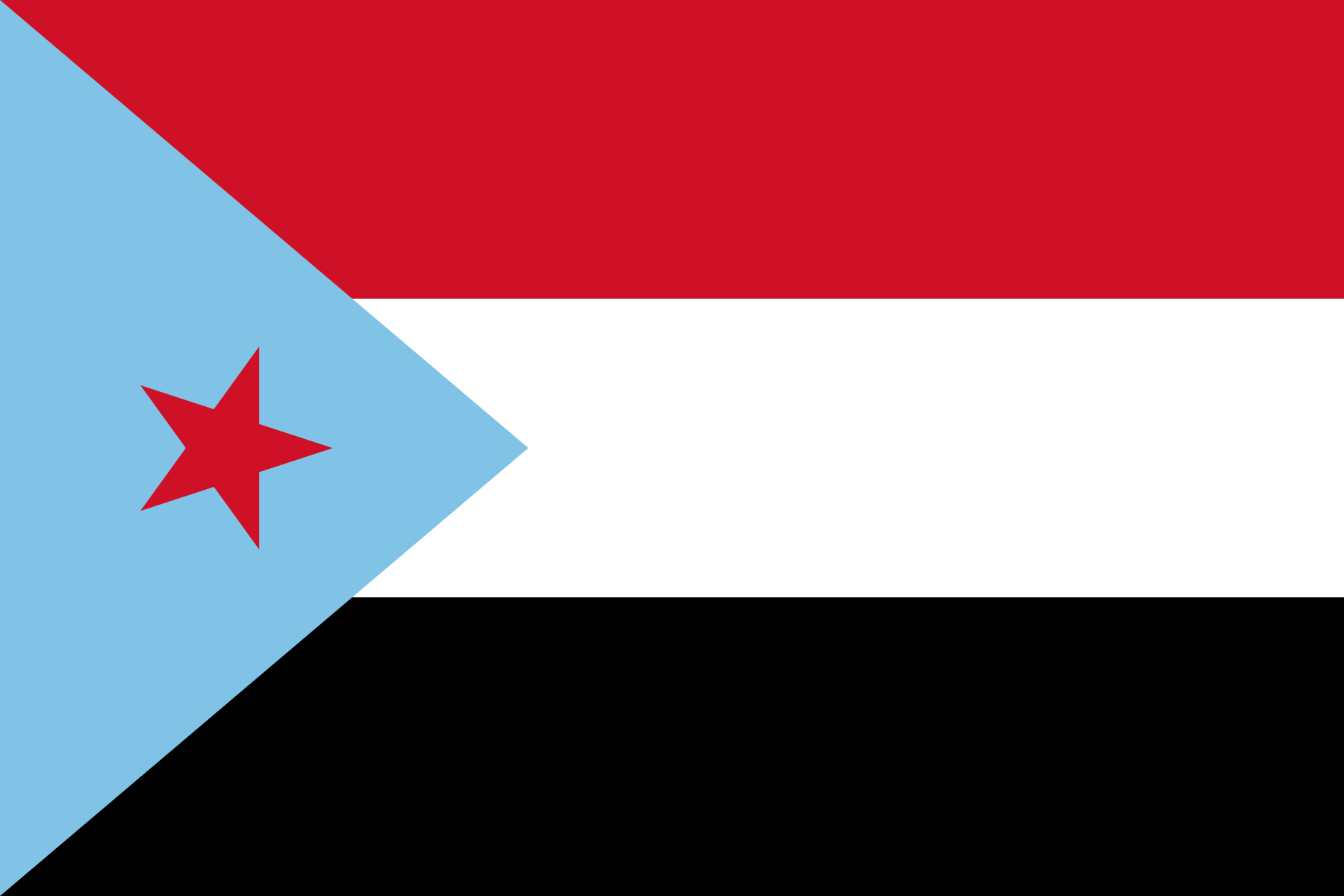
It gives me great pleasure, Sir, to be addressing the Security Council under your wise presidency. Your represent a friendly country, Madagascar, which shares with my country goals for the attainment of which we struggle together in the interest of the security and stability of our peoples and in the interest of the maintenance of international peace and security. Our confidence in your ability successfully to guide the work of the Security Council for the month of March is enhanced by your well-known long experience, expertise and integrity.
179. I wish also to convey our appreciation and gratitude to Mr. Krishnan. the representative of friendly India. for the way in which he conducted the Council’s business in February, which confbmed the ability for which he is so well known.
180. I am pleased to be participating, in my capacity as Chairman of the Group of Arab States in the United Nations for the current month, in the present Security Council debate on the situation in South Africa, a situation which is the result of the per&ten= and intensification of the policy of up&r& pursued by the racist r&jme of South Africa. That regime adds new crimes to those already perpetrated, crimes such as murder, oppremion, uprooting and arbitrary arrests, committed against the indigenous population and against the patriotic militants in South Africa, whose only crime is to be struggling for the liberation of their land. for the exercise of their legitimate national rights, and for the elimination of the policy nfnm*,*rlrl 0 n,&.., uhrA.4 I.., ,L a..-r.L..A n-e.* -. -r-. .,.e..v, L pa.-, ,“p.. .” Y, ,... .I..C1,ara,.“*~. C”. ,,I, ,Y nity, which has on numerous occasions qualifKd it as a crime against humanity.
181. There is no question but that our participation in this debate is an expressi-In of our firm belief in the cultural, historic and geographic ties and shared experiences indissolubly linking the Arab and African peoples in the
I6
182. Perhaps the most sincere afiirmation of this African-Arab solidarity is to be found in the Conference’s Declaration, which stressed that upmheid and all other forms of racism must be totally eliminated from this globe, that no adjustments or reforms of racism are accep table and that there cBn be no compromise with racism. The Declaration further affirmed that any support, direct or indirect. for the manoeuvres of the Pretoria rkgime to delay genuine independence to the people of Namibia, or to dispossess the African majority in South Africa, or to intimidate independent African States, is not only a hostile act against the continent of Africa, but a challenge to the Arab States and people and the international community.
183. Over the years, the Council has considered the crimes perpetrated against the indigenous population by the racist r&gime of South Africa, and, with regard to those crimes, has adopted a series of resolutions, including mohttions 473 (1980). S4 (1984) and 556 (1984). Today. having been informed of developments in the grave situation in South Africa, the Council is called upon to bring about the implementation of those resolutions and to take immediate e&ctive steps to put an end to the injustice and suffering inflicted upon the people of South Africa as a result of the policy of opotrhold. The Council is further called upon to take practical steps leading ultimately to the eradication of uporlhpid.
184. We are fully aware of the magnitude of the suffering afKicting the peoples of South Africa and Namibia because of the large-scale terrorist practices and p&i&s being pursued by the racist r&me in South Africa, practices and policies that take numerous forms and that affect old people, women and children in the civilian population.
185. Our Atab peoples in Palestine, in Lebanon and in the Syrian Golan Heights are facing the terrorist practices and policies being pursued by the racist Zionist regime, practices and policies that ate no different in method from those being implemented by the racist South African r&irrre. ~&taps the best proof of this is the fact that the Security Council is at thii very moment considering the nl-*iv. A *Ku r.imr r-mit*rA kv Aa Lead; -es-. q-.s..-.. Y. . ..- - . . . . . -- _- . . . . . . . . . W” -, “a- .**--*, %n&“)ru tion forces against the Lebanese people in southern Lebanon.
186. We need not dwell on the close alliance that exists between the two racist regimes in Pretoria and Tel Aviv or on their common hostility to the freedom of the African and Arab peoples. The growing co-operation between
187. We strongly condemn all the policies and practtces pursued by the racist regime a South Africa against the indigenous population and that regime’s marlocuvres designed to impede full independence for Namibia in accordance with Security Council resolution 435 (1978). We also condemn the acts of aggression, destabilization and terrorism that are repeatedly committed by that regime against the front-line States and independent African States. We feel that the policy of constructive engagement pursued by the American Administration vir-
&vis the Pretoria regime has damaged the vital interests ot Afrtca just as that Administration’s strategic co-operation with Israel has inflicted damage on the vital interests of the Arab world.
188. While reiterating our unswerving support for the peoples of Namibia and South Africa under the leadership of their national liberation movements in their legitimate struggle to free their territories and eradicate racial discrimination, we fully support the just African demands
189. We also call for the imposition of comprehensive and mandatory sanctions against the Pretoria regime, in accordance with Chapter VII of the United Nations Charter, and for an end to the continuous opposition by permanent Western members of the Security Council to the imposition of such sanctions in order to enable the peoples of southern Africa to wipe out racial discrimination. At the same time, we call for a cessation of all forms of co-operation being maintained by the Western States and Israel with the mcist regime in South Africa that enable and encourage it to persist in its crimes against the indigenous population.
MO. We believe that the fulfilment of those demands would be a concrete translation of the will of the intermttional community as embodied in the many resolutions adppted by the Security Council, the General Assembly and other international forums.
The meeting rose at 7.20 p.m.
- ---.- - --- -
litho in L’wicd Namm. New York awo 9S61439--April 1994-2.050
▶ Cite this page
UN Project. “S/PV.2571.” UN Project, https://un-project.org/meeting/S-PV-2571/. Accessed .