S/PV.2602 Security Council
▶ This meeting at a glance
24
Speeches
10
Countries
1
Resolution
Resolution:
S/RES/569(1985)
Topics
Southern Africa and apartheid
Arab political groupings
War and military aggression
Security Council deliberations
General statements and positions
UN procedural rules

(interpretation from Russian): In accordance with the decisions-taken at the previous meetings on this item [26OOth and 2601s~ meetings], I invite the representative of Mali to take a place at the Council table; I invite the representatives of the Central African Republic, Cuba, Ethiopia, the German Democratic Republic, Kenya, Senegal, South Africa, the Syrian Arab Republic and Zaire to take the places reserved for them at the side of the Council chamber.
At the invitation of the President, Mr. Niare (Ma@ took a place at the CounciI table; Mr. Gbezera-Bria (Centrat African Repubhc), Mr. Oramas Oliva (Cuba), Mr. Worku (Ethiopia), -Mr. Hucke (German Democratic Republic), Mr. Mudho (Kenya), Mr. Ba (Senegal), Mr. von Schirnding (South Africa), Mr. EI-Fattai (Syrian Arab Republic) and Mr. Bagbeni Adeito Nzengeya (Zaire) took the pIaces reserved for them at the side of the Council chamber.















Members of the Council have before them document S/17354/Rev.l, which contains the revised text of a draft resolution submitted by Denmark and France.
3. I should like to draw the attention of members of the Council to document S/17360, tihich contains the text of a letter dated 26 July 1985 from the representative of Tunisia, addressed to the President of the Security Council.
4. The first speaker is the representative of Central African Republic. I invite him to take a place at the Council table and to make his statement.


I should like first of all to congratulate you, Sir, on your assumption of the presidency of the Council. Preceding speakers have paid tribute to your long and varied experience in international affairs and to your diplomatic skills. I associate myself with that tribute.
6. I also wish to express my great esteem for your predecessor, the Minister for Foreign Affairs of Trinidad and Tobago, who presided over the Council’s deliberations last month. At a time when the Council is once again dealing with the question of the South African Government’s policy of apartheid, Trinidad and Tobago offers a picture of a successful multiracial society.
7. I also appreciate the honour which you have bestowed upon my country in allowing it to address the Council and to air its views on the grave situation prevailing in South Afi-ica.
8. Based on the groundless premise of racial superiority-in this case, white-the system of apartheid stands our strikingly in our world in that the negation of the right to be different, racism, is made into a philosophy of State and constitutes the State’s very foundation.
9. That white minority has exclusive enjoyment of all rights and privileges, and arrogates to itself the principles of dignity, equality and justice-principles universally rec-
10. The system of apartheid thus identifies, categorizes and pens in on the basis of skin colour. It denies nationality to 20 million blacks, plunders their lands and fragments a country.
11. At other times and in other places, the world mobilized to tight against a system which sought to govern a world on the basis of the specious, terrible criterion of racial inferiority and which also identified, categorized, penned, annihilated.
12. How human, or rather, how the sacred values of the human person are defended in South Africa by the men, women, children, who have stood up against the sophisticated arsenal of repression by the minority regime of South Africa and its countless criminal actions inside and outside its borders..
13. The established of a state of emergency in 36 districts, under the cover of which the racist regime increases its arbitrary arrests and. detentions without trial and carries out forced displacements, signals a grave deterioration of the situation in that country. It is difficult to justify the establishment of a state of emergency; it is difficult to justify the unjustifiable, unless one really is at bay.
14. There is no superiority whatsoever on the basis of skin colour. Skin colour is no indicator of maturity or immaturity. It gives no grounds for human beings to refuse to treat their fellow human beings as such.
15. My country, the Central African Republic, whose national motto is “zo kouC zo 20” and “so zo la”, in other words, that “each man is a man”, and that “before each man stands another”, who has a right to respect and to dignity, rejects unambiguously and condemns any system that denigrates the affirmation of human identity and the preservation of the human being. This is the constant policy of my country and of its Head of State, General AndrC Kolingba.
16. Apartheid, which in our day remains a crime against mankind and a threat to international peace and security, cannot be reformed. It must be dismantled and yield to a free, indivisible and democratic society, because only the eradication of that scourge and the exercise by the majority of its right to participate in the administration of the public affairs of its country, either directly or through freely chosen representatives in accordance with the Universal Declaration of Human Rights, can restore peace and harmony to that part of Africa.
25. Emboldened by the impunity with which it was able to perpetuate all its crimes over a period of four decades and by the assistance provided it all along by some,, the apartheid Pretoria regime has once again awakened the conscience of the world community by decreeing a state of emergency to allow its police to exterminate the black population of South Africa in order to gain mastery over the territory of South Africa without the presence of the indigenous population of that territory. 17. My country is aware of the immense difficulties, the uncompromising positions and the very different and highly tenacious interests that must be overeome for the attainment of racial justice in South Africa.
19. The authors of the draft resolution [~17354/Bev. I], which in my country’s view is a positive text, explained yesterday the spirit in which the text was drafted and the need for the Council, in the present tragic situation in South Africa, to arrive at a common position. It is in fact desirable for the Council to rally together before this new challenge hurled at it by the racist regime.
20. Therefore my delegation is convinced that negotiations will result in a text that will not only live up to the expectations of the international community but also contribute to the victory of freedom, dignity and justice in South Africa.
2 1. The PRESIDENT (interpretation from Russian): The next speaker is the representative of Zaire. I invite him to take a place at the Council table and to make his statement.


The delegation of Zaire would like first of all to associate itself with all those who extended their congratulations to you, Sir, on your assumption of the presidency of the Security Council for this month of July. Trusting in your qualities as a consummate diplomat together with your long experience in this tield, and furthermore taking into account the fact that you are the Vice-Chairman of the Special Committee against Apartheid, I remain fully convinced that you will successfully conduct the work of the Council on this question before us.
23. My delegation, furthermore, is grateful to the representative of Trinidad and Tobago for the skill with which he presided over the Council during the month of June.
24. My delegation is pleased at this opportunity to present the position of its Government on this question. It was pure outrage and a refusal to stand resigned in the face of the cruelty of the racist regime of apartheid that led France and the Group of African States to call for the convening of an emergency meeting of the Council.
26. If any supervisory commission or the Commission on Human Rights had been able to count the number of killings, disappearances, deportations and acts of genocide
27. Indeed, it is more and more a matter of public record that the policies of apartheid and of racial discrimination, which up until now have denied to the majority of the South African black people its most fundamental human rights, have been becoming more and more a criminal policy used against the black population.
28. The Botha regime is trying not only to consolidate its policy of apartheid, which has been recognized as being a crime against humanity and a threat to international peace and security, but to wipe the black population off the map of South African territory in order to continue occupying the land without the indigenous inhabitants.
29. Otherwise, it is hard to believe that, at a time when all the other racial communities in South Africa are enjoying certain rights and are spared certain humiliations, only the black population continues to suffer arbitrary arrests-the number of which has now reached the record of 9OO-and unjustified removals and killings; in a word, barbarous and inhuman repression.
30. Zaire strenuously denounces and condemns the methods of repression imposed by the racist regime on the black people, and it will tight energetically not only against racial discrimination and Pretoria’s hideous apartheid policy as crimes against human dignity, but also against all the obstacles to Namibian independence erected by that regime.
31. It is within this context that on 25 May 1985 at Kinshasa, on the occasion of the celebration of the Day of Liberation of Africa, Zaire’s Commissar of State for Foreign Affairs and International Co-operation urgently appealed to the international community to continue to exert ever greater pressure on the Pretoria regime, to compel it to put an end to its policy of repression and apartheid.
32. The Commissar of State also called on Governments to cease providing any assistance whatsoever to South Africa and to impose more severe sanctions against it. The Executive Council of Zaire, he continued, condemns Pretoria’s apartheid policy and denounces the policy of bantunization, which deprives the black people of South Africa both of its freedom and of all its rights by keeping it under the booth of the white minority.
33. In concluding his appeal, the Commissar of State called on world public opinion to assist the South West Africa People’s Organization (SWAPO) and to exert pressure to bring about the unconditional liberation of Nelson Mandela, the leader of the African National Congress of South Africa (ANC), as well as all his companions. Hence the delegation of Zaire is extremely pleased that the appeal made by the Zairian Commissar of State is shared by
34. Zaire is pleased, furthermore, that France, the country of the Universal Declaration of Human Rights, the country of Rousseau’s Social Contract and so many other historic decisions that have determined the future of peoples and defined fundamental human freedoms, that France reacted so promptly and so aptly to the horrors and plunders of the Pretoria regime by imposing on it appropriate diplomatic, economic and financial sanctions.
35. My delegation expresses its thanks to the Govemment of France.
36. In our view, the French initiative should be supported and endorsed by all Member States in order to bring down the Pretoria regime and to force it to dismantle its system of apartheid and racial discrimination.
37. The delegation of Zaire also hopes that this initiative will be supported by most other States, which heretofore had relations with South Africa.- -
38. Zaire fervently hopes that the revised draft resolution submitted by France and co-sponsored by Denmark, as discussed with the Group of African States [S/17354/ Rev.& will meet with the approval of all members of the Council.
39. Furthermore, my delegation feels that this positive step taken by France may win over other countries so as to pull up the racist roots of the Pretoria regime, thus allowing the majority black population of South Africa to exercise its civil and political rights in a democratic system.
40. The international community must consequently take this opportunity to devise comprehensive measures not only to put an end to the state of emergency decreed in the 36 districts inhabited by blacks, not only to allow the immediate and unconditional liberation of Nelson Mandela and all other political prisoners or the adoption of political, diplomatic, economic, financial and telecommunication sanctions, but also, and above all, to eliminate completely apartheid in South Africa in order to build a democratic society based on justice and equal rights.
41. I wish to thank members of the Council for their kind attention to the position of the Executive Council of Zaire which I have just presented.
The next speaker is the representative of the Syrian Arab Republic. I invite him to take a place at the Council table and to make his statement.


I am pleased to extend to you, Sir, on my own behalf and in my capacity as, Chairman of the Group of Arab States for this month, heartfelt congratulations on your assumption of the presidency of the Council
44. I take this opportunity to associate myself with the previous speakers in paying a tribute to your predecessors, the Minister for Foreign AfTairs of Trinidad and Tobago and the representative of that friendly country, for the exemplary manner in which they guided the Council’s affairs during its consideration of the aggression of the Pretoria racists against Angola and Botswana, and during’ its consideration of the question of eliminating racist colonialism from Namibia.
45. The Council ‘is meeting today not only to consider a complaint similar to those lodged in the past. Today’s meeting must be one in which we express, with the entire world, solidarity with those who lead the liberation struggle and with the broad masses in South Africa struggling against the terrorism, persecution and servitude imposed upon them. The South African masses have gone beyond the stage of demonstrations and protests and have taken the initiative to resist in self-defence, district by district, house by house and neighbourhood by neighbourhood.
46. Regardless of the attempts of Pretoria and its allies to brand the upheaval as terrorism, there is a growing popular revolution in the full sense of the word, and the Council cannot but salute that revolution and pay tribute to the heroism of its sons. We believe that the emergence of the revolution of the people of South Africa, from the point of view of principle and results, is for the benefit of humanity in its entirety and in the interest of peace and the restoration of stability and justice in southern Africa.
47. The Council, despite the intransigence of those who persist in protecting Pretoria, must support this revolution; it deeply relieves the peoples of the world which have lost faith in the credibility of those who, on the one hand, condemn apartheid and, on the other, strengthen it.
48. ‘The truth has emerged in all its tragic dimensions, and all peoples have espoused the struggle of the South African people following the debunking of the arguments propagated by those who benefit politically, strategically and materially from prolonging servitude and exploitation:
49. Here the South ,African people is speaking its final words to the Council and to the entire world. It is saying: enough hypocrisy, enough manipulation of reality, enough toying with human feelings and aspirations, enough misleading slogans and dilatory tactics. The South African militants have said no-and we join with them-to the policy of “constructive engagement” which provides the white tyrants of South Africa with the ways and means to devastate, destroy, displace and dismember the country, to strengthen apartheid institutions and to increase the brutaiity of racist aggression against the, neighbouring African States.
51. ‘By pursuing those policies, South Africa gravely threatens international peace and security and flouts the relevant provisions of the Charter. It is therefore incumbent upon the Council to use the collective security machinery against’ South Africa.
52. We cannot, intellectually or practically, differentiate between the Fascist, racist practices of Pretoria against the, South African people and its occupation of Namibia or its aggressive practices against the front-line States. The apartheid regime practises settler colonialism at home and corn-. mits :, one act of aggression .after another against neighbouring States to extend its hegemony and control over them. I 53. The Council should facilitate the birth and growth of a revolution against a regime that is an international outlaw; it should not embark, through utopian resolutions, on disfiguring or misleading this revolution by espousing allegations that do not reflect noble Africa’s political, demographic, geographic and political realities.
54. Sanctions are imperative to end the war’being waged by Pretoria against the people of South Africa and the neighbouring countries and to attain the complete independence of Namibia. The argument that economic and other sanctions will adversely affect the black masses belittles the struggle of those masses. He who has proven his willingness to die for the sake of freedom and dignity is not afraid of poverty or hunger. Both publicly and in his heart of hearts, he says c*My freedom and the freedom of coming generations nurtures my humanity and my’ dignity-not’ your .doilars, which are invested in the exploitation of my land, my sweat and my blood.‘*
55. The question before the Council is not the state’of emergency originally declared to mislead the world by creating the impression that Pretoria believes in the supremacy of law and kills, displaces and tortures in accordance with the provisions of law. Has the world forgotten that the apartheid regime is a regime of institutionalized terrorism and violence, practised under laws established to make possible the waging of war against the people of South Africa? Whether or not the state of emergency is lifted will not change a thing. What is required of the Council is the adoption of concrete effective measures to dismantle that regime and to supplant it with.a regime that accords with the will of the struggling masses and is based on freedom and equality without any discrimination.
65. Many representatives of States here have very convincingly uncovered the oppressive facts of the latest crimes of the apartheid regime. The ‘state of emergency installed in 36 districts of South Africa since 21 July especially affects the larger and most densely populated settlements of the black majority of the country and confers new full powers on the apparatus of racist oppression for terrorizing all opponents of apartheid.
57. In his flagrant hypocrisy, the representative of South Africa reminded us, as Arabs, of the statements of the representative of Israel, his comrade and fellow-member of the racist gang. We wonder; for how long will the United Nations allow representatives of the racist rkgimes of Pretoria and Tel Aviv to address it? Is it not time to expel them from membership in an Organisation created in the wake of the Second World War to eliminate fascism and all manifestations of terrorism, aggression and racism?
58. We reaffirm our solidarity, as peoples and Govemmen& with Africa’s struggle by all means. We are confident that the South African masses, thanks to their struggle under the leadership of the national liberation movements embodied in the ANC and the Pan Africanist Congress of Azania (PAC) will triumph over the ruling clique. The terrorists are those who resist the will of peoples to achieve liberty, independence, self-determination, equality and justice.
59. World imperialism, which seeks to rein in the aspirations of the masses by every means, is bound to recede and shrink. That is the lesson of history.
The next speaker is the representative of the German Democratic Republic. I invite him to take a place at the Council table and to make his statement.

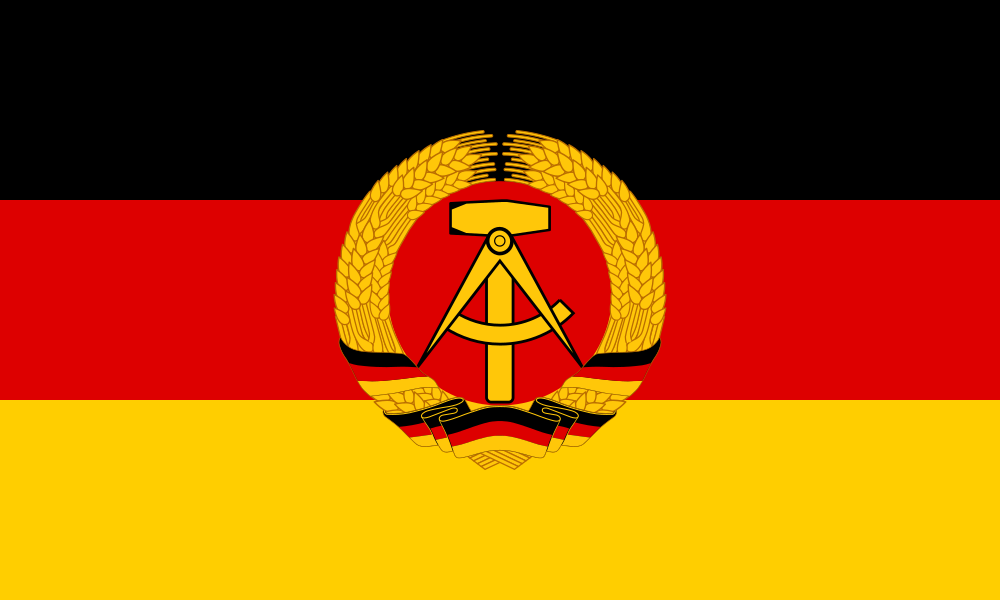
Permit me, Sir, to extend to you the heartiest congratulations of my delegation on your assumption of the presidency of the Security Council for the month of July. Your efforts as President over the last few weeks have already shown that you, as the representative of the Ukrainian Soviet Socialist Republic, with which the German Democratic Republic is, closely and fraternally linked, are using all your great diplomatic skill to lead the Council in the interests of securing peace, solving conflicts and promoting international co-operation.
62 Our appreciation also goes to the Minister for Foreign Affairs and the,Permanent Representative of Trinidad and Tobago for holding the high offtce of the presidency so effectively in the month of June.
63. I thank you, Sir, and the members of the Council for the opportunity given to me to explain.my country’s position on the item under discussion. We appreciate the initiative of France and the Group of African States to convene the Security Council as a timely step in the right direction.
64: Only a few weeks have passed since the Council last had to deal with the policy of apartheid in South Africa, 71. In his message on the occasion of the International Day for the Elimination of Racial Discrimination this
66. .In the fust few days alone after the proclamation of the state of emergency, another 16 people murdered and more than 800 arrested were added to the crime register of the Pretoria regime; more than 500 people have been killed over the last, 10 months.
67. The Special ‘Committee against Apurtheid rightly stated in its declaration of 24 July 198%
“The road from Sharpeville and Soweto to Crossroads and Uitenhage has been one of escalating resistance by the people and indiscriminate violence by the regime, resulting in the killing and wounding of people, including women and children.“’
68. We share the assessment that the state of emergency constitutes Botha’s open declaration of war against oppressed people and the opponents of aparrheid. It is more proof of State-organized terrorism by the ruling circles of the white minority and a clear indication that the racist regime is historically doomed.
69. The new wave of terror in South Africa is an expression of the worsening economic and political crisis of the apartheid system, which has constantly been deepened by the high expenditures for securing the policy of apartheid both inside and outside the country and by the continuation of the illegal occupation of Namibia. However, that policy, which has become stuck in a deep crisis, was possible only because the racists are sure of support from certain imperialist allies, notably the United States. With a policy of so-called constructive engagement, which is aimed at global strategic and economic interests, and with verbal condemnation and half-hearted measures, the system of apartheid is not liquidated, but only encouraged.
70. The upswing of the liberation movement in South Africa, led by the ANC, and the multiplicity of mass actions furnish proof that the manoeuvres of the regime to consolidate its minority rule by an alleged reform of qpurtheid have failed. Against the ever greater revolt of the oppressed and outlawed masses, Pretoria sets in motion its perfected machinery to suffocate their protest.
“Mindful of the bitter historical experience, the people and the Government of the German Democratic Republic oppose with disgust and indignation the practices of the racist and Fascist apbrheid rtgime in South Africa whose policy of State terrorism seriously endangers international peace and security. They condemn the attempts, in disregard of worid-wide protests and United Nations decisions, to preserve the criminal apartheid regime as an instrument for destabilizing the region and preventing any social progress.“2
72 The German Democratic Republic supports the democratic demands of the African population for the terniination of the genocide policy against the population, the immediate cessation of the state of emergency, the release of the political prisoners, including Nelson Mandela, $e suspension of restrictions on persons and organizations, the liquidation of the policy of bantustanization, the creation of democratic conditions, the introduction of a universal fran&se and the elaboration of a new constitution.
73. The situation requires speedy action by the United Nations and the Security Council. International pressure on Pretoria, in accordance with the legitimate demands of the South African fighters against aparrheid, must be enhanced.
74. Like many other States, the German Democratic Republic supports here in this debate the following demand made by the Committee against Aparrhefd at its meeting on 24 July:
“As a first step, the Security council must consider the matter urgently, determine that the situation in South Africa constitutes a threat to international peace and security in terms of Chapter VII of the Charter of the United Nations and decide on’effective sat&ions against the apartheid +gime.‘r3
I should like to infothe Council that I have received a letter from the representative of Yugoslavia in which he requests to be invited to participate in thediscussion of the item on the agenda. In conformity with the usual practice, I propose, with the consent 0: the Council, to invite that representative to participate in the discussi.on, without the right to vote, in accordance with the relevant provisions of the Charter and rule 37 of the provisional rules of procedure.
At t& invitation of rhe president, Mr. Djokic’(Yugoslavia) took the place reserved for trim at the side of the C’auncl CXamber.
The next speaker is the representative of Ethiopia. I invite him


Allow me at the outset, Sir, to congratulate you on your assumption of the high office of the presidency. Givkn your diplomatic dexterity and finesse, we have no doubt that the Council will have very fruitful deliberations.
78. I also thank the Minister for Foreign Affairs, and the representative of Trinidad and Tobago for the able manner in which they guided the proceedings of the Council during the month of June.
79. I should also like to express my gratitude to you, Sir, and your colleagues in the Council for the opportunity accorded to us to participate in this debate.
80. Once again the Council is meeting to consider the abhorrent situation prevailing in South Africa. Once again the world community has been alerted to the tragic situation arising from the imposition of a state of emergency by the terrorist rkgime in Pretoria.
81. The international community is painfully aware of the loss of life in that unhappy country. During the last three months alone, over 500 defenceless persons have one way or another been murdered as a result of the terrorist practices of the apartheid regime. Others, in the hundreds, have been subjected to mass arrest and detention. What is particularly alarming about the declaration of the state of emergency which was imposed on the black masses of South Africa on 20 July is the fact that it allows the fascist forces of aparzheid to arrest, torture, maim and kill the black population in the name of peace and order. It enables them to pursue in a manner which is undoubtedly more vicious and brutal what they have actually long been practicing. The imposition of this notorious state of emergency has already led to the arrest of many leaders of the democratic forces and movements in South Africa. The number of those .lost or unaccounted for is alarming. In all, this has created a state of terror in a country which has yet to witness peace and stability.
82. ‘This state if affairs cannot go unchecked. It is indeed appropriate that the Council should consider measures to be taken against a rdgime which continues to defy intemational public opinion. In this regard, we welcome the timely initiative taken by the Government of France and the efforts that Government has deployed in its endeavour to ensure the immediate convening of the Council, This is a step in the right direction and is worthy of emulation by those who continue to collaborate with the Pretoria @me.
83. What we are witnessing today in South Africa is a continuation-nay, an escalation-of the heinous scheme involving the bantustanization, arrest, torture and mass murder of the black majority by a rkgime which has never harboured even the most elementary notion of human decency, For decades, those who have chosen to wage a struggle for freedom, justice and peace in South ,Africa
84. In an attempt to arrest the rising tide of democracy and social justice in the country, the regime has been uprooting communities and condemning them to a life in arid and semi-arid wastelands. Its response to peaceful demonstrations by defenceless citizens has been more violence and terror. Throughout these years, this regime has enjoyed the unfailing support of some countries which regrettably maintain close contact with South Africa. Consequently, whenever the international communitydemands the adoption of stronger measures against the racist regime in accordance with Chapter VII of the Charter of the United Nations, those same countries advise caution in the treatment of apartheid. We find this attitude totally unacceptable and dilatory.
85. Failure to act promptly would mean condoning the state of terror which has been generated by the repressive regime and the continuation of the human suffering which has been going on in South Africa for far too long. We therefore call upon the Council to act and adopt effective measures against the Pretoria regime, including those provided for by Chapter VII of the Charter.
The next speaker is ‘the representative of Yugoslavia. I invite him to take a place at the Council table and to make his statement.


At the outset, Sir, I wish to convey to you our congratulations upon your assumption of the presidency for the month of July. We are we!1 aware of your diplomatic skill and experience, and we wish you every success in guiding the work of the Council this month.
88. I should like to express our appreciation to the delegation of Trinidad and Tobago, to that country’s Minister for Foreign Affairs and to its representative for the competent, outstanding manner in which they guided the work of the Council during the month of June.
89. Much has been said about apartheid, which has been rightly proclaimed by the General Assembly to be a crime against humanity and a constant threat to international peace and security. Today, in the mid-1980s, apartheid has turned South Africa into a country with an anachronistic and shameful system of State-controlled racism, into a society lacking any respect for human rights and human dignity.
90. For decades, the policy of apartheid of the minority racist regime of South Africa has been causing grave concern to the international community, since it represents a system based on the very antithesis of the fundamental principles of the Charter of the United Nations. The South African regime, by its persistent and most outrageous violations of international law, has isolated itself from the basic values which constitute the very essence of contem-
9 1. Now that a state of emergency has been dedared, it is more evident than ever that the abhorrent system of apurtheid constitutes permanent aggression against the majority of the population of South Africa. Hundreds of persons have been arrested so far. At the same time, at least 11 people, most of them very young, have been killed in clashes with the racist regime’s security forces. Since last September, some 500 people have been killed and thousands injured as the’tragic toll of the new illegal discriminatory constitution.
92 The racist r&me has been conducting large-scale arrests of leaders of the organizations rallied together in the United Democratic Front (UDF), trade unionists, lawyers, students and the leading figures of the civil rights groups opposing racism and the policy of apartheid. By declaring a state of emergency and conferring full powers on the army and the police, the regime has once again demonstrated that it believes only in naked force, repression and terror.
93. The Security Council and the General Assembly have repeatedly cahed upon South Africa to abandon the policy of apartheid and to stop its increasingly ruthless acts of discrimination, detention, criminal prosecution and enforcement of this obnoxious system through sweeping laws and brutal police methods.
94. Over the years, all those acts of the Pretoria regime were meant to institutionalize racial discrimination and to undermine the moral and political principles and fundamental objectives of the Organization and the intemational community, including those embodied in the Universal Declaration of Human Bights. It is evident that the latest measures represent a blatant violation of the principle of the rule of law and of respect for basic human rights. We view the imposition of the state of emergency as a formally declared war on almost 75 per cent of the population of South Africa and demand that such an indiscriminate measure be met with vigorous condemnation.
95. The apartheid State has time and again unleashed its military might against patriotic and progressive men, women and children, at Soweto, Cassinga, Johannesburg and elsewhere in that country of pain and suffering, and beyond its borders as well. The established system of discrimination, repression and aggression represents the basis on which the internal and foreign policies of the minority racist regime are founded.
96. The illegal occupation of Namibia is continuing, and the regime is committing acts of aggression against the front-line States. The decision of the South African regime to form a so-called interim government in Namibia was yet another among the illegal attempts by the racists to prolong the occupation of that Territory by internal manoeuvres.
98. The non-aligned countries have consistently underlined the urgent need for eliminating ‘apartheid and called for the establishment of a society based on equality regardless of race, colour, religious belief or sex. .At the Seventh Conference of Heads ‘of State or .Govemment of Non- Aligned Countries, held at New Delhi in March 1983, stressed their resolve to intensify joint efforts in support of the peoples of southern Africa. Strong support was given also to the liberation movements in southern Africa [see S/15675 and Corr. 1 and 2 annex, sect. IJ.
99. In March this year, in the wake of yet another dramatic manifestation of violence, the Coordinating Bureau of the Movement of Non-Aligned Countries demanded‘ that Pretoria put an immediate end to its policy of terror and uprooting of the indigenous African people from their homes and banishing them to artificially created bantustans. The Bureau commended the massive united resistance of the oppressed people of South Africa against the apartheid regime and reaffirmed the legitimacy of their struggle for a united, non-racial and democratic South Africa [see S/17009, annex]. .
100. We in Yugoslavia strongly oppose and condemn the use of force against innocent people and the imposition of the state of emergency in South Africa. We express our total solidarity and will to continue to render -our full ,moral, political and material support to the courageous struggle of the people in southern Africa against apartheid, racism, colonialism and discrimination. Support for the liberation struggle in southern Africa and for the liberation movements-the ANC and the PAC in South Africa and SWAP0 in Namibia-is the most efficient way to eliminate apartheid and establish freedom, equality.and dignity in that part of the world.
101. It is our firm belief that the Council should strongly condemn the imposition of the state of emergency and call for its immediate abrogation. The Council should also resolutely condemn the continued massacres of the oppressed people and arbitrary arrests and repression. It should demand the urgent and full eradication of apartheid and undertake to consider concrete measures against the oppressive regime of South Africa, including measures provided by Chapter VII of the Charter of the United Nations.
I shall now make a statement in my capacity as the represen-
103. Little more than four months have passed since the Council, after deliberating on the serious situation in South Africa resulting from the latest acts of repression on the part of the racist regime, adopted resolution 560 (1985), which firmly condemned the Pretoria regime for the murders of innocent Africans and arbitrary arrests. That resolution called on South Africa to release unconditionally and immediately all political prisoners. Last month, the Council took up the problem of Namibia, which remains unsolved through Pretoria’s fault, as well as the situation resulting from the acts of aggression committed by South Africa against Angola and Botswana. The resolutions adopted by the Council on those matters made appropriate demands on South Africa.
104. However, recent events in South Africa very clearly demonstrate that the racist regime continues to remain deaf to the repeated demands of the United Nations and of the international community as a whole. In South Africa blood is flowing again. House-to-house searches are going on and arbitrary arrests made. In the last few days alone, more than 800 freedom fighters have been thrown into the racist prisons. Under the cover of the state of emergency imposed by Pretoria, the racists’ police and army are step ping up terror and repression. The worsening situation in South ‘Africa will inevitably, lead to a greater ,threat to international peace and security.
105. The situation ‘in South Africa has worsened and become truly explosive because the Pretoria regime, trampling underfoot the legitimate rights of the overwhelming majority of the population of the country in.disregard of the will of the international community, is stubbornly pursuing a policy of perpetuating the apartheid system and shoring up the rule of the racist minority. After failing in its political manoeuvring, the racist regime of Pretoria has returned to its more usual methods-the use of guns and bayonets. However, this new violence on the part of the aparrheid regime will lead only to‘a greater upsurge in the national liberation struggle ‘in South Africa.
106. We feel complete solidarity with those who are so courageously lighting apartheid; we firmly support their just struggle for a future of freedom.
107. As correctly pointed out in the statement made by, the Special Committee against ‘Apartheid on 24 ‘July this year, in connection with the serious deteriorationof the situation in South Africa.
“The responsibility for the tragic loss of life rests not only on the terrorist regime in Pretoria, but also on those Powers that have continued to hinder and frustrate effective international action to force that regime to abandon apartheid and tepression.“3
108. It is absolutely clear that political, dipiomatic, economic, military and other assistance and support.provided South Africa, whatever name you give it-“constructive
The representative of France has proposed that the Council proceed to a vote on the draft resolution distributed under the symbol S/17354/Rev.l.
115. The representative of Burkina Faso, together with the delegations of Egypt, India, Madagascar, Peru and Trinidad and Tobago, has submitted an amendment to draft resolution S/17354/Rev. 1.
109, The situation which has arisen in the southern part of the African continent calls for firm and, above.all, effective measures on the part of the international community. An important role in this must be played by the Security Council. In view of the South African regime’s continued disregard of United Nations resolutions, its steadily hardening apartheid practices and policies, its persistent acts of .aggression against independent African States, the build-up of its military potential and South Africa’s continuing plans for the development of nuclear weapons, the Ukrainian SSR firmly supports the call for the Council’s adoption of all necessary measures against the racist regime in South Africa, including comprehensive, mandatory sanctions provided in Chapter VII,of the Charter of : the United Nations, which, in the view of a majority of. countries, are the only remaining peaceful means for compelling Pretoria to give up its policy of apartheid, terror and repression. It is time to put an end to the tyranny of racism. This can be done only through joint efforts on the part of the entire international community, and first and foremost the members of the Security Council.
116. Article 33 of the rules of procedure provide, that a proposal to introduce an amendment has precedence over a draft resolution. I shall therefore put the amendment proposed by the representative of Burkina Faso to the vote.
A vote was taken by show if hands.
In fayour: Australia, Burkina Faso, China, Denmark, Egypt, India, Madagascar, Peru, Thailand, Trinidad and Tobago, Ukrainian Soviet Socialist Republic, Union of Soviet Socialist Republics.
Against: ‘United Kingdom of Great Britain’ and Northern -Ireland; United States of America.’
Abstaining: France.
110. I now resume’ my function ,as PRESIDENT. ,
l’here were I2 votes in favour, 2 against and 1 abstention.
111. Mr. de KEMOULARIA (France) @trerpreturion from French): Mr. President, as you yourself indicated at the beginning of this afternoon’s meeting, my delegation submitted a revised draft resolution which has been distributed under the symbol S/17354/Rev.l and which is now before the Council. This draft broadly takes into account suggestions made to us since yesterday. It is therefore my honour at this time to request that it be put to the vote in the Council.
The amendment was not adopted, owing to the negative votes of two permanent members of the Council
I shall now call on members of the -Council ,who wish to speak before the voting on the revised draft resolution contained in document S/17354/Rev.l. That draft resolution, sponsored by Denmark and France, has just been introduced by the representative of .France.

It is my honour, on behalf of the delegations of Burkina Faso, Egypt, India, Madagascar, Peru and Trim- : dad and Tobago to submit to the Council the following amendment to draft resolution S/17354/Rev.l:

The draft resolution submitted by the delegations of Denmark and France symbolizes the Council’s revulsion at the continuing violence and killing in South Africa and at the repressive measures invoked. Apartheid is the antithesis of democracy and of the civil and political rights which democratic countries uphold. The policy and practice of apartheid have therefore evoked particularly strong feelings in democratic countries. They offend the very principles on which our societies are founded.
“Strongly warm South Africa that failure to do so would compel the Security Council to meet forthwith to consider the adoption of appropriate measures under the United Nations Charter, including Chapter VII, as additional pressure to ensure South Africa’s compliance with relevant United Nations resolutions and decisions;” [S/173631. ,i I propose that this amendment be inserted after operative paragraph 5 of the draft resolution.
119. While no one can claim a monopoly of concern; it is true to say that nowhere are there deeper and more genuine feelings about the situation in South Africa than in the United Kingdom. My Government, in reaching its decision on this draft resolurion, has taken full account of
120. However, the situation which it has created in South Africa requires the most serious and sober thought on the part of the Council. This is, as we have said before, a matter where our objective should be to unite, not divide, the Security Council and the United Nations.
121. Most of the draft resolution which is before us accords generally with the existing policy of my Govemment and of our European partners-a policy, as I have said, .which combines pressure and persuasion-but we cannot endorse in particular its operative paragraph 6. To us, the sale of South African krugerrands is not a major issue. Many years ago the United Kingdom declined to participate in South Africa’s civil nuclear programme because the South African Government refused to accept the safeguards of the International Atomic Energy Agency. We have long urged other Governments to adopt a similar attitude. With our Commonwealth partners we participate in the Gleneagles’ Agreement on sporting contacts with South Africa. It goes without saying that the United Kingdom upholds strictly the mandatory embargo enacted under Security Council resolution 418 (1977) to govern the sale of arms to South Africa.
122. However, we cannot vote for this draft resolution and were obliged to vote against the amendment just submitted because, as I said earlier, it would not, in our view, be responsible to call for measures that would not achieve the changes we all seek in South Africa and which could indeed prove counter-productive. It would not be responsible to try to engender economic disruption in South Africa when it is clear that the economic advancement of all sections of the population-and particularly of the pooresthas been a powerful catalyst for change and increases the pressure on the South African Government to dismantle completely the apartheid laws. Measures under Chapter VII of the Charter of the United Nations would thus not be an effective way of achieving constructive internal change in South Africa. The Council should be seeking to build, not to destroy. Above all, it should seek by all means to promote a genuine dialogue within South Africa between all sections of the community, and not to encourage further violence or a widening of the grave divisions which at present exist. k
123. We and our European partners stated on 23 July [s/17362, annex] that we were looking for significant and rapid progress within a reasonable period of time in South Africa. We shall watch developments in the months ahead with close concern.
Since no other member of the Council wishes to speak
A vote was taken by show of hands.
In favour: Australia, Burkina Faso, China, Denmark, Egypt, France, India, Madagascar, Peru, Thailand, Trinidad and Tobago, Ukrainian Soviet Socialist Republic, Union of Soviet Socialist Republics.
Against: None.
Abstaining: United Kingdom of Great Britain and Northern Ireland, United States of America.
By 13 votes to zero, with 2 abstentions, the draft resolurion was adopted [resolution 569 (1985)].
I shall now call on members of the Council who wish to make statements after the vote.
126. Mr. de KEMOULARIA (France) (interpretation from French): France, which took the initiative in calling for these emergency meetings of the Council in view of the continuation and worsening of the suffering caused by the apartheid system in South Africa, is pleased at the adoption of the draft resolution it submitted to the Council with the co-sponsorship of Denmark after having in great measure taken into account the comments made by the nonaligned members of the Council.
127. France thanks all the members of the Council for the constructive spirit and seriousness they have shown during our work. None the less my country believes that the provisions of Chapter VII of the Charter of the United Nations do not apply to the question the Council has had before it. That is why my delegation abstained in the vote on the draft amendment in document S/17363.
128. The Council’s adoption of this resolution is the gravest warning that has been issued to South Africa to condemn its policy of racial discrimination and the violation of human rights. Let us hope that this warning may be heeded.
On behalf of Egypt, India, Madagascar, Peru, Trinidad and Tobago and Burkina Faso, I should like to make the following statement.
130. The Council has just adopted resolution 569 (1985) on the situation in South Africa. The delegations of the aforementioned countries voted in favour of that resolution. Our votes should be understood as expressions of our firm condemnation of the heinous apartheid regime and everything it represents, as well as the systematic murders and arbitrary arrests and detentions carried out by the racist Pretoria regime following imposition of the state of emergency in South Africa.
132. If, on the one hand, we have already expressed our appreciation of the initiative taken by France within the Council, as well as the efforts of the sponsors of the draft resolution, Denmark and France, to take account of certain concerns of the non-aligned countries, on the other hand we regret that the resolution adopted by the Council suffers from a fun&mental omission, in that it contains no reference-even a veiled one-to measures under Chapter VII of the Charter of the United Nations, which we feel the Council should impose against South Africa.
133. That omission could have been overcome to a large extent through the inclusion of our amendment [S/I7363J, which is identical to the text of Council resolution 566 (1985), adopted on 19 June, on the situation in Namibia. We regret that two permanent members voted against that paragraph today, which has led to a weakening of the Council’s position and thus sends Pretoria a false message. We hope, however, that the Council will revise that position in the near future. Furthermore, we deplore such formulations as “the Republic of South Africa” and “the South African Government”. We do not recognize such language, and it is not in such terms that we are accustomed to designating the racist South Afi-ican r&me in the United Nations. Any other expression that might in any way whatsoever tend to legitimize the racist rigime would not be acceptable to us either.

The United States supports most of the elements in the resolution the Council has just adopted. The United States wants an end to the state of emergency in South Africa. Clearly, the underlying problem in South Africa is apartheid, and the impatience to see that system change underlies the current turmoil.
135. The Government of South Africa must understand that the question is not whether but how apartheid is going to end.
136. We reiterate our call for serious talks between the Government of South Africa and black leaders aimed at establishing a just society in South Africa.
137. We will maintain our policy of constructive engagement with South Africans. If there is no voice of reason

The Soviet delegation voted in favour of the draft resolution contained in document S/17354/Rev.l. Similarly, we voted for the amendment to it proposed by a group of non-aligned States members of the Council [S/17363]. We voted for the draft resolution because it vigorously condemns the system of apartheid, the policies and practices of the upartheid regime, the mass arrests and murders that have been carried out by the criminal elements in Pretoria and the state of emergency that has been declared in that country, and because it contains a demand that the state of emergency be revoked.
139. At the same time, we should like once again to emphasize that the draft resolution did not reflect The just and completely warranted demands of the African States and other non-aligned countries for the imposition of comprehensive mandatory sanctions against the racist rkgime in South Africa, as laid down in Chapter VII of the Charter of the United Nations.
140. We regret that the amendment put forward by the group of non-aligned States members of the Council, containing a warning that sanctions would be imposed against the racist r&ime, was vetoed by the United States and the United Kingdom. We also regret that those countries, which said that they condemned the racist regime, failed to support even the draft-insuff%ziently strong, in our opinion-put forward by Denmark and France. That is a further indication of whose side those countries are on.
The Council has thus concluded the present stage of its consideration of the item on the agenda.
i%e meeting rose at 6 p.m.
NOTES
’ See A/AC.1 lVL.627, p. 1.
z See A/ACJIS/PV.560, p, 62.
’ See A/AC. 1 WL.627, p. 2.
-41 & &.A Js J,.Al iis
&I 2 l+s *I . lJWl .L;i fl$ cj$ll ,,c d&l 2 UI pi/l ;‘rrtj & J&i ,+Q .c;;c$,i4r.~~j~,j.;L”;‘~pr~l:J!~~J~~~~jll
BRmB4zerabRdiC B~~~~lbQt~~~~#~~!~A~B~~~~ inm#baMarEH!3fitHAhm w$ulnalL, !
HOW TO OBTAIN UNITED NATIONS PUBLICATIONS United Nations publications may be obtained from bookstores and distributors throughout~the world. Consult your bookstore or write to: United Nations. Sales Section, New York or Geneva.
COMMENT SE PROCURER LES PUBLICATIONS DES NATIONS UNIE!G Les publications des Nations Unies sont en vente dans les librairies et les agences d@sitaircs du monde entier. Informez-vous aupr&s de votre libraire ou adresscz-vous B : Nations Unies. 6ection des ventes. New York ou Gentve.
ICAK llOJIYYMTb W3fiAHWS OPrAHH3Am O6M,UMHEHHblX HAUMQ H3J.tamtn Opratttt3attutt 06aenmtettxstx HatmR MOXHO WHTb B KHHlKHbtX ~ara3mtax
it arettTcTBaX BO BCCX PaftOHaX MHpa. fianomtre cttpaBXH 06 it3JtaHHRX B BattEn XHHEHOM
Mara3HHe AJtH ttHUIHTe tt0 al.tpecY: OprtWH3aUHX 06SellHHeHHbtX HatmU. CetCUHa II0 ItpoJtalKe H’JllaHHtt. HbK)-hpX HllH XKeHeBa.
COMO CONSEGUIR PUBLICACIONES DE LAS NACIONES UNIDAS Las publicaciones de las Naciones Unidas est&n en venta en librerfas y casas distribuidoras en todas partes de1 mundo. Consulte a su libnro o dirljase a: Naciones Unidas. Seccib de Ventas. Nueva York o Ginebra.
Litbo in United Nations, New York 00300 90-61439-January 1995-l ,925
▶ Cite this page
UN Project. “S/PV.2602.” UN Project, https://un-project.org/meeting/S-PV-2602/. Accessed .