S/PV.2240 Security Council
▶ This meeting at a glance
19
Speeches
7
Countries
2
Resolutions
Resolutions:
S/l401,
S/RES/475(1980)
Topics
Southern Africa and apartheid
Security Council deliberations
War and military aggression
UN procedural rules
General statements and positions
Peace processes and negotiations

In accordance with the decisions taken at the 2237th meeting, I invite the representative of Angola to take a place at the Council table and I invite the representatives of Algeria, Botswana, Brazil, Cuba, India, Mozambique, Nicaragua, Pakistan, Romania and Yugoslavia to take the places reserved for them at the side of the Council chamber.
At the iwitcrtion of the President, Mr. de Figucircdo (Angola) took u place ot the Cotmcil t&e und Mr. Semi&i (Algeriu), Mr. Modisi (Botswmu), Mr. CorrZu dr Costu (Brcrzil), Mr. Rou Koln-i (Cwbu), Mr. Mishru (India). Mr. Lobo (Mozumhiquc). Mr. Tinoco (Nicarugs), Mr. Nuik (Pukistun), Mr. Marinescu (Romania) and Mr. M&ezinoviP (Ylrgoslavicr) took the places reservedfcw them crt the side of the Council chamber.














I should like to inform members of the Council that I have received letters from the representatives of Benin, Guinea and Nigeria in which they request to be invited to participate in discussion of the item on the agenda. In accordance with
the usual practice, I propose, with the consent of the Council, to invite those representatives to participate in the discussion without the right to vote, in conformity with the relevant provisions of the Charter and rule 37 of the provisional rules of procedure.
At the invitation c$ the President. Mr. Horrngcworr (Benin), Mr. Kouyath (Guineu) und Mr. Blunkson (Nigcviu) took the pluces reserwd for them ut the side of the Council chumher.
I should like to inform members of the Council that I have received a letter dated 27 June from the Acting President of the United Nations Council for Namibia which rehds as follows:
“I wish to convey to you the desire of the United Nations Council for Namibia to participate in the debate on South African aggression against the People’s Republic of Angola, without the right to vote.
“For this purpose, the Council will be represented by a delegation headed by myself as Acting President of the Council and including the following representatives in the Council: Mr. Sreenivasan of India, Mr. F. Star&v% of Yugoslavia.”
4. On previous occasions the Security Council has extended invitations to representatives of other United Nations bodies in connection with the consideration of matters on its agenda. In accordance with past practice, I propose that the Council extend an invitation under rule 39 of its provisional rules of procedure to the Acting President and the delegation of the United Nations Council for Namibia.
It w*s so decided.
I should like to inform members of the Council that I have received a letter dated 26 June [S//4026] from the representative of Tunisia, which reads as follows:
“I have the honour to request that during its consideration of the item ‘Complaint by Angola against South Africa’ the Security Council extend an invitation under rule 39 of its provisional rules of procedure to Mr. Clovis Maksoud, Permanent Observer for the League of Arab States to the United Nations.**
I should like to draw the attention of members to document S/14028, which contains the text of a letter dated 27 June from the representative of South Africa addressed to the President of the Council. I should also like to draw the attention of members to document S/14030, which contains the text of a letter dated 27 June from the representative of Angola to the Secretary-General.

The Council is now quite familiar with this alternation of debates and acts of aggression affecting in turn southern Africa and occupied Palestine. We have already said so, on 11 April last [2211th meeting], and we concluded that this situation was extremely .illuminating for anyone who wanted to learn from it.
8. The escalation of aggression against Angola demonstrates once again that the retreat of colonialism is nothing but an illusion for the African peoples and that South Africa has certainly not drawn the conclusions which the United Nations itself has largely drawn, although in terms of words, of course.
9. The same strategy of invasion, the destruction of civilian property and the stationing of troops is, as we can see, repeated in Angola, and it is equally probable that in future it will spread to other countries of the region. If legal scruples do not do much to prevent this violation, what must an African country do in physical or military terms to deter South Africa?
10. It is quite obvious that this tragic situation transcends the framework of Africa alone,. as indeed nazism overwhelmed the countries of Europe; it could not be contained or reduced by the efforts of Europe alone. That is why the urgent appeal to the United Nations assumes its true significance, and the Security Council therefore assumes a decisive role.
11. In such a context, the people of Angola first, and all the African people whose hearts beat as one, attach vital importance to the action of the United Nations. We do not think it is enough to be listened to, or to register often enough the expression of theoretical support, but what we do need, very specifically, is to ensure the security of our peoples, peace on our frontiers and respect for our rights and dignity. The evil lurks within. As in the case of Europe formerly, we know from our everyday experience that the proximity of a racist regime is far from signifying peace.
12. The Council must first rise to the call for effective action in the face of the repeated and unbridled outrages of the South African regime. Every responsible State must face up to its international obligations. We are witnessing the constant violation of intemas
13. We believe that this new aggression against Angola, in its scope and with the resources used, just a few weeks after the adoption by the Council of resolution 466 (1980) and of resolution 473 (1980), really leaves no hope that South Africa will comply with any measure decided upon by the United Nations unless that measure is accompanied by the machinery of binding sanctions in accordance with Chapter VII of the Charter.
14. Before concluding, I should like to express the hope that the Council will be able to take a decision urgently in order to put an immediate end to aggression and to bring about the withdrawal of the troops which have invaded Angolan territory and which are still there. That measure is an urgent necessity, in our view, because of the large number of civilian victims and the degree of damage caused by that invasion.
15. I am instructed by the Group of Arab States to assure the fraternal people of Angola of our wholehearted solidarity with them in their ordeal. In their resistance and in their calmness, they may rest assured of the constant and unswerving support of all peaceloving peoples, and they can rest confident in the inexorable victory of justice, law and right.
16. Mr. vanden HEUVEL (United States of America): The most frustrating aspect of the long and arduous attempt to bring South Africa’s illegal occupation of Namibia to a peaceful conclusion is that progress towards a solution is too often accompanied by behaviour that endangers the prospects of peace. Today’s debate illustrates this point.
17. Once again, we have reached a critical juncture in the negotiations towards a lasting settlement of the Namibian dispute. Yet even now, with the possibility of peace so close, South Africa has launched another military action into the territory of an independent nation that borders on Namibia.
18. South Africa’s attack on the People’s Republic of Angola, launched from Namibia across an internationally recognized border, was wrong. Its continued military presence in Angola is wrong. By its behaviour, South Africa is simply reinforcing the doubts of those who are sceptical about whether a negotiated solution is truly possible.
.
20. The cycle of violence rooted in South Africa’s illegal occupation of Namibia must end, and it must end now. But only the achievement of a comprehensive settlement will break the cycle, and ensure a lasting peace for Namibia and all its neighbours.
21. The United States is determined that the people of Namibia will soon realize their dream of freedom. We will use every practical means to create conditions so that our efforts will succeed. We once again call upon all concerned to do the same.
The next speaker is the representative of Benin. I invite him to take a place at the Council table and to make his statement.


Mr. President, I should like to thank you and the other members of the Council once again for inviting the delegation of the People’s Republic of Benin to take part in this debate devoted to the repeated acts of aggression of the racist regime of Pretoria against the People’s Republic of Angola. I should like to express the satisfaction of my delegation at the admirable manner in which you have been conducting the work of the Council during this month of June.
24. The-situation created in southern Africa by the racist regime of Pretoria, with the continued illegal occupation of Namibia, which serves as a base for senseless and unprovoked aggression against neighbouring States-the People’s Republic of Angola in particular its principal target-is filled with threats to peace and security in Africa and in the world. I should hope that the Security Council is well aware of this dangerous situation.
25. The delegation of the People’s Republic of Benin listened with deep emotion yesterday to the statement of facts presented to the Council by the head of the Angolan delegation [2237rh meefing]. The situation is extremely grave; it is even dramatic. The population of the People’s Republic of Angola, in particular the women, the children and the elderly, are the victims, even as I speak, of barbarous acts and massacres committed by the armed forces of the racist regime of Pretoria.
27. I have much admiration and respect for the sponsors of the draft resolution contained in document S/14024. I am well aware of’how much work went into this text. I am aware of the fact that the sponsors are standing together behind independent Africa and are in favour of the complete liberation of our continent from foreign, colonialist and imperialist domination. I am also well aware of the fact that around this table there are in addition to the sponsors a number of States which also stand together in favour of the complete liberation of Africa from the racist control exercised by Pretoria. I also know that in this Council there is a majority in favour of radical action under Chapter VII of the Charter, this being the only way of dealing with the repeated challenges offered by the racist regime in Pretoria, which stops at nothing to maintain its racist domination over southern Africa and which is continuing with impunity to commit acts of aggression against Angola, killing members of the civilian population, in particular women, children and innocent old people who have not the slightest means of defending themselves.
28. An objective analysis of the composition of the Council, and especially a thorough study of the positions adopted publicly and behind the scenes by its members, shows clearly that the imperialist Powers who hold the right of veto are accomplices to the atrocities committed every day by the Pretoria racists in Namibia, South Africa and Angola. This is not even to mention acts of aggression committed in the frontline countries. Those Powers, to our way of thinking, are primarily responsible for the Council’s inaction and for making it, to all intents and purposes, ineffective in the matter of putting into effect the principles contained in the Charter.
29. All these Powers, since 7 June, when the People’s Republic of Angola became the victim of aggression, have remained silent. None of them has condemned in its national sphere the acts of aggression committed by the South African regime. Not a single one of these Powers seems really to take seriously the dangerous invasion which today threatens the stability of the People’s Republic of Angola. Never has the press of
30. A!! these circles, and the voracious multinational corporations which exploit the natural resources of our continent, speak of and concern themselves with aggression or threats against peace and security .on!y when their vita! interests are directly threatened. The armies of Pretoria, which they have endowed with awesome sophisticated weapons in frequent violation of the embargo on arms bound for South Africa, can kill, slaughter and wreak havoc among innocent women and children in South Africa and Angola, as at Cassinga, in Zambia and in other front-line countries; but the Western Powers will not raise their little finger, for their vita! interests are served by these acts of slaughter and barbarous killings. This is their political morality. This is their system of human rights. This is Western democracy. Here, today, our anger is legitimate.
31. In the Council, al! these’ Powers that .ho!d the right of veto have concocted a veritable ritual, a vocabulary, a specific ‘language of words and commas and ready-made phrases that they impose on other members of the Council. ,Whenever any group of States tries to break the official ritual in the Council, ,the right of veto hovers over all the Council’s debates like .a very sword of Damocles. ’
32. This is the truth. It may not be to the liking of some, but we shall say it anyway. This is a particularly serious situation, which has quite annihilated the authority of the Council and makes the United Nations a’laughing-stock. The draft resolution which I referred to earlier, and which you may shortly‘be adopting, is a striking illustration of the ‘situation we have just described. In the humble opinion of my delegation, there is not a single word or comma in this text which has not already been used and accepted by the Powers to which I have referred. These words and these commas are ,part of the official vocabulary perfected over the years by the Powers to protect their interests. It is’at this point that we say “no” and that our revolt is expressed in the most radical way.
33. It is clear in the light of what I have just said that the adoption of this new resolution does not represent any progress at al! and brings to bear no impact on the situation prevailing in southern Angola today, a situation which was so ably described to us by the representative of Angola. This resolution is another useless piece of paper containing a resolution deprived of teeth. It has nothing to do with the serious events which the Council has met to discuss. The question that we have raised here must concern a!! States, in particular small States which have no armies with which to defend themselves, and which have become Members of the United Nations in order to find shelter under the umbrella of international justice. The whole international community must take this matter seriously.
34. The Security Council, by virtue of Chapter VII of the Charter, has been provided with the means -genera! and. obligatory sanctions-to confront the dangerous situation ,which the racist Pretoria regime is daily creating to the detriment of peace and security in the African continent and in the world. why ‘this hesitation? Why not dare to act? All those who have spoken here have shown that no measure can be effective in influencing South Africa except genera! sanctions. Why not decree such sanctions? The concern of certain Powers with their own petty interests, aswe!! as their desire to dominate and exploit, obstruct the work of the Council. The wrongful use of the veto by those same Powers is a scandal which ought to be denounced here.
35. Aparrheid is a policy which has been decried by the United Nations and considered a crime against mankind. The occupation of Namibia is yet another act of lawlessness, as is’aggression by one country against another. Those acts were foreseen, and, to limit them, steps were taken in .the Charter. Why, then, does the Council not act? It is high time that it did so. We have had enough of vacuous texts, useless pieces of paper which the-Council adopts in the face of particularly serious situations in which’human lives are at stake. We have had enough of all this empty chatter,. a!! this verbiage. It is high time to confront the danger which is a threat to everyone;
36. We have stated and we reiterate that the uparrheid regime is inextricably linked with international imperialism in Africa. It is a bridgehead of imperialism in its global strategy of dominating our continent. If the Council could be consistent’ and ‘act in a concerted manner, the repeated acts of aggression by the Pretoria regime against the People’s Republic of Angola would by now have ceased, by perfectly peaceful means provided for in the Charter. ’
37. That is why we say that a!! those who assist the Pretoria regime to maintain its evil practices are entirely responsible for the present situation. We shall continue to denounce that regime and we shall never tire of doing so. We say that Africa shall be free. We do not like war, it is true. Africa is made up of peaceful peoples who love life, the pastoral life, the everyday routine, and who foster friendship with every country in the world. It is true that we do not like violence; but when violence is used against us, we are forced to meet it with violence.
38. Our patience does have its limits-the Council must take immediate action.. States which are fighting for peace and security in the world, those far removed from the cynicism and hypocrisy of international
39. Before concluding, I should like to express the complete solidarity of my country, the People’s Republic of Benin, of its people, its ,Govemment and its party, with the people, the Government a& the MPLA party of Angola in their courage and their determination to fight and to overcome. ,’
40. The fight goes on!
The next speaker is the representative of Nigeria; whom I invite td take a place at the Council table and to make his statement.


Mr. President, my delegation, a?d 1 personally, are happy for this opportunity to congratulate you once again on your assumption of the presidency of the Council.’ During this month of June developments that threaten intemationa! peace and security in many parts of the world have placed heavy responsibilities on your shoulders. Your wisdom, diplomacy, skills and ability have enabled you to discharge the functions of your high and demanding office with fairness and firmness. I have no doubt that you will continue to draw upon those qualities in your efforts to shape the Council’s response to this pressing matter on its agenda, South Africa’s unprovoked and premeditated aggression against the People’s Republic of Angola, which is in violation of a!! norms of international law and conduct. : 43,‘. We h&e listened with carefu’i &ten&$ ;o t& eloquent account by my dear friend and brother Ambassador .de Figueiredo of Angola of this latest chapter in South Africa’s deliberate series of outrages against his country. We have been confronted by specific facts, facts which no one has challenged or dares challenge, facts detailing the violation of Ango- Ian airspace and territorial boundaries, facts listing the criminal exploits launched by South Africa against Angola and their dire consequences for the latter. We have learned that the casualties from the latest South African invasion, which began on 23 June, include the killing of more than 370 men, womenand children, the injuring of over 255 persons and extensive damage to property, farms and livestock. Nigeria extends its deep sympathy to our Angolan brothers and sisters on these tragic losses.
44. it was our historic privilege to be actively and positively associated with the birth of an independent Angolan nation. I wish to reiterate our national commitment to stand shoulder to shoulder with Angola through thick and thin until our continent is totally rid of racists, settler colonialists, .exp!oiters and surrogates of imperialists.
46. Commenting on the South African raids against SWAP0 bases in southern Angola, Mr. Willers, formerly of the South African Department of Foreign Affairs, wrote the following in the,RmJ Duily Mtril of 18 .June:
“It is an enduring the& of South African foreign policy, a .pervasive belief, that military and economic power generally, outweigh other factors circumscribing South Africa’s relations with the African continent and vice versa. There is a view that in the final analysis redpolitik counts for more than the moral considerations of upcrr-theid and other ideologies, even Marxism. Redpolitik is the name of the game, and perhaps this is the reason why it is so difficult. to escape the impression that a climate of acceptance in South Africa for a possible eventual SWAP0 election victory in Namibia and a South African withdrawal from the Territory is being generated at present.
“This is the pragmatic ,construction which can be placed on the recent security raid into Angola which destroyed the Plan Operation Headquarters and which went a long way towards answering the question whether Mr! P. W. Botha’s Cabinet would .ever countenance a SWAP0 Government,. The answer of course is yes, it would. Pretoria has never said it would not accept the democratic choice of the .Namibian people in a free and fair ele.ction.. ,Power through the barrel of a gun? No, with a capita! N. But through elections, why not?” _, ,
The article also stated that the raid had bolstered the internal forces in Namibia, for, as the author saw it, as a result of the events in Rhodesia, the Democratic Tumhalle Alliance (DTA) had come to the conclusion that “nice guys don’t win elections in Africa”. Therefore they, DTA, not only must have to show that they are as tough as their opponents but, more important, they must have the power to get in, in other words to win the election. ./ .-
47. Whether that represents the thinking ‘of the benighted South African r&ime or not. and this author should know, the fact-that the sovkreignty of Angola, a State Member of the United Nations, has again been violated in contravention of a!! the norms and tenets of international law and conduct should be strongly condemned by the Security Council. The South African tigime, in sanctioning the invasion of
48. Nigeria is not surprised at South Africa’s repeated attempts at diverting attention from her own domestic problems, problems brought about by criminal policies of racial arrogance, racial hatred and human exploitation. We reject all attempts to settle those self-imposed problems by the illegal usurpation of Namibia or the occasional military occupation of Angola and other neighbouring States. Instead of deceiving themselves by applying cosmetic changes to the face of crpcrrtlreid, the South African racist regime should come to grips with reality; crprrrtiwid cannot be changed; it has to be destroyed, completely eliminated.
49. Until the crporthd regime reads and understands the writing on the wall, it is essential that the international community should concert its efforts primarily in two areas to help save South Africa from itself, in the interests of justice and of world peace and security. These two areas are being mentioned because of the reluctance to take action under Chapter VII of the Charter.
50. The first is the arms embargo. In its resolution 418 (1977). the Council imposed an arms embargo against South Africa. That embargo has, like the sanctions on Rhodesia, been by and large honoured more in the breach than in the observance. We are therefore faced with a situation whereby, through the support of its friends and allies in the West, South Africa is now a major arms exporter. To substantiate that allow me to quote from a commentary broadcast on 7 May 1980 by the Johannesburg International Service of the South African radio:
“The latest development is that the South African navy has acquired a missile capability, and its feature, according to tests conducted, is that it has a simple shot capacity, which falls in line with modem naval operations. The announcement follows hot on the heels of one made last week when it was disclosed that South Africa had developed a 127 mm artillery rocket system similar to the Russian Stalin organ but superior to it in several ways.”
51. These then are the latest developments in a country which depends on its own resources and expertise for defence weaponry and which has now reached a stage beyond self-sufficiency and is embarking on arms exports. This self-sufficiency in weaponry which South Africa is now gloating about could not have happened, as we see it, but for the co-operation of its well-known friends and supporters in exploiting and circumventing loopholes in the arms embargo. In the light of the evidence from the horse’s
52. The second area is that of an oil embargo. Several oil-producing countries have imposed an oil embargo on their own. It is encouraging that the campaign for an oil embargo is gaining momentum in the Netherlands, among other countries. Nigeria maintains. that an oil embargo is one of the measures that will contribute most effectively to dismantling the heinous structure of crpmthcid and, in the long run, assist in averting the catastrophic consequences for world peace and security that will inevitably flow from the policies of uparthici. Obviously, with oil sanctions in force, South Africa will be obliged to think twice before launching raids against neighbouring States, South Africa will have to minimize its intimidation, harassment and efforts to destabilize neighbouring States.
53. My delegation believes that the gravity of South Africa’s continued aggression against Angola calls for serious countervailing action on the part of the Council. What is at stake is the authority and credibility of the Council. In the circumstances, the least we can expect is a very strong condemnation of South Africa for its invasions of Angola in violation of international law and for the use of Namibia, which it illegally occupies in defiance of the United Nations, as a springboard for such aggression. We expect a Council decision regarding payment of full compensation by South Africa to Angola for all the damage to life and property in that country. We expect the Council to demand that South Africa should withdraw all its military forces from Angola and should desist from further invasions of that territory. We submit that the Council should now request all Member States to rally round Angola and all other neighbouring States, all victims of South African aggression, and render them concrete assistance for the defence of their independence and territory. That is the least the Council can do to demonstrate its solidarity with the people of Angola.
The next speaker is the representative of Guinea. I invite him to take a place at the Council table and to.make his statement.
55. Mr KOUYATB (Guinea) (interpretation from Fwnch) : Mr. President, it is a signal honour for us and a real pleasure to extend to you, on behalf of the delegation of the Revolutionary People’s Republic of Guinea, our satisfaction and warm congratulations on seeing you presiding over the Council this month. The nature of the relations between your great peaceloving country, Norway, and my own country, the ‘Revolutionary People’s Republic of Guinea, as well as your personal diplomatic qualities give us grounds for hoping that the Council’s deliberations on the issue of the warfare being carried out by the racist minority
56. Permit me furthermore to extend our gratitude to Ambassador Ide Oumarou of the sister Republic of the Niger for the extremely competent and intelligent way in which he conducted the proceedings of the Council in May.
57. Members will recall that, in his statement on 11 October 1979 in the general debate during the thirtyfourth session of the General Assembly, the head of the delegation of the Party-State of Guinea stated the following:
“The elimination of apartheid and an end to foreign intervention in the domestic affairs of the peoples of Africa, Asia and Latin America are preconditions to the establishment of true peace. In order to be genuine, detente must cover every region of our planet.
“Indeed, developing countries know that any threat to peace imperils their efforts to strengthen their national independence and ensure their economic development. They are thus the first to feel concern about the establishment of an international order based on relations of trust and free from the threat of war. Such an international order must abolish the parcelling of the world into zones of, influence or conquest in which the right to exercise domination would be preserved. The tendency of certain Powers to extend their lines of security beyond their geographical borders and into regions of the world that come under their purported protection and influence is extremely dangerous;“’
The people and Government of Guinea are therefore particularly concerned, especially our guide, Comrade President Ahmed SCkou Toure, in the face of the constant criminal aggression perpetrated by the sickening regime of South Africa against the valiant Angolan people, to which we wish here to reiterate the active and militant solidarity of the people and the Party-State of Guinea.
‘58. The Fascist army of Pretoria has been constantly engaging in many acts of aggression against neighbouring African States, causing incalculable loss of human life and material damage. After its armed incursions into Mozambique and its infiltrations into Botswana and Lesotho, the South African soldiery is once again attacking the People’s Republic of Angola. These are desperate attempts to deflect that country from its peaceful policy of national construction, condemning it to concern itself more with national security than with economic and social development.
59. We know that South African aggression, which is repeated with ever greater regularity against the
60. It is becoming ever clearer that South Africa is seeking to expand the geographical area of its white racist hegemony in southern Africa. This clearly explains the intensification of its acts of aggression committed against Angola in order to wipe out the rearguard of SWAP0 and thus to create in Namibia a situation similar to that in the Rhodesia of yesterday, and all this in spite of the warnings of the United Nations and in defiance of international law.
61. Our delegation notes with regret that, despite the many crimes committed against African peoples by the apartheid regime, the Council has not yet given convincing evidence that it is deeply concerned with I this situation or, particularly, that it has finally decided to take concrete measures against this regime in conformity with Chapter VII of the Charter.
62. Surely it is time to pick up the gauntlet thrown down before the United Nations by the racist regime of South Africa and its allies. However that may be, the peoples who are working for the liberation and the freedom of southern Africa are keenly aware of the plots against Africa and the world, which is menaced by the dangers of war.
63. It is no longer a secret to anyone that the defiance and the arrogance of South Africa exist because the power of that racist State-which explains its ~aggressiveness-is fuelled by the active complicity of certain Powers which condemn that regime in words but support it in deeds. This state of affairs cannot continue!
64. Africa has come of age, and we believe that this is well understood. Africa is on its feet and resolutely determined to sweep from its soil the sad bastion of shame which is upurtheid. That is why the delegation of the Revolutionary People’s Republic of Guinea wishes also to express the solidarity and support of the people and the Government of Guinea for the fraternal people of Angola, who have suffered repeated acts of aggression by the South African regime, This is also why our delegation supports the measures contemplated in the draft resolution contained in document S/14024. We will furthermore support any other necessary measures-which the Council is sure to take-to prevail upon South Africa to halt its acts of aggression against the People’s Republic of Angola and against the independence and territorial integrity of all other neighbouring African States. We do this with the assurance that our President, Comrade
65.. The PRESIDENT: I should like to inform members of the Council that I have received a letter from the representative of Madagascar, in which he, requests to be invited to participate in the discussion of the item on the agenda. In accordance with the usual practice, I propose, with the consent of the Council, to invite that representative to participate in the discussion without the right to vote, in accordance with the relevant provisions of the Charter and rule 37 of the provisional rules of procedure.
At theinvitation of the President, Mr. Rasolondruibe (Mudagascur) took the place reserved for him at the side of the Council chamber.
66. .The .PRESIDENT: The next speaker is the representative of Madagascar, whom I invite to take a place at the Council table.and to make a statement.


Mr. x President, your country and mine maintain cloudless and long-standing relations which have developed positively in recent years. I should like to. vouch‘for the excellence of these relations in expressing our. satisfaction at seeing you presiding ,over the work of the Council this month. The courageous positions taken by .Norway on the question of southern Africa and Palestine permit us to think that the current debates will be crowned with success. .. _ 6,. : .,’ ~’ 68. 1’ should like also to thank, all members of the Council; ‘who’have permitted us to participate in-this de&tern : >,
69. %&make our present contribution without prejudice ‘to the positions which OAU’ will not fail, in the course of its present session .and at the appropriate political lever, to take on the question of South Africa’s aggression against Angola. .Ti’ ‘. ’ 70. There is no longer any need for my delegation to speak of the fact of the case, of the number of South African divisions involved in this aggression, of the depthof their penetration into Angolan territory, of the extent of. the material damage and, above all, of the. number of victims and the loss of human lives. ._, We,note that the racist Pretoria regime, in its disdain and arrogance, has not even bothered to deny the events-.and does not seem to care very much at having been. accused of committing a premeditated and unprovoked act of aggression.
71. ‘In fact, we are hot here to convince the Council of the existence of an act of aggression which has already been fully established and which has not been disputed. Our modest purpose is to help the Council to view the events in a wider context.
73. A pillar of the upurtheid system, that anti-African army is ensuring the occupation of Namibia and using that international Territory to. invade ,neighbouring countries. ‘,.
74. Would it suffice for the Council to ‘condemn the presence of that army in Angola and call upon it to withdraw?
75. The question before the international community is not hypothetical-that of ascertaining if a more vigorous. demonstration of the Council’s authority. could have spared Angola the trials it is now under:’ going. . _
76. ‘The genuine questions to which we must ‘give clear answers are those ‘being asked not only by the Angolan people but also by all African countries. What measures is the Council prepared to take to eliminate upartheid and the institutions which support it, in order to remove the ,threats posed. to the security of the region by the racist regime and its anti-African army? What measures are necessary to prevent a repetition of the acts of aggression we are witnessing today? -.
-- /
77. Some will use the pretext of the present political context tobring out the limitations of the Council and to explain why the Council did not act earlier.
78. My second purpose was precisely to say that the cavalier attitude of South Africa is the result of the present political context and can be accounted for essentially in the light of that context. In saying that, I refer tothe fact that the apartheid regime hasno lack of objective allies which ensure it de facto impunity and in that way and by other means provide it genuine encouragement to persevere in its erring ways and its reprehensible policy. Furthermore, aware that the interests of imperialism are linked to its own interests,
79. Above and beyond the particular’ events of the kind uow before the Council, we believe that it is important to consider how tlie United Nations and, above all, the Council will be able, through their decisions and actions, to ensure the long-term peace, security and stability of southern Africa. That means that the Council must choose-that we must chooseto which of the influences being exercised in that region we shall give the unconditional support of the Organization.
80. The South African racists are deeply .convinced that they have no future outside of apartheid; they take into consideration, with condescension, the weakness of those who have acquiesced in the dis: mantlement of the European colonial empires. They find virtue in the maintenance of their racial supremacy, even if it means using force against the liberation and anti-apartheid movements and keeping Namibia against a!! the norms of international law and the Charter, as we!! as strengthening the military occupation of the Territory and violating the borders of the neighbouring countries to eliminate resistance from SWAPO.
81. For the imperialists, the racist regime is an embarrassment because of its extremism; if. only it could accept the necessary corrective measures regarding respect for human rights, its place in the defence of the so-called free world would be more openly recognized. However that may be, South Africa must remain in the Western ambit because of its mining wealth and its strategicsituation; ” ’ ’ I.
82. ‘The Africans and those who make up the majority ‘in southern Africa, like their brothers in Zimbabwe and elsewhere, reject the gloomy visions of the racists and the machinations .,of the imperia!ists. They demand justice, freedom and dignity for themselves. They want to be the masters of their own destiny in their own country and refuse to accept the continuation of racism, oppression, exploitation and plundering of their natural resources.
83. We speak of these different aspirations not to suggest that there might be some kind of arbitration that could be exercised but to stress their fundamental incompatibility.
84. If we do not become aware of this fundamental incompatibility, we run the risk of misunderstanding events, of losing sight of the political meaning of the acts of aggression directed today against Angola, of considering these acts outside their proper context and of taking inadequate decisions with regard to African aspirations.
86. .Before ending, I wish once again to’ reaffirm the complete solidarity of the Government and. people of Madagascar with the Government and fraternal people .of ,Ango!a and with a!! those in southern Africa and elsewhere who have been fighting for their freedom and the recognition of their rights.

I vividly recall the moving statement of the representative of Angola when the Council met last November [2169rh meeting] in siinilarly sad circumstances, and I know that none of us here could fail to have been moved again, and very deeply, by ,Ambassador de Figueiredo’s statement of yesterday [2237rh meerlng] describing the bloodshed, destruction and misery which his countrymen have suffered. We profoundly regret the loss of life and property in Angola. We cannot in any way condone the actions.,of the South- African armed forces, :We .condemn the, resort to violence. 8 1. .
88, Ambassador de Figueiredo spoke of the ineffectiveness of previous Council resolutions in preventing attacks upon his country. I fully understand what he means. No one could fail to symeathize with this deep frustration and. strong feelings. But we, with other Western countries and with the front-line States, are doing everything we can to cut out the problem at its roots. I am speaking of what we hope ‘and believe to be progress towards a settlement of the Namibian problem which will bring that dountry-to independence and’peace. I am, I hope, no foolish optimist,,but I do believe that the settlement which we a!! desire may be within our grasp. The Secretary-Genera! wrote a week ago to the Minister of Foreign Affairs of South Africa (S/l401 I ] in terms that reflected the views put to him by tt, front-line States and SWAP0 and which we hope will constitute a major step towards the implementation of Council resolution 435 (1978). My Government; along with the four other Western Governments which. originated the settlement proposal for Namibia, support the Secretary-Genera! and have informed the ‘South African Government of, that iupport. We will do everything we can to help secure the early implementation of Council resolution 435 (1978). A settlement in Namibia remains our top priority, and the bloodshed in Angola serves only to make. us redouble our efforts towards that goal.
89. Turning to the draft resolution which is before the Council [S/14024], my delegation regrets that we

As the representative of Angola said yesterday with eloquence and very movingly, and as many other representatives have repeated, the case before the Council today is certainly not without precedent. As Mr. de Figueiredo put it rather depressingly, there have been “massacres as a matter of routine” [2237th meeting, para. 81.
91. My ‘Government shares the feelings of indignation which have been expressed here regarding attacks upon the territory of the independent State of Angola. We profoundly deplore the loss of human life that has taken place, and we would address our full sympathy to the victims and their families. It regrets that the destruction of the property of the civilian population during the fighting has added to the suffering.
92. Mv countrv wishes to reaffirm. as it has done in past cases, its &sapproval of the military actions that have been undertaken by South Africa against its neighbours. We are well aware of the seriousness of the situation which exists in Angola, where the fighting strength of those involved gives grounds for fears that the number of victims will increase as will the devastation. France, attached to the principles of independence, sovereignty and territorial integrity of States and to the right .of peoples to selfdetermination, cannot excuse this most recent violation of the sovereignty of Angola. We demand that the South African authorities stop the fighting and withdraw their troops unconditionally and without delay.
93. I hardly need dwell on the profound causes of the troubled situation in southern Africa. Those causes were set forth here two -weeks ago in the Council’s debate on the question of South Africa. The direct cause is the maintenance in Namibia of a South Afri-. can presence without any legal justification and the refusal to recognize the right to self-determination of the people of the Territory. The international community is familiar with France’s initiatives and those taken by its Western partners to bring Namibia to genuine independence in internationally acceptable circumstances. The negotiations which have begun are at a particularly important stage right now, and the Secretary-General addressed a letter on 20 June to the Minister of Foreign Affairs of South Africa [S/14011], a letter for which my Government has expressed its support. My country will continue, along with its partners, its efforts to bring about a peaceful solution
94. I now turn to the draft resolution [S/14024] which is at present before the Council. My delegation, as stated, shares the spirit and understands the underlying motivation of the draft resolution. We join in its fundamental concerns and in its condemnations, and we are convinced of the need to put an end to attacks upon Angola. However, because of some of the language in the text we regret that we are unable to vote in favour of it. We would note, in particular, that two preambular paragraphs and operative paragraphs 1,5, 6 and 7 contain language whose meaning may be interpreted in different ways and whose implications might give rise to serious difficulties. It would, in our opinion, have been preferable for negotiations with the sponsors to allow the preparation of a consensus text. The resolutions of the Council have much greater authority, indeed, if they are adopted unanimously.
The next speaker is the Acting President of the United Nations Council for Namibia, Mr. Eralp. 1 invite him to take a place at the Council table and to make a statement.


May I initially express the appreciation of the delegation of the United Nations Council for Namibia for this opportunity to address the Council during its deliberations on the question of the South African invasion of the People’s Republic of Angola.
97. Mr. President,. I should like, this time in my capacity as Acting President of the Council for Namibia, and on behalf of the Council, to congratulate you on your presidency on the occasion of these meetings, the consequences of which are related to the future of Namibia which is the direct responsibility of the Council for Namibia in accordance with the decision of the United Nations.
98. The Security Council is once again meeting to consider the situation arising from the latest in a series of premeditated and vicious acts of aggression against Angola with the use of modem weapons of mass destruction. In order to carry out its acts of aggression against neighbouring African States, South Africa has intensified the militarization of Namibia. The Namibian people, struggling to achieve selfdetermination and independence under the leadership of SWAP0 have been suffering the consequences of the occupation of their Territory by the illegal South African administration.
99. The efforts of the United Nations to achieve a peaceful settlement of the question of Namibia have
100. At its extraordinary plenary meetings at Algiers, the United Nations Council for Namibia carried out an extensive review of the situation in Namibia and adopted the Algiers Declaration and Programme of Action.* On that occasion, in his message to the Council for Namibia, the Secretary-General said:
“The Council has fully succeeded in presenting to the international community the nature of the problems at stake in Namibia . . . . The choice [in Namibia] is clearly between a conflict which risks daily escalation or the rapid transfer of power to the people of Namibia on the basis of free and fair elections under the supervision and control of the United Nations.“*
101. The postponement of a final settlement of the question of Namibia has raised the spectre of increasingly grave threats to international peace and security as manifested by the wanton aggression by South Africa against the People’s Republic of Angola.
102. In the Algiers Declaration the Council for Namibia strongly condemned the continuous and systematic aggression which has been repeatedly committed by the racist regime of South Africa against both Angola and Zambia.
103. At the same time that the Pretoria regime is carrying out acts of aggression against neighbouring African States, it is engaged in continuous efforts of repression of Namibian patriots in their struggle to achieve self-determination, freedom and independence for the Namibian people.
104. In the light of the actions of the illegal occupation regime of-South Africa in Namibia, &e Council for Namibia, in its Programme of Action adopted at Algiers, invited the attention of the Security Council to the present critical situation in Namibia and requested it to convene urgently to impose comprehensive and mandatory sanctions against South Africa as provided for under Chapter VII of the Charter of the United Nations. The Council for Namibia furthermore called upon the international community to intensify efforts for the complete and effective isolation of South Africa, and, in that regard, called for the exposure to the widest international scrutiny of
105. The Council for Namibia expects the Security Council: strongly to condemn the racist regime of South Africa for its premeditated, persistent and sustained armed invasions of the People’s Republic of Angola, which constitute a flagrant violation of the sovereignty and territorial integrity of Angola as well as a serious threat to international peace and security; to take appropriate measures to ensure prompt and total withdrawal of all South African troops from the territory of Angola; and to prevent further acts of aggression by South Africa against any of the neighbouring African States. In doing so, the Security Council must bear in mind that it must act to fulfil its commitment to the Namibian people by effectively implementing its resolutions on the withdrawal of the illegal South African administration from Namibia.
I shall now make a statement in my capacity as the representative of Norway.
107. The new attacks carried out by South Africa against Angola must be strongly condemned by the Council. We are deeply saddened to learn about the further loss of life and destruction of property. On this occasion, I should like to extend to the families of the victims and to the Government of Angola my delegation’s deepest sympathy.
108. The Council must also .be concerned about these new attacks because of their wider implications. These latest acts of aggression represent another direct challenge to the Council which has on previous occasions already declared unacceptable such clear violations of the sovereignty and territorial integrity of an independent country.
109. When the Security Council considered ,South Africa’s aggression against Angola towards the end of last year, my delegation noted [2/7&h meeting] that the Council, then as now, was involved in an effort to seek a peaceful solution to the question of Namibia. We noted also that the attacks at that time coincided with new and important initiatives towards a peaceful settlement in Namibia. Today we are again faced with the same situation. Only a few days ago, the Secretary- General made a new and highly important proposal to the South African Government with a view to seeking its agreement on a date for a cease-fire in Namibia and starting implementation of the United Nations plan for the Territory. We commend the Secretary-General for his efforts and his latest and timely proposal aimed at securing free and fair elections in Namibia under United Nations supervision. His efforts have our full support.
110. South Africa must be urged to respond quickly and positively to the proposal by the Secretary-General
111. The only way for the South African authorities. to demonstrate that they are interested in a peaceful, transition to independence in Namibia is to agree without further delay to implementation of the United Nations plan. Further South African aggression / against Angola or any other front-line State will raise the.most serious doubts as to ,South Africa’s willing- 1 ness to seek a peaceful and internationally acceptable solution in Namibia. Continued failure by South Africa to agree to the, implementation of the United Nations plan will ultimately lead South Africa into further isolation and result. in new international measures against it.
l’i2. _,., Norway’will vote in favour of the draft resolution before the Council. I should, however, like to reiterate the reservations we have expressed on previous occasions concerning the contents of operative paragraph 5.
113. I now resume my functions as PRESIDENT of the Council.
114. There are no further speakers who wish to speak at this stage. It ‘is my understanding that the Council is ready to proceed. to’the vote on the draft resolution sponsored by Bangladesh, Jamaica, Mexico, the Niger, Philippines, Tunisia and Zambia [S/14024].
A vote wus taken by show of hands.
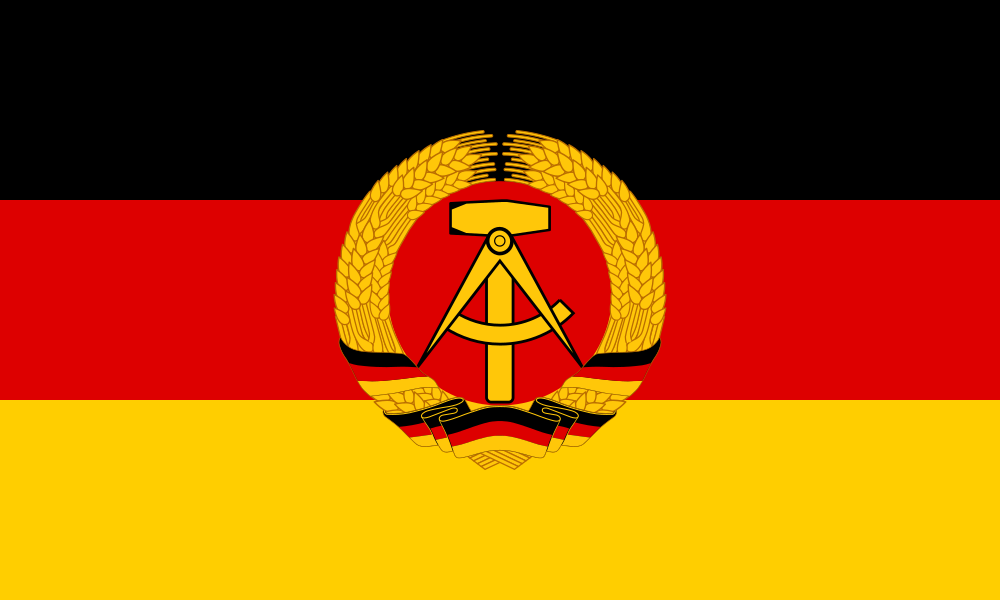
In favour: Bangladesh, China, German Democratic Republic,. Jamaica, Mexico, Niger, Norway, Philippines, Portugal, Tunisia, Union of Soviet Socialist Republics, Zambia.
Against: None.
Abstaining: France, United Kingdom of Great Britain and Northern Ireland, United States of America.
The draft resolution was adopted by I2 votes to none, with 3 abstentions (resolution 475 (1980)).
The representative of the United States has asked to make a statement following the vote.
116. Mr. vanden HEUVEL (United States of America): I think that the reasons for our abstention are clear to everyone, certainly to those with whom we were privileged to discuss the text of this resolu-
1‘17. The PRESIDENT: The representative of Angola has asked to speak and I now call on him.
118. Mr. de FIGUEIREDO. (Angola): Angola has borders with Namibia; Angola has no, borders with South Africa. History is not predestined, nor is it governed by the doctrine of the elect., But the racist minority regime in Pretoria acts as though it is. History is made of the dynamic between people, institutions and incidents. And as we talk, history is being made. This process of history is no consolation for those, who are burying their dead today in Angola. History as expressed in the corpses of infants gives no peace to those who cradle those tiny bodies,in their arms. History written as bombed-out wrecks and craters in the earth of Angola gives no explanation to those who lose their homes and their livelihood.
119. The people of Angola are still under attack, with a ‘portion of their territory still under. the ,occupation of racist South African troops. Colonialism is trying to establish another outpost. Racism is trying to send. out its tentacles to engulf a free and’equal people. Militarism is trying to win another victory.
120. South Africa launched what has been termed its largest military occupation since the Se,cond World War and unleashed its racist forces once more on the territory and people of Angola: If the international community does not force an immediate and union-‘ ditional South African withdrawal ‘-and guartintee’ South Africa’s observance of the principles that. govern international relations, South Africa will not’ be alone in the dock. This comity of nations must accept its responsibility in allowing South Africa freely and regularly to exercise its racist and imperialist options in southern Africa. South Africa must be forced to show what has been referred to as a decent respect for the opinions of mankind.
121. The Security Council has a mandate under the Charter. But what use is a mandate unless it is predi-. cated on a sense of mission? The Council has a clear role in international peace and security. Does not the situation now prevailing in southern Africa qualify?
122. Throughout its history there have been links that Africa has established; others that it has endured. Africa, -Asia and Latin America have realized that we have to fight imperialism, not accommodate it. We have to punish racism, not condone it. We have to defeat colonialism, not accept it. What unites Africa and the non-aligned movement is more important than what divides us. And the same is true of all of us represenfed in the United Nations, especially. those seated in this Chamber.
123. Gandhi characterized as one of the seven sins “politics without principle**. I regret that this is the
124. South Africa’s military action is confined to the areas corresponding to the demilitarized zone which forms an important part of the United Nations proposals for Namibian independence. Pretoria aims at controlling that area and at setting up a band of renegades under its sponsorship. Neither the group nor the action has any legitimacy. The racists intend to create well-proved “facts” on the basis of wellfounded “concepts” to Iegitimize well-established “rights”. In this manner, a myth becomes history and a crime becomes legitimate.
125. Before. concluding, Mr. President, I wish to thank you, on behalf of my ,Govemment, for your co-operation, and all those who spoke in the Council yesterday and today, at short notice despite other commitments. ;’
126. A resolution has been adopted. .But there have been a number of similar resolutions since 1976. What guarantee does my Government have that this resolution will fare any better than the previous ones? What guarantee do the people of Angola have that they will not be subjected to invasion, attack and murder in the very near future? What compensation can we ever have for all those killed, now and earlier? What payment can compensate us for all the loss, damage and destruction? Who will wash the earth of the blood it has soaked from the corpses of Angolan men, women ,and children? Who will erase. the scars that our country-’ side carries of the bombing, napalm, artillery attacks and mine fiejds? Who will answer all those questions that the sons of the soil ask? /
. .
\.. .
j . . : ‘St,
.
‘,
I .
.
‘.
Vote:
S/l401
Consensus
There are no further speakers inscribed on my list. The Council has thus concluded the present stage of consideration of the item on its agenda: ‘I . . The meeting rose ut 8.70 p.m. > a.
. ,.. ’ :
NOTES . . I Oficial Records of thi denerai Assembly, Thirfy-f&h Sessick, Plenary Metk’ngs, 29th’meeting. paras. 169 and 170.. .
s Ibid., Thirty-fflh Session, Supplemerit No. 24, vol. I. p&a. 91. ‘- .y,, ,(,j. : : ‘. ‘. , .I
HOW TO OBTAIN UNITED NATIONS PUBLICA-IIONS
United Nations publications may be obtained from bookstores and distributors throughout the world. Consult your bookstore or write to: United Nations. Sales Section. New York or Geneva.
COMMENT SE PROCURER LES PUBLICATIONS DES NATIONS UNIES
Les publications des Nations Unies sent en vente dans Ies librairies et les agences depositaims du monde entier. Informez-vous aupr&s de votre libraire ou adressez-vous A : Nations Unies, Section des ventes. New York ou Gent%.
KAK HOjIY.CHTh H3AAHHSf OPFAHHIAI&HH OribEAUHEHHS.IX HAUHR
HJnaHHn ~praRx3aIIllx O6aenxxeRxbrx Hat&l YOXHO xynurb a XHHxXblX Mara- Jxxax x arexTcTBax xo acex paxoxax xxpa. HaeoxnTe cnpamtx 06 HSAaHxnX B aamex KXBXCXOM waraaxxe xnx nxmx~e no anpeey: Opraxxsanxx 06’beAxxexxbrx HasxR. Cexsxx no nponarrte xanaxxx. HbK)-FfOpX XnX HCeHesa.
COMO CONSEGUIR PUBLICACIONES DE LAS NACIONES UNIDAS
Las publicaciones de las Naciones Unidas estAn en vcnta en hbretias y cams disttibuidorrts en todas psrtes de1 mundo. Consuhe a su tibrcro o dirfjase a: Naciones Unidas. Seccibn de Ventas, Nueva York o Ginebm.
Litho in United Nations, New York 00300 83-61462-October 1987-2.050
▶ Cite this page
UN Project. “S/PV.2240.” UN Project, https://un-project.org/meeting/S-PV-2240/. Accessed .