A/44/PV.34 General Assembly

I call on the representative of Saudia Arabia, who will
introduce the draft resolution W\der this item.
Nr. SHIll\B~ (Saudi Arabia): It Qive me -pleasure to introduce, on behalf
of the member States of the Organization .of the Islamic Conference, draft
resolution A/44/L.S, dated 12 October 1989, which is entitled ·Co-operation between
the United Nations and the Orqsnization of the Islamic Conferen.ce-.
All mellbers of the OrQanization of the Islamic Confe~ence are also Mellbers of
the United Nations. It is only natural, therefore, that the two orqanizations
should co-operate closely in prolDOtinq their common endeavours in the fields of
pence, security, del7elopment and progress. The text of the draft resolu tion is
similar to that of resolutions on this subject adopted dur inq previous sesions of
the General Asse1d:)ly.
In the prullble, the General AsseJrbly reooqnizes the need for closer
co-operation between the United Nations system and the Orqanization of the Islamic
Conferenoe and its soecialized institutions in the implementation of the proposals
adopted bV the co-ordination meetinq between the two orqanizations, which was held
at Geneva in Septeliber 1989.
In operative paraqraph 1 the General Asse1lbly takes note of the report of the
Secretarv-Genel'al (A/44/424 and Add.U.
(Mr. Shihabi. Saudi Arabia) . In opet:a~iv. p4raQraph 2 the General Assemly aoprOlts the conclusions and
reco_ndatlons of the co-ordination lleetinQ of the focal paints of the lead
aqencies of the United Rations system alllS the Organization of the Islamic
Conference.
In operative paraqraJ)h 3 the General Assemly notes with satisfaction the
active partici'Paticln of the Orqanization of the Islamic Conference in the work of
the United Nations towards the realization of the J)Urr:oses and pr inciples of the
United Nations Charter..
In operative Daraqraph 4 the Assellbly requests the United Nations and the
OrQani:aticn of the Islamic Conference to continue co-operation in their commn
search for solutions to qlobal problems.
In operative paraqral)h 5 the General Assemly eneouraqes the sDecialized
8Qencies and other orqanizations of the United Nations system to continue to expand
their co-oPeration with the OrQanization of the Islamic Conference.
In operative paraQraph 6 the Asse1llbly requests that a meet!nq of the focal
points of the lead aQencies of the United Nations system and the Orqanization of
the Islamic Conference and its sl)ecialized institutions be orqanized in 1990 in
order to rwillll the progress in the iIIlpllllentatiDn of the plan of action adopted by
the 1989 co-ordinaticn lIleetinq between the two orcaan!zatlons, to be follOllled by a
caenera1 meetinQ .in 1991 between the representatives of the secretariats of the
Unitfld Nations syst_ and the Orqanization of the Islallic Conference•
. In operative paraqr:apb 7 the General Assellbly urQea the orQanlzat1ons of the
United Nations aystelft. eBl)ecially the lead aqencies. to provLc:Je increased technical
and other pOssible assistailce to the Orqanizatlon of the Islallic Conference and its
specialized institutions for the enhancement of co-operation.
In o~erative paraqra-ph 8 the Gen«al AsselOly requests the secretarv-Ganeral
to strenqthen co-operation and co-ordination between the United Nations and other
orqanizations of the United Nations system and the Orqanization of the Islamic
Conference to serve their ..tual interests.
In operative paraqraph 9 the General Assenbly requests the United Nations and
the Organization of the Islamic Conference to hold consultations, as and when
appropriate, between the representatives of the Secretariat of the United Nations
and the General Secretariat of the Orqanization of the Islamic Conference on the
i1\1)lementation of projects and fellow-up action.
In operative paraqraP'a 10 the Assemblv requests the Secretary-General of the
United Nations, in consultation with the Secretary-General of the United Nations,
in consultatioo with the secretary-Gen«al of the Orqanization of the Isl.aaic
Conference, to eneouraqe the conveninq of sectoral meetings between the two
organizations on the priority areas of co-operation.
In operative paraqraph 11 the Assembly expresses its appreciation of the
efforts of the Secretary-GenEral in the promotion of co-operation between the
United Nations and the Orqanization of the Islamic Conference and expressea the
hope that he will continue to strengthen the mechanism of co-operation between the
two organizations.
In operative par aqraph 12 the General Assenbly rEquests the Secretaty-General
to report to the General Assembl"j at its forty-fifth session on the state of
co-operation between the United Nations and the Otqanizat1on of the Islamic
Conferenceo
Finally, in OPerative 1)araqraph 13 the Assemly decides to include in the
prO'lisional 8Qenda of its forty-fifth session the item entitled "Co-operation
between the United Nations and' the Orqanization of the Islamic Conference".
(Mr. Shihabi. Saudi Arabia)
On behalf of all member States of the Orqanization of the Islamic Conference,
I call upon all meJlbers of the General Asseably to support draft resolution
A/44/L~5, which envisaqes the promtion of co-operation bebleen the two
orqanizations, within their exisUnq resouraes, with a view to achievinq their hiqh
goals~ We hope that the draft resolution will be adopted without a vote.
(Mr. Shihabi, Saudi Arabia)
Vote:
A/RES/44/9
Recorded Vote
Show country votes
— Abstain
(24)
























✗ No
(1)

Absent
(6)






✓ Yes
(128)
-
 China
China
-
 Malawi
-
 Bhutan
-
 El Salvador
-
 Yemen
Yemen
-
 Mauritius
-
 Bangladesh
-
 Singapore
-
 Afghanistan
-
 Benin
Benin
-
 Comoros
-
 Indonesia
-
 Syrian Arab Republic
-
 Saudi Arabia
-
 Ethiopia
-
 Finland
-
 Sudan
Sudan
-
 Egypt
Egypt
-
 Algeria
-
 Argentina
-
 Australia
-
 Bahamas
-
 Bahrain
-
 Barbados
-
 Plurinational State of Bolivia
-
 Botswana
-
 Brazil
-
 Bulgaria
-
 Burundi
-
 Chile
Chile
-
 Colombia
-
 Congo
Congo
-
 Costa Rica
-
 Czechoslovakia
-
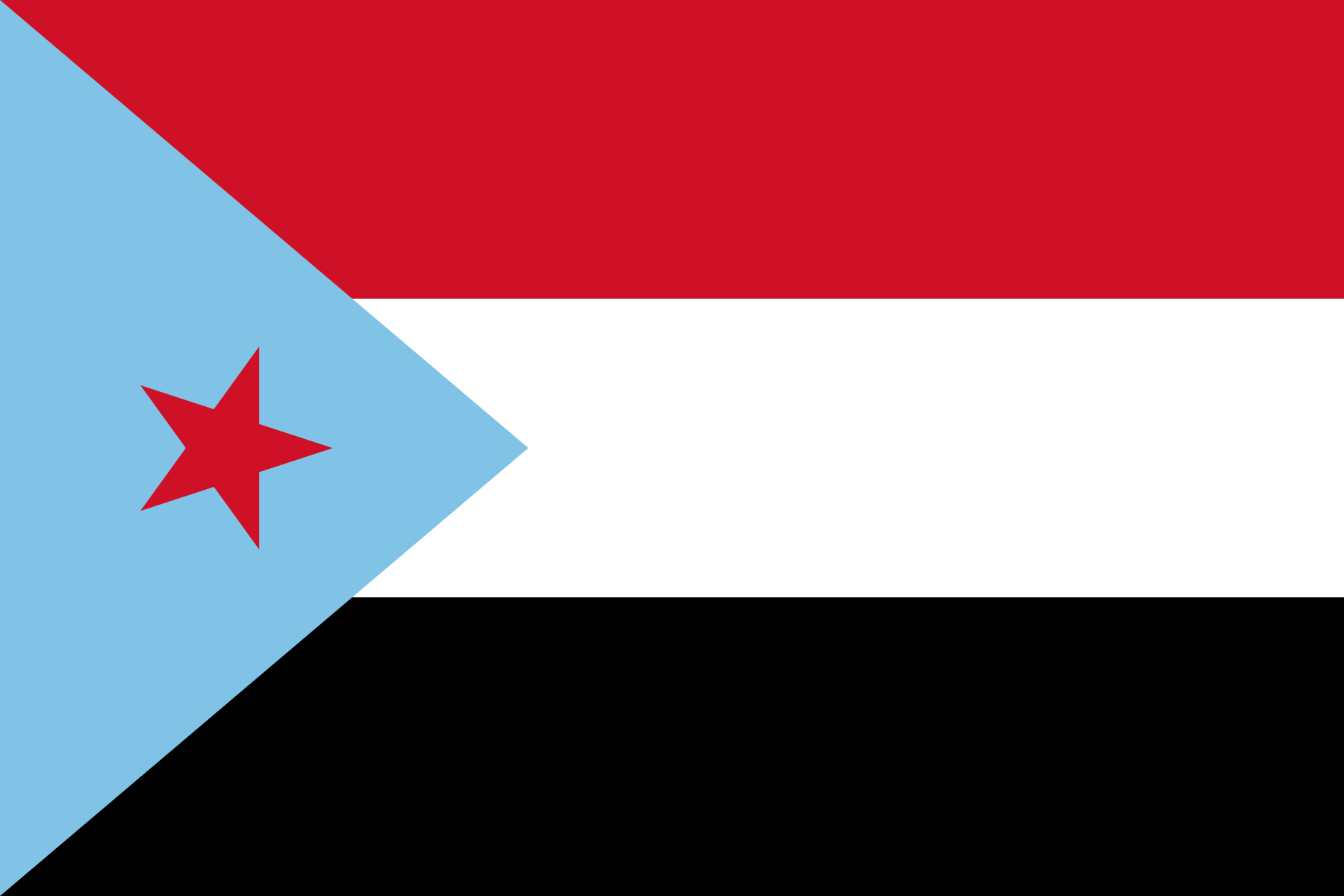 Democratic Yemen
-
 Ecuador
-
 Equatorial Guinea
-
 Fiji
Fiji
-
 Gabon
Gabon
-
 German Democratic Republic
-
 Ghana
Ghana
-
 Grenada
-
 Guatemala
-
 Guinea
-
 Guinea-Bissau
-
 Guyana
-
 Hungary
-
 Islamic Republic of Iran
-
 Iraq
Iraq
-
 Côte d'Ivoire
-
 Jamaica
-
 Jordan
-
 Lao People's Democratic Republic
-
 Liberia
-
 Madagascar
-
 Malaysia
-
 Mali
Mali
-
 Mauritania
-
 Mexico
-
 Mongolia
-
 Morocco
-
 Nepal
Nepal
-
 New Zealand
-
 Niger
Niger
-
 Nigeria
-
 Oman
Oman
-
 Panama
-
 Papua New Guinea
-
 Paraguay
-
 Peru
Peru
-
 Philippines
-
 Poland
-
 Qatar
Qatar
-
 Romania
-
 Sao Tome and Principe
-
 Senegal
-
 Sierra Leone
-
 Somalia
-
 Sri Lanka
-
 Eswatini
-
 Sweden
-
 Thailand
-
 Trinidad and Tobago
-
 Tunisia
-
 Türkiye
-
 Uganda
-
 Ukraine
-
 Union of Soviet Socialist Republics
-
 United Arab Emirates
-
 Myanmar
-
 India
India
-
 Kenya
Kenya
-
 Maldives
-
 Pakistan
-
 Cuba
Cuba
-
 Kuwait
-
 Togo
Togo
-
 United Republic of Tanzania
-
 Uruguay
-
 Bolivarian Republic of Venezuela
-
 Yugoslavia
-
 Democratic Republic of the Congo
-
 Zambia
-
 Albania
-
 Cambodia
-
 Mozambique
-
 Chad
Chad
-
 Central African Republic
-
 Lesotho
-
 Haiti
Haiti
-
 Gambia
-
 Nicaragua
-
 Cabo Verde
-
 Honduras
-
 Angola
-
 Libya
Libya
-
 Viet Nam
-
 Djibouti
-
 Suriname
-
 Zimbabwe
-
 Saint Lucia
-
 Solomon Islands
-
 Vanuatu
-
 Antigua and Barbuda
-
 Brunei Darussalam
-
 Burkina Faso
-
 Cameroon
-
 Belarus
In accordance with General Asseilbly resolution 3369 (XXX)
of 10 October 1975, I nON call on the Permanent Observer of the OrqanizaUm of the
Islamic Conference.
Mr. ANSAY (Orqanization of the Ish.le Conference); It is a matter of
great privilege fOl: me to address the General ABse.,ly on an item of particular
siqnlfioance to the United Nations and the orqanization I represent, naJDely,
"Co-operation between the united Nations and the Orqanizmtion of the Islamic
Conference"•
AllClf me to beqin, Sir, bv extendinq to you our It&rmest conqratulations on
your unanillOus election to the oost of President. Your election is a reflection of
the esteem and lesPect Niqeria enjoys in the comity of nations and a personal
tribute to you for YOIr well-known abilities, statesmanship, vast experience and
lonq association with the united Nations and everythAng it stands for.
I should like to avail myself of this opportunity to pay a tribute to
Mr. Dante Ca¥:Uto of Arqentina, who served in an exerAPlarv manner _ President of
the General Assemly at its forty-third session.
I should also like to seize this opportunity to express our deep appreciation
for the s!qnificant oontributia\ the Secretary-General,
Mr. JaV'ier Perez de Cuellar, is makinq to the effectiveness and smooth funetioninq
of the world body.. He has earned the qratitude and resJ)ect of all of us and of the
international co1llllUnity bV his humane attitude and deep understandinq of qlobal
problems. Ris various achiEWements in the name of peace durirlQ the short span of a
few years SPeak for themelves.
From the very outset, the mellbers of the OrQanization of the Islamic
Conference clearly identified the role of our orQanization within the O'Ierall
framework of the United Nations Charter. The charter of the OrQanization ~f the
Islamic Conference underlines the determination of its "member states to lllake
effective contributions for the enrichment of mankind and the achierellent of
1)roqress, freedom and justice all over the world by Droaotinq qlobal ~ce and
secudtv.
The Orqanization of the Islallic Calference derives its inspiration frOll the
eternal and noble lIessaqe of Islam, and its establiehment was predicated on the
DrinciplfJB of peace and harmony, tolerance, equality and iustice for all.
'l'be charter: of our orqanization reaf!lrllB the commitment of our IIlembers to the
Chm:ter of the United Nations. The perceptions of the mellbers of our exganization,
all of which are also MellDers of the United Nations, are identical to those of the
vut majority of the United Nations meattership on all iftq:)ortant international
issues. It is only natural that the two organizations should work closely to
prOl'lOte the ideals, 1;)1:lnciplea and objectives tbey shere.
Since its inceptiQ'l in 1969 the OrGanization of: the Islamic Conference has
adopted numerous resolutions and declarations both at the summit level and at the
leYel of lIleet1nqs of Foreian Ministers addressinq the issues confrontinq the
Islamic world, as well as important qlobal develol:)lllents relatinq to international
peace and security, disarmament, huraan riqhts, minorities, decolonization and
issues relatinq to social and economic development, particularly the establishment
of the new interna tional economic order.
On the question of Palestine and the explQBive situation in the Middle-East,
the Oraanizatial of the Islamic Conference r.fUrftB that a just and lastinq peace
in the re.qion cannot be es~bl1shed without the withdrawal of Israeli forces from
all the occupied Arab and PalEStinian territories, includinq the Holv City of
Al-Quds Al-Sharif, and the res,toration of the inalienable national riqhts of the
Palestini~n people, includinQ their riahts to return, to self-determination and to
(Mr. Ansa?, Orqanisation of the Is1aaic Conference)
the eetabUsh1leftt of m independent Palestinian State on their awn territory, with .
the Holy City of AI-Qu&' AI-Sharif as its capital.
In this Context, I Mould like to reaffira that the Orqanizatian of the
Islaaic Cenference hu endorsed in full the Pez peace plan adopted at the 1982 Arab
su.it aeetinQ. The Orqanizatian of the Islamic Confturencit ha expressed its full
• • ~rt feft °tlie national upriSinq, the intifadah p of the Palestinian people In the
occuplea territory, and has also qiven its full support to the earlv conveninq of
the international peace conference on the Middle Bast under the auspices of the
United Nations, with the particioation on an equal footinq of the Palestine
Liberation OrQanization (PLO), the sole, leqitiute and authentic reoresentai:ive of
the Palestinian people, and all other parties concerned.
The Organization of the Isolaale Canference fully sUPJX)rts the mediation .
efforts IIllde by the high-level Arab Tripartite Ca.f.ttee to find a solution to the
traqic crisis in Lebanon, a Mellber country that has Buffered so IlUch durinq the
past decade. It welCOll. the measurE taken by the Co_Utee, in particular, the
aeeting of the Lebanese par lta.ntar lans in TaU, in the Kinqdoll of Saudi Arabia.
It urqes all concerned parUes to co-operate with the Tripartite Co_Ut.. to
enable it to restore peace in Lebanon, while respectinq its ~dependence,
8cwereiqnty and territorial inteqrity.
The Orqanbaticn of the Islallic Conference stands firllly behind the black
peoJ)le .of South Africa and Naaibia in their just and leqitillate struqqle aqainst
th~ abhcr:rent oolicy of apartheid of the South African rectille and demands the
i_ediate illpleaentation of Security Council resolutions 385 (1976) and 434 (1978),
which constitute the only acceDtable basiB for the tranBition of Nalllibf.a to
independence.
(Mr. Ansay, Orqanbat!on of the I8laaic Conference)
The OrQanization of the Is14.1c Conference welcoaed the CCIIDletion of the
Soviet trOOJ) withdrawal frOll AfQhanistan and underlined the ~rtance of the
AQr.aentB concluded in Gen..,. _ m iaportant SUD towards a CQlprlbensive
pOlitical solution of the Afghanistan probl... It invited the inter 111 QOVEn_nt
of the Afqhan Mujahidin to usua. the seat of AfQhanistan in the OrQanlzation of
the Islaaic Conference. It also 8IPhaa!zed the need for the openinq of an
intra-Afqban dialoQue with a view to establishinca a bl'oad-b.ed qOlFemDent to
replace the current regille in Kabul. The OrQanization of the Islallic Conference
also strused the need for the achiweaent of a CCIIprehensive DOUtical solution
which would enable the voluntary return of the Afqhan refuQees to their country in
safety and honour.
The Orgenization of the Islaalc Conference expressed its satisfaction at the
decision of the Islallic Republic 0' Iran and the Republic of I.raq to hold direct
talks, under the auspices of the Secretary General of the United Rations, ailled at
achievinq full and rapid iapleaentatiOll of Security Council resolution 598 (1987),
in order to reach a colIIDrehensive, just, honourable and lastinq settlellf:lnt.
The position of the Organization of the Is1&lIic Conference en these and other
issues was also reflected in the Pinal C~n!qu' adopted follO'llinq its annual
ainisterial co-ordination .eatinq held in New Ycxk on .. OCtobtE 1989. An
enraordinary llinisterial, _etinq of the Orqanization of the Ishaic Conference was
also held on the sa_ date in New Ycxk reqardinq the pUQht of the Turkish Musl1a
Il!nority in Bulqaria, a atter tJbich the Orqanization of the Islallic Conference
follow an4 BOnitors with great sensitivity tbrcuc:b its General Secretariat,
aeBbership and BDecial Contact Group.
On the critical econcxaic situation in Af!:ica, the Orqanization of the Is1&mic
Conference reiterated ita call to the international col1llllUnity, in particular the
d"'elo~ ccuntries and international financial institutiors concernad, to expedite
the Dpl8lentation of the tJnitac1 Nations ProqraJlUlle of Action for African Economic
RecOl7etY and DweloPllent.
On the international economic situation, the Orqanizetion of the Islamic
CcnfKflnCe eaphllSbcd the need fee strengthening horizon'tal economic co-operation
bebret!n its _nbers and called upon them to work toqether at the international
level to promote the North-SOuth dialoque with a via; to redressinq the J)revailina
iniquitous system of iilternational economic relations.
(Mr. Ansa", Orqanization of the Islamic Conference)
Since the adoptiCX'l of General Assembly resolution 35/36 in 1980, the first
resolution on co-oper&tion between the United Nations and the Orqanization of the
Islamic Conference, a number of co-operation aqreements have been concluded by our
orqaniz!ltion with specialized aqencies and other bodies of the United Nations
system, such as the United Nations Educational, Scientific and Cultural
OrQanizlltion$ the World Health Orqanization, the United Nations ChUdren's Fund,
the Office of the United Nations Biah COlll'llission.er for Refuqeea, the Food and
Aqr iculture Orqanization of the United Nations, the United Nations Fund for
Po-pulation Activities, the United Nations Conference on Trade and DeII'elopment and
the bodies concerned with technical co-operation for development.
The comprehensive rel)ort of the secretary-General, doeull"OVlt A/44/424 and Add .. l
describes in detail the ranqe of activities underta'lten by the two orqanizations to
promote and strengthen their relationship..
Our co-operation in the past few years with the United Nations system had
reached a point where it was essential on both sides to reV'iew proqress and make " more effective use of consultation mechanisRB and enhance co-operation on both
sides. Such an opportunity was provided under resolution 43/2, and a joint review
lIleetinct of the focal pointe on both sides was held in Geneva from 13 to
15 Septellbe: lagt to evaluate proqress, identify impediments and qive qreater focus
to co-opell:ation between the two orqanizations.
We lOre indeed Qratified that the United Nations and its soecialized aqencies,
especially those who participated in the joint meetinQ in Geneva and those who
attended as observers. made a useful and timely contribution, thus Qivi~ the
co-operation a sharper focus and facilitatinQ and enhancinq it on both sit'les in the
seven priority 8t'eas. Members will notice that the report of the secretarv-General
(A/44/424), and especially its addendum 1, contains an action-oriented proqramme
(Mr .. Ansay, OrQanization of the Islamic Conference)
for the next two years. and it is not only our hooe but also our IUtual expectation
that th. prcqraJllllles to which we have cOlllllitted ourselves will provide us with an
opoortunity to rel)ort to the Assemly next year the meanincaful, productive and
tanqible results ach leved froll th is co-operation. "e have disaerned a keen des ire on the part of all United Nations offices and
SPeciaU:ed aqencies to develop concrete orojeets, to strencathen oncaoinq areas of
co-oocation and to include such projects which would benefit the States memere of
the Orqanization of the Islamic Conference. We are very happy to note that the
co-ordinatirq department has also made a useful contribution in ensurinq the
success of the joint meetinq in Geneva by adequately and efficientlY prepar inq that
joint seetinq.
By identifyinq priority areas, we have meant to focus attention on some
specific areas of common co-ooeration, but in no way will that deflect from our
determination to pUrsue onqoinq co-ooeration in other important areas of
dwelopment for the me11bers of our orqanization. It is prudent that for the next
two years we should limit ourselves to pressing forward with our mutual efforts so
as to place them on a certain plateau, therebY qeneratinq an internal IIDmentum
within our co-operation and the States meJlbers of the Orqanization of the Islamic
Conference, fa: some of which these proqra_. will provide meaninqful results.
Let me assure the General Assembly that we are fully conscious of the
financial constraints on all sides and, therefore, our co-opet'ation takes those
factors into account. Our 1990 and 1991 co-operation meetings are both subject to
normal consultations between the Secretaries-General of the two orqanizations Eto
time and 1)lace.
(Mr. Ansay, Organization of the Islamic Conference)
Dtaf~ resolution A/U/L.5, which has been IllCl8t eloquently introduced to the
Assellbly by the Permanent Representative of Saudi Arabia, representativ~of the
current Chairman of the Islamic Conference, takes into consideration the
recollllendatiofts of the joint meeting of the focal points of the lead 8r;encies of
the United Nations and the Organization of the Islamic Conference held this year in
Geneva, and reflects the firm det2rmination of the two organizations to co-operate
in various fields.
Reoogni,ing that there are no additional financial implications for draft
resolution A/44/L.5, I am confident that it will receive the unanirrous approval of
the memership of the Aaseni)ly.
The PR!SIDENT: The Assemly will nc* take a decision on draft
resolution A/44/L.5. In this connection I should like to inform members that the
Secretary-General does not foresee any programme budget impll~ationB in the
. implementatien of this draft resolution.
~y I take it that the Assemly adopts draft resolution A/44IL.51
~t resolution A/44/L.5 was adopted (resolution 44/8).
The PRlBIDEN'i'. We have concluded our consideration of agenda item 22.
EXPRESS ION OF SlMPATR! 'ID THE mVBR*!NT AND PliDPLB OF TRB UNITED STA'l'BS OF JlMERICA
The PIU!SIDENT, Before taking up the second item on our agenda for this
morning, .y I on behalf ?f all the members of the Assembly extend our deepest
sympathy to the Cbvernment and peoples of the United States of 14merica on the
tragic loss of life and extensive material damage which resulted from the recent
earthQUake.
Ms. BAILEY (United States of America), First 1 should like to say that I
have no paper. That I know is indeed quite rare, but as always I speak from the
heart. There is not a man or. a woman in this Asselllbly, of "hieb I am very proud to
(MC;, hlsay, Or9anisa~ion'of the'Islamic'COnference)
be a member, who has not had in his or her country some disaster - hunqer, disease,
typhoons, cyclmes or earthquakes. I do not know exactly how to express !IV thanks
for ,our carinq, for I knCllf you do care just as we in our country care when you
have troubles.
I am reminded of three thinqs. First, a wonderful friend of mine sits in the
Hall in that direction - or I could sav in any direction, since yOu are all my
friends - and at a little qet-together that friend asked: ""hat do you think we
will do this time in the Assembly? Do you think that we will do better?" At that
particular tt.e Huqo was raqing out in the waters, and I replied: ""ell, tell you
what, I am sure we are all qoinq to do better. With all our disasters - those
HUgoS out there - we have no choice. at
Secondly, a lady sent me a letter - I have answered that letter, but I have
kept it to remind me of what I am now saying to you - in which she wrote: "X am in
South Carolina.. Pearl, I have learned somethinq. 1 have no church; that is Qone.
My house is <lone: my job is Qone.. Some loved ones are Qone." She added: "Mankind
can lellrn sOlllethinq: the awesome power of God which hit us for 15 minutes."
I haDPSl to have a loved one - not in that part of California, but in the
south - to whom I wrote lonQ ago that, t1hen it starts to shake, all men anywhere,
wen here, should all join hands together and try to hold the' earth still or the
winds and the waves back. Then we would forqet all the other thinqs, and that
would make us friends•
. ..'
(Ms. Bailey, United States)
She said to me IIIIn that awesome 15 minutee we knew the power of Q)c!".
Last night, as I watched what was going on, I smiled to myself and thought, lllLad:l'1
in 15 seconds we knew the awesome power of Q:)d.
I want to thank all representatives for caring about us and, regardless of any
differences in this Hall, I want to remind memers that we in our country care
about them. That is the only way that is ever going to work. let us think about
it.
I '
AGBNDA rrPM 29
CJ}ESTION OF TIE o::MORIAN ISLAND OF MAYOT'l'E
(a) RElORT OF THE SBmETARY-GBNERAL (A/44/6331
(b) tRAFT RESOWTION (A/U/L.10)
The PREmENT, I call on the representative of the Comoros, its Minister
for Planning, Mr. MiUdache Abdourahim, who will introduce the draft resolution.
Mr. MlKIDACHE (Ccrroros) (interpretation from French), As I find myself
for the first time in this Hall I cannot hide my real eJIDtion and it is indeed with
profound respect that I bOw to the Assembly. In addressing the Assemly, in which
resolutions are adopted that give positive shape to the future of m.nkind, I feel
both deeply honoured and truly humble. I feel sincere and genuine ellOtion, and I
aSk for brotherly indulgence for the calibre of what I am about to say.
1 must convey to the Assetrbly, on behalf of the President of the Islamic
Federal Republic of the Comor08, Ris Excellency, Hr 0 NlIlSd Abdallah Abdetemane .and
the Comorian Government and people, brotherly good wishes for the success of the
vet,' significant work that 16 being done in this historic fonm in the service of
peace, justice and progress in the world.
(Ms. Bailey, United States)
118 fu... the CollOr1an people are concerned, it is vith reneved bopa and
unl1a1ted confidence in the bandling of the !latter that: it follows our discussion
an the ialand of Mayot.te. It sincerely hopes that the parties cancerned, Prench
and Ca-orian alike, vill, in their .utual intereat. and with greater vill and
deter.ination, find within the f~aJDeVOrk of and beyond resolution., a solution to
this prClblea, vhose set.t.le_Rt vill _ke possible the full flawering of their
fE' 1en41y co~perat1on.
1"01' the fourteenth year: 1n succesdon we are considering the &genda ita.
entiUed ·Que8tion of the CollOrian island of Mayotte w• The cCl!\t.lnued inclusion of
thl. itea on the agenda of our debates and the sustained attention paid to It by
our Asselbly are reflections of our Org_1sation t e !It.dfut 4eteraiination to
continue to take an active part in the quest for an appropriate solution to thls
prd)lcn, in keeping .,i th its ...da te.
'this too ls rQas8uring for the CoftlOdan people and (bvernJlent, vhieb, because
of this dispute, have for the put 14 years been compalled to mobiliae their
ene~giea and a sUbstantial part of their lIO&tst ~esource. tx) &tfend thoir national
sovereignty. On bebalf of .the ColiOdan nation, I viSh to eXiue88 our sincere
appreciation to the Aeselllbly.
I rellind those alllOn9 us who are follawlng thicdebato for the firat title, that
In the process of the accession of the CoJlOfOB to independence there vas nothing
that gave U8 cauae to expect that 3 d1epute as deplorable a8 1t. is harMful fo~ the
COaoroa would ariae betveen us and Prance, a friflfldly countly. Indeed, a process
bad been painstakingly vo~kecJ out to ensure that the accession to national
.cwe~eignty would proceed SlJM)Othly, in friend.hip and co-operation vi tb Pranca ad
in conforalty with the procedure &9r"d upon by the international co..nity.
(Mr. Mikidache, CoMoroa)
'!'hue, _en Prance acknowledged the readiness of the Comorcs for independence,
agree_nu were negotiated and signed in Par!si on 15 June 19'73, between the
representatives Qf the Prench Government and tbCl8e of the local Governaent of the
Co~ros.. 'rhose agree_nu envisaged, atmng other thlngs~ that the COJlC)dan people
would be consulted by means of a referendllDl and that 1f a _jodty of the voters
declued themselves in favour of independence, Prance would grant the Charmer of
Deputies of the Coaoros the potters of II constituent sssellbly, wile the Pr&81dent
of the local Gover~nt Council would have the coll1lPStences and prerogatives of H!!ad
of Stam.
PurtherJlC)r:e, one of the clawses in those agree_nts stipulated that the
outCOM of the referendwn on self-determination would be considered on a
COllprehensive basis, that is, for all four Comrian islands. That major
stipulation was, of course, 1n keeping with the fact that for IIOre than a century
of its presence in the COlllOroe Prance never: challenged or called into Question the
unity of the Comodan archipelago, which; on the contrary and to its credit, it
helped to strengthen. Indeed, successive Prench Governllents, basing thellBelves on
geography and bistory, repeatedly stressed the need to respect the territorial
uni ty of our: country ..
Our unity its not founded, as ae-e suggest, on artificial bases or any other
tranaltoey administrative convenience. It is rooted and finds its strength in the
geography, Illstory and co.cn destiny of all the sister islands that Mke up the
181all10 Fedaral Republic of the Coaoros, na.ely, the islands of An jouan,
Grande-Oomore, Mayotte and Moheli.
As a result all PrGncb lavs and all!lllniatrative declslens adopted during the
colonial period enshrine categorically the unity of the Ccaorian archipelago.
'l'hwh the law of 9 May 1946 that _de the arc:bipelago -a territory enjoying
adalnlsuati.,e and financial autonomy- elearly spells out in setting forth the
reasons that
-It is the _slim religion that giveSi the archipelago ita f;trong unity, which
ls reinforced by a unique idiom, Swahill-.
(ME'. Nikidacbe, CollOrce)
This unity vae reaffirmed and consolidated by the law which granted internal
autonoay to our archipelago on 3 January 1961.
Tbis brief reviev of the juridical and administrative dispositions p.lt into
effect by France up to the very eve of our country's accession to indepondence
clearly shows that the unity of the Comoroe vas not challenged at any time for over
a century.
That is why, in keeping vith the agreements of 15 June to which I have just
referred and the law of -23 Ncwember 19n that organized the self-determination
referendulI, the people of the COllOroe, on 22 Decellber 1974, vent to the polls in
all serenity, and in a cal1l atlllOBphere, to decide upon its future ..
On that historic day the Question to which we "ere called upon to g1ve a reply
was, Do you wish the Comoros to become independent?- It waB not, -Do you "lGh
the island of 'bheli to become independent?-, or -Do you wish the island of Mayotte.
to become independent?-, or -00 you wish the island of D'1ftjouan to become
independent?-, or WOo you wish the island of Grande Co.,re to become
independent?-. On that dete of 22 Dece.,er 1974 not one island was called upon to
pronounce itself separately on its destiny.
The reply to the question that wae put proved that more than 95 per cent of
the Comor1an people were in favour of independence. All that the French Gcwernaent
and Parliament had to do was to draw the logical conclusions from this vote, in
keeping w1tb thl! law that provided for the referendum.
Unfortunately for UEl, and to everyone's aston1eh1llent, things turned out
otherwise. Instead of respecting its couitments and the clearly and freely
expressed .,Ul of the Comfian pt;Iople, the Government of France - quite to the
cClfttrary - had a law adopted that confirlled the partition of our country.
(Mr. Milcldache;· Cos;)r~)
That French law was promulgated on 31 December 1915 - in other words, after
the CO!'llOr08' acceesion to independence on 6 July 1975 and its admission en
12 November of that year to membership of the Organization as a scwereign State
_de up of the four islands, Anjouan, Grande COIlOr:e, Mayotte and ltbheli.
'1'0 be sure, the French law recognized the independence of the Comorian State -
but a State that had had a part of its national territory - the island of Mayotte -
amputated. The pretext put forward for that amputation was that. in Mayotte a part
of the population had voted aga inst independence.
That unjust and arbitrary act was condemned immediately by the internat.ional
colllftunity, which regarded it as interference in the domestic affairs of the
Comorian State. tIlat is more, the law infringed the sacred principle of the
inviolability of the borders inherited from the era of colonization - a principle
contained in the Declaration on the Granting of Independence to Colonial Countries
and Peoples, in General Assembly resolution 1514 (XV), and the Progral'lllle of Action
for the full implementation of.that Declaration, in General Assembly resolution
2621 (XXV).
The Government of France at the time, seeking legal justification for this act
of force, decided to invoke its own Constitution, article 53 of which stipulates
that there can be no transfer, exchange or adjunation of territory without the
consent of the people concerned.
No one can be unaware that the specific case of the CO!'llOros that is of concern
to us does not involve the transfer: or the adjunction or the eXc:hange of any
territory. Rather, what is involved is purely and simply the secession of a single
territory - the Camoros archipelago, which all French laws had been carefUl to
treat as a ~hole during mote than a century of colonization.
(Mc. Mikidache, Comoros)
'1'h&t. ia why the Organbation. together with the entire international
co-.unity, rejected that contention and why, on the baais of the results of the
aelf-dateralnatlon referendum held on 22 DeceDber 1974, it continues to affi", that
the ColllOrian island of MIlyotte ia an integral part of the Islamic Federal Republic
of the Comoros. It is thus clear that there can be no confusion about or cballenge
to t!le unity of our country.
Anyone aware of the hOJIDgeneity of the COJlOrian population and the blood ties
that frOil the very beginning have bound together the inhabitants of the four
islanda·tmat 'unde~stand the deep pain of our people, who sbare the same culture,
the same language and the same religion. I do not even want to think about what
would h&ppen to this shared ethnic and socio-cultural heritage if this separation
lIere to be prolonged.
We _at note alao that the adverse effects of that separation do not have a
human dimension alone. This situation also seriously undermines the country's
development.
Indeed, because of their complement8rity, the four Comrian islands have an
ecClftOlllY that can develop only in a symbiaais. that results from the specific
production and activities of eaCh of these islands. Ranee, separating Mayotte froll
ita sister islands constitutes a serious obstacle to the development of the Is1all1c
Federal Republic of the COl'l\Oros. BarJlW)nious 4evelopment can be achieved only
d thin the framework of 1ts unity •
The hlseflbly w111 understand that the country does not need this additional
,..dieap at a time vben the Comorian authorities are entering into negotiations
dth the World Bank and the International Monetary PUnd on a progranne of
.tructural adjUDtment.
~day, the super-Powers are joining together in a quest fot a more peaceful
world and 60r the further strengthening of their multifaceted economic
co-operation. It is inconceivable that at such a time the small Comorian islands
should find themselves split up·, when, instead, they must unite to cope with the
many challenging tasks of development.
France and the Comor08 are united by a long cOlllilOn history. We have many,
varied relations. They go beyond the bilateral framework because our two States
are taking an active part in the building of subregional co-operation through the
Indian Ocean Commission, together with the other island States of the "Africa of
the islands", of East Africa.
An isolated Mayotte would become a kind of cyst on a body which needs to
achieve development but whose development would thus be delayed. That would be an
undeniable handicap, for Mayotte would not be able to participate, along with its
sister islands, in this process of economic integration that gives all the
countries of the subregion a major opportunity to keep their appointment with the
year 2000 in the best possible conditions.
Benefiting from the teachings of the Koran, the people of the Comoros regard
harmony. and the aChievement of agreement as major virtues. Thus, to solve this
prOblem th~ Q)ver~ment of the COllOf08 has constantly given pride of place to
dialogue and has based itself on the relevant resolutions and recommendations of
various international organizations. In acting in that way m~ country also aims at
abiding by the principles of peace and justice embodied in the Charter of the
Organization. We fervently hope that this readiness for conciliation on the part
of our people will be given the full weight it deserves.
In keeping with the Organization's recommendations we are pursuing the quest
for contacts with the Frend\ 'side, and on every possible occasion the Head of the
Oomorian State has raised this problem with his French counterpart.
(Mr. Mikidache; CollOr08)
Moreover, the noble initia tlve \Ddertalcen in 1986 vis-A-vis the Prench
Gbverllllent by the Ad oBoe Comittee of the Organization of African Unity responsible
for followiDC) up this _tter, prompted France to decide not to organise a new
i'0fertoW@t.1ua on Mayotte. We welcome that fact.
~l!Ver, since then nothing has happened to bring us closer to a resolution of
We feel that it: Is time for Fr:&lce, as a founding Member of our Organization,
to go beyond short-term considerations and agree, together with the United Nations,
to -=each an understanding in the quest for a just and lasting common resolution of
this P!linful prcmlem. It ie alca9 these lines that France is being invited to take
part in achieving a resolution of the matter by all the other internatiorcal and
regional organisation3 involved.
Throughout itfi la!9 history France has always shown its imaginative and
innovetlve ca~city mtd ability to adapt ita policy to the needs of the time. Is
it not the homeland of human rights and the rights of the ci tiz@n, a country whose
bicentenary the world celebrated laat July? The efforts exerted recently by its
leadership at the highest level, notably the President of the French Republic,
Mr. M1tterrand, with a view to pQrticipating actively in the search for solutions
to prOblems as delicate as those related to third-world debt or drugs, are dramatic
proof of what Prance can do.
The Comorian authorities, ,for their part, continue to express, from this
rostrum" their st~afaat rad1nesB actively to consider any specific propossl from
the FrC!ncb side so lQ'ig as it respects the unity and territorial integrity of the
Islamic Federal Re9ubl1c of the Comoros. It is understood, of course, that vi thin
this framswork th~ o:ganizing of any referendum would be out of place and contr6ry
to the rolevant ~e801utions ef our: Organiza tion.
It is fi tUng to note that at the previous seesioft we welcomed tba fact that
the confrontation that had prevailed throughout tha wodd seemed to bG giving way
'to better understanding, thus making it possible fo!: us to hope for the progressive
elimination of confliots. Like all other peace-lcwin9 countries, the Islemic
!'eden· F~PUbl1c of the Conor02 welcomes this eU:uation. That is why the Head of
the Cosorian State se12led the oppo~tW\ity of the recent summit conference of
French-speaking cour.,i;ries held in DaIt!l1' once again to issue an appeal, expressing
the hope "that the winds of &itente which are nov being felt in international
relations may have a favourable impact on this particular case as well".
This climate of detente is the result of the efforts exerted by our
Organization, under the co-ordination and effective guidance of the
secretary-General, Mt. Javier Pel:e~ de Cuellar. whose competence and readiness to
sel:ve peace throughout the world we should like to praise once again. We are
convinced that in so far as this particular case is concerned our shared
determination to pcess forward can also help us achieve progress in this situation
along the 1 iDes hoped for by the AssennlY.
This prOblem has been vith us r.uCh too long, and nOltl more than eve~ it calls
for an lJrgent solution. We must manage to quicken the pace of history and destroy
artificial barriers, if necessary, by our strong will and determination to overcome
obstacles.· And help from everyone will be invaluable - whether as friends or
brothers of the parties involved.
In this connection, I should like to recall a sura from th~ Holy Koran, which
teaches us thata When two brothers - and by extension, two friends - ate pitted
against each other in a dispute~ you must reconcile them or help them to settle
their differences. That is a good deed not only for them but also for you, and God
will reward you for it.
We believe that by restor~n9 the territorial integrity of our country, our
friend Prance - whose achievements throughout history have Sllwayn rested on the
united determination of its great people - would emerge the greater feom a
situation which is not in keeping either with its traditions or with the image it
has projected to the world at this time of deoolonizatioR. for the other African
terdtcc:ies.
(!!!.._Mikidache, Co1l!Oros)
The draft resolution before the Assembly, which underpins our current debate,
15 not differel\t from others that have preceded it inasmuch as it emphasizes the
need to accelerate the process of negotiations between the French and Comorian
Governments, with a view to ensuring the effective return of the island of Mayotte
to its natw:al community, the Comorian community. We earnestly hope that the
Asse11ibly wll1 be able to adopt it unanimously.
Mr. BADllfI (E:jyPt) (interpretation from Arahic): B;ypt's interest in the
Collortan island of Mlyotte and its desire to ac:bieve a dpeedy and just solution to
the prOblem £lOts froll the strong relationships of friendship and close
co-operation we maintain with the two parties to the problem. Our position, as we
have always expreB~ed it, is a consistent position, based as it is on the
principles of the United Nations, in which we firmly believe.
FlJypt supports the sovereignty of the Islamic Federal Republic of the COIlO~OS
over the island of Mayotte. We have often reaffirmed that position in various
international and regional forQms. It is also a position which has been clearly
supported in all the international and regional forums concerned with the
question. This is reflected in the relevant resolutions of the United Nations, and
those of the summit meetings of the Organization of African Unity and of the
countr ies of the non-aligned movement, all of Which call for respect for the unity
and for the territorial integrity of the Comeros archipelago. Given our constant
contacts ifith the wo parties to the prOblem, we appreciate and fully understand
the grounds for concern by the Comorian Government owing to the lack of concre~
progress of the efforts under way to find a just solution to the problem. Actually
there have been no new developments in the situatior. since 1975. We realize that
this situation and the persistent stftte of affairs that has a marked semblance to a
stalemate of the problem carries the risk of political instability which may
(Mr. Mikidache, Comoros)
be adversely reflected in the climate 'Prevailinq in the reqicn as a whole.
However, we still believe that there are Qrounds for hODe and o'PUili•• and that a
just anclpeaceful neqotiated solution of the 'Problem if feasible. We have
ascettained, in the liqht of our contacts with the two friendlY GoverlUlents of the
COIl«OS and Prance, that there is a firra des ire on the part of both sides to
continue dialoque and to keep open the channels of colllDunication. This confir.
the sincere hltentiO!'lS of both 'Parties to intensify efforts aiaed at. ac:hi.inq a
political solution safequardinq and affirminq the territorial inteqrity of the
Comoros and, at the same time, takinQ into account the interests of all the
parties.
We should like to take this 001;)Ortunity to eXl)ress our sUJ)l)Ort of the efforts
of the Secretary-General in this connection and to request him to continue bis
contacts with the two J)arties. We commend his readiness to exert every effort with
the two 'Parties in order to aOO iel7e the des ired solu tion.. We beU..,e that the
current international climate, which is favourable to the 'Promotion of peace and
security in various reQions of the wCX'ld, should encouraqe both parties in their
persistent efforts to adlieve concrete results in the near future.
(Mr. Badawi, BcvPi:)
Mr. iWlIRBI (Cololbia) (interpretatSon fro. Spanish): !'or aore than 20
years new the international co_unity has been exaMininl1 the situation of the
Comr ian island of 'Iayotte. Nobf ithstandi~ that, and now ithstaneUnq the liMY
appeals by the Gen.al Assellbl", the administratial of the islm'ld continues to be
colonial in nature. That has had an adverse effect on the country's territorial
inteqrit'/. My Government hopes that the neqotiatlons between the parties concerned
will -proceed satisfactorily, in keepinQ with the principles and nor_ of
international law. Ife welcolle the hiqh-level dialoque that has been set in train.
That eUaloque fits properly into the fruework of the new cliMate of detente in the
world.
Before there can be understandinq, each of the parties IlUst demonstrate its
will fcx sum understandinq and it is our duty to see to it that that happens. In
other words, that is the basis for peaceful coexistence, in which the riqhts of
each and wery one "ithin the fraMwork of those political approaches that the
international oo881nity itself has adopted are recoqnized. In ~is vein, the
fulfilment of the proce88 of decolonization, soearheaded by the united Nations, has
been possible thanks to the efforts exerted by the J)eOoles and to the raal1zation
that 'Patt.erns of daaination by the former colonial Powers are unsustainable. Let
this be the time, then, to hiqhlight the scope ond s iqnificance of resolutio"
1514 (XV), of 14 Decemel' 1960, which elllbodies the Declaration on the Grantlnq of
Independence to Colonial Countries and Peoples.
It is la qreat honour for Colom:la to stand united with othelr countries round
.tfie world in their demand for their leqitiHte ric;htss and the ric;hts of the
COJDOr08 are indeed ·leqitiute, in••m .. they were reooqnlzed here upon
cOlI)l:lance with the required procedures, includinq the agreaentli signed by the
COIlOf08 and France Oft 15 June 1973 • to the outcoa. ef the referendum that .,. to
be held the follOlfing year - results wich were to be interoreteeS 1n a
CCll'Iprehenaift, not a piece-by-piece, island-by-1s1ana .y, as Gxpreeely re0091'taed
in General Assem1y resolution 3385 (XXX) cf 12 Novenllber: 1975, whereby the Comr08
were adllitted to IllellbereMp of the Qlited Natione.
My country likwise veloollles the infotmation provided by the Per_nent Ml.ealon
of Prance on 14 July 1989 in a not& vetbale addreued to the Secretary-General. to
the effect thatl
•• •• France has deJlOnstrated its tRdiness, as expressed by the President af
the Republic, to seek activ&ly a solutiClft to the problea of Mayotte 'that is in
keeping with its national law and with international law· (AlU/633, p~ 2),
because it takes as 1t.s point of departure the principle recognized in law that
"people are to be bet ~.eved· - all the IIOre if "hoover IUde the prolll1se cUd so on
behalf of a country enjoying such great respect, and also if he knew the
consequences of the international juridical acts of 1975 and the national acts
undertaken the following year.
My Q)vernment believes that all the efforts being exerted in this realll are
useful, especially when this involves an initiative which the Secretary-General
might encourage. Indeed, we think it would be a p::)8itive develcplent if his
experience could be combined with that of the Secretary-General of the Organisation
of African Unity 80 that their good officee could be offered to those seeking a
peacefUl, negotiated solution ~ the problem..
For all th08e reasons, ay delegation is pleased to support. the draft
resolution that has been circulated on agenda i tell 29, ·Question of the Comrian
island of Mayotte-.
Mr. DANWE RDlAKA (Gabon) (interpretation froll Prench) I The inclusion
once again of the itea on the eo-:»rian island of Ma,otte in the agenda of our
current a.seion testUies to the ardent desir_ of the United Nations to find a
eolution to this probleM, Which has lasted only too long.
(Mr. _mire., ColOlllbia)
Gabon's position bears the i.print of conaiatenCYi conmiatencv, first of all,
with the 'Principl.e of the lnv101mbility of borders inherited free the J)eri04 of
colonisation. conautency, also, in the coMieteration of the leqitiuts cla1. of
the C~rlan GoverlUllent= and, finally, consistency with the purposes and principl.
of the United Nations Charter, which uta it mcullbent upon Nelilbers of the Unitect
Nations to settle their international etll1DUtee bv I)uc.rul _aftS.
Reqrettably, no notable proQr••• ha been achi.et! on this illsul! since the
forty-thud s..ion of the General Aas.ly.
Tbe current situation, whim is like to a sort of stale_te, cannot last
indefinitely. GGbon aweals to the Prench Gov....nt to tr_late into deeds ita
deteraination to find a just 801t' \an to the problea of llayotte.
The Ad Hoc C~ttee of Seven, presided ener by ., country; intends to
continue anet d_elop ita activiti. to eneure CQlpliance with the co_ltaents , entereet into on the eYe of thfl referenell. of 22 Decfillber 1974 concerninq the self-
detenl1nation of the Coa«oa atchipe1&qo.
Bene., we call for the unanilDoua adoption of the draft r.olution now before
the Aasellbly.
Nr. SU'rRBSHA (Indonesia): Itf deleqatioD's oartlcil)lltion in the debate on
the it. under co~ld..at1(lft 8te_ frOll Indonesia's sincete desire far a soee4y .mc1
1ust settl..nt of the question ef the C~r1an island of Mayotte, wbleb has been
en the agenda of the Geneal Assellbly since it was inscribe4 in ]915.
(Mr .. Danque • ..,aka, Gabon)
Our intereat in, and support for, all efforts to areive at an allicable
solPJtion ace based on a co_itllent to the sanctity of the principles of the Charter
concerning the territorial integrity of States and on the bonds of friendship and
co-operation that Indonesia uintains with France and the traditional fcaternal
relations and ties of non-aligned solidarity that we enjoy with the Islallic Federal
RtpUblic of the COllOros"
The regrettable reality is that, despite successive resolutions of the United
Rations, the Hon-Aligned MOYeeent, the Ocg~i.ationof the Islantc Conference and
the Organization of African Unity (OAU), the searCh for a solution has not brought
tangible results. My delegation believes that it is important to note that all
these decisions have etressed that the overriding principle in any settle-ent .oat
be recognition of the unity and territorial integrity of the CollOros arChipelago,
collpOsed of the ielands of Anjouan, Grande-CollOre, Mayotte and 'bheli. This basic
eleMot of a just and honourable aettlelftent - ftrat enunciated in General AMemly
resolution 3291 (XXIX), of 13 Decellber .1974 - vas reiterated IIOSt recently in the
final cJocu_nta of the sUMit meeUnge of the Non-A'U,gned Move1lent, the
Organisation of the Islamic COnference and the OAD, thus attesting to tha
determination of the international co_unity to ~eaitore Co1llOrian 8cwereiqnty over
Mayotte.
Indonesia l\a8 always maintained that justice can be served only when disputes
between States are settled peacefully through re.ort to diploacy and negotiation.
Indeed, "'utual respact and constructive dialogue alre the eeaential elementa of an
hcnourable solution. It is therefore hearten!ft9 to note the positive and cordial
IN~latlona that continue to exist between the partie. inVOlved. In this regard, my
delegation is pleased that the GoIrernllent of tlke CollOros has continued its
statealllu'llike quest for negotiations. It i. our tiC::lPe. that France, for its part,
(Mc. Sutcesna, Indonesia)
"ill acwe f«ward by vorking actively for a just solution through dialogue and
acco-.odation. 'n) this end, ve encourage all sides to utilise the existing
goodwill' in tbeir bilateral relationa, v1 th a view to resorting to, the good offices
of the Secretary...Qanerel in the settle_nt of the dispute.
Indonesia lIbares the conviction of the vast _jodty of Melllber States that 8
peaceful, negotiated and durmble solution to the question of Mayotte is to be found
in respect for the .cwe~eignty, tmlty and territorial integrity of the CollOfCS
arcblpelago. we appeal to the parties to engage in constructive dialogue, leading
to a speedy and bonourable settle_nt in accordance with the aUirter of the United
Hat,ions and relevant resolutions of the Organization.
In conclus1cnp .y delegation vculd like to empbaabe the need for wisdom and
rationality 1n coiling to tel'. with historical, cultural, geographic and political
ceal! ties as tbey pertain to the island of Mayotte and _ they bave been afUr_d
by the international co18Unity. My delee}ation is convinced that, by recognising
the cc.pelllng logic of these essential el&ments, the parties could resolve this
question peacefully and expeditiously. It is in the interests of contributing
positively to this proce.s that ay delegation supports draft resolution A/U/L..10.
Mr. KmRO (Pakistanh Bve~ since ComrOll beca_ independent in 1976, the
quuUon of the COmorian island of Mayotte has been on the aganda of the Q\lted
Nations General Assemly. It may be recalled that under General Asaellbly
r&801utioft 3114 of that yea~'. seuion Prance vae called upon to withdraw froll
Mayctte. Since then, this Organization hes appealed repeatedly to the Govern_nt
of Prance to lIiltart negotlating vi th the Gcwernllent. of Comros w1tb a v1": to
ll1Pl..ntaUon of the rel_ant resolutions, of the United Nations. Also, the
Secretary-General ha Mlntatned elOll. liaison vith the Org8ftlaaticn of Afdcan
Unity and ha offered hia good l)ffices to its Secretary-General in the seaw:dl for a
(Mc. Sutcesna, Indonesia)
. peaceful, neqotiated settlement of the problem. This year:, aB in l)revious years,
we have taken up this iJIIportant aqenda item in an effort to encouraqe the two
parties b:;) institute a constructive and aeaninqful dialoque with a vi., "to
achievinq a 1ust solution to the problEm in keepinq with the rel4WMt resolutions
of the General Asselllblv.
The resolutions of the General Asse;i)ly on the question of the COIDOr lan island
of Mayotte underline the necessity of respectin::a the unity and territorial
inteqritv of the COIaOrian archipelaqo and rM.ffirll that a lastinq solution to the
problell can be found C1nly in reetoration of the disputed island to COilOfOS. The
territorial InteC)rit.y and unity of COlDOros as a whole have also been reaffirlled in
resolutions adopted oyer the years in other international forums, such &9 the
Non-Aligned Movement, the Organization of the Islallic Cenference and the
Organization of African Unity. 'l'his positicn wu also reflected recently in the
final Declaration of the Cenference of Porelqn Ministers of Non-Allqned Countri.,
held in Cyprus in Septemb.. 1988, in the r.olution adopted at the Addis. Ababa
suait _etinq of the Organization of African Unity in May 1988 and, lIore recently,
at the Rarare ministerial aeetinq of the Non-Aligned Movellant in May 1989, as "ell
as at the 8elqrade Buuit _etinq of the ncn-alignad countri. in Septemer this
year. SUch demonstratione of support for ColllOrctl en this question clearly leave no
doubt regardinq .the validity of its claia to the COlIOrian island of Mayotte.
It _y be pointed out that the Pl'oblea of the ColDOrian island of Mayotte is
not just a bilateral probl. betwaen Prance anc! Comros but asentially a question
of decolonization and, therefore, a probl_ far all of \11 to reGolveo In this
context D I recall General Aaselillbly resolution 3291 (XXIX), of 13 Decelber 1974, and
resolutlcn 1514 (XV), of 14 DeceJlbU 1960, en the qran tinq of independElnce to
colQ1ial countries and peoples. Th.e reaolutions clearly uintain that the
(Kr.. Itbcxo, Pakistan)
granUnQ of independence Cl' of the right to exercise self-deteraination applies to
colonial entiti. _ a wbole, and not selectively. This should have been the case
with reqaEd to the COllOrian archipelago.
In our vier, constructive dialogue ed peaceful negotiations are the best
possible aeans of resolvinq differences and disputes. In this context, the
assertion by Prance that it 8intains dialoque at the highest level with Comoros,
and the visit last year of the President of COlllOrCIJ to France, are positive
develos-ents which My lea4 to settlement of the dispute. In our ViEW, such a
ellaloque, illbued with a spirit of co-operation and understanding and built upat the
foundations laid by the relevant General Assenblv resolutions, prOlTides the best
chance of a p.ceful solutien to the problem.
Pakistan has traditional ties of friendship and co-operation with France, and,
as a fellar _Jlber: of the Non-Aliqned Movement and of the Organization of the
Isluic Conference, enjoys oleae and fraternal ties with the Islamic Federal
RePublic of Coaocos also. Therefore, a dispute between those two friendly
countries is certainly a matter of concern to us. Pakistan has been following very
closely the develoJ:HIentB that are takinQ place en this issue and maintains a keen
and special interest in its expeditious settlement.
(Nr. Khoror Pakistan)
..", .
The draft resolution before us is both moderate and balanced and reiterates
the position of principle maintained in international forums. ~ My delegation
supports the draft resolution and expresses the desire and hO~ that it will
initiate an expeditious process of negotiations leading to an early solution of the
problem on the basis of the recognized principles of internatiOnal law and the
Charter of the United Nation. This could undoubtedly have a beneficial effect on
the relations between the two countries and on zoegional peace and security. My
delegation would also like to avail itself of this opportunity to conlllend the
secretary-General's efforts towards resolving this problem, and to join others in
requesting him to continue his efforts and to extend his good offices to the
Organization of African Unity in the search for a negotiated settlement.
Mr. BLANC (France) (interpretation from French) a Once again France can
only express regret that the question of the island of Mayotte is the subject of an
item on the agenda of the General Assetrbly. It can only vote against the draft
resolution now before us, in particular because of operative paragraph 1.
My delegation has listened carefUlly to those who have spoken on this
question. It would seem that everYbOdy desires a just and lasting solution to be
quickly founu to this problem. This is also the position of France.
We have embarked upon the search for a satisfactory outcome of the problem of
Mayotte and we do. not rule out any solution which is in accordance with our
Constitution and respects the aspirations of the peoples concerned.
In a spirit of responsibility and open-mindedness, the French Government is
engaging in a constru~tive dialogue with the Islamic Federal RePublic of the
Comoros. This ,~ialogue is based on the clClSe bonds of fr iendship and co-operation
between ou~ t'iQ countries, which were demonstrated recently by the meetings at the
highest level, as was recalled by Mr. Kafe, the ft)reigft Minister of the COllOros, in
(Mr. Khoro, Pakistan)
his statement in the general debate on 4 October.. We are convinced that such joint
efforts, pursued in a l!Jteadfast spirit of conciliation and appeasement. will be
able, d.spite all difficulties, to lead to progress in the common search for a just
solution.
France will spare no effort in this regard.
!!le' BUSmENT, We have heard the last speaker in the debate on this
item. The Assellbly will now take a decision on draft resolution A/44/L.lO. I have
to infom the General Aaselllbly that the Secretary-General does not foresee any
progral'll1le budget implications in the implementation of the draft resolution.
A recorded vote has been requested.
A recorded vote was taken.
In favouu Afghanistan, Albania, Algeria, Angola, Antigua and Barbuda, Argentina, Australia, Bahamas, Bahrain, BangladeSh, Barbados, Benin, Bhutan. Bolivia, Botswana, Brazil, Brunei Darussalam, Bulgaria, Burkina Paso, Burundi, Byelorussian Soviet Socialist Republic, Cameroon, Cape Verde, Central African Republic, Chad, Chile, China, Colollbla, Comoros, Congo, Costa Rica, Cote d'Io;,oire, Cuba, CzechoslOVakia, Democratic Kampuchea, Democratic Yemen, Djibcu ti, Ecuador, Egypt, El Salvador, EQuatorial Guinea, Ethiopia, Fiji, Finland, Gabon, Gambia, German Democratic Republic, Ghana, Grenada, Guatemala, Guinea, Guinea-Bisseu, GUyana, Haiti, Honduras, Bungary, India, Indonesia, Iran (Islamic Republic of), Iraq, Jamaica, Jordan, Kenya, Kuwait, Lao people's Democratic Republic, J'.eaotho, Liberia, Libyan Arab Jamahiriya,
M!adaga8ca~, Malawi, Malaysia, Maldives, Mali, Mauritania, Mauritius, Mexico, Mongolia, i'broc:co, Mozambique, Myanmar, Nepal, New Zealand, Nicaragua, Niger, Nigeria, oman, Pakistar., Panama, Papua New Guinea, Paraguay, Peru, Philippines, Poland, Qatar, Romania, saint Iucia, Sao 'lb_ and Principe, Saudi Arabia, Senegal, Sierr, Leone, Singapore, Solaaon Islands. Somalia, Sri Lanka, Sudan,· Suriname, Swaziland, Sweden, Syrian Arab Republic, ThaUand, 'lbgo, Trinidad and'lbbago, '1\Inisia, Turkey, UJanda, Ukrainian Soviet Socialist Republic, onion of Soviet Socialist Republics, United Arab Ibirates, United Republic of Tanzania, Uruguay, Vanuatu, Venezuela, Viet Nam~ Yemen, 1\1goslavia, Zaire, Zambia, Zimbabwe
Against: Prance
(Mr. 8lanc, PranceJ
Abstaining,
AwJtria, Belgium, canada, ~prus, DentiDrk, Do1ll1nica, Dollinlcan Republic, Germany, Federal Repu' lie of, Greece, IcelanD, Ireland, Israel, Italy, Japan, wxe1llbourg, Malta, -Netherlands, Norway, Portugal, saint ICltts and Nevis, saint Vincent and the Grenadines, Spain, United IClngdom of Gr:eat Britain and. Northern Ireland, united States of America
Draft resolution-A/44/L.10 was-ado
-(resolution 44 9).
The PRmmBNTlI This concludes our consideration of agGnda item 29.
AGBti)A ITEM 15
ELEC'l'IOm m PILL VACANCIES IN PRINCIPAL ORGANS
(a) ELEer JJN OF FIVE lI>N-PERMANENT M.SERS OF '1'HB SEamITY Q)UNCIL
The PRES IDDlT, The Msembly '1111 now proceed to the election of five
non-permanent _Jlbers of the Security Council to replace thoso members whose term
e~pires on 31 Dece1llber 1989.
The five outgoing mem8r8 are the followingl Algeria, Brazil, Nepal, Senegal
and Yugoslavia. These five States C8Mot be re-elected and therefore t.'1eir names
should not appear on the ballot papers.
Apart from the five permanent memers, the Security Council will include in
1990 the following States, Canada, Colomia, Bthiopia, Finland and Malaysia. The
names of those States, therefore, should not appear on the ballot papers.
Of the five non-permanent members which will remain in office In 1990, two are
from Africa and Asia, one _Is from latin Jlmerica and the Caribbean, and two are
from Western Europe and other Sta tes.
* Subsequently the delegation of Bwanda advised the Secretariat that it had intended to vote in favour.
1, -with -24- abstentions
Consequently, pursuant to para9~aph 3 of resolutiOn 1991 A (XVIII) of
17 December 1963, the fh~ non-permanent memers should be elected according to the
fol1~lng patterna thr" frem Africa and Asia, one from Eastern lpe and one
froll ~tiit ~arica. and the Caribbean. This P3ttern is refl'!Cted in a. single ballot
paper.
In aCX'Ordance with the established practice, there is an understanding to the
effect that, of the three Sutes to be elected from Africa and Asia, two should be
from Africa and one from Asia.
! should like to inform the Asse1fbly that the numer of candi.dates, not
. ex~dln9 the num"r of seats to be filled, receiving the greatest number of votes
and a two-third~ ~jority of the votes of those pro~ent and voting will be declared
elected. In the cue of a. tie vote fOl the last seat, there "ill be a restricted
ballot limited to those candidates which have obtained an equal number of votes.
I take it that the General Assembly agrees to that procedure.
It was eo decided.
The mmmENT, In accordance with rule 92 of the rules of procedure, the
election shall be held by secret ballot and there shall be no nominations.
I call on the representative of Bangladesh, who wishes to speak on behalf of
the As tan Sta.tes.
Mr. MOBIUDDIN (Banql&desh): In ffP/ capacity as Chairman of the Asian
Group for the current IIOnth, I have the honour to inform all Melllber States that
Democratic Yemen is tho endorsed candidate of the Asian GroW') for the Asian seat in
the Securi~ Council.
The PRESIDEN:£: I call on the representative of the Dveloruss lan Soviet
Socialist Republic, who will 8Deak on behalf of ~e Group of Eas tern European
States.
Mr. MMSIMOV (Byelorussian Soviet Socialist Republic) (interpretation
from Russian): As the current Chairllan of the Group of Bastern European states, !
wish to inform merabers of the General AsseUlblv that the countries lleabera of our
Group have unaniillOusly end«sed the candidacy of the Socialist Republic of Romania
as a non-per_nent _mer of the Security Couneil for the period 1990 throuqb 1991.
The PRBSmBNT: 1 call on the representative of Peru. who wUl speak in
his capacity aa Chair_n of the Latin American and Caribbsn Gro\Ul>.
Mr~'WNA (Peru) (interpret4tio~ from spanish): As the current Chairman
of the Latin Amer iean and Car ibbean Group. I am very pleased indeed to confirm our
regional qrouo's endorsement. of the candidacy of Cuba in the elections to the
Security Council.
I Qall on the reoresentative of Kenya, who will speak in
his c5Pllcitv as the current Chairllm of the African Group•
.!!r. OIBm (Kenya): As the current Chairun of the African Group, I
should like to indicate that two African States have been encllixsed b9 the African
Group for election to the Security Council - COte d'Ivoire and Zaireo
The PRBSmBNT: In accordance with the rules of proeed~e, we shall
proceed now to the election by secret ballot, takinQ into account the statellents
just .de by the representatlv. of Banq1adesh. the Byel«u8sian SCNlet Socialist
Republic. Peru and lenya.
Ballot ~pers are now beirq distributed.
I request representatives to use only ballot papers that have lust been
distributed and to write on them tht. names of the five Member States fa: which they
wish to vote. As I have indicated, the ballot papers should not include the names
of the five permanent memers, the five outqoinq non-permanent roerrbers or the five
States that will remain in office as non-permanent menbers in 1990. Votes for a
large nuDlber of States than there are seats allocated to the relel1ant reqion will
be declared invalid. Votes for States outside the r~levant reqion will not be
counted.
At the invitation of the President, NI.'. Rabiq (8elqiuml, NI.'. James Droushiotis
(Cyprus). Mr. Garro Galvez (Peru) and Mr. Makarevitch (Ukrainian Soviet SOcialist
Republic) acted as tellers.
A vote was taken by secret ballot.
(The President)
The meetinq was sU!pended at 12 noon and resWled at 12.45 p.m.
The result of the votinq for the election of five
non-permanent Embers of the Security Council is as follows:
Numer of ballot papers:
Number of invalid ballots:
",
!!ulber of valid ballots:
Abetentions:
NUnber of menbers votinQ:
.. .!..eq\1 ired two-th irds majority;
Nullber of vot~ obtained:
Cuba
Democratic Yemen
Romania
Cote d'Ivoire
zaire
Yemen
Arqentina
Barbados
Costa Rica
Ghana
India
Mali
N!c:er
Poland
zamia
1$6
o
Bavinq obtained the required two-thirds majority. the follC7fling States were
elected non-PH_anent 1Il811lbetS of the security Council fa: a two-year period
beginninq on 1 January 1990: Cote d'Ivoire. Cuba. Democratic Yemen. Romania and
zaire. - The PRESID!N,!: I conqratulate the States that have been elected
non-permanent members of the Security Council ".. ., I thank the tellers for their
assistance in ta'1e election.
This concludes our consideration ofsub--item (a) of aqenda item 15.
The meetinQ rose at 12.50 p.m.
·:1 .1