A/41/PV.92 General Assembly
19. IMPLEMENTATION OF THE DECLARATION ON THE GRANTING OF INDEPENDENCE TO COLONIAL COUNTRIES AND PEOPLES: (a) REPORT OF THE SPECIAL COMMITTEE ON THE SITUATION WITH REGARD TO THE IMPLEMENTATION OF THE DECLARATION ON THE GRANTING OF INDEPENDENCE TO COLONIAL COUNTRIES AND PEOPLES (A/4l/23; A/AC.109/848-A/AC.I09/857, A/AC.I09/858 and Corr.l, A/AC.I09/859-A/AC.I09/868, A/AC.I09/873 and Corr.l, A/AC.I09/874 and Corr.l and 2, A/AC.109/8?7 and Add.l) (b) REPORT OF THE SECRETARY-GENERAL (A/4l/673) (c) DRAFT RESOLUTIONS (A/41/L.33 and Corr.2, A/41/L.36, A/41/L.37) Cd) REPORT OF THE FIFTH COMMITTEE (A/4l/921) Mr. SAEMALA (Solomon Islands): My delegation wishes, first, to endorse the statement so eloauently delivered by the Permanent Representative of Fiji on behalf of the South Pacific Forum States Members of the united Nations. Solomon Islands fully supports the objective analysis of the situation in New Caledonia and reaffirm our commitment to the South Pacific Forum initiative and its high ideals and aspirations to the promotion of peaceful progress in our region and international peace and security. Twenty-six years ago the General Assembly adopted resolution 1514 (XV), and thereby the Declaration on the Granting of Independence to Colonial Countries and Peoples. That Declaration not only brought freedom to many peoples in all corners of the world, but also shed light on what had been hidden in the darkness of colonialism: that human dignity and respect were not the exclusive right of the rulers of mighty colonial and imperialist empires. These are in fact attributes of all human beings regardless of their race, sex, lanugage or religion. By that historic Declaration, the General Assembly, inter. alia, reaffirmed its faith in fundamental human rights and solemnly proclaimed "the necessity of bringing to a speedy and unconditional end colonialism in all its forms and manifestations". (resolution 1514 (XV), twelfth preambular paragraph) Subsequent General Assembly resolutions - 2621 (XXV) of 12 October 1970 and 35/118 of 11 December 1980 - gave further effect to the implementation of the 1960 Declaration. The result of those important political developments is clearly reflected in the membership of our Organization. But the task is still incomplete. There are still people under colonial control and domination in southern Africa, Western Sahara, the Middle East, Asia and the Pacific and Atlantic regions. While many of the Non-Self-Governing Territories are already under the guiding role of the United Nations - for the purpose of ensuring their continuing progress toward self-determination - there are still cases that call for the immediate attention of this body. (Mr. Saemala, Solomon Islands) Namibia, for instance, ought to be dealt lllti.:h lIt d (l~·,.,ec that transcends mere rhetoric. The immediate independence of Namibia can no longer be left at the mercy of the "linkage" policy, which has proved to be a deceptive criterion. Likewise, the liberation of the oppressed people of South Africa should not be clouded by propaganda for one ideology against another. What is needed for the Namibiar. people's national independence and the liberation of the oppressed people of South ~frica, as for all colonial peoples, is a determined application of the basic principles of democracy - freedom and justice. In the South Pacific region all the countries that have attained independence since the 1960 Declaration came through the decolonization process under the auspices of the United Nations. Solomon Islands itself, I am proud .to say, came through that process smoothly and attained its independence on 7 July 1978. In our own case, we were certain that united Nations involvement gave us the assurance that our progress towards statehood and nation-building was being pursued under the watchful eyes of the international community, the united Nations. That is why we have joined in sponsoring draft resolution A/4l/L.33 which relates to the question of the applicability of the 1960 Declaration to New Caledonia, a French colonial Territory in the South Pacific region, and that is why we shall vote in favour of draft resolution A/4l/L.36 and L.37. Draft resolution A/4l/L.33 calls for the recognition of the inalienable rights of the people of New Caledonia to a legitimate act of self-determination and independence, in accordance with resolution 1514 (XV). This is the basic auestion here: is New Caledonia a Non-Self-Governing Territory? In our view, the answer to that ouestion can be determined by examining the following factors: first, New Caledonia, as is well known, is situated in the South Pacific region, approximately 20,000 kilometres from France. Geographically, New Caledonia is not part of France. (Mr. Saemala, Solomon Islands) Secondly, the indigenous people of New Caledonia, the Kanaks, are Melanesians whose culture ~nd ethnic background are related to the Melanesian societies of Papua New Guinea, Solomon Islands, Vanuatu and Fiji, which are clearly distinct from the French cultural heritage. By its ethnic background, New Caledonia is not part of France, although there is a growing adaptation to and accommodation of French cultural influences, as has beer. the case elsewhere around the world. Thirdly, New Caledonia has been colonized by France since 24 September 1853. New Caledonia, then, haa been under colonial control and domination for 133 years. Those factors are in line with the principles established by the General Assembly in resolution 1541 (XV) for determining when a Territory is Non-Self-Governing in terms of the Charter and the decolonization Declaration. Solomon Islands, like all the other South Pacific Forum members and the other sponsors of draft resolution A/4l/L.33, is fully convinced that New Caledonia is a Non-Self-Governing Territory. We therefore affirm that an obligati~n exists for France to transmit the intormation called for under Article 73 ~ of the Charter. Let me state very clearly here Solomon I~lands' position with regard to New Caledonia - and I want to make this very clear because my good friend the representative of France be clouded this position yesterday. Solomon Islands supports the peaceful and smooth transition of New Caledonia to self-determination and independence. We believe that is the inalienable right of the people of New Caledonia, who alone should determine their own future destiny, and when to accede to that new status. It is our hope that this transition will be pursued by toe people of New Caledonia and the Government of France in close consultation and co-operation with the United Nations, so as to ensure the peaceful attainment of independence and nationhood. We urge France and the Front de Liberation Nationale (Mr. Saemala, Solomon Islands) Kanak et Socialiste (FLNKS). which represents Kanak interests, to proceed in a spirit of partnership to devise an electoral system that will make it possible to hold a fair and just referendum to decide on New Caledonia's future independent status. Such co-operation would, in our view, augur well for the future of the Territory and strengthen the traditional friendly ties between France and the countries in our region. In saying this, we are mindful of the role that France has been playing in the South Pacific. The contribution by that great country to the sceial and economic development of our peoples, particularly through the South Pacific Commission, is well recognized. We hope that France will continue to play a useful role in those fields. We express this hope, together with Solomon Islands' commitment to partnership in development. This partnership is based on mutual respect f which involves listening to the views and concerns of others. But it cannot be cultivated in the presence of distrust, and condescending attitudes. Consequently my delegation regrets the campaign waged by the French delegation a few weeks ago in an attempt to denigrate the countries of the South Pacific. Speaking for my own country, Solomon Islands, I can say - and I am sorry that my good friend is not present to hear this - that we regard that campaign as a malicious affront. The document I am referring to is such that I shall not take up the Assembly's valuable time to discuss it in detail. However, there are two po~nts which need to be placed in proper perspective. The top item on the French campaign agenda concerns the number of countries which have proposed the question of New Caledonia for reinscription on the united Natiohs list of Non-Self-Governing Territories. The following is stated in the French paper: (Mr. Saemala, Solomon Islands) -France has taken note of the move by a small numtier of countries, in complete disregard of the facts, to have New Caledonia included on the list of Non-Self-Governing Territories during the present session of the General Assembly.- What are the facts? As far as Solomon Islands is coneerned, the facts are: first, the auestion of New Caledonia has been on the agenda of the South Pacific Forum for the past six years. At their meeting in Suva, Fiji, in August of this year the leaders of the 13 Forum countries decided to reauest the reinscription of New Caledonia on the United Nations list of Non-Self-Governing Territories. (Mr. Saemala, Solomon Islands) Secondly, this South Pacific Forum initiative has the unanimous support of the Head of State ~r Government of the countries of t~e Non-Aligned Movement. The declaration issued following their eighth Conference, held at Harare, Zimbabwe, from 1 to 7 September 1986 f states, in reference to New Caledonia, the following: "the Heads of State or Government ••• welcomed and supported the decision by the members of the South Pacific Forum, made during their meeting at Suva, Fiji, from 8 to 11 August 1986, to seek the reinscription of New Caledonia on the United Nations list of Non-Self-Governing Territories." (A/41/697, p. 75, para. 150) The Declaration goes on to say: "they strongly urged the forty-first session of the united Nations General Assembly to reinscribe New Caledonia on the list of Non-Self-Governing Territories." (p. 76, para. 151) Thirdly, during their summit Conference in Nassau, in the Bah~mas, the Commonwealth Heads of Government made the following declaration: "Heads of Government reaffirmed cheir support for the right of the peoples of the remaining non-self-governing territories of the South Pacific to self-determination and independence in accordance with the Charter of the United Nations. They stressed the need to secure the early independence of New Caledonia." (A/40/817, p. 15, para. 31) Fourthly, the olaft resolution before the General Assembly has been sponsored by no less than 30 Member States. Are these groupings to be considered a small numbe~ of countries, as stated by France? In my delegation's view, these groupings are indicative of a significant international call for the reinscription of New Caledonia, and it is rightly before this world Assembly for due consideration and decision. The unanimity of (Mr. Saemala, Solomon Islands) this request places·on the General Assenbly a responsibility and an obligation which it would be most difficult to shirk. For its part, Solomon Islands will abide by the principles and obligations of the united Nations Charter and the well-established practice that out OrganizatiCJll has consistently pursued in the impleme~tation of the decolonization Declaratioo. The seccnd point refers to the role of the Special Committee of 24. That the questic:.n concerning New Caledonia was addressed to that Conunittee is undeniable, but to suggest, as France has dooe, that since the Committee has decided to defer the question to its next regular sessioo, in 1987, the General Assembly should not consider it during this present session is clearly a challenge to the legitimate authority and competence of the General Assembly. Solomon Islands holds the view that the General Assemly is competent to consider the question of New Caledooia at its pleasure, provided the question is in order. The question is in order. Taking up the Special Committee's action, it should be noted that following the Forum approach the Committee did not deCide finally to take up New Caledonia next year. It did, however, make a decis ion to do so "subject to any directives which the General Assembly might give". This is the crucial point. The Special Committee of 24 is a SUbsidiary organ of the General Asserrbly, from which it gets its mandate. The Commi ttee cannot give directions to the General Assembly - vice versa, yes. Furthermore, reliance by France on the Special Conunittee of 24 to take up New Caledonia next year is contradictory and highly questionable, because consistently since 1949 it has regarded that Committee and its predecessor as unconstitutional. If France now accepts the role of the Special Committee of 24 in this matter, then I submit to the French delegation that it should have no objection to draft resolution A/4l/L.33 and Corr. 2. (Mr. Saemnla, SOlomon Islands) At this juncture, I should like to make some reference to wbat was said yesterday by the representative of France. He referred to the three Melanesian countries. His ~emarks were provocatively hostile, but this is understandable, for clearly his purpose has been to misrepresent what our countries stand for in respect of decolonization in New Caledonia. My wantok~ - wantok is a Melanesian pidgin word for brotherhood - the representatives of Papua New Guinea and Vanuatu, speaking in exercise of their right of reply, have already commented on the remarks of the French representative. However, he did say that the Melanesian countries are advocating a two men, one vote, principle. Speaking for my own country, Solomon Islands, I must say that, much as I appreciate the French desire to develop friendly relations with Solomon Islands and Solomon Islanders, France has no right to speak for us, let alone misrepresent us. We have been speaking for ourselves since our independence and we shall continue to do so in the future. For France to tell this body that my country is advocating the principle of two men, one vote is not only ridiculous, and therefore belittling to the dignity and respect of representatives here, but also totally unfounded. We have never proposed such a principle. It is not even our intention to put it before representatives here. We are a constitutionally established democracy in the true meaning of the word and we shall continue to promote and uphold universally accepted democratic principles. The principle of two men, one vote, as all members are aware, was propounded yesterday by the representative of France. And here the old proverb in the Holy Bible must surely apply, that "Out of the abundance of the heart the mouth speaketh". (Matthew, 12:34) In other words, my good and dear friend, the representative of France, has declared before this Assembly a principle he holds thus dear in his heart. (Mr. Saemala, Solomon Islands) Now let me get back to the important question before us. We have to decide on three draft resolutions, A/41/L.33 and Corr.2, A/41/L.36 and A!41/L.37. This being a world parliament with a responsible body of repre~entatives, let us cast aside irrelevances and consider the dependencies. In thic respect, I thank the Special Committee for its fine work. In respect of New Caledonia, resolution A/4l/L.33 and Corr.2 is clear. It is a restatement of what the united Nations stande for in terms of deco10nization. It is an international call for the reinscription of New Caledonia. It emanates from the South Pacific Forum, with clear support from the members of the Association of South-East Asian Nations (ASEAN), the Heads of State or Government cf the countries of the Non-Aligned Movement and the Commonwealth Heads of Government. Solomon Islands' position is clear and we look forward to our friend$ support.* *The President took the Chair. (Mr. Saemala, Solomon Islands) We have heard a lot in the Assen~ly this year, as in previous years, of the need for all nations to abide by their Charter obligations, to recogni~e and adhere scrupulously to the principles of the Charter. For my country, ths principles of the Charter are not simply a guide~ they are the very basis of our foreign policy. They are the guarantee of our security and continued existence as a sovereign nation. Despite what it has cost us, we have striven to make sure that the obiigations we accepted on independence and on achieving our prized membership of this Organization have been fulfilled. The Charter obligations are solemn and binding commitments. They are not a multiple-choica examination, so that one can choose the fine principles which are easiest to respond to. For us, the Charter is indivisible, the commitments cannot be aualified. The Charter applies in its entirety. Were we then naive in this when we joined this Organization? We had hoped not. Now we are not so ,m!!.e. A number of countries have given us to understand that the dominant considet~tion on the auestion of New Caledonia must be the strength of their immediate political li.nks with their neighbours or trading partners, "nd that the question of principle must be put aside. For it is a auestion of principle that the South Pacific Forum countries are arguing. Support for the principle, support for the Charter. We are aski~~ that one of the few specific obligations imposed on Member States in the Charter be respscted - the obligation in Article 73 ~ to transmit information to the Secretary-General on the situation in a Non-Self-Governing Territory. 1 repeat, this is a Charter obligation, not some pious expression of how an ideal world might be administered. What must we learn from these countries which tell us they cannot ignore economic pressures or political links and cannot, therefore, support a draft resolution as simple and technical as this one? What we learn is this. That those countries will be seen in our region as inconsistent, accepting Charter obligations (Mr. Saemala, Solomon Islands) only when it suited them, ignoring them at other times. That ·is not the image of the United Nations we had when this Organization was involved in our own process of decolonization. I appeal to those frt tdly couG~ries to think again. Is that the image of themselves that they want to portray before this Assembly today, or to ~roject in our region of the South Pacific? ,Mr. McDOWELL (New zealand): Thls is the debate each year in which the General Assembly membership recommits itself to the vision of the founders of these United Nations that the world community has a solemn responsibility to uphold and promote the interests of the people of Non-Self-Governing Territorier, That message, that commitment, has gone forth from this place for forty years no~. It was a revolutionary message in its time. It has produced a revolution in the way the world looks. The message has not been heard or heeded universally. The task of decolonization is not yet finished. So, I join with my colleagues from the South Pacific to seek support for the call from Heads of Government of our regional organization for this Assembly to turn its attention to one of the last remaining colonial Territories, New Caledonia. We have a natural and legitimate concern about that Territory and what happens there. It is not on the far side of the globe from us. New Caledonia is New Zealand's closest neighbour. It is some two hours flying time away. So its future is not a semi-academic question to us. How the people of New Caledonia exercise their undoubted right to self-determination, the manner in which they are permitted to exercise it, the effect on the peace and stability of the region, these are all issues of fundamental concern to us. We will live with the consequenc~s for goed. So we trust that the legitimacy of our interest will be conceded. (Mr. Saemala, Solomon Islands) We place before this gathering a simple basic case: the Territory of N~w Caledonia is, on any rational reading and interpretation of united Nations doctrine and practice, non-self-governing. We therefore suggest, not unreasonably it seems to us, that the administering Power concerned carry out its solemn obligations under the Charter and provide an annual report on the Territory. We also ask that the relevant Committee of this Assembly, the Special Committee on the Implementation of the Declaration on D~colonization, keep an eye on developments in the Territory on behalf of tt.e international community. We request that the Government of France extend its co-operation to the Special Committee in this. None of this is at all extraordinary, or beyond what we have ourselves been happy to do in the case of those Territories which New Zealand formerly administered in the South Pacific. As befits a country whose Prime Minister of the time chaired the Commission which drew up Chapters XI, XII and XIII of the Charter in San Francisco, we have extended all co-operation to the United Nations in helping ensure the exercise of self-determination in the small Territories we have administered. We did not just carry out the bare Charter obligations. We took the initiative to involve this Organization in the process of fostering political awareness, in watching over the consultations which led to self-determination, and in monitoring and observing the final decision-making process. Then we sought and obtained the specific agreement of this Assembly that our obligations under the Charter and resolution 1514 (XV), the Declaration on decolonization, had been fufilled. We thus ask no more of France than we have been prepared to do ourselves. We suggest that this is a reasonable reauest which rnerits a forthcoming response. (Mr. McDowell, New Zealand) For, without being presumptuous, we say to the delegation of France that New Zealand has not had cause on any occasion to regret involv!ng the united Nations in our former Territories. The contributions of those united Nations representatives who have visited the South Pacific over the years on Trusteeship Council or Committee of Twenty-four missions has always been a positive one. Drawn usually from the developing, and formerly colonized, world they have been able to provide sensible and often imaginative advice to all cONcerned. Their role has been a helpful and often conciliatory one. There is a place in the resolution of most conflicts for an impartial third party. We commend this thought to France. Yesterday the involvement of this Organization was dismissed as "outside interference" which could only disrupt the process of self-determination. We cannot regard the involvement of the United Nations with its forty years of accumulated wisdom and experience in decolonization as "outside interference". United Nations procedures and practices which are rooted in Charter principles have been tested in many different situations and not least in the South Pacific. They are well understood, they are well respected by the international community. (Mr. McDowell, New zealand) Let me make clear that our purpose in seeking United Nations involvement is not to chase France out of the Pacific. That, as my Prime Minister said a few months ago, would be "idle, wrong an~ stupid." ~aose are strong words. We assure you, they are meant. We believe the inter~sta of France in the South Pacific will not be served through the perpetuation of a colonial presence in New Caledonia. For our part, we are determL.ed to pursue dialogue with France. Let there be no misconceptions on where New Ze3land stands: it is vital that the option for reasonable and rational exchange in the South Pacific be kept open. Against that background, I now turn briefly to some aspects of the subject which have attracted special attention. We have been asked why we have left it until now to raise the qu9stion in New York. The anflwer is that we have been willing to give France the benefit of all doubts until this time. The subject has been a very live one in our region for several years. An extraordinary willingness has been shown throughout this period to give France'e~ery opportunity t.o work out something in New Caledonia in co-operation, not confrontation, with the Forum countries. That is the way we do things in the Sout~ Pacific: we try patiently to talk matters through. But it has not worked on this occasion - or at least, not yet. So why this year in particular for an initiative on New Caledonia? We had not been willing to believe until now that France, a country which has decolonized most of its former territories in other regions, would not follow the same path in our part of the world. A succession of French Ministers have acknJwledged frankly that there had been some deficiencies in France's administration, that it had acted "too little and too late" and that only arrangements which enjoyed the support of all the authentic communities in New Caledonia wold ensure domestic peace and security. We welcomed France's commitment to this course. But, as my brother from (Mr. McDowell, New Zealand) Fiji said at the outset, this assessment changed once the views of the new Government in Paris became known earlier this year. The Forum concl~sion, reached reluctantly and with some sorrow, was that the change in French policy towards New Caledonia was "a significant backward step." Hence the request for reinscription of the Territory on a non-self-governing list. In short, contrary to what was said yesterday, we have not acted in haste. The details of the case have been carefully analysed and presented to the Assembly in good time by the South Pacific Forum countries. This is a classic colonial issue, to which we now invite the Assembly to address itself. We have also been asked why, if the Committee of 24 is already seized of the issue, the General Assembly needs to take any action on New Caledonia. It is a superficially attractive thought. Who, after all, wants to stand up anc be counted on any subject if one does not ~3ve to? The answer is that the decision by the Special Committee was conditional. Entirely appropriately for a Pody which draws its mandate from the Assembly, the Special Committee's decision was "SUbject to any directives which the General Assembly might give." The year 1987 is to be, according to the administering Power, a key year in the development of the Territory because it is proposed to hold a referendum on its future relationship with France. But let us consider the Special Committee's time-table. Only the General Assembly can make a determination on non-self-governing status. Without that decision, the Special Committee can only debate the applicability of the Declaration on deco10nization. During 1987, it could thus do no more than make a recommendation on reinscription to next year's session of the General Assembly. (Hr. McDowell, New Zealand) If at that session the General Assembly took the decision to reinscribe, only then could the Special Committee begin substantive consideration of the circumstances of the referendum. In reality, we are talking about early 1988. The Fourth Committee would not have a chance to discuss the Territory until late 1988. The reason the Assembly needs to act during the present session is to give the Committee of 24 the necessary authority to follow substantive developments, including the referendum in 1987. The effect of setting aside a recommendation on reinscription woul~ he to deny the speciQi Committee this authority. There is no hostility to France involved in suggesting that the United Nations be permitted to fulfil its normal role in the decolonization process. As we have said, we believe sincerely that it could be of benefit to France, as it was to New Zealand in the decolonization of our smal: Territories. As t6 the proposed referendum, it should be clear from New Zealand's own record that we are wholly in favour of consulting a Colonized people on their future. It was suggested yesterday that the Forum countriee "are expecting ~he united Nations will put pressure on the French Government to organize a slanted referendum" - a slanted referendum - "the outcome of which would be determined in advance." (A/4l/PV.9l, p. 62) In fact, what Forum Heads of Government said earlier this year was that they "urged the French Government to give careful consideration to the question of those eligible to vote so that the result accurately reflects the aspirations of the Kanak and other peoples who have a long-term residence in New Caledonia and a commitment to New Caledonia." That is not a call for a slanted referendum. (Mr. McDowell, New Zealand) If France is to organize a referenaum as a way of resolving the situation in New Caledonia, the operation will need to be well prepared and to offer real choices. We of the South Pacific say to France that it is vital that any referendum or similar consultations help bring about a popular and durable result and help bring together the various New Caledonian communities to face a common future. We would add that there is little evidence at this time of the people's being prepared, through political education, for example, for a referendum now a little over six months away. And we would also observe that France may not exclude the independence option, but it is doing nothing to encourage it or even to indicate that independence would be an acceptable outcome from its point of view. Very pUblic statements by the Ministers concerned suggest just the opposite. In those circumstances, it is France, not the Forum countries, which is distorting the principle of self-determination. It is France, not the Forum countries, which is organizing a slanted referendum. France has shown flexibility in the past in other decolonization situations - that in ojibouti, for example. We simply ask that it show the same spirit of flexibility in New Caledonia. The Forum does not presume to tell France or the people of New Caledonia the means by which the issue of the Territory's future links with France might best be resolved. But, in the interests of the stability and peaceful development of our region, the Forum asks that France accept the reality of the independence movement, the legitimacy of the aspirations of the Kanak people and the need to work towards a settlement which takes those factors into account. There is a paragraph in the communigue issued after the round-table consultations on New Caledonia's future held in Nainville-les-Roches in July 1983 which should be underlined at this time. It recognizes the legitimacy of the Kanak (Mr. McDowell, New Zealand) people in seeing themselves as entitled to what is called "an active and innate right to independence.- It also makes clear that self-d~terminationis to be open for historical reasons to other ethnic groups whose legitimacy is recognized. That should be the spirit w~~ich infuses talks on the way forward. The way forward is neither easy nor clear for France. We acknowledge that. We say to France r based on our own experience, that the international community represented by this world body may have a good deal that is positive to contribute to the consultative process as well as to the monitoring of any referendum. (!I'. McDowell, New zealand) We say that, given that France is so attached to the non-distortion of the principle of self-determination, then it should 'feel no concern at the idea of the united Nationo taking a close interest in the applioation of the principle to New Caledonia c I do not want to go too deeply into the historical, technical and doctrinal basis of the case before us today. The case is a simple and an irrefutable one. It stands on its own. But there 3re two theses in particular advanced by our French colleague which should not be left without response. He said yesterday that the co-sponsors had stretched to the limit the criteria laid down in resolution 1541 (XV) for determining whether an obligation exists under Article 73 ~ of the Charter to provide an annual report. In his non-paper he has also taken issue with the use by Forum countries of the term "arbitrary subordination" to describe the relationship between New Caledonia and Paris. The use of the term "arbitrary subordination" by the Forum countries in their background paper is derived from united Nations practice. It is a legal term. It makes no moral judgements about France, France's administration of New Caledonia or the status of the New Caledonian people. The term simply refers to the status of the Territory. It is a term taken directly from the provisions of resolution 1541 (XV). The Forum's case is technical, legal and dispassionate. Resolution 1541 (XV) talkS about geographical separation being a factor to be taken into account. The distance between New Caledonia and France - 20, 000 kms - makes them about as geographically separate as it is possible to be on this globeJ and ethnically and culturally New Caledonia is a diverse South Pacific island society, so it is distinct ethnically and culturally from France - another factor to be taken into account according to resolution 1541 (XV). (Mr. McDowell, New zealand) Principle V of that resolution is the crux of the matter. It says that if certain additional elements of an aaministrative, political, juridical, economic or historical nature affect the relationship between the metropolitan State and the Territory concerned in a manner which ·arbitrarily places the latter in a position or status of subordination· then they support the presumption that there is an obligation to transmit information under Article 73 ~. The history of constitutional change in New Caledonia is a tangled skein. It was traced in impressive detail by the representative of Thailand last night, and we will not go over it again. All we would say is that through all the twists and turns over the years the pre-eminent position of Paris has been maintained. The power to promulgate arbitrary change has not disappeared. The basic auestion today remains: ·where does the power lie?·. Of course there are regional institutions and there is the Territorial Congress, but they bold their authority only at the pleasure of Paris. Their powers, their rights, can be withdrawn at any time. We can look at who has control of the various parts of the government machinery in New Caledonia. A cool analysis of where power lies in important sectors clearly substantiates the subordinate status of New Caledonia to Paris. Earlier this year the incoming Government, for reasons of political philosophy, disagreed with the Fabius administration and the devolutionary reforms it had implemented, so those reforms were to all intents and purposes simply abr,lished: no consultation, no agreement, a simple display of power. I thought our colleague from France summarized the position neatly yesterday: ·The French Parliament has dec~ded to organize a consultation •••• , h~ said. That illustrates our point in a nutshell: power lies in Paris. It follows, in terms of practice of this Organization that this is a Non-Self-Governing Territory in terms of Article 73 of (Mr. McDowell, New Zealand) the Charter, in terms of resolution 1541 (XV) and in terms of the Declaration on colonialism. The representative of F~ance, in his usual most engaging way, yesterday attempted to disinforro the Assembly by setting up a whole row of straw men and then proceeding to knock them down - a good debating technique but not one he would expect to get away with. Let us briefly examine one or two of those straw men. First, he asked by what right and on what pretexts were the South Pacific Forum countries raising this issue with the united Nations? We say: by right of proximity - we will live with the results of France's policies; by right of brotherhood; by right, in some cases, of association which predates that of France by hundreds of years - by that same right, in short, which gives the front-line states in Africa their pre-eminent role in relation to Namibia and apartheid; by right, too, of membership of this Organi~ation itself; by rights guaranteed in the Charter and the Declaration on colonialism; and by right of our own long and close friendship and comradeship in arms with France. Need I go on? What about straw man number two? "I ask you not to prejudge by your vote" the outcome of the proposed referendum, said the permanent representative of France. No one is being asked to make any judgement about the referendum. There is no reference to it in the draft resolution before us because thus far it is not a reality. Let us not be led astray. The negative vote sought by our colleague from France is designed to preclude any united Nations role in monitoring or o~serving that referendum. There should be no misunderstanding about that. What about straw man number th£ee? By taking this subject up now a "deliberately hostile attitude towards France and its presence in the South Pacific" is being shown by the Forum. That is simply not so. The many assurances (Mr. flicDowell, New Zealand) to the contrary were noted by our Prench colleague last night. We deeply regret that the solemn pUbli~ statements of the assembled Heads of Government of our region are thus dismissed. We could go on, but we will spare the Assembly~ There is not much spor.t in demol~shing straw men. I conclude with one final thought. We of the South Pacific have made few demands of this Organization. We have for many years pulled our weight here. We have provided troops for peace-keeping end observation forces around the globe. We have mounted sanctions, responded to appeals for disaster and development operations, helped out in a hundred political causes in every region of the world. We have acted on the basis nf Charter principles. Now we merely ask that delegations do the same in this case. I stress again that it is we who will live with the consequences of French policies on New Caledonia. Those policies are deficient. They fail to recognize basic truths: that New Caledonia is a Non-Self-Governing Territory, that the presence of an independence movement in the Territory is a permanent reality that no denial can hope to dissipate, and that the international community and the countries of the region in particular do not accept that the principles of the decolonization Declaration do not apply to New Caledonia. (Mr. McDowell, New zealand) So what we ask is a simple thing: that representatives support at this session of the General Assembly the traditional role of this Organization - a role which has helped so many fo~mer colonies achieve independence - in keeping an eye on developments in the non-self-governing Territory of New Caledonia. Such support would, we believe, help foster peace and stability in our part of the world. We also beiieve - and we believe it sincerely - that it may well help France to find a way forward. We trust that support for our draft resolution will therefore he forthcoming. Mr. VAN LIEROP (Vanuatu): In the old English poem, Beowulf, when Beowulf and his companions arrive in Hrothgar's Kingdom, a sentry challenges the party. Turning to Beowulf, the 6en~ry demands to know who he is and what he intends to do. Beowulf answers that he comes as a friend. The shore guard then allows him to proceed on the condition that he will be watched. As they pass, the sentry states, "Between two things must a sharp shield warrior know the difference: words and works." The three draft resolutions before us today, A/41/L.33 and Corr.2, A/41/L.36 and A/4l/L.37 afford Members of the united Nations an opportunity to match our words with our works. Nothing could be clearer, more direct and less complicated than our words on colonialism. Perhaps nothing will be more closely scrutinized by friend and foe of the world body than how closely we match our deeds to those words on the votes to be taken today. If today we cannot abide by our Charter, we certainly cannot recite it..::; provisions tomorrow. If today we cannot be guided by our own precedents, and stand by our earlier decisions on this subject, then who can we expect to take us seriously tomor.r.ow? If today we waver on the auestion of colonialism, then who will respect us tomorrow? It will certainly not be those for whom some of us might (Mr. McDOWQll, New zealand) be tempted to waver. They will simply smile and congratulate themselves on their ability to convince some of us that the world still belongs to a select few, as it did in the nineteenth century. We do not believe that many of us seated here today believe that the world belongs to anyone other than all of its inhabitants. In the 41 years of its existence, few of the pronouncements, declarations or calls to action issued by this Organization have had the dramatic impact of resolution 1514 (XV), the Declaration on the Granting of Independence to Colonial Countries and Peoples. Even a cursory glance around this Hall offers visible evidence of the impact of that Declaration and how much the world has changed during our lifetime. Most of us were born into a world where the bondage of entire nations was as common, and as comprehensive, as the bondage of individuals had been one century earlier. Throughout most of the world, indigenous peoples were forcibly dispossessed, and then discriminated against in their own lands. They were relegated to a.n inferior status and treated as mere un!ts of production or units of consumption. Psychological violence wa'. i.so visited upon them as they were systematically stripped of their histories, their cultures and all reasonable hope of a better life •. or so the colonizers thought. However, as everyone knows, hope does not die so easily. Nor do cultures or histories die so easily. In many cases, resistance to foreign domination continued, often drawing inspiration from seemingly isolated acts by people with little apparent connection to each other. Pockets of resistance spread throughout each country and each region. Gradually, almost imperceptibly, simmering embers of discontent erupted into raging flames of resistance that spread like a global brush fira. (Mr. Van Lierop, Vanuatu) In rapid succession, first one, and then another, and then another territory erupted, first in defiance of, and then in open rebellion against colonial rule. In every corner of the globe, colonialism became a more expensive, less manageable and less justifiable proposition. The Charter of the united Nations and the Declaration which is the sUbject of this debate merely stated what most thinking people already ~new. The era of formal political colonialism was rapidly drawing to a close. In a few cases, colonial regimes tried desperately to hold on. They succeeded in doing nothing but delaying the inevitable. In some cases they also succeeded in aggravating the sacial and economic conditions that now plague so many of the world's form~r ~olonies, and that now occupy positions of prominence on our agenda. Unfort.u;l:.;;'e1y, we cannot yet write a happy ending to the saga of coloni2>lism. It would give us a great deal of pleasure to stand here today and state that the task of decolonization is almost complete or is nearing completion. Glancing about this Hall and recognizing all that has been achieved, one is tempted to do exactly that. After all, so many former colonies are represented here that we might easily mislead ourselves into believing that which we would like to believe. We must remember that there are always a few who refuse to acknowledge what is obvious to everyone else. They s~ill live in the nineteenth century. To them, nothing could be worse than surrendering their colonial privileges and having to treat their former colonial subjects as equals. Therefore they concoct elaborate schemes and subterfugesaimed at camouflaging the continuation of their colonial rule. They change the form but not the substance. When their deception is uncovered, they piously proclaim their innocence, failing to realize that most of us can see beyond the labels they affix to their colonialism. (Mr. Van Lierop, Vanuatu) What is most alarming, however, is their rather transparent attempts to enlist a few amongst us to defend their colonial interests. Shamelessly, and without regard for anyone but themselves, they ask others to jeopardize their integrity and their reputations in delence of what cannot be defended. What we find even more remarkable is that they even occasionally ask former colonies to defend colonialism. It is disturbing to think that anyone would ask a country which itself attained its independence with the help of the united Nations to embarrass itself by voting against the United Nations being involved in decolonizing another Territory. How can anyone ask any country to vote against its own history? Even asking former colonies to abstain, on something as basic as our own decolonizatiun process; is asking too much. We cannot imagine any auestion on which we would ask any nation to vote against itself. Perhaps that is understandable because we were never colonialists. Some who were have considerable difficulty in remembering that they no longer own or possess other countries and other people. To them, no demand is unreasonable. In "this regard, we must also bear in mind that political colonialism was never in itself an end. It was merely a means to an end. The object was, quite simply, economic domination at a minimal cost. Some still seem to be motivated by a desire to dominate others. They behave as if the Declaration on the Granting of Independence to Colonial Countries and Peoples does not exist. If we were to be guided by them, almost all of us would revert to being non-self-governing Territories, in fact if not in name. Should we fail to comprehend the intricate schemes and designs of others, we will most certainly repeat the mistakes of the past. We will find ourselves seduced by promises and gestures, just as earlier generations were seduced by (Mr. Van Lierop, Vanuatu) trinkets and devious deceptions. We will then find ourselves forgetting our obligations to those who have not yet attained their political independence. How then will we be regarded by future generations? Shall we bequeath to them a world in which little progress has been made to resolve the remaining coloni~l situations in the Middle East, in southern Africa, in the South Atlantic and in the South Pacific? Or shall we beaueath to them, at the very least, our resolve and our unity of purpose in seeing an end to these last vestiges of the colonial era? Issues which emanate from these colonial situations are among the major items on our agenda. Year after year we are faced with the conseauences of our inability to solve these problems. Our will is frustrated because a few powerful Members place themselves, and their own short-term interests, above international law and the long-term interests of us all. In many ways, this is the most serious crisis facing the united Nations and the most complex problem in international relations. (Mr. Van Lierop, Vanuatu) We simply cannot turn back the hands of history's clock and permit might - whether military or economic - to be right. We cannot be selective and decide to live by some of the principles of our Charter and not others. We cannot decide to be principled one day er one hour, but not the next. We cannot advocate an end to co'.onialism in one situation but then rationalize it in another. We either stand for what we profess all the ttme or we stand for nothing. We either believe in what we say or we are not worthy of belief on any subject. Palestine, Namibia, South Africa and New Caledonia will all be free one day. That is a certainty. The people of those countries are today claiming what is legittmately theirs - the right to live as free human beings and determine their own futures. Their fate rests primarily in their own hands. However, all of us have a role to play. We can help to shorten the path to their freedom and make it less painfulJ or, we can, by our inaction, prolong the journey and make it a far more tortuous affair. It is our prayer that all of us will have the courage and the determination of those very brave people who are strugqling against Colonialism. It is our hope that those who have in the past not fully committed themselves will do so now while there is still time. What better cause to ally oneself with than the proposition that all people, and all nations, are equals? We often marvel at the patience and tolerance of people who have been colonized. We never cease to be amazed at how they baar the pain and indignity of being dispossessed and disenfranchised in their own lands. No one but they can really understand the sting of the abuses and d~gradation they endure. In many ways, the people of neighbouring countries understand better than others. Often the neighbours of a colonized country are held in the same low esteem by the colonizer and endure similar humiliations. In addition, their own (Mr. Van Lierop, Vanuatu) security is threatened, as well as the psychological health of their own children. Thus, one can readily understand and appreciate the legitimate concern that the countries of Africa share over Namibia and South Africa. Similarly, one can understand and appreciate the concern of the Ar~b states over Palestine. We hope, therefore, that others will understand how we, in the South Pacific, feel about New Caledonia. The countries of our region have been exceedingly patient and tolerant. None of us has enjoyed living with the anomaly of a colony in our midst. However, all of us enjoy good relations with the administering Power in New Caledonia. Therefore, all of us were willing to give it time to engage in dialogue with the colonized people and resolve their outst~nding difficulties. All of us respect France a great d~a1 and recogni~e its positive contributions to the area. However, none of us is prepared to live indefinitely with the explosive colonial situation that exists in New Caledonia. Nor are we prepared to ignore the plea of the Kanak people for justice and eauality in their own country. To the countries of the South Pacific, New Caledonia is our Namibia. It is our Palestine. It is our Ma1vinas. This is, for every Government in our region, a major issue. We are absolutely united in our advocacy of this cause. Let no one be mistaken or misled on that subject. There may be a few other issues on which we have our normal but reasonable differences of opinion. However, this is not one of those issues. The decision by the Governments of the region to bring the case of New Caledonia to the united Nations was not a precipitous act. Other delegations know that we have been concerned with this subject and have been monitoring events there for a good many years. Most members also know that we had sincerely hoped (Mr. Van Lierop, Vanuatu) and prayed that the administering Power and the colonized people would themselves be able to resolve major auestions concerning the future of the country. Unfortunately, this was not the case, and now this matter is here before the united Nations, where it has always belonged. As many members know, some of us had thought of formally bringing this matter to the united Nations at an earlier stage. However, we generally operate by consensus. We are a rather cautious regional group which prefers compromise to confrontation. So long as there was a thin thread of hope, we were prepared to wait and to take the administering Power at its word. We also counselled our brothers and sisters, the Kanak people, to be patient and to engage in dialogue with the administering Power. They have been extremely patient, and as moderate and restrained as humanly possible. They understand the contradictions and difficulti~s faced by the French colonial administration just as we do. However, as is often the case, and I state this with sadness rather than rancour, the colonial authorities made the mistake of seeing the cestraint of the colonized people as a weakness rather than a strength. They also erroneously saw the patience of the neighbouring countries as indifference to the plight of the Kanaks. In short, the administering Power has repeatedly misread our feelings and has squandered numerous opportunities to advance the process of decolonization in our region. In doing so, it has also squandered considerable good will. In many respects, the question of New Caledonia poses an interesting challenge to us all. It is no secret that. every nation represented here has been contacted by France on this matter. Those contacts have occurred here at the United Nations and in our respective capitals. (Mr. Van Lierop, Vanuatu) We have all been bombarded with very high powered French representations on the sUbject. Many of us have been pressured in ways never previously e~perienced, none more so than Vanuatu. In some instances, those pressures have been so great as to constitute nothing less than threats. Our position has not, however, been affected by the threats. Nor will it be. Imagine for one moment the pressures all of us would subject ourselves to in the future on other issues if we permitted ourselves to be dictated to on this question. Other powerful States might be encouraged to act similarly. One result could very well be that our positions on southern Africa or the Middle East would become meaningless and devoid of any substance. None the less, one party has continued, even up to now, to pressure us all on this matter. Some of us have been reminded of our economic vulnerahilities. Some of us have been the recipients of rat~pr unusual proposals and propositions. Some of us have been privileged to hear remarkable distortions of history and international law. We have threatened no one. We would not even if we could. We have promised nothing, for we have nothing to promise otber than our willingness to abide by our Charter, which we have already pUblicly pledged to do. We have distorted no history nor any legal precedents. We would never dream of attempting to insult the intelligence of members by doing so. Furthermore, we have not and will not exchange insults or recriminations with the administering Power. We respect France too much to do so, and we believe this Assembly has better things to do with its time. Some of the things which have been said about us, and our neighbours, are disturbing. However, we will not be distracted and respond in kind. We understand passions of the moment and simply consider those remarks to be unfortunate and unintended lapses in decorum generated (~Van Lierop, Vanuatu) in the heat of the excitement over this sUbject. Once the vote is taken on this auestion, ours will be the first delegation to walk to the seats of the French delegation and, as always, extend a hand of sincere friendship, as equals, but never as servants. So much effort seems to have been put into providing disinformation on New Caledonia, one cannot help but wonder ~n amazement at how much easier it would have been for the administering Power simply to co-operate with the united Nations and regularly transmit information on the Territory as it is required to do. (Mr. Van Lierop, Vanuatu) Our Charter is quite clear on this subject. There are very few explicit duties and obligations under the Charter. Member states are, as everyone knQis, permitted considerable leeway. Very little is specifically required. The payment of dues or assessments is one dUty that comes to mind immediately. The duties and obligations under Article 73 are also in this category. This Article is so clear and so unequivocal as to be unquestionable. To ignore its provisions is to seriously emasculate the Charter and undermine the Organization. We also note the well-established fact that it lies with the General AsSembly itself to decide when a Non-Self-Governing Territory has attained a full measure of self-gover nment in terms of the Charter. Then, and only then, may an administer ing Power cease to transmit information under Article 73 ~ wi th respect to that Territory. Barely one month ago, the General Assembly itself overwhelmingly reaffirmed this position when it adopted resolution 41/13. Three countr ies abstained on that vote. One was the administer ing Power in New Caledonia. one hundred and forty-nine countries voted in favour of that resolution. Not a single country voted against it. How then can anyone rationally argue that New Caledonia's administering Power is not under a strict legal obligation to transmit information under Article 73 !!.,? As so eloquently stated by others who spoke earlier during this debate, draft resolution L.33 and Corr.2 is procedural in natur:e. It merely enables the United Nations to play its customary and accepted role in the process of decolQ'lization. We will not at this time discuss the substance of that process in New Caledonia. That is a subject best left to the Special Committee of 24, the SUbsidiary body with the recognized expertise and the support of those of us who genuinely wish to see the process of decolooization completed. (Mr. Van Lierop, Vanuatu) It is ironic that in previous years France has not demonstrated any great desire to co-operate with the Special Committee of 24 on this or any other decolonization IMtter. Now, we have been told that the General Assenbly should not act because the Special Committee will take this question up next year. Interestingly, France has not said that it will be any more forthcoming at that time than it has been so· far. We intend to participate in the deliberations of the Special Committee. We urge the administering Power to do so also. In addition, we urge other delegations to do so, as well as petitioners - all petitioners. Even the few colonial subjects who wish to remain colonial subjects should participate. We believe everyone should be heard. The important thing to remember today is that, unless we adopt draft resolution L.33 and Corr.2, no one will be heard. The administering Power is planning to conduct what it terms a referendum. It plans to do so before next July. Therefore, unless we decide today to place New Caledonia on the list of Non-self-Governing Territories, it is most likely that the United Nations will be barred from playing its norlMl role and fulfilling its mandate. On the other hand, placing New Caledonia on the list of Non-Self-Governing Territories will not at all pcejudice France's role as the administering Power. If France has nothing to hide, and nothing to be ashamed· of, it should welcome the participation of the united Nations in 'What it terms a referendum on the future of New Caledonia. We cannot but observe, however, that if, as the administering Power maintains, New Caledonia is a part of France, then why hold a referendum at all? This type of inconsistent reasoning is an example of why the countr ies of the region are anxious for the united Nations to play its customary role and why the time for it to do so is nOli. . (Mr. Van Lierop, Vanuatu) Evetyone knows that there was not sUfficient time for the Special Committee of 24 to meet and make a recomnenda'ell.on on New Caledonia, in response to the request to do so, in time for the current session of the General Assenbly. However, everyone also knOltls that it is essential that the decision be made nOltl to assure that the Special Committee's deliberations next year will not be made moot by the actions of the administer ing POItIer. The Heads of State or Government of the 101 member States of the M:>vement of No~Aligned Countries knew this when they met in Harare in septenber and "••• strongly urged the forty-first session of the united Nations General Asserrbly to reinscribe New Caledonia on the list of no~self-gOl7erning territories." (A/41/697, p. 76, para. 151) Furthermore, they ... agreed to act together in pur suing the objective of reinscr iption " ... . l'ilat could bl! clearer? l'ilat could be more consistent wi th the often sta ted pr inciples and declarations of the ~·:;';:;rement of Non-Al igned Countr ies? What could be more damaging to the MOI7ement than for any of its menbers to fail to adhere to such a basic policy on decolonization? HOItI could we explain such action other than by noting that the administering Power sits in this c:hanber but not at our summit conferences? Lest there be any doubt on the intention of our leadars at the Eighth Summit Conference, let me remind everyone that they also recogn ized that "••• New Caledonia is non-self-governing in terms of united Nations precedents and practice, and bearing in mind the duties and responsibilities of the United Nations under the Charter and the positive role which it has played in the process of decolonization, the' Heads of state or GOI7ernment stated that New Caledonia's inclusion in the list of non-self-governing territories would (Mr. Van Lierop, Vanuatu) ensure that the united Nations regularly reviews the territory's progress towards self'"'9overnment and independence." (A/4l/697, pp. 75-76, para. 151) The leaders of the Non-Aligned MoI1ement also took the very important step of admitting the FLNKS, New Caledonia's independence movement, as observers and urging them and the administering Power to renew their dialogue. The countries of our region welcomed this support and the wise and pr incipled posture of the M;)vement on this matter. The FLNKS has indicated its willingness to pcoceed as urged to by our Heads of State or Government. It n~ remains for us to match our words with our deeds and to vote in a maMer that is consistent wi th what we said so clearly in Harare. It tnen remains with the administering Power to have a dialogue with the represen.tatives of the colcmized people and to coo<)perate wi th the special COJmlittee of 24. What could be fairer or more equitable? Last year wen we commemotated the fortieth anniversary of the founding of the united Nations, most of those who spoke mentioned dec;olonization as one of the areas of great success of the Organization. In other areas, many pointed to some of our more notable failures. However, speaker after speaker pointed to the fact that in the area of decolonization and in a few other areas, the U'lited Nations had unrnt'tched expertise and unparalleled success. Only a few short months ago, a different celebration and commemoration occur red here in New Yor k City not far from where we now sit. One hundred year s ago France gave the U"\ited States a statue wich synbolizes not only the deep and abiding fr iendship of these two great nations, but also a hope and a dream to millions of other people all CNer the world. The words "Give me your tired, your poor, your huddled masses yearning to be free" have as much meaning today to the millions of people around the globe wo look to the deliberations held in this (Mr. Van Lierop, Vanuatu) building for a better life, as they eNer did to those immigrants who sailed into New Yor k har bour see~ing a better life. Like the sentry guarding the approac::n to Hrothgar's Kingdom, that stately lady sitting in the harbour of our host city knows the difference between awords and wrks". She has heard and seen enough of both to know the difference. So have we. There are moments in history when what we do can make a significant difference in the lives of people who are being punished even though they coiiiilitted no crime. There are occasions on which what we do can send an important signal to the rest of the world. This is one of those moments. This is one of those occasions. Most of us here in this Hall have vivid memories of colonialism. l-le recall the shame and degradation, the looks of scorn and the nasty names. We remember the bruised and beaten uncles, our proud and defiant fathers, our worried IIDthers, our fr igb tened younger sister s and brother s. we know what it is to see peopl e die of hunger and curable diseases. we know what it is to see many people homeless While a few live in opulent wealth. It is we who say all people are created equal - and we mean it. (Mr. Van Lierop, Vanuatu) Today, the people of New Caledonia are knocking on our door here at the united Nations. They are not seeking privileges, only justice for themselves and a warm place near the fire. Others have come knocking at this door: Palestinians, Namibians, South Africans - so many that I cannot list thpm all. We have a chance now to open that door and welcome our fellow human beings to the table and to the comfort of our fire. Will we? will ~e, in fact, even permit ourselves to hear the knock? Someone else is telling us not to listen. Someone else is telling us that if we close our ears, our minds and our hearts the knocking will cease and whoever is at the door will go away. Do not believe it. The knocking will never cease until that door is open for everyone. Today we can take one small step toward opening the door. We have it in our power to do that. Let us not allow anyone to take that power away from us. Let us not be afraid to use that power as we should. Let us all remember the times that we came knocking on that same door seeking the same justice. Let us all remember the times that we reminded those who were then on the other side of the door that justice denied is justice stolen. Mr. GBEHO (Ghana): The Ghana delegation would like to take the opportunity to place on record its appreciation of the dedicated work done this year by the special Committee of 24 on decolonization. The coverage of issues and the depth of their treatment in the documents now before the General Assembly attest to the thoroughness with which the Committee has discharged its responsibilities. The report of the Committee reminds the Assembly of the need to sustain the decolonization effort so as to bring freedom and independence to Namibia and other Non-Self-Governing Territories in the near future. My delegation endorses these findings and regrets, therefore, that an administering Power and some member States have found it necessary to withdraw co-operation from the (Mr. Van LieroR~ Vanuatu) Committee of 24. We hope that the candid exchange of Vlews in the cu~rent debate will improve the situation in the coming year. May I also take this opportunity to pay a richly deserved tribute to Mr. Oscar Oramas Oliva of Cuba, the Acting Chairman of the Committee of 24, for his indefatigable service to the Committee. His leadership of the Committee's work bore the hallmark of impartiality, thoroughness and commitment to the cause of decolonization. Little wonder, therefore, that the Committee, despite its traditional handicaps, has been able to perform" its duties with distinction. My delegation contributes to the debate today on agenda item 19 in the conviction that even as colonialism enters its final years onr vigilance as Member States in seeing to its orderly and certain demise must remain as keen and Vigorous as it was in the years following the adoption of resolution 1514 (XV). Moreover, draft resolution A/41/L.33 provides the Assembly with a useful opportunity to revisit Chapter XI of the Charter of the United Nations, creatively augmented and elaborated upon by resolutions 1514 (XV) and 1541 (XV) of 1960. Such an exercise is necessary if only to reaffirm the continuity, validity and relevance of the obligations on, and conduct required of, administering Powers in discharging their functions with regard to non self-governing dependencies. Chapter XI of the Charter, together with resolutions 1514 (XV) and 1541 (XV), provides t~e uncontested juridical bases governing the practice of States in relation to the status and exercise of the right of self-determination by dependent peoples. With regard tp the consistency, continuity and coherence of this practice, the International Court of Justice in its ruling of 1971 on Namibia unambiguously affirmed the singular contribution of these legislative actions of the United Nations in elucidating and amplifying the content of customary international law in respect of the exercise of the right of self-determination. (Mr. Gbeho, Ghana) This substantial body of practice, thus acknowledged, fashions the perspectives my delegation in regard to the inscription of New Caledonia on the united Nations list of Non-Self-Governing Territories. My delegation, within the general parameters of the decolonization responsibility I have just outlined, has listened to and assessed the viewpoints of those who have already cOntributed to the debate, especially the administering Power, France, a.nd the States members of the SOuth Paciflc Forum. It is our understanding that the present effort is designed merely to reinscribe the question of New Caledonia on the agenda of the General Assembly. This course of action is being sought over the objections of France. It should be noted, however, that France itself admits that the Territory in question is a colonial one. The present claim that the Territory is part of metropolitan France is one of those peculiar postures whi~h F~ance takes ~~en it comes to its own colonial Territories but which has no basis in international law or United Nations practice. France rejects the united Nations association with the decolonization practice. That is intolerable. We cannot have one set 6£ rules for all administering Powers and another for France alone. Surely, France itself would not want the united Nations to be so nakedly ambivalent on such an important principle as decolonization. My delegation has no option therefore but to lend support to the Charter and other relevant legislative instruments in dealing with the matter. Furthermore, the reasoning of the South Pacific Forum States is persuasive. They explain that they had exhausted all other peaceful negotiations with France to complete the process of decolonization in New Caledonia, that they engaged in their present course of:action because the new Government in France had unilaterally repudiated all past measures agreed upon. Considering the universality of the General Assembly forum, my delegation supports the inscription of the item on the (Mr. Gbeho, Ghana) Assembly's agenda without prejudice to the action that the Assembly might C~ke at the end of its deliberations in the future. Most of the representatives who have spoken in this debate have outlined their political arguments in connection with this item, but there are also legal reasons for the decision of my delegation which I should like to set forth briefly. Within the meaning of the Charter and resolutions 1514 (XV) and 1541 (XV), the auestion of the existence of a NOn-SQlf-Governing Territory and people is not a matter SUbject to the unilateral determination of an administering Power. Indeed, the description "administering Power" is in itself a term of art empl~ed by the Charter in regard to those charged with the responsibility to fulfil the reauirements of Article 73 by creating the conditions for the full and free exercise of the right of self-determination by peoples subject to their authority by reason of colonial history. (Mr. Gbeho, Ghana) In effect Article 73 outlines international standards of cooduct required of an Mministering Author:ity in discharging obligatioos contained therein, standards of CC!'!lduct wi~h are the basis fee evaluating the effective discharge of international responsibilities towards subject peoples. Coosequently, it is only logical that the interna tional communi ty, consti tu ted as the O1i ted Nations, should require of those P~ers under Article 73 .! of Chapter XI information pertaining to the progress made in creating coodi tions for the exercise by dependent peoples o-f their right to self-determination. Draft resolution A/41/L.33 merely seeks to require France to fulfil its obligations as the administering Power of New Caledooia, as cootemplated in Chapter XI. It would seem that in the past France had not been alive to its responsibili ties wi th regard to New Caledooia in terms of furnishing the secretary-General with information pertaining to developnents in that Territory in fulfilment of the requirements of Article 73 e of the Charter. Significantly the various constitutional changes affecting the status of New Caledonia legislated by France acknowledge in their content and rationale the Territory to be a dependency of France. Thus the Fabius-Pisani Plan of August 1985 and the pronouncements of Mr. Bernard Pons have a signi ficance only as part of a continuum of actions to clarify the status of New Calo:!donia. Our concern here is not to en ter into the mer! ts or demeri ts of the subs tance of the arr angements bu t to distill from the administering Power's practice matters of evidentiary value that point to the fact that its actions have meaning only in the context of regarding New Caledonia as a non-self-governing dependency of metropolitan France. Beymd the reality of France's being regarded as the administering Power with regard to New Caledonia, resolutions 2621 (XXV) and 40/51 make it abundantly clear that: (Mr. Gbeho, Ghana) 11 ••• in the absence of a decision by the General Assenbly itself that a Non-Self~verning Territory has attained a full measure of self-qovernment in terms of Chapter XI of the Charter, the administering Power concerned should continue to transmit information under Article 73 e of the Charter with respect to that Territory. 11 (General Asserrbly resolution 40/51, para. 2) In the case of New Caledonia the General Assembly has not pronounced that Territory to be fully self-governing. Indeed its capacity to do so is severely circumscribed by the failure of the administering PCMer to provide information as to progress made in the Territory towards self-government. How are we to interpret the unilateral action of an administer ing PCMer denying the united Nations information with regard to matters contemplated in Chapter XI of the Charter and resolution 1514 (xV) of 1960? on the face of it sudl an action can only be calculated to deny the uni ted Na tions, through its secretary~eneraland the Special Committee of 24, a role in the decolonization of a Terri tory which to all intents and purposes remains a non-self-governing entity within the meaning of the Charter. Indeed, the consequences of removing such a Territory from the list of Non-Self-Governing Territories is also to muzzle the indigenous proponents of self-qover nment and the free exercise of the right to self-determination, by denying them access to international forums to plead their CCi.se, and to offer different perspectives from those of the administering Power wi th regard to the palitical condi tions that pertain in their Telri tories that may per haps impinge on their fu tur e independence. There are several features of the situation in New Caledonia that require our impartial appraisal with a view to ensuring that the political rights of the inhabitants, especially the indigenous Kanak population, are not compromised. Thus, in the same way that the status of a dependent Territory is subject to (Mr. Gbeho, Ghana) international determination, arrangements to alter that status are likewise subject to international scrutiny both in their form and substance. In this context, constitutional arrangements that seek unilaterally to subordinate that Territory to the metropolitan Government, with the effect of writing off United Nations initiatives ccntemplated under Chapter XI of the Charter as meddling in the internal affairs of that metropolitan PQlIer, are pr ima facie suspect and impinge on the tr ied and tes ted role of the tl'li ted Nations in co-operating wi th administer ing PQlIers to manage the transition of colonial dependencies to the status of s-elf-government and independence. In the light of intP-rnational practice, history, and instruments pertaining to the question of decolooization, such an eventuality can cnly be detrimental to the free exercise of the right to self-determination in an order ly and peaceful manner. It is for those reascns that the Ghana delegation does not feel itself able to deny the SOuth Pacific Forum States and the indigenous people of New Caledonia access to the General Assembly to state their case. This is not necessarily to impugn the integrity of the administering Power but, rather, to apply the relevant international laws to a situation between France anG its subjects that demands the adjuchcation of a third party. To fail to do so would be to invite possible Violence. OUtlined in cbcument A/41/668, submitted by the States of the SOuth Pacific ForlD, is a ccncise summary of the colcnial history of New Caledonia up to the present day under the administration of France. Its object and purpose is to enhance the poss ibili ties of a thi ted Nations role in the tr ansi tion of NeW Calecbnia to an independent status. We can do no better than to support the clear conclusions of that document, as evidenced by the terms of draft resolution A/41/L.33. This is also the considered opinion of the many states which (Mr. Gbebo, Ghana) constitute the Commonwealth, the Non-Aligned Movement, and the SOUth Pacific Forum. It is also significant that no delegation has e»1'!Ie to France's rescue in this debate~ perhaps the ominous silence is moce audible than is realized. Not to take this course would therefore be to set ourselves against the logic of history which finds such valid proof in the menbership of this Organization.

I n(Y.tl call on the representative of Fiji to introduce
draft reso1u tion A/41/L. 33, and Corr. 2.
Mr. TB>MPSON (Fiji); On behalf of the 31 sponsors, I have the honour to
introduce draft resolution A/4l/L.33 and Corr.2, which deals with the Dac1aration
on the Granting of Independence to Colonial Countr ies and Peoples and its
application to New Caledonia.
The draft resolution is straic;l\tforward, with a very simple purpose; it asks
the General Assembly to apply to the Non-Self-GoITerning Territory of New Caledonia
the normal and well-established united Nations decolonization procedures. That is
all. It does not go into detail about how the people should exercise their right
to self-determination, because that is not necessary. We have a time-tested
process which many countries represented here today, including my own, have gone
through. That process wor k9.
(Nr. Gbeho, Ghana)
We ask that the people of New Caledooia be given their rights now, that this
Assembly be not distracted by manoeuvres to put off consideration of this question
so that the colonial Power can cooduct a referendum which my not conform to tl'lited
Nations principles and practice. We would therefore strongly oppose any procedural
mUoo, which could be seen only as an attempt to block consideration of this
issue. 'It would deny the Organization its normal role in the decolonization
process in, for New Caledooia, the key year immediately ahead.
I repeat that what representatives are being asked to vote on in this draft
r~solution is simply this. Do they believe that a Euro~an Power, a colonial
Power, has the right in today's wor ld to decide the future of people
20,000 kilometres away, under conditions worked out by that colooial Power alone?
Or do they believe that the people of New Caledonia have the right to a proper act
of self-determination, in accordance wi th the normal processes of the uni ted
Nations? Surely the answer is clear and self-evident. Wi th the exception only of
the Permanent Representative of France, not a single word has been said in
opposition to draft resolution A/41/L.33 and Corr. 2, or to the fundamental
princi ples e11Dodied in it, in the debate on item 19.
A vote against this draft resolution, or even an absention, will be remembered
and seen by the sponsors, especially the SOuth Pacific co~tries, as a vote to
obstruct the process of deoolooization. We hope that the principles of
decolooization will prevail OI7er the enormous and far from subtle pressures we know
France is applying here in New Yor k and in capi tals elsewhere.
This vote offers a plain choice between uncootrolled colooial power and a
legi timate act of self-determination observed by the United Nations in accordance
with united Nations principles and practice. on th~t question, and that question
alone, delegations should judge and will be judged.
(Mr. Thorrp;oo, Fiji)
We, the sponsors, are confident of a resounding vote in favour of draft
resolution A/41/L.33 and Corr.2.
Vote:
A/RES/41/41A
Recorded Vote
Show country votes
— Abstain
(34)
-
 El Salvador
-
 Iceland
-
 United States of America
-
 United Kingdom of Great Britain and Northern Ireland
-
 Mauritius
-
 Ireland
-
 Israel
-
 Egypt
Egypt
-
 Argentina
-
 Austria
-
 Bahrain
-
 Plurinational State of Bolivia
-
 Burundi
-
 Canada
-
 Costa Rica
-
 Denmark
-
 Dominican Republic
-
 Greece
-
 Guatemala
-
 Guinea-Bissau
-
 Iraq
Iraq
-
 Mali
Mali
-
 Niger
Niger
-
 Norway
-
 Oman
Oman
-
 Paraguay
-
 Sierra Leone
-
 Trinidad and Tobago
-
 Türkiye
-
 Lebanon
-
 Central African Republic
-
 Haiti
Haiti
-
 Gambia
-
 Saint Kitts and Nevis
✗ No
(24)







Absent
(12)

✓ Yes
(89)
-
 China
China
-
 Malawi
-
 Yemen
Yemen
-
 Bangladesh
-
 Singapore
-
 Afghanistan
-
 Benin
Benin
-
 Indonesia
-
 Syrian Arab Republic
-
 Ethiopia
-
 Finland
-
 Sudan
Sudan
-
 Algeria
-
 Australia
-
 Bahamas
-
 Barbados
-
 Botswana
-
 Brazil
-
 Bulgaria
-
 Chile
Chile
-
 Colombia
-
 Congo
Congo
-
 Czechoslovakia
-
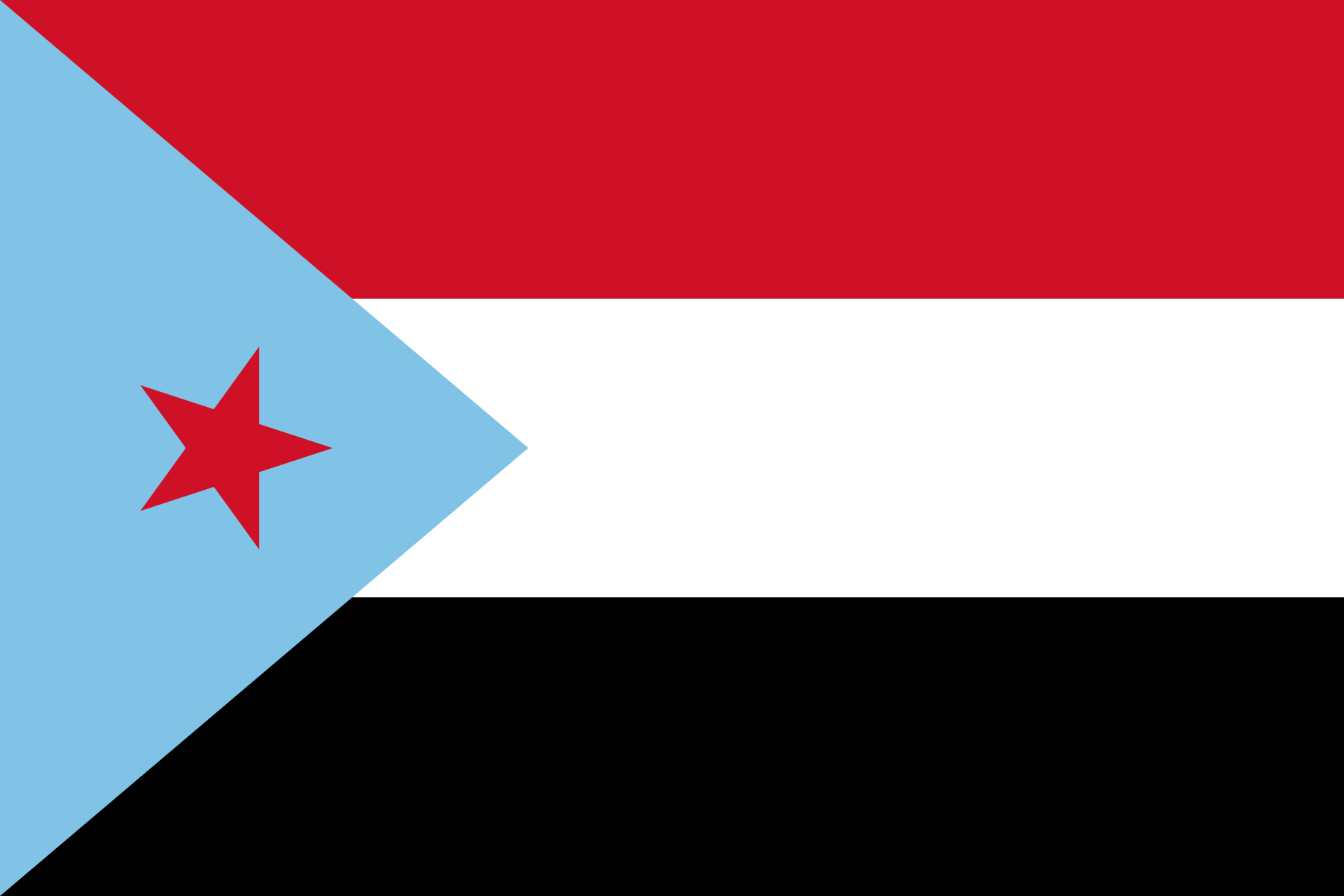 Democratic Yemen
-
 Ecuador
-
 Fiji
Fiji
-
 German Democratic Republic
-
 Ghana
Ghana
-
 Guyana
-
 Hungary
-
 Islamic Republic of Iran
-
 Jamaica
-
 Japan
Japan
-
 Lao People's Democratic Republic
-
 Liberia
-
 Madagascar
-
 Malaysia
-
 Malta
Malta
-
 Mexico
-
 Mongolia
-
 Nepal
Nepal
-
 New Zealand
-
 Nigeria
-
 Panama
-
 Papua New Guinea
-
 Peru
Peru
-
 Philippines
-
 Poland
-
 Romania
-
 Rwanda
-
 Sao Tome and Principe
-
 Somalia
-
 Sri Lanka
-
 Eswatini
-
 Sweden
-
 Thailand
-
 Uganda
-
 Ukraine
-
 Union of Soviet Socialist Republics
-
 Myanmar
-
 India
India
-
 Kenya
Kenya
-
 Maldives
-
 Pakistan
-
 Cuba
Cuba
-
 United Republic of Tanzania
-
 Uruguay
-
 Bolivarian Republic of Venezuela
-
 Yugoslavia
-
 Zambia
-
 Albania
-
 Cambodia
-
 Mozambique
-
 Lesotho
-
 Nicaragua
-
 Cabo Verde
-
 Angola
-
 Libya
Libya
-
 Viet Nam
-
 Samoa
Samoa
-
 Suriname
-
 Zimbabwe
-
 Solomon Islands
-
 Vanuatu
-
 Belize
-
 Antigua and Barbuda
-
 Brunei Darussalam
-
 Burkina Faso
-
 Belarus
Vote:
A/RES/41/41B
Recorded Vote
Show country votes
— Abstain
(9)
Absent
(3)
✓ Yes
(144)
-
China
-
 Bhutan
-
El Salvador
-
Iceland
-
Yemen
-
Bangladesh
-
Singapore
-
Ireland
-
Afghanistan
-
Benin
-
 Comoros
-
Indonesia
-
Syrian Arab Republic
-
 Saudi Arabia
-
Ethiopia
-
Finland
-
Sudan
-
Egypt
-
Algeria
-
Argentina
-
Australia
-
Austria
-
Bahamas
-
Bahrain
-
Barbados
-
Plurinational State of Bolivia
-
Botswana
-
Brazil
-
Bulgaria
-
Burundi
-
Chile
-
Colombia
-
Congo
-
Costa Rica
-
Czechoslovakia
-
Democratic Yemen
-
Denmark
-
Dominican Republic
-
Ecuador
-
 Equatorial Guinea
-
Fiji
-
 Gabon
Gabon
-
German Democratic Republic
-
Ghana
-
Greece
-
 Grenada
-
Guatemala
-
 Guinea
-
Guinea-Bissau
-
Guyana
-
Hungary
-
Islamic Republic of Iran
-
Iraq
-
 Côte d'Ivoire
-
Jamaica
-
Japan
-
 Jordan
-
Lao People's Democratic Republic
-
Liberia
-
Madagascar
-
Malaysia
-
Mali
-
Malta
-
 Mauritania
-
Mexico
-
Mongolia
-
 Morocco
-
Nepal
-
New Zealand
-
Niger
-
Nigeria
-
Norway
-
Oman
-
Panama
-
Papua New Guinea
-
Paraguay
-
Peru
-
Philippines
-
Poland
-
 Qatar
Qatar
-
Romania
-
Rwanda
-
Sao Tome and Principe
-
 Senegal
-
Sierra Leone
-
Somalia
-
 Spain
Spain
-
Sri Lanka
-
Eswatini
-
Sweden
-
Thailand
-
Trinidad and Tobago
-
 Tunisia
-
Türkiye
-
Uganda
-
Ukraine
-
Union of Soviet Socialist Republics
-
 United Arab Emirates
-
Myanmar
-
India
-
Kenya
-
Lebanon
-
Maldives
-
Pakistan
-
Cuba
-
 Cyprus
-
 Kuwait
-
 Togo
Togo
-
United Republic of Tanzania
-
Uruguay
-
Bolivarian Republic of Venezuela
-
Yugoslavia
-
 Democratic Republic of the Congo
-
Zambia
-
Albania
-
Cambodia
-
Mozambique
-
 Chad
Chad
-
Central African Republic
-
Lesotho
-
Haiti
-
Gambia
-
Nicaragua
-
Cabo Verde
-
Angola
-
 Seychelles
-
Libya
-
Viet Nam
-
 Djibouti
-
Samoa
-
Suriname
-
 Dominica
-
Zimbabwe
-
 Saint Lucia
-
Solomon Islands
-
Vanuatu
-
Belize
-
 Saint Vincent and the Grenadines
-
Antigua and Barbuda
-
Brunei Darussalam
-
Burkina Faso
-
 Cameroon
-
Saint Kitts and Nevis
-
Belarus
Vote:
A/RES/41/42
Recorded Vote
Show country votes
— Abstain
(7)
Absent
(2)
✓ Yes
(148)
-
China
-
Malawi
-
Bhutan
-
El Salvador
-
Iceland
-
Yemen
-
Mauritius
-
Bangladesh
-
Singapore
-
Ireland
-
Afghanistan
-
Benin
-
Comoros
-
Indonesia
-
Syrian Arab Republic
-
Saudi Arabia
-
Ethiopia
-
Finland
-
Sudan
-
Egypt
-
Algeria
-
Argentina
-
Australia
-
Austria
-
Bahamas
-
Bahrain
-
Barbados
-
Plurinational State of Bolivia
-
Botswana
-
Brazil
-
Bulgaria
-
Burundi
-
Canada
-
Chile
-
Colombia
-
Congo
-
Costa Rica
-
Czechoslovakia
-
Democratic Yemen
-
Denmark
-
Dominican Republic
-
Ecuador
-
Equatorial Guinea
-
Fiji
-
Gabon
-
German Democratic Republic
-
Ghana
-
Greece
-
Grenada
-
Guatemala
-
Guinea
-
Guinea-Bissau
-
Guyana
-
Hungary
-
Islamic Republic of Iran
-
Iraq
-
Côte d'Ivoire
-
Jamaica
-
Japan
-
Jordan
-
Lao People's Democratic Republic
-
Liberia
-
Madagascar
-
Malaysia
-
Mali
-
Malta
-
Mauritania
-
Mexico
-
Mongolia
-
Morocco
-
Nepal
-
New Zealand
-
Niger
-
Nigeria
-
Norway
-
Oman
-
Panama
-
Papua New Guinea
-
Paraguay
-
Peru
-
Philippines
-
Poland
-
 Portugal
-
Qatar
-
Romania
-
Rwanda
-
Sao Tome and Principe
-
Senegal
-
Sierra Leone
-
Somalia
-
Spain
-
Sri Lanka
-
Eswatini
-
Sweden
-
Thailand
-
Trinidad and Tobago
-
Tunisia
-
Türkiye
-
Uganda
-
Ukraine
-
Union of Soviet Socialist Republics
-
United Arab Emirates
-
Myanmar
-
India
-
Kenya
-
Lebanon
-
Maldives
-
Pakistan
-
Cuba
-
Cyprus
-
Kuwait
-
Togo
-
United Republic of Tanzania
-
Uruguay
-
Bolivarian Republic of Venezuela
-
Yugoslavia
-
Democratic Republic of the Congo
-
Zambia
-
Albania
-
Cambodia
-
Mozambique
-
Chad
-
Central African Republic
-
Lesotho
-
Haiti
-
Gambia
-
Nicaragua
-
Cabo Verde
-
Angola
-
Seychelles
-
Libya
-
Viet Nam
-
Djibouti
-
Samoa
-
Suriname
-
Dominica
-
Zimbabwe
-
Saint Lucia
-
Solomon Islands
-
Vanuatu
-
Belize
-
Saint Vincent and the Grenadines
-
Antigua and Barbuda
-
Brunei Darussalam
-
Burkina Faso
-
Cameroon
-
Saint Kitts and Nevis
-
Belarus
The Assembly will now turn to draft resolutions A/4l/L.33
and Corr.2, A/41/L.36 and L.37.
I call first on representatives who wish to explain their votes before the
voting on these draft resolutions. I remind mer. ~rs that explanations of vote are
limited to 10 minutes and should be made by repre,~ntatives from their seats.
Mr. SARRE (Senegal) (interpretation from French): The question of New
Caledonia; which is one of the problems at present befo~e us, is both historical
and COmp16& in nature. It is historical in that this case was brought before the
Assembly for the first time about 40 years ago. It is complex because it pertains
to two principles to which we are all firmly attached but whose implementation
reauires that we be objective, realistic and open-minded. These two principles are
those of the right of peoples to self-determination, and non-interference in the
internal affai~s of other States. The first of these principles is reaffirmed
uneauivocally in the San Francisco Charter, on the basis of which the united
Nations has gradually dev~loped over the 40 years of its existence of the basic
right recognized to Non-Self-Governing Territories and peoples as well as to States.
The relevant solutions of the United Nations, especially the Declaration on
the Granting of Independence to Colonial Countries and Peoples, are auite clear in
this respect and too well known for it to be necessary for me to quote their major
provisions here. It is a question of a universal right that must be exercised
fully and without discrimination. Nevertheless, paragraph 6 of General Assembly
resolution 1514 (XV) states:
(Mr. Thompson, Fiji)
"Any attempt aimed at the partial or total disruption of the national ... unity and the territorial integrity of a country is incompatible with tbe
purposes and principles of the Charter of the tbited Nations."
Non-interference in the inter nal affair s of States is also one. of the major
principles of the Charter. I would even go so far as to say that for all states
represented here it constitutes one of the essential conditions of their membership
of the great united Nations family. There can be no question of departing from·
this pr inciple.
In this particular case, we have been told that the French authorities intend
to carry out between now and the summer of 1987 measure which will enable the
population of the Territory concerned to take a decision on their future, in full
freedom and without manoeuvres or tricks of any kind.
It is therefore the responsibility of the united Nations to encourage the
pcocess begun by France towards an outcome which only the peoples of NeW Caledonia
of all types and political tendencies can continue the dialogue already begun with
France witr; respect for the principles and purposes of the Charter of the united·
Nations. New Caledonia and France must find in the Organization the major forum
for the implementation of resolutions 1514 (XV) and 1541 (XV). If we can ensure
trust and credibility on both sides, we shall have done useful wor k and, better
still, achieved our objective, of enabling the peoples of t.!eW Caledonia to decide
on their own future in the best conditions and by peaceful means.
Of course, an endeavour of such scope nay encounter some obstacles, but that
is a major concern. The essential point is that the parties concerned should show
greater political determination to overcome these obstacles. That political
determination exists. The recent talks between the leaders of FlNKS and the French
authocities are pr;oof of this. It is to be regretted that the draft resolution
submitted for our consideration does not mention this.
(Mr. Sure, Senegal)
History has taught us that in cases of self-determination we should explore
and make use of all positive politic,l and legal elements that could help us to
find just and lasting solutions. l'ny other procedure could have unfortunate
consequences.
My delegation feels that the draft resolution before us does not contain all
of the elements necessary for the solution of this problem. we shall therefore
vote against draft resolution A/4l/L.33 and Corr.2. Nevertheless, senegal, tb~ough
its President, Mr. Abdou Diouf, as it has always date in other arel.lB and
circumstances and on similar problems, will spare no effort to help bring about a
just and lasting solution to the New Caledatian issue.
(Mr. sarre, senegal)
Mr. de KEMOULARIA (France) (interpretation from French): The Assembly
will n~w take a decision on d~aft resolution A/4l/L.33 and Corr.2. Following the
debate yesterday and today, whose often repetitive nature - and I am not speaking
of the excesses we heard this morning - was not the fault of the French delegation,
I should like to recall the main reasons why France will vote against this text.
First, New Caledonia is not included in the catagory of Non-Self-Governing
Territories within the meaning of the Charter. It is a complex multiracial whole
where ethnic groups are represented in a balanced way, contrary to the statements
made by some speakers and contrary to what is happening in other countries in the
region, to the detriment of their earliest inhabitants.
New Caledonians of every origin, integrated into an overall French entity,
benefit scrupulously, as I have said before, from the same rights as other citizens
of my country. At the same time, they also have institutions which ensure for them
free management of their own affairs, as I emphasized in my statement yesterday.
Secondly, even though they do not belong to a Non-Self-Governing Territory,
the people of New Caledonia are perfectly entitled to cease to be French, if they
so desire. I would even go further and say that an opportunity will be given them
to express themselves quite clearly on this point during the referendum which is to
take place in the summer of 1987. A vote by Parliament decided on this, and they
can therefore chose between two very clear-cut options: complete independence and
a status of broadened autonomy. Of course, only the people really concerned will
take part in the ballot, without any manipulation, in full view of all, quite
openly.
Thirdly, the partisans of independence do not suffer from any sort of
discrimination. On the contrary, they benefit from all necessary facilities to put
forward their point of view, both at home and abroad. The only right they do not
have, and this applies to all other political movements, is to impose their point
of view when it is not supported by the majority.
Fourthly, if the majority of New Caledonians come out in favour of
independence, my country will comply with their wishes, as it has done elsewhere,
at other times and in other circumstances.
By submitting to the exercise of the right of self-determination, whatever the
conseauences may be, France does not intend to teach anyone lessons, but it also
believes that it has no lessons to learn, particularly, from countries in the
region Which, in the face of a similar problem, settled it in a less democratic and
more brutal way. The regrets they might express today, however sincere they may
be, in no c&se entitles them to present themselves as models even less as critics.
In conclusion, France has no doubt that by remaining faithful to its
democratic tradition and by opposing this draft resolution, it will be understood
and supported by all those who in this Assembly intend to show, in all objectiVity,
their dedication to the principle of self-determination.
Mr. EDWARDSEN (Norway): I have the honour to speak on behalf of the five
Nordic countries, Denmark, Finland, Iceland, Sweden and Norway regarding our vote
on draft resolutions A/4l/L.36 and A/41/L.37.
The Nordic countries' abiding commitment to the process of decolonization is
well known. That process has now very nearly run its course. This is one of the
historic achievements of the United Nations.
The Nordic countries will vote in favour of A/41/L.36 and A/4l/L.37. We
regret, however, that we cannot do so without reservations.
Draft resolution A/41/L.36 contains formulations to which we cannot give our
consent. For example, operative paragraph 4 has formulations which are contrary to
the principle upheld by the Nordic countries that in conformity with its Charter
(Mr. de Kemoularia, France)
the united Nations should always encourage only peaceful solutions. Furthermore,
we find operative paragraph la too categorically formulated. We also have
reservations with respect to certain formulations referring to the united Kingdom
in this year's draft resolution A/41/L.36, since the United Kingdom has made it
clear that it will continue strictly to fulfil its responsibilities under
Article 73 of the Charter and has expressed its willingness to inform the
Secretary~Generalof any relevant political and constitutional developments in the
Territories, for which it is responsible.
Furthermore, our vote on operative paragraph 1 of draft resolution A/4l/L.37
regarding the chapter of the report of the Special Committee on Decolonization
relating to the dissemination of information, should not be interpreted as approval
of all specific parts of that chapter. We disapprove of operative paragraph 3,
subparagrapns (f) and (9) which may hinder the Secretary-Generalis actions with
regard to the cur~ent financial crisis.
Mr. MATOS PROENCA (Port·~al): My delegation has followed with great
interest the debate on New Caledonia, under item 19 of the agenda.
This issue gives me the opportunity to reiterate Portugal's commitment to the
principles embodied in General Assembly resolutions 1514 (XV) and 1541 (XV), which
are recalled in draft resolution A/4l/L.33 and Corr.2 regarding the situation in
New Caledonia.
Since the beginning of the process that led to the independence of the former
Portuguese colonies in 1974, Portugal has consistently held the view that it is the
sovereign right of peoples to choose freely their own political future. That is
why we have noted with satisfaction that France has committed itself to hold a
referendum next year to hear the views of the popUlation of New Caledonia about the
way this right is going to be exercised.
(Mr. Edwardsen, Norway)
Rence, some problems now raised, are not sUfficiently clear to m¥ delegation.
. ' First of a11, my de1egation believes that a referendum is the most convincin~ test
of the wl11'of a people, particularly regarding the exercise of the right to
self-determination.
Secondly, my delegation was'not given convincing arguments that the referendum
proposed by France is not a genuine exercise of the right to self-determination.
In our view, France is now ~ffering the mechanisms conducive to
self-determination. Unless decisive arguments are pre~ented showing that the \ procedure proposed is not serving that purpose, my delegation feels that
consideration of this issue is indeed premature.
(Mr. Matos Proenca, Portugal)
Furthermore, it is our belief that draft resolution A/4l/L.33 will not
contr ibute to a peaceful pcocess of consultation of the will of the people of
New Caledonia. Hence, my delegation will not be able to support it, although it
shares the concerns of Member States, and of most of the sponsors, regarding the
future of the populations in the area.
As in previous years, we shall vote in favour of draft resolution A/41/L.37 on
the dissemination of information on decolooization. However, with regard to draft
resolution A/4l/L.36, "Implementation of the Declaration on the Granting of
Independence to Colooial Countri-es and Peoples," to which we attach the utmost
importance, we regret that this year we must abstain in the voting on that draft
resolu~ion owing to the fact that we cannot agree wi th the selective and
discr iminatory references made to a Member state of the United Nations in both the
preanbular and operative parts of the draft. This is all the more unacceptable to
my delegation because it is a well-known fac;:t that certain countries not mentioned
in the draft resolution are preventing others from fulfilling their obligations
under the Charter, and that atti tude continues to be ei ther ignored or condoned.
Mr. StMAmA (Iraq) (interpretation from Arabic): Last August, the
Commi ttee of 24 discussed the issue of New Caledonia and agreed L:.; ~stpone
consideration of that issue to its 1987 session in order to give all parties
concerned adequate opportunity and sufficient time to study the question in all its
aspects.
Iraq, a member of the Special Committee on decolonization, and believing as it
does in the ultimate right of peoples to self-determination, had hoped that all the
par ties ooncerned would remain committed to the agreement reached in the Special
Committee's deliberations. Hence, my delegation will abstain in the voting on
draft resolution A/41/L.33 for purely procedural reasoos. We bel ieve it is
(Mr. Matos Proenca, Portugal)
preferable for the Special Committee on decolCl1izatim first to conclude its
deliberations and then make its recoDlllendations to the General Assembly, in
accordance with past practice, so that the Assemly my take action thereon.
Mr. AL-ANSI (oman) (interpretatim from Arabic) ~ My delegation was one
of the first lnser ibed on the l1st to speak on Malday, 1 DeceJlber 1986, on agenda
item 19, Implementation of the Declaration on the Granting of Independence to
Colonial Countries and Peoples, and on the aaport of the Special Committee of 24,
which was asked by the Gene.?J. Assembly to follow up on the granting of
independence to those peoples and countries still struggling to attain their
legitimate rights to freedom and self-determination. However, in view of the lCllg
list of speakers and the short, time available for meetings, we decided to satisfy
ourselves with making a statement in explanation of vote before the voting to
express our views on the three draft resolutions before use, A/41/L.33, L.36
and L.37.
First, we would like to express our full endorsement of the contents of
resolution 1514 (XV) of 14 Decenber 1960, which enbodies the Declaration on the
Granting of Independence to Colonial Countries and Peoples~ of resolution
2621 (XXV) of 12 OCtober 1970, which cootains the programme of action for the full
implementa tion of that Declaration and of reso~ution 40/56 of 2 December 1985 on
the conmmemoration of the twenty-fifth anniversary of the adoption of the
Declaration on the Granting of Independence to Colm la1 Countr ies and Peoples, and
of all other relevant uni ted Nations resolutions.
We should also Bite to congr atula te the Chairman and the member s of the
Special Committee for their cClltinued fruitful and successful efforts to eliminate
all forms of colonialism and to encourage the efforts of the international
community and its competent bodies, particularly the oepartment of political
Affairs, Trusteeship and Decolonization.
(Mr. Sumaida, Iraq)
As foe our position on the other draft resolutions, my delegation, while
appreciating the motives of the sponsors of draft resolutial A/41/L.33, and while
believing' in the full rights of peoples to self-determination and freedom from all
forms of colalialism imposed al them counter to the r;Eincip1.es and purposes of the
O'1ited Nations, must state with regret that 1n the present circumstances, we cannot
vote in favour of the draft resolutial because the situation in New Caledonia is
not entirely clear to us. we shall therefor:e abstain in the voting on the draft
resolution, hoping that at future sessions of the General Assembly we shall have
more details, through the reports of the Committee of 24 and other thited Nations
bodies. oman's decision to abstain must be viewed in that context alone.
Wi~ regard to draft resolutiCll A/41/L.36, we support the positive efforts of
the Special·Connittee to achieve the full independence of the people of Namibia and
other peoples and countries still suffering Wlder the c0100ial yoke and are still
being denied their right to self-determination. we will vote in favour of the
draft resolution, as we have voted in the past for similar resolutions, although we
do not agree with the penUltimate lEeaJlt)ular paragraph, expressing regret at the
decision. of the Bdtish GoIrernment not to take part in the wor: k of the Special
COJllllittee, because we believe that to be a sovereign right of any independent
r-sellber state of the O'1i ted Nations.
Wi th regard to draft resolution A/41/L. 37, -Dissemination of information on
cecolmization,· \IIlhich is a question that we consider to be of great importance and
one that complements the activities of the Special COImIittee on deoolalization and
the TrusteeShip Council, we shall vote in favour of that draft resolution in
accordance with the principles of our foreign policy. Ha",evet:, we believe it is
important to be accurate in disaeminating such information, since, unfortunately,
we must recognize that some information on deoolalb-ltt-.lon disseminated by competent
(Mr. Al-Ansi, Q!!an)
organs in the field is inadequate. P« example, totally unfomded misinformation
has been disseminated according to whim the SUltanate of Qaan achieved its
independence fran Britain in 1971 tbrou9h the efforts of the special COIlIIIlittee,
whereas the fact of the matter is that QIlan has never been subject to any 00100ia1
Power and its independence is as time hcnoured as it·.:, histCltY, notwithstanding
special links with particular states when its interests so dictated. The date 7
OCtober 1971 marks the admission of the Sultanate of Oman to mellbershlp of the
United Nations and the date of the accession of Sultan Qabus ibn said to the
throne, succeeding the late Sultan said ibn 'nlylllOur a1 said. we wished to make
this clarification for the record.
(Mr. Al.-Ansi, OBan)
Hr. OUID BOYE (Mauritania) (interpretation from Frend'l): The Islamic
Republic of Mauritania reoognizes the inalienable right of all peoples to
self-determination and independence, in keeping with the principles of the United
Nations Charter and resolution 1514 (XV), of 14 Decenber 1960, which contains the
Declaration on the Granting of Independence to Colonial Countr ies and Peoples.
Having noted the information on New CaledCl'lia submitted by the GoVernment of
France, the administering Paler, we fear that this draft resolution, if aCbpted,
might disrupt the free, denocratic referendum on self-determination scheduled for
the middle of July 1987 at the latest.
For this reason, and because the Special Committee on deoolonization has
postponed consideration of the matter until 1~87, the Islamic Republic of
r~uritania, will vote against draft resolution A/41/L.33 and Corr.2, before the
Assenbly.
Hr. BIRCH (united Kingdom): As with similar resolutions in previous
years, my delegation will vote against draft resolutions A/4l/L.36 and A/4l/L. 37.
The draft resolution A/41/L.36, on the implementation of the Declaration on
decolmization, fails to reflect the enormous strides that have been made in the
field of deoolonization over the last 40 years, in which rcrJ country has played such
a leading role. Colooialism, at least colonialism as defined in this draft
resolution, is close to an end. To be sure there are some unique and regrettable
exceptions, of wich Namibia is the most glaring example, but this draft resolution
says nothing of relevance about the other Non-Self-Governing Territories, the
majority of which are British. None of the remaining British dependencies has
indicated any wish to move to independence or is likely to do so in the foreseeable
future. On the cCl'ltrary, all have made it clear that they do not want to break
their links with the united Kingdom, and we intend to respect their wishes.
It is a natter of great regr<it to my delegation that this self-evident fact is not
recognized in the draft resolution. Instead, the colonialism of today continues to
be addressed in the jargon of the past. There are references in the text' to the
need to eradicate the last vestiges of colonialism when ·instead we should be
consider ing how best the uni ted Nations can contr ibute to the welfare of the
remaining colonial peoples.
I have already mentioned Namibia. To be sure, this draft resolution says a
good deal about the situation in that Territory, and rightly so. No one is more
concerned than we are to see the peaceful transition of Namibia to independence,
but we must recolJOize that Namibia is in a different legal position from all other
Territories. Accordingly, the special provisions that apply to Namibia should be
taken for what they are, namely, special arrangements that apply to a unique and
particular set of circumstances.
Naturally we deplore the critical references in the draft resolution to the
decision of my GoI7ernment to take no further part in the activities of the Special
Conuni ttee on'decolonization. I explained in a letter earlier this year to the
Chairman of the Special Committee that our decision reflected our belief that the
colonial era, as far as the remaining British dependencies were concerned, was
over. As a result, we came to the conclusion that no useful purpose would be
served by the United Kingdom's continuing to take part in the activities of the
Special Committee and that the.re was no need for the united Nations to devote time
and resources to the special study of the ai:fairs of, those Territories. But we
made it very clear that we would cootinue to tr ansmi t informa Hon on those
Territories to the secretary-General, as we are required to do under Article 73 e
of the United Nations Charter. We particularly reject the assertion in the
penultimate pl'eambular paragraph of this draft resolution that our
(Mr. Birch, Un i ted Kingdom)
non-participation had'a "negative impact" on the w.Qrk of the Special Committee this
year.
Turning now to draft resolution A/41/L. 37, 01\ dissemination of information on
decolmization, it follows from what I have already said that we cannot accept the
call in operative paragraph 2 of the draft resolution for intensification of
information work in the field of decolonization. On the contrary, we believe that
this should diminish as the era of decolonization draws to a close. For' the same
r-:--.son we cannot agree with the call in operative paragraphs 3 (f) and 3 (g) to
oontinue to ~ovide verbatim records and full ~ess release coverage to the Special
Committee on decolonization. Verbatim coverage of the sessions of the special
Committee was withdrawn this year as part of the secretary-General's cost-saving
measures. Agaioot the background of the continuing financial crisis facing the
United Nations, we see no justification for its reinstatement.
Mr. JESUS (Cape Verde): My delegation will cast a positive vote on draft
resolution A/4l/L.33 and Corr.2, on New Caledonia. we do so in keeping with full
respect for the provisions of the Charter on the right of self-determination of
peoples and the principles of decolonization set forth in resolution 1514 (XV).
The political struggle undertaken for the independence of Cape verde was
substantially carried out in this Organization on the basis of those principles.
It would therefore be an ireny of history if today we were to deny other peoples
their right to see their problems considered by this Organization, whose IXestige
and the respect it commands were the main poli tical tools for achieving our own
self-determination and independence. By casting a p)sitive vote we want only to
signify our position of principle. Our vote cannot and should not in any way be
construed as enmity or an unfriendly act towards France, a country with which
Cape Verde maintains good relations of friendship and co~peration. We have great
(Mr. Birch, United Kingdom)
respect for France, 'whose historical CQ'ltribution to human civilization and
positive contr ibution in the search for solutia)s to lEoblems of global concern are
very meli appreciated by my coun try •
We believe that those countr tes which support this draft resolutioo do so
essentially as a matter of principle. we would have hoped, therefore, that some of
those same countr i~.s would have displayed equal attachment to and respect for the
inalienable right of self-determination of other peoples and Territories. It is
regrettable, to say the least, that among the sponscxs of this draft resolution we
find a country lolbich still continues its illegal occupation of East Timee, in
blatant violation of international neems and the well-established practice of the
United Nations in the field of decolonization.
The PRES IDENT: The Assembly will now begin the voting process and take
decisions on draft resolutions A/41/L.33 and Corr.2, A/41/L.36 and A/41/L.37.
(Mr. Jesus, Cape Verde)
In this connection, I should like to inform the General Assembly that Burkina
Faso has become a sponsor of draft resolution A/4l/L.36, and that Burkina Faso and
Samoa have become sponsors of draft resolution A/4l/L.37.
The programme budget implications of draft resolutions A/4l/L.36 and A/4l/L.37
are contained in the report of the Fifth Committee in document A/4l/92l.
The Assembly will vote first on draft resolution A/4l/L.33 and Corr.2. A
recorded vote has been requested.
A recorded vote was taken.
la favour:
Afghanistan, Albania, Algeria, Angola, Antigua and Barbuda, Australia, Bahamas, Bangladesh, Barbados, Belize, Benin, Botswana, Brazil, Brunei Darussalam, Bulgaria, Burkina Faso, Burma, Byelorussian Soviet Socialist Republic, Cape Verde, Chile, China, Colombia, Congo, Cuba, Czechoslovakia, Democratic Kampuchea, Democratic Yemen, Ecuador, Ethiopia, Fiji, Finland, German Democratic Republic, Ghana, Guyana, Hungary, India, Indonesia, Iran (Islamic Republic of), Jamaica, Japan, Kenya, Lao People's Democratic RepUblic, Lesotho, Liberia, Libyan Arab Jamahiriya, Madagascar, Malawi, Malaysia, Maldives, Malta, Mexico, Mongolia, Mozambique, Nepal, New Zealand, Nicaragua, Nigeria, Pakistan, Panama, Papua New Guinea, Peru, Philippines, Poland, Romania, Rwanda, Samoa, Sao Tome and principe, Singapore, Solomon Islands, Somalia, Sri Lanka, Sudan, Suriname, Swaziland, Sweden, Syrian Arab Republic, Thailand, Uganda, Ukrainian Soviet Socialist Republic, Union of Soviet Socialist Republics, united Republic of Tanzania, uruguay, Vanuatu, Venezuela, Viet Nam, Yemen, Yugoslavia, Zambia, zimbabwe
Against:
Belgium, Chad, Comoros, Cote d'Ivoire, Djibouti, Dominica, Equatorial Guinea, France, Gabon, Germany, Federal Republic of, Grenada, Honduras, Italy, Luxembourg, Mauritania, Morocco, Netherlands, Portugal, Saint Lucia, Saint Vincent and the Grenadines, Senegal, Spain, Togo, Zaire
Abstaining: Argentina, Austria, Bahrain, Bolivia, Burundi, Canada, Central African Republic, Costa Rica, Denmark, Dominican RepUblic, Egypt, El Salvador, Gambia, Greece, Guatemala, Guinea-Bissau, Raiti, Iceland, Iraa, Ireland, Israel, Lebanon, Mali, Mauritius, Niger, Norway, Oma~, Paraguay, Saint Christopher and Nevis, Sierra Leone, Trinidad and Tobago, Turkey, United Kingdom of Great Britain and Northern Ireland, united States of America
Draft resolution A/41/t.33 and Corr.2 was adopted by 89 votes to 24, with
34 abstentions (resolution 41/41 A).
(The President)
The Assembly will now vote on draft resolution
A/4l/L.36. A recorded vote has been requested.
A recorded vote was taken.
In favour: Afghanistan, Albania, Algeria, Angola, Antigua and Barbuda, Argentina, Australia, Austria, Bahamas, Bahrain, Bangladesh, Barbados, Belize, Benin, Bhutan, Bolivia, Botswana, Brazil, Brunei Darussalam, BUlgaria, Burkina Faso, Burma, Burundi, Byelorussian Soviet Socialist Republic, Cameroon, Cape Verde, Central African Republic, Chad, Chile, China, Colombia, Comoros, Congo, Costa Rica, Cote d'Ivoire, Cuba, Cyprus, Czechoslovakia, Democratic Kampuchea, Democratic Yem~n, Denmark, Djibouti, Dominica, Dominican Republic, Ecuador, Egypt, El Salvador, Eauatorial Guinea, Ethiopia, Fiji, Finland, Gabon, Gambia, German Democratic Republic, Ghana, Greece, Grenada, Guatemala, Guinea, Guinea-Bissau, Guyana, Haiti, Hungary, Iceland, India, Indonesia, Iran (Islamic Republic of), Iraq, Ireland, Jamaica, Japan, Jordan, K~nya, Kuwait, Lao People's Democratic Republic, Lebanon, Lesotho, Liberia, Libyan Arab Jamahiriya, Madagascar, Malaysia, Maldives, Mali, Malta, Mauritania, Mexico, Mongolia, Morocco, Mozambiaue, Nepal, New Zealand, Nicaragua, Niger, Nigeria, Norway, Oman, Pakistan, Panama, Papua New Guinea, Paraguay, Peru, Philippines, Poland, Qatar, Romania, Rwanda, Saint Christopher and Nevis, Saint Lucia, Saint Vincent and the Grenadines, Samoa, Sao Tome and Principe, Saudi Arabia, Senegal, Seychelles, Sierra Leone, Singapore, Solomon Islands, Somalia, Spain, sri Lanka, Sudan, Suriname, Swaziland. Sweden, Syrian Arab Republic, Thailand, Togo, Trinidad and Tobago, Tunisia, Turkey, uganda, Ukrainian Soviet Socialist RepUblic, Union of Soviet Socialist Republics, United Arab Emirates, United RepUblic of Tanzania, Uruguay, Vanuatu, Venezuela, Viet Nam, Yemen, Yugoslavia, Zaire, Zambia, Zimbabwe
Against: France, United Kingdom of Great Britain and Northern Ireland, united States of America
Abstaini~: Belgium, Canada, Germany, Federal RepUblic of, Israel, Italy, Luxembourg, Malawi, Netherlands, portugal
Draft resolution A/4l/L.36 was adopted by 144 votes to 3, with 9 abstentions
(resolution 41/41 B).
I now put to the vote draft resolution A/4l/L.37. A
recorded vote has been requested.
A recorded vote was taken.
In favour: Afghanistan, Albania, Algeria, Angola, Antigua and Barbuda, Argentina, Australia, Austria, Bahamas, Bahrain, Bangladesh
Barb~dos, Belize, Benin, Bhutan, Bolivia, Botswana, Brazil, Brunei Darussalam, BUlgaria, Burkina Faso, Burma, Burundi, Byelorussian Soviet Socialist Republic, Cameroon, Canada, Cape Verde, Central African Republic, Chad, Chile, China, Colombia, Comeros, Congo, Costa Rica, Cote d'Ivoire, Cuba, Cyprus, Czechoslovakia, Democratic Kampuchea, Democratic Yemen, Denmark, Djibouti, Dominica, Dominican Republic, Ecuador, Egypt, El Salvador, Equatorial Guinea, Ethiopia, Fiji, Finland, Gabon, Gambia, German Democratic Republic, Ghana, Greece, Grenada, Guatemala, Guinea, Guinea-Bissau, Guyana, Haiti, Hungary, Iceland, India, Indonesia, Iran (Islamic Republic of), Iraa, Ireland, Jamaica, Japan, Jordan, Kenya, Kuwait, Lao P~ople's Democratic Republic, Lebanon, Lesotho, Liberia, Libyan Arab Jamahiriya, Madagascar, Malawi, Malaysia, Maldives, Mali, Malta, Mauritania, Mauritius, Mexico, Mongolia, Morocco, Mozambique, Nepal, New zealand, Nicaragua, Niger, Nigeria, Norway, oman, Pakistan, Panama, Papua New Guinea, Paraguay, Peru, Philippines, Poland, portugal, Qatar, Romania, Rwanda, Saint Christopher and Nevis, Saint Lucia, Saint Vincent and the Grenadines, Samoa, Sao Tome and Principe, Saudi Arabia, Senegal, Seychelles, Sierra Leone, Singapore, Solomon Islands, Somalia, Spain, Sri Lanka, Sudan, Suriname, Swaziland, Sweden, Syrian Arab Republic, Thailand, Togo, Trinidad and Tobago, Tunisia, Turkey, uganda, Ukrainian Soviet Socialist Republic, Union of Soviet Socialist Republics, United Arab Emirates, United Republic of Tanzania, Uruguay, Vanuatu, Venezuela, Viet Nam, Yeme~~ Yugoslavia, zaire, Zambia, Zimbabwe
Against: United Kingdom of Great Britain and Northern Ireland, united States of America
Abstaining: Belgium, France, Germany, Federal Republic of, Israel, Italy, Luxembourg, Netherlands
Draft resolution A/4l/L.37 was adopted by 148 votes to 2, with 7 abstentions
(resolution 41/42).
Vote:
A/4l/L.36
Recorded Vote
✓ 144
✗ 3
9 abs.
Show country votes
✗ No
(11)
✓ Yes
(142)
-
China
-
Bhutan
-
El Salvador
-
Iceland
-
Yemen
-
Bangladesh
-
Singapore
-
Ireland
-
Afghanistan
-
Benin
-
Comoros
-
Indonesia
-
Syrian Arab Republic
-
Saudi Arabia
-
Ethiopia
-
Finland
-
Sudan
-
Egypt
-
Algeria
-
Argentina
-
Australia
-
Austria
-
Bahamas
-
Bahrain
-
Barbados
-
Plurinational State of Bolivia
-
Botswana
-
Brazil
-
Bulgaria
-
Burundi
-
Chile
-
Colombia
-
Congo
-
Costa Rica
-
Czechoslovakia
-
Denmark
-
Dominican Republic
-
Ecuador
-
Fiji
-
Gabon
-
German Democratic Republic
-
Ghana
-
Greece
-
Grenada
-
Guatemala
-
Guinea
-
Guinea-Bissau
-
Guyana
-
Hungary
-
Islamic Republic of Iran
-
Iraq
-
Côte d'Ivoire
-
Jamaica
-
Japan
-
Jordan
-
Lao People's Democratic Republic
-
Liberia
-
Madagascar
-
Malaysia
-
Mali
-
Malta
-
Mauritania
-
Mexico
-
Mongolia
-
Morocco
-
Nepal
-
New Zealand
-
Niger
-
Nigeria
-
Norway
-
Oman
-
Panama
-
Papua New Guinea
-
Paraguay
-
Peru
-
Philippines
-
Poland
-
Qatar
-
Romania
-
Rwanda
-
Sao Tome and Principe
-
Senegal
-
Sierra Leone
-
Somalia
-
Spain
-
Sri Lanka
-
Thailand
-
Trinidad and Tobago
-
Tunisia
-
Türkiye
-
Uganda
-
Ukraine
-
Union of Soviet Socialist Republics
-
United Arab Emirates
-
Myanmar
-
India
-
Lebanon
-
Maldives
-
Pakistan
-
Cuba
-
Cyprus
-
Kuwait
-
Togo
-
United Republic of Tanzania
-
Uruguay
-
Bolivarian Republic of Venezuela
-
Yugoslavia
-
Democratic Republic of the Congo
-
Zambia
-
Albania
-
Cambodia
-
Chad
-
Central African Republic
-
Lesotho
-
Haiti
-
Gambia
-
Nicaragua
-
Cabo Verde
-
Angola
-
Seychelles
-
Libya
-
Viet Nam
-
Djibouti
-
Samoa
-
Suriname
-
Dominica
-
Zimbabwe
-
Saint Lucia
-
Solomon Islands
-
Vanuatu
-
Belize
-
Saint Vincent and the Grenadines
-
Antigua and Barbuda
- Democratic Yem~n
-
Brunei Darussalam
-
Burkina Faso
-
Cameroon
- Eauatorial Guinea
- Mozambiaue
- K~nya
-
Saint Kitts and Nevis
-
Belarus
In view of the lateness of the hour, I propose that we
hear explanations of vote after the voting at the beginning of this afternoon's
meeting.
The meeting rose at 1.15 p.m.
Vote:
A/4l/L.37
Recorded Vote
✓ 148
✗ 2
7 abs.
Show country votes
— Abstain
(7)
✓ Yes
(144)
-
China
-
Malawi
-
Bhutan
-
El Salvador
-
Iceland
-
Mauritius
-
Singapore
-
Ireland
-
Afghanistan
-
Benin
-
Indonesia
-
Syrian Arab Republic
-
Saudi Arabia
-
Ethiopia
-
Finland
-
Sudan
-
Egypt
-
Algeria
-
Argentina
-
Australia
-
Austria
-
Bahamas
-
Bahrain
-
Plurinational State of Bolivia
-
Botswana
-
Brazil
-
Bulgaria
-
Burundi
-
Canada
-
Chile
-
Colombia
-
Congo
-
Costa Rica
-
Czechoslovakia
-
Democratic Yemen
-
Denmark
-
Dominican Republic
-
Ecuador
-
Equatorial Guinea
-
Fiji
-
Gabon
-
German Democratic Republic
-
Ghana
-
Greece
-
Grenada
-
Guatemala
-
Guinea
-
Guinea-Bissau
-
Guyana
-
Hungary
-
Islamic Republic of Iran
-
Côte d'Ivoire
-
Jamaica
-
Japan
-
Jordan
-
Liberia
-
Madagascar
-
Malaysia
-
Mali
-
Malta
-
Mauritania
-
Mexico
-
Mongolia
-
Morocco
-
Nepal
-
New Zealand
-
Niger
-
Nigeria
-
Norway
-
Oman
-
Panama
-
Papua New Guinea
-
Paraguay
-
Peru
-
Philippines
-
Poland
-
Portugal
-
Qatar
-
Romania
-
Rwanda
-
Sao Tome and Principe
-
Senegal
-
Sierra Leone
-
Somalia
-
Spain
-
Sri Lanka
-
Eswatini
-
Sweden
-
Thailand
-
Trinidad and Tobago
-
Tunisia
-
Türkiye
-
Uganda
-
Ukraine
-
Union of Soviet Socialist Republics
-
United Arab Emirates
-
Myanmar
-
India
-
Kenya
-
Lebanon
-
Maldives
-
Pakistan
-
Cuba
-
Cyprus
-
Kuwait
-
Togo
-
United Republic of Tanzania
-
Uruguay
-
Bolivarian Republic of Venezuela
-
Democratic Republic of the Congo
-
Zambia
-
Albania
-
Cambodia
-
Mozambique
-
Chad
-
Central African Republic
-
Lesotho
-
Haiti
-
Gambia
-
Nicaragua
-
Cabo Verde
-
Angola
-
Seychelles
-
Libya
-
Viet Nam
-
Djibouti
-
Samoa
-
Suriname
-
Dominica
-
Zimbabwe
-
Saint Lucia
-
Solomon Islands
-
Vanuatu
-
Belize
-
Saint Vincent and the Grenadines
-
Antigua and Barbuda
-
Brunei Darussalam
-
Burkina Faso
-
Cameroon
- Comeros
- Bangladesh Barb~dos
- Lao P~ople's Democratic Republic
-
Saint Kitts and Nevis
-
Belarus