A/67/PV.62 General Assembly
The meeting was called to order at 3.45 p.m.
Vote:
A/RES/67/234A
Recorded Vote
Show country votes
— Abstain
(17)






Absent
(43)
-
 Malawi
-
 Comoros
-
 Burundi
-
 Canada
-
 Equatorial Guinea
-
 Gabon
Gabon
-
 Ghana
Ghana
-
 Guinea
-
 Guinea-Bissau
-
 Mauritania
-
 Paraguay
-
 Sao Tome and Principe
-
 Senegal
-
 Sierra Leone
-
 Somalia
-
 Eswatini
-
 Kenya
Kenya
-
 Democratic Republic of the Congo
-
 Mozambique
-
 Chad
Chad
-
 Central African Republic
-
 Gambia
-
 Cabo Verde
-
 Angola
-
 Seychelles
-
 Suriname
-
 Dominica
-
 Zimbabwe
-
 Vanuatu
-
 Belize
-
 Kazakhstan
-
 Democratic People's Republic of Korea
-
 Micronesia (Federated States of)
-
 Marshall Islands
-
 Azerbaijan
-
 Tajikistan
-
 Kyrgyzstan
-
 Turkmenistan
-
 Uzbekistan
-
 Tuvalu
-
 Nauru
Nauru
-
 Kiribati
-
 Timor-Leste
✓ Yes
(133)
-
 China
China
-
 Bhutan
-
 El Salvador
-
 Iceland
-
 United States of America
-
 United Kingdom of Great Britain and Northern Ireland
-
 Mauritius
-
 Bangladesh
-
 Belgium
-
 Singapore
-
 Ireland
-
 Afghanistan
-
 Benin
Benin
-
 Indonesia
-
 Israel
-
 Ethiopia
-
 Germany
-
 Finland
-
 Algeria
-
 Argentina
-
 Australia
-
 Austria
-
 Bahamas
-
 Barbados
-
 Botswana
-
 Brazil
-
 Bulgaria
-
 Chile
Chile
-
 Colombia
-
 Congo
Congo
-
 Costa Rica
-
 Denmark
-
 Dominican Republic
-
 Ecuador
-
 Fiji
Fiji
-
 France
-
 Greece
-
 Grenada
-
 Guatemala
-
 Guyana
-
 Hungary
-
 Iraq
Iraq
-
 Italy
Italy
-
 Côte d'Ivoire
-
 Jamaica
-
 Japan
Japan
-
 Jordan
-
 Lao People's Democratic Republic
-
 Liberia
-
 Luxembourg
-
 Madagascar
-
 Malaysia
-
 Mali
Mali
-
 Malta
Malta
-
 Mexico
-
 Mongolia
-
 Morocco
-
 Nepal
Nepal
-
 Netherlands
-
 New Zealand
-
 Niger
Niger
-
 Nigeria
-
 Norway
-
 Panama
-
 Papua New Guinea
-
 Peru
Peru
-
 Philippines
-
 Poland
-
 Portugal
-
 Romania
-
 Rwanda
-
 Spain
Spain
-
 Sri Lanka
-
 Sweden
-
 Thailand
-
 Trinidad and Tobago
-
 Tunisia
-
 Türkiye
-
 Uganda
-
 Ukraine
-
 India
India
-
 Lebanon
-
 Maldives
-
 Pakistan
-
 Cyprus
-
 Togo
Togo
-
 United Republic of Tanzania
-
 Uruguay
-
 Zambia
-
 Albania
-
 Cambodia
-
 Lesotho
-
 Haiti
Haiti
-
 Honduras
-
 Libya
Libya
-
 Viet Nam
-
 Djibouti
-
 Samoa
Samoa
-
 Saint Lucia
-
 Solomon Islands
-
 Saint Vincent and the Grenadines
-
 Antigua and Barbuda
-
 Brunei Darussalam
-
 Burkina Faso
-
 Cameroon
-
 Saint Kitts and Nevis
-
 Liechtenstein
-
 Latvia
-
 Estonia
-
 Lithuania
-
 Namibia
-
 Republic of Korea
-
 Croatia
-
 Russian Federation
-
 Slovenia
-
 Moldova
-
 Bosnia and Herzegovina
-
 San Marino
-
 Armenia
-
 South Africa
-
 Czechia
-
 Slovakia
-
 North Macedonia
-
 Monaco
-
 Andorra
-
 Georgia
-
 Eritrea
-
 Switzerland
-
 Palau
Palau
-
 Tonga
Tonga
-
 Serbia
-
 Montenegro
-
 South Sudan
Vote:
A/RES/67/243
Recorded Vote
Show country votes
— Abstain
(12)
Absent
(42)
-
Malawi
-
Comoros
-
 Saudi Arabia
-
Ethiopia
-
Bahamas
-
Burundi
-
Equatorial Guinea
-
Gabon
-
Guinea
-
Guinea-Bissau
-
Paraguay
-
Sao Tome and Principe
-
Senegal
-
Somalia
-
Eswatini
-
Kenya
-
Democratic Republic of the Congo
-
Mozambique
-
Chad
-
Central African Republic
-
Lesotho
-
Gambia
-
Cabo Verde
-
Angola
-
Seychelles
-
Suriname
-
Dominica
-
Zimbabwe
-
Vanuatu
-
Belize
-
Micronesia (Federated States of)
-
Marshall Islands
-
Azerbaijan
-
Tajikistan
-
Turkmenistan
-
Uzbekistan
-
Palau
-
Tuvalu
-
Nauru
-
Tonga
-
Kiribati
-
Timor-Leste
✓ Yes
(139)
-
Bhutan
-
El Salvador
-
Iceland
-
 Yemen
Yemen
-
United States of America
-
United Kingdom of Great Britain and Northern Ireland
-
Mauritius
-
Bangladesh
-
Belgium
-
Singapore
-
Ireland
-
Afghanistan
-
Benin
-
Indonesia
-
Israel
-
Germany
-
Finland
-
 Sudan
Sudan
-
 Egypt
Egypt
-
Algeria
-
Argentina
-
Australia
-
Austria
-
 Bahrain
-
Barbados
-
Botswana
-
Brazil
-
Bulgaria
-
Canada
-
Chile
-
Colombia
-
Congo
-
Costa Rica
-
Denmark
-
Dominican Republic
-
Fiji
-
France
-
Ghana
-
Greece
-
Grenada
-
Guatemala
-
Guyana
-
Hungary
-
 Islamic Republic of Iran
-
Iraq
-
Italy
-
Côte d'Ivoire
-
Jamaica
-
Japan
-
Jordan
-
Lao People's Democratic Republic
-
Liberia
-
Luxembourg
-
Madagascar
-
Malaysia
-
Mali
-
Malta
-
Mauritania
-
Mexico
-
Mongolia
-
Morocco
-
Nepal
-
Netherlands
-
New Zealand
-
Niger
-
Nigeria
-
Norway
-
 Oman
Oman
-
Panama
-
Papua New Guinea
-
Peru
-
Philippines
-
Poland
-
Portugal
-
 Qatar
Qatar
-
Romania
-
Rwanda
-
Spain
-
Sri Lanka
-
Sweden
-
Thailand
-
Trinidad and Tobago
-
Tunisia
-
Türkiye
-
Uganda
-
Ukraine
-
 United Arab Emirates
-
 Myanmar
-
India
-
Lebanon
-
Maldives
-
Pakistan
-
Cyprus
-
 Kuwait
-
Togo
-
United Republic of Tanzania
-
Uruguay
-
Zambia
-
Albania
-
Cambodia
-
Haiti
-
Honduras
-
Libya
-
Viet Nam
-
Djibouti
-
Samoa
-
Saint Lucia
-
Solomon Islands
-
Saint Vincent and the Grenadines
-
Antigua and Barbuda
-
Brunei Darussalam
-
Burkina Faso
-
Cameroon
-
Saint Kitts and Nevis
-
Liechtenstein
-
Latvia
-
Kazakhstan
-
Estonia
-
Lithuania
-
Namibia
-
Republic of Korea
-
Croatia
-
Slovenia
-
Moldova
-
Bosnia and Herzegovina
-
San Marino
-
Armenia
-
Kyrgyzstan
-
South Africa
-
Czechia
-
Slovakia
-
North Macedonia
-
Monaco
-
Andorra
-
Georgia
-
Eritrea
-
Switzerland
-
Montenegro
-
South Sudan
Statement by the President

Standing before this greatest of parliaments more than three months ago, I pledged to faithfully serve the cause of the United Nations and to exercise my authority in a forthright and even-handed manner, with the utmost respect for the sovereign equality of Member States. Now that the main part of the sixty-seventh session is drawing to a close, I can only hope that I have fulfilled most of Member States’ expectations. I truly look forward to the start of the resumed part of the session in a few weeks’ time and to joining participants again in this Hall after the holiday break.
Allow me to thank all speakers, who, in expressing their countries’ positions, have made substantial contributions to the work of the plenary. In addition, I would like to express my most special and sincere appreciation to the Vice-Presidents for their selfless assistance and cooperation. I am also deeply grateful for the leadership and guidance of the Secretary-General and for the institutional support of the Secretariat, particularly the Department for General Assembly and Conference Management.
As of this morning, the plenum has adopted 231 resolutions and 63 decisions, and there remain many more to conclude. The highlights include the so-called humanitarian omnibus resolution, human rights and freedom of religion or belief improvements, combating intolerance and strengthening the disarmament machinery, among others. The issue that perhaps drew the most attention was the historic vote, held on 29 November, granting Palestine non-member observer State status in the United Nations (see resolution 67/19). Moments before the ballots were cast, I extended an appeal from this rostrum to the General Assembly, in particular my dear friends from Palestine and Israel, to work for peace with the aim of reaching a comprehensive settlement. Today, allow me to call again for a just peace in the Holy Land. I fervently believe that when it comes to the Middle East — or, for that matter, to the Sahel, the Great Lakes Region of Africa and a number of other conflict-ridden areas across our planet — good-faith engagement in a peace process is the only way to bring strife to a lasting conclusion. In today’s globalized interconnected world, what happens in one part of it invariably affects us all. With that in mind, I chose as the overarching theme for the sixty-seventh session “Bringing about adjustment or settlement of international disputes or situations by peaceful means”. In such tumultuous times, the enormity of that challenge is evident. So we look with hope to far-sighted leaders, mindful of democratic aspirations, yet capable of making tough and historic decisions. Their task is a truly monumental one — to see ahead what not appears, as the poet Robert Frost wrote so many years ago, and to remember the future and the path that beckons. The content of the general debate reflects the fact that there is now a congruence of views among Member States that conflict prevention, durable peace and security and sustainable development can be achieved only through an integrated approach. Fulfilling the Millennium Development Goals must remain at the core of our shared vision for a more prosperous, peaceful and equitable world. At the same time, we must also focus on the post-2015 agenda. I am going to leave aside the substantial part of my speech on sustainable development goals. I had certain strong beliefs that I am no longer prepared to share with this audience before the next attempt is made to make certain breakthroughs in that process. Personally, I strongly believe that the sustainable development agenda is critical to the prosperous future of mankind. I very much hope that that view will also be reflected in the decisions that we might take in this Hall in the future. However, before we come to an agreement, I must say that I am no longer prepared to speak in public about sustainable development as President of the General Assembly. Over the past few years, the Group of 20 (G-20) has come to play an increasingly important role in the debate on global economic governance. Its decisions have worldwide implications and, in one way or another, affect every Member State’s political, economic and social development. I believe that the General Assembly, which operates on the basis of the principle of sovereign equality, can provide a unique platform to exchange views and to share information on our economic concerns. To that end, I intend to launch a process that would lead to the establishment of a non-intrusive form of regular interaction between the General Assembly and the G-20, with the participation of international financial institutions as appropriate. Let me be very clear that the intent of that initiative is not to infringe on established prerogatives but to complement the existing international efforts, in accordance with the G-20’s readiness to reach out to non-G-20 countries and the United Nations. That would certainly help answer a number of questions related to transparency and inclusivity. I intend to organize a thematic debate on ways to enhance dialogue between the G-20 and the rest of the world. I will extend invitations to several G-20 and non-G-20 Heads of State and Government, as well as the Russian G-20 presidency and other key stakeholders. In my view, the need for regular consultations has become all the greater in the wake of a number of sobering studies that forecast a slowdown in global growth and job creation, including, most recently, the alarming United Nations World Economic Situation and Prospects 2013 report. I will also convene several other high-level thematic debates in the months to come. One will be organized on social inequality, in partnership with the Organization of American States. Another will focus on the role of international criminal justice in reconciliation. In collaboration with UNESCO, I will invite Member States to participate in a thematic debate on culture and development. In addition, we will have a debate devoted to examining tools for the peaceful resolution of conflicts in Africa. Moreover, a thematic debate will be held on climate change, green energy and water sustainability, in partnership with the United Arab Emirates and the newly established United Nations Sustainable Development Solutions Network, spearheaded by the Director of its secretariat, Mr. Jeffrey Sachs of Columbia University. As mandated by the relevant General Assembly resolutions, a thematic session will also be held to mark the International Year of Water Cooperation. Other debates will be held on entrepreneurship for development, improving coordination of efforts against trafficking in persons, external debt sustainability and development, and international migration and development, among others. The themes we have chosen for our debates during the resumed part of the sixty-seventh session are not only important in and of themselves, meriting significant attention from the Member States; they are also designed to advance our common efforts to revitalize the work of the General Assembly. At the same time, we must endeavour to consistently implement what has already been agreed on in this Hall. Doing so should be seen by all Member States as a core principle of effective multilateralism for the twenty-first century. As President, I will also continue to encourage greater transparency in the conduct of our affairs, making more efficient use of our time and resources in advancing our common objectives. However, at the end of the day, it is the conduct and dedication of Member States, and Member States alone, that will determine the future strength of the General Assembly. In coming to the end of my remarks, I would like to extend my best wishes to all delegations and their families for a joyful festive season. As we take the time to reflect on what has been achieved and what remains to be done, I believe that we can draw inspiration from the words of one of my predecessors, Namibia’s Theo-Ben Gurirab, who, while addressing the plenary from this rostrum a little over a decade ago, said that the United Nations must always be a “beacon for all worthy causes in the far corners of the world, especially among the poor and needy in the developing world” (A/54/PV.1, pp. 2-3).
Offi cial Records
69. Promotion and protection of human rights (b) Human rights questions, including alternative approaches for improving the effective enjoyment of human rights and fundamental freedoms Report of the Third Committee (A/67/457/Add.2) Report of the Fifth Committee (A/67/670)
Vote:
40/144
Consensus
Mr. Charles (Trinidad and Tobago), Vice-President, took the Chair.
124. International Criminal Tribunal for the Prosecution of Persons Responsible for Genocide and Other Serious Violations of International Humanitarian Law Committed in the Territory of Rwanda and Rwandan Citizens Responsible for Genocide and Other Such Violations Committed in the Territory of Neighbouring States between 1 January and 31 December 1994 Letter from the Secretary-General (A/67/602) Letter from the President of the Security Council (A/67/652)
Vote:
A/67/L.51
Consensus
The meeting was suspended at 3.55 p.m. on Friday, 21 December, and resumed at 5 p.m. on Monday, 24 December.
125. International Tribunal for the Prosecution of Persons Responsible for Serious Violations of International Humanitarian Law Committed in the Territory of the Former Yugoslavia since 1991 Letter from the Secretary-General (A/67/574) Letter from the President of the Security Council (A/67/653)
Vote:
A/67/L.52
Consensus

The Assembly has before it draft resolution XVI, recommended by the Third Committee in paragraph 137 of its report. We will now take a decision on draft resolution XVI, entitled “Committee Against Torture”. The Third Committee adopted it. May I take it that the Assembly wishes to do the same?
Draft resolution XVI was adopted (resolution 67/232).
May I take it that it is also the wish of the General Assembly to conclude its consideration of sub-item (b) of agenda item 69? (c) Human rights situations and reports of special rapporteurs and representatives Report of the Third Committee (A/67/457/Add.3) Report of the Fifth Committee (A/67/672)
It was so decided.
I now give the floor to the representative of Saudi Arabia to speak in explanation of position.
Vote:
31/37
Consensus
130. Programme budget for the biennium 2012-2013 Reports of the Fifth Committee (A/67/677)
Vote:
31/37
Consensus

The delegation of the Kingdom of Saudi Arabia will join
the consensus on draft resolution I, entitled “Situation of human rights in Myanmar”, since my Government supports the progress that has been made in Myanmar and its Government’s declared commitment to political reform, strengthening and protecting human rights, national reconciliation, achieving justice and equality for all citizens, and preventing all acts of aggression on the basis of race or religion, especially organized attacks, killings and displacement that target the Rohingya Muslim minority.
The Rohingya Muslim minority is enduring a tragic situation caused by the policy of punishment and violence directed at it, in contravention of all principles of human rights, moral values and international law. My country supports the rights of this vulnerable minority, including those relating to citizenship, political rights, property and all other fundamental rights. We also call for full access to humanitarian assistance for affected people and groups, regardless of their race or religion. My country has contributed $50 million to help the Rohingya victims and hopes that the international community will take similar, speedy steps to support that vulnerable minority.
My Government welcomes the recent letter from the President of Myanmar to the Secretary-General, in which he condemned the criminal provocation of violence and organized attacks in his country that have resulted in a significant loss of lives and displacement of families in the state of Rakhine. We also welcome his affirmation of the Myanmar Government’s willingness to address the political matter of resettling displaced members of the Rohingya Muslim minority and its intention to take into consideration all relevant issues, in line with international standards. Accordingly, Saudi Arabia has joined the consensus in the hope that the commitments made by the President of Myanmar on behalf of his Government will be respected and fulfilled.
Unfortunately, we note that after the vote on the draft resolution in the Third Committee, the Government of Myanmar expressed strong reservations about the use of the term “Rohingya minority”. Saudi Arabia notes that such reservations do not encourage hopes of reaching a peaceful settlement of the situation of this oppressed minority, and are a negative response to the consensus reached by the international community. The Kingdom of Saudi Arabia will continue to closely monitor the situation of the Rohingya minority in Myanmar in the hope that the Government of Myanmar will cooperate
fully with the international community in order to achieve justice for that minority.
We will now take a decision on draft resolution I, entitled “Situation of human rights in Myanmar”. The Third Committee adopted it. May I take it that the Assembly wishes to do the same?
94. General and complete disarmament Report of the First Committee (A/67/409) Report of the Fifth Committee (A/67/671)
Vote:
A/67/666
Consensus
Draft resolution I was adopted (resolution 67/233).
Vote:
32/413
Consensus
May I take it that it is the wish of the General Assembly to conclude its consideration of sub-item (c) of agenda item 69, and of agenda item 69 as a whole?
It was so decided.
The Assembly has before it draft resolution IV, recommended by the First Committee in paragraph 97 of its report. The report of the Fifth Committee on the programme budget implications of the draft resolution is contained in document A/67/671.
We will now take a decision on draft resolution IV, entitled “The arms trade treaty”. Separate votes have been requested on operative paragraphs 2 and 3. I shall first put to the vote paragraph 2.
A recorded vote was taken.
In favour: Afghanistan, Albania, Algeria, Andorra, Antigua and Barbuda, Argentina, Armenia, Australia, Austria, Bahamas, Bangladesh, Barbados, Belarus, Belgium, Benin, Bhutan, Bosnia and Herzegovina, Botswana, Brazil, Brunei Darussalam, Bulgaria, Burkina Faso, Chile, China, Colombia, Congo, Costa Rica, Côte d’Ivoire, Croatia, Cuba, Cyprus, Czech Republic, Denmark, Djibouti, Dominican Republic, Ecuador, El Salvador, Eritrea, Estonia, Ethiopia, Finland, France, Georgia, Germany, Greece, Grenada, Guatemala, Haiti, Honduras, Hungary, Iceland, India, Ireland, Israel, Italy, Jamaica, Japan, Jordan, Lao People’s Democratic Republic, Latvia, Lesotho, Liberia, Libya, Liechtenstein, Lithuania, Luxembourg, Madagascar, Malaysia, Maldives, Mali, Malta, Mauritius, Mexico,
Monaco, Mongolia, Montenegro, Morocco, Nepal, Netherlands, New Zealand, Nicaragua, Niger, Nigeria, Norway, Pakistan, Palau, Panama, Papua New Guinea, Peru, Philippines, Poland, Portugal, Republic of Korea, Republic of Moldova, Romania, Russian Federation, Rwanda, Saint Kitts and Nevis, Saint Lucia, Saint Vincent and the Grenadines, Samoa, San Marino, Serbia, Singapore, Slovakia, Slovenia, Solomon Islands, South Africa, Spain, Sri Lanka, Sweden, Switzerland, Thailand, the former Yugoslav Republic of Macedonia, Togo, Tonga, Trinidad and Tobago, Tunisia, Turkey, Ukraine, United Kingdom of Great Britain and Northern Ireland, United Republic of Tanzania, United States of America, Uruguay, Viet Nam, Zambia
Against: Iran (Islamic Republic of)
Abstaining: Bahrain, Bolivia (Plurinational State of), Egypt, Indonesia, Iraq, Kazakhstan, Kuwait, Lebanon, Mauritania, Myanmar, Namibia, Oman, Qatar, Saudi Arabia, South Sudan, Sudan, Syrian Arab Republic, Uganda, United Arab Emirates, Venezuela (Bolivarian Republic of), Yemen [Subsequently, the delegations of Kazakhstan and Kyrgyzstan informed the Secretariat that they had intended to vote in favour; the delegations of Belarus and the Russian Federation informed the Secretariat that they had intended to abstain.]
Operative paragraph 2 of draft resolution IV was retained by 126 votes to 1, with 21 abstentions.
I shall now put to the vote operative paragraph 3.
A recorded vote was taken.
In favour: Afghanistan, Albania, Algeria, Andorra, Antigua and Barbuda, Argentina, Armenia, Australia, Austria, Bahamas, Bangladesh, Barbados, Belgium, Benin, Bhutan, Bosnia and Herzegovina, Botswana, Brazil, Brunei Darussalam, Bulgaria, Burkina Faso, Chile, China, Colombia, Congo, Costa Rica, Côte d’Ivoire, Croatia, Cyprus, Czech Republic, Denmark, Djibouti, Dominican Republic, El Salvador, Eritrea, Estonia, Ethiopia, Fiji, Finland, France, Georgia, Germany, Greece, Grenada, Guatemala, Haiti, Honduras, Hungary, Iceland, India, Ireland, Israel, Italy, Jamaica, Japan,
Jordan, Lao People’s Democratic Republic, Latvia, Lesotho, Liberia, Libya, Liechtenstein, Lithuania, Luxembourg, Madagascar, Malaysia, Maldives, Mali, Malta, Mauritius, Mexico, Monaco, Mongolia, Montenegro, Morocco, Namibia, Nepal, Netherlands, New Zealand, Nigeria, Norway, Palau, Panama, Papua New Guinea, Peru, Philippines, Poland, Portugal, Republic of Korea, Republic of Moldova, Romania, Russian Federation, Rwanda, Saint Kitts and Nevis, Saint Lucia, Saint Vincent and the Grenadines, Samoa, San Marino, Serbia, Singapore, Slovakia, Slovenia, Solomon Islands, South Africa, Spain, Sri Lanka, Sweden, Switzerland, Thailand, the former Yugoslav Republic of Macedonia, Togo, Tonga, Trinidad and Tobago, Tunisia, Turkey, Uganda, Ukraine, United Kingdom of Great Britain and Northern Ireland, United Republic of Tanzania, United States of America, Uruguay, Viet Nam, Zambia
Against: Iran (Islamic Republic of)
Abstaining: Bahrain, Belarus, Bolivia (Plurinational State of), Cuba, Ecuador, Egypt, Indonesia, Iraq, Kuwait, Lebanon, Mauritania, Myanmar, Nicaragua, Niger, Oman, Pakistan, Qatar, Saudi Arabia, South Sudan, Sudan, Syrian Arab Republic, United Arab Emirates, Venezuela (Bolivarian Republic of), Yemen [Subsequently, the delegations of Kazakhstan and Kyrgyzstan informed the Secretariat that they had intended to vote in favour; the delegation of the Russian Federation informed the Secretariat that it had intended to abstain.]
Operative paragraph 3 of draft resolution IV was retained by 123 votes to 1, with 24 abstentions.
I now put to the vote draft resolution IV, entitled “The arms trade treaty”, as a whole. [Subsequently, the delegations of Kazakhstan and Kyrgyzstan informed the Secretariat that they had intended to vote in favour; the delegation of the Russian Federation informed the Secretariat that it had intended to abstain.]
A recorded vote was taken.
Draft resolution IV, as a whole, was adopted by 133 votes to none, with 17 abstentions (resolution 67/234).
I now give the floor to the observer of the Holy See to make a statement following the adoption of the draft resolutions.

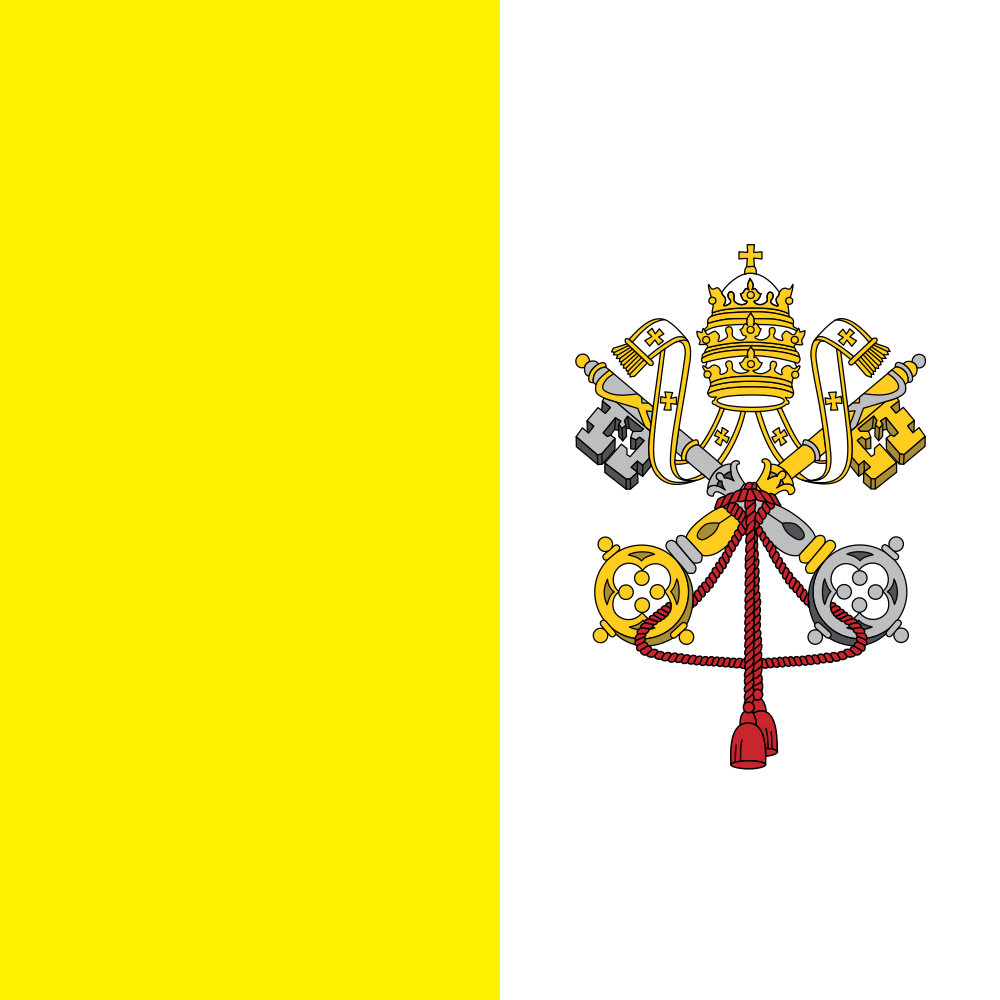
As the Holy See has long reiterated, a strong, effective and credible arms trade treaty can make a difference to millions of people confronted by insecurity, deprivation and fear. We therefore welcome the adoption of resolution 67/234, entitled “The arms trade treaty”, which reignites the hope that, after the unfortunate stalemate of the conference of July 2012, the international community will finally be provided with such a legally binding instrument.
In order to achieve that noble goal, it is necessary that we have an open and transparent process that allows for the full participation of all States. The United Nations and the conferences held under its auspices have long followed the practice of encouraging the participation of all States in the drafting and adoption of multilateral treaties so that the outcomes of such conferences have broad and universal support and ratification. Therefore, in view of a treaty as important as the arms trade treaty, the participation of all States also in such a conference is not only desirable but necessary and consistent with the long-held practice of the General Assembly.
The Holy See therefore understands that the inclusion of mutatis mutandis in paragraph 2 of the present resolution is recognition that one of the changes necessary for the upcoming conference is to rectify the improper treatment of my delegation during the previous conference so as to ensure that the Holy See, in accordance with resolution 58/314, pertaining to its participation, be fully recognized, in accordance with its rights within the United Nations and the rules of procedure adopted at the beginning of the July conference.
The Assembly has thus concluded this stage of its consideration of agenda item 94.
Reports of the Fifth Committee
The General Assembly will now consider the reports of the Fifth Committee on agenda items 128 to 131, 133, 134, 137, 138, 141 to 145 and 153.
I request the Rapporteur of the Fifth Committee, Mr. Justin Kisoka of the United Republic of Tanzania, to introduce in one intervention the reports of the Fifth Committee that are before the Assembly.
Mr. Kisoka (United Republic of Tanzania), Rapporteur of the Fifth Committee: I have the honour today to introduce to the General Assembly the reports of the Fifth Committee that contain recommendations on issues that required action during the main part of the sixty-seventh session of the General Assembly.
The Fifth Committee met from 4 October to 24 December and held 22 plenary meetings and several rounds of informal consultations, as well as innumerable informal-informal consultations. I will now introduce the reports of the Fifth Committee.
With regard to agenda item 128, entitled “Financial reports and audited financial statements, and reports of the Board of Auditors”, the Committee recommends to the General Assembly, in paragraph 7 of its report contained in document A/67/666, the adoption of a draft resolution, which the Committee adopted without a vote.
On agenda item 131, entitled “Programme planning”, the Committee recommends to the General Assembly, in paragraph 7 of its report contained in document A/67/668, the adoption of a draft resolution, which the Committee adopted without a vote.
On agenda item 133, entitled “Pattern of conferences”, the Committee recommends to the General Assembly, in paragraph 6 of its report contained in document A/67/664, the adoption of a draft resolution, which the Committee adopted without a vote.
On agenda item 134, entitled “Scale of assessments for the apportionment of the expenses of the United Nations,” the Committee recommends to the General Assembly, in paragraph 6 of its report contained in document A/67/502/Add.1, the adoption of a draft resolution, which the Committee adopted without a vote.
On agenda item 145, entitled “Scale of assessments for the apportionment of the expenses of the United Nations of the United Nations peacekeeping operations,” the Committee recommends to the General Assembly, in paragraph 6 of its report contained in document A/67/665, the adoption of a draft resolution, which the Committee adopted without a vote.
Under agenda item 138, entitled “United Nations pension system”, the Committee recommends to the General Assembly, in paragraph 7 of its report contained in document A/67/667, the adoption of a
draft resolution, which the Committee adopted without a vote.
Under agenda item 139, entitled “Administrative and budgetary coordination of the United Nations with the specialized agencies and the International Atomic Energy Agency”, the Committee recommends to the General Assembly, in paragraph 6 of its report contained in document A/67/662, the adoption of a draft decision, which the Committee adopted without a vote.
On agenda item 141, entitled “Administration of justice at the United Nations”, the Committee recommends to the General Assembly, in paragraph 6 of its report contained in document A/67/669, the adoption of a draft resolution, which the Committee adopted without a vote.
On agenda item 142, entitled “Financing of the International Criminal Tribunal for the Prosecution of Persons Responsible for Genocide and Other Serious Violations of International Humanitarian Law Committed in the Territory of Rwanda and Rwandan Citizens Responsible for Genocide and Other Such Violations Committed in the Territory of Neighbouring States between 1 January and 31 December 1994”, the Committee recommends to the General Assembly, in paragraph 6 of its report contained in document A/67/674, the adoption of a draft resolution, which the Committee adopted without a vote.
On agenda item 143, entitled “Financing of the International Tribunal for the Prosecution of Persons Responsible for Serious Violations of International Humanitarian Law Committed in the Territory of the Former Yugoslavia since 1991”, an oral amendment to the draft resolution contained in document A/67/675 was introduced by the delegation of the Russian Federation. The delegation of Sweden requested a recorded vote on that amendment, and the Committee voted not to accept the amendment. A recorded vote was also requested on the draft resolution as a whole. Subsequently, the draft resolution was adopted.
On agenda item 144, entitled “Financing of the International Residual Mechanism for Criminal Tribunals”, the Committee recommends to the General Assembly, in paragraph 6 of its report contained in document A/67/676, the adoption of a draft resolution, which the Committee adopted without a vote.
On agenda item 153, entitled “Financing of the United Nations Integrated Mission in Timor-Leste”,
the Committee recommends to the General Assembly, in paragraph 6 of its report contained in document A/67/663, the adoption of a draft resolution, which the Committee adopted without a vote.
With regard to agenda item 130, entitled “Programme budget for the biennium 2012-2013”, the Committee considered two draft resolutions contained in its report contained in document A/67/677. With regard to draft resolution I, the delegation of Cuba introduced an oral amendment to section I of the draft resolution. The delegation of Denmark requested a recorded vote on the amendment, in which the Committee voted not to include the oral amendment in the draft resolution. The Committee subsequently adopted the draft resolution as a whole without a vote.
Also with regard to agenda 130, the Committee considered and recommended the adoption of three statements of programme budget implications. The reports of the Fifth Committee on those statements were issued in documents A/67/670, A/67/671 and A/67/672.
The Committee therefore recommends the adoption of the draft resolution on the programme budget for the biennium 2012-2013.
Finally, under agenda item 129, entitled “Review of the efficiency of the administrative and financial functioning of the United Nations”, the Committee adopted, without a vote, the draft resolution on the proposed programme budget outline for the biennium 2014-2015. Also, in paragraph 9 of the same report, the Committee recommends to the General Assembly the adoption of a draft decision entitled “Questions deferred for future consideration”, which the Committee adopted without a vote.
I wish to thank delegations for their cooperation, and to assure them that the action taken in the course of the main part of the sixty-seventh session of the Fifth Committee will be reflected in the draft resolutions and reports that will be issued shortly.
I also wish to thank the secretariat of the Fifth Committee and other United Nations officials and personnel for their dedicated efforts in support of our work. I wish everyone happy holidays.
Before proceeding further, I would like to emphasize to delegations that, as the Fifth Committee has just finished its work, the reports are available in English only. It is my understanding that they will be issued in all the other official
languages as soon as possible. I thank delegations for their understanding.
If there is no proposal under rule 66 of the rules of procedure, I shall take it that the General Assembly decides not to discuss the reports of the Fifth Committee that are before it today.
It was so decided.
Statements will therefore be limited to explanations of vote.
The positions of delegations regarding the recommendations of the Fifth Committee have been made clear in the Committee, and are reflected in the relevant official records.
May I remind members that under paragraph 7 of decision 34/401, the General Assembly agreed that
“When the same draft resolution is considered in a Main Committee and in plenary meeting, a delegation should, as far as possible, explain its vote only once, that is, either in the Committee or in plenary meeting, unless that delegation’s vote in plenary meeting is different from its vote in the Committee.”
May I remind delegations that, also in accordance with General Assembly decision 34/401, explanations of vote are limited to 10 minutes and should be made by delegations from their seats.
Before we begin to take action on the recommendations contained in the reports of the Fifth Committee, I should like to advise representatives that we are going to proceed to take decisions in the same manner as was done in the Committee, unless notified otherwise in advance.
128. Financial reports and audited financial statements, and reports of the Board of Auditors Report of the Fifth Committee (A/67/666)
The Assembly has before it a draft resolution recommended by the Fifth Committee in paragraph 7 of its report. For the time being, the text of the draft resolution, entitled “Financial reports and audited financial statements, and reports of the Board of Auditors”, is contained in document A/C.5/67/L.8. We will now take a decision on the draft resolution. The Committee adopted it without a vote. May I take it that the Assembly wishes to do the same?
The draft resolution was adopted (resolution 67/235).
The Assembly has thus concluded this stage of its consideration of agenda item 128.
131. Programme planning Report of the Fifth Committee (A/67/668)
The Assembly has before it a draft resolution recommended by the Fifth Committee in paragraph 7 of its report. For the time being, the text of the draft resolution, entitled “Programme planning”, is contained in document A/C.5/67/L.10. We will now take a decision on the draft resolution. The Committee adopted it without a vote. May I take it that the Assembly wishes to do likewise?
The draft resolution was adopted (resolution 67/236).
The General Assembly has thus concluded this stage of its consideration of agenda item 131.
133. Pattern of conferences Report of the Fifth Committee (A/67/664)
The Assembly has before it a draft resolution recommended by the Fifth Committee in paragraph 6 of its report. For the time being, the text of the draft resolution, entitled “Pattern of conferences”, is contained in document A/C.5/67/L.5. We will now take a decision on the draft resolution. The Committee adopted it without a vote. May I take it that the Assembly wishes to do the same?
The draft resolution was adopted (resolution 67/237).
The General Assembly has thus concluded this stage of its consideration of agenda item 133.
134. Scale of assessments for the apportionment of the expenses of the United Nations Report of the Fifth Committee (A/67/502/Add.1)
The Assembly has before it a draft resolution recommended by the Fifth Committee in paragraph 6 of its report. For the time being, the text of the draft resolution, entitled “Scale of assessments for the apportionment of the expenses of the United Nations”, is contained in document A/C.5/67/L.6.
I give the floor to the representative of Monaco in explanation of position.

Monaco would like to explain its position before the Assembly’s adoption of the report of the Fifth Committee on agenda item 134, entitled “Scale of assessments for the apportionment of the expenses of the United Nations”.
The Government of His Serene Highness the Sovereign Prince of Monaco joined the consensus for the adoption of the draft resolution contained in document A/C.5/67/L.6 and recommended by the Fifth Committee in paragraph 6 of its report contained in document A/67/502/Add.1, although, for the period 2013-2015, Monaco has seen its assessments increase from 0.03 to 0.12 per cent, which is a 300 per cent increase. Monaco has reservations about the methodology used to calculate this scale of assessments, and regrets that it has not been reviewed, despite the fact that the General Assembly decided upon that at its sixty-fourth session in order to fully abide by the principle of Member States’ capacity to pay.
Monaco particularly regrets that the current methodology does not allow for specific characteristics particular to the Principality to be taken into account, including its low resident population and salaried population. When Monaco’s non-resident salaried population involved in daily domestic wealth creation is factored in, it represents an increase of 120 per cent over the country’s resident population. That atypical situation leads to a distortion in evaluating Monaco’s capacity to pay.
Despite the 300 per cent increase in its assessment in the United Nations budget, the Government reiterates its commitment to complying with its international obligations and to honour the payment of its contribution on time. In doing so, Monaco reaffirms its attachment to a strong United Nations with the financial resources needed to implement the mandates of its agencies in accordance with the purposes and principles of the Charter.
The Assembly will now take a decision on the draft resolution. The Fifth Committee adopted it without a vote. May I take it that the Assembly wishes to do likewise?
The draft resolution was adopted (resolution 67/238).
The Assembly has thus concluded this stage of its consideration of agenda item 134.
145. Scale of assessments for the apportionment of the expenses of United Nations peacekeeping operations Report of the Fifth Committee (A/67/665)
The Assembly has before it a draft resolution recommended by the Fifth Committee in paragraph 6 of its report. For the time being, the text of the draft resolution, entitled “Scale of assessments for the apportionment of the expenses of United Nations peacekeeping operations”, is contained in document A/C.5/67/L.7. The Assembly will now take a decision on the draft resolution.
I would like to confirm the understanding of the Assembly that, on an exceptional basis for the 2013-2015 scale period only, three countries in Level B — the Bahamas, Bahrain and Oman — will be afforded discounts of 7.5 per cent on their assessment rates; that Oman will forgo its transition period; and that these accounts will not cause the aggregate assessment rates for countries in Level A over the scale period to exceed their aggregate effective rates, as contained in annex III of the report of the Secretary-General on the implementation of General Assembly resolutions 55/235 and 55/236 (A/67/224).
The Fifth Committee adopted the draft resolution without a vote. May I take it that the Assembly wishes to do likewise?
The draft resolution was adopted (resolution 67/239).
I call on the representative of Oman, who wishes to speak in explanation of position on the resolution just adopted.

I will be brief. With respect to agenda item 145, “Scale of assessments for the apportionment of the expenses of
United Nations peacekeeping operations”, I should first like to thank the Chairman of the Fifth Committee, Ambassador Berger of Germany, for the wisdom with which he conducted the work of the Committee, as well as the Chairman of the Group of 77 and China, the Permanent Representatove of Algeria, and all the representatives of that Group, who made great efforts to reach fair conclusions in the interests of those members of the Group who are currently facing great difficulties.
Oman joined in the consensus adoption of resolution 67/239. However, consideration should be given to the fact that there was no justification for raising Oman to Level B under fabricated pretexts and for only one scale of assessment period. In view of all the logical and objective criteria on which relevant decisions are supposed to be based, the Sultanate of Oman should be at the same level as developing countries where per capita income increases gradually and nominally. The level on which Oman has been placed includes all developed countries, while Oman remains a developing country.
The Sultanate of Oman is proud to participate in providing the necessary support to United Nations peacekeeping operations, and we appreciate the fact that some measures are being taken to reduce our assessment by 7.5 per cent, in line with the scale of assessments. In that regard, we thank all those who negotiated for that conclusion. However, we are not happy with the fact that our country has been put at Level B when it should have remained at its previous level or at least allowed to accept a gradual increase and not a sudden, direct move to Level B.
The General Assembly has thus concluded this stage of its consideration of agenda item 145.
137. United Nations common system Report of the Fifth Committee (A/67/678)
The Assembly has before it a draft decision recommended by the Fifth Committee in paragraph 6 of its report. For the time being, the text of the draft decision, entitled “United Nations common system”, is contained in document A/C.5/67/L.14. We will now take action on the draft decision. The
Committee adopted it without a vote. May I take it that the Assembly wishes to do the same?
The draft decision was adopted.
The General Assembly has thus concluded this stage of its consideration of agenda item 137.
138. United Nations pension system Report of the Fifth Committee (A/67/667)
The Assembly has before it a draft resolution recommended by the Fifth Committee in paragraph 7 of its report. For the time being, the text of the draft resolution, entitled “United Nations pension system”, is contained in document A/C.5/67/L.9. We will now take a decision on the draft resolution. The Committee adopted it without a vote. May I take it that the Assembly wishes to do the same?
The draft resolution was adopted (resolution 67/240).
The General Assembly has thus concluded this stage of its consideration of agenda item 138.
141. Administration of justice at the United Nations Report of the Fifth Committee (A/67/669)
The Assembly has before it a draft resolution recommended by the Fifth Committee in paragraph 6 of its report. For the time being, the text of the draft resolution, entitled “Administration of justice at the United Nations”, is contained in document A/C.5/67/L.11. We will now take a decision on the draft resolution. The Committee adopted it without a vote. May I take it that the Assembly wishes to do likewise?
The draft resolution was adopted (resolution 67/241).
The General Assembly has thus concluded this stage of its consideration of agenda item 141.
142. Financing of the International Criminal Tribunal for the Prosecution of Persons Responsible for Genocide and Other Serious Violations of International Humanitarian Law Committed in the Territory of Rwanda and Rwandan Citizens Responsible for Genocide and Other Such Violations Committed in the Territory of Neighbouring States between 1 January and 31 December 1994 Report of the Fifth Committee (A/67/674)
The Assembly has before it a draft resolution recommended by the Fifth Committee in paragraph 6 of its report. For the time being, the text of the draft resolution, entitled “Financing of the International Criminal Tribunal for the Prosecution of Persons Responsible for Genocide and Other Serious Violations of International Humanitarian Law Committed in the Territory of Rwanda and Rwandan Citizens Responsible for Genocide and Other Such Violations Committed in the Territory of Neighbouring States between 1 January and 31 December 1994”, is contained in document A/C.5/67/L.15.
We will now take a decision on the draft resolution. The Fifth Committee adopted the draft resolution without a vote. May I take it that the Assembly wishes to do likewise?
The draft resolution was adopted (resolution 67/242).
The General Assembly has thus concluded this stage of its consideration of agenda item 142.
143. Financing of the International Tribunal for the Prosecution of Persons Responsible for Serious Violations of International Humanitarian Law Committed in the Territory of the Former Yugoslavia since 1991 Report of the Fifth Committee (A/67/675)
The Assembly has before it a draft resolution recommended by the Fifth Committee in paragraph 6 of its report. The text of the draft resolution, for the time being, is contained in document A/C.5/67/L.16.
We will now take a decision on the draft resolution.
I give the floor to the representative of the Russian Federation to introduce oral amendments to the draft resolution.

First of all, I wish to state for the record that we worked under a very heavy schedule and that we have not had an opportunity to properly verify the enumerated figures on the financing of the two Tribunals. The Secretariat has assured us informally that amendments to the financing figures corresponding to our a consensus decision would be provided subsequently.
With regard to the voting, we are grateful for the active involvement of all delegations in discussing the financing of the International Criminal Tribunals for Rwanda and the Former Yugoslavia and of the International Residual Mechanism for Criminal Tribunals. We thank delegations for their pursuit of a compromise solution, taking into account our position on the financing of the Rwanda Tribunal and the Residual Mechanism.
Unfortunately, it was not possible to achieve a consensus on the parameters for the financing of the Tribunal for the Former Yugoslavia. The Russian delegation showed maximum flexibility and amended its proposals to strengthen the budgetary discipline of the Former Yugoslavia Tribunal. However, even our amended proposals, including those of other delegations, are not reflected in the text of draft resolution A/C.5/67/L.16, submitted by the Chairman of the Fifth Committee.
In line with the request of the Secretary-General to approve the additional expenditure requirements with respect to inflation and exchange-rate fluctuations, we support the recommendations of the Advisory Committee on Administrative and Budgetary Questions to absorb those reasonable requirements. As was the case with such requirements for the Tribunal under the United Nations internal justice system, we propose conducting an independent expert assessment of the administrative budgetary aspects of the activities of the International Tribunal for the Former Yugoslavia. The delegations that endorse the need for such an assessment of the Disputes Tribunal and the Court of Appeal but did not support such requirements for the International Tribunal for the Former Yugoslavia, are, in our view, adopting a position of double standards
and a politicized approach with regard to financial and technical matters.
Given that the International Tribunal for the Former Yugoslavia requires greater budgetary discipline and accountability than the Tribunal for Rwanda, we support the initiative of returning the budgetary cycle of that Tribunal to a one-year basis, as was the case prior to the year 2000. Such a proposal would be fully in line with Security Council resolution 1966 (2010) on the completion of the work of the Tribunal and the transfer of its functions to the Residual Mechanism.
In view of the aforementioned issues, we are compelled to propose amendments to the draft resolution on behalf of the Russian Federation and the Republic of Serbia in order to strengthen the International Tribunal for the Former Yugoslavia’s administrative and budgetary discipline and accountability to Member States. Allow me to make those amendments orally.
First, in paragraph 3, we propose endorsing the conclusions and recommendations contained in the report of the Advisory Committee on Administrative and Budgetary Questions and to delete the phrase “subject to the provisions of the resolution”. In that connection, we request that the calculations for the revised appropriations for 2012-2013 and the respective apportionment be amended to bring them in line with the levels recommended by the Advisory Committee.
We also propose the following amended paragraphs:
“Recalls its resolution 55/225 and requests the Secretary-General, with the objective to ensure timely downsizing of the work force and transition to the International Residual Mechanism for Criminal Tribunals, to submit proposals for an independent expert evaluation of the efficiency of the functioning of the Tribunal.
“Decides not to take note of the basis for the proposed budget for the biennium 2014-15, as requested in paragraph 19 of the relevant report of the Secretary-General A/67/595.
“Requests the Secretary-General to ensure the transition from a biennual budget cycle of the Tribunal to an annual cycle in connection with the upcoming completion of its work and transition to the Residual Mechanism.
“Requests the Secretary-General to submit his next budget proposals for the Tribunal only for 2014 on the basis of the approved preparations for 2012.”
The representative of the Russian Federation has submitted an oral amendment to the draft resolution recommended in the report of the Fifth Committee in document A/67/675. In accordance with rule 90 of the rules of procedure, the Assembly shall first take a decision on the amendment submitted by the representation of the Russian Federation.
May I take it that the Assembly wishes to adopt the oral amendment submitted by the Russian Federation?
I give the floor to the representative of Cyprus.

My delegation would like to request a recorded vote on the oral amendment proposed by the Russian Federation.
A recorded vote has been requested on the oral amendment suggested by the Russian Federation.
A recorded vote was taken.
In favour: Belarus, Bolivia (Plurinational State of), China, Cuba, Democratic People’s Republic of Korea, Dominican Republic, Eritrea, Kazakhstan, Lao People’s Democratic Republic, Nicaragua, Russian Federation, Serbia, Sudan, Syrian Arab Republic, Venezuela (Bolivarian Republic of), Zambia, Zimbabwe
Against: Albania, Andorra, Australia, Austria, Belgium, Bosnia and Herzegovina, Bulgaria, Burkina Faso, Canada, Chile, Colombia, Costa Rica, Croatia, Cyprus, Czech Republic, Denmark, Estonia, Finland, France, Georgia, Germany, Greece, Guatemala, Hungary, Iceland, Ireland, Israel, Italy, Jordan, Latvia, Lebanon, Liechtenstein, Lithuania, Luxembourg, Malta, Mexico, Monaco, Montenegro, Netherlands, New Zealand, Norway, Panama, Peru, Poland, Portugal, Republic of Korea, Republic of Moldova, Romania, San Marino, Slovakia, Slovenia, Spain, Sweden, Switzerland, the former Yugoslav Republic of Macedonia, Turkey, United Kingdom of Great Britain and Northern Ireland, United States of America, Uruguay
Abstaining: Afghanistan, Algeria, Antigua and Barbuda, Argentina, Bahrain, Bangladesh, Barbados, Bhutan, Botswana, Brazil, Brunei Darussalam, Cameroon, Congo, Ecuador, Egypt, El Salvador, Fiji, Grenada, Guyana, Haiti, Honduras, India,
Indonesia, Iraq, Jamaica, Japan, Kuwait, Kyrgyzstan, Liberia, Libya, Madagascar, Malaysia, Maldives, Mali, Mauritania, Mauritius, Mongolia, Morocco, Myanmar, Namibia, Niger, Nigeria, Oman, Pakistan, Papua New Guinea, Philippines, Qatar, Rwanda, Saint Lucia, Saint Vincent and the Grenadines, Samoa, Sierra Leone, Singapore, South Africa, South Sudan, Sri Lanka, Thailand, Togo, Trinidad and Tobago, Tunisia, Uganda, Ukraine, United Arab Emirates, United Republic of Tanzania, Yemen [Subsequently, the delegation of Saudi Arabia informed the Secretariat that it had intended to abstain.]
The oral amendment was rejected by 59 votes against to 17 in favour, with 65 abstentions.
Since the oral amendment submitted by the representative of the Russian Federation has not been adopted, we shall now proceed to take a decision on the draft resolution as a whole. A recorded vote has been requested.
A recorded vote was taken.
In favour: Afghanistan, Albania, Algeria, Andorra, Antigua and Barbuda, Argentina, Armenia, Australia, Austria, Bahrain, Bangladesh, Barbados, Belgium, Benin, Bhutan, Bosnia and Herzegovina, Botswana, Brazil, Brunei Darussalam, Bulgaria, Burkina Faso, Cambodia, Cameroon, Canada, Chile, Colombia, Congo, Costa Rica, Côte d’Ivoire, Croatia, Cyprus, Czech Republic, Denmark, Djibouti, Dominican Republic, Egypt, El Salvador, Eritrea, Estonia, Fiji, Finland, France, Georgia, Germany, Ghana, Greece, Grenada, Guatemala, Guyana, Haiti, Honduras, Hungary, Iceland, India, Indonesia, Iran (Islamic Republic of), Iraq, Ireland, Israel, Italy, Jamaica, Japan, Jordan, Kazakhstan, Kuwait, Kyrgyzstan, Lao People’s Democratic Republic, Latvia, Lebanon, Liberia, Libya, Liechtenstein, Lithuania, Luxembourg, Madagascar, Malaysia, Maldives, Mali, Malta, Mauritania, Mauritius, Mexico, Monaco, Mongolia, Montenegro, Morocco, Myanmar, Namibia, Nepal, Netherlands, New Zealand, Niger, Nigeria, Norway, Oman, Pakistan, Panama, Papua New Guinea, Peru, Philippines, Poland, Portugal, Qatar, Republic of Korea, Republic of Moldova, Romania,
Rwanda, Saint Kitts and Nevis, Saint Lucia, Saint Vincent and the Grenadines, Samoa, San Marino, Singapore, Slovakia, Slovenia, Solomon Islands, South Africa, South Sudan, Spain, Sri Lanka, Sudan, Sweden, Switzerland, Thailand, the former Yugoslav Republic of Macedonia, Togo, Trinidad and Tobago, Tunisia, Turkey, Uganda, Ukraine, United Arab Emirates, United Kingdom of Great Britain and Northern Ireland, United Republic of Tanzania, United States of America, Uruguay, Viet Nam, Yemen, Zambia
Against: None
Abstaining: Belarus, Bolivia (Plurinational State of), China, Cuba, Democratic People’s Republic of Korea, Ecuador, Nicaragua, Russian Federation, Serbia, Sierra Leone, Syrian Arab Republic, Venezuela (Bolivarian Republic of)
The draft resolution, as a whole, was adopted by 139 votes to none, with 12 abstentions (resolution 67/243).
The General Assembly has thus concluded this stage of its consideration of agenda item 143.
144. Financing of the International Residual Mechanism for Criminal Tribunals Report of the Fifth Committee (A/67/676)
The Assembly has before it a draft resolution recommended by the Fifth Committee in paragraph 6 of its report. For the time being, the text of the draft resolution is contained in document A/C.5/67/L.17.
The Assembly will now take a decision on the draft resolution. The Fifth Committee adopted it without a vote. May I take it that the Assembly wishes to do likewise?
The draft resolution was adopted (resolution 67/244).
The Assembly has thus concluded this stage of its consideration of agenda item 144.
153. Financing of the United Nations Integrated Mission in Timor-Leste Report of the Fifth Committee (A/67/663)
The Assembly has before it a draft resolution recommended by the Fifth Committee in paragraph 6 of its report. For the time being, the text of the draft resolution is contained in document A/C.5/67/L.4.
We will now take a decision on the draft resolution. The Fifth Committee adopted it without a vote. May I take it that the Assembly wishes to do the same?
The draft resolution was adopted (resolution 67/245).
The Assembly has thus concluded this stage of its consideration of agenda item 153.
The Assembly has before it two draft resolutions recommended by the Fifth Committee in paragraph 33 of its report.
I now call on the representative of Cuba.

My delegation has the honour to speak on behalf of the delegations of the Plurinational State of Bolivia, the Republic of Nicaragua, the Bolivarian Republic of Venezuela, the Republic of Ecuador and the Islamic Republic of Iran on the draft resolution contained in document A/C.5/67/L.18, entitled “Questions relating to the programme budget for the biennium 2012-2013”, which includes estimates related to special political missions, good offices and other political initiatives authorized by the General Assembly and/or the Security Council.
Our delegations regret the fact that, once again, activities and elements related to the responsibility to protect were included in the logical framework of the Office of the Special Adviser on the Prevention of Genocide, as we all know that the General Assembly has not pronounced itself on that concept. Given the absence of specific mandates, it is inappropriate to
include, in budget estimates, human and financial resources related to the activities of the Special Adviser on the Responsibility to Protect. We are concerned that the budget presentation did not indicate the resources related to activities pertaining to the responsibility to protect within the total resources requested for the Special Adviser on the Prevention of Genocide.
In addition, our delegations believe that including those activities is a violation of various resolutions on programme planning and the programme budget, including the settlement of and detailed regulations for programme planning, programme budget elements, implementation oversight and evaluation methods. Our delegations furthermore believe that this inclusion does not help us to reach an agreement on the budget estimates for this thematic group.
The delegations on behalf of which I am speaking would like to reiterate our full support for the activities of the Special Adviser on the Prevention of Genocide. We also reiterate our full adherence to international law. However, given the stated reasons for including activities and concepts related to the responsibility to protect within the budgetary estimates of the Special Adviser to the Secretary-General on the Prevention of Genocide, our delegations call for a recorded vote on section I of draft resolution I recommended by the Fifth Committee in paragraph 33 of its report in document A/67/677.
I give the floor to the representative of the Islamic Republic of Iran, who wishes to speak in explanation of vote before the voting.

My delegation has asked for the floor to explain its vote under this agenda item. My delegation has always supported the activities of the United Nations in all areas within the scope of its work, as long as they abide by the rules and regulations of the Organization and remain within international law and the purview of the United Nations. Although Iran supports the functions of the Special Adviser to the Secretary-General on the Prevention of Genocide, in the view of my delegation the issue of the responsibility to protect, including its definition, is still under consideration by the General Assembly. It is therefore not acceptable for my delegation that the limited financial resources of the Organization be allocated to fund posts for which there is no mandated definition.
It is for that reason that my delegation will vote against section I of the draft resolution and urges other member States to do the same.
The Assembly will now take action on draft resolution I, entitled “Questions relating to the programme budget for the biennium 2012-2013”, the text of which is contained, for the time being, in document A/C.5/67/L.18.
A separate, recorded vote has been requested on section I of draft resolution I.
A recorded vote was taken.
Section I of draft resolution I was retained by 113 votes to 12, with 22 abstentions.
The Assembly will now consider draft resolution I, entitled “Questions relating to the programme budget for the biennium 2012-2013”, as a whole. The Fifth Committee adopted it without a vote. May I take it that the Assembly wishes to do the same?
Draft resolution I was adopted (resolution 67/246).
We shall now turn to draft resolution II, the text of which, for the time being, is contained in document A/C.5/67/L.19.
Draft resolution II is entitled “Programme budget for the biennium 2012-2013”. The Fifth Committee adopted it without a vote. May I take it that the Assembly wishes to do likewise?
Draft resolution II was adopted (resolution 67/247).
I give the floor to the representative of the Syrian Arab Republic, who wishes to speak in explanation of vote.

My delegation voted in favour of section I, “Special political missions”, of resolution 67/246. However, my delegation would like to express reservations about the allocation of financial resources to the Special Envoy of the Secretary-General for the Implementation of Security Council resolution 1559 (2004), because the Special Envoy, Mr. Roed-Larsen, does not qualify under the criteria set out in paragraph 12 of resolution 63/261.
He has exceeded the mandate given to him under Security Council resolution 1559 (2004) by pursuing bilateral issues concerning two sovereign States, Syria and Lebanon, on the establishment of diplomatic
relations and the demarcation of borders between them, whereas he is flagrantly biased in favour of Israel and deliberately covers up that country’s failure to implement any of its obligations under resolution 1559 (2004), especially its obligation to withdraw from the occupied Lebanese territories.
My delegation joined the consensus on resolution 67/247, entitled “Programme budget for the biennium 2012-2013”. However, with regard to section 7, entitled “Revised estimates on decisions and resolutions of the Human Rights Council”, the Syrian delegation would like to express its reservations about the allocation of financial resources under the two Human Rights Council resolutions 19/22 and 21/26.
The Assembly has thus concluded this stage of its consideration of agenda item 130.
129. Review of the efficiency of the administrative and financial functioning of the United Nations Report of the Fifth Committee (A/67/673)
The Assembly has before it a draft resolution recommended by the Fifth Committee in paragraph 8 of its report and a draft decision recommended in paragraph 9 of the same report.
The Assembly will now take action on the draft resolution entitled “Proposed programme budget outline for the biennium 2014-2015”, the text of which, for the time being, is contained in document A/C.5/67/L.13. The Fifth Committee adopted it without a vote. May I take it that the General Assembly wishes to do likewise?
The draft resolution was adopted (resolution 67/248).
The Assembly will now take action on the draft decision entitled “Questions deferred for future consideration”, the text of which, for the time being, is contained in document A/C.5/67/L.21. The Fifth Committee adopted it without a vote. May I take it that the Assembly wishes to do likewise?
The draft decision was adopted.
The General Assembly has thus concluded this stage of its consideration of agenda item 129.
139. Administrative and budgetary coordination of the United Nations with the specialized agencies and the International Atomic Energy Agency Report of the Fifth Committee (A/67/662)
The Assembly has before it a draft decision recommended by the Fifth Committee in paragraph 6 of its report. For the time being, the text of the draft decision is contained in document A/C.5/67/L.3. We shall now take action on the draft decision, entitled “Budgetary and financial situation of the organization of the United Nations system”. The Fifth Committee adopted the draft decision without a vote. May I take it that the Assembly wishes to do likewise?
The draft decision was adopted.
The General Assembly has thus concluded this stage of its consideration of agenda item 139.
110. Elections to fill vacancies in subsidiary organs and other elections (c) Election of five members of the Organizational Committee of the Peacebuilding Commission
Members will recall that, in accordance with subparagraphs 4 (a) to (e) of resolution 60/180, of 20 December 2005, the Organizational Committee shall comprise the following: seven members of the Security Council, including the five permanent members; seven members of the Economic and Social Council, elected from regional groups; five top providers of assessed contributions to United Nations budgets and voluntary contributions to United Nations funds, programmes and agencies, including a standing peacebuilding fund; five top providers of military personnel and civilian police to United Nations missions; and seven additional members elected by the General Assembly, giving due consideration to representation from all regional groups in the overall composition of the Committee.
Members will also recall that, at the 83rd plenary meeting during its sixty-sixth session, the Assembly elected Croatia and El Salvador as members of the Organizational Committee of the Peacebuilding
Commission for a two-year term of office, beginning on 1 January 2012.
Members will further recall that by resolution 63/145, of 18 December 2008, the General Assembly decided, at its sixty-third session, that the term of office for the members of the General Assembly on the Organizational Committee of the Peacebuilding Commission shall begin on 1 January instead of 23 June.
By a letter dated 19 December 2012 addressed to the President of the General Assembly (A/67/657), the facilitator of the group of the leading financial contributors informed the President that the financial contributors had decided that Canada, Japan, Spain and Sweden would serve a full two-year term in 2013 and 2014, and that Norway and Germany would each serve a one-year term in 2013 and 1014, respectively.
Also, by a letter dated 20 December 2012 addressed to the President of the General Assembly (A/67/658), the facilitator of the troop-contributing countries informed the President of their decision that the terms of office of Bangladesh, Egypt, India, Nigeria and Pakistan, from the troop-contributing countries category of membership, would start on 1 January 2013 and run until 31 December 2014.
May I take it that it is the wish of the General Assembly to take note of documents A/67/657 and A/67/658?
It was so decided.
The General Assembly will now proceed to the election of five members of the Organizational Committee of the Peacebuilding Commission.
By resolution 60/261, of 8 May 2006, the Assembly decided that the members of the Organizational Committee shall serve for renewable terms of two years, as applicable. Accordingly, Benin, Brazil, Indonesia, Tunisia and Uruguay are eligible for immediate re-election.
With regard to candidatures for the five seats, I should like to inform members that the Group of Asia- Pacific States has endorsed Malaysia, and the Group of Latin American and Caribbean States has endorsed Brazil and Peru.
Members will recall that, in resolution 60/261, the General Assembly decided that the rules of procedure and established practice of the Assembly for the election
of members of its subsidiary bodies shall apply to its election of members of the Committee. For this election, rules 92 and 94 shall be applicable. Accordingly, the election shall be held by secret ballot and there shall be no nominations. However, I should also like to recall paragraph 16 of decision 34/401, whereby the practice of dispensing with the secret ballot for elections to subsidiary organs when the number of candidates corresponds to the number of seats to be filled should become standard, unless a delegation specifically requests a vote on a given election.
In the absence of such a request, may I take it that the Assembly decides to proceed to the election on that basis?
It was so decided.
Since the number of candidates endorsed by the Group of Asia-Pacific States and the Group of Latin American and Caribbean States corresponds to the number of seats to be filled, may I take it that the General Assembly decides to elect Brazil, Malaysia and Peru as members of the Organizational Committee of the Peacebuilding Commission for a two- year term of office, beginning on 1 January 2013?
It was so decided.
I congratulate Brazil, Malaysia and Peru on their election as members of the Organizational Committee of the Peacebuilding Commission.
I should like to remind members that there remain two vacant seats on the Organizational Committee of the Peacebuilding Commission for a two-year term of office, beginning on 1 January 2013.
The General Assembly has thus concluded this stage of its consideration of sub-item (c) of agenda item 110.
111. Appointments to fill vacancies in subsidiary organs and other appointments (f) Appointment of members of the Committee on Conferences Note by the Secretary-General (A/67/107)
As indicated in document A/67/107, since the terms of office of Côte d’Ivoire, Germany, Nigeria, Panama, the Republic of Moldova,
the Syrian Arab Republic and the Bolivarian Republic of Venezuela will expire on 31 December 2012, it will be necessary for the President to appoint, during the current session, seven members in order to fill the resulting vacancies. Those members will serve for a period of three years, beginning on 1 January 2013.
On the recommendation of the African States, I have appointed Côte d’Ivoire and Senegal as members of the Committee on Conferences for a period of three years, beginning on 1 January 2013. May I take it that the Assembly takes note of these appointments?
It was so decided.
I should also like to remind members that one seat from among the Asia-Pacific States, two from among the Latin American and Caribbean States, one from among the Eastern European States and one from among the Western European and other States for a three-year term of office beginning on 1 January 2013 remain vacant.
I would also like to recall to members that one seat from among the Asia-Pacific States and one from among the Latin American and Caribbean States for a term of office beginning on the date of appointment and ending on 31 December 2015 have remained vacant since the sixty-sixth session. I urge those regional groups to submit their candidatures as soon as possible.
The Assembly has thus concluded this stage of its consideration of sub-item (f) of agenda item 111.

In connection with draft decision A/67/L.51, entitled “International Criminal Tribunal for the Prosecution of Persons Responsible for Genocide and Other Serious Violations of International Humanitarian Law Committed in the Territory of Rwanda and Rwandan Citizens Responsible for Genocide and Other Such Violations Committed in the Territory of Neighbouring States between 1 January and 31 December 1994”, I wish to put on record the following statement of financial implications on behalf of the Secretary-General, in accordance with rule 153 of the rules of procedure of the General Assembly.
By the draft decision, the General Assembly would decide to extend the term of office of the following permanent judges of the International Tribunal, who are members of the Appeals Chamber, until 31 December 2014 or until the completion of the cases to which they are assigned, if sooner: Mehmet Güney (Turkey), Khalida Rachid Khan (Pakistan), Arlette Ramaroson (Madagascar), Bakhtiyar Tuzmukhamedov (Russian Federation) and Andrésia Vaz (Senegal).
In accordance with the trial schedule, provisions for the costs of the honoraria and other entitlements for the five judges for 2013 were included in the budget for the International Criminal Tribunal for Rwanda for 2012-2013.
The resource requirement for the biennium 2014-2015 will be reviewed in the context of established budgetary procedures. Hence, the adoption of draft decision A/67/L.51 would not entail any additional appropriation under the programme budget for the biennium 2012-2013.
May I take it that the Assembly decides to adopt the draft decision?
The draft decision was adopted.
The General Assembly has thus concluded this stage of its consideration of agenda item 124.
We shall now proceed to consider draft decision A/67/L.52.
I give the floor to the representative of the Secretariat.
In connection with draft decision A/67/L.52, entitled “International Tribunal for the Prosecution of Persons Responsible for Serious Violations of International Humanitarian Law Committed in the Territory of the Former Yugoslavia since 1991”, I wish to put on record the following statement of financial implications on behalf of the Secretary-General, in accordance with rule 153 of the rules of procedure of the General Assembly.
By the draft decision, the General Assembly would decide to extend the term of office of the following permanent judges at the International Tribunal, who are members of the Appeals Chamber, until 31 December 2013 or until the completion of the cases to which they are assigned, if sooner: Carmel Agius (Malta), Liu Daqun (China), Theodor Meron (United States of America), Fausto Pocar (Italy) and Patrick Robinson (Jamaica).
The Assembly would also decide to extend the term of office of the following permanent judges at the International Tribunal, who are members of the Trial Chambers, until 31 December 2013 or until the completion of the cases to which they are assigned, if sooner: Jean-Claude Antonetti (France), Guy Delvoie (Belgium), Burton Hall (Bahamas), Christoph Flügge (Germany), O-Gon Kwon (Republic of Korea), Bakone Justice Moloto (South Africa), Howard Morrison (United Kingdom of Great Britain and Northern Ireland) and Alphons Orie (Netherlands).
The Assembly would also decide to extend the terms of office of the following ad litem judges at the
International Tribunal, who are members of the Trial Chambers, until 1 June 2013 or until the completion of the cases to which they are assigned, if sooner: Elizabeth Gwaunza (Zimbabwe), Michèle Picard (France), Árpád Prandler (Hungary) and Stefan Trechsel (Switzerland).
The Assembly would also decide to extend the term of office of ad litem Judge Frederik Harhoff (Denmark), who is a member of the Trial Chambers, until 31 December 2013 or until the completion of the cases to which he is assigned, if sooner.
And the Assembly would decide to extend the term of office of the following ad litem judges at the International Tribunal, who are members of the Trial Chambers, until 31 December 2013 or until the completion of the cases to which they are assigned, if sooner: Melville Baird (Trinidad and Tobago), Flavia Lattanzi (Italy) and Antoine Kesia-Mbe Mindua (Democratic Republic of the Congo).
The extension of the terms of office of judges through 31 December 2013 would require a total payment in honoraria amounting to $1,303,100 for an aggregate period of one additional month. The Tribunal would make every effort to meet those additional requirements from within the overall resources amounting to $201,036,100 approved for the Tribunal for the biennium 2012-2013.
Hence, adoption of the draft decision A/67/L.52 would not entail any additional appropriation under the programme budget for the biennium 2012-2013.
The Assembly will now take action on draft decision A/67/L.52.
May I take it that the Assembly wishes to adopt the draft decision?
The draft decision was adopted.
The General Assembly has thus concluded this stage of its consideration of agenda item 125.
Programme of work
With regard to the programme of work of the General Assembly, apart from organizational matters and items that may have to be considered by operation of the rules of procedure of the Assembly, and bearing in mind that the Assembly has already considered and taken action on the majority of items, I should like to inform members that the
following agenda items remain open for consideration during the sixty-seventh session of the General Assembly: agenda items 9, 11, 13 to 15, 20 (a) and (h), 30, 31, 33 to 37, 39, 40, 42 to 48, 54, 56, 60, 63 (a) and (b), 70 (a) to (c), 74, 94 (b), 106, 107, 110 (a) to (c), 111 (f), (g) and (h), 112 to 117, 118 (a) and (b), 119, 120, 121 (a), (b), (e), (g), (i) (p), (q), (r), (s) and (v), 122, 124 to 126, 128 (a) to (r), 129 to 157, 158 (a) and (b), and 159 to 164.
May I take it that the General Assembly wishes to take note of those items on the agenda that remain open for consideration during the sixty-seventh session of the Assembly?
It was so decided.
I should like to announce that the consideration of the following items will take place immediately following the consideration of the reports of the Fifth Committee: sub-item (c) of agenda item 110, “Election of five members of the Organizational Committee of the Peacebuilding
Commission”; sub-item (f) of agenda item 111, “Appointment of members of the Committee on Conferences”; agenda item 124, “International Criminal Tribunal for the Prosecution of Persons Responsible for Genocide and Other Serious Violations of International Humanitarian Law Committed in the Territory of Rwanda and Rwandan Citizens Responsible for Genocide and Other Such Violations Committed in the Territory of Neighbouring States between 1 January and 31 December 1994”; and agenda item 125, “International Tribunal for the Prosecution of Persons Responsible for Serious Violations of International Humanitarian Law Committed in the Territory of the Former Yugoslavia since 1991”.
I should also like to inform members that the consideration of draft decision A/67/L.48 is postponed to a later date, to be announced, in order for further consultations to be conducted on that issue.
I wish everyone here a bright and prosperous New Year and success in all their endeavours.
The meeting rose at 6.45 p.m.