A/49/PV.88 General Assembly
▶ This meeting at a glance
26
Speeches
9
Countries
4
Resolutions
Topics
UN resolutions and decisions
Israeli–Palestinian conflict
General statements and positions
Security Council deliberations
Economic development programmes
Global economic relations
In the absence of the President, Mr. Ansari (India), Vice-President, took the Chair.
Vote:
A/RES/49/62B
Recorded Vote
✓ 105
✗ 2
40 abs.
Show country votes
— Abstain
(40)
-
 Argentina
-
 Armenia
-
 Australia
-
 Austria
-
 Belgium
-
 Bulgaria
-
 Canada
-
 Croatia
-
 Czechia
-
 Denmark
-
 Estonia
-
 Finland
-
 France
-
 Georgia
-
 Germany
-
 Greece
-
 Hungary
-
 Iceland
-
 Ireland
-
 Italy
Italy
-
 Japan
Japan
-
 Latvia
-
 Liechtenstein
-
 Luxembourg
-
 Marshall Islands
-
 Monaco
-
 Netherlands
-
 New Zealand
-
 Norway
-
 Poland
-
 Portugal
-
 Moldova
-
 Romania
-
 Russian Federation
-
 Slovenia
-
 Spain
Spain
-
 Sweden
-
 Tajikistan
-
 North Macedonia
-
 United Kingdom of Great Britain and Northern Ireland
✗ No
(2)


Absent
(37)
-
 Afghanistan
-
 Albania
-
 Andorra
-
 Bosnia and Herzegovina
-
 Burundi
-
 Chad
Chad
-
 Comoros
-
 Costa Rica
-
 Dominica
-
 Dominican Republic
-
 Equatorial Guinea
-
 Eritrea
-
 Gambia
-
 Guinea-Bissau
-
 Honduras
-
 Lesotho
-
 Liberia
-
 Lithuania
-
 Madagascar
-
 Malawi
-
 Micronesia (Federated States of)
-
 Rwanda
-
 Saint Lucia
-
 Saint Vincent and the Grenadines
-
 Samoa
Samoa
-
 San Marino
-
 Sao Tome and Principe
-
 Seychelles
-
 Sierra Leone
-
 Slovakia
-
 Solomon Islands
-
 Somalia
-
 Sudan
Sudan
-
 Turkmenistan
-
 Vanuatu
-
 Yugoslavia
-
 Democratic Republic of the Congo
✓ Yes
(105)
-
 Algeria
-
 Angola
-
 Antigua and Barbuda
-
 Azerbaijan
-
 Bahamas
-
 Bahrain
-
 Bangladesh
-
 Barbados
-
 Belarus
-
 Belize
-
 Benin
Benin
-
 Bhutan
-
 Plurinational State of Bolivia
-
 Botswana
-
 Brazil
-
 Brunei Darussalam
-
 Burkina Faso
-
 Cambodia
-
 Cameroon
-
 Cabo Verde
-
 Central African Republic
-
 Chile
Chile
-
 China
China
-
 Colombia
-
 Congo
Congo
-
 Côte d'Ivoire
-
 Cuba
Cuba
-
 Cyprus
-
 Democratic People's Republic of Korea
-
 Djibouti
-
 Ecuador
-
 Egypt
Egypt
-
 El Salvador
-
 Ethiopia
-
 Fiji
Fiji
-
 Gabon
Gabon
-
 Ghana
Ghana
-
 Grenada
-
 Guatemala
-
 Guinea
-
 Guyana
-
 Haiti
Haiti
-
 India
India
-
 Indonesia
-
 Islamic Republic of Iran
-
 Iraq
Iraq
-
 Jamaica
-
 Jordan
-
 Kazakhstan
-
 Kenya
Kenya
-
 Kuwait
-
 Kyrgyzstan
-
 Lao People's Democratic Republic
-
 Lebanon
-
 Libya
Libya
-
 Malaysia
-
 Maldives
-
 Mali
Mali
-
 Malta
Malta
-
 Mauritania
-
 Mauritius
-
 Mexico
-
 Mongolia
-
 Morocco
-
 Mozambique
-
 Myanmar
-
 Namibia
-
 Nepal
Nepal
-
 Nicaragua
-
 Niger
Niger
-
 Nigeria
-
 Oman
Oman
-
 Pakistan
-
 Panama
-
 Papua New Guinea
-
 Paraguay
-
 Peru
Peru
-
 Philippines
-
 Qatar
Qatar
-
 Republic of Korea
-
 Saint Kitts and Nevis
-
 Saudi Arabia
-
 Senegal
-
 Singapore
-
 South Africa
-
 Sri Lanka
-
 Suriname
-
 Eswatini
-
 Syrian Arab Republic
-
 Thailand
-
 Togo
Togo
-
 Trinidad and Tobago
-
 Tunisia
-
 Türkiye
-
 Uganda
-
 Ukraine
-
 United Arab Emirates
-
 United Republic of Tanzania
-
 Uruguay
-
 Uzbekistan
-
 Bolivarian Republic of Venezuela
-
 Viet Nam
-
 Yemen
Yemen
-
 Zambia
-
 Zimbabwe
Vote:
A/RES/49/62C
Recorded Vote
✓ 142
✗ 2
3 abs.
Show country votes
— Abstain
(3)
✗ No
(2)
Absent
(37)
-
Afghanistan
-
Albania
-
Andorra
-
Bosnia and Herzegovina
-
Burundi
-
Chad
-
Comoros
-
Costa Rica
-
Dominica
-
Dominican Republic
-
Equatorial Guinea
-
Eritrea
-
Gambia
-
Guinea-Bissau
-
Honduras
-
Lesotho
-
Liberia
-
Lithuania
-
Madagascar
-
Malawi
-
Micronesia (Federated States of)
-
Rwanda
-
Saint Lucia
-
Saint Vincent and the Grenadines
-
Samoa
-
San Marino
-
Sao Tome and Principe
-
Seychelles
-
Sierra Leone
-
Slovakia
-
Solomon Islands
-
Somalia
-
Sudan
-
Turkmenistan
-
Vanuatu
-
Yugoslavia
-
Democratic Republic of the Congo
✓ Yes
(142)
-
Algeria
-
Angola
-
Antigua and Barbuda
-
Argentina
-
Armenia
-
Australia
-
Austria
-
Azerbaijan
-
Bahamas
-
Bahrain
-
Bangladesh
-
Barbados
-
Belarus
-
Belgium
-
Belize
-
Benin
-
Bhutan
-
Plurinational State of Bolivia
-
Botswana
-
Brazil
-
Brunei Darussalam
-
Bulgaria
-
Burkina Faso
-
Cambodia
-
Cameroon
-
Canada
-
Cabo Verde
-
Central African Republic
-
Chile
-
China
-
Colombia
-
Congo
-
Côte d'Ivoire
-
Croatia
-
Cuba
-
Cyprus
-
Czechia
-
Democratic People's Republic of Korea
-
Denmark
-
Djibouti
-
Ecuador
-
Egypt
-
El Salvador
-
Estonia
-
Ethiopia
-
Fiji
-
Finland
-
France
-
Gabon
-
Germany
-
Ghana
-
Greece
-
Grenada
-
Guatemala
-
Guinea
-
Guyana
-
Haiti
-
Hungary
-
Iceland
-
India
-
Indonesia
-
Islamic Republic of Iran
-
Iraq
-
Ireland
-
Italy
-
Jamaica
-
Japan
-
Jordan
-
Kazakhstan
-
Kenya
-
Kuwait
-
Kyrgyzstan
-
Lao People's Democratic Republic
-
Latvia
-
Lebanon
-
Libya
-
Liechtenstein
-
Luxembourg
-
Malaysia
-
Maldives
-
Mali
-
Malta
-
Marshall Islands
-
Mauritania
-
Mauritius
-
Mexico
-
Monaco
-
Mongolia
-
Morocco
-
Mozambique
-
Myanmar
-
Namibia
-
Nepal
-
Netherlands
-
New Zealand
-
Nicaragua
-
Niger
-
Nigeria
-
Norway
-
Oman
-
Pakistan
-
Panama
-
Papua New Guinea
-
Paraguay
-
Peru
-
Philippines
-
Poland
-
Portugal
-
Qatar
-
Republic of Korea
-
Moldova
-
Romania
-
Saint Kitts and Nevis
-
Saudi Arabia
-
Senegal
-
Singapore
-
Slovenia
-
South Africa
-
Spain
-
Sri Lanka
-
Suriname
-
Eswatini
-
Sweden
-
Syrian Arab Republic
-
Thailand
-
North Macedonia
-
Togo
-
Trinidad and Tobago
-
Tunisia
-
Türkiye
-
Uganda
-
Ukraine
-
United Arab Emirates
-
United Kingdom of Great Britain and Northern Ireland
-
United Republic of Tanzania
-
Uruguay
-
Uzbekistan
-
Bolivarian Republic of Venezuela
-
Viet Nam
-
Yemen
-
Zambia
-
Zimbabwe
The meeting was called to order at 3.30 p.m.
154. United Nations New Agenda for the Development of Africa in the 1990s: draft resolution (A/49/L.44)

Our debate today devoted to the United Nations New Agenda for the Development of Africa in the 1990s is one of particular importance inasmuch as it awakens our collective conscience to the serious economic situation on that continent.
The consideration of this question gives us the opportunity, on the eve of the fiftieth anniversary of this prestigious Organization, to reflect on one of the fundamental principles of the United Nations Charter, which commits all Member States to combined efforts to promote economic growth in the world, particularly in developing countries.
Further, the Organization’s medium-term plan for the period 1992-1997 has identified, among the five global priorities, the one relative to the economic recovery of Africa. Yet we have to note, with regret, that the gap in development between the countries of the North and those of the South is widening year after year, while the economic situation of Africa is steadily deteriorating and has now reached disquieting, indeed alarming, proportions.
Africa’s external debt recorded an increase of 2.4 per cent and is now about $285.4 billion. The proportion of the exports of our continent that this debt represents increased from 287.4 per cent in 1993 to 288.9 per cent nowadays.
Although the volume of African exports has increased by 8 per cent, receipts, in fact, dropped by 0.2 per cent and levelled out at $74.3 billion in 1993, having decreased by 5.4 per cent in 1991 and by 1.7 per cent in 1992. This may appear to be a paradoxical situation, but it is explained by the fact that the unitary value of African exports fell by 7.5 per cent.
Another worrying paradox is that, although the unitary value of African imports dropped by 2.1 per cent, their value increased by 1.3 per cent and is now in the area of $75.9 billion, notably on account of the 3.5 per cent increase in their volume.
Analysis of these statistics shows that this situation is due to the triple phenomenon of a 5.5 per cent deterioration in the terms of trade in Africa, the increasingly dangerous accumulation of debt in that continent and the resulting reduction, in real terms, in the flow of its resources. This finding is quite indicative of the need to consider adequate measures and concrete action to sustain agricultural production, on which African economies largely depend.
Such support comes through — among other measures — diversification of these economies and the
In addition, the Food and Agriculture Organization of the United Nations and the African Development Bank are equally of the opinion that the creation of such a fund would tend to boost agricultural production in Africa, with a double, positive impact on economic growth and on food security in the countries of that area. Indeed, the existence of opportunities within the framework of Amsterdam joint fund is often cited as a means of meeting this need, but an objective analysis of the functioning of that fund has shown its operational limits.
For all these reasons the delegation of Senegal thinks that draft resolution A/49/L.44 of 30 November 1994, which was presented on behalf of the President-in-office of the Organization of African Unity by the Permanent Representative of Tunisia, is an initiative that deserves our unanimous support.
This is why, in associating ourselves fully with the statement of the Permanent Representative of Tunisia and with the statement of the Permanent Representative of Algeria on behalf of the Group of 77, we appeal to all delegations present here to support draft resolution A/49/L.44, when the time comes for a decision, by adopting it without a vote.

I should like at the outset to endorse what my Tunisian and Algerian colleagues have said. They spoke back to back as the representatives of the countries of the Organization of African Unity and of the Group of 77 and China.
The economic situation of African countries in this period before the turn of the century is indeed highly alarming. For three decades now the United Nations has tried ceaselessly to find solutions to the problems of development in general and those facing Africa in particular. Now, in the context of the New Agenda for the Development of Africa, the establishment of a diversification fund has been proposed. The purpose of the fund is to diversify African economies and thereby make them less vulnerable and to eliminate the hazards of the raw materials markets.
In addition, the peoples of our respective countries hoped that this programme with the title “United Nations New Agenda for the Development of Africa in the 1990s”, together with its corollary the fund on diversification of Africa’s commodities, would indeed come into being and that our partners would join.
My country, Côte d’Ivoire, which has for the last 34 years been engaged in great efforts to diversify its economy and in the follow-up to those efforts, is aware of the positive effects that such a fund could have on African economies. In this spirit, my delegation hoped our partners would be receptive to our concerns. The lengthy consultations held by African delegations, in conjunction with the discreet and effective contacts made by the current President of the General Assembly, bear witness to Africans’ interest in this new programme, which is fully endorsed by the African Development Bank.
Côte d’Ivoire is aware that such machinery, the implementation of which all African countries consider indispensable, will require financial decisions on the part of our partners. But is this too much to ask for the building of something that will last, such as what has been proposed, especially when it is clear that the tragedies and tensions spawned by poverty and destitution in our continent call for enormous sacrifices by our partners, sacrifices in the context of humanitarian operations and sacrifices gladly accepted by the large countries of the North?
My delegation feels that the time has come to ask the international community to resolutely tackle the African continent’s real problems of underdevelopment by providing the right solutions. We are convinced that the proposed diversification fund is an invitation to invest in the harmonious development of our continent and, by extension, in peace. To this end I wish to invite delegations here to lend their full backing to the draft resolution on the diversification fund now being

In accordance with General Assembly resolution 2011 (XX), of 11 October 1965, I now call on the Observer of the Organization of African Unity.

Once again the Assembly is considering the implementation of the United Nations New Agenda for the Development of Africa in the 1990s (UN-NADAF), the successor to the United Nations Programme of Action for African Economic Recovery and Development 1986-1990 (UNPARED).
When the UN-NADAF was adopted by the General Assembly at its forty-sixth session, it was expected to carry on the unfinished work of UNPARED, which was a commitment by the international community to assist African countries in their efforts for economic recovery and development. The UN-NADAF represents faith in Africa and its people to build their own future and faith in the world community to give its support to that endeavour. In this programme the international community has accepted the principle of shared responsibility and full partnership with Africa and the responsibility and commitment to give full and tangible support to African efforts.
We note with satisfaction that a number of initiatives have been undertaken by the Secretary-General and the members of the international community to address Africa’s economic development problems. However, we cannot but underscore at this point that the advancement of the larger implementation of this programme still remains very unsatisfactory three years after its adoption, mainly because of the lack of political will.
During this period, the economic situation in Africa has deteriorated further. Africa is the only region of the world which has continued to experience stagnation and decline since 1980. The crisis in food and agricultural production has yet to be resolved. The industrial share of gross domestic product has not increased satisfactorily, and the production structure of most African countries has remained highly skewed, with little connection with the global industrial system. Besides, external trade has provided little stimulus to growth in African economies, and Africa’s share of total world exports has declined
The UN-NADAF is almost halfway through its lifespan. In a rapidly changing international economic environment, there is an urgent need for the international community to translate its commitment into concrete action in order to reverse the current economic trend in Africa. In the context of the UN-NADAF, African Governments have themselves taken several measures with the aim of achieving the objectives of the programme in the shortest possible time. Their political and economic reforms have had far-reaching effects on existing political and economic structures and their peoples’ way of life. However, it is clear that these efforts must be effectively complemented in timely fashion by the international community in order to instal the engine of development in African economies.
I would like to stress at this point that the Organization of African Unity has been at the forefront of the development effort in Africa. A major move by the OAU was the establishment of the African Economic Community in 1991. This represents an important economic strategy that is complementary to strategies for accelerated and sustainable development of African countries. In addition, the OAU has established a conflictresolution mechanism to cope with the recurrent conflicts within and between African countries and has helped create an environment of peace and security more conducive to democracy and economic development.
In view of these efforts by African countries and organizations, there is an urgent need for effective cooperation by the international community in the following areas.
First, there is the need for diversification of African commodities, which is a prerequisite for economic recovery and growth. The diversification of commodities represents the initial step by which the foreign-exchange earnings of African countries could be stabilized and increased. The international community should assist African countries with additional funds that would enable them to carry out pre-investment and implementation projects. In this context, it is important that current
Secondly, foreign debt constitutes another major cog in the wheel of development for many African countries. In resolution 46/151, on the United Nations New Agenda for the Development of Africa in the 1990s, specific reference is made to the cooperation of the international community. The international community has attempted to deal with this problem essentially through global debt strategies. However, the specific, serious case of African countries has yet to receive an adequate solution. There is therefore an urgent need to evolve a credible strategy for the reduction of debt burden and the enhancement of the financial capacity of African countries.
Thirdly, at a time when the foreign-exchange earnings have fallen for most African countries, especially during the past decade, financial assistance for development has, ironically, also declined or has served as a reversing force in the major economic reforms undertaken by many African countries. The call for increased financial support for African development is well articulated in many United Nations resolutions. What is required is greater political will from the international community. Increases in realresource inflow, especially in concessional financing and grants, are very critical to the recovery of African economies. In addition, increases in investments are highly desirable, since they will make a considerable difference in the productive sectors of the African economies.
Fourthly, in an increasingly competitive world economy the tendencies towards the marginalization of the African economies should not be allowed to become more pronounced. The adverse position of African countries in the international economy has not been made easy in the recently concluded Uruguay Round. The projected loss in the volume of trade and earnings for African countries is very important. Adequate compensatory measures are thus called for to mitigate the impact of this loss. In this context, it is important that adequate measures are taken to strengthen the relevant unit within the United Nations Secretariat to allow it to provide the necessary support and visibility of the programme’s needs.
These are just a few well-known areas for international cooperation for Africa’s development. Further inaction by the international community would mean not only the aggravation of poverty in Africa but also a defeat for envisaged global development ab initio.
The Assembly has thus concluded this stage of its consideration of agenda item 154.
40. Question of Palestine (a) Report of the Secretary-General (A/49/636) (b) Draft resolutions (A/49/L.53, L.54, L.55, L.56)
Members will recall that the General Assembly concluded its debate on this agenda item at its 72nd meeting, on 30 November.
I now call upon the Acting Chairman of the Committee on the Exercise of the Inalienable Rights of the Palestinian People to introduce draft resolutions A/49/L.53 to L.56.
Mr. Remírez de Estenoz Barciela (Cuba), Acting Chairman of the Committee on the Exercise of the Inalienable Rights of the Palestinian People (interpretation from Spanish): On behalf of the Committee on the Exercise of the Inalienable Rights of the Palestinian People, I have the honour to introduce draft resolutions A/49/L.53, L.54, L.55 and L.56. These texts all refer to the question of Palestine and have been drafted in the light of recent developments in the peace process, which the Committee has welcomed and supported.
At the outset, allow me to announce that Egypt, Malaysia and the United Arab Emirates have become sponsors of draft resolutions L.53, L.54 and L.55 and that Djibouti, Egypt, Malaysia, the United Arab Emirates and Zambia have joined the sponsors of draft resolution L.56.
The first three draft resolutions (A/49/L.53, L.54 and L.55) give mandates to the Committee, the Division for Palestinian Rights and the Department of Public Information to undertake a programme of work in their fields of competence while taking current developments into consideration.
In draft resolution L.53, the Assembly welcomes the signing of the Declaration of Principles as well as the subsequent implementation agreements, including the Agreement on the Gaza Strip and the Jericho Area of
The General Assembly also considers that the Committee has the duty and, indeed, can continue to make a valuable and positive contribution to international efforts to promote the effective implementation of the Declaration of Principles and to mobilize international support and assistance to the Palestinian people during the transitional period. The Assembly endorses the recommendations of the Committee contained in its report and requests the Committee to continue to keep under review the situation relating to the question of Palestine and to report and make suggestions to the General Assembly or to the Security Council, as appropriate. It also authorizes the Committee to continue to exert all efforts to promote the exercise of the inalienable rights of the Palestinian people, to make such adjustments in its programme of work as it may consider appropriate and necessary in the light of developments, and to give special emphasis to the need to mobilize support and assistance for the Palestinian people and to report thereon to the General Assembly at its fiftieth session and thereafter. The Assembly also requests the Committee to continue to extend its cooperation to non-governmental organizations and to take the necessary steps to involve additional non-governmental organizations in its work.
In draft resolution L.54, which deals with the work of the Division for Palestinian Rights of the Secretariat, the General Assembly considers that the Division continues to make a useful and constructive contribution through the organization of seminars and meetings of non-governmental organizations, as well as through its various informational activities, and requests the Secretary-General to continue to provide the Division for Palestinian Rights with the necessary resources in accordance with existing mandates and as provided for in the current budget.
Regarding the draft resolution in document A/49/L.55, negotiations have been continuing over the past few days and, as a result of these negotiations, I should like to make the following oral revisions.
First, paragraph 2 should be replaced by the following text:
“Considers that the special information programme on the question of Palestine of the Department of Public Information helps to raise the
Secondly, the phrase “and in particular the achievements of the peace process” should be added at the end of paragraph 3 (b).
In this draft resolution, on the activities of the Department of Public Information, the General Assembly also
“requests the Department, in full cooperation and coordination with the Committee on the Exercise of the Inalienable Rights of the Palestinian People, to continue, with the necessary flexibility as may be required by developments affecting the question of Palestine, its special information programme on the question of Palestine for the biennium 1994-1995, with particular emphasis on public opinion in Europe and North America”, (A/49/L.55, para. 3)
as provided for in the current budget.
Draft resolution A/49/L.56 is entitled “Peaceful settlement of the question of Palestine”. In it, the General Assembly reaffirms the necessity of achieving a peaceful settlement of the question of Palestine, the core of the Arab-Israeli conflict, in all its aspects; expresses its full support for the ongoing peace process, which began in Madrid, and the Declaration of Principles on Interim Self- Government Arrangements; expresses the hope that the process will lead to the establishment of a comprehensive, just and lasting peace in the Middle East; and calls for the timely and scrupulous implementation of the agreements reached between the parties towards the negotiation of the final settlement.
In the draft, the General Assembly stresses the need for the realization of the inalienable rights of the Palestinian people, primarily the right to selfdetermination, and for the withdrawal of Israel from the Palestinian territory occupied since 1967. It also stresses the need for resolving the problem of the Palestine refugees in conformity with General Assembly resolution 194 (III) of 11 December 1948; urges Member States to expedite the provision of economic and technical assistance to the Palestinian people during this critical period; emphasizes the importance for the United Nations
The draft resolutions I have just introduced were formulated with a firm resolve to contribute to the current peace process and to make real progress towards a comprehensive, just and lasting solution to the question of Palestine. A number of delegations have been consulted in the drafting of these texts, which represent the view of the majority of the members of the international community on the question of Palestine.
On behalf of the Committee on the Exercise of the Inalienable Rights of the Palestinian people, and in the conviction that it is now necessary not only to maintain but also to reinforce our solidarity with the Palestinian people, I invite delegations to reaffirm their support for this objective and constructive approach by voting in favour of the proposed draft resolutions.
I should like to inform members of a correction to paragraph 6 of draft resolution A/49/L.54. The penultimate line of that paragraph should read as follows:
“in cooperation with the Permanent Observer Mission of Palestine to the United Nations.”
We shall now proceed to consider draft resolutions A/49/L.53 to A/49/L.56.
A number of representatives wish to speak in explanation of vote before the voting. May I remind delegations that explanations of vote are limited to 10 minutes and should be made by delegations from their seats.

I have the honour to speak on behalf of the European Union, Austria, Finland and Sweden.
When the General Assembly dealt with this item last year, we stated that the signing of the Declaration of Principles had created a new political context for the activities of the Committee on the Inalienable Rights of the Palestinian people, the Division for Palestinian Rights and the Department of Public Information of the Secretariat. In our view, the time had come to end the confrontation and
Although some progress has been made in that direction during the past few months, we still think that there is a strong need to adapt the three aforementioned organs to better reflect the progress achieved in the peace process. Therefore, the European Union has made some concrete and constructive suggestions to this end. To our regret, the Palestine Liberation Organization (PLO) was not in a position to take those suggestions into account at this stage. Therefore, the European Union will abstain in the voting on draft resolutions A/49/L.53 and A/49/L.54. However, we have taken note with satisfaction of the fact that the PL0 has declared its readiness for early negotiations with the European Union with the aim of adapting the mandates of the three organs to the new developments of the peace process.
The European Union expresses its hope that those negotiations will be conducted in a flexible and constructive manner and that they will yield positive results. We will review our position on resolutions 49/69 A to C during the fiftieth session of the General Assembly in the light of the results achieved during those negotiations.
The European Union welcomes the substantial and positive changes made in draft resolution A/49/L.56, entitled “Peaceful settlement of the question of Palestine”. These changes, which to a large degree reflect concerns of the European Union, will enable us to vote unanimously in favour of this draft resolution.
Vote:
A/RES/49/62A
Recorded Vote
✓ 103
✗ 2
40 abs.
Show country votes
— Abstain
(40)
-
Angola
-
Argentina
-
Armenia
-
Australia
-
Austria
-
Belgium
-
Bulgaria
-
Canada
-
Croatia
-
Czechia
-
Denmark
-
Estonia
-
Finland
-
France
-
Georgia
-
Germany
-
Greece
-
Hungary
-
Iceland
-
Ireland
-
Italy
-
Japan
-
Latvia
-
Liechtenstein
-
Luxembourg
-
Marshall Islands
-
Netherlands
-
New Zealand
-
Norway
-
Poland
-
Portugal
-
Moldova
-
Romania
-
Russian Federation
-
Slovenia
-
Spain
-
Sweden
-
Tajikistan
-
North Macedonia
-
United Kingdom of Great Britain and Northern Ireland
✗ No
(2)
Absent
(39)
-
Afghanistan
-
Albania
-
Andorra
-
Bosnia and Herzegovina
-
Burundi
-
Chad
-
Comoros
-
Costa Rica
-
Dominica
-
Dominican Republic
-
Equatorial Guinea
-
Eritrea
-
Gambia
-
Guinea
-
Guinea-Bissau
-
Honduras
-
Lesotho
-
Liberia
-
Lithuania
-
Madagascar
-
Malawi
-
Micronesia (Federated States of)
-
Monaco
-
Rwanda
-
Saint Lucia
-
Saint Vincent and the Grenadines
-
Samoa
-
San Marino
-
Sao Tome and Principe
-
Seychelles
-
Sierra Leone
-
Slovakia
-
Solomon Islands
-
Somalia
-
Sudan
-
Turkmenistan
-
Vanuatu
-
Yugoslavia
-
Democratic Republic of the Congo
✓ Yes
(103)
-
Algeria
-
Antigua and Barbuda
-
Azerbaijan
-
Bahamas
-
Bahrain
-
Bangladesh
-
Barbados
-
Belarus
-
Belize
-
Benin
-
Bhutan
-
Plurinational State of Bolivia
-
Botswana
-
Brazil
-
Brunei Darussalam
-
Burkina Faso
-
Cambodia
-
Cameroon
-
Cabo Verde
-
Central African Republic
-
Chile
-
China
-
Colombia
-
Congo
-
Côte d'Ivoire
-
Cuba
-
Cyprus
-
Democratic People's Republic of Korea
-
Djibouti
-
Ecuador
-
Egypt
-
El Salvador
-
Ethiopia
-
Fiji
-
Gabon
-
Ghana
-
Grenada
-
Guatemala
-
Guyana
-
Haiti
-
India
-
Indonesia
-
Islamic Republic of Iran
-
Iraq
-
Jamaica
-
Jordan
-
Kazakhstan
-
Kenya
-
Kuwait
-
Kyrgyzstan
-
Lao People's Democratic Republic
-
Lebanon
-
Libya
-
Malaysia
-
Maldives
-
Mali
-
Malta
-
Mauritania
-
Mauritius
-
Mexico
-
Mongolia
-
Morocco
-
Mozambique
-
Myanmar
-
Namibia
-
Nepal
-
Nicaragua
-
Niger
-
Nigeria
-
Oman
-
Pakistan
-
Panama
-
Papua New Guinea
-
Paraguay
-
Peru
-
Philippines
-
Qatar
-
Republic of Korea
-
Saint Kitts and Nevis
-
Saudi Arabia
-
Senegal
-
Singapore
-
South Africa
-
Sri Lanka
-
Suriname
-
Eswatini
-
Syrian Arab Republic
-
Thailand
-
Togo
-
Trinidad and Tobago
-
Tunisia
-
Türkiye
-
Uganda
-
Ukraine
-
United Arab Emirates
-
United Republic of Tanzania
-
Uruguay
-
Uzbekistan
-
Bolivarian Republic of Venezuela
-
Viet Nam
-
Yemen
-
Zambia
-
Zimbabwe

My Government is unable to support the four draft resolutions — A/49/L.53, A/49/L.54, A/49/L.55 and A/49/L.56 — which have been introduced under agenda item 40, “Question of Palestine”.
Draft resolutions A/49/L.53, A/49/L.54 and A/49/L.55 are artifacts of an earlier time, largely unchanged in their focus and purpose from years past. They have been overtaken by events on the ground in the Middle East. These draft resolutions promote institutions and activities whose approach to the question of Middle East peace is unbalanced and outdated. They do not support the process of negotiation now under way directly between the parties concerned. They do not contribute to a spirit of reconciliation in the Middle East.
One way to do this would be to assist the Special Coordinator in the occupied territories. Mr. Larsen has only a handful of people to assist him in his vital job of stimulating Palestinian economic development. My Government strongly advocates transferring resources from the unproductive activities and committees authorized in these draft resolutions to the Special Coordinator’s vitally productive efforts.
Draft resolution A/49/L.56, entitled “Peaceful settlement of the question of Palestine”, speaks conclusively to issues that are at this moment under direct negotiation between parties in the region. As a co-sponsor of the Madrid peace process, my Government believes that it is inappropriate and unhelpful for the General Assembly to take a position on issues that are now under direct negotiation by the parties, in a process to which they have given their solemn agreement. At this important moment, we want to support that process of negotiation, rather than focusing on issues or statements that divide and polarize.
The United States supports the achievement of a comprehensive, just and lasting peace in the Middle East. To our regret, the lack of balance in the draft resolution before us obviates their usefulness for the achievement of that objective. We will vote against them, and we invite others to do the same.

Since September 1993, Israel and the Arabs have made historic steps forward in the peace process. Major developments included the signing by Israel and the PLO of the Declaration of Principles on 13 September 1993, and the subsequent Agreement on the Gaza Strip and the Jericho Area, signed in Cairo on 4 May 1994 and the Agreement on Preparatory Transfer of Powers and Responsibilities, signed on 29 August 1994. On 14 September 1993, Israel and Jordan signed the agreed common agenda which led to the subsequent Washington Declaration, signed on 25 July 1994, and culminated in the
We had hoped that at its forty-ninth session the General Assembly would respond to the new realities in the Middle East by changing and eliminating obsolete resolutions drafted at the height of the Arab-Israeli conflict. Regrettably, this has not happened. The draft resolutions before us do not reflect the new realities, nor do they reflect our hopes for a better future. Rather, they recycle old language and ideas which have hindered, rather than helped, efforts to bring about peace in our region.
Draft resolution A/49/L.53 endorses and authorizes the work of the “Committee on the Exercise of the Inalienable Rights of the Palestinian People”. Draft resolution A/49/L.54 does the same with regard to the Division for Palestinian Rights of the Secretariat. Israel has opposed the existence of these bodies since their inception. They have obstructed dialogue and understanding through a one-sided and distorted portrayal of the Arab-Israeli conflict. Indeed, they stand in contradiction to the very principles upon which the peace process is based. In addition, these bodies expend valuable resources which should be devoted to more constructive activities, such as supporting social and economic development that would benefit Palestinians.
Draft resolution A/49/L.55 requests the Department of Public Information to, among other things, disseminate information on all activities of the United Nations system relating to the question of Palestine. We believe that this too is a needless expenditure of valuable resources which could be put to better use.
Draft resolution A/49/L.56, while somewhat changed, remains essentially the same as the resolution adopted last year. Like resolution 48/158 D, it attempts to predetermine the outcome of the negotiations on issues relating to permanent status, in contradiction to the Declaration of Principles. And, like the previous resolution, draft resolution A/49/L.56 is fraught with internal contradictions. On the one hand, it claims to support the peace process which began in Madrid. On the other hand, it attempts to undermine the fundamental principle of direct negotiations without preconditions, upon which the Madrid process is based. We believe that Member States that claim to support the peace process have a responsibility to oppose this draft resolution, as it
Accordingly, Israel will vote against the draft resolutions under this agenda item. We encourage others who support the peace process to do the same.
The Assembly will now take decisions on draft resolutions A/49/L.53 to A/49/L.56.
We turn first to draft resolution A/49/L.53, entitled “Committee on the Exercise of the Inalienable Rights of the Palestinian People”.
We shall now begin the voting process. A recorded vote has been requested.
A recorded vote was taken.
Draft resolution A/49/L.53 was adopted by 103 votes to 2, with 40 abstentions (resolution 49/62 A).*
We now turn to draft resolution A/49/L.54, entitled “Division for Palestinian Rights of the Secretariat”.
We shall now begin the voting process. A recorded vote has been requested.
A recorded vote was taken.
We turn next to draft resolution A/49/L.55, as orally revised, entitled “Department of Public Information of the Secretariat”.
A recorded vote has been requested. A recorded vote has been requested.
Vote:
A/RES/49/62D
Recorded Vote
✓ 136
✗ 2
7 abs.
Show country votes
— Abstain
(7)
✗ No
(2)
Absent
(39)
-
Afghanistan
-
Albania
-
Andorra
-
Bosnia and Herzegovina
-
Burundi
-
Chad
-
Comoros
-
Costa Rica
-
Dominica
-
Dominican Republic
-
Equatorial Guinea
-
Eritrea
-
Gambia
-
Guinea-Bissau
-
Honduras
-
Islamic Republic of Iran
-
Iraq
-
Lesotho
-
Liberia
-
Lithuania
-
Madagascar
-
Malawi
-
Micronesia (Federated States of)
-
Rwanda
-
Saint Lucia
-
Saint Vincent and the Grenadines
-
Samoa
-
San Marino
-
Sao Tome and Principe
-
Seychelles
-
Sierra Leone
-
Slovakia
-
Solomon Islands
-
Somalia
-
Sudan
-
Turkmenistan
-
Vanuatu
-
Yugoslavia
-
Democratic Republic of the Congo
✓ Yes
(136)
-
Algeria
-
Angola
-
Antigua and Barbuda
-
Argentina
-
Armenia
-
Australia
-
Austria
-
Azerbaijan
-
Bahamas
-
Bahrain
-
Bangladesh
-
Barbados
-
Belgium
-
Belize
-
Benin
-
Bhutan
-
Plurinational State of Bolivia
-
Botswana
-
Brazil
-
Brunei Darussalam
-
Bulgaria
-
Burkina Faso
-
Cambodia
-
Cameroon
-
Canada
-
Cabo Verde
-
Central African Republic
-
Chile
-
China
-
Colombia
-
Congo
-
Côte d'Ivoire
-
Croatia
-
Cuba
-
Cyprus
-
Czechia
-
Democratic People's Republic of Korea
-
Denmark
-
Djibouti
-
Ecuador
-
Egypt
-
El Salvador
-
Estonia
-
Ethiopia
-
Fiji
-
Finland
-
France
-
Gabon
-
Germany
-
Ghana
-
Greece
-
Grenada
-
Guatemala
-
Guinea
-
Guyana
-
Haiti
-
Hungary
-
Iceland
-
India
-
Indonesia
-
Ireland
-
Italy
-
Jamaica
-
Japan
-
Jordan
-
Kazakhstan
-
Kenya
-
Kuwait
-
Kyrgyzstan
-
Lao People's Democratic Republic
-
Latvia
-
Lebanon
-
Libya
-
Liechtenstein
-
Luxembourg
-
Malaysia
-
Maldives
-
Mali
-
Malta
-
Mauritania
-
Mauritius
-
Mexico
-
Monaco
-
Mongolia
-
Morocco
-
Mozambique
-
Myanmar
-
Namibia
-
Nepal
-
Netherlands
-
New Zealand
-
Nicaragua
-
Niger
-
Nigeria
-
Norway
-
Oman
-
Pakistan
-
Panama
-
Papua New Guinea
-
Paraguay
-
Peru
-
Philippines
-
Poland
-
Portugal
-
Qatar
-
Republic of Korea
-
Moldova
-
Romania
-
Saint Kitts and Nevis
-
Saudi Arabia
-
Senegal
-
Singapore
-
Slovenia
-
South Africa
-
Spain
-
Sri Lanka
-
Suriname
-
Eswatini
-
Sweden
-
Syrian Arab Republic
-
Thailand
-
North Macedonia
-
Togo
-
Trinidad and Tobago
-
Tunisia
-
Türkiye
-
Uganda
-
Ukraine
-
United Arab Emirates
-
United Kingdom of Great Britain and Northern Ireland
-
United Republic of Tanzania
-
Bolivarian Republic of Venezuela
-
Viet Nam
-
Yemen
-
Zambia
-
Zimbabwe
A recorded vote was taken.
Draft resolution A/49/L.55, as orally revised, was adopted by 142 votes to 2, with 3 abstentions (resolution 49/62 C).*
A recorded vote was taken.
Draft resolution A/49/L.56 was adopted by 136 votes to 2, with 7 abstentions (resolution 49/62 D).*
Before calling on the first speaker in explanation of vote after the vote, I remind delegations that explanations of vote are limited to 10 minutes and should be made by delegations from their seats.
My delegation did not participate in the vote on draft resolution A/49/L.56, since we believe that the recent agreements will not lead to the full restoration of the legitimate rights of the Palestinian people.

Draft resolutions A/49/L.53 to L.56, which the Assembly has just adopted, adequately cover the needs of the Palestinian people and will be conducive to support for all efforts towards that people’s exercise of its rights. That is why we voted in favour of the draft resolutions.
We wish, however, to put on record our reservations with regard to the contents of the said resolutions that could be construed as recognition of what is known as Israel or welcome for the ongoing peace process, as we believe that that process does not provide the desired just, comprehensive and final solution to the Palestinian problem or to other problems of the Middle East.
My delegation wishes to reiterate that the resolution of the question of Palestine could be achieved only through the implementation of the many resolutions adopted by the United Nations which the international community continued to reaffirm over the past four decades. We believe that those United Nations resolutions provide the most appropriate framework for a just, comprehensive solution that would enable the Palestinian people to exercise all its legitimate inalienable rights, including the right to return to its homeland and to exercise self-determination.
The events of the recent past have shown that the efforts of the international community have helped in resolving the problem of South Africa which was similar, in many ways, to the Palestinian problem, and have enabled the people of South Africa to establish a united, non-racial and democratic State. This continues to be a model upon which the Palestinian problem could be solved through the establishment of a democratic State in Palestine wherein Arabs and Jews may live as equals.

My delegation voted in favour of draft resolution A/49/L.56, entitled “Peaceful settlement of the question of Palestine”. That positive vote does not imply

My delegation would like to express its reservations concerning the wording of the third preambular paragraph of the draft resolution in document A/49/L.53, and the wording of the fifth preambular paragraph of the draft resolution in document A/49/L.55.
In accordance with General Assembly resolutions 3237 (XXIX) of 22 November 1974 and 43/177 of 15 December 1988, I now call on the Observer of Palestine.

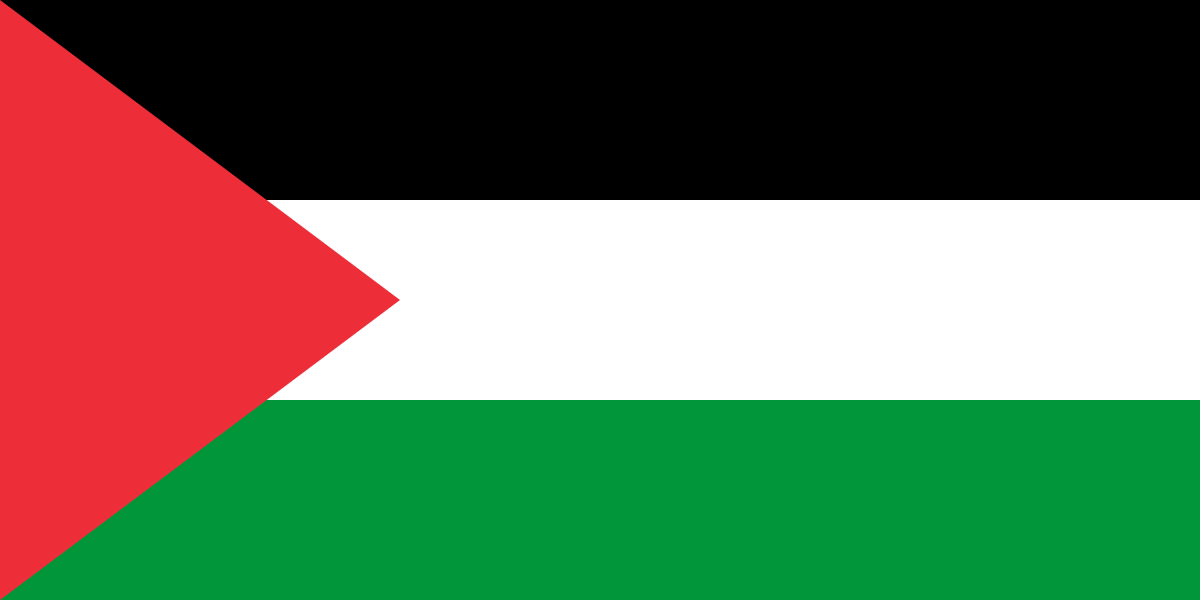
Let me express our deep appreciation to all Member States that voted in favour of the draft resolutions that have just been adopted under agenda item 40, “Question of Palestine”. I wish to convey special thanks to Member States that sponsored those draft resolutions, and to all members of the Committee on the Exercise of the Inalienable Rights of the Palestinian People.
With the adoption of those draft resolutions, the Assembly sends the proper message to the parties by reaffirming the commitment of the international community to a just and peaceful settlement of the question of Palestine, the core of the Arab-Israeli conflict, and by affirming the role of the United Nations in this regard. By doing so, the Assembly contributes positively to the creation of a better atmosphere in the region and strengthens the position of all those who believe in international legitimacy and the principles of international law and who are effectively seeking a lasting and comprehensive peace in the Middle East.
We had hoped that these draft resolutions, and other draft resolutions relevant to the question of Palestine, especially those that reaffirm the rights of the Palestinian people, including their right to self-determination, would be adopted by consensus in the light of the new situation in the area, for change should take place in both directions if it is to be genuine and realistic. Unfortunately, achieving consensus was not possible, and this has basically been due to what we view as a wrong Israeli approach, one that expects the Palestinian side to give up its inalienable rights and positions in advance and
Let us recall that the peace process on the Palestinian- Israeli track is still at the beginning, and furthermore deals with a transitional period. The agreement to postpone negotiations on the final settlement issues does not and should not detract from the Palestinian positions of principle on those issues, and it certainly does not and should not result in a decrease in the responsibilities of the United Nations in this regard.
No one should say that the principles of the Charter of the United Nations and those of international law and international humanitarian law, as well as Security Council resolutions, are irrelevant at any time or in any place. No one should tell the General Assembly to give up its position, enshrined in those principles. Such calls will mean the real prejudging of the outcome of the negotiations through the acceptance of the imbalance of power and the illegal de facto situations that have already been created by the Israeli side. Further, actions illegal under international law remain illegal, and do not become less illegal with the beginning of negotiations.
We had hoped for a more balanced position in the General Assembly on the part of the co-sponsors of the peace process, away from partisan support for one side or, on the other hand, from unjustified changes in position at the expense of the Palestinian people. We firmly believe that the successful development of the peace process requires, among other things, more balanced and objective positions to be taken by each of the two co-sponsors and by them together.
We do believe that the peace process has achieved important progress. We also believe that we at the United Nations have done our best to support that process and to reflect the new realities the way they are. We are sure that the international community and the United Nations will always shoulder their responsibilities in respect of the question of Palestine until a final settlement is effectively reached. Let us only hope that the parties concerned will adhere to their contractual obligations and implement the agreements reached without further delays and difficulties.
Finally, we would like to express our thanks to all Member States with which we have worked to produce what we believe to be a very good and useful package of draft resolutions, which has received overwhelming support
The Assembly has thus concluded this stage of its consideration of agenda item 40.
8. Adoption of the agenda of the forty-ninth regular session of the General Assembly and allocation of items: reports of the General Committee Sixth report of the General Committee (A/49/250/Add.5)
The sixth report of the General Committee concerns two requests for the inclusion in the agenda of the current session of additional items submitted, respectively, by the delegation of Namibia and by a number of countries.
I first draw the attention of representatives to paragraph 1 (a) of the report. The General Committee recommends the inclusion in the agenda of the current session of an additional item entitled “United Nations Fund for Namibia: scholarship programme for Namibian students”.
May I take it that the General Assembly decides to include this additional item in its agenda?
It was so decided.
In paragraph 1 (b) of the report, the General Committee recommends that the item be considered directly in plenary meeting.
May I take it that the General Assembly adopts this recommendation of the General Committee?
It was so decided.
May I take it that, as requested by the sponsor, this item should be given priority consideration by the Assembly because of its urgent character?
It was so decided.
Next, I should like to draw the attention of representatives to paragraph 2 (a) of the report.
May I take it that the General Assembly decides to include this additional item in its agenda?
It was so decided.
In paragraph 2 (b) of the report, the General Committee recommends that the item be considered directly in plenary meeting. May I take it that the General Assembly adopts this recommendation of the General Committee?
It was so decided.
Postponement of date of recess
I should like to draw the attention of members to a matter relating to the date of recess.
Members will recall that at the 3rd plenary meeting, on 23 September 1994, the General Assembly decided that the forty-ninth session should recess on 20 December 1994 and close on 18 September 1995.
However, I am informed that some Main Committees will complete their work later than originally scheduled. Therefore, the Assembly will not be able to conclude its work on 20 December. I should like, therefore, to propose to the Assembly that it postpone its date of recess until Friday, 23 December 1994.
If there is no objection, may I take it that the Assembly agrees to this proposal?
It was so decided.
Programme of work
Before adjourning the meeting, I should like to make the following announcement.
As members know, the General Assembly is now preparing to conclude its work for the year. In this connection, I should like to inform members of the programme of work from now until Friday, 23 December, the day on which the Assembly will recess, as decided this afternoon.
On Thursday, 15 December, in the afternoon, the Assembly will first take up agenda item 14, “Report of the International Atomic Energy Agency”, in order to take action on the draft resolution submitted under that item. The Assembly will next consider the reports of the First Committee.
On Friday, 16 December, in the morning, the Assembly will first take up agenda item 38, “The situation in the Middle East”, to consider the draft resolutions submitted under that item. The Assembly will then take up sub-item (h) of agenda item 17, “Appointment of the members of the Consultative Committee on the United Nations Development Fund for Women”, followed by agenda item 18, “Implementation of the Declaration on the Granting of Independence to Colonial Countries and Peoples”, in order to take action on draft resolutions A/49/L.51 and A/49/L.52.
The last agenda item scheduled for the morning of Friday, 16 December, is item 42, “The situation in Central America: procedures for the establishment of a firm and lasting peace and progress in fashioning a region of peace, freedom, democracy and development”, so that the Assembly may take action on the draft resolution submitted under that item.
On Monday, 19 December, in the afternoon, the Assembly will first consider the agenda item on the “United Nations Fund for Namibia: scholarship programme for Namibian students”. The Assembly will then take up the reports of the Second Committee.
On Tuesday, 20 December, in the morning, the Assembly will first take up agenda item 37, “Strengthening of the coordination of humanitarian and disaster relief assistance of the United Nations, including special economic assistance”, in order to consider and take action on the remaining resolutions submitted under this item.
Then, the Assembly will consider the agenda item on “Cooperation between the United Nations and the Caribbean Community”.
Lastly, on Tuesday, 20 December, in the morning, the Assembly will take up agenda item 46, “Declaration of the Assembly of Heads of State and Government of the Organization of African Unity on the aerial and naval military attack against the Socialist People’s Libyan Arab Jamahiriya by the present United States Administration in April 1986”.
Finally, on Friday, 23 December, in the morning, the Assembly will consider the reports of the Third Committee.
The programme of work of the General Assembly for the remainder of December will be issued tomorrow in document A/INF/49/5/Add.4.
The scheduling of agenda items pending consideration by the Assembly will be announced in due course. Changes in recorded and/or roll-call votes Resolution 49/62 A Subsequent to the voting, the delegation of Angola advised the Secretariat that it had intended to vote in favour. Resolution 49/62 A, B, C and D Subsequent to the voting, the delegations of Afghanistan, Burundi and the Sudan advised the Secretariat that they had intended to vote in favour; the delegation of Uzbekistan had intended to vote in favour of resolution 49/62 D.
The meeting rose at 4.45 p.m.
Annex
▶ Cite this page
UN Project. “A/49/PV.88.” UN Project, https://un-project.org/meeting/A-49-PV-88/. Accessed .