A/49/PV.91 General Assembly
▶ This meeting at a glance
38
Speeches
16
Countries
5
Resolutions
Topics
Israeli–Palestinian conflict
Security Council deliberations
UN resolutions and decisions
Peace processes and negotiations
General statements and positions
Global economic relations
The meeting was called to order at 10.30 a.m.
Vote:
A/RES/49/88
Recorded Vote
✓ 149
✗ 4
2 abs.
Show country votes
— Abstain
(2)
Absent
(30)
-
 Andorra
-
 Angola
-
 Belize
-
 Cabo Verde
-
 Chad
Chad
-
 Democratic People's Republic of Korea
-
 Dominican Republic
-
 Equatorial Guinea
-
 Eritrea
-
 Gambia
-
 Guatemala
-
 Guinea-Bissau
-
 Iraq
Iraq
-
 Kyrgyzstan
-
 Liberia
-
 Lithuania
-
 Madagascar
-
 Malawi
-
 Palau
Palau
-
 Papua New Guinea
-
 Rwanda
-
 San Marino
-
 Sao Tome and Principe
-
 Seychelles
-
 Somalia
-
 Tajikistan
-
 Turkmenistan
-
 Uzbekistan
-
 Yugoslavia
-
 Democratic Republic of the Congo
✓ Yes
(149)
-
 Afghanistan
-
 Albania
-
 Algeria
-
 Argentina
-
 Armenia
-
 Australia
-
 Austria
-
 Azerbaijan
-
 Bahamas
-
 Bahrain
-
 Bangladesh
-
 Barbados
-
 Belarus
-
 Belgium
-
 Benin
Benin
-
 Bhutan
-
 Plurinational State of Bolivia
-
 Bosnia and Herzegovina
-
 Botswana
-
 Brazil
-
 Brunei Darussalam
-
 Bulgaria
-
 Burkina Faso
-
 Burundi
-
 Cambodia
-
 Cameroon
-
 Canada
-
 Central African Republic
-
 Chile
Chile
-
 China
China
-
 Colombia
-
 Comoros
-
 Congo
Congo
-
 Costa Rica
-
 Côte d'Ivoire
-
 Croatia
-
 Cuba
Cuba
-
 Cyprus
-
 Czechia
-
 Denmark
-
 Djibouti
-
 Dominica
-
 Ecuador
-
 Egypt
Egypt
-
 El Salvador
-
 Estonia
-
 Ethiopia
-
 Fiji
Fiji
-
 Finland
-
 France
-
 Gabon
Gabon
-
 Georgia
-
 Germany
-
 Ghana
Ghana
-
 Greece
-
 Grenada
-
 Guinea
-
 Guyana
-
 Haiti
Haiti
-
 Honduras
-
 Hungary
-
 Iceland
-
 India
India
-
 Indonesia
-
 Ireland
-
 Israel
-
 Italy
Italy
-
 Jamaica
-
 Japan
Japan
-
 Jordan
-
 Kazakhstan
-
 Kenya
Kenya
-
 Kuwait
-
 Lao People's Democratic Republic
-
 Latvia
-
 Lesotho
-
 Liechtenstein
-
 Luxembourg
-
 Malaysia
-
 Maldives
-
 Mali
Mali
-
 Malta
Malta
-
 Marshall Islands
-
 Mauritania
-
 Mauritius
-
 Mexico
-
 Micronesia (Federated States of)
-
 Monaco
-
 Mongolia
-
 Morocco
-
 Mozambique
-
 Myanmar
-
 Namibia
-
 Nepal
Nepal
-
 Netherlands
-
 New Zealand
-
 Nicaragua
-
 Niger
Niger
-
 Nigeria
-
 Norway
-
 Oman
Oman
-
 Pakistan
-
 Panama
-
 Paraguay
-
 Peru
Peru
-
 Philippines
-
 Poland
-
 Portugal
-
 Qatar
Qatar
-
 Republic of Korea
-
 Moldova
-
 Romania
-
 Russian Federation
-
 Saint Kitts and Nevis
-
 Saint Lucia
-
 Saint Vincent and the Grenadines
-
 Samoa
Samoa
-
 Saudi Arabia
-
 Senegal
-
 Sierra Leone
-
 Singapore
-
 Slovakia
-
 Slovenia
-
 Solomon Islands
-
 South Africa
-
 Spain
Spain
-
 Sri Lanka
-
 Suriname
-
 Eswatini
-
 Sweden
-
 Thailand
-
 North Macedonia
-
 Togo
Togo
-
 Trinidad and Tobago
-
 Tunisia
-
 Türkiye
-
 Uganda
-
 Ukraine
-
 United Arab Emirates
-
 United Kingdom of Great Britain and Northern Ireland
-
 United Republic of Tanzania
-
 United States of America
-
 Uruguay
-
 Vanuatu
-
 Bolivarian Republic of Venezuela
-
 Viet Nam
-
 Yemen
Yemen
-
 Zambia
-
 Zimbabwe
38. The situation in the Middle East Reports of the Secretary-General (A/49/556 and A/49/636) Draft resolutions (A/49/L.59, A/49/L.60 and A/49/L.61)

Members will recall that the Assembly concluded its debate on agenda item 38 at its 73rd meeting, on 1 December 1994.
I call on the representative of Egypt to introduce draft resolutions A/49/L.59 and A/49/L.60.

On behalf of the Group of Arab States I am pleased to introduce two of the draft resolutions presented under agenda item 38.
The first draft resolution, contained in document A/49/L.59, relates to Al-Quds. I introduce this draft on behalf of the delegations of Algeria, Cuba, Djibouti, Egypt, Indonesia, Jordan, Malaysia, Mauritania, Morocco, Qatar, Saudi Arabia, Sudan, Tunisia, the United Arab Emirates and Yemen.
___________
* Reissued for technical reasons.
In its preamble, the draft resolution refers to all the resolutions adopted by the General Assembly since 1981 which stipulate categorically that all legislative measures and actions taken by Israel, the occupying Power, with the aim of altering the legal status or the demographic nature of the Holy City of Al-Quds are null and void and must be rescinded forthwith.
The draft resolution also refers to Security Council resolution 478 (1980), in which the Council, inter alia, decided not to recognize the so-called Basic Law of Israel concerning the city of Al-Quds. In that resolution, the Council called upon those States that had established diplomatic missions in Al-Quds to withdraw those missions.
The draft resolution reiterates the importance of implementing the foregoing resolutions.
The sponsors of this draft resolution express the hope that Israel’s withdrawal from all the occupied Arab territories, including Al-Quds, will be completed in order for peace to be achieved in the Middle East and in order for the city of Al-Quds to become a symbol of peace, peaceful coexistence and harmony amongst the three monotheistic religions.
The second draft resolution, contained in document A/49/L.60, relates to the Syrian Golan. I introduce that draft resolution on behalf of Cuba, Egypt, Indonesia, Jordan, Kuwait, Lebanon, Malaysia, Saudi Arabia, Sudan, Syrian Arab Republic, Tunisia, the United Arab Emirates and Yemen.
The draft resolution also recalls that Israel has not yet complied with Security Council resolution 497 (1981) and that the measure adopted by Israel with regard to annexation of the Golan runs flagrantly counter to that resolution.
The draft resolution also refers to the peace process which began with the convening of the Madrid Peace Conference, in the hope that tangible progress will be achieved in the negotiations now taking place in the context of that process on both the Syrian and the Lebanese tracks.
The draft resolution calls for the complete withdrawal by Israel from all the Syrian Golan.
In calling for speedy progress on the Syrian and Lebanese tracks, I voice the wish of all the sponsors of this draft resolution to witness the implementation of all the resolutions of the Security Council and the General Assembly since this will be the means of bringing about the desired comprehensive, just and lasting peace in the Middle East region.
I call on the representative of Norway to introduce draft resolution A/49/L.61.

I take great pleasure in introducing, together with the Russian Federation and the United States of America, draft resolution A/49/L.61, on the Middle East peace process. The following countries have joined in sponsoring the draft resolution: Albania, Argentina, Armenia, Australia, Austria, Barbados, Belarus, Belgium, Botswana, Bosnia and Herzegovina, Brazil, Burkina Faso, Bulgaria, Canada, Colombia, Comoros, Costa Rica, Côte d’Ivoire, Croatia, the Czech Republic, Denmark, El Salvador, Ethiopia, Finland, Gabon, Georgia, Germany, Guinea, Hungary, Iceland, India, Ireland, Israel, Italy, Japan, Jordan, Kazakhstan, Latvia, Luxembourg, Malta, Marshall Islands, the Federated States of Micronesia, Mongolia, Morocco, Myanmar, the Netherlands, New Zealand, Nicaragua, Peru, Poland, Portugal, the Republic of Korea, the Republic of Moldova, Romania, Saint Kitts and Nevis, Saint Lucia, Saint Vincent and the Grenadines, Samoa, Singapore, Slovenia, Solomon Islands, South Africa, Spain, Sweden, Thailand, The Former Yugoslav
This draft resolution is a follow-up to resolution 48/58 on the Middle East peace process, which was introduced for the very first time last year.
Under the draft resolution, the Assembly would welcome and give full support to the achievements of the peace process so far. The text also includes references to the agreements and treaties entered into during the past year. The implementation of the Declaration of Principles on Interim Self-Government Arrangements for the Palestinians is moving steadily forward, although behind schedule, and the subsequent Agreement on the Gaza Strip and the Jericho Area, establishing the Palestinian Authority, was signed by Israel and the Palestine Liberation Organization (PLO) at Cairo on 4 May this year. Normalization of the relations between Israel and its Arab neighbours continues, and on 26 October this year Israel and Jordan signed the historic Treaty of Peace. These new important steps are reflected in both the preambular and the operative parts of the draft resolution.
The parties deserve our praise for their outstanding courage and commitment to moving ahead with the peace process despite internal opposition and attempts to derail the peace process through violence and terror.
In operative paragraph 4, the Assembly would stress the need to achieve rapid progress on the other tracks of the Arab-Israeli negotiations within the peace process initiated in Madrid. It is our hope that the bilateral talks between Israel and Syria and between Israel and Lebanon will be inspired by these positive developments and will soon lead to concrete results towards peace, in accordance with relevant Security Council resolutions. With regard to the Israel-Lebanon track, Security Council resolution 425 (1978) of 19 March 1978 will be an important point of reference.
The Middle East/North Africa Economic Summit, which was held at Casablanca from 30 October to 1 November this year, clearly demonstrated that a profound change of climate has occurred in the Middle East. New possibilities for regional cooperation have opened up, which in turn should inspire further progress in the peace process. The declaration of the Casablanca Summit is welcomed in the last preambular paragraph of the draft resolution.
Operative paragraph 7 points to the positive contribution that an active United Nations role can have in the Middle East peace process and in assisting in the implementation of the Declaration of Principles and the subsequent Agreement on the Gaza Strip and the Jericho Area and the agreement on preparatory transfer of powers and responsibilities. The appointment by the Secretary- General of a Special Coordinator in the occupied territories, mentioned in paragraph 5, has underlined the commitment of the United Nations to strengthening further its role in the peace process.
The purpose of this draft resolution is not only to welcome the achievements of the peace process so far, but also to register the strong support of United Nations Members for further efforts towards a comprehensive, just and lasting peace in the Middle East. Many important issues remain to be solved. And this year the draft resolution does not mention issues which are subjects for negotiation between the parties. We believe that the Assembly should be careful not to add to or detract from what only the parties themselves can decide. We do, however, consider it vitally important that at this critical stage the world community express its continued support for the peace process through the General Assembly. We therefore recommend this draft resolution for unanimous adoption.
I call next on the representative of the Russian Federation, also to introduce draft resolution A/49/L.61.

The delegation of the Russian Federation, as a cosponsor of the Middle East peace process, is honoured to join Norway and the United States of America in introducing draft resolution A/49/L.61. The main purpose of the draft resolution is to strengthen the positive elements
Since the beginning of the Madrid peace process, impressive progress has been achieved. The Palestinian self-governing body is being established, and work is under way on other aspects of the process. We are pleased by developments in the process, and want all aspects of the conflict to be resolved without prejudice to any of the parties to the conflict. That, indeed, is the logic of the Madrid formula for the peace process.
Guided by the basic principle that regional conflicts must be unblocked in the interests of improving the overall international climate, Russia has made the achievement of a comprehensive, just and lasting settlement in the Middle East an important priority in its foreign policy. We are actively promoting progress in the region — which, I should note, is very near the southern borders of the Russian Federation.
We consider that the signing of the Jordan-Israel Treaty of Peace, which also bears the signature of the Foreign Minister of the Russian Federation, marked the beginning of a new era in the peace process. The next important event was the beginning of the establishment on the ground of Palestinian self-rule.
On the whole, we are satisfied with the dynamics of the Palestinian-Israeli negotiations, although with respect to the establishment of an autonomous authority the leadership of the Palestine Liberation Organization is facing considerable concrete difficulties. At the moment, talks in Cairo between Israel and the Palestinians on elections to the Palestinian Council, the self-government body for the West Bank and the Gaza Strip, are of great importance.
Material support from outside is necessary to ensure the establishment of Palestinian self-rule, and in the draft resolution the Assembly would call upon States to expedite economic, financial and technical assistance to the Palestinian people during the interim period. For its part, Russia is extending assistance to the Palestinians, including equipment for the Palestinian police and security forces. We are also considering projects for possible Russian participation in the economic and social development of the West Bank and the Gaza Strip.
By another very important paragraph of the draft resolution, the Assembly would consider that an active
In the draft resolution the Assembly would also stress the need to achieve rapid progress on the other tracks of the Arab-Israeli negotiations.
In this context, we are concerned at the lack of synchronization of the negotiating tracks. At this stage the primary need is to get the Syrian-Israeli talks going again. Intensive contacts between Russia and Syria and Israel have identified, in the positions of both parties, specific elements of flexibility sufficiently meaningful to convince the sponsors that they should aim at achieving progress. In this regard, it is important that things be speeded up.
The outcome of the Syrian-Israeli negotiations will largely determine the means by which the Lebanese-Israeli problem can be unblocked. At the same time, the situation in Lebanon has its own characteristics. We assume that Security Council resolution 425 (1978), whose purpose is to ensure Lebanon’s sovereignty and territorial integrity, Israel’s withdrawal from southern Lebanon, and security in the northern part of Israel, still provides a specific international legal basis for the settlement of this question.
We are convinced that the adoption of this draft resolution will provide important political support for the process of building a post-confrontation Middle East based on wide international cooperation and accelerated economic development in the region. Russia attaches great significance to the multilateral aspect of the peace process, which is becoming more and more specific, and is of the opinion that the United Nations, including the Security Council, will continue to help advance the process in all its aspects.
I now call on the representative of the United States of America, also to introduce draft resolution A/49/L.61.
It is necessary and appropriate that the world should offer its encouragement to the parties as they work to overcome the legacy of a past marked by hatred, war, suspicion and distrust. It is also imperative that the world support the parties as they face the challenge of those who seek, by violence and terrorism, to undermine and reverse the strides that they have taken so far. The parties themselves have reiterated their condemnation of violence and terrorism. They remain committed to the resolution of their differences through negotiation, despite the brutal and bloody efforts of the enemies of peace and reconciliation.
It is the long-standing position of the United States that the just and lasting peace that we seek for the Middle East must be comprehensive. We therefore strongly hope and desire that progress will soon become evident in the efforts of Syria and Israel and of Lebanon and Israel to negotiate peace. In this context, I wish to reaffirm my Government’s commitment to Lebanon’s political independence, sovereignty and territorial integrity. Those objectives were set forth in Security Council resolution 425 (1978), which my Government supports.
My Government has been deeply involved in numerous efforts to see that appropriate economic assistance is channelled in support of peace. This draft resolution clearly reflects the international community’s view that such assistance for development is a crucial priority and should be supported by it.
The draft resolution is a clear signal to the parties that the international community recognizes and supports their courageous efforts to reshape the world in which their children will live. It also constitutes recognition of
In closing, I wish to say that the United States is proud once again to have worked with the representatives of Russia, Norway and many other countries in sponsoring this draft resolution. We invite the representatives of all States to join in expressing support for the peoples of the Middle East as they continue their efforts to achieve a comprehensive, just and lasting settlement of the Middle East conflict.
18. Implementation of the Declaration on the Granting of Independence to Colonial Countries and Peoples Report of the Special Committee on the Situation with regard to the Implementation of the Declaration on the Granting of Independence to Colonial Countries and Peoples (A/49/23 (Parts I- VIII), A/AC.109/1179-1183, 1185-1186, 1188-1195 and 1197) Report of the Secretary-General (A/49/492) Draft resolutions (A/49/L.51, A/49/L.52)
Vote:
A/RES/49/89
Recorded Vote
✓ 128
✗ 2
26 abs.
Show country votes
— Abstain
(26)
Absent
(29)
-
Albania
-
Andorra
-
Angola
-
Azerbaijan
-
Bosnia and Herzegovina
-
Cabo Verde
-
Chad
-
Dominican Republic
-
Equatorial Guinea
-
Eritrea
-
Gambia
-
Guatemala
-
Guinea-Bissau
-
Jordan
-
Kyrgyzstan
-
Lesotho
-
Liberia
-
Malawi
-
Palau
-
Rwanda
-
San Marino
-
Sao Tome and Principe
-
Seychelles
-
Somalia
-
Tajikistan
-
Turkmenistan
-
Uzbekistan
-
Yugoslavia
-
Democratic Republic of the Congo
✓ Yes
(128)
-
Afghanistan
-
Algeria
-
 Antigua and Barbuda
-
Argentina
-
Armenia
-
Australia
-
Austria
-
Bahamas
-
Bahrain
-
Bangladesh
-
Barbados
-
Belarus
-
Belize
-
Benin
-
Bhutan
-
Plurinational State of Bolivia
-
Botswana
-
Brazil
-
Brunei Darussalam
-
Burkina Faso
-
Burundi
-
Cambodia
-
Cameroon
-
Central African Republic
-
Chile
-
China
-
Colombia
-
Comoros
-
Congo
-
Costa Rica
-
Côte d'Ivoire
-
Croatia
-
Cuba
-
Cyprus
-
Democratic People's Republic of Korea
-
Denmark
-
Djibouti
-
Dominica
-
Ecuador
-
Egypt
-
El Salvador
-
Ethiopia
-
Fiji
-
Gabon
-
Ghana
-
Greece
-
Grenada
-
Guinea
-
Guyana
-
Haiti
-
Honduras
-
Iceland
-
India
-
Indonesia
-
 Islamic Republic of Iran
-
Iraq
-
Ireland
-
Jamaica
-
Japan
-
Kazakhstan
-
Kenya
-
Kuwait
-
Lao People's Democratic Republic
-
 Lebanon
-
 Libya
Libya
-
Liechtenstein
-
Madagascar
-
Malaysia
-
Maldives
-
Mali
-
Malta
-
Marshall Islands
-
Mauritania
-
Mauritius
-
Mexico
-
Micronesia (Federated States of)
-
Mongolia
-
Mozambique
-
Myanmar
-
Namibia
-
Nepal
-
New Zealand
-
Nicaragua
-
Niger
-
Nigeria
-
Norway
-
Oman
-
Pakistan
-
Panama
-
Papua New Guinea
-
Paraguay
-
Peru
-
Philippines
-
Portugal
-
Qatar
-
Republic of Korea
-
Russian Federation
-
Saint Kitts and Nevis
-
Saint Lucia
-
Saint Vincent and the Grenadines
-
Samoa
-
Saudi Arabia
-
Senegal
-
Sierra Leone
-
Singapore
-
Solomon Islands
-
South Africa
-
Spain
-
Sri Lanka
-
 Sudan
Sudan
-
Suriname
-
Eswatini
-
Sweden
-
 Syrian Arab Republic
-
Thailand
-
Togo
-
Trinidad and Tobago
-
Tunisia
-
Uganda
-
United Arab Emirates
-
United Republic of Tanzania
-
Uruguay
-
Vanuatu
-
Bolivarian Republic of Venezuela
-
Viet Nam
-
Yemen
-
Zambia
-
Zimbabwe
We shall now proceed to consider draft resolutions A/49/L.59, A/49/L.60 and A/49/L.61.
I should like to inform representatives that Greece and Paraguay have become sponsors of draft resolution A/49/L.61.
Several representatives wish to make statements in explanation of vote before the voting. May I remind delegations that explanations of vote are limited to 10 minutes and should be made by delegations from their seats.
I have the honour of speaking on behalf of the Group of Arab States on draft resolution A/49/L.61, which relates to the Middle East peace process. In this draft resolution the Arab States reaffirm their complete support for the ongoing peace process, which began with the convening of the Madrid Peace Conference in 1991, and once again voice the hope that this process will arrive at a comprehensive, just and lasting peace in the Middle East that will guarantee complete withdrawal by Israel’s forces from the occupied Arab territories and the exercise by the Palestinian people of all its legitimate national rights.
The Arab Group wishes to declare here its complete solidarity with Lebanon on the need for the immediate implementation of Security Council resolution 425 (1978). For the second consecutive year, the Group has made considerable efforts to get the States that sponsored the draft resolution to make a clear reference in its text to Security Council resolution 425 (1978), in view of the fact that Lebanon agreed to participate in the Madrid Peace Conference with the aim of securing the implementation of that very resolution.

This year there have been promising developments in the peace process, and the leading players in the process were deserving recipients of the Nobel Peace Prize. My delegation takes this opportunity to congratulate them and to express its satisfaction that they took advantage of the Oslo ceremony to step up their efforts. Substantial progress has been made in relations between Israel and Jordan, the question of Palestine, and regional cooperation. It is right for the General Assembly to welcome this progress through a new draft resolution on the peace process in the Middle East.
As it did last year on a similar draft resolution, France will vote in favour of draft resolution A/49/L.61, which crowns a set of draft resolutions devoted to the Middle East and which has been thoroughly updated and improved. Like last year, too, France’s support of this positive draft resolution stops short of sponsorship. There is a well-known reason for this, which my delegation explained last year. In our view, the absence of a reference to Security Council resolution 425 (1978) constitutes a regrettable lacuna. France attaches particular importance to respect for the principles established by that text and would have liked to see this opportunity taken to reaffirm the United Nations commitment to Lebanon’s sovereignty, independence and territorial integrity.
The arguments put forward by the sponsors of the draft resolution for refusing to make reference to resolution 425 (1978) are not convincing. Israel avers that it has no territorial claim on Lebanon and that it is motivated solely by concern for its own security. The sponsors of the peace process, for their part, state their conviction that peace must be just, comprehensive and lasting. No one can imagine such a peace as long as Lebanese soil remains illegally occupied by foreign troops.

The Argentine Republic is following closely and with particular attention the promising developments taking place in the Middle East region. In this respect, we acknowledge the moderation reflected in the draft resolution submitted on the Syrian Golan Heights (A/49/L.60), under agenda item 38.
Having thoroughly analysed the substance of the question of the Golan Heights in the framework of the Argentine Republic’s support for Security Council resolutions 242 (1967) and 338 (1973), we have decided to vote in favour of draft resolution A/49/L.60. This affirmative vote should be understood in the context of my country’s express recognition of, and unequivocal support for, the significant progress we have seen in the Middle East. We value and support the important, tireless efforts exerted by the State of Israel and its neighbours, since the Peace Conference in Madrid, to overcome all obstacles and not be held back by hatred or rancour, with a view to achieving a just, lasting and comprehensive peace in the region. Those efforts are the reflection of our own hopes.
Vote:
A/RES/49/90
Recorded Vote
✓ 130
✗ 2
24 abs.
Show country votes
— Abstain
(24)
Absent
(29)
-
Albania
-
Andorra
-
Angola
-
Azerbaijan
-
Bosnia and Herzegovina
-
Cabo Verde
-
Chad
-
Dominican Republic
-
Equatorial Guinea
-
Eritrea
-
Gambia
-
Guatemala
-
Guinea-Bissau
-
Jordan
-
Kyrgyzstan
-
Lesotho
-
Liberia
-
Malawi
-
Palau
-
Rwanda
-
San Marino
-
Sao Tome and Principe
-
Seychelles
-
Somalia
-
Tajikistan
-
Turkmenistan
-
Uzbekistan
-
Yugoslavia
-
Democratic Republic of the Congo
✓ Yes
(130)
-
Afghanistan
-
Algeria
-
Antigua and Barbuda
-
Argentina
-
Armenia
-
Australia
-
Austria
-
Bahamas
-
Bahrain
-
Bangladesh
-
Barbados
-
Belarus
-
Belize
-
Benin
-
Bhutan
-
Plurinational State of Bolivia
-
Botswana
-
Brazil
-
Brunei Darussalam
-
Burkina Faso
-
Burundi
-
Cambodia
-
Cameroon
-
Central African Republic
-
Chile
-
China
-
Colombia
-
Comoros
-
Congo
-
Costa Rica
-
Côte d'Ivoire
-
Croatia
-
Cuba
-
Cyprus
-
Democratic People's Republic of Korea
-
Denmark
-
Djibouti
-
Dominica
-
Ecuador
-
Egypt
-
El Salvador
-
Ethiopia
-
Fiji
-
Gabon
-
Ghana
-
Greece
-
Grenada
-
Guinea
-
Guyana
-
Haiti
-
Honduras
-
Iceland
-
India
-
Indonesia
-
Islamic Republic of Iran
-
Iraq
-
Ireland
-
Jamaica
-
Japan
-
Kazakhstan
-
Kenya
-
Kuwait
-
Lao People's Democratic Republic
-
Lebanon
-
Libya
-
Liechtenstein
-
Madagascar
-
Malaysia
-
Maldives
-
Mali
-
Malta
-
Marshall Islands
-
Mauritania
-
Mauritius
-
Mexico
-
Micronesia (Federated States of)
-
Mongolia
-
Mozambique
-
Myanmar
-
Namibia
-
Nepal
-
New Zealand
-
Nicaragua
-
Niger
-
Nigeria
-
Norway
-
Oman
-
Pakistan
-
Panama
-
Papua New Guinea
-
Paraguay
-
Peru
-
Philippines
-
Portugal
-
Qatar
-
Republic of Korea
-
Russian Federation
-
Saint Kitts and Nevis
-
Saint Lucia
-
Saint Vincent and the Grenadines
-
Samoa
-
Saudi Arabia
-
Senegal
-
Sierra Leone
-
Singapore
-
Solomon Islands
-
South Africa
-
Spain
-
Sri Lanka
-
Sudan
-
Suriname
-
Eswatini
-
Sweden
-
Syrian Arab Republic
-
Thailand
-
Togo
-
Trinidad and Tobago
-
Tunisia
-
Türkiye
-
Uganda
-
Ukraine
-
United Arab Emirates
-
United Republic of Tanzania
-
Uruguay
-
Vanuatu
-
Bolivarian Republic of Venezuela
-
Viet Nam
-
Yemen
-
Zambia
-
Zimbabwe

As it did last year on a similar draft resolution, my delegation will vote against draft resolution A/49/L.61.
Lebanon, which participated wholeheartedly in the Middle East peace process launched in Madrid on 30 October 1991, is the country which has suffered the most from the Arab-Israeli conflict. We therefore feel that we have much to gain from the attainment of the just, lasting, and comprehensive peace that we seek in the region.
However, the draft resolution before us, despite our efforts vis-à-vis its sponsors, fails to address our particular concern, which is the implementation of Security Council resolution 425 (1978), calling for Israel to withdraw forthwith its forces from all Lebanese territory to Lebanon’s internationally recognized boundaries. No real peace in the Middle East can be achieved without this prerequisite. We
Once again I would like to recall that Lebanon participated in the Madrid Peace Conference and the subsequent bilateral talks in Washington on the basis of Security Council resolution 425 (1978) in order to end the Israeli occupation of southern Lebanon. This was confirmed by the letter of assurances dated 18 October 1991 from the Government of the United States, one of the sponsors of the Madrid Peace Conference, to the Government of Lebanon.
Subsequently, Lebanon entered the peace process and participated in it positively and constructively, with a view to seeing resolution 425 (1978) fully implemented. This was done on the clear understanding that the Middle East peace process would provide the framework for finally attaining Israel’s implementation of Security Council resolution 425 (1978), which it has refused to do for the past 16 years, and particularly since the beginning of the peace process three years ago. Furthermore, the continuation of the Israeli occupation of southern Lebanon, the daily acts of aggression committed by the Israeli forces against Lebanese civilians, and the declarations of Israeli officials on the highest level do not give us any assurances of Israeli compliance with the terms of the draft resolution.
The violent situation prevailing in South Lebanon makes very clear the complete failure of the concept of the security zone established by Israel. Furthermore, the numerous attacks launched by the Israeli Army in the north of that zone underline again, and eloquently, the failure of this concept. We firmly believe that only the implementation of Security Council resolution 425 (1978) will be conducive to peace and security in South Lebanon.
Lebanon had keenly hoped that this draft resolution could be adopted by consensus in order to express the unconditional support of the international community for the Middle East peace process. Security Council resolution 425 (1978) is a clear-cut resolution. Indeed, since 1978 the Council has constantly renewed the mandate of the United Nations Interim Force in Lebanon (UNIFIL).
As an essential participant in the Middle East peace process, Lebanon is casting a negative vote on the draft resolution submitted to the Assembly. The international
Furthermore, regarding the fourth and seventh preambular paragraphs and operative paragraph 5 of draft resolution A/49/L.61, which mention the multilateral talks, my delegation reiterates once again its well-known and constant position on this subject: Lebanon considers that no multilateral talks should be held until the bilateral talks have ended with a complete agreement between all the participants in the Peace Conference. We continue to believe firmly that the multilateral talks being held today are premature and cannot but be inconclusive.
Finally, I should like to emphasize that Lebanon remains fully committed to the Madrid Peace Conference in order to achieve a just, lasting and comprehensive peace. My country will continue to call for the full implementation of resolution 425 (1978) in order to meet the challenge.

Syria has confirmed its commitment to the objective of achieving a just and comprehensive peace in the Middle East on the basis of international legality and respect for United Nations resolutions and in accordance with the Madrid formula. As Syria remains committed to the achievement of that objective, we cannot support a draft resolution that relates to the totality of the Middle East peace process and yet makes no mention of Security Council resolution 425 (1978), relating to Lebanon, which participated in the Madrid Peace Conference and the subsequent bilateral peace talks held at Washington D.C. on the basis of that very resolution.
With regard to the multilateral talks and respective working groups, my country has previously stated that it will not participate in those talks unless substantial and concrete progress is made on the Syrian track.
Therefore, my delegation will cast a negative vote on draft resolution A/49/L.61, “Middle East peace process”.
The Assembly will now take decisions on the three draft resolutions under agenda item 38, namely, draft resolutions A/49/L.59, A/49/L.60 and A/49/L.61.
A recorded vote has been requested. [Subsequently, the delegations of Lithuania, the United Kingdom of Great Britain and Northern Ireland, and Zambia advised the Secretariat that they had intended to
A recorded vote was taken.
Draft resolution A/49/L.59 was adopted by 138 votes to 2, with 7 abstentions (resolution 49/87 A).
Vote:
A/RES/49/87A
Recorded Vote
✓ 138
✗ 2
7 abs.
Show country votes
— Abstain
(7)
✗ No
(2)
Absent
(38)
-
Andorra
-
Angola
-
Belize
-
Benin
-
Cambodia
-
Cabo Verde
-
Chad
-
Congo
-
Dominica
-
Dominican Republic
-
El Salvador
-
Equatorial Guinea
-
Eritrea
-
Gabon
-
Gambia
-
Ghana
-
Guatemala
-
Guinea-Bissau
-
Kyrgyzstan
-
Liberia
-
Lithuania
-
Madagascar
-
Malawi
-
Palau
-
Papua New Guinea
-
Rwanda
-
Samoa
-
San Marino
-
Sao Tome and Principe
-
Seychelles
-
Somalia
-
Tajikistan
-
Turkmenistan
-
United Kingdom of Great Britain and Northern Ireland
-
Uzbekistan
-
Vanuatu
-
Yugoslavia
-
Democratic Republic of the Congo
✓ Yes
(138)
-
Afghanistan
-
Albania
-
Algeria
-
Argentina
-
Armenia
-
Australia
-
Austria
-
Azerbaijan
-
Bahamas
-
Bahrain
-
Bangladesh
-
Barbados
-
Belarus
-
Belgium
-
Bhutan
-
Plurinational State of Bolivia
-
Bosnia and Herzegovina
-
Botswana
-
Brazil
-
Brunei Darussalam
-
Bulgaria
-
Burkina Faso
-
Burundi
-
Cameroon
-
Canada
-
Central African Republic
-
Chile
-
China
-
Colombia
-
Comoros
-
Croatia
-
Cuba
-
Cyprus
-
Czechia
-
Democratic People's Republic of Korea
-
Denmark
-
Djibouti
-
Ecuador
-
Egypt
-
Estonia
-
Ethiopia
-
Finland
-
France
-
Georgia
-
Germany
-
Greece
-
Grenada
-
Guinea
-
Guyana
-
Haiti
-
Honduras
-
Hungary
-
Iceland
-
India
-
Indonesia
-
Islamic Republic of Iran
-
Iraq
-
Ireland
-
Italy
-
Jamaica
-
Japan
-
Jordan
-
Kazakhstan
-
Kenya
-
Kuwait
-
Lao People's Democratic Republic
-
Latvia
-
Lebanon
-
Lesotho
-
Libya
-
Liechtenstein
-
Luxembourg
-
Malaysia
-
Maldives
-
Mali
-
Malta
-
Mauritania
-
Mauritius
-
Mexico
-
Monaco
-
Mongolia
-
Morocco
-
Mozambique
-
Myanmar
-
Namibia
-
Nepal
-
Netherlands
-
New Zealand
-
Nicaragua
-
Niger
-
Nigeria
-
Norway
-
Oman
-
Pakistan
-
Panama
-
Paraguay
-
Peru
-
Philippines
-
Poland
-
Portugal
-
Qatar
-
Republic of Korea
-
Moldova
-
Romania
-
Russian Federation
-
Saudi Arabia
-
Senegal
-
Sierra Leone
-
Singapore
-
Slovakia
-
Slovenia
-
Solomon Islands
-
South Africa
-
Spain
-
Sri Lanka
-
Sudan
-
Suriname
-
Eswatini
-
Sweden
-
Syrian Arab Republic
-
Thailand
-
North Macedonia
-
Togo
-
Trinidad and Tobago
-
Tunisia
-
Türkiye
-
Uganda
-
Ukraine
-
United Arab Emirates
-
United Republic of Tanzania
-
Uruguay
-
Bolivarian Republic of Venezuela
-
Viet Nam
-
Yemen
-
Zimbabwe
-
Saint Kitts and Nevis
-
Saint Lucia
-
Saint Vincent and the Grenadines
Draft resolution A/49/L.60 is entitled “The Syrian Golan”.
A recorded vote has been requested.
A recorded vote was taken.
Draft resolution A/49/L.60 was adopted by 77 votes to 2, with 70 abstentions (resolution 49/87 B).
Draft resolution A/49/L.61 is entitled “Middle East peace process”.
A recorded vote has been requested.
A recorded vote was taken.
In favour: Afghanistan, Albania, Algeria, Argentina, Armenia, Australia, Austria, Azerbaijan, Bahamas, Bahrain, Bangladesh, Barbados, Belarus, Belgium, Benin, Bhutan, Bolivia, Bosnia and Herzegovina, Botswana, Brazil, Brunei Darussalam, Bulgaria, Burkina Faso, Burundi, Cambodia, Cameroon, Canada, Central African Republic, Chile, China, Colombia, Comoros, Congo, Costa Rica, Côte d’Ivoire, Croatia, Cuba, Cyprus, Czech Republic, Denmark, Djibouti, Dominica, Ecuador, Egypt, El Salvador, Estonia, Ethiopia, Fiji, Finland, France, Gabon, Georgia, Germany, Ghana, Greece, Grenada, Guinea, Guyana, Haiti, Honduras, Hungary, Iceland, India, Indonesia, Ireland, Israel, Italy, Jamaica, Japan, Jordan, Kazakhstan, Kenya, Kuwait, Lao People’s Democratic Republic, Latvia, Lesotho, Liechtenstein, Luxembourg, Malaysia, Maldives, Mali, Malta, Marshall Islands, Mauritania, Mauritius, Mexico, Micronesia (Federated States of), Monaco, Mongolia, Morocco, Mozambique, Myanmar, Namibia, Nepal, Netherlands, New Zealand, Nicaragua, Niger, Nigeria, Norway, Oman, Pakistan, Panama, Paraguay, Peru, Philippines, Poland, Portugal, Qatar, Republic of Korea, Republic of Moldova, Romania, Russian Federation, Saint Kitts and Nevis, Saint Lucia, Saint Vincent and the Grenadines, Samoa, Saudi Arabia, Senegal, Sierra Leone, Singapore, Slovakia, Slovenia, Solomon Islands, South Africa, Spain, Sri Lanka, Suriname, Swaziland, Sweden, Thailand, The Former Yugoslav Republic of Macedonia, Togo, Trinidad and Tobago, Tunisia, Turkey, Uganda, Ukraine, United Arab Emirates, United Kingdom of Great Britain and Northern Ireland, United Republic of Tanzania, United States of America, Uruguay, Vanuatu, Venezuela, Viet Nam, Yemen, Zambia, Zimbabwe
Against: Iran (Islamic Republic of), Lebanon, Libyan Arab Jamahiriya, Syrian Arab Republic
Abstaining: Antigua and Barbuda, Sudan
[Subsequently, the delegations of Lithuania and Papua New Guinea advised the Secretariat that they had intended to vote in favour.]
Vote:
A/RES/49/87B
Recorded Vote
✓ 77
✗ 2
70 abs.
Show country votes
— Abstain
(70)
-
Antigua and Barbuda
-
Australia
-
Austria
-
Bahamas
-
Barbados
-
Belarus
-
Belgium
-
Benin
-
Botswana
-
Brazil
-
Bulgaria
-
Cameroon
-
Canada
-
Central African Republic
-
Colombia
-
Costa Rica
-
Côte d'Ivoire
-
Czechia
-
Denmark
-
El Salvador
-
Estonia
-
Fiji
-
Finland
-
France
-
Georgia
-
Germany
-
Greece
-
Haiti
-
Hungary
-
Iceland
-
Ireland
-
Italy
-
Jamaica
-
Japan
-
Kenya
-
Latvia
-
Liechtenstein
-
Luxembourg
-
Malta
-
Marshall Islands
-
Mexico
-
Micronesia (Federated States of)
-
Monaco
-
Netherlands
-
New Zealand
-
Nicaragua
-
Norway
-
Paraguay
-
Peru
-
Poland
-
Portugal
-
Republic of Korea
-
Moldova
-
Romania
-
Russian Federation
-
Saint Kitts and Nevis
-
Saint Vincent and the Grenadines
-
Samoa
-
Singapore
-
Slovakia
-
Slovenia
-
Solomon Islands
-
Spain
-
Eswatini
-
Sweden
-
North Macedonia
-
Togo
-
Ukraine
-
United Kingdom of Great Britain and Northern Ireland
-
Uruguay
✗ No
(2)
Absent
(36)
-
Albania
-
Andorra
-
Angola
-
Belize
-
Bosnia and Herzegovina
-
Cambodia
-
Cabo Verde
-
Chad
-
Congo
-
Croatia
-
Dominica
-
Dominican Republic
-
Equatorial Guinea
-
Eritrea
-
Gabon
-
Gambia
-
Ghana
-
Guatemala
-
Guinea-Bissau
-
Kyrgyzstan
-
Liberia
-
Lithuania
-
Madagascar
-
Malawi
-
Palau
-
Papua New Guinea
-
Rwanda
-
San Marino
-
Sao Tome and Principe
-
Seychelles
-
Somalia
-
Tajikistan
-
Turkmenistan
-
Uzbekistan
-
Yugoslavia
-
Democratic Republic of the Congo
✓ Yes
(77)
-
Afghanistan
-
Algeria
-
Argentina
-
Armenia
-
Azerbaijan
-
Bahrain
-
Bangladesh
-
Bhutan
-
Plurinational State of Bolivia
-
Brunei Darussalam
-
Burkina Faso
-
Burundi
-
Chile
-
China
-
Comoros
-
Cuba
-
Cyprus
-
Democratic People's Republic of Korea
-
Djibouti
-
Ecuador
-
Egypt
-
Ethiopia
-
Grenada
-
Guinea
-
Guyana
-
Honduras
-
India
-
Indonesia
-
Islamic Republic of Iran
-
Iraq
-
Jordan
-
Kazakhstan
-
Kuwait
-
Lao People's Democratic Republic
-
Lebanon
-
Lesotho
-
Libya
-
Malaysia
-
Maldives
-
Mali
-
Mauritania
-
Mauritius
-
Mongolia
-
Morocco
-
Mozambique
-
Myanmar
-
Namibia
-
Nepal
-
Niger
-
Nigeria
-
Oman
-
Pakistan
-
Panama
-
Philippines
-
Qatar
-
Saint Lucia
-
Saudi Arabia
-
Senegal
-
Sierra Leone
-
South Africa
-
Sri Lanka
-
Sudan
-
Suriname
-
Syrian Arab Republic
-
Thailand
-
Trinidad and Tobago
-
Tunisia
-
Türkiye
-
Uganda
-
United Arab Emirates
-
United Republic of Tanzania
-
Vanuatu
-
Bolivarian Republic of Venezuela
-
Viet Nam
-
Yemen
-
Zambia
-
Zimbabwe
Several representatives wish to speak in explanation of vote. May I remind delegations that explanations of vote are limited to 10 minutes and should be made by delegations from their seats.

My Government’s views are well known on resolutions that seek to address issues being negotiated between parties in the region. This Assembly does not encourage or support that process by continuing to promote resolutions that are divisive and clearly take sides in the negotiations. It is also not helpful, in my Government’s view, to adopt resolutions which seek to prejudge the outcome of negotiations.
My Government is again disappointed by the adoption of draft resolution A/49/L.60, concerning the Golan Heights. While my Government voted in favour of Security Council resolution 497 (1981), on the status of the Golan Heights, we are convinced that draft resolution A/49/L.60, like others which deal with issues under negotiation, serves to complicate the achievement of a mutually acceptable outcome. It is up to Syria and Israel to negotiate arrangements concerning the Golan Heights. The two parties are deeply involved in this delicate process. They, and they alone, have to resolve their differences at the negotiating table.
The United States has long maintained that it is essential to pursue a just, lasting and comprehensive peace. We are committed to this goal in our role as full partner and active intermediary in the Arab-Israeli peace process.
As has been our practice in the past on similar draft resolutions, the United States abstained in the voting on draft resolution A/49/L.59, concerning Jerusalem. We are convinced that Jerusalem should remain undivided and that its future should be decided through permanent status negotiations, as the parties agreed in their historic 13 September 1993 Declaration of Principles. This Assembly should not interject itself into this most complex and emotional issue when the parties themselves have decided to leave discussion concerning Jerusalem to a future time.

My delegation voted in favour of the draft resolutions contained in documents A/49/L.59 and A/49/L.60. However, I should like to express my delegation’s reservations on those parts of these resolutions which might be construed as implying any recognition of Israel.
Regarding the subject of the draft resolution contained in document A/49/L.61, the position of my Government is on record. I would just like to mention that we believe that the recent agreements will not lead to the full restoration of the legitimate rights of the Palestinian people. Moreover, this resolution makes no reference to the withdrawal of occupying forces from Lebanon.

My delegation voted in favour of the draft resolutions contained in document A/49/L.59, on Jerusalem, and in document A/49/L.60, on the Syrian Golan. However, my delegation wishes to express its reservations on the contents of those resolutions, especially with regard to any recognition of Israel.
My Government voted against draft resolution A/49/L.61, entitled “Middle East peace process”, because it does not request Israel to withdraw from southern Lebanon in conformity with Security Council resolution 425 (1978), nor does it contain all the elements necessary for complete restoration of peace in the Middle East.
My country favours a comprehensive, just and lasting peace that will ensure Israel’s withdrawal from all the occupied Arab territories, including the Syrian Golan and southern Lebanon, and the implementation of all the rights of the Palestinian people, including its right to return to its homeland and its right to self-determination. We reiterate that the peace formula used in the case of South Africa could be an example for the resolution of the Palestinian problem and the establishment of the Palestinian State, of a country where Jews and Arabs could live together.
The European Union continues fully to support the peace process in the Middle East, which aims at achieving a just, lasting and comprehensive peace in the region. The mutual recognition of Israel and the Palestine Liberation Organization (PLO) and the signing of the Declaration of Principles on 13 September 1993 constituted an important first step in that direction. The European Union has committed itself to supporting the peace process in the form of a joint action that mobilizes the political, economic and financial resources of the Union. As the major donor of assistance to the Palestinian people, the European Union has a great interest in ensuring the rapid, efficient and transparent implementation of aid programmes. Within the framework of the multilateral tracks, the European Union pursues the goal of consolidating peace by setting up regional cooperation.
We are following with great interest the improvement of the situation in Lebanon, but stability remains fragile there in the absence of a comprehensive settlement for the entire Middle East region. We continue to plead for the full restoration of Lebanon’s sovereignty, independence, territorial integrity and national unity. In that context, the European Union reiterates its insistence on the full implementation of Security Council resolution 425 (1978), adopted on 19 March 1978. We urge the parties to make progress in the bilateral negotiations and to bring them to a successful end.
With respect to draft resolution A/49/L.60, entitled “The Syrian Golan”, the European Union is well aware of the ongoing negotiations between the parties in the framework of the Madrid peace process. Both sides have declared their willingness to reach a just, comprehensive and lasting solution to this question on the basis of Security Council resolutions 242 (1967) and 338 (1973). It is our view that such a solution has to be found between the parties, taking into account international law and the legitimate concerns of both sides.
The European Union welcomes the substantial progress demonstrated by the fact that this draft resolution now takes into account new and positive developments in the peace process. The Union was involved in serious discussions on further improvements of the text. The negotiations failed only narrowly to yield positive results. However, we take note of the positive spirit in which those
Furthermore, the European Union reiterates its wellknown position that the Israeli occupation of the Syrian Golan and the extension of Israeli law, jurisdiction and administration to this territory are illegal.

My delegation voted in favour of the draft resolution on the occupied Syrian Golan which is contained in document A/49/L.60. We should like to express our reservation with regard to the formula used in the seventh preambular paragraph of the resolution.

My delegation abstained in the voting on draft resolution A/49/L.60, although we are fully convinced that a just and lasting peace in the Middle East must be achieved. This draft resolution did not mention Security Council resolution 425 (1978) at all. No reason was given for that omission. We feel that a peaceful and lasting settlement to the Middle East problem must provide for Israel’s total withdrawal from all the occupied Arab territories, including southern Lebanon, the Syrian Golan and the occupied West Bank. All the legitimate national rights of the Palestinian people must be guaranteed.
We reaffirm our conviction that the international community must work to achieve a comprehensive and lasting settlement of the problem on the basis of the resolutions that reflect the truth, and without losing sight of the important elements that must form the basis of such a settlement.
We have heard the last speaker in explanation of vote after the voting.
In accordance with General Assembly resolution 3237 (XXIX), dated 20 November 1974, and resolution 43/177, of 15 December 1988, I call on the Observer for Palestine.

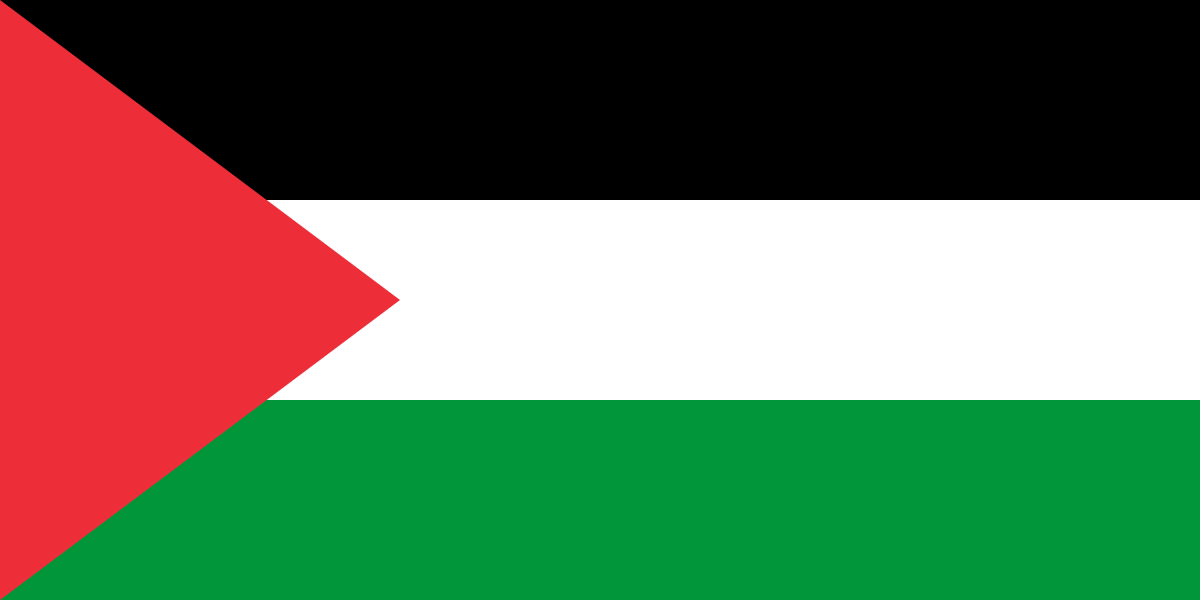
We have expressed our position before the General Assembly on many occasions during this session. We have also expressed our sincerest gratitude to the Member States that have assisted us and cooperated with us in reaching the excellent results that have been achieved at this session.
We took an active part in the negotiations on the draft resolution entitled “Middle East peace process”. The parties concerned were able to remove certain obstacles they had encountered. Indeed, certain controversial issues were set aside. We are grateful to the original sponsors of the draft resolution for the understanding they showed of our position and that of the Arab Group of States on this question.
In general terms, since we are a principal party to the peace process, we are in favour of this resolution and find it useful. At the same time, we must recall our reservations on paragraph 3 of section B of the Washington Declaration, concluded between the Hashemite Kingdom of Jordan and Israel on 25 July 1994, and on paragraph 2 of article 9 of the Israeli-Jordanian peace treaty. These two paragraphs refer to Jerusalem. We expressed our position in detail on this matter in an official letter which was addressed to the Secretary-General and which was published as document A/49/288 dated 29 July 1994. This position, however, should not be interpreted as meaning that we are not in favour of progress in the peace negotiations on the Israeli- Jordanian track.
May I, in conclusion, thank you, Mr. President, for the position you have taken.
May I take it that the General Assembly wishes to conclude its consideration of agenda item 38?
It was so decided.
17. Appointments to fill vacancies in subsidiary organs and other appointments
Members will recall that at the 75th plenary meeting, on 5 December last, I informed the Assembly that the terms of office of the present five members of the Consultative Committee on the United Nations Development Fund for Women, appointed under General Assembly decisions 46/311 A, B and C of 13 November and 20 December 1991 and 22 May 1992, would expire on 31 December 1994 and that, following consultations, I had appointed Indonesia and Uganda as members of the Consultative Committee for a three-year term beginning on 1 January 1995.
Following further consultations, I have appointed Norway, Peru and Poland as members of the Consultative Committee for a three-year term beginning on 1 January 1995.
May I consider that the General Assembly takes note of these appointments?
It was so decided.
May I take it that it is the wish of the Assembly to conclude its consideration of sub-item (h) of agenda item 17?
It was so decided.
Members will recall that the Assembly held the debate on agenda item 18 at its 83rd meeting, on 9 December last.
There appears to be no objection, and the name of the delegation of Sierra Leone is therefore included in the list of speakers.

It is with pleasure that, on behalf of the delegation of Sierra Leone, I am participating once again in the debate on agenda item 18: “Implementation of the Declaration on the Granting of Independence to Colonial Countries and Peoples”. I do so also in my capacity as Vice-Chairman of the Special Committee on the Situation with Regard to the Implementation of the Declaration on the Granting of Independence to Colonial Countries and Peoples — the Special Committee of 24 — and I wish to endorse the statement made on Friday, 9 December last, by the Permanent Representative of Cuba, the Acting Chairman of the Committee of 24, who spoke on behalf of the Special Committee.
My delegation welcomes the accession to independence of Palau, the last Trust Territory of the Pacific Islands, and its admission to the United Nations yesterday as the 185th Member. As we welcome this new independent country in our midst, we express the hope that the Republic of Palau will participate effectively in the work of the Organization, including that of the Special Committee on decolonization.
As we did last year, my delegation wishes to express its satisfaction again this year with the work of the Special Committee, especially its continued application during the past year of new measures aimed at enhancing its efficiency through its approach to, and the methodology of, its work. And in a continually changing world, particularly on the political scene, the Special Committee on decolonization must, along with other related United Nations bodies, take pride in its achievements, especially on the African continent, with the dismantling of apartheid in South Africa — a question that had featured on its programme of work for many, many years — culminating in the holding of the first pluralistic, non-racial and democratic elections in that country, in April this year, and the subsequent installation of the Government of National Unity.
My delegation wishes to reiterate its oft-expressed concern over the lack of cooperation with the Committee and the non-participation in its work by a number of administering Powers. We believe that the cooperation of administering Powers is crucial to the proper and effective functioning of the Committee of 24. One area where the Committee of 24 continues to seek cooperation with administering Powers concerns the facilitation of the dispatch of United Nations visiting missions to the Territories under their administration. Visiting missions provide the most effective means of obtaining first-hand information on developments in the Territories and of ascertaining the situation on the ground and the views of the people of the Territory with regard to their future status. My delegation can attest to this fact because we participated in the last Visiting Mission to Tokelau.
We therefore urge those administering Powers that have withheld their cooperation from the Committee of 24 to reconsider their decisions and participate in the work of the Committee, whose members are not only ready but eager to discuss those issues that are keeping them away from the Committee, with a view to finding solutions to them.
I cannot conclude this statement without expressing my delegation’s, and my own very personal, gratitude to the Government and people of New Zealand for the warm hospitality graciously accorded to me and to the other members of the team during our visit to Tokelau and New Zealand in July and August this year. The trip to various countries in that region — the South Pacific — was for me a particularly enriching and rewarding experience, which I will treasure for the rest of my life. My gratitude also goes to the people on the three atolls of Tokelau — Atafu, Fakaofu and Nukonunu — for their hospitality and the generous gifts they gave to all the members of the Visiting Mission.
I should like to conclude by conveying my appreciation to the members of the Committee of 24, especially the members of the African Group and the
We have heard the last speaker in the debate on this item.
The Assembly will now take decisions on draft resolutions A/49/L.51 and A/49/L.52.
I should like to announce that the following countries have become co-sponsors of draft resolutions A/49/L.51 and A/49/L.52: Haiti, Marshall Islands, Mali, Namibia and the United Republic of Tanzania.
I call on the representative of the Secretariat.

As regards paragraph 10 of draft resolution A/49/L.51, a seminar is planned in the Caribbean region in April 1995. It will be held in the framework of the Plan of Action for the International Decade for the Eradication of Colonialism. The seminar will last three days, with two meetings a day. Interpretation and documentation services will be required in English, Spanish and French. The number of pages involved will be 200 before, 50 during, and 50 after the seminar.
We are operating on the assumption that the conference services required for the seminar will be provided from the resources available under section 25 (e), “Office of Conference and Support Services”, of the programme budget for the biennium 1994-1995. This means that no additional resources will be required to cover the cost of these conference services.
The Assembly will first take a decision on draft resolution A/49/L.51, entitled “Implementation of the Declaration on the Granting of Independence to Colonial Countries and Peoples”.
A recorded vote has been requested.
A recorded vote was taken.
Draft resolution A/49/L.51 was adopted by 128 votes to 2, with 26 abstentions (resolution 49/89).
The Assembly will now take a decision on draft resolution A/49/L.52, entitled “Dissemination of information on decolonization”.
A recorded vote has been requested.
A recorded vote was taken.
Draft resolution A/49/L.52 was adopted by 130 votes to 2, with 24 abstentions (resolution 49/90).
Several representatives wish to make statements in explanation of vote. May I remind members that, in accordance with General Assembly decision 34/401, statements in explanation of vote are limited to 10 minutes and should be made by delegations from their seats.

We were obliged to vote against draft resolutions A/49/L.51 and
While we welcome changes from last year’s resolutions, we do not believe that sufficient improvements have been made in the thrust and import of this year’s draft resolutions to merit our support. On the contrary, as the United Nations fast approaches its fiftieth anniversary year, at a time when we should be looking to meeting the challenges of the 1990s and the twenty-first century, these resolutions are relics of outmoded ways of thinking. They misrepresent and distort the record of the administrators of Non-Self-Governing Territories; they equate the role of the administrators with colonialism and wrongly label “foreign economic interests” and “foreign military activities” as contrary to the interests of Territories and their peoples; and they fail to give due weight to the wishes of the peoples concerned, to important progress made toward freedom over the past 30 years and to the benefits derived by Non-Self-Governing Territories from administrators that have faithfully discharged their obligations to promote the well-being of the people of the Territories concerned.
We would hope that future resolutions would redress these imbalances and serve as a clarion call for cooperation. The future United Nations must be built not on backward-looking resolutions but on bold, constructive action.

Once again, I regret that the British delegation has found it necessary to vote against the draft resolutions on the implementation of the Declaration on the Granting of Independence to Colonial Countries and Peoples (A/49/L.51) and on the dissemination of information on decolonization (A/49/L.52).
In my delegation’s statement in the Fourth Committee and in various explanations of vote and position in that forum we acknowledged that in a rapidly changing world the Special Committee had made an effort to reflect present-day realities. We welcome these efforts and we hope they will continue. But we still have fundamental objections to the implication that selfdetermination automatically equates with independence, ignoring the existence of other options, and to the references to issues irrelevant to decolonization, such as military activities. We do not believe that the presence of military bases in our dependent Territories could in any way constitute an obstacle to the granting of
The two draft resolutions submitted to the General Assembly do nothing to advance the wishes and interests of the indigenous peoples of the remaining dependent Territories, which remain the foundation of my Government’s policies.

The Australian delegation has just voted in favour of the draft resolutions contained in document A/49/L.51, “Implementation of the Declaration on the Granting of Independence to Colonial Countries and Peoples”, and document A/49/L.52, “Dissemination of information on decolonization”.
These positive votes are a reflection of our strong support for a meaningful United Nations role in the decolonization process, particularly as a number of the remaining Non-Self-Governing Territories are our near neighbours — small islands in the South Pacific.
My delegation is encouraged by the fact that outdated and inappropriate references from the resolutions of
In preparation for the next session of the General Assembly, we encourage the Special Committee to review further the language of these texts, particularly with respect to foreign economic interests, with a view to achieving greater balance and objectivity and bearing always in mind the goal of ensuring that the United Nations decolonization processes remain consensual, meaningful and relevant to the situations and interests of the colonial peoples whose progress towards selfdetermination we are charged to oversee.
May I take it that it is the wish of the General Assembly to conclude its consideration of agenda item 18 as a whole?
It was so decided.
The meeting rose at 12.10 p.m.
▶ Cite this page
UN Project. “A/49/PV.91.” UN Project, https://un-project.org/meeting/A-49-PV-91/. Accessed .