A/63/PV.60 General Assembly
▶ This meeting at a glance
32
Speeches
9
Countries
9
Resolutions
Resolutions:
63/33,
63/34,
63/35,
A/RES/63/26,
A/RES/63/27,
A/RES/63/28,
A/RES/63/29,
A/RES/63/30,
A/RES/63/31
Topics
UN resolutions and decisions
Security Council deliberations
Israeli–Palestinian conflict
General statements and positions
Arab political groupings
Economic development programmes
The meeting was called to order at 10.20 a.m.
16. Question of Palestine Draft resolutions (A/63/L.32, A/63/L.33, A/63/L.34 and A/63/L.35)

Members will recall that the General Assembly held the debate on agenda item 16 at its fifty-seventh and fifty-eighth plenary meetings on 24 and 25 November 2008.
Before giving the floor to the speakers in explanation of vote before the vote, I would like to remind delegations that explanations of vote are limited to 10 minutes and should be made by delegations from their seats.
I now give the floor to the representative of the United States of America in explanation of vote.


The four draft resolutions under this agenda item, in combination with over 15 other draft resolutions that will come before the General Assembly this year, as every year, form a clear pattern of institutional bias directed at one State Member of the United Nations.
The United States has clearly stated its policy that there should be two democratic States, Israel and
Palestine, living side by side in peace and security. We back up that policy with substantial diplomatic support for both sides, consistent with the process launched in Annapolis in November 2007. We also contribute very significant financial and programmatic support to the Palestinian Authority and to Palestinian refugees, for whom the United States is the largest single State donor.
We see no contradiction whatsoever between support for the Palestinian people and support for Israel. Both sides need support to be able to take the steps necessary for a just and lasting peace.
Each year, therefore, we are distressed and discouraged as the General Assembly unhelpfully devotes a disproportionate number of resolutions related to the Middle East. All of them are unbalanced by the explicit or implicit one-sided criticism of Israel.
The draft resolutions discussed under this and other upcoming agenda items entitled, “The situation in the Middle East”, “Report of the Special Committee to Investigate Israeli Practices Affecting the Human Rights of the Palestinian People and Other Arabs of the Occupied Territories”, “Permanent sovereignty of the Palestinian people in the Occupied Palestinian Territory, including Jerusalem, and of the Arab population in the occupied Syrian Golan over their natural resources” and others are repetitive and, I repeat, unbalanced. They are completely at odds with the General Assembly’s actions regarding any other Member State, geographic area or issue. They place demands on the Israeli side while failing to
acknowledge that both sides have obligations and both must take difficult steps towards peace that can only be agreed through negotiations between the parties.
The United States accepts the principle that the General Assembly may look into the practices of individual States. However, last year, the Assembly adopted 14 resolutions specifically criticizing Israel and seven more expressing support for the Palestinian people vis-à-vis their relations with Israel.
In the same year, the Assembly adopted only six resolutions specifically critical of any Member State other than Israel. We supported some of those and opposed others, but all together, the 21 resolutions addressing alleged Israeli violations and obligations stretched to 61 pages of text compared to only 20 for resolutions critical of the six other nations. The Assembly is on course to repeat that same pattern again this year.
Whatever the merits of the issue, this represents an extraordinarily disproportionate and unjustified focus on one Member State. The situation in the Middle East is very important, but viewed in relation to all problems facing our planet, this matter does simply not warrant three quarters of all the time and energy the General Assembly devotes to critical review of the action of its 192 Member States.
Of particular concern to the United States are two draft resolutions submitted for adoption today: “Division for Palestinian Rights of the Secretariat” (A/63/L.33) and “Committee on the Exercise of the Inalienable Rights of the Palestinian People” (A/63/L.32). Additionally, there is a text that will be considered under agenda item 30, entitled “Work of the Special Committee to Investigate Israeli Practices Affecting the Human Rights of the Palestinian People and Other Arabs of the Occupied Territories” (A/C.4/63/L.15).
These entities, established more than a generation ago, perpetuate and institutionalize the perception of inherent United Nations bias. By their very nature, they fail to properly demand actions from both sides and, instead, focus only on Israel. The millions of dollars expended on them and the significant staff contributions consumed by them could be better directed towards more pressing issues, including direct assistance to needy Palestinians.
Consistent with the overall programme of United Nations reform, the time has come for the Assembly to seriously review these bodies with a sharp focus on what, if anything, they contribute towards a solution to the Middle East conflict.
These institutional arrangements, backed by nearly two dozen one-sided draft resolutions, serve more to undermine than advance ongoing negotiations. They also undermine the credibility of the United Nations which, as a member of the Quartet, must be seen by both sides as an honest broker in facilitating a resolution to the Middle East conflict. They make no positive contribution to achieving a just resolution to the conflict. Instead, these draft resolutions can have a corrosive effect on the negotiations, both by convincing many on the Israeli side that Israel will be treated unfairly by the United Nations no matter what compromises it offers and by convincing extremist Palestinians such as Hamas that they will be spared criticism no matter what they do, including terrorist attacks intentionally targeting civilians. Certainly these draft resolutions add nothing to the far more detailed and up-to-date monthly discussions of the Security Council on the situation in the Middle East.
Finally, these draft resolutions presuppose the outcome of permanent status issues, such as the return of refugees, checkpoints and settlement activity, which properly belong to ongoing bilateral negotiations. In the 9 November briefing to the Quartet, the Palestinian and Israeli negotiators pledged to continue bilateral talks until they achieved their goal of a comprehensive agreement on all issues without exception, as agreed at Annapolis. Both sides attested that the negotiating structure is effective and productive and affirmed their intent to keep it in place. They noted — and I wish to emphasize this — that third parties should not intervene in the negotiations absent their joint request.
The United States is acutely aware of the suffering of the Palestinian people. We have been and will continue to be at the forefront of international efforts to address the underlying causes of that suffering. But it is impossible to see how supporting resolutions so detached from the reality on the ground and so intrusive into the substance of sensitive, sustained negotiations will either alleviate that suffering or contribute to a solution. Therefore, we cannot support these draft resolutions.
We have heard the only speaker in explanation of the vote before the vote.
We turn first to draft resolution A/63/L.32, entitled “Committee on the Exercise of the Inalienable Rights of the Palestinian People”. Since the introduction of this draft resolution, Nigeria and Somalia have become co-sponsors.
The Assembly will now take a decision on draft resolution A/63/L.32. A recorded vote has been requested. [Subsequently the delegation of Belize advised the Secretariat that it had intended to vote in favour.]
A recorded vote was taken.
15. The situation in the Middle East Draft resolutions (A/63/L.36 and A/63/L.37) The Acting President (spoke in Spanish): Members will recall that the General Assembly held a debate on agenda item 15 on 25 November 2008 at its fifty-ninth plenary meeting.
Vote:
A/RES/63/30
Recorded Vote
✓ 163
✗ 6
6 abs.
Show country votes
✗ No
(6)




Absent
(17)
















✓ Yes
(163)
-
 Afghanistan
-
 Albania
-
 Algeria
-
 Andorra
-
 Angola
-
 Antigua and Barbuda
-
 Argentina
-
 Armenia
-
 Austria
-
 Azerbaijan
-
 Bahamas
-
 Bahrain
-
 Bangladesh
-
 Barbados
-
 Belarus
-
 Belgium
-
 Belize
-
 Benin
Benin
-
 Bhutan
-
 Plurinational State of Bolivia
-
 Bosnia and Herzegovina
-
 Botswana
-
 Brazil
-
 Brunei Darussalam
-
 Bulgaria
-
 Burundi
-
 Cambodia
-
 Canada
-
 Cabo Verde
-
 Central African Republic
-
 Chile
Chile
-
 China
China
-
 Colombia
-
 Comoros
-
 Congo
Congo
-
 Costa Rica
-
 Croatia
-
 Cuba
Cuba
-
 Cyprus
-
 Czechia
-
 Democratic People's Republic of Korea
-
 Denmark
-
 Djibouti
-
 Dominica
-
 Dominican Republic
-
 Ecuador
-
 Egypt
Egypt
-
 El Salvador
-
 Eritrea
-
 Estonia
-
 Ethiopia
-
 Finland
-
 France
-
 Gabon
Gabon
-
 Gambia
-
 Georgia
-
 Germany
-
 Ghana
Ghana
-
 Greece
-
 Grenada
-
 Guatemala
-
 Guinea
-
 Guinea-Bissau
-
 Guyana
-
 Honduras
-
 Hungary
-
 Iceland
-
 India
India
-
 Indonesia
-
 Islamic Republic of Iran
-
 Iraq
Iraq
-
 Ireland
-
 Italy
Italy
-
 Jamaica
-
 Japan
Japan
-
 Jordan
-
 Kazakhstan
-
 Kenya
Kenya
-
 Kuwait
-
 Kyrgyzstan
-
 Lao People's Democratic Republic
-
 Latvia
-
 Lebanon
-
 Lesotho
-
 Liberia
-
 Libya
Libya
-
 Liechtenstein
-
 Lithuania
-
 Luxembourg
-
 Malaysia
-
 Maldives
-
 Mali
Mali
-
 Malta
Malta
-
 Mauritania
-
 Mauritius
-
 Mexico
-
 Monaco
-
 Mongolia
-
 Montenegro
-
 Morocco
-
 Mozambique
-
 Myanmar
-
 Namibia
-
 Nepal
Nepal
-
 Netherlands
-
 New Zealand
-
 Nicaragua
-
 Nigeria
-
 Norway
-
 Oman
Oman
-
 Pakistan
-
 Panama
-
 Papua New Guinea
-
 Paraguay
-
 Peru
Peru
-
 Philippines
-
 Poland
-
 Portugal
-
 Qatar
Qatar
-
 Republic of Korea
-
 Moldova
-
 Romania
-
 Russian Federation
-
 Saint Lucia
-
 Saint Vincent and the Grenadines
-
 Samoa
Samoa
-
 San Marino
-
 Saudi Arabia
-
 Senegal
-
 Serbia
-
 Singapore
-
 Slovakia
-
 Slovenia
-
 Solomon Islands
-
 Somalia
-
 South Africa
-
 Spain
Spain
-
 Sri Lanka
-
 Sudan
Sudan
-
 Suriname
-
 Eswatini
-
 Sweden
-
 Switzerland
-
 Syrian Arab Republic
-
 Tajikistan
-
 Thailand
-
 North Macedonia
-
 Timor-Leste
-
 Togo
Togo
-
 Trinidad and Tobago
-
 Tunisia
-
 Türkiye
-
 Uganda
-
 Ukraine
-
 United Arab Emirates
-
 United Kingdom of Great Britain and Northern Ireland
-
 Uruguay
-
 Uzbekistan
-
 Bolivarian Republic of Venezuela
-
 Viet Nam
-
 Yemen
Yemen
-
 Zambia
-
 Zimbabwe
Draft resolution A/63/L.32 was adopted by 107 votes to 8, with 57 abstentions (resolution 63/26).
49. Sustainable development (d) Protection of global climate for present and future generations of mankind Report of the Second Committee (A/63/414/Add.4) The Acting President (spoke in Spanish): If there is no proposal under rule 66 of the rules of procedure, I shall take it that the General Assembly decides not to discuss the report of the Second Committee that is before the Assembly today.
Vote:
63/33
Consensus
Vote:
A/RES/63/26
Recorded Vote
✓ 107
✗ 8
57 abs.
Show country votes
— Abstain
(57)
-
Albania
-
Andorra
-
Austria
-
Belgium
-
Bosnia and Herzegovina
-
Bulgaria
-
 Cameroon
-
Colombia
-
Croatia
-
Czechia
-
Denmark
-
El Salvador
-
Estonia
-
 Fiji
Fiji
-
Finland
-
France
-
Georgia
-
Germany
-
Greece
-
Guatemala
-
Hungary
-
Iceland
-
Ireland
-
Italy
-
Japan
-
Latvia
-
Liechtenstein
-
Lithuania
-
Luxembourg
-
Monaco
-
Montenegro
-
Netherlands
-
New Zealand
-
Norway
-
Panama
-
Papua New Guinea
-
Peru
-
Poland
-
Portugal
-
Republic of Korea
-
Moldova
-
Romania
-
Russian Federation
-
Samoa
-
San Marino
-
Serbia
-
Slovakia
-
Slovenia
-
Spain
-
Sweden
-
Switzerland
-
Thailand
-
North Macedonia
-
 Tonga
Tonga
-
Ukraine
-
United Kingdom of Great Britain and Northern Ireland
-
Uruguay
✗ No
(8)
Absent
(20)
✓ Yes
(107)
-
Afghanistan
-
Algeria
-
Angola
-
Antigua and Barbuda
-
Argentina
-
Armenia
-
Azerbaijan
-
Bahamas
-
Bahrain
-
Bangladesh
-
Barbados
-
Belarus
-
Benin
-
Bhutan
-
Plurinational State of Bolivia
-
Botswana
-
Brazil
-
Brunei Darussalam
-
 Burkina Faso
-
Cambodia
-
Cabo Verde
-
Central African Republic
-
Chile
-
China
-
Comoros
-
Congo
-
Costa Rica
-
 Côte d'Ivoire
-
Cuba
-
Cyprus
-
Democratic People's Republic of Korea
-
Djibouti
-
Dominica
-
Dominican Republic
-
Ecuador
-
Egypt
-
Eritrea
-
Ethiopia
-
Gabon
-
Ghana
-
Grenada
-
Guinea
-
Guinea-Bissau
-
Guyana
-
 Haiti
Haiti
-
Honduras
-
India
-
Indonesia
-
Islamic Republic of Iran
-
Iraq
-
Jamaica
-
Jordan
-
Kazakhstan
-
Kenya
-
Kuwait
-
Kyrgyzstan
-
Lao People's Democratic Republic
-
Lebanon
-
Lesotho
-
Liberia
-
Libya
-
Malaysia
-
Maldives
-
Mali
-
Malta
-
Mauritania
-
Mauritius
-
Mexico
-
Morocco
-
Mozambique
-
Myanmar
-
Namibia
-
Nepal
-
Nicaragua
-
Nigeria
-
Oman
-
Pakistan
-
Paraguay
-
Philippines
-
Qatar
-
Saint Lucia
-
Saint Vincent and the Grenadines
-
Saudi Arabia
-
Senegal
-
Singapore
-
Solomon Islands
-
Somalia
-
South Africa
-
Sri Lanka
-
Sudan
-
Suriname
-
Eswatini
-
Syrian Arab Republic
-
Tajikistan
-
Timor-Leste
-
Togo
-
Trinidad and Tobago
-
Tunisia
-
Türkiye
-
Uganda
-
United Arab Emirates
-
Uzbekistan
-
Bolivarian Republic of Venezuela
-
Viet Nam
-
Yemen
-
Zambia
-
Zimbabwe
We shall now proceed to consider draft resolution A/63/L.33, entitled “Division for Palestinian Rights of the Secretariat”. I should like to inform the Assembly that since the introduction of this draft resolution, Nigeria and Somalia have become co-sponsors.
The Assembly will now take a decision on draft resolution A/63/L.33. A recorded vote has been requested. [Subsequently, the delegation of Belize informed the Secretariat that it had intended to vote in favour.]
A recorded vote was taken.
Draft resolution A/63/L.33 was adopted by 106 votes to 8, with 57 abstentions (resolution 63/27).
Vote:
A/RES/63/31
Recorded Vote
✓ 116
✗ 6
52 abs.
Show country votes
— Abstain
(52)
-
Albania
-
Andorra
-
 Australia
-
Austria
-
Belgium
-
Bulgaria
-
Cameroon
-
Côte d'Ivoire
-
Croatia
-
Czechia
-
Denmark
-
Estonia
-
Fiji
-
Finland
-
France
-
Georgia
-
Germany
-
Greece
-
Haiti
-
Hungary
-
Iceland
-
Ireland
-
Italy
-
Japan
-
Latvia
-
Liechtenstein
-
Lithuania
-
Luxembourg
-
Malta
-
Monaco
-
Montenegro
-
 Nauru
Nauru
-
Netherlands
-
New Zealand
-
Norway
-
Poland
-
Portugal
-
Republic of Korea
-
Moldova
-
Romania
-
Samoa
-
San Marino
-
Serbia
-
Slovakia
-
Slovenia
-
Spain
-
Sweden
-
Switzerland
-
North Macedonia
-
Tonga
-
Ukraine
-
United Kingdom of Great Britain and Northern Ireland
✗ No
(6)
Absent
(18)
✓ Yes
(116)
-
Afghanistan
-
Algeria
-
Angola
-
Antigua and Barbuda
-
Argentina
-
Armenia
-
Azerbaijan
-
Bahamas
-
Bahrain
-
Bangladesh
-
Barbados
-
Belarus
-
Belize
-
Benin
-
Bhutan
-
Plurinational State of Bolivia
-
Botswana
-
Brazil
-
Brunei Darussalam
-
Burkina Faso
-
Cambodia
-
Cabo Verde
-
Central African Republic
-
Chile
-
China
-
Colombia
-
Comoros
-
Congo
-
Costa Rica
-
Cuba
-
Cyprus
-
Democratic People's Republic of Korea
-
Djibouti
-
Dominica
-
Dominican Republic
-
Ecuador
-
Egypt
-
El Salvador
-
Eritrea
-
Ethiopia
-
Gabon
-
Gambia
-
Ghana
-
Grenada
-
Guatemala
-
Guinea
-
Guinea-Bissau
-
Guyana
-
Honduras
-
India
-
Indonesia
-
Islamic Republic of Iran
-
Iraq
-
Jamaica
-
Jordan
-
Kazakhstan
-
Kenya
-
Kuwait
-
Kyrgyzstan
-
Lao People's Democratic Republic
-
Lebanon
-
Lesotho
-
Liberia
-
Libya
-
Malaysia
-
Maldives
-
Mali
-
Mauritania
-
Mauritius
-
Mexico
-
Mongolia
-
Morocco
-
Mozambique
-
Myanmar
-
Namibia
-
Nepal
-
Nicaragua
-
Nigeria
-
Oman
-
Pakistan
-
Panama
-
Papua New Guinea
-
Paraguay
-
Peru
-
Philippines
-
Qatar
-
Russian Federation
-
Saint Lucia
-
Saint Vincent and the Grenadines
-
Saudi Arabia
-
Senegal
-
Singapore
-
Solomon Islands
-
Somalia
-
South Africa
-
Sri Lanka
-
Sudan
-
Suriname
-
Eswatini
-
Syrian Arab Republic
-
Tajikistan
-
Thailand
-
Timor-Leste
-
Togo
-
Trinidad and Tobago
-
Tunisia
-
Türkiye
-
Uganda
-
United Arab Emirates
-
Uruguay
-
Uzbekistan
-
Bolivarian Republic of Venezuela
-
Viet Nam
-
Yemen
-
Zambia
-
Zimbabwe
We shall now proceed to consider draft resolution A/63/L.34, entitled “Special information programme on the question of Palestine of the Department of Public Information of the Secretariat”. I should like to inform the Assembly that since the introduction of this draft resolution, Nigeria and Somalia have become co-sponsors.
The Assembly will now take a decision on draft resolution A/63/L.34. A recorded vote has been requested.
A recorded vote was taken. In favour: Afghanistan, Albania, Algeria, Andorra, Angola, Antigua and Barbuda, Argentina, Armenia, Austria, Azerbaijan, Bahamas, Bahrain, Bangladesh, Barbados, Belarus, Belgium, Benin, Bhutan, Bolivia, Bosnia and Herzegovina, Botswana, Brazil, Brunei Darussalam, Bulgaria, Burkina Faso, Cambodia, Cape Verde, Central African Republic, Chile, China, Colombia, Comoros, Congo, Costa Rica, Côte d’Ivoire, Croatia, Cuba, Cyprus, Czech Republic, Democratic People’s Republic of Korea, Denmark, Djibouti, Dominica, Dominican Republic, Ecuador, Egypt, El Salvador, Eritrea, Estonia, Ethiopia, Finland, France, Gabon, Gambia, Georgia, Germany, Ghana, Greece, Grenada, Guatemala, Guinea, Guinea-Bissau, Guyana, Haiti, Honduras, Hungary, Iceland, India, Indonesia, Iran (Islamic Republic of), Iraq, Ireland, Italy, Jamaica, Japan, Jordan, Kazakhstan, Kenya, Kuwait, Kyrgyzstan, Lao People’s Democratic Republic, Latvia, Lebanon, Lesotho, Liberia, Libyan Arab Jamahiriya, Liechtenstein, Lithuania, Luxembourg, Malaysia, Maldives, Mali, Malta, Mauritania, Mauritius, Mexico, Monaco, Mongolia, Montenegro, Morocco, Mozambique, Myanmar, Namibia, Nepal, Netherlands, New Zealand, Nicaragua, Nigeria, Norway, Oman, Pakistan, Panama, Paraguay, Peru, Philippines, Poland, Portugal, Qatar, Republic of Korea, Republic of Moldova, Romania, Russian Federation, Saint Lucia, Saint Vincent and the Grenadines, Samoa, San Marino, Saudi Arabia, Senegal, Serbia, Singapore, Slovakia, Slovenia, Solomon Islands, Somalia, South Africa, Spain, Sri Lanka, Sudan, Suriname, Swaziland, Sweden, Switzerland, Syrian Arab Republic, Tajikistan, Thailand, the former Yugoslav Republic of Macedonia, Timor-Leste, Togo, Trinidad and Tobago, Tunisia, Turkey, Uganda, Ukraine, United Arab Emirates, United Kingdom of Great Britain and Northern Ireland, Uruguay, Uzbekistan, Venezuela (Bolivarian Republic of), Viet Nam, Yemen, Zambia, Zimbabwe.
Against: Australia, Canada, Israel, Marshall Islands, Micronesia (Federated States of), Nauru, Palau, United States of America.
Abstaining: Cameroon, Fiji, Papua New Guinea, Tonga. [Subsequently, the delegation of Belize informed the Secretariat that it had intended to vote in favour.]
114. Cooperation between the United Nations and regional and other organizations (c) Cooperation between the United Nations and the Association of Southeast Asian Nations (A/63/L.40) (e) Cooperation between the United Nations and the Caribbean Community (A/63/L.38) (i) Cooperation between the United Nations and the Economic Cooperation Organization (A/63/L.39) The Acting President (spoke in Spanish): Members will recall that the Assembly held a debate on agenda item 114 and its sub-items (a) to (u) at its 36th and 37th plenary meetings on 3 November 2008.
Vote:
63/34
Consensus
Vote:
A/RES/63/27
Recorded Vote
✓ 106
✗ 8
57 abs.
Show country votes
— Abstain
(57)
-
Albania
-
Andorra
-
Armenia
-
Austria
-
Belgium
-
Bosnia and Herzegovina
-
Bulgaria
-
Cameroon
-
Colombia
-
Croatia
-
Czechia
-
Denmark
-
El Salvador
-
Estonia
-
Fiji
-
Finland
-
France
-
Georgia
-
Germany
-
Greece
-
Guatemala
-
Honduras
-
Hungary
-
Iceland
-
Ireland
-
Italy
-
Japan
-
Latvia
-
Liechtenstein
-
Lithuania
-
Luxembourg
-
Monaco
-
Montenegro
-
Netherlands
-
New Zealand
-
Norway
-
Papua New Guinea
-
Peru
-
Poland
-
Portugal
-
Republic of Korea
-
Moldova
-
Romania
-
Russian Federation
-
Samoa
-
San Marino
-
Serbia
-
Slovakia
-
Slovenia
-
Spain
-
Sweden
-
Switzerland
-
Thailand
-
North Macedonia
-
Tonga
-
Ukraine
-
United Kingdom of Great Britain and Northern Ireland
✗ No
(8)
Absent
(21)
✓ Yes
(106)
-
Afghanistan
-
Algeria
-
Angola
-
Antigua and Barbuda
-
Argentina
-
Azerbaijan
-
Bahamas
-
Bahrain
-
Bangladesh
-
Barbados
-
Belarus
-
Benin
-
Bhutan
-
Plurinational State of Bolivia
-
Botswana
-
Brazil
-
Brunei Darussalam
-
Burkina Faso
-
Cambodia
-
Cabo Verde
-
Central African Republic
-
Chile
-
China
-
Comoros
-
Congo
-
Costa Rica
-
Côte d'Ivoire
-
Cuba
-
Cyprus
-
Democratic People's Republic of Korea
-
Djibouti
-
Dominica
-
Dominican Republic
-
Ecuador
-
Egypt
-
Eritrea
-
Ethiopia
-
Gabon
-
Ghana
-
Grenada
-
Guinea
-
Guinea-Bissau
-
Guyana
-
Haiti
-
India
-
Indonesia
-
Islamic Republic of Iran
-
Iraq
-
Jamaica
-
Jordan
-
Kazakhstan
-
Kenya
-
Kuwait
-
Kyrgyzstan
-
Lao People's Democratic Republic
-
Lebanon
-
Lesotho
-
Liberia
-
Libya
-
Malaysia
-
Maldives
-
Mali
-
Malta
-
Mauritania
-
Mauritius
-
Mexico
-
Morocco
-
Mozambique
-
Myanmar
-
Namibia
-
Nepal
-
Nicaragua
-
Nigeria
-
Oman
-
Pakistan
-
Panama
-
Paraguay
-
Philippines
-
Qatar
-
Saint Lucia
-
Saint Vincent and the Grenadines
-
Saudi Arabia
-
Senegal
-
Singapore
-
Solomon Islands
-
South Africa
-
Sri Lanka
-
Sudan
-
Suriname
-
Eswatini
-
Syrian Arab Republic
-
Tajikistan
-
Timor-Leste
-
Togo
-
Trinidad and Tobago
-
Tunisia
-
Türkiye
-
Uganda
-
United Arab Emirates
-
Uruguay
-
Uzbekistan
-
Bolivarian Republic of Venezuela
-
Viet Nam
-
Yemen
-
Zambia
-
Zimbabwe
Draft resolution A/63/L.34 was adopted by 162 votes to 8, with 4 abstentions (resolution 63/28).
The Assembly will now take a decision on draft resolution A/63/L.35, entitled “Peaceful settlement of the question of Palestine”. I should like to inform the Assembly that, since the introduction of this draft resolution, Nigeria and Somalia have become co-sponsors.
The Assembly will now take a decision on draft resolution A/63/L.35. A recorded vote has been requested. [Subsequently, the delegation of Belize informed the Secretariat that it had intended to vote in favour.]
Vote:
63/35
Consensus
A recorded vote was taken.
Vote:
A/RES/63/28
Recorded Vote
✓ 162
✗ 8
4 abs.
Show country votes
— Abstain
(4)
✗ No
(8)
Absent
(18)
✓ Yes
(162)
-
Afghanistan
-
Albania
-
Algeria
-
Andorra
-
Angola
-
Antigua and Barbuda
-
Argentina
-
Armenia
-
Austria
-
Azerbaijan
-
Bahamas
-
Bahrain
-
Bangladesh
-
Barbados
-
Belarus
-
Belgium
-
Benin
-
Bhutan
-
Plurinational State of Bolivia
-
Bosnia and Herzegovina
-
Botswana
-
Brazil
-
Brunei Darussalam
-
Bulgaria
-
Burkina Faso
-
Cambodia
-
Cabo Verde
-
Central African Republic
-
Chile
-
China
-
Colombia
-
Comoros
-
Congo
-
Costa Rica
-
Côte d'Ivoire
-
Croatia
-
Cuba
-
Cyprus
-
Czechia
-
Democratic People's Republic of Korea
-
Denmark
-
Djibouti
-
Dominica
-
Dominican Republic
-
Ecuador
-
Egypt
-
El Salvador
-
Eritrea
-
Estonia
-
Ethiopia
-
Finland
-
France
-
Gabon
-
Gambia
-
Georgia
-
Germany
-
Ghana
-
Greece
-
Grenada
-
Guatemala
-
Guinea
-
Guinea-Bissau
-
Guyana
-
Haiti
-
Honduras
-
Hungary
-
Iceland
-
India
-
Indonesia
-
Islamic Republic of Iran
-
Iraq
-
Ireland
-
Italy
-
Jamaica
-
Japan
-
Jordan
-
Kazakhstan
-
Kenya
-
Kuwait
-
Kyrgyzstan
-
Lao People's Democratic Republic
-
Latvia
-
Lebanon
-
Lesotho
-
Liberia
-
Libya
-
Liechtenstein
-
Lithuania
-
Luxembourg
-
Malaysia
-
Maldives
-
Mali
-
Malta
-
Mauritania
-
Mauritius
-
Mexico
-
Monaco
-
Mongolia
-
Montenegro
-
Morocco
-
Mozambique
-
Myanmar
-
Namibia
-
Nepal
-
Netherlands
-
New Zealand
-
Nicaragua
-
Nigeria
-
Norway
-
Oman
-
Pakistan
-
Panama
-
Paraguay
-
Peru
-
Philippines
-
Poland
-
Portugal
-
Qatar
-
Republic of Korea
-
Moldova
-
Romania
-
Russian Federation
-
Saint Lucia
-
Saint Vincent and the Grenadines
-
Samoa
-
San Marino
-
Saudi Arabia
-
Senegal
-
Serbia
-
Singapore
-
Slovakia
-
Slovenia
-
Solomon Islands
-
Somalia
-
South Africa
-
Spain
-
Sri Lanka
-
Sudan
-
Suriname
-
Eswatini
-
Sweden
-
Switzerland
-
Syrian Arab Republic
-
Tajikistan
-
Thailand
-
North Macedonia
-
Timor-Leste
-
Togo
-
Trinidad and Tobago
-
Tunisia
-
Türkiye
-
Uganda
-
Ukraine
-
United Arab Emirates
-
United Kingdom of Great Britain and Northern Ireland
-
Uruguay
-
Uzbekistan
-
Bolivarian Republic of Venezuela
-
Viet Nam
-
Yemen
-
Zambia
-
Zimbabwe
Draft resolution A/63/L.35 was adopted by 164 votes to 7, with 3 abstentions (resolution 63/29).
Before giving the floor to speakers in explanation of vote after the vote, may I remind delegations that explanations of vote are limited to 10 minutes and should be made by delegations from their seats.

I wish to put on record at this Assembly that my delegation voted in favour of all the resolutions just adopted under agenda item 16 in the spirit of solidarity with the Palestinian people. However, I would like to express my delegation’s reservations on those parts of the said resolutions which may not be in line with the stated policies and positions of my country or may be construed as recognition of the Israeli regime.

I have the honour to speak on behalf of the European
Union. The candidate countries Turkey, Croatia and the former Yugoslav Republic of Macedonia; the countries of the Stabilisation and Association Process and potential candidates Albania, Bosnia and Herzegovina and Serbia; and Ukraine align themselves with this statement.
The European Union voted in favour of resolution 63/28 on the special information programme on the question of Palestine of the Department of Public Information of the Secretariat. The European Union welcomes the new elements introduced by the Palestinian mission in the spirit of cooperation. These new elements enabled the improvement of the resolution on which we have just voted.
In light of the ongoing peace process, the European Union encourages the Department of Public Information and the parties to improve the contribution of the special programme in the promotion of dialogue and comprehension between Israeli and Palestinian societies. The European Union is ready to work together with the Department of Public Information and the parties to achieve this objective.
Vote:
A/RES/63/29
Recorded Vote
✓ 164
✗ 7
3 abs.
Show country votes
✗ No
(7)
Absent
(18)
✓ Yes
(164)
-
Afghanistan
-
Albania
-
Algeria
-
Andorra
-
Angola
-
Antigua and Barbuda
-
Argentina
-
Armenia
-
Austria
-
Azerbaijan
-
Bahamas
-
Bahrain
-
Bangladesh
-
Barbados
-
Belarus
-
Belgium
-
Benin
-
Bhutan
-
Plurinational State of Bolivia
-
Bosnia and Herzegovina
-
Botswana
-
Brazil
-
Brunei Darussalam
-
Bulgaria
-
Burundi
-
Cambodia
-
Cabo Verde
-
Central African Republic
-
Chile
-
China
-
Colombia
-
Comoros
-
Congo
-
Costa Rica
-
Côte d'Ivoire
-
Croatia
-
Cuba
-
Cyprus
-
Czechia
-
Democratic People's Republic of Korea
-
Denmark
-
Djibouti
-
Dominica
-
Dominican Republic
-
Ecuador
-
Egypt
-
El Salvador
-
Eritrea
-
Estonia
-
Ethiopia
-
Fiji
-
Finland
-
France
-
Gabon
-
Gambia
-
Georgia
-
Germany
-
Ghana
-
Greece
-
Grenada
-
Guatemala
-
Guinea
-
Guinea-Bissau
-
Guyana
-
Haiti
-
Honduras
-
Hungary
-
Iceland
-
India
-
Indonesia
-
Islamic Republic of Iran
-
Iraq
-
Ireland
-
Italy
-
Jamaica
-
Japan
-
Jordan
-
Kazakhstan
-
Kenya
-
Kuwait
-
Kyrgyzstan
-
Lao People's Democratic Republic
-
Latvia
-
Lebanon
-
Lesotho
-
Liberia
-
Libya
-
Liechtenstein
-
Lithuania
-
Luxembourg
-
Malaysia
-
Maldives
-
Mali
-
Malta
-
Mauritania
-
Mauritius
-
Mexico
-
Monaco
-
Mongolia
-
Montenegro
-
Morocco
-
Mozambique
-
Myanmar
-
Namibia
-
Nepal
-
Netherlands
-
New Zealand
-
Nicaragua
-
Nigeria
-
Norway
-
Oman
-
Pakistan
-
Panama
-
Papua New Guinea
-
Paraguay
-
Peru
-
Philippines
-
Poland
-
Portugal
-
Qatar
-
Republic of Korea
-
Moldova
-
Romania
-
Russian Federation
-
Saint Lucia
-
Saint Vincent and the Grenadines
-
Samoa
-
San Marino
-
Saudi Arabia
-
Senegal
-
Serbia
-
Singapore
-
Slovakia
-
Slovenia
-
Solomon Islands
-
Somalia
-
South Africa
-
Spain
-
Sri Lanka
-
Sudan
-
Suriname
-
Eswatini
-
Sweden
-
Switzerland
-
Syrian Arab Republic
-
Tajikistan
-
Thailand
-
North Macedonia
-
Timor-Leste
-
Togo
-
Trinidad and Tobago
-
Tunisia
-
Türkiye
-
Uganda
-
Ukraine
-
United Arab Emirates
-
United Kingdom of Great Britain and Northern Ireland
-
Uruguay
-
Uzbekistan
-
Bolivarian Republic of Venezuela
-
Viet Nam
-
Yemen
-
Zambia
-
Zimbabwe
We have heard the last speaker in explanation of vote after the vote.
The General Assembly has thus concluded this stage of its consideration of agenda item 16.
On this very agenda item on the situation in the Middle East, this Assembly heard a number of unfounded distortions and allegations against the Islamic Republic of Iran by the representative of Australia. In the exercise of the right of reply while rejecting the said allegations and distortions, which were made under an agenda item with no relevance to the issue, I wish to bring the following points to the attention of Member States.
The Islamic Republic of Iran has consistently condemned terrorism in all its forms and
manifestations. Iran has been and is a victim of terrorism — a terrorism committed by terrorist groups that have been supported by certain Western countries. Given the history of unqualified support by Australia to the State terrorism perpetrated by the Israeli regime against the Palestinians, Lebanese and others in the region, Australia is the last to be in a position to judge the record of others in this area.
Iran has fully cooperated with the International Atomic Energy Agency (IAEA) and Iran’s nuclear programme has been and is absolutely peaceful. Any claims to the contrary are ill-intended and absurdly false. Iran’s cooperation with the Agency and the peaceful nature of our nuclear programme has been confirmed by the IAEA’s own reports on numerous occasions. While the representative of Australia claimed that Iran has not cooperated with the IAEA — a claim that is totally groundless — he, in a seriously questionable and utterly inexplicable manner, neglected the fact that the Israeli regime, that enjoys all-out support from Australia, has clandestinely developed hundreds of nuclear weapons and warheads. Moreover, it is not a party to the Non-Proliferation Treaty and other international instruments on weapons of mass destruction and is the most serious threat that the region is facing today.
If Australia is genuinely worried about the Middle East, which we doubt it is, it had better cease and desist from its complicity with the Israeli regime in its war crimes and join the international community in condemning the said regime’s atrocities and destabilizing policies and practices in the region. Australia’s voting record on the resolutions on the question of Palestine and the situation in the Middle East, adopted by this Assembly every year, as it has today, is adequately self-explanatory. That record suffices to show the political motivation behind Australia’s behaviour in crying wolf on behalf of others in the Middle East.
We will now proceed to consider draft resolutions A/63/L.36 and A/63/L.37.
We will turn first to draft resolution A/63/L.36, entitled “Jerusalem”. I should like to inform the Assembly that, since the introduction of this draft resolution, the following countries have become sponsors: Nigeria and Somalia.
The General Assembly will now take a decision on draft resolution A/63/L.36. A recorded vote has been requested.
A recorded vote was taken.
Draft resolution A/63/L.36 was adopted by 163 votes to 6, with 6 abstentions (resolution 63/30).
We will now proceed to consider draft resolution A/63/L.37, entitled “The Syrian Golan”. I should like to inform the Assembly that, since the introduction of this draft resolution, the following countries have become sponsors: Nigeria and Somalia.
The General Assembly will now take a decision on draft resolution A/63/L.37. A recorded vote has been requested.
A recorded vote was taken.
Draft resolution A/63/L.37 was adopted by 116 votes to 6, with 52 abstentions (resolution 63/31).
Before giving the floor to speakers in explanation of vote after the vote, may I remind delegations that explanations of vote are limited to 10 minutes and should be made by delegations from their seats.

With your permission, Mr. Vice-President, I would like to speak in Portuñol.
I would like to explain the vote of the delegations of Brazil and Argentina on draft resolution A/63/L.37 on the Syrian Golan, which has just been approved by the Assembly. Brazil and Argentina voted in favour of this draft resolution because we understand that the essential aspect of this draft is linked to the illegality of acquiring territory by force. Article 2, paragraph 4, of the Charter of the United Nations prohibits the use or threat of force against the territorial integrity of a State. This constitutes an imperative standard of international law.
At the same time, I would like to qualify the position of our delegations with regard to operative paragraph 6 of the draft resolution in question. Our vote does not prejudge the content of that operative
paragraph, in particular in its reference to the border of 4 June 1967. On behalf of the Governments of Brazil and Argentina, I would like to take this opportunity to urge the Israeli and Syrian authorities to renew negotiations with a view to finding a definitive solution to the situation in the Syrian Golan, in accordance with resolutions 242 (1967) and 338 (1973) of the Security Council and the principle of land for peace.
I wish to put on record in this Assembly that my delegation voted in favour of all the draft resolutions just adopted in the spirit of solidarity with the Palestinian people and other peoples under occupation. However, I would like to express my delegation’s reservations on those parts of the said draft resolutions that may not be in line with the stated policies and positions of my country or may be construed as recognition of the Israeli regime.

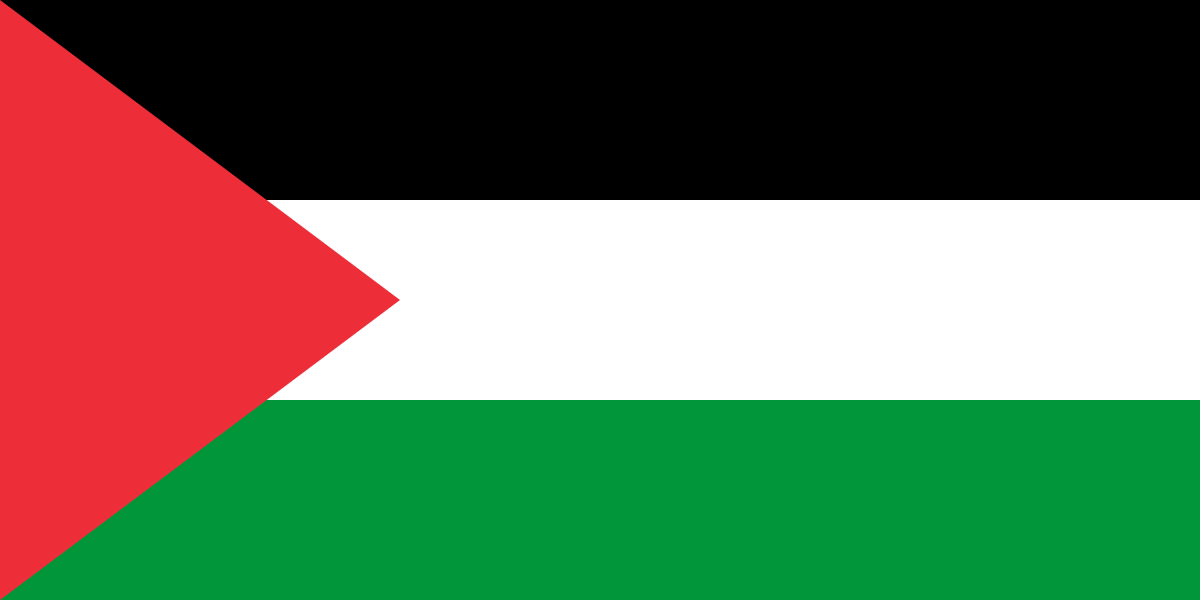
Palestine would like to express its gratitude and appreciation to all countries that played a very important role in introducing the resolutions just adopted and all the countries that voted in favour of them. We also express our gratitude to all the political blocs that collaborated with us in order to introduce very balanced and responsible draft resolutions that have become resolutions.
We want to thank the Arab Group, the Organization of the Islamic Conference, the Non-Aligned Movement, the African Union, the Rio Group, the European Union and all those who worked with us in reaching responsible language that is reflective of the position of nearly the entire international community. We are grateful to them and will continue to work with them to bring Israel into compliance with international law, to uphold international law and to allow for the implementation of these resolutions. We will work to bring peace and justice to our region and put an end to the occupation, which started in 1967, of our land and areas, including East Jerusalem, and to find a just and agreed-upon solution to the refugee question based on resolution 194 (III).
We believe that the challenge for the international community is to bring Israel into compliance. It is not in the interests of the international community or the United Nations to allow Israel to have preferential
treatment, to continue acting outside of the law, and to continue to get away with not fulfilling its obligations enshrined in the United Nations Charter and in General Assembly and Security Council resolutions.
These resolutions are very balanced. The fact that almost all Member States voted in favour of them reflects the position of the international community in trying to find a just solution to this conflict, which has lasted too long — 61 years since the Nakba — and 41 years since occupation. Israel is getting away with not abiding by international law and the will of the international community. I believe that shielding Israel from being brought into compliance does a disservice to this international Organization, to international law and to the belief in a just solution to the conflict.
When we all responded to the invitation of the United States to Annapolis — when 50 countries and international organizations went there about a year ago — we were all representing in essence the United Nations in order to help the two parties achieve a just solution to the conflict. We were hoping that by now we would have a peace treaty that would allow for the birth of the Palestinian State.
Unfortunately, it does not seem as if this peace treaty will be agreed by the end of this year. Until it is agreed, it is the duty of the international community, which played a role in creating the problem and in trying to find a solution to the problem through the adoption of resolution 181 — the partition plan — to remain engaged on this issue until it is resolved in all its aspects. We promise that we will continue to work with the United Nations and will continue to appreciate what it does for us until we bring about a just solution to this conflict.
Once again, we express our gratitude to all Member States and groups, including the European Union as I mentioned, under the presidency of France, for its cooperation and support in attaining the balanced and effective language which enabled a large number of countries to vote in favour of the resolutions.
We hope that next year if we move effectively towards peace and achieve a peace treaty, we promise you that we will reflect the essence of that peace treaty that would allow for the birth of our State, in the resolutions that we adopt next year. But that we would really like to do is not to adopt a single resolution if our State is born, if the Israeli occupation is terminated
and if our flag, the flag of the independent, contiguous, viable State of Palestine with East Jerusalem as its capital, is raised with the 192 other flags outside of this building. We will be so delighted that we will not bother the Assembly with a single resolution nor engage in discussions of balanced or unbalanced or of upholding international law or anything of that sort. We are so eager for that moment when we have our own State and to open a new chapter of relationships between us and our neighbours, including Israel, where we can live in peace and security.
So the vote of the Assembly today is helping us and giving our people strength to continue with the struggle until that moment when we can relieve the Assembly from the task of dealing with and adopting so many of our resolutions. But until we reach that moment, we will not forget about those resolutions and the need to uphold international law.
The General Assembly has thus concluded the present stage of its consideration of agenda item 15.
It was so decided.
Statements will therefore be limited to explanations of vote. The positions of delegations regarding the recommendations of the Second Committee have been made clear in the Committee and are reflected in the relevant official records.
May I remind members that, under paragraph 7 of decision 34/401, the General Assembly agreed that
“When the same draft resolution is considered in a Main Committee and in plenary meeting, a delegation should, as far as possible,
explain its vote only once, i.e., either in the Committee or in plenary meeting, unless that delegation’s vote in plenary meeting is different from its vote in the Committee.”
May I remind delegations that, also in accordance with General Assembly decision 34/401, explanations of vote are limited to 10 minutes and should be made by delegations from their seats.
Before we begin to take action on the recommendations contained in the report of the Second Committee, I should like to advise representatives that we are going to proceed to take a decision in the same manner as was done in the Second Committee.
The General Assembly has before it a draft resolution recommended by the Second Committee in paragraph 8 of its report. We will now take a decision on the draft resolution entitled “Protection of global climate for present and future generations”. May I take it that the Assembly wishes to adopt the draft resolution, as recommended by the Second Committee?
The draft resolution was adopted (resolution 63/32).
The Assembly has thus concluded this stage of its consideration of sub-item (d) of agenda item 49. Agenda item 44 (continued) Integrated and coordinated implementation of and follow-up to the outcomes of the major United Nations conferences and summits in the economic, social and related fields Draft resolution (A/63/L.28) The Acting President (spoke in Spanish): Members will recall that the General Assembly held the debate on agenda item 44 jointly with agenda items 107 and 112 at the fifty-first plenary meeting on 17 November 2008. Members will also recall that draft resolution A/63/L.29 was introduced under this agenda item at the same plenary meeting.
We will now take action on draft resolution A/63/L.28, entitled “Global health and foreign policy”. I should like to announce that, since the introduction of the draft resolution, the following countries have become sponsors: Albania, Argentina, Austria, Bosnia and Herzegovina, Bulgaria, Colombia, Costa Rica, Croatia, Egypt, Equatorial Guinea, Guyana,
Liechtenstein, Lithuania, Maldives, Mali, Mexico, Monaco, Mongolia, Mozambique, New Zealand, Peru, the Philippines, Saint Vincent and the Grenadines, Serbia, Slovenia, Spain, Sweden, the former Yugoslav Republic of Macedonia, Turkey and Zimbabwe.
May I take it that the Assembly decides to adopt draft resolution A/63/L.28?
Draft resolution A/63/L.28 was adopted (resolution 63/33).
The General Assembly has thus concluded this stage of its consideration of agenda item 44.

It is often the case for draft resolutions dealing with cooperation between the United Nations and regional organizations to focus largely on the dimension of the cooperation that the United Nations offers. For this reason, I was careful, when I had the honour, on 3 November last, of addressing this Assembly in the name of the Caribbean Community on the subject of cooperation between the United Nations and the Caribbean Community and Common Market (CARICOM), not to end my statement without drawing attention to what we in CARICOM offer to this Organization. We do believe that, through our active participation in the dialogue on the various issues on the agenda of this Organization, whether as individual States or as a grouping of States, we are helping to infuse greater life into the Charter, to ensure the attainment and the consistent fulfilment of its high and lofty purposes, and to strengthen faith in
the principle of international cooperation. We believe that there is no more practical or valuable cooperation that we can render to the United Nations and we are proud of our record in this regard.
Today, it is my honour to introduce the draft resolution entitled “Cooperation between the United Nations and the Caribbean Community”, contained in document A/63/L.38. I do so not only on behalf of the member States of CARICOM but also on behalf of all the countries that have generously extended themselves to sponsor the current draft.
In the preambular section of this draft resolution, we would have the Assembly recall previous commitments by the United Nations to the principle of cooperation with the Caribbean Community. But beyond that, the draft resolution would also have the Assembly give due recognition to what are, for us, particular landmarks in the development of this cooperation. The most important of these landmarks relate, of course, to those areas that for us are the most sensitive, or where our needs for the benefits of cooperation are greatest. These areas are constituted first by the death-dealing combination of illicit narcotic drugs and weapons. Then there are the challenges to the sustainable development of our predominantly small-island and low-lying coastal States, as highlighted in the outcome of the World Summit on Sustainable Development, held in Johannesburg, South Africa in 2002, and the Mauritius Strategy adopted at the International Meeting to Review the Implementation of the Programme of Action for the Sustainable Development of Small Island Developing States, adopted in 2005, and other such outcome documents. Other important areas of concern to us are our vulnerability to natural disasters, in which context Haiti stands as the most dramatic example, and the ravaging effects of HIV/AIDS on our societies.
In the same preambular paragraphs, the draft resolution would also have the Assembly recall the abiding cooperation that has existed between the two secretariats, and affirm the need, in the light of the multiple crises characterizing the international environment, for the further strengthening of such cooperation.
This assessment is sustained in the operative portion of the draft resolution. In paragraph 2, the Secretary-General is called upon to continue to assist in furthering the development and maintenance of
peace and security in the region, while in paragraph 3 he is invited to work for deepening the capacity of the two sides to attain their objectives.
Recognizing that the United Nations development system depends, for its effectiveness, on a strengthened multilateral development framework, the draft resolution, in paragraph 4, has the Assembly call on the developed countries to make a vastly increased effort in that regard. At the same time, the specialized agencies are being urged in paragraph 5 to step up their cooperation with the organizations’ respective Secretaries-General, with a view to intensifying cooperation programmes with the Caribbean Community, paying special attention to areas and issues identified by the two sides, as well as to the decisions of major international conferences dealing with the sustainable development of small island developing States, such as those emanating from the World Summit on Sustainable Development and the International Meeting to Review the Implementation of the Programme of Action for the Sustainable Development of Small Island Developing States, for example.
The operative section of the draft resolution also notes the existing cooperation taking place with the United Nations Industrial Development Organization and the Food and Agriculture Organization of the United Nations in areas of critical importance to the development of our countries, such as industrial development on the one hand and agriculture and food security on the other. But quite beyond cooperation in these specific areas, the operative section also makes a call to the specialized agencies and other organizations and programmes of the United Nations to assist our countries in addressing the social and economic consequences of the vulnerability of our economies and the consequent challenges for fulfilling the Millennium Development Goals.
The threats posed to the region in the area of security have led us to stress the urgent need for the reopening of the office of the United Nations Office on Drugs and Crime in the region in order to reinforce our efforts in combating the interrelated scourges of drugs, violent crime and the illicit trade in small arms and light weapons.
We could not, of course, fail to mention and give credit to the Department of Public Information for the very valuable cooperation that it extended to us in the
implementation of the activities commemorating the 200th anniversary of the ending of the trans-Atlantic slave trade, and also in the activities for the establishment of the permanent memorial to the victims of that trade.
In like manner, we could not fail to include in this draft resolution a note of welcome and encouragement for the initiatives of Member States to assist cooperation between the United Nations and the Caribbean Community.
Finally, a critical dimension of the cooperation between the United Nations and the Caribbean Community is formed by the cooperation agreement signed by the Secretaries-General of the two organizations on 27 May 1997. In that framework, there have been a number of fruitful and actionoriented exchanges, as our draft resolution states, one of the high points of which has been the holding of a series of biennial meetings between the two sides at the highest level. The fourth such general meeting took place in the Caribbean in 2007, and preparations are currently under way for the holding of the fifth in New York in January 2009. The draft resolution would have the Assembly welcome that event as an opportunity to review and appraise progress in the development of our cooperation and to identify ways in which it can be intensified.
As in previous years, we have had the privilege of having a significant number of countries join with us in presenting to the Assembly our draft resolution for adoption by consensus. We once again express our gratitude to them for having so accompanied us. In draft resolution A/63/L.38, we have recorded our vision of the effectiveness of the cooperation that we have received from the United Nations since this item was last considered; our vision of the areas in which, we feel, that cooperation can be enhanced; and our strong faith in the solidity of the bases on which it is proceeding. In the light of that, we trust that States Members of the Organization in all regions will see our draft resolution as one that warrants their most enthusiastic support, for which we thank all of them in advance.
I now call on the representative of the Bolivarian Republic of Venezuela, who wishes to speak in explanation of position before action is taken on the draft resolution.

We should like to make a statement regarding the draft resolution contained in document A/63/L.38, entitled “Cooperation between the United Nations and the Caribbean Community”.
The delegation of the Bolivarian Republic of Venezuela wishes to reaffirm its firm commitment to supporting Caribbean integration through supportive cooperation aimed at overcoming the region’s limited base of financial resources, its high poverty levels and the resulting social problems.
In that connection, in addition to supporting draft resolution A/63/L.38, we wish to reiterate our position on the Mauritius Strategy for the Further Implementation of the Programme of Action for the Sustainable Development of Small Island Developing States, in particular its paragraphs 21 and 22, which refer to the United Nations Convention on the Law of the Sea, in the understanding that they are directed at States parties to the Convention. We stress that, since the Bolivarian Republic of Venezuela is not a State party to the 1982 United Nations Convention on the Law of the Sea, its norms do not apply to us under customary international law, save those that the Bolivarian Republic of Venezuela has expressly recognized or will recognize in the future through their incorporation into its domestic legislation. Those paragraphs are not binding for our country.
Finally, we wish to reiterate that the Bolivarian Republic of Venezuela will continue to strongly support all efforts required to make progress in attaining the objectives of the present draft resolution in order to promote activities aimed at strengthening cooperation with the Caribbean Community.
I call on the representative of Afghanistan to introduce draft resolution A/63/L.39.

My delegation, in its capacity as Chair of the Economic Cooperation Organization (ECO) group in New York, has the honour to introduce the draft resolution contained in document A/63/L.39, entitled “Cooperation between the United Nations and the Economic Cooperation Organization”, sponsored by the 10 States members of the Economic Cooperation Organization: Afghanistan, Azerbaijan, the Islamic Republic of Iran, Kazakhstan, Kyrgyzstan, Pakistan, Tajikistan, Turkey, Turkmenistan and Uzbekistan.
The Economic Cooperation Organization is an intergovernmental regional organization established for the purpose of promoting economic, technical and cultural cooperation among Member States and stands for the same principles as those that guide the United Nations. The ECO region is full of bright trading prospects and opportunities. Despite its young age and the lack of appropriate infrastructure and institutions in the region, ECO has developed into a successful regional organization.
The Economic Cooperation Organization seeks to develop, on a prioritized basis, its infrastructure and institutions, which make full use of the resources available in the region. Specifically, ECO has embarked on several projects in priority areas of its cooperation, including energy, trade, transportation, agriculture and drug control. In addition, we have established relations and signed memorandums of understanding with regional and international organizations, including United Nations specialized agencies and international financial institutions. Consequently, ECO’s international stature is growing.
This draft resolution invites the various specialized agencies, organizations and programmes of the United Nations system, as well as other relevant international financial institutions, to join in ECO’s efforts to achieve the shared goals of the United Nations and the Economic Cooperation Organization through regional cooperation and to achieve internationally agreed development goals, including those set out in the United Nations Millennium Declaration. In addition, it stresses the importance of the continuation and expansion of the areas of cooperation between the United Nations and the Economic Cooperation Organization, expresses appreciation for the technical and financial assistance extended by the United Nations and its specialized agencies and calls for a further increase in the technical assistance provided by United Nations agencies to the States members of the Economic Cooperation Organization.
In conclusion, I would like to take this opportunity to invite all interested countries to sponsor draft resolution A/63/L.39. We would be grateful for their sponsorship and hope that the draft resolution will be adopted by consensus, as it was at the sixty-second session.
I now give the floor to the representative of Thailand, to introduce draft resolution A/63/L.40.

On behalf of the 10 States members of the Association of Southeast Asian Nations (ASEAN) — Brunei Darussalam, Cambodia, Indonesia, the Lao People’s Democratic Republic, Malaysia, Myanmar, the Philippines, Singapore, Thailand and Viet Nam — and 71 other sponsors in various regions of the world, I have the honour to introduce draft resolution A/63/L.40, entitled “Cooperation between the United Nations and the Association of Southeast Asian Nations”. I am pleased to inform the Assembly that, since the introduction of the draft resolution, the following 16 countries have joined the list of sponsors: Belgium, Bulgaria, Costa Rica, Croatia, Cuba, Greece, Grenada, the Islamic Republic of Iran, Jamaica, Lithuania, Luxembourg, Montenegro, the Republic of Moldova, Senegal, Serbia and Somalia.
ASEAN is going through an exciting period in its evolution to become the ASEAN Community, resting on the three pillars of the ASEAN Security Community, the ASEAN Economic Community and the ASEAN Socio-Cultural Community. Presently, all 10 ASEAN member States have submitted their instruments of ratification for the ASEAN Charter, thus ensuring that that landmark document will enter into force when ASEAN leaders meet at their Summit in Thailand next month.
The aim of ASEAN leaders is that the ASEAN Charter will provide a legal and institutional framework to make ASEAN a more rules-based, people-centred, effective and efficient organization. It is the aspiration of all 10 ASEAN member States to move ahead towards closer integration, with the goal of transforming South Asia into a single market and a production base with free movement of goods, services, skilled labour and freer movement of capital. Through that process of community-building and integration, ASEAN will emerge as a stronger partner to the United Nations in the pursuit of the shared purposes and principles enshrined in the Charter of the United Nations.
At the same time, the partnership between ASEAN and the United Nations has also been undergoing an exciting period over the past two years. As reflected in draft resolution A/63/L.40, the
Secretaries-General of ASEAN and the United Nations signed a memorandum of understanding on ASEAN- United Nations cooperation in 2007, in order to promote cooperation between the two secretariats on a wide range of issues of mutual benefit. ASEAN has also worked in close partnership with the United Nations in response to humanitarian needs in the wake of the devastating Cyclone Nargis in May this year. Next month, the third ASEAN-United Nations Summit, to be held in Thailand, will provide a good opportunity for ASEAN leaders and the United Nations Secretary- General to exchange views about issues of common interest and to develop an effective partnership in response to those critical issues.
ASEAN would like to express its sincere appreciation to all sponsors of this draft resolution, which currently number 97. We are grateful for the strong support extended to ASEAN by all dialogue partners and our friends from all regions. It is our wish that the General Assembly adopt this draft resolution by consensus, as in the past. By doing so, the General Assembly will send a message of strong support for the growing partnership between ASEAN and the United Nations and for the growing importance of effective regionalism as a building block for an effective global multilateralism.
Before proceeding further, I would like to inform members that, at the request of the sponsors, action on draft resolution A/63/L.39, entitled “Cooperation between the United Nations and the Economic Cooperation Organization”, has been postponed to a later date that will be announced at the appropriate time.
We shall now proceed to consider draft resolutions A/63/L.38 and A/63/L.40. The Assembly will now take a decision on draft resolutions A/63/L.38 and A/63/L.40.
We turn first to draft resolution A/63/L.38, entitled “Cooperation between the United Nations and the Caribbean Community”.
Before proceeding to take action on draft resolution A/63/L.38, I should like to announce that, since the introduction of the draft resolution, the following countries have become sponsors: Benin, Burundi, Cambodia, Côte d’Ivoire, Equatorial Guinea, Finland, the Libyan Arab Jamahiriya, Lithuania, Malaysia, Mexico, Nigeria, Portugal, Senegal, Serbia, Slovenia, Thailand, the former Yugoslav Republic of
Macedonia, Uruguay and the Bolivarian Republic of Venezuela.
May I take it that the Assembly decides to adopt draft resolution A/63/L.38? I now give the floor to the representative of the United States of America.
Draft resolution A/63/L.38 was adopted (resolution 63/34). The Acting President (spoke in Spanish): The Assembly will now take a decision on draft resolution A/63/L.40, entitled “Cooperation between the United Nations and the Association of Southeast Asian Nations”. May I take it that the Assembly decides to adopt draft resolution A/63/L.40?
Draft resolution A/63/L.40 was adopted (resolution 63/35). The Acting President (spoke in Spanish): Before giving the floor to the speakers in explanation of vote, may I remind delegations that explanations of vote are limited to 10 minutes and should be made by delegations from their seats.

My remarks concern resolution 63/34, entitled
“Cooperation between the United Nations and the Caribbean Community”. The United States is pleased to have joined consensus on this resolution and welcomes cooperation between the United Nations and the Caribbean Community. In particular, the United States recognizes the need to support States in the region in their efforts to fight illicit trafficking in all its aspects, and we recognize the ongoing work of the United Nations Office on Drugs and Crime (UNODC) in the region to that end. We would only caution that, given the budget situation, it is important that any field office be sustainable and that the UNODC carefully evaluate the feasibility of reopening any field offices in the context of its existing budget.
We have heard the only speaker in explanation of vote.
May I take it that it is the wish of the General Assembly to conclude its consideration of sub-items (c), (e) and (i) of agenda item 114?
It was so decided.
Before adjourning the meeting, I would like to appeal to those Member States intending to submit draft resolutions on the remaining sub-items to do so as soon as possible.
The meeting rose at 11.50 a.m.
▶ Cite this page
UN Project. “A/63/PV.60.” UN Project, https://un-project.org/meeting/A-63-PV-60/. Accessed .