A/70/PV.96 General Assembly
The meeting was called to order at 10.05 a.m.
35. Protracted conflicts in the GUAM area and their implications for international peace, security and development Report of the Secretary-General (A/70/879)

I now give the floor to the representative of Georgia to introduce draft resolution A/70/L.51.

I have the honour to address the Assembly on behalf of my Government and in the name of my fellow countrymen — hundreds of thousands of them internally displaced persons (IDPs) or refugees from Abkhazia, Georgia, and the Tskhinvali region of Georgia — to solicit the Assembly’s support for the draft resolution contained in document A/70/L.51, under agenda item 35, “Protracted conflicts in the GUAM area and their implications for international peace, security and development”.
On 19 May, a 31-year-old Georgian man, Giga Otkhozoria, an IDP from Abkhazia, was shot dead by the so-called border guards on the occupation lines between the Abkhazia region and the rest of Georgia. A native of Gali, Giga had been forced to flee the conflict- affected area and lived with his family of four in a rented apartment in the town of Zugdidi. Just before the tragic event, he was trying to bring food to his relatives and to attend the funeral of his late aunt in the Gali
district, on the other side of the occupation line. He was refused entry and was subsequently shot dead with six bullets. This brutal murder is a sad reminder of the human costs the Georgian IDPs endure. That is why we are here today and why Georgia is submitting the draft resolution. It is also why the Assembly’s engagement and international involvement are important.
Giga was one of nearly 400,000 IDPs and refugees, of all ethnicities and religions, who were uprooted from the two Georgian regions of Abkhazia and the Tskhinvali region/South Ossetia, due to the conflict and several waves of displacement since the early 1990s. In a country with a population of nearly 4 million, hundreds of thousands remain displaced and are unable to return to their homes because of circumstances entirely beyond their control. That said, according to the Office of the United Nations High Commissioner for Refugees (UNHCR) in its Intentions Survey on Durable Solutions: Voices of Internally Displaced Persons in Georgia”, published in June 2015, the majority, 88.3 per cent of the displaced Georgian population, said they are willing to return voluntarily to their places of origin.
For more than 16 years, from 1993 to 2009, the Security Council in more than 40 resolutions, presidential statements and communiqués unanimously stressed the necessity to address “the need for a dignified return of IDPs and refugees, including their security and human rights concerns” (resolution 1666 (2006), para. 7). In one of its earliest resolutions on Georgia, resolution 876 (1993), the Security Council also expressed deep concern.
“at the human suffering caused by conflict in the region, and at reports of ‘ethnic cleansing’ and other serious violations of international humanitarian law” (resolution 876 (1993), fourth preambular para.).
For eight consecutive years, the General Assembly has been adopting a document like that before us with an increasing number of positive votes and an encouraging dynamic of support. Countries from all regions of the world have voted in favour of the text due to its human appeal and humanitarian values, such as the right to return in safety and dignity, the unacceptability of forced demographic change and the need for unimpeded humanitarian access. It transcends the case of a particular country and is universal in its terms, because the right of return is a principle drawn from the Universal Declaration of Human Rights and the International Covenant on Civil and Political Rights.
As for the implementation of the main goals of the draft resolution in practice, including the creation of conditions conducive to voluntary, safe and dignified return, the document shows its firm commitment to the Geneva international discussions mandated by the six- point ceasefire agreement of 12 August 2008, which, as Secretary-General Ban Ki-moon also underlines,
“remain the only forum for relevant stakeholders to meet and address the issues identified in [General Assembly resolution 69/286]” (A/70/879, para. 13).
For that very reason, both resolution 69/286 and the subsequent report of the Secretary-General (A/70/879) serve as reference points in the Geneva international discussions and complement the work on humanitarian issues. Let me reiterate that my Government is committed to the peace talks and will remain engaged in the discussions in good faith to attain tangible results.
(spoke in French)
Restrictions and limitations on the freedom of movement pose serious obstacles to the exercise of the right of return. The razor-wire fences and other artificial obstacles installed by the occupation forces rip families and communities apart and violate their civil, social, economic and cultural rights. Local residents are prevented from cultivating their agricultural lands, visiting cemeteries or religious sites, and reaching emergency medical services. Locals continuously endure intimidation, and risk their lives on a daily basis when attempting to cross the occupation line in both
directions. Moreover, the so-called integration treaties signed by the Russian Federation with its occupation regimes in Tskhinvali and Sukhumi, and the so-called laws on the status of foreigners recently adopted by authorities in control, have created official grounds for the ethnic discrimination against native Georgians and the violation of their rights to work and freedom of movement and to other fundamental rights. All of this represents an ongoing policy of occupation and ethnic cleansing, and constitutes part of a strategy of de facto annexation.
(spoke in English)
Pending their return, the Government of Georgia makes every effort to alleviate the burden and ensure decent conditions for the displaced population, in accordance with the national strategy and its relevant action plan. At the end of 2015, with the support of UNHCR through its joint project via the Mutual Recognition Agreement, the Livelihood Action Plan of 2016-2017 was adopted, providing opportunities for IDPs and their host communities to fulfil their potential by gaining financial independence from the State and becoming self-reliant. As concerns relations with our compatriots living in the occupied territories, the ethnic Abkhazians are an integral part of our common history and future. Despite the current artificial barriers, the full reintegration of all ethnicities into a vibrant society where human rights and individual freedoms, as well as cultural and linguistic diversity of different communities, is the Georgian State’s top priorities.
While the Geneva international discussions address the fulfilment of all provisions of the six-point ceasefire agreement here at the General Assembly, with the draft resolution before us we focus on the humanitarian needs of the affected population by upholding and enshrining their rights until return becomes safe and a viable option. The Secretary-General also reiterates in his report that
“the right of return and its exercise by an internally displaced person cannot therefore be directly linked to political questions or the conclusion of peace agreements. It is essential to recognize return as both a human right and a humanitarian issue that must be addressed irrespective of any solution to an underlying conflict” (A/70/879, para. 49).
This year, Member States embarked on implementing the 2030 Agenda for Sustainable Development (resolution 70/1), having pledged that no
one would be left behind. At the World Humanitarian Summit, held in May in Istanbul, the international community reaffirmed all five core responsibilities outlined in the Secretary-General’s Agenda for Humanity (A/70/709, annex), which places people first and underlines the importance of securing their safety, upholding their dignity and providing opportunities for a better future.
The rights of the displaced should be acknowledged, reaffirmed and protected, regardless of political processes and negotiations. The draft resolution represents the case of a single country, but the issue itself is a part of the greater humanitarian crisis. Therefore, each and every Member State concerned with the current humanitarian catastrophe in the world must take a responsible decision in support of this particular humanitarian cause. We, the United Nations, have a moral responsibility to do so. Once again, voting in favour of the present draft resolution is not about taking sides between the parties, but about making the right choice by saying “yes” to the basic human rights and fundamental humanitarian values, based on the principles of humanity and international law. In that light, I urge the Assembly once again to show solidarity, support the fundamental principle of the right of return and to vote in favour of the draft resolution.

I have the honour to speak on behalf of the Organization for Democracy and Economic Development-GUAM and its member States: Georgia, Ukraine, the Republic of Moldova and my own country, Azerbaijan.
This year once again, the GUAM member States are presenting a joint position in support of draft resolution A/70/L.51, entitled “Status of internally displaced persons and refugees from Abkhazia, Georgia, and the Tskhinvali region/South Ossetia, Georgia”. We call upon the Member States to vote in favour of the document.
The draft resolution before us addresses the issue of protracted displacement in the GUAM area, specifically in Georgia, where hundreds of thousands of men, women and children from the Abkhazia and Tskhinvali regions have remained forcibly displaced as a result of conflict and violence since the early 1990s. As a non-political draft resolution, the text focuses solely on the humanitarian aspects of the displacement, and calls for respect of the right to return, property
rights and humanitarian access to the affected regions of Georgia.
Given its exclusively humane goals, the document has steadily gained international support from the States Members of the United Nations since 2008. The GUAM countries thank the Secretary-General for his report, entitled “Status of internally displaced persons and refugees from Abkhazia, Georgia, and the Tskhinvali region/South Ossetia, Georgia” (A/70/879). We regret that despite the calls of the international community, the conditions for organized return in safety and dignity have not yet been fulfilled. Furthermore, since the last adoption of the document on 3 June 2015 (resolution 69/286), the humanitarian situation on the ground has seriously deteriorated due to the additional impediments imposed by the authorities in control of Georgia’s Abkhazia and Tskhinvali regions.
Those new discriminatory regulations on the legal status of foreigners target the ethnic Georgian population living in the occupied territories and impose new restrictions on the freedom of movement, the right to property, labour rights and the right to receive education in one’s native language. They endanger the livelihoods of the remaining Georgian population in the Abkhazia and Tskhinvali regions and could potentially trigger a fresh wave of forced displacement.
In that context, we find it particularly alarming and unacceptable that the authorities in control have voiced their intention to conduct a so-called referendum in the Tshkinvali region “on accession to the Russian Federation”. The situation in Georgia’s occupied regions illustrates the urgency of international engagement. However, being encircled by 60 kilometres of razor- wire fences, other artificial obstacles and the so-called border signs, the Abkhazian and Tskhinvali regions remain inaccessible to the international community to this day. In that light, voting in favour of the draft resolution strengthens our joint call for unimpeded access by humanitarian actors to the displaced population and those living in the conflict-affected areas.
GUAM reiterates its firm support for the sovereignty and territorial integrity of Georgia within its internationally recognized borders. We believe that the General international discussions are an important platform for addressing the security and humanitarian challenges in the aftermath of the August 2008 armed conflict. We appreciate the role of the United Nations
as one of the co-Chairs of the Geneva international discussions and stress the relevance of the annual reporting by the Secretary-General, pursuant to the General Assembly’s resolutions, as a viable instrument for maintaining the international community’s focus on the issue of the displaced. In that regard, we view the present draft resolution as an important tool to further encourage the participants in Geneva to redouble their efforts to ensure respect for human rights and address the issues within their respective mandate, including the creation of conditions conducive to a voluntary return in safety and dignity.
Forced displacement has led to a range of serious challenges in the GUAM countries. Over 60 million people in our nations have become affected by armed conflicts. We believe that the humanitarian concerns of the affected population, including internally displaced persons, should be a priority, and that the issue has to be addressed regardless of the lack of progress in the conflict-resolution process.
We also believe that the United Nations, as a universal international organization, is best placed to seek a lasting solution, while addressing the long-term needs of internally displaced persons (IDPs), such as securing their right to return. Two weeks ago, for the first time in 70 years of the history of the United Nations, the World Humanitarian Summit took place in Istanbul to address all relevant humanitarian issues and to renew our commitments to the principles of international humanitarian law. We believe that those principles should be upheld in every case and situation involving displaced populations. In that regard, the present draft resolution is an opportunity for United Nations Members to reconfirm our commitment and express support for the right of a safe and dignified return for the IDPs and refugees from Abkhazia, Georgia, and the Tskhinvali region/South Ossetia, Georgia. Therefore, the GUAM member States once again urge members to vote in favour of the draft resolution.

I am honoured to speak on behalf of the Baltic and Nordic States: Denmark, Estonia, Finland, Iceland, Latvia, Norway, Sweden and my own country, Lithuania. Poland and Bulgaria associate themselves with this statement.
Today the world faces the worst levels of displacement since the end of the Second World War. Over 60 million people have been forced to leave their homes as a result of armed conflict, violence and human
rights violations. Within Europe, forced displacement has affected significant numbers of people, hundreds of thousands of them in Georgia. Since the beginning of the conflict in Georgia, residents of the conflict-affected areas have been deprived of their basic human rights.
Unfortunately, as highlighted by the Secretary- General’s report in document A/70/879, there have been no major changes with regard to refugees or internally displaced persons exercising their right to a safe, voluntary and dignified return. Regardless of the international community’s efforts, authorities in control of the occupied regions continue to deny the right of internally displaced persons and create additional impediments to the exercise of their rights. The problem has been further compounded by the continued implementation of so-called borderization measures, as well as by the introduction of new restrictions, including for local staff of international organizations in crossing the administrative boundary line.
We share the Secretary-General’s call for unimpeded access for all United Nations agencies and international non-governmental organizations to the occupied regions of Georgia. Any additional obstruction of humanitarian access exacerbates their already difficult situation for the conflict-affected population and is contrary to the obligations under international humanitarian and human rights law.
The humanitarian nature of draft resolution A/70/L.51 commits us all to continue working with the international community to ensure that those who have been forcibly displaced are able to exercise their fundamental rights and freedoms, while welcoming the resumption of the Joint Incident Prevention and Response Mechanism under United Nations auspices in Gali. We would like to encourage all participants in the Geneva format of talks to continue their efforts and agree on additional steps to further strengthen the security situation and meet the humanitarian needs of conflict- affected populations, especially internally displaced persons. We take this opportunity to reiterate our firm support for the sovereignty and territorial integrity of Georgia within its internationally recognized borders.
In conclusion, this is already the ninth year that we are taking action on a draft resolution on the status of internally displaced persons and refugees from Abkhazia, Georgia, and the Tskhinvali region/ South Ossetia, Georgia, and we welcome the growing support for this humanitarian cause. We believe that
the General Assembly is best placed to send a powerful signal of support to the displaced population and to the participants in the Geneva international discussions to redouble their efforts to facilitate the return process. Respecting our long-standing commitment to fundamental human rights and humanitarian principles, including the right to return, property rights and humanitarian access, this year again we will vote in favour of the draft resolution, and call on others to join us in supporting it.

Ukraine aligns itself with the statement just delivered by the representative of Azerbaijan on behalf of the Organization for Democracy and Economic Development-GUAM and its member States, Georgia, Ukraine, Azerbaijan and the Republic of Moldova. I would also like to make several remarks in my national capacity.
There is no doubt that the refugee and displacement crisis is one of the most important issues on the agenda of the General Assembly. It has also been a long- standing one in the GUAM region. Regrettably, since 2014 this challenge has been very relevant to Ukraine. Russian aggression against my country has created about 1.7 million internally displaced persons (IDPs). It continues to destroy families and peoples’ lives. Many citizens of Ukraine have been displaced twice, first from Crimea and then again from certain regions of Eastern Ukraine.
Hundreds of thousands of IDPs have been living in limbo in Georgia since the early 1990s. The Georgian Government has taken unprecedented steps to improve IDP conditions, but a lot of work remains to be done. IDPs in Georgia continue to require international assistance and attention. We stand together with Georgians in solidarity and urge all United Nations Member States to lend their full support to the document just presented, which has purely humanitarian goals.
Draft resolution A/70/L.51 is aimed at addressing the issues IDPs from Georgia face every day, and it will help them to live the life they deserve. The draft resolution is clearly of a humanitarian nature, despite many attempts to politicize its content. It recognizes the right of safe and dignified return of all internally displaced persons and refugees and their descendants, regardless of ethnicity, to their homes in Abkhazia and the Tskhinvali region of Georgia, and stresses the need to respect their property rights. Let us put aside all political differences and prove our commitment to
the Charter of the United Nations and international humanitarian law.
We firmly believe that the humanitarian concerns of the affected population, including internally displaced persons, should be a priority in the present situation. I would like to reiterate Ukraine’s full support for the draft resolution as well as for Georgia’s sovereignty and territorial integrity. Ukraine will vote in favour, and I urge all those States that did not support the resolution last year to reconsider their position. It will be the best proof of the General Assembly’s support for humanitarian principles.
We have heard the last speaker in the debate on this item.
We shall now proceed to consider draft resolution A/70/L.51. Before giving the floor to speakers in explanation of vote before the voting, may I remind delegations that explanations are limited to 10 minutes and should be made by delegations from their seats.


Our delegation is convinced that the initiative being considered today is counterproductive and politically motivated and that it will not facilitate solving the problems that are addressed in it. Its main goal is not to improve the situation of those who have been forcibly displaced. The experience of adopting similar resolutions in previous years reaffirms that it has not led to any practical results in this area. We have no doubt that behind this initiative lies the desire to divert attention from the tasks of the real work in the region and to use the rostrum of the General Assembly to advance unilateral approaches and assessments, as well as the traditional anti-Russian rhetoric.
The consideration at the United Nations of the issue addressed in draft resolution A/70/L.51 would make sense and have a real outcome if Abkhazia and South Ossetia were involved in it. While the representatives of Tskhinvali and Sukhumi have many times asked to come to the United Nations and lay out their positions to delegations of Member States, it is clear that we should not expect this to happen in the near future. The intention of the Georgian delegation is understandable. In the absence of representatives of the Abkhaz and South Ossetian parties, it is easy to lay out their own version of the sources and reasons of the situation, covering up the many harmful attempts by Tbilisi to resolve the issue by force, including the armed attack on non-combatants in Tskhinvali in August 2008.
In these conditions, the Abkhaz and South Ossetian parties have no other option but to attempt to bring to the international community, via the Russian Federation, information on the situation in the territories of the Republics and the reasons behind it. In particular, we have articulated this position in General Assembly documents, in the form of appeals by the Ministers for Foreign Affairs of Abkhazia and South Ossetia to States members of leading international organizations. We hope that the contents of these documents will be taken into account by delegations when they are formulating their position on the draft resolution under consideration.
The sponsors of the draft resolution are not troubled by the consequences for the currently frozen discussion of refugee problems in the working group on humanitarian issues of the Geneva international discussions on security and stability in the Caucasus region, where a targeted discussion really could be taking place. Once again, they are merely trying to make a place for their approach regarding the status of Abkhazia and South Ossetia. This unfortunately reaffirms that Tbilisi is still not prepared to undertake a constructive dialogue with its neighbours about the long-term settlement of the situation in the region, including the problems of refugees and internally displaced persons.
Without this, unfortunately, it is difficult to discuss Georgia’s stubborn unwillingness not only to conclude a legally binding agreement with Georgia and South Ossetia in support of lasting peace and stability in the region, but even to adopt a short-term joint statement about this under the Geneva international discussions. It is the Georgian party that has for years blocked this initiative in Geneva, although the initiative supported by most participants in the discussion, including the co-Chairs. Moreover, we cannot fail to notice the strengthening of the offensive capacity of the Georgian Army and the increased number of military exercises, which in no way promote efforts to stabilize the situation in the region.
The draft resolution before us does not reflect the current realities in the region and will in no way help to resolve humanitarian issues or improve the overall situation. We propose that the Georgian delegation reject this approach and focus its efforts on the consistent reduction of tensions, restoring trust and supporting security, which would lead to an improvement of the living conditions on both sides of the border.
Taking all this into account, the delegation of the Russian Federation asks for a recorded vote on draft resolution A/70/L.51, and calls on members to vote against it. We will vote against it, and we ask other Member States to not support this politicized initiative.

Canada is pleased to once again support the draft resolution on the status of internally displaced persons and refugees from Abkhazia, Georgia, and the Tskhinvali region/South Ossetia, Georgia (A/70/L.51). We are encouraged by Georgia’s continued efforts in promoting, immediate, full, sustained and unimpeded access for humanitarian activities to internally displaced persons and refugees in all conflict-affected areas in Georgia. Canada calls on all participants in the Geneva discussions to intensify their efforts to establish a durable peace, commit to enhance confidence-building measures and create favourable security conditions for the voluntary, safe and unhindered return of all internally displaced persons and refugees to their homes.
Canada unreservedly supports Georgia’s territorial integrity and sovereignty within its internationally recognized borders. We view the so-called partnership treaties signed between the Georgian regions of Abhkazia and South Ossetia with the Russian Federation as both illegal and illegitimate, and we call on the Russian Federation to end its interference in the region and to fully respect its Organization for Security and Co-operation in Europe commitments, in particular the 12 August 2008 ceasefire agreement and its implementing measures of 8 September 2008. Canada believes that sustainable solutions to conflicts must include respect for the human rights of all individuals, regardless of ethnic descent, faith or sexual orientation.
Canada invites all Member States to prioritize efforts to alleviate the suffering of all people affected by conflicts worldwide and to unite to intensify efforts to establish sustainable peace. Supporting the draft resolution under consideration this morning will be a valuable first step towards achieving that goal.

The United Kingdom will vote in favour of draft resolution A/70/L.51 today. The draft resolution seeks to reaffirm the inalienable right of internationally displaced persons (IDPs) and refugees to return to their homes in a safe and dignified manner, regardless of their ethnic origin. Let me be clear — this is a humanitarian and
human rights issue and should not be linked to wider political processes.
There are over a quarter of a million registered IDPs in Georgia. Too many of them live in difficult and vulnerable conditions. We will and we must continue to call for their return home. With every year that goes by, the call must only become stronger. It is vital that the General Assembly show that it has not forgotten these people — individuals like Giga Otkhozoria, who was shot, unarmed, near a crossing point last month, as we heard earlier in the debate today. Giga was but one tragic example of the continuing human cost of this unresolved conflict. It is vital that the incident be investigated fully and that those responsible for his death be held accountable under Georgian law.
Until their return is secured, it is clear that more needs to be done to improve the lives of the men, women and children who remain internally displaced in Georgia. We hope that all sides will use the Geneva international discussions to make much needed progress on those humanitarian issues. The United Kingdom welcomes the Government of Georgia’s efforts to date. Such efforts could be further improved by effectively implementing national and international legislation to help and protect the lives of IDPs. Like others, the United Kingdom calls on Russia to stop the continued borderization of the administrative boundary lines with Abkhazia and South Ossetia, which directly impedes the return of Georgians to their homes.
In closing, we hope to see the momentum and constructive approach by all sides sustained. We look forward to future meetings of the Joint Incident Prevention and Response Mechanism, which are scheduled to begin next month.
The Assembly will now take a decision on draft resolution A/70/L.51, entitled “Status of internally displaced persons and refugees from Abkhazia, Georgia, and the Tskhinvali region/South Ossetia, Georgia”.
A recorded vote has been requested. In favour: Albania, Andorra, Antigua and Barbuda, Australia, Austria, Azerbaijan, Belgium, Belize, Bulgaria, Canada, Central African Republic, Costa Rica, Croatia, Czech Republic, Denmark, Dominica, Estonia, Finland, France, Georgia, Germany, Greece, Guatemala, Guyana, Haiti, Honduras, Hungary, Iceland, Ireland, Italy, Jamaica, Japan, Kiribati, Latvia, Liberia, Liechtenstein, Lithuania, Luxembourg, Malawi, Malta, Marshall Islands, Mauritius, Mexico, Micronesia (Federated States of), Monaco, Montenegro, Netherlands, New Zealand, Norway, Palau, Panama, Poland, Portugal, Republic of Moldova, Romania, Saint Kitts and Nevis, Saint Vincent and the Grenadines, Samoa, San Marino, Saudi Arabia, Senegal, Sierra Leone, Slovakia, Slovenia, Solomon Islands, Spain, Sweden, Togo, Tonga, Trinidad and Tobago, Turkey, Tuvalu, Ukraine, United Kingdom of Great Britain and Northern Ireland, United States of America, Vanuatu Against: Armenia, Belarus, Burundi, Cuba, Democratic People’s Republic of Korea, Lao People’s Democratic Republic, Nauru, Nicaragua, Russian Federation, South Sudan, Sudan, Syrian Arab Republic, Venezuela (Bolivarian Republic of), Viet Nam, Zimbabwe Abstaining: Algeria, Argentina, Bangladesh, Benin, Bhutan, Bolivia (Plurinational State of), Bosnia and Herzegovina, Brazil, Brunei Darussalam, Burkina Faso, Cabo Verde, Cameroon, Chile, China, Colombia, Côte d’Ivoire, Cyprus, Dominican Republic, Ecuador, Egypt, El Salvador, Eritrea, Fiji, Gabon, Ghana, Grenada, Guinea, India, Indonesia, Iran (Islamic Republic of), Iraq, Israel, Jordan, Kazakhstan, Kuwait, Kyrgyzstan, Lebanon, Madagascar, Malaysia, Mongolia, Myanmar, Namibia, Niger, Oman, Pakistan, Papua New Guinea, Paraguay, Peru, Philippines, Qatar, Republic of Korea, Rwanda, Serbia, Singapore, Sri Lanka, Suriname, Switzerland, Thailand, the former Yugoslav Republic of Macedonia, Tunisia, United Arab Emirates, Uruguay, Uzbekistan, Zambia [Subsequently, the delegations of Bahrain and Senegal informed the Secretariat that they had intened to abstain]
A recorded was taken.
Draft resolution A/70/L.51 was adopted by 76 votes to 15, with 64 abstentions (resolution 70/265).
Vote:
A/RES/70/265
Recorded Vote
✓ 76
✗ 15
64 abs.
Show country votes
— Abstain
(64)
-
 China
China
-
 Bhutan
-
 El Salvador
-
 Bangladesh
-
 Singapore
-
 Benin
Benin
-
 Indonesia
-
 Israel
-
 Egypt
Egypt
-
 Algeria
-
 Argentina
-
 Plurinational State of Bolivia
-
 Brazil
-
 Chile
Chile
-
 Colombia
-
 Dominican Republic
-
 Ecuador
-
 Fiji
Fiji
-
 Gabon
Gabon
-
 Ghana
Ghana
-
 Grenada
-
 Guinea
-
 Islamic Republic of Iran
-
 Iraq
Iraq
-
 Côte d'Ivoire
-
 Jordan
-
 Madagascar
-
 Malaysia
-
 Mongolia
-
 Niger
Niger
-
 Oman
Oman
-
 Papua New Guinea
-
 Paraguay
-
 Peru
Peru
-
 Philippines
-
 Qatar
Qatar
-
 Rwanda
-
 Sri Lanka
-
 Thailand
-
 Tunisia
-
 United Arab Emirates
-
 Myanmar
-
 India
India
-
 Lebanon
-
 Pakistan
-
 Cyprus
-
 Kuwait
-
 Uruguay
-
 Zambia
-
 Cabo Verde
-
 Suriname
-
 Brunei Darussalam
-
 Burkina Faso
-
 Cameroon
-
 Kazakhstan
-
 Namibia
-
 Republic of Korea
-
 Bosnia and Herzegovina
-
 Kyrgyzstan
-
 North Macedonia
-
 Uzbekistan
-
 Eritrea
-
 Switzerland
-
 Serbia
✗ No
(15)













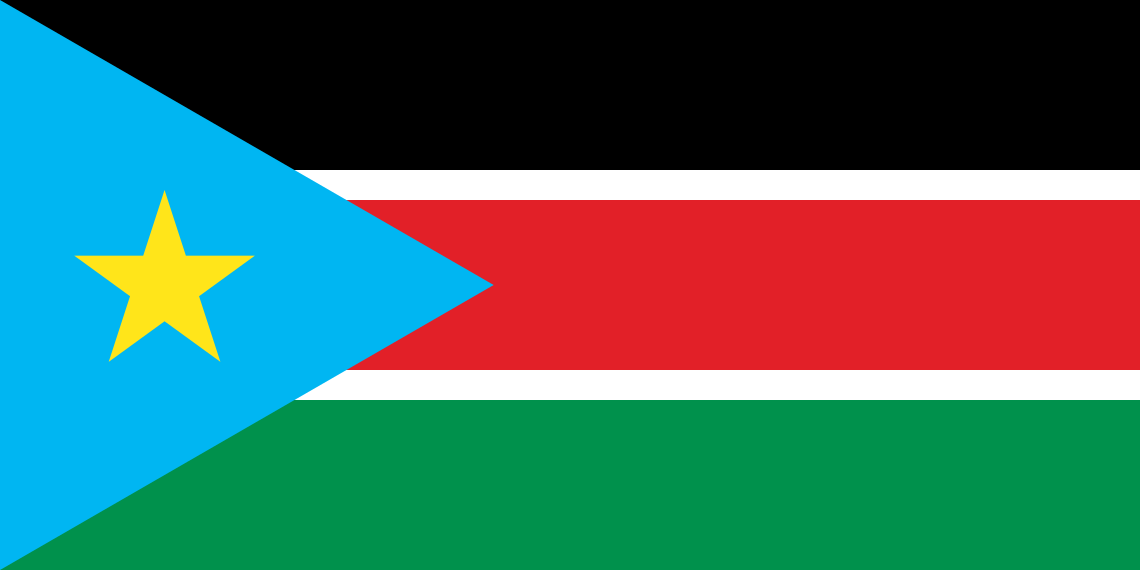
Absent
(38)
-
 Yemen
Yemen
-
 Afghanistan
-
 Comoros
-
 Ethiopia
-
 Bahamas
-
 Bahrain
-
 Barbados
-
 Botswana
-
 Congo
Congo
-
 Equatorial Guinea
-
 Guinea-Bissau
-
 Mali
Mali
-
 Mauritania
-
 Morocco
-
 Nepal
Nepal
-
 Nigeria
-
 Sao Tome and Principe
-
 Somalia
-
 Eswatini
-
 Uganda
-
 Kenya
Kenya
-
 Maldives
-
 United Republic of Tanzania
-
 Democratic Republic of the Congo
-
 Cambodia
-
 Mozambique
-
 Chad
Chad
-
 Lesotho
-
 Gambia
-
 Angola
-
 Seychelles
-
 Libya
Libya
-
 Djibouti
-
 Saint Lucia
-
 Tajikistan
-
 Turkmenistan
-
 South Africa
-
 Timor-Leste
✓ Yes
(76)
-
 Malawi
-
 Iceland
-
 United States of America
-
 United Kingdom of Great Britain and Northern Ireland
-
 Mauritius
-
 Belgium
-
 Ireland
-
 Saudi Arabia
-
 Germany
-
 Finland
-
 Australia
-
 Austria
-
 Bulgaria
-
 Canada
-
 Costa Rica
-
 Denmark
-
 France
-
 Greece
-
 Guatemala
-
 Guyana
-
 Hungary
-
 Italy
Italy
-
 Jamaica
-
 Japan
Japan
-
 Liberia
-
 Luxembourg
-
 Malta
Malta
-
 Mexico
-
 Netherlands
-
 New Zealand
-
 Norway
-
 Panama
-
 Poland
-
 Portugal
-
 Romania
-
 Senegal
-
 Sierra Leone
-
 Spain
Spain
-
 Sweden
-
 Trinidad and Tobago
-
 Türkiye
-
 Ukraine
-
 Togo
Togo
-
 Albania
-
 Central African Republic
-
 Haiti
Haiti
-
 Honduras
-
 Samoa
Samoa
-
 Dominica
-
 Solomon Islands
-
 Vanuatu
-
 Belize
-
 Saint Vincent and the Grenadines
-
 Antigua and Barbuda
-
 Saint Kitts and Nevis
-
 Liechtenstein
-
 Latvia
-
 Estonia
-
 Lithuania
-
 Micronesia (Federated States of)
-
 Croatia
-
 Slovenia
-
 Moldova
-
 Marshall Islands
-
 San Marino
-
 Azerbaijan
-
 Czechia
-
 Slovakia
-
 Monaco
-
 Andorra
-
 Georgia
-
 Palau
Palau
-
 Tuvalu
-
 Tonga
Tonga
-
 Kiribati
-
 Montenegro
Before giving the floor to speakers in explanation of vote on the resolution just adopted, may I remind delegations that explanations of vote are
limited to 10 minutes and should be made by delegations from their seats.

Israel welcomes the steps that the Government of Georgia has taken to improve the livelihood and socioeconomic status of internally displaced persons, which is highlighted in the Secretary- General’s report (A/70/879). Israel is encouraged by the substantial progress made by the Georgian Government in the areas of developing irrigation and drinking water, roads, education, agriculture, shelter, heating and especially the provision of gas to villages. Israel also views positively Georgia’s programme of engagement through cooperation that aims to build trust and confidence among divided communities. Israel supports the spirit of reconciliation through direct dialogue promoted by the Georgian Government.
Israel would like to take this opportunity to reiterate its support for and recognition of Georgia’s territorial integrity. We reiterate our well-established position that the way to resolve long-standing conflict is through a negotiated, mutually agreed approach, not through unilateral actions.

As in past years, Chile abstained in the voting on resolution 70/265, because we believe that it could prejudice or influence the consideration of unresolved issues under negotiation in Geneva. Chile supports the search for a peaceful and consensual solution, either through the Geneva international discussions or in another forum, that would ensure the impartiality of the process, above all by avoiding the politicization of an exclusively humanitarian situation and the establishment of a multilateral context for the consideration of items currently under mediation.

Uruguay firmly promotes, protects and defends human rights and international humanitarian law at the national and international levels. The defence of international law and the principles of peaceful coexistence and territorial integrity have been priorities of our foreign policy. In that regard, we reiterate our support for all the purposes and principles of the Charter of the United Nations and to the principles of international law expressed in resolution 70/265.
We note with concern the further deterioration in the human rights situation in the regions of Abkhazia and South Ossetia, and we are concerned by the increase in the number of refugees and internally displaced
persons. We therefore believe it critical to step up our efforts to arrive at solutions that will enable displaced persons to return to their homes. We believe that it is vital to facilitate the conditions necessary for the United Nations system, in particular the Office of the United Nations High Commissioner for Human Rights and the United Nations Special Rapporteur on the Human Rights of Internally Displaced Persons, to travel to the regions in emergency situations. That is essential in order to arrive at long-term solutions, especially for internally displaced persons.
It is also vital to ensure the safe and unimpeded access of humanitarian personnel to the region, taking into account in particular the situation affecting women and children. We believe that all involved parties in all situations must impartially and consistently protect, strengthen and respect the norms of international humanitarian law, which are the very basis for the protection civilians.
Uruguay believes that the Geneva international discussions must continue in order to find a solution to security and stability issues and to the humanitarian situation of internally displaced persons and refugees in the region. We hope that those negotiations will conclude as soon as possible with a positive outcome for the people involved, creating conditions conducive to their voluntary return to their homes while respecting their human rights without discrimination on ethnic grounds. Uruguay accords the utmost priority to those negotiations and urges the parties involved to make every effort to ensure their success.
My delegation therefore abstained in the voting on resolution 70/265.

Brazil recognizes the territorial integrity of Georgia and expects that the dispute between Georgia and the Russian Federation can achieve a peaceful resolution in the shortest term. We express our solidarity with all victims of forced displacement in Georgia and reiterate our conviction that overcoming the challenges faced by refugees and internally displaced persons depends above all on the creation of favourable political conditions for their return and on dispelling fears of conflict resumption.
Nevertheless, Brazil, as in previous years, abstained in the voting on resolution 70/265, which has just been adopted, as from our perspective it can prejudge or influence the consideration of sensitive issues that should be addressed by the negotiations currently
taking place in Geneva. In this regard, we believe that confidence-building measures and initiatives to foster cooperation should be pursued by all parties, particularly in the framework of the Geneva process. We also urge all actors to seek lasting solutions for the situation of internally displaced persons and refugees, bearing in mind their right of return.
Finally, Brazil deplores the recent death of a Georgian citizen on the Georgian-Abkhaz contact line. It is our sincere hope that the resumption of the Joint Incident Prevention and Response Mechanism can prevent the recurrence of other tragic incidents.
I give the floor to the representative of Georgia.
I just wanted to thank all the delegations that voted for the principle and voted for the humanity. I deliberately do not want to engage in responding to the Russian delegation with regard to the accusations made. In that regard, I already circulated my letter some time ago and that is sufficient. I thank all representatives again who voted in favour of resolution 70/265 and in favour of humanity.
May I take it that it is the wish of the General Assembly to conclude its consideration of agenda item 35?
It was so decided.
The meeting rose at 10.55 a.m.