A/57/PV.75 General Assembly
The meeting was called to order at 10.15 a.m.
Programme of work

Before proceeding to the items on our agenda for today, I would like to inform Members that action on draft resolution A/57/L.67, under agenda item 42, entitled “Follow-up to the outcome of the twenty-sixth special session: implementation of the Declaration of Commitment on HIV/AIDS”, which had been announced in the Journal of last Friday, 13 December 2002, is postponed to a later date in order to allow for the review of the programme budget implications.
44. Follow-up to the outcome of the Millennium Summit Draft resolutions (A/57/L.6/Rev.1, A/57/L.61)
Members will recall that the General Assembly held its debate on this agenda item at the 22nd to 26th plenary meetings on 4, 7 and 8 October 2002.
It is my honour to present to your attention draft resolution A/57/L.61, entitled “Follow-up to the outcome of the Millennium Summit”.
In the draft resolution in front of you, I have reflected views of Member States expressed during the general debate on agenda item 44 and also in the
course of the negotiation process on this draft resolution.
Operative paragraph 2 of this draft resolution recognizes the uneven progress achieved in the implementation of objectives and goals of the Millennium Declaration, as stated in the report of the Secretary-General on the implementation of the United Nations Millennium Declaration (document A/57/270 and Corr.1) and expressed by many of you during our deliberations. Since Member States are in the driver's seat in implementing the Millennium Declaration, this operative paragraph, therefore, urges the Member States to undertake with determination appropriate measures towards its implementation.
Operative paragraph 3 invites the entities of the United Nations system and other interested parties to continue to pursue vigorously the achievement of the objectives and goals of the Millennium Declaration.
Operative paragraph 4 invites the entities of the United Nations system, the Bretton Woods institutions and the World Trade Organization to engage in the review of its implementation.
Operative paragraphs 6 and 7 outline the way in which the implementation of the outcomes of the Millennium Summit will be reviewed in the years to come.
In this draft resolution, Member States will decide that the convening of a high-level plenary meeting during the sixtieth session of the General Assembly for a comprehensive review of the
Millennium Declaration as a whole will be considered during the next session. The review of the implementation of the development goals contained in the Millennium Declaration should be considered within the framework of the integrated and coordinated follow-up to the outcomes of the major United Nations conferences and summits in the economic and social fields.
I do hope that this draft resolution has the support of Member States and can be adopted.
I now give the floor to the representative of the Russian Federation, who will introduce draft resolution A/57/L.6/Rev.1.

On behalf of the delegations of Azerbaijan, Armenia, Belarus, Brazil, China, Dominican Republic, Egypt, Georgia, India, Republic of Moldova, South Africa, Ukraine and my own country, the Russian Federation, I have the honour to introduce draft resolution A/57/L.6/Rev.1, entitled “Responding to global threats and challenges”, for the consideration of the General Assembly.
Contemporary civilization is being faced nearly every minute with threats and challenges of the most varied kind, a whole range of which have become global in character, threatening people’s lives and well- being and whole communities throughout the world. A graphic example of this is the worrying increase in the scale and brutality of international terrorism — as well as drug trafficking, transnational organized crime, environmental degradation, the spread of poverty, illiteracy, disease, the continuing acuteness of sustainable development as a whole and continuing bloody conflicts in various regions.
A successful response to such serious threats and challenges is possible only through combining the efforts of the entire international community. In an era of globalization and unprecedented increase in the interdependence of States, no one is in a position to shut themselves off from the increasing problems in the world.
In order to develop a collective response to these challenges, there are real prerequisites — a recognition by people of the dangers common to all, increased political action and interaction through legal instruments.
But the main thing is that the world community already has an experienced effective mechanism — the United Nations — which is capable of fulfilling the functions of a worldwide coordinating centre, since it possesses a unique legitimacy, universality, experience and potential. These characteristics are the main areas and methods for responding to new threats and challenges.
In essence, we are already agreed on the Millennium Declaration, endorsed by Heads of State or Government of United Nations Member States, and on the implementation of its goals. We need to take into account the constantly changing situation in world affairs, and we need to respond promptly to new problems arising along the way.
What is particularly important is that we always need to keep in focus all of the goals, without exception, of the Millennium Declaration, and to mobilize efforts in all components of the United Nations system and its Member States, regional organizations, civil society and the private sector by working persistently and collectively to find effective responses to new challenges and threats in the inter- connection, without reducing the amount of attention paid to any of these problems.
That is the main thrust of the draft resolution introduced by the sponsors. It supports the steps already taken by the Secretary-General to achieve the aforementioned goals through the coordinated actions of the entire international community and encourages further efforts to ensure a genuinely comprehensive, integrated and complex response to new threats and challenges on the basis of the United Nations Charter.
I wish to draw particular attention to paragraph 2 of the draft resolution, by which the Secretary-General, in consultation with the heads of the agencies and organizations of the United Nations system, and taking into account the views of Member States and cooperating with various international organizations, would study possible ways to formulate, in the context of implementation of the Millennium Declaration, a multifaceted approach to the problem of the global threats and challenges of the twenty-first century. The Secretary-General would also be requested to include his observations on the corresponding issues in his report on the follow-up to the outcome of the Millennium Summit to be submitted to the General Assembly at its fifty-eighth session.
The draft resolution was the subject of negotiations with all interested delegations and groups of States. We are grateful for the concrete proposals made to improve the text, which the sponsors took into account in the draft resolution before the Assembly. We count on its being adopted by consensus.
The Assembly will now take decisions on draft resolutions A/57/L.6/Rev.1 and A/57/L.61.
We turn first to draft resolution A/57/L.61, entitled “Follow-up to the outcome of the Millennium Summit”.
May I take it that the Assembly decides to adopt draft resolution A/57/L.61.
Vote:
57/144
Consensus
Draft resolution A/57/L.61 was adopted (resolution 57/144).
We now turn to draft resolution A/57/L.6/Rev.1, entitled “Responding to global threats and challenges”.
I should like to announce that, since the publication of the draft resolution, Kyrgyzstan has become a co-sponsor of A/57/L.6/Rev.1.
May I take it that the Assembly decides to adopt draft resolution A/57/L.6/Rev.1.
Draft resolution A/57/L.6/Rev.1 was adopted (resolution 57/145).
Vote:
57/145
Consensus
Before giving the floor to speakers in explanation of vote, may I remind delegations that explanations of vote are limited to ten minutes and should be made by delegations from their seats.

My delegation has taken the floor to speak in explanation of vote after the adoption of resolution 57/144, entitled “Follow-up to the outcome of the Millennium Summit”.
Spain thanks the Secretary-General for the report contained in document A/57/270. At the same time, however, we have certain concerns about the contents of certain sections of the report, in particular with regard to the reference to ageing, which does not fully reflect the commitments undertaken by States Members in the course of the Second World Assembly on Ageing, held at Madrid in April this year. During that World Assembly, Member States unanimously adopted
a Political Declaration and a Plan of Action aimed at guaranteeing the positive role that older persons can play in our societies.
At the same time, I should like to recall that the platform establishes important objectives and challenges in the field of development that unfortunately are not correctly reflected in the report. The platform contains specific guidance with regard to development that is absent from document A/57/270.
I also wish to emphasize the importance of gender considerations in United Nations documents. In that regard, Spain’s position differs from the view of women as a vulnerable group of societies, as contained in the report. I should like to make clear the importance of integrating gender perspectives — an issue that is not correctly reflected in the report under consideration — into all reports.
Spain hopes that in the future, both issues — ageing and gender perspectives — will be taken into consideration, as is appropriate and necessary. Any follow-up to the Millennium Summit would be incomplete if it failed to refer to the commitments undertaken during the Second World Assembly on Ageing.

I have taken the floor to explain Pakistan’s position on resolution 57/145 entitled “Responding to global threats and challenges”. My delegation supported the draft resolution (A/57/L.6/Rev.1) in view of our support for its objectives, which are consistent with the purposes and principles of the Charter of the United Nations.
Unfortunately, Pakistan was unable to participate in the discussion of the draft resolution before it was officially introduced. Had we had that opportunity, we should have wished to strengthen the draft resolution in certain respects. We feel that, in the present global environment, it was essential to include a reference to the peaceful settlement of disputes, in accordance with the provisions of Chapter VI of the Charter. Moreover, global threats can be effectively addressed in many parts of the world if there is a genuine commitment to the full and unreserved implementation of all relevant Security Council resolutions, as required by Article 25 of the Charter.
Secondly, Pakistan is committed to combating terrorism. Pakistan has been one of the principal victims of terrorist over the years, including during the
years when we supported the struggle of the people of Afghanistan for self-determination. Global threats also arise when the rights of peoples for freedom and human rights are violated. Therefore, we would have called for a reference in the resolution to the legitimacy of the struggle of peoples for self-determination.
If this matter comes up for deliberation next year, my delegation reserves the right to raise the concerns that I have just mentioned.
The General Assembly has thus concluded this stage of its consideration of agenda item 44.
21. Strengthening of the coordination of humanitarian and disaster relief assistance of the United Nations, including special economic assistance
Members will recall that the Assembly held the debate on agenda item 21 and its sub-items (a) to (c) at the 58th and 59th plenary meetings on 25 November 2002 and adopted five draft resolutions.
I now give the floor to the representative of the Congo to introduce draft resolution A/57/L.43/Rev.1.

I have the honour to take the floor, on behalf of the sponsors, to introduce draft resolution A/57/L.43/Rev.1, entitled “Special assistance for the economic recovery and
reconstruction of the Democratic Republic of the Congo”.
First of all, I wish to make two announcements. The first concerns the list of sponsors, to which should be added France, Greece, Ireland, Italy, Portugal and Sweden. The second announcement concerns a slight modification in operative paragraph 5. After the word “soldiers”, delete the following phrase: “contrary to international law”.
I should like the General Assembly to adopt this draft resolution by consensus, as has been the case in previous years.
The text that is presented to the Assembly today follows the broad outline of the draft resolution adopted last year, because the grave crisis that is raging in the Democratic Republic of the Congo continues to have disastrous effects at the humanitarian level. Human development, therefore, remains one of the priorities of the leaders of the Democratic Republic of the Congo, who want to extricate their people from their precarious existence in poverty and famine.
However, modifications have been made to the text, particularly to take account of certain developments that are under way. It takes note of the signing of certain peace agreements that offer new opportunities for a return to peace, which the international community should welcome. It also welcomes the efforts made by the Government of the Democratic Republic of the Congo to undertake courageous economic reforms. It highlights the need for urgent international economic assistance. Lastly, it makes an appeal to the international community for increased support to humanitarian activities in that country.
As we consider this draft resolution, it is important to keep in mind that the Democratic Republic of the Congo is a least developed country that has undergone grave economic crises that stem from, among other things, economic structural imbalances and a persistent, protracted war that has driven the population into precarious living conditions. The people of the Democratic Republic of the Congo have shown courage and endurance in the face of adverse uncertainty and deserve the support of the international community in order to benefit from the prospects of peace that are now present.
In this context, we welcome the recent adoption of a number of initiatives that indicate a mobilization to support the Democratic Republic of the Congo. I will mention just three of them. During a public meeting of the Security Council devoted to Central Africa on 20 October 2002, an appeal was made for increased assistance to the Democratic Republic of the Congo. On 4 December 2002, this country’s main partners held another meeting in Paris — it included 13 countries and twelve agencies. Following that meeting, this country’s partners solemnly undertook a financial commitment to contribute about $2.5 billion for its support. They also plan to release additional resources to support the multi-sectoral emergency programme of reconstruction and rehabilitation to help that war-torn country. Lastly, on 12 December, the Food and Agriculture Organization of the United Nations announced the launch of a project of road building and rehabilitation in the Democratic of the Congo as part of a programme to combat hunger and malnutrition, as the country has one of the highest malnutrition rates in the world. Therefore, the draft resolution before the General Assembly aims at strengthening the solidarity that is already wide-spread today. On behalf of all the donors I urge the Assembly to adopt it by consensus.

I give the floor to the representative of Denmark to introduce, on behalf of the European Union, draft resolutions A/57/L.51 and A/57/L.66 in one intervention.

On behalf of the European Union and the co-sponsors, I have the honour of introducing the draft resolution entitled “Safety and security of humanitarian personnel and protection of United Nations personnel”, contained in document A/57/L.66, and the draft resolution entitled “Assistance to the Palestinian people” contained in document A/57/L.51.
After the tabling of the draft resolution entitled “Safety and security of humanitarian personnel and protection of United Nations personnel”, the following countries have joined the sponsors: Brazil, Canada, Cyprus, Madagascar, Slovakia, Slovenia, Republic of Moldova, and United Republic of Tanzania. With respect to the draft resolution on assistance to the Palestinian people, the following countries have joined the list of sponsors: Estonia, Gabon, Georgia, Japan, Senegal, Slovakia, South Africa, United Republic of Tanzania and United States of America.
The safety and security of United Nations and all humanitarian personnel continue to be of utmost concern to the European Union and the sponsors of this resolution. We must all work to improve the situation of United Nations and humanitarian personnel so that they can safely and effectively assist people in need. This year’s draft resolution contains some new development based on the Secretary-General’s report on the safety and security of United Nations and humanitarian personnel. In the preambular paragraphs, the General Assembly expresses, inter alia, profound regret for the deaths of international and national personnel who were involved in the provision of humanitarian assistance. The Assembly strongly deplores the rising toll of casualties among such personnel.
In the operative paragraphs, the General Assembly expresses deep concern over the escalation of threats at an unprecedented rate against the safety and security of humanitarian and United Nations personnel and associated personnel in the past decades, and that the perpetrators of acts of violence seemingly operate with impunity. The General Assembly urges all States to take stronger action to ensure that any threat or act of violence committed against humanitarian and United Nations personnel and associated personnel on their territory is fully investigated, and ensure that the perpetrators of such acts are brought to justice in accordance to international and national law. The Assembly welcomes the appointment of a full-time United Nations Security Coordinator at the Assistant- Secretary-General level and reaffirms the need to further strengthen security coordination and management, while sustaining initiatives aimed at increasing the efficiency of the security management system.
I would like to thank all the delegations that participated in the negotiations on this important draft resolution. The European Union and the co-sponsors are of the hope that the draft resolution will this year again be adopted with consensus.
The draft resolution on assistance to the Palestinian people, contained in document A/57/L.51, reflects the outcome of constructive consultations with interested delegations. In the preambular paragraphs, it, inter alia, expresses great concern at the deterioration of the living conditions of the Palestinian people throughout the occupied territories, which constitutes a mounting humanitarian crisis. It notes the great
economic and social challenges facing the Palestinian people and is conscious of the urgent need for international assistance in this regard. Furthermore, it stresses the need for the full engagement of the United Nations in the process of building Palestinian institutions and providing broad assistance to the Palestinian people.
In the operative paragraphs, the draft resolution takes note of the report of the Secretary-General and the report of the Secretary-General’s Personal Humanitarian Envoy on the humanitarian conditions and needs of the Palestinian people. Moreover, it urges member States, international financial institutions of the United Nations system, inter-governmental and non-governmental organizations to extend, as rapidly and generously as possible, economic and social assistance to the Palestinian people, including emergency assistance to counter the impact of the current crisis. In this regard, the draft resolution calls upon the international donor community to expedite the delivery of pledged assistance and stresses the importance of ensuring free passage of aid and free movement of persons and goods.
Finally, the draft resolution requests the Secretary-General to submit a report to the General Assembly at its fifty-eighth session containing an assessment of the assistance received and the needs that are yet to be met. It is the hope of the co-sponsors that the draft resolution will find broad support, and that it will be adopted without a vote, as it has been in previous years.
I give the floor to the representative of Yugoslavia to introduce draft resolution A/57/L.54.

I have the honour to introduce to the General Assembly a draft resolution on humanitarian assistance to the Federal Republic of Yugoslavia. I am pleased to announce that, in addition to the countries listed in document A/57/L.54, Canada, Lithuania and Liechtenstein have become sponsors of the draft resolution.
Before proceeding, I should like to express my sincere gratitude to all the sponsors and delegations whose constructive participation and contribution resulted in the consensus text of the draft resolution.
I should also like to thank the Secretary-General for his valuable report, contained in document
A/57/174, concerning humanitarian assistance to the Federal Republic of Yugoslavia.
My delegation deeply appreciates the humanitarian assistance and rehabilitation support that has been rendered to the Federal Republic of Yugoslavia by a number of States, particularly the major contributors, international agencies and organizations and non-governmental organizations, as well as the humanitarian assistance provided through the United Nations and its specialized agencies.
The Federal Republic of Yugoslavia recognizes the need to profoundly restructure the economy of the country, and it has already mobilized its internal resources in order to overcome the circumstances of its dire starting position and to reform rapidly. The scale of the problems that we have inherited, however, is such that the process of reform and recovery will be very difficult. It will take time to set the country firmly on an accelerated development track. In the meantime, humanitarian assistance is still needed so as to address the widespread poverty and fragile basic services and to provide support for the largest population of refugees and displaced persons in Europe.
We note that there has been a decrease in humanitarian assistance in 2002 due to a shift in donor funding to humanitarian emergencies in other parts of the globe. However, given the enormous burden of the past, my country still requires significant short-term backing from the international community in order to complete the transition process from relief to development.
An important element of the present draft, based on the text of the consensus resolution from the fifty- sixth session of the General Assembly, is an appeal to the international community to support further the Government of the Federal Republic of Yugoslavia in its efforts to ensure transition from emergency humanitarian assistance to the long-term rehabilitation, reconstruction and development of the country.
In this respect, it is especially important for the Federal Republic of Yugoslavia that Member States and international intergovernmental and non- governmental organizations assist — financially and otherwise — the implementation of the national strategy for resolving the problems of refugees and internally displaced persons in Yugoslavia. The national strategy, which is integrated into the overall development strategy and reform programme of the
country, reflects our firm determination to offer assistance and concrete solutions to all refugees and internally displaced persons. It is a transparent and comprehensive policy aimed at helping refugees select the best decision regarding their future — either safe return to their homes or integration into the life of the Federal Republic of Yugoslavia.
The draft resolution pays great attention to the issue of finding durable solutions to the problems of refugees, especially through voluntary repatriation and reintegration. In this context, the draft resolution stresses the importance of developing regional cooperation in the quest for solutions that can improve the difficult situation of the refugees.
The role of the United Nations and its specialized agencies is also emphasized in the draft resolution, and the Organization is requested to continue its efforts to assess humanitarian needs, in cooperation with the Government of the Federal Republic of Yugoslavia, the relevant international and regional organizations and bodies and interested States, with a view to ensuring effective links between relief and long-term assistance to the Federal Republic of Yugoslavia. Although there will be no United Nations consolidated humanitarian appeal for 2003, the importance of the coordination of humanitarian assistance in Yugoslavia has nevertheless been emphasized, inter alia, through the mechanisms of the United Nations Resident Coordinator system.
Finally, the Secretary-General is requested to prepare a report on humanitarian assistance to the Federal Republic of Yugoslavia for consideration at the fifth-ninth session of the General Assembly.
In conclusion, let me express my sincere hope that the draft resolution will receive the broadest possible support and, as last year, that it will be adopted by consensus. In that way, it will help to accelerate the coordination of humanitarian assistance and broad international cooperation for the recovery of the Federal Republic of Yugoslavia.
I give the floor to the representative of Ethiopia to introduce draft resolution A/57/L.57.

I should like to announce that, since the publication of draft resolution A/57/L.57, the following countries have become sponsors: Armenia, Austria, Azerbaijan, Bhutan, Canada, Costa Rica, the Democratic Republic of the
Congo, Ecuador, France, the Gambia, Ghana, Israel, Jordan, Liberia, the Netherlands, Poland, Portugal, Qatar, Saudi Arabia, Slovakia, South Africa and Spain.
On behalf of the Ethiopian delegation, I am pleased to introduce draft resolution A/57/L.57, entitled “Emergency humanitarian assistance to Ethiopia” under agenda item 21(b), “Special economic assistance to individual countries or regions”. Over the past decade, my country, Ethiopia, has undertaken a series of political and economic reforms with a view to improving the humanitarian situation and ensuring sustainable development. We have also focused on the agricultural sector in order to address food insecurity. However, my country is now facing unprecedented drought. We are encouraged by the immediate willingness of Member States to sponsor the draft resolution. It is my fervent hope that the adoption of this draft resolution by consensus will pave the way for a strengthened and committed partnership between my country and the international community to meet the immediate humanitarian assistance needed and, over the long-term, for the integration of relief efforts with recovery and development.
Mr. Gallegos Chiriboga (Ecuador), Vice- President, took the Chair.
I call on the representative of Turkey to introduce draft resolution A/57/L.60.

It is my distinct pleasure to introduce the draft resolution entitled “Strengthening the effectiveness and coordination of international urban search and rescue assistance”, which is before the plenary today, under agenda item 21. Sixty countries have sponsored this draft resolution, which we hope will be adopted by consensus.
Given their humanitarian nature, all 16 draft resolutions that have been presented to the Assembly under agenda item 21 are of great importance and particular significance. While they each have their own focus, their common denominator is a noble effort to alleviate human suffering in humanitarian emergencies.
By definition, humanitarian emergencies are bad and unwelcome news. However, they do have one aspect that is a source of hope for the future and that should not go unnoticed in the “fog of calamity" surrounding them. At such times, one can actually expect the international community to unite almost
automatically to reach out to those in need of help. As its title indicates, the draft resolution in question is geared towards that end. It aims to strengthen a specific and very crucial activity, namely urban search and rescue in time of disaster.
In his report entitled “International cooperation on humanitarian assistance in the field of natural disasters, from relief to development", the Secretary- General points out the disturbing upward trend in the occurrence and impact of natural disasters. The Secretary-General also underlines the fact that communities in many countries around the world are increasingly exposed to the risk of natural disasters by virtue of increasing urbanization.
Currently half of the world's population lives in cities, and, by the year 2030, this ratio is expected to go up to 60 per cent. This is one element that makes the content of this draft resolution particularly important. Another equally pertinent element is the proven fact that, in the aftermath of disasters, 98 to 99 per cent of the lives that are saved are saved in the first 48 to 72 hours. Therefore, speed, efficiency and coordination are of the essence when it comes to saving lives. This draft resolution aims to address precisely those issues by streamlining and ensuring efficiency in urban search and rescue operations.
In brief, saving lives is the main goal of this draft resolution, which is being submitted for the first time. Its nature is such that its significance can only increase in time.
As a country that has suffered from the tragic consequences of natural disasters, Turkey is a keen supporter of increased international cooperation in the countering of such emergencies. Furthermore — again through its own dealings with urban search and rescue teams from a range of countries — Turkey is acutely aware of the importance of making the best possible use of such teams, which, when deployed efficiently, can make the difference between life and death.
As recognized in the draft resolution, the Guidelines developed by the International Search and Rescue Advisory Group constitute a flexible and helpful reference tool for disaster preparedness and response efforts. Formulated on the basis of real-life experiences, they contain detailed checklists and guidance on technical urban search and rescue issues such as the marking of buildings, training standards, reception and departure procedures, and on-site
coordination. They also include specific recommendations for both assisting and affected countries, as well as for the United Nations — all with the overarching goal of strengthening efficiency and coordination. All of these aspects of urban search and rescue, when implemented efficiently, can lead to extremely positive outcomes. Yet when there is no coordination in these areas, even the most resolute efforts may be to no avail.
Turkey believes that this draft resolution addresses key aspects of urban search and rescue and therefore considers it to be a step in the right direction. While Member States are the driving force behind the draft, it would not have been possible without the invaluable support of the United Nations Secretariat and particularly of the Office for the Coordination of Humanitarian Affairs.
I should like to conclude, therefore, by thanking the Emergency Relief Coordinator, Mr. Kenzo Oshima, for his help throughout this process.
I give the floor to the representative of Liberia to introduce draft resolution A/57/L.62.

At the outset, I wish to thank Ambassador Hubert Wurth, Permanent Representative of Luxembourg, for his skilful leadership in coordinating the informal consultations held on the humanitarian draft resolutions submitted under agenda item 21. We also commend the Secretariat for its important contribution to this process.
Since the inception of the Liberian civil crisis and in its aftermath, the General Assembly has adopted a resolution each year calling for international assistance for the rehabilitation and reconstruction of Liberia. It is in this context that, on behalf of the sponsors, I will introduce draft resolution A/57/L.62, entitled “Assistance for the rehabilitation and reconstruction of Liberia”.
I should like to announce that, since the publication of the draft resolution, the following countries have become sponsors of A/57/L.62: Austria, Gabon, Germany, Greece, France, Ireland, Mali, Madagascar, Morocco, Mozambique, the Netherlands and Togo.
The text before the Assembly is the product of intensive negotiations conducted by interested delegations, to which we are immensely grateful.
Basically, the draft resolution calls upon Member States and the international community at large to respond to the humanitarian and development needs of Liberia, which have serious implications for security and economic stability within the subregion. Among other things, the Government of Liberia is urged to take the necessary steps to facilitate the peace- building process in Liberia and to promote regional security and socio-economic development.
The enormity of the task of rebuilding the country and the inability of the Government to generate the requisite financial resources at home and abroad cannot be overemphasized. Clearly, the imposition by the Security Council in May 2001 of selective sanctions has been less than helpful in the peace-building enterprise in Liberia. In spite of the programmes and policies initiated by the Government, problems persist. Inadequate funding is mostly responsible for the slow pace of recovery, including the lack of basic necessities such as electricity, safe drinking water and adequate health care for the majority of the population. Moreover, the problems of new Liberian refugees and internally displaced persons are additional pressing humanitarian concerns which require urgent attention.
In the light of these hard realities, I am obliged to appeal to this body, on behalf of my compatriots, not to give up on Liberia. In particular, I would ask the donor community to overcome its indifference and to seek to adopt a positive and humane approach to the Liberian situation. As members of the human family, Liberians cannot continue to be denied the goodwill and support of the international community during this difficult period of their national existence. I therefore request that this draft resolution be adopted unanimously by the Assembly.
I call on the representative of Venezuela to introduce draft resolution A/57/L.63.

I have the honour to present, on behalf of the Group of 77 and other sponsors, draft resolution A/57/L.63 entitled “International cooperation on humanitarian assistance in the field of natural disasters, from relief to development.” I wish to thank all delegations who participated in the informal discussions on the text of the resolution. We appreciate the positive and constructive atmosphere in which the discussions were held.
Given the length of the resolution I will not cover each paragraph, but I will flag a few issues that are mentioned in the resolution. Both the preambular and the operative parts reaffirm, inter alia, the guiding principles of humanitarian assistance that are contained in the annex of General Assembly resolution 46/182. The draft resolution stresses the importance of strengthening cooperation in the provision of humanitarian assistance, particularly through the effective use of the multilateral mechanisms, including the provision of adequate resources.
One of the new elements in the resolution is to encourage donors to consider the importance of ensuring that assistance for higher profile natural disasters does not come at the expense of those natural disasters with a relatively lower profile. Another element emphasizes the importance of efforts to increase the overall level of assistance.
The draft resolution also requests the Secretary- General to examine the overall situation regarding the mobilization of resources for responding to natural disasters and to make concrete recommendations to improve the international response.
The reference in the tenth preambular paragraph to a resolution of the current General Assembly on international urban search and rescue assistance is to the resolution contained in A/57/L.60.
In addition to the delegations listed in A/57/L.63, other delegations have joined as sponsors. It is our hope that the resolution can, as in previous years, be adopted by consensus.
I call on the representative of Sweden to introduce draft resolution A/57/L.64.
Vote:
57/147
Consensus

I have the honour to introduce, on behalf of the sponsors, a draft resolution on the strengthening of the coordination of emergency humanitarian assistance of the United Nations contained in document A/57/L.64. Since the publication of the draft resolution before the Assembly, the following countries have also become sponsors: Brazil, Croatia, Ecuador, Estonia, Hungary, Lesotho, Nepal, Nicaragua, the Republic of Moldova, Romania, Senegal, the former Yugoslav Republic of Macedonia and the United Republic of Tanzania.
Valuable proposals were made during several informal consultations for improvement of the text and
agreement was reached on all paragraphs. My delegation would like to thank the sponsors and other delegations for the good and constructive spirit of cooperation and partnership in which the consultations were held. The draft resolution begins by recalling the landmark resolution 46/182, which of course still guides the work of the United Nations in the humanitarian field. It goes on to take note of the reports of the Secretary-General and it stresses the need to address further the issues of funding, coordination and strategic planning in the context of natural disasters and complex emergencies, particularly in the transition between relief and development activities, and the need to mobilize adequate levels of financing for emergency humanitarian assistance.
The draft resolution addresses, among other things, two issues of recent concern. First, the aggravating effects that major diseases, in particular the HIV/AIDS pandemic, cause in the context of natural disasters and complex emergencies. There is a request to the Secretary-General to address ways and means for strengthening the humanitarian response and for the mobilization of greater resources in this regard. Secondly, the draft resolution outlines efforts to develop the plan of action on protection from sexual exploitation and abuse in humanitarian crises, and stresses the importance of the timely implementation of this plan.
The draft resolution commends the Emergency Relief Coordinator and his staff for their activities in emergency information management and stresses that national authorities, relief agencies and other relevant actors need to continue to improve the sharing of relevant information related to natural disasters and complex emergencies. It emphasizes that coordination of humanitarian assistance within the United Nations system is a mandate of the Secretary-General and that the Office for the Coordination of Humanitarian Affairs should benefit from adequate and more predictable funding. It invites the Economic and Social Council to continue to consider ways to enhance further the humanitarian affairs segment of future sessions of the Council, including through the adoption of negotiated outcomes of its deliberations. The draft resolution in its final paragraph requests the Secretary- General to report to the next session of the General Assembly, through the Economic and Social Council, on progress made in strengthening the coordination of the United Nations humanitarian assistance.
On a final note I would like to express my gratitude to my colleague, Ambassador Hubert Wurth for his able chairmanship and guidance during the informal consultations on this agenda item. My delegation and other sponsors hope that the draft resolution contained in this document can be adopted by consensus.
22. Cooperation between the United Nations and regional and other organizations
Vote:
A/RES/57/156
Consensus
Show country votes
— Abstain
(65)
-
 Malawi
-
 Yemen
Yemen
-
 United States of America
-
 Bangladesh
-
 Singapore
-
 Comoros
-
 Indonesia
-
 Saudi Arabia
-
 Ethiopia
-
 Sudan
Sudan
-
 Egypt
Egypt
-
 Bahamas
-
 Bahrain
-
 Barbados
-
 Burundi
-
 Ghana
Ghana
-
 Grenada
-
 Guinea
-
 Guyana
-
 Islamic Republic of Iran
-
 Jamaica
-
 Jordan
-
 Malaysia
-
 Mali
Mali
-
 Mauritania
-
 Mongolia
-
 Oman
Oman
-
 Papua New Guinea
-
 Philippines
-
 Qatar
Qatar
-
 Rwanda
-
 Sierra Leone
-
 Sri Lanka
-
 Eswatini
-
 Trinidad and Tobago
-
 Uganda
-
 United Arab Emirates
-
 Myanmar
-
 India
India
-
 Kenya
Kenya
-
 Maldives
-
 Pakistan
-
 Cuba
Cuba
-
 Kuwait
-
 Togo
Togo
-
 United Republic of Tanzania
-
 Lesotho
-
 Haiti
Haiti
-
 Gambia
-
 Libya
Libya
-
 Dominica
-
 Zimbabwe
-
 Saint Lucia
-
 Vanuatu
-
 Belize
-
 Saint Vincent and the Grenadines
-
 Antigua and Barbuda
-
 Brunei Darussalam
-
 Burkina Faso
-
 Saint Kitts and Nevis
-
 Kazakhstan
-
 Democratic People's Republic of Korea
-
 Namibia
-
 Nauru
Nauru
-
 Tonga
Tonga
Absent
(34)
-
 Bhutan
-
 Benin
Benin
-
 Botswana
-
 Congo
Congo
-
 Equatorial Guinea
-
 Fiji
Fiji
-
 Gabon
Gabon
-
 Guinea-Bissau
-
 Iraq
Iraq
-
 Côte d'Ivoire
-
 Lao People's Democratic Republic
-
 Liberia
-
 Niger
Niger
-
 Sao Tome and Principe
-
 Somalia
-
 Democratic Republic of the Congo
-
 Albania
-
 Mozambique
-
 Chad
Chad
-
 Central African Republic
-
 Seychelles
-
 Viet Nam
-
 Solomon Islands
-
 Micronesia (Federated States of)
-
 Marshall Islands
-
 Tajikistan
-
 Kyrgyzstan
-
 Turkmenistan
-
 Uzbekistan
-
 Eritrea
-
 Palau
Palau
-
 Tuvalu
-
 Kiribati
-
 Timor-Leste
✓ Yes
(92)
-
 China
China
-
 El Salvador
-
 Iceland
-
 United Kingdom of Great Britain and Northern Ireland
-
 Mauritius
-
 Belgium
-
 Ireland
-
 Afghanistan
-
 Syrian Arab Republic
-
 Israel
-
 Germany
-
 Finland
-
 Algeria
-
 Argentina
-
 Australia
-
 Austria
-
 Plurinational State of Bolivia
-
 Brazil
-
 Bulgaria
-
 Canada
-
 Chile
Chile
-
 Colombia
-
 Costa Rica
-
 Denmark
-
 Dominican Republic
-
 Ecuador
-
 France
-
 Greece
-
 Guatemala
-
 Hungary
-
 Italy
Italy
-
 Japan
Japan
-
 Luxembourg
-
 Madagascar
-
 Malta
Malta
-
 Mexico
-
 Morocco
-
 Nepal
Nepal
-
 Netherlands
-
 New Zealand
-
 Nigeria
-
 Norway
-
 Panama
-
 Paraguay
-
 Peru
Peru
-
 Poland
-
 Portugal
-
 Romania
-
 Senegal
-
 Spain
Spain
-
 Sweden
-
 Thailand
-
 Tunisia
-
 Türkiye
-
 Ukraine
-
 Lebanon
-
 Cyprus
-
 Uruguay
-
 Bolivarian Republic of Venezuela
-
 Yugoslavia
-
 Zambia
-
 Cambodia
-
 Nicaragua
-
 Cabo Verde
-
 Honduras
-
 Angola
-
 Djibouti
-
 Samoa
Samoa
-
 Suriname
-
 Cameroon
-
 Liechtenstein
-
 Latvia
-
 Belarus
-
 Estonia
-
 Lithuania
-
 Republic of Korea
-
 Croatia
-
 Russian Federation
-
 Slovenia
-
 Moldova
-
 Bosnia and Herzegovina
-
 San Marino
-
 Armenia
-
 Azerbaijan
-
 South Africa
-
 Czechia
-
 Slovakia
-
 North Macedonia
-
 Monaco
-
 Andorra
-
 Georgia
-
 Switzerland
I call on the representative of Somalia to introduce draft resolution A/57/L.65.

I take the floor to introduce, on behalf of its sponsors, draft resolution A/57/L.65 entitled “Assistance for humanitarian relief and the economic and social rehabilitation of Somalia”. I should like to announce that, since the publication of the draft resolution, the following countries have also become sponsors of this draft resolution: Austria, Azerbaijan, Burkina Faso, France, Germany, Greece, India, Ireland, Italy, Jordan and Libya.
I ask the General Assembly to adopt this draft resolution on a consensus basis as was done last year. I wish to emphasize that this draft resolution before you is about humanitarian assistance to Somalia and the rehabilitation and reconstruction of Somalia. Somalia urgently needs this assistance, since we have had a devastating civil war going on in Somalia for a long time.
I wish also to point out that the current draft resolution is a continuation of last year’s resolution passed by the General Assembly. It calls for all to contribute to humanitarian assistance for Somalia. The draft resolution also encourages the current national reconciliation process in Eldoret, Kenya, in which nearly all stakeholders in the Somalia conflict are participating. The success of this conference will enable Somalia to move from relief to rehabilitation and reconstruction of the country. The draft resolution also draws attention to the current drought in the Horn of Africa, and in particular to those areas in Somalia that are affected, and urges the international community, as an urgent matter, to provide humanitarian assistance and relief to the Somali people, so as to alleviate in particular the consequences of the prevailing drought. The draft resolution further urges all States and non-governmental organizations (NGOs) to assist the Somali people in embarking on the rehabilitation of basic social and economic services, as well as institution-building aimed at the
restoration of the structures of civil governance throughout Somalia. The draft also welcomes agreements and declarations recently signed by the participants at the Somali National Reconciliation Conference at Eldoret, Kenya.
The draft has the sponsorship of 47 countries and we hope that the passage of this draft resolution will add positively to the momentum of peace and reconciliation and assist our rehabilitation.
I hope this draft resolution will be adopted on a consensus basis, as it was last year.
Vote:
57/148
Consensus
We shall now consider draft resolutions A/57/L.43/Rev.1, as orally revised, A/57/L.51, A/57/L.54, A/57/L.57, A/57/L.60, A/57/L.62, A/57/L.63, A/57/L.64, A/57/L.65 and A/57/L.66.
Before giving the floor to speakers in explanation of vote before the vote, may I remind the delegations that explanations of vote are limited to ten minutes and should be made by delegations from their seats.
I now call on the representative of the United States for an explanation of vote before the vote.
Vote:
57/157
Consensus

My delegation has two explanations to give, one on draft resolution A/57/L.57 and one on draft resolution A/57/L.60. Concerning the draft resolution on emergency humanitarian assistance to Ethiopia, while the United States Government joins the consensus on this draft resolution, we note there is a recurrent drought affecting the entire Horn of Africa. Thus, if this topic comes up again next year, it would, in our view, be more appropriate to handle it under the umbrella of a regional resolution. The United States Government is gravely concerned by the magnitude of the current drought, which has affected up to 18 million people over the last two years, and by the serious crop failures in many parts of the region. We also have serious concerns that the prevailing dire humanitarian situation in the region will have long- term socio-economic and environmental impacts. We note in this context the Secretary-General’s decision to eliminate food insecurity in the Horn of Africa over a long-term period.
With these points in mind, the United States recommends that the international community take into account the entire region in their humanitarian planning. The United States Government also welcomes the initiative of the Secretary-General to
address the recurrent regional drought on a long-term basis, calls for the implementation of that initiative and requests that the Office for the Coordination of Humanitarian Affairs continue considering ways to further enhance the mobilization of emergency relief assistance.
Concerning draft resolution A/57/L.60 entitled “Strengthening the effectiveness and coordination of international urban search and rescue assistance”, the United States Government is pleased to co-sponsor this important resolution and, by doing so, to support the process of the International Search and Rescue Advisory Group (INSARAG). The Government of the United States also wishes to thank the Government of Turkey for its outstanding leadership in this matter, as well the Geneva staff of the Under-Secretary-General for Humanitarian Affairs. The INSARAG process has been developed in order to save lives, to speed qualified aid to victims and to make sure that rescue teams are fully equipped and protected, while also respecting the national sovereignty of nations.
With this in mind, the United States Government urges nations subject to disasters to participate in the INSARAG discussions and to cooperate with each other and the United Nations to the greatest extent possible.
I now call on the representative of Israel for an explanation of vote before the vote.
Vote:
57/149
Consensus

My explanation of vote refers to the draft resolution on assistance to the Palestinian people.
Israel shares the concern of the international community over the deterioration in the humanitarian situation in the region. Violence and terrorism, by their very nature, entail hardship for the civilian population. Israeli and Palestinian civilians have both endured tremendous pain and suffering as a consequence of the upsurge in terrorism that began in September 2000. Bringing this suffering to an end and providing for the security and prosperity of all the peoples in the region are critical components of any successful peace initiative and is therefore a prime objective of Israeli policy.
In this respect, Israel welcomes the efforts of Member States and of international agencies to relieve the suffering of innocent civilians. Israel has done its
utmost to cooperate with international actors in an effort to facilitate their humanitarian work aimed at improving the living conditions of Palestinians in the West Bank and the Gaza Strip. Despite the unrelenting threat of terrorism that Israel confronts on a daily basis, we have consistently tried to permit the flow of food, medicine, humanitarian assistance and other necessities to the greatest extent possible.
While Israel has tried, and will continue to try, to facilitate humanitarian assistance to the greatest extent possible, Palestinian terrorists have consistently exploited any Israeli attempt to ease the conditions of the Palestinian people. Terrorists have viewed measures intended to increase freedom of movement as opportunities to infiltrate Israeli cities. They have used the immunity granted to medical and humanitarian vehicles to smuggle weapons and explosives. It is clear from these examples that terrorists pose a threat not only to those they target, but also to those they hide behind.
It is therefore entirely disingenuous to suggest, as certain speakers have, that Israeli policies are the source of the hardships facing the Palestinian people.
As is obvious to anyone willing to make an honest assessment of Palestinian economic and social development over the past decade, in periods in which the Palestinian leadership was actively confronting terrorist organizations and engaging in serious negotiations with Israel, the living conditions of the Palestinian people steadily improved. It was only with the breakdown of the peace process and the Palestinian resort to a deliberate campaign of terrorism aimed at the citizens of Israel that conditions began to decline.
While it is politically useful for the Palestinians to place the blame for their current predicament solely on Israel’s shoulders, such allegations will do little to offer any relief to Palestinian civilians that do not participate in acts of terror. If the international community is serious about alleviating the humanitarian plight of the Palestinian people, the single most important thing it can do is to insist that the Palestinian leadership end its campaign of violence, terror and incitement, as called for in Security Council resolutions.
I wish to emphasize once again that while Israel is joining the consensus on this draft resolution out of our concern for the Palestinian people, Israel’s participation should not be construed as implying any
position regarding the present status of the territories referred to as “the occupied territory”. This term is not used in the agreements between the parties, nor does it reflect, in Israel’s view, the legal status of the disputed territory in the West Bank and Gaza which, pursuant to signed agreements, are a matter to be directly negotiated between the two sides.
We remain hopeful that despite the tension that persists in the region, we will soon be able to return to a process of negotiations aimed at achieving a lasting political settlement for the benefit of all the peoples of the region.
The Assembly will now take a decision on draft resolutions A/57/L.43/Rev.1, as orally revised, A/57/L.51, A/57/L.54, A/57/L.57, A/57/L.60, A/57/L.62, A/57/L.63, A/57/L.64, A/57/L.65 and A/57/L.66.
We turn first to draft resolution A/57/L.43/Rev.1, as orally revised, entitled “Special assistance for the economic recovery and reconstruction of the Democratic Republic of the Congo”. I wish to inform the Assembly that the following countries have joined the list of sponsors of the draft resolution: Finland, Germany and Mali.
May I take it that the General Assembly decides to adopt draft resolution A/57/L.43/Rev.1, as orally revised?
Draft resolution A/57/L.43/Rev.1, as orally revised, was adopted (resolution 57/146).
Vote:
57/150
Consensus
Draft resolution A/57/L.51 is entitled “Assistance to the Palestinian people”. The following countries have joined the list of sponsors of the draft resolution: Bosnia and Herzegovina, the Gambia, Mali, Mozambique and Niger.
May I take it that the Assembly decides to adopt draft resolution A/57/L.51?
Draft resolution A/57/L.51 was adopted (resolution 57/147).
Draft resolution A/57/L.54 is entitled “Humanitarian assistance to the Federal Republic of Yugoslavia”. The following country has joined the list of sponsors of the draft resolution: Cuba.
May I take it that the Assembly decides to adopt draft resolution A/57/L.54?
Vote:
57/151
Consensus
Draft resolution A/57/L.54 was adopted (resolution 57/148).
Draft resolution A/57/L.57 is entitled “Emergency humanitarian assistance to Ethiopia”. The following countries have joined the list of sponsors of the draft resolution: Armenia, Belgium, Gabon, Kuwait, Mali and Turkey.
May I take it that the Assembly decides to adopt draft resolution A/57/L.57?
Draft resolution A/57/L.57 was adopted (resolution 57/149).
Vote:
57/152
Consensus
Draft resolution A/57/L.60 is entitled “Strengthening the effectiveness and coordination of international urban search and rescue assistance”. The following countries have joined the list of sponsors: Bangladesh, Brazil, France, Gabon, Ireland, Israel, Madagascar and Tanzania.
May I take it that the Assembly decides to adopt draft resolution A/57/L.60?
Draft resolution A/57/L.60 was adopted (resolution 57/150).
Draft resolution A/57/L.62 is entitled “Assistance for the rehabilitation and reconstruction of Liberia”. The following countries have joined the list of sponsors of the draft resolution: Belgium and Italy.
May I take it that the Assembly decides to adopt draft resolution A/57/L.62?
Vote:
57/153
Consensus
Draft resolution A/57/L.62 was adopted (resolution 57/151).
Draft resolution A/57/L.63 is entitled “International cooperation on humanitarian assistance in the field of natural disasters, from relief to development”. The following countries have joined the list of sponsors of the draft resolution: Austria, Belgium, Brazil Ecuador, France, Germany, Greece, Ireland, Italy, Madagascar, Nepal, Nicaragua, Portugal, Romania, Sweden, Tajikistan, Tanzania and the former Yugoslav Republic of Macedonia.
May I take it that the Assembly decides to adopt draft resolution A/57/L.63?
Draft resolution A/57/L.63 was adopted (resolution 57/152).
Vote:
57/154
Consensus
Draft resolution A/57/L.64 is entitled “Strengthening of the coordination of emergency humanitarian assistance of the United Nations”. The following country has joined the list of sponsors of the draft resolution: Madagascar.
May I take it that the Assembly decides to adopt draft resolution A/57/L.64?
Draft resolution A/57/L.64 was adopted (resolution 57/153).
Draft resolution A/57/L.65 is entitled “Assistance for humanitarian relief and the economic and social rehabilitation of Somalia”. The following countries have joined the list of sponsors of the draft resolution: Bangladesh, Belgium, the Libyan Arab Jamahiriya, Madagascar, Niger and Syria. May I take it that the Assembly decides to adopt draft resolution A/57/L.65?
Vote:
57/155
Consensus
Draft resolution A/57/L.65 was adopted (resolution 57/154).
Draft resolution A/57/L.66 is entitled “Safety and security of humanitarian personnel and protection of United Nations personnel”. Additional sponsors are Bangladesh, Bosnia and Herzegovina, Colombia, Croatia, Estonia, Gabon, Gambia, Honduras, Latvia, Lithuania, Mozambique, Nicaragua, Paraguay, Sierra Leone, South Africa, Tajikistan, Ukraine.
May I take it that the Assembly decides to adopt draft resolution A/57/L.66?
Draft resolution A/57/L.66 was adopted (resolution 57/155).
Before giving the floor to speakers in explanation of vote after the adoption of the draft resolutions, may I remind delegations that explanations of vote are limited to ten minutes and should be made by delegations from their seats.

My delegation associated itself with the general consensus regarding the adoption of draft resolution A/57/L.66 on the safety and security of
humanitarian personnel and protection of United Nations personnel. However, our position should not be interpreted as agreeing to what is contained in operative paragraph 14 of that resolution.
We have heard the last speaker in the explanation of vote of the adoption.
I should like to take this opportunity to thank Ambassador Wurth of Luxembourg, on behalf of the General Assembly, for undertaking the task of holding consultations and negotiations on the resolutions adopted on this agenda item.
The adoption by consensus of the draft resolution for emergency humanitarian assistance to Ethiopia under agenda item 21 (b), “Special economic assistance to individual countries or regions”, has a significant message to my people and Government. I am grateful to note that Ethiopia enjoys the full support of Member States.
In this regard, I would like to thank the delegation of Denmark, in its capacity as the President of the European Union, for its utmost contribution during the informal consultations. Likewise, I would like to thank the delegations of the United States, the Russian Federation, India, China, Qatar and of the Member States of the Arab region and the African Union. I would also like to thank the secretariat of the Office for the Coordination of Humanitarian Affairs for their valuable assistance.
It would be remiss of me if I failed to mention the contribution of Ambassador Hubert Wurth, the Permanent Representative of Luxembourg, for his able leadership in coordinating this resolution. I am fully confident that it will be fully implemented.

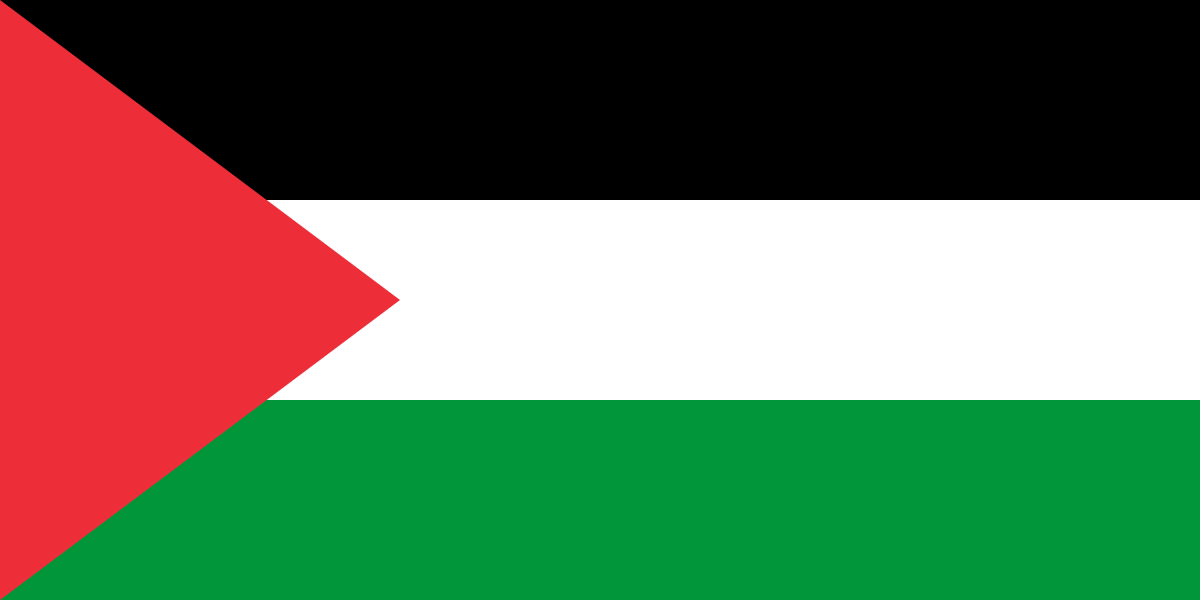
To begin, I wish to convey my delegation’s appreciation with regard to the adoption by consensus of the resolution on assistance to the Palestinian people. Emergency economic and humanitarian assistance to the Palestinian people is indeed a matter of urgency for addressing the dire humanitarian crisis that has taken root in the occupied Palestinian territory.
The root cause of this humanitarian crisis is the Israeli policies and practices being imposed on the Palestinian people under occupation. The severe decline in the socio-economic conditions of the Palestinian people is fundamentally a result of an
oppressive occupation now in its thirty-fifth year. For more than 35 years, the occupying Power has prevented the socio-economic development and progress of the population under its occupation. Since September, with the escalation of the Israeli military attacks against Palestinian cities, towns and villages and refugee camps, development has not only been halted, it has been destroyed.
Israeli policies and practices of collective punishment against the Palestinian people, including the imposition of the severest restrictions on the freedom of movement of persons and goods — including humanitarian and medical help, which the Israeli Government purports to cooperate with and facilitate — have severely and detrimentally impacted all facets of Palestinian life — economic, social, political, health, educational and cultural.
It is thus Israel’s policies and practices in imposing its occupation that are the root source of the humanitarian suffering in the occupied Palestinian territory. While we are always grateful for the assistance of the international community in addressing the humanitarian needs of our people, we do at the same time reaffirm the need to address the root source of this humanitarian crisis in all its aspects.
May I take it that it is the wish of the General Assembly to conclude its consideration of sub-items (a) and (c) of agenda item 21?
It was so decided.
The Assembly has thus concluded this stage of its consideration of sub-item (b) of agenda item 21.
Members will recall that the Assembly held a debate on agenda item 22 and its sub-items (a) to (s) at its 53rd to 56th plenary meetings, on 20 and 21 November. In this connection, the Assembly has before it two draft resolutions, A/57/L.23/Rev.1 and A/57/L.55/Rev.1.
I now give the floor to the representative of Grenada to introduce draft resolution A/57/L.55/Rev.1.

The necessary changes having been made — mutatis mutandis — I have the honour to introduce, on behalf of all the sponsors, draft resolution A/57/L.55/Rev.1, entitled “Cooperation between the United Nations and the Organization of American States”. I should like to announce that, since the publication of the draft resolution, Peru has also become a sponsor.
The growing interconnectedness and interdependence of economies and societies, brought about by the rapid rise in information and communication technologies, make cooperation between the United Nations and regional organizations, such as the Organization of American States (OAS), even more necessary and desirable.
The English poet and clergyman, John Donne (1572-1631), was not far from the mark when he wrote his famous saying in old English: “No man is an island, entire of itself; every man is a piece of the continent, a part of the main ...”. (Meditation XVII)
At that time, he was referring to the relationship between England and the continent, which by present- day measurement was a minuscule part of today’s known world. The point Donne was making was that what happens to each of us affects all of us. How true of the global village in which we now live.
The draft resolution lists the areas of activities in which the United Nations and the OAS have been cooperating during the past biennium 2001-2002. Some ongoing areas of cooperation cover a wide range, including sustainable development; trade, investment, technology and entrepreneurial development; drug control; promotion and protection of human rights and democratic rights; and education and health.
I would like to highlight three specific areas mentioned in the draft resolution. The first area is our grave concern with the spread of the HIV/AIDS pandemic in the region, and indeed in the entire world. The draft resolution stresses the need for increased financial resources and affordable drugs; but there are other important factors in the fight against this menace, especially in the area of education. And here I would like to commend the very simple, but effective slogan provided by the UNAIDS office at Headquarters — namely, the ABC of AIDS prevention and care. A stands for Abstinence, B stands for Be faithful, and C stands for Condomize.
My second point relates to Haiti. The United Nations/OAS International Civilian Support Mission in Haiti completed its mandate in March 2001. We now have, since June 2002, the OAS Special Mission for Strengthening Democracy in Haiti, as well as the continuing involvement of the Group of Friends in support of mediation efforts in Haiti. While we welcome both these efforts, we believe that the situation in Haiti requires more positive and sustained assistance from the international community, encompassing a wide spectrum of activities dedicated to improving the economic, social, juridical and administrative structures in Haiti.
My third point relates to the convening of a special conference on security in Mexico City in May 2003. A number of preparatory meetings will take place before the conference, and we are looking forward to a successful conference from which specific recommendations will be made, taking into account recent issues and developments, especially in the aftermath of 9/11.
The draft resolution seeks the furtherance of cooperation and collaboration between the United Nations and the OAS, as contained in the Secretary General’s report (document A/57/267). It involves United Nations bodies and agencies in the promotion and enhancement of OAS activities.
Thus, the sponsors express the hope that this draft resolution will be adopted by consensus.
We shall now proceed to consider draft resolutions A/57/L.23/Rev.1 and A/57/L.55/Rev.1.
Before giving the floor to speakers in explanation of vote before the vote, may I remind delegations that
explanations of vote are limited to 10 minutes and should be made by delegations from their seats.

It is customary for the United Nations General Assembly to adopt annually a number of resolutions related to the cooperation between the United Nations and certain regional organizations, among which is the draft resolution this body is about to consider today.
Throughout the years, these resolutions continue to be characterized by their generous scope of reference and language. However, the authors of this year’s draft resolution contained in document A/57/L.23/Rev.1, entitled “Cooperation between the United Nations and the Council of Europe”, have deviated from such practice by choosing to introduce the controversial reference to the death penalty, explicitly, in operative paragraph 6, and, implicitly, in operative paragraph 12. In a resolute effort to bridge the differences and achieve consensus on the aforementioned draft resolution, the Permanent Mission of Egypt to the United Nations, along with a number of other interested and concerned delegations, clearly voiced these concerns to the sponsors of the resolution during the informal consultations conducted under the able leadership of His Excellency the Ambassador and Permanent Representative of Malta.
The Permanent Mission of Egypt to the United Nations has always been supportive of all resolutions related to cooperation between the United Nations and other regional organizations. Such resolutions enhance the prospects of international cooperation and coordination between different bodies and organizations and further help in the achievement of the principles and objectives of the United Nations Charter. Yet, the inclusion of controversial concepts into a resolution otherwise adopted by consensus has resulted in a difference of opinion when considering the different interpretations of certain paragraphs.
Thus, the Permanent Mission of Egypt to the United Nations is not in a position to join consensus on this draft resolution and has called for a separate vote on both operative paragraphs 6 and 12.
It is worth noting that the draft resolution contains other paragraphs that constitute additional difficulties, such as the fourth preambular paragraph, which stresses “the importance of adherence to the standards and principles of the Council of Europe”,
while not specifying the countries concerned with the jurisdiction of such a paragraph.
In conclusion, our call for a separate vote on certain paragraphs should not be perceived as undermining the principle objective of the draft resolution: cooperation between the United Nations and the Council of Europe. The Council of Europe is an organization whose contributions to international efforts and endeavours we regard with the highest esteem and appreciation.

At the outset, let me state that Singapore fully supports cooperation between the United Nations and regional and other organizations; certainly, we support cooperation between the United Nations and the Council of Europe. Hence, we deeply regret the fact we have had to call for a vote on the draft resolution contained in document A/57/L.23/Rev.1.
We are doing so because we are deeply troubled by attempts to slip in contentious issues under the innocuous guise of a draft resolution that is intended to focus on cooperation with the United Nations. The fundamental principle that the General Assembly should work under is that we should not include non- consensual elements in a consensual draft resolution. There is clearly no international consensus on the issue of the death penalty.
Operative paragraph 6 — as the representative of Egypt pointed out, speaking just before me — refers to Protocol No. 13 to the European Convention for the Protection of Human Rights and Fundamental Freedoms, which is focused on the abolition of the death penalty in all circumstances.
We are even more troubled by operative paragraph 12, even though it looks harmless. It merely takes note of the “Guidelines on Human Rights and the Fight against Terrorism”. However, chapter X of the “Guidelines” state that
“under no circumstances may a person convicted of terrorist activities be sentenced to the death penalty; in the event of such a sentence being imposed, it may not be carried out”.
This is clearly unacceptable to us. Terrorists who kill hundreds or thousands of people should not be exempt from the penalty that applies to other criminals. Our fear as we look at this draft resolution is that there may well be other controversial elements hidden in it that
we, as a small delegation, are in some ways ill- equipped to detect. For that reason, we want to thank the delegation of the large country that drew our attention to chapter X of the “Guidelines” referred to in paragraph 12.
We also recognize that the main sponsors have attempted to address our concerns by proposing that a neutral term be used, such as the words “takes note”. We appreciate the efforts made by the sponsors to take our concerns on board. They have argued that “takes note” is a neutral term that connotes neither approval nor disapproval of these paragraphs.
In response, we would like to make two points. First, like the representative of Egypt, I would once again like to draw the Assembly’s attention to the fourth preambular paragraph, which reads:
“Stressing the importance of adherence to the standards and principles of the Council of Europe and its contribution to the solution of conflicts throughout the whole of Europe”.
It is strange that we, the 191 Member States, should be called upon to adhere to the standards and principles of the Council of Europe. We respect its standards and principles, but we have our own, too. Indeed, were it not for the fact that this particular clause was included in a resolution adopted by consensus last year, we would also have objected to the paragraph this year. But the fact that this preambular paragraph exists and is linked to operative paragraphs 6 and 12 means that we can no longer accept even the phrases “notes” and “takes note” included in those paragraphs.
The second point is that “takes note” is unacceptable to us precisely because it is neutral. We actually cannot merely take note because we would have to take note with disapproval of the elements contained in paragraphs 6 and 12.
Let me also mention here in passing that we regret the fact that the draft resolution on cooperation between the United Nations and the Council of Europe is growing longer and longer each year. Two years ago, there were 11 operative paragraphs in the resolution on this item. This year, there are 24 — more than double the number when this item first appeared on the agenda two years ago. We would therefore respectfully like to suggest that next year, to avoid a repetition of the unfortunate situation we are in today, we revert to the
usual practice and adopt a short and sharp resolution which focuses only on the issues of cooperation and does not include any non-consensual elements.
This year, unfortunately, as the draft resolution contains elements which are not germane to cooperation between the United Nations and the Council of Europe and which reflect positions that are contrary to our national point of view, we will have no choice but to vote against operative paragraphs 6 and 12. Should those paragraphs remain in the text, we will abstain in the voting on the whole draft resolution. Any vote in favour of the draft resolution would amount to a dishonest stand on our part, which we are unable to take on such important issues as the death penalty.
We would like to state for the record that Singapore cannot and will not join consensus on any draft resolution that refers to the death penalty issue, no matter how indirectly it is done.

My delegation is well aware of the important role that has been played by the Council of Europe in a number of areas of concern to the mandate of the United Nations. We therefore fully support ongoing cooperation between both organizations.
While, in previous years, Jamaica has been pleased to join consensus on the resolution on cooperation between the United Nations and the Council of Europe, we regret that we will be unable to join in any consensus on this occasion, in view of the inclusion of elements which fail to command the support of some Member States, including my own. Jamaica is particularly concerned with the reference in paragraph 6 to Protocol 13 to the Convention for the Protection of Human Rights and Fundamental Freedoms concerning the abolition of the death penalty. While we appreciate the attempts to amend the original language of the draft, which highlighted the support of the Council for the abolition of the death penalty worldwide, we would have preferred if the sponsors of the draft had withdrawn all references to the death penalty in paragraph 6 and refrained from including in a traditionally consensual United Nations draft resolution issues internal to the Council of Europe and which have neither a clear bearing on cooperation with the United Nations system nor consensus within the Organization’s membership.
The General Assembly need not be reminded that that the laws of a number of States Members of this
Organization still provide for the death penalty, which is recognized as a legitimate and constitutionally sanctioned penalty for the most severe crimes. It must therefore not be expected that these States should collectively endorse a draft resolution which contains divisive and non-consensual elements that imply a singular lack of appreciation for their judicial and legislative processes, developed and applied in compliance with their international legal obligations.
We believe that the principles of the sovereignty and equality of States under the Charter would dictate that each State be respected in the legitimate exercise of its domestic jurisdiction in matters of criminal law. Each State should therefore be entitled to take steps in accordance with international norms which it deems necessary to protect its citizens in the context of its social, cultural and economic realities.
While Jamaica will vote in favour of paragraph 12 — since, in our view, it cannot be presumed to be prescriptive and was not exhortatory in its original intent — we will be forced to vote against paragraph 6 and will abstain in the voting on the draft resolution as a whole.

Like previous speakers who have so ably described the situation in which they find themselves, the United States is unable to join the consensus on this draft resolution. I should like to refer to three operative paragraphs.
With reference to operative paragraph 4, the United States seeks a position of abstention. The Rome Statute, and indeed the International Criminal Court emanating from it, are matters that we consider to be controversial. Thus, the United States, together with the majority of Members of the General Assembly, have not ratified the Statute. The implication of endorsement in that paragraph is therefore an overstatement, not representing a consensual position of United Nations Members.
Concerning operative paragraph 6, because the United States has steadfastly supported both the Council of Europe and the principle of United Nations cooperation with that body, it is particularly disappointing to find that the basically simple intent of the draft resolution has become distorted. Any attempt to make this text into a vehicle for advocacy of narrower objectives must not prevail. Abolition of capital punishment may be an ultimate goal worthy of
attention, but this draft resolution is not the place for it. Instead, each State may consider the matter for itself, in accordance with its own constitutional processes. It is not the place of the United Nations to commend or to condemn activities of the Council of Europe in this highly controversial field, nor may a resolution that is tantamount to a directive addressed to the United Nations Secretariat prescribe its cooperation in a field unacceptable to many Member States. The United States will vote against this paragraph and urges its fellow members of the General Assembly to do so as well.
Finally, with reference to operative paragraph 12, the reasoning that impels the United States to vote against operative paragraph 6 reinforces the conviction that we should vote “no” in this case. Let us act now to eliminate this reference to capital punishment, a subject that has been in deep dispute within the General Assembly for the past several years.

Under normal circumstances, Malaysia would support the draft resolution on cooperation between the United Nations and the Council of Europe. We have always believed in the forging of cooperation between the United Nations and regional organizations. Such cooperation attests to the importance that regional organizations attach to the United Nations and to its centrality in multilateralism.
Although the draft resolution has many positive elements, Malaysia finds difficulty in supporting it as a whole. We are particularly concerned at the implications of operative paragraphs 6 and 12, which pertain to the death penalty. We are of the firm conviction that States have the sovereign right to determine their own criminal justice systems and to enact their own laws concerning punishment. Malaysia has laws on capital punishment. We believe that these two operative paragraphs would be inconsistent with Malaysia’s criminal justice system. Therefore, Malaysia will vote against the two operative paragraphs and will abstain from voting on the draft resolution as a whole.

Sierra Leone attaches great importance to cooperation between the United Nations and regional organizations. It is undeniable that regional organizations play an extremely significant role in the maintenance of international peace and security, in conformity with the principles and purposes of the United Nations. In the light of that
fact, Sierra Leone views cooperation between the United Nations and the Council of Europe as very important.
In the past, Sierra Leone has gone along with the consensus on draft resolutions regarding cooperation between the United Nations and the Council of Europe. Sierra Leone views such cooperation as very important in the fulfilment of the principles and purposes of the United Nations. This year, like previous speakers, we find it difficult to go along with the consensus on this resolution. Sierra Leone still has provisions for capital punishment in its laws. Consequently, we find it difficult to support operative paragraphs 6 and 12 of the draft resolution, which call explicitly and implicitly for the abolition of the death penalty.
It is argued by some that noting this aspect of the draft resolution — operative paragraph 12 — should not create any problems. That may be true with regard to a non-controversial draft resolution; noting a position may not be problematic. But in the case of a draft resolution of this nature, which has certain controversial provisions, “noting” may be tantamount to acquiescence. For that reason, Sierra Leone will find it difficult to go along with the consensus. We will vote against operative paragraphs 6 and 12. With regard to the draft resolution as a whole, we will find it difficult to support it; therefore, we will abstain.

My delegation would like to recall that Indonesia has always fully supported cooperation between the United Nations and the Council of Europe. We observe with regret, however, that this draft resolution is not being adopted by consensus this year, owing largely to the inclusion of new elements.
As a result of the informal consultations generously held by the representative of Malta, my delegation can understand the argument behind the inclusion of a provision recognizing the legal developments that took place in Europe this year. I should like to refer to operative paragraph 6, which reads: “Notes the opening for signature on 3 May 2002 in Vilnius of ‘Protocol No. 13 to the Convention for the Protection of Human Rights and Fundamental Freedoms’...”. In that respect, the paragraph is not controversial. But the substance of Protocol No. 13 concerns “the abolition of the death penalty under all circumstances”. I think that is the beginning of the
controversy, because the death penalty is still applied in many States.
While it supports cooperation between the United Nations and the Council of Europe, my delegation will abstain from voting on the draft resolution as a whole. However, Indonesia hopes that a consensus on this important matter will be possible in the coming year.

My delegation has requested to speak in explanation of vote before a decision is taken on this draft resolution in order to make the following points.
The State of Qatar constantly supports cooperation between the United Nations and the Council of Europe, just as we support cooperation between the United Nations and other regional organizations, in conformity with the principles and purposes of the Charter of the United Nations. We are convinced that such cooperation, based on multilateralism, enriches the United Nations. We are mindful of the importance of continued cooperation between the United Nations and the Council of Europe, and we have joined the list of States that have requested a reconsideration of the letter presented by the Permanent Representative of Singapore to his counterpart, the Permanent Representative of Malta. Preambular paragraph 4 and operative paragraphs 6 and 12 do not take into account our concerns and opposition, even when we explained that such a sensitive text contradicts our national legislation. Therefore, we will vote against paragraphs 6 and 12, and will abstain from supporting the text in its entirety.

My delegation would first like to recall that Saudi Arabia supports cooperation between the United Nations and other regional organizations. However, the draft resolution contained in document A/57/L.23/Rev.1, entitled “Cooperation between the United Nations and the Council of Europe”, contains in its operative paragraph 6 mention of the death penalty. There is also mention in paragraph 12 of the guidelines on human rights adopted by the Council of Europe that relate to the abolition of the death penalty. Saudi Arabia cannot join in such a consensus. We object to those two paragraphs, namely 6 and 12, and will abstain from supporting the draft resolution as a whole.

My delegation has had no difficulties in the past in supporting resolutions on cooperation between the United Nations and the
Council of Europe. Regrettably, a new element — one on the abolition of the death penalty — was introduced in the draft resolution this year. This runs counter to our laws and my delegation cannot support it. This was introduced in spite of an appeal to the sponsors of draft resolution A/57/L.23/Rev.1 to accommodate our concerns, which would have allowed my delegation to join in the consensus. Unfortunately, this was not to be. My delegation will, therefore, not support operative paragraphs 6 and 12. Least there be any doubt, my delegation wholeheartedly supports cooperation between the United Nations and the Council of Europe and would have gladly supported the draft resolution. If operative paragraphs 6 and 12 are retained, my delegation will regrettably abstain on the draft resolution as a whole.

The Government of the Republic of Rwanda does not accept paragraphs 6 and 12 of draft resolution A/57/L.23/Rev.1 entitled “Cooperation between the United Nations and the Council of Europe”, because genocide and terrorism are the worst crimes against humanity and development. It is unconstitutional in my country and unacceptable to fail to carry out the death penalty. I believe that other countries have their own constitutions and that is a matter of sovereignty. Therefore, the abolition of the death penalty cannot be made into a common denominator for all national constitutions.
The Government of Rwanda believes that it would be shameful to the survivors of the genocide if the death penalty were not carried out against those guilty of genocide. The Rwanda genocide of 1994 took away more than 1 million lives in less than a hundred days. The genocide was the result of a culture of impunity, and that is why Rwanda carries out the death penalty against those guilty of genocide. This punishment became educative, as those who had committed genocide started confessing and repenting; before then, they had refused to give any information as to how the genocide was planned and carried out.
Our efforts to eliminate impunity are incompatible with paragraphs 6 and 12 of the draft resolution. The Council of Europe is not well informed with regard to the situation on the ground in other countries. It seems that the Council of Europe seeks to grant amnesty and bestow its blessing on genocide and terrorism, as if the Europeans were not concerned about victims on other continents. While Rwanda
attaches great importance to cooperation between the United Nations and the Council of Europe, we cannot endorse impunity. Therefore, Rwanda will not stop carrying out the death penalty, because those who commit genocide and terrorism are criminals. I do not understand why the Council of Europe seeks to grant amnesty to terrorists and those who have committed genocide as they carry out their dirty missions.
Let me remind the representatives of the Council of Europe that they failed to prevent genocide in Rwanda, just as today they are failing to prevent terrorism. As regards terrorism, the Council of Europe has forgotten the victims of the terrorist activities of 11 September 2001 in New York and Washington, D.C., as well as those of earlier attacks in Nairobi and Dar es Salaam on the United States embassies in Africa. Those attacks were followed by attacks in Bali and recently in Mombasa that took more innocent lives. Crimes of terrorism must be punished by a death sentence. In our view, the Council of Europe is sympathetic to genocide and terrorism, both of which are the consequences of impunity. In order to eliminate impunity and eradicate crimes of genocide and terrorism there is an urgent need to impose the death penalty on criminals who cause the death of innocent civilians. For this reason, there should be no consensus on this draft resolution.
Finally, it is my wish that the death penalty be carried out against rapists of young children, if we seek to be serious about defending human rights. Moreover, the abolition of the death penalty in some countries would be to commit suicide. Rwanda is going to vote against the two paragraphs, 6 and 12, and then abstain on the draft resolution as a whole.

Let me make it clear that my delegation fully supports cooperation between the United Nations and the Council of Europe. However, my delegation has a problem with paragraphs 6 and 12 of the draft resolution for reasons already pointed out by others who have spoken before me. More importantly, my country still maintains the death penalty in our laws, and it would take a parliamentary act to change such a legal status. Until this is done, my delegation will vote against paragraphs 6 and 12 and abstain if the resolution as a whole still carries those paragraphs.

My delegation, like many others, is keen on supporting
cooperation between the United Nations and the Council of Europe. The draft resolution contained in A/57/L.23/Rev.1 does not take into account the concerns expressed by certain delegations with regard to the abolition of the death penalty, which is still in force in those countries, including my own. My delegation will therefore vote against paragraphs 6 and 12 of the draft resolution and abstain from voting for the draft resolution as a whole.
We have heard the last speaker in explanation of vote before the voting.
The Assembly will now take a decision on draft resolutions A/57/L.23/Rev.1 and A/57/L.55/Rev.1.
We turn first to draft resolution A/57/L.23/Rev.1, entitled “Cooperation between the United Nations and the Council of Europe”. I should like to inform the Assembly that Canada and Suriname have also become sponsors of the draft resolution.
Separate votes have been requested on operative paragraph 4, operative paragraph 6 and operative paragraph 12 of draft resolution A/57/L.23/Rev.1.
Are there any objections to those requests?
There are none. We shall therefore proceed accordingly.
I shall first put to the vote operative paragraph 4 of draft resolution A/57/L.23/Rev.1.
A recorded vote has been requested.
A recorded vote was taken.
Operative paragraph 4 was retained by 109 votes to none, with 36 abstentions.
I shall now put to the vote operative paragraph 6 of draft resolution A/57/L.23/Rev.1.
A recorded vote has been requested.
A recorded vote was taken.
Operative paragraph 6 was retained by 71 votes to 54, with 32 abstentions.
I shall now put to the vote operative paragraph 12 of draft resolution A/57/L.23/Rev.1.
A recorded vote has been requested.
A recorded vote was taken.
Operative paragraph 12 was retained by 71 votes to 52, with 33 abstentions.
I shall now put to the vote draft resolution A/57/L.23/Rev.1 as a whole.
A recorded vote has been requested. [Subsequently the delegation of Eritrea informed the Secretariat that it had intended to abstain.]
A recorded vote was taken.
Draft resolution A/57/L.23/Rev.1 was adopted by 92 votes to none, with 65 abstentions (resolution 57/156).
The Assembly will now take a decision on draft resolution A/57/L.55/Rev.1, entitled “Cooperation between the United Nations and the Organization of American States”.
May I take it that the Assembly decides to adopt draft resolution A/57/L.55/Rev.1?
Draft resolution A/57/L.55/Rev.1 was adopted (resolution 57/157).
I now call on those representatives who wish to speak in explanation of vote or position on the resolutions just adopted.
May I remind delegations that explanations of vote are limited to 10 minutes and should be made by delegations from their seats.

My delegation regrets the fact that consensus was not reached on draft resolution A/57/L.23/Rev.1, which we have just adopted. We had strongly hoped for a consensus resolution because of the importance that my delegation and my Government attach to cooperation between the United Nations and regional and other organizations such as the Council of Europe. In this regard, we fully support cooperation between the United Nations and the Council of Europe and have supported similar resolutions in the past.
We thank Ambassador Balzan and the delegation of Malta as well as the other sponsors for their efforts to try to reach consensus. Nevertheless, my delegation — regrettably — abstained in the voting on the draft resolution this year because of difficulties
with some of the language contained in operative paragraph 12 and in the fourth preambular paragraph.
On the latter paragraph, I wish to make it clear that we fully respect the standards and principles of the Council of Europe, but we are uncertain as to the implications of adhering to them as stated in the resolution.
Finally, my delegation reiterates its full and continuing support for cooperation between the United Nations and the Council of Europe.

My delegation abstained in the voting on operative paragraphs 6 and 12 in the resolution on cooperation between the United Nations and the Council of Europe.
We believe that the inclusion of references to regional conventions and guidelines that rule in a certain way on a divisive issue at the global level is inappropriate in a resolution that calls for cooperation between this global body and a regional organization.
However, we voted in favour of the resolution as a whole because we are fully supportive of the cooperation between the United Nations and the Council of Europe, and we can go along with the modified language of the two paragraphs in question.
We hope that the spirit of cooperation which the resolution tries to strengthen will not be harmed by the non-consensual manner in which it was adopted this time, and that in future delegations will work together so that the resolution can reclaim the consensus support it had traditionally enjoyed.
My delegation has always supported cooperation between the United Nations and regional as well as other organizations. My delegation joined the consensus on all the resolutions we have adopted in the past few days. Of course, we would have liked this draft resolution, which relates to cooperation between the United Nations and the Council of Europe, also to be adopted by consensus. That was the case at previous sessions, and we were among those countries that supported such an approach.
However, at this session, my delegation was not able to support the draft resolution, because it now includes elements that are irrelevant to the objectives that we are trying to attain through cooperation between the United Nations and the Council of Europe.
We would like in particular to highlight operative paragraph 6, which concerns the abolition of the death penalty under all circumstances, as well as operative paragraph 12, which mentions the “Guidelines on Human Rights and the Fight against Terrorism” elaborated by the Council of Europe, item 10 of which also mentions the abolition of the death penalty under all circumstances.
The abolition of the death penalty is a controversial question for many States, for religious and cultural reasons. It is not easy to move beyond these questions when General Assembly resolutions are involved. We wish that the sponsors of the draft resolution had taken the positions of these States into account. Since this was not the case, my delegation had no choice but to vote against operative paragraphs 6 and 12.
My delegation was also obliged to abstain in the voting on draft resolution A/57/L.23/Rev.1 as a whole. This is an expression of our rejection of any attempt to impose on us practices that run counter to our laws and beliefs.
There are a number of speakers remaining on my list. I would therefore urge all delegation to speak as briefly as possible in view of the lateness of the hour.

My delegation voted in favour of the draft resolution entitled “Cooperation between the United Nations and the Council of Europe” because we believe that such cooperation is important and that we should strengthen the means and scope of cooperation between the two organizations, in a similar approach to the one taken to cooperation between the United Nations and other regional organizations.
However, Syria believes that resolutions on cooperation between the United Nations and regional and international organizations should stress coordination among these organizations and the United Nations. We should not go into the specifics of the policies of these organizations, which are primarily linked to their mandates in accordance with their laws and practices. To include the policies of such organizations in this kind of resolution, in order to oblige Member States, directly or indirectly, to espouse approaches or concepts that run counter to their national legislation and their religious or cultural practices, is in no way justifiable.
In this context, we feel that the content of operative paragraphs 6 and 12 have nothing to do with the objectives of this draft resolution. Everyone is aware that all peoples and States have their own, particular characteristics and humanitarian and cultural heritage. It is therefore difficult to impose the experiences and practices of some States on other States under different or varied names. For all these reasons, my delegation abstained in the vote on operative paragraphs 6 and 12. We hope that this kind of language will not be included in future draft resolutions of this kind.

My delegation is taking the floor on behalf of the following countries — Antigua and Barbuda, Barbados, Grenada, Guyana, Saint Lucia, Saint Vincent and the Grenadines, Trinidad and Tobago and my own country, Belize, in explanation of vote after the vote on resolution A/57/L.23/Rev.1, entitled “Cooperation between the United Nations and the Council of Europe”.
As do other Members of the United Nations, my delegation attaches great importance to the cooperation between the United Nations and regional and other organizations and has supported resolutions that promote such cooperation.
With respect to operative paragraphs six and 12 of resolution A/57/L.23/Rev.1, Belize, like other delegations, cannot in principle support references to issues that are significantly contentious and divisive for the general membership of the United Nations in a resolution on cooperation. For that reason, we have voted for the deletion of the paragraphs and have, regrettably, abstained on the resolution as a whole. We regret that efforts to reach a consensus on this occasion were unsuccessful. However, we trust that it will be possible to return to the tradition of consensus that has attended the cooperation between the United Nations and regional and other organizations.

My delegation associates itself with other delegations in expressing our rejection, in particular, of operative paragraphs 6 and 12, of draft resolution A/57/L.23/Rev.1, on cooperation between the United Nations and the Council of Europe, which was adopted today. My delegation fully supports the efforts of the Council of Europe to strengthen international cooperation. We also support the activities of the United Nations in all areas, in particular, with respect
to the Charter and the resolutions of the United Nations.
It is regrettable that we have to say that we cannot join the consensus, as we have done every year, in the vote on this draft resolution. We have supported it in previous years because we are convinced of the importance of cooperation between the Council of Europe and the United Nations. Operative paragraphs 6 and 12, concerning the abolition of the death penalty, run counter to my country’s national laws and legislation concerning the death penalty, adopted according to the precepts of the Islamic religion. That is why we abstained in the vote on the draft resolution and voted against its operative paragraphs 6 and 12.
Finally, we would like to thank the delegation of Malta for its efforts to achieve a consensus. In the future, we will continue to give our support to the Council of Europe and its efforts to strengthen international cooperation.

The delegation of the Kingdom of Morocco voted in favour of the draft resolution on cooperation between the United Nations and the Council of Europe, subject to Moroccan legislation and the penalties it prescribes for violations of it.

My delegation supports the principle of cooperation between the Council of Europe and the United Nations. Furthermore, Sudan supports all areas of cooperation between the United Nations and the other regional organizations.
My delegation regrets that we were unable to adopt this draft resolution by consensus. My delegation voted against operative paragraphs 6 and 12 contained in the draft resolution A/57/L.23/Rev.1 and abstained in the vote on the draft resolution as a whole. We did this for the following reasons. First, this draft resolution, as many delegations have said, dealt with a subject on which there was agreement: cooperation between the United Nations and the Council of Europe. However, a certain number of controversial elements were added. The Assembly knows that the abolition of the death penalty remains a most delicate question for some countries. The positions expressed in the Assembly on this question have been divergent.
Secondly, including controversial questions such as the abolition of the death penalty, guidelines on
human rights and the fight against terrorism in a draft resolution that specifically concerns a subject of agreement has only complicated our task of adopting this draft resolution as a whole. My delegation feels that controversial questions of this kind should be resolved in a different forum.
Thirdly, it would have been possible to keep the international community and States informed of the opening for signature of Protocol 13 to the Convention for the Protection of Human Rights and Fundamental Freedoms concerning the abolition of the death penalty in all circumstances by resorting to other established methods followed in diplomacy. This would have led to averting controversial issues and to focusing on strengthening of cooperation and coordination between the United Nations and regional organizations in various activities.
Finally, my delegation would like to express its thanks to the delegation of Malta for its praiseworthy efforts to achieve consensus. It hopes that all draft resolutions under this item will be adopted by consensus in the future.

My explanation is with regard to A/57/L.23/Rev.1, on cooperation between the United Nations and the Council of Europe. India has extremely warm and friendly relations with the members of the Council of Europe. We are, indeed, gratified that these relations continue to be further strengthened and deepened. Under these circumstances, we regret that the draft resolution on cooperation between the United Nations and the Council of Europe had to be put to a vote. The United Nations has arrangements for cooperation with various regional and other organizations. Resolutions dealing with cooperation with various individual organizations have traditionally been adopted by consensus. We abstained from voting on the resolution as a whole, given the inclusion of elements which do not enjoy consensus. We agreed that the sponsors did not find it possible to take on board completely the concerns which had been voiced by us and by other delegations. This vote will, we feel, establish a precedent for the future.

The Government of Japan, as an observer of the Council of Europe, greatly appreciates the important activities of that body and wishes to further cooperate with its various activities. For this reason, my delegation voted for draft resolution A/57/L.23/Rev.1.
With regard to operative paragraphs 6 and 12, however, there are different views on the issue of the death penalty. While Japan retains capital punishment, the Government of Japan believes that whether to retain or abolish capital punishment should be carefully studied by each State, taking fully into account the opinion of its people and the nature of the most serious crimes committed in each jurisdiction. Therefore, my delegation strongly believes that the decision of each State in this regard should be respected. My delegation hopes that this resolution will be adopted on a consensus basis in the future.

Ethiopia notes the cooperation between the United Nations and the Council of Europe over the last couple of decades with great satisfaction. We are looking forward to the strengthening of this cooperation on more solid and concrete grounds to achieve the common goals and objectives of the two organizations.
My delegation regrets that consensus was not achieved on the resolution contained in A/57/L.23/Rev.1. Ethiopia voted against operative paragraph 6 and 12 of the resolution, which deals with the abolition of the death penalty. This issue does not command consensus among the United Nations membership and it contradicts our domestic laws. We abstained in the vote on the resolution as a whole, as it contained these two controversial paragraphs, namely operative paragraphs 6 and 12.

Two hours ago, the General Assembly adopted 11 draft resolutions. And a few moments ago, before the draft resolution on cooperation between the United Nations and the Council of Europe, another resolution, a twelfth one, was adopted by consensus. There was no controversial clause in any of them.
My delegation would like to explain our vote on the important draft resolution A/57/L.23/Rev.1, entitled “Cooperation between the United Nations and the Council of Europe”. My delegation voted against operative paragraphs 6 and 12, which make reference to the death penalty. My delegation has been pained by the inclusion of the controversial measure that has no consensus in the General Assembly. We have made our position known in the informal consultations, ably chaired by the Permanent Representative of Malta.
The draft resolution on cooperation between the United Nations and the Council of Europe has always
received consensual support. This year, to our consternation, our development partners have chosen to introduce a very divisive issue that is making it problematic for my delegation to provide its support. For those reasons we abstained.
All resolutions on cooperation are by tradition and precedent adopted by consensus. One important feature of all of them has been the embodiment of non- controversial clauses. The United Republic of Tanzania enjoys excellent relations with the Council of Europe, and indeed with all members of the European Union. It is therefore with deep regret that my delegation has voted against those paragraphs and as a consequence abstained in the vote on the resolution as a whole.
In conclusion, I would like to report that the death penalty is incorporated into our laws. It is our hope that in the future resolutions that are normally adopted by consensus will not be held hostage by the introduction of controversial paragraphs.

The Chinese delegation has all along supported strengthened cooperation between the United Nations and the various regional organizations, including the Council of Europe. We hope that such cooperation can produce concrete results on the basis of pragmatism and mutual respect. It is because of this reason that the Chinese delegation voted in favour of the resolution contained in document A/57/L.23/Rev.1.
However, this does not mean that the Chinese delegation supports operative paragraphs 6 and 12. These two paragraphs contain certain elements, that is, they call for the abolition of the death penalty in all circumstances. Such elements have nothing to do with the question of cooperation between the United Nations and the Council of Europe. These are highly controversial issues within the United Nations, and to introduce such elements in this draft resolution will not enhance cooperation between the United Nations and the Council of Europe. Therefore my delegation abstained in the vote on these two paragraphs. It is our hope that the General Assembly will be able to reach a consensus in adopting the resolution in the future.

My delegation is always keen to support cooperation between the United Nations and any regional organization. However, given the inclusion of external elements in draft resolution A/57/L.23/Rev.1, my delegation voted as shown in the records and regrets not being able to join the
consensus. This decision is based on the principle that the explicit and implicit references to the abolition of death penalty in operative paragraphs 6 and 12 respectively are indirectly interfering with the national legal processes of some Member States.
We have heard the last speaker in explanation of vote after the vote.
I now give the floor to the representative of the Czech Republic on a point of order.

I take the floor to inform the General Assembly that a few days ago my country signed the list of sponsors for the draft resolution on cooperation between the United Nations and the Council of Europe. Therefore, I ask that the Czech Republic be considered as a sponsor of draft resolution L.23/Rev.1.
I call on delegations wishing to make statements after the adoption of the resolution.

I have listened carefully to the explanation of positions expressed prior to and after the votes were taken on resolution A/57/L.23/Rev.1, entitled “Cooperation between the United Nations and the Council of Europe”.
It is very much regretted that, notwithstanding several genuine attempts to amend the language in order to facilitate acceptance by all delegations, we were not able to adopt the resolution by consensus.
In expressing my full respect for all the views expressed, and the positions taken by different delegations, may I reassure this body that it was not the intention of the Council of Europe or of the sponsors of the resolution, to convert a cooperation resolution into a debate on specific issues, controversial or otherwise. The resolution took note of factual events that occurred with the Council of Europe’s ambit, as well as its contribution towards enhancing cooperation with the United Nations.
I reiterate that the Council of Europe attaches great importance and significance to its cooperation with the United Nations and looks forward to its further enhancement.
In conclusion, Mr. President, allow me to express my sincere thanks to all delegations that participated in the negotiating process. My heartfelt thanks are also
addressed to the sponsors and delegations that expressed their support for the Council of Europe’s work, particularly that of cooperation with the United Nations.

In a brief general statement, Suriname, as a traditional strong supporter of cooperation between the United Nations and the Council of Europe, wishes to state that we have also wholeheartedly supported the resolution as a whole and as a sponsor, but we want to express full solidarity and understanding with the representatives who have serious and valid concerns against operative paragraphs 6 and 12 by abstaining on these paragraphs and by doing so, expressing the hope that it will be possible to achieve full consensus on this important resolution in the near future, as has been the case in previous years.
May I take it that it is the wish of the General Assembly to conclude its consideration of sub-items (d) and (n) of agenda item 22?
I see no objection. Postponement of the date of recess The President in the Chair.
It was so decided.
I should like to draw members’ attention to the date of recess of the current session. Members will recall that, at its 68th plenary meeting on 6 December 2002, the General Assembly decided that the fifty-seventh session would recess on Wednesday, 18 December 2002. However, in view of the work that remains to be done for this part of the session, I should like to propose to the Assembly that it postpone the date of recess of the current session to Friday, 20 December 2002.
If there is no objection, may I take it that the Assembly agrees to this proposal?
It was so decided.
The meeting rose at 1.20 p.m.